Two paintings were donated to Glasgow Corporation in 1947 by “The Sir F. C. and Lady E. M. Gardiner Trusts”, per Messrs Brownlie, Watson and Beckett, 241 St Vincent Street, Glasgow. C.2. The Glasgow Corporation minutes record that “There was submitted a letter from Messrs Brownlie, Watson and Beckett, solicitors, intimating bequests by the late Sir Frederick Gardiner and Lady Gardiner of Old Ballikinrain, Balfron, of their portraits by Sir James Guthrie, and the committee, having heard a report by the Director, agreed to the bequests being accepted.” 1
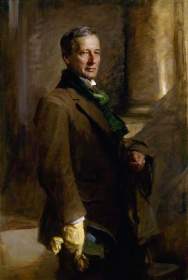

Frederick Crombie Gardiner was born on the 10th of February 1855 at Kincardine Manse, Tulliallan, Perthshire where his father Dr. Andrew Gardiner was minister of the United Presbyterian Church.2 Frederick`s mother Jane Guthrie, was a sister of the Rev. Dr. John Guthrie father of the artist Sir James Guthrie. Andrew and Jane were married in 1842 and went on to have a family of six boys and two girls. In 1861 the family was living at the U.P. Church manse in Tulliallan.3 However, after serving for twenty years at Tulliallan, the Reverend Gardiner accepted the post of pastor at Dean Street Church, Stockbridge, Edinburgh. On the 26th of March 1863, the family, including Frederick then aged 8, moved to Edinburgh – first to 24 and then to 26 Scotland Street. 4,5
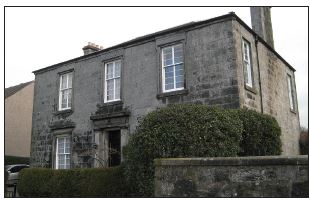
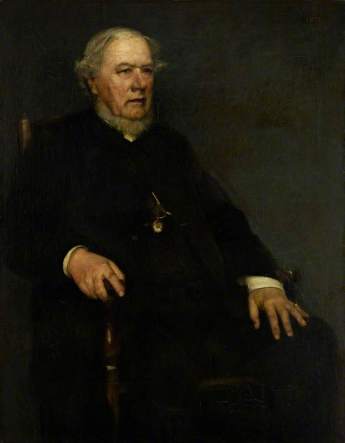
Elizabeth Morton Ritchie was born on the 28th of June 1861 at 14 Henderson Row, in the Stockbridge area of Edinburgh.6 She was the only daughter of William Ritchie a “master bookseller” with the firm of Paton and Ritchie 7 and his wife Wilhelmina Morton.8 Elizabeth enrolled in the Mary Erskine School for girls in October 1870. This was in the year the school moved to Queen Street and became a day rather than a purely boarding school resulting in a large increase in the school roll.9 The following year the family was living at 12 Lonsdale Terrace with Elizabeth a scholar aged nine.10 Elizabeth may have remained at school as a “pupil-teacher” as ten years later aged nineteen she is still recorded as a “scholar”. 11
As a boy, Frederick Gardiner suffered from delicate health and indeed he was troubled with asthma throughout his life. Health problems interrupted his schooling – his attendance at the Edinburgh Institution was restricted to two years between 1868 and 1870 12 and was part of the reason he did not attend university. Some sources suggest that he was about nineteen when he travelled to New Zealand partly to see if the change of climate would improve matters. However, he was not with his family in the 1871 census suggesting that he may have travelled out much earlier – possibly aged sixteen. During his time in New Zealand he worked as a clerk in the firm of Oliver and Ulph.13, 14 His co-workers clearly thought highly of him as a report in a local newspaper of 1876 indicates.
“A pleasing ceremony took place at the warehouse of Messrs. Oliver and Ulph yesterday, when the employees presented Mr. F. C. Gardiner, who has long been a clerk in the employ of the firm, with a handsome gold albert and locket, as a memento of their respect for him on his leaving them for a visit to his native country.” 15
This further suggests a longer stay in New Zealand. Whatever the case, Frederick appears to have put the experience gained to good use as, returning to Scotland in 1880, he joined with two of his elder brothers, James and William to set up the firm of James Gardiner and Co., shipowners. The firm operated extremely successfully for almost forty years amassing a fleet of fourteen cargo vessels by the start of the first World War. 16
On the 15th of September 1887, Frederick married Elizabeth (Lizzie) Morton Ritchie whose father was now a “wholesale stationer” at her home, 6 St. Margaret`s Road, Edinburgh. Frederick`s father Andrew was the officiating minister. At the time, Frederick`s address was 15 Grosvenor Crescent, Edinburgh.17 The couple settled in Glasgow and four years later were living at 1 Rowallan Quadrant, Kelvinside.18
Although not a university graduate himself, Frederick put great store by the benefits a university education could bring and in 1898, along with his brother William, he endowed two lectureships at the University of Glasgow; one in Organic Chemistry and one in the Pathology of Diseases of Infancy and Childhood. 19 The following year he was elected a member of the Glasgow Chamber of Commerce and became a Director ten years later.
Another interest of Frederick`s was electrical energy generation and in 1911 he became a director of the Clyde Valley Electrical Power Company. In the census of that year he was living at 5 Dundonald Road, Kelvinside with his wife Lizzie and three servants. In 1920 he became chairman of the company and under his leadership it increased its customer base to 130,000 and from the 1920s was linked to the National Grid. 20
The portrait of Elizabeth Gardiner was painted in 1914 and exhibited at the Royal Scottish Academy the following year. 21
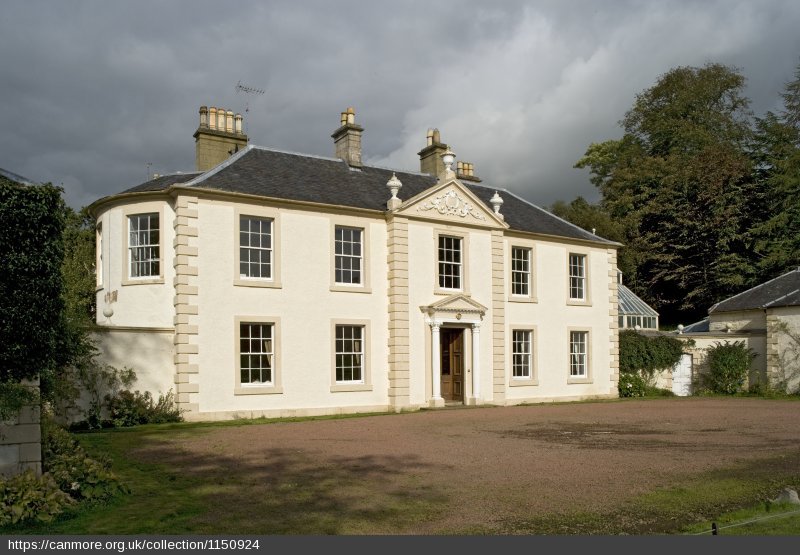
During WW1, Frederick served on several war-related committees including the “Foodstuffs Requisition Committee” and the “Advisory Committee of the Admiralty Transport Department”. He was also a member of Lloyds and was Chairman of the Glasgow Lloyd’s Association.22 The company`s fleet of ships would have been invaluable in the war effort but at the end of the war, the decision was taken to dispose of the fleet and perhaps contemplate retirement. With this in mind, Frederick had earlier purchased the estate of Old Ballikinrain in Killearn, Stirlingshire. 23 The estate consisted of a mansion house, four houses, a sawmill, two lodge houses, a farm and separate fields, woods and shootings. His brother William also had a house on the estate.24
In 1919, he and his brother William continued their association with the University of Glasgow by each providing £60,000 to endow the “Gardiner Chairs” in Physiological Chemistry, Bacteriology and Organic Chemistry. In 1920 Frederick was awarded the degree of LL. D. by the University in thanks for his generosity.25 This was also the year that his portrait was painted by his cousin, Sir James Guthrie. Thanks to his services to the country during the war, Frederick Gardiner was knighted in 1921. In 1923 he was appointed Deputy Lieutenant of the City of Glasgow and Lord Dean of Guild. The following year he was also appointed Deputy Lieutenant of the County of Stirling.26
The firm of James Gardiner & Company was dissolved by mutual consent on the 31st of December 1924 when Sir Frederick C. Gardiner retired.27
Sir Frederick and Lady Gardiner spent a good part of their retirement in travelling. In 1925 they sailed aboard the Empress of Canada from the Philippines to Hong Kong and Japan and thence to Seattle, Vancouver and Victoria B.C. On this trip Frederick’s occupation was listed as “Naval Architect” 28 and “Civil Engineer”29. The following year they were in South Africa 30 and in 1932 they left Southampton for Colombo, Sri Lanka 31.
Sir Frederick and his brother William continued to make charitable donations. In
1926 they gave £20,000 to be distributed among youth organisations and charities in Glasgow and the West of Scotland including the Boys` Brigade, Boy Scouts, Girls Guides and Girls` Guildry and in 1928 they gave £12,000 to endow the Gardiner Chair of Music at Glasgow University as well as a lectureship in the “Pathology of Diseases of Infancy and Childhood”.32 In the same year the brothers presented a series of sixteen studies to the Scottish National Portrait Gallery. Another portrait study, that of William Ferguson Massey, Prime Minister of New Zealand was presented to the National Portrait Gallery in London in 1930. These studies were made by their cousin Sir James Guthrie for his painting “Some Statesmen of the Great War”. 33
In 1927 Lady Gardiner was elected to the Board of Governors of the Atheneum School of Music in Glasgow. She served on a joint committee one of whose objectives was to establish a Chair of Music. The committee was formed from Governors of the Atheneum together with members of Sir D. M. Stevenson`s committee. Lady Gardiner was first present at the meeting of the 3rd of May 1927 and was present at the Finance Committee on the 3rd of June. She was a subscriber to the scheme to raise funds for the Music Chair and was involved in trying to elicit funds from others. At a meeting on the 2nd of August 1927 it was agreed that the name of the institution would be changed from the Atheneum to the Scottish National Academy of Music.34 In 1928 Sir Frederick and William Gardiner endowed the Gardiner Chair of Music with the incumbent occupying a dual role as Professor at Glasgow University and Principal of the SNAM 35. (This arrangement persisted until 1953)
Lady Gardiner was for some years President of the Nurses` Memorial to King Edward VII at Hazelwood House, Dumbreck, Glasgow.36 This house had been an auxiliary hospital during WW1 and was now a home for retired nurses.
In October 1931 a memorial exhibition of Sir James Guthrie’s works was held at Glasgow`s Kelvingrove Art Gallery. Sir Frederick contributed to the exhibition by lending the portraits of himself and Lady Gardiner. 37

In 1936, the year before his death, Sir Frederick donated £10,000 for the provision of the Gardiner Medical Institute at Glasgow University with the trustees of his brother William`s estate providing the same sum – William having died in 1935. After experiencing some years of ill-health, Sir Frederick Crombie Gardiner died on the 7th of August 1937 at Old Ballikinrain, Balfron. He was 82.38 He left an estate valued at £541,466. Among the bequests in his will were £7,500 to build and equip the Gardiner Medical Institute (the Institute was officially opened by Lady Gardiner in 1938), £3000 to the Glasgow Royal Cancer Hospital, £1500 to the Glasgow Western Infirmary and £1000 to the Royal Society for the Relief of Indigent Gentlewomen in Scotland.39 The funeral service was held at Landsdowne Church Glasgow of which he had been a member, followed by burial in the Necropolis.40
Lady Elizabeth Morton Gardiner died aged 85 on the 17th of May 1947 at Old Ballikinrain, Killearn. 41 She was buried beside her husband in the Glasgow Necropolis. The Minutes of the Board of Governors meeting of the Royal Scottish Academy of Music and Drama immediately after her death record the following:
“The chairman paid tribute to the late Lady Gardiner (died 17th May 1947) who had been a Governor since the inception of the Academy and had latterly been an Honorary Vice-President. She had always maintained a warm and practical interest in the work of the Academy and her kindly presence would be missed.”
A brief obituary also appeared in the Glasgow Herald.42
References
- Glasgow Corporation Minutes 12th August 1947
- Scotland`s People, Birth Certificate
- ancestry.co.uk, Scotland 1861 Census.
- Askew, Bob George Gardiner, Early Days and Musical Influences; Hampshire Voices, September 2011
- ancestry.co.uk, Scotland, 1881 Census
- Scotland`s People, Birth Certificate
- Edinburgh Post Office Directory, 1860-61
- Family Search, Scotland
- Archives, Mary Erskine School, Edinburgh, Dorothy Sharp, archivist
- Scotland’s People, 1881 Census
- Scotland’s People, 1891 Census
- Stewart’s Melville College Archives, Ian McKerrow, Archivist
- The New Zealand Railways Magazine, Vol. 9, 1st August 1934
- New Zealand Parliamentary Debates, Vol. 133, p 422
- Otago Witness, 11 November 1876; https://paperspast.natlib.govt.nz/newspapers/ODT18761108.2.10
- http://www.universitystory.gla.ac.uk/biography/?id=WH0037&type=P
- Scotland`s People, Marriage Certificate
- ancestry.co.uk, Scotland, 1891 Census
- http://www.universitystory.gla.ac.uk/biography/?id=WH0037&type=P
- theglasgowstory.com/image/?inum=TGSE00499
- Information from an Object File held at Glasgow Museums Resource Centre (GMRC)
- Glasgow Herald, 9th August 1937, Obituary
- Glasgow Post Office Directory, 1917-18
- Valuation Roll of the County of Stirling, 1925-26
- www.universitystory.gla.ac.uk/biography/?id=WH0037&type=P
- London Gazette, 26th August 1924
- Edinburgh Gazette, 2nd January 1925
- United States Passenger Arrivals, ancestry.co.uk
- Canadian Immigration Records, ancestry.co.uk
- United Kingdom Departures from Southampton, ancestry.co.uk
- United Kingdom Arrivals in Southampton, ancestry.co.uk
- http://www.universitystory.gla.ac.uk/biography/?id=WH0037&type=P
- Glasgow Herald, 9th August 1937, Obituary
- Minutes of the Board of Governors Meetings, Glasgow Atheneum
- Royal Conservatoire of Music, archives
- Glasgow Herald, 19th May 1947, Obituary
- Object File at GMRC
- Scotland’s People, Death Certificate
- The Scotsman, October 1937
- Glasgow Herald, 9th August 1937, Death Notices
- Scotland’s People, Death Certificate
- Glasgow Herald, 19th May 1947, Obituary
Footnotes
The Gardiner Brothers owned several of Sir James Guthrie’s paintings. James Gardiner bequeathed The Highland Funeral to Glasgow in 1903 Acquisition Number 1060). Sir Frederick Gardiner owned The Garden Party (now in a private collection) and The Wash which was passed down through the family and is now in the Tate Gallery in London.
Oliver and Ulph were the proprietors of the first railway in New Zealand – the Port Chalmers to Dunedin line which operated from the 18th of September 1872. The firm was also involved in import/export and shipping.



 Glasgow Museums Art Donors Group