Hugh Locke Anderson, Junior (1863 – 1928)

Hugh Locke Anderson, junior, of Ava Lodge, Helensburgh bequeathed several works by Joseph Crawhall. They were given to Glasgow on 20th April 1943.

The works were:

2324 The Purple Cow – Charcoal, watercolour, wash, paper.

2325 Lady on Horseback – Pen, watercolour, paper

2326 The Country Gentleman – Ink, watercolour, wash, paper

2327 Horse and Cart with Lady – Gouache, linen.

2328 The Whip – Chalk, watercolour, gouache, paper.


Figure 1. Crawhill, Joseph. Horse and Cart with a Lady. © CSG GIC Glasgow Museums Collection.

This painting was exhibited at the Royal Academy Exhibition of 30th October 2010 to 23rd January 2011.(1) Another version of this painting is to be found in the National Galleries of Scotland.

He also donated “Hunting and Coursing” – six pen and ink sketches on paper catalogued as PR. 1943. 8.1 to 8.6. (Numbers 8.1 and 8.3 are drawn on menu cards of the Calfe Hotel, Tangier, Morocco.) All works are located at the Glasgow Museums Resource Centre in South Nitshill.

Hugh Locke Anderson was the son of a master house painter. His father, also Hugh Locke Anderson, was born about 1818 in Glasgow. He trained as a painter while living at 223 Gallowgate Street, Glasgow.(2) After completing his apprenticeship he formed his own company based at 119, Renfield Street and by 1851 was employing twelve men.(3) He married Helen Willox, on 9th of December 1847 in Pollokshaws,(4) and in 1851 they were living at 113, Cumberland Street, Lauriston, Glasgow.(5) Throughout the 1850s the business continued to thrive necessitating the addition of a workshop at 13, Renfield Lane and later at 16, East St. Vincent Lane.(6)

About 1860, Hugh Locke Anderson, moved with his family, which now consisted of two boys and three girls, to Williamwood House, Cathcart. (7),(8) Hugh Locke Anderson, junior was born there on 21st March 1863,(9) and was christened in Glasgow on the 3rd of May. Two years later the family moved again, this time to Hillside House, Partickhill. The firm was now styled, “H. L. Anderson and Co., Carlton, house painters and decorators”.(10) In 1871, the family moved to “Ava Cottage” at 92, Glasgow Street in Helensburgh. Hugh senior now employed 30 men and 8 boys with premises located at 141, St. Vincent Street, Glasgow.(11),(12)

In 1875 the family was living at 11, Glasgow Street, Helensburgh with the name “Ava Cottage”, moving with them!(13) With the success of his business, Hugh senior was able to have his sons John and Hugh educated privately at Larchfield Academy in Helensburgh.(14) Both boys had successful school careers with John going on to become a procurator fiscal and Hugh a marine insurance broker. Hugh continued to take a keen interest in the activities of his old school and in 1899 was a member of the committees of the Larchfield Academical Club and the Larchfield Literary Society.(15)

Both Hugh, senior and his wife Helen owned substantial stock in the City of Glasgow Bank.(16) The collapse of this bank in 1878 may have hastened Helen Anderson`s death which occurred in 1879 when she was 53.(17) After her death, the family moved again, this time to “Ava Lodge” at 14, Glasgow Street.(18) There is no mention of the family in the 1881 census.

Hugh Locke Anderson, senior, died aged 70 in Helensburgh on 11th of January 1888 and his son John became head of the family. In the 1891 census, Hugh, junior, was a marine insurance clerk, living at 14, Glasgow Street, Helensburgh and ten years later he had become a “marine insurance broker”.(19) He was employed by Bennett, Browne and Co. an old established Glasgow firm based at 17, Royal Exchange Square.(20) He became a joint partner and then sole partner, a position he held for many years until his retirement.(21) Other positions he held were the vice- chairmanship of the Royal Exchange and Justice of the Peace for the County of Dumbarton.

He also devoted a good deal of time to philanthropic work, and as a Director of the Glasgow Sailors` Home was a keen and enthusiastic supporter of that institution. For many years, until its winding up in 1923, he was a Director of the `Empress` Training Ship for Boys.(22) (This ship, formerly HMS Revenge, was moored in the Gareloch from 1889 to 1923 and was owned by the Clyde Industrial Training Ship Association. The Association had the object of providing for the education and training of boys who, through poverty, parental neglect, or any other cause, were destitute, homeless, or in danger from association with vice or crime).

Figure 2. Talisman at Rhu with The Empress Training Ship in the background. Courtesy of Helensburgh Heritage Trust.
Figure 3. Christmas Card sent from The Empress Training Ship. Courtesy of Helensburgh Heritage Trust

Hugh Locke Anderson had a great appreciation for art and possessed a valuable collection of paintings. He was an Extraordinary Member of the Royal Glasgow Institute of Fine Arts. In this capacity he is likely to have encountered a variety of contemporary artists especially those with a connection to Helensburgh. Edward Arthur Walton was born in 1860 and was thus a contemporary of Hugh Locke Anderson. He was one of the “Glasgow Boys” and among his friends were the artists James Whitelaw Hamilton, James Guthrie and Joseph Crawhall. Walton, Crawhall and Guthrie spent a great deal of time painting in Helensburgh and district and stayed with Hamilton at weekends at his home “The Grange”, 23 Suffolk Street. They spent one whole summer at Rosneath. Like Anderson, Whitelaw Hamilton (1860 – 1932) was a former pupil of Larchfield Academy. One of his paintings “Evening on the Gareloch” (In the Anderson Trust Collection, Helensburgh) contains a view of the Empress Training Ship.

It is thus likely that Hugh Locke Anderson knew Crawhall and it is possible that the paintings he subsequently donated were given to him by Crawhall or that he purchased them from him.

Figure 4. Walton, Crawhall, Guthrie and Whitelaw Hamilton in 1883. Courtesy of T & R Annan and Sons.

The photograph above appeared in the programme for Helensburgh and District Art Club’s loan exhibition ‘Helensburgh and The Glasgow School’, staged in the Victoria Halls, Helensburgh from September 9-23, 1972.

In his leisure pursuits, Hugh Locke Anderson was a member of the Helensburgh golf and tennis clubs and in 1926 was President of the Helensburgh Bowling Club.(23) For a great many years he was a member of the choir of the Helensburgh Congregational Church.(24) He also found time to travel. In 1914 he sailed from Liverpool to New York arriving there on the 5th of June. Again, on 3rd of December 1926 (probably after he retired) he left London for Australia. He stayed till the end of the month, leaving Sydney on the 30th of December bound for London. On the way home, the ship called at Melbourne, Adelaide, Colombo and Bombay.(25)

Hugh Locke Anderson, junior died on 22nd December 1928 at Ava Lodge in Helensburgh (26),(27) and was buried in Helensburgh Cemetery on the 26th.(28) His estate was valued at £72,813:3:7. In his will he stipulated that “all my pictures by Jos. Crawhall I bequeath to Glasgow Corporation in decease of my sister Jessie Jane & the large picture by Simon to my brother Stuart outright”. All his other pictures were left to Jessie Jane.(29) This explains the time interval between his death and Glasgow Corporation receiving the pictures. Jessie Jane Anderson died at Ava Lodge in November 1942. She was 85 years old.(30)

A list of Hugh Locke Anderson`s bequests to Glasgow is contained in “Joseph Crawhall, The Man & The Artist” by Adrian Bury, published by Charles Skilton Ltd., London 1958.

References

1. static.royalacademy.org.uk/files/gallery-3-etruscan-red-864.pdf (Lent by Culture and Sport Glasgow on behalf of Glasgow City Council)

2. ancestry.co.uk, 1841, Scottish Census

3. Scotland`s People, 1851, Scottish Census

4. Family Search, Scotland

5. Scotland`s People, 1851, Scottish Census

6. Glasgow Post Office Directories, 1851-1859

7. Glasgow Post Office Directory, 1860/61

8. Scotland`s People, Census 1861

9. Scotland`s People, Birth Certificate

10. Glasgow Post Office Directory, 1865/66

11. Scotland`s People, Census 1871

12. Glasgow Post Office Directory, 1871/72

13. Helensburgh Directory, 1875

14. Helensburgh and Gareloch Times, 26th December 1928, p3

15. ibid

16. Otago Daily Times, 28th November 1878, page 2 (paperspast.natlib.govt.nz/cgi-bin/paperspast?a=d&d…2.4‎)

17. Scotland`s People, Death Certificate

18. Helensburgh Directory, 1879

19. Scotland`s People, Census 1891

20. Glasgow Post Office Directory, 1891/2

21. Helensburgh and Gareloch Times, 26th December 1928, p3

22. ibid

23. Past Presidents` Board, Helensburgh Bowling Club

24. Helensburgh and Gareloch Times, 26th December 1928, p3

25. Ancestry.co.uk, UK Arrivals/Departures

26. Glasgow Herald, Death Notices, 26th December 1928.

27. Scotland`s People, Death Certificate

28. Helensburgh and Gareloch Times, 26th December 1928, pp 2 and 3

29. National Records of Scotland, SC65/36/28, page 183

30. Scotland`s People, Death Certificate
James Donald (1830-1905)

James Donald was one of the principal donors to the Kelvingrove Gallery. Over his lifetime, he collected paintings from The Hague School, French Barbizon School and also from British artists such as Turner and Constable. Towards the end of nineteenth century, he also used to loan a number of his paintings to exhibitions held in Glasgow and Edinburgh. The bequest to the Gallery from James Donald in 1905, which contained paintings of the nineteenth century Dutch, French and British oil paintings and watercolours, set the foundation for the Kelvingrove Galleries’ Impressionist Collection. During his lifetime, James Donald also made significant donations to his home town of Bothwell.

James Donald was born in 1830 in Bothwell, Lanarkshire. His parents were Mr John Donald, a grocer and spirit dealer in Bothwell and Mrs Jane (Lang) Donald. He had two older brothers, John born in 1826 and Gavin born in 1828 and a younger brother Robert who died in infancy. After the deaths of his father John Donald in 1834, when our donor was only four years old, and his brother John Jr. in 1841 [1], his mother Mrs Jane Donald found herself running the business as grocer and spirit dealer alone and looking after two young boys. This difficult period in the Donald Family’s life is somehow relieved when Mrs Donald, our donor’s mother married George Miller, a manufacturing chemist in 1843 (the Banns were proclaimed in Bothwell and Glasgow). In the 1851 census, it is recorded that the family has moved to 3 James Street, Calton, Lanarkshire near Bridgeton. However, in this census, our donor, James Donald is not listed with the family. The occupation of Mr Miller, James Donald’s stepfather is listed as the Head of the household and his occupation is described as manufacturing chemist employing 74 men in his firm.

From the Glasgow Post Office Directories 1905-1906 [2]  the name and the address of his stepfather’s Chemical Manufacturing firm to be:

Miller, George, & Co., gas coal-tar distillers, manufacturers of sulphate of ammonia, naphthas,  benzoles, pitch, carbolic acid, creosote, and dipping  oils; 40 West Nile Street.

The works; 89 Rumford St.

Miller, Geo., commission agent; 20 Smith St., Hillhead.

In the 1861 census, the Miller Family is still in Glasgow but James is still not with them. At the time of the 1861 census, the family had moved to 137 Greenhead St, Calton, Glasgow. In the 1871 census, James Donald re-appears. He is now 39 years old and the address is Wingfield Bothwell Lanarkshire. He is recorded as the stepson of the Householder George Miller (retired manufacturing chemist) and his occupation is recorded as Manufacturing Chemist.

During this period (1861), there appears to be a court case taken against George Miller and Company by the famous chemist James (Paraffin) Young and others with regard to some dispute over patent infringement [3]. However, the name of James Donald does not appear in the records quoted.

James Donald’s stepfather George Miller of Wingfield Bothwell died on the 5th January 1877.  His estate was valued [4] at £13,649 8s 5d with an additional estate of £410.

In the 1881 census, James appears on the census as living at 5 Queens Terrace, Barony, Lanark. He is the head of the house and his brother Gavin is staying with him. There is also a domestic servant in the house by the name of Margaret Nicholson. In the 1891 census, it is recorded that James is now 60 years old and married to Emily Mary. Mr and Mrs Donald are living with their daughter also called Emily. There are four others in the household. Their address is recorded as: 5 Queens Terrace, Barony, Lanark.

In the 1901 census, James Donald appears in the English Census as living in 96 Anerly Park, Anerly, London SE, Borough of Camberwell, Hamlet of Penge. He is living with his wife Emily Mary and two servants. His son-in-law Harry Busby lives with Emily at 94 Anerly Park, Anerly, London.

On the 16th March 1905, Mr James Donald died. The following notice was recorded in the Death Notices of the Glasgow Herald [5] of 21st  March 1905:

Donald, – At 96 Anerly Park Anerly, London on 16th March (inst.) James Donald also of 5 Queens Terrace, Glasgow – Friends please accepts this (the only) intimation.  

 The key words which was used in this search was ‘manufacturing chemist’, the profession of Mr James Donald.  It was evident that James Donald, the donor, worked in his stepfather’s firm, George Miller and Co. in Glasgow as a Manufacturing Chemist.  Because of the scientific nature of his profession, initially, it was assumed that he might have been a graduate of Glasgow University. However, a search in the register of graduates revealed that his name did not appear there. We know that all university students do not necessarily graduate for one reason or another. Therefore, it is possible that Mr Donald may have attended the university but not graduated. No further search was made as to his university education.

From his collection which was bequeathed in 1905, it was clear that he was a keen art collector. As there were a number of well known art dealers in Glasgow in the 1880s, such as Alexander Reid and Craig Angus, it was fairly easy for him to indulge in collecting the works of the new art of the era. Our donor was particularly interested in the artists of the Hague School of the Netherlands and French Realists such as Jozef Israëls and Jean Francoise Millet respectively.

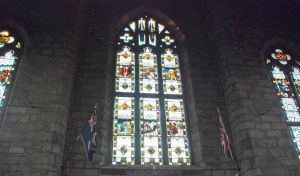
Furthermore, it is known that he also made significant contributions to Bothwell, the town of his birth. Firstly, in 1880, he donated the Centre Window of the Bothwell Parish Church [6]. This is a three-light window whose theme is a series of six parables drawn by Sir John E Millais R A which originally appeared in a magazine called “Good Words” edited by Dr Norman Macleod [7] in the 1860s. Other portions of the windows were designed and the entire work was executed by Cottier & Co. of London in 1880. A picture of this window is depicted below.


Bothwell Parish Church Window
Figure 1. Centre Window of Bothwell Parish Church. Courtesy of the Rev.James Gibson.

An inscription on the brass plate beneath the picture states “This window was gifted by Mr James Donald in expression of his appreciation of the order in which the parish Church graveyard had been put by the Heritor’s of Bothwell during the Ministry of the Rev. John Pagan M A, March 1880.”

Secondly, another contribution of James Donald was to erect a monument to Joanna Baillie, who was a famous daughter of Bothwell. Her father, Rev. James Baillie (c.1722–1778), was a Presbyterian minister and briefly, during the two years before his death, a Professor of Divinity at the University of Glasgow. Her mother Dorothea Hunter (c.1721–1806) was a sister of the great physicians and anatomists, William and John Hunter.

Joanna Baillie was born in the manse behind the church on 11th September 1762. Her father having died in 1776, Joanna and the family moved to London where she was later to become a friend of Sir Walter Scott. Joanna spent the rest of her life in Hampstead where she is buried. Here, she was to gain fame as a poet and a playwright, often writing in her native lowland Scots dialect, her verse “Family Legend” being one of her best known works. A picture of the Joanna Bailley Memorial is shown below. More information about Bothwell Church and Joanna Baillie monument may be obtained from the links below.

Monument to Joanna Baillie
Figure 2. Joanna Bailley Memorial in Bothwell. Courtesy of the Rev. James Gibson


The third  important contribution made by James Donald to the town of Bothwell was to leave money in his will for a place of education and recreation for boys. This resulted in the building of the Donald Institute in 1910 by the architect Alexander Cullen who had secured the commission by competition. Later, the Donald Institute was converted to Bothwell Public Library which to this day contains a room dedicated to James Donald called the “Donald Institute”.  More information can be obtained from the following link:

http://www.bothwellhistoricalsociety.co.uk/about4.html

When he died on 16th March 1905, James Donald bequeathed to the Corporation in trust of the City of Glasgow a large number of paintings and bric-a-brac. A descriptive inventory and valuation of the pictures etc. had been prepared by an expert, who had valued the bequest at over £42,000 (in the year of 1905). The pictures include some of the finest examples of Turner, W.Q. Orchardson, Velasquez, Corot, Rousseau, Millet, Kalf and other eminent artists. The copies of the official minutes are kept by the Corporation of the City of Glasgow, in chronological order. Below are the 4 of his 40 paintings that James Donald gifted to the Gallery.

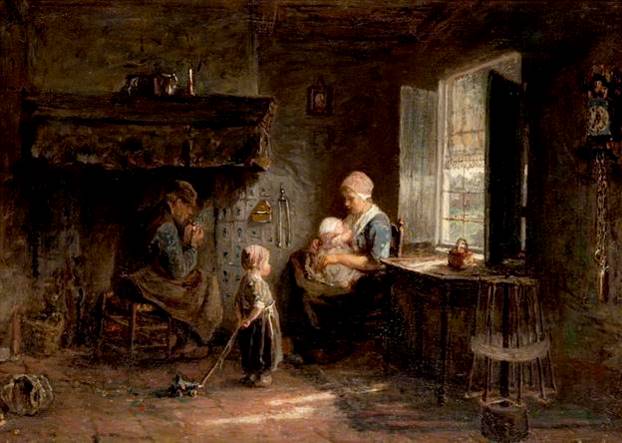
The Happy Family by Josef Israels
Figure 3. The Happy Family by Jozef Isarels. © CSG GIC Glasgow Museums Collection. (www.artuk.org)


Figure 4. Going to Work by Juan Francoise Millet. © CSG GIC Glasgow Museums Collection. (www.artuk.org)


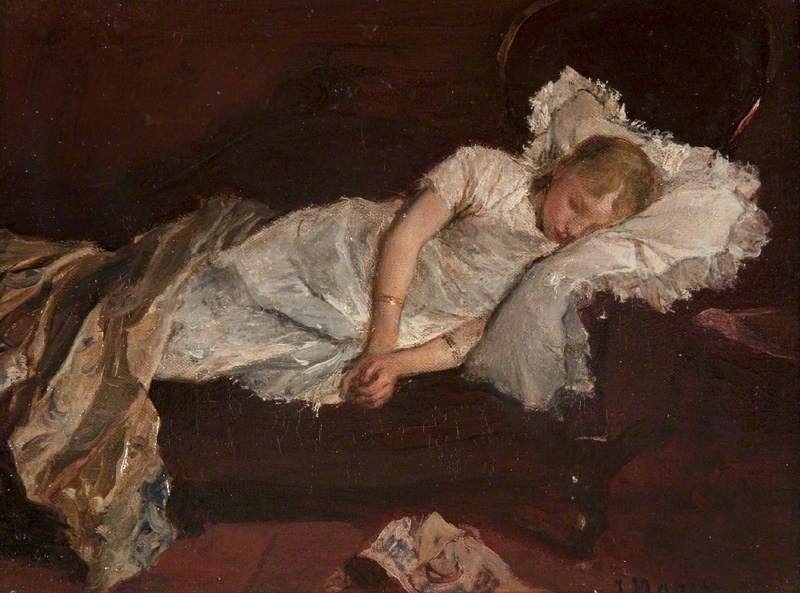
Maris, Jacob Henricus, 1837-1899; A Girl Asleep on a Sofa
Figure 5. A Girl Asleep on a Sofa by Jacob Henricus Maris. © CSG GIC Glasgow Museums Collection. (www.artuk.org)


Turner, Joseph Mallord William, 1775-1851; Italian Scene with Boats and Figures
Figure 6. Italian Scene with Boats and Figures by J.M.W. Turner. © CSG GIC Glasgow Museums Collection. (www.artuk.org)

References: 

[1] Graves of his Father and two brothers http://www.memento-mori.co.uk/88.pdf

[2] Mitchell Library, Glasgow, PO Glasgow Directory, 1905-1906, p. 542.

[3] Corporate.  May 2010. Shale Oil. https://www.scottishshale.co.uk/KnowledgePages/Companies/Miller_John&Co.html. [Accessed on 19 March 2018].

[4] Confirmations and Inventories,. Mitchell Library. Glasgow. Year 1877, p 382.

[5] Death Notices. 21st March 1905. Glasgow Herald.

[6] Bothwell Parish Church http://bothwellparishchurch.org.uk/history/the-centre-window/. [Accessed on 19 March 2018].

[7] Dr Norman Macleod, Good Words. https://en.wikipedia.org/wiki/Good_Words, [Accessed on 19 March 2018].

[8] Joanna Baillie-monument. https://www.britishlistedbuildings.co.uk/200336476-bothwell-bothwell-parish-church-joanna-baillie-monument-bothwell#.Wq-n0Jenzv8, [Accessed on 19 March 2018].