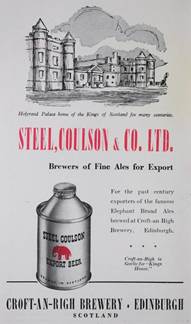
Richard Niven Coulson was born at 46 Lauder Road, Newington, Edinburgh on 13 July 1879. His parents were John Laurie Coulson, a master brewer, and Mary McLean Niven.1 The family’s connection to the brewing industry began when Richard’s grandfather, George Francis Coulson, was taken into partnership by James Steel to form Steel, Coulson & Co. in 1865. James Steel had inherited a brewery in Glasgow from his father, and he later acquired the Craigend Brewery in Edinburgh. This was sold in 1874 and a new brewery, later named Croft-an-Righ, was acquired. Steel later sold his interest in the company to Coulson. When George retired, two of his sons, Frank and John Laurie became joint managing directors.2,3
Fig. 3 Steel and Coulson advertisement Grace’s Guide
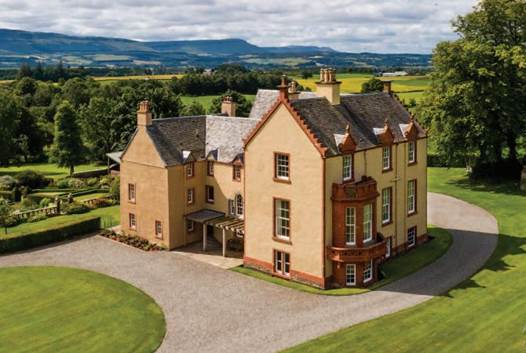
John Laurie Coulson married Mary McLean Niven at the bride’s home, 12 Fitzroy Place, Anderston, Glasgow, on 29 April 1869.4 They had four sons, George Francis (1870 – 1901), Hugh Niven, (1872 – 1901), John (1873 – 1929) and Richard Niven.5 In the 1881 census, Richard, aged one, was at 46 Lauder Road in the company of three servants but his parents were not at home. Ten years later the family was at Gartincaber Mains House, Kilmadock, Perthshire. Richard was now a scholar with two of his brothers, George Francis, a student civil engineer, and Hugh Niven, an accountant’s clerk.6
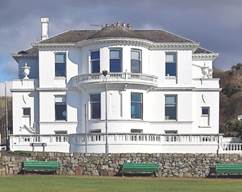
Fig. 4 Gartincaber Mains House
(Michael Dickie, Savills, Country Life 2021)
From 1894-1898, Richard attended Fettes College in Edinburgh based in Carrington House.7 He entered Caius College, Cambridge University on 1 October 1898.8 At Cambridge he joined the Volunteer Battalion of the Suffolk Regiment and was made a Second Lieutenant on 17 January 1900.9 Richard graduated from Cambridge with a B.A. in 1901.10 This was the same year that two of his older brothers died: Hugh Niven on 11 January at Tiverton, Devon aged twenty-nine and George Francis on 7 June aged thirty-one.11 Perhaps his university education was interrupted as a result. He was a ‘student of Natural Science’ in the census of 1901 with his parents at the mansion of Smithston, Tarbolton, Ayrshire.
By 1905 his parents had moved again, to Failford, Tarbolton, Ayrshire where John Laurie Coulson was the tenant/occupier of the mansion and garden, the fishings and shootings in the Parish.12 (It seems that John Laurie Coulson never owned a house but moved from one rented property to another!). Richard completed his university education in 1907 when he graduated with an M.A. from Cambridge.13 In the 1911 census he was a boarder at The Marine Hotel, Elie, Fife He was single, aged 31 and managing director of a brewery. He may have been attending a convention as his fellow boarders were stockbrokers, chartered accountants and ship owners. In WW1, Richard Coulson served as a Major in the 8th Cameronians (Scottish Rifles) and was later promoted to acting Lieutenant-Colonel. As a result of actions during the war, he was awarded the D.S.O.: for conspicuous gallantry and determination while commanding his battalion during an attack, when there was great difficulty in maintaining direction owing to fog and smoke barrage. On the advance being checked he went forward and reorganized his own firing line and that of units on his flank. Continuously under heavy fire, his personal example had a marked effect on the men.14 He was promoted to Lieutenant-Colonel in the King’s Own Scottish Borderers, was twice mentioned in dispatches and received the French Croix de Guerre.15
By 1920, John Laurie Coulson had moved again, this time to be a tenant/occupier of a house and stables at 114 St Leonard’s Road, Ayr and a house at 8 Corsehill Road Ayr.16 Richard’s mother, Mary Maclean Coulson (Niven) died the same year on 5th October. She was buried in the Glasgow Necropolis.17 The 1921 census recorded Richard and his father at 8 Southdean, Ayr. He was now managing director of Steel, Coulson Ltd., his father having retired from the same position. They employed two servants and two nurses.
Later the same year, the engagement was announced between Richard Niven Coulson, D.S.O., T.D., M.A. (Cantab) and Ada Marion, younger daughter of William Eagle Clarke, I.S.O., LL.D., and Mrs. Eagle Clarke, 53 North Castle Street, Edinburgh.18 The couple were married at St John’s Church, Edinburgh on 18 October 1921. Lieut. Colonel Richard Niven Coulson was forty-two and a brewer of Airthrey, 8 Corsehill Road, Ayr. Ada Marion Clarke was forty-one. Richard’s brother John was a witness.19 (William Eagle Clarke was Keeper of the National History Department at the Royal Scottish Museum from 1906 to 1921)20
John Laurie Coulson died aged eighty on 1 March 1923. He was buried in the Glasgow Necropolis. Richard succeeded to the chairmanship of Steel, Coulson and Co. and became proprietor of his father’s house and stables at 114 St. Leonard’s Road but continued to live at Airthrey.21 He rented Cuil Lodge and Shootings at Glenmore for June 1925.22 Richard and Ada were married for just five years when Ada died on 7 April 1927 after suffering from pernicious anaemia.23
In 1935, Richard was elected to the committee of management at the 58th meeting of the Scottish Conservative Club in Princes Street, Edinburgh.24 From 1930 to 1935, he was the proprietor of a house and garage at 30 Rosebank Crescent, Ayr but his main residence appears to have remained at Airthrey.25 This was his address when, on 2 December 1936, he married Emily (Millie) Campbell Warrand at St. Saviour’s Church in Bridge of Allan. She was a spinster aged fifty-six, the eldest daughter of Thomas Alexander Warrand a tea planter in Bengal.26 Their engagement had been announced in October the previous year.27 The couple moved to 5 Victoria Park Road in Ayr where Richard also had offices.
After several months of poor health, Richard Niven Coulson died from a cerebral haemorrhage at the County Hospital in Ayr on 26th December 1945. He was sixty-seven. His usual address was at 5 Victoria Park Road, Ayr.28,29
Emily Campbell Coulson nee Warrand (1878 – 1968)
The donation was made by Mrs. R. N. Coulson on behalf of her husband.
Mrs. R. N. Coulson was Emily Campbell Warrand who was born on 2 December 1878 in Bengal, India where her father Thomas Alexander Warrand was a tea planter. She was baptised on 26 December 1878 at Ranakhet, Bengal. 30
Thomas Warrand was a notable 19th century tea planter operating out of Bengal and Assam. He helped establish and manage tea estates during the early years of the commercial tea trade.31
He was born in Southwell, Nottinghamshire in 1835. Emily’s mother was Margaret Warrand Connal who was born in Glasgow on 15 May 1854. 32 She married Thomas on 31 November 1877 at her home, 19 Park Circus, Glasgow. 33 After their marriage they travelled to India where Emily was born. The family did not remain long in India after Emily’s birth. Her younger sister Katharine Sophia Claye was born at 19 Park Circus, Glasgow on 24 August 1880. 34 In the 1881 census, Emily and Katharine (Catherine) were at 18 Woodside Crescent, Glasgow in the care of two nurses; their parents were not at home. Ten years later the family visited Thomas’s brother, Major-General William Edmund Warrand at Westhorpe Hall, Southwell, Nottinghamshire. Thomas was now employed as a pig iron storekeeper. Emily is listed as a ‘niece, aged 12, born East Indies (British Subject)’. 35 At the census of 1901 she was visiting her aunt and uncle at Frimley, Surrey. Her uncle was Nathaniel Spens, born in Glasgow in 1851. He was the managing director of the State Commission and Investment Trust Ltd. Nathaniel’s wife was Emily Jessie Connal, born in Hillfoot, Dunbartonshire in 1860. 36 Their eldest son, William, became 1st Baron Spens in 1959 after retiring from the House of Commons. 37 Thomas Warrand, meantime, had moved to Polmont House, Grangemouth where he was living on private means with his wife Margaret, sons William, 18 and Alistair, 12 and daughters, Muriel, 16 and Margaret, 13. 38 In 1921, Emily was at the family home, Lentran, Bridge of Allan, Stirlingshire with her parents, their two granddaughters and five servants. Emily was engaged in ‘house duties’. 39 Emily’s father, Thomas Alexander Warrand, died at Lentran on 21st October. He was eighty-nine. 40 Emily was still living at Lentran, Bridge of Allan, Stirlingshire when, aged 56, she married Richard Niven Coulson on 2 December 1936. Her mother continued to be the proprietor/occupier of Lentran until her death in 1947. 41 Emily Coulson died aged 89, on 16th January 1968 at 23 Carrick Road, Ayr. 42
The Warrand lineage can be traced back to Emily’s great-great grandfather Robert Warrand who was born about 1733 near Forres, Morayshire. He bought the estate of Lentran near Inverness in 1787 and renamed it Warrandfield. Robert died on 24 March 1801 at Warrandfield. His son Thomas was a naval officer and Scottish landowner. He had a distinguished career in the Royal Navy and was commander of H.M.S. Sealark. He married Catherine Munro and their son, another Robert, was born at Kirkhill, Inverness on 27 May 1795. He became a major in the 6th Dragoons on 6th May 1828. Two years later, on 2 April 1830, he married Sarah Sophia Clay of Westhorpe Hall, Nottinghamshire. Their son was Thomas Alexander Warrand.
Parish Register Transcripts from Presidency of Bengal, India, Births and Baptisms, 1786-1947; United Kingdom, British India Office, Births and Baptisms, 1712-1965 FamilySearch
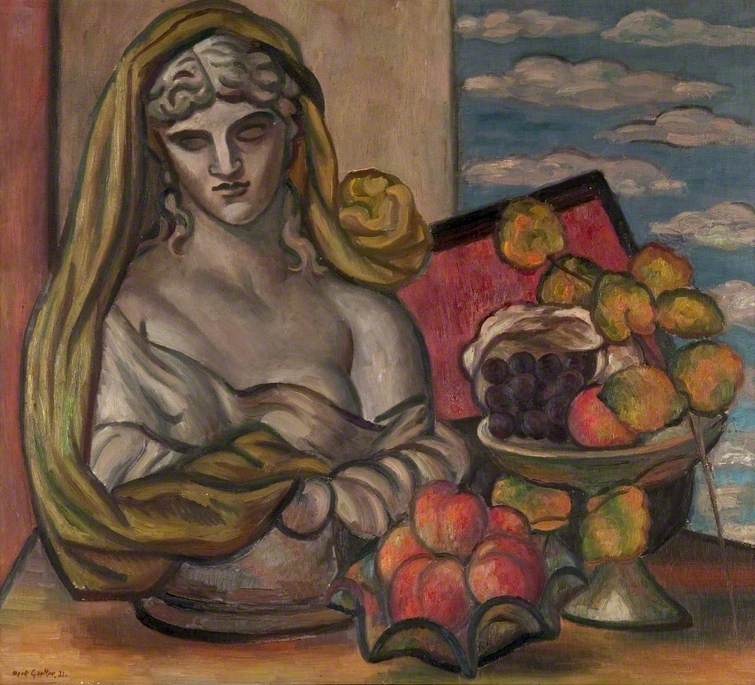
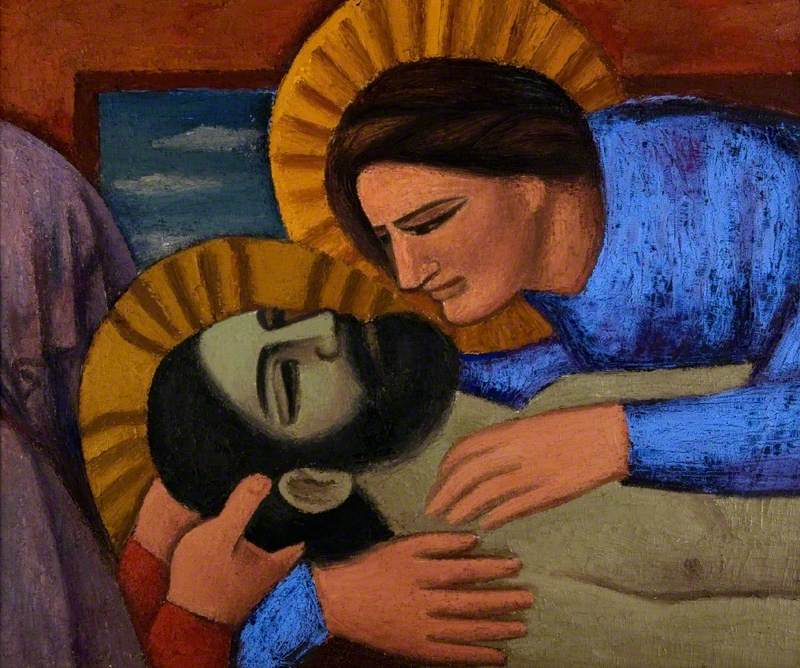
John M Mathias donated four paintings to Glasgow in December 19511. Two are by French artist Andre Lhote (Figures 1 and 2) and two are by English artist Mark Gertler(Figures 3 and 4)
Figures 1 and 2 are the work of Andre Lhote (1885-1962). He was born in Bordeaux and trained first as a decorative wood carver before attending L’Ecole des Beaux- Arts in Bordeaux where he took up painting. He moved to Paris in 1906 where his works were shown for example at the Salon d’Automne. Lhote originally painted colourful landscapes in the Fauvist style but his mature works were in the Cubist style. Over the next few years Lhote’s works were shown all over Europe including in London in 1912 at the SecondPost Expressionist exhibition at the Grafton Galleries which was organised by Roger Fry and the Bloomsbury Group. He set up his own art school- Academie Montparnasse in Paris in 1922. His most significant work however was not as a visual artist but as a writer who articulated Cubist theories and as an educator who influenced a generation of French artists.2
We do not know at this point for certain how or when these paintings were acquired by John Mathias or the Mathias family. We do know that in November 1927 Andre Lhote held an exhibition of his own and his students work at the Claridge Gallery at 52 Brook Street in London 3 which was partly owned by our donor’s mother Ena Mathias . In the 1927 exhibition catalogue (Exhibition ofPaintings and Drawings by Andre Lhote and His Pupils) there is one work entitled Negresse which is the title given to one of two Andre Lhote paintings which appear in the 1951 Catalogue of FrenchPaintings published by Glasgow Museums. The description and measurements correspond to Figure 1Head of a Woman” above. The original title was obviously changed at some point as it would not now be acceptable .There are three works entitled Nu in the 1927 exhibition catalogue any one of which could be our Nude ( Figure2) in the 1951 catalogue though there is no description or any measurements to support this .4 It is possible that both paintings were bought by someone in the Mathias family from this exhibition.
During the period of the exhibition Andre Lhote gave a lecture at the home of Mrs Emile Mond whose home was a centre of art and culture at the time. She was said to be a talented artist and musician .5 Emile Mond was a cousin of Robert Moritz Mathias, our donor’s father(See Appendix ) .
Figures 3 and 4 are the work of English artist Mark Gertler(1891-1939) ) who was born in Spitalfields of Polish -Jewish descent. 6 He attended the Slade School of Art from 1908-1912 where he won several prizes. His health was not good and he spent a lot of time in the South of France where he was influenced by Post -Impressionism. His style was highly individual with strong elements of Eastern folk art. He specialised in still lives, female portraits and nudes. He had a studio in Hampstead and frequently exhibited in various London Art Galleries such as the Leicester Galleries. He was very successful until the nineteen thirties when his popularity began to wane. He suffered bouts of depression and after an unsuccessful exhibition at the Lefevre Gallery in London in 1939 he committed suicide .7 We can only speculate at this point as to how these two paintings came into the possession of John Mathias or the Mathias family or why they were given to Glasgow. We know that one of Gertler’s patrons was Lady Ottoline Morrell, half -sister of the Duke of Portland. She was also a close friend of Ena Mathias. Another link between Gertler and the Mathias family is that Ena’s brother Robert bought one of Gertler’s paintings .8 Ottiline suggested that Gertler might exhibit at her friend Ena’s Claridge Gallery at a time when his finances were low but Gertler refused saying the Claridge was not prestigious enough and Ena could not offer him an advance payment. However in November 1926 Robert Mathias did buy one of Gertler’s paintings -possibly Pomegranates and Melon for £50 which according to
Gertler was ,’a Godsend’. 9 According to The Times Gertler did exhibit at the Claridge Gallery at the end of 1926.10Clytie and Autumn Leaves was exhibited at the Leicester Galleries in 1932.11 A work called After Giotto was exhibited in the Lefevre Gallery in London in May 1939 shortly before Gertler’s death . 12 These may have been our paintings but we still do not know how they came into the hands of the Mathias family.
Our donor’s father was Robert Moritz Mathias (1873-1961) and his mother was Helena(known as Ena) Wertheimer(1874-1936).
Robert M Mathias was a watercolourist as well as a collector of art . He was born in Cologne ,Germany in 1874 and he came to Britain partly because of religious persecution against Jewish people at that time and also to work for his uncle Ludwig Mond(See Appendix )). He became a naturalised British citizen in 1910. The naturalisation papers were signed by Winston Churchill who was then one of the Principal Secretaries of State.13 His father was Mathieson Mathias (1823-1883) and his mother was Mathilde Mond (1845-1928).14 At the time of our donor’s birth in 1906 Robert Mathias was the managing director of the Mond Nickel Company .15 He does not appear on the UK Census of 1891 or 1901 but was in the UK by 1905 when he married Ena Wertheimer .16
Ena Wertheimer was one of the daughters of successful London art dealer Asher Wertheimer (1844-1918) who had a gallery at 154 New Bond Street ,London which had been established by his father Samson Wertheimer, who was born in Germany but fled to Britain in the 1830s as a result of the antisemitic persecution of that time. A Family Romance by Jean Strouse gives a detailed account of Samson and Asher Wertheimer’s very successful dealing in the British art world in the late nineteenth and early twentieth centuries when they bought from and sold to prominent families in London society including the Rothschilds as well as British aristocracy and became part of London Society of the early twentieth century .17 The Wertheimers moved to 8 Connaught Place near Hyde Park, London in 1884 . Connaught Place housed a mixture of titled aristocrats and wealthy Jewish families. Lord and Lady Randolf Churchill lived at 2 Connaught Place .18
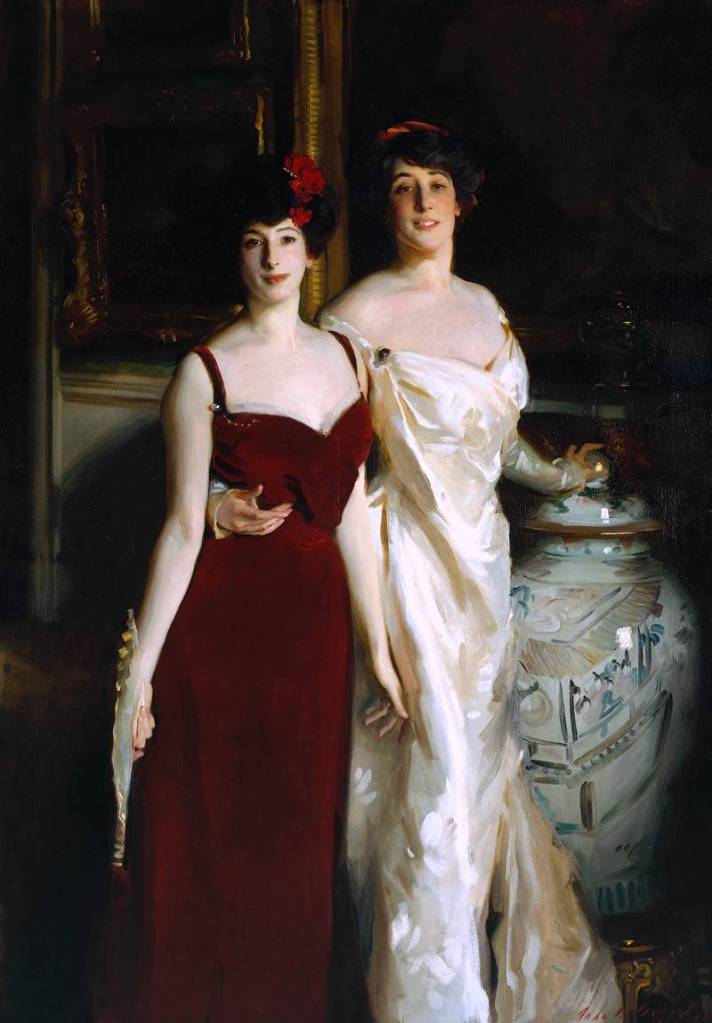
Asher Wertheimer was a friend of the artist John Singer Sargeant and commissioned him to paint twelve portraits of his family over a period of ten years including portraits of Ena and her sister(Figure 5). Nine of the twelve paintings were bequeathed to the nation in 1918 after the death of Asher Wertheimer and were displayed in their own room in the National Gallery between 1923 and 1926. Many of these portraits are now in The Tate Gallery in London. When Asher Wertheimer died in 1918 his obituary in The Times described his involvement in the highest echelons of the world of art dealing and the respect in which he was held by the art world during his life Asher Wertheimer left £1.5 million in his will which was an enormous fortune at that time .19
Ena and Betty, Daughters of Asher and Mrs Wertheimer 1901 John Singer Sargent 1856-1925 Presented by the widow and family of Asher Wertheimer in accordance with his wishes 1922 http://www.tate.org.uk/art/work/N03708
Ena had attended the Slade School of Art between 1902 and 1905 to study painting. ()Ena was said to be ,’an accomplished painter’ 20 who seems to have been something of a force of nature . She carried on the Wertheimer family’s presence in the art trade by opening the Claridge Gallery at 52 Brook Street London. This was not her fIrst commercial venture. 1923 Ena had opened a dress shop for girls and debutantes which specialised in French dresses which she obtained from Paris. The shop was called Poulain (foal) and was in George Street in London’s West End. Russian emigrees and a manageress ran the shop which soon moved to larger premisses at 52 Brook Street. However an examination of the accounts showed that the business was deeply in the red partly because the manageress had been helping herself to cash. Ena’s husband Robert commented that,
‘she might as well have given each dress away with a £10 note pinned to it.’
The Mathias marriage was said to be tempestuous with the couple agreeing on nothing. ‘Ena was as extravagant ,strong-willed and impulsive as her husband was cautious and restrained’. Ena loved to entertain and gave lavish dinners, teas and musical entertainments with the help of a large household staff .21 Her activities were frequently reported in the press as in 1912 when the Westminster Gazette reported her taking part in a pageant at the Allbert Hall to raise money for the University College Hospital ,London. The pageant consisted of the performance of a series of fairy stories in which Ena took part in the production of Aladdin .The pageant was attended by the Prince of Wales and other members of the Royal Family .22 Her friends included prominent artists, poets and authors such as Somerset Maugham and the Sitwells . Celebrities from the world of ballet such as Diaghilev and from the art world such as Picasso had dinner in Montague Square. While he lived Ena had a close relationship with John Singer Sargeant and they wrote to one another frequently. It was even suspected by Robert that they had an affair .23
After the demise of Poulain 52 Brook Street was reconfigured as the Claridge Gallery which was said to appeal more to Ena’s cultural and artistic interests. The Claridge Gallery was opened in July 1925 with an exhibition of the work of John Singer Sargent (1856-1925)who had recently died. The proceeds of the sale of the exhibition catalogue were to go to the National Art Collections Fund .24
The Gallery did not follow the Wertheimer tradition of exhibiting and dealing in Old Masters, portraits and the art of the French ancient regime. Ena exhibited twentieth- century art giving young artists an opportunity to show their works without having to pay the exorbitant fees and commissions charged by other west-end galleries. She exhibited established artists as well including Lhote, Mark Gertler, Raoul Dufy, Harold Squire and many others .25
Also part owner of the gallery was Walter Archibald Propert who as well as being a surgeon was a devotee of ballet and art. He wrote a book on Russian ballet and many of the exhibitions at the Claridge Gallery concerned Russian art and Russian ballet. He had served as a surgeon in Russia during WW1 so perhaps his interest in Russia stemmed from then. He had been a friend of the Mathias family for at least twenty years and was one of the referees who supported John Mathison Mathias’s application to become a student at The Inner Temple in 1927(see below).26
After several apparently successful years where visitors included Queen Mary in June 193027 the Claridge Gallery closed on December 18 1931. There appear to be two reasons for the closure. The Daily Mirror in December 1931 reported that the closure of the gallery would be regretted by many people even though few bought paintings .28 It is said Ena bought many works that failed to sell .29The Daily Sketch reported that a recent exhibition of the work of a popular young artist had attracted 1800 people only six of whom bought paintings. The Daily Sketch however also reported that the lease of the property was up .30
The Mathias family lived at 15 Montague Square, Marylebone,London at the time of our donors birth 31 and in the late nineteen twenties also bought Bury Manor, a country house in the village of Bury in West Sussex .This was a house of fourteen bedrooms ,six bathrooms and several reception rooms.32 As we have seen the Mathias family, though Jewish were not overtly so and were greatly involved in London society many of whom were frequent guests at Bury Manor. The Mathias family was also involved in the community around Bury Manor and Ena especially was involved in many fundraising charity events, those involving the creative arts being her greatest interest .33
John Mathieson Mathias
John Mathieson Mathias was born on 4 September 1906.34 He had four siblings:-
Diana Henrietta born 1908
Anthony Robert born 1910
Elizabeth Flora born 1912
David Frederick Archibald born 191335
As we have seen at the time of his birth the family was living 15, Montague Square ,Marylebone ,London. The 1911 Census tells us that at that time of the census John ,Diana and Anthony were staying at the home of his father’s cousin ,Robert Mond, eldest son of Ludwig Mond the chemist ,at Combe Bank, Sundridge in Kent. Also in the house were Robert Mond’s two daughters, Freda age 11 and Irena age 10 . Neither set of parents were in the house and it appears that all the children were being looked after by the governess ,Amy Allen and a house full of servants .36 There is no trace of either set of parents in the 1911 Census so perhaps they were abroad on holiday . Robert and Ena Mathias often travelled abroad to the Continent ,North Africa and the Middle East leaving the children with nannies and governesses .37
There is little information regarding our donor’s childhood. In a letter to his mother John Singer Sargent referred to him as ,
“the Greek God so shy and struggling although possessed of magnificent aplomb” which appears to be something of a contradiction. 38
John attended a school in Horsham ,West Sussex but we do not know which one .39 The 1921 Census sees the family still living in Montague Square together with a butler, cook and housemaid. John was fourteen at the time of this census and described as a full-time student .40 He appears to have matriculated in October 1925 when he would have been 17 years old.
John was admitted to Trinity College Cambridge on 1 October 1925 to study for a BA in History as a ‘pensioner’ which was the name given to regular fee-paying students. He was assigned historian Denys Arthur Winstanley as a tutor. For his first two years he lived at 11 Portland Stree,Cambridge ,moving to Bishops Hostel where he remained until the end of his third year at Easter 1928. His name does not appear in the residency lists after this point. 41
The University Records show that in 1928 he was granted leave to proceed to study for an LLB but appears to have failed the Principal Examination in Law at the end of that year. However in 1929 he sat the Principal Examination in French and achieved a second -class grade finally gaining his BA in 1930. During his time at Trinity JMM appears to have been a member of the Magpie and Stump-a Trinity College debating Society and a member of the Boat Club .42
John’s career studying for his LLB was rather mixed. He was admitted to the Inner Temple on 22 September 1927 to study for the Bar while still attending Trinity College. Between 1928 and 1931 he failed several exams at the first sitting but eventually passed his Final Exams in the Hilary Term of 1931. He was called to the Bar at the inner Temple on 17 November 1931.43 He is listed as a member of the Inner Temple in the 1932 Law List which is an annual record of solicitors and barristers .44 His professional chambers were in the Goldsmith Building of the Inner Temple from 1932 while he lived at various address in the West End of London .45 Unfortunately we have no information about JMMs career as a barrister.
The Mathias country home Bury Manor had been owned by the Mathias family since at least 1928 .46 As already stated the family involved themselves in the local community for example opening the gardens of Bury Manor each year to raise money for local causes and ran an annual bazaar to raise money for the Bury and District Nursing Association .47 Ena Mathias was very hospitable and generous. According to the West Sussex Gazette ,’ she had in its highest and best sense the artistic temperament -an acute and sensitive love of beauty unmixed with any trace of pose or affectation’ .48 and The Times reported that ,
‘at her charming house in London and at her lovely little manor house under the Sussex Downs it was her delight to entertain her friends .’49
John Mathias’s mother, Ena died in a London nursing home on 24 March 1936 of stomach cancer. According to the local press she was much missed by the people of Bury most of whom attended a memorial service for her in the local church to which she had donated two brass candlesticks .50
On 9 November 1937 John married Ludmilla Krassin who was the daughter of the late Leonid Krassin ,Russian Ambassador to the United Kingdom before his death in 1926. Leonid Krassin was a prominent Bolshevik .The marriage took place in the Chelsea Registry Office. 51 It is not known how John and Ludmilla met.
Before being Soviet Ambassador in London Leonid Krassin had been Soviet Ambassador in Paris where he lived with his wife and three daughters. In 1925 he was appointed to the post in London but died in 1926 leaving a vast fortune according to rumours of the time but which turned out to be a myth. 52 There were numerous reports in newspapers about Ludmilla Krassin’s romantic entanglements . One that she had secretly married M Gaston Bergery, a lawyer who had been secretary to a former Prime Minister of France . The marriage was reported to have taken place in the Soviet Embassy in Paris in August 1927 but was later denied by M. Bergery who said they were merely engaged. The second rumour going around in 1927 was that Ludmilla was to marry the French Duc de la Rochefoucaud . The newspapers emphasised Ludmilla’s beauty and wealth .53 However neither’ romance ended in marriage as Ludmilla was described as a spinster on the certificate of her marriage to John Mathias. Perhaps finding out that Ludmilla had not inherited a fortune affected her previous romances.
In 1938 John and Ludmilla were living at 27 Donne Place in the Borough of Kensington and Chelsea,London. They later moved to 3 Sterling Street in Kensington which remained their London home until around 1958 /1959 when they moved to a flat at 23 Rutland Gate, London SW 7.54
At the time of the 1939 Register John and Ludmilla together with father Robert and sister Elizabeth were living at Bury Manor while still retaining town houses in London. The sister of Robert Mathias , Theresa Said -Ruete was also there. Also listed was Dorothy Braddell whose husband was the son of Sir Thomas Braddell ,Chief Justiciary to the Federal Malay States. Dorothy was there with her daughter Virginia who was in her twenties.
There were twenty three people listed as living at Bury Manor , five of whom were servants .55 Those who were not either family friends or relatives may have been evacuees. 2 September 1939 saw the beginning of Operation Pied Piper ,the name given to the British Government plan to evacuate mothers with babies as well as school age children from the threat of bombing in London at the outbreak of war. West Sussex saw the arrival of thousands of evacuees to the Petworth area which was near Bury Manor. 56 Listed in the 1939 Register as living at Bury Manor were Rosina Linton with her daughter Doreen who was only a few months old and Irene Linton with her son Anthony who was about a year old .57 They had all previously lived in London. The 1939 Register was taken at the end of September 1939 giving time for evacuees to be listed .58
We have little information regarding life at Bury Manor during World War 2 apart from Robert Mathias being fined £1 for not immobilising his car according to wartime legislation. 59 Robert remarried in December 1942. His bride was Mary Branch who had lived at White Webbs Cottage in Bury .60 Another wedding in the family was that of Elizabeth Mathias, John’s sister, to Captain Robert Guillaumet of the Fighting French. 61
Whether John and Ludmilla spent the war living at Bury Manor or lived in London is not known at this point. They did not have any children. John Mathias does not seem to appear in any military records of the period. The 1939 Register tells us that Ludmilla was involved with ‘W.S Red Cross’ which may be an abbreviation of West Sussex Red Cross. However the inhabitants of Bury Manor played a part in fund- raising for various causes during the war. One example is a Garden Fete held to raise funds for the Bury and Amberley District Nursing Association in which the new Mrs Mathias participated .62 She also organised a whist drive and dance in the tithe barn of Bury Manor in 1944 in aid of The Agricultural Fund of the Prisoners of War Fund .63
On 9 August 1952 Ludmilla and John set sail from London for Vigo on the south west coast of Spain presumably for a holiday. They travelled First Class on the Highland Monarch64 which was a combined cargo and passenger ship of the Royal Mail Line which had been built in 1928 by Harland and Wolff for the Nelson Line and transferred to the Royal Mail Line in 1932. 65 The Highland Monarch covered the South American route calling at Vigo ,Lisbon, Las Palmas ,Rio de Janeiro, Santos, Monte Video and Buenos Aires .66
The Mathias family appear to have continued their interest in art as in July 1960 John Mathias was one of the sponsors of a posthumous exhibition of the works of local artist Harold Squire of Henfield in West Sussex . Robert Mathias owned two of Squire’s works which he loaned to the exhibition which was held in aid of the Chilean earthquake relief fund. Harold Squire was born in Chile. 67
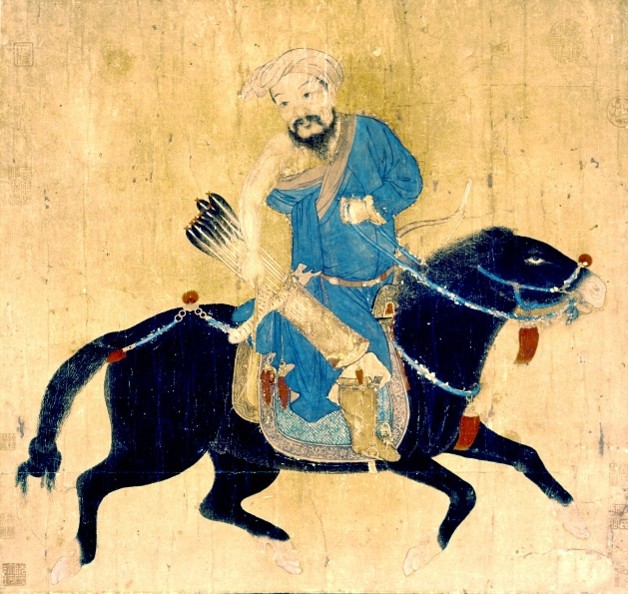
Robert Mathias died in London on 25 January 1961 aged eighty-nine leaving over £184,000 in his will .68 John Mathiesson Mathias died at Bury Manor on April 18 1963 aged only fifty-seven. He left over £230,000 in his will .69 He also bequeathed a painting to the Victoria and Albert Museum. The work was Mongol Archer on Horseback described as an ink on paper painting by an unknown artist from the Ming Dynasty(c 1368-1644) and is in the East Asian Collection .It had been exhibited at Sotherby’s Gallery in January 1940 which may have been when it was bought by a member of the Mathias family.70
After the death of John Mathias Bury Manor was put up for auction 71 and became Dorset House Preparatory School which it remains to this day .72 The former tithe barn which saw fundraising events during WW2 is now a popular wedding venue .73
Appendix The Mond Family
Mathilde Mond ,our donor’s grandmother, was the sister of the chemist Ludwig Mond (1839-1909) who was responsible for setting up the Brunner Mond Company in 1873 to produce soda ash. Brunner Mond eventually became part of Imperial Chemical Industries in 1926. Ludwig was also a collector of Italian art .He set up the Mond Nickel Company in 1900 which was licensed to mine nickel in Canada which was then sent to Britain to be purified by the carbonite process patented by Ludwig Mond. Robert Mathias ,our donors father ,was a director of the Mond Nickel Company. Alfred M Mond was a son of Ludwig Mond who was involved in the various family businesses, became a Liberal MP in 1906 and was elevated to the House of Lords as first Baron Melchett of Landford in 1928.74(1869-1936)( Oxford Dictionary of National Biography).
References
1. Minutes of the Corporation of Glasgow November 1951-May 1952 p.1351
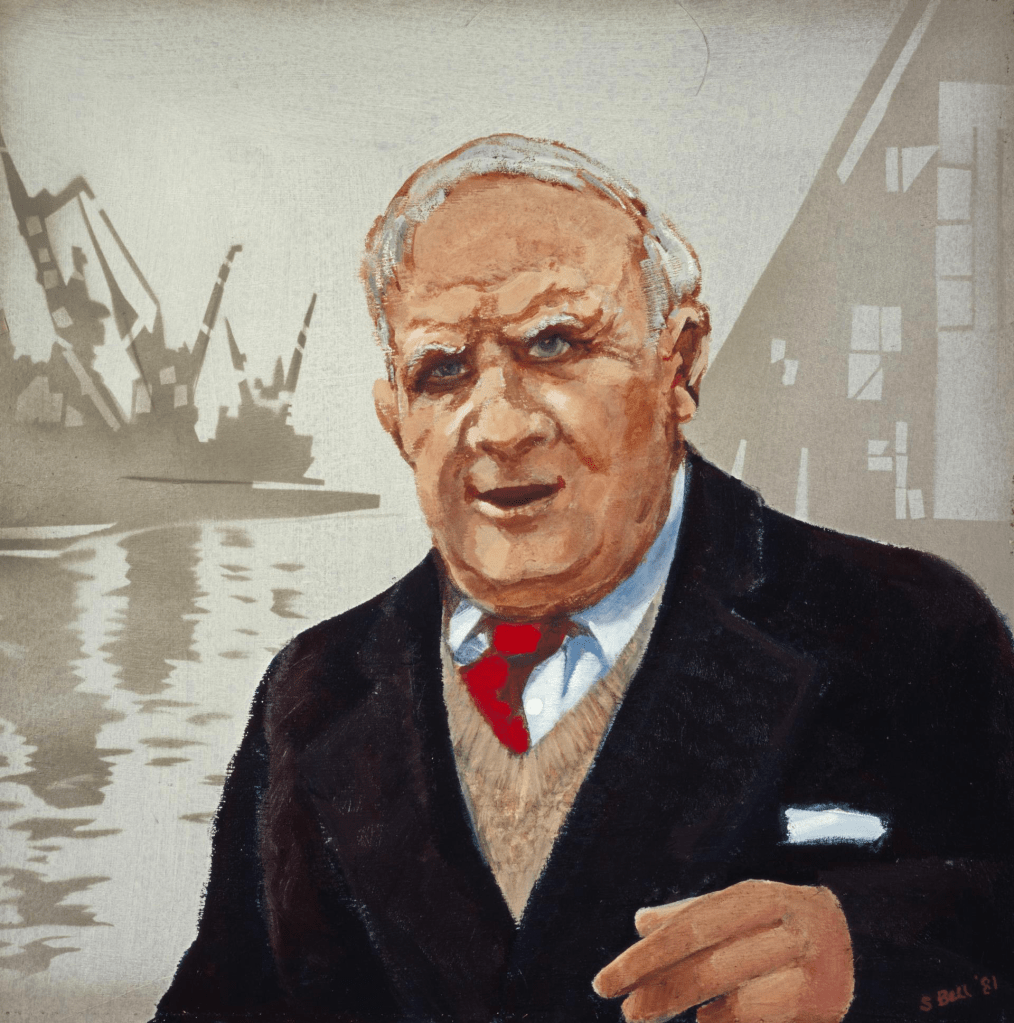
‘He became a revolutionary Marxist in 1908 and he died a revolutionary Marxist in 1988.’
Thus Paul Foot described Harry McShane, going on to call Harry an agitator in the struggle between the classes. ‘He made up his mind very early on that the socialist society he wanted was not going to be made by anyone for the workers, it was going to be made by the workers or not at all’. (1)
Harry McShane lived in Glasgow for almost a century, living and working within the city throughout most of this time, witnessing first hand and being actively involved in many of the significant events of the movement.
Early Life
Harry McShane was born on 7 May 1891. (2) His father, John McShane, was from an Irish Catholic family. McShane’s paternal grandparents came from County Tyrone in Northern Ireland. His mother, Janet Sanson, was from a family who were originally from Edinburgh. They were a Protestant family. The couple met and married in Glasgow. Janet worked in a fish hook factory in Glasgow. John was a mason’s labourer. (3)
Harry McShane wrote about the problems facing those who entered into mixed marriages in the 1900s. Both Catholics and Protestants disapproved of such marriages. When he was a few months old his parents separated and his father took him to live with his grandparents. Harry stated that the differences in the marriage were about status as well as religion. Harry’s father and grandfather were builders’ labourers. His maternal grandfather, Tom Sanson, was a blacksmith, a skilled worker, and was also a member of the Church of Scotland. McShane stated that Tom Sanson was very anti Catholic.
The separation between Harry’s parents did not last long. John McShane went back to his wife and they went on to have ten more children. They never separated again. Harry, however, stayed with his grandparents and rarely saw his mother, although his father came regularly to visit him at his grandparents and took him out a lot. He was brought up as a Catholic. (4)
Family Life
Compulsory education in the 1890s began at six, but Harry started school at five. He remembered that he wore shoes to school, while most of the other children had bare feet. Harry had a shaky start at the local school in the Gorbals – ‘ My first day, I saw a teacher hitting a boy’s bare leg with a cane. Then, to make matters worse I lost my road home.’ His grandparents decided not to send him back to that school. They moved from Gorbals to Tradeston, to a house where Harry could have his own bedroom, and he was sent to St Margaret’s in Kinning Park, where Harry got what he described as his ‘meagre Catholic education’. He described a cruel regime at the school, although he acknowledged that there were some good teachers there. Harry’s father’s influence on his education was significant. He encouraged him to read and also influenced what he read, steering him away from boys’ stories to more serious reading, such as the essays of Macauley.
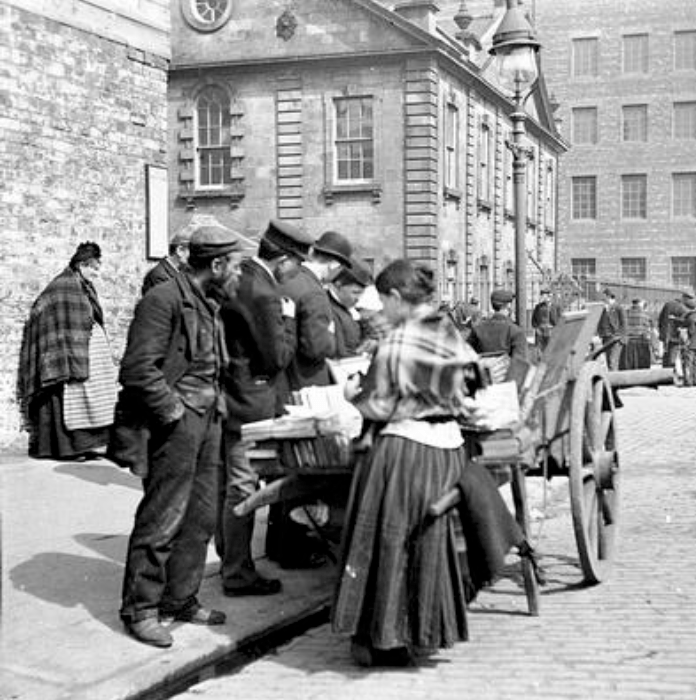
Harry describes buying books to read: ‘ There was a string of barrows right along the riverside then, with second-hand tools and books – this was before Barrowland grew up in the East End of Glasgow’.
Book Barrow in Greendyke Street c 1916
Glasgow City Council. Glasgow Museums
Harry also remembered being told at school that for his knowledge of English he should read Macaulay’s essays and the Glasgow Herald. Many of his grandparents’ generation were illiterate, not uncommon at the time, as many of that generation would not have attended school as children. He described people coming to his grandparents’ house so that Harry could read reports from the newspapers to them. (5)
Harry started a relationship with Jean Johnstone when he was aged eighteen. She lived in the next close to him and Harry described her as ‘the best-looking girl in the whole place’ Their social life consisted of visits to music halls and theatres, with an occasional visit to a restaurant. They married in 1915. (6) His wife attended Communist Party Meetings when they were first married.
Political Awakening
Growing up, Harry would have been aware of working life around him. He recalled playing around the Kingston Docks near to where he lived in Tradeston. Harry’s father and grandfather were both involved in the union movement. Originally they were members of the Workers’ Union, which eventually merged into the Transport and General Workers Union after the First World War. Harry had an awareness of politics, both British and Irish, and the union movement from an early age. He attended meetings and debates from his early teenage years onwards. Glasgow Green on a Sunday was where debates and speeches would be heard. Large numbers of people would attend these gatherings, which began at noon and went on until nearly ten o’clock at night. Harry described hearing arguments during these debates and following them up by visiting the Mitchell Library to find books on the issues he had heard discussed. When he left school, the priest and others tried to persuade him to go to St Mungo’s Academy, but he resisted as he wanted to start work. His grandparents agreed with him and they and his father encouraged him to try for an engineering apprenticeship. They did not want him to be a labourer or a handyman as they had been. Harry began an engineering apprenticeship in 1907, aged sixteen.
Harry’s engineering apprenticeship involved attending evening lectures twice a week. A normal day was getting up at 5.30 am to attend work, then going to his lectures in the evening. Harry described his status as an engineer, which had been so important to his grandparents and father: ‘ They (engineers) weren’t the highest paid men. The joiners, masons and bricklayers were better paid than we were, but we had much greater security’. (7)
Working hours were long at the beginning of the twentieth century. Up to 1914 the working week was 54 hours. Working people, including boys and girls started the day at 6.00 am and finished at 5.30 pm and worked until noon on Saturdays. Harry McShane described working at Dalmuir during the war and having to leave the house before 5 a.m. to get the ferry to Anderston Cross and the train to Dalmuir.
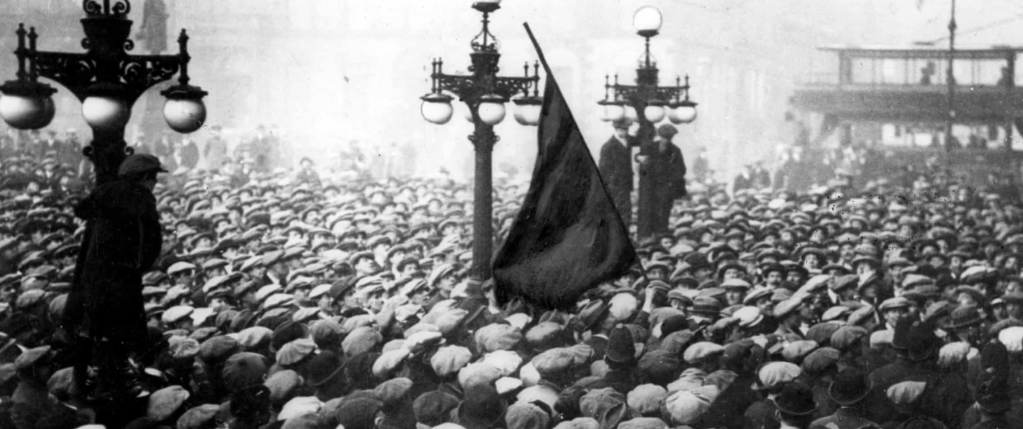
Harry had joined the Independent Labour Party (ILP) in 1909 and left the Catholic Church shortly afterwards, in spite of pressure from local Catholics and the priest. This pressure served only to strengthen Harry’s decision to break with the church. The decision to join the ILP seems to have been influenced by the slump of the early 1900s. By 1908 unemployment in Glasgow was very high and there were mass demonstrations about unemployment, which took place in George Square every week until they were banned by magistrates. One of the leaders of these meetings became legendary in Glasgow history – John Maclean. (8) John Maclean was a Glasgow teacher who believed that Marxism had to be accepted as the only way to look at socialism. He established regular classes to teach Marxist economics. These classes were held every Sunday afternoon at the Central Halls in Glasgow and were regularly attended by several hundred people. Harry believed these meetings led to a transformation of the Labour movement in Glasgow.
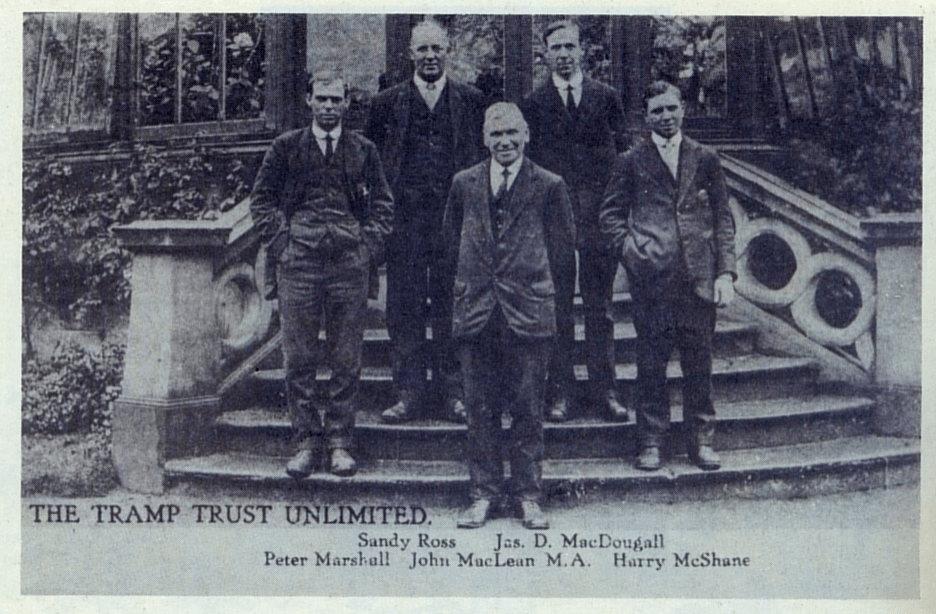
McShane was a member of the Tramp Trust Unlimited, a small group of unemployed people who travelled around the country spreading ideas of militant socialism. The Tramp Trust Unlimited was formed by John Maclean and campaigned for a minimum wage a six hour working day and full unemployment benefits.
Hayes People’s History Michael Walker 2013 (6)
Political activity at this time was associated with self-improvement. Harry McShane wrote of John MacLean: ‘ He educated the Socialists of Clydeside and of Scotland. Let me say that he had a greater influence on me than any man I have ever known.’ (9)
In September 1914, Harry enlisted in the army with the aim of doing propaganda work with his fellow soldiers. He joined the Royal Engineers. He became a sapper and learned how to handle explosives and build bridges and pontoons. He never intended to take part in the war and he returned to Glasgow on leave and never went back to the army. Harry was sheltered by friends and tried to get work under an assumed name, but every time he got a job he would be recognised and have to move on. (10)
UnionActivism
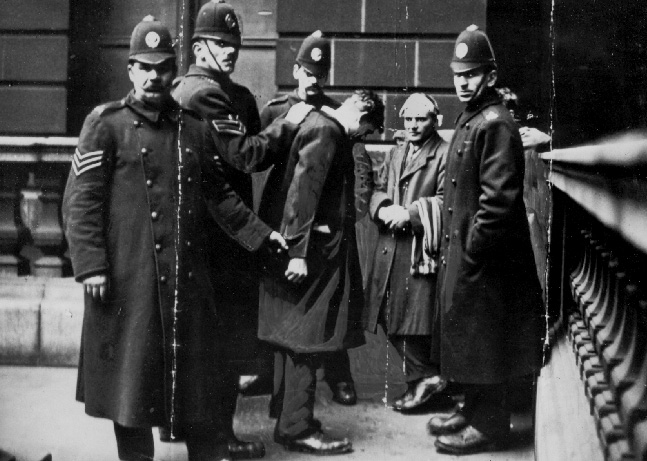
After the war, unions were keen to see a reduced working week, some suggesting 47 hours. The engineering workers took up the fight to reduce the working week to 40 hours. A strike to support this was called on 27 January 1919. The strike caused significant unrest in the city centre. Harry McShane was present during most of it. He described the aim of the strike as reducing the working week from 54 to 40 hours. It was believed that the reduction in the working week would lead to improved chances of work for soldiers returning from the war. When the strike ended on Monday 10 February an agreement for a 47 hour week had been made and the workers started work at 8am. The 40 hour week did not come into being until after the Second World War. (11)
David Kirkwood and Willie Gallagher being arrested. George Square 1919
George Square 1919 Herald and Times Group
In 1920/21 Harry McShane became involved in working with the unemployed. He continued to work as an engineer, moving south to England where he worked during the 1920s. In 1928 he moved briefly to America and Canada, working in the Yukon. In 1930 Harry discovered that his marriage had ended. The only other evidence found of the ending of the marriage is on Harry’s death certificate which states that he was divorced. (12)
Harry McShane joined the Communist Party in 1922, which led to a break in his friendship with John McLean. Harry remained a member until 1953, when he decided he could no longer agree with the party’s leadership. During his time in the Communist party, he was the main Scottish spokesman for the National Unemployed Workers Movement (NUWM) and led many marches and demonstrations throughout the UK. During the Second World War he joined the staff of the Daily Worker, the newspaper of the Communist Party.
In the early 1940s, the NUWM had closed down and he started working on the Daily Worker, the newspaper of the Communist Party. A Scottish edition was being published and McShane and a small group of others were responsible for producing the weekly paper. He worked there, apart from a brief closure, until 1953. (13)
Scrutiny by the State
Between 1930 and 1939 there is evidence in the National Archives at Kew, London that Harry McShane was under scrutiny by the state. This included warrants to intercept his mail, where some correspondents discussed use of arms and spreading of discontent leading to possible uprisings. McShane’s articles were also scrutinised. His passport was limited to the UK. No commonwealth travel was permitted. A record of McShane’s court appearances, mostly for incitement to breach of the peace, was kept.
The warrants stated that they were issued by one of His Majesty’s Principal Secretaries of State. The reason given for the warrant was that he was an official or leading member of the Communist Party of Great Britain…… and may have been engaged in different open or underground phases of communist work. Some of the letters he received were considered suspicious. Programmes of meetings he attended were kept and he was being followed, as reports were made of his movements around the UK. When he tried to join the army at this time, he was turned down as unsuitable. There were suspicions that the intention was to enlist for the purposes of obtaining weapons. Correspondence with someone known as Winged Spur suggested to McShane that he and others should enlist in the territorial army for the purposes of obtaining weapons, which Winged Spur claimed were held in drill halls throughout the country. Winged Spur argued that these weapons could then be used to carry out an uprising.
McShane’s marches were also closely monitored. On 28 September 1932 a memo gave information that McShane had been instructed by the HQ of the National Unemployed Workers’ Union to call at the GPO in each town on the march to pick up material or instructions. The GPO was provided with details of the route and asked to intercept the mail and examine the correspondence when it arrived. (14)
Later Life
In 1953 Harry left the Communist party and became unemployed. He took work in the shipyards and worked there until he could claim his old age pension at 69.
After his retirement aged 69, Harry McShane remained active. In his eighties he was still writing pamphlets, lecturing at Saskatchewan University and taking part in right to work marches. In his nineties he saw off an attempt to evict him from his Church of Scotland Nursing home because he was an atheist. He also supported the staff at his nursing home in an industrial dispute. In 1987, the year before he died, he addressed the May Day rally in Glasgow.
In 1984 Harry McShane was given the Freedom of the City of Glasgow. It was noted jokingly during the Ceremony that Harry had cost the city a great deal of money over the years. First, when he led the unemployed, the cost of policing the City Chambers to keep him out. Years later, when he finally got in, there was the cost of the banquet to celebrate his freedom of the city. During that day, the red flag flew over the City Chambers and instead of the National Anthem the guests sang ‘I Belong to Glasgow’. (15)
‘We all know that great men and women don’t make history, but we also know that working class history would be a mean thing if it were not enriched by great men and women’. (16)
Harry McShane’s archive is held in the City Archive in the Mitchell Library (17)
Frances Mary-Jane Ingram was christened in St. Mary’s, Cardiff on 24 December 1856. Her parents were James Oliver Ingram, a watchmaker and jeweller, and Mary Anne Robotham1 who married in Cardiff in 1848.2 Frances had an older brother and sister; John was born in 1850 and Laura in 1854 and a younger brother Frederick was born in 1859.3 Both their parents died within two years of each other, James in 1867 and Mary Ann in 1869.4 By 1871, John, aged 21, was now head of the family.5 On 1 February 1876, in Cardiff, Frances married the Rev. William Fergus.6,7 William Fergus was born in Glasgow on 19 June 1839.8 He attended the Free Church Training College and the University of Glasgow and was licensed by the Free Presbyterian Church of Glasgow on 1 July 1868. He applied to become the minister of the Presbyterian Church in Cardiff on 25 May 18719 and officiated at the wedding of his sister Mary there in 1873.10 In January 1876 he resigned his charge at a meeting of the Birmingham Presbytery with a view to seeking admission to the ministry of the Established Church of Scotland.11 He moved to Glasgow with his new bride and on 4 February he was inducted into the Church of Scotland at a meeting of the Presbytery of Glasgow in Blythswood Parish Church.12 In the census of 1881, William and Frances were living at 227 Bath Street in Glasgow. He was listed as the Minister of Blythswood Church. The couple employed a cook and table maid.13
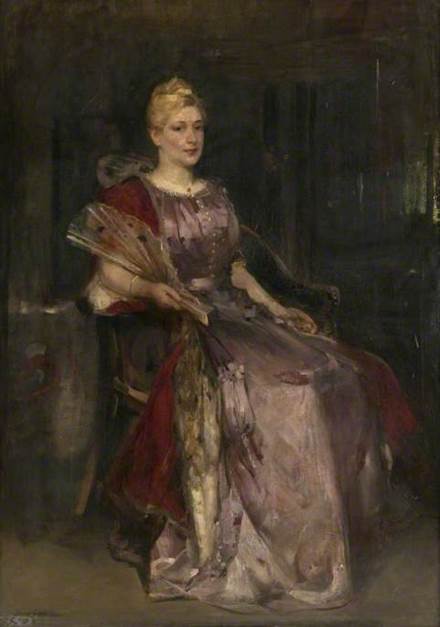
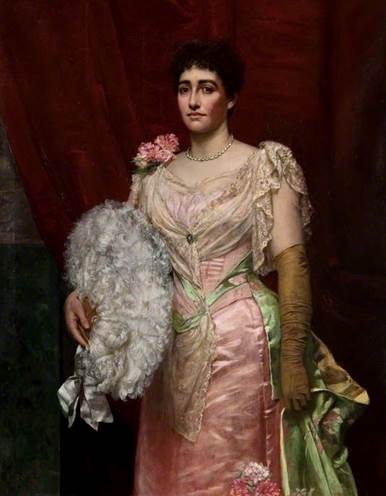
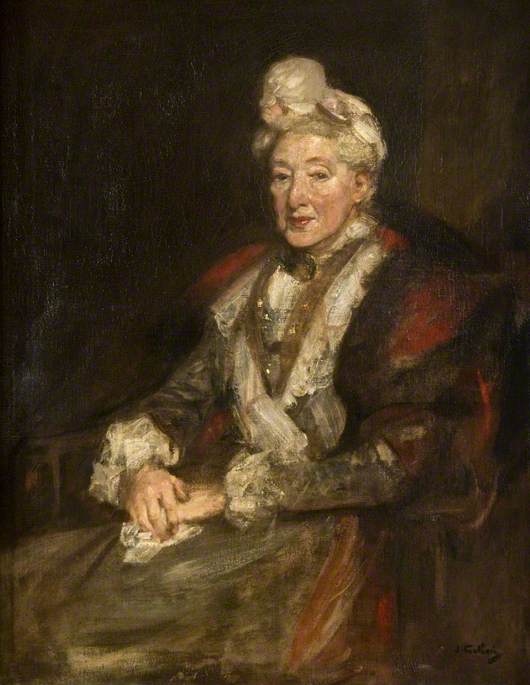
The painting of Mrs. William Fergus was completed in 1889 when she was thirty-three.
In the second quarter of 1889, Thomas Robert Strange married Laura Ann Ingram at St. Saviour Church, Southwark. London.14 Laura was the sister of Frances Fergus. On the third of August 1889, Laura gave birth to twins, Gladys and Hugh. They were baptized on 11 October 1889 in St. Giles, Camberwell, Southwark. Gladys was named Laura Clarissa Gladys Strange.15 In the census of 1891 the family was at Camberwell with the twins aged 1, Laura 37 and Thomas who was a greengrocer, aged 35. At the age of six, Gladys was enrolled at Comber Grove School.16
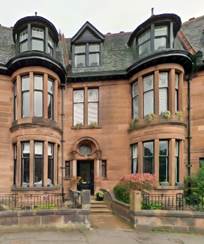
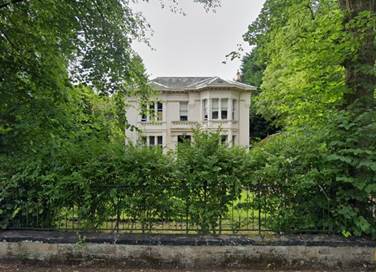
In the 1891 Scottish census, William and Frances were now at 67 Ann Street in the Hillhead area of Glasgow. They remained there until 1895 17 and then moved to 17 Kensington Gate, Hyndland, Glasgow.18 However, they do not appear in the 1901 census.
Fig.2, 17 Kensington Gate, Hillhead (Google Maps)
By 1901, Gladys, her brother Hugh and her parents had moved to 173 Camberwell New Road in Brixton, London.19 Ten years later, Gladys was living with her aunt and uncle at 17 Kensington Gate. She was now twenty-one with ‘no occupation’.20 On 23 August 1912, William Fergus died aged seventy-two. Frances reported his death.21 He was buried in Sighthill Cemetery in Glasgow.22
Gladys and her aunt continued to live at 17 Kensington Gate with Frances now the proprietor.23 In the census of 1921, Gladys was occupied in ‘home duties’. Her name also appears on the electoral register.24 Gladys’ father Thomas Stange died in London in 1927. Her mother died four years later.
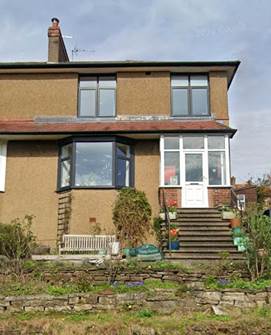
Frances Mary-Jane Fergus died aged seventy-eight on 30 May 1935 at 17 Kensington Gate. Gladys reported her death.25 Gladys lived on at Kensington Gate as the proprietor until 1940 when she moved to 26 Colchester Drive, Glasgow.26
Fig. 3, 26 Colchester Drive (Google Maps)
During WW2, Gladys was a billeting officer in Glasgow for the WVS. The main problem she seemed to have was finding accommodation for couples with babies.
‘There are landladies who seem to think that children are bundles of rags, to be dumped anywhere’ said Miss Strange-Fergus, ‘It is terrible the things that are happening.’ 27
However, she was apparently very successful in her role so-much-so that she was mentioned in the Birthday Honours of 1948 where she was awarded the British Empire Medal.
‘B.E.M. Miss Gladys Laura Clarissa Strange-Fergus, Billeting Officer, Glasgow’. 28
Laura Clarissa Gladys Strange-Fergus died on 1 April 1970 at 26 Colchester Drive. She was eighty years old. Her death was reported by Ian walker, a friend. Her funeral took place at Glasgow Crematorium. 29,30
The Painting
The painting was first exhibited at the Glasgow Institute of Fine Arts in 1889. Then in Paris and Munich in 1890 and in Edinburgh the following year. It was exhibited in London in 1893 and at the 110th Annual Exhibition of the Royal Society of Art in Edinburgh in 1936. It returned to Kelvingrove Art Galleries where it was on show in the Glasgow Room in 1956. 31
References
England and Wales Births and Baptisms, 1541-1907, familysearch
England and Wales Marriage Registration Index, 1837-2005, familysearch
ancestry.co.uk Wales Census, 1861
England and Wales Death Reg Index 1837-2007, familysearch
ancestry.co.uk Wales Census, 1871
ancestry.co.uk England and Wales Civil Registration Marriage Index, 1837-1915
Fasti Ecclesiae Scoticanae, Vol 3, p. 402
Scotland Births and Baptisms, 1564-1950, familysearch
Fasti Ecclesiae Scoticanae, Vol 3, p. 402
South Wales Daily News, 13 June 1873
Staffordshire Advertiser 8 January 1876
North British Agriculturalist 9 February 1876
Scotland’s People, Census 1881
England and Wales, Marriage Registration Index, 1837-2005, familysearch
ancestry.com, London, Church of England Births and Baptisms, 1813-1924
ancestry.com London, Schools Admissions and Discharges, 1840-1911
In 1955 a bequest was received by Glasgow Museums on behalf of Mrs. A. Carvick Webster of a print On the Clyde by Walter Severn.
Catherine Agnes Balfour Fairfax was born in Sydney, New South Wales, Australia on 19 July 1867. She was the only daughter of Edward Ross Fairfax and Catherine Mackenzie.1
Edward Ross Fairfax was a partner in the media empire of John Fairfax and Sons, which was founded by his father in 1841. They were publishers of the Sydney Morning Herald and the Sydney Mail and had extensive interests in Australia and New Zealand. Edward married Catherine Mackenzie about 1866. After retirement, they moved to England probably taking their daughter with them.2,3 Harry Carvick Webster was born in Sydney about 1862 4 the only son of Alex. Speed Webster. He moved to England to take up a position in his cousin’s firm, Alexander, Fergusson and Co., lead and paint manufacturers.5 Harry and Catherine may have known each other in Sydney or perhaps they met upin England. In any event, they were married on 31 July 1888 at St. Stephen’s Church, South Kensington, London.6 Harry was twenty-six and Catherine twenty-one. Afterwards, the couple moved to Glasgow where Harry was to be the manager of the Glasgow branch of the firm. They took up residence at 10 Huntly Gardens, Hillhead, Glasgow where, on 18 April 1890, their first child, Una Zara Marie, was born.7 At the census of the following year, Catherine (Agnes B. Webster) was visiting her parents Kate R. Fairfax, 41, and Edward R. Fairfax, 48, and her brother John Fairfax, 20, at Hanover Square in London. Her parents were ‘living on means’8 Meanwhile, Harry Webster was at home in Huntly Gardens with eleven-month-old Una Zara. He employed a cook, nurse and two maids and was described as a ‘manufacturer of lead paints’. 9 Between 1893 and 1900, Catherine and Harry had four more children, all born at 10 Huntly Gardens. They were Catherine Agnes Rua born 23 May 1893, Joan Marguerite (Ferguson?) 1896, John Alexander Croom 3 June 1897, Harry Ross Fairfax 1900.10 By 1901, the family had moved to 48 Montgomerie Drive, (later named Cleveden Drive) Kelvinside, Glasgow. 11 A sixth child, Iris Speid Elasaid Balfour was born there on 11 December 1901.12 A notice in the Glasgow Herald of 3 August 1903, recorded that, ‘A fancy dress ball, which was largely and fashionably attended, was held in the Royal Hotel, Largs on Friday night, in aid of the funds of the Samaritan Hospital Bazaar. The ball was organized by Mrs. Carvick Webster, of Glasgow and of Crescent Lodge, Largs’. (The Samaritan Hospital for Women was located in Govanhill, Glasgow).
The stay in Largs may only have been temporary as they were not in occupation before 1895 or after 1905.13 The Glasgow Post Office Directory for 1903-4 has the entry,
H. Carvick Webster of Alexander, Fergusson & Co., Ltd., House 48 Montgomerie Drive.
During 1905/06 Catherine and Harry took their two oldest daughters, Zara and Rua, out to Australia and then on to New Zealand, on a part business, part family reunion trip. The 13-year-old Rua kept an account of part of the trip in her diary.14 By 1911, Harry and Agnes (Catherine) had moved to 58 Montgomerie Drive. At the time of the census, Zara, 20, Iris, 9 and five servants were in the house. 15
On 20 March 1912, ‘Mrs. and Miss Carvick Webster’ attended a society Mi-careme (mid-lent) Festival in the ballroom of St. Andrew’s Halls, Glasgow. This had been preceded by a dinner in the Central Hotel hosted by Major and Mrs. MacRae Gilstrap to which ‘parties came from most of the country houses in the district’.16
On 18 September 1912 at St. Mary’s Episcopal Cathedral, Glasgow, Zara Webster married Robert Scott Cree, younger son of Thomas Scott Cree, LLD. A reception was held at 58 Montgomerie Drive hosted by Mrs. Carvick Webster.17
The years 1915 to 1917 were tragic for Catherine. Her father, Edward Ross Fairfax died on 31 July 1915 aged seventy-two, at 6 Harcourt House, London. He also had addresses at 145 Macquarie Street, Sydney and at 5 Harcourt House, London. His effects amounted to £29,122. 11s 1d. 18,19 The following year on 15 October, Catherine’s mother Catherine Mackenzie (Kate Ross Fairfax), died in London. 20
Catherine’s elder son, John Alexander Croom Webster was killed in action on 21 April 1917. He had been educated at Kelvinside Academy, Glasgow and at Cheltenham School before entering Sandhurst in November 1915. He then received a commission in the Seaforth Highlanders.21 He was killed shortly after the capture of Bagdad and is buried in the Bagdad War Cemetery, Iraq.22 Later that year on 14 November, her son-in-law, Captain Robert Scott Cree was killed in Palestine, He was buried in the Deir el Belah War Cemetery and is commemorated on the family gravestone in the Glasgow Necropolis.
On 15 March 1919, Catherine’s daughter Rua married Captain (later Sir) Dudley Williams of Sydney at All Souls’, Langham Place, London. Rua was the ‘second daughter of Mr. and Mrs. Carvick Webster of 5, Harcourt House, Cavendish Square and of Glasgow’. 23,24
Sometime after 1915, Harry, Catherine and family moved to Orangefield, Monkton, Ayrshire. This mansion had five reception rooms and sixteen bedrooms and was surrounded by fifteen acres of ground with rose and rock gardens. In 1920 another daughter, Joan Marguerite, married Hugh Neilson at Orangefield. 25
(Robert Burns was acquainted with John Dalrymple who owned Orangefield at that time. They were both Masons. Burns wrote that “I have met in Mr. Dalrymple of Orangefield what Solomon emphatically calls ‘a friend that sticketh closer than a brother’.”) 26
Una Zara Marie Cree arrived in Sydney from Glasgow with her son Thomas aged five on 9 January 1920. 27 She married Clive Evans at Darling Point, Sydney on 6 August 1921.28 Back in Scotland at the 1921 Census on 19 June, Harry, Agnes and Iris were all at Orangefield so it was unlikely that they would have been at Zara’s wedding. However, sometime later Catherine and Harry travelled to Australia visiting both their daughters, Zara now Mrs. Clive Evans and Rua, Mrs. Dudley Williams. On their return journey they met up with their son Harry in Bombay. He was a lieutenant in the Sappers and Miners, stationed with the army in India.29 In 1923 tragedy again struck the family when Harry was killed in an ambush by natives when working on roadmaking near the northwest frontier. He was twenty-two years old.30 Some years later Catherine and Harry had a community hall built and donated to the village of Monkton as a memorial to their two sons. The ‘Carvick-Webster’ hall was completed in 1929 to a ‘semi arts and crafts design.31
Catherine and Harry remained at Orangefield and in 1925 their daughter Iris married Cecil Gibb there. On 23 February 1929 they left Avonmouth bound for Jamaica. Harry was now retired and they were accompanied by their daughter Joan Fergusson Neilson.32 They left Jamaica on 31 March to return to Avonmouth, but Joan was not with them. 33 On 18 October 1930, Catherine sailed from Liverpool aboard S. S. Scythia bound for New York. She was described as a housewife aged sixty-three of “Scotch” descent living in Monkton. Also on the passenger list were her cousins John H., and Ruth B., Fairfax. Harry was not present. 34
On 3 June 1932, Harry Carvick Webster died aged seventy from bowel cancer at Orangefield. His death was reported by his son-in-law (Lt. Col.) Cecil Gibb whose address was Gatwick House, Shackleford, Surrey.35 An obituary noted that Harry was born in Sydney but educated at Merchiston College, Edinburgh. After a spell in London in the office of his cousin Alexander Fergusson, he took over the management of the Glasgow branch of the firm. During the war he was controller of lead, tin and zinc supplies at the Ministry of Munitions. He was managing director of British Amalgamated Lead Manufactures with interests in Australia.36
Orangefield House and estate was sold the year after Harry’s death.37 and Catherine moved to a flat in Portman Square, London. She seems to have spent her time visiting family in Scotland and Australia. Her daughter Rua and her granddaughter, also Rua, stayed with her in Portman Square in 1934. 38
On 14 July 1948, Catherine made a gift of a pewter plate dated to 1660 approximately to Glasgow Museums. Her address at the time was ‘Fieldfares’, Thursley, Surrey. This reflects a continuing interest in pewter, As early as 1919 she had hosted the second meeting of the Society of Pewter Collectors in her home at 5 Harcourt House, Cavendish Square, London. She had suggested that members bring along specimens from their collections for an informal exhibition.39 She also made significant donations of British Pewter to the Art Gallery of New South Wales in Sydney between 1938 and 1949 – the ‘Carvick-Webster Collection’. Other donations she made to the Gallery included a collection of ninety-seven medals and two drawings – Crowning of a Pope signed ‘Tadeo Zuccaro’ believed to be from about 1563 and a Study of a Dog by the School of Paolo Veronese both donated in 1926.
‘Catherine collected various things e.g. stamps, china and pewter……..She also had a fine collection of Australian paintings by local artists’. 40
Catherine Agnes Balfour Carvick Webster died aged eighty-seven on 23 May 1955 at 2, St. Michael’s Drive, Helensburgh, Dunbartonshire. She may have moved to Helensburgh to be with family as her death was reported by her son-in-law, Hugh Nielson whose address was 3, Easterhill Road, Helensburgh. 41 A service was held at St. Michael’s and All Angels Church, Helensburgh followed by a private funeral. 42
On 7 November 1854, Alexander MacKay married Isabella Thomson in Wick, Caithness. 1 The family moved to Thurso where a daughter, Rose-Ann MacKay was born on 31 August 1856 in Durness Street. 2 From the census taken in 1861, the family had moved to 9 Dempster Street in Pulteneytown, Wick. Alexander, aged fifty-five, was a mason born in Rogart, Sutherland while Isabella, thirty-six, had been born in Eday, Orkney. The couple had two daughters, Isabella aged eleven (perhaps from a previous marriage?) born in Avie, Orkney and Rose-Ann aged four. 3 Ten years later Roseanna (sic) and her parents were still at 9 Dempster Street, but Isabella was not. 4 The family later moved to Kintore, Aberdeenshire where Alexander is listed as tenant/occupier of Kintore House from 1877-1880. 5
Rose-Ann MacKay, (now styled Ann Fitzgerald MacKay) married Sir Walter Grindlay Simpson of 5 Randolf Cliff, Edinburgh on 13 January 1881 in the Manse at Banchory Devenick, Kincardinshire. Walter was thirty-seven and an advocate. Ann was twenty-four living at Kintore, Aberdeenshire. On the marriage certificate, Ann’s parents are Alexander MacKay, architect, deceased and Isabella Catherine Thomson. 6
(According to the 1911 census for England, Ann Simpson (nee MacKay) was born in Thurso about 1857. The only birth listed on Scotland’s People for that date is that of Rose-Ann MacKay born to Alexander MacKay and Isabella Thomson. There is no record of an Ann Fitzgerald MacKay.)
The best man at the wedding was the groom’s brother, William Simpson. The sole bridesmaid was Evelyn Farquharson, cousin of the bride. Ann’s uncle, Peter Farquharson was a witness. (Evelyn Farquharson was born in Kirkwall, Orkney on 24 August 1843. Her parents were Peter Farquharson and Mary Thomson7 who married in Shapinsay on 18 January 1842 8) After the ceremony the couple left for London and thence to a honeymoon in the south of France. 9
Walter Grindlay Simpson was born on 1 September 1843 in Edinburgh. He was the second son of Sir James Young Simpson (7 June 1811 – 6 May 1870), the eminent physician and pioneer in the use of chloroform as an anaesthetic) and Janet (Jessie) Grindlay. With the death of his father in 1870, Walter became the second baronet. He was a good friend of Robert Louis Stevenson whom he met at the University of Edinburgh and in 1876, the pair undertook a voyage by canoe from Antwerp to Pontoise. This was later documented by Stevenson. 10
Sir Walter and Lady Simpson had four children, James Walter MacKay Simpson (1882 – 1924), Odo Louis MacKay Simpson (1885 – 1917, k.i.a.), Ethel Lucy Florence MacKay Simpson (later Lady Willert) and Beatrix Frances Frederica MacKay Simpson. In 1891 the family was living in Hanover Square, Belgravia, London. 11 This suggests the painting was completed in London the following year when Lady Simpson was thirty-six.
Walter Grindlay Simpson died on 29 May 1898 at his home, Balabraes, House Ayton, Berwickshire. He was 54. 12 Obituaries mentioned that he was educated at Edinburgh Academy and Caius College, Cambridge where he studied chemistry and anatomy graduating with a BA Hons. in Natural Science. He also rowed stroke for the university. He was called to the Scottish Bar in 1873. 13 He was an enthusiastic golfer and was Captain of the Honourable Company of Edinburgh Golfers. He published an authoritative guide to the game The Art of Golf in 1887. It seems that he purchased Millbank House about 1890 14 and renamed it Balabraes 15
Now widowed, Lady Simpson continued to live at Balabraes House with her two daughters. She and Florence were ‘living on their own means’. 16 Florence married Arthur Willert in 1908 and by 1911 Ann was in residence in Kensington, London with Beatriix and Odo. The census of that year states that she was born in Thurso. 17 During WW1, her son Odo enlisted in the Canadian Expeditionary Force. Ann signed his Attestation Papers 18 Tragically, he was killed in action in 1917. She seems to have retained ownership of Balabraes until about 1920 when it was sold. 19 In 1921, Ann Simpson was living at 14a Westbourne Terrace, Paddington, London. 20 This was the home of her daughter Beatrix and husband Bertram Couly. (They divorced in 1933). She probably attended the wedding of her grandson Paul Willert in 1934. Lady Ann Fitzgerald MacKay Simpson died on 23 October 1941 at 62 St. John Street, Oxford. She was eighty-six. 21
Lady Willert
Florence Ethel Lucy Mackay Simpson (later Lady Willert) was born in Kensington, London in the second quarter of 1882. 22 She was the daughter of Sir Walter Grindlay Simpson, Bt. and Anne Fitzgerald Mackay. Florence was also the granddaughter of Sir James Young Simpson who pioneered the use of chloroform as an anaesthetic.
She must have been a precocious child since when her grandmother, Isabella MacKay, died on 26 January 1896 at Sunnyside, Bridge of Allan, Stirlingshire, the thirteen-year-old Florence was entrusted with reporting the death the following day. 23 She was seventeen when her father died in 1898 at the family home Ballabraes House, Ayton, Berwickshire.24 She was one of the executors of her father’s will. 25 In 1901, Florence was with her widowed mother, both living on their own means, and sister Beatrix F. Simpson aged five at Ballabraes House. 26 (There are two mistakes in the census; Florence was not twenty-five and her mother was not born in England). On 25 January 1908, Florence married Arthur Willert. 27 The marriage took place in Italy.
In Genoa, at the Archbishop’s Palace, and before H.B.M.’s Consul General, Arthur, son of P. F. Willert Esq., Headington Hill, Oxford, to Florence, elder daughter of the late Sir Walter Grindlay Simpson, Bart. of Balabraes, Ayton, Berwickshire. 28
The following month, on 10 February both Florence and Arthur left Southampton to sail to New York and then on to Washington D.C. 29
After returning from America, Florence gave birth to a son, Paul Odo Willert, on 25 May 1909, in Marylebone, London. 30 On 15 January 1910, Arthur Willert sailed to New York from Liverpool on his own. His last permanent address was that of his parents at Headington Hill, Oxford. He was a journalist. 31
Arthur and Florence again sailed to New York and then to Washington on 7 February 1910 with Florence’s mother, Lady Simpson, listed as their nearest relative in the old country. They remained in Washington at The Dresden Apartments and were there at the time of the census on 28 April 1910. Florence confirmed that her parents were born in Scotland. Arthur’s occupation was ‘journalist’. They were also travelling with a nurse. So, although Paul does not appear on the census, it would appear he was with them. 32
Arthur Willert was The Times‘s chief United States correspondent from 1910 to 1920, with an interruption from 1917 to 1918, when he was Secretary of the British War Mission in Washington and the representative of the Ministry of Information. He formed an extensive network of influential American contacts, which enabled him to supply the British government with valuable information concerning American politics during the First World War and to convey British views to American officials. 33
It seems likely therefore that Florence and Arthur spent the years 1914-1918 in America returning to Britain at the end of the war. On 19 February 1919, Arthur sailed from Liverpool via New York to Washington. Later that year he was in Canada but there is no indication that Florence was with him. 34
Arthur Willert was appointed Knight Commander of the Order of the British Empirein 1919 ‘for valuable services rendered in connection with the war’ and was ‘late secretary of the British War Mission in Washington’. 35
In 1924 Florence was joint author of Told in the Corner Tides with B. Montgomery and E. Paterson. 36 Thereafter she and Arthur appear to have been part of the London social scene. ‘Sir Arthur and Lady Willert (who) lived in Washington for some years’ attended a reception given by the American Women’s Club for the new American Consul-General’. 37 It was also noted that Sir Arthur and Lady Willert and Mr Paul Willert have returned to Cambridge Square from Italy. 38 On 12 November 1925 Lady Willert assisted in the opening of a Grand Bazaar at St. Thomas the Apostle church. 39 In 1927 she sailed to New York with her son Paul who was then a student aged 18. They travelled on ‘Diplomatic Passports’. 40
On 11 June 1934, Paul Willert married the Honourable Brenda Pearson daughter of Viscount Cowdray at St. Mark’s Church, North Audley Street, London. 41
On 20 December 1935 Arthur and Florence sailed from Southampton to New York aboard S.S. New York. He was described as a ‘writer’, she was a ‘housewife’. 42 They remained in Washington over Christmas and the New Year and later visited the White House.
As Eleanor Roosvelt recorded on 4 January 1936,
Sir Arthur and Lady Willert, who spent many years in Washington when he was correspondent for the London Times, were also staying with us. He has since served many years in the Foreign Office in London. There were many to greet them warmly on their reappearance even here where people are quickly forgotten because they change so often. 43
and on 16 March 1936,
This morning, I said goodbye to Lady Willert who is sailing for England, and now I am on the train on my way back to Washington. 44
Arthur and Florence again spent the following Christmas and New Year in Washington having sailed from Southampton on 23 December 1936, aboard S.S. New York. Both were described as ‘writers’. Florence was 57yrs 10mo, Arthur 54yrs 4mo. 45 The following year on 24 February they had dinner at The White House and were also houseguests of President Roosevelt. 46
Eleanor Roosevelt again recorded on 1 March 1937 that
Lady Willert, Miss Fannie Hurst, Mrs. Leach and I had a grand evening of talk.
One of the items discussed appears to have been the White House meals which the President had complained were too ‘routine’. Mrs. Roosevelt revealed that she had given the President a ‘New Deal’ and that the new menus would include several items suggested by Lady Willert. 47
On 4 November 1942, Mrs. Roosevelt recorded,
I was in London. During the day I saw my old friends, Sir Arthur and Lady Willert and their granddaughter (born in 1936) who is my godchild.
From 1939 to 1945, Sir Arthur Willert oversaw the regional work at the Ministry of Information. At a leaving ceremony in 1945 he was presented with an engraved silver tankard, and Lady Willert received a bouquet of flowers. 48
In 1948, Lady Willert and her sister Mrs. Beatrice Long gifted some documents related to the early use of chloroform as an anaesthetic to the University of Edinburgh. These included a letter from Sir William Lawrence to Sir James Young Simpson reporting the first use of chloroform in St. Bartholomew’s Hospital in 1847. 49
Two years after she donated the painting of her mother, Dame Ethel Lucy Florence Mackay Willert died on 3 April 1955. Her address at the time was 12 Sloane Terrace Mansions, Chelsea, London. Arthur Willert died aged ninety in 1973. His papers were bequeathed to Yale University. Among them are his own letters to and from his wife and also correspondence of Florence’s e.g. to and from Winston Churchill in 1917 and to/from Eleanor Roosevelt at various times between 1932 and 1955.
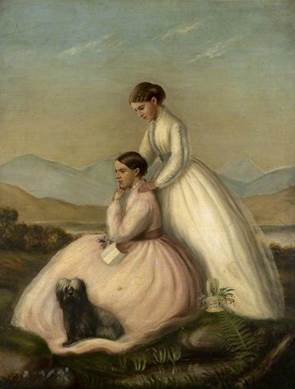
The sisters depicted in Fig. 1 are Charlotte Crawford-Cumming (seated) and Marion Finlay Crawford-Cumming. They are pictured in the garden of their home in Rosneath. The sisters were the daughters of Robert Crawford-Cumming (1808-1876) and his wife Sophia Connell (1815-1890). In 1839, Robert, on the death of his father Dougald, inherited the Barreman Estate on the Rosneath peninsula in Dunbartonshire. This estate comprised about six hundred acres and included the village of Clynder. On 13 August 1840 Robert married Sophia Connell in Rosneath 1 and on 24 June 1841 Charlotte Crawford-Cumming was born. 2 Her sister Marion was born on 22 September 1843.3 In the 1851 census, the family was at Port Street, St. Ninians, Stirlingshire with Sophia’s relatives. Robert was described as a ‘landed proprietor’. His lands included the House and Garden of Barrieman (Barreman), Barrieman Farm (occupier as well), Crossewan Farm, Stroul Farm, Stroul Park and Stroul Quarry. 4 In 1861 the family was at 42 Albany Street, Edinburgh with Charlotte 19 and Marion 17. 5 On 23 July 1868 Charlotte married Robert Henderson, eldest son of Robert Henderson of Malone Park, Belfast in St. John the Evangelist Church, Notting Hill, London. The service was conducted by the Rev. James Connell, Vicar of Hammersmith who was a cousin of the bride. 6 Robert’s father was a shipping agent in Belfast and was also involved in the ship building and ferry trade. In 1847, he became a Commissioner of Belfast Harbour Board and, in 1853, formed the Belfast Screw Steam Shipping Co. He became a shareholder in William Sloan & Co., of Glasgow in 1858 and acted as their agents in Belfast. Robert (1842-1895) carried on the business when his father died. 7 On 4 March 1871 Marion Finlay Crawford-Cumming married Edward James Henderson, merchant, brother of Robert, in St. James Piccadilly, London. 8 It seems that Marion’s parents attended the wedding as they were in London at the time. 9 In the same year, Robert sold his Rosneath Estate to Robert Thom of Canna for £20,300. It was described as a ’fine property…..extending a mile and a half along the Gareloch shore’. 10 The sale was apparently to avoid the estate passing to his nearest male relative who was resident in Australia, as it was covered by a Deed of Male Entail. The sale was thus strictly illegal. However, his wife and daughters appear to have received the funds after Robert died on 24 September 1876. 11 Marion Finlay Henderson (Crawford-Cumming) died aged thirty-five from convulsions leading to a coma at Strollamus, Isle of Skye on 9 January 1881. On her death certificate, her husband Edward is described as a ‘tacksman’. 12,13 Marion was buried on 17 January in Belfast City Cemetery. Edward Henderson died in Bath on 30 May 1890. 14 leaving his daughter Marguerite, orphaned and probably in the care of her aunt and uncle. Charlotte and her husband were staying at the Burlington Hotel in Hene, Worthing, Sussex at the time of the census of 1891 perhaps preparing for the marriage of their niece Marguerite. Robert was a ’shipowner’ neither employed nor employer. 15 Robert died four years later in London. Charlotte published an ‘In Memoriam’ in remembrance. 16 In ever loving memory of Robert Henderson, my beloved husband, who entered into rest on the night of the 30th December 1895 at Clarges Street, Mayfair. Charlotte died at 26 Dover Street, London on 9 January 1900. She was buried on 13 January in the Belfast City Cemetery. 17 Later that year it was reported that ‘the estate of Charlotte Henderson late of Belfast in the County of Antrim formerly of 41, Clarges Street, Piccadilly,….. was granted to Marguerite Kennedy Groome wife of Harry Groome of Luxford Cottage, East Grinstead.18 The ‘estate has been valued at £67,055 17s 10d (£66,223 11s 4d net) (and that she) devised and bequeathed all of her real and personal estate to her husband Mr. Robert Henderson, of Belfast who died in her lifetime……(the) estate has therefor been granted to her niece and only next-of-kin Mrs Marguerite Kennedy Groome 19 Marguerite Kennedy Groome nee Henderson was born on 10 May 1873 in Belfast. 20 She was the daughter of Edward James Henderson and Marion Crawford-Cumming. On 10 November 1893, Marguerite married Harry Groome at St. Botolph’s, Church, Hene, Sussex. 21 Harry was thirty-two and from Broadwater, Sussex. The couple spent their honeymoon in the south of France. 22 The wedding was attended by Mr and Mrs Robert Henderson, the bride’s uncle and aunt. 23 In March 1901, Marguerite, now twenty-eight, was living at Luxford Cottage, Lewes Road, East Grinstead, Sussex, with her husband Harry Groome and a son, Robert E. Groome, aged six and born in Eastbourne, Sussex. They were living on ‘Private Means’. 24,25 Ten years later Marguerite and Harry were boarding at Oak House, Brockenhurst, Lymington, Hampshire. 26 Their son Robert Edward Charles Groome aged sixteen was a boarder attending Harrow School, Harrow on the Hill, Middlesex. 27 Tragically, Robert Groome, died in 1915 after the battle of Ypres. 28
Second-Lieut. Robert E. C. Groome Royal Field Artillery, died near Ypres on March 4th (1915) of wounds received in action on the previous evening. The only child of Mr. and Mrs. Harry Groome of Brooklands, Brockenhurst, he was educated at the Priory School at Malvern and at Harrow, afterwards passing to the Royal Military Academy, Woolwich. He received his commission in December 1913 and at the time of his death was in his 21st year. 29
In the census of 19 June 1921 Marguerite was 46 years 1 month. She and Harry were living at Lymington Road, Brooklands, Brockenhurst, Hampshire. Marguerite was probably widowed before 29 January 1929, when she undertook a ‘round voyage’ from England. 30 In the pre-war register of 1939, Marguerite gave her date of birth as 10 May 1873. She was a widow living on private means at 6 Burlington Court Flats, Eastbourne, Sussex. 31 Thereafter Marguerite moved to Sidcliffe House, Sid Road, Sidmouth, Devon and in 1950 she advertised for a ‘cook-housekeeper’ and seems to have been quite particular! Required Cook-Housekeeper; one lady: small flat: age 45; C. of E.; good references. Apply by letter. – Groome, Sidcliffe House, Sidmouth’. 32
The two paintings were donated to Glasgow in 1952 probably because of the sisters’ birthplace in Rosneath near Glasgow. It may also have been about this time that Marguerite moved to a nursing home in Devon. It was here that she died on 14 October 1963 aged ninety. 33 Some details of her will were published the following year. Mrs Margaret Kennedy Groome of Cranford Nursing Home, Exmouth, Devon, widow of Harry Groome, formerly of Sidmouth, Devon, who died on October 14, leaving £149,365 (£148,559 net) left her property “Finaghy” Belfast and one half of the residuary estate to her cousins Jean McMullen and Sidney A. B. Smyth of Malone Park, Belfast and £100 to the Royal Victoria Hospital, Belfast. 34 She also left £100 to various hospitals and one half of the residuary estate to be divided equally between the N.S.P.C.C., St. Dunstan’s, the National Institute for the Blind, the Royal U.K. Beneficent Society, the Distressed Gentlefolks Aid Association, the R.N.L.I. and the R.S.P.C.A. 35
References
Scotland Marriages, 1561 – 1910, FamilySearch
Scotland Births and Baptisms, 1564 – 1950, FamilySearch
On 9 February 1871, William Ridge-Beedle (39), a general merchant, married Jane Walker Denniston (25) in Glasgow.1 After spending a few months in Glasgow with Jane’s parents 2, the couple moved to Buenos Aires, Argentina where a daughter, Elizabeth was born on 24 February 1872. 3 A son, Robert, was born in January 1874. Tragically, the same year that a second son, William, was born, Robert died of dysentery aged fifteen months.4 This may have prompted the family to move back to Scotland where on 20 November 1876, their son Peter Denniston Ridge-Beedle was born in his grandparents’ house at 17 Holyrood Crescent, Kelvin, Glasgow. Peter’s birth was registered by his grandfather, Robert Dennistoun, as his father had returned to Argentina and was ‘domiciled in Belgrana, Buenos Ayres’. 5 The following year Peter’s brother William died in Glasgow and on 2 December 1880 his father died of a suspected heart attack at Cathcart Railway Station in Greenock. 6 After his father’s death, Peter his mother and sister continued to live at his grandparents’ house at 17 Holyrood Crescent. 7 It is not recorded where Peter attended school. However
‘When I was fourteen, my mother, who was a widow, took my sister and myself for about eighteen months to the Riviera and Switzerland. There, I thoroughly acquired French and extended my knowledge of German, which I subsequently perfected. I then tackled Spanish and, after having reached an advance stage in it, was thinking of starting to master a further language, as I had become keen on acquiring them. ……..in later years I acquired a considerable knowledge of Italian’. 8
On return, the family moved to 12 Ashton Gardens, Govan where Peter’s mother was tenant/occupier. 9 By 1898, the firm of Ridge-Beedle & Co., merchants had been established at 116 Hope Street, Glasgow. 10 The following year there would appear to have been a partner in the business.
Beedle, Peter D. Ridge 12 Ashton Gardens (of MacBean & Ridge Beedle, merchants, 57 West Nile Street), later Ridge Beedle & Co., merchants, 116 Hope Street 11
In 1901 Peter, now twenty-four and a merchant was living at 18 Ashton Gardens with his mother Jane who was the head of the household and his sister Elizabeth twenty-nine. There were two servants in the house. 12 It may be that Peter’s mother took more than a passive interest in his business as in 1905 she was the proprietor of a warehouse and workshop at 90/92 Argyll Street, Glasgow. 13 On the census of 1911 Peter’s mother and sister were visiting his aunt Agnes Denniston in Dunoon. Mother and aunt were living on ‘private means’. 14 Peter does not appear on the census. Just prior to World War One, Peter submitted a paper on Air Ships in Naval Defence to the Navy League but was met with little interest. He warned of the ‘aerial threat’ from Germany particularly from a fleet of Zeppelins that Germany was building. 15 In a speech to the Navy League in Glasgow he warned that compared to Germany, Britain only had three tiny airships and about twenty aircraft. The meeting adopted a resolution requesting a grant of £1,000,000 from the Treasury to the Royal Flying Corps. 16 As the war progressed, Peter became more involved with the Navy League. He was Hon. Treasurer of the Ladies Committee appealing for funds to send ‘comforts’ to Royal Navy personnel and to provide food parcels for naval prisoners of war. 17 He was also an early advocate of a ‘Mid Scotland Ship Canal’ and as Hon. Secretary of the Glasgow and West of Scotland branch of the Navy League he sent a letter to the Government urging that such a canal be constructed on a direct route from Grangemouth to Yoker.18 Perhaps feeling that his political views would be best put forward in parliament, on 24 October 1918 he was adopted as the prospective Unionist candidate for the Clydebank and Dumbarton Burghs constituency. He was described as a ‘prominent iron ore merchant of the firm of Messrs. Ridge-Beedle & Co.’ 19 He appears to have withdrawn his candidacy before the election as his name did not appear on the ballot paper. On 31 March 1919, Peter arrived in New York having sailed from Liverpool aboard the S.S. Orduna. He intended to stay for one month. On the ship’s manifest he is described as ‘5ft 6 1/4 in, dark brown hair, dark grey eyes, fair complexion, person in old country, Mrs J. W. Ridge-Beedle., mother’. 20 On his return he was involved in a serious accident on the Drymen Road outside Glasgow when his chauffeur-driven car was involved in a collision with another car. His mother and sister who were with him sustained broken bones when the car overturned. He himself had his leg crushed and his face lacerated. Luckily the chauffeur managed to turn the engine off to prevent a fire. 21 In 1920, Ridge-Beedle and Co. Ltd. was registered as a private company with capital of £40,000 to carry on the business of ore, metal, foreign and general merchants etc. 22 Its offices were at 116 Hope Street, Glasgow with a garage at 17 Elliot Lane, Govan. 23 In 1921 Peter’s mother was still head of the household at 18 Parkville Road, Partick with Peter an ‘ore, metal and foreign merchant’. His sister Lizzie was also present and two servants. 24 In the following three years, Peter again stood for Parliament as a Unionist candidate. In Bothwell in 1922 and 1923 where he lost to Labour and in 1924 in Camlachie where he again lost to Labour but by a close margin of 215 votes.25 Perhaps encouraged by this result, he was again adopted as the Unionist candidate for Camlachie in the 1929 General Election. In a pre-election address at Dennistoun Parish Church, he directed his ire at the Scottish National Party. ‘There was undoubtedly a sinister aspect about this movement in that there existed a Roman Catholic tinge amongst its leaders’. 26 He also blamed the influx of Irish people for the fact that many Scots could not find employment. However, he failed to impress the voters of Camlachie and was again unsuccessful. In the 1930s, Peter was living at 55 Dowanside Road, Hillhead, Glasgow presumably with his mother and sister. 27 Jane Walker Ridge-Beedle died on 30 August 1938 at the age of ninety-two. In 1939 Peter was made a Life Member of the Iron and Steel Institute. He was Governing Director, Ridge-Beedle & Co. of 116 Hope Street, Glasgow. His private address was 6 Albert Gate, Glasgow. 28 During WW2, Peter was again involved with The Navy League, this time as chairman of the Glasgow and West pf Scotland branch. Under the banner ‘Lend a Hand’, advertisements appeared appealing for ‘knitted goods and gifts of all kinds for the men of the fleet’ Subscriptions were to be sent to the chairman. 29 In times of rationing it was clarified later that the wool to be used was ‘coupon free’ and sold at reduced prices. 30 Peter Ridge-Beedle had long been an advocate of the Mid-Scotland Ship Canal. This was a proposal first mooted in the late nineteenth century to build a canal capable of carrying large ships from the Forth to the Clyde via Loch Lomond. It was debated in Parliament in 1913 and a report produced in 1917. However, it was not carried forward. The idea seems to have been revived in the war years, and a Mid-Scotland Ship Canal Committee set up with Peter as a member. The report was submitted to Parliament with a booklet published independently, by Peter in January 1944 entitled Report of Mid-Scotland Ship Canal Committee….The Case for the Canal etc. However, the proposal was not well received, not least by the Glasgow Chamber of Commerce which prompted a furious response from Peter. 31 Peter Ridge-Beedle continued as chairman of the Navy League in Glasgow and in 1945 received a letter from Buckingham Palace informing him that the Queen had instructed that a consignment of comforts be sent to their Glasgow depot. These had been made by the Buckingham Palace, Windsor Castle and Balmoral work parties. 32 Consistent with his interest in languages, Peter in 1947 published a book Why Not English? Which claimed to contain ‘A New Alphabet for the English Language (The Bedel Alphabet) enabling each word to be spelled as it is pronounced and pronounced as it is spelled’.33
Fig. 3 Advertisement for Why Not English and ‘The Bedel Alphabet’ (Stratford Press)
Fig. 4 Example of the Bedel Alphabet in use
A favourable review appeared in the press but the new alphabet seems not to have been taken further.34 On 10 January 1952, two years after the death of his sister, Peter intended to leave Liverpool aboard the Reina Del Pacifico heading for Valparaiso, Chile. It is not clear that he undertook the voyage as his name has a line through it on the ship’s manifest. His address was 8 Albert Gate, Dowanside Road, Glasgow. 35 Peter Denniston Ridge-Beedle died suddenly on 8 May 1952 at 121 Hill Street, Glasgow. He was seventy-six. 36 Just a few days before his death he had been re-elected as a director of the Scottish General Insurance Co. Ltd. 37 A brief obituary appeared in a local newspaper.
P. D. Ridge-Beedle (76), a well-known Glasgow merchant who in 1947 published the “Beedle Alphabet”, which was designed to make the spelling and pronunciation of English correspond. He was a director of two prominent insurance and assurance companies. 38
He was buried in the Glasgow Necropolis. The inscription on the gravestone reads:
Erected by PETER DENNISTON RIDGE-BEEDLE Merchant Glasgow in memory of his father WILLIAM RIDGE – BEEDLE Foreign Merchant who died 2nd December 1880 aged 48 years, and his mother JANE WALKER RIDGE-BEEDLE who died 30th August 1938 aged 92 years, who are interred in the vault in the 5th avenue to the west of her father ROBERT DENNISTOUN Shipowner Glasgow, also his brothers ROBERT and WILLIAM who died in infancy in 1875 and 1877 and interred in this vault, his sister ELIZABETH( LIZZIE) DENNISTON RIDGE-BEEDLE who died 27h February 1950 aged 78 years, PETER DENNISTON RIDGE –BEEDLE Merchant Glasgow born 20th November 1876, died 8th May 1952
Two years after his death, on 30 December 1954, the firm of Ridge-Beedle & Co., Ltd. was wound up voluntarily. 39
References
Scotland’s People, Marriage Certificate
Scotland’s People, Census 1871
Baptisms Recorded at St. Andrew’s Scots Presbyterian Church Buenos Aires, Vol. 3 1871-1878, Jeremy Howat, June 2015
Deaths Recorded at St. Andrew’s Scots Presbyterian Church Buenos Aires, Vol. 3 1871-1878, Jeremy Howat, June 2015
Scotland’s People, Birth Certificate
Scotland’s People, Death Certificate
Scotland’s People, Census 1881
Why Not English? The Stratford Press, 116 Hope Street. Glasgow, 1947
Scotland’s People, Valuation Roll, Govan, 1895
Grace’s Guide
glasgowwestaddress.co.uk
Scotland’s People, Census 1901
Scotland’s People, Valuation Roll, Glasgow 1905
Scotland’s People, Census 1911
Aberdeen Press and Journal, 13 March 1913
The Scotsman, 13 March 1913
Glasgow Herald 30 October 1916
Milngavie and Bearsden Herald 13 July 1917
Glasgow Observer and Catholic Herald, 2 November 1918
New York, Passenger Arrival Lists (Ellis Island) 1892-1925, family search
Daily Record, 15 October 1919
Grace’s Guide
Scotland’s People, Valuation Roll, Govan, 1920
Scotland’s People, Census 1921
United Kingdom Election Results, Wikipedia
John o’ Groats Journal, 9 November 1928
Scotland’s People, Valuation Roll, Glasgow 1935
Grace’s Guide
Daily Record, 22 January 1940
Various newspapers, e.g. Linlithgowshire Gazette, 10 October 1941
Daily Record, 1 February 1944
The Scotsman, 10 March 1945
Why Not English, The Stratford Press, 116 Hope Street. Glasgow
Daily Record, 26 January 1948
ancestry.co.uk, UK and Ireland Outward Passenger Lists, 1890-1960
On 6 September 1881, John McLean Finlayson married Elizabeth Semple in Hillhead, Glasgow.1 The following year, on 17 September, their daughter Elizabeth Campbell Finlayson was born at 19 Shaftesbury Terrace, Glasgow, Kelvin.2 By 1891, the family had moved to 144 Holland Street and Elizabeth now had two sisters, Georgina and Margaret. The family also employed two servants. 3 Ten years later, Elizabeth aged eighteen and an arts student had moved with her parents and siblings to forty-seven Albert Drive, Pollokshields. John Finlayson was now a sugar broker. 4 Shortly afterwards, the family moved again. This time to 8 Matilda Road, Pollokshields 5 and from the census of 1911, Georgina was now twenty-seven and a music student while Margaret, aged twenty-two, was a student in arts. 6
On 27 June 1914 at the Trinity Free Church, Claremont Street, Glasgow, Elizabeth Campbell Finlayson, thirty-one, married William Barr Inglis Pollock an ophthalmic surgeon aged thirty-six. The wedding reception was held in the Grand Hotel.7,8 After a honeymoon in Switzerland, the couple moved into the groom’s home at 21 Woodside Place, Glasgow. In 1916, Dr. Inglis Pollock completed registration for the Medical Recruiting Scheme. He was at that time Consultant Assistant Surgeon, Glasgow Eye Infirmary, Ophthalmic Surgeon, Ayr County Hospital, Govan School Board and Ayr School Board. He stipulated that should his services be required, arrangements had to be made to ensure his present work was carried out during his absence. 9 The couple continued to live at 21 Woodside Place. 10 In 1926, Dr. Pollock applied unsuccessfully for the Chair of Ophthalmic Medicine and Surgery at the Anderson College of Medicine.11 Dr. Inglis Pollock died aged seventy-five at 1055 Great Western Road, Glasgow (usual residence 21 Woodside Place). He was an ophthalmic surgeon, retired. 12 The two paintings were given to Glasgow shortly afterwards, possibly as a result of Elizabeth downsizing. Elizabeth Campbell Pollock died of a cerebral haemorrhage aged eighty-one on 23 September 1963. She was found dead at 14 Royal Terrace, Glasgow. Her death was reported by a nephew John A. Barr Pollock. 13
Daily Record, 29 June 1914 (This contains a full report of the wedding including a description of the dresses etc. worn by the bride and bridesmaids. Two of the latter were the bride’s sisters, Georgina and Margaret. The best man was Mr. A. Barr Pollock from Hong Kong, brother of the groom).
https:/smsec.rcpe.ac.uk
Scotland’s People, 1921 Census
Archives of Royal College of Physicians and Surgeons, Glasgow.
The subject of the painting is Mrs Ellen Watson (c1820-1902), our donor’s paternal grandmother. Painted by Sir James Guthrie c1898 it has been exhibited on several occasions including at the RSA in 1901, The Franco -British Exhibition in 1908, Links House Scottish Art Promotion in Glasgow in 1966 and the Arts Council’s London and Empire Tour ‘Decade 1890-1900’ in 1967.1 The painting was in the possession of the sitter’s son George Lennox Watson(see below) until his death in 1904 and was then passed down the family until it was gifted to Glasgow Museums by the sitter’s granddaughter Mrs Ellen Marjorie Grenside or Watson in 1952.2
Ellen Marjorie Watson (1904-1963)
Ellen Marjorie Watson(known as Madge) was born at 9 Highbury Terrace Dowanhill Glasgow on 29 April 1904. Her father was George Lennox Watson (GLW)and her mother was Marie (or Mary) Alice Lovibond .3 By the time of our donor’s birth her father was well established as a yacht designer of great repute.4
GLW was born on 30 October 1851 in Regent Street Glasgow. His father was Thomas Lennox Watson, a doctor at Glasgow Royal Infirmary, and his mother, the subject of our portrait, was Ellen Burstall ,5 daughter of engineer Thomas Burstall who was involved in the Rainhill Locomotive Trials in 1828/9.6 As a boy GLW spent holidays at Inverkip on the River Clyde where he is believed to have developed a passion for yachts and at the age of sixteen became an apprentice draughtsman at the shipyard of Robert Napier andSons in Glasgow. During this training period GLW was involved in the use of hydrodynamics in yacht design. He went on to gain more experience with Aand J Inglis Shipbuilders . In 1873 at the age of twenty two he founded the world’s first dedicated yacht design office-G Watson & Company. He had early success with racing yachts such as Verve, Clothildeand Vril.This brought his name to the fore as the most innovative yacht designer of the time. Though he was personally involved in the building and part ownership of these early yachts he never made a business of yacht building instead concentrating on yacht design. He went on to design over 400 yachts for some of the wealthiest men in the world venturing into steam yachts from 1885. 7
In 1893 GLW designed the Britannia (see Figure 3) for Edward ,Prince of Wales, later Edward VII who was a keen sailor. The yacht was built at the Clyde yard of D& W Henderson. In 1910 the new king George V, also a keen sailor, inherited Britannia and competed with it successfully for the rest of his life .8 GLW designed four yachts for the Americas Cup Race including Shamrock IIfor Sir Thomas Lipton .9
Other famous clients included the Tsar of Russia (Zarnitza),10 F. W.Vanderbilt the American millionaire(Warrior) which was launched by Mrs Marie Watson in February 1904.11 GLW also redesigned Scotiafor the Scottish Antarctic Expedition of 1902-4 .12
In addition to yacht design GLW was also heavily involved with the Royal National Lifeboat Institution (RNLI). He became consulting Naval Architect in 1887 and remained involved with the RNLI for the rest of his life. He developed the Watson- Class Lifeboat which in several variations was operated by the RNLI around the coasts of Britain and Ireland between 1888 and 1991 .13 As we shall see this involvement influenced his daughter throughout her life
Involvement in yacht design and other interests seemed to leave GLW little time for his personal life. He did not marry until he was 52 years old when he married Marie Alice Lovibond in Putney ,London on 10 June 1903. The wedding was described as ‘a gathering of the most fashionable people in society.’ Sir Thomas Lipton, Lord Dunraven and Peter and James Coats of Ferguslie were among many other prominent guests .14 The couple lived at 9 Highbury Terrace, Dowanhill, Glasgow where our donor was born .15 Ellen or Madge as she became known ,was to grow up not knowing her father as he died suddenly on 12 November 1904 of ‘Coronary asthma’. 16
Shortly after her father’s death Madge and her mother moved from Glasgow to Putney Hill, Greater London where they lived at 12 Chartfield Avenue . Marie Watson came from Putney so they possibly moved there to be near her family. According to the 1911 Census the house was also occupied by Madge’s nurse and three servants .17 The Watsons lived at this address until 1922 when they moved to a house called Vril in Holloway Hill, Godalming in Surrey. The house was probably named after one of Madge’s father ‘s first yachts and was previously known as Braemar House until bought by the Watsons .18
There is little information about our donor’s life in the nineteen twenties and early thirties but we do know that she was a talented pianist gaining the Licentiateship of the Royal College of Music in 1927 which qualified her to teach the piano.19 She was also pianist for the Rainbow Band, ‘a small ensemble of the daughters of Godalming families specialising in playing for charity concerts .’20 One example of this was in January 1931 when ,’Miss Madge Watson and the Rainbow Band provided the music for a pantomime The Sins of Cinderella’ which was performed by The Cottage Players at the Church Room in Godalming to raise money for the Church Room Building Fund. 21 Rainbow was also the name of one of Madges fathers yachts.(Wikipedia)22
Madge was said to be involved in numerous social activities including the Godalming Badminton Club and the Hindhead Golf Club. She was also heavily involved with the Godalming branch of the RNLI ,appointed as honorary secretary, in 1929 ,an office she held for 30 years .23
Madge’s mother died on 23 March 1929 leaving her daughter living alone at Vril .24 However at the age of thirty Madge married Philip James Grenside (known as Jimmie) ,an electrical engineer, on 20 January 1934 at the Church of St Peter and St Paul in Godalming.25 We do not know how they met but perhaps through mutual social interests such as sport as Jimmie was also a member of the Godalming Badminton Club and the Hindhead Golf Club.
George Lennox Watson was not forgotten at the wedding as the wedding cake was decorated with a silver cup presented by the RNLI on the occasion of the marriage of Madge’s parents .26
Figure 6 Wedding of Philip James Grenside and Ellen Marjorie Watson
The couple both lived at Vril after the wedding. A son, George, was born in 193527 followed in 1937 by a daughter, Hazel .28 In 1938 they moved to The Mount, Bushbridge Lane, Godalming and this house was renamed Vril .29There in 1940 a third child, Lois, was born. 30 There appear to have been three servants living in the house including Alice Agnew .31
Jimmie was a member of Brooklands Flying Club and in June 1935 acquired a Royal Aero Club Aviators Certificate .32 According to the 1939 Register by 1939 his occupation was that of Assistant Flying Instructor .33 From April 1940 until November 1945 Jimmie was a First officer in the Air Transport Auxiliary which had been established in 1939 for the purpose of delivering aircraft to the Royal Airforce and the Royal Navy as well as other air transport tasks auxiliary to the war effort .34
Madge continued her volunteer work as honorary secretary of the Godalming RNLI. In 1936 she was awarded the RNLI Gold Badge for her work .35 Her work continued during the war. For example in September 1941 she organised a whist drive at the Church Rooms in Godalming which raised £16.36 just one of many fundraising events. Throughout her life she helped raise a total of £7750 for the RNLI. In 1949 she was appointed an Honorary Life Governor. 37
Madge was also involved with the British Red Cross Society, The British and Foreign Bible Society ,The Mission for Seamen and the United Nations. She was a regular church goer attending the Busbridge Parish Church and later of St Johns Church, Farnham .38
Madge was also interested in local history and for many years was Honorary Curator of the Weybridge Museum which had been founded in 1911.39
By the end of the war the Grensides had moved to Ramsden Road, Godalming .One of the former servants ,Alice Agnew, was still living with the family. Again the house was names Vril .40
By 1961 Madge, Jimmie and the three children had moved again to Flat 1, Frith Hill House ,Nightingale Road, Farnham .41 Here Jimmie died on 8 July 1961. His estate on his death was very small 42 compared to that of Madge 43 who died at the Royal Surrey Hospital on 24 August 1963. As was said in the obituary published in the Guilford and Godalming Advertiser,
‘ Mrs Grenside devoted most of her spare time to helping others less fortunate than herself ‘.44
References
1. Glasgow Museums Resource Centre Object File 2949 Grenside Mrs E. M