On 3rd September 1943 an oil painting with the title Landscape by R. Macaulay Stevenson was bequeathed by Mr Samuel M. Mavor. The painting has an acquisition number 2339.

The minutes of Glasgow Corporation for the 17th August 1943 contain the following: “There was submitted a letter from Mclay, Murray and Spens, Solicitors, intimating that the late Mr Mavor of Cleghorn House by Lanark had bequeathed to the Corporation, subject to the life-rent enjoyment of his sister, a landscape by Macaulay Stevenson and that Mr Mavor`s sister had given authority for the picture to be delivered to the Corporation now. The Committee, after hearing a report from the director, agreed that the bequest be accepted, and that delivery of the picture be taken now.”
On 3rd September 1943, a note in the minutes indicates that a “Landscape by R. Macaulay Stevenson had been received”. 1
Samuel Miller Mavor was born on 3rd June 1863 at 25, Kelvinhaugh Street, Anderston.2 He was the fifth of seven boys born to James Mavor, a schoolmaster and Free Church minister, and his wife Mary Ann Taylor Bridie. His parents married on 22nd August 1851 in Barony. Samuel also had three sisters, 3 one of whom, Jessie, was also to become a donor to Glasgow (see Acquisition Number 2559). At the time of the 1871 Census the family was at Middleton Cottage, Dunoon with Samuel aged seven and a “scholar”. His father`s occupation was “schoolmaster” born in Aberdeen; his mother was born in Forfar. 4
Samuel`s father graduated M.A. from the University of Glasgow in 1871 as a Licentiate of the Free Church. Thereafter he was the Principal of a Private Academy in Pollokshields till his death in 1879.5 It was at this Academy that Samuel received his early education before moving to the Glasgow Royal Technical College.6 He then began serving his time as an apprentice engine fitter with Robert Harvey and Co. at Parkgrove Ironworks 7 and in the 1881 census, he is aged 17 and an “engine fitter”, living with his mother, seven siblings and two servants at “Devon Bank Villa”, Kinning Park.8 Later that year he enrolled at Glasgow University to study Natural Philosophy.9
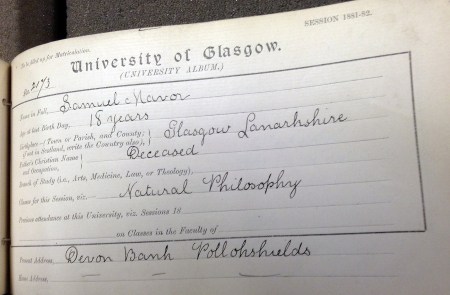
However, his time at university seems to have been short or non-existent as he went to work for his brother Henry, the agent in Scotland for the firm of Crompton and Co., who were pioneers in setting up electric lighting systems in Britain and Ireland.10 His first “lighting” task was to illuminate the square in front of Holyrood Palace while Queen Victoria was in residence in 1881. Earlier he had been on parade as a volunteer in the 105th Glasgow Highlanders and from his own account, had to do a quick change to prepare for the demonstration.11
One of the Mavors` achievements was to install, in 1884, electricity to light the General Post Office in George Square, Glasgow. This was the first public building in Glasgow to have electric lighting installed. This was followed by other establishments in Glasgow i.e. the Royal Exchange and Messrs. Arthur & Co., Ltd. (In 1890, Glasgow Corporation purchased the generating plant, and this became the nucleus of the public electricity supply in Glasgow).12
Samuel undertook the first of many foreign travels in 1886 when he sailed from the Tyne aboard a Japanese warship to serve as a junior engineer in the Japanese Navy.13 On his return he joined his brother`s firm of Muir and Mavor, electrical engineers.14 Later, when the firm became Mavor & Coulson, Samuel became a partner.15
He had been involved in the erection of electric lighting plant during the construction of the Forth Rail Bridge and had become friends with Sir William Arrol. After his return from the Far East, Sir William had offered him the post of Chief Electrical Engineer at the bridge which, because of his commitment to his firm, he felt obliged to refuse. Later he introduced Arrol to the collector and connoisseur T.G. Arthur when they met at Ayr Racecourse. 16
In the 1891 census, Samuel was living with his mother, three sisters and two servants at 4 Elmbank Crescent, Glasgow He was now an electrical engineer aged 27.17
The Mavors had a long connection with Russia. His mother had spent a winter in St. Petersburg and Moscow and his grandfather, Captain Bridie “in 1839 left Dundee on the brig Europe” bound for St. Petersburg. But in the Gulf of Finland the ship was chased by pirates and ran ashore. (Using the insurance money, the captain later managed to have the ship refloated but on its return voyage it was wrecked in a storm off the Mull of Kintyre and was not insured). 18 The Thornton Woollen Mills Company owned a giant mill near St. Petersburg and in 1896 an order was placed with Mavor and Coulson for the electric lighting of the mill. Samuel travelled out to see the completion of the first stage of the enterprise. As well as St. Petersburg he visited Moscow and other cities in Russia. Two years later, in 1898 he undertook a voyage across Russia as the guest of a large Russian transport company which had ordered electrical plant from Mavor and Coulson. 19 In 1899 and 1900 he addressed the Royal Philosophical Society of Glasgow about his travels in Russia. 20
By 1901 he had moved to 37 Burnbank Gardens, Maryhill with his sister Isabella. He continued to work for Mavor & Coulson who advertised themselves as;
“manufacturers of electric dynamos, motors and coal cutters; and contractors for the erection and equipment of electric power and lighting in Central Stations, public works, factories, coal mines, and public and private buildings”. 21
In 1897 the company had started to build electric coal-cutting machines. They were the first to manufacture a completely enclosed electric coal-cutter and the first to incorporate an ironclad motor in one of these machines.22 Samuel specialized in this part of the business. He was a pioneer “notably in the providing of the machinery for mechanical coal cutting” and was “recognised as one of the highest authorities in the country in that branch of his profession”. He wrote many papers on the subject and many of these were translated into French and German 23.
“It was Sam Mavor`s faith in the future of electric coal-cutters that kept the enterprise going, and when mining machinery became a permanent part of the company`s interests, it was he who organised the nucleus of mining engineers who supervised the commissioning of machines. Sam Mavor was active in other countries as well – by 1914 continental coal- producing countries were buying 90 percent of their long-wall requirements from Mavor and Co.” 24
In 1908 he was one of a group invited by the Canadian Mining Institute to tour Canada`s mining and smelting industries. The tour began in Nova Scotia and extended to Vancouver Island. On his return journey while staying at the Banff Springs Hotel, he met an acquaintance whom he had known in Scotland:

“My friend was Edmund Morris, a Canadian artist whom I had known some years earlier when he spent a summer painting on the coast of Fife. He was now working on a commission for the Canadian Government – the painting of portraits of the Chiefs of the various Indian tribes; these now hang in the National Gallery at Ottawa. ……I asked him to paint for me the portrait of a representative chief; some time after my return home it arrived – a very striking portrait of Tcillah (Bullhead) the Head Chief of the Sarsee Indians, titled “The Mourner” for his only son had just died”. 25
This portrait was donated to Glasgow Corporation in 1946 by Samuel`s sister Jessie. (Acquisition Number 2559) © CSG GIC Glasgow Museums Collection.
Samuel continued to travel; in 1910 he was in Germany and was one of the passengers in the maiden voyage of the airship, Düsseldorf; he was in America in 1911 and in Provence in 1912 and also found time to travel in Scotland 26 His address was still 37, Burnbank Gardens where he was now living with two of his sisters and two servants. 27
By 1913, the output of coal cutting machinery reached its peak and was exported world-wide. In this year, 25 percent of Scottish coal was cut by machinery and Mavor and Coulson were at the forefront of production. When his brother Henry died in 1915 Samuel took over the management of the company.
During WW1, Samuel Mavor was a director of the Glasgow Chamber of Commerce and served on various government committees including the Industrial Welfare Committee of the Ministry of Munitions. 28

Throughout his life Samuel Mavor made friends with people from many different backgrounds. He befriended; revolutionaries – Prince Peter Kropotkin, academics – George Forbes – Professor of Natural Philosophy at Anderson`s College, Glasgow and for many years the deliverer of the David Elder Lectures on Astronomy at the Royal Technical College; John Scott Haldane whom he met at meetings of the Council of the Institution of Mining Engineers (Professor Haldane carried out research into the composition of the atmosphere in mines); authors – R.B. Cunninghame Graham whom he last met in 1935 at the unveiling of a memorial to Neil Munro near Inveraray, (Mavor and Coulson had previously installed equipment for the lighting of Inveraray Castle); shipbuilders – Sir Archibald Denny whom he met when Peter Denny placed an order with M&C for a power station to provide electric light in his shipyards. The two also met at meetings of the British Standard Institution. He met Auguste Rodin in 1900 with a group of admirers of Balzac. He later wrote that “Our Kelvingrove Galleries contain casts of Rodin`s St. John the Baptist, Head of Victor Hugo and a figure from the group The Burgesses of Calais”. 29
He was also a well-respected employer. Thanks in large part to his initiatives, Mavor and Coulson adopted enlightened methods for works organisation and were praised for their scheme for education and welfare among their apprentices. They produced the “Mavor and Coulson Apprentices Magazine”, the first of its kind in Scotland. A bonus system of wages was introduced – payment by results which enabled the employees to earn high wages – while a suggestion scheme provided workpeople with awards for initiative. When Mavor and Coulson celebrated its jubilee in 1931, Samuel was presented with his portrait in oils from the employees. 30

The following year he left Glasgow for New York aboard the “Cameronia” and arrived there on the 9th of February 1932. He was then 68.32 He retired from the position of managing director of the firm in 1934 but retained the chairmanship. He was succeeded by his nephews, Mr J. B. Mavor and Mr. E. I. Mavor, sons of the founder of the firm. In the same year, to recuperate from a severe illness he spent three and a half months of the winter in Jamaica. This included a two-week voyage through the Azores and a stop in Bermuda. He visited South Africa in 1935 and flew from Johannesburg to Capetown a distance of 820 miles in a time of 8 hours. In 1939 at the age of 76 he left Liverpool 33 bound for South America visiting Chile and the Falkland Islands and voyaging around the tip of the continent to visit Juan Fernandez (Robinson Crusoe`s island).
In 1940 he published a volume of reminiscences, “an informal record of 50 years of engineering and the friendships it yielded”.34
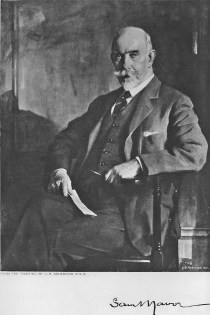
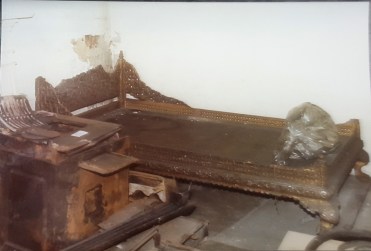
In this book he also records another donation which he made to Glasgow – King Theebaw`s Bed. Theebaw was the last king of Burmah deposed by the British. Samuel first came across the bed at the house of a retired Rangoon merchant. When this merchant died his goods were dispersed and sometime later Samuel came across it again in an antique furniture shop in Edinburgh. He bought it and so this “gaudy relic of fallen royalty” now resides in the Glasgow Museums Resource Centre looking rather the worse for wear.35
In 1925 Samuel Mavor made a further donation to Glasgow. This was a bronze bust of the poet Roger Quinn by Alexander Proudfoot, A.R.S.A.36

Roger Quinn was a Border`s Poet author of “The Borderlands”. His death in 1925 seems to have prompted the donation of the bust. One of his poems describes a scene in George Square, Glasgow;
NOCTURNE George Square, Glasgow, 2 A.M.
The City’s clamour now has ebb’d away,
And silence settles o’er the dusky Square,
Save for a cough, sepulchral, here and there,
From shivering forms, that wait the coming day;
Hunger and Houselessness, without one ray
Of hope to chase the shadow of Despair,
Keep weary vigil in the wintry air,
Each heart to dread Despondency a prey.
Proudly the Civic Palace, over all,
Looms through the night, and, with a sculptur’d frown,
Meets the dull gaze of Want’s lack-lustre eye:
Till slowly, like some vast funereal pall,
The chill, dense curtain of the mist creeps down,
Shrouding the splendour, and – the Misery!
Roger Quin 1850-192537
The following is a list of the many posts Samuel Mavor at one time or another held
“Chairman of Mavor and Coulson Ltd; Member of the Scottish Committee on Art and Industry; Governor, Glasgow Western Infirmary; Glasgow Royal Technical College; Glasgow School of Art; Director on Board, Glasgow Chamber of Commerce; President, Mining Institute of Scotland, 1936-38; past Chairman, Scottish Section of Institution of Electrical Engineers; Member of Council, Institution of Mining Engineers; Director on Board, Glasgow Eye Infirmary; past Chairman, N.W. Engineering Employers Assoc.; Member of Council, The Royal Scottish Geographical Society.” He was also the author of many papers on Geographical, Engineering and Mining subjects. 38
Samuel Miller Mavor died, unmarried, on 11th June 1943 aged 80 at Cleghorn House, Lanark.39 His death was announced in the Glasgow Herald of 12th and an obituary, was published on page 4 of the same issue.
Although Samuel Mavor had no children, his nephew was Dr. O. H. Mavor aka James Bridie the playwright.
References
- Minutes of Glasgow Corporation, Committee on Art Galleries and Museums, Vol. Apr. – Nov. 1943, p 1300 (Mitchell Library)
- Scotland`s People, Birth Certificate
- Family Search, Scotland, births
- Scotland`s People, 1871 Census
- Addison, W. Innes, “Roll of Graduates of the University of Glasgow, 1727 – 1897”, Glasgow, James MacLehose and Sons, 1898
- Scottish Biographies, 1938. London: E. J. Thurston, Glasgow: Jackson, Son & Co., 1938
- Glasgow Herald, 12th June 1943, p4 (Obituary)
- Scotland’s People, 1881 Census
- Matriculation Album, University of Glasgow Archives
- Glasgow Herald, 12th June 1943, p4 (Obituary)
- Mavor, Sam, “Memories of People and Places”. London: William Hodge and Co., 1940, p11
- http://www.theglasgowstory.com/image.php?inum=TGSA05173
- Mavor, Sam, “Memories of People and Places”. London: William Hodge and Co., 1940, p4 and p236
- The Glasgow Story, Mitchell Library, GC 052 BAI (theglasgowstory.com/)
- Index of Glasgow Men, 1909, (glasgowwestaddress.co.uk/1909)
- Mavor, Sam, “Memories of People and Places”. London: William Hodge and Co., 1940, p45
- Scotland`s People, 1991 Census
- Mavor, Sam, “Memories of People and Places”. London: William Hodge and Co., 1940, pp 4 and 5
- Ibid, pp 163 – 186
- Op. cit, Preface
- Glasgow Post Office Directory, 1911-12
- gracesguide.co.uk/Mavor_and_Coulson
- The Bailie , “Men You Know”, No. 2498
- “Mavor and Coulson, Ltd.”, Colliery Guardian, July 23rd, 1965
- Mavor, Sam, “Memories of People and Places”. London, William Hodge and Co., 1940, pp305 – 306
- A collection of his photograph albums, Mitchell Library, Glasgow Archives, TD1440
- Scotland`s People, 1911 Census
- Glasgow Herald, 12th June 1943, p4 (Obituary)
- Mavor, Sam, “Memories of People and Places”. London, William Hodge and Co., 1940, p 116
- Glasgow Herald, 12th June 1943, p4 (Obituary)
- britainfromabove.org.uk/image/spw035722, (Image reference SPW035722 Date 30th June 1931)
- ancestry.co.uk, New York Passenger Lists, 1820-1957
- ancestry.co.uk, UK Outward Passenger Lists, 1890 – 1960
- Mavor, Sam, “Memories of People and Places”. London: William Hodge and Co., 1940
- ibid. p 325
- Letters on file at Glasgow Museums Resource Centre
- https://www.flickr.com/photos/summonedbyfells/5992710917 (https://creativecommons.org/)
- Scottish Biographies, 1938, E.J. Thurston, Glasgow: Jackson, Son & Co., 1938
- Scotland`s People, Death Certificate

 Glasgow Museums Art Donors Group