William Graham Greig (1910-1999)

In 1949 Baillie William Graham Greig (WGG) donated the following paintings to Glasgow.
Lavery, John, 1856-1941; Potter at Work
Figure 1. Potter at Work  John Lavery 1888  Acc. 2835 © CSGCIC Glasgow Museums
Lavery, John, 1856-1941; Woman Painting a Pot
Figure 2. Woman Painting a Pot  John Lavery 1888 Acc 2834 © CSGCIC Glasgow Museums


Two potters from Bengal,Tarini Charan Pal and Harakumar Guha, were brought to Glasgow to demonstrate their craft in the Indian Court at the 1888 Glasgow International Exhibition. The Indian Court was a very popular feature of the Exhibition.¹These paintings were two of the fifty or so which Lavery  painted of the 1888 Glasgow International exhibition. In October 1888 the paintings were exhibited at the Craibe Angus gallery in Queen Street ,Glasgow.²

There is no information as to how these paintings were acquired by William Graham Greig. Woman Painting a Pot has been exhibited on several occasions including in 1951 in an exhibition of John Lavery paintings at the Belfast Museum and Art Gallery, in 1983 at the St Andrews Crawford Centre for the Arts, again in an exhibition of John Lavery paintings,  and  in 1990 at Kelvingrove Art Gallery and Museum in Glasgow in an exhibition entitled  Women in Art and Design 1880-1920. The paintings are currently on display in the Glasgow Boys Gallery at Kelvingrove Art Gallery and Museum, Glasgow.3

The model featured on the Doulton stand was Alice Groom. According to the 1881 census she was living in Auckland Street, Lambeth with her widowed mother  Eilzabeth, who was a dressmaker, and two younger brothers. Alice’s occupation is recorded as ‘artist/painter’. She almost certainly trained at the  Lambeth School of Art which had been set up in 1854 to teach applied art and design to working artisans. The school formed a close relationship with the nearby Doulton &Co Pottery and from the 1870s had a curriculum designed to train young men and women for the pottery trade.4

John Lavery saw Alice demonstrating the art of painting pottery at the Doulton and Co stand at the 1888 Glasgow International Exhibition. He described her as,”a fascinating, red-haired beauty, attracting crowds by her dexterity in decorating vases.5 “. Even though her career at Doultons was short, vases  bearing her name still appear in auctions from time to time.6

Lavery was so taken with Alice Groom that he used her as the model again a year or so later. This painting, My Lady Disdain ,was painted in 1889.

It was exhibited at the 1890 annual exhibition of the Royal Glasgow Institute of Fine Arts (No748) and was bought for  £50 by a Mr W. Shields of Perth. Today this painting is on show at the Berwick Museum. It was one of 46 paintings, drawings and watercolours donated to the town in 1949 by Sir William Burrell to form the basis of an art gallery for the town.

Lavery, John, 1856-1941; Dear Lady Disdain
Figure 3. My Lady Disdain John Lavery 1889 © Berwick Museum and Art Gallery

How it came to be in Burrell’s collection is unclear but he must have bought it fairly soon after the 1890 exhibition, possibly through a dealer, as Burrell loaned it to Glasgow’s East End Industrial Exhibition of Manufactures, Science and Art in 1890. It appears in the exhibition catalogue as no 26.7 Burrell’s home, Hutton Castle in the Scottish Borders, was near Berwick.

In September 1888  Alice  married an artist called Frank Markham Skipworth9   who often used her as a model in his paintings. For example Portrait of a Red Haired Lady, painted in 1889 and which is in a private collection.10  Skipworth often exhibited at the Royal Academy in London.

She then went on the stage, appearing in 1894 at Daly’s Theatre in London in ‘The Gaiety Girl’. In 1895 the couple moved to New York where Alison Skipworth, as she was known there, carried on her stage career on Broadway. In 1897 she joined the company of Daniel Frohman at the Lyceum on Broadway and toured the US  acting and singing in plays and light opera. She did return to England in 1898 as The Stage reported on June 23rd . She appeared in a musical drama Adelaide  at St Georges Hall Langholm Place in London.  The review stated, ‘Miss Alison Skipworth ,a pretty and clever young lady, showed most commendable versatility as Clara, acting with intelligence and sympathy, singing charmingly and accompanying skilfully.’ However this was just a visit and she returned to New York appearing in many Broadway plays throughout the 1920s. She received very good reviews on many occasions. One such review appeared  in  The Era, an entertainment magazine ,on 2nd February 1927  when she appeared in  a play called New York Exchange in which she played the role of a wealthy and elderly cradle snatcher.’The role of the elderly pursuer of youth is in the skilful hands of Alison Skipworth and she acts the part for all its worth.’ Alison made her movie debut in 1912 in silent films and by 1930,by which time she was in her sixties, she had moved to Hollywood and graduated to ‘talkies’. She played character roles in over 50 films.

Alison Skipworth
Figure 4. Alison Skipworth as Mrs Crawley in Becky Sharp 1935. © Mary Evans Picture Library.

Alison Skipworth appeared in many films with W.C.Fields , Mae West, and Marlene Dietrich,often playing the role of formidable ‘grande dame’. In 1935 she appeared in The Devil was a Woman which starred Marlene Deitrich and was directed by Josef von Sternberg for Paramount. ‘Skippy’ as she was known to her friends and colleagues, played the part of the formidable Senora Perez. Photographs of her appear in the collection at the Paul Getty Museum. She was said to be very popular. 11

In 1936 John Lavery went to Hollywood with the intention of painting the stars. On his arrival at the Plaza Hotel he found an invitation to lunch from Alison Skipworth 48 years after he had painted her on the Doulton Pottery stand at the Glasgow International Exhibition. She reminded him of the other portrait he had painted of her12, telling him she had no idea at that time that she would become an actress. She introduced him to several famous stars of the time  including  Marlene Deitrich, Herbert Marshall and Rod La Roque.13

In his book  John Lavery A Painter and his World  Kenneth McConkey refers to a painting of  film actresses Maureen O’Sullivan,  and Loretta Young which was done by Lavery during his Hollywood visit.The painting was donated to the Limerick  City Gallery of Art  by the artist.
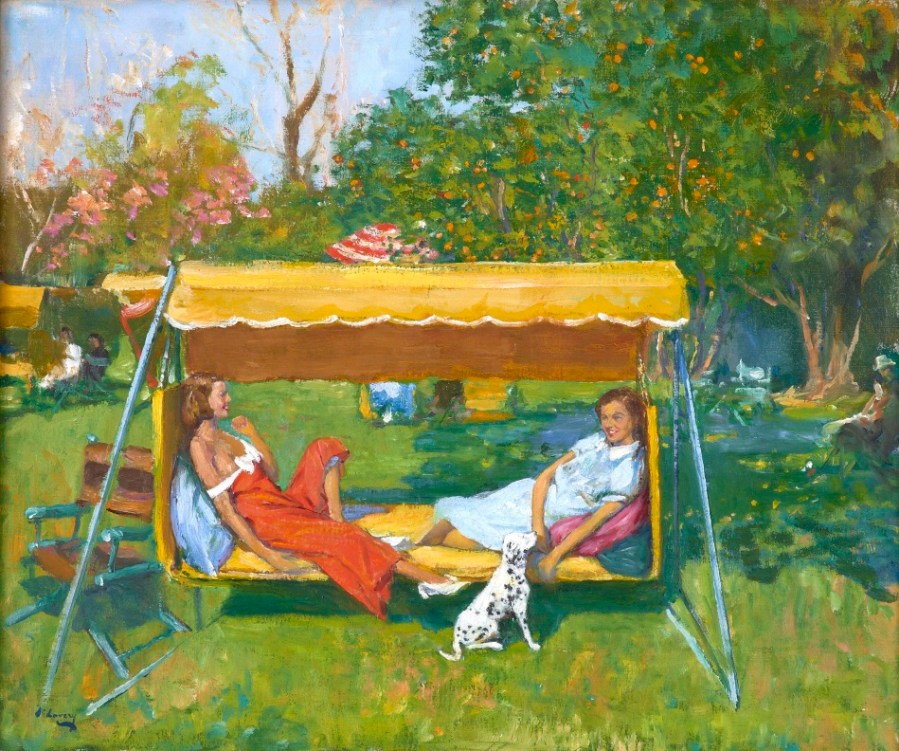
LCGA4458_Lavery_Sir_John_Stars in Sunlight_copyrightLCGA (002)

Figure 5. Stars in Sunlight by John Lavery ©  Permanent Collection of Limerick City Gallery of Art

The Donor

William Graham Greig(WGG) (1910-1999)

Our donor was the only son of James Graham Greig(JGG) (1879-1951) and Janet Alexander Buchanan, daughter of John Buchanan, a Falkirk timber merchant. At the time of WGG’s birth on 16th July 1910  the family home was at 2 Strathallan Terrace, Dowanhill in Glasgow’s West End.14 Janet Alexander Buchanan was JGG’s second wife. His first wife, Helen Stewart Jacob, who he married in 1905, sadly died at the age of 28.15

JGG was a stockbroker. Originally a co-partner in the firm of Service Brothers and Greig of 118 Queen Street, in 1909 the partnership was dissolved and James Graham Greig set up his own stockbroking business -James Graham Greig & Co- at 8, Gordon Street16. By 1930 the business had moved to 164 Gordon Street, premises owned by the Commercial Bank of Scotland.17

By the time of the 1911 census the family were living at 2, Caledon Street, Hillhead, off Byres Road. They had one live-in servant, Elizabeth McDonald18. In 1912 a daughter, Margaret Alston was born, followed a few years later in 1919 by another daughter, Doris Graham.19

JGG was a member of the Glasgow Stock Exchange Committee for many years. He was also appointed a Justice of the Peace for the County and City of Glasgow in 1935. He was a member of the Sandyford Burns Club and was president for a term. JGG was also one-time chairman of the Partick Unionist Association.20

There is little information available on the life of our donor, WGG, in the 1920s either about his schooldays or whether or not he went to university. Like his father he became a stockbroker and went to work in the family firm.21 He and his father shared an interest in angling. There are newspaper reports of them taking part in competitions for example on Loch Leven in April 1935.22

In 1936 WGG entered Glasgow local politics and was elected councillor for the Whiteinch Ward which he served until 1955.23 He stood for the newly formed Glasgow Progressive Party(formerly known as the Moderate Party) which was a mixture of  Liberals,Unionists and Independents. The Progresssive Party  supporters were members of the public who opposed the policies of the Socialists on Glasgow Corporation who were in the majority at that time.  The terms ‘Conservative’ and ‘Labour’ were not really used until the mid 1960s. Instead ‘Unionist ‘and ‘Socialist’ were used. What we now know as the Scottish Conservative Party was then the Scottish Unionists Association.24

WGG won the Whiteinch Ward from the sitting Socialist Hector McNeill with a comfortable majority of 1036.25 Overall the Progressive Party won seven additional seats, not quite the dozen they had hoped for but now the Progressives had   49 seats to the Socialist 55, an improvement on the previous election.26 At this time the family were living at 88 Balshagray Avenue in the West End27.

For the rest of the 1930s, while continuing his career as a stockbroker, WGG  served  on many of the Glasgow  Corporation committees. These included  Housing, Education, Water and Markets as well as the Police Committee, Sub- Committee on Baths and Washhouses  and the Sub -Committee for Continuation Classes. He was also on the Western School Management Committee   and the Advisory Committee for Juvenile Employment on which he represented Partick. WGG was one of the Town Council patrons of Hutcheson’s Hospital.28

Although only 29 when war broke out in 1939 there is no record of WGG serving in any of the services during World War Two. Whether this was because of a medical condition or some other reason there is no information available at this time. According to the National Register of 1939 WGG was  a   Stockbroker, Member of the Police Committee and of the Emergency Police Committee. There is no information available as to whether he was involved in such organisations as the Home Guard or Air Raid Wardens etc. His younger sister Doris, however, became a British Red Cross driver during the war.29 At the outbreak of war WGG was living at 88 Balshagray Avenue with his parents and sisters.30

During the war years WGG continued his career in local politics. In addition to the committees already mentioned he served on the Libraries Committee and the Special Committee for Public Indoor Gymnasia. In 1943 WGG was elected a Bailie of the Burgh by his fellow councillors, and was thus a magistrate.31

WGG also followed in his father’s footsteps by taking an interest in Robert Burns. He was a member of the Sandyford Burns Club and one of the speakers at the Annual Burns Supper   held on January 25th1943. This was the Jubilee Year for the club. Attending the meeting was King Peter II of Yugoslavia who happened to be on a visit to the west of Scotland and expressed an interest in the traditional ceremonies associated with the Bard.32

A report in the Glasgow Herald in October 1945 relates WGG as attending a meeting at Dunoon of the Glasgow and   West of Scotland Seaside Convalescent Homes where he was a speaker along with Reverend Neville Davidson of Glasgow Cathedral.33 Whether WGG was a patron of the home or a representative of Glasgow Corporation is unknown.  The home had been opened in 1869 ‘for the purpose of affording sea air, bathing and repose to those invalids (from Glasgow) whose circumstances prevented them regaining in any other way the health and strength necessary to resume work.’ Glasgow philanthropist Beatrice Clugston, along with councillors James Salmon and James Thomson, had been instrumental in raising the £11,000 to build the home, which housed 150 patients.34 The running costs were covered by annual charitable subscriptions from various philanthropic individuals and bodies, for example The Incorporation of Coopers of Glasgow.35  The Homes had been requisitioned by the Admiralty in September 1940 for the training of radar operatives. WGG spoke in support of a motion for the homes to be de-requisitioned quickly so the normal work of providing convalescent facilities for workers and their families could resume.36 The Dunoon Homes were de-requisitioned in May 1946 and eventually re-opened around 1948 after extensive renovation which was needed after damage done during the war-time occupation by the Admiralty. They remained supported by charitable subscription until closure around 1971.37

The Chief Constable of Glasgow  had not had a rise in salary since 1931. So reported The Scotsman in May 1947. WGG, as a member of the Police Committee, was reported as speaking in favour of such a pay rise as had been recommended by the Secretary of State for Scotland. The recommended rise was to £1700 per annum rising by £50 increments to a maximum of £2,200 plus a free house. This was still below the Secretary of States recommendation of £1900 with increments of £100 up to a maximum of £2400 plus a free house. The proposal was carried by 42 votes to 35. Opposition came from   Labour and ILP councillors.38  

In 1949 WGG was on the Galleries and Museums Committee of Glasgow Corporation, remaining on that committee for a couple of years.  As 1949 was the year in which WGG donated the two Lavery paintings,perhaps it was his membership of this committee which influenced him to make the donation. There is no record of the donation in the Glasgow Corporation Minutes.

In January 1951 the death of James Graham Greig, our donor’s father, was reported in the Glasgow Herald.  The business by this time was at 22a West Nile Street. JGG was reported as being one of the oldest members of the Glasgow Stock Exchange, joining in 1903, serving as a member of the Stock Exchange Committee for 12 years. He was a Justice of the Peace and also Chairman of the Partick Unionist Association and past president of the Sandyford Burns Club.39

In December 1953 WGG was adopted as Unionist Parliamentary Candidate for the Bothwell Constituency. Perhaps,once again, this was due to his father’s  interest in the Scottish Unionist Party. The Motherwell Times describes WGG as,”Former police judge and ex-Bailie of the Corporation of  Glasgow. Representative of the Whiteinch Ward since 1936 as a Progressive and at present sits on the Public Health and Welfare Committee”. At this time the Bothwell Constituency included Mount Vernon, Carmyle, Springboig and Garrowhill as well as Uddingston and Bothwell. 40 

In March 1955 WGG retired from Glasgow Corporation. 41 In May of that year he was appointed Master of Works for the following year.42 The appointment of Master of Works meant that WGG was the Glasgow Corporation Representative  in the Department of Public  Works (later the Engineers Department)and also on the Dean of Guilds Court which, until its abolition in 1975, dealt with all matters pertaining to the positioning and construction of streets and buildings.43 

In the General Election held on May 26th 1955 WGG had the daunting task of overturning a Labour majority of 6,000 gained at the previous election in 1951.  However in a report in the Motherwell Times of 18th May 1955 entitled,” No Need  for Despondency” , WGG was optimistic about his chances of being elected  because of the enthusiasm and hard work of his team of Unionist Party Workers and the reports from the canvassers and reports that many in the constituency  who voted Labour in 1951, seeing the job done by the current Tory Government, did not intend to vote against the government this time.44 In the event WGG was not elected but he did reduce his opponent’s (John Timmons) majority to 3,610.45

After retirement as a councillor WGG continued to work as a stockbroker at the firm his father had founded, still at 229a West Nile Street. By this time he had moved to another address in the West End-Westcraig ,22 Victoria Park Gardens North.46 He was living with his mother, Janet and his sister Margaret.47

In February 1958 at the annual meeting of the Bothwell Unionists Association WGG was once again elected as the prospective Unionist Candidate for the Bothwell Constituency.48 A few days later WGG gave a short address at the meeting of the Bothwell Constituency Association. At this meeting a motion from the Uddingston Branch was passed overwhelmingly, recommending the death penalty for all types of murder. This motion was to be forwarded to the May Conference of the Scottish Unionist Conference.49

WGG is reported as attending a meeting of the Women’s Section of the Bothwell Unionist Constituency Association later in February 1958.The Motherwell Times reported that a vote of thanks was given by Miss G Greig.50 This must have been WGG’s sister Margaret A. Graham Greig as his other sister Doris had married George Campbell McKinlay in 1943.51 Margaret appears to have had a similar interest in the Unionist Party to that of her brother. Also in March 1958 the Motherwell Times reported on a whist drive held by the Newarthill Unionist  Association,presumably a fundraiser,  which was attended by WGG who spoke a few words and by Miss G Greig who presented the prizes.52

In the Queen’s Birthday Honours List of June 1958 William Graham Greig Esq. JP  was awarded the OBE ‘for political and Public Services to Glasgow’.53

The General Election of 8th October 1959 proved no more successful than that of 1955 for our donor, though again he lost by the comparatively small margin of 4,352 again to John Timmons.54  At this time  the Labour Party were almost unbeatable in the Central Belt of Scotland, especially around Glasgow. This was to be the last time WGG attempted to become a Member of Parliament.

WGG continued as a stockbroker under the name of James G Greig until the early 1960s. He then moved to the firm of Campbell Neill and Co,Stock Exchange House,69 St Vincent Street. He appears to have remained there until around 1974 after which time his name disappears from the Glasgow Post Office Directory. By this time WGG would have been around 65 and perhaps he retired. His home up this point remained Westcraig in Victoria Park Gardens.55

There is no more information concerning our donor until his death on February 1st1999 at the age of 88. He died at the Lyndoch Nursing Home in Bearsden.56

References.

    1. Kelvingrove Art Gallery and Museum Glasgow. Glasgow Boys Gallery. Information Panel Potter at Work by John Lavery
    2. McConkey,Kenneth John Lavery :A Painter and His World pp40-45 .2nd Edition 2010   Atelier Books  Edinburgh
    3. Glasgow Museums Resource Centre Object File. Lavery, John
    4. www.artisansinscotland.shca.ed.ac.uk
    5. Lavery, John The Life of a Painter p239 Cassell 1940
    6. op cit. 4 above
    7. e-mail . Amoore@museumsnorthumberland.org.uk
    8. https//www.berwickshirenews.co.uk/burrell_family_life_at_hutton_castle.
    9. www.ancestry.co.uk Statutory Marriages
    10. www.artnet.com
    11. https//Wikipedia.org/wiki/Alison_Skipworth
    12. Hull Daily Mail 14/11/1936
    13. op cit 5 above
    14. www.scotlandspeople.gov.uk Statutory Births
    15. ibid. Statutory Deaths
    16. Edinburgh Gazette 25.05/1909
    17. www.scotlandspeople.gov.uk Valuation Rolls 1930
    18. ibid Census Records 1911
    19. ww.scotlandspeople.gov.uk Statutory Births
    20. Obituary James Graham Greig. Glasgow Herald (GH) 08/01/1951
    21. Glasgow Post Office Directory 1936-7
    22. Dundee Courier (DC) 20/04/1935
    23. Corporation of the City of Glasgow: Town Council Lists 1938-9. Glasgow Corporation 1939
    24. Seawright, David. An Important Matter of Principle:The Decline of the Scottish Conservative and Unionist Party. 2nd Edition. Routledge  2018
    25. GH 04/11/1936
    26. DC 04/11/1936
    27. op cit. 21 above
    28. op cit. 23 above
    29. http://www.scotlandspeople.gov.uk  Statutory Marriage
    30. www.ancestry.co.uk Glasgow,Lanarkshire,Scotland Electoral Registers 1857-1962.
    31. Glasgow Corporation Minutes 05/11/1943 Ref C1/3/109
    32. Burns Chronicle and Club Directory Second Series Vol X1X
    33. GH 23/10/1945
    34. https//historic_hospitals.com/gazeteer/argyll_and_bute
    35. Mair,Craig The History of the Incorporation of Coopers of Glasgow. Pub Neil Wilson 2013
    36. GH 08/10/1946
    37. www.live.argyll.co.uk
    38. GH 08/01/1951
    39. GH 08/01/1951
    40. Motherwell Times (MT) 18/12/1953
    41. Glasgow Corporation Minutes 17/03/1955. Ref C1/3/130
    42. ibid 06/05/1955 Ref C1/3/131
    43. www.mackintosh-architecture.gla.uk
    44. MT 20/05/1955
    45. Birmingham Daily Gazette 28/05/1955
    46. Glasgow Post Office Directory 1957-58
    47. op cit. ref 30
    48. MT 01/02/1958
    49. ibid. 07/02/1958
    50. ibid. 14/02/1958
    51. www.scotlandspeople.gov.uk Statutory Marriages
    52. MT 07/03/1958
    53. London Gazette 12/06/1958
    54. GH 10/10/1959
    55. Glasgow Post Office Directories 1960-1975
    56. www.scotlandspeople.gov.uk Statutory Deaths


William McInnes (1868-1944)

In 1944 ship owner, Sir William Burrell donated to Glasgow his collection of paintings, Japanese and Chinese ceramics, tapestries, sculpture, stained glass and many other artefacts, totalling some 6000 items. By the time of his death in 1958 the donation had grown to over 8000 items, probably one of the greatest collections ever amassed by an individual. The collection is housed in a dedicated building in Pollok Park and has a world-wide reputation for its range and quality.

Earlier that year, on the 19th March, another ship owner, William McInnes, died at his home in Mariscat Road, Glasgow. In his will he bequeathed his collection, some 700 items including over 70 paintings, to Glasgow. Compared to Burrell, McInnes is much less well known to the Glasgow public, however his French paintings, which include works by Degas, Renoir, and Matisse are amongst the finest in any European Municipal collection.

Undoubtedly McInnes is, correctly, overshadowed by Burrell. The following however is an attempt to appropriately redress the balance between the two men. Whilst there can be no doubt that Burrell’s gift is and will remain unsurpassed, McInnes’s significant contribution to Glasgow’s cultural life deserves broader acknowledgement than it has received so far.

William McInnes’s paternal family originated in Crieff, Perthshire. His grandparents William and Janet married in 1825 [1] and had eleven children, not all of whom survived childhood. William’s father John was the oldest child, born in Crieff at the end of December 1825.[2] Seven of the children were born in Crieff or Comrie, the others in Glasgow after the family moved there sometime between 1841 and 1851.[3] Grandfather William, John and his brother Alexander were all working on the railways by 1851, William as a labourer, John as an engine man and Alexander as a fireman.

Ten years later the family home was at 6 Salisbury Street in the Gorbals where John and his siblings lived with their parents. The three men continued to work on the railways, William now being a timekeeper. John’s three sisters, Jessie, Jeanie and Mary were milliners.[4]

In 1867 John McInnes married Margaret McFadyen from Neilston on 28th June. At the time of his marriage he was working as a railway engine driver.[5] They lived at 6 Cavendish Street where their four children were born: son William on 13th September 1868[6], to be followed by Finlay (1870), Thomas (1872) and Ann (1876).[7]

Tragically, at the early age of 33, Margaret, died of plithisis (tuberculosis) in 1879 [8] which resulted in John  and the four children, who were aged between 3 and 11 years, moving to 6 Salisbury Street to live with his brother Andrew and sisters Jessie and Mary; where Jessie acted as housekeeper and surrogate mother to the children.[9] This manifestation of strong family ties working to bring some good out of a bad and difficult situation I’m sure had a lasting impression on William. His friendships, particularly with the artist George Leslie Hunter and his support of family members in later life, provide evidence of that.

It’s not clear where William received his schooling although one source has suggested that he attended Hutcheson Grammar at the same time as the author John Buchan.[10] Having talked to the administration staff at the school this has not been confirmed.

In 1882 John’s sister Mary married Gavin Shearer in Glasgow.[11] Gavin aged 44 was an Insurance Broker working for the Glasgow Salvage Company Ltd.[12] whose business was marine salvage. The marriage was childless and short lived as he died in 1887 from tuberculosis. At the time of his death he was secretary of the salvage company.[13]

William was aged 19 at this time and probably had been in employment for some time. Was Gavin Shearer his entrée to the world of insurance when he was old enough? Considering how the family stuck together and supported each other it’s not unreasonable to think that his uncle helped him to get work, especially in an industry where he would have some influence. This is clearly conjecture as it’s not known what employment, if any, he was in at the time of his uncle’s death, however by 1891 he was working as a marine insurance clerk for P.H.Dixon and Harrison.[14]

Four years later the company merged with Allan C. Gow to form Gow, Harrison and Company. Allan Carswell Gow had established his shipping company in the early 1850s. In 1853 he was joined in the business by his brother Leonard who on Allan’s death in 1859 became head of the firm. His younger son, also Leonard, in due course joined the business which by this time had offices in London as well as Glasgow.[15] Senior partners in the new company which was located at 45 Renfield Street were the young Leonard Gow and John Robinson Harrison; McInnes continued to be employed as a marine insurance clerk.[16]  In 1899 the Glasgow Ship Owners and Ship Brokers Benevolent Association was formed, which Gow, Harrison and McInnes joined in its inaugural year. Another well-known Glasgow shipping name also joined later that year, George Burrell of William Burrell and Son, brother to the future Sir William Burrell.[17] McInnes possibly became a partner in the business in 1907, the first year he appeared in the Glasgow Post Office Directory, however it’s more likely to have been 1922 when John Harrison retired from the business and his son Ion joined it. In 1929 William became godfather to Ion’s son Iain Vittorio Robinson Harrison.[18]

Between 1899 and 1907 William’s brothers and sister married. Thomas married Jessie McEwan in 1899 at the Grand Hotel, Glasgow, there were no children of the marriage; Finlay married Agnes Hamilton at 95 Renfield Street on 15th February 1907, they had one son who was born on 8th December of the same year; Ann married William Sinclair on 27th February 1907 at 22 Princes Street, which was where the McInnes family then stayed.[19] Shortly afterwards Ann and William emigrated to the United States and settled in Maine where their three sons William (1908), John (1912) and Andrew (1916) were born.[20]

William McInnes never married although according to one source he was close to it. Lord McFarlane of Bearsden relates the story that his wife’s aunt and McInnes planned to marry but her father forbade it because he ‘didn’t have enough siller’.[21]

McInnes moved to 4 Mariscat Road, Pollokshields in 1909 and lived there for the rest of his life with his elderly father and his uncle Andrew and aunt Mary.

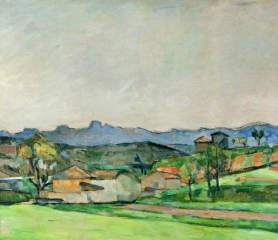
It’s not clear when he started his collection, however it’s likely that his collecting activity would be prompted, certainly influenced by his relationship with Gow who became a renowned collector in his own right, particularly of paintings and Chinese porcelain. You can also envisage that Gow was the means by which McInnes met Alexander Reid and hence Leslie Hunter. What is known is that he bought his first painting, ‘Autumn’ by George Henry from Alexander Reid in 1910.[22] His final purchase was ‘The Star Ridge with the King’s Peak’ (near Gardanne) by Cezanne, in 1942, from Reid and Lefevre, London.[23] This painting eventually came into his sister-in-law Jessie’s (widow of brother Thomas) possession.[24] In between those purchases he bought a number of significant paintings ranging from French Impressionists to Scottish Colourists. He bought works by Degas, Renoir, Picasso, and Matisse[25] and was the first Scottish collector to buy a van Gogh, (The Blute Fin Windmill, Montmatre) bought in 1921 for £550.[26]

Fig. 1 van Gogh, Vincent; The Blute-Fin Windmill, Montmartre© CSG GIC Glasgow Museums Collection. (http://www.artuk.org)

He also purchased, glassware, ceramics and silver which in due course, along with his paintings, formed the basis of his eventual bequest to Glasgow.[27]

In a Kelvingrove museum publication of 1987 the then Fine Art keeper Ann Donald commented as follows: ‘The most important individual 20th Century benefactor to date has been William McInnes (1868-1944), a Glasgow ship owner who left to his native city his entire collection of over 70 paintings as well as prints, drawings, silver, ceramics and glass. The bequest included 33 French works (many of them bought from Alexander Reid) by key artists such as Monet, Degas, Renoir, van Gogh, Cezanne and Picasso, whilst the British pictures were mostly by the Glasgow Boys and the Scottish Colourists, of whom he was a regular patron. This donation firmly established the international importance of Glasgow’s French collection.’[28]

McInnes is described by those who knew him as a modest, unassuming individual who did not seek attention or the limelight.[29] and may have found these comments not particularly welcome, despite them being highly complimentary. McInnes valued his friendships and his family, which is evident from the support he gave, and his ability to listen to the advice he was given. He was able to take the artistic guidance given him by the likes of Leslie Hunter, Tom Honeyman and others, and act on it if he thought it appropriate to do so, which wasn’t always. He bought paintings it’s said not only for his own pleasure but for that of his friends.[30] He gave unstinting support to family and friends, particularly Leslie Hunter and his closest family members.

As stated earlier, William lived with his father, and aunt and uncle, for a number of years at Mariscot Road, incidentally where most of his paintings were housed. His father died in 1911, aged 85, cause of death being senile decay and pneumonia. His uncle Andrew, aged 81, died in April 1930 from senility and glycosuria (untreated diabetes); his aunt Mary, aged 83, also died in 1930 (August) from glycosuria.  Both died at home.[31]

These are very distressing and difficult conditions, not only for the sufferers, but for those who have to care for them. When it is considered that he had a senior position in a significant shipping business, that he was a member and leader of a number of industry organisations and also of the Ship Owners Benevolent Association, in addition to whatever he had to do at home, it’s clear that William had a strong sense of service and duty, perhaps inculcated by his early family experiences. It seems reasonable to presume he found this to be more intrinsically rewarding than anything else. When his support of Leslie Hunter is taken into account, then that presumption gains credence.

The artist must have seemed to McInnes to be a vulnerable, possibly unstable individual, whose life style could be fraught and chaotic at times. This must have resonated with McInnes’s home life in that here was another person who needed care and support. This may be more fanciful than factual, however there does seem to be this pattern to how William lived his life.

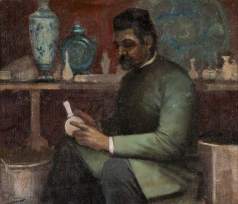
Hunter and McInnes met before 1914 and are known to have been in Paris pre WW One along with John Tattersall, the trip expenses, according to Hunter, being paid for by his two friends.[32] There are examples of how Hunter was helped and encouraged by McInnes and others in Tom Honeyman’s biography of him.[33] The most tangible evidence of McInnes’s support is, I suppose, the fact that his collection contains 23 paintings by Hunter.[34] There was one occasion apparently when McInnes commissioned a portrait of himself because the artist needed the money.[35] The friendship between the two men was not a one-way street however. McInnes was in many respects helped and guided by Hunter in his artistic education; however the better part of the bargain must have what McInnes gave to Hunter in encouragement, friendship, and in helping to sustain his motivation and confidence. McInnes has been described as Hunter’s most important patron; that is true in a way that goes well beyond the expected understanding of the phrase.

After Hunter’s death in 1931 [36] McInnes continued to promote him by persuading Tom Honeyman to write his biography of the artist[37] and along with Honeyman and William McNair, by organizing a memorial exhibition of his work, which was held in Reid and Lefevre’s gallery in West George Street during February 1932. Mrs Jessie McFarlane, the painter’s sister, asked the group to decide which paintings to keep and which to destroy.[38]

McInnes and Honeyman met around the time Honeyman gave up medicine and moved into art dealership, probably through Leslie Hunter. It developed into a well bonded relationship, not only when Hunter was a common link between them but also after his death. Probably Honeyman is the only person to have recorded in any detail McInnes’s personality and interests which he did in his autobiography ‘Art and Audacity’. He is described as having a keen interest in classical music in which he indulged through his gramophone records and pianola, and his attendance at the Scottish National Orchestra’s Saturday evening concerts. He is said to have played the church organ in his younger days. Art and learning about paintings and artists was also a primary interest. It’s perhaps a moot point as to which he preferred. He also enjoyed travelling to the continent, during which time visits to the various museums and galleries would further develop his knowledge of art, art styles and artists, particularly when in the company of Hunter. Honeyman describes visits to the McInnes home as always stimulating and interesting.[39]

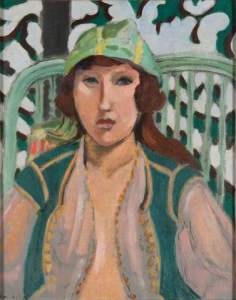
Fig.2 Matisse, Henri; Woman in Oriental Dress.© CSG GIC Glasgow Museums Collection. (http://www.artuk.org)

In many respects because of his interest in painting in particular, McInnes was fertile ground for Honeyman in his quest to interest industrialists of the day in fine art and bring them to the idea of donating to municipal collections. I don’t believe this was a ‘corruption’ of their friendship but a celebration of its strength and depth. Between 1921 and 1943 he donated works by Hunter, Peploe and Fergusson and in 1940 William presented Matisse’s ‘Woman in Oriental Dress’ to Kelvingrove to commemorate Honeyman’s appointment as Museum Director.[40]

In 1931 McInnes was nominated for the vice-presidency of the Ship Owners Benevolent Association and was duly elected. The rules of the Association meant that he would become president in 1932.  However at the last board meeting of the year it was agreed that ‘having regard to the very serious time through which the country was passing the directors felt that the president and vice president should carry on for another year, especially as the honour to Mr McInnes was only deferred.’ In 1933 McInnes duly became president.[41]

It’s clear from the minutes of the meetings held during his tenure that he played a full and influential part in the decision making process of the Association.[42] On his retiral from the post he donated £100 to the association funds, equivalent to £5000 in today’s money.[43]

William McInnes died at home on 19th March 1944 from a heart attack.[44] He was senior partner in Gow, Harrison and Co. at the time of his death, taking over from Leonard Gow on his death in 1936. In his will he left in excess of 700 items, including 70 paintings, to Glasgow. His bequest was made free of any legacy duty or any other expenses, his only stipulation was that his paintings would go on show at Kelvingrove. The same day his bequest came before a special meeting of Glasgow Corporation’s committee on Art Galleries and Museums it was accepted with ‘high appreciation’ following a report on the collection by Tom Honeyman, the Director of Art Galleries.[45]

His obituary in the Glasgow Herald stated: ‘McInnes was a man of cultured taste, he was keenly interested in music and art. He had brought together in his home a collection of pictures which was notable for its quality and catholicity.’ It adds finally “He was an intimate friend and patron of the late Leslie Hunter with whom he made several visits to the continent.’[46]

In a sense William’s contribution didn’t stop there. In 1951 his sister-in-law Jessie donated Cezanne’s ‘The Star Ridge with the Kings Peak’ to Kelvingrove.[47] In 1985 a portrait of McInnes by Leslie Hunter was sold to Kelvingrove by his sister Ann’s son Andrew McInnes Sinclair of Massachusetts, USA. The painting was handed over in person by Andrew and his cousin John McInnes, the son of William’s brother Finlay, on 9th July.[48] The portrait had been commissioned by William for his sister to take back to America following a visit to Scotland in 1930[49]

Fig.3 Cezanne, Paul; The Star Ridge with the King’s Peak.© CSG GIC Glasgow Museums Collection. (http://www.artuk.org)
Fig.4 Hunter, George Leslie; William McInnes (1868-1944).© CSG GIC Glasgow Museums Collection. (http://www.artuk.org)


References.

[1] Marriages (OPR) Scotland. Crieff, Perthshire, 342/00. 1 May 1825. McINNES, William and McDONALD, Janet. GROS Data 342/00 0020 0113. http://www.scotlandspeople.gov.uk: accessed June 2011.

[2] Baptisms (OPR) Scotland. Crieff, Perthshire, 342/00. 1 January 1826 McINNES, John. GROS Data 342/00 0020 0019. http://www.scotlandspeople.gov.uk: accessed June 2011.

[3] Census. 1851. Scotland. Gorbals, Glasgow City, 644/02. GROS Data 644/02 126/00 012.

Census. 1861. Scotland. Tradeston, Glasgow City, 644/09. GROS Data 644/09 027/00 001.

http://www.scotlandspeople.gov.uk: accessed June 2011.

[4] Census. 1861. Scotland. Tradeston, Glasgow City, 644/09. GROS Data 644/09 027/00 001.

http://www.scotlandspeople.gov.uk: accessed June 2011.

[5] Marriages (OPR) Scotland. Tradeston, Glasgow City, 644/09. 28 June 1867 McINNES, John and McFADYEN, Margaret. GROS Data 644/09 257. http://www.scotlandspeople.gov.uk: accessed June 2011.

[6] Births. Scotland. Tradeston, Glasgow City, 644/09. 13 September 1868, McINNES, William. GROS Data 644/09 1456.  http://www.scotlandspeople.gov.uk: accessed June 2011.

[7] Births. Scotland. Tradeston, Glasgow City, 644/09. 1 May 1870 McINNES, Finlay. GROS Data 644/09 0689. Births. Scotland. Tradeston, Glasgow City, 644/09. 2 June 1872 McINNES, Thomas GROS Data 644/09 0989.

Births. Scotland. Gorbals, Lanarkshire, 644/12. 22 October 1876, McINNES, Ann GROS Data 644/12 1367.

http://www.scotlandspeople.gov.uk: accessed June 2011.

[8] Deaths. Scotland. Gorbals, Glasgow City 6444/12. 12 June 1879. McINNES, Margaret. GROS Data 644/12 0428. http://www.scotlandspeople.gov.uk: accessed June 2011.

[9] Census. 1881. Scotland. Gorbals, Glasgow City, 644/12. GROS Data 644/12 025/00 002.

http://www.scotlandspeople.gov.uk: accessed June 2011.

[10] The Art Review, Vol 1, no.1, 1946 Tom Honeyman.

[11] Marriages. Scotland. Blythswood, Glasgow, 644/07. 14 September 1882. SHEARER, Gavin and McINNES, Mary. GROS Data 644/07 0321. http://www.scotlandspeople.gov.uk: accessed June 2011.

[12] The Post Office. 1881-1882 Glasgow Post Office Directory Glasgow: William McKenzie p.475.

[13] Deaths. Scotland. Kelvin, Glasgow, 644/09. 20 February 1887. SHEARER, Gavin. GROS Data 644/09 0178.

http://www.scotlandspeople.gov.uk: accessed June 2011.

[14] ibid

[15] The Merchant Navy Association: The Red Duster: The Glen Line http://www.red-duster.co.uk/GLEN.htm. accessed June 2011, AND

George Eyre-Todd (1909) Who’s Who in Glasgow in 1909 – Leonard Gray Glasgow: Gowans and Gray Ltd.

[16] Census. Scotland. 1901. Tradeston, Glasgow City. GROS Data 644/13 035/00 021 http://www.scotlandspeople.gov.uk: accessed June 2011.

[17] Glasgow Ship Owners and Ship Brokers Benevolent Association (1899) Minutes of meeting 5th May 1899 and 1899 year end Director’s report dated January 1900, page 8.

[18] Iain Vittorio Robinson Harrison – June 2011

[19] Marriages. Scotland. Kelvin, Glasgow City, 644/09. 5 July 1899. McINNES, Thomas and McEWAN, Jessie GROS Data 644/09 0344.

Marriages. Scotland. Blythswood, City of Glasgow, 644/10. 15 February 1907. McINNES, Finlay and HAMILTON, Agnes GROS Data 644/10 0144.

Marriages. Scotland. Pollokshields, 644/18. 27 February 1907. SINCLAIR, William and McINNES, Ann GROS Data 644/18 0049.  http://www.scotlandspeople.gov.uk: accessed June 2011

[20] Ancestry.com. UK, Incoming Passenger Lists, 1878-1960 Class: BT26; Piece: 755; Item: 25. Passenger lists for SS California 1924 show Ann, husband and three sons, the sons’ birth place being stated as Maine USA. They arrived in Scotland in July and returned to America in September. http://search.ancestry.co.uk/cgi-bin/sse.dll?indiv=1&db=bt26&rank=1&new=1&MSAV=1&msT=1&gss=angs-d&gsfn=william+&gsln=sinclair&msbdy=1876&msedy=1908&cpxt=1&uidh=hd2&msbdp=2&_83004003-n_xcl=f&cp=11&pcat=40&fh=9&h=18164070&recoff=&ml_rpos=10

[21] Lord McFarlane of Bearsden –June 2011

[22]  Frances Fowle (2010) Van Gogh’s Twin: The Scottish Art Dealer Alexander Reid. Edinburgh: National Galleries of Scotland. p. 63.

[23] VADS (2008) National Inventory of Continental European Paintings  http://vads.ac.uk/large.php?uid=87972&sos=2 accessed October 2011.

[24] Kelvingrove Art Gallery and Museum donor attribution.

[25] Glasgow Art Gallery and Museum (1987) The Building and the Collections. Glasgow: Wm. Collins. p. 101

[26] Fowle, op.cit. p. 134.

[27] Glasgow Museums Resource Centre (GMRC) – Inventory list of the McInnes Bequest.

[28] Glasgow Art Gallery and Museum (1987) The Building and the Collections. Glasgow: Wm. Collins. p. 101

[29] T.J. Honeyman (1971) Art and Audacity London: Collins p.124.

[30] Honeyman, op.cit. p. 127.

[31] Deaths. Scotland. Cathcart, Glasgow City, 560/00. 8 September 1911. McINNES, John GROS Data 560/00 0483.

Deaths. Scotland. Pollokshields, Glasgow City, 644/18. 19 April 1930 McINNES, Andrew GROS Data 644/18 0222.

Deaths. Scotland. Pollokshields, Glasgow City, 644/18. 1 August 1930. SHEARER, Mary GROS Data 644/18 0355.

http://www.scotlandspeople.gov.uk: accessed June 2011.

[32] Fowle, op.cit. p. 116.

[33] Honeyman, op.cit. pp various.

[34]Glasgow Museums Resource Centre (GMRC) – Inventory list of the McInnes Bequest.

[35] McTears auction 25th April 2006 – auction house notes on lots 455, 455a: William McInnes at his piano by Leslie Hunter, plus copy of Introducing Leslie Hunter.

[36] Deaths. Scotland. Hillhead, Glasgow City, 644/12. 1931. HUNTER, George Leslie GROS Data 644/12 1155.

http://www.scotlandspeople.gov.uk: accessed June 2011.

[37] Honeyman, op.cit. p. 126.

[38] Honeyman, op.cit. p. 208.

[39] Honeyman, op.cit. p. 124. .

[40] Honeyman, op.cit.p. 126.

[41] Glasgow Ship Owners and Ship Brokers Benevolent Association (1931). Minutes of meeting 14th December 1931

[42] Glasgow Ship Owners and Ship Brokers Benevolent Association (1931/1934). Minutes of meetings January 1931 to January 1934.

[43] Andrew Nicholson (2011) Secy. Of Scottish Shipping Benevolent Association – email May 2011

[44] Deaths. Scotland. Pollokshields, Glasgow City, 644/18. 19 March 1944. McINNES, William GROS Data 644/18 0218.

http://www.scotlandspeople.gov.uk: accessed June 2011.

[45] Glasgow Corporation Minutes April 1944 to November 1944. Mitchell Library reference: C1/3/110

[46] Obituary (1944) Glasgow Herald 20 March 1944. McINNES, William. p. 4 http://www.glasgowherald.co.uk; accessed June 2011.

[47] Kelvingrove Art Gallery and Museum donor attribution.

[48] T.J. Honeyman (1937) Introducing Leslie Hunter London: Faber and Faber Ltd. pp. 149,150 and 167.

[49] Glasgow Museums Resource Centre (GMRC) – Object folder on William McInnes.