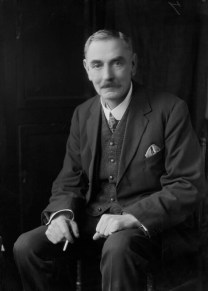
Figure 1. George Sheringham 1927 – (c National Portrait Gallery, London under Creative Commons Licence)
George Sheringham was born in London on 13th November 1884. (1) His father was an Anglican clergyman and vicar of Tewksbury Abbey. George was educated at Kings School, Gloucester and studied art at The Slade, London and The Sorbonne in Paris. He was interested in art at from early age and the decorative arts became a lifelong passion. He first exhibited at the Paris Salon and his work was subsequently exhibited in London, Ghent, Brussels, Melbourne and New York. (2) He specialised in flower paintings but he is probably best remembered as a theatre set designer, especially for designs for The D’Oyly Carte Opera Company.
George married Sybil Mengens in 1912. Sybil was born in Calcutta (Kolkata) and was living in Hampshire with her parents at the time of her marriage. (3) When George died in 1937 she gifted the watercolour Faded Roses painted by Charles Rennie MacKintosh to Glasgow.
Faded Roses waspainted in 1905and, as the title suggests, represents roses in a state of decay and depicted in a rather sombre colour scheme. It was painted at a time when MacKintosh had little work and may reflect his mood at that period. Mackintosh is well known for his architecture and interior design but when he moved to Walberswick, Surrey in 1914 he produced a series of watercolours depicting stylised flowers. In 1915 he moved to Chelsea, a fashionable, artistic district of London and socialised with many artists and designers, including George Sheringham and his wife Sybil, who was now a successful artist in her own right. (4) It was in 1923 that MacKintosh gifted Faded Roses to Sybil prior to leaving for France
There is a pencil sketch of George Sheringhame, drawn by Powys Evans in 1921, in The National Portrait Gallery in London,. Evans was a caricaturist who made numerous sketches of Sheringham.
In 1925 George was awarded the Paris Grand Prix, both for architectural decoration and for theatre design.(5) He also illustrated books including The Happy Hypocrite by Max Beerbolm.
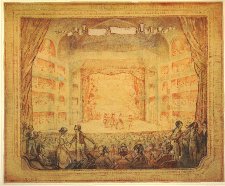
Figure3. Drury Lane Theatre 1800, design for decorative panel, Claridges Hotel – permission of British Museum under Creative Commons attribution.
As a decorator he designed the music room at 40 Devonshire House, London and the ballroom at Claridges Hotel. He also completed a striking series of large paintings for the 8th Lord Howard de Walden (Baron Seaford), entitled The Cauldron of Anwyn, to illustrate his Celtic poem, probably for Seaford House in Belgravia. The house was being remodelled and included a fine onyx staircase from South American marble and it is said that to ensure the finest quality possible he purchased the quarry.(6)
Sheringham became an authority on Chinese art and much of his work shows this influence. He designed fans,which illustrate his thoughts on the fundamental differences between Western and Far Eastern art. In an article in The Studio magazine of January 1936 he describes how he thinks Western art is limiting in its scientific approach ‘science has put a fence around art ‘(the frame), whereas Eastern art, especially from China, expresses ideas in limitless detail (scroll paintings only finish when the meaning is complete). He explains…’Meaning being the very essence, the beginning, end and centre of all the greater Eastern Works of Art’. He criticises James McNeill Whistler’s paintings which combined eastern and western influences…’Whistler may be said to have missed the main underlying tradition of Eastern Art, for he snatches at Japanese fundamental insistence on perfection of arrangement; and discarded meaning’.(7)
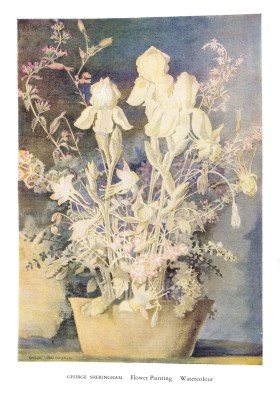
Sheringhamwas particularly interested in flower painting influenced by a Chinese style. In The Studio he wrote an article entitled The Flower Sculptures of China which refers to work in jade (usually in the most sought after white colour) and which both George and Sybil collected. An image in the magazine of a rose-coloured peony is described as ‘capturing the essence of the flower, not just copying it’ and was part of Sybil’s collection. The illustrated watercolour by Georgeis included in The Studio article is entitled simply Flower Painting and was commissioned, among other artists, to hang in the newly launched Queen Mary.(8)
Sheringham also designed woodblock prints and received lessons from Ernest A Taylor, one of the Glasgow Boys painters who was living in Hampstead at the time and who was closely connected to Mackintosh and the Glasgow Style. . Although Sheringham may never have visited Glasgow he was much influenced by these artists with a Glasgow connection.
Another influence in Sheringham’s life was music which inspired much of his life, and his work for D’oyly Carte Opera Company would have combined his love of art and music together.Mention has already been made of Whistler who was also influenced by music and many of his paintings were entitled ‘arrangements’ or ‘harmonies’.
Sheringham’s fluid rhythmic style of painting was influenced by the rhythm of life, in the way plants grew and seasons changed, and in later life this aspect became more important. Indeed his last completed painting was titled ‘Jungle Rythm’. James Duncan Fergusson, one of the ‘Scottish Colourists’, had a similar interest and they knew each other when Fergusson was living in London. Fergusson produced a magazine called ‘Rythm’ while he was in Paris.
In 1936 The Royal Society of Arts established the Royal Designers for Industry Award and Sheringham was one of the first artists to receive the accolade in 1937.
George Sheringham died at his Hampstead home on 11th November 1937 and in the following year Sybil presented Faded Rose to Glasgow. Sybil passed away on 8th August 1942 at Golders Green London.
A Miser- 18th Century German School Accession Number 2367
The painting was donated in 1944. It is unsigned but has been attributed to the eighteenth century German School by Hamish Miles in 1961.1 In addition the National Inventory of Continental and European Paintings gives 1700 as the earliest date and 1800 as the latest date and goes on to say, “The figure of the old man,the embodiment of greed and miserliness,reflects well-known models of Netherlandish tradition ,including those of Rembrandt.”2 The inscription in the painting,”Haec mea voluptas” means,” this is my obsession.”
Although the painting was donated by Archibald Montgomerie Craig(AMC) it had belonged to his father William Blackburn Craig , a wealthy Glasgow merchant, at least as early as 1902.3 AMC also donated an 18th Century Scottish tablecloth dated 1783 or 1788 to Glasgow Museums in September 1925.4
There is no record of the painting ever having being exhibited.
Family Background
AMC’s paternal grandfather was James Craig, a wine and spirit merchant, who married Margaret Aitkin Blackburn in 1821.5James Craig had various business premises in Glasgow including 22 Stockwell Street and 9 Miller Street.6They were fairly affluent, living at such genteel addresses as Abbotsford Place7 and 4 Carlton Place in the Gorbals.8 Carlton Place was begun in 1802, designed by Peter Nicholson and the brainchild of John and David Laurie who had bought the land on the south side of the river, now known as Laurieston, with the intention of developing an up-market suburb on the south side of the River Clyde.9 James Craig and his family , including AMC’s father William, were living at 4 Carlton Place from at least 1851 to 1861 along with two live-in servants10, an indication of affluence. By 1861 ,William, aged 18, was a clerk, possibly in his father’s business.11
Family Homes to c 1890
Athough AMC was born at Fordbank House , Lochwinnoch, the Craigs only occupied this house between c 1872 and c1874.12 William Craig and his family followed the path of most wealthy Glasgow merchants, living first of all at various addresses in Glasgow’s New Town, Blytheswood Hill.13 William and Elizabeth’s first home post marriage in 1863 was in West George Street( formerly Camperdown Street) 14.From 1865 to 1871 they lived at 239 St Vincent Street.15
On returning from Renfrewshire they lived at 245 St Vincent Street then c187516 , as Blytheswood Hill was more and more being turned over to business premises, they moved out to the west end of Glasgow to 2 Lancaster Terrace off Great Western Road.17By the time AMC was about nine years old the family were living at 10 Westbourne Terrace18,in a terrace of houses designed by Alexander ‘Greek’ Thomson.19
Schooldays
AMC’s father owned 10 x£10 shares in Kelvinside Academy20, a private school which opened in the West End of Glasgow on 21st September 1878 with places for 155 boys.21The Kelvinside Academy Company Limited had a share capital of £15-20,000 in £10 shares.22 In Colin McKay’s History of Kelvinside Academy 1878-1978 there is a photograph of the First Elementary Class 187823 ,one of whom is Arthur Blackburn Craig, AMC’s elder brother.
There is also a photograph of the Third Junior Class of 1881 where we find young Archibald Montgomerie Craig aged about eight . He is named in the photograph as ‘Montgomerie’. Elsewhere in the book we are told that AMC was known as ‘Gummy’ to his classmates.The curriculum in those early years included shorthand and book-keeping . The reason for this was that most of the pupils then were the sons of business men and were expected to join their father in business at the end of their time at the school rather than go to University.24 Although there is no evidence that Edward, the youngest Craig brother attended Kelvinside Academy, the fact that if three members of one same family attended the school only half the fee was due, might lead us to believe Edward went there too.25
According to the 1871 UK census William Blackburn Craig’s occupation was that of “drysalter”, a dealer in gums, dyes and various chemicals. From that period onwards he appears in census records as ‘living on private means’ or a ‘retired drysalter’.26 However the real wealth came from property. His obituary in the Bearsden and Milngavie Herald referred to “ …Mr William Blackburn Craig, well-known in property circles in Glasgow. One of his latest undertakings was the purchase of the valuable ground and the erection of a handsome block of red buildings in course of completion at the corner Buchanan Street and St Vincent Place…”.27 The Valuation Rolls tell us that in 1865 W B Craig was the owner of 5 properties in Glasgow City Centre consisting of three counting houses(Great Clyde Street and St Vincent Street) a warehouse(St Vincent Street) and two stores(St Vincent Street and Fox Street). 28 By 1895 he owned 41 properties in Glasgow City Centre, mostly in St Vincent Street and Virginia Street. These were rented out to a variety of businesses. No 11 Virginia Street was a Gospel Hall. No 63 St Vincent Street-presumably at street level- was a tea room.29 No 151 St Vincent Street was a branch of the Commercial Bank.30His own main business premises were at various times 63a St Vincent Street where John Smiths Bookshop was for many years31 and 147 St Vincent Street.32
Family Homes from c1890
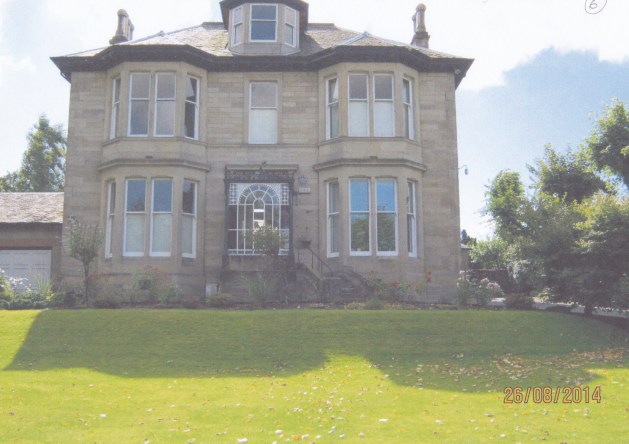
Our donor, AMC, never married and lived most of his life with his family first with his parents and brothers and sisters 33 and latterly with his unmarried or widowed sisters .34 About 1890 the family moved to ‘Borva’, a substantial house in Middlemuir Road, Lenzie35 , a growing suburb of Glasgow to which many wealthy Glasgow merchants moved when the opening of a railway station made commuting to the city easy.36
William Blackburn Craig continued to follow the path of many wealthy Glasgow merchants when in 1896 he bought the 836 acre Ballagan Estate near Strathblane in Stirlingshire. Ballagan House was completely renovated and the family moved in around 1897.37 AMC was 18 by this time.
According to the 1891 UK Census AMC was an accounts clerk, one presumes in the family business. He first appears in the Glasgow Post Office Directory in 1897 as an iron merchant ‘at Arthur Blackburn Craig , iron merchant’ at 63a St Vincent Street. Thus he was working with or for his elder brother. He remained there until 1903. 38 William Blackburn Craig died in February 190339 and AMC became one of the trustees of Ballagan Estate along with his younger brother Edward and his three sisters. Strangely, Arthur Blackburn Craig, the eldest son, is not mentioned in the Will of William Blackburn Craig either as a beneficiary or as a trustee.40 Had Arthur already received his share in the family wealth, perhaps to set up in business for himself or is there some other explanation for the eldest son not to be mentioned?
Arthur had married Mary Balfour Robertson on 19th June 1900. The wedding took place at the Windsor Hotel, St Vincent Street. The wedding was carried out under the rites of the Episcopal Church.41 According to the 1901 UK census Arthur and his bride lived at ‘Beechmount’ Dalkeith Avenue Dumbreck, which was the home of Mary’s parents, Mr and Mrs Anthony Robertson. Anthony Roberston was an iron master42, which was also Arthur Blackburn Craig’s occupation at the time of his marriage.43
Had there been a family feud? Arthur’s sister Williamina was one of the witness at the wedding so some of the family were there.44 There is no evidence as to why Arthur was not mentioned in his father’s will.
AMC became head of the household at Ballagan in 1903. Also living in the house were his mother, Elizabeth Samson Craig until her death in 1908 45, his younger brother Edward who was an accountant and his three sisters, Elizabeth, Williamina and Margaret.46
In 1903 AMC joined H F Docherty and Company-gas and steam heating and appliance manufacturers of Robertson Street.47 He remained with Docherty and Company until around 1906.48 During this period AMC and HF Docherty registered three patents:-
1903Improvements in Gas Cooking Attachments for Kitchen Ranges
1905 Improvements in Apparatus for the Production of Acetylene Gas
1905 A New or Improved Generator for the Production of Acetylene Gas 49
Perhaps HF Docherty and Company manufactured this equipment for their customers but there is no information available to support this.
From about 1906 until 1914 AMC was in business for himself as a ‘bakery utensil manufacturer’ of whom there were many in Glasgow at that time.50 He had premises in St Enoch Square, then Queen Street, then from 1911 in Springfield Court between Buchanan Street and Queen Street.
In 1912 AMC put his name to another patent registration-Improvements in Egg Whisks.51 Robert McDiamid was the other name on the application. This was possibly a business or work colleague.From the technical drawing it appears that the egg whisk was for industrial rather than domestic use.
AMC’s elder brother Arthur was also operating his business as an iron merchant from the Springfield Court Premises from about 1910.Whatever the reason for not being mentioned in their father’s Will the two brothers appear to have been on good terms.52
The Saturday Soldier 1890-1903
Around 1890 at the age of 17 AMC became what was often referred to as a ‘Saturday Soldier’. He joined what would be known today as the Territorial Army. He joined the 5th Volunteer Battalion (Glasgow) Highland Light Infantry.53 This battalion is better known as ‘The Glasgow Highlanders’.
In 1859, after the Crimean War had ended, the Government decided a civilian Volunteer Force was needed in time of war when regular forces were deployed overseas. Regiments were formed at county level with no connection to the regular army.54
In 1868 a group of Glasgow migrants from the Highlands formed such a regiment. It was called the 105th Lanarkshire (Glasgow Highland) Rifle Volunteers.55
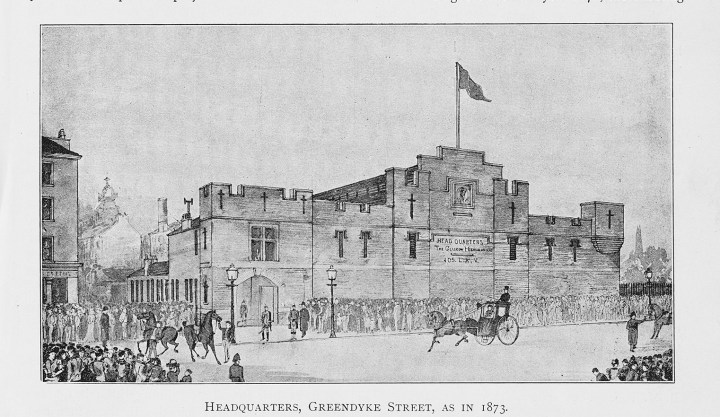
The 105th wore the Black Watch kilt and cap badge at that point.56 In 1881 Secretary of State for War Childers put through a series of reforms which linked the Volunteer Defence Forces more closely to regiments of the regular British army.57 The 105th was allied to the Highland Light Infantry and became the 10th Lanarkshire Rifles. In 1887 this was changed to the 5th Volunteer Battalion(Glasgow) HLI in . 58 Headquarters was 81 Greendyke Street near Glasgow Green.59
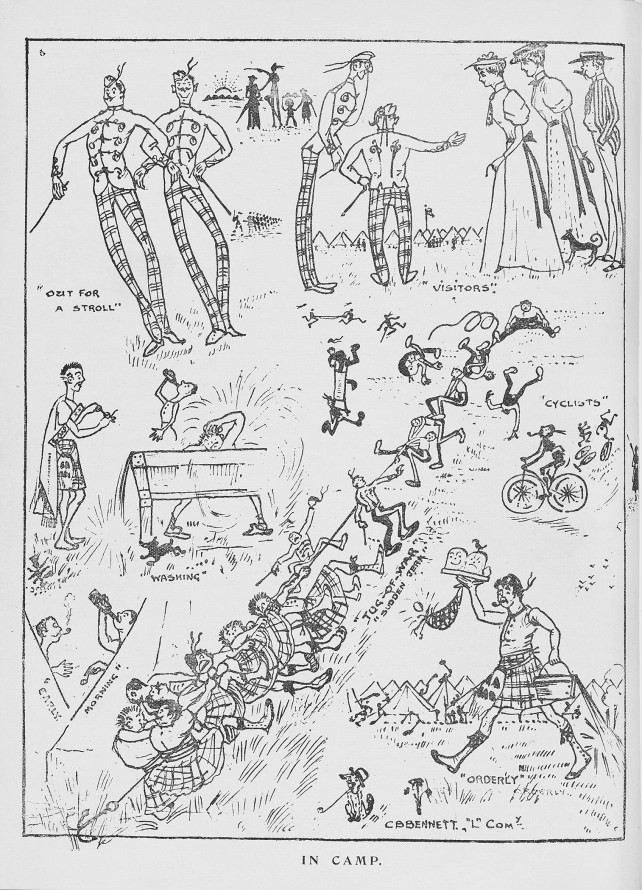
The 5th VB was distinct from the other HLI volunteer battalions because they continued to wear the Black Watch kilt rather than the Mackenzie tartan trews of the HLI. They did have their own cap badge by this time.60As well as regular drills and rifle shooting out at the Rifle Range at Patterton61, there was annual camp which , according to the The Pibroch, the annual report of the Glasgow Highlanders published each December from 1895, was much enjoyed by the volunteers.
An annual gathering each December at St Andrews Halls and one can imagine the good social life that would go along with the serious purpose of the organisation. In time of war many of the volunteers went on active service,in the South African War for example. In fact in 1900 the Annual Ball was cancelled and only a concert was held in order to respect those of the Highland Brigade who had fallen at Magersfontein.62
The 5th VB had companies A-M all over the city. AMC joined M Company based at Hillhead.63 This Company was commanded by Alexander Duff Menzies. AMC’s brother Arthur was already in M Company as Colour Sergeant.64The Pibroch-the annual record of The Glasgow Highlanders- enables us to follow AMC’s career as a Saturday Soldier.
For some reason AMC was demoted to Lance Sergeant again in 1899. The reason is not evident.68 Arthur resigned in 1899, the reason given is ‘expiry of term of service and other causes’ one of which may have been that he was due to marry the following year. AMC served until 1903, still as Lance Sergeant .On resignation he was given a special certificate ‘For long and good service’. AMC does not appear to have distinguished himself in any way-winning rifle shooting competitions etc- but appears to have given good service.69 Perhaps he resigned because of heavier business and family duties. His father had died in February 190370 and he was now head of the household. Also the volunteer forces were changing. The annual camp was shortly to be lengthened to two weeks and was to be compulsory, while the training was to brought much more in line with that of the regular forces.71 AMC was 31 by this time and perhaps he thought he had been a Saturday Soldier long enough.
War Service 1914-16
By the beginning of World War One in August 1914 the volunteer forces had been reorganised yet again.72 In 1908 the reforms of Richard Haldane,Secretary of State for War, had established the Territorial Force (TF) from the old volunteer brigades. In Scotland the TF consisted of 2 Divisions (1) Highland Division and (2) Lowland Division . AMC’s former battalion became the 9th (Glasgow Highland )Battalion HLI Territorial Force and was in the Lowland Division. The conditions of service had been altered from 1908.The men now had to complete 10 drills and a musketry course. The annual camp was now two weeks and was compulsory. This meant the entire annual holiday and more for many men in Glasgow and elsewhere. Even though many employers cooperated and the men were paid, a lot of good men resigned, either unwilling or unable to make this commitment. The weakness in the system, however was that no man in the Territorial Force was obliged to serve overseas.73
The 9th (Glasgow Highland)HLI now had eight companies-A-H and its HQ and Drill Hall was still 81 Greendyke Street. It was probably there that our donor reported when on 9th September 1914 at the age 41 he enlisted in 2/9th Battalion(Glasgow) HLI-still known as the Glasgow Highlanders.74
Along with his fellow volunteers AMC was sent to Lochend Camp Dunfermline. According to army records AMC (Service no 2989) was five foot six inches tall with grey eyes and grey hair. His occupation is given as that of commercial traveller .75 In October 1914 he was promoted to sergeant .76 On 24th October AMC signed Army Form E624 whereby he volunteered for overseas service. It appears that the volunteers in Dunfermline had been paraded before the commanding officer, Colonel W Fleming, for the purpose of urging them to commit themselves to overseas service, which most of them did .77
The 2/9th Battalion (Glasgow) HLI embarked for France in November 1914.78 However AMC did not go with them. No reason is forthcoming at that point but in August 1915 we find AMC in Craigleith Military Hospital in Edinburgh suffering from heart problems which had begun to show themselves in June 1915 . The medical report of 4th August 1915 states that he was suffering from myocardial disease which manifested itself in shortness of breath and occasional pains in his chest when marching etc. He was recommended for light duties.79
On 18th August 1915 AMC was transferred to 9th Scottish Provisional Battalion, Company A which was a reserve battalion used for coastal defence formed in May 1915 of home service men. The 9th Scottish was a battalion of the 1st Provisional Brigade’. The 1st Brigade was moved down to Kent in June 1915 and the 9th Scottish Provisional Battalion was stationed in Deal .80There is no information as to whether AMC was in Deal, one can only presume that he was with his battalion.
What is known is from 3rd September to 12th October 1915 AMC was a patient in Newcastle on Tyne Workhouse Military Hospital. His medical records state that he although he has myocardial disease the reason for his stay in Newcastle was that he was also suffering from a disease which was very common in the army at that time . AMC was discharged on 12th October 1915, presumably to go back to his battalion.81 In November 1915 he was promoted to Acting Company Master Sergeant of C Company. 82
There were several changes to the organisation and names of regiments and battallions of the British Army during 1915 and it has proved difficult to track the movements of AMC and the 9th Scottish Provisional Battalion during the period following AMC’s stay in Newcastle. However, by September 1916 he was at the 2nd Scottish Command Depot near Randalstown County Antrim in Northern Ireland. 83
Sir Alfred Keogh, Director of Army Medical Services, concerned about the availability of beds in UK Hospitals , set up four large convalescent camps in Blackpool, Epsom, Dartford and Eastbourne. This system was further refined early in 1916 by the establishment of over twenty Command Depots for the rehabilitative training of wounded soldiers who were too fit for a convalescent hospital but not fit enough to return to the front. One of these Depots was at Shanes Park near Randalstown, County Antrim in the grounds of Lord O’Neill’s Estate .84 Presumably AMC was there to assist in the retraining of troops as he had already been declared unfit for duty abroad .85
It was from here on 8th September 1916, after two years, that AMC was discharged from military service at his own request. The only reason given for his discharge was ‘Termination of Engagement ’.86 Perhaps it was AMC’s health problems or his age-he was 43 by this time. The Military Service Act of January 1916 had ended the distinction between home and foreign service and all Territorial Force soldiers became liable for overseas service but they had to be medically fit, which AMC was not. Also the age limit for conscription was 41 so perhaps it was a combination of his health and his age which led him to request his discharge.87
Home Again-Glasgow 1916-c1921
At some point in 1914 our donor’s three sisters, Williamina, Elizabeth and Margaret, had left Ballagan House and became tenants of Woodhall House , Kirkintilloch Road ,Bishopbriggs. 88 Ballagan House was rented to a farmer, John Paton. 89 Perhaps this was done because AMC, the head of the household, had volunteered for the army and the ladies wanted to live somewhere smaller(though Woodhall was a sizeable house ) and perhaps nearer to other members of the family. Younger brother Edward and his wife lived in nearby Lenzie in a house called ‘Craigmillar’ .90 The Ballagan Estate was eventually advertised for sale in November 1917 .91 It was sold to Colonel Peter Charles Macfarlane ,shipowner.92 The purchase price was £15,925.00. 93
It was to Woodhall House that AMC went after his discharge .94 According to the Glasgow Post Office Directories up to 1921 AMC was a commercial agent based at 63a St Vincent Street.After 1921 there is no trace of AMC in Glasgow again until 1931 except in 1925 when he donated an eighteenth century Scottish tablecloth to Glasgow Museums95 giving his address as 9 Kelvin Drive. The three Craig sisters had moved to 9 Kelvin Drive in the west end of Glasgow around 1922. 96
Where did he go? 1921-1931
AMC’s brother Arthur and wife Mary had moved to London around 1918 where Arthur set up in business as a merchant in Chancery Lane 97 with a home at 24 Regent Court Park Road in Westminster 98,a prestigious address and later as a land agent at 8 Blenheim Street Mayfair,SW1.99 Arthur and Mary spent the rest of their lives in London at various prestigious addresses including Belsize Park Hampstead, Baker Street100, Courtfield Gardens Kensington101 and from c about 1938 at 52 South Edwards Square Kensington 102 where Arthur died in on 20th August 1947. 103
Did AMC go down to London to join his brother? There are a few tantalising yet inconclusive pieces of evidence that suggest he may have gone to London. In the London Telephone Directories of 1922,1923,1925 and 1927 there are entries for an A. Montgomerie Craig in Chancery Lane where his brother Arthur was in business at that time and then in Dane Street Holborn. 104 As we have seen AMC was probably known as Montgomerie rather than Archibald since his school days. Did his sisters move to the much smaller house at 9 Kelvin Drive because their brother was moving to London? We can only speculate. These slight pieces of evidence alone cannot allow us to say definitely that these London Post Office entries refer to our donor. So his whereabouts remain a mystery until further sources of evidence can be accessed.
Later Life 1931-1947.
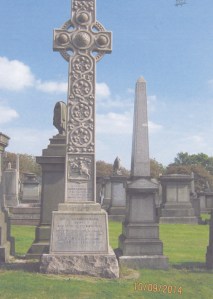
AMC re -appears as a Glasgow resident in 1931 living with his sisters at 9 Kelvin Drive. He was about 60 years old by this time.105 There is no evidence that he worked again after his return to Glasgow. 106 As we know he donated the painting The Miser to Kelvingrove Art Gallery and Museum in 1944. He died on May 26th 1947 of chronic myocarditis at the age of 74. 107 He was buried in the family grave at Glasgow Necropolis which had been designed for his father in 1903 by Glasgow architect James Thompson (1835-1905). 108
Figure 12. Craig Family Memorial Glasgow Necropolis- Epsilon. Copyright J M Macaulay
References and Notes
Miles, Hamish Catalogue of Dutch,Flemish and Netherlandish Paintings in the GlasgowArt Gallery. Glasgow Corporation 1961. Vol I p59
Glasgow Post Office Directories 1912-21; Glasgow Electoral Rolls 1931-1947
Glasgow Post Office Directories 1890-1895
The Edinburgh and Glasgow Railway Company opened a station in 1848 to serve the town of Kirkintilloch,naming it Kirkintilloch Junction. The building of houses around the station for Glasgow commuters began in the 1850s but the housing and population boom really began in the 1870s when piped and running water was made available to the villas. The North British Locomotive Company renamed the station Lenzie Junction in June 1890. http://www.edic.co.uk Local History and Heritage.
The Territorial and Reserve Forces Act 1907,also known as the Haldane reforms after Richard Haldane, Secretary of State for War, transferred existing volunteer and yeomanry units into a new Territorial Force where all units were attached to regiment of the British Army.
Glasgow City Archives TD366/3/2. Glasgow Highlanders, Notes on Battalion 1908-18.







 Glasgow Museums Art Donors Group