On 11th October 1948 the following 3 paintings were presented to Kelvingrove Galleries from Mrs Anna Walker’s Trust, per Messrs. Inglis Glen and Co., 223 West George St., Glasgow, C2:
On 11October 1948 the following three paintings were presented to the Kelvingrove Galleries from Mrs Anna Walker’s Trust, per Messrs. Inglis Glen and Co., 223 West George Street, Glasgow, C2:
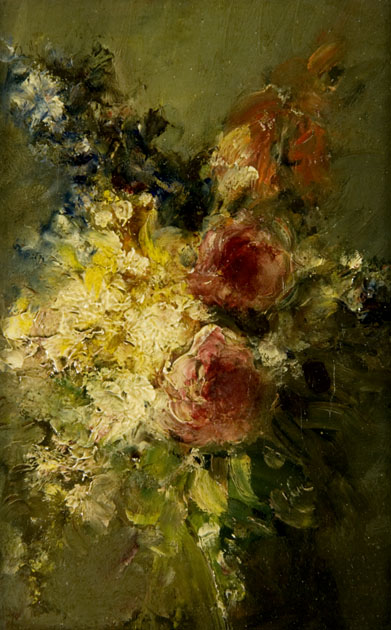
- A Bunch of Flowers, an oil painting by Victor Vincelet (1840-1871).
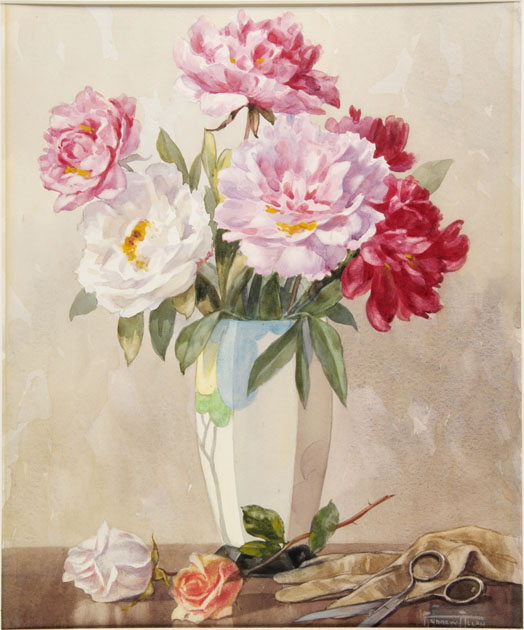
- Peonies, a watercolour by Andrew Allan (1905-1982).
- Cathedral Interior, a watercolour by James Holland (1799-1870).
When a female donor makes a donation using only her married name and with no other details, it is difficult to find out much information about her. Our donor is a prime example of this. Apart from her name and the pictures that she donated to the Gallery, there is no other information. However, what was obvious about her was her enthusiasm for flowers which is very clear from the above two paintings that were presented to Kelvingrove Gallery (See 1 and 2).
As the search started, it was clear that it would be expedient to write something about the historical background. This was the mid- Industrial Revolution age which saw tremendous social changes as well as certain scientific awareness and discoveries which affected everybody in this country as well the whole world.
The Industrial Revolution took hold in Glasgow at the beginning of the nineteenth century. Linen was Scotland’s premier industry in the eighteenth century but at the beginning of the nineteenth century the manufacture of cotton and textiles increased rapidly. Immigrants from the Highlands in the 1820s and from Ireland in the 1840s formed the workforce. The city then diversified into heavy industries like shipbuilding, locomotive construction and other heavy engineering that could thrive on nearby supplies of coal and iron ore. Between 1870 and 1914, Glasgow ranked as one of the richest and finest cities in Europe. [1]
As all this industrialisation was going on, it was clear that certain breathing spaces of the City must be built in the form of parks and botanic gardens as the lungs of the City. Thomas Hopkirk, a distinguished Glasgow botanist, had founded the Botanic Gardens in 1817 with the support of a number of local dignitaries and the University of Glasgow. [2] The Gardens were originally laid out on an 8-acre site at Sandyford at the western end of Sauchiehall Street (at that time on the edge of the city). The Royal Botanical Institution of Glasgow owned and ran the Gardens. They agreed to provide the University of Glasgow with teaching aids, including a supply of plants for medical and botanical classes. It is worth noting that one of the future famous plant-hunters, David Douglas, who was born at Scone near Perth, had taken up a post at the Glasgow Botanic Gardens in 1820.
Professor Hooker, who was Regius Professor of Botany at Glasgow University in 1820 and later became the first official director of the Royal Botanic Gardens, Kew in 1865, took a great liking to Douglas and the two men made a number of botanical trips together to the Scottish Highlands while Hooker was writing his book Flora Scotica. It was on Hooker’s recommendation that the Horticultural Society (not yet ‘Royal’) employed Douglas in 1823 as an explorer. It should be noted here that when David Douglas was exploring North-West America in the 1830s, he sent home seeds of Pseudotsuga, now commonly known as the Douglas Fir. David Douglas had also introduced more than 200 species of plants to gardens in Europe. [3]
Until the 1840s Glasgow’s West End consisted of open countryside, isolated farmhouses and the country dwellings of Glasgow’s most wealthy citizens. The completion of the Great Western Road and the re-location of the Botanic Gardens to the Kelvinside Estate in the early 1840s was the catalyst for a rapid change to the character of the area. [4] The Botanic Gardens and Glasgow Green are prime examples of these developments of the time. ln 1852 the Council purchased some land from the Kelvingrove and Woodlands estate to create an area which is now Kelvingrove Park and which was to be the new home for the famous Kibble Palace. [5]
There was definitely some desire to experiment growing and cultivating new breeds of plants brought in by scientists and other enthusiasts from the faraway lands of India, China, Japan and the Americas. These plants were either acquired in seed form or as complete plants to the newly established Horticultural Society and the like.
This enthusiasm for bringing plants from faraway lands continued into the beginning of the twentieth century, when we meet our donor Mrs Anna Walker.
She was on holiday in Northern Italy, when she accidentally discovered a heather. It was propagated by her gardener Robert Howieson-Syme and it was then sent to the Royal Horticultural Society (RHS) at Wisley and in 1925 named by F.J Chittenden, the then Director of the RHS. Initially, this new variety of heather was called Springwood which was the name of the house in Stirling where Anna lived with her husband. Later it was named Springwood White on the appearance of another variant called Springwood Pink by F. J. Chittenden in 1925. [6] The preferred name for the plant is Erica Carnea f1 Alba Springwood White. [7] It is remarkable that our donor Mrs Anna Walker had discovered her heather at a time when the main part of the Industrial Revolution had ended. Furthermore, World War I was over. However, the endeavour for the appreciation and growing plants from foreign lands was still alive.
The above information obtained from the article in the Heather Society [8] was the key to discovering the identity of our donor Anna Walker – her age, date of birth and her family’s details. In the 1881census [9], Anna was 14 years old and described as a scholar. She was born in 1866 in Glasgow, Lanarkshire. Her father, William Gibson, born in 1841, was a cloth merchant and her mother Isabella S. Gibson was born in 1844. In the same census record, it is recorded that she had a brother George who was 10 and a sister Jeannie T. who was 12. The Gibson Family lived in 1 Burnbank Gardens, Glasgow, Barony Lanarkshire with two servants.
Anna Gibson married Ralph Wardlaw Thomson Walker, a ship broker in 1890 in the Glasgow district of Partick. [10] Also in the 1891 census [11] it is recorded that the Gibson family was living in Doune, Perthshire in Castle Bank Cottage. Ralph WT Walker is shown to be in the same dwelling with his now wife, Mrs Anna Walker. Furthermore, the same household appears to have a guest, William Linklater, a minister of the Free Church in their house.
Our donor’s husband, Ralph W.T. Walker, was born in 1865. His father’s name was Robert Walker and his mother’s name was Mary Ann (Donaldson). The couple lived for a time in 3 Bruce Street Glasgow where Ralph had lived and had been living for a few years before he married. In the 1891 census [12], Anna’s brother George Gibson is described as a mercantile shipping clerk.
In the 1901 census [13], Mr and Mrs Walker are shown to be living in 4 Athole Gardens at Partick Burgh, Glasgow. Ralph’s profession is now recorded as ship owner. This is a large house and our donor Mrs Anna Walker now employed two servants – one as a table maid domestic and the other as a cook domestic. There is an impression that Mr and Mrs Walker were keen travellers, because apart from their travel to Italy in the 1920s, both of their names also appear on the First Class passenger list of the ship Duchess Of Atholl belonging to the Canadian Pacific Line bound to a West Indies cruise from the port of Greenock on 30 January 1930. [14]
Our couple stayed in Athole Gardens until 1915 and then moved to Stirling . The name of the house is Springwood and is B-listed. It was built about 1870 and they lived there from the early twentieth century until Anna died on the 24 July 1948. Earlier, Ralph had died there too in 1943.
In the Glasgow Herald of the 26 July 1948 there was a notice [15] which is printed below:
At Springwood Stirling on the 24th July 1948 Anna, wife of late Ralph W.T.Walker, ship owner. Funeral private. No Flowers.
References
[1]https://www.bbc.co.uk/history/scottishhistory/victorian/trails_victorian_glasgow.shtml
[2] https://www.glasgowbotanicgardens.com/the-gardens/history/
[3] ibid
[4] https://www.glasgowwestend.co.uk/pats-guide-buildings-architecture-history-glasgows-west-end/.
[5] op.cit [1]
[6] https://www.heathersociety.org/heathers/erica-hardy/erica-carnea/carnea-corolla-pure-white/springwood-white/
[7] Correspondence from Mr Chris Moncrieff, Head of Horticultural Relations, Royal Horticultural Society
[8] op.cit [6]
[9] 1881 census
[10] Marriage Cert. from Scotland’s People.
[11] 1891 Census
[12] ibid
[13] 1901 Census
[14] West Indies Cruise, UK and Ireland, Outward Passenger Lists, 1890-1960 for Ralph W T Walker
[15] Glasgow Herald of the 26 July 1948, Anna’s death notice.




 Glasgow Museums Art Donors Group