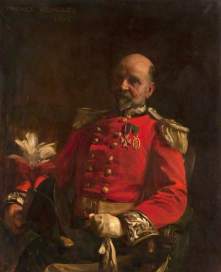
Colonel John Macfarlane (1846-1910)

Figure 1. Reynolds, Warwick; Colonel John Macfarlane (1846-1910); Glasgow Museums;© CSG CIC Glasgow Museums Collection.

In 1933 Gertrude Elizabeth Macfarlane gifted a portrait of her father Colonel John MacFarlane to Glasgow Museums. The painting, titled Portrait of Colonel John MacFarlane M.V.O., V.D., D.L., J.P., of The 1st Lanarkshire Rifle Volunteers was completed by Warwick Reynolds in 1907, who was  better known as a painter of animals, but he had an interest in depicting regimental figures. The portrait was exhibited at The Royal Glasgow Institute of Fine Art in 1909.(1)

Figure 2. Reynolds; Warwick, Poster – Recruits Wanted for the Scottish Regiments: Permission of Imperial War Museum, Accession IWM PST 13490

In 1919 Reynolds designed a poster entitled Recruits Wanted for the Scottish Regiments, a copy of which is in The Imperial War Museum.(2)

Gertrude was born in Glasgow on 6 January 1877 to John Macfarlane, a grain merchant, and Marion Buchanan McCallum from Lanarkshire.(3) John was born at Gartmore, Perthshire on 19 June 1846 and his parents were John MacFarlane, farmer and portioner (inheritor of a small piece of land), and Janet Sands.(4)

John junior, the subject of our story, attended Dalmary School in Gartmore, and when the family moved to Glasgow he was educated at St Enoch’s Public School followed by Andersons College. (5) At age 16 he started in business in Helensburgh with his brother Robert. Six years later he was working in a grain store in Glasgow, and in 1869 he set up business with another brother Malcolm. (6) Number 14 Kent Road, Charing Cross, Glasgow was the business address of Robert S MacFarlane, grain merchant, from 1865 to 1868, followed by Malcolm MacFarlane, grain merchant from 1868 to 1870. The same address was then occupied by the firm of M & J Macfarlane from 1870 to1879, (7) so this appears to be Johns place of work for this period and his progression to a senior level within the business. The business expanded and a branch was opened in Coleraine in Ireland followed by several agencies in Africa. (8)

John married Marion on second of February 1872 at 15 Hill Street, Garnethill, Glasgow. (9) In 1881 they were living at 11 Camphill Quadrant adjacent to Queens Park in Glasgow, with their family, John, William, Robert, Gertrude (our donor) and Marion aged from five months to eight years.  They employed three servants. (10)

Figure 3. 20 Berkeley Street, Glasgow 1968. Permission of J R Hume https://canmore.org.uk/collection/685598

John then became senior partner with Messrs M and J MacFarlane, grain merchants, and eventually sole partner with Macfarlane Brothers, Job Masters, hiring out horse drawn carriages in Berkley Street. (11) The arched entrance gave access to two levels for horses and carriages. The premises were demolished in 2000 to make way for a large block of flats and shops.

In 1907-08 John and Marion were living at 15 Dundonald Road in the West End with their son William (12)  who was employed in both of these businesses.

During his lifetime John contributed much to public duty, beginning as a reforming member of The Barony Parochial Board. In 1884 he entered the Town Council as a representative of the fourteenth ward and was a Magistrate of the city from 1889 to 1903. He became Convenor of The Statute Labour Committee from 1894 to 1902, with responsibility for looking after the public streets of Glasgow, and laying the foundation stones of three Glasgow bridges; Millbrae Bridge over the River Cart, Rutherglen Bridge over the River Clyde and Kirklee bridge over the River Kelvin. (13)

Among his many prominent roles he was preceptor (chairman) of Hutchieson’s Hospital from 1905 to 1908 and a Justice of The Peace and President of Central Division Liberal Association, Glasgow. He was Deputy Lieutenant of the County of the City of Glasgow and was on the board of many charitable institutions. (14)

One of his overriding interests was in The 1st Lanarkshire Volunteers, where he passed through all the grades to command the battalion as Colonel Commandment. John’s services were recognised by being awarded The Volunteer Decoration, and in 1905 he was enrolled as a member of The Royal Victorian Order by King Edward V11 when on a visit to Edinburgh. (15)

During a Royal Visit to Glasgow in 1907 Colonel John MacFarlane’s skills were employed in organising the royal processions. (16) John also originated the ‘Marches Out’, and these included the then famous midnight march to Lenzie and the three day march to Gartmore and around Loch Katrine. Johns’ favourite pastimes were riding and shooting and he also made time to join The Royal Clyde Yacht Club.(17)

John died on 19 December 1910 of pneumonia at his home at 15 Dundonald Road.(18)

DS

References…

  1. Mitchell Library, Royal Glasgow Institute record of exhibitions
  2. https://www.vads.ac.uk/digital/collection/IWMPC/id/4526/rec/1
  3. (births 644/090118) 1877, https://www.scotlandspeople.gov.uk/
  4. https://www.clanmacfarlanegenealogy.info/genealogy/TNGWebsite/getperson.php?personID=I8257&tree=CC
  5. Mitchell Library, Glasgow Contemporaries at The Dawn of the xxth Century, John M’Farlane p.82
  6. Mitchell Library, Index of Glasgow men 1909, Colonel John MacFarlane
  7. http://www.glasgowwestaddress.co.uk/Kent_Road/14_Kent_Road.htm
  8. Mitchell Library, Index of Glasgow men 1909, Colonel John MacFarlane
  9. (Marriages 64/060062),1872, https://www.scotlandspeople.gov.uk/
  10. (Census, 560/00006/00044) 1881 https://www.scotlandspeople.gov.uk/
  11. Mitchell Library, Gaskell, Ernest, Lanarkshire Leaders Social and Political, Col. John MacFarlane, D.L., M.V.O,  V.D., J.P.
  12. Mitchell Library, Post Office Directories 1907-08
  13. Mitchell Library, Index of Glasgow men (1909) http://gdl.cdlr.strath.ac.uk/eyrwho/eyrwho1212.htm
  14. Mitchell Library, Gaskell, Ernest, Lanarkshire Leaders Social and Political, Col. John MacFarlane, D.L., M.V.O,  V.D., J.P.
  15. Mitchell Library, Index of Glasgow men (1909) http://gdl.cdlr.strath.ac.uk/eyrwho/eyrwho1212.htm
  16. Mitchell Library, Gaskell, Ernest, Lanarkshire Leaders Social and Political, Col. John MacFarlane, D.L., M.V.O,  V.D., J.P.
  17. Mitchell Library, Index of Glasgow men (1909) http://gdl.cdlr.strath.ac.uk/eyrwho/eyrwho1212.htm
  18. (Deaths 644/120946) 1910 https://www.scotlandspeople.gov.uk/
Arthur Edward Anderson (1870-1938)

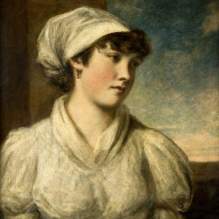
Gardner, Daniel, 1750-1805; Agnes Pennington
Figure 1. Gardener, Daniel: Agnes Pennington (1820) Glasgow Museums Resource Centre © CSG GIC Glasgow Museums Collection.
Figure 2. Stott, Edward A.R.A. : The Sacred Pool  (1820) Glasgow Museums Resource Centre © CSG GIC Glasgow Museums Collection.

Arthur Edward Anderson donated the two paintings shown to Kelvingrove in 1931 (1) Arthur Edward Anderson was born in Wandsworth in 1870. (2) He was the son of Edward John Anderson and Eleanor Anderson. Arthur Edward Anderson died in Chessington Surrey on November 9th 1938. (3) There is no evidence of any marriage. Edward John Anderson was born in Meerut, East India, with census returns  in 1871 showing him as a British Subject, his occupation listed as ‘gentleman’. His father owned a soap factory in Meerut. Edward John Anderson returned to England to live and established himself as a wharfinger. (4)

The family undoubtedly had money. Most of the scant census information available for Arthur E. Anderson, who was the first born son of the family, lists him as a gentleman, although in the 1901 and 1911 census he is listed as a clerk in the East India Merchant Company. (4) His life’s work however, seems to have been philanthropy, fuelled by his passion for art.

His wealth is also highlighted in a brief biography on the website of the British Museum which states that his art purchases were funded by his ‘inherited wealth’, although the same biography states that Anderson was ruined by the ‘great crash’ – presumably the stock market crash of 1929. It is worth noting that although he was ‘ruined’, he still managed to donate two paintings to Kelvingrove in 1931 and donated paintings to the Fitzwilliam Museum in Cambridge until 1935 (5)

A.E. Anderson was a philanthropist who definitely gave for public benefit. He wanted others to enjoy art as he did. According to Sir Sydney Cockerell who wrote Anderson’s obituary for the Times, Anderson was a man of exceptional taste who bought art works because they were beautiful. Cockerell acknowledges that he took advice from gallery directors about what he should buy. (6) Having bought these works, Anderson then donated them to Galleries and Museums around Britain.

These galleries included the Fitzwilliam Museum In Cambridge (of which Sir Sydney Cockerell was the director) and the Whitworth Institute in Manchester. Between 1924 and 1935 Anderson donated twenty six items to the Fitzwilliam Museum, including watercolours, drawings and sculpture. Between 1916 and 1927 Anderson donated 17 drawings to the British Museum. These included drawings by Brandoin, Daumier, Raemaekers and Clara Klinghoffer, among others. (7)

 After his death, obituary notices were featured not only in the Times, but also in local papers in places such as Gloucester, Hull, Derby, Belfast and in Angus in Scotland, perhaps an indication of the scope of Mr Anderson’s generosity (8)

Although frequently invited to do so, Anderson seldom visited any of the museums and galleries to which he donated art works. Even when the Whitworth Institute held an exhibition of works donated by him he could not be persuaded to attend the opening. He has been quoted as saying ” I do it because I enjoy it and I don’t like being thanked.” 

Apparently he did once visit Cambridge because he had at one time been destined to attend Clare College. He is also known to have attended a gathering of distinguished guests invited by the government of the day to celebrate the centenary of the foundation of the National Gallery in 1924. Largely however, Anderson was not a man who sought recognition. In some cases, paintings would arrive at galleries having come directly from the dealer where Anderson bought them with no information other than the name of the donor. 

Cockerell stated of Anderson that he got as much pleasure out of finding homes for his art works as did the collector who hung his treasures on his own walls. Cockerell also hoped that “the example of this unique public benefactor will inspire others with similar enthusiasm”

Anderson himself wrote, ” I often wonder what made me take up such an unusual hobby – I simply cannot resist buying a beautiful work of art when I see it and, as there is no room in my tiny cottage, there is nothing like presenting them to the great public museums, where they will have a safe refuge for many years to come. I should hate a sale for distribution far and wide after they have been collected together with such loving care.” (9)

Arthur Edward Anderson’s story is a small but significant one. He has no great galleries named after him and most of the works he donated rest in the stores of the Museums to which he was so generous. However, his motives for giving are clear and his desire to share his love of art with others stands in tribute to his memory. Donors such as Arthur Edward Anderson form an important part of much of our cultural life. Without them our galleries and museums would be lesser places.

Bibliography

(1) Glasgow Corporation Minutes 1931

(2) ancestry.co.uk :1881 census accessed 07/04/2021

(3) The Times, November 11th 1938

(4) ancestry.co.uk: 1901 census, 1911 census accessed 07/04/2021 

(5) Fitzwilliam Museum Cambridge : http://www.fitz museum.cam.ac.uk

(6) The Times, November 26th 1938: p.17, par2

(7) http://www.british museum.org.uk/ research/ collection online accessed 12/04/21

(8) www-British newspaper archive-co-uk.nls.idm.oclc.org  accessed 19/04/2021

(9) The Times, November 26, 1938: p.17 par 3

George Bowie Sawers(1855-1923)

In the minutes of the Corporation of Glasgow of 5 February 1919 (page 615) [1], it was reported that: ‘the sub-committee agreed to accept an offer made by Mr G B Sawers of 1 Belgrave Terrace, Hillhead to present to the Corporation two pictures entitled:

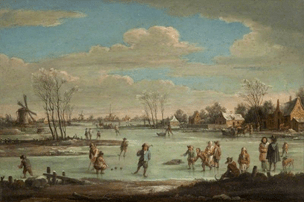
1-Skaters on a Frozen River after Peeter Bout 

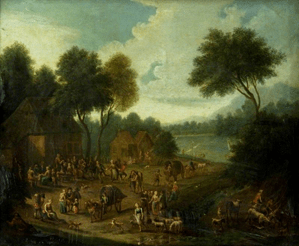
2-A Village Festival attributed to Mathys Schoevaerdts

 and to accord the donor a cordial vote of thanks therefore.’

The paintings that our donor presented to the Corporation in 1919 are displayed below. Dutch and Flemish paintings were popular with Glasgow collectors and it is possible that our donor had bought these paintings in Glasgow where there was a number of well-known art dealers, among them Alexander Reid and Craibe Angus who had contacts in Europe. These dealers could help buyers with their purchases of what was available in the art market.

Our donor, Mr George Bowie Sawers was born on 3 February 1855 [2], in the Tradeston District of Glasgow, in 14 Kenning Street. His parents were Robert Sawers, and Janet Anderson Sawers of Perth. His father’s occupation was recorded as ‘a pattern designer’. He was born into a family three boys and two girls.

Most of our donor’s career was spent in the locomotive industry in Glasgow. Initially, he workedfor the Hyde Park Locomotive Works and when the Company joined with the North British Locomotive Company [3], he became the joint secretary of the new firm.  

According to the 1881 census, our donor was living with his parents at 1 Belgrave Terrace, Glasgow and also spending some time in Dunoon where his father had a house. He was a very civic minded person and although his demanding position in a large company kept him very busy, he managed to find time to be a member of the 1st Lanarkshire Rifle Volunteersandreach the rank of major. [4] The Volunteers was initially a Scottish Volunteer Unit of the British Army and it was raised in Glasgow in 1859. During WWI, the Unit served on the Western Front and Ireland. All of our donor’s business-life was spent in the service of Messrs Neilson, Reid and Co., Glasgow, afterwards known as the NB Locomotive Co. Apart from his usual company work, he appears to have been an elected member of the Royal Scottish Geographical Society. His name appears in Volume 28, 1912 – Issue 12 of the Proceedings of the Royal Scottish Geographical Society.

He retired approximately seven years before his death. However, his name appears on the passenger list of s/s Etruria on 9 September 1898, on the return journey from New York, USA to Liverpool, England. This indicates that he had managed to have some free time to travel. When he retired, he moved to Hunters Quay in Dunoon and bought a house named Tignacoille. He was a well-known personality in the area as he had spent many years on holiday in his father’s house at Kirn. Although public life had no attraction for him, it appears that he liked playing bowls and he was still involved in the 1st Lanarkshire Rifle Volunteers. It was after taking part in such a match at the Green that he felt unwell and later died of heart failure in his house. In the report of his death in the local paper [5] it was mentioned that ‘he was a most generous subscriber to all deserving objects’. The report continued:

Major Sawers died 7 August 1923 aged 69 years at his home Tignacoille, Hunter’s Quay Dunoon. [6] He was in his 69th year when he died; he leaves a number of nephews and nieces. The cause of his death was heart failure. In accordance with his express wish, his remains were conveyed to the Crematorium at Maryhill on Friday, 10 August 1923.

A remembrance note printed in the 11 August 1923 edition of the Dunoon Observer and Argyllshire Standard after his death stated that he had lived in his residence Tignacoille, Hunters Quay, which he bought about 20 years before his death. [7]

His will dated 27 January 1923 [8] was recorded at Dunoon on 8 October 1923. His estate was valued at £12,286: 7s: 3d.

As our donor spent most of his working life in the North British Locomotive Company (NBL or North British) and because  NBL is an important development in the history of steam locomotive, it is important at this point to introduce the NBL and give a short history of it from 1903 until it closed down in 1962.

The NBL was created in 1903 through the merger of three Glasgow locomotive manufacturing companies: Sharp, Stewart and Company (Atlas Works), Neilson, Reid and Company (Hyde Park Works) and Dübs & Company (Queens Park Works), creating the largest locomotive manufacturing company in Europe. [9]

The main factories were located at the neighbouring Atlas and Hyde Park Works in central Springburn, as well as the Queens Park Works in Polmadie. A new central Administration and Drawing Office for the combined company was completed across the road from the Hyde Park Works in Flemington Street by the architect James Miller in 1909.  Hugh Reid, who was a well-known engineer and philanthropist of his time, became Deputy-Chairman and chief   Director. William Lorimer was the chairman. The building later became the main campus of Kelvin College.

The new company produced 5000 locomotives (the 5,000th one was produced in 1914) and the company had 7000 employees at that time. 

The Company [10]

1903 The largest Locomotive Company in Europe was created through mergers.

1905 Hugh Reid was the joint inventor with David MacNab Ramsay of the ‘Reid-Ramsay’ steam-turbine electric-locomotive, which underwent some trials but was not placed in service.

1914 The 5,000th locomotive was produced.

1914 Specialities: all types of locomotive engines; contractors to home railways, government railways of India, South Africa, Australia etc., state railways of France, Norway, Chile, Argentina, Japan, China, Egypt etc., also to railways and docks companies, steelworks, mines etc. Employees, 7,000.

1914 WWI Made 1,400 locomotives.

1918 The factory produced the first prototype of the Anglo-American Mark VIII battlefield tank for the Allied armies, but with the Armistice it did not go into production.

1924 Construction of the Reid-MacLeod turbine-driven locomotive, designed by Hugh Reid and James MacLeod. The turbine developed 500 HP at 8000 rpm. The reversing turbine developed 70% of the forward power. Boiler pressure 180 psi. 4-4-0+0-4-4 wheel arrangement.

1927 See Aberconway Chapter XV for information on the company and its history

By the start of WWII 8,850 locomotives had been completed.

1951 NBL acquired a controlling interest in Henry Pels and Co. (Great Britain), Ltd. Thereafter machine tools were made at the Queens Park works.

1961 Engineers and locomotive builders.

1962 The company ceased trading.

NBL had supplied many of its diesel and electric locomotives to British Rail (BR) at a loss, hoping to make up for this on massive future orders that never came. This, with a continuing stream of warranty claims to cure design and workmanship faults, proved fatal – NBL declared bankruptcy on 19 April 1962. Andrew Barclay, Sons and Co acquired the goodwill. They had built 11,318 locomotives since 1903.

Whilst highly successful as designers and builders of steam locomotives for both its domestic market and abroad, NBL failed to make the jump to diesel locomotive production. In the 1950s it signed a deal with the German company MAN to construct diesel engines under licence. These power units appeared in the late 1950s BR designs, later designated Class 21, Class 22, Class 41, Class 43 (Warship) and Class 251 (Blue Pullman). None of these were particularly successful (constructional shortcomings with the MAN engines made them far less reliable than German-built examples). A typical example of this was the grade of steel used for exhaust manifolds in the Class 43s – frequent manifold failures led to loss of turbocharger drive gas pressure and hence loss of power. More importantly, the driving cabs of the locomotives would fill with poisonous exhaust fumes. BR returned many NBL diesel locomotives to their builder for repair under warranty and also insisted on a three-month guarantee on all repairs (a requirement not levied on its own workshops). This and the continuing stream of warranty claims to cure design and workmanship faults proved fatal – NBL declared bankruptcy. Because of the unreliability of its UK diesel and electric locomotives, all were withdrawn after comparatively short lifespans.

NBL built steam locomotives for countries as far afield as Malaysia and New Zealand. The Colony of New South Wales purchased numerous of their locomotives, as did the State of Victoria as late as 1951 (Oberg, Locomotives of Australia), and in 1939 it supplied locomotives to New Zealand Railways, some of which were later converted to other classes. In 1949, South Africa purchased over 100 engines from the company. Some still operate tourist trains on the George-Kynsa line. Additionally South Africa also purchased some engines from the company between 1953 and 1955. These successful engines, with various in-service modifications, survived until the end of steam in South Africa in 1990. NBL also introduced the Modified Fairlie locomotive in 1924.

In 1957, the last order for steam locomotives was placed with the company and the last steam locomotive was completed in 1958. Although the company was making small industrial diesel locomotives, and received some early main line diesel orders from British Railways, the orders were never big enough to maintain the company. Other locomotive manufacturers, who had acted swiftly in transferring from steam to diesel and electric production, were becoming more successful. Messrs Andrew Barclay Sons & Co (Kilmarnock, Ayrshire, Scotland) acquired NBL’s goodwill.[11]

References

[1] Minutes of the Glasgow Corporation Minutes of 5th February 1919, Volume November 1918-April 1919, page 615.

[2] Birth Certificate, obtained from Scotland People.

[3] Archives of North British Locomotive Co., Springburn Museum (Mitchell Library, Glasgow).

[4] The London Gazette, 31 October 1899. Page 6531.

[5] Dunoon Observer and Argyllshire Standard, 11August 1923. Archives of Argyll and Bute Council.

[6] Death Certificate, records from Scotlands People.

[7] op.cit. [5]

[8] Confirmations and Inventories 1923 (Vol. M-Z), Mitchell Library.

[9] https://archiveshub.jisc.ac.uk/search/archives/450f1232-3643-3c24-b8b9-9df92d152798

[10] https://www.gracesguide.co.uk/North_British_Locomotive_Co

[11] https://archiveshub.jisc.ac.uk/search/archives/450f1232-3643-3c24-b8b9-9df92d152798