Donors-Family and Trustees of Reverend Robert Buchanan (1802-1875)
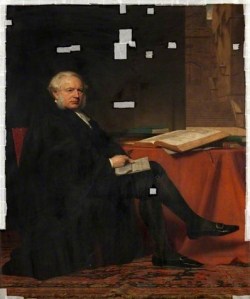
This painting was exhibited at the Royal Scottish Academy Annual Exhibition in 1873.1The subject is the Reverend Robert Buchanan DD, Minister of the Free Church College Church in Lyndoch Street Glasgow . He is painted wearing the robes of the Moderator of the Free Church sitting to the right of stairs leading to the entrance of the Free Church College in Edinburgh. The portrait was donated to Glasgow Corporation by the family and trustees of the late Robert Buchanan in a letter dated 5 July 1898 from Messrs McKenzie Robertson and Co Writers.2 The donation was made after the death of Mrs Elizabeth Stoddart Buchanan in April 1898.3
Robert Buchanan was born in St Ninians, Stirling on 15 August 1802. He was the sixth son of Alexander Buchanan, a brewer and farmer. He was educated at the University of Glasgow (1817-20) and then at the University of Edinburgh (1820-25). He was first licensed as a preacher in the Church of Scotland by the Presbytery of Dunblane in 1825. Buchanan served briefly as tutor to the Drummond family of Blair Drummond and through their influence was ordained minister to the Parish of Gargunnock in 1826. He then served in the parish of Saltoun in East Lothian from 1829 to 1833.
In 1833 a vacancy arose at the prestigious Tron Church in Glasgow where Thomas Chalmers had begun his Glasgow ministry. Buchanan was called to fill this charge and so began the most important part of his career. At the time the bulk of the congregation were not from the area surrounding the Tron Church around Glasgow Cross but from a much wider area to the west which had a growing and much more affluent population.
Robert Buchanan agreed with the views of Thomas Chalmers regarding the missionary work of the church among the poor of the city, the importance of setting up and maintaining schools as well as Chalmers’ evangelical views. He did much work in the Wynds, a very poor area around Glasgow Cross and was instrumental in raising money for several new churches.
In fact Robert Buchanan became one of the leading figures in the evangelical wing of the Church of Scotland in the west. The story of the Disruption of the Church of Scotland in 1843 is well-known and need not be repeated here except to state that Robert Buchanan was a leading figure during the period leading up to the Disruption. He represented the dissenting evangelical majority party in the negotiations with the Westminster government in London to try to resolve the situation. It was Buchanan who moved the ‘Independence Resolution’ at the General Assembly of the Church of Scotland in 1838 where the majority refused to defer to the civil courts in spiritual matters especially in the appointment of church ministers. Buchanan was one of the signatories to the Disruption document in 1843.
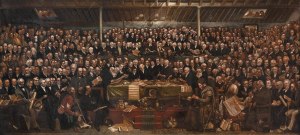
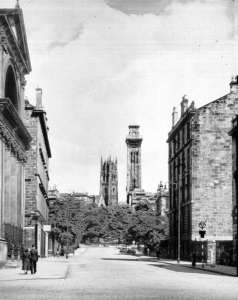
After the Disruption Buchanan took his congregation from the Tron Church and for a while held church services in Glasgow City Hall which had opened in 1840. The congregation then moved to the new Dundas Street Free Church opened in 1844.4 In 1857 a new church was opened in Lyndoch Street adjacent to the recently opened Free Church College for the training of ministers which was designed by architect Charles Wilson. The Free Church College Church was also designed by Charles Wilson at the cost of £10,000.5 Robert Buchanan was invited to be minister of the new church a post which he accepted.
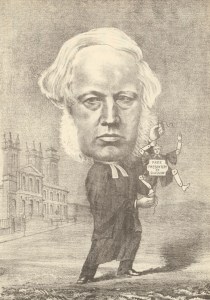
In 1847 on the death of Thomas Chalmers, Buchanan became the Convener of the Sustentation Fund, the financial system devised by Chalmers whereby the richer congregations of the Free Church subsidised the poorer. For thirty years he managed this fund, giving the Free Church a sound financial footing and earning the respect of his contemporaries. Such was thought to be Buchanan’s influence on the Free Church that the caricaturist of the satirical magazine The Bailie portrayed him as its ‘puppet master’.
The Ten Years of Conflict was Buchanan’s scholarly account of the Disruption which went a long way to justify to the public the actions of those who ‘went out’. He also published Clerical Furloughs an account of a visit to the Holy Land in 1860.6
In 1860 Robert Buchanan was elected Moderator of the Free Church of Scotland which showed the high esteem in which he was held.7
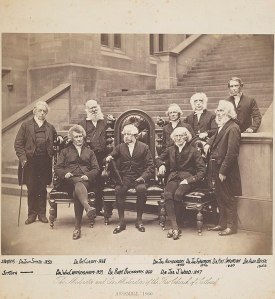
His congregation at the Free Church College Church ,along with other subscribers, also showed their appreciation of their minister when in August 1864 the sum of 4000 guineas was presented to Robert Buchanan at a reception at the Queens Hotel in George Square, part of what is now the Millenium Hotel. The gift was presented, ‘as a tribute to his private worth and to his public labours as a citizen of Glasgow’. Mrs Buchanan was presented with ,” a silver epergne and appendage’.8 The same congregation commissioned our portrait.9
Robert Buchanan continued as senior pastor to the Free Church College Church as well as serving the city of Glasgow in many ways. For example he was elected to the newly formed Glasgow School Board in 1873.10 In the winter of 1874 when he went to Rome to take charge of the Free Church in Rome for the winter, his wife and two of his daughters went with him. While there he caught a cold and died on 31 March 1875. He had just been appointed the next Principal of the Free Church College in Glasgow.11
The body was brought back to Glasgow by members of the family. Robert Buchanan was buried in the Glasgow Necropolis on 18 May 1875. According to the Glasgow Herald which reported the funeral in great detail, 15000 people lined the streets to see the funeral cortege. Among the many of Glasgow’s most notable citizens who walked behind the coffin were the Lord Provost, the Dean of Guild and the Deacon Convenor.12
The Buchanan Family (1)
Robert Buchanan was first married in 1828 to Ann Handyside in Edinburgh. They had six children of whom three survived to adulthood. Alexander was born in 1829,Hugh in 1831 and Ann Wingate in 1837. Sadly Buchanan’s wife Ann died in 1840.13 In 1841 Robert and two of the boys were living in Richmond Street Glasgow which is now the site of one of the University of Strathclyde buildings.14 Alexander became an engineer and spent most of his adult life in Derby15 and as we shall see he was one of the trustees of his father’s estate.
Hugh attended The High School of Glasgow16 which until 1878 was situated between John Street and Montrose Street. The High School of Glasgow began in the twelfth century as the Glasgow Cathedral Choir School. It was absorbed into The Glasgow School Board in the early 1870s only to become an Independent School once again in the 1970s.17
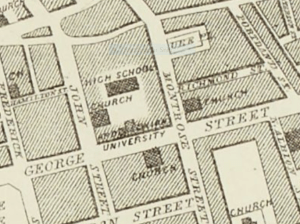
Hugh died in 1852 aged only twenty. He is recorded in the 1851 census as being a warehouseman. As he died in Georgetown, Demerara one can only assume that he had gone out there to improve his prospects.18
In 1843 Robert Buchanan married again to Elizabeth Stoddart who was born in Hertfordshire in 1825.19 Daughter Ann lived in the family home until her marriage to John McLaren on 22 August 1861.20 John McLaren is recorded in various census reports as being a merchant. He must have been fairly prosperous as in the 1871 census he and Ann were living at 5 Belhaven Terrace, a prestigious address off Great Western Road and they had five servants. They had six children between 1864 and 1876.21
Buchanan Family (2)
Elizabeth and Robert went on to have six children between 1844 and 1855.
- Charlotte Gordon born 1844
- Elizabeth born 1846
- Lawrence Barton born 1847
- Isabella McCallum born 1849
- Harriet Rainy born 1852
- Edith Gray born 185522
The family moved to 11Sandyford Place, Sauchiehall Street around184523 and then to 2 Sandyford Place around 184824 where they remained until Robert Buchanan’s death in 1875.25 The family then dispersed, several to live in England as we shall see.
By the time of the 1881 census Mrs Buchanan had moved to 192 Berkley Street, Glasgow and was living with two servants. She then moved to London as the 1891 census puts her at 52 Ladbroke Grove, Kensington where she was living with her unmarried daughter Harriet and her granddaughter Louise McLaren, daughter of her stepdaughter Ann. Elizabeth Stoddart Buchanan died at this address in 1898.26 As we have seen it was after their mother’s death that the portrait was donated to Glasgow by the family and trustees of Robert Buchanan, though there was no mention of the portrait in Elizabeth’s will. One of the trustees was Alexander Buchanan, eldest son of Robert Buchanan’s first wife Ann Handyside.27
Charlotte Gordon Buchanan (1844-1919)
There is very little information about the life of Charlotte Buchanan except for the minimal detail provided on census records. She was born in 1844,presumably at 11 Sandyford Place and would have moved to 2 Sandyford Place along with the family around 1848.28There she remained until her father’s death in 1875 when the family was dispersed. Charlotte accompanied her parents on the trip to Rome in 1874 and it was she who sent the simple telegram, ‘Father died suddenly last night’ to her step-sister Ann’s husband John McLaren to inform the world at large of her father’s death.29
Charlotte was staying with her sister Mrs Edith Gray Wilson at 9 Woodside Crescent, Glasgow at the time of the 1881 census.30She does not appear in the 1891 census but by 1901 Charlotte had moved to London and was living at 31 Hawke Road, Upper Norwood in a ten bedroom house called St Ninians which was the name of the village outside Stirling where her father had been born. Perhaps she moved to London to be near other members of the family who had moved there. She is still at that address in 1911 and is said to be ‘of independent means’.31 Charlotte died in London on 5 September 1919. 32
Elizabeth McAlpine Thornton (1846-1932)
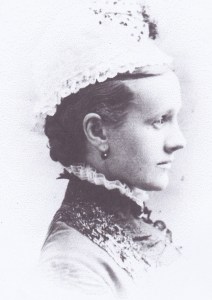
Elizabeth was born in 1846 and lived in the Buchanan’s family home at 2 Sandyford Place 33 until her marriage to the Reverend Robert McAlpine Thornton on July 20th 1871. Robert McAlpine was the minister of Knox’s Presbyterian Church, Montreal at the time of the marriage.34The marriage ceremony was performed by Elizabeth’s father. Robert became minister of Wellpark Free Church in the east end of Glasgow around 1872.35 As with most women of the time it was Elizabeth’s husband’s life which is on record rather than her own.
Robert Thornton was born in Ontario, Canada ,the second son of the Reverend Robert Hill Thornton who had been called to Whitby Township, Ontario in 1833 as minister of the first Presbyterian Church and who went on to have a distinguished career as founder of several churches and schools and was also Superintendent of Education until his death in 1875. Robert McAlpine Thornton was one of ten children.36In 1881 the Reverend and Mrs Thornton were living at 12 Annfield Place, Dennistoun, Glasgow along with three sons. Kenneth Buchanan was seven, David Stoddart was five and Robert Hill was four.37
The family moved to London around 1883 as Reverend Thornton was called to be minister of Camden Road Presbyterian Church.38By this time four more children had been born. Margaret Elizabeth was six, Edith Wilson was seven and John McLaren was aged one. The family were living at 72 Carleton Road, North Islington.39
The Reverend Thornton had a distinguished career. He raised large sums for the African Missions.40 The Mail reported on the 25 November 1910 that he was unanimously chosen as Moderator of the next Synod of the Presbyterian Church of England which was to meet in Manchester in May 1911.
1898 the Reverend Thornton was one of many ministers who contributed to what was to be the third edition of Charles Booth’s Life and Labour of the People of London which was published in seventeen volumes 1902-3.41The Thorntons were still at 72 Carleton Road in 190142. In 1911 Robert visited his son Robert Hill Thornton in Whitley Bay ,Northumberland where he was a Church of England Minister. Robert Junior was married with two children. Elizabeth was at home with the children at 18 Hilldrop Road North London.43
The Reverend Robert Thornton died in London on 19 July 1913. His death was marked by a complimentary obituary in the London Times.44 It was perhaps fortunate he did not live to experience the sadness of the death of his youngest son John McLaren who was killed in action in Flanders in 1916.45 At the time of Robert’s death the family were living in Elgin Crescent Notting Hill46 and it was there that Elizabeth died on 28 March 1932 aged 86.47
Lawrence Barton Buchanan (1847-1926)
Born about 1847 Lawrence lived at the family home at 2 Sandyford Place.48He attended Glasgow Academy, Glasgow’s oldest independent school founded in 1845 and which was in Elmbank Street at that time. Lawrence’s father had been involved in setting up the school.49
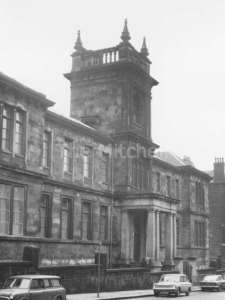
William Campbell of Tullichewan, founder of the drapery and warehouse emporium J&W Campbell50 had been instrumental in setting up the school. He was a generous benefactor to the Glasgow Royal Infirmary, Glasgow Botanic Gardens and to the Free Church of Scotland among many others. In May 1845 William Campbell convened a meeting with Free Church ministers at the Star Hotel in George Square to discuss the possibility of setting up ‘ an academic Institution in the city’. Dr Robert Buchanan, Lawrence’s father and then Minister of the Tron Church, proposed that ‘an academic Institution shall be established for the purpose of teaching youth the various branches of secular knowledge, based upon strictly evangelical principles and pervaded by religious instruction’. This was unanimously agreed by those present. A school of 400 pupils was envisaged. Although admission of girls was discussed this did not happen for another 145 years. Lawrence’s father headed a committee charged with selecting the headmaster and staff of the school. The first headmaster or rector as he was known was James Cumming, who was appointed in January 1846. The school was built in Elmbank Street, Charing Cross and was designed by Charles Wilson. It was financed by the issuing of 200 shares at £40 each.51 In 1878 the school moved to Colebrooke Street Kelvinbridge and the Elmbank Street premises were sold to the High School of Glasgow which was taken over by the Glasgow School Board after the passing of the 1872 Education(Scotland )Act.52
The Glasgow Post Office Directory of 1874-5 tells us that Lawrence was a ‘writer’ meaning a lawyer, working for Bannantyne, Kirkwood and McJannets, a legal firm, at 145 West George Street, while still living in the family home. After his father’s death in 1875 Lawrence moved to 17 Ashton Lane, Hillhead which remained his address until about 188053 by which time he was a writer with premises at 190 West George Street but living at ‘Fernlea’ in Bearsden.54
On 28 May 1877 The Glasgow Herald reported the laying of the foundation stone of the Buchanan Memorial Free Church in Caledonia Road ,Oatlands. Lawrence attended the ceremony and spoke of his father’s work and ‘expressed the hope that the Church…would be the means of prospering Christian work in the district.’ The church was designed by Glasgow architect John Honeyman.
Lawrence married Elizabeth(Lizzie) Agnes McLachlan in October 1877 in St Pancras in London.55Lizzie was the daughter of Elizabeth McLachlan and the late David McLachlan.56 David McLachlan had been first a wine and spirit merchant with premises in Oxford Street ,Glasgow and also had business dealings in London.57 In June 1868 he took over the George Hotel at 74 George Square at the east corner of what is now Glasgow City Chambers.58
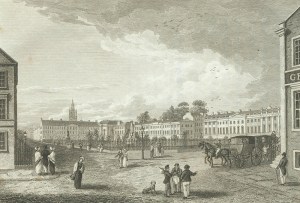
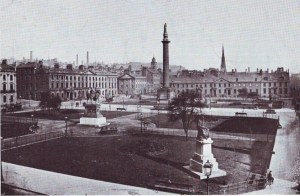
George Square had undergone many changes since it was laid out in 1781.59 At the time of the Jacobite Rising in 1745 it was a marsh surrounded by meadowlands and kitchen gardens.60 At the beginning of the nineteenth century it was still ,’a hollow filled with green water and a favourite resort for drowning puppies ,cats and dogs while the banks of this suburban pool were the slaughtering place of horses’.61 Building began around 1789 with a series of elegant town houses. The only statue in 1829 was that of Sir John Moore, erected in 1819.62 As Glasgow prospered the town houses of George Square were taken over by commercial enterprises and hotels.
By the 1860s George Square had many hotels. Along the western side for example was The Edinburgh and Glasgow Chop House and Commercial Lodgings. In 1849 this had been taken over by George Cranston, father of Catherine Cranston who became famous later in the nineteenth century for her tearooms. The Chop house was renamed The Edinburgh and Glasgow Hotel and then Cranston’s Hotel. Around 1855 the town houses on the north side of the square were converted into the Royal, the Crown and the Queen’s Hotel. This expansion was possibly as the result of the opening of the Edinburgh and Glasgow Railway with its Queen Street Station (known as Dundas Street station at first) in 1842. David McLachlan became a well-known Glasgow hotel keeper.63 After her husband’s death in 187264 Elizabeth McLachlan took over the running of the hotel and when the George Hotel was due for demolition to make way for the new Glasgow City Chambers Elizabeth McLachlan took over the Queen’s Hotel at 40 George Square and later changed the name to the George Hotel.65
One can only speculate how Lawrence and Lizzie met but in February 1877 Lawrence, in his capacity as a lawyer, defended Mrs Elizabeth McLachlan when she was prosecuted for a breach of the George Hotel licence.66 If this was when they first met and they were married the following October it must have a whirlwind romance or perhaps Lawrence had been acting as Mrs McLachlan’s lawyer for some time as his office was in nearby West George Street. Why they married in London raises a question unless it was because, as we have seen, Lawrence’s mother and other members of his family had moved to London by then.
By the time of the 1881 census Lawrence and Lizzie had three children. May Hamilton aged four was born in France rather unusually. A second daughter Ethel Howard was born in England about 1879 and a son Lawrence Gordon in New Kirkpatrick, Dumbarton in May 1880.67
Around 1880-1 Lawrence’s life seems to have taken a different direction. At the time of the 1881 census Lawrence and his family were living at 40 George Square Glasgow at the Queen’s Hotel, later renamed The George Hotel. He and his mother-in-law, Elizabeth McLachlan, were listed as hotel keepers.68 What made Lawrence decide to give up the legal profession and take up that of hotel keeper is not known but it turned out to be a fortuitous decision. On 14 October 1881 Mrs McLachlan died suddenly of ‘apoplexy’.69 She was only 58 years old.70 There had been a serious fire at the George in July 1881 which had destroyed a third of the roof. The Glasgow Herald commented that the damage was around £200 and even though the premises were insured ‘the loss to the lessee of the hotel was considerable‘.71 Perhaps the stress of the fire caused the stroke.
Lawrence was proprietor of the George Hotel for the next ten years.72 Sometime in 1890 The George was taken over by J. Fritz Rupprecht73 who previously owned the Alexandra Hotel at 148 Bath Street.74The name of the hotel was changed to the North British Railway Hotel sometime in 1891.75 Then in 1903 this hotel and the Royal at 50 George Square were bought by the North British Railway Company and became one hotel. This is today the Millennium Hotel.76
There is no trace of either Lawrence or his wife after about 1890. They do not appear in the 1891 census. The only clue we have is contained in Lawrence’s mother’s will. When she wrote her will in July 1893 she commented that her son was living in Stuttgart in Germany but no reason for this is given.77 Neither do they appear in the UK census of 1901 but by 1911 Lawrence, aged 64, was back in the UK living in Saffron Waldon with his wife ,daughter May and son Lawrence. His occupation was given as ‘retired solicitor’.78 Lawrence Buchanan died on 31 July 1926 at 2 London Lane, Bromley Kent aged 79 and was buried in Plaistow Cemetery in Bromley.79
Isabella McCallum Bruce (1849-1908)
Isabella Buchanan lived in the family home at 2 Sandyford Place until at least 1871 according to the census of that year. There is no trace of her in the 1881 census.80 She married Thomas Boston Bruce who was a barrister. They married at the British Consul in Rome on 26 February 1885.81 Thomas was six or seven years younger than Isabella. It is not known at this time why the wedding took place in Rome. In 1891 the Bruces were living at 22 Ladbrooke Grove in Kensington. They had three children by this time. Charles Gordon was four, Isabel M two and Rosamund was one. There were four servants living in the house demonstrating that the Bruces were quite prosperous.82 Another daughter Elizabeth Winifred was born about 1894.83 As we have seen several members of the Buchanan family had moved to London by this time and Isabella’s mother was living close by at 52 Ladbroke Grove at the time of her death in 1898.
According to the 1901 Census the Bruce family were at 2 Lunham Road Upper Norwood. Thomas Boston Bruce had chambers at 32 Camden House Chambers, Kensington at the time of his death. 84 There is very little information forthcoming about the Bruces except that gleaned from the census records. We do know that the eldest son, Charles Gordon followed in his grandfather’s footsteps and became a minister of the church though it was the Church of England rather than the Free Church of the Reverend Robert Buchanan.85 Isabella died at the Lunham Road address on 5 January 1908 aged 59.86
Harriet Rainey Buchanan (1852-1925)
Harriet was probably given her middle name in honour of the Reverend Robert Rainey, a friend and colleague of her father. Robert Rainey was a leading figure in the Free Church of Scotland and was for many years Principal of New College Edinburgh, the first training college for Free Church ministers in Scotland after the Disruption.87 Harriet lived at the family home in Sandyford Place until the death of her father in 1875.There is no trace of her in 1881 but by 1891 she was living with her mother at 52 Ladbroke Grove ,Kensington.88Her sister Isabella was living at 22 Ladbroke Grove at this time. After her mother’s death in 1898 Harriet appears to have moved in with her eldest sister Charlotte in Hawke Road, Norwood. Also living in the house was niece Margaret Thornton, daughter of elder sister Elizabeth and Robert McAlpine Thornton.89
At the time of the census in 1911 Harriet was staying with her sister Edith Gray Stewart who was married to Robert Barr Stewart ,a solicitor. Their home was Hillfoot House ,New Kilpatrick. It appears the middle classes were already moving to Bearsden by this time.90
In all the census reports consulted Harriet is said to be ‘living on her own means’ and there is no evidence of her having a paid occupation. Like her eldest sister Charlotte Harriet never married. Harriet died in Edinburgh of pneumonia in October 1925 aged 73. At the time of her death she was living in Eglinton Crescent , Edinburgh. Her death was registered by her brother-in-law Robert who by this time was living at 4 Huntley Gardens, Glasgow.91
Edith Gray Stewart (1855-1938)
Edith was the youngest of the children of Robert and Elizabeth Buchanan. She lived in the family home in Sandyford Place92 until her marriage on 4 November 1874. She was nineteen when she married Dr James George Wilson, Professor of Midwifery at Anderson’s College Glasgow.93 Dr Wilson was more than twice Edith’s age and already had a home at 9 Woodside Place in Glasgow’s west end.94 Dr Wilson died on 4 March 1881 at the age of 52.95 Edith remarried in the spring of 1887 to Robert Barr Stewart, Writer to the Signet and Notary Public. They were married in Kensington possibly because, as we have established, Edith’s mother and other members of the family were living in London by this time. Edith’s brother-in-law the Reverend Robert McAlpine Thornton assisted at the wedding.96 In 1891 Edith and Robert were living in Inverallen Place ,Stirling97 and later moved to Carronvale Road, Larbert.98
They moved again to Hillfoot House in Bearsden along with their two children . Alex was 22 at this time and Lillian was twenty.99 At the time of their deaths the Barr Stewart’s usual residence was 4 Huntley Gardens Glasgow. Edith died of cerebral thrombosis at Balmenoch, Comrie Road Crieff on 21 September 1938 aged 84. Her death was registered by her daughter Lilian, now Oldham.100 Less than a month later on 20 October Edith’s husband Robert died in Perth.101
The Buchanans appear to have been a very close family. Through the years we have seen numerous examples of members of the family visiting one another, living with one another and generally supporting one another. Even as late as 1939 when she was in her eighties we find Lawrence Buchanan’s widow Lizzie and unmarried daughter May either visiting or living with the Reverend Charles Gordon Bruce , the son of Lawrence’s sister Isabella.102
References
- Baile de Laparriere (editor). The RSA Exhibition 1826-1990. 1991
- Minutes of Glasgow Corporation Parks and Gardens Committee July 6th
- ancesty.co.uk Statutory Deaths. Elizabeth Stoddart Buchanan
- Stephen, Sir Leslie (editor). Dictionary of National Biography.(DNB). OUP, 1921
- Morning Post 02/04/1875
- Op cit 4
- http:/www.archive.org/stream/disruptionworthi00edin
- Glasgow Herald (GH) 08/08/1864
- Op cit 5
- Op cit 5
- GH 05/04/1875
- GH 19/05/1875
- Op cit 4
- UK Census Records 1841 http://www.scotlandspeople.co.uk
- UK Census Records 1861-1891 http://www.ancestry.co.uk
- GH 29/091846
- highschoolofglasgow.co.uk/why-hsog-/history
- Inverness Courier 28/10/1852
- Op cit 4
- scotlandspeople.co.uk/Statutory Marriages
- UK Census Records 1871,1881 http://www.scotlandspeople.co.uk
- Ibid 1851,1861
- Glasgow Post Office Directory (GPOD)1845
- Ibid 1848
- UK Census Records 1881 http://www.scotlandspeople.co.uk
- scotlandspeople.co.uk. Will of Elizabeth Stoddart Buchanan
- ibid
- UK Census Records 1851-1881 ancestry.co.uk
- GH 01/04/1875
- UK Census Records 1881 http://www.scotlandspeople.co.uk
- UK Census Records 1891-1911 http://www.ancestry.co.uk
- England and Wales National Probate Calendar1858-1966.www.ancestry.co.uk
- UK Census Records 1851-1871 http://www.scotlandspeople.co.uk
- scotlandspeople.co.uk Statutory Marriages
- GH 26/09/1874
- whitby.library.on.ca
- UK Census Records 1881www.ancestry.co.uk
- London Times 21/07/1913 Obituary Reverend R. M. Thornton
- UK Census Records 1891.www.ancestry.co.uk
- 0p cit 28
- Charles Booth Online Archive . Ref Booth B213 pp2-10** check
- UK Census Records 1901 http://www.ancestry.co.uk
- Ibid 1911
- Op cit 38
- University of London Student Records 1836-1945.Role of War Service 1914-18.www.ancestry.co.uk
- Op cit 32
- ancestry.co.uk/Statutory Deaths
- UK Census Records 1851-1871 http://www.scotlandspeople.co.uk
- McLeod, Iain The Glasgow Academy.150 Years. Glasgow Academy 1997 pp1-9
- glasgowmuseumsartdonors.co.uk Lt Colonel Henry Alastair Campbell OBE
- Op cit McLeod
- theglasgowacademy.org.alumni/from-our-archives/the-history-of-the-academy
- Glasgow Post Office Directories1876-1881
- Glasgow Post Office Directory 1880-81
- General Record Office. Marriage Certificate. Lawrence Barton Buchanan and Lizzie Agnes McLachlan 02/10/1877
- GH 25/07/1872
- UK Census Records 1851 http://www.ancestry.co.uk
- GH 11/06/1868
- Sommerville,Thomas A History of George Square. Glasgow 1891 p12
- Ibid p9
- Ibid p12
- Ibid p26
- ibid p43
- North British Daily Mail 03/07/1874
- Glasgow Evening News and Star 04/12/1880
- GH 24/02/1877
- scotlandspeople.co.uk/Statutory Births
- UK Census Records 1881 http://www.scotlandspeople.co.uk
- Dundee Evening Telegraph 15/10/1881
- scotlandspeople.co.uk/Statutory Deaths
- GH 11/07/1881
- Glasgow Post Office Directories 1881-1891
- Dundee Courier and Argus 23/12/1890
- Glasgow Evening News 08/03/1890
- Glasgow Post Office Directory 1891-2
- theglasgowstory.com
- Op cit 26
- UK Census Records1901,1911 ancestry.co.uk
- London Times 03/08/1926
- UK Census Records1851-1881 scotlandspeople.co.uk
- Dundee Courier 02/03/1885
- UK Census Records 1891 ancestry.co.uk
- Ibid 1901 ancestry.co.uk
- England and Wales National Probate Calendar 1858-1966 ancestyry.co.uk
- Ibid
- Op cit 54
- Robert Rainey DD 1826-1906 DNB ancestry.co.uk
- UK Census Records 1861-1891 scotlandspeople.co.uk
- Ibid 1901
- Ibid 1911
- scotlandspeople.co.uk/Statutory Deaths
- UK Census Records 1861,1871 scotlandspeople.co.uk
- scotlandspeople.co.uk/Statutory Marriages
- UK Census Records 1871 scotlandspeople.co.uk
- scotlandspeople.co.uk/Statutory Deaths
- ibid Statutory Marriages
- UK Census Records 1891 scotlandspeople.co.uk
- Ibid 1901
- Ibid 1911
- scotlandspeople.co.uk/Statutory Deaths
- Ibid
- 1939 England and Wales Register.www.ancestry.co.uk>search>collection
Illustrations Notes:
Figure 2. Amelia Robertson Hill was the wife of David Octavius Hill. The original was painted by David Octavius Hill between 1843 and 1866 and is owned by the Free Church of Scotland.
Figure 3. Mitchell Library Special Collections. Virtual Mitchell Ref C2607
Figure 4. The Baillie No 29 May 1873
Figure 5. National Galleries of Scotland .ID PGP751
Figure 6. http://www.maps.nls.uk/index.html
Figure 7. Whitby Online Historic Photographs Collection.
http:/www.whitbylibrary.ca/archives
Figure 8. Mitchell Library Special Collections. Virtual Mitchell Ref C5141
Figure 9. Mitchell Library Special Collections. Ref GC914.14353 SWA
Figure 10. Mitchell Library Special Collections. Ref C8571

 Glasgow Museums Art Donors Group