Donor Mary Morris (1873-1951)
Painting
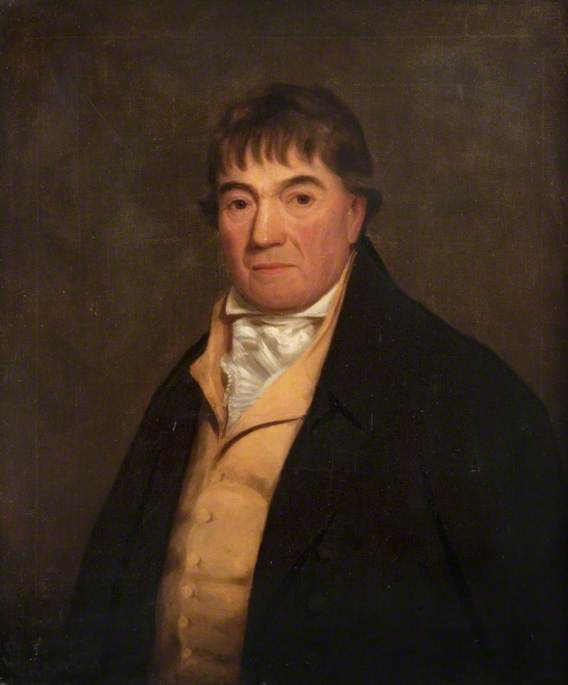
Donor
Mary Morris (1873-1951)
The donor of this painting was Mary Morris (see below) who bequeathed the portrait on 22 May 1951 as well as several other items.1 At the time of her death she was living at 67 Argyle Road, Saltcoats.2 There is no date or artist attributed to this portrait and there are several members of the Morris family named Hugh but evidence leads us to believe that the portrait is that of Mary Morris’s great -great grandfather (see Morris Family Tree below).3 Before discussing the life of Mary Morris the Morris Family who came before her will be discussed.
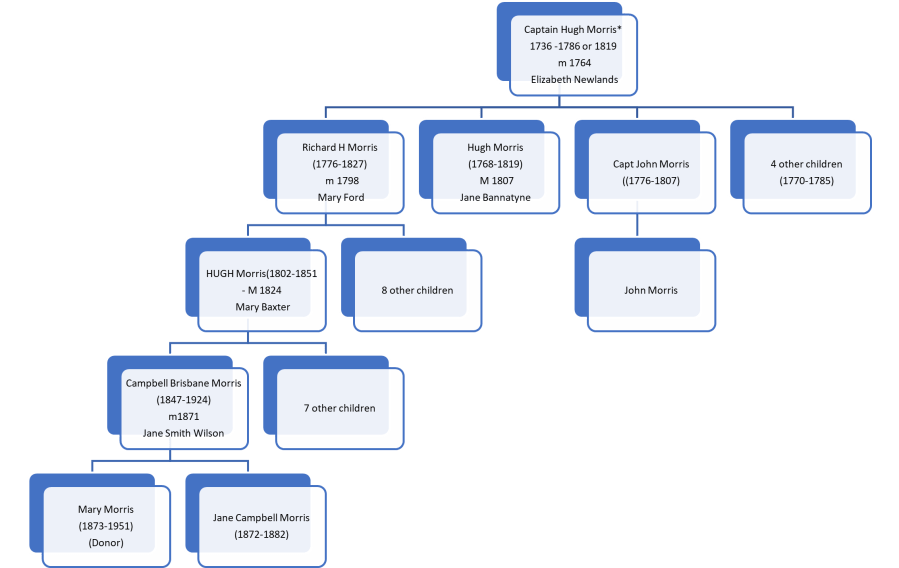
*Captain Hugh Morris (1736-1786 or1819)
Captain Hugh Morris was our donor’s great-great grandfather. He was possibly born on 6 May 1736 in Largs ,Ayrshire. His father was John Morris and his mother was Jean McFie.4 After his birth the next information we have is his marriage on 31 July 1764 to Elizabeth Newlands at Calton then a separate weaver’s village outside Glasgow. Elizabeth’s father Richard was a weaver and Hugh Morris’s occupation is given as ‘mariner.5 By the time of the birth of their first child John in 1766 Hugh Morris was described on the baptism certificate as a ‘shipmaster’ (captain)of Port Glasgow’.6 Subsequent children were born in Port Glasgow leading us to believe that the family lived there while the head of the family was at sea. Hugh and Elizabeth had at least seven children. All but Hugh (b1768 in Barony, Glasgow) were born in Port Glasgow between 1766 and 1785 including our donor’s direct descendant Richard Morris born in 1776.7 Also there is a Captain Hugh Morris, shipmaster of Port Glasgow listed in John Tait’s Directory of the City of Glasgow 1783.8
There is evidence that Captain Hugh Morris was involved in Glasgow’s tobacco trade with Virginia as captain of a ship owned by William Cunninghame, one of Glasgow’s foremost ‘tobacco lords.’ Morris was captain of the ship Neptune from about 1769 to at least 1781. 9 The Neptune appears to have made at least two voyages each year. For example it was reported in February 1775, ’A Manifest of the Lading on board the ship Neptune, Hugh Morris Master, for Glasgow 476 hogshead tobacco, 30,000 staves, 30 dozenHoops’.10 Then in July 1775 the James River Manifest Book 1774-5 reported ‘a manifest of lading of the ship Neptune, Hugh Morris master, to be 474 hogshead of tobacco,13,000 staves and 40 dozen hoops’.11
In 1777 shortly after the beginning of the American War of Independence an Act of Parliament was passed allowing the Lord High Admiral or his Commissioners to grant Letters of Marque to merchant ships which allowed them to be armed and to seize any enemy ships encountered in regular trading enterprises for the duration of hostilities. Any prize money gained from the selling- off of enemy ships and or cargo went to the ship owner, captain and possibly the crew. The Letter of Marque was given to the captain of the ship and a copy was preserved in the records of the High Court of the Admiralty.12 In 1777 one such Letter of Marque signed by Registrar Godfrey Lee Tarrant was granted to Captain Hugh Morris and the ship Neptune.13
There are two further reports of Captain Morris’s involvement in voyages to Virginia after the issue of the Letter of Marque but no information as to seizure of American ships. In 1779 the Chester Courant reported the arrival at Falmouth of the Neptune from Jamaica with Morris as Captain. It is unclear if this was referring to Falmouth Virginia or Falmouth in England.14 Then in September 1781 the Neptune, captained by Morris, sailed from Portsmouth (presumably Portsmouth Virginia) to London.15 There is no information after this date of any further voyages.
Perhaps Captain Morris retired from sea at this time? Perhaps he had gained some prize money from seized American ships? Information on this point is speculative. Did he develop business interests of his own in America perhaps? James Robinson, superintendent factor of W. Cunninghame and Co. who was based in Falmouth, Virginia reported in a letter to Cunninghame on 15 September 1774 that ,’Captain Morris…wants to go to Carolina to look after some old affairs’.16 So perhaps he had business interests there.
In The Biographical Register of St Andrews Society of the State of New York 17 the entry for Richard Morris (see family tree above) our donor’s great grandfather, who appears to have joined the society in 1797 while living in New York, describes him as, ‘ a son of Captain Hugh Morris of the Greenhead, Glasgow’. Greenhead was an old industrial part of Glasgow north of John Street (now Tullis Street) in Bridgeton extending into the Calton.18 There is a present day Greenhead Street near to Glasgow Green which possibly took its name from the area known as Greenhead.
Jones Directory or Useful Pocket Companion for 1787 lists a Morris ,Hugh &Son, manufacturers, Todds Land, High Street and for 1789 Morris ,Hugh & Sons, manufacturers High Street,’ above no 16’.19 The family business was certainly known as Hugh Morris &Sons in 1797 in a letter written to the United States Secretary of State, James Madison by John J Murray Consulate General in Glasgow concerning a dispute over ownership of ships being traded by the company to New York.20 The business later moved to St Andrews Square(see below). There are also examples of Hugh Morris & Sons trading with Jamaica. For example in July 1802 when customers were invited to contact Hugh Morris& Sons regarding freight and passage aboard The Maria sailing from Port Glasgow.21
A map of Glasgow of 1807 shows a piece of land off Glasgow Green owned by Hugh Morris Senior.22
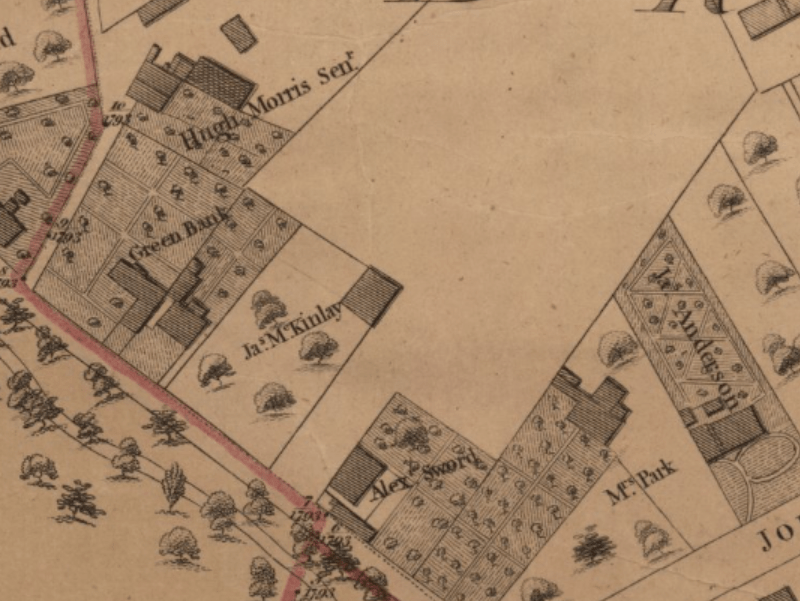
The Glasgow Sasines Register 1801 shows that a Hugh Morris bought land in St Andrews Square off Glasgow Green23 and The Post Office Directory for 1801 has an entry for Morris H & Sons Merchant, 55 St Andrews Square and in 1806 for Morris H Senior merchants 55 St Andrews Square. House, Greenhead.24 By this time his second son Hugh and third son Richard appear to have joined the business (see below).
It is unclear when our Captain Hugh Morris died. A Captain Hugh Morrice, shipmaster, died on 20 April 1786 with no indication of age.25 But a Captain Hugh Morrise died 22 February 1819 aged 89. Both died in Glasgow and both were buried in the Parish of Ramshorn and Blackfriars. However as there continued to be a Hugh Morris Senior mentioned in the various directories later than 1786 it is probable that our Hugh Morris(or Morrise) died at the later date.26 The alternative is that the name of the firm Hugh Morris Senior was used by his son Hugh for several years after his death.
Hugh Morris (1768-1819)
This Hugh Morris was our donor’s great- uncle. The second son of Captain Hugh Morris and Elizabeth Newlands he was born on 21 March 1768 in Glasgow Barony.27 There is little information about his early life and no evidence that he went to sea. It is not clear exactly when he started in the family business of Hugh Morris and Sons but as we know from about 1801 the business premises were at 55 St Andrews Square. Around 1806 his brother Richard appears in the Glasgow Post Office Directory at the same address.28
In 1807 Hugh married Jane Bannatyne daughter of John Bannatyne of Castlebank, Lanark.29 As we have seen, the Morris Family appears to have lived in the Greenhead area better known as Bridgeton today and many streets have been renamed for example the then William street is now Templeton Street around the area of the former Templeton Carpet Factory building. By 1819 Jane and Hugh had a house in St Vincent Street.30
There do not appear to have been any children as when Hugh was thrown from a gig and killed at Pitcaithly near Perth in August 31 his estate, after making provision for his wife Jane, went to his brother Richard and various nephews and nieces.32
Around 1810 a Hugh Morris appears to have become part of the firm of Morris, Kinnear &Co at 55 St Andrews Square and this partnership continued until Hugh’s death in 1819. They were listed as ‘merchants’.33
By the time of his death in 1819 as well as being a partner in the Glasgow firm of Morris, Kinnear and Company, Hugh Morris was also a partner in the firm of Ferguson, Morris and Co of St Lucia34 which suggests an involvement in trade with St Lucia. He left an estate worth £10,000 including the house in St Vincent Street and a house in Largs which he left to his brother Richard together with the business property in St Andrews Square.35
Richard H Morris (1776-1827)
Richard Morris was our donor’s great-grandfather. He was born 28 July 1776 in Port Glasgow.36There is little information about his early life but one presumes it was spent in Port Glasgow with the rest of the family. Most of our information in this period comes from The Biographical Register of the St Andrew Society of New York, which Richard joined in 1797. He was introduced as ‘a son of Captain Hugh Morris of the Greenhead of Glasgow.’
By the age of twenty Richard had moved to New York and had begun business principally as a shipping agent and commission merchant for the family business Hugh Morris &Sons. He was also part owner of the brig Moses Gill which traded between New York and Greenock.37 On 16 June 1797 he married Mary Ford (1778-1840).38 They went on to have nine children between Agnes, born in New York in 1801 and Jean born in 1815 a total of seven girls and two boys.39
By 1799 Richard’s business was operating from 10 Liberty Street, New York.40 He and Mary appear to have travelled back to Scotland around 1802 as a son Hugh was born there about 1802.41 Richard’s brother Captain John Morris, master of a vessel The Hunter went to New York in 1804 to take over the business in Liberty Street which suggests that was when Richard and Mary moved back to Scotland. Unfortunately John Morris died of consumption in 1807 which brought Richard back to New York to settle up his brother’s affairs. Then on 15 December 1808 ,along with his nephew John, he set sail on the British packet Chesterfield for Falmouth.42
As we have seen Richard went into the family business known as Hugh Morris & Sons with his father and then his brother Hugh. In 1809 the firm of Morris ,R H & Co merchants was based at 55 St Andrews Square as was Morris, H, Merchant. In both cases the home address was given as Greenhead possibly 63 William Street43 (later renamed Templeton Street) in present day Bridgeton. Between 1810 and the death of his brother Hugh in 1819 the firm changed to Morris ,Kinnear &Co still based at 55 St Andrews Square.44
He was executor of both his brother’s estate, Hugh Morris (junior) and that of Hugh Morris( senior) of Greenhead, presumably his father. On 16 June 1820 an advertisement appeared in the Glasgow Herald for the sale of
‘Property at Greenhead belonging to the late Mr Hugh Morris Senior ,extending to about 2 acres and bounded by the Camlachie Burn…’
suggesting that as executor for both his late father and brother he was dispensing with the Greenhead land. It is also further indicates that Hugh Morris senior died at the later date of February 1819 but of course we cannot be certain.
Richard was also Treasurer of the Calton Chapel of Ease and owned a house in Rothesay.45
By 1824 Richard and his family were living at 24 Monteith Row off Glasgow Green.46 In 1814 permission had been granted to build a terrace of houses to front Glasgow Green. The row of houses which was in three sections, was not completed until the1840s. The street was named after Henry Monteith the then Lord Provost of Glasgow. This development had been planned for several years, the plans having been drawn up by architect David Hamilton in 1812. Monteith Row was referred to as the ‘Park Lane ‘ of Glasgow where affluent citizens lived until smoke and industrial development moved them out to the developing West End.47
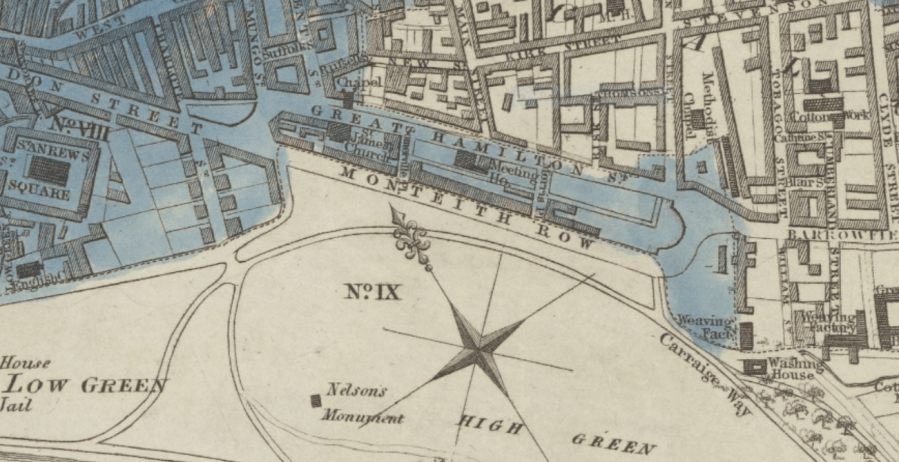
In his will Richard Morris refers to his building a three-storey tenement in Monteith Row of which his wife Mary was to receive the rental as part of her settlement49. As can be seen from the above map there was a short road called Morris Place between the second third terraces of Monteith Row which possibly takes its name from the Morris family. Mrs Richard Morris was living at 1 Morris Place in 1831-2.50
Richard had retired from business in August 1827 and died in Rothesay on 22 October 1827 of cholera morbus an old medical term for acute gastroenteritis. He was buried in St Davids (Ramshorn) ‘in Capt Morris Lair’.51
Hugh Morris (1802-1851 )
This Hugh Morris was Richard Morris’s eldest son born around 1802 and the grandfather of our donor. There appears to be no record of his birth at this point but the UK Census of 1851 puts his birth around 1802 or 1803. He attended Glasgow University from 181852 and then joined the family business.53
On 11 July 1824 Hugh married Mary Baxter at the Chapel of Ease,Calton.54 Hugh is described as a ‘cloth merchant’. Mary was the daughter of Isaac Baxter who was also a merchant with a business Isaac Baxter & Sonswho were grocers, confectioners, oilmen and wine merchants operating from The Italian Warehouse in Candleriggs and from 137 Buchanan Street.55 At some point Isaac bought Rhinsdale House close to Baillieston on the outskirts of Glasgow56 together with nine acres of land. There is a Rhinsdale Tavern and a Rhinsdale Crescent in Baillieston today. The house had five bedrooms, a drawing room, dining room and parlour, servants quarters stables and coach house together with a large garden.57
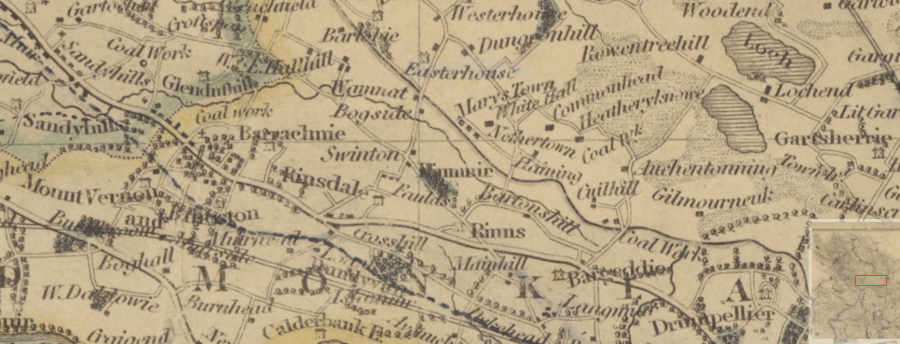
Mary and Hugh went on to have at least nine children including another Richard born in 182559, Mary born in 1827, Hugh born in 1830 and our donor’s father Campbell Brisbane Morris born in 184760. They appear to have lived for a time at 48 West Nile Street.61
When his father Richard retired in August 1827 Hugh appears to have bought his father’s share of the family business by an agreed series of instalments. When his father died he inherited the family business as well as receiving £3,000 from his father.62
In 1829 the firm of Hugh Morris &Co Cloth Merchants was still operating but from 18 Hutcheson Street.63 By 1832 Hugh had become a partner in the firm of Morris Kirkwood & Co, merchants and warehousemen. Unfortunately the company and the two partners went bankrupt in 183264 but the following year sees Hugh applying for a discharge of bankruptcy so he must have been able to pay off his various creditors.65 It is difficult to know exactly what was going on as no other details are forthcoming.
The family appears to have gone to live at Rhinsdale House in Baillieston with Mary’s father as Hugh is referred to as ‘Hugh Morris Esquire of Rinsdale’ when his son Hugh Baxter was born in 1828.66 The present A8,Edinburgh Road, cuts through what was once the site of Rhinsdale House and its policies and stood where Kaldi’s (formerly the Little Chef) restaurant stands today at the Baillieston end of the Edinburgh Road.67
Mary and the children were still at Rhinsdale at the time of the 1841 Census but Hugh was not there. There are two entries for a Hugh Morris of relevant age in the 1841 Census. One, a seaman in Port Glasgow aged 30 and one in Mount Stuart Road in Rothesay aged 35.68 The Rothesay entry would appear to be the closest as the age is about right and we know Hugh’s father Richard owned a house in Rothesay.69 This Hugh Morris was said to be of independent means.
We can presume the family remained in Baillieston until Isaac Baxter’s death in 184870 when the house was advertised for rent probably by Mary’s brother Walter.71 As daughter Jane was born in Ardrossan in 1845 and son Campbell in West Kilbride (see below Campbell Baxter Morris) in 184772 perhaps the family then moved to Ayrshire. Certainly by 1851 the family was living at Sandlands House, Seamill.73 Hugh’s occupation in the 1851 Census is given as ‘retired cloth merchant’. Along with wife Mary were five of their children. Mary was twenty, Walter was fourteen, Eliza was eleven, Jane six and our donor’s father Campbell Brisbane was three.
In April 1851 Sandlands House was put up for sale.74 However it had not sold by 4 October of that year when Hugh Morris died.75 He was buried in Glasgow Necropolis.76
Campbell Brisbane Morris (1847-1924)
Campbell Brisbane Morris our donor’s father was born on 19 April 1847 at Kenningbrae Cottage, Seamill 77 in the Parish of West Kilbride.78 He was only three years old when his father died. By 1861 aged thirteen he was a pupil at Montgreenan House School, Kilwinning while his mother, now a widow, lived at Springburn Cottage, Ardrossan Road, Saltcoats.79
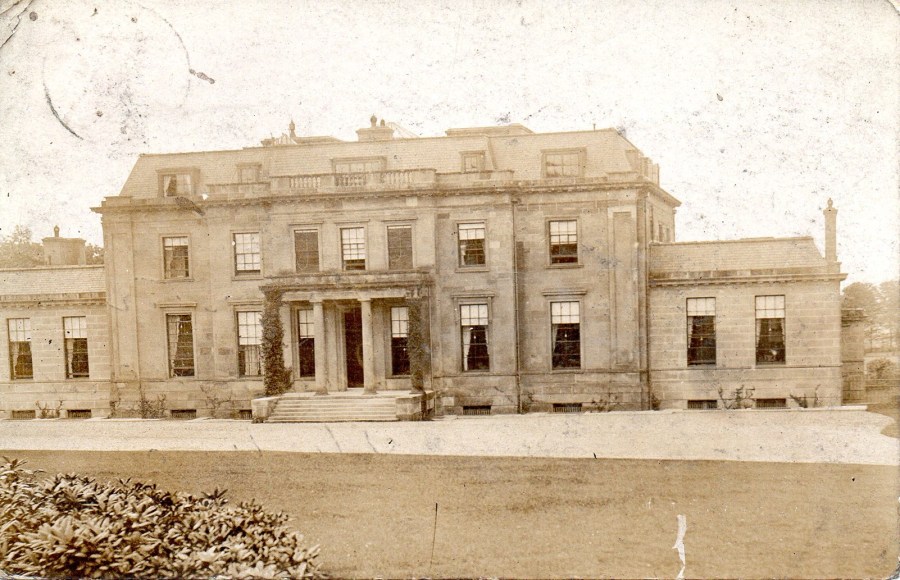
Montgreenan House was built in 1810 by Robert Glasgow a Glasgow merchant who had bought the Montgreenan Estate in 1794. Robert Glasgow had owned two sugar plantations and 247 slaves in St Vincent in the West Indies. After Robert Glasgow’s death in 1827 the house was often let out.80
Montgreenan School was opened in 1849 by Thomas R Wilson who originally ran a boarding school at North Woodside in Glasgow. The school was ’For the Education of Young Gentlemen’.81 Thomas R Wilson also taught mathematics. At the time of opening the school had three residential teachers covering Classics, English, Writing and Drawing as well as visiting teachers of French and German, Fencing and Gymnastics, Music and Dancing. Many of the pupils were from the British Colonies.82 We do not know when Hugh started at the school but perhaps he was a pupil on 20 August 1856 when the school went on a trip to The Isle of Arran but unfortunately missed the last ferry home and had to stay the night on Arran. No doubt the boys found that an adventure.83
There are several examples of the boys donating pocket money to the local poor. For example at Christmas in 1856 they donated £25. There were four mining villages nearby whose inhabitants lived precarious lives.84 In August 1861 the School moved to Sunderland so presumably Hugh left Montgreenan at that point.85
The 1871 Census puts Hugh age twenty-three at Clydeview Terrace, a row of villas on the north side of Whiteinch in Partick with his mother Mary now sixty-eight. His occupation is ‘engineer in steamships.86 On 20 April 1871 at 20 Laurence Place, Partick, Campbell married Jane Smith Wilson, daughter of the late David Wilson of Rothesay, a grocer and wine and spirit merchant. One of the witnesses at the wedding was Hugh Baxter Morris, Campbell’s elder brother.87
The newly-weds lived at 20 Laurence Place. They had two daughters, Jane born in 1872 and our donor Mary in 1873.88 Sadly Campbell’s wife Jane aged only thirty, died in July 1877 of a long-standing pulmonary complaint. She died at 5 Mount Stuart Road, Rothesay. Perhaps this was her former family home or the house in Rothesay owned by Campbell’s grandfather Richard. Campbell was still a marine engineer at the time of Jane’s death.89
By 1881 Campbell appears to have given up his maritime career as his occupation in the 1881 Census is given as ‘calico printer’. The family was living at Primrose Place, 219 Paisley Road. Also in the house was nephew Hugh Low, a marine insurance clerk, and a domestic servant called Margaret Milne aged twenty-three. Ten-year old daughter Jane died the following year of diptheria. She died at 5 Mount Stuart Road, Rothesay. As has already been suggested perhaps this was her mother’s family home or the house which had been in the Morris family since the time of Richard Morris.90 Our donor Mary then became an only child. The family was still at Primrose Place in 1891 with Campbell’s occupation now ‘warehouseman/calico printer’ and he was an employee rather than an employer. Margaret Milne was still employed in the house as ‘housekeeper’ now aged thirty-three, assisted by a sixteen-year old domestic servant Janet Jack.91
According to the Valuation Rolls of 1885 Campbell owned Mansfield Cottage, Howgate, Kilwinning as well as being tenant/occupier of Primrose Place. Mansfied Cottage was rented out.92 He was also a partner in Charles Cassils &Co, Calico Printers based at 13 St Vincent Place in Glasgow. The company went bankrupt in 189893 but by 1901 Campbell seems to have recovered from this as his occupation was that of calico printer but this time he was an employer. He and Mary were now living at 5 Walmer Crescent, Bellahouston with one servant. Margaret Milne was included in the census as a visitor so she must have remained very close to Campbell and Mary.94
The next census in 1911 tells us that Campbell and Mary had moved to 53 Glencairn Drive,Polloksheilds. Campbell’s occupation was ‘calico printer/salesman’ and he was now ‘a worker’ rather than an employer. Once again Margaret Milne was a visitor at the house at the time of the census.
There is no more information concerning Campbell Brisbane Morris until his death on 21 May 1924 at home in Glencairn Drive. He was seventy-six.95
Mary Morris (donor) (1873-1951)
As has been experienced many times before it is always difficult to find information about female donors apart from the little which is contained in official documents such as Census Reports. Mary Morris is no exception to this thus much of Mary’s early life has been covered in the above section about her father.
Mary Morris was born on 27 August 1873 at Primrose Place, Paisley Road Govan.91 Mary was the second daughter, her sister Jane having been born on 14 February 1872.96 The family had moved to Primrose Place ( 219 Paisley Road) in Govan by the time of the 1881 Census. Also living in the family home was Mary Milne, a general domestic servant aged twenty-three. Mary was seven at this time and was at school.
As we know Mary had lost both her mother and her only sister by the time she was nine years old and she lived with her father and servants. She was at school at the time of the 1881 census . At 17 in1891 Mary was still a scholar97 which was beyond the normal school leaving age at that time and suggests she may have either been at a private school or had entered further education of some kind but this is speculation.
Mary’s next home was 5 Walmer Crescent, Bellahouston where she still lived with her father and there is no information as to any occupation. Again, as at the time of the 1901 census, Margaret Milne was a visitor and again at the time of the 1911 census when the family had moved to Pollokshields and was living at 53 Glencairn Drive. Perhaps Margaret Milne, former housekeeper, had become something of a mother figure to Mary or perhaps there is some other explanation for her continued presence in the house.
In 1911 Mary who was thirty-two by this time and unmarried with no recorded occupation perhaps looked after the house for her father as was the lot of many unmarried daughters. They still had one servant Williamina Cunningham aged seventeen.98
Mary remained at 53 Glencairn Drive until 193099 when she bought a property at 67 Argyle Road, Saltcoats. This may have been a flat as there was another occupier of that address who appears unconnected to Mary. This remained her address throughout World War II.100 We have no information as to any involvement in war work as it has been impossible to access the 1939 Scottish Register at this time.
It was in Saltcoats Mary died on 19 February 1951. Interestingly on her death certificate her occupation is given as ‘artist’ but this was the first mention of any such occupation and so far no information has been found to give more details.101
Acknowledgements.
Many thanks to Chris Hawksworth of Kilwinning Heritage for sharing his research on the Montgreenan Estate and Montgreenan House.
Many thanks also to Jane Raftery of Glasgow Museums Resource Centre for bringing to my attention the Letter of Marque issued to Captain Hugh Morris in 1777
Notes and References
- As well as the portrait Mary Morris donated the following items which are in stored at the Glasgow Museums Resource Centre.
Glasgow Museums Resource Centre Object Files:
- Punch Bowl ref A.1951.38.a
- Vase ref A1951.38.b
- Mustard Mill ref A 1951.37.c
- Letter of Marque 1777.ref A.1951. 37.d (See Above p1)
- Two Toddy Ladles ref A.1951.38.a
2. www.scotlandspeople.gov.uk Statutory Deaths. Mary Morris
3.The name Hugh Morris is very common and although every care has been taken to be accurate the information in the Old Parish Registers is often incomplete and errors do happen unintentionally.
4. www.scotlandspeople.gov.uk Births OPR 602/10 186
5. www.scotlandspeople.gov.uk Marriages OPR 622/60 162
6. www.scotlandspeople.gov.uk Births OPR 622/20 286
7. http://www.scotlandspeople.gov.uk eg. David- OPR 574/30/306 ; Robert OPR 574/30/255
8.National Library of Scotland John Tate’s Directory of the City of Glasgow 1785
9.Devine T.M. A Scottish Firm in Virginia. 1767-1777. Clark Constable,1882. pp113,155,201
10. https://www.history.navy.mil Naval Documents of the American Revolution. Volume 1 Part 8
11. As above p 1329
12. www.loyalist.lib.unb.ca.node/4439
13.op cit. ref 1
14. Chester Courant 01/06/1779 p.2
15. Hampshire Chronicle 17/09/1781 p.2
16.op. cit. Devine p.155
17. McBean W.M. Biographical Register of the St Andrews Society of the State of New York . Volume II. New York, 1925.
18. Smart, Aileen. Villages of Glasgow . Volume 1 John Donald 1988. P43
19. www.nls.ukJones Directory or Useful Pocket Companion. 1787,1789.
20. https://archives.gov/documents/Madison/02-91-02-6741
21. Glasgow Courier 01/07/1802
22. https://maps.nls.uk/ Fleming, Peter Map of the City of Glasgow and its suburbs. 1807.
23.Burgh of Glasgow Register of Sasines 1801. Mitchell Library Archives 1801 B10/5/10/11
24. www.nls.uk Post Office Directories . Glasgow 1801,1806
25. www.scotlandspeople.gov.uk Deaths OPR 644/1 590 323
26. http://www.scotlandspeople.gov.uk Deaths OPR 644/1 610 221
27. www.scotlandspeople.gov.uk Births OPR 622/20 286
28. www.nls.uk Post Office Directories. Glasgow 1806
29. http://www.scotlandspeopl.gov.uk Marriages OPR 644/1 280 66
30. www.scotlandspeople.gov.uk Wills and Testaments. Hugh Morris (junior)
31. Caledonian Mercury 23/08/1819
32. op cit. ref 30
33. http://www.nls.uk Post Office Directories Glasgow 1810-1820
34. Glasgow Herald 27/11/1820
35. op cit. ref 30
36. www.ancestry.co.uk Statutory Births
37. op cit. ref 17 p.327
38. www.ancestry.co.uk /family-tree/person/tree17218896
39. as above
40. op cit. ref 15
41. UK Census 1851
42. op cit. ref 34 pp.379/80
43. www.nls.uk Post Office Directories 1806,1809
44.as above 1810-1819
45. www.scotlandspeople.gov.uk Wills and Testaments. Richard Morris
46. www.nls.uk Post Office Directories Glasgow 1825
47. Mitchell Library Archives. The Regality Club. RC4 4th Series. James Macelhose &Sons 1912. P110.
48. maps/nls/towns/rec/7507 City of Glasgow and its Suburbs c1830. Pub James Lumsden & H Wilson Glasgow 1830. Hamilton Street is now London Road.
49. op cit. ref 45
50. http://www.nls/uk Post Office Directories Glasgow 1830-31
51. www.scotlandspeople.gov.uk Deaths OPR 644/1620 182
52. op cit. ref 17
53. www.nls/uk Post Office Directories Glasgow 1822
54. www.scotlandspeople.gov.uk Marriages OPR 644/1 400 276
55 www.nls/uk Post Office Directories Glasgow 1828
56. UK Census 1841,1851
57. Glasgow Herald 10/04/1841 p.1
58. www.maps.nls.uk/counties Lanarkshire/Baillieston
59. www.scotlandspeople.gov.uk OPR 644/1 320 65
60. op cit. ref 53
61. www.nls/uk Post Office Directory Glasgow 1828
62. www.scotlandspeople.gov.uk Wills and Testaments. Richard Morris
63. www.nls/uk Post Office Directories Glasgow 1829
64. Perthshire Courier 05/04/1832 p.4
65. Scotsman 24/08/1833
66. www.scotlandspeople.gov.uk Births OPR 652/20 113
67.Wilson, Rhona Old Baillieston, Garrowhill and Easterhouse. Stenlake Publishing 1997.p26
68. UK Census 1841
69. op.cit. ref 62
70.. www.scotlandspeople.gov.uk Deaths OPR Deaths 644/1 580 9
71. Glasgow Herald 10/04/1848 p.1
72. www.scotlandspeople.gov.uk Statutory Births. Jane Campbell Morris
73. www.nls/uk Post Office Directories Ayrshire 1851-2
74. Glasgow Herald 07/04/1851
75. Glasgow Herald 10/10/1851 p.5
76. The Glasgow and West of Scotland Family History Society. The Glasgow Necropolis. DVD 2012 .KAP104a
77. Glasgow Chronicle 28/04/1847 p.8
78. www.scotlandspeople.gov.uk Births OPR 620/30 239
79. UK Census 1861
80Chris Hawksworth Kilwinning Heritage
81. Greenock Advertiser 15/01/1861 p.2
82. op cit. Ref 80
83. Ardrossan and Saltcoats Herald 23/08/1856 p.2
84. Scottish Guardian 16/03/1855 p.3
85. Dundee Courier 02/08/1861 p.1
86.UK Census 1871
87. www.scotlandspeople.gov.uk Statutory Marriages
88. www.scotlandspeople.gov.uk Statutory Births
89. www.scotlandspeople.gov.uk Statutory Deaths
90. as above
91. UK Census 1891
92.www.scotlandspeople.gov.uk Valuation Rolls 1885
93. Edinburgh Evening News 07/05/1898 p.4
94. UK Census 1901
95.www.scotlandspeople.gov.uk Statutory Deaths
96 www.scotlandpeople.gov.uk Statutory Births.
97. UK Census 1891
98. UK Census 1911
99. www.scotlandspeople.gov.uk Valuation Rolls 1920,1925
100. as above 1930
101. www.scotlandspeople.gov.uk Statutory Deaths

 Glasgow Museums Art Donors Group