On 11 December 1946, an oil painting entitled Mrs. Scott, Wife of James Scott of Kelly (2590) by John Graham-Gilbert RSA, was presented to Glasgow Corporation by Major Ker of Easterton, Milngavie. 1
The subject of the painting is Jane Martha Galbraith who was born in Barony on 7 May 1830. (She died aged 87 in 1917 at 8 Woodside Crescent, Glasgow). Her parents were Andrew Galbraith, a cotton spinner/merchant, and Margaret Bogle Scott. 2 In 1848, aged eighteen, Jane married the thirty- eight-year-old James Scott. 3 (Appendix) The following year James Scott bought the estate of Kelly in the parish of Inverkip, Renfrewshire. The painting is dated to 1850 (ArtUK) so either commemorates the couples’ marriage or perhaps the birth of their first child Margaret Bogle Scott who was born on 14 July 1850. 4 Between 1850 and 1866 Jane Martha Scott gave birth to ten children, five boys and five girls. One of the girls, Helen Bethia Scott who was born on 16 July 1855 in Inverkip 5 was the mother of the donor. Helen Bethia Scott was 21 when she married Thomas Ripley Ker ‘gentleman’ of Dougalston, Milngavie on 20 June 1877 at St. Mary`s Tower, Birnam, Little Dunkeld. 6 (Thomas Ker’s father Robert Ker went out East as a merchant in 1825 and made his fortune before returning to Glasgow in 1836 and becoming a partner in Ker, Bolton & Co. of 27 West George Street, Manilla and Singapore Merchants. In 1841 he married Elizabeth Johnston of Shieldhall and had four children).7
Thomas and Helen Ker’s first child, Robert McNeil Ker (later ‘Major Ker’ the donor of the painting) was born in Strathblane on 18 February 1878. 8 A second child, Ronald Scott Ker was born in 1879 and the family took up residence in Bardowie House (Castle), Baldernock, Stirling. 9
‘Finely situated on its north-east side of Bardowie Lochan, and embowered among foliage, is Bardowie House, an edifice of moderate size, and somewhat timeworn, yet withal wearing an appearance of quiet cosieness and comfort .’ 10
Figure 2. Bardowie_Castle in 1870 By Thomas Annan httpwww.theglasgowstory.comimage.phpinum=TGSB00235, Public Domain, httpscommons.wikimedia.orgwindex.phpcurid=15233785
Robert was educated at Dalvreck Academy (later Ardvrek Academy) in Crieff and appears on the school roll in 1891 11 but no record of Robert’s time there could be found by the school archivist. By 1901 the family had moved to Dougalston Mansion. This was a large house – according to the census there were thirty-five rooms with one or more windows – situated in Milngavie. 12
Figure 3. Dougalston, Milngavie (From an old post card)
The house had been built by John Glassford, one of the Glasgow ‘Tobacco Lords’ in the early 18th century. Robert’s grandfather Robert Ker bought the house and estate in 1870 13 and had the house restored about 1872-73. 14 He also, in 1883, acquired the estate of Easterton . When he died in 1888, Robert Ker left an estate valued at £220,000 not including Dougalston. 15
The family now consisted of Thomas and Helen, Robert aged 23 was a ‘militiaman’, Ronald, an Oxford undergraduate and a sister Helen Ripley Ker born in 1887. They employed eight servants and a governess. 16
On 24 September 1902, Robert joined the army – the Officer Cadet Battalion with the rank of Honorary Captain. 17 The following year as a lieutenant in the Royal Garrison Regiment he married Margaret Lilian Blagden in Tisbury, Wiltshire.18,19 On 29 April 1904, the Royal Garrison Regiment embarked for South Africa to take up garrison duties at Fort Napier, Pietermaritzburg. 20 Tragically, Margaret Lilian Ker died in Pietermaritzburg on 7 April 1905. Robert later erected a memorial plaque to her in the church of St. Mary the Virgin, Donhead St. Mary, Wiltshire:
In Memory of
Margaret Lilian Ker
Nee Blagden
Who was married in this church 13th October 1903
And who died in Pietermaritzburg, Natal
7th April 1905
Erected by Robert MacNeil Ker
Xmas 1905
Robert returned from South Africa later that year with three battalions of the regiment. (The Royal Garrison Regiment was disbanded on 1 September 1908 21). In the same year as the death of his wife, Robert’s grandmother Elizabeth Ker died at Eastertoun. 22
On 17 April 1907, Robert McNeil Ker married Lucy Winifred Strickland -Constable at Holy Trinity Church, Sloane Street, Chelsea. 23 Lucy was born in Wassand Hall, Seaton, Yorkshire in 1875. She was the daughter of Henry Strickland – Constable and niece of Sir Charles Strickland eighth baronet of Boynton. After the wedding, the couple left for Paris and a continental honeymoon. 24
They had a son, Neil Ripley Ker, born on 28May 1908 in Brompton, London. Neil became an eminent palaeographer and his entry in the Oxford Dictionary of National Biography says that his father was a captain in the 3rd battalion of the Argyll and Sutherland Highlanders (A & SH). During the war years his mother and grandmother held garden fetes etc. to raise funds for the A & SH Comforts’ Fund. 25
According to the census of 1911, Robert, aged 33 was living ‘on private means’ at Friningham Lodge, Detling, near Maidstone in Kent. With him were his wife Lucy aged 36 and son Neil aged 2. In 1914, with the advent of war, Robert was a captain in the Reserve of Officers attached to the Brigade of Infantry. In the same year he joined the Argyll and Sutherland Highlanders and then the Machine Gun Corps with the rank of major. At some point during the war, he was made acting lieutenant colonel of the corps. 26
Figure 4. Easterton House (Alexander Nisbet Paterson, 1915)Old Postcard View found in Crawford, James, Old Mugdock, Balmore, Baldernock and Bardowie, 2016, Stenlake Publishing, Ltd.
After the war he seems to have lived quietly at Easterton, his father’s house in Milngavie taking an interest in local affairs. Lucy Winifred Ker died at Eastertoun on 7 December 1942. 27She was sixty-seven. Robert’s father, Thomas Ripley Ker, died at Eastertoun on 18 July 1947. An extensive obituary was published in the local paper. 28Robert McNeil Ker died on 15 October 1953 at Easterton. His death certificate states that he was a Major in the Royal Garrison Regiment (retd.) and the widower of Lucy Winifred Strickland – Constable. 29 A brief report appeared in the local newspaper stating that ‘he was well known locally for the deep interest and kindness he showed in philanthropic institutions, and particularly of the Old Folks Clubs. He was of a quiet genial disposition and will be missed by many in the district’. 30
After a private funeral he was buried in Baldernock Churchyard alongside his parents, his brother and his second wife. His father had earlier gifted land to enlarge the churchyard ‘where the maternal ancestors of President Roosevelt are buried’. 31
Figure 5. Ker family gravestones in Baldernock Churchyard. httpswww.findagrave.commemorial196889564robert-macneil-ker
Appendix
James Scott 1810 – 1884
James Scott had been made a partner in the firm of James Black & Co., calico printers, at the age of twenty and largely thanks to his efforts the firm’s business grew rapidly. In 1835 it acquired the Dalmonach printworks in Alexandria and through Scott’s ‘extraordinary enterprise’…….. attained it’s present position in the foremost ranks of printing’. James Scott retired from business in 1847. However, in 1852 he returned to set up the firm of J. & W.J. Scott with his younger brother. It became the largest cotton spinning works in Scotland. He also had interests in the railways and in oil setting up works at Clippens in Renfrewshire. 32 As a town councillor in Glasgow he was largely responsible for the formation of Kelvingrove Park. He sold the estate of Kelly to James ‘Paraffin’ Young in 1867. James Young died there on 13 May 1883 and is buried in Inverkip cemetery. James Scott died in 1884. Kelly House burned down in 1913 allegedly from suffragette activity. 33
References
Catalogue of Donations, Glasgow Museums Resource Centre
Scotland’s People, Death Certificate 1917, Jane Martha Scott
Old Parish Registers, Family Search, Scotland
Ibid
Scotland’s People, Birth Certificate
Scotland’s People, Marriage Certificate
Smith, John Guthrie, Strathendrick, and its inhabitants from early times, Glasgow, J Maclehose and sons, 1896
Scotland’s People, Birth Certificate
ancestry.co.uk, 1881 Scotland Census
Macdonald, Hugh, Rambles Round Glasgow, 1854
ancestry.co.uk, 1891 Scotland Census
ancestry.co.uk, 1901 Scotland Census
Smith, John Guthrie, Strathendrick, and its inhabitants from early times, Glasgow, J Maclehose and sons, 1896
To avoid confusion donor Cecilia Douglas will always be in bold.
In 1862 Mrs Cecilia Douglas (nee Douglas) bequeathed oil paintings and sculptures to the then Glasgow Corporation. The paintings, thirteen in total consisting of an old master, copies of old masters and other originals, initially were on display in the Mclellan Galleries in Sauchiehall Street. Currently they are located in the Glasgow Museum Resource Centre or on display in Kelvingrove Art Galleries.
She and her husband Gilbert represented two different branches of the Douglas family. Hers, according to one source, perhaps wishful thinking, descended from the Douglas Earls of Angus via the Douglas families of Cruixton and Stobbs,[1] Gilbert’s from the Douglases of Mulderg in Ross-Shire.[2] Her mother was a Buchanan, descending from the Buchanans of Leny, Gilbert’s mother was a Robertson, daughter of a farmer from Balcony (Balconie). Interestingly there is a line of descent chart which shows the Robertson family descending from Edward I of England and his wife, the daughter of the king of France.[3] All pre-eminent families, particularly the Douglases and the Buchanans who were heavily involved in the West Indies in the eighteenth century, owning plantations and dealing in sugar and tobacco.
Gilbert Douglas
Gilbert’s paternal ancestry can be traced back to Hector Douglas, the first of Mulderg, who is mentioned in the 1644 Valuation Roll of the Sheriffdom of Inverness and Ross. He seems to have been the proprietor of the estate from around 1630.He died before 1653, his son Hector succeeding him being ‘retoured as heir of his father’ (legally recognised). Son Hector had married Bessie Gray around 1630 producing at least three sons, however his time as owner of the estate was short lived as he died around 1657, to be succeeded by son Robert. Robert, his brother another Hector who succeeded him, both had no issue the estate passing on to a third brother, first name unfortunately not known. This brother was succeeded by his son Hector who was Gilbert’s great grandfather. Around 1718 the Douglases ceased to own Mulderg, Gilbert’s great grandfather’s eldest son (another Hector) being the last.[4]
The second son was Robert [5] who married Catherine Munro in 1703.[6] She was his second wife and they had three children one of whom was yet another Robert, a farmer in Balcony, who was Gilbert’s father. He married Janet Robertson, daughter of farmer Hugh Robertson also of Balcony, Gilbert being born in 1749. He was baptised in the parish church of Kiltearn in Ross-shire.[7]
Cecilia Douglas
From 1378 to 1660 there were twelve Douglas Earls of Angus, the last one being William Douglas, who became the Marquis of Angus in 1633. No clear connection has been established between the Earls and Cecilia’s father John Douglas, a Glasgow merchant, however I believe his first traceable direct ancestor, and Cecilia’s paternal great great grandfather was Robert Douglas, an Edinburgh merchant who married Helen Hunter in 1665.[8] According to the Douglas Archives website they had a son, Robert of Cruixton, who married Rachael McFarlane, who in turn had a son named William, John Douglas’s father. William was a merchant in Leith. He married Katherine Dunlop of Garnkirk[9] and died in 1772.[10]
John Douglas was born in Leith in 1727.[11] He married Cecilia Buchanan in 1766,[12] the daughter of George Buchanan, a maltman, burgess and guild brother of Glasgow. Her paternal ancestry can be traced back to Walter Buchanan of Leny in the sixteenth century, his grandson Andrew Buchanan of Gartacharn being her great grandfather. She shares this ancestry with Mary Buchanan, the wife of Alexander Speirs, who also was Andrew’s great granddaughter.
Andrew’s son George was a maltman in Glasgow, a member of the Trades House from 1674, where he held a number of positions. At various times he was also a Glasgow Bailie and Deacon Convener of the Trades House. He married twice, his second wife being Mary Maxwell, daughter of Glasgow merchant Gabriel Maxwell. They had ten children, seven sons and three daughters.
The eldest was also George, born in 1686 who followed in his father’s footsteps becoming a maltman in Glasgow. He was also Glasgow Burgh Treasurer at one point and became a Bailie in 1732.[13] He married three times, his third wife Cecilia Forbes, whom he married in 1736,[14] being the mother of Cecilia Buchanan who was born in 1740.[15]
George’s younger brothers Andrew, Neil and Archibald, who was Alexander Speirs’ father in law, were heavily involved in the American tobacco trade becoming Glasgow’s largest tobacco importer by 1730.[16]
The Family of John Douglas and Cecilia Buchanan
John and Cecilia had eleven children, all born in Glasgow, as follows:
· William, b. October 1766.[17] Matriculated at Glasgow University in 1778.[18] Died before 1828, the Trust deed of Cecilia Douglas, written in 1828 refers to him as her late brother as she bequeathed to his daughter Rosina £250.[19] As the name Rosina in the Scotlandspeople records for that time is rare there is some reasonably strong evidence, but not fully conclusive, that William was a ship’s captain, had married Rosina Service, daughter Rosina being born in 1811.[20] She died in 1912,[21] the widow of Peter Drew whom she married in 1854,[22] her father being described as a master mariner.
· John, b. May 1768.[24] What happened to his twin George has not been established except that he matriculated at Glasgow University in 1780 and died young.[25] John also matriculated at Glasgow[26] and afterwards was significantly involved with the sugar trade in Demerara, (British Guiana, now Guyana) probably on his own initially but subsequently with his brothers through the family firm of J. T. and A. Douglas & Co. Probably/possibly his involvement in the trade was through Gilbert Douglas who owned plantations in the West Indies. He actually lived in Demerara around 1800 owning, with his brothers, at least three sugar plantations directly, plus others indirectly as mortgagees.[27] Whilst there he fathered three children, two boys and a girl, with a free creole woman. The second son James, born in 1803, was to have an astonishing career considering his parents never married and his mother was of mixed European and black descent. He came to Scotland with his brother Alexander, possibly with their father, for his early schooling and in 1819 they both went to Canada to work in the fur trade for the North West Company. By 1821 James was working for the Hudson Bay Company. He married Amelia Connelly, who was half native Canadian, half white in 1827 and continued to rise through the Hudson Bay Company, eventually being transferred to British Columbia to run its operation there with a wide range of responsibilities. By 1851 he had been appointed governor of Vancouver Island. When it became officially a crown colony in 1859 he became the first governor of British Columbia, holding the two posts until his retirement in 1864 at which point he became a Knight Commander of the Order of the Bath. He died in 1877.[28]
Figure 3. Sir James Douglas. From Dictionary of Canadian Biography. (source Wikimedia Commons).
John returned to Glasgow before 1809, probably around 1806/07 as the first time the family firm of J. T. snd A. Douglas & Co., located at 51 Virginia Street, appeared in the Glasgow Post Office Directory was in the 1807 edition.[29] He married Jessie Hamilton, the daughter of a Greenock merchant in 1809[30] and they had at least three children, one boy named for his father and two girls.[31] I have the impression that he returned to Demerara at some point but there is no clear proof of that. He eventually moved to Edinburgh living at Moray Place where he died in 1840. His estate in Scotland was valued at just under £71,500, the majority of it in bank, railway and canal stock.[32] Today that would be worth between £7m and £290m.[33] His estate in England was valued at ‘under £20,000’, being finally settled in 1862, his brother Thomas being by that time the sole surviving executor,[34] John’s wife Jessie having died in 1861 at Moray Place.[35]
· Robert, b. 20 July 1770.[36] Not mentioned in her 1828 Trust deed presumably having died before then.
· Cecilia, b. 28 February 1772,[37] more of whom and husband Gilbert to follow.
· Neil, b. 24 February 1774.[38] Matriculated at Glasgow University in 1786 then became a partner in Douglas and Brown, cotton spinners.[39] Joined the Rifle Brigade in 1801 as a second lieutenant and had an extremely successful military career. By 1811 he had attained the rank of major and had fought with Sir John Moore in Portugal and Sweden. He was no desk soldier being wounded twice between 1810 (Busaco) and 1815 (Quatre Bas). In June of that year he had commanded his battalion at Waterloo. He continued to progress through the ranks becoming by the end of his career Lieutenant General of the 78th regiment in 1851. He was an aide-de-camp of William IV from 1825 to 1837 and from 1842 to 1847 was governor of Edinburgh Castle.[40] He was awarded many honours being made a Commander of the Order of Maria Theresa in 1815 by the Austrian emperor,[41] in 1831 he was knighted becoming a Knight-Companion of the Royal Hanoverian Guelphic Order,[42] finally becoming a Knight Commander of the Bath. I’ve not been able to clearly identify when he was given this last honour but when he was appointed to Edinburgh Castle in 1842 he was described as a KCB.[43] In 1816 he married Barbara Robertson, the daughter of George Robertson, a banker of Greenock.[44] They had at least one son, Sir John Douglas, who like his father became a soldier. He fought in the Crimean War and was involved in dealing with the Indian Mutiny of 1857. He reached the rank of general in 1880.[45] Sir Neil Douglas died in Brussels in 1853.[46]
Figure 4. Sir Neil Douglas. National Portrait Gallery of Scotland
· Thomas Dunlop, b. 1 February 1776.[47] He began his business life as an apprentice hat maker with Thomas Buchanan (a relative of his mother?) in Glasgow and by 1801 had his own hat making business located between Brown Street and Carrick Street.[48] Following the partnership with his brothers John and Archibald in 1807 he continued as a hat maker until 1816, the last year he appears in the Glasgow directory as such.[49] From 1823 until 1857/58 he was described as an insurance broker. From 1807 until 1855 he continued to be a partner of J. T. and A. Douglas & Co., that being the last year the company appeared in the Glasgow directory [50]. He married Rose Hunter of Greenock in May 1808,[51] there being, apparently, no children of the marriage. He was a member of the Board of Green Cloth, a Glasgow whist and supper club from at least 1809 and in 1845 bought the Dunlop estate in Ayrshire, which was once owned by the Dunlop family his grandfather William Douglas had married into.[52] He died in 1869 at Dunlop House, his wife Rosina pre- deceasing him.[53] His inventory of assets totalled over £64,000 in Scotland and £176,000 in England, combined total being £241,600.[54] Today this would equate to around £500m in terms of economic worth.[55] In his trust settlement of 1867 he made several bequests to the families of his brothers, other family members, servants, farm hands and charitable institutions, however the most significant beneficiary was Thomas Dunlop Douglas Cunninghame Graham, who I believe was a nephew or great nephew, but not proven.[56]
· Archibald, b. 10 October 1778.[57] Reliable information about Archibald has been difficult to get, however like his brothers he matriculated at Glasgow University in 1789.[58] He clearly was a partner in the family business but rarely appeared in the Glasgow directory. There is an Archibald Douglas, stocking manufacturer, in the 1801 directory, becoming Archibald Douglas & Co, hosiers by 1807, thereafter no further entries. Similarly his personal life only becomes clear through his Trust settlement of 1860. In the Regality Club of Glasgow publications he is described as a merchant in 1811 and a member of Glasgow Golf Club in 1815.[59] In addition to being a partner in J. T. and A. Douglas and Co. he was also a partner, with brother Neil, in Douglas, Brown and Co., cotton spinners. He purchased the estate of Glenfinnart in Argyllshire in 1845 where lived for the rest of his life.[60] He died there in 1860 and it is in his Trust document that you get primary evidence that he married and had children. He married firstly Christina Riddell in 1810, then Harriet May in 1828, and finally Anna McNeill in 1838. There appears to be children only of the last marriage, namely John, a colonel and Assistant Adjutant General of Cavalry who was his executor and main beneficiary, and daughters Anna Glassford and Eleanor Louisa, who pre deceased him. His estate was valued at over £28,000.[61]
· James, b. 8 August 1779.[62] Very little known about this brother except he seems to have lived and died in Demerara. The only evidence I have for that is that there is a reference to his death in the July-December 1853 issue of the Official Gazette for British Guiana concerning a share of the Good Hope plantation there being transferred to his brother Thomas Dunlop Douglas.[63] In his sister Cecilia’s Trust deed of 1828 he is described as ‘of Demerara’[64] however it’s possible he may have returned to Glasgow on occasion as in his brother John’s will in 1840 he is described as a merchant in Glasgow.[65] In his only entry in the Glasgow directory in 1850/51 he is described as a partner in the family company his house address given as 234 St Vincent Street. [66]
· Colin, 25 November 1781.[67] Matriculated at Glasgow University in 1793 and graduated M.D. in 1802.[68] He is very likely to have died unmarried before 1828 as sister Cecilia does not mention him or any family of his in her Trust settlement of 1828
As Indicated previously John Douglas senior was a Glasgow merchant. Around 1775 he purchased from John Miller a plot of land in what became Miller Street.[70] In the same year he and two other city merchants were charged by the Sheriff Depute of the County of Lanark, with ensuring that the Clyde from Dumbuck Ford to the Broomielaw had been deepened in accordance with the contract between Glasgow and a Mr. Goldburne, which was confirmed as seven feet at an ordinary neep tide![71]
What kind of merchant he was is not entirely clear as entries in the Glasgow directories don’t always specify. His first entry in the1783 John Tait directory simply says he was a merchant in Miller Street.[72] However in the Jones directories in 1789 and 1790/91 the only John Douglas entry in each states he was a wine and rum merchant, located in Miller Street.[73] Confusingly another source states he was the father of Sir Neil Douglas, which is correct, but then goes on to describe him as an insurance broker.[74]
I have not been able to clearly identify when John Douglas died but it must have been after 1803, the date of his last entry in the Glasgow directory and before 1810, the date of his wife Cecilia’s death where she was described as the relict (widow) of merchant John Douglas.[75]
J. T. and A. Douglas and Co.
The company lasted for just under fifty years, the final entry in the Glasgow directory being in 1854. Its main area of operation had been the sugar plantations it or the brothers owned in Demerara and Berbice in British Guiana. They had an involvement with at least six plantations Union, Better Hope, Enfield, Good Hope, Belmont and Windsor Forest either as owners or mortgagees which collectively had 1155 slaves. Additionally there were five more slaves presumably household for either John or James. When slavery was abolished they claimed compensation, eventually receiving as owners £41517 and a further £48874 from other owners which paid off the outstanding mortgage debt.[76] The total of these sums, £90391, equate today to £392m in terms of economic power.[77] That sum was in addition to the profits they made over the lifetime of the company, the majority of that time investing in human misery to their clear advantage. That misery erupted into a slave rebellion in Demerara in 1823 which was savagely put down by the military with hundreds of slaves killed, those who weren’t being sentenced to 1,000 lashes and hard labour.[78]
Cecilia and Gilbert Douglas
Cecilia and Gilbert married in Glasgow on the 26 January 1794.[79] There were no children of the marriage. As a farmer’s son Gilbert presumably spent his early working life on his father’s farm in Balcony, however there is not a great deal known about his subsequent business activities. At the time of his marriage he was described as a merchant in Glasgow but the usual sources to confirm that such as the city directories, the Merchants House and the Scottish Record Society records of burgesses etc, contain no reference to him. Nor is there any record of matriculating/graduating from the University. What is known is that at the time of his death he owned a cotton plantation called Fairfield in Demerara and a sugar plantation called Mount Pleasant, on the island of St. Vincent, where he had lived for a period.[80] How and when he acquired them has not been discovered.
In 1800 he bought the Douglas Park estate from Major-General John Hamilton of Orbiston,[81] following which he engaged architect Robert Burn to build a mansion on the site of the old Orbiston House based on plans apparently prepared in 1795.[82] He also bought the estate of Boggs from Hamilton a year later. He and Cecilia lived there for the rest of their lives.
He died in 1807 at Douglas Park,[83] his deed of settlement in St. Vincent naming Cecilia and her brothers as trustees of his estate. She specifically was bequeathed half shares in the two plantations as well as life rent of the Douglas Park and Boggs estates.[84]
As it turned out the plantations had debts which Cecilia paid off by continuing to sell the Demerara produce for a time and eventually her half share in the plantation itself.[85]
Figure 5. Orbiston House. From: Smith, John Guthrie and Mitchell, John Oswald. (1878). The Old Country Houses of the Old Glasgow Gentry. 2nd ed. Glasgow: James Maclehose and Sons.
The remainder of Cecilia’s life does not reflect that of a typical Victorian lady. She travelled to Italy and lived there for an extended period, she purchased the estate of Orbiston, adjacent to her own and renamed the whole estate and house Orbiston,[86] and she had a number of significant industrial and financial investments which included the Forth and Clyde Canal (£3536), the Bank of England (£7977) and various railway stocks (over £9700).[87] She also retained her half share in the ownership of the St. Vincent plantation which had 231 slaves. When slavery was abolished in 1834 she claimed compensation and in 1836 was duly awarded £3014.[88] She collected art in many different formats, paintings, sculptures, furniture and so on, the collection in due course being donated to Glasgow.[89]
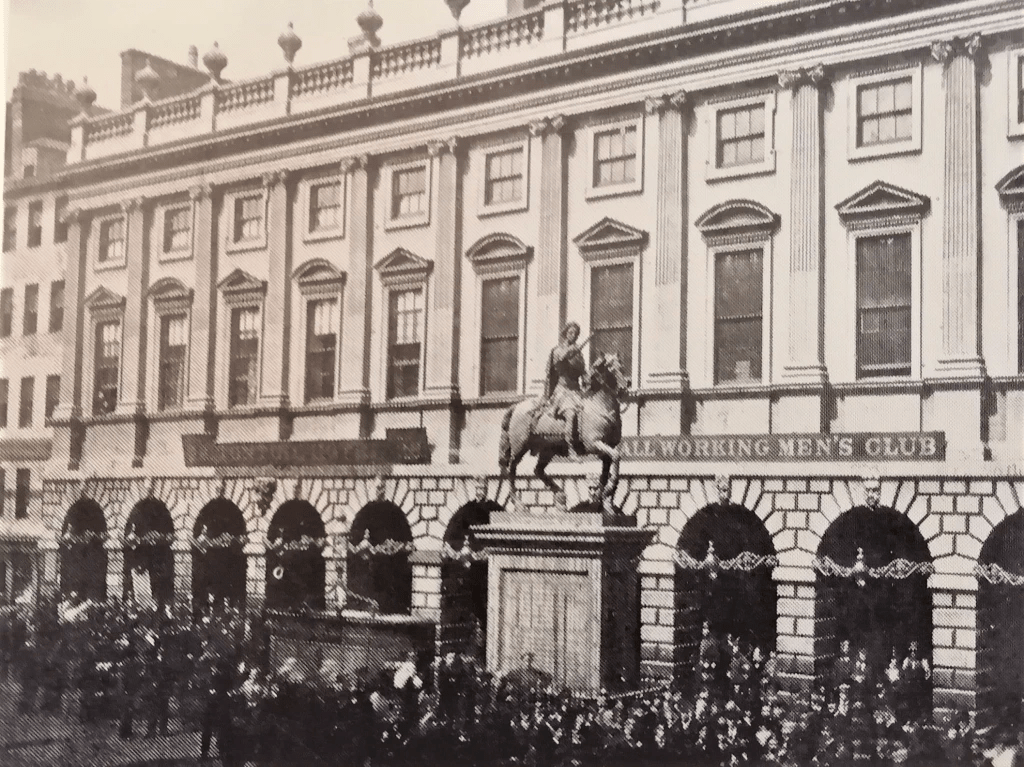
Figure 6. The Tontine Building in 1868, photographed by Thomas Annan. From ‘ Glasgow’s Treasure Chest’ by James Cowan, ‘Peter Prowler’. Published June 1951, page 393.
In December 1860 she came into the ownership of the Tontine building in Glasgow. The Tontine scheme in 1781 financed the reconstruction of the old Tontine Hotel creating what became known as the Tontine Building. Individual shares were purchased at £50 per share, there being a total of one hundred and seven shares sold. Two shares were bought in young Cecilia’s name one of which was by her grandfather William Douglas, the other by Glasgow merchant Alexander McCaul. The objective of the scheme, apart from having a grand civic building, was that the last living share holder would have ownership of it. That turned out to be Cecilia,[90]although it was a close run thing as she was the oldest of four survivors in February of that year.[91]
She died at home in 1862 in her ninety first year, essentially from old age.[92] She left a personal estate valued at just over £40,365. In accordance with her Trust deed her bequests included family and a number of charities and organisations, and individual members of her domestic staff.[93] In accordance with her husband’s Trust deed the Orbiston estate was left to his grandnephew Robert Douglas.[94]
She and her husband are commemorated by a plaque on the wall of St. Bride’s Collegiate Church in Bothwell inscribed as follows:
To the memory of Gilbert Douglas of Douglas Park. Born 28th May 1749 Died 10th March 1807 and also of Cecilia Douglas of Orbiston his wife Born 28th Feby 1772 Died 25th July 1862
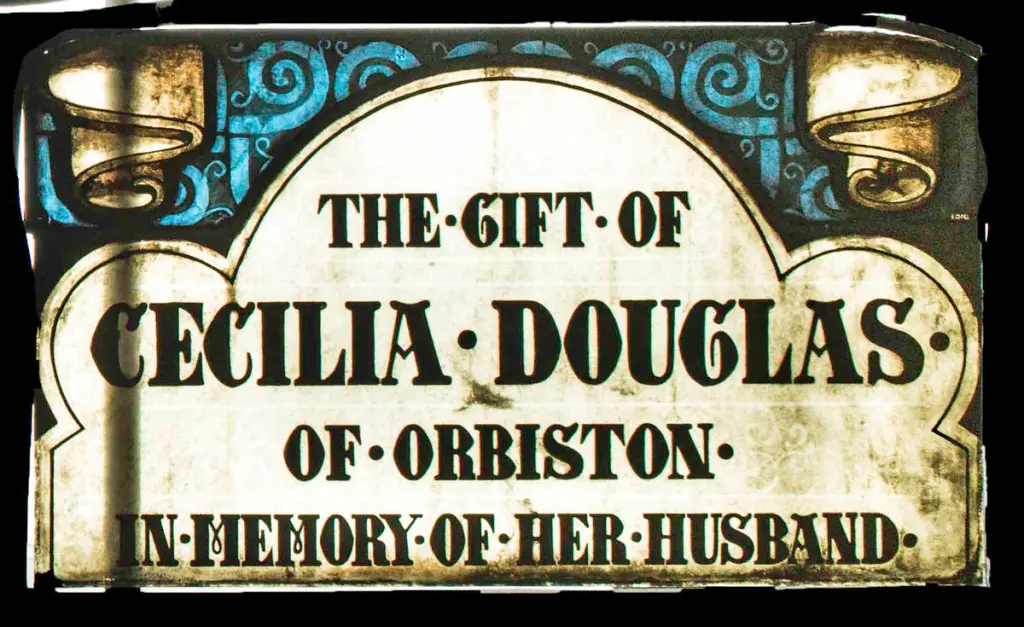
Before her death she funded a window in Glasgow Cathedral dedicated to her husband and her parents and siblings, which was completed in October 1862, part of it being shown below.[95]
Figure 8. Kind Permission of Heritage Environment Scotland.
In 2013 articles about the paintings bequest to Glasgow appeared in the Herald newspaper, one entitled “The Paintings Sullied by Slavery”. It goes into detail about the Cecilia Douglas fortune being founded on slavery and asks the inevitable question about whether paintings with their financial provenance should ever go on show. A complex question with no easy answer. The following are two telling and moving extracts referring to the conditions on the Douglas plantation in St. Vincent.
‘Slavery conditions on the Mount Pleasant estate on St. Vincent were brutal. Large gangs of slaves would spend much of the day digging holes for the sugar cane and constantly weeding the plantation, with women not spared such physical labour.’
‘The slaves die off because they are being worked in very difficult conditions very hard with inadequate nutrition.’[96]
It’s clear that the fortunes of the family of Cecilia Douglas, both paternal and maternal, came about, either directly or indirectly through the exploitation of African slaves, the extracts above indicating what little regard they had for the enslaved people creating their fortunes.
Glasgow generally has come late to the idea that slavery underpinned the city’s commerce from around the Act of Union to the mid 1800’s. This was a major ‘self-denial’ that persisted well into the twentieth century, the following, which was printed in the Herald in 1883, being typical of the mindset that existed until fairly recently.
‘The American War of Independence finished the latter (the tobacco lords), but the trading instinct of Glasgow was not to be denied, and prompted no doubt by its favourable situation for the purpose, the merchants of Glasgow embarked largely in the West India (West Indies) trade. The other great sugar ports were London, Bristol and Liverpool, and it is to Glasgow’s lasting honour that while Bristol and Liverpool were up to the elbows in the slave trade Glasgow kept out of it. The reproach can never be levelled at our city, as it was at Liverpool, that there was not a stone in her streets that were not cemented with the blood of a slave.’ [97]
2] Ross, A.M. (1895) The Genealogy of the Families of Douglas of Mulderg and Robertson of Kindeace and theirdescendants. Dingwall: A.M. Ross and Co. pp. 9-12.
[34] Testamentary Ancestry. England. 9 April 1862. DOUGLAS, John. National Probate Calendar. (Index of Wills and Administration). 1858 – 1995. p. 147. https://www.ancestry.co.uk
[40] Stephens, H. M. ‘DOUGLAS, Sir Neil, (1774-1853)’ In: Oxford Dictionary of National Biography. Oxford: Oxford University Press. https://doi.org/10.1093/ref:odnb/7913
[46] Stephens, H. M. ‘DOUGLAS, Sir Neil, (1774-1853)’ In: Oxford Dictionary of National Biography. Oxford: Oxford University Press. https://doi.org/10.1093/ref:odnb/7913
[47] Births. (OPR) Scotland. Glasgow. 1 December 1776. DOUGLAS, Thomas Dunlop. 644/1 160 218. www.scotlandspeople.gov.uk
[56] Testamentary Records. Scotland. 26 March 1869. DOUGLAS, Thomas Dunlop. Trust Disposition and Deed of Settlement. Ayr Sheriff Court Wills. SC6/46/6. www.scotlandspeople.gov.uk
[60] Devine, T. M. An Eighteenth Century Business Elite: Glasgow West India Merchants etc. In : The Scottish Historical Review Vol 57, No. 168. Part 1 April 1978. pp. 40-67. Edinburgh: Edinburgh University Press. https://www.ucl.ac.uk/lbs/person/view/27301
[61] Testamentary Records. Scotland. 22 January 1861. DOUGLAS, Archibald. Trust Deed of Settlement and Inventory. Dunoon Sheriff Court. SC51/32/11. www.scotlandspeople.gov.uk
On 28 February 1944, an oil painting by Sir John Lavery presented by Mrs Baird of 8 Northbank Terrace, Glasgow, N.W., was accepted by Glasgow Corporation.1 The subject of the painting was Mr. George Ure Baird who was the father-in-law of the donor.
Anna Bella Walker Maltman was born at 17 Kelvinhaugh Street, Anderston, Glasgow on 14 January 1870.2 Her father, Thomas Maltman was a drapery warehouseman who had married Anna`s mother Isabella Adam on 6 July 1860 in Glasgow.3 In 1871 the family consisted of Thomas, (who was now a shipping clerk) and Isabella with Magdalena aged 8, Frances 6, John 4 and Anna Bella.4 Ten years later the family was living at 9 Windsor Street, Kelvin, Glasgow. Anna Bella was a scholar, aged 11 and there were two other children, Johanna aged 7 and James aged 2.5
In 1891, the twenty-year-old Anna was living at 52 Ardbeg Road, Rothesay with her sisters Frances and Magdalena and brother-in-law, Andrew Adamson who was a photographic artist. Anna was ‘living on private means’.6 On 9 April 1896 Anna married George Callwell Baird at her home, 22 Montgomerie Street, Glasgow. George was a commercial traveller, aged 27, living at his brother`s home, Killadoon, Langside. Anna`s sister Johanna was a witness.7
By 1901 Anna and George had moved to 2 Albany Street, Kelvinside. They now had a son George Ure Baird aged 3 and employed one servant.8 Ten years later, they were living at 242 Wilton Street, (later 8 Northbank Terrace) and now had three children, George, Dorothy, aged 9 and Thomas, aged 2.9 George senior was now a silk buyer employed by Gilmour & Co. silk merchants of 5 Royal Exchange Square, Glasgow. 10
George Callwell Baird died in the Western Infirmary, Glasgow on 18 May 1943. He was 75.11 The following year Anna donated the painting of her father-in-law to Glasgow Museums.
Anna Bella Walker Baird died on 10 December 1963 at 44 Balshagray Avenue, Glasgow. She was aged 93 and the cause of death was ‘senile decay’. Her usual address was that of her son Thomas at 242 Wilton Street.12
The Sitter
George Ure Baird was born in Saltcoats on 8 January 1832 although the birth was registered in Stevenston. His parents were Hugh Baird, gentleman, and Margaret Anderson.13 On 18 July 1860, George married the nineteen-year-old Mary Helen Robertson at Gothic Cottage in Govan, and the couple took up residence at 3 Osborne Place, Govan. George was a commission merchant in sewing machines and lace.14 By 1881 the family had moved to Cartbank, 45 Netherlee Road, Cathcart. (This small Georgian house consisted of a single storey with a basement. It was described as symmetrical, two ends circled, ashlar, large square bay window on front. Probably circa 1770, with ends added circa 1800).15 The family now consisted of four sons and three daughters.16
It was about this time that the portrait of George Ure Baird was commissioned from John Lavery – probably to help the artist become established. Lavery later said that ‘Mr. Baird was one of my first patrons and his kindness to me still excites my warm gratitude’.17 Lavery`s paintings The Tennis Party and a watercolour Lady on a Safety Tricycle, (now in the government art collection) were painted at Cartbank and dated to 1885.18
George Ure Baird died of consumption aged 53 at Anglesy Lodge on 21 January 188519 and was buried in the Glasgow Necropolis along with two sons and a daughter who had predeceased him. The inscription on the headstone reads;-
‘GEORGE URE BAIRD ANN OGILVY born 22nd April 1873 died 6 March 1875, DAVID ANDERSON born 6th Oct 1870 died 28th March 1875 JESSIE born 3rd Jan 1877 died 9th Aug 1877, GEORGE URE BAIRD born 8th Jan 1832 died 21st Jan 1885, MARY HELEN ROBERTSON wife of the said GEORGE URE BAIRD who died 4th Oct 1903 aged 61’.
His business of commission merchant was carried on by his son Hugh Baird in partnership with Mr. William Ewing. However, the name George Ure Baird was retained. 20
The Painting and the Artist
John Lavery was born in Belfast in 1856 but was orphaned three years later. At the age of ten he was sent to live with a rich cousin of his aunt who had a pawnshop in Saltcoats.21 George Ure Baird was one of his earliest patrons and the portrait was one of the first painted by Lavery. It may have been commissioned partly to help the artist become established. (It is not clear if the Saltcoats connection is relevant to their relationship since Baird would have moved to Glasgow before Lavery arrived in Saltcoats). However, the present portrait at GMRC is not the one commissioned by Baird.
Lavery had bought and insured a studio in St.Vincent Street and ‘very shortly afterwards it succumbed to a mysterious fire’. Lavery recalled later that he had completed the original painting at his studio one Saturday evening but was not at all happy with the finished work. On returning to the studio the next day he found the place in flames and the painting destroyed ‘to his secret pleasure’. He pretended to be aggrieved but was secretly pleased with the outcome. More especially since he collected £300 of insurance money with which he financed his departure in 1880 for the Heatherley School of Fine Art in London and then to Paris.22
Sometime later (1885) he painted the present portrait from a photographic miniature. Unfortunately, it was completed after the sitter’s death and was delivered to his widow. When Mary Helen Baird died on 4 October 1903, the painting passed to her son George Callwell Baird, husband of the donor. There is a letter on file at Glasgow Museums Resource Centre from Lavery to Mr. J. (sic) C. Baird dated 3 October 1931 from 5 Cromwell Place, London in which he says that he will be ‘passing through Glasgow on Monday with an hour to spare’ and stating that he would wish to come and visit and view the painting. The letter was handed in to Kelvingrove in February 1962 by Mr. T. M. Baird the grandson of the sitter.