
This oil painting was bequeathed by the sitter, David Fortune, of the Scottish Legal Life Assurance Society, 84 Wilson Street. It was received in June 1911.
David Fortune was born about 1842 in Glasgow. His parents were Helen Brown and David Fortune, a master plumber. It is possible that both his parents died when David was young because in the 1851 census he was with his grandfather, David Fortune, a journeyman plumber, and his grandmother Smollet Renton.1 (His grandparents had married on 19 June 1818 in Glasgow). 2 They were living at 74 Cannon Street, Glasgow along with David`s uncle John Fortune who was 17 and his aunt Smollet Fortune aged 14. David`s parents do not appear in any census. In the 1861 census 3, David`s occupation was ‘printer compositor’. He was now aged 18 and living with his uncle John and his wife Mary at 140 Cumberland Street, Hutchesontown. His grandfather was living with them.
By 1865, aged 23, David Fortune had become secretary of the Central Working Men’s Club based at 153 Trongate. He had a house at 10 Wellington Street 4. While occupying this position, he was instrumental in setting up the first of several industrial exhibitions he was to be involved with. From a retrospective article in The Bailie we are told that:
Mr. David Fortune was the Secretary of the first Industrial Exhibition in
Scotland. It was held under the auspices of the Central Working Men`s
Club, in the present Royal Polytechnic buildings, in the year 1865, and
was opened by the late Duke of Argyll as a Winter Exhibition. Mr.
Fortune was also connected with the Partick and Whiteinch Exhibition
held in the same year. 5
(An earlier edition of The Bailie had demoted him somewhat stating that he was ‘janitor of an industrial exhibition in what is now (1889) the Polytechnic Warehouse’). 6 According to the Glasgow Encyclopaedia, The Royal Polytechnic buildings were at 99 Argyll Street and the exhibition (of 1865) had ‘500 exhibits, 400 of which, its placards announced, were by working men’. 7
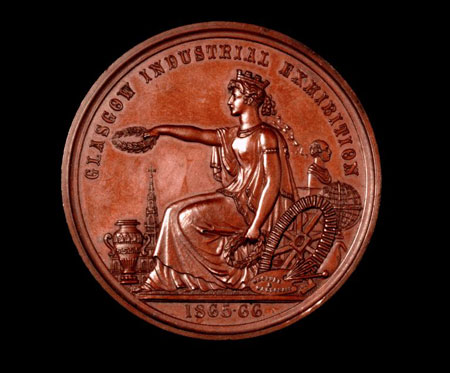
The Post Office Directory for 1866-67 lists David Fortune as the ‘manager of an Industrial Museum at 99 Argyll Street with a house at 26 George Street’.
On 15 March 1866, David Fortune married Ann Webster, a seamstress, at 24 Stockwell Street, Glasgow. In the same year, on 29 November, their first child, George Roy Fortune was born. 8 This occasion gives the first glimpse of David`s passion for the Temperance Movement as the child seems to have been named after George Roy Esq. who, according to a report on the movement 9, was a prominent member of the Scottish Temperance League and became its Honorary Director in 1868. The whole family was named as members of the Scottish Temperance League in 1868-69 with George Roy (aged 2) a ‘Juvenile Adherent’. In the report David Fortune is listed among those ‘Gentlemen who have frankly given their occasional services in the advocacy of the cause….their labours have been most abundant and self-denying’. He contributed five shillings in Donations and Subscriptions. (William Collins, the publisher, and future employer of David Fortune, who was also a member, contributed £5).
The following year, aged 25, David Fortune was appointed to the post of Janitor of Anderson`s University and Keeper of the University Museum. There were 267 applicants for the post with 14 leeted. (Whether significant or not, David Fortune was the first name on the leet). He was appointed on 18 September 1867, with a salary of £60 per annum. In addition, he was to receive a 5% commission on Annual Subscriptions to the University which he was to collect. He was also to occupy the Janitor`s House rent free with water, gas and coal included and free of taxes. He sent his letter of acceptance on 20 September 10 (Appendix 1).
In the census of 1871 11, the family was at 204 George Street (the Janitor`s House). David is described as the ‘Curator of University’. Apart from George Roy, aged 4, there were two other children, Jamie E. (a daughter who probably died young) and Maggie Webster aged 7 months. Another child, Anne Smollett Fortune, had been born on 24 July 1869 12 but is not recorded on the census. In the Glasgow Post Office Directories from 1868 to 1872, David Fortune is listed at the Andersonian University, 204 George Street. He was still pursuing his temperance activities as the following advertisement, which appeared in The Temperance Record of 1871, illustrates:
Amy Royson`s Resolve, by David Fortune. A New Prize Temperance Tale.
Price, in paper covers, 1s; post free, 14 stamps. In extra cloth
boards, 2s; post free 28 stamps. Published by John S. Marr and Sons,
Glasgow. 13
According to the Anderson`s University Calendar, David Fortune was Janitor of the University until 1871-2. However, on 21 February 1872 he tendered his resignation in order to take up a ‘new post’. Although his terms of employment stated that he was required to give three months’ notice, he asked to be allowed to relinquish his post within fourteen days and was given permission to leave on 1 March.14 His ‘new post’ was that of Secretary of the Irish Temperance League (ITL) in Belfast.15 On 2 June 1873 he communicated an article on The Origin of the Temperance Agitation in Ireland which was published in a volume entitled The Early Heroes of the Temperance Reformation. 16 ‘He was a very dynamic and effective secretary’ of the League and had the idea of setting up coffee stalls in Belfast ‘for which the ITL is popularly remembered’. 17
In 1876 an International Temperance Conference was held in Philadelphia. David Fortune contributed an article The Irish Temperance League which was published in a Memorial Volume. 18 He left the ITL in 1877 (a departure that was ‘greatly regretted’) and returned to Glasgow to take up a ‘share in the management of the important business of Sir William Collins &Co.’.19 From 1879 to 1881 he was living at 89 North Frederick Street 20 and according to the census of 1881 he was the ‘foreman of a stationery manufacturer’. There had been an addition to the family – David jnr. who was aged two and born in Glasgow.21
Between 1881 and 1886 he became President of the Scottish Legal Life Assurance Society (SLLA).22 It is likely that this was a part-time post as his main occupation was still with William Collins. In the same year he gave evidence to the Select Committee on ‘National Provident Insurance’. 23, 24 (Appendix 2) At that time the SLLA had over 30,000 children under the age of five listed as members, but he denied, in his evidence, that child insurance encouraged infanticide or neglect.
He was now resident at 104 Peel Terrace, Hill Street, Garnethill. As The Bailie commented ‘whenever a decent, hard-working, shoemaker or warehouseman blossoms into a ‘swell’ he chucks his ancient dwelling-place in Monteith Row or North Frederick Street, and travels ‘out West’. 25 The article was bemoaning the exodus from the East-end of Glasgow and the increased prominence in city affairs of the West-end.
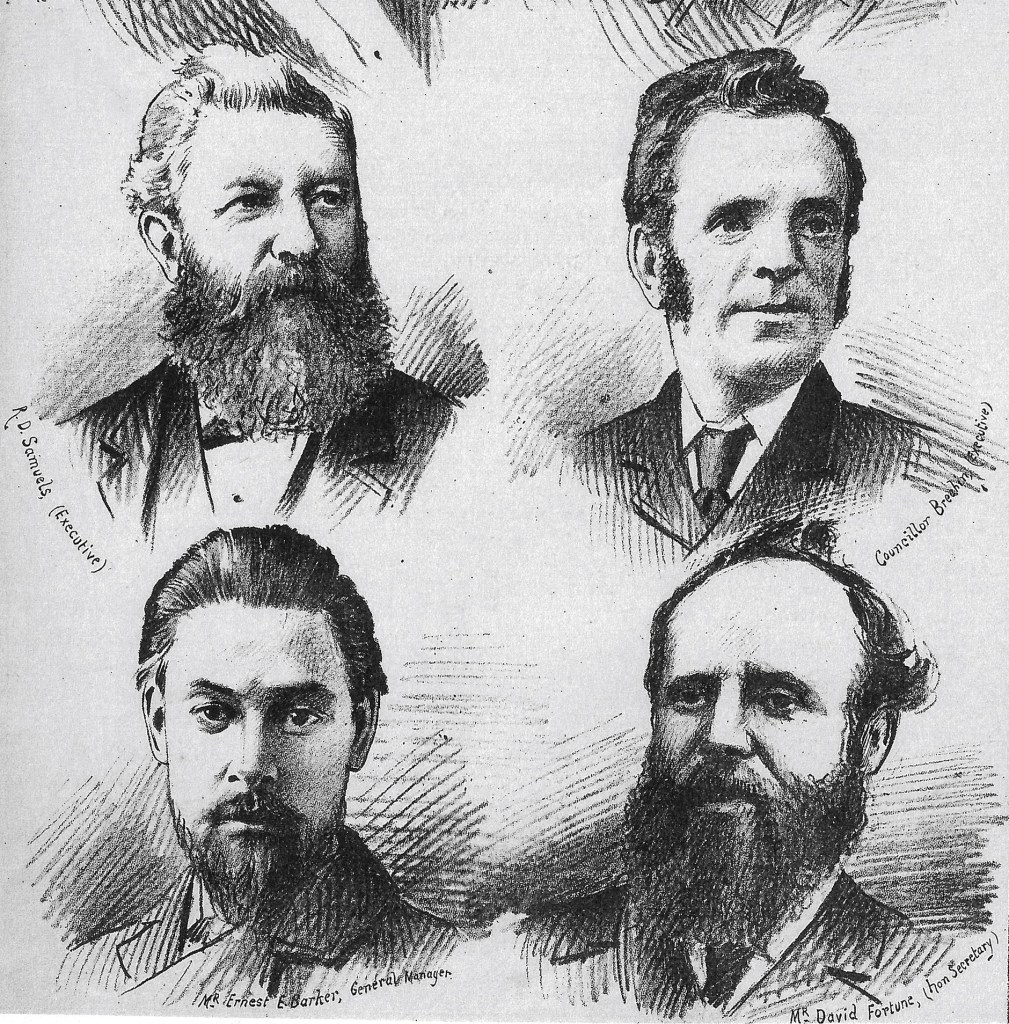
On 25 November 1886 an Industrial Exhibition was opened at the Burnbank Drill Hall and Grounds in Great Western Road. David Fortune was a member of the Executive Committee and Honorary Secretary. Of the members of the Executive Committee, The Bailie commented ‘One and all of these gentlemen, each of whom is a citizen of repute, has wrought with might and main to further the scheme’. 26
An advertisement was placed in The Glasgow Herald advising that there would be ‘Illuminations with Electric Light’, ‘Machinery in Motion’ and ‘Sir Noel Paton`s Choice Works’ etc. etc. The proceeds of the first week and any overall profits were to be given to local charities. An article in the same issue gave a full account of the attractions on offer. 27
In the Glasgow Post Office Directory of 1888-89 David Fortune is described as ‘manager, Sir William Collins, Sons and Co., Stirling Road’ and ‘President of Scottish Legal Life Assurance’. According to The Bailie the SLLA ‘may be congratulated on the possession of a Chairman (President) whose strong common sense and admirable business faculty has already been of the utmost advantage in their interests’. 28 He was also Chairman of the Congress of Friendly Societies and Director of the Scottish Temperance League. His interest in education was shown when he gave evidence before a Royal Commission on Technical Education.
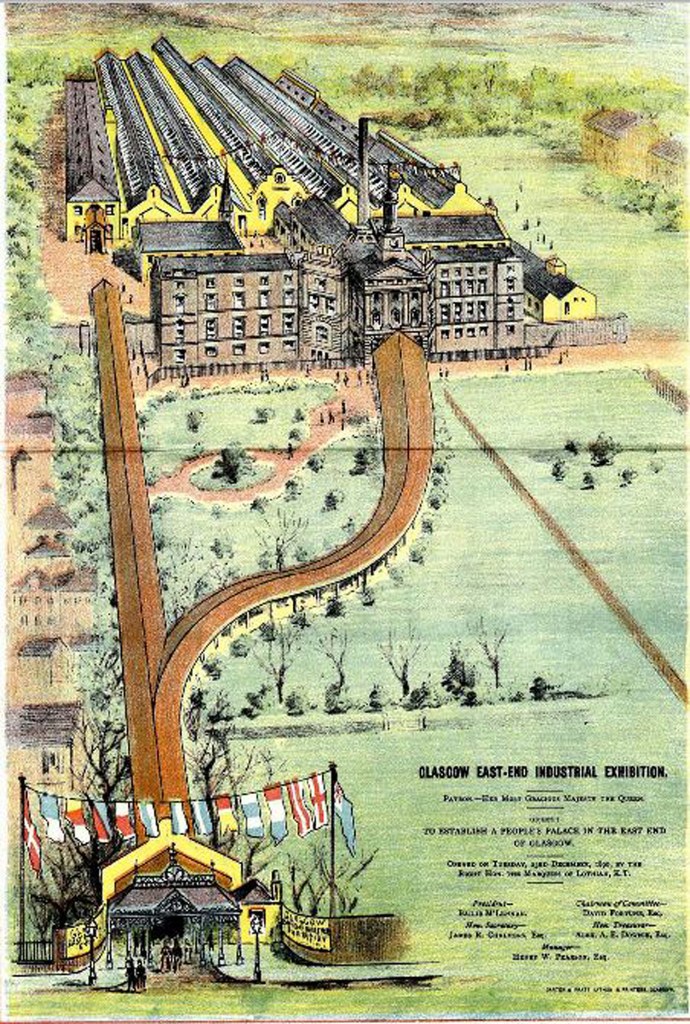
David Fortune`s next major project was the East-End Industrial Exhibition of 1890 held in Dennistoun.
‘It is but a few months since an East-end Industrial Exhibition was
suggested by Mr. David Fortune, and today………the Marquis of
Lothian unlocks a palace of instruction and entertainment’. 29
Perhaps because of the influence of David Fortune the exhibition seems to have been a teetotal affair and perhaps because of that ‘misguided decision’ was lacking in visitors. 30 However, a later edition of The Bailie states that the exhibition ‘resulted in a surplus of £3000 being handed to the Corporation to aid in building the People`s Palace.’ 31 This is confirmed by an article in the Glasgow Encyclopaedia:
The East End Industrial Exhibition of Manufactures, Science and Art,
took place in 1890-91. Its profits were to go towards establishing ‘an
institute for the intellectual and social improvement and recreation of
the inhabitants of the East End of Glasgow’. – this objective was realised
by the erection of the People`s Palace.32
Again, The Baillie had something to say:
‘Concerning Mr. David Fortune, the Chairman of the Executive
Committee, there is little need to say anything. Mr. Fortune is an
eager and enthusiastic worker at whatever he puts his hand to, and
he usually contrives to make the different enterprises with which he is
connected turn out successes.’ 33
One of his duties was to reply to the toast to the executive at the opening ceremony.
According to the 1891-92 Glasgow Post Office Directory he was ‘President, Scottish Legal Life Assurance Society’ but was now described as a ‘mercantile stationer’ at 28 Gordon Street. In the 1893-94 edition he was a manager at Sir William Collins, Sons and Co., Stirling Road and had become Secretary of Scottish Legal Life. In 1895-96 he is listed as ‘J.P., F.S.S.’. In 1897 he moved to 197 Pitt Street and two years later he moved again to 19 Rowallan Gardens, Broomhill.
David Fortune was Chairman of the Glasgow East End Industrial Exhibition which ran from 9 December 1903 till 9 April 1904. It was staged in Duke Street in premises designed for the East End Exhibition of 1890 – 91 and attracted 908,897 visitors. Its aim was to raise funds for the Royal Infirmary but in the event made a disappointing profit of £221. An advertisement for the exhibition appeared in the Glasgow Herald of 9 December 1903. At the closing ceremony ‘the members of the Executive, accompanied by Sir John Ure Primrose, the Hon. the Lord Provost came upon the platform and were enthusiastically received. Mr. David Fortune, who presided, briefly introduced the Lord Provost’. 34 In his speech, the Lord Provost congratulated the Executive on the success of the Exhibition. Mr. Fortune then proposed a vote of thanks to the Lord Provost and the formal proceedings were terminated.
The Bailie again commented:
‘Mr. Fortune`s zeal and energy have permeated the various
committees. Exhibitions are Mr. Fortune`s hobby, but in the serious
business of life he devotes his time and attention to the work of the
Scottish Legal Life Assurance Society, where, as the able and efficient
Secretary, he renders yeoman service. Mr. Fortune is also actively
identified with the leading social, educational, and municipal
movements in the city.’ 35
On 10 October 1911, David Fortune was presented with his portrait in oils ‘in recognition of 50 years public service in Glasgow’. (This was the painting which was subsequently bequeathed to Glasgow). Rather appropriately, the portrait was presented to him at the Scottish National Exhibition of 1911 held in Kelvingrove. The purpose of this exhibition was to raise funds to endow a Chair of Scottish History and Literature at the University of Glasgow. For once, David Fortune appears not to have been involved. The presentation was made by Lord Rowallan in front of a large gathering in the Athole Restaurant. At the same time, Mrs. Fortune was presented with a gold pendant set with pearls. Among those present were David Fortune`s daughter and his son Dr. George Fortune. Also present was Francis Wilson who painted the portrait. 36
On 16 June 1912 Annie Fortune died aged 65 at home in Broomhill. Her death was reported by her son G. Roy Fortune but some details on her death certificate differ from those shown on her marriage certificate i.e., her father is listed as David Webster, a blacksmith and farmer, and her mother as Annie Webster m.s. Hall. 37
After his wife’s death, David Fortune appears to have remarried although this marriage is not recorded on Scotland’s People. His new bride was a widow Mary Ann Gray (nee Kemp) who predeceased him. She died on 24 March 1917. 38
David Fortune died, aged 75, on 12 November 1917 at 19 Rowallan Gardens, Broomhill. He was buried in the Glasgow Necropolis on 14 November but there is no evidence of a gravestone having been erected. His death certificate records that he was an insurance secretary, widower of 1. Annie Webster, 2. Marion (sic) Gray. The death was reported by his son G. Roy Fortune and again the details differ from those on his marriage certificate. His father is given correctly as David Fortune, plumber but his mother is listed as Maggie Fortune m.s. Galloway. 39 His obituary was published in The Glasgow Herald under the heading ‘A Social Reformer – Death of Mr David Fortune’. The author noted that as well as his many other interests, David Fortune was a ‘keen Burnsian’ and was frequently called upon to deliver ‘The Immortal Memory’. He was a Fellow of the Royal Statistical Society and of the Chartered Institute of Secretaries and a member of the Greenock Harbour Trust. 40
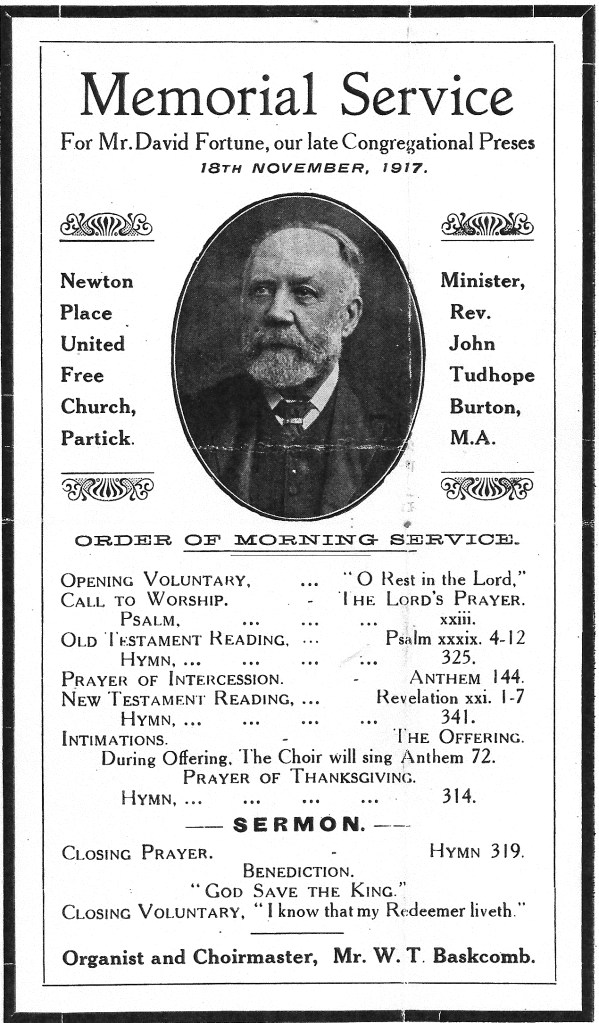
A memorial service was held on 18 November 1917 in the Newton Place United Free Church in Partick.
His estate was valued at £6913.18s. 6d and in his will,41 he left £100 each to the Scottish Temperance League and the Royal Glasgow Institute for the Deaf and Dumb and £50 each to the Royal National Lifeboat Institute and the East Park Home for Infirm Children. He also left bequests to the Sabbath Schools of the Newton Place United Free Church, Partick ‘for the purchase of prizes’ and to the Rose Street Day Industrial School to help with funding the Annual Excursion and Christmas Entertainment for the poorer children. The ‘goods and chattels’ belonging to his second wife were left to her grand-niece Marjorie Hartstone who was then living at 19 Rowallan Gardens.
Two paintings are mentioned in his will; Scotland Yet by Cameron (first name not given) ‘bequeathed to me by the grandson of Robert Burns’ which was left to his elder son and his portrait by Francis Wilson which was to be given to the People`s Palace in Glasgow.
His portrait was offered by his trustees to Glasgow Corporation on 1 February 1918 and was initially declined due to a lack of space at the People`s Palace. However, after further consideration and correspondence from the trustees, the painting was accepted on 31 May 1918. 42
The Artist
Francis Wilson was primarily a painter of landscapes and portraits. He was born in Glasgow in 1876. He studied at the Glasgow School of Art and continued his training in Florence, Paris and Rome. On his return from the Continent, he set up a studio in Glasgow, exhibiting at many of the Scottish societies, including the Royal Scottish Academy and the Glasgow Institute. He also exhibited at the Paris Salon. He was a Member of the Glasgow Art Club and his work is represented in the Glasgow Art Gallery.
References
- ancestry.co.uk, Scotland Census 1851
- familysearch.org
- ancestry.co.uk, Scotland Census 1861
- Glasgow Post Office Directory, 1865-66.
- The Bailie, No. 1626, 16 December 1903, Mitchell Library, Glasgow
- The Bailie, No. 886, 9 October 1889
- Fisher, Joe, The Glasgow Encyclopaedia, Mainstream Publishing, 1994. pp 130-134.
- Scotland`s People, Birth Certificates
- Annual Report of the Scottish Temperance League, 1868-69. Anguline Research Archives. http://anguline.co.uk/Free/Temperance.pdf
- Minute Book of Anderson`s University, 1865-1881. Andersonian Library, University of Strathclyde.
- ancestry.co.uk, Scotland Census 1871
- Scotland Births and Baptisms, 1564-1950, database, FamilySearch (This birth is not recorded on Scotland’s People
- The Temperance Record, 4 November 1871, p528. Google Books.
- Minute Book of Anderson`s University, 1865-1881. Andersonian Library, University of Strathclyde.
- The Bailie, No. 886, 9 October 1889
- The Early Heroes of the Temperance Reformation, Scottish Temperance League, Glasgow, 1873. Houlston and Sons and W. Tweedie, London. http://www.archive.org/stream/earlyheroesoftem00logauoft/earlyheroesoftem00logauoft_djvu.txt
- Information from Archie Wood, Honorary Archivist, Irish Temperance League. (Sent by email, 2012)
- Centennial Temperance Volume. A Memorial of the International Temperance Conference, held in Philadelphia, June 1876. (Published 1877, article number 851 – 852). (Google Books).
- The Bailie, No. 886, 9 October 1889
- Glasgow Post Office Directories
- Scotland’s People, Census 1881
- Glasgow Post Office Directories
- Scotland in the 19th Century, (ebook), Chapter 6, Section 6.8, Insurance
- The Bailie, No. 736, 24 November 1886.
- The Bailie, No. 886, 9 October 1889.
- The Bailie, No. 736, 24 November 1886
- The Glasgow Herald, 25 November 1886 pages 1 and 5.
- The Bailie, No. 886, 9 October 1889.
- The Bailie, No. 949, 24 December 1890.
- ibid
- The Bailie, No. 1626, 16 December 1903.
- Fisher, Joe, The Glasgow Encyclopaedia, Mainstream Publishing, 1994 pp 130-134.
- The Bailie, No. 949, 24 December 1890.
- The Glasgow Herald, 11 April 1904, page 9.
- The Bailie, No. 1626, 16 December 1903.
- The Glasgow Herald, 11 October 1911, page 9.
- Scotland`s People, Death Certificate.
- ibid
- ibid
- The Glasgow Herald 12 November 1917.
- Scotland’s People, Wills and Testaments, SC36/51/179, pp 228-239, 1918
- Glasgow Corporation Minutes, 1 February 1918, C1 3.58, p584; 1 May 1918, p1089; 31 May 1918, C1 3.59, p 1277, Mitchell Library
Appendix 1
David Fortune`s letter of acceptance of the post of Janitor of
Anderson`s University and Keeper of the Museum.
26, George Street,
20th September 1867
Sir,
I beg to acknowledge receipt of your communication of yesterday, acquainting me of my appointment by the Managers, as Janitor to Anderson`s University, and Keeper of the Museum connected with that institution. I cordially agree to the terms specified in your letter, and I need scarcely say that my best energies shall be devoted to the fulfilment of the various duties required of me, in a manner which, I hope, shall prove satisfactory to the Managers and the other gentlemen connected with, and interested in the welfare of the University. With thanks for the great favor (sic) bestowed on one,
I remain, Sir etc.
(signed) David Fortune
William Ambrose Esq.
Secretary,
Anderson`s University.
Taken from the Minute Book of Anderson`s University, 1865-1881.
Appendix 2
David Fortune, the President of the Scottish Legal Life Assurance Society, which was a mutual as well as a collecting society, said its business was almost entirely confined to the working classes. Out of a total of 400,000 members, 38,771 were under the age of 5 and 37,731 between the ages of 5 and 10. He disclaimed the suggestion that child insurance encouraged infanticide or neglect. He recommended that only one insurance should be allowed on a child, as with only one certificate, there would be no possibility of insurance beyond the legal amount. He thought all societies insuring children ought to be registered under the Friendly Societies Act, 1875, but did not recommend the registration of every child life insurance as this would be extremely unpopular among the working classes

 Glasgow Museums Art Donors Group
