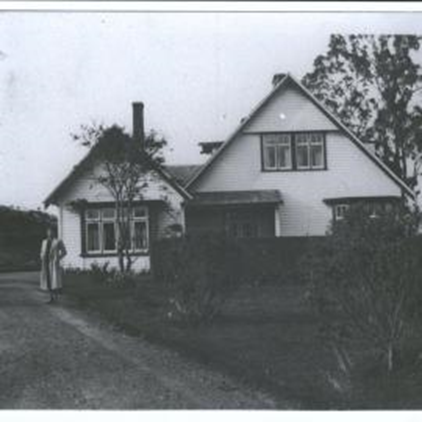
Godfrey Herbert Pattison (1877-1960)

In December 1945, Godfrey Pattison donated five paintings to Glasgow museums. The paintings were thought to be associated with family members from the late eighteenth to nineteenth centuries. Godfrey Pattison was a widower with no surviving children and no surviving brother. It is reasonable to suppose that, having no immediate family, he would ensure that family pictures were in safekeeping.

 Godfrey Herbert Pattison was born in Chorleton upon Medlock, Lancashire on 16 April 1877 to John Pattison (1840-1917) and Mary Jane Ovington (1850-). (1 ) He was from a well-known Glasgow family descended from John Pattison of Kelvingrove House. He lived with his parents in Withington, in Lancashire and then in Cheshire. In !897 he sailed from the Liverpool docks bound for Calcutta. (2) The records of The Imperial Yeomanry show that he enlisted during the Boer War and served in South Africa from January 1900 to June 1901. (3)

Our subject is found travelling to and from England during his lifetime but passenger lists do not give his occupation or profession. Over the years he had different temporary addresses when he was on leave. In 1932 he was travelling to the UK from Dar-es-Salaam and his permanent address is given as Tanganyika (now Tanzania).   He returned to Mozambique in 1932. (4)   By 1939 he was home living in Andover, Hampshire. (5) His occupation at that time was given as farmer. When he gave the paintings in 1945 his address was given as the Commercial Hotel, High Street, Andover, Hants. (6)

In1939 he is described as widowed but there is no mention of his wife’s name or of a wedding. A son Donald Moncrieff Pattison (1920- 1944) was born in Tanganyika Territory. He served in the Second World War in the Royal Army Corps but died in action in June 1944 in Calvados in France and is buried in Ryles War Cemetery. (7)

 Godfrey continued to travel to Africa after 1945 and was travelling to and from Mombasa in 1958. (8) He died in 1960 and is buried in Manchester. (9)

Family History
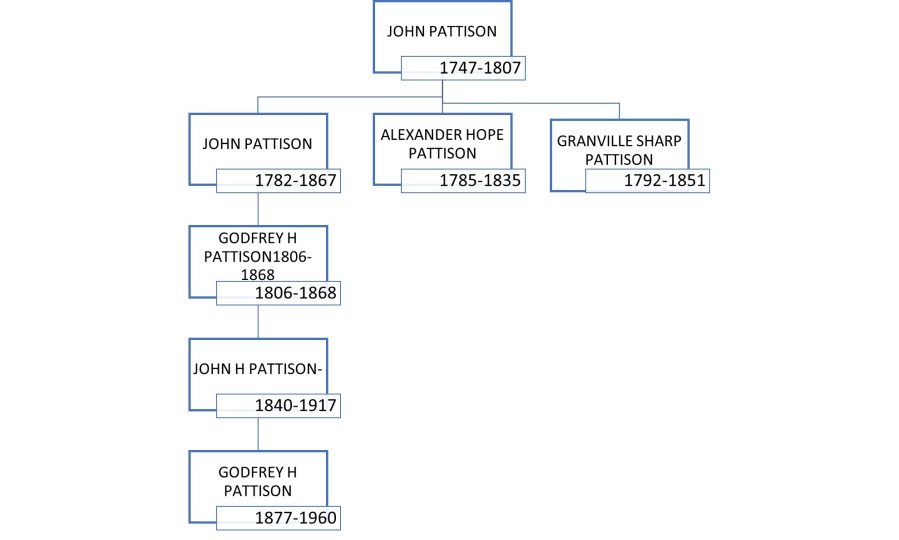
Figure 1. Pattison Family Tree

The family history, not only shows the direct line of descent of our subject from John Pattison of Kelvingrove House and the links to the present day Kelvingrove Museum, but also that this was a family who did not remain in Glasgow and were well travelled.

His father, John Pattisson (1840-1917) was the son of Godfrey Thomas Hope Pattison (1806- 1868) and Mary Cornelia Thomson (1819-1885). . He was born in New York at the British Naval Dockyard Hospital (10) (11) and his mother was an American citizen He is next found in the UK 1851and 1861 censuses (12) (13) in Glasgow. He married Mary Jane Ovington in 1873 in Glasgow. (14)  Thereafter he lived in Lancashire and then in Altringham Cheshire. (15) (16) His occupation was given as Silk Merchant.  He died on 7 March 1917 and is buried in Chorlton-cum-Hardy. (17)

His grandfather, Godfrey Thomas Hope Pattison (1806-1868) was the son of John Pattison (1782-1867) and Rebecca Monteith (1786-). (18)    He became an American citizen on January 2 1828. (19) The reason for his being in America and his occupation have not been ascertained. However, he was a nephew of Alexander Hope Pattison and of Granville Sharp Pattison, who was Professor of Anatomy in the University of New York. (20)  Godfrey married Mary Cornelia Thomson (1819 -1885) in 1836 in New York at a ceremony conducted by the mayor. (21). His son John was born in New York. Thereafter the family returned to Glasgow and are found in the 1851(22) and 1861(23) censuses at 27 Newton Place when he is described as a Commission merchant. He died in Glasgow in 1868 (24) and is buried in the Glasgow Necropolis.

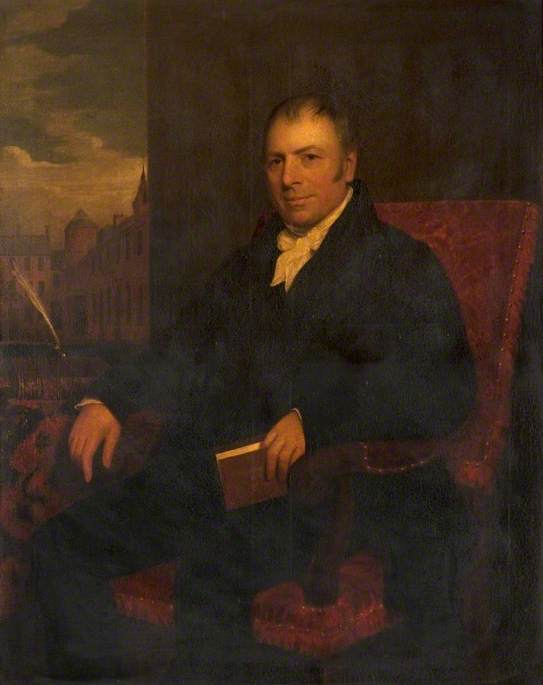
Our subject’s great grandfather, John Pattison (1782-1867) was born   in Glasgow son of John Pattison of Kelvingrove (1747-1807) and his wife Hope Margaret Moncrieff (1755-1803) of Culfargie in Perthshire. (25) He was active in local politics and a strong supporter of the Reform Act of 1832. (26) He married Rebecca Monteith in Glasgow in 1803. He lived in Bothwell in 1851(27) and in Mauchline (28) in 1861. He died in 1867 in Edinburgh. (29) He is buried in the Glasgow Necropolis. (30) It is his portrait by the American artist Chester Harding which was donated to Glasgow.

Our Subject’s great great grandfather John Pattison (1747-1807) of Kelvingrove was born in Paisley on 7 December 1750. (31) He was a Glasgow merchant and mill owner who owned one of the largest steam driven spinning mills in Glasgow. (32 ) He married Hope Margaret Moncrieff of Culfargie  in the Low Church  Paisley on 17 July 1781. (33)
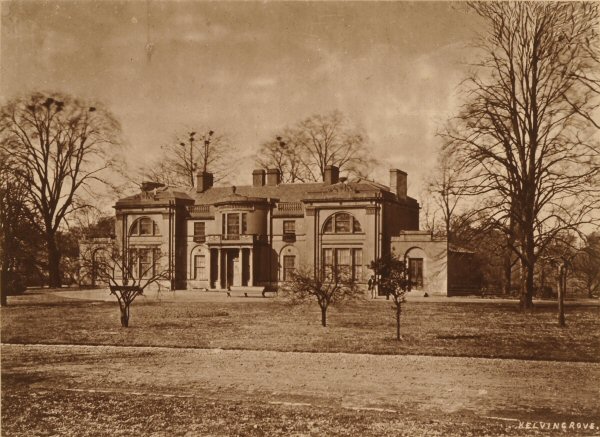
Figure 2. Kelvingrove House by Thomas Annan. Wikimedia Commons

In 1792 he bought Kelvingrove House, which had been built for Lord Provost Patrick Colquhoun in 1782. With the house was an estate of 24 acres .and to which he added and sold both in 1795. It was not until 1852 that it was acquired by Glasgow Corporation .and became Kelvingrove House in the West End Park. Kelvingrove House was much extended to become a museum but it was later demolished. (34)    Kelvingrove Park is the site of the present day Kelvingrove Museum Glasgow. He died in Glasgow in December 1807. (35)

John Pattison and Hope Margaret Moncrieff Pattison had a large family who incorporated the names ‘Hope’ and ‘Moncrieff’ into the family forenames.

The Donated paintings

Painting                                                     Artist

Lt Colonel A .Hope PattisonThomas Duncan R.S.A.
Portrait of a Young Man, nephew of the aboveUnknown
Lord MoncrieffAfter Raeburn
John PattisonChester Harding
Unknown GentlemanUnknown
  

These portraits give some clues to the antecedents of Godfrey Pattison but there are some questions about the reliability of their connections.

Four of the paintings merit some attention. The other is obscure and there is no information about the identity of the subject or of the painter.
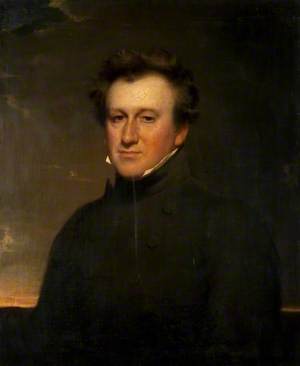
Figure 3. Harding,Chester; John Pattison;© CSG CIC Glasgow Museums Collection

The painting of John Pattison by Chester Harding is not of John Pattison of Kelvingrove (1747-1807) but of his son John Pattison (1782-1867). Harding was an American artist who did not arrive in Britain until 1823. (36) John Pattison of Kelvingrove died in 1807. It is of interest that there is a painting of his wife Hope Margaret Pattison by Harding which is in a private collection.
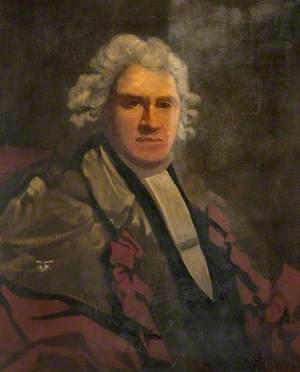
Figure 4. Raeburn, Henry; Lord Moncrieff(1776-1851);© CSG CIC Glasgow Museums Collection

The painting of Lord Moncrieff (1776-1851) is of Sir James Wellwood Moncrieff of  Tullibole in Kinross. (37) No family link has been found at the time of the marriage with Hope Margaret’s family who were Moncrieff of Culfargie in Perthshire. Her father was a minister of the Church of Scotland. However it may be that the families have a common ancestor.
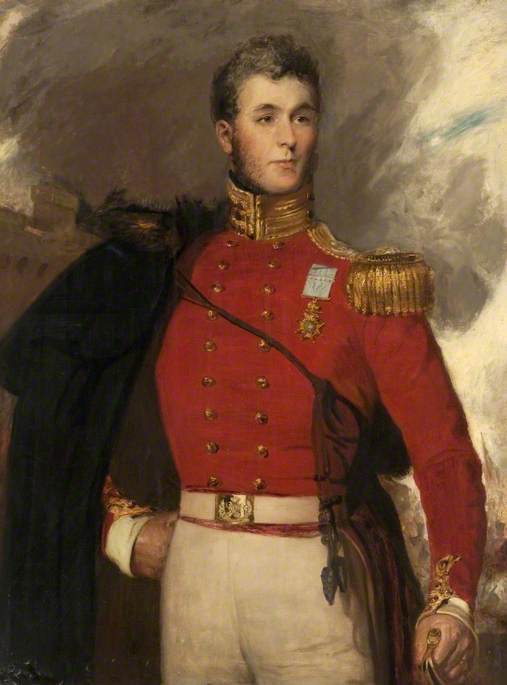
Figure 5. Duncan Thomas; Lt. Colonel A. Hope Pattison;© CSG CIC Glasgow Museums Collection

The painting of Lt. Colonel A Hope Pattison (1785-1835) by Thomas Duncan does have a strong family connection. He was a son of John Pattison of Kelvingrove and Hope Margaret Moncrieff but our subject is not a direct descendant. Alexander fought with distinction in the Napoleonic wars. There is a monument to him and to other members of the Pattison family (38)) in the Glasgow Necropolis and there is much information about them on their website   and in the Glasgow Stories website of Glasgow University.

The painting of a young man, nephew of Alexander Hope Pattison, might be a portrait of Godfrey Thomas Hope Pattison but without knowledge of artist or date this is only a theory.

References

  1. Ancestry .co.uk/ Church of England Births and Baptisms
  2. Passenger lists 1878-1960
  3. Ancestry.co.uk/Records of Imperial Yeomanry
  4. Incoming passenger lists 1878-1960
  5. 1939 England and Wales Register
  6. Archives of Glasgow Museums
  7. Royal  Army Corps Records
  8. Outgoing Passenger Lists 1878-1960
  9. Find a Grave Index 1300 to current day
  10. Ancestry.co.uk
  11. Wikipaedia  Naval Dockyard Hospital, New York City USA
  12. National Records of Scotland Census 1851 and 1861
  13. National Records of Scotland Statutory Marriages 1873
  14. Ancestry .co.uk
  15. Ibid
  16. ibid
  17. England and Scotland Select Cemetery Registers 1800-1961
  18. Ancestry.co.uk/Old Parish Records
  19. Philadelphia. Naturalisation Records 1789-1880
  20. www.glasgownecropolis.org/profiles/The Pattison family
  21. Newspaper Extractions from North east :  Christian Intelligencer of the Dutch Reformed Church.17 September 1836
  22. National Records of Scotland Census 1851
  23. National Records of Scotland Census 1861
  24. National Records of Scotland Statutory Deaths 1868
  25. Ancestry.co.uk
  26. Catalogue of Portraits at the New Art Gallery, Glasgow 1861 Glasgow Museums Archives.
  27. National Records of Scotland Census 1851
  28. National Records of Scotland Census 1861
  29. National Records of Scotland Statutory Deaths
  30. www.glasgownecropolis.org/profiles/The Pattison family
  31. Ancestry.co.uk
  32. Glasgowwestaddress.co.uk/old_country_houses
  33. National Records of Scotland Statutory Marriages 1781 correct
  34. Glasgowwestaddress.co.uk/ old_country_houses
  35.  Britishnewspaperarchive.co.uk
  36. Leah Lipton .Chester Harding in Great Britain. Antiques. Vol.CXXV No 6. June 1984
  37. Millar.Gordon F.  Moncrieff, James Wellwood (1811-1895) Oxford Dictionary of National Biography, Oxford University Press, 2014.
  38. www.glasgownecropolis.org/profiles/The Pattison family
Reverend John McClure Brodie (1874-1964)

Figure 1. Bailie John Alston of Rosemount by John Graham Gilbert. © CSG GIC Glasgow Museums Collection.(www.artuk.org).

This portrait was donated to Glasgow Art Galleries  in 1953 by  the Reverend John McClure Brodie. The painting had originally been owned by the Glasgow Blind Asylum in Castle Street and was offered to Glasgow Art Galleries in 1934 when the building was sold  to Glasgow Royal Infirmary. However the Galleries Committee rejected the work and it was given to our donor.1

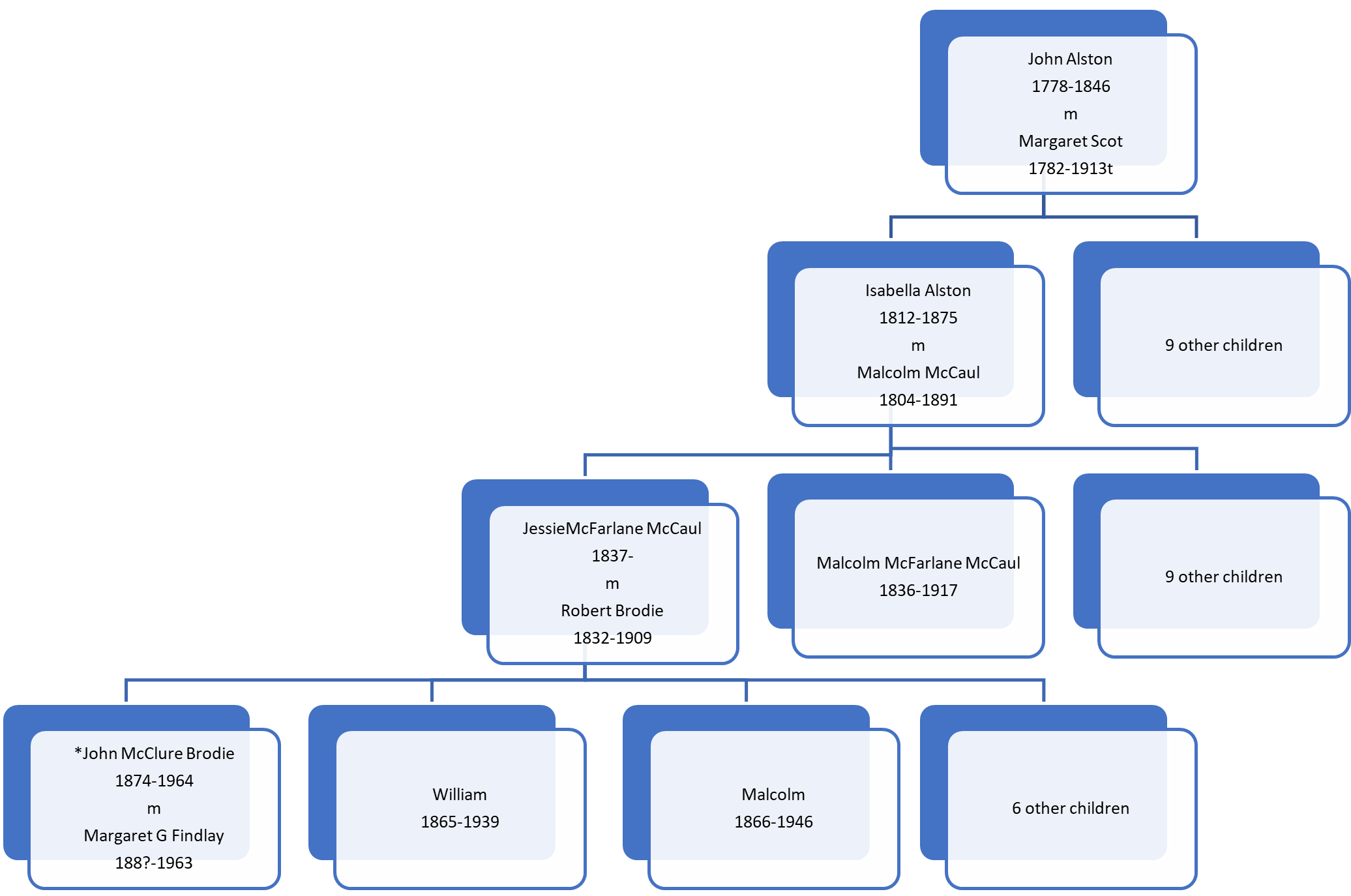
The subject of the portrait was our donor’s great- grandfather .2

Figure 2. Alston/Brodie Family Tree. © J M Macaulay

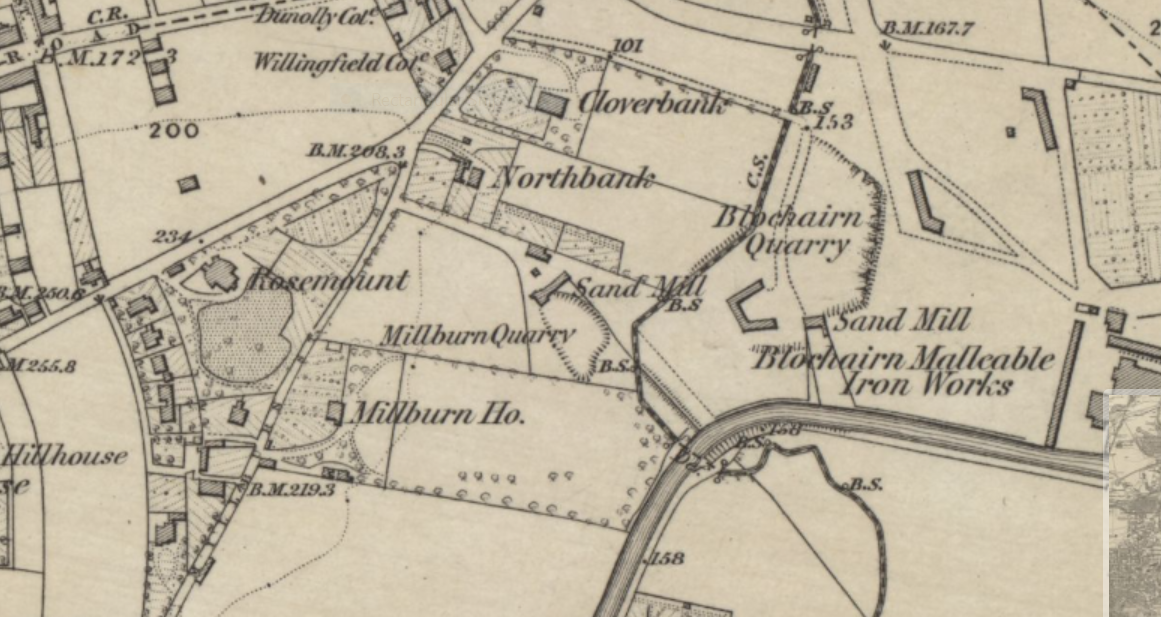
John Alston was a cotton manufacturer based at 55 Glassford Street ,Glasgow but lived at Rosemount House on the Rosemount Estate  in the area of Glasgow now known as Roystonhill, previously known as  Garngad.3 The Rosemount Estate was described as,’ composed of beautiful grounds and orchards.’  The area is now a housing estate but its history is remembered by  one of the streets being named Rosemount Street.4

Figure 3. Extract from map showing position of Rosemount Estate, Garngad, Glasgow c. 1858. © National Library of Scotland.

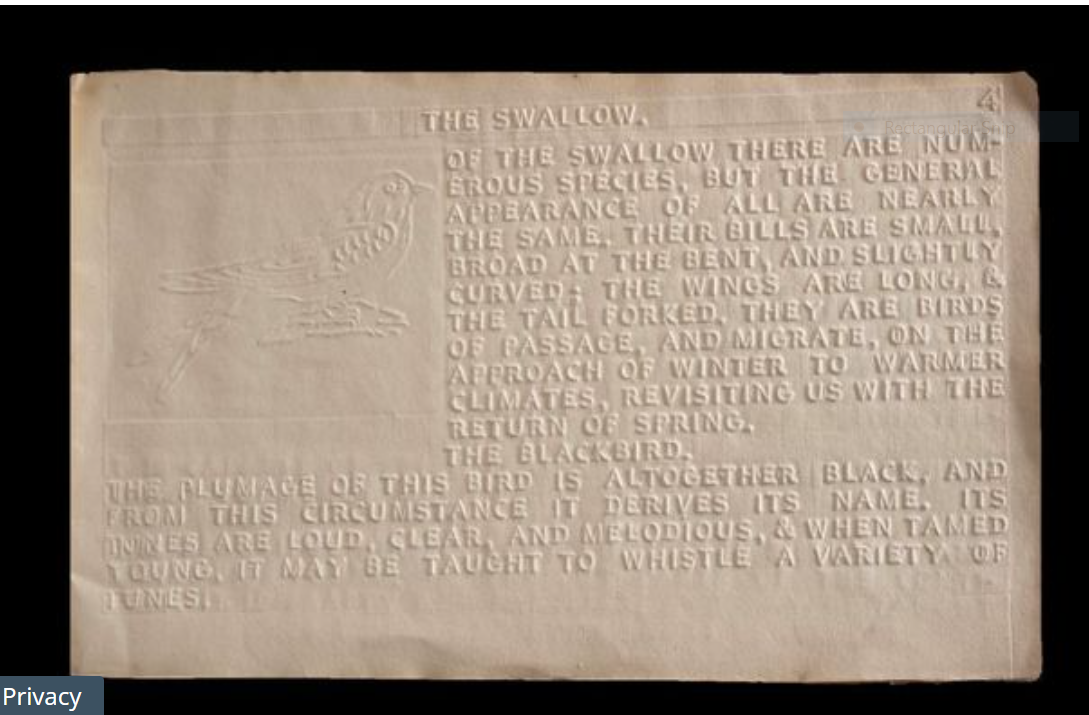
During his life in Glasgow John Alston was a town councillor, a magistrate and Deacon Convenor of the Incorporated Trades and a tireless supporter of many charities. However he is best known for his work for the Glasgow Blind Asylum of which he was a director and honorary treasurer and enthusiastic  fund- raiser. He developed a system of reading for the blind using an embossed version of the Roman alphabet arguing that sighted people could then teach the blind to read. Alston Type  was used at the School for the Blind in Paris for many years before the adoption of the system invented by Louis Braille.  Alston produced the first embossed copy of the New Testament  printed on the Asylum printing press. His ambition was that every blind child in the country  should be able to read The Word of God. By 1844 almost 14,000 volumes of the whole Bible had been distributed across the country.5

Figure 4. Example of Shorter Catechism for use of the blind. c1839. ©CSG CIC Glasgow Museums. Alston Collection.
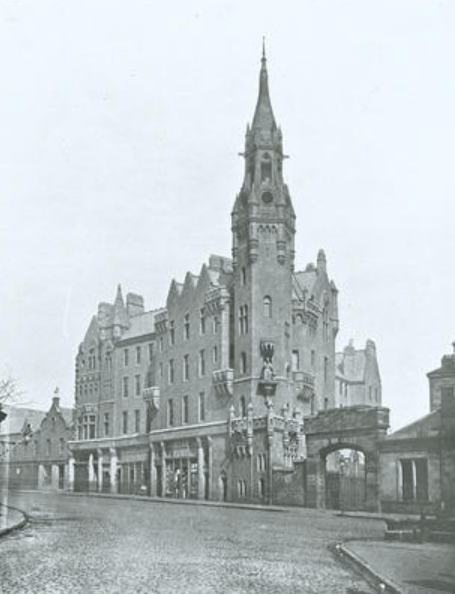
Figure 5. Glasgow Blind Asylum c. 1901.© CSG GIC  Glasgow Museums Alston collection . GCf 1920.04GLA
 

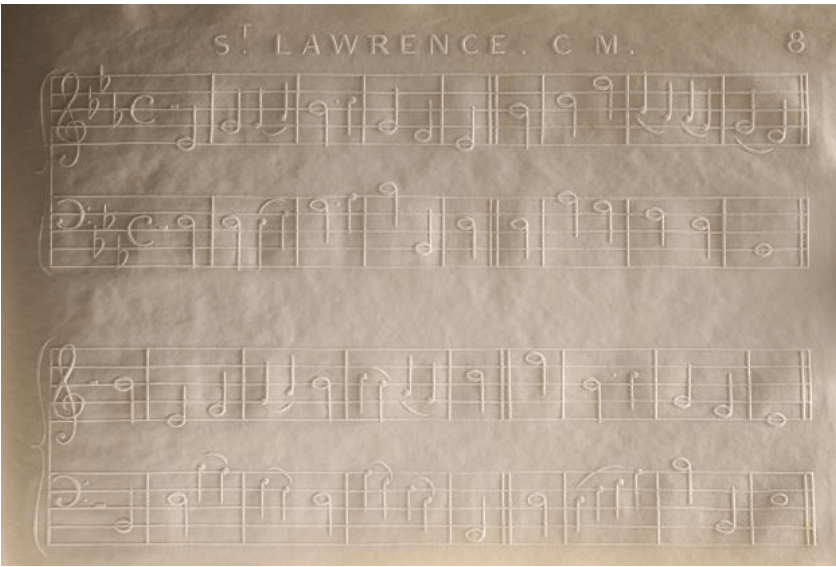
The Glasgow Blind Asylum was founded in 1804 but the first building was erected in Castle Street in 1828 to be replaced in 1881 with a building designed by William Landless. The building was taken over in  1934 by the Glasgow Royal Infirmary as the Out Patients Department. Residents of the Asylum were taught music as well as various trades. Costs were covered by subscriptions, donations, bequests and the sale of articles made in the workshops such as brushes, baskets and bedding made in the various workshops.


Figure 6. Detail from the musical catechism for the use of the blind.

©  CSGCIC Glasgow Museums Alston Collection

Reverend John McClure Brodie 1874-1964)

John McClure Brodie(J McC) was born on 5 September 1874 in Govan.7 He was one of several children born to Robert Brodie8 and Jessie McFarlane McCaul.9According to  the 1881 UK Census the family lived at 23 Belhaven Terrace, Partick, Glasgow which remained the family home until Robert Brodie’s death in 1909.10 Robert Brodie was a partner in the firm of McClure,Naismith and Brodie ,Writers to the Signet, and our donor was probably named after John McClure, one of the partners.11 In the 1891 census  JMcC was recorded as a scholar and  probably attended  Kelvinside Academy as not only did his father  Robert Brodie hold shares in the company which owned the school12 but John’s brother Malcom certainly attended the school13.By 1901 John McC was a law clerk and scholar, possibly working for his father’s firm   though that is not certain.14 He graduated  Batchelor of Law from Glasgow University in 1902.15 While attending the University he was a member of the Volunteer Medical Staff Corps. 16

Sometime after graduating J McC appears to have moved to Edinburgh where in 1907 he was a partner in the firm ofGraham ,Miller and Brodie, Writers to the Signet, at 44 Frederick Street17 and lived at 9 Marchmont Street.18 He appears to have moved back to Glasgow by the time of the 1911 Census  or perhaps was commuting to Edinburgh. He lived in the family home at 23 Belhaven Terrace in Hillhead  along with his mother, brother Thomson who was an accountant and sisters Margaret and Mary both spinsters in their thirties. By this time JMcC was thirty -six years old.19

Our donor’s life changed later in 1911 when he emigrated to New Zealand via Australia where he landed in Melbourne in October 1911 on the SS Anchises.20  We do not know for certain why he went to New Zealand, perhaps the death of his father in 1909 was the catalyst. Also his uncle Malcolm McFarlane McCaul(see Figure 2 above) had emigrated first to Australia sometime after 1862 and then moved to New Zealand sometime before 188121 Perhaps this was the reason for our donor’s choosing New Zealand. JMcC went via Australia perhaps  to visit his  elder brother, Malcolm who lived there.22

  By September 1912 JMcC was living at 12 Lower  Symonds Street , Auckland, North Island, where he was enrolled as a solicitor of the Supreme Court of New Zealand  on the motion of W.A. Styak23 for  whose law firm at Colville Chambers in Auckland he worked for the next few years.24

After the outbreak of WW1 at the age of forty-one  JMcC volunteered for the New Zealand Expeditionary Force  and became a private in the New Zealand Medical Corps.25 As we have seen while  at Glasgow University JMcC had been a member of the  Volunteer Medical Staff Corps of the Glasgow University Volunteers. While living in Auckland he  had also been a volunteer with the Auckland Highland Company one of many such volunteer companies.26

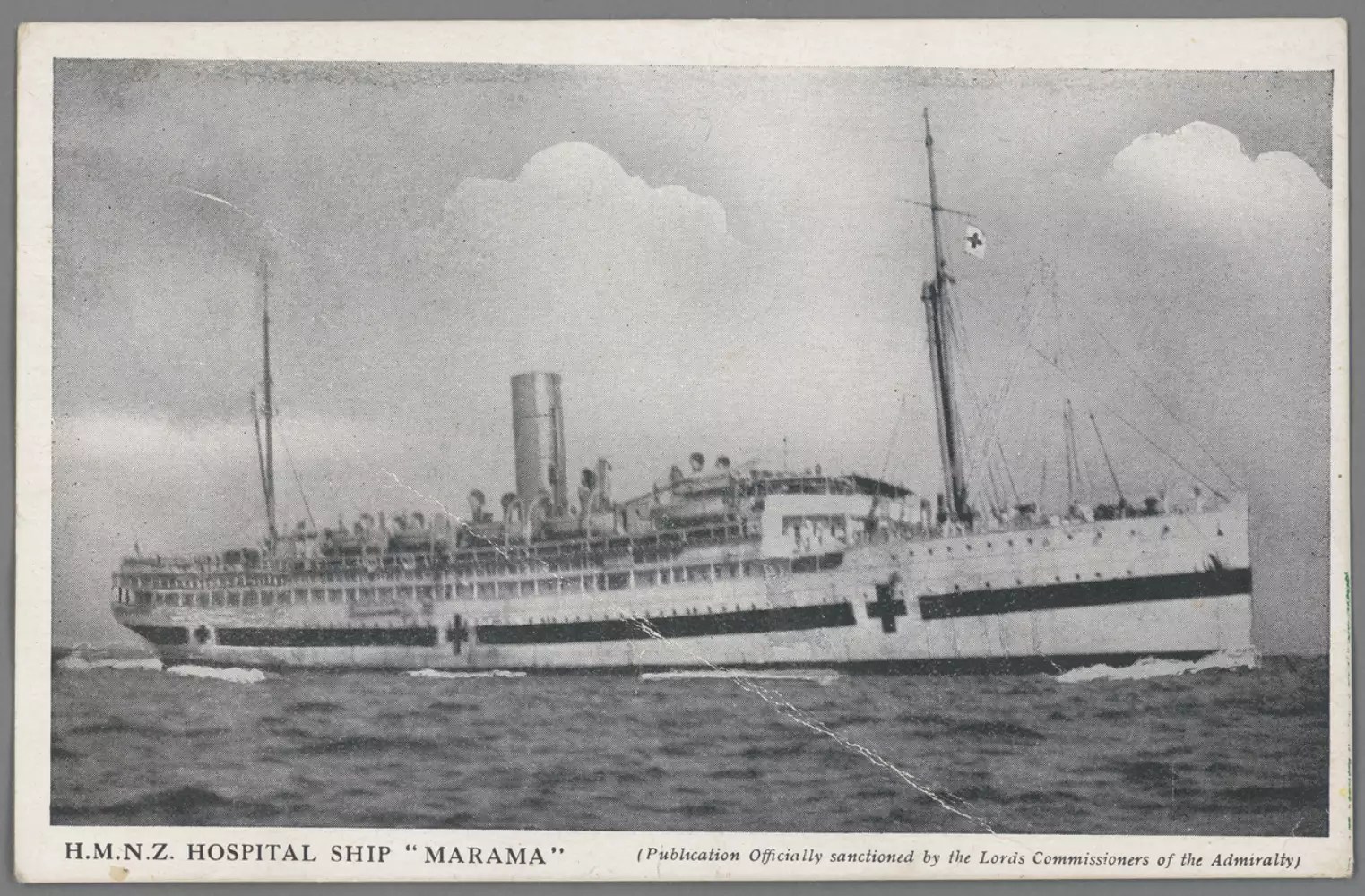
According to his Military Record  JMcC enlisted as a private on 15 December 1915 and was posted  for training the following day  to the Awapuni Camp near Palmerston, North Island.27 Established in October 1915 this was New Zealand’s only dedicated training camp for medical officers, orderlies, stretcher bearers and medical crew for hospital ships.28 He remained at Awapuni until March 1916 and was then transferred to Featherston Training Camp as a lance corporal and then back to Awapuni  from where he was posted to the Hospital Ship Marama on 1 September 1916. Only three days later he was sent back to Awapuni  having been demoted to private again, though it appears this may have been a temporary promotion and was ended when he was no longer needed.29  JMcC’s Military Record also states  he was posted back to the Marama on 10 November 1916 in time  to  sail on its second commission on November 12 1916.The ship sailed via Bombay to Suez then proceeded to Southampton where 540 patients were embarked for New Zealand. A few days out from Southampton the Marama rescued survivors from a torpedoed ship.

Figure 7. Hospital Ship Marama. No known ©. By permission of Auckland Military Museum, Nerw Zealand.

The ship sailed again for England via Bombay on 17 March 1917 then to Mesapotamia and Suez  where orders were received that the Mediterranean was unsafe and all nurses had to disembark. This may have been because  in March 1917 the  German Government had announced an unrestricted submarine campaign resulting in the sinking of several hospital ships in the English Channel. From Suez the  Marama  sailed to Durban. The lack of nurses put a great  strain on the orderlies ,of which JMcC was probably one, as they had to take over the nursing of the most severely wounded, who were confined to the cots, as well as carrying out their own duties.30 JMcC must have been doing a good job    as  on 3rd May 1917 he was promoted to the rank of Corporal.31

From Durban they went to Cape Town and Sierra Leone and finally docked in Avonmouth to pick up a full complement of wounded New Zealand soldiers bound for home via the Suez Canal.32 JMcC’s Military Record states that he reported to Awapuni Camp on 10 October 1917 only to rejoin the Marama on 19 October 1918. The purpose of this voyage was to clear the New Zealand Hospitals in England of New Zealand patients and transport them back to various ports in New Zealand as necessary.33 He arrived back at Awapuni on 27 January 1919 and was finally discharged on 6 March 1919.

After discharge JMcC  appears to have taken a post as a school teacher in Wallaceville ,Upper Hutt, a city in  Wellington Region.(Military record; voting reg).34 According to The Wallaceville School  Attendance and Examination  Register of February to December 1921 the teacher was certainly a J.M Brodie.35

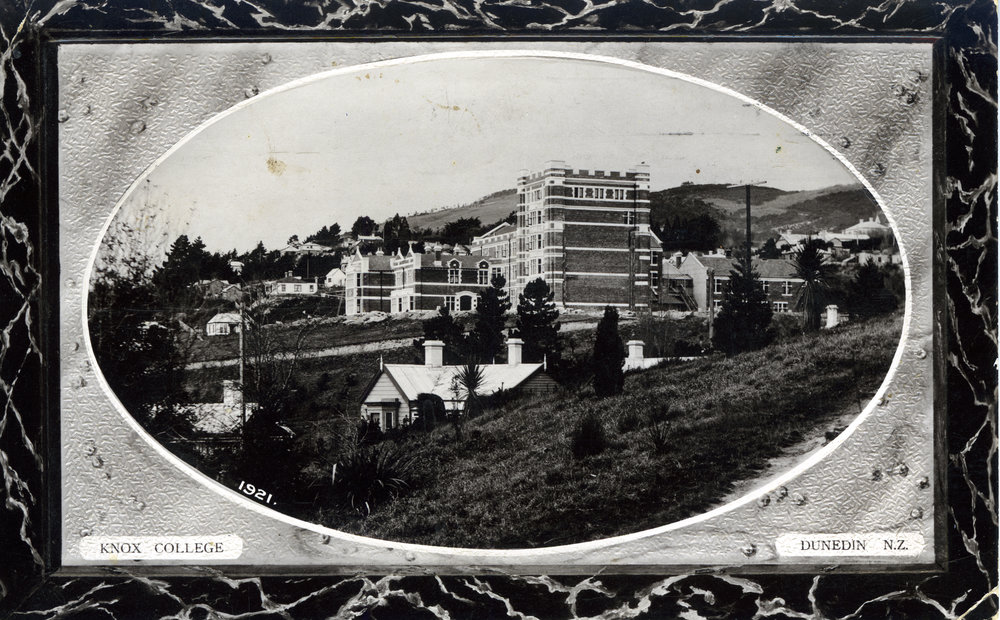
 Then in 1922 JMCc enrolled as a student at Knox College, Dunedin in South Island in order to train to be a minister in the Presbyterian Church.36 There is some evidence of his earlier  involvement in the Presbyterian Church in three letters kept in the National Library of Scotland addressed to John McClure Brodie at 23 Belhaven Terrace Glasgow between 1894 and 1896 which refer to his proposed sponsorship of a local person as an agent, possibly a missionary, in another  country but unfortunately the content lacks detail .37 JMcC was also a member of the Kirk Session of St Andrews Church, Wellington, presumably while he was living in the area after his war service thus giving us further evidence of his connection to the Presbyterian Church.38

Figure 8. Knox College, Dunedin c.1921 ©  Knox College Archives, Dunedin

While at Knox College JMcC appears to have made his mark amongst his fellow students as in the student magazine The Knox Collegian No 14 1923 p23 the following ‘poem’ appeared along with others in the same vein regarding other students:-

                   “We now have a legal advisor

                     John Brodie, B.L. word geyser

                    He will scratch his bald head

                   And talk like-nuff sed-

                  But at the end you’re no wiser.”39

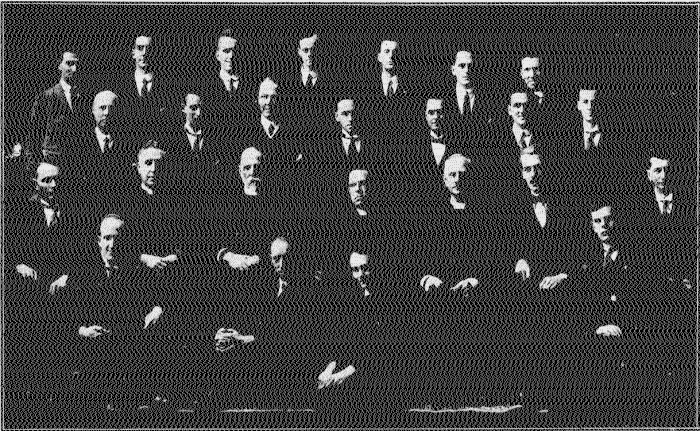
Figure 9. Staff and Students Theological Hall, Knox College 1925 © Knox College Archives Dunedin

J.M Brodie  is first on left, second row from the back.

By 1925 JMcC was 50 years old and at that point, surprisingly, he  married. He married 43- year- old Margaret Graham Findlay from Glasgow who appears to have sailed to New Zealand specifically to marry our donor. Margaret had sailed from Southampton on the SS Corinthic accompanied by one of her  sisters, a Miss A Findlay, though we do not know if it was Agnes or Anna, on 27 November 1924.They travelled First Class and were headed for Wellington.40 According to the Intention To Marry Register dated 10th January 1925 John McClure Brodie, theological student aged fifty  had been resident in Wellington for three weeks. On the other hand Margaret Graham Findlay, spinster aged 43, had been resident in Wellington for only two days which suggests she arrived in very early January1925.41The couple were married on 15 January 1925 in the Scots Church, Seatown, Wellington.42

Margaret Graham Findlay was born in Glasgow on 2 January 1882 at 9 Montgomerie Drive, Kelvinside in Glasgow’s West End. Her father was Joseph Findlay(1852-1910),a cotton merchant and her mother was Jessie B Marshal(1852-1927).43 There is little information about Margaret except from census records. In 1891 the family was living at 11 Winton Drive, Kelvinside. There were six children including twin girls Agnes and Anna.44 The 1901 census gives us the same address and Margaret is recorded as being still a scholar even at the age of nineteen though we have no information as to the school.45

There is no mention of Margaret at the family home in Kingsborough Gardens in Hillhead in the 1911 Census, though there is a record of a Margaret Findlay aged 29 who was a patient at a Nursing Home at 4 Queens Crescent in the Park District of Glasgow but it is mere speculation that  this is the same person.46 By 1921 she was back living in the family home at 16 Kingsborough Gardens, Hillhead along with her mother Jessie and twin sisters Agnes and Anna 00.47How Margaret and JMcC came to know one another is a complete mystery at this time.

The newly-weds  lived in Dunedin at 15 Craigleith Street and  attended the First Presbyterian  Church in Dunedin48 until 1926 when John McClure Brodie was ordained as the Minister of the Seacliff and Warrington Presbyterian Church, Otago on 29th June for a period of five years.49 Seacliff was a small village on the east coast  of  the Otago Region  of New Zealand’s South Island  about twenty miles north of Dunedin. Most early Otago settlers were Presbyterians and the district had been served by Presbyterian ministers  or missionaries in one way or another since 1858. The Seacliff Parish was first established  around 1916 but there was no church building until 1923. However a manse was built in 1916 on land purchased in Kilgour Street ,Seacliff, intended for both the manse and the church. The first minister was the Reverend F. Tucker. 50Seacliff is best  known for the  presence of the Seacliff Mental Hospital, opened in 1884 and once the largest building in New Zealand.51

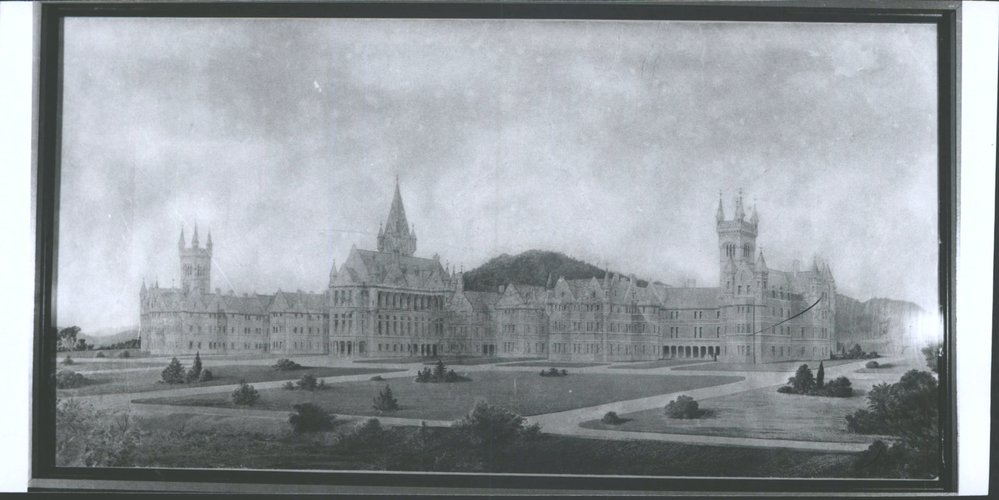
Figure 10.Seacliff Mental Hospital Otago. By permission of TheHocken Collection. University of Otago Library

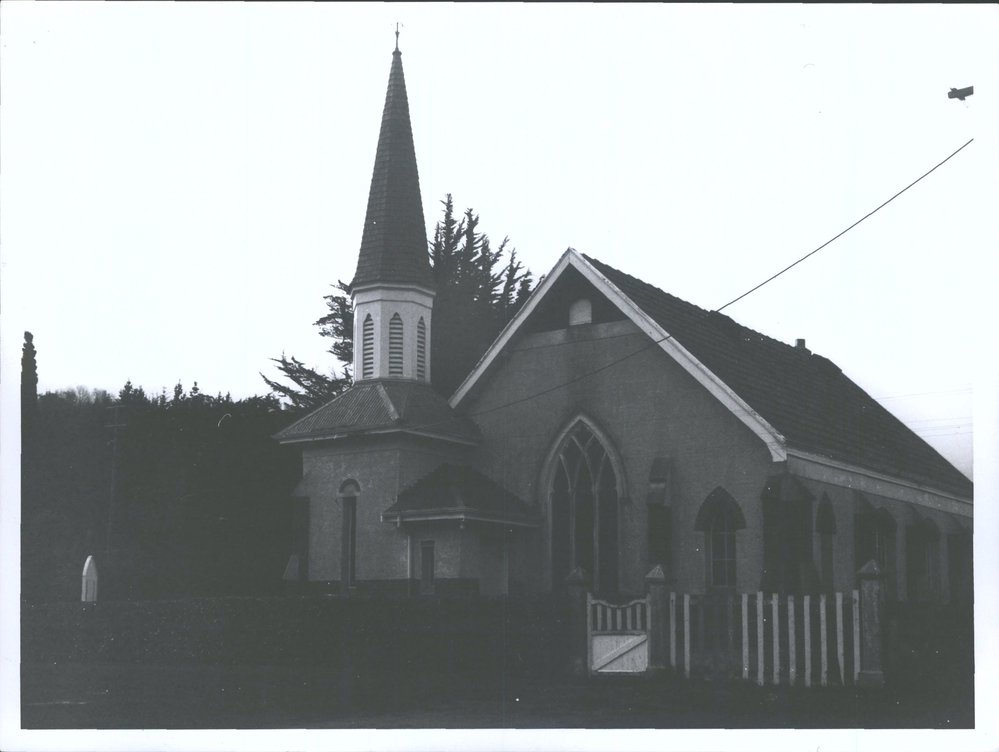
The foundation stone for the new church was laid in June 1923 by Dr A.C. McKillop, Medical Superintendent of the Seacliff Mental Hospital. The Seacliff Presbyterian Church had an intimate connection with  Mental Hospital from its inception and there is a suggestion that it was originally built for the staff of the hospital. Before the building of the church services were often held in the hospital hall as well as in the local school. The various ministers who served the parishioners in  the district over the years also ministered to the patients in the hospital. Services were held in the wards and hospital patients also attended services in the Seacliff Presbyterian Church  after its opening in 1923 and much of the minister’s time was spent serving the  patients in the hospital.52

Figure 11. Seacliff Presbyterian Church , Kilgour Street.

Figure 11. Seacliff Presbyterian Church , Kilgour Street. Photographer J Chisholm. By permission of The Hocken Collection. University of Otago Library.

John and Margaret Brodie appear to have remained living at The Manse in Seacliff until 1929.53

Figure 12. The  Manse ,Kilgour Street, Seacliff. Photographer J Chisholm. By permission of The Hocken Collection. University of Otago Library.

In March 1929 after only three years  JMcC resigned as minister of Seacliff because of  unspecified eye trouble.54 There had been some warning about this in the Kirk session Minutes of 22nd March 1927 when  it was reported that, ‘Mr Brodie had had to postpone a communion service for Karitane( a small village about 3 miles north of Seacliff) because of eye trouble.’55 We do not know if this was the reason the Brodies  decided to  return to Scotland that same year. They travelled Third Class from Brisbane, Australia on the SS Berima, arriving in London on 27  August 1929.56

We do not know if JMcC had treatment for his eye problem but the  Brodies did not return to New Zealand. By 1930 JMcC and his wife were living in Glasgow, probably at 18 Bank Street off Great Western Road.57 At some point in 1930  JMcC became Assistant Chaplain to the Reverend James Cardwell at the Glasgow Royal Mental Hospital in Great Western Road. Perhaps his experience ministering  to  the patients  at  the Seacliff Mental Hospital had played a part in the appointment. The Reverend Cardwell had been chaplain for 25 years. J McC took over from him sometime before 1940 when Cardwell died.58

Gartnavel  Royal Hospital as it is known today originally opened in 1814 as the Glasgow Lunatic Asylum in Parliamentary Road, Cowcaddens. The hospital was awarded a Royal Charter in 1924 and became the Glasgow Royal Lunatic Asylum. It moved to new premises in the Gartnavel district of Glasgow in 1843  designed by architect Charles Wilson in the Tudor Gothic Style. There were two main wings to the hospital. The West House, later West Wing was for private patients and the East House ,later East Wing, for patients who could not afford to pay for their treatment. The hospital became Glasgow Royal Mental Hospital in 1931 then Gartnavel Royal Hospital in 1963.  59

There is little information about our donor’s time at Gartnavel .He did find time to write a History of Gartnavel Mental Hospital1810-1948 though it was never published. 60 The only information we have about JMcC during this period is from a couple of newspaper reports. In 1931 the Scotsman reported that along with others  the Reverend J M Brodie had donated £1/1/0 to the New Zealand Earthquake Relief Fund.61 Then in 1940 the JMcC attended the celebration of the founding of Presbyterianism in New Zealand held at the Martyrs Church in Paisley.

 ‘ In the afternoon  the Reverend J M Brodie, formerly a member of the Kirk session of St Andrews Church, Wellington, was the preacher.’62

 The Brodies lived at 18 Bank Street during the 1930s 1940s  and early 1950s.63 JMcC retired from Gartnavel  around 1950.64Then around 1952 or1953 at the age of seventy-nine J McC and Margaret moved to 3 Buckingham Terrace, Great Western Road. Numbers 3 and 4 Buckingham Terrace at that time were the Kirklee Hotel. So perhaps the couple felt life would be easier for them at their age if they lived in a hotel.65

 On 9 January 1962 Margaret Brodie was admitted to the West Wing of Gartnavel Royal Hospital.66 This wing was for private patients. J McC joined her  on 30th January 1963 aged eighty-eight.67 Margaret died on the 19 November 1963 of ,’myocardial degeneration with arterio sclerosis’68 and the Reverend John McClure Brodie died on 11 April the following year of ‘generalised arterio sclerosis’.69 We do not know if Gartnavel Hospital  acted as a care home and took in elderly patients as a matter of course or if the Brodies were taken as patients because JMcC had once worked there. There is no information as to where the couple are buried.

References

1.Glasgow Museums Resource Centre Object File. Accession No 2993

2. http://www.ancestry.co.uk

3.Glasgow Post Office Directory  1840-41

4. www.roystonroadproject/archive/history/garngad_royston.htm

5. https://theglasgowstory

6. as above

7. www.scotlandspeople.co.uk Statutory Births

8.UK Census 1881,1891,1901

9. op cit ref 7

10. www.scotlandspeople.co.uk   Statutory Deaths

11. Glasgow Post Office Directory 1890-91

12. www.scotlandspeople.co.uk  Will of Robert Brodie

13. Victoria State Library  https://www.slv.vic.gov.aw/

14.UK Census 1901

15. https://www.universitystory.gla.ac.uk/biography

16. Archives New Zealand. New Zealand Defence Force. Personnel Records. John McClure Brodie. Ref AABK 18805 W5520 0018299

17. Edinburgh Post Office Directories 1907-1911

18. op cit ref 12

19. UK Census 1911

20. www.ancestry.co.uk Incoming and Outgoing Passenger Lists 1845-1940

21. https://nzolivers.com/tree/ps01/ps01_041.html

22. op cit  ref 13

23. New Zealand Herald  02/09/1912  p.8

24. op cit ref 16

25. as above

26. op cit  ref 24

27. op cit ref  24

28. https://nzhistory.gov.nz>photo>awapuni:-wa

29. op cit ref 16

30. Archives New Zealand. New Zealand Defence Force. Personnel Records. John McClure Brodie. Ref AABK 18805 W5520 0018299

31. Barnes,Frank . Hospital Ship Marama http://ehive.com/account/3319

32. as above

33. op cit ref 31

34. op cit ref 16

35. https://uncl.recollect.co.nz

36. Knox College Archives Dunedin.  pcanzarchives@prcknox.org.nz

37. National Library of Scotland. Missionary Correspondence for United  Presbyterian Church. Ms.7707,Ms 7710-11

38. Scotsman 01/04/1940 p.6

39. Knox Collegian No 14.1923 p.33

40. www.ancestry.co.uk  UK and Ireland Outward Passenger Lists 1890-1960

41. Archives New Zealand. Ref BDM 20/165/p1914/27

42. New Zealand Herald  05/02/1925 p.1

43. www.scotlandspeople.co.uk Statutory Births

44. UK Census 1891

45.UK Census 1901

46. UK Census 1911

47. www.scotlandspeople.co.uk 1921 Census

48. pcanzarchives@prcknox.or.nzFirst Church Dunedin Communion Roll1916-35

49. Otago Daily Times 26/10/1926 p.7

50. Tod, Frank E. The History of Seacliff :a History of the District to 1970. pub Otago Daily Times Print ,Dunedin 1971 p.65

51. https://thespinoff.co.nz

52. op cit ref 50

53. op cit  Tod p.66

54. Seacliff Warrington Presbyterian Church  Session Minutes 25/3/1929  pcanzarchives@prcknox.org.nz

55. as above  22/03/1927

56. www.ancestry.co.uk  UK and Ireland Incoming Passenger Lists1878-1960

57. Glasgow Post Office Directory 1931-2

58. Brodie,John McClure  The Glasgow Royal Mental Hospital 1810-1948  unpublished. NHS Archives HB13/14/24 Mitchell Library, Glasgow

59. https://theglasgowstory.com

60. op cit 58

61. Scotsman  09/03/1931 p.1

62. Scotsman  01/04/1940 p.6

63. Glasgow Post Office Directories 1932-1951

64.  Church Of Scotland Yearbook 1964.pub. Church Of Scotland Committee on Publications

65. Glasgow Post Office Directory 1952-3

66. Register of Patients 1959-63.ref HB/13/6/70 NHS Archives. Mitchell Library Glasgow

67. As above

68. www.scotlandspeople.com  Statutory Deaths

69. as above

Acknowledgements

I would like to thank the following people for their invaluable help with the research for this donor: Danielle Ashby Coventry and Alison Metcalfe-National Library of Scotland; Laura Stevens-NHS Archives,Mitchell Library Glasgow; Susan Taylor-Special Collections,Mitchell Library,Glasgow;Matthew-Auckland Military Museum;Nick Austen-Hocken Collection,University of Otago;Hilary Ackroyd-Archives New Zealand;Linda McGregor-National Library of New Zealand;Rachel Hurd and Jane Boore -Presbyterian Research Centre(Archives) Knox College Dunedin.

John Blackie Jnr. (1805-1873)

The donor John Blackie jnr. always in bold.

John Blackie jnr. donated three paintings by Hugh William Williams to Glasgow museums in 1868, the subjects of the paintings being a portrait of David Dale, industrialist and philanthropist who founded the cotton mills in New Lanark, and two different views of his factories.[1]

Although being described as John jnr. he was in fact John Blackie the fourth, his great grandfather, grandfather and father all being named John.

The Blackie family originated from the east of Scotland, great grandfather John living in Haddington. Grandfather John was born and christened in 1762 [2] in Yester, Haddingtonshire, and for the first part of his life he lived in the parish of Dirleton and Gullane. He was a tobacco spinner and in 1781 he moved to Glasgow, presumably to pursue his trade more effectively. Later that year he married Agnes Burrell,[3] the daughter of James Burrell and Margaret Anderson, who was born in Scoonie in Fife in 1760.[4]

John and Agnes lived in the Old Wynd in Glasgow  and had five children, three boys and two girls, the first of whom was John born in 1782.[5] He, in due course, became known as John senior.

Around 1793/94 John, Agnes and family decided to move to Newcastle, however son John snr. remained behind to serve an apprenticeship as a weaver with his father’s friend Robert Dobbie who had a four loom weaving business. The terms of the indenture were that John snr. would serve five years as an apprentice, followed by two years as a journeyman thereafter. Another common condition of the time was that  John snr. would be given board and lodging with the family of Robert Dobbie. In the event John snr. was released from his journeyman commitment after one year.

Figure 1. John Blackie, Senior, by William Bonner. © CSG GIC Glasgow Museums Collection. (www.artuk.org).

His maternal grandfather James Burrell and his wife came to Glasgow around 1799/1800, James being involved in supplying water to the military barracks in the Gallowgate. The water conduit passed through Ark Lane near Duke Street on its way to the Gallowgate. In that area resided John Duncan, a well-to-do weaver. Burrell got to know Duncan and he recommended his grandson to him. Duncan agreed to employ John snr. and on the 30th January 1800 he formally joined Duncan’s business and lived with the family for nearly five years until December 1804, when on the 31st December he married Duncan’s daughter Catherine, who was five years older than him. Their first home was in Barrack Street where on the 27th September 1805, son John was born, later known as John jnr.[6] They also had two other sons, Walter Graham, born in 1816 [7] and Robert born in 1820.[8]

John snr. did not remain a weaver for long. He clearly had ambitions to improve his lot and was offered the opportunity to change his occupation by A Brownlie of the firm W.D. & A. Brownlie who were publishers and booksellers located at 414 Gallowgate.[9] It’s not clear how long he stayed with them however the last entry in the Glasgow P.O. directory for Brownlie was in 1807, located at 20 New Vennel.[10] There is some evidence to suggest that the business ran into financial difficulties and that John snr. was asked to take on some of it by its main creditor and Brownlie.[11]

He seems to have been successful in what he did as in 1812 he first appears in the Glasgow directory as J. Blackie and Co., printers and booksellers, located at 5 Saltmarket.[12] He remained there until 1816 when he moved premises to 8 East Clyde Street.[13] Also located at 5 Saltmarket was Andrew Khull, printer, and it seems likely that Blackie used him for his own publications as when he moved to East Clyde Street so did Khull.[14] By 1819 the entry in the directory was for Khull, Blackie and Co.[15] The formal partnership was established in 1820,[16] but dissolved in 1826.[17]

In 1824 he formed a partnership with Archibald Fullarton and William Somerville, the company being known as Blackie, Fullarton and Co.[18], located in 8 East Clyde Street, and first appearing in the directory of 1828.[19] John jnr. joined the partnership in 1826.[20] which lasted until 1831 when the partnership was dissolved.[21] In the 1832-33 directory, Blackie’s entry is as Blackie and Son, consisting of John snr. and John jnr., printer and publisher, still in East Clyde Street; Fullarton is listed as Fullarton and Co., printer and stereotype founders, located at 34 Hutcheson Street.[22]

John jnr. was initially educated  at the school of William Angus thereafter attending the High School being tutored in English by a Mr. Gibson and in commercial arithmetic (accountancy) by Thomas Rennie at which he excelled. This was to be of great benefit to him in his early days working with his father. As the business had developed, various agencies had been set up in different parts of Great Britain. John jnr. had the task of visiting these agencies to supervise, look at accounts, and to generally be satisfied that the conduct of each agency was acceptable. Dealing with the English agencies only could take as long as three months to visit them all.[23]

Figure 2. John Blackie Jnr. From Memoirs and Portraits of 100 Glasgow Men. 1886.

He was also involved with company publications, the Casquet of Literary Gems being the first major book entrusted to him. It sold very well and probably confirmed to his father that he had [24] the capability to deal with all aspects of the business. Another major success for John jnr. was obtaining the publication rights in 1833 to the Winter Evening Tales by James Hogg, the Ettrick Shepherd. The first volume was published in 1836, the year after Hogg died.[25]

John jnr. continued to develop his activity in the business getting more involved with its publications and finances and sharing the management load with his father. His younger brothers Walter and Robert had also become active in the business and became partners in 1842.[26] He was a member of the Free Church of Scotland and became heavily involved with the publication of the company’s religious books. In particular he was instrumental in the publication of Scotland’s first religious newspaper, Scottish Guardian in 1832. It was a liberal minded publication and evangelical, it’s motto being ‘The people of Great Britain are a free and religious people and by the blessing of God I will lend my aid to help keep them so’. It remained in publication until 1862.[27]

His beliefs also manifested themselves in a number of practical ways. He helped set up three model lodging houses in Glasgow in 1845 (Green Dyke Street), 1847 (Mitchell Street) and 1856 (Carrick Street) in attempt to alleviate the squalor of existing lodging houses and generally to try and improve the conditions of the housing in which the poor were forced to live which were consequentially overcrowded, and unhealthy. In the mid-1860s he was to do much more as I’ll explain later.[28]

John jnr. married Agnes Gourlie, the daughter of Glasgow merchant William Gourlie in 1849.[29] They had three children, all boys: John James, born 1851 [30], William Gourlie, born 1853 [31], and Alfred, born 1855.[32]

Incidentally John snr. at the age of 68 married again in 1850, his second wife being Margaret Frame, the widow of wine merchant David Ferguson,[33] his first wife Catherine Duncan, having died in 1847 according to the Ancestry website although there is no primary proof of this.

In 1857 John jnr. was asked by the electors of the seventh ward in Glasgow to put himself forward for election to the town council. He was duly elected in November of that year and served on the police committee. In 1860 he was elected in ward six after becoming a bailie in 1859. He became a senior bailie in 1862 and in November 1863 he was unanimously elected as Glasgow’s Lord Provost remaining so until 1866.[34]

As a councillor, bailie and Lord Provost John jnr. continued to seek, in accordance with his political and religious beliefs, practical solutions to the housing of Glasgow’s poor whose living conditions were filthy, disease ridden and over-crowded, the buildings being too close together lacking full daylight  and air. In a talk given to the Glasgow Philosophical Society in 1895 by Bailie Samuel Chisolm, a future Lord Provost of Glasgow who promoted further city improvement action, the condition of central or old Glasgow in the 1860s was clearly stated:

‘There were narrow streets, with high and crowded tenements on either side ; and closes, dark and filthy, running at right angles to the streets, were literally swarming with inhabitants. Within a comparatively narrow area 75,000 persons were huddled together, a large proportion of them under conditions which made physical well-being difficult, and moral well-being all but impossible.’

‘From each side of the Gallowgate, High Street, Saltmarket, Trongate, etc. there are narrow lanes or closes running like so many rents or fissures backwards to the extent of two, or sometimes three hundred feet, in which tenements of three or four storeys stand behind each other, generally built so close on each side that the women can either shake hands or scold each other, as they often do, from the opposite windows. When clothes are put out from such windows to dry, as is usually done by means of sticks, they generally touch each other. The breadth of these lanes is, in most instances, from three to four feet, the expense of the ground having at first induced the proprietor to build upon every available inch of it. Throughout the whole of these districts the population is densely crowded. In many of the lanes and closes there are residing in each not fewer than five, six, and even seven hundred souls, and in one close we observed thirty-eight families occupying one common stair. In the Tontine Close there are nearly eight hundred of the most vicious of our population crowded together, forming one immense hot bed of debauchery and crime’.

Dealing with this situation was therefore the key action of his time as Glasgow’s chief magistrate. Initially he and some like-minded friends joined together for the purpose of purchasing property in some of the worst districts of the city, with a view to laying out wider streets and thereafter reselling the remaining building ground, or themselves building upon it. That was not successful mainly due the exorbitant prices asked for by the landowners. What they did however was to bring the issue to the general public’s attention and demonstrate, by their failure, that the problem would only be resolved by means of an Act of Parliament which would compel change.[35]

He first brought before the council his City Improvement Scheme on the 17th September 1865. It was well received by council members and the public at large. It provided for 88 acres of over built land being dealt with, the creation or improvement of 45 streets and the power to spend £1,250,000 on the purchase of property. It also included a general rental taxation of 6d per £ for five years. This latter feature was to result in John jnr. leaving the council. In June 1866, the Act of Parliament was approved and trustees were appointed to deal with its implementation. In 1867 the first imposition of the 6d rental tax was due to be applied which led to a negative reaction to the act and John jnr. personally. So much so that when stood for  re-election in November 1866, his three years tenure being up, he lost by two votes. [36]

He never sought election to the council again, continuing to play an informal part in city affairs and running the family business. He died of pleurisy on the 12th February 1873.[37]

His obituary in the Scotsman of the 13th February recorded his many attributes and included the following comment:

‘Ex Provost Blackie, as originator of the (City) Improvement Plan, has perhaps done more for the good of the city of Glasgow than any other of its chief Magistrates, with the exception of Lord Provost Stewart who promoted the Loch Katrine water scheme.’[38]

John snr. died in 1874,[39] the company he formed essentially in 1809 ceased trading in 1991.[40]

Shown below are examples of the children’s books Blackie published which are in the writer’s possession.

Figure 3. Published 1928
Figure 4. Published 1890.
Figure 5. Published 1935.

One other point worthy of mention, it was William Wilfrid Blackie, the son of Walter Graham Blackie, brother of John jnr., who commissioned Charles Rennie Mackintosh to design and build the Hill House in Helensburgh.

[1] Glasgow Museums Donor Records

[2] Baptisms. Scotland. Yester, Haddingtonshire. 26 June 1762. BLACKIE, John. Scotland Births and Baptisms, 1564-1950. https://familysearch.org/ark:/61903/1:1:XTY2-T56

[3] Marriages. Scotland. Glasgow, Lanarkshire. 11 September 1781. BLACKIE, John and BURRELL, Agnes. Scotland Marriages, 1561-1910.  https://familysearch.org/ark:/61903/1:1:XTYR-L32

[4] Births. (OPR) Scotland. Scoonie, Fife. 1760. BURRELL, Agnes. 456/  295.  www.scotlandspeople.gov.uk

[5] Births. (OPR) Scotland. Glasgow. 27 October 1782. BLACKIE, John. 644/1 170 222. www.scotlandspeople.gov.uk

[6] Blackie, W. G. (1897) Concerning the Firm of Blackie and Son. 1809 – 1874. pp.  1-7. https://digital.nls.uk/histories-of-scottish-families/archive/95489617?mode=fullsize

[7] Births. (OPR) Scotland. Glasgow 21 March 1816. BLACKIE, Walter Graham. 644/1 210 312. www.scotlandspeople.gov.uk

[8] Births. (OPR) Scotland. Gorbals. 20 March 1820. BLACKIE, Robert. 644/2 40 14. www.scotlandspeople.gov.uk

[9] Directories. Scotland. (1803). Glasgow P.O. directory. Glasgow: W. McFeat and Co. p. 17. https://digital.nls.uk/87872897

[10] Directories. Scotland. (1807). Glasgow P.O. directory. Glasgow: W. McFeat and Co. p. 16. https://digital.nls.uk/90147419

[11] Blackie, op.cit. p. 9

[12] Directories. Scotland. (1812). Glasgow P.O. directory. Glasgow: W. McFeat and Co. p. 21. https://digital.nls.uk/90149248

[13] Directories. Scotland. (1816). Glasgow P.O. directory. Glasgow: A. McFeat and Co. p. 23. https://digital.nls.uk/90712736

[14] Directories. Scotland. (1816). Glasgow P.O. directory. Glasgow: A. McFeat and Co. p. 84. https://digital.nls.uk/90712736

[15] Directories. Scotland. (1819). Glasgow P.O. directory. Glasgow: W. McFeat and Co. p. 105. https://digital.nls.uk/83429824

[16] University of Glasgow Archive Services. Reference: GB 248 UGD 061/1/1/1/3. https://archiveshub.jisc.ac.uk

[17] University of Glasgow Archive Services. Reference: GB 248 UGD 061/1/1/1/5. https://archiveshub.jisc.ac.uk

[18] University of Glasgow Archive Services. Reference: GB 248 UGD 061/1/1/2/3. https://archiveshub.jisc.ac.uk

[19] Directories. Scotland. (1828). Glasgow P.O. directory. Glasgow: W. McFeat and Co. p. 27. https://digital.nls.uk/83439439

[20] Blackie, op.cit. p. 21.

[21] University of Glasgow Archive Services. Reference: GB 248 UGD 061/1/1/2/5. https://archiveshub.jisc.ac.uk

[22] Directories. Scotland. (1832/33) ). Glasgow P.O. directory. Glasgow: The Post Office. p. 50. https://digital.nls.uk/87847018

[23] Blackie, op.cit. p. 22

[24] Blackie, op.cit. pp. 23,24.

[25] Blackie, op.cit. pp. 28,29.

[26] Blackie, op.cit. p. 45.

[27] Maclehose, James. (1886). Memoirs and Portraits of 100 Glasgow Men. pp. 37-42. http://www.glasgowwestaddress.co.uk/100_Glasgow_Men/Blackie_John.htm

[28] Withey, Matthew. (2003) The Glasgow City Improvement Trust etc. PhD Thesis. St Andrews University. MatthewWitheyPhdThesis(2).pdf

[29] Marriages. (OPR) Scotland. Glasgow. 21 November 1849. BLACKIER, John and GOURLIE, Agnes.

644/1 430/576. www.scotlandspeople.gov.uk

[30] Births. (OPR) Scotland. Glasgow. 26 November 1851. BLACKIE, John James. 644/1 390/160

www.scotlandspeople.gov.uk

[31] Births. (OPR) Scotland. Glasgow. 17 September 1853. BLACKIE, William Gourlie. 644/1 390/457. www.scotlandspeople.gov.uk

[32] Births. (SR) Scotland. Glasgow. 21 October 1855. BLACKIE, Alfred. 644/1 1394. www.scotlandspeople.gov.uk

[33] Marriages. (OPR) Scotland. Barony. 4 November 1850. BLACKIE. JOHN and FRAME or FERGUSON, Margaret. 622/   200/220. www.scotlandspeople.gov.uk

[34] Tweed, John. (1883). Biographical Sketches of the Lord Provosts of Glasgow. pp. 173-175, pp. 220-240. Glasgow: John Tweed. https://archive.org/details/biographicalske00tweegoog/page/n8/mode/2up?q=blackie&view=theater

[35] Edited by the Secretary. (1896) Proceedings of the Philosophical Society of Glasgow. Vol 27. Chapter IV. Glasgow: John Smith & Son. https://archive.org/details/proceedingsroya11glasgoog/page/n3/mode/2up?view=theater

[36] Blackie, op.cit. pp. 92-94

[37] Deaths. (SR) Scotland. Lanark, Partick. 12 February 1873. BLACKIE, John. 646/3 104. www.scotlandspeople.gov.uk

[38] Scotsman. (1873) Death of Ex-Lord Provost Blackie of Glasgow. Scotsman 13 February. p.4e. https://www.nls.uk/

[39] Testamentary Records. Scotland. 1 September 1874. BLACKIE, John. Trust Disposition and Settlements. SC36/51/66.  www.scotlandspeople.gov.uk

[40] Graces Guide.Blackie and Son. https://www.gracesguide.co.uk/Blackie_and_Son