
Paintings Donated:

Figure 2. Barmouth, John Wright Oakes, ARA (1820 – 1887)(Accession Number 1732) © CSG GIC Glasgow Museums Collection. (Art UK).

Figure 3. St. Ives Bay, John Brett, ARA (1831 – 1902) (1733) Exhibited RA 1881© CSG GIC Glasgow Museums Collection./ArtUK
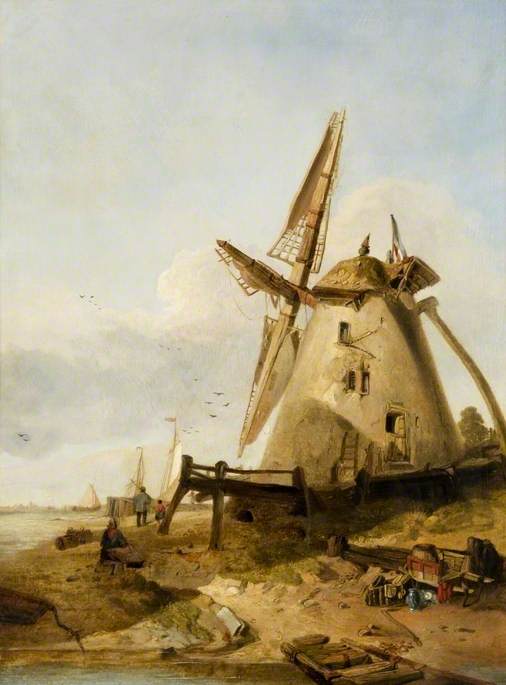
© CSG GIC Glasgow Museums Collection/ArtUK
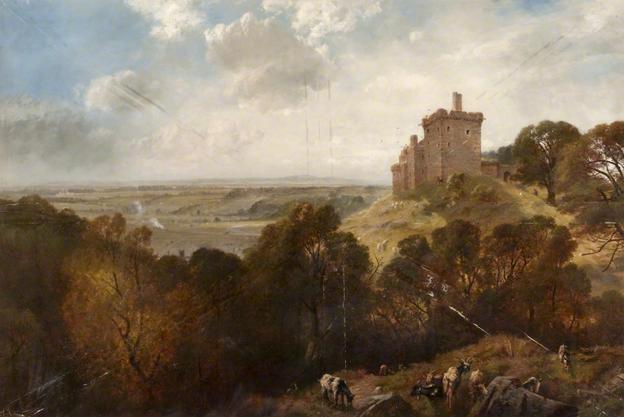
( Barmouth, St. Ives Bay and A Dutch Mill, were received in February 1928 from Andrew Lusk`s executor. Castle Campbell near Dollar was given by his niece Mrs. Berkeley Robertson, nee. Janet Lusk on 29 August 1941. However, the catalogue entry at Glasgow Museums Resource Centre for this painting has a note added ‘to be described as presented by the late Andrew Lusk, Windsor, 1941’).
Andrew Lusk was born at ‘Lusk`s Cottage’, Coatbridge, Lanarkshire on 3 June 1853. 2 He was the son of James Lusk, a master baker and his wife Janet Reid. (James was born in Colmonell, Ayrshire in 1817. Janet was born in Cambuslang also in 1817). 3 There were two other children, John Lusk, born 14 July 1848 (the father of Janet Lusk) and Margaret Earl Lusk, born 3 March 1851.4 All were at Lusk`s Cottage in the 1861 Census along with two servants. Andrew`s father employed two men and forty-three boys. 5 The family is listed in Armorial Families 6. (Appendix 1)
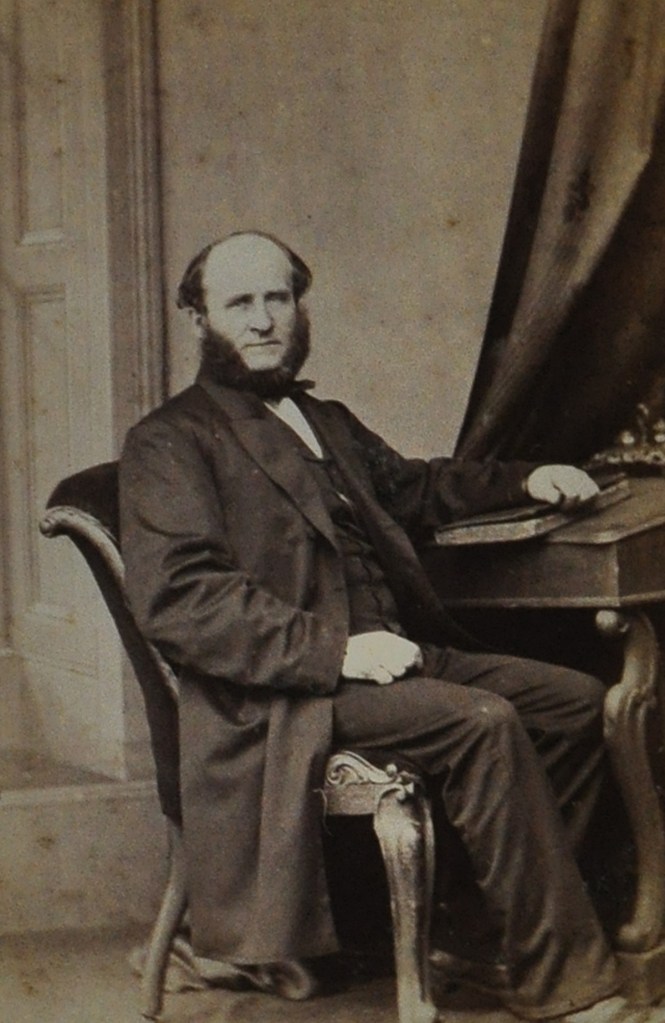

Andrew attended Glasgow High School in the 1860s and seems to have had an interest in and an aptitude for art from an early age which was further developed while at school. 7
From the 1871 census, Andrew, aged 17, was living with his parents, brother and sister at Glasgow Road, Bothwell. He was employed as a clerk. 8 By 1881 his siblings had both married and he had moved with his parents to Hamilton Road, Ferniebank, Bothwell. He was now aged 27 and a ‘commercial clerk in the iron trade’. 9 Sometime after that he moved to England. His father died in 1890 and Andrew was one of his executors. His address then was 3 Fenchurch Avenue, London. The 1891 census found him, aged 37 and single, at The Dell, Woking in Surrey. (The Dell was one of the larger houses in Woking but has since been demolished 10). He was now an ‘iron and steel merchant’ and employed two servants. 11 Woking would seem an unlikely place to find an iron and steel merchant. However, the town had an excellent train service to London so Andrew could have commuted to his business in the city.
It is possible that his career as a steel merchant came about after his brother John married, in 1876, Jessie, the daughter of David Colville, the founder of the Colville steel firm. 12 An account of his assets after his death showed that Andrew was receiving a pension from Colvilles. 13
By the time of the 1901 Census, Andrew had moved to 7 Queen`s Gardens, Osborne Road, New Windsor. 14 He later named the house St. Moritz after a holiday in Switzerland in 1909.
Andrew’s uncle Sir Andrew Lusk who was Lord Mayor of London in 1874 and head of the firm of Andrew Lusk and Co. died in 1909. His funeral took place at St. John’s Church, Southwick Crescent, London on 24 June 1909. Andrew was in attendance as one of the ‘chief mourners’. 15 Andrew later wrote a memoir of his uncle which is held in the National Archives of Scotland. Dame Eliza Lusk, widow of Sir Andrew, died the following year. Andrew was an executor of her will and was left the sum of £1000.
In the 1911 census, Andrew was at the Regent Hotel, Leamington Spa, 16 presumably on holiday because by this time his residence was in Windsor, Berkshire. He also owned a house Roseisle in Glasgow Road, Perth. This was occupied by his sister Margaret and her husband Alexander Sutherland who was a local minister. After Andrew`s death, the house was to have been left to Margaret during her lifetime. However, she predeceased him. His mother Janet who was living on private means moved in with her daughter after the death of her husband in 1890. She died at Roseisle in 1899 and Andrew was present to register her death. 17
In 1915 an appeal was made for subscribers to ‘extinguish the debt incurred by the King Edward VII Hospital in Windsor’. Andrew donated fifteen guineas and a further twenty the following year 18.
Andrew had a great interest in art, music and books. In his house in Windsor he had a collection of paintings, sculpture and many fine editions of books. These were to be kept in the family after his death as ‘I cannot bear the thought of my Fine Editions being handled by careless young people’. He owned a library of music manuscripts which was left to his nephew the Rev. David Colville Lusk who sold it to St. Andrew`s University in 1952.19 He also owned a violin and piano which he may have played. His intention, according to his will was that his paintings be given to the National Gallery in Edinburgh. Were the National Gallery to refuse them, they were then to be offered to Glasgow and to Perth. In the event, Glasgow received four paintings as detailed above. The Sandeman Library in Perth was given five pictures, five marble busts and three pedestals (Appendix 2). The Royal Scottish Academy was given a tea urn believed to have belonged to Sir Henry Raeburn 20. In his will he left £100 to his former housekeeper. After his death she wrote to his executor thanking him for the legacy and stating that as Mr. Lusk`s housekeeper, she ‘had spent many happy years in his service’. (As well as a detailed will, he left a four-page document of ‘Testator’s Suggestions to his Executors’ on how to dispose of his assets e.g. who should be employed to sell his furniture and books and where to find various items mentioned in his will. He also suggested the best firm to pack up his pictures for donation). 21
He also left a painting by Fred Roe ARA, The Landing of Nelson at Yarmouth to the Castle Museum at Yarmouth. (This painting had been exhibited at the Royal Academy in 1909). His own sketches – views of Rome, Florence, Holland, Sweden etc. were to be kept in the family ‘if at all possible’.
Andrew Lusk never married and died at his home in Windsor on 12 October 1927. It is likely he had been ill for some time as illness prevented him attending the funeral of his sister who died in Perth the previous year.22 He was buried in a lair in St. Andrew`s Cathedral Churchyard, Fife which he had purchased in 1899.23 His will contained instructions for the design of his tombstone! It was to be ‘in the same style and colour as Lord Playfair`s close by’! According to his will which was probated in Edinburgh his personal estate was valued at £25, 190. 5s. 8p. The Scotsman reported that he ‘left £100 to the Royal Society of Musicians, and £300 to the United Free Church of Scotland Foreign Missions, in memory of his mother Janet Lusk’ and gave details of his donation of paintings to Edinburgh and Glasgow. 24 The Motherwell Times also carried a report of his estate and noted that he was a director of David Colville and Sons, Ltd., steel manufacturers. 25
The following are two extracts from the Minutes of the Corporation of Glasgow, sub-committee on Art Galleries and Museums:
23 December 1927: The Superintendant reported that he had received a letter from Messrs. Gard, Lyell and Co., London, Law Agents for the trust estate of the late Andrew Lusk, St. Moritz, Windsor, intimating that the deceased under his will, had bequeathed to the National Gallery, Edinburgh, certain pictures, and that six of these pictures specified in said letter might, if desired, be available for the Corporation of Glasgow. The sub-committee, after consideration, agreed that it be remitted to Depute River Baillie Doherty and Councillor Drummond, along with the Superintendant, to inspect the pictures, and with power to accept the same on behalf of the Corporation.
2 March 1928: With reference to the minute, of date 23rd December last, Depute River Baillie Doherty and Councillor Drummond, under remit to them, along with the Superintendant, reported that they had inspected the collection of pictures belonging to the Trust Estate of the late Andrew Lusk, St. Moritz, Windsor, and had agreed to recommend acceptance of the following works of art, viz.
- Barmouth – J. W. Oakes, A.R.A.
- St. Ives Bay – John Brett, A.R.A. and
- The Windmill – Clarkson Stanfield, R.A. 26
Because Andrew Lusk had insisted in his will that his paintings should be hung tastefully and together with the appellation ‘from the bequest of Andrew Lusk, Windsor’, his executor went to great lengths to see that this was carried out. There are three letters relating to the placement of the pictures given to Glasgow in the NAS file.
In his ‘Testator’s Suggestions to his Executors’ he stated that ‘I wish particularly that my other pictures apart from those mentioned in my will be kept in the family (the Greenock cousins excluded!!) or given to friends who would appreciate them rather than sold to dealers for whom I have a great objection’.
A portrait of Lady Sawyer by Sir Hubert Herkomer RA was left to his nephew and executor David Colville Lusk. Heidelberg on the Rhine by J. B. Pyne probably went to his niece Jenny Robertson. Another picture Old Mortality had been entrusted to him by his aunt Dame Eliza Lusk in her will but was in fact the property of his brother.
References.
- National Archives of Scotland, (NAS) GD501 (This is an extensive collection of Lusk family papers and photographs. It contains a book of Andrew`s paintings completed while still at school. The donor`s address was Dunblane, Perthshire). Other family photographs (Figs. 6 and 7) taken from the same source,
- Scotland, Lanarkshire Church Records, 1823 – 1967, FamilySearch (https://www.familysearch.org/ark:/61903/1:1:66K6-5M6X : 2 February 2022)
- Ibid
- ibid
- Scotland’s People, 1861 Census
- Fox-Davis, Arthur Charles, Armorial Families – A Directory of Gentlemen of Coat-Armour, two vols., Edinburgh, T.C. and E.C. Jack, 1905.
- Scotland`s People, 1871 Census
- Scotland’s People, 1881 Census
- Woking History Society, Sue Jones, by e-mail
- ancestry.co.uk, England Census, 1891
- Scotland’s People, Marriages
- NAS, GD501
- Ancestry.co.uk, England Census, 1901
- The Times, 25 June 1909
- Ancestry.co.uk, England Census, 1911
- Scotland’s People, Death Certificate
- Slough, Eton and Windsor Observer, 17 and 24 July 1915, p. 4 and 19 May 1916, p1.
- NAS, GD501
- ibid
- ibid
- Perthshire Advertiser, 6 November 1926.
- NAS, GD501
- The Scotsman, 3 March 1928, p14.
- Motherwell Times, 10 October 1928, p5.
- Corporation of Glasgow, Minutes, 1928, C1/3/78 pp. 516 and 987.
Appendix 1: From Armorial Families.
Sons of James Lusk of Feam Bank(sic), Lanarksh., (5. 1817 ; d. 1890; m. 1846, Janet, d. of Andrew Reid of Hamilton, Cambuslang : —
John Lusk, Gentleman [Arms as above, and (matric. 30 May 1903) a bordure silver. Crest — An ancient ship as in the arms, but without the rainbow as above], b. 14 July 1848 ; m. 10 Aug. 1876, Jessie, d. of David Colville ; and has issue — (i) James Lusk, Gentleman, b. 19 Sept. 1878 (2) David Colville Lusk, Gentleman, b. 19 Nov. i88i
and Janet. Res. — South Dean, Merchiston, Edinburgh ..Coulter House, Lanarkshire.
Andrew Lusk, Gentleman, b. 3 June 1853. Res. — St. Moritz, Windsor.
Appendix 2
Donations to the Sandeman Library, Perth (Now Perth Museum).
- Trebarwith Strand, Cornwall, Edwin John Ellis, R.I. (1848 – 1916)
- Dover Cliffs, Edwin John Ellis, R.I.
- Cattle and Trees (original title), now Landscape with Cattle, William Shayer, sen.
- Windsor Castle from Snowhill (original title), now Windsor Castle from Windsor Great Park, Charles Edward Johnson, R.I. (Exhibited at RA, 1895)
- General Gabriel Gordon, (1763 – 1855), Sir John Watson Gordon, P.R.S.A. (1788 – 1864)
- Marble Busts of: Sir Walter Scott, with pedestal
Milton
Diana, with pedestal
Dido, with pedestal
Demosthenes.
Further Information about these:
- There is a picture in Perth Art Gallery by Edwin John Ellis entitled Fishing Boats on a Beach. Could this be the same picture? It has reference FA76/78 and acquisition method is ‘unknown’.
- In Perth Art Gallery, ref. FA99/78. ‘Unknown acquisition method’.
- In Perth Art Gallery, ref. FA59/78. ‘Unknown acquisition method’.
- In Perth Art Gallery, ref. FA101/78. ‘Bequeathed by Andrew Lusk, 1951’.
- In Perth Art Gallery, ref. FA92/78. ‘Bequeathed by Andrew Lusk, 1951’.
A receipt for five pictures, five busts and three pedestals was received by D.C. Lusk on 5 December 1927 from the Sandeman Library, Perth.

 Glasgow Museums Art Donors Group