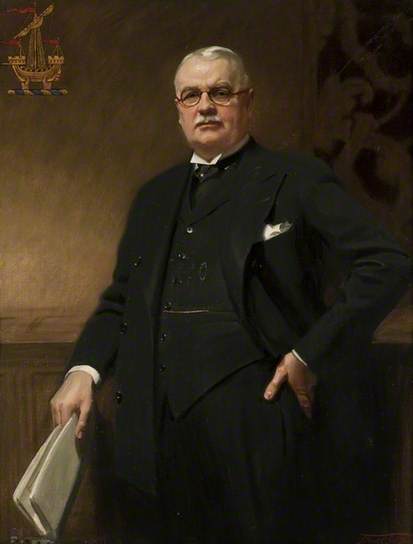
Frank O. Salisbury, C.V.O., LL.D., R.P., R.I. (1874-1962).
Acquisition Number 2310.
© estate of Frank O. Salisbury. All rights reserved, DACS 2024.
Image credit: Glasgow Life Museums/ArtUK
‘The Town Clerk submitted a letter from Lord Inverforth offering to present to the corporation his portrait by Frank O. Salisbury, at present on exhibition in the Kelvingrove Art Galleries, and the committee agreed that the gift be accepted and that a letter of appreciation be sent to the donor.’ 1
Andrew Weir was born on the 24 April 1865 in Glasswork Street, Kirkcaldy. He was the eldest son of William Weir a cork manufacturer and Janet Laing who were married on 2 January 1865.2 According to the census, 3 the family was still at Glasswork Street in 1871 but by 1881 had moved to 269 High Street, Kirkcaldy.4 Andrew, aged 15, having attended Kirkcaldy High School was now an apprentice clerk with the Commercial Bank of Scotland living with his parents, brothers Thomas (13), William (8), David (1) and sisters Jessie (6) and Isabella (4). Thereafter, Andrew moved to Glasgow and worked for a time in a shipping office. Then, in 1885, at the age of twenty, he bought his first ship – the barque Willowbank. On 5 May that year he opened a small office in Hope Street, Glasgow 5 (According to The Bailie it was at 70 Waterloo Street. 6) and used his ship in the coasting trade. The business prospered and within ten years he had built up a fleet of fifty-two ships of modern design and created the firm of Andrew Weir and Co. Shipowners of Glasgow. This firm ‘controlled the largest fleet of sailing ships in the world’ under one owner. 7 It became managing owners of the Bank Line (named after Weir`s first ship), Invertanker, Inver Transport, Trading Company, and several other shipping companies.
On 1 August 1889 Andrew Weir married Tomania Anne Dowie, daughter of Thomas Kay Dowie, a coachbuilder, in her home at 28 Thomson Place, Kirkcaldy. Andrew`s address was 185 Kent Road, Glasgow. His younger brother William was a witness. 8 Two years later, Andrew and Tomania were living at 4 Edelweiss Terrace, Partick, Glasgow with their newborn daughter Anne Forrestdale. With them were Andrew`s siblings, William Weir (19), Jessie B. Weir (16) and Bella B. Weir (14). 9
In 1896 Weir began to modernize his fleet by converting it to steam. His first steamship was launched under the banner of the Bank Line. At the time of the 1901 Census, he was with his family (now four girls and a boy) at Blanefield Mansion, Kirkoswald, Ayrshire. 10 Sometime after this he moved to London and at the 1911 Census his address was 57 Holland Park, Kensington, London. 11
In 1917 Weir was asked to investigate the way in which materials were supplied to the army. Among his recommendations was the appointment of a Surveyor-General of Supply to oversee the task of providing the army with all its stores and equipment other than munitions. His recommendations were accepted, and he was given the job of Surveyor-General with a seat on the Army Council.
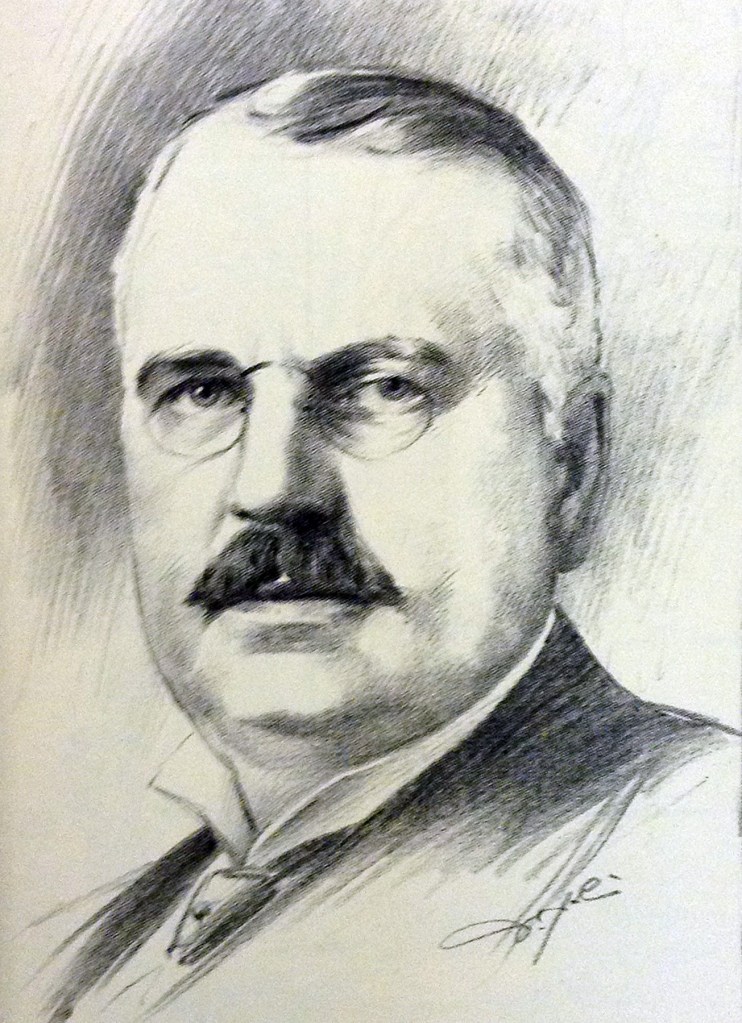
Fig. 2 Andrew Weir in 1917 12
In 1919 he was appointed Minister of Munitions, and he remained in this office until March 1921. His focus now changed to the sale of the vast quantities of army stores which had accumulated during the war. ‘Again, his genius for organization and great business acumen converted what might have been worthless goods or liabilities into considerable assets. It was not without reason that he was termed the man who saved Britain millions.’ For his services he was raised to the peerage as Baron Inverforth, of Southgate on 5February 1919. 13 He was also made a member of the Privy Council and received the American Distinguished Service Medal.
After the war he invested in diesel-powered ships and broadened his business interests. He became chairman of the Marconi Wireless Telegraph Company and president of the Radio Communications Company, the Marconi International Marine Communications Company and Cable and Wireless which was formed by a merger of all the transmission companies. He was chairman of the Anglo-Burma Rice and Wilmer Grain companies and was on the board of Lloyds Bank. He was founder and first chairman of the United Baltic Corporation set up at the instigation of George V to replace German shipping interests in the Baltic.
In 1925, Inverforth bought the 60-room mansion, and eight acres of grounds called The Hill, Hampstead Heath. This property had formerly belonged to Lord Leverhulme. (When Inverforth died in 1955 he bequeathed the house, now known as Inverforth House, to Manor House Hospital. Inverforth House became the women’s section of the hospital and became known as Inverforth House Hospital).14
Andrew Weir and his wife celebrated their golden wedding in 1939, but Lady Inverforth died two years later in 1941. He continued to go to his office four days a week into his ninety-first year. He died at his home in Hampstead on 17 September 1955.15,16 An obituary was published in the Glasgow Herald.17(Appendix 1) His wealth at death was £548,214 1s. 8d.18
‘One thing more remains to be said. Mr. Andrew Weir inherited the moral traditions of Scottish industry. He grew rich, but not ostentatious. His increasing fortune went back and back into trade. He never dreamed either of cutting a figure in plutocratic society or making himself a public character. A quiet, rather shy, and not often articulate person, he lived a frugal life, loving his business because it occupied all his time and satisfied nearly every curiosity of his inquiring mind.’19
‘Inverforth possessed great energy and enthusiasm, and also that almost essential quality of leadership: the ability to select suitable subordinates and leave them to carry on without interference. His integrity, great driving force, and brilliant organizing ability made him a man of power and influence in the commercial world although he shunned the limelight of publicity. His friends and employees, terms frequently synonymous, knew his unobtrusive generosity and kindness. He was particularly approachable: even the most junior employee who had some suggestion towards the improvement or well-being of the firm would be sure of a patient and appreciative hearing and would carry away the remembrance of a kindly twinkle in Inverforth’s eye and a good-humoured quiet voice. In many ways he was a model employer, taking interest in the welfare of his staff and their families both during and after their service with him. For many years, until he was eighty, he was treasurer of the Royal Merchant Navy School and, even after he had handed over this office, he continued to take a deep interest in the children.’ 20
References
- Minutes of Glasgow Corporation, 19th January 1943, page 394, Mitchell Library.
- Scotland`s People, Birth Certificate
- Scotland’s People, 1871 Census
- Scotland’s People, 1881 Census
- Oxford Dictionary of National Biography
- The Bailie, No. 2321, Mitchell Library, Glas
- Begbie, Harold, The Mirrors of Downing Street Chapter XII, G. P. Putnam and Sons, 1921 http://www.readcentral.com/Books/Harold Begbie
- Scotland’s People, Marriage Certificate
- Scotland’s People, Census 1891
- Scotland’s People, Census 1901
- ancestry.co.uk, England Census, 1911
- The Bailie, No. 2321, Mitchell Library, Glasgow
- The London Gazette 7Feb 1919, p 1956
- www.cityoflondon.gov.uk/…/Hampstead-heath-inverforth-house-heritage#
- Wikipedia, en.wikipedia.org/wiki/Andrew_Weir,_1st_Baron_Inverforth
- Glasgow Herald 19 September 1955, page 1
- Glasgow Herald 19 September 1955, page 8. (There were also obituaries published in The Times, Manchester Guardian and The Scotsman)
- probate, 3 Oct 1955, CGPLA Eng. & Wales
- Begbie, Harold, The Mirrors of Downing Street Chapter XII, G. P. Putnam and Sons, 1921 http://www.readcentral.com/Books/Harold Begbie
- Oxford Dictionary of National Biography
Obituary Glasgow Herald 19 September 1955 page 8
The death occurred on Saturday of Lord Inverforth at his home, The Hill, Hampstead Heath, London. He was in his ninety-first year.
Lord Inverforth was one of the greatest shipowners of his time, and his work as Surveyor-General of Supply at the War Office during the First World War and later as Minister of Munitions was of the greatest importance to the nation. He was Andrew Weir and was born in Kirkcaldy in 1865 and educated at Carlyle`s High School. He originally chose banking as a profession but at a very early age his interest turned to shipping.
At the age of 20, having purchased two sailing vessels, he founded the firm of Andrew Weir and Co., with offices in Glasgow. The two ships soon became a fleet, and one of his barques, the Willowbank, gave her name to the Bank Line. In 1896 his first steamship was launched, and this was the beginning of the Bank Line which Andrew Weir and Co. managed.
War Services
During the First World War, Mr. Weir placed his services at the Government`s disposal. In 1917 he was made Surveyor-General of Supply at the War office and a member of the Army Council. Two years later he became Minister of Munitions and remained in that post and a member of the Cabinet until 1921. For his war services he was created a baron in 1919 and made a member of the Privy Council.
On entering the Government he severed his connection with Andrew Weir and Co. and thereafter his business interests lay in wider fields. He became chairman of a number of companies, including the Marconi Wireless Telegraph Company, and when in 1929 the merger of all the transmission companies was arranged Lord Inverforth became the chairman of the new Cable and Wireless, Ltd. and later president and then honorary president. He was also the president of the Andrew Weir Shipping and Trading Company, chairman of the United Baltic Corporation, and the Bank Line. He had been a director of Lloyds Bank and the National Bank of Australasia.
Heir to the Peerage
In 1889 Lord Inverforth married Anne (who died in 1941), younger daughter of Mr Thomas Kay Dowie and they had one son and four daughters. The son, who succeeds to the peerage, is the Hon. Andrew Alexander Morton Weir. He was born in 1897 and is a partner in Andrew Weir and Co. In 1929 he married Iris Beryl, daughter of the late Charles Vincent, 4th battalion, The Buffs, and they have two sons.

 Glasgow Museums Art Donors Group
4 Edelweiss Terrace, is now 37 Partickhill Road
LikeLike
Thank you. Do you have an interest in this donor?
LikeLike
He owned/lived at Arnos Grove House 1918-28; a house now know as Southgate Beaumont Barchester; source: Barchester
LikeLike
Thank you for the information
LikeLike
Thank you for the information.
LikeLike