The subject of the painting is Mrs Ellen Watson (c1820-1902), our donor’s paternal grandmother. Painted by Sir James Guthrie c1898 it has been exhibited on several occasions including at the RSA in 1901, The Franco -British Exhibition in 1908, Links House Scottish Art Promotion in Glasgow in 1966 and the Arts Council’s London and Empire Tour ‘Decade 1890-1900’ in 1967.1 The painting was in the possession of the sitter’s son George Lennox Watson(see below) until his death in 1904 and was then passed down the family until it was gifted to Glasgow Museums by the sitter’s granddaughter Mrs Ellen Marjorie Grenside or Watson in 1952.2
Ellen Marjorie Watson (1904-1963)
Ellen Marjorie Watson(known as Madge) was born at 9 Highbury Terrace Dowanhill Glasgow on 29 April 1904. Her father was George Lennox Watson (GLW)and her mother was Marie (or Mary) Alice Lovibond .3 By the time of our donor’s birth her father was well established as a yacht designer of great repute.4
GLW was born on 30 October 1851 in Regent Street Glasgow. His father was Thomas Lennox Watson, a doctor at Glasgow Royal Infirmary, and his mother, the subject of our portrait, was Ellen Burstall ,5 daughter of engineer Thomas Burstall who was involved in the Rainhill Locomotive Trials in 1828/9.6 As a boy GLW spent holidays at Inverkip on the River Clyde where he is believed to have developed a passion for yachts and at the age of sixteen became an apprentice draughtsman at the shipyard of Robert Napier andSons in Glasgow. During this training period GLW was involved in the use of hydrodynamics in yacht design. He went on to gain more experience with Aand J Inglis Shipbuilders . In 1873 at the age of twenty two he founded the world’s first dedicated yacht design office-G Watson & Company. He had early success with racing yachts such as Verve, Clothildeand Vril.This brought his name to the fore as the most innovative yacht designer of the time. Though he was personally involved in the building and part ownership of these early yachts he never made a business of yacht building instead concentrating on yacht design. He went on to design over 400 yachts for some of the wealthiest men in the world venturing into steam yachts from 1885. 7
In 1893 GLW designed the Britannia (see Figure 3) for Edward ,Prince of Wales, later Edward VII who was a keen sailor. The yacht was built at the Clyde yard of D& W Henderson. In 1910 the new king George V, also a keen sailor, inherited Britannia and competed with it successfully for the rest of his life .8 GLW designed four yachts for the Americas Cup Race including Shamrock IIfor Sir Thomas Lipton .9
Other famous clients included the Tsar of Russia (Zarnitza),10 F. W.Vanderbilt the American millionaire(Warrior) which was launched by Mrs Marie Watson in February 1904.11 GLW also redesigned Scotiafor the Scottish Antarctic Expedition of 1902-4 .12
In addition to yacht design GLW was also heavily involved with the Royal National Lifeboat Institution (RNLI). He became consulting Naval Architect in 1887 and remained involved with the RNLI for the rest of his life. He developed the Watson- Class Lifeboat which in several variations was operated by the RNLI around the coasts of Britain and Ireland between 1888 and 1991 .13 As we shall see this involvement influenced his daughter throughout her life
Involvement in yacht design and other interests seemed to leave GLW little time for his personal life. He did not marry until he was 52 years old when he married Marie Alice Lovibond in Putney ,London on 10 June 1903. The wedding was described as ‘a gathering of the most fashionable people in society.’ Sir Thomas Lipton, Lord Dunraven and Peter and James Coats of Ferguslie were among many other prominent guests .14 The couple lived at 9 Highbury Terrace, Dowanhill, Glasgow where our donor was born .15 Ellen or Madge as she became known ,was to grow up not knowing her father as he died suddenly on 12 November 1904 of ‘Coronary asthma’. 16
Shortly after her father’s death Madge and her mother moved from Glasgow to Putney Hill, Greater London where they lived at 12 Chartfield Avenue . Marie Watson came from Putney so they possibly moved there to be near her family. According to the 1911 Census the house was also occupied by Madge’s nurse and three servants .17 The Watsons lived at this address until 1922 when they moved to a house called Vril in Holloway Hill, Godalming in Surrey. The house was probably named after one of Madge’s father ‘s first yachts and was previously known as Braemar House until bought by the Watsons .18
There is little information about our donor’s life in the nineteen twenties and early thirties but we do know that she was a talented pianist gaining the Licentiateship of the Royal College of Music in 1927 which qualified her to teach the piano.19 She was also pianist for the Rainbow Band, ‘a small ensemble of the daughters of Godalming families specialising in playing for charity concerts .’20 One example of this was in January 1931 when ,’Miss Madge Watson and the Rainbow Band provided the music for a pantomime The Sins of Cinderella’ which was performed by The Cottage Players at the Church Room in Godalming to raise money for the Church Room Building Fund. 21 Rainbow was also the name of one of Madges fathers yachts.(Wikipedia)22
Madge was said to be involved in numerous social activities including the Godalming Badminton Club and the Hindhead Golf Club. She was also heavily involved with the Godalming branch of the RNLI ,appointed as honorary secretary, in 1929 ,an office she held for 30 years .23
Madge’s mother died on 23 March 1929 leaving her daughter living alone at Vril .24 However at the age of thirty Madge married Philip James Grenside (known as Jimmie) ,an electrical engineer, on 20 January 1934 at the Church of St Peter and St Paul in Godalming.25 We do not know how they met but perhaps through mutual social interests such as sport as Jimmie was also a member of the Godalming Badminton Club and the Hindhead Golf Club.
George Lennox Watson was not forgotten at the wedding as the wedding cake was decorated with a silver cup presented by the RNLI on the occasion of the marriage of Madge’s parents .26
Figure 6 Wedding of Philip James Grenside and Ellen Marjorie Watson
The couple both lived at Vril after the wedding. A son, George, was born in 193527 followed in 1937 by a daughter, Hazel .28 In 1938 they moved to The Mount, Bushbridge Lane, Godalming and this house was renamed Vril .29There in 1940 a third child, Lois, was born. 30 There appear to have been three servants living in the house including Alice Agnew .31
Jimmie was a member of Brooklands Flying Club and in June 1935 acquired a Royal Aero Club Aviators Certificate .32 According to the 1939 Register by 1939 his occupation was that of Assistant Flying Instructor .33 From April 1940 until November 1945 Jimmie was a First officer in the Air Transport Auxiliary which had been established in 1939 for the purpose of delivering aircraft to the Royal Airforce and the Royal Navy as well as other air transport tasks auxiliary to the war effort .34
Madge continued her volunteer work as honorary secretary of the Godalming RNLI. In 1936 she was awarded the RNLI Gold Badge for her work .35 Her work continued during the war. For example in September 1941 she organised a whist drive at the Church Rooms in Godalming which raised £16.36 just one of many fundraising events. Throughout her life she helped raise a total of £7750 for the RNLI. In 1949 she was appointed an Honorary Life Governor. 37
Madge was also involved with the British Red Cross Society, The British and Foreign Bible Society ,The Mission for Seamen and the United Nations. She was a regular church goer attending the Busbridge Parish Church and later of St Johns Church, Farnham .38
Madge was also interested in local history and for many years was Honorary Curator of the Weybridge Museum which had been founded in 1911.39
By the end of the war the Grensides had moved to Ramsden Road, Godalming .One of the former servants ,Alice Agnew, was still living with the family. Again the house was names Vril .40
By 1961 Madge, Jimmie and the three children had moved again to Flat 1, Frith Hill House ,Nightingale Road, Farnham .41 Here Jimmie died on 8 July 1961. His estate on his death was very small 42 compared to that of Madge 43 who died at the Royal Surrey Hospital on 24 August 1963. As was said in the obituary published in the Guilford and Godalming Advertiser,
‘ Mrs Grenside devoted most of her spare time to helping others less fortunate than herself ‘.44
References
1. Glasgow Museums Resource Centre Object File 2949 Grenside Mrs E. M
This painting , a watercolour, gouache on paper ,appears to be a study for a larger work Sowing NewSeed for the Board Of Agriculture and Technical Instruction In Ireland (see below Figure 2))which was described by one newspaper as ,’a baffling but beautiful piece of imaginative painting’ when it was exhibited at The New English Art Club in December 1913. 2 (See Appendix A)
The completed painting is now in the collection of the Mildura Arts Centre in Victoria, Australia. 3
The painting was donated in February 1952. The work appears to have been previously owned by T. & R. Annan Ltd , Photographers and Fine Art Dealers of 518 Sauchiehall Street ,Glasgow. According to a letter dated 21 January 1952 from Thomas Craig Annan, one of the directors of the firm, to Dr Tom Honeyman ,the Director of Glasgow Museums, a ‘visitor’ had approached him wanting to know if Dr Honeyman would be interested in the painting if it was presented to Glasgow Corporation and if it might then be loaned to Glasgow School of Art for the students to study. Apparently some of the instructors at GSA had praised the work and had sent students to the Annan Gallery to study the work. The visitor referred to was probably Gilbert J Innes or his representative as the work was presented by Gilbert to Glasgow Museums the following month. There is no information at this date that the painting was loaned to Glasgow School of Art at any time .4
Figure 2 Sowing New Seed c 1913 by Sir William Newenham Montague Orpen (see Appendix B)
By kind permission of the Mildura Art Centre Collection
Senator RD Elliott Bequest. Presented to the City of Mildura by Mrs Hilda Elliot 1956
Donor. Gilbert James Innes (1888-1971)
1888-1914
Gilbert James Innes was born on 5 April 1888 at 24 Oakfield Terrace ,Hillhead in Glasgow. His father was Gilbert Innes ,a draper and warehouseman, and his mother was Margaret Richmond .5 Gilbert was the eldest of four boys . John Richmond was born in 1891, Frederick in 1892 and Thomas in 1894.6 Frederick had a twin sister Margaret who sadly died of whooping cough when eight weeks old .7 By 1901 the family were living at 27 Hamilton Drive in Partick and employed two servants .8 All the Innes boys attended Glasgow Academy ,a private school for boys near Kelvinbridge in Glasgow’s West End. Gilbert was in the Latin Class and attended the school from 1898 to 1904 when he left aged sixteen .9 Gilbert retained a connection to the school throughout his life. For example he was an Honorary Governor of the Glasgow Academicals War Memorial Trust from 1957 to 1971.10 In 1961 he gave £2000 to the school to provide new laboratory equipment for the school .11
In 1908 Gilbert became a member of the Incorporation of Weavers at Trades House in Glasgow. The Innes family had connections to the weaving industry. His father ,Gilbert was a draper and his grandfather, James Innes, was a calico printer and mill manager .12
The family had moved to 16 Kirklee Road in Hillhead by 1911. This remained the family home for many years . Gilbert was twenty-two years old in 1911 and was employed as a clerk in a shipping agency .13 His employer was probably P Henderson & Company where his uncle, John Innes, had been a partner since 1887. John Innes was managing director of the company from 1884 to 1927.14 John Innes was a knowledgeable and wide collector of art. He was especially known for as a collector of prints. In the 1920s he presented over 170 prints and etchings to Glasgow Art Galleries including works by Albert Durer, Lucas von Leyden , Rembrandt, Whistler ,Cameron and Boner(see figure 3 ). This donation forms a valued part of the ’black and white ‘ section of Glasgow Art Galleries .It may be that this interest influenced his nephew but this is mere speculation.
Christ Before Pilate by Albrecht Durer(1471-1528) Glasgow Museums Resource Centre PR1920.6aq
Head of a Young Girl by David Young Cameron GMRC 1920.6
P Henderson & Company had been founded in Glasgow in 1834 by twenty-five year old Patrick Henderson. The company were ship owners, agents and managers. From about 1854 the company began to transport Scottish emigrants to New Zealand in sailing ships and had the contract for Royal Mail to New Zealand. As there was little cargo to carry back from New Zealand at that time the company ships began calling regularly at Burma for cargo such as teak to take back to Glasgow. So successful was this venture that to increase the supply of much needed capital more investing partners were taken on in 1860 and formed The Albion Shipping Company Ltd which dominated trade with New Zealand and in 1882 pioneered the first refrigerated frozen meat shipment from New Zealand to London using sailing ships as there were no coaling stations en route at that time.
Figure 4 Poster advertising emigration from Glasgow to Otago, New Zealand.
In 1865 the opportunity arose to become involved in the Irrawaddy Flotilla Company which operated a ferry service on the Irrawaddy River in Burma. This company was managed by P. Henderson and Company from Glasgow and by the nineteen twenties operated over 600 ferries on the river .16 The company also started a steamship service between Glasgow, Liverpool and Burma in 1870 which in 1882 need capital for expansion and amalgamated with Shaw Savill and Company becoming Shaw, Savill &Albion Co Ltd. The ships continued to be managed by P Henderson & Company for whom our donor probably worked after leaving school at sixteen .17
1914-1919
Gilbert and his three brothers all served in the army during World War One. Gilbert’s service at the beginning of the war is rather confusing as he appears to have originally enlisted with 9th Battalion Highland Light Infantry as a private but in August 1915 he was transferred to the 8th Battalion Scottish Rifles(The Cameronians) as a 2nd Lieutenant .18 It appears that these two battalions both served at Hamilton Barracks at the beginning of the war and transfers between battalions were quite common 19, especially if a soldier had previous officer training as Gilbert may have done in the Glasgow Academy Officer Training Corps which was attached to the 9th Battalion HLI from 1908.20 Gilbert served in Egypt, Palestine and in France between 1916 and 1918. He was wounded in France in July 1918 by which time he was a captain in the 8th Battalion Scottish Rifles. Lt Colonel J.M. Findlay who was the commanding officer of the 8th Battalion in his book With The Scottish Rifles 1914-1918, writes , ‘Innes ,my adjutant, was badly wounded ‘. This was at a battle in Baigneux which was fought between 28 July and 4 August 1918.21 Gilbert’s brother John was also serving in the 8th Battalion though John may have ended war as a captain in Royal Engineers .22 All the Innes brothers survived the war.
Post War Years
Gilbert was made a partner at P. Henderson and Company in 1920.23 He was principally concerned with the design of ships and later with the passenger side. He played an active part in the world of shipping becoming a member of several organisations connected to shipping. For example he was a member of the management committee and later chairman of The British Corporation Classification Society, later The British Corporation Register of Shipping and Aircraft, before its absorption by Lloyds Register of Shipping. He was elected as a member of the General and Technical Committee of Lloyds Register of Shipping 24 and was an underwriter for Lloyds. 25 He served as honorary treasurer of The Institution of Engineers and Shipbuilders in Scotland 26 and also became chairman of the Clyde Lighthouse Trust .27
At the time of the 1921 census Gilbert was a boarder staying at Ellerslie, a guesthouse in Cove, a popular holiday destination on the Clyde Coast. Also staying the house were two nurses, one of whom was Dorothy S.Prain .28 We do not know if Gilbert and Dorothy already knew each other or if this is when they first met but they were married on July 12 1922 in Dundee .29
Dorothy was born in Longforgan , Perthshire on 29 April 1893. Her father was John Prain ,a farmer at the time of her birth. Her mother was Nellie Boyd Scrymegeour .30 Dorothy attended the High School of Dundee .31 Dorothy’s mother died in 1907 aged only thirty-three 32 and her father married again in 1913.33
There is no information as to Dorothy’s activities during WW1 but she trained to be a nurse at the Western Infirmary in Glasgow and was registered as a nurse in 1919 so presumably she was undergoing nursing training during the war . 34 Perhaps Dorothy and Gilbert met in the hospital while Gilbert was recuperating from his wounds.
According to the tradition at that time Dorothy would have given up her nursing career on marriage. The couple lived at 8 Queensburgh Gardens in Hillhead Glasgow after their marriage and on July 15 1928 a daughter Doreen Prain Innes was born. Doreen was born at a private nursing home at 1 Claremont Terrace in Glasgow. 35 There were several nursing homes in Claremont Terrace at that time. 1 Claremont Terrace was run by Henrietta Gunn who was an experienced nurse and midwife. 36
During the nineteen twenties Gilbert travelled abroad several times and spent time in Burma possibly because of P. Henderson &Company’s connection with the Irrawaddy Flotilla Company. In March 1928 he and his uncle John Innes travelled to Rangoon in Burma on the SS Amorapoora and later that year Gilbert and Dorothy travelled to Rangoon on the SS Yoma departing from Liverpool on 26th October 1928.37 Both ships were owned by the Henderson Line. Whether daughter Doreen travelled with them is unknown as she would have been only three months old at the time.
At the end of the decade the Innes family moved to Killearn in Stirlingshire where they built a house called Gartaneaglais .38 The house was designed by a naval architect called Gardener and the garden by J B Wilson. 39
Gilbert continued to be involved in the shipping industry after the move to Killearn both as a partner in Patrick Henderson Ltd and in various shipping concerns as well as being an underwriter for Lloyds. One example in 1953 was his bid to became a major shareholder in the Liverpool Steamship Company. 40
Our donor appears to have had an interest in charitable activities throughout his life. In 1930 he was elected a member of the Incorporated Glasgow and Stirlingshire and Sons of the Rock Society an organisation founded to help those in need. The annual dinner was held at the Golden Lion Hotel in Stirling. 41
He was also a founding member of The Killearn Trust which was founded in July 1932 for the ‘promotion and advancement of the welfare and interests of the Parish of Killearn.’ Gilbert is quoted as ‘the moving spirit’ of the Trust and remained its chairman until his death in 1971.42 The activities of the Trust are too numerous to mention here but one of the main activities was to provide housing for those in need in the community. 43
Gilbert was, like his Uncle John, a collector of art including the Scottish Impressionists. He gave several paintings from his collection to The Glasgow Academy. 44 He was listed as a member of the council of the Royal Glasgow Institute of Fine Arts when it met at the Glasgow Art Club in March 1937.45 Gilbert was also a keen photographer. Several local photographs taken by Gilbert were included in the second edition of a book about Killearn The Parish of Killearn. 46 As we have seen Gilbert also took an interest in Glasgow School of Art (GSA). He was a member of GSA Board of Governors from 1935 and Vice Chairman from 1941 to 1967. From 1936 to 1949 he was Convenor of the School and Staff Committee and Honorary Vice President from 1967 to 1972.47
Dorothy Innes also played a part in community activities .To support the war effort during WW2 for example on 2 November 1939 she presided over a meeting of the Killearn Red Cross Society. 48 In May 1942 Mr and Mrs Innes invited local people to visit the gardens at Gartaneaglais to view the great show of daffodils, narcissi and flowering shrubs and to give donations to the Women’s Royal Institute (WRI) Comforts Fund for HM Forces. 49 In June 1944 on behalf of the Dumgoyne WRI Mrs Innes granted the use of her kitchen at Gartaneaglais for the canning of fruit. 50 In December 1945 an advertisement appeared in the Stirling Observer for a Christmas Sale of toys and fancy goods at Gartaneaglais in aid of the Thanksgiving Fund. 51 These are only a few of many such events.
Participation business and the local community is a constant theme in our donor’s life. He was a member of the Glasgow Chamber of Commerce and was Convener of the Postal, Telephone and Telegraph Committee in the 1940s. 21 He was a member of the Glasgow Western Hospital Board of Management. When a new medical rehabilitation and geriatric hospital opened at Killearn Hospital in 1957 Gilbert stated, ’Western Hospitals Group, since the inception of the NHS, had been very much in need of the facilities now provided in Killearn’. 53
Gilbert was also involved in business and commercial education. At some point he became vice-chairman of the Board of Governors of the Glasgow and West of Scotland Commercial College Ltd 54 which had been founded in 1915 and which moved to a new building at 173 Pitt Street in Glasgow in 1934. Among its courses the college offered qualifications in business and commerce, librarianship and secretarial studies and ran the Scottish Hotel School which was based at Ross Hall in Crookston in Glasgow. In 1955 this college became The Scottish College of Commerce. In 1964 the college joined with the Royal College of Science and Technology in George Street, Glasgow to form the new Strathclyde University. In 1975 173 Pitt Street became the headquarters of Strathclyde Police. 55
There is little further information regarding the Innes family other than they often spent holidays in Iona for which they had great affection. 56
Daughter Doreen attended St Andrews University and in 1950 graduated with a BSc in Mathematics and Astronomy 57 going on to earn an Honours BSc in 1952.58 She married William Thomas Foster in 1956.59
It is to be assumed that Gilbert continued his involvement in the various activities described above as his contribution to the community and the business world was recognised in the Queen’s Birthday Honours in 1963 when he was awarded an OBE in June specifically for his services as chairman of the Glasgow War Pensions Committee. 60 Gilbert had been involved in this organisation since at least 1937 when he was vice-chairman. 61
Dorothy Innes died, aged 74 on November 1 1967 of bronchopneumonia while staying in Perth possibly with a cousin A. M Prain who witnessed the death certificate. 62
Gilbert died on 2 November 1971 aged eighty-three at Cannisburn Hospital Bearsden of ,’peripheral vascular failure’ and artherosclerosis’. 63
Our study is of the naked female on the left of the full painting. The inspiration for the completed painting was reported to be a reaction to Orpen’s anger that at that time in Ireland government grants for art and education
came from Whitehall under the direction of the Irish Board of Agriculture. Orpen was horrified by this situation which he thought was bizarre and furious that agriculture received far more funding than art. His painting is thought to mock the attitudes of the government using allegorical figures. The nude female(our study) represented the sowing of new ,more progressive ideas while the naked children appear as the offspring of this intellectual enlightenment. The peasant couple on the right and the ramshackle farmhouse with the pig-pen to the left signified the Board of Agriculture’s awkward attitude towards art and culture.
Appendix B The Artist
William Newenham Montague Orpen (1878-1932)
William Orpen was born in Stillorgan ,County Dublin and studied at the Dublin Metropolitan School of Fine Art for six years from the age of thirteen. He won every major prize including the British Isles Gold Medal for life drawing. He then moved to London and studied at the Slade School from 1897 to 1899. He had a private teaching studio in Chelsea along with Augustus John ,a fellow Slade graduate. He split his time between Dublin and London and built a lucrative reputation painting society portraits as well as group portraits known as ‘conversation pieces’ for example The Café Royal in London (1912).During WW1 he was a war artist based mainly in Amiens, travelling to the Somme in April 1917. He painted portraits of Douglas Haig and Sir Hugh Trenchard, commander of the Royal flying Corps. He continued to be successful after the war exhibiting at the New English Art Club and The Royal Academy .4 Orpen also had connections to Glasgow School of Art. During the 1914 to 1915 academic year Orpen was an assessor for diplomas, scholarships and bursaries (Drawing and Painting) and one of the judges for the Haldane Travelling Scholarships.
Acknowledgements
I would like to offer many thanks to the following people for their help in the research for this report:
Jillian Peterson of the Mildura Arts Centre ,Victoria, Australia
Fiona Glass ,a member of the Innes family and editor of the 3rd edition of The Parish of Killearn.
Our donor was born Edith Mary Adam on 20 January 1870 at 6 Oakley Terrace, Dennistoun ,Glasgow .2 Her father was John Adam whose family owned a bleachworks, William Adam & Son of which John was a partner .3 Her mother was Elizabeth Jane Cochrane .4 According to the 1871 Census Edith lived at at 8 Oakley Terrace with her parents and the following siblings:- John aged seventeen, Catherine aged fifteen, Charles aged ten and Eliza aged eight. There were also at least four servants living in the house .5
Oakley Terrace was part of a model middle- class suburb planned from the 1850s by Alexander Dennistoun, from a wealthy Glasgow merchant family . Up to that time this area to the east of Glasgow consisted of country estates such as Craigpark ,Whitehill and Meadowpark which were owned by wealthy Glasgow businessmen(see below Figure 2).
Alexander’s father James had bought the Golfhill Estate in 1814 and built Golfhill House, the home of Alexander Dennistoun. Architect James Salmon was engaged to design the feuing and planning of the suburb after Alexander Dennistoun had purchased the above estates in the 1850s, an area of around 200 acres. However the plan was eventually modified and only Oakley Terrace, Westercraig Street and Clayton Place were built as after the 1870s there was competition from the expanding building for wealthier Glaswegians to the west and south of the city. Also, with builders were requesting more profitable feus to build tenements in the Dennistoun area to house lower middle- class and working class families often from Ireland, Italy and Eastern Europe. This put an end to the original plan for a model suburb for the wealthier middle class merchants in Dennistoun .6
Edith’s father’s occupation was that of master bleacher of the firm WilliamAdam and Son of Milnbank which was a bleaching and dyeing company located at 399-400 Townmill Road Glasgow situated between the Monkland Canal and the Molindinar Burn and employing over 300 workers 7 The bleachworks were situated east of Alexander Park in Dennistoun(see below Figure 4). The earliest reference to the Milnbank bleachworks was in the Glasgow Post Office Directory of 1828-9.
The following year, 1872, the Adam children lost both their parents. Eliza Adam died at 6 Oakley Terrace on 2 March 1872 of congestion of the brain and lungs .8 Edith’s father John also appears to have had health problems as he died on 13 December 1872 while ‘visiting Bournemouth for his health’.9
Edith was only two years old at the time of her parent’s death. It appears she and her elder sister Eliza went to live with her father’s elder brother William and his wife Helen. From about 1875 William Adam and his wife lived at 5 Windsor Terrace West in Glasgow’s West End .10 Edith, now aged eleven , was with her Uncle William and Aunt Helen at the time of the 1881 census ,visiting a Mrs Agnes Arthur at Cove , Kilcreggan in Dunbartonshire .11 She was at 5, Windsor Terrace, aged 21, with her Aunt Helen at the time of the 1891 Census with no indication that she was merely a visitor .12 She was married from that address in 190013 so we may presume that her Uncle William and his wife became substitute parents. It would also explain why Edith donated the painting Crummock Water by Samuel Bough in memory of her Uncle William .14 When Edith’s sister Eliza married in 1886 her address on the marriage certificate was also 5 Windsor Terrace .15
William Adam was also a partner in the family bleaching and finishing business. Helen Adam or Walker was his second wife ,his first wife Frances having died in 1869.16 Helen was Frances Walker’s younger sister .17 At this point no record of the second marriage has been found but according to William’s will Helen was certainly his wife .18
Uncle William died age sixty-seven on 24 September 1894 at 5 Windsor Terrace of ‘general debility’ so did not see his niece Edith marry .19 Edith married John Willison Anderson, an East India merchant, on November 7 1900 . John was twenty-seven and Edith was thirty .20
The Anderson family were cotton manufacturers in Glasgow so both families were involved in the cotton textile business which may be how the couple met. The business began in 1822 as Anderson & Lawrie, cotton manufacturers .21 It was taken over in 1839 by brothers David and John Anderson who was John W. Anderson’s grandfather .22 They built the Atlantic Mills in Bridgeton in 1864 which was a major employer in Bridgeton with 700 looms. The company concentrated on high quality fabrics with short production runs. Their shirt fabrics in particular earned a strong reputation at the top end of the market. D &J Anderson expanded in the early twentieth century becoming a limited company in 1911. In 1959 the company was absorbed into the House of Fraser .23
John Anderson, our donor’s husband, worked for Steel Brothers Co. Ltd, Burma24 which had originally been W S Steel & Co founded in Burma by Glasgow merchant William Strang Steel(1832-1911) in 1870. After moving to London in 1873 the founder was joined by his brother James Alison Steel as Steel Brothers Co. Ltd. The company traded in rice from 1871, in the export of teak from the 1890s and in 1906 became involved in the Indo -Burma OilCompany of which they eventually took control .25
Edith and John were married at St Georges Church in Buchanan Street Glasgow which was popular with wealthy Glaswegians .26 Only ten days after the wedding Edith and John boarded the SS Derbyshire in Liverpool bound for Marseilles and from there to Rangoon (now Yangon ), in Burma ( now Myanmar) where they appear to have spent the next ten years or so .27 Both their children were born in Rangoon: Hilda Constance Willison on 12 August 190528 and Freda Campbell Willison on 19 November 1910 .29 Neither Edith nor her husband appear in either the 1901 or the 1911 UK Census so it would appear they were living in Burma during this period.
The couple returned to Britain for a visit in 190330 and Edith and daughter Hilda came back in 1910. Mother and daughter sailed on the SS Derbyshire arriving in London on March 24th 1910 via Port Said and Marseilles .31 This journey may have been made for the purpose of bringing five year old Hilda to live in England as she appeared in the 1911 census living with her mother’s elder sister Elizabeth and her family in Willsden , Middlesex .32 Elizabeth had married Archibald E. Scott, a civil engineer, in 1886.33 Perhaps the climate in Burma did not suit such a young child. Edith herself certainly returned to Rangoon because as we have seen her second daughter Freda was born there on 19 November 1910.
By 1918 the Andersons had returned to Britain though the exact date of their return is not known. In 1918 they were living in a house called Greystones ,St Georges Hill, Weybridge. 34 St Georges Hill was a luxurious ,gated estate some 19 miles from London and had been developed by builder Walter George Tarrant . Tarrant had begun as a carpenter but in 1895 set up the building firm of W. G Tarrant Ltd. In 1911 he bought 964 acres of Surrey scrubland from the Edgertons, the family of the Earl of Ellesmere, on which he planned to build homes for wealthy London businessmen, the estate being near to Weybridge Railway station thus within easy commuting distance of London. No house was to be built on less than one acre of land and most had grounds of up to 10 acres. St Georges Hill was to contain not only a championship golf course which was laid out in 1912 but also tennis courts, croquet lawns, bowling greens , a swimming pool and an archery range. Such was the prestige attached to the development that the SurreyAdvertiser issued a special supplement in 1912 describing all the features of St Georges Hill in glowing terms. Each plot was to be sold freehold to individuals and several different architects were contracted so most houses were custom- designed, many being very large mansions .35 Greystones was built in 1913 to a design by architect Theophilus A. Allen . There is no information to date when the Andersons bought the house. The original name was Blythewood but the name was changed to Greystones in May 1914 so one could speculate that that is when the Andersons bought it. There is no image available of the house at this time but it was,’ three storeys high, classical style, buff roughcast ,red pantiles ….stone surround to front door.’ 36
There is little information about the life the Andersons led at Greystones .They employed several servants so one can presume they were affluent. There are references in local newspapers to a Mrs Anderson and a Miss Anderson taking part in tennis tournaments but we do not know if these referred to our donor and her daughters .37 There is also some evidence that a Miss H. Anderson(Hilda perhaps?) was involved in the Oatlands and Weybridge Girl Guide Association during the nineteen thirties.38
During World War Two both daughters served in the Voluntary Aid Detachment 39, a voluntary unit of civilians who provided nursing care for military personnel both in Britain and abroad .40 According to the 1939 Register Hilda was Acting Commandant of presumably a local VAD unit 41 while Freda served abroad where she probably met Major Edwin Archer of the Royal Army Service Corps. Major Archer was Scottish and was born in Morningside 42, Edinburgh in 1914 .They were married in Colombo, Ceylon(now Sri Lanka) on 17 May 1944. Eldest daughter Hilda did not marry .43 There is no further information at this point regarding John, Edith or Hilda Anderson during World War Two.
John And Edith remained at Greystones along with Hilda until their death. John died on 22 October 194544 and Edith died on 27 October 1952.45
St Georges Hill remains an exclusive gated community today where houses sell for millions of pounds. In recent decades it has been home to celebrities such as John Lennon, Ringo Starr, Cliff Richard and Elton John .46
The William Graham Collection consists of approximately 3000 glass negatives, 450 lantern slides bought and donated by Thomas Holt Hutchison in 1916 and originally one and now two volumes of prints 180 of which were bought by purchase in 19121 and others donated later by Mrs Graham and it is thought by other members of the Graham family. 2 The collection is a unique photographic record of different areas of Scotland especially of Glasgow and the includes many buildings which have long been demolished, eminent Glasgow men of the time as well as slums and old stone carvings and photographs of ordinary citizens .3
William Graham was born in Glasgow on February 8 1845 .4 His father, William, was a ‘railway servant’ 5 and his mother was Elizabeth Hamilton. 6 The family home was Little Hamilton Street (Figure 1) off George Square between Frederick Street and John Street.
He was educated at St Paul’s Parish School in Stirling Street (Figure 1) off the High Street and later at St Andrew’s Parish School in Greendyke Street.
His first job as a young boy was that of carter’s boy employed by J&P Cameron. William changed occupations several times and was variously a printer working for a well-known Glasgow Printers Bell and Bain, a cooper with Mathers Wine Merchant in Queen Street, a fireman with the Edinburgh to Glasgow Railway and an engine driver with the North British Railway Company (see Figure 2). 7
There is also some evidence that somewhere along the line he was also an ‘iron turner’ possibly around the 1870s.8
William was first married to Mary Morton possibly in 1868 9 with whom he had at two children, Elizabeth, who was born at 16 Colgrain Terrace in Springburn in 186910 and William who was born in 1871.11 Eight days after young William’s birth his mother died of puerperal fever. 12 In 1873 William remarried. His second wife was Catherine Wilson and it is on the marriage certificate that the occupation ‘iron turner’ is recorded. Catherine was a domestic servant at the time of her marriage which appears to have taken place at 131 New City Road in Glasgow, the location of her father’s grocery business. 13
According to the 1881 census William, Catherine and twelve year old Elizabeth were living at 29 Portland Street. This was probably during William’s time with Mathers Wine Merchants .14 There is no mention of son William so perhaps he did not survive long after his mother’s death. By the time of the 1891 census Catherine and William were living at 4 Colgrain Terrace in Springburn and William’s occupation was that of ‘engine driver’ with the North British Railway Company. 15 After a series of strikes in 1890-1891 William was sacked from his job and went into business as a photographer ,having been an enthusiastic amateur for many years. He set up a studio in Vulcan street in Springburn. 16 The couple had moved to 468 Springburn Road by the time of the 1901 census in which William’s occupation was described as ‘photographic artist’ and which remained the family home.
William was a friend of another amateur photographer ,Duncan Brown ,who had acquired a reputation for his work in the 1850s and 1860s 17(see Fig 2).
William was a freemason and a founding member of the Old Glasgow Club which was founded in 1900 and which met in the Trades Hall in Glassford Street. 18 The aim of the club was to inform members of Glasgow’s history, architecture etc in the form of papers presented by members and guests. William contributed himself. For example on 21 February 1910 he gave a talk illustrated with his photographs entitled ‘Inscribed Sculptured Stones in and around Glasgow with Lime-Light Illustrations.’ 19 He had friends in Glasgow’s artistic community for example watercolourist William Young RSW (1845-1916). They often went for walks together and Graham took photographs while Young painted. The photograph of William Graham (Figure 3 below) was taken on a walking trip in September 1909 to the Peel of Drumry near Drumchapel. 20
In 1914 in a letter to the Club Secretary William suggested the Club might acquire ‘certain photographs taken by him of Old Glasgow Buildings and other items of interest…’.However William had died before this offer could be discussed. Whether ‘acquire’ meant purchase is unknown. 21
There is little information as to how financially successful was William’s business . His talents as a photographer certainly did not go unnoticed by the press . The Weekly Herald reported in February 1913, ‘Mr William Graham, photographer,…is well known in the city…his pictorial stories have been frequently called on to supply material for illustrated lectures and they are always available for the newspaper press of the city’. 22 We know he had financial dealings dealings with George Outram & Co, owners of the Glasgow Herald, as he took a photograph of a cheque from Outram’s for photographs he had taken of the 1911 Glasgow International Exhibition. 23 There is little information about William or Catherine and their day- to- day life but William Graham will always be remembered for his hundreds of photographic prints and plates which form the William Graham Collection .
William Graham died at the age of 69 on July 22 1914 at his home in Springburn of arterial sclerosis. 24 Catherine lived until 1921 and died at the family home at 468 Springburn Road. On her death certificate it is stated that Catherine was the widow of ‘William Graham iron turner’ with no mention of her husband’s photographic career or his railway years. 25
The Hutchison family came from Perthshire. Our donor’s great-grandfather Thomas Holt(1760-1855) was a tailor who in 1784 married Betty Miller, daughter of a mason. 26 Among their children was Joseph (1790-1854) who by 1835 was running a ‘comb warehouse ‘ at 36 High Street in Glasgow. 27 This business had expanded into that of ,’comb manufacturer, jeweller, hardware merchant and importer of foreign goods, wholesale’ by 1841. and was at 25 St Andrews Street near St Andrews Square. 28
By 1851 Joseph was living at 35 St Andrews Square with his wife Elizabeth ,formerly McIntyre,(1790-1865) and four children of whom John was born in 1822, and our donor’s father Peter in 1834. Joseph is described in the 1851 census as a merchant who employed 23 men. 29
Thomas Holt Hutchison (THH) (1861-1918)
Early Life and Education
Our donor was born on 19 February 1861 at 211 Sauchiehall Street, Glasgow the home of his parents Peter Hutchison and Marion Paterson Hutchison(or Holt).30Thomas was the eldest of five surviving children. Elizabeth was born around 1863, Joseph around 1865, Jeanette around 1867 and Marion around1870.31 By 1865 the family home was 15 Charing Cross which was off Sauchiehall Street at the junction of Woodside Crescent and Sauchiehall Street but which today has been replaced by the M8 motorway complex. 32
The family had moved to Berkley Street by the time of the 1871 census in which THH was reported to be ‘a scholar’ .33
His obituary states that THH had his early education at the old Albany Academy and then at Glasgow Academy. 34 Albany Academy, a private school for boys, was opened around 1871 at 328 Sauchiehall Street 35 and then in 1876 moved to 44 West Cumberland Street( later changed to Ashley Street) off Woodlands Road to a new school building designed by architects H&D Barclay which was described as ‘More like a city mansion than a school.’36 Hence the reference to the ‘old Albany Academy’. The building still stands today and is a Community Volunteer Centre. The headmaster was James N. McRaith, formerly an assistant teacher of English at Glasgow Academy (see below).37
THH was enrolled at Glasgow Academy in Elmbank Crescent, aged twelve ,for the 1873-4 academic year in Class 4L so he probably attended Albany Academy before it was moved. 38 Glasgow Academy was a private school founded in 1845 by, ‘a number of gentlemen connected with the Free Church’ one of whom was the Reverend Robert Buchanan .39 The building was designed by Charles Wilson and situated in Elmbank Street off Sauchiehall Street.40 These premises were opened in 1847 but the school was moved to Kelvinbridge in 1878 after the Elmbank premises were sold to the Glasgow School Board. During our donor’s time at Glasgow Academy the rector was Donald Morrison MA LLD who was rector from 1861 to 1899. Although originally a boys only school it is now co-educational. 41 THH remained at Glasgow Academy for three academic years while the family were living in nearby Berkley Street and left in 1896 at the age of fifteen. 42
After leaving school THH travelled and studied in France and Greece before entering the family ship- owning business of J&P Hutchison. 43 The family had moved to 3 Lilybank Terrace in Hillhead by 1881 and this remained the Glasgow home of THH’s parents and where THH lived until his marriage and where his mother Marion died in 1888.44
Like many young men of the time THH joined one of the many volunteer companies which were founded after 1859 at the end of the Crimean War when the British Government became concerned about home defence at times when most of the regular army was abroad fighting various wars.4 5 These volunteer companies underwent several amalgamations and name changes in the late nineteenth and early twentieth centuries according to the various government initiatives of the time. We do know that THH joined the 19th Lanarkshire Corps as a 2nd Lieutenant in 1879,46 was promoted to Captain in the renamed 5th Lanarkshire Regiment(2nd Northern Company) in 188247 resigned his commission in 188448 only to be made Captain again in April 1885.49 This regiment eventually became the 5th(City of Glasgow) Battalion the Highland Light Infantry50 in which THH served for eight years.
Business Career
According to the 1881 census THH ,aged 20, was working as a shipping clerk, presumably in the family business of J &P Hutchison. At this time the business was based at 69 Great Clyde Street. 51 J&P Hutchison was founded around 1869 by our donor’s uncle John Hutchison who was joined in the enterprise by his brother Peter, our donor’s father. 52 The company’s ships traded with Ireland ,France and Portugal as well as around the coast of Scotland. 53 When Peter Hutchison died in 1899 the company had majority shareholdings in approximately thirteen ships. 54 THH became sole partner in the company in September 1911.55 In 1919 the company was taken over by The Royal Steam Packet Company and later became part of the Moss Hutchison Line. 56
THH had many other business interests and investments including shares in the Caledonian Railway Company, J&P Coats Ltd, The Lanarkshire Steel Company Co Ltd, The Ailsa Shipbuilding Company of which he was a director and The Galway Granite Quarry and Marble Works Ltd to name but a few. 57 The Hutchison family also owned several tenement properties in Glasgow which were rented out for example several tenements around Dumbarton Road in Partick. 58
Public Service
THH , following his father Peter’s example, served on Glasgow City Council. 59 After many invitations in 1910 THH agreed to stand for and was elected one of the councillors for Park Ward and in 1915 became a Bailie.60 Possibly his most valuable contribution was during his chairmanship of the Libraries Committee where he was instrumental in setting up the Commercial Library, the first such library in Britain outside London which was open to the public. The idea was first suggested in October 1913.61
Figure 10. Thomas Holt Hutchison. The Bailie. Men You Know No 2302 November 29 1916. By permission National Library of Scotland.
The first Commercial Library was to use part of the Stirling’s Library at 21 Miller Street, which had formerly housed the Mitchell Library before it was moved to its current premises in North Street ,Charing Cross. The City Librarian was encouraged to ‘utilise as far as possible furniture, books ,periodicals etc already available in the City Libraries and to add such further books etc and minor fittings as necessary’.62 The City Librarian had visited the London Chamber of Commerce , the Imperial Institute and the Guildhall Library for information and assistance in setting up Glasgow’s Public Commercial Library. 63 A booklet was produced to describe the library and its function. Four thousand copies were printed at a cost of £22.64
The Commercial Library was formally opened by the Lord Provost on 3 November 1916 ,’ with a large and representative attendance of businessmen’.65 The library was intended to serve the needs of local industry and commerce with ‘business directories, telephone directories with world- wide coverage, book stock on company law, economics, insurance, taxation, trade publications, patents and trade -marks for the UK and overseas and newspapers and statistical publications’. 66 One of the councillors paid tribute to Bailie Hutchison’s ‘zeal and energy…in helping to establish and develop this Commercial Library’. 67
There were 15,000 enquirers and visitors in the first few months and it was decided more books and other materials were needed .68 By March 1917 all four thousand copies of the Commercial Library pamphlet had been distributed and the Libraries Committee agreed that a second edition be published. 69 In 1955 the Commercial Library, along with Stirling’s Library, was moved to to the former Royal Bank of Scotland building in Queen Street which had been bought by Glasgow Corporation in 1949 and remained there until its closure in 1983 when its function was transferred to the Mitchell Library. 70 THH was also responsible for the building and opening of Langside Library which was the first in Glasgow to experiment with the open access method and which proved to be such a success that the system was adopted throughout the city, overcoming the prediction in some quarters that the result would be “all sorts of sacrilege, destruction and even theft. 71
THH also took a deep interest in the Glasgow Trades House and in September 1917 was elected Deacon Convenor of the Incorporation of Hammermen. He was treasurer of the Hillhead United Free Church ‘and gave valued service to several philanthropic institutions’.In 1915 he was elected to the Magistrates Bench. 72 He was a well-respected magistrate and councillor and remained on Glasgow Corporation Council until 1918.73
Family and Home Life.
In 1890 THH married Florence Riley at the Church of Scotland in Uddingston. Florence was the daughter of James Riley, general manager of the Steel Company of Scotland whose home was Brooklands Villa in Uddingston.74 The couple began married life at 4 Windsor Quadrant(now Kirklee Quadrant) in Kelvinside where they remained until around 1897-1898.75 The building was a red sandstone tenement block which was built in the later 1890s 76 and rent was £105 per year plus £20 feu duty.77 During this period Florence gave birth to a son, James Riley in 1893 and a daughter Marion, known as Maisie, born in 1895. 78 The Hutchisons moved to 16 Crown Terrace in Dowanhill, around 1898- 1899 where a second son Thomas Holt was born in 1899.79 16 Crown Terrace was one of a row of terraced houses designed by James Thomson and built around 1880 consisting of two floors ,an attic and a basement. 8016 Crown Terrace remained their Glasgow home until the death of THH in 1918.81
The Hutchisons also had a country home. Sometime before June 1910 82 the Hutchison’s had become tenants of Cranley House and Estate near Carstairs, which was rented along with two other shooting estates. One can presume that THH enjoyed shooting, a fashionable pastime among the rich at the time. Cranley was owned by the Monteith family. 83 The Hutchisons appear to have played a full part in the local community with many references in local newspapers to participation in local events such as Mrs Hutchison’s attendance at the Carstairs Horticultural Society Flower Show 84 and THH’s participation in local political meetings such as that to support the prospective Unionist Candidate for South Lanark in November 1912.85
World War One
THH continued his involvement in the Volunteer Movement during WW1 and was a Major commanding the Third Battalion Lanarkshire Volunteers attending such events as a Parade Inspection at Lanark .86 He was also involved in the formation of the Biggar Company of the Third Lanarkshire Volunteers. 87
The Lanarkshire Volunteer Regiment was part of the World War One equivalent of what was to become the Home Guard during World War Two. The Volunteer Movement had been replaced in the Haldane Act of 1908 by the Territorial Movement, with each volunteer regiment being attached to a regiment of the Regular Army. When World War One broke out many of the Territorial Regiments went to fight with the Regular Army leaving the Home Front with little defence. At the outbreak of the war there had been calls from those under or over the age of enlistment or those unable to enlist for other valid reasons to form volunteer battalions to be trained for home defence in case of invasion. These ‘civilian defence companies’ were organised all over the country and were largely self -financing through membership fees. At first their value was not officially recognised by the War Office as it was thought these civil defence companies would deter recruits from enlisting in the regular Army. However it was gradually realised that these men could carry out duties which would free up trained troops. The Central Association of Volunteer Training Corps (VTC) was set up in London to coordinate these civilian defence groups with a similar body in Scotland. There was much public and press pressure to have official recognition of the VTC. 88
The Scottish Volunteer Association (SVA )was formed in the spring of 1915 under the presidency of Lord Roseberry and was officially recognised by the War Office in May 1915. The aim of the SVA was to co-ordinate and supervise the volunteer movement in Scotland. A communication was sent to Lord Provosts, Provosts of all burghs in Scotland and to the Lord Lieutenants of all counties to bring all the volunteer forces within their respective areas in touch with the new organisation. 89
In March 1916 due to the introduction of conscription and much public pressure the dormant 1863 Volunteers Act was reinvigorated and regulations were drawn up by the War Office to organise the Volunteer Training Corps which was to be organised strictly on a county level and administered by the Lord Lieutenant of each county. Recruits had to be 17 with ‘no alien to be enrolled’. Commissions were to be temporary and the VTC were eventually allowed to wear the khaki uniform with a red armband inscribed with the letters ‘G R’. So at last the former civilian defence organisations became volunteer regiments named after the county concerned. The demands upon the services of the VTC grew and they were used for example to guard munitions factories, on the rail network and to bring in the harvest.90
The VTC trained regularly in Drill Halls, took part in many shooting competitions and had to attend summer training camps, for example at Lanark Race Course.91 Some members of the public did make jokes rather unkindly about the VTC referring to the ‘GR’ as meaning ‘Grandpa’s Regiment’ or ‘Government Rejects’. But by July 1918 they were being issued Enfield Rifles and Hotchkiss Mk 1 machine guns by the War Office. 92
Florence Hutchison, along with her daughter Maisie, also contributed to the war effort from Cranley by being one of the founders of the local Red Cross Society. They helped to recruit seventy volunteers who knitted socks and other garments for soldiers. 93 In 1915 they played a role in the National Egg Collection, an appeal for one million eggs ‘for our wounded soldiers and sailors’. The Hamilton Advertiser reported Mrs Hutchison’s thanks to local farmers for contributing 404 eggs which were sent to London. 94 They also entertained convalescing soldiers at Cranley. 95 Maisie became secretary of the Red Cross Society and her work was greatly valued. 96 She married Lieutenant J. E. Glynn Percy at Carstairs Parish Church in March 1918.97
THH’s two sons, James Riley Holt and Thomas Holt also played their part in the war. James Riley Holt obtained a commission in the Lanarkshire Yeomanry at the outbreak of the war and was later attached to the 19th Lancers in France after which he transferred to the 17th Cavalry in India . He also had a distinguished career in World War Two serving with the French Resistance and was awarded the DSO. After the war he became Conservative MP for Glasgow Central and was awarded a baronetcy. 98 The younger son, Thomas Holt, had to wait until March 1918 when, aged 18, he joined the Royal Naval Air Service as a Probationary Flight Officer. 99
The J&P Hutchison shipping fleet also played its part by transporting Red Cross goods and ambulances to France free of freight charges 100 and suffered casualties with at least three ships being lost. The Chloris and the Dartmoor appear to have been lost or badly damaged as compensation was paid by the British Government. 101 The Chloris had been torpedoed off Flamborough Head on 27 July 1918 with the loss of three lives including that of the master.102 The Atalanta, sailing from Galway to Glasgow with a cargo which included coal, timber and scrap iron, was torpedoed off the coast of Connemara on 14 March 1915 but the crew of sixteen who were all from Cushendall in County Antrim managed to escape by lifeboat. 103 The ship ,though taking, water was towed to harbour and the damage later repaired .104
Thomas Holt Hutchison died at Cranley on 22 June 1918 aged fifty -seven of pernicious anaemia 105 so did not live to see the end of the war. The HamiltonAdvertiser reported that his death ,’ was not unexpected ,none the less it was a surprise to the community’. At the beginning of the proceedings of the Northern Police Court in Glasgow just after his death THH was paid a tribute by Bailie John Bryce who referred to his death as ,’a great loss to the city’ 106 THH was buried at the Glasgow Necropolis on 25 July 1918.107
In 1921 Mrs Hutchison and the Hutchison Family presented an organ to Carstairs Parish Church in memory of Thomas Holt Hutchison. 108
Notes and References
1. Glasgow Corporation Minutes 10/12/1912 p. 312
2. William Graham Collection. Mitchell Library Special Collections
Thanks to the following for the help given in the production of this report:-
Staff of the Glasgow City Archives and Special Collections at the Mitchell Library Glasgow, the National Library of Scotland, Glasgow Academy Archives and Glasgow School of Art Archives.
This portrait was donated to Glasgow Art Galleries in 1953 by the Reverend John McClure Brodie. The painting had originally been owned by the Glasgow Blind Asylum in Castle Street and was offered to Glasgow Art Galleries in 1934 when the building was sold to Glasgow Royal Infirmary. However the Galleries Committee rejected the work and it was given to our donor.1
The subject of the portrait was our donor’s great- grandfather .2
John Alston was a cotton manufacturer based at 55 Glassford Street ,Glasgow but lived at Rosemount House on the Rosemount Estate in the area of Glasgow now known as Roystonhill, previously known as Garngad.3 The Rosemount Estate was described as,’ composed of beautiful grounds and orchards.’ The area is now a housing estate but its history is remembered by one of the streets being named Rosemount Street.4
During his life in Glasgow John Alston was a town councillor, a magistrate and Deacon Convenor of the Incorporated Trades and a tireless supporter of many charities. However he is best known for his work for the Glasgow Blind Asylum of which he was a director and honorary treasurer and enthusiastic fund- raiser. He developed a system of reading for the blind using an embossed version of the Roman alphabet arguing that sighted people could then teach the blind to read. Alston Type was used at the School for the Blind in Paris for many years before the adoption of the system invented by Louis Braille. Alston produced the first embossed copy of the New Testament printed on the Asylum printing press. His ambition was that every blind child in the country should be able to read The Word of God. By 1844 almost 14,000 volumes of the whole Bible had been distributed across the country.5
The Glasgow Blind Asylum was founded in 1804 but the first building was erected in Castle Street in 1828 to be replaced in 1881 with a building designed by William Landless. The building was taken over in 1934 by the Glasgow Royal Infirmary as the Out Patients Department. Residents of the Asylum were taught music as well as various trades. Costs were covered by subscriptions, donations, bequests and the sale of articles made in the workshops such as brushes, baskets and bedding made in the various workshops.6
Figure 6. Detail from the musical catechism for the use of the blind.
John McClure Brodie(J McC) was born on 5 September 1874 in Govan.7 He was one of several children born to Robert Brodie8 and Jessie McFarlane McCaul.9According to the 1881 UK Census the family lived at 23 Belhaven Terrace, Partick, Glasgow which remained the family home until Robert Brodie’s death in 1909.10 Robert Brodie was a partner in the firm of McClure,Naismith and Brodie ,Writers to the Signet, and our donor was probably named after John McClure, one of the partners.11 In the 1891 census JMcC was recorded as a scholar and probably attended Kelvinside Academy as not only did his father Robert Brodie hold shares in the company which owned the school12 but John’s brother Malcom certainly attended the school13.By 1901 John McC was a law clerk and scholar, possibly working for his father’s firm though that is not certain.14 He graduated Batchelor of Law from Glasgow University in 1902.15 While attending the University he was a member of the Volunteer Medical Staff Corps. 16
Sometime after graduating J McC appears to have moved to Edinburgh where in 1907 he was a partner in the firm ofGraham ,Miller and Brodie, Writers to the Signet, at 44 Frederick Street17 and lived at 9 Marchmont Street.18 He appears to have moved back to Glasgow by the time of the 1911 Census or perhaps was commuting to Edinburgh. He lived in the family home at 23 Belhaven Terrace in Hillhead along with his mother, brother Thomson who was an accountant and sisters Margaret and Mary both spinsters in their thirties. By this time JMcC was thirty -six years old.19
Our donor’s life changed later in 1911 when he emigrated to New Zealand via Australia where he landed in Melbourne in October 1911 on the SS Anchises.20 We do not know for certain why he went to New Zealand, perhaps the death of his father in 1909 was the catalyst. Also his uncle Malcolm McFarlane McCaul(see Figure 2 above) had emigrated first to Australia sometime after 1862 and then moved to New Zealand sometime before 188121 Perhaps this was the reason for our donor’s choosing New Zealand. JMcC went via Australia perhaps to visit his elder brother, Malcolm who lived there.22
By September 1912 JMcC was living at 12 Lower Symonds Street , Auckland, North Island, where he was enrolled as a solicitor of the Supreme Court of New Zealand on the motion of W.A. Styak23 for whose law firm at Colville Chambers in Auckland he worked for the next few years.24
After the outbreak of WW1 at the age of forty-one JMcC volunteered for the New Zealand Expeditionary Force and became a private in the New Zealand Medical Corps.25 As we have seen while at Glasgow University JMcC had been a member of the Volunteer Medical Staff Corps of the Glasgow University Volunteers. While living in Auckland he had also been a volunteer with the Auckland Highland Company one of many such volunteer companies.26
According to his Military Record JMcC enlisted as a private on 15 December 1915 and was posted for training the following day to the Awapuni Camp near Palmerston, North Island.27 Established in October 1915 this was New Zealand’s only dedicated training camp for medical officers, orderlies, stretcher bearers and medical crew for hospital ships.28 He remained at Awapuni until March 1916 and was then transferred to Featherston Training Camp as a lance corporal and then back to Awapuni from where he was posted to the Hospital Ship Marama on 1 September 1916. Only three days later he was sent back to Awapuni having been demoted to private again, though it appears this may have been a temporary promotion and was ended when he was no longer needed.29 JMcC’s Military Record also states he was posted back to the Marama on 10 November 1916 in time to sail on its second commission on November 12 1916.The ship sailed via Bombay to Suez then proceeded to Southampton where 540 patients were embarked for New Zealand. A few days out from Southampton the Marama rescued survivors from a torpedoed ship.
The ship sailed again for England via Bombay on 17 March 1917 then to Mesapotamia and Suez where orders were received that the Mediterranean was unsafe and all nurses had to disembark. This may have been because in March 1917 the German Government had announced an unrestricted submarine campaign resulting in the sinking of several hospital ships in the English Channel. From Suez the Maramasailed to Durban. The lack of nurses put a great strain on the orderlies ,of which JMcC was probably one, as they had to take over the nursing of the most severely wounded, who were confined to the cots, as well as carrying out their own duties.30 JMcC must have been doing a good job as on 3rd May 1917 he was promoted to the rank of Corporal.31
From Durban they went to Cape Town and Sierra Leone and finally docked in Avonmouth to pick up a full complement of wounded New Zealand soldiers bound for home via the Suez Canal.32 JMcC’s Military Record states that he reported to Awapuni Camp on 10 October 1917 only to rejoin the Marama on 19 October 1918. The purpose of this voyage was to clear the New Zealand Hospitals in England of New Zealand patients and transport them back to various ports in New Zealand as necessary.33 He arrived back at Awapuni on 27 January 1919 and was finally discharged on 6 March 1919.
After discharge JMcC appears to have taken a post as a school teacher in Wallaceville ,Upper Hutt, a city in Wellington Region.(Military record; voting reg).34 According to The Wallaceville School Attendance and Examination Register of February to December 1921 the teacher was certainly a J.M Brodie.35
Then in 1922 JMCc enrolled as a student at Knox College, Dunedin in South Island in order to train to be a minister in the Presbyterian Church.36 There is some evidence of his earlier involvement in the Presbyterian Church in three letters kept in the National Library of Scotland addressed to John McClure Brodie at 23 Belhaven Terrace Glasgow between 1894 and 1896 which refer to his proposed sponsorship of a local person as an agent, possibly a missionary, in another country but unfortunately the content lacks detail .37 JMcC was also a member of the Kirk Session of St Andrews Church, Wellington, presumably while he was living in the area after his war service thus giving us further evidence of his connection to the Presbyterian Church.38
While at Knox College JMcC appears to have made his mark amongst his fellow students as in the student magazine The Knox Collegian No 14 1923 p23 the following ‘poem’ appeared along with others in the same vein regarding other students:-
J.M Brodie is first on left, second row from the back.
By 1925 JMcC was 50 years old and at that point, surprisingly, he married. He married 43- year- old Margaret Graham Findlay from Glasgow who appears to have sailed to New Zealand specifically to marry our donor. Margaret had sailed from Southampton on the SS Corinthic accompanied by one of her sisters, a Miss A Findlay, though we do not know if it was Agnes or Anna, on 27 November 1924.They travelled First Class and were headed for Wellington.40 According to the Intention ToMarry Register dated 10th January 1925 John McClure Brodie, theological student aged fifty had been resident in Wellington for three weeks. On the other hand Margaret Graham Findlay, spinster aged 43, had been resident in Wellington for only two days which suggests she arrived in very early January1925.41The couple were married on 15 January 1925 in the Scots Church, Seatown, Wellington.42
Margaret Graham Findlay was born in Glasgow on 2 January 1882 at 9 Montgomerie Drive, Kelvinside in Glasgow’s West End. Her father was Joseph Findlay(1852-1910),a cotton merchant and her mother was Jessie B Marshal(1852-1927).43 There is little information about Margaret except from census records. In 1891 the family was living at 11 Winton Drive, Kelvinside. There were six children including twin girls Agnes and Anna.44 The 1901 census gives us the same address and Margaret is recorded as being still a scholar even at the age of nineteen though we have no information as to the school.45
There is no mention of Margaret at the family home in Kingsborough Gardens in Hillhead in the 1911 Census, though there is a record of a Margaret Findlay aged 29 who was a patient at a Nursing Home at 4 Queens Crescent in the Park District of Glasgow but it is mere speculation that this is the same person.46 By 1921 she was back living in the family home at 16 Kingsborough Gardens, Hillhead along with her mother Jessie and twin sisters Agnes and Anna 00.47How Margaret and JMcC came to know one another is a complete mystery at this time.
The newly-weds lived in Dunedin at 15 Craigleith Street and attended the First Presbyterian Church in Dunedin48 until 1926 when John McClure Brodie was ordained as the Minister of the Seacliff and Warrington Presbyterian Church, Otago on 29th June for a period of five years.49 Seacliff was a small village on the east coast of the Otago Region of New Zealand’s South Island about twenty miles north of Dunedin. Most early Otago settlers were Presbyterians and the district had been served by Presbyterian ministers or missionaries in one way or another since 1858. The Seacliff Parish was first established around 1916 but there was no church building until 1923. However a manse was built in 1916 on land purchased in Kilgour Street ,Seacliff, intended for both the manse and the church. The first minister was the Reverend F. Tucker. 50Seacliff is best known for the presence of the Seacliff Mental Hospital, opened in 1884 and once the largest building in New Zealand.51
Figure 10.Seacliff Mental Hospital Otago. By permission of TheHocken Collection. University of Otago Library
The foundation stone for the new church was laid in June 1923 by Dr A.C. McKillop, Medical Superintendent of the Seacliff Mental Hospital. The Seacliff Presbyterian Church had an intimate connection with Mental Hospital from its inception and there is a suggestion that it was originally built for the staff of the hospital. Before the building of the church services were often held in the hospital hall as well as in the local school. The various ministers who served the parishioners in the district over the years also ministered to the patients in the hospital. Services were held in the wards and hospital patients also attended services in the Seacliff Presbyterian Church after its opening in 1923 and much of the minister’s time was spent serving the patients in the hospital.52
Figure 11. Seacliff Presbyterian Church , Kilgour Street.
Figure 11. Seacliff Presbyterian Church , Kilgour Street. Photographer J Chisholm. By permission of The Hocken Collection. University of Otago Library.
John and Margaret Brodie appear to have remained living at The Manse in Seacliff until 1929.53
Figure 12. The Manse ,Kilgour Street, Seacliff. Photographer J Chisholm. By permission of The Hocken Collection. University of Otago Library.
In March 1929 after only three years JMcC resigned as minister of Seacliff because of unspecified eye trouble.54 There had been some warning about this in the Kirk session Minutes of 22nd March 1927 when it was reported that, ‘Mr Brodie had had to postpone a communion service for Karitane( a small village about 3 miles north of Seacliff) because of eye trouble.’55 We do not know if this was the reason the Brodies decided to return to Scotland that same year. They travelled Third Class from Brisbane, Australia on the SS Berima, arriving in London on 27 August 1929.56
We do not know if JMcC had treatment for his eye problem but the Brodies did not return to New Zealand. By 1930 JMcC and his wife were living in Glasgow, probably at 18 Bank Street off Great Western Road.57 At some point in 1930 JMcC became Assistant Chaplain to the Reverend James Cardwell at the Glasgow Royal Mental Hospital in Great Western Road. Perhaps his experience ministering to the patients at the Seacliff Mental Hospital had played a part in the appointment. The Reverend Cardwell had been chaplain for 25 years. J McC took over from him sometime before 1940 when Cardwell died.58
Gartnavel Royal Hospital as it is known today originally opened in 1814 as the Glasgow Lunatic Asylum in Parliamentary Road, Cowcaddens. The hospital was awarded a Royal Charter in 1924 and became the Glasgow Royal Lunatic Asylum. It moved to new premises in the Gartnavel district of Glasgow in 1843 designed by architect Charles Wilson in the Tudor Gothic Style. There were two main wings to the hospital. The West House, later West Wing was for private patients and the East House ,later East Wing, for patients who could not afford to pay for their treatment. The hospital became Glasgow Royal Mental Hospital in 1931 then Gartnavel Royal Hospital in 1963. 59
There is little information about our donor’s time at Gartnavel .He did find time to write a History of Gartnavel Mental Hospital1810-1948 though it was never published. 60 The only information we have about JMcC during this period is from a couple of newspaper reports. In 1931 the Scotsman reported that along with others the Reverend J M Brodie had donated £1/1/0 to the New Zealand Earthquake Relief Fund.61 Then in 1940 the JMcC attended the celebration of the founding of Presbyterianism in New Zealand held at the Martyrs Church in Paisley.
‘ In the afternoon the Reverend J M Brodie, formerly a member of the Kirk session of St Andrews Church, Wellington, was the preacher.’62
The Brodies lived at 18 Bank Street during the 1930s 1940s and early 1950s.63 JMcC retired from Gartnavel around 1950.64Then around 1952 or1953 at the age of seventy-nine J McC and Margaret moved to 3 Buckingham Terrace, Great Western Road. Numbers 3 and 4 Buckingham Terrace at that time were the Kirklee Hotel. So perhaps the couple felt life would be easier for them at their age if they lived in a hotel.65
On 9 January 1962 Margaret Brodie was admitted to the West Wing of Gartnavel Royal Hospital.66 This wing was for private patients. J McC joined her on 30th January 1963 aged eighty-eight.67 Margaret died on the 19 November 1963 of ,’myocardial degeneration with arterio sclerosis’68 and the Reverend John McClure Brodie died on 11 April the following year of ‘generalised arterio sclerosis’.69 We do not know if Gartnavel Hospital acted as a care home and took in elderly patients as a matter of course or if the Brodies were taken as patients because JMcC had once worked there. There is no information as to where the couple are buried.
References
1.Glasgow Museums Resource Centre Object File. Accession No 2993
I would like to thank the following people for their invaluable help with the research for this donor: Danielle Ashby Coventry and Alison Metcalfe-National Library of Scotland; Laura Stevens-NHS Archives,Mitchell Library Glasgow; Susan Taylor-Special Collections,Mitchell Library,Glasgow;Matthew-Auckland Military Museum;Nick Austen-Hocken Collection,University of Otago;Hilary Ackroyd-Archives New Zealand;Linda McGregor-National Library of New Zealand;Rachel Hurd and Jane Boore -Presbyterian Research Centre(Archives) Knox College Dunedin.
Robert Brough (1872-1905) was born in Invergordon, Ross-shire and brought up in Aberdeen. He was a student at the Royal Scottish Academy Life School in 1891. He was a close friend of J.D. Peploe with whom he spent a few months in Paris, returning to Aberdeen for three years where he earned his living as a portrait painter. He moved to London in 1897 and became a friend and neighbour of J.S Sergeant who influenced his technique.1 This portrait is of our donor aged about twenty one and was painted before her marriage. Brough died at the age of 33 in a railway accident in Yorkshire in 1905. This portrait of Maud Beatrice Lawrence was one of the exhibits at a memorial exhibition of Brough’s work held at the Burlington Gallery in London in 1907. It was reported in the Scotsman that, ”the pink satin and flowing chiffon of the dress are painted with wonderful cleverness”.2
We do not know why this painting was donated to Glasgow as there does not seem to be any link between Glasgow and Mrs Pollen except perhaps ,as we shall see, Lord Kelvin was a friend and business associate of her father Joseph Lawrence. Maud donated the portrait in 1951 while she was living at Cranleigh Gardens in Kensington. Perhaps she was downsizing? There is some evidence that she offered it first of all to Aberdeen Art Gallery, possibly because Robert Brough came from Aberdeen. It appears that for some reason the offer was declined and the portrait was presented to Glasgow instead but there is no information as to the reasoning behind this.3
Maud Beatrice Pollen (or Lawrence) 1877-1962
Our donor was born on 28 April 1877 at Urmston, Lancashire. She was the only child of Joseph Lawrence (1847-1919) and Margaret Alice Jackson.4 There is little information about her early life but as according to a later comment, “they travelled a lot for some years”5,we can perhaps presume that wherever her father went to work she and her mother went too.
Thus we can say that she probably lived in Urmston until c1878 as her father was deputy secretary to the Manchester, Sheffield and Liverpool Railway Company.6 They then moved to Kingston-upon-Hull when her father went to work for the Hull Dock Company 7 and then briefly for the Hull, Barnsley and West Riding Junction Railway and Dock Company.8 Neither Maud or her parents appear in the 1881 UK Census so they probably accompanied Joseph to South Africa in early 1881 when Joseph went to work for a railway company in the Cape of Good Hope travelling on the Royal Mail packet, SS Balmoral Castle.9
1882 sees the Lawrence family back in Manchester, presumably with Maud and her mother, when Joseph Lawrence began working for the company which supported the construction of the Manchester Ship Canal.10
The only information about Maud in her early years is a report in 1884 of her attendance aged seven at a “Character Ball” for “juveniles” held by M.D Adamson, JP at The Towers, Didsbury. Maud was among fifty children attending and was dressed as “Folly”.11 M. D. Adamson was an old friend and colleague of her father.12 Maud was educated at various private schools including in the USA and Dresden but there are no further details available about travelling to the USA and Dresden except a reference, “ up till 1889 one year in Dresden at a pension.”13
According to the 1891 UK census the Lawrence’s family home was a house called Oaklands, Park Road, Kenley in Surrey. The house was set in two acres of land and had, “three reception rooms,10 bedrooms, bath and dressing rooms, servants hall (or library), excellent cellarage”.14. The 1891 census also states that Joseph Lawrence’s occupation was now that of ‘newspaper proprietor. It is thought that Joseph Lawrence first became involved in the newspaper world during his time working for the Manchester Ship Canal Project when he produced a weekly newspaper The Ship Canal Gazette as part of the campaign to influence public opinion in favour of the Manchester Ship Canal Project.15
Then in the late1880s Joseph Lawrence became involved in the production of a railway staff magazine The Railway Herald16 where he complained that the cost of typesetting ”was draining my purse”.17 Possibly as a result of this experience Joseph Lawrence played a large part in the revolutionising of the printing industry both at home and abroad and which, as we shall see later , indirectly influenced his daughter’s future. On a trip to America Lawrence had come across the Linotype machine which had been invented by a German watchmaker Ottmar Mergenthaler. These machines cut the cost of typesetting by 60% ,thus making newspapers, magazines and books available to a wider public. In 1895 Lawrence set up The Linotype Company in Manchester and then in Broadheath, Altringham to manufacture the typesetting machines which were soon adopted by newspaper and book publishers all over the world.18
The new machines were used by Lawrence when, in July 1897, along with another railway enthusiast Frank Cornwall, he produced the first issue of TheRailway Magazine which was aimed at all railway enthusiasts and which is still in production today.19
As well as being a newspaper proprietor Joseph Lawrence became the Member of Parliament for Monmouth in 1901 and was knighted in 1903 for his services to the printing industry.20
After all the moving from place to place according to where her father’s career took him by the early 1890s the family appear to have settled at Oaklands.
At some point between 1891 and 1895 Maud became a pupil at The Cliff, St John’s Road, Eastbourne which was a private boarding school for girls run by Mrs Emma Powers.21 Mrs Powers was the wife of the Reverend Philip Bennett Powers(1822-1899) a Church of England minister who held several appointments until around 1865 when his health forced him to retire from his post as vicar of Christ Church, Worthing in Sussex.22 By this time there were seven children in the family.23 The Reverend Bennett then took up writing and between 1864 and 1894 produced over one hundred short religious tracts and individual longer tracts.24 The 1881 census tells us that Mrs Powers was the “Principal of a Ladies School” in Ham which was a suburb of Richmond in Surrey. Perhaps Mrs Powers had taken up this profession to supplement the family income, though this is speculation. The school had fifty-four pupils in 1881 ranging in age from thirteen to eighteen.25 By 1892 the Powers had moved to Eastbourne and opened The Cliff in St Johns Road. We do not know exactly when this school was opened as there is no trace of Philip or Emma Powers in the 1891 census . However in 1892 The Gentlewoman magazine reported in an article which gave advice and recommendations of schools entitled, ”Our Children and How to Educate them” which stated that if a reader chose to send a daughter to school in Eastbourne, ”The training, discipline and education she will receive with Mrs Power, The Cliff, St Johns Road is incomparable.”26 Of course this article might well have been merely advertising but at least we know the school was there by 1892.
We do not know exactly when Maud began at The Cliff but she had certainly left by the end of the summer term in 1895 as in the autumn of that year she entered Girton College, Cambridge as a student. At the time of entry her home address was 24,Cranley Gardens London SW7 probably the Lawrence’s London home. She did not sit the entrance examinations known as the Previous Parts 1and 2 which meant she was “allowed” them because of examinations taken while at school.27
In 1858 the first public examinations for schools had been introduced . The Universities of Oxford and Cambridge had been approached by headmasters of many schools to produce these examinations as a way of marking their pupils’ attainment and enabling boys to take the “locals”, as they were known, where they lived. Girls were allowed to take these examinations from 1867. There were two stages, the Junior for under sixteens and the Senior for under eighteens, which would eventually also be allowed for university entrance. From 1860 examiners from Cambridge travelled by train to village and church halls all over the country wearing full academic dress and carrying the examination papers in a locked box. The examinations took place over six or seven days. Most schools made a point of advertising the fact that they prepared pupils for these “locals”. The exemptions had been introduced in 1893 and this is probably how Maud gained her place at Girton.28 Mrs Emma Powers gave a standard character reference to support Maud’s application for entry, though we have no details of this.29
Maud appears to have studied languages . German was available for study from 1886 and in 1896 Maud studied for and passed what were known as Additional Papers in German. In her first year these papers covered translation into English from selected books and questions on grammar. According to the Girton College Archives in her second year 1896-1897 Maud would have moved on to what was known as Tripos study30, perhaps in MML(Medieval and Modern Languages) ,”as she was clearly good at languages”. However there is no record of which Tripos she was studying. Maud did not complete three years at Girton but left in the Easter term of 1897 for what the College noted were ”family reasons” but with no further information.31
The next we hear of Maud is the announcement of her engagement to Arthur Hungerford Pollen in April 1898 .Perhaps this was Maud’s reason for leaving Girton. Her address at the time was given as Oaklands, Kenley, the family home. 32 To celebrate her engagement and her coming of age as well as their silver wedding anniversary Maud’s parents held a reception at Oaklands. The famous contralto Clara Butt performed at the event along with Whitney Mockridge, a Canadian tenor and the Royal Welsh Ladies Choir.33
Arthur Hungerford Pollen (1866-1937) was the sixth son of a family of eight children born to John Hungerford Pollen and his wife Maria. Arthur’s grandfather was Sir Richard Hungerford Pollen(1786-1838), third Baronet of Redenham in Hampshire.34 In 1852 Arthur’s father had been one of the prominent converts to Catholicism influenced by his friend and former fellow student John Henry Newman later Cardinal Newman. John H Pollen was an Anglican clergyman by training but gave up holy orders in 1852 on his conversion to Catholicism and turned to art and architecture in which career he was greatly assisted by Cardinal Newman.35
Arthur Hungerford Pollen was born in London on 13 September 1866. He attended Birmingham Oratory School which had been founded by Cardinal Newman in 1859.36 Arthur then went to Trinity College, Oxford where he graduated with a BA Honours in History. He became a barrister-at-law at Lincolns Inn in 1893.In 1895 he stood as Liberal candidate for Walthamstow but was never elected.37Arthur’s interests appear to have gone beyond the law and politics as he was at the time of his engagement also the Saturday reviewer and art critic of the Westminster Gazette and ”late acting editor of the Daily Mail”.38
Arthur’s leisure interests before his marriage were those of the rich such as racing, polo and hunting both at home and abroad. In 1893 while hunting big game in the Canadian Rockies he and his party were lost for two weeks and had to resort to shooting and eating some of their horses. The party was led by Lord Henry Somerset, son of Lady Henry Somerset ,”England’s famous apostle of temperance”.39 There is evidence that Arthur was also a supporter of temperance.40 In September 1897 we find Arthur hunting deer in the Highlands on the Lochrosque Estate of Arthur Bignold, owner of the Norwich Union Fire Insurance Company, and attending balls associated with The Northern Meetings in Inverness.41 The year before Francis Pollen, a brother of Arthur, also attended the hunting at Lochrosque so perhaps the Bignolds were family friends.42 Maud appears to have become engaged to a man with as much energy and as many interests as her father.
According to the Western Mail Arthur was also managing director of the Linotype Company of which Maud’s father was chairman.43 There is no information at this point which states how he came to be appointed though at the AGM of the Linotype Company in March 1898 Joseph Lawrence had suggested to the Board ,”that someone from the newspaper trade should be added to the Board who could give them more advice and assistance.”44 Whether Arthur was appointed as managing director of Linotype through his being the prospective son-in-law of Joseph Lawrence or whether he met Maud after that appointment we do not know but the consensus of opinion is that he proved himself to be a shrewd businessman and intelligent technical innovator.45
One example of Arthur’s talents and initiative and which confirmed that he was involved in the management of the Linotype Company before his marriage was demonstrated at what was thought at the time to be the biggest society event of 1898 . This was The Press Bazaar held on 28th and 29th June 1898 at the Cecil Hotel in London. There had been an appeal in the press in March 1898 by the board of the London Hospital which catered for the poor of the East End of London for £100,000 funding from the government.46 Led primarily by Mrs J.A. Spender, wife of the editor of the Westminster Gazette around thirty-four prominent newspapers decided to hold a charity event to raise funds for the hospital by holding The Press Bazaar where each newspaper or a group of newspapers would manage stalls selling a range of objects to the public who would pay an entry fee to the bazaar of 5/- or 2/6d.
Arthur hit upon the idea of writing, editing,” setting up” a newspaper in the hotel over the two days of the event using a Linotype machine and printing the newspaper on the premises. News Agencies such as Reuters installed their communication equipment in the hotel and the proprietors and editors of the all the prominent newspapers joined the “staff” of the Press Bazaar News. Arthur was the “managing editor” of what was possibly the shortest lifespan of a newspaper ever of two days during which numerous editions were produced and sold for 1/- each. The bazaar was opened by the Princess of Wales and the stalls were run by as many duchesses and countesses as well as a multitude of high society ladies as one would see at a coronation. Around 10,000 visitors attended the event, though those with the cheaper tickets were not allowed in until the Princess of Wales had left the building.47 The Press Bazaar raised £12,000 for the London Hospital.48 Of course as well as raising money for the London Hospital the use of the Linotype equipment and the carrying of the total financial responsibility for the production of Press Bazaar News would have been brilliant publicity for the Linotype Company.
The Lawrence-Pollen wedding took place on 7th September 1898 at Brompton Oratory as Arthur was a Catholic. Presumably Maud converted to Catholicism before her wedding. The wedding service was conducted by one of Arthur’s brothers the Reverend Anthony Hungerford Pollen. The bridegroom ”did a very effective setting of Tantum Ergo”.49
The wedding was a big social event and was reported in many newspapers. The report in the Croyden Chronicle of 10th September 1898 covered four columns. Among the hundreds of guests was the Duke of Norfolk and the American Ambassador Colonel Hay as well as numerous members of the aristocracy, journalists, diplomats, politicians and commercial friends. The reception was held in the Empress Rooms, Royal Palace Hotel, Kensington Gardens. Fifty or so of the staff of Oaklands, the Lawrence country home in Kenley, also attended the ceremony. However they dined at a West End café with the head gardener Mr Bannerman in the chair. Maud and Arthur spent their honeymoon at Elmwood in Kent which was the country home of Alfred Harmsworth the proprietor of the Daily Mail.50
As is often the situation with female donors there is little information available about the donor herself. There is no trace of the family in the 1901 census, but by 1911 Maud and Arthur were living at New Cottage ,Walton-on-the-Hill, Epsom51 but also had a London address at 69, Elmpark Gardens London SW .52
During the first four years of marriage Maud and Arthur had three children. Arthur Joseph Lawrence Pollen was born in 1899 at Oaklands, the Lawrence family home.53 Arthur went on to become a sculptor.54 John Anthony Pollen was born in Chelsea in September 1900 55 and Margaret Mary Pollen was born in Chelsea in September 1901.56 Sadly Margaret died at the age of almost five in August 1905.57 There were no more children after that.
The little we know about Maud is from newspaper reports which tells us they were considered newsworthy by the press. In May 1903 she and Arthur went on a trip to the Mediterranean to help Arthur recover from an attack of “articular rheumatism”.58 The couple attended several society weddings during the next few years, for example in January 1904 they attended the wedding of Lady Marjorie Greville ,daughter of Lord and Lady Warwick, to Viscount Helmsley.59
Although we hear little of Maud her husband is mentioned frequently in the press. He continued as managing director of the Linotype Company for ten years and was elected to the board of directors in 1899 along with Lord Kelvin.60 He travelled frequently to the USA for the next 30 years including the war years but there is no evidence that Maud accompanied him.61
To add to Arthur’s portfolio of interests in 1900 he witnessed a naval gunnery practice in Malta through a relative, Commander William Goodenough and was disturbed by the inaccuracy of the naval guns even at a range of less than a mile. With the help and advice of scientist and mathematician Lord Kelvin and his brother James Thomson Arthur used the resources of Linotype and especially a designer named Harold Isherwood to develop an “Aim Correction” system which used an analogue computer to improve the fire control of naval guns by enabling the calculation of the range of the guns when the ships and the targets were in motion. He set up the Argo Company in 1909 to develop and produce the equipment. The Argo system was not adopted for use by the Royal Navy during WW1 for political reasons however after the war it was confirmed that many aspects of the Argo system had been used in the Dreyer System which was used and Arthur Pollen was paid £30,000 compensation in 1926. Arthur also published books and articles on naval warfare which often criticised the conduct of the war at sea.62
It is after the war that Maud’s father died suddenly. It is one of life’s sad ironies that Joseph Lawrence died in a railway station, having spent a large part of his working life involved in railways. The Surrey Mirror and County Post of 31 October 1919 reported that while travelling back to his home in Kenley after attending a dinner in London he had a heart attack and was taken from the train at East Croyden station where he died. He was buried in Coulsden Churchyard with a memorial service shortly afterwards at St Margarets in Westminster.
After the war Arthur continued as part-time director of Linotype and joined the board of The Birmingham Small arms Company (BSA), Daimler and several others.63 We do know from the press that Maud was supplied with a new Daimler car in1931 possible a benefit of being married to one of the directors.64 He became vice-president of the Council of the Federation of British Industries and chairman of the British Commonwealth Union. He believed in the role of the entrepreneur in the growth of industry and campaigned against the growth of socialism. In 1926 he resumed the role as managing director of Linotype and hired one of the first management consultants T. Gerald Rose to reorganise the company. In 1936 he was part of a group of Catholics who acquired the Catholic magazine The Tablet serving as its chairman for a year while its fortunes were restored.65
The couple lived at various addresses in Kensington and Chelsea such as Elmpark Gardens, Wilton Place and St James Court while maintaining a country home at Walton-on-the Hill near Reigate.66 Arthur Hungerford Pollen died at his London home in St James Court on January 28 1937 aged 71.67
After her husband’s death Maud continued to live in London’s West End. In 1939 she was living at 24 Cranleigh Gardens, Kensington which is the same address as her parents’ London home so perhaps she inherited this but this is speculation. There is no information as to her activities during WW2 at the end of which she was sixty -eight years old.
Maud remained at 24 Cranleigh Gardens until 195668 when she became a resident of St Johns Convent, Kiln Green ,Twyford in Berkshire. She was seventy -six by this time. As well as being a convent St Johns appears to have been a residential home for the elderly.69 Maud Beatrice Pollen died at St Johns Convent on 12th May 1962.70
Acknowledgements
Many thanks to Hannah Westall of Girton College Archives, Michelle Owen, Archives Officer with Manchester Central Library, Lisa Olrichs, Rights and Images Office, National Portrait Gallery, London and Emma Boyd of the National Library of Scotland for all their help in the production of this report.
Notes and References
1. Halsby, Julian and Harris ,Paul Dictionary Of Scottish Painters 1600-1990 p21. Canongate, 1990.
The donor of this painting was Mary Morris (see below) who bequeathed the portrait on 22 May 1951 as well as several other items.1 At the time of her death she was living at 67 Argyle Road, Saltcoats.2 There is no date or artist attributed to this portrait and there are several members of the Morris family named Hugh but evidence leads us to believe that the portrait is that of Mary Morris’s great -great grandfather (see Morris Family Tree below).3 Before discussing the life of Mary Morris the Morris Family who came before her will be discussed.
Captain Hugh Morris was our donor’s great-great grandfather. He was possibly born on 6 May 1736 in Largs ,Ayrshire. His father was John Morris and his mother was Jean McFie.4 After his birth the next information we have is his marriage on 31 July 1764 to Elizabeth Newlands at Calton then a separate weaver’s village outside Glasgow. Elizabeth’s father Richard was a weaver and Hugh Morris’s occupation is given as ‘mariner.5 By the time of the birth of their first child John in 1766 Hugh Morris was described on the baptism certificate as a ‘shipmaster’ (captain)of Port Glasgow’.6 Subsequent children were born in Port Glasgow leading us to believe that the family lived there while the head of the family was at sea. Hugh and Elizabeth had at least seven children. All but Hugh (b1768 in Barony, Glasgow) were born in Port Glasgow between 1766 and 1785 including our donor’s direct descendant Richard Morris born in 1776.7 Also there is a Captain Hugh Morris, shipmaster of Port Glasgow listed in John Tait’s Directory of the City of Glasgow 1783.8
There is evidence that Captain Hugh Morris was involved in Glasgow’s tobacco trade with Virginia as captain of a ship owned by William Cunninghame, one of Glasgow’s foremost ‘tobacco lords.’ Morris was captain of the ship Neptune from about 1769 to at least 1781. 9 The Neptune appears to have made at least two voyages each year. For example it was reported in February 1775, ’A Manifest of the Lading on board the ship Neptune, Hugh Morris Master, for Glasgow 476 hogshead tobacco, 30,000 staves, 30 dozenHoops’.10 Then in July 1775 the James River Manifest Book 1774-5 reported ‘a manifest of lading of the ship Neptune, Hugh Morris master, to be 474 hogshead of tobacco,13,000 staves and 40 dozen hoops’.11
In 1777 shortly after the beginning of the American War of Independence an Act of Parliament was passed allowing the Lord High Admiral or his Commissioners to grant Letters of Marque to merchant ships which allowed them to be armed and to seize any enemy ships encountered in regular trading enterprises for the duration of hostilities. Any prize money gained from the selling- off of enemy ships and or cargo went to the ship owner, captain and possibly the crew. The Letter of Marque was given to the captain of the ship and a copy was preserved in the records of the High Court of the Admiralty.12 In 1777 one such Letter of Marque signed by Registrar Godfrey Lee Tarrant was granted to Captain Hugh Morris and the ship Neptune.13
There are two further reports of Captain Morris’s involvement in voyages to Virginia after the issue of the Letter of Marque but no information as to seizure of American ships. In 1779 the Chester Courant reported the arrival at Falmouth of the Neptune from Jamaica with Morris as Captain. It is unclear if this was referring to Falmouth Virginia or Falmouth in England.14 Then in September 1781 the Neptune, captained by Morris, sailed from Portsmouth (presumably Portsmouth Virginia) to London.15 There is no information after this date of any further voyages.
Perhaps Captain Morris retired from sea at this time? Perhaps he had gained some prize money from seized American ships? Information on this point is speculative. Did he develop business interests of his own in America perhaps? James Robinson, superintendent factor of W. Cunninghame and Co. who was based in Falmouth, Virginia reported in a letter to Cunninghame on 15 September 1774 that ,’Captain Morris…wants to go to Carolina to look after some old affairs’.16 So perhaps he had business interests there.
In The Biographical Register of St Andrews Society of the State of New York17 the entry for Richard Morris (see family tree above) our donor’s great grandfather, who appears to have joined the society in 1797 while living in New York, describes him as, ‘ a son of Captain Hugh Morris of the Greenhead, Glasgow’. Greenhead was an old industrial part of Glasgow north of John Street (now Tullis Street) in Bridgeton extending into the Calton.18 There is a present day Greenhead Street near to Glasgow Green which possibly took its name from the area known as Greenhead.
Jones Directory or Useful Pocket Companion for 1787 lists a Morris ,Hugh &Son, manufacturers, Todds Land, High Street and for 1789 Morris ,Hugh & Sons, manufacturers High Street,’ above no 16’.19 The family business was certainly known as Hugh Morris &Sons in 1797 in a letter written to the United States Secretary of State, James Madison by John J Murray Consulate General in Glasgow concerning a dispute over ownership of ships being traded by the company to New York.20 The business later moved to St Andrews Square(see below). There are also examples of Hugh Morris & Sons trading with Jamaica. For example in July 1802 when customers were invited to contact Hugh Morris& Sons regarding freight and passage aboard The Maria sailing from Port Glasgow.21
A map of Glasgow of 1807 shows a piece of land off Glasgow Green owned by Hugh Morris Senior.22
Figure 3 Extract from Peter Fleming Map of Glasgow and Suburbs 1807. Reproduced with the permission of the National Library of Scotland.
The Glasgow Sasines Register 1801 shows that a Hugh Morris bought land in St Andrews Square off Glasgow Green23 and The Post Office Directory for 1801 has an entry for Morris H & Sons Merchant, 55 St Andrews Squareand in 1806 for Morris H Senior merchants 55 St Andrews Square. House, Greenhead.24 By this time his second son Hugh and third son Richard appear to have joined the business (see below).
It is unclear when our Captain Hugh Morris died. A Captain Hugh Morrice, shipmaster, died on 20 April 1786 with no indication of age.25 But a Captain Hugh Morrise died 22 February 1819 aged 89. Both died in Glasgow and both were buried in the Parish of Ramshorn and Blackfriars. However as there continued to be a Hugh Morris Senior mentioned in the various directories later than 1786 it is probable that our Hugh Morris(or Morrise) died at the later date.26 The alternative is that the name of the firm Hugh Morris Senior was used by his son Hugh for several years after his death.
Hugh Morris (1768-1819)
This Hugh Morris was our donor’s great- uncle. The second son of Captain Hugh Morris and Elizabeth Newlands he was born on 21 March 1768 in Glasgow Barony.27 There is little information about his early life and no evidence that he went to sea. It is not clear exactly when he started in the family business of Hugh Morris and Sons but as we know from about 1801 the business premises were at 55 St Andrews Square. Around 1806 his brother Richard appears in the Glasgow Post Office Directory at the same address.28
In 1807 Hugh married Jane Bannatyne daughter of John Bannatyne of Castlebank, Lanark.29 As we have seen, the Morris Family appears to have lived in the Greenhead area better known as Bridgeton today and many streets have been renamed for example the then William street is now Templeton Street around the area of the former Templeton Carpet Factory building. By 1819 Jane and Hugh had a house in St Vincent Street.30
There do not appear to have been any children as when Hugh was thrown from a gig and killed at Pitcaithly near Perth in August 31 his estate, after making provision for his wife Jane, went to his brother Richard and various nephews and nieces.32
Around 1810 a Hugh Morris appears to have become part of the firm of Morris, Kinnear &Co at 55 St Andrews Square and this partnership continued until Hugh’s death in 1819. They were listed as ‘merchants’.33
By the time of his death in 1819 as well as being a partner in the Glasgow firm of Morris, Kinnear and Company, Hugh Morris was also a partner in the firm of Ferguson, Morris and Co of St Lucia34 which suggests an involvement in trade with St Lucia. He left an estate worth £10,000 including the house in St Vincent Street and a house in Largs which he left to his brother Richard together with the business property in St Andrews Square.35
Richard H Morris (1776-1827)
Richard Morris was our donor’s great-grandfather. He was born 28 July 1776 in Port Glasgow.36There is little information about his early life but one presumes it was spent in Port Glasgow with the rest of the family. Most of our information in this period comes from The Biographical Register of the St Andrew Society of New York, which Richard joined in 1797. He was introduced as ‘a son of Captain Hugh Morris of the Greenhead of Glasgow.’
By the age of twenty Richard had moved to New York and had begun business principally as a shipping agent and commission merchant for the family business Hugh Morris &Sons. He was also part owner of the brig Moses Gill which traded between New York and Greenock.37 On 16 June 1797 he married Mary Ford (1778-1840).38 They went on to have nine children between Agnes, born in New York in 1801 and Jean born in 1815 a total of seven girls and two boys.39
By 1799 Richard’s business was operating from 10 Liberty Street, New York.40 He and Mary appear to have travelled back to Scotland around 1802 as a son Hugh was born there about 1802.41 Richard’s brother Captain John Morris, master of a vessel The Hunter went to New York in 1804 to take over the business in Liberty Street which suggests that was when Richard and Mary moved back to Scotland. Unfortunately John Morris died of consumption in 1807 which brought Richard back to New York to settle up his brother’s affairs. Then on 15 December 1808 ,along with his nephew John, he set sail on the British packet Chesterfield for Falmouth.42
As we have seen Richard went into the family business known as Hugh Morris & Sons with his father and then his brother Hugh. In 1809 the firm of Morris ,R H& Co merchants was based at 55 St Andrews Square as was Morris, H, Merchant. In both cases the home address was given as Greenhead possibly 63 William Street43 (later renamed Templeton Street) in present day Bridgeton. Between 1810 and the death of his brother Hugh in 1819 the firm changed to Morris ,Kinnear &Co still based at 55 St Andrews Square.44
He was executor of both his brother’s estate, Hugh Morris (junior) and that of Hugh Morris( senior) of Greenhead, presumably his father. On 16 June 1820 an advertisement appeared in the Glasgow Herald for the sale of
‘Property at Greenhead belonging to the late Mr Hugh Morris Senior ,extending to about 2 acres and bounded by the Camlachie Burn…’
suggesting that as executor for both his late father and brother he was dispensing with the Greenhead land. It is also further indicates that Hugh Morris senior died at the later date of February 1819 but of course we cannot be certain.
Richard was also Treasurer of the Calton Chapel of Ease and owned a house in Rothesay.45
By 1824 Richard and his family were living at 24 Monteith Row off Glasgow Green.46 In 1814 permission had been granted to build a terrace of houses to front Glasgow Green. The row of houses which was in three sections, was not completed until the1840s. The street was named after Henry Monteith the then Lord Provost of Glasgow. This development had been planned for several years, the plans having been drawn up by architect David Hamilton in 1812. Monteith Row was referred to as the ‘Park Lane ‘ of Glasgow where affluent citizens lived until smoke and industrial development moved them out to the developing West End.47
Figure 4. 1830 Map of Glasgow showing Monteith Row and Morris Place48. Reproduced with the permission of the National Library of Scotland
In his will Richard Morris refers to his building a three-storey tenement in Monteith Row of which his wife Mary was to receive the rental as part of her settlement49. As can be seen from the above map there was a short road called Morris Place between the second third terraces of Monteith Row which possibly takes its name from the Morris family. Mrs Richard Morris was living at 1 Morris Place in 1831-2.50
Richard had retired from business in August 1827 and died in Rothesay on 22 October 1827 of cholera morbus an old medical term for acute gastroenteritis. He was buried in St Davids (Ramshorn) ‘in Capt MorrisLair’.51
Hugh Morris (1802-1851 )
This Hugh Morris was Richard Morris’s eldest son born around 1802 and the grandfather of our donor. There appears to be no record of his birth at this point but the UK Census of 1851 puts his birth around 1802 or 1803. He attended Glasgow University from 181852 and then joined the family business.53
On 11 July 1824 Hugh married Mary Baxter at the Chapel of Ease,Calton.54 Hugh is described as a ‘cloth merchant’. Mary was the daughter of Isaac Baxter who was also a merchant with a business Isaac Baxter & Sonswho were grocers, confectioners, oilmen and wine merchants operating from The Italian Warehouse in Candleriggs and from 137 Buchanan Street.55 At some point Isaac bought Rhinsdale House close to Baillieston on the outskirts of Glasgow56 together with nine acres of land. There is a Rhinsdale Tavern and a Rhinsdale Crescent in Baillieston today. The house had five bedrooms, a drawing room, dining room and parlour, servants quarters stables and coach house together with a large garden.57
Figure 5.Extract from 1890 Map of Glasgow showing Rhinsdale.58 Reproduced with the Permission of the National Library of Scotland.
Mary and Hugh went on to have at least nine children including another Richard born in 182559, Mary born in 1827, Hugh born in 1830 and our donor’s father Campbell Brisbane Morris born in 184760. They appear to have lived for a time at 48 West Nile Street.61
When his father Richard retired in August 1827 Hugh appears to have bought his father’s share of the family business by an agreed series of instalments. When his father died he inherited the family business as well as receiving £3,000 from his father.62
In 1829 the firm of Hugh Morris &Co Cloth Merchants was still operating but from 18 Hutcheson Street.63 By 1832 Hugh had become a partner in the firm of Morris Kirkwood & Co, merchants and warehousemen. Unfortunately the company and the two partners went bankrupt in 183264 but the following year sees Hugh applying for a discharge of bankruptcy so he must have been able to pay off his various creditors.65 It is difficult to know exactly what was going on as no other details are forthcoming.
The family appears to have gone to live at Rhinsdale House in Baillieston with Mary’s father as Hugh is referred to as ‘Hugh Morris Esquire of Rinsdale’ when his son Hugh Baxter was born in 1828.66 The present A8,Edinburgh Road, cuts through what was once the site of Rhinsdale House and its policies and stood where Kaldi’s (formerly the Little Chef) restaurant stands today at the Baillieston end of the Edinburgh Road.67
Mary and the children were still at Rhinsdale at the time of the 1841 Census but Hugh was not there. There are two entries for a Hugh Morris of relevant age in the 1841 Census. One, a seaman in Port Glasgow aged 30 and one in Mount Stuart Road in Rothesay aged 35.68 The Rothesay entry would appear to be the closest as the age is about right and we know Hugh’s father Richard owned a house in Rothesay.69 This Hugh Morris was said to be of independent means.
We can presume the family remained in Baillieston until Isaac Baxter’s death in 184870 when the house was advertised for rent probably by Mary’s brother Walter.71 As daughter Jane was born in Ardrossan in 1845 and son Campbell in West Kilbride (see below Campbell Baxter Morris) in 184772 perhaps the family then moved to Ayrshire. Certainly by 1851 the family was living at Sandlands House, Seamill.73 Hugh’s occupation in the 1851 Census is given as ‘retired cloth merchant’. Along with wife Mary were five of their children. Mary was twenty, Walter was fourteen, Eliza was eleven, Jane six and our donor’s father Campbell Brisbane was three.
In April 1851 Sandlands House was put up for sale.74 However it had not sold by 4 October of that year when Hugh Morris died.75 He was buried in Glasgow Necropolis.76
Campbell Brisbane Morris (1847-1924)
Campbell Brisbane Morris our donor’s father was born on 19 April 1847 at Kenningbrae Cottage, Seamill 77 in the Parish of West Kilbride.78 He was only three years old when his father died. By 1861 aged thirteen he was a pupil at Montgreenan House School, Kilwinning while his mother, now a widow, lived at Springburn Cottage, Ardrossan Road, Saltcoats.79
Montgreenan House was built in 1810 by Robert Glasgow a Glasgow merchant who had bought the Montgreenan Estate in 1794. Robert Glasgow had owned two sugar plantations and 247 slaves in St Vincent in the West Indies. After Robert Glasgow’s death in 1827 the house was often let out.80
Montgreenan School was opened in 1849 by Thomas R Wilson who originally ran a boarding school at North Woodside in Glasgow. The school was ’For the Education of Young Gentlemen’.81 Thomas R Wilson also taught mathematics. At the time of opening the school had three residential teachers covering Classics, English, Writing and Drawing as well as visiting teachers of French and German, Fencing and Gymnastics, Music and Dancing. Many of the pupils were from the British Colonies.82 We do not know when Hugh started at the school but perhaps he was a pupil on 20 August 1856 when the school went on a trip to The Isle of Arran but unfortunately missed the last ferry home and had to stay the night on Arran. No doubt the boys found that an adventure.83
There are several examples of the boys donating pocket money to the local poor. For example at Christmas in 1856 they donated £25. There were four mining villages nearby whose inhabitants lived precarious lives.84 In August 1861 the School moved to Sunderland so presumably Hugh left Montgreenan at that point.85
The 1871 Census puts Hugh age twenty-three at Clydeview Terrace, a row of villas on the north side of Whiteinch in Partick with his mother Mary now sixty-eight. His occupation is ‘engineer in steamships.86 On 20 April 1871 at 20 Laurence Place, Partick, Campbell married Jane Smith Wilson, daughter of the late David Wilson of Rothesay, a grocer and wine and spirit merchant. One of the witnesses at the wedding was Hugh Baxter Morris, Campbell’s elder brother.87
The newly-weds lived at 20 Laurence Place. They had two daughters, Jane born in 1872 and our donor Mary in 1873.88 Sadly Campbell’s wife Jane aged only thirty, died in July 1877 of a long-standing pulmonary complaint. She died at 5 Mount Stuart Road, Rothesay. Perhaps this was her former family home or the house in Rothesay owned by Campbell’s grandfather Richard. Campbell was still a marine engineer at the time of Jane’s death.89
By 1881 Campbell appears to have given up his maritime career as his occupation in the 1881 Census is given as ‘calico printer’. The family was living at Primrose Place, 219 Paisley Road. Also in the house was nephew Hugh Low, a marine insurance clerk, and a domestic servant called Margaret Milne aged twenty-three. Ten-year old daughter Jane died the following year of diptheria. She died at 5 Mount Stuart Road, Rothesay. As has already been suggested perhaps this was her mother’s family home or the house which had been in the Morris family since the time of Richard Morris.90 Our donor Mary then became an only child. The family was still at Primrose Place in 1891 with Campbell’s occupation now ‘warehouseman/calico printer’ and he was an employee rather than an employer. Margaret Milne was still employed in the house as ‘housekeeper’ now aged thirty-three, assisted by a sixteen-year old domestic servant Janet Jack.91
According to the Valuation Rolls of 1885 Campbell owned Mansfield Cottage, Howgate, Kilwinning as well as being tenant/occupier of Primrose Place. Mansfied Cottage was rented out.92 He was also a partner in Charles Cassils &Co, Calico Printers based at 13 St Vincent Place in Glasgow. The company went bankrupt in 189893 but by 1901 Campbell seems to have recovered from this as his occupation was that of calico printer but this time he was an employer. He and Mary were now living at 5 Walmer Crescent, Bellahouston with one servant. Margaret Milne was included in the census as a visitor so she must have remained very close to Campbell and Mary.94
The next census in 1911 tells us that Campbell and Mary had moved to 53 Glencairn Drive,Polloksheilds. Campbell’s occupation was ‘calico printer/salesman’ and he was now ‘a worker’ rather than an employer. Once again Margaret Milne was a visitor at the house at the time of the census.
There is no more information concerning Campbell Brisbane Morris until his death on 21 May 1924 at home in Glencairn Drive. He was seventy-six.95
Mary Morris (donor) (1873-1951)
As has been experienced many times before it is always difficult to find information about female donors apart from the little which is contained in official documents such as Census Reports. Mary Morris is no exception to this thus much of Mary’s early life has been covered in the above section about her father.
Mary Morris was born on 27 August 1873 at Primrose Place, Paisley Road Govan.91 Mary was the second daughter, her sister Jane having been born on 14 February 1872.96 The family had moved to Primrose Place ( 219 Paisley Road) in Govan by the time of the 1881 Census. Also living in the family home was Mary Milne, a general domestic servant aged twenty-three. Mary was seven at this time and was at school.
As we know Mary had lost both her mother and her only sister by the time she was nine years old and she lived with her father and servants. She was at school at the time of the 1881 census . At 17 in1891 Mary was still a scholar97 which was beyond the normal school leaving age at that time and suggests she may have either been at a private school or had entered further education of some kind but this is speculation.
Mary’s next home was 5 Walmer Crescent, Bellahouston where she still lived with her father and there is no information as to any occupation. Again, as at the time of the 1901 census, Margaret Milne was a visitor and again at the time of the 1911 census when the family had moved to Pollokshields and was living at 53 Glencairn Drive. Perhaps Margaret Milne, former housekeeper, had become something of a mother figure to Mary or perhaps there is some other explanation for her continued presence in the house.
In 1911 Mary who was thirty-two by this time and unmarried with no recorded occupation perhaps looked after the house for her father as was the lot of many unmarried daughters. They still had one servant Williamina Cunningham aged seventeen.98
Mary remained at 53 Glencairn Drive until 193099 when she bought a property at 67 Argyle Road, Saltcoats. This may have been a flat as there was another occupier of that address who appears unconnected to Mary. This remained her address throughout World War II.100 We have no information as to any involvement in war work as it has been impossible to access the 1939 Scottish Register at this time.
It was in Saltcoats Mary died on 19 February 1951. Interestingly on her death certificate her occupation is given as ‘artist’ but this was the first mention of any such occupation and so far no information has been found to give more details.101
Acknowledgements.
Many thanks to Chris Hawksworth of Kilwinning Heritage for sharing his research on the Montgreenan Estate and Montgreenan House.
Many thanks also to Jane Raftery of Glasgow Museums Resource Centre for bringing to my attention the Letter of Marque issued to Captain Hugh Morris in 1777
Notes and References
As well as the portrait Mary Morris donated the following items which are in stored at the Glasgow Museums Resource Centre.
Glasgow Museums Resource Centre Object Files:
Punch Bowl ref A.1951.38.a
Vase ref A1951.38.b
Mustard Mill ref A 1951.37.c
Letter of Marque 1777.ref A.1951. 37.d (See Above p1)
3.The name Hugh Morris is very common and although every care has been taken to be accurate the information in the Old Parish Registers is often incomplete and errors do happen unintentionally.
This painting was exhibited at the Royal Scottish Academy Annual Exhibition in 1873.1The subject is the Reverend Robert Buchanan DD, Minister of the Free Church College Church in Lyndoch Street Glasgow . He is painted wearing the robes of the Moderator of the Free Church sitting to the right of stairs leading to the entrance of the Free Church College in Edinburgh. The portrait was donated to Glasgow Corporation by the family and trustees of the late Robert Buchanan in a letter dated 5 July 1898 from Messrs McKenzie Robertson and Co Writers.2 The donation was made after the death of Mrs Elizabeth Stoddart Buchanan in April 1898.3
Robert Buchanan was born in St Ninians, Stirling on 15 August 1802. He was the sixth son of Alexander Buchanan, a brewer and farmer. He was educated at the University of Glasgow (1817-20) and then at the University of Edinburgh (1820-25). He was first licensed as a preacher in the Church of Scotland by the Presbytery of Dunblane in 1825. Buchanan served briefly as tutor to the Drummond family of Blair Drummond and through their influence was ordained minister to the Parish of Gargunnock in 1826. He then served in the parish of Saltoun in East Lothian from 1829 to 1833.
In 1833 a vacancy arose at the prestigious Tron Church in Glasgow where Thomas Chalmers had begun his Glasgow ministry. Buchanan was called to fill this charge and so began the most important part of his career. At the time the bulk of the congregation were not from the area surrounding the Tron Church around Glasgow Cross but from a much wider area to the west which had a growing and much more affluent population.
Robert Buchanan agreed with the views of Thomas Chalmers regarding the missionary work of the church among the poor of the city, the importance of setting up and maintaining schools as well as Chalmers’ evangelical views. He did much work in the Wynds, a very poor area around Glasgow Cross and was instrumental in raising money for several new churches.
In fact Robert Buchanan became one of the leading figures in the evangelical wing of the Church of Scotland in the west. The story of the Disruption of the Church of Scotland in 1843 is well-known and need not be repeated here except to state that Robert Buchanan was a leading figure during the period leading up to the Disruption. He represented the dissenting evangelical majority party in the negotiations with the Westminster government in London to try to resolve the situation. It was Buchanan who moved the ‘Independence Resolution’ at the General Assembly of the Church of Scotland in 1838 where the majority refused to defer to the civil courts in spiritual matters especially in the appointment of church ministers. Buchanan was one of the signatories to the Disruption document in 1843.
After the Disruption Buchanan took his congregation from the Tron Church and for a while held church services in Glasgow City Hall which had opened in 1840. The congregation then moved to the new Dundas Street Free Church opened in 1844.4 In 1857 a new church was opened in Lyndoch Street adjacent to the recently opened Free Church College for the training of ministers which was designed by architect Charles Wilson. The Free Church College Church was also designed by Charles Wilson at the cost of £10,000.5 Robert Buchanan was invited to be minister of the new church a post which he accepted.
In 1847 on the death of Thomas Chalmers, Buchanan became the Convener of the Sustentation Fund, the financial system devised by Chalmers whereby the richer congregations of the Free Church subsidised the poorer. For thirty years he managed this fund, giving the Free Church a sound financial footing and earning the respect of his contemporaries. Such was thought to be Buchanan’s influence on the Free Church that the caricaturist of the satirical magazine The Bailie portrayed him as its ‘puppet master’.
The Ten Years of Conflict was Buchanan’s scholarly account of the Disruption which went a long way to justify to the public the actions of those who ‘went out’. He also published Clerical Furloughs an account of a visit to the Holy Land in 1860.6
In 1860 Robert Buchanan was elected Moderator of the Free Church of Scotland which showed the high esteem in which he was held.7
His congregation at the Free Church College Church ,along with other subscribers, also showed their appreciation of their minister when in August 1864 the sum of 4000 guineas was presented to Robert Buchanan at a reception at the Queens Hotel in George Square, part of what is now the Millenium Hotel. The gift was presented, ‘as a tribute to his private worth and to his public labours as a citizen of Glasgow’. Mrs Buchanan was presented with ,” a silver epergne and appendage’.8 The same congregation commissioned our portrait.9
Robert Buchanan continued as senior pastor to the Free Church College Church as well as serving the city of Glasgow in many ways. For example he was elected to the newly formed Glasgow School Board in 1873.10 In the winter of 1874 when he went to Rome to take charge of the Free Church in Rome for the winter, his wife and two of his daughters went with him. While there he caught a cold and died on 31 March 1875. He had just been appointed the next Principal of the Free Church College in Glasgow.11
The body was brought back to Glasgow by members of the family. Robert Buchanan was buried in the Glasgow Necropolis on 18 May 1875. According to the Glasgow Herald which reported the funeral in great detail, 15000 people lined the streets to see the funeral cortege. Among the many of Glasgow’s most notable citizens who walked behind the coffin were the Lord Provost, the Dean of Guild and the Deacon Convenor.12
The Buchanan Family (1)
Robert Buchanan was first married in 1828 to Ann Handyside in Edinburgh. They had six children of whom three survived to adulthood. Alexander was born in 1829,Hugh in 1831 and Ann Wingate in 1837. Sadly Buchanan’s wife Ann died in 1840.13 In 1841 Robert and two of the boys were living in Richmond Street Glasgow which is now the site of one of the University of Strathclyde buildings.14 Alexander became an engineer and spent most of his adult life in Derby15 and as we shall see he was one of the trustees of his father’s estate.
Hugh attended The High School of Glasgow16 which until 1878 was situated between John Street and Montrose Street. The High School of Glasgow began in the twelfth century as the Glasgow Cathedral Choir School. It was absorbed into The Glasgow School Board in the early 1870s only to become an Independent School once again in the 1970s.17
Hugh died in 1852 aged only twenty. He is recorded in the 1851 census as being a warehouseman. As he died in Georgetown, Demerara one can only assume that he had gone out there to improve his prospects.18
In 1843 Robert Buchanan married again to Elizabeth Stoddart who was born in Hertfordshire in 1825.19 Daughter Ann lived in the family home until her marriage to John McLaren on 22 August 1861.20 John McLaren is recorded in various census reports as being a merchant. He must have been fairly prosperous as in the 1871 census he and Ann were living at 5 Belhaven Terrace, a prestigious address off Great Western Road and they had five servants. They had six children between 1864 and 1876.21
Buchanan Family (2)
Elizabeth and Robert went on to have six children between 1844 and 1855.
Charlotte Gordon born 1844
Elizabeth born 1846
Lawrence Barton born 1847
Isabella McCallum born 1849
Harriet Rainy born 1852
Edith Gray born 185522
The family moved to 11Sandyford Place, Sauchiehall Street around184523 and then to 2 Sandyford Place around 184824 where they remained until Robert Buchanan’s death in 1875.25 The family then dispersed, several to live in England as we shall see.
By the time of the 1881 census Mrs Buchanan had moved to 192 Berkley Street, Glasgow and was living with two servants. She then moved to London as the 1891 census puts her at 52 Ladbroke Grove, Kensington where she was living with her unmarried daughter Harriet and her granddaughter Louise McLaren, daughter of her stepdaughter Ann. Elizabeth Stoddart Buchanan died at this address in 1898.26 As we have seen it was after their mother’s death that the portrait was donated to Glasgow by the family and trustees of Robert Buchanan, though there was no mention of the portrait in Elizabeth’s will. One of the trustees was Alexander Buchanan, eldest son of Robert Buchanan’s first wife Ann Handyside.27
Charlotte Gordon Buchanan (1844-1919)
There is very little information about the life of Charlotte Buchanan except for the minimal detail provided on census records. She was born in 1844,presumably at 11 Sandyford Place and would have moved to 2 Sandyford Place along with the family around 1848.28There she remained until her father’s death in 1875 when the family was dispersed. Charlotte accompanied her parents on the trip to Rome in 1874 and it was she who sent the simple telegram, ‘Father died suddenly last night’ to her step-sister Ann’s husband John McLaren to inform the world at large of her father’s death.29
Charlotte was staying with her sister Mrs Edith Gray Wilson at 9 Woodside Crescent, Glasgow at the time of the 1881 census.30She does not appear in the 1891 census but by 1901 Charlotte had moved to London and was living at 31 Hawke Road, Upper Norwood in a ten bedroom house called St Ninians which was the name of the village outside Stirling where her father had been born. Perhaps she moved to London to be near other members of the family who had moved there. She is still at that address in 1911 and is said to be ‘of independent means’.31 Charlotte died in London on 5 September 1919. 32
Elizabeth was born in 1846 and lived in the Buchanan’s family home at 2 Sandyford Place 33 until her marriage to the Reverend Robert McAlpine Thornton on July 20th 1871. Robert McAlpine was the minister of Knox’s Presbyterian Church, Montreal at the time of the marriage.34The marriage ceremony was performed by Elizabeth’s father. Robert became minister of Wellpark Free Church in the east end of Glasgow around 1872.35 As with most women of the time it was Elizabeth’s husband’s life which is on record rather than her own.
Robert Thornton was born in Ontario, Canada ,the second son of the Reverend Robert Hill Thornton who had been called to Whitby Township, Ontario in 1833 as minister of the first Presbyterian Church and who went on to have a distinguished career as founder of several churches and schools and was also Superintendent of Education until his death in 1875. Robert McAlpine Thornton was one of ten children.36In 1881 the Reverend and Mrs Thornton were living at 12 Annfield Place, Dennistoun, Glasgow along with three sons. Kenneth Buchanan was seven, David Stoddart was five and Robert Hill was four.37
The family moved to London around 1883 as Reverend Thornton was called to be minister of Camden Road Presbyterian Church.38By this time four more children had been born. Margaret Elizabeth was six, Edith Wilson was seven and John McLaren was aged one. The family were living at 72 Carleton Road, North Islington.39
The Reverend Thornton had a distinguished career. He raised large sums for the African Missions.40 The Mail reported on the 25 November 1910 that he was unanimously chosen as Moderator of the next Synod of the Presbyterian Church of England which was to meet in Manchester in May 1911.
1898 the Reverend Thornton was one of many ministers who contributed to what was to be the third edition of Charles Booth’s Life and Labour of the People of London which was published in seventeen volumes 1902-3.41The Thorntons were still at 72 Carleton Road in 190142. In 1911 Robert visited his son Robert Hill Thornton in Whitley Bay ,Northumberland where he was a Church of England Minister. Robert Junior was married with two children. Elizabeth was at home with the children at 18 Hilldrop Road North London.43
The Reverend Robert Thornton died in London on 19 July 1913. His death was marked by a complimentary obituary in the London Times.44 It was perhaps fortunate he did not live to experience the sadness of the death of his youngest son John McLaren who was killed in action in Flanders in 1916.45 At the time of Robert’s death the family were living in Elgin Crescent Notting Hill46 and it was there that Elizabeth died on 28 March 1932 aged 86.47
Lawrence Barton Buchanan (1847-1926)
Born about 1847 Lawrence lived at the family home at 2 Sandyford Place.48He attended Glasgow Academy, Glasgow’s oldest independent school founded in 1845 and which was in Elmbank Street at that time. Lawrence’s father had been involved in setting up the school.49
William Campbell of Tullichewan, founder of the drapery and warehouse emporium J&W Campbell50 had been instrumental in setting up the school. He was a generous benefactor to the Glasgow Royal Infirmary, Glasgow Botanic Gardens and to the Free Church of Scotland among many others. In May 1845 William Campbell convened a meeting with Free Church ministers at the Star Hotel in George Square to discuss the possibility of setting up ‘ an academic Institution in the city’. Dr Robert Buchanan, Lawrence’s father and then Minister of the Tron Church, proposed that ‘an academic Institution shall be established for the purpose of teaching youth the various branches of secular knowledge, based upon strictly evangelical principles and pervaded by religious instruction’. This was unanimously agreed by those present. A school of 400 pupils was envisaged. Although admission of girls was discussed this did not happen for another 145 years. Lawrence’s father headed a committee charged with selecting the headmaster and staff of the school. The first headmaster or rector as he was known was James Cumming, who was appointed in January 1846. The school was built in Elmbank Street, Charing Cross and was designed by Charles Wilson. It was financed by the issuing of 200 shares at £40 each.51 In 1878 the school moved to Colebrooke Street Kelvinbridge and the Elmbank Street premises were sold to the High School of Glasgow which was taken over by the Glasgow School Board after the passing of the 1872 Education(Scotland )Act.52
The Glasgow Post Office Directory of 1874-5 tells us that Lawrence was a ‘writer’ meaning a lawyer, working for Bannantyne, Kirkwood and McJannets, a legal firm, at 145 West George Street, while still living in the family home. After his father’s death in 1875 Lawrence moved to 17 Ashton Lane, Hillhead which remained his address until about 188053 by which time he was a writer with premises at 190 West George Street but living at ‘Fernlea’ in Bearsden.54
On 28 May 1877 TheGlasgow Herald reported the laying of the foundation stone of the Buchanan Memorial Free Church in Caledonia Road ,Oatlands. Lawrence attended the ceremony and spoke of his father’s work and ‘expressed the hope that the Church…would be the means of prospering Christian work in the district.’ The church was designed by Glasgow architect John Honeyman.
Lawrence married Elizabeth(Lizzie) Agnes McLachlan in October 1877 in St Pancras in London.55Lizzie was the daughter of Elizabeth McLachlan and the late David McLachlan.56 David McLachlan had been first a wine and spirit merchant with premises in Oxford Street ,Glasgow and also had business dealings in London.57 In June 1868 he took over the George Hotel at 74 George Square at the east corner of what is now Glasgow City Chambers.58
George Square had undergone many changes since it was laid out in 1781.59 At the time of the Jacobite Rising in 1745 it was a marsh surrounded by meadowlands and kitchen gardens.60 At the beginning of the nineteenth century it was still ,’a hollow filled with green water and a favourite resort for drowning puppies ,cats and dogs while the banks of this suburban pool were the slaughtering place of horses’.61 Building began around 1789 with a series of elegant town houses. The only statue in 1829 was that of Sir John Moore, erected in 1819.62 As Glasgow prospered the town houses of George Square were taken over by commercial enterprises and hotels.
By the 1860s George Square had many hotels. Along the western side for example was The Edinburgh and Glasgow Chop House and Commercial Lodgings. In 1849 this had been taken over by George Cranston, father of Catherine Cranston who became famous later in the nineteenth century for her tearooms. The Chop house was renamed The Edinburgh and Glasgow Hotel and then Cranston’s Hotel. Around 1855 the town houses on the north side of the square were converted into the Royal, the Crown and the Queen’s Hotel. This expansion was possibly as the result of the opening of the Edinburgh and Glasgow Railway with its Queen Street Station (known as Dundas Street station at first) in 1842. David McLachlan became a well-known Glasgow hotel keeper.63 After her husband’s death in 187264 Elizabeth McLachlan took over the running of the hotel and when the George Hotel was due for demolition to make way for the new Glasgow City Chambers Elizabeth McLachlan took over the Queen’s Hotel at 40 George Square and later changed the name to the George Hotel.65
One can only speculate how Lawrence and Lizzie met but in February 1877 Lawrence, in his capacity as a lawyer, defended Mrs Elizabeth McLachlan when she was prosecuted for a breach of the George Hotel licence.66 If this was when they first met and they were married the following October it must have a whirlwind romance or perhaps Lawrence had been acting as Mrs McLachlan’s lawyer for some time as his office was in nearby West George Street. Why they married in London raises a question unless it was because, as we have seen, Lawrence’s mother and other members of his family had moved to London by then.
By the time of the 1881 census Lawrence and Lizzie had three children. May Hamilton aged four was born in France rather unusually. A second daughter Ethel Howard was born in England about 1879 and a son Lawrence Gordon in New Kirkpatrick, Dumbarton in May 1880.67
Around 1880-1 Lawrence’s life seems to have taken a different direction. At the time of the 1881 census Lawrence and his family were living at 40 George Square Glasgow at the Queen’s Hotel, later renamed The George Hotel. He and his mother-in-law, Elizabeth McLachlan, were listed as hotel keepers.68 What made Lawrence decide to give up the legal profession and take up that of hotel keeper is not known but it turned out to be a fortuitous decision. On 14 October 1881 Mrs McLachlan died suddenly of ‘apoplexy’.69 She was only 58 years old.70 There had been a serious fire at the George in July 1881 which had destroyed a third of the roof. The Glasgow Herald commented that the damage was around £200 and even though the premises were insured ‘the loss to the lessee of the hotel was considerable‘.71 Perhaps the stress of the fire caused the stroke.
Lawrence was proprietor of the George Hotel for the next ten years.72 Sometime in 1890 The George was taken over by J. Fritz Rupprecht73 who previously owned the Alexandra Hotel at 148 Bath Street.74The name of the hotel was changed to the North British Railway Hotel sometime in 1891.75 Then in 1903 this hotel and the Royal at 50 George Square were bought by the North British Railway Company and became one hotel. This is today the Millennium Hotel.76
There is no trace of either Lawrence or his wife after about 1890. They do not appear in the 1891 census. The only clue we have is contained in Lawrence’s mother’s will. When she wrote her will in July 1893 she commented that her son was living in Stuttgart in Germany but no reason for this is given.77 Neither do they appear in the UK census of 1901 but by 1911 Lawrence, aged 64, was back in the UK living in Saffron Waldon with his wife ,daughter May and son Lawrence. His occupation was given as ‘retired solicitor’.78 Lawrence Buchanan died on 31 July 1926 at 2 London Lane, Bromley Kent aged 79 and was buried in Plaistow Cemetery in Bromley.79
Isabella McCallum Bruce (1849-1908)
Isabella Buchanan lived in the family home at 2 Sandyford Place until at least 1871 according to the census of that year. There is no trace of her in the 1881 census.80 She married Thomas Boston Bruce who was a barrister. They married at the British Consul in Rome on 26 February 1885.81 Thomas was six or seven years younger than Isabella. It is not known at this time why the wedding took place in Rome. In 1891 the Bruces were living at 22 Ladbrooke Grove in Kensington. They had three children by this time. Charles Gordon was four, Isabel M two and Rosamund was one. There were four servants living in the house demonstrating that the Bruces were quite prosperous.82 Another daughter Elizabeth Winifred was born about 1894.83 As we have seen several members of the Buchanan family had moved to London by this time and Isabella’s mother was living close by at 52 Ladbroke Grove at the time of her death in 1898.
According to the 1901 Census the Bruce family were at 2 Lunham Road Upper Norwood. Thomas Boston Bruce had chambers at 32 Camden House Chambers, Kensington at the time of his death. 84 There is very little information forthcoming about the Bruces except that gleaned from the census records. We do know that the eldest son, Charles Gordon followed in his grandfather’s footsteps and became a minister of the church though it was the Church of England rather than the Free Church of the Reverend Robert Buchanan.85 Isabella died at the Lunham Road address on 5 January 1908 aged 59.86
Harriet Rainey Buchanan (1852-1925)
Harriet was probably given her middle name in honour of the Reverend Robert Rainey, a friend and colleague of her father. Robert Rainey was a leading figure in the Free Church of Scotland and was for many years Principal of New College Edinburgh, the first training college for Free Church ministers in Scotland after the Disruption.87 Harriet lived at the family home in Sandyford Place until the death of her father in 1875.There is no trace of her in 1881 but by 1891 she was living with her mother at 52 Ladbroke Grove ,Kensington.88Her sister Isabella was living at 22 Ladbroke Grove at this time. After her mother’s death in 1898 Harriet appears to have moved in with her eldest sister Charlotte in Hawke Road, Norwood. Also living in the house was niece Margaret Thornton, daughter of elder sister Elizabeth and Robert McAlpine Thornton.89
At the time of the census in 1911 Harriet was staying with her sister Edith Gray Stewart who was married to Robert Barr Stewart ,a solicitor. Their home was Hillfoot House ,New Kilpatrick. It appears the middle classes were already moving to Bearsden by this time.90
In all the census reports consulted Harriet is said to be ‘living on her own means’ and there is no evidence of her having a paid occupation. Like her eldest sister Charlotte Harriet never married. Harriet died in Edinburgh of pneumonia in October 1925 aged 73. At the time of her death she was living in Eglinton Crescent , Edinburgh. Her death was registered by her brother-in-law Robert who by this time was living at 4 Huntley Gardens, Glasgow.91
Edith Gray Stewart (1855-1938)
Edith was the youngest of the children of Robert and Elizabeth Buchanan. She lived in the family home in Sandyford Place92 until her marriage on 4 November 1874. She was nineteen when she married Dr James George Wilson, Professor of Midwifery at Anderson’s College Glasgow.93 Dr Wilson was more than twice Edith’s age and already had a home at 9 Woodside Place in Glasgow’s west end.94 Dr Wilson died on 4 March 1881 at the age of 52.95 Edith remarried in the spring of 1887 to Robert Barr Stewart, Writer to the Signet and Notary Public. They were married in Kensington possibly because, as we have established, Edith’s mother and other members of the family were living in London by this time. Edith’s brother-in-law the Reverend Robert McAlpine Thornton assisted at the wedding.96 In 1891 Edith and Robert were living in Inverallen Place ,Stirling97 and later moved to Carronvale Road, Larbert.98
They moved again to Hillfoot House in Bearsden along with their two children . Alex was 22 at this time and Lillian was twenty.99 At the time of their deaths the Barr Stewart’s usual residence was 4 Huntley Gardens Glasgow. Edith died of cerebral thrombosis at Balmenoch, Comrie Road Crieff on 21 September 1938 aged 84. Her death was registered by her daughter Lilian, now Oldham.100 Less than a month later on 20 October Edith’s husband Robert died in Perth.101
The Buchanans appear to have been a very close family. Through the years we have seen numerous examples of members of the family visiting one another, living with one another and generally supporting one another. Even as late as 1939 when she was in her eighties we find Lawrence Buchanan’s widow Lizzie and unmarried daughter May either visiting or living with the Reverend Charles Gordon Bruce , the son of Lawrence’s sister Isabella.102
References
Baile de Laparriere (editor). The RSA Exhibition 1826-1990. 1991
Minutes of Glasgow Corporation Parks and Gardens Committee July 6th
ancesty.co.uk Statutory Deaths. Elizabeth Stoddart Buchanan
Stephen, Sir Leslie (editor). Dictionary of National Biography.(DNB). OUP, 1921
1939 England and Wales Register.www.ancestry.co.uk>search>collection
Illustrations Notes:
Figure 2. Amelia Robertson Hill was the wife of David Octavius Hill. The original was painted by David Octavius Hill between 1843 and 1866 and is owned by the Free Church of Scotland.
Figure 3. Mitchell Library Special Collections. Virtual Mitchell Ref C2607
Figure 4. The Baillie No 29 May 1873
Figure 5. National Galleries of Scotland .ID PGP751
Although Mrs Grahame (known as Clara) bequeathed these paintings on her death in 1954 the portraits were in fact of members of her husband’s family. Clara’s husband was Lt Colonel John Crum Grahame (1870-1952).
Humphrey Ewing Maclae was born Humphrey Ewing .His father Walter Ewing had inherited Cathkin Estate near Rutherglen in 1790 through Walter Maclae an uncle of his mother Margaret Maclae and had added Maclae to his name at that point.Humphrey Ewing did the same on inheriting Cathkin in 1814.Walter Ewing Maclae had built Cathkin House in 1799 funded in the main through the fortune he had made in the West India Trade. By the 1790s the family owned several sugar plantations in Jamaica and 449 slaves. According to the slavery compensation claims in 1836 Humphrey Ewing Maclae owned at least three plantations which were Dallas Castle Port Royal with 161 slaves; Southfield in St Ann with 195 slaves and Lilyfield in St Ann with 93 slaves.1 John Crum Grahame was Humphrey Ewing Maclae’s great-great-nephew through his mother Agnes Crum. See Figure 4 below.
Thomas Grahame was the son of Robert Grahame of Whitehill, advocate and former Lord Provost of Glasgow and brother of James Grahame.2 He was born in Glasgow in 1792. There is no information on his early life. Although he used the title of major there is no information at this point of his military service which may have been in a militia regiment. He married Hannah Finlay of Castle Toward in 1823 with whom he had three daughters. Hannah died in 1834.3 Thomas moved to England sometime in the late 1830s at about the same time as his father Robert Grahame. In 1847 Thomas married Elizabeth Campbell in London.4 They had no children. The 1851 and 1861 census records his occupation as ‘landed proprietor,stocks and shares’ so he was of independent means. Thomas spent the rest of his life in England . In 1851 he was living in Rickmansworth in Hertfordshire with his wife, three daughters and his ninety-one year old father Robert 5 and in 18616 the family were living in Broadwater in Sussex where Thomas died in 1870.7 Thomas Grahame was the great-uncle of our donor through his father’s family. See Figure 5 below.
Hannah Finlay (1803-1834) was the eldest daughter of Kirkman Finlay (1773-1842). After the death of his father in 1790 Kirkman Finlay took over the running of his father’s business James Finlay & Co,Glasgow Merchants. He moved into the new business of cotton spinning and owned mills in Ayrshire, Stirlingshire and Perthshire. By 1810 he was the largest exporter of cotton yarn to Europe and managed to evade Napoleon’s wartime blockade. He was Lord Provost of Glasgow 1812-15 and 1818 and MP for Clyde Burghs 1812-1819.As well as Castle Toward in Argyll the Finlays had a town House in Queen Street Glasgow.8 Hannah was the first wife of Thomas Grahame of Whitehill and died at the age of 31.
John Crum Grahame, known as Jack was born in Auldhouse , Renfrewshire on 2 February 1870. He was the son of James Grahame and Agnes Crum. His mother was the daughter of John Crum of Thornliebank and his great -great -grandfather was Archibald Grahame of Drumquassie Drymen in Stirlingshire. Jack was educated at Harrow. He joined the 2nd Battalion Highland Light Infantry in 1892 as a 2nd Lieutenant after serving with the Militia and was promoted to Lieutenant in 1894. He served on the Northwest Frontier in India. In 1900 he was attached to the 1st Battalion West African Frontier Force and took part in the Ashanti Campaign and was Mentioned in Despatches and awarded the Ashanti Medal in 1901. During this period he was promoted Local Captain.
During 1901-2 he saw service with the 3rd Battalion as Local Major on the West African Frontier in Southern Nigeria and was once again Mentioned in Dispatches after the capture of Aro Chuko. He was slightly wounded during this campaign. He was awarded the DSO, the entry in the London Gazette of 12 September 1902 reported:
John Crum Grahame,Captain Highland Light Infantry. For services during the Aro Campaign in Southern Nigeria.
Between 1904 and 1907 Jack served with the Egyptian army and The Sudan Administration.9 It was during this period that Jack married Clara.
Donor. Mrs A. C Grahame 1864-1954
Our donor was born Alice Clara Purvis on 28 July 1864 at Kinaldy House on the Kinaldy Estate near St Andrews in Fife. She was the daughter of John Purvis of Kinaldy (JP) (1820-1909) and Wilhelmina(Mina) Berry of Newport-on-Tay(1827-1905). 10 She was known as Clara. Clara was the youngest of two surviving daughters. Her sister Ethel was born in 186011 and there were four brothers who lived to adulthood-Alex, Herbert, Harry and Robert.12 John Purvis’s father Alexander Purvis (1766-1844) originated from Northumberland. He emigrated to South Carolina after the American War of Independence and set up a store and cotton broking business with his eldest brother John at Charleston, Sumter and Columbia. In Columbia the site of the Purvis premises on the corner of Gervais and Main Street was known as Purvis Corner as late as 1900.The business was very successful and Alexander became an American citizen in 1795. He retired in 1809 and returned to Scotland. He purchased the Kinaldy estate near St Andrews in 1829. His only child John was born in 1820.13
John Purvis(1820-1909) was a landowner and astute businessman. He was a Justice of the Peace, and a director of the Anstruther and Fife Railway. He also had many business interests abroad.For example he invested in The Pacific Sugar Mill Company and a plantation at Kukuihaele in Hawaii (see Appendix) which was later managed by son Herbert14 and investments in New Zealand. According to Aylwin Clark:
JPwas always ready to seize the opportunity to invest in something promising well but then his caution would weigh in reproachfully, reminding him how infrequently there was a pot of gold at the end of the rainbow.15
JP’s investments were worldwide. In the 1870s for example he invested in the Imperial Ottoman Bank, the Natal Colonization Company, the Central Railway Uruguay, the Tay Bridge and Leuchars Extension,the East London Railway,the Kansas and Pacific Railway, the Lanberg and Czarovitz Railway in Rumania and many more.16
1870s. Schooldays at home and abroad.
According to the 1871 Census the Purvis Family were staying at a house in Newport -on -Tay from where Clara’s mother Wilhelmina Berry originated. According to Clark John Purvis was not overly impressed with the way his children were turning out. At one point he wrote in is diary of his depression at the melancholy spectacle of Ethel, Clara and Harry on a Sunday evening as , ‘ devoid of sense as of sensibility’. His main grumble seemed to be that they were not enough like their mother.17
Ethel and Clara appear to have inherited their father’s love of sport and the outdoors rather than the more ladylike pursuits of their mother.
In order to improve the education of his family John took them to Dresden in 1872 for an extended stay presumably to widen their horizons. Clara would have been about ten at this point.18 At this time Dresden was a very popular city with the British and other European visitors and known as ‘Florence on the Elbe’.19 John Purvis was very keen on education both for boys and girls and he was one of the founders of St Leonards School for Girls in 1877. John Purvis was keen that girls,
should betaught matters of substance at school and be challenged to use their minds.20
The staff at St Leonards, headed by Louisa Lumsden, formerly of Cheltenham Ladies College were mostly graduates and encouraged the ideas of plain living and high thinking.
John Purvis was on the School Council for many years and acted as Chairman for the bulk of that time. Clara was a pupil at St Leonards from April 1878 to July 1879 during which time she was in the Upper Third Form.21 One of the teachers at the school, Constance Maynard, kept a diary in which Clara is mentioned several times and not to her credit. Such diary entries as ‘Clara’s ill-concealed smile’ and ‘whose influence was the worst possible’ and ‘rude, loud and on the look-out for fun’ 22 leads us to believe that Clara, aged about thirteen, was not the best behaved of pupils. In fact according to Clark Clara hated school.23
Perhaps part of the reason for this was that from about 1878 to 1880 the rest of the Purvis family was living in Bruges, Belgium or was it simply that she did not respond to being taught matters of substance and to use her mind. It appears that John Purvis’s affairs were undergoing financial difficulties as a result of a series of bad harvests, bad weather and a fall in the price of corn following the repeal of the Corn Laws. Kinaldy was rented out for the shooting while the family moved to Bruges where they could live more cheaply and where John Purvis had family connections.24
Clara joined the family in Bruges for the Christmas holidays in 1878 where she put pressure on her mother to let her leave St Leonards. According to Clark Clara could always persuade her mother to do as she wished and Mina could always influence her husband. As Mina did not approve of the ethos of the school either she was probably won over quite easily. This episode is an early indication of Clara’s character in that she was very strong minded and liked her own way and was often described as ‘difficult’. Clara did not return to St Leonards after July 1879 but was sent to a convent school in Bruges. How she performed there we do not know.25 The family underwent tragedy in Bruges in 1879 when Clara’s younger sister Mona died of pleurisy. This affected John Purvis for the rest of his life as Mona had been a favourite child.26
1880s. The Social Whirl
By the time of the 1881 census the Purvis Family was back at Kinaldy without Clara. She had been sent to The Beehive School in Windsor at the urging of her mother even though the family finances were rather stretched at this time. Correspondence between John Purvis and his wife early in 1880 gives us further indication that Clara was ‘difficult’.
Mina writes in February 1880:
I wish to send Clara to school and this cannot be delayed until we have the money as she will be sixteen in July and she should be at school till she is eighteen. We must borrow what is necessary as I think it is the only chance of making her a girl we can have any comfort in.
John Purvis replied:
As for Clara, though you do not say so I see she is giving you trouble. To spend £500 on sending her to a fashionable boarding school is, in my opinion, just so much money thrown away- she appears to delight in living in a spirit of antagonism to anyone she should be subject to and until she is …less insolent in manner and speech need not care where you send her.27
The Beehive School had been set up by Mariana Alice Browning in 1876 for the education of girls whose brothers were attending Eton College which is also in Windsor. The Beehive School was relocated to Bexhill-on-Sea in 1900.28 According to the 1881 census Clara was one of 27 girls at the school ranging in age from eleven to seventeen. There were four female teachers all in their twenties as well as the headmistress and nine servants at The Beehive.29 There is no information as to how long she stayed there. There is no mention of her in her father’s diaries for quite some time so perhaps Clara did not cause her parents any problems whilst at the school.30
After leaving school Clara lived the social life typical of a young lady of her ‘class’. She loved the outdoors and was a keen tennis player, golfer and foxhunter. She was an excellent horsewoman and a member of the Fife Hunt. Clara excelled at all sports 31 and was a member of the St Andrews Ladies Golf Club and the Fifeshire Lawn Tennis Association. There are many newspaper reports of Miss C. Purvis being successful in the Fifeshire Lawn Tennis Annual Championships.32 She also took part in the social whirl of St Andrews attending, along with other members of her family, the annual Fife Hunt Ball and the Annual Ball of the Royal and Ancient Golf Club of which her father was a member.33
Clara benefited from her father’s enthusiasm for travel and in 1885 she accompanied her parents,brother Aleck and sister Ethel on a trip to the Rhineland. They visited Heidelberg, Treves, Spa, Brussels and Bruges. Unfortunately Mina developed bronchitis while the family were in Stuttgart causing great worry to her husband.34
In March 1886 Clara was bridesmaid at her sister Ethel’s wedding to Thomas Jeffrey of Edinburgh.35 There is a family story that Clara was presented at court -presumably when she was about eighteen and possibly in Edinburgh but as yet there is no documentary evidence to back this up.
For an unmarried woman of the time Clara had a lot of freedom visiting her friends on her own and joining her parents on their travels. According to Alwyn Clark,’ she could usually get her own way with her mother and as her mother could usually get JP to do what she wanted then Clara was not being frustrated as may women in her position would have been’.
Clara was now twenty- two but there is little information regarding any romance in her life. However while her father was on his second business trip to Hawaii in 1886-7 Mina took Clara to Cannes about which her mother wrote:
As far as I am concerned I could leave without regret but K(Clara) likes the life greatly.There are a number of pleasant young men, lots of tennis and a dance every week, and she usually meets with a good deal of attention and, as I came for her I shall stay until nearly the end of the month.
According to Clark one of the ‘pleasant young men’ was a Mr Glover whom Clara got to like. When Mina discovered that Mr Glover’s father’s name was over a shop called ‘Tailor and Clothier’ she put an end to the friendship, presumably as being unsuitable. Mina wrote to her husband on 27th December 1886 that Clara felt it very much but that she had given him up and her mother was sorry for her.36
Another trip took place in December 1889 this time to Egypt spending a few days in Malta on the way arriving in Alexandria on Christmas Day37 and then to Shepherd’s Hotel in Cairo where once again Mina was ill.38
Clara’s diary for the first half of 1890 records lots of socialising in Cairo and Alexandria, numerous mentions of army officers and going to the races. She appears to be having a ball. The Purvises visited Pireaus and Athens, Trieste on April 6,Venice on April 7 followed by a tour round Italy. In May they were in Mainz on the Rhine and were back in London by 21 June where they dined at Hampton Court at whose invitation is not known.39
The Purvis family are nowhere to be found in the 1891 Census. Where were they? According to Clara’s diary for 1891 the family were off again on an extended voyage back to Egypt via the Mediterranean . One of the ships they were on was the SS AgiaSophia which called in at several North African ports. On February 2 the Purvises, ‘lunched with the Rempsters ,intro to Colonel Kitchener’ presumably the Kitchener who later became famous for his service in the Sudan, Boer War and First World War. Clara visited Luxor and ‘Karnak on a donkey’ and on March 30 visited the Bey’s Palace in Tunis. She was back in England in time to attend Ascot on June 11. 40
She was off again in 1893 leaving London on the SS Victoria this time to Gibraltar, Tangiers then to Spain where she spent time in Malaga, Seville, Cordoba and Granada.41 In 1894 she went on a trip to India with a Miss Price where ‘they travelledwidely and were treated royally and did not return until 1896.’42
It is in 1896 that the first references to ‘Mr Grahame ‘appear in Clara’s diary for that year. There are also references to quite a few letters to Mr Grahame who is given the initial “J”.43 Lieutenant John Crum Grahame (Jack)of the 2nd Battalion Highland Light Infantry was to be Clara’s future husband.
By 1898 Jack appears to have become a fixture in Clara’s life. He accompanied Clara and her mother on a trip to Dieppe on 3 June 3 and there are numerous references to her watching Jack fishing at Gilmerton (her brother Robert’s home) and dining at Kinaldy.In 1898 Clara had her portrait painted. A letter written to her brother Herbert in that year illustrates the rather cold relationship she appears to have with her father. She writes:
My portrait which I think your father rather depreciated (sic) is thought a very good likeness. No doubt it is a well-painted picture and will therefore do credit to the family gallery. Your father is obdurate about having his done so there is no use fighting him.44 It seems sad she could not just call him ‘Father’.
Clara was back at Kinaldy by the time of the 1901 census along with her parents and youngest brother Robert who was at home possibly recovering from wounds he had received in 1900 fighting in the Boer War. Clara was thirty -seven by this time. These years were not happy ones as in 1900 Clara’s mother had a severe stroke which affected her speech. A trained nurse, Margaret McKenzie, was also living at Kinaldy presumably to take care of Mina.45 John Purvis had become very deaf by this time and
was unable to discuss matters with Mina because he could not understand her slurred speech. This was a very unhappy time for him as on top of Mina’s illness he and Clara did not enjoy a good relationship.
Part of the problem appears to have been the worry over the financial provision her father would make for her after her parent’s death. This issue was made more pressing when The Amicable Life Insurance Company refused to insure John Purvis’s life in Clara’s favour after he had undergone a medical examination in Edinburgh. J P wrote in the spring of 1901:
I was kept in hot water with respect to Clara’s provision,giving rise to much acrimony and unpleasantness and in order to avoid matters coming to an impasse I yielded…much against my better judgement.
This appears to mean Clara was put in charge of running the household.46
No other members of the family were living at Kinaldy at that time and Clara seems to have used her new authority to its utmost. Although Clara’s brothers Aleck and Herbert recognised the misery Clara was causing their father they did not confront her even though Aleck admitted that ‘Father leads a dog’s life in his own house’.
She behaved rather strangely in several ways according to the family papers. For example she accused her brother Herbert’s children, Arthur and Inez, of stealing when they were visiting their grandparents at Kinaldy which angered Herbert’s wife greatly. Apparently the butler had complained that Arthur had taken food from the press. When questioned by Herbert the butler denied making any such complaint. Clara forbade the children to be given anything without her orders. Even more strange was a short note in the family archives from Clara’s youngest brother Robert to Herbert telling him:
Mother asks me to tell you she hopes you come out today and that when you come you will lock your bicycle up in the School Room. This is because Clara puts pins in the tyres when it is left in the lobby.
Clara also read her father’s letters and diaries and treated the servants very unfairly. So bad was the situation that in November 1904 the butler, gardener and coachman had gone before JP knew they had been given notice. By 11th July 1905 JP had been more or less driven from his own house. He wrote to his son Herbert from the Monifeith House Hotel,
I have thought it expedient to evacuate the house …. Your Mother is now so much under the evil influence of Clara that I thought more prudent on the fifty-third anniversary of our wedding to clear out.47
Of course there are always two sides to every family dispute but Clara’s behaviour does seem rather inexplicable.
As we have seen Clara had met John Crum Grahame(Jack) around 1896 when he began to appear in her diaries. Jack is recorded in various newspapers as attending social functions with the Kinaldy Party from that time.48 He also accompanied Clara and her parents on a visit to Harrogate in 1902. It is unclear how they met but Clara’s brother Harry was also in the Highland Light Infantry so perhaps they met through him. It appears to have been a long courtship. Perhaps the Boer War and other military offences postponed thoughts of marriage or there may have been another reason. Correspondence between brothers Harry and Herbert tells us:
The Mother told me yesterday that it is her belief that Clara is waiting for the Father’s death in order to marry Grahame ,intending thereby to profit by the clause in Father’s will, which gives a larger allowance if she is unmarried at her death.49
1905-1914 Married at Last
The marriage between Clara and Jack Grahame took place in St Giles Cathedral, Edinburgh on 27 July 1905. Any friction between Clara and her father appears to have been put aside and the bride was given away by her father. As there is no mention of Mina in the press report of the wedding we can presume she was too ill to attend. The reception was held at the Roxburgh Hotel in Edinburgh after which the couple left for a honeymoon in the Austrian Tyrol.50 At this time Jack was attached to the Egyptian Army serving in the Sudan and Clara returned to Kinaldy after the honeymoon, presumably to take care of her mother. Relations between father and daughter do not appear to have improved as in his diary for 30 September 1905 JP wrote:
Do not see how I can continue to live here while Clara is at the head of affairs-setting everyone by the ears and making mischief continually.51
It is difficult to account for this state of affairs but everything was about to change. On October 14th 1905 Mina lapsed into a coma and died at midnight. Clara wrote in her diary on Sunday 15 October :
My Mother died just at midnight with her hand in mine. She looked up just before death and gave me a sad loving look and I think recognised the others.52
JP was eighty-six two days later. Clara moved to Gilmerton the home of her youngest brother Robert but not before dismissing all the servants without consulting her father. She also took with her items which did not belong to her according to her father.53This matter was eventually sorted out only with the intervention of William Kirk an Edinburgh lawyer who was also a relative and this seemed to put an end to the battle between Clara and her father.54
Kinaldy House was rented to JP’s eldest daughter Ethel and her husband Tom Jeffreys and JP moved to the Imperial Hotel St Andrews and then to a house in Queens Gardens St Andrews. JP’s eldest son Aleck took over the running of the Kinaldy Estate.56
The couple returned to Kinaldy after the honeymoon and on 7 September Jack left for the Sudan.56 It was not until January 1906 that Clara set off to join him. She was in Cairo by February where she sees the local sights and socialises with other army types. She arrived in Khartoum in Sudan on Thursday 15 March via Luxor and sees Jack who looks ill.57
In 1908 Jack was posted to India and Clara went with him. Entries in her diary record the journey thus:
January 16thpassed Malta, January 24th passed Aden,30th January arrived in Bombay,3rd February arrived Dinapore after which Jack left for Barrackpore.
Clara joined him on 10 March and they enjoyed some socialising in Calcutta. They were still in Calcutta in November 1908 and appear to have stayed there for a further year.58 By this time Jack had been promoted to Major.59
John Purvis died on 21 June 1909 in a nursing home in Edinburgh60 and Clara inherited Lingo Estate which her father had purchased in 1852. Lingo Estate adjoins the Kinaldy Estate to the south west.61 This was to be the home of Clara and Jack until 1952.62
In 1910 Jack was with the Second Battalion HLI in Cork.63 He also took part in the Coronation Ceremony of King George Vth in 1910 after which he was awarded the Coronation Medal.64 In 1911 he was appointed Superintendent of the Military Prison in Cork. 65 There is no information regarding Clara’s whereabouts during this period and she does not appear to be in the Census records for England, Scotland or Ireland. By 1913 and with war looming Jack was commanding the Third Battalion HLI, a Special Reserve Battalion based in Hamilton.66 Jack was in command of the troops during the visit of George Vth and Queen Mary to Hamilton in July 1914.67
An advertisement had appeared in the Situations Vacant section of the Scotsman on 30 May 1914 asking for a house sewing maid from early June for a small house in Lanarkshire to serve a lady and gentleman. Particulars were to be sent to Mrs J C Grahame at 31 Dover Street, London. This suggests that Clara and Jack would be living near to the Hamilton Depot and also that they had a base in London. The advertisement also tells us that a cook and butler were also employed.,
War Years 1914-18
On 19 August 1914 Jack was promoted Temporary Lieutenant Colonel of the 10th (Service) Battalion HLI which he had raised organised and trained. In May 1915 he and his battalion were sent to France.68 Clara appears to have spent at least some time in London as on June 5 1915 an advertisement appears in the Hamilton Advertiser asking for donations for comforts for the 10th Battalion HLI and that donations be sent to Mrs J C Grahame wife of Lt Colonel Grahame at the Dover Street address.
An entry in Clara’s diary for 25 September 1915 tells us that Jack was badly gassed at the Battle of Loos. In January 1916 he was Mentioned in Dispatches for ‘gallant and distinguished conduct in the field’.69 He continued to command the 10th battalion until March 1916 when he was invalided home presumably because of the cumulative effects of front line service. Later entries in Clara’s diary inform us that she went to visit him in hospital in Dublin and brought him back to England on the night boat.70 What Clara does not mention, perhaps because she was preoccupied with Jack, was that her nephew John,son of Clara’s brother Herbert, was killed on 25 September71 and her brother Harry was wounded while commanding the 15th Battalion HLI and for which he won the DSO.72
Jack returned to the front in December 1916 in command of the 10th/11th HLI, then the 12th Battalion, later the 9th Battalion (The Glasgow Highlanders). Finally he assumed field command of his old battalion the 2nd HLI. Also in December 1916 he was promoted to full Lt Colonel.73 In April 1917 at the Battle of Arras Jack was severely wounded and this put an end to his front line service until the end of the war.74 There is no information at this point as to Clara’s activities during the war.
From 1918
In October 1919 Jack attended the funeral of Major General Scrase- Dickinson who had been invalided out of the HLI after the Battle of Loos in October 1917 and never recovered. Scrase -Dickinson had been best man at Jack and Clara’s wedding in July 1905.75
Jack retired from the army in 192176 as a result of his wounds and he and Clara lived at Lingo House until 1951.There are few snippets of information about Jack and Clara during the 1920s. On 1 January 1927 The Scotsman reported a break-in at Lingo House on 18/19 November when James Taylor of no fixed abode stole an Indian tweed overcoat, scarf, lady’s coat, three postage stamps and two message bags. Taylor was sent to prison for six months.
There is little information about Jack and Clara in the 1930s, 1940s and 1950s. Clara’s brother Robert owned the nearby Gilmerton and Brigton Estates while her brother Harry lived at Kinaldy which he had bought from his elder brother Alexander in 1921.77 One presumes there would be contact between the siblings. Clara’s great nephew John Purvis remembers cycling over to Lingo to visit Clara and despite her fearsome reputation does not remember having any problem with his great-aunt and describes Jack as ‘quitedelightfully easy going‘.78 There are numerous mentions in the local press about Jack’s salmon fishing on the River Tay. One day in February 1935 he caught a 20lb salmon79, in January 1937 a 22lb fish80 and in January 1939 a 27lb salmon.81
In November 1940, 551 acres of the Lingo Estate was requisitioned for war use.82 According to his obituary Jack played his part in the Home Guard from 1940 until 1944.83
According to family legend Clara continued to be a force to be reckoned with. One story relates how a visitor to Lingo during the war found the local post lady sitting in the hall. When asked why she replied that she had been ordered by Mrs Grahame to wait until she had finished her correspondence so the post lady could take it with her to the post office.84
In 1949 Jack made a claim to the General Claims Tribunal for damage done during the requisition period. He was awarded £1500. At a different tribunal, the Land Court in 1951, the Secretary of State put in a claim for £3430 for improvements done during the requisition period. This was reduced to £2150 and was upheld by the Land Court. A case of two tribunals looking at an issue from different points of view as the judges commented. The final outcome of the matter is unknown.85
Jack and Clara sold Lingo in October 1951 and moved to an apartment in Cameron House Arden Dunbartonshire86 where they lived until Jack’s death on 19 August 1952.He was buried in Dunino Churchyard with representatives of the Highland Light Infantry honouring him.87
Clara moved back to Fife and lived in a flat at Strathvithie House, Dunino. She died two years later on 17th August 1954 and was buried in Dunino Churchyard alongside Jack.88
As well as the three paintings she donated to Glasgow Museums Clara donated to the 2nd Battalion HLI a silver bowl which Jack had won in Jersey riding his horse Sir James. To the regimental depot she left a testimonial for valor signed by King George V after the 1914-18 war along with an oak display table and a French cabinet containing Jack’s manuscripts with maps and portraits of the history of the 74th Highland Regiment. After several bequests the residue of her estate which was £24,714 was used to set up the John Grahame of Lingo Memorial Trust which is still used to help the families of former HLI soldiers especially for education purposes.89
Appendix. The Hawaii Connection
Archibald Scott Cleghorn whose family came from Anstruther in Fife, had gone out to Honolulu with his father in 1851 to set up a dry goods business. He stayed on after his father’s death and expanded the business. He married Miriam K Likelike, his second wife, whose brother David became the King of Hawaii in 1874. As David had no children the Cleghorn’s daughter Victoria Kaiulani (Princess Kaiulani) became heir presumptive to the throne of Hawaii. Hers is an interesting but sad story. She returned to Hawaii after a British education only to see her country annexed by the USA in 1893 and died in 1899 at the age of twenty-three.90
Clara’ brother Herbert had gone out to Hawaii in the late 1870s to join his father’s cousin Robert Purvis who had invested in a sugar plantation in Hawaii, John Purvis having given Herbert £1000 to start him off. The investment at Kukuihaele was extended to include a sugar mill.91
The Cleghorn family were related to the Sprots of Strathnivie, the estate which bordered Kinaldy and so were neighbours of the Purvises.92 Nancy Sprot was a bridesmaid at Jack and Clara’s wedding.93Through that connection the Purvis family became close to Princess Kaiulane . She was godmother to Herbert’s daughter Inez and gave her a napkin ring made of silver Hawaiian coins as a christening gift. This gift is still in the possession of the Purvis Family. Clara must have known her, as she signed Kauilane’s autograph book sometime in the 1880s, probably during the time the princess was at school in Britain.94
Purvis,John Purvis Family History(PFH) unpublished. p.1178
PFH p.1198
PFH pp.1179,1180,1203,1218
PFH pp.1175-1177
Clark, Aylwin John Purvis of Kinaldy 1820-1909. 1995 unpublished. p6. Based on Purvis family papers. University of St Andrews Special Collections.MS 38684/1.Misc Box 1 No 57 (Clark)
My grateful thanks to Clara’s great -nephew John Purvis and his wife Louisa for welcoming me into their home and sharing information about the history of Purvis Family which John has been researching for many years. I am particularly grateful for his discovery of Aylwin Clarks biography of Clara’s father John Purvis of Kinaldy. Thanks also to their son Rob who also welcomed me into his home and gave me permission to use wonderful family photographs and portraits. Rob was also responsible for extracting invaluable information from Clara’s diaries which I used in Clara’s story. Last but not least I must thank Angela Tawse, Librarian of St Leonard’s School, St Andrews for confirming Clara’s attendance at the school and for putting me in touch with the Purvis family. JMM
This painting was presented to Glasgow by Christopher Bell Sherriff (CBS) on 18th March 1946.1 There does not appear to be any record of the painting being exhibited at the Royal Scottish Academy or in any other exhibition.2
There is reference to an oil painting by Alexander Fraser in the inventory of Carronvale House, the family home of the Sherriff family in Larbert, Stirlingshire, from about 1857.This inventory appears in the trust papers of John Bell Sherriff, grandfather of CBS who died in 1896. Unfortunately the painting is not named but is hung in the dining room.3 Again, on the death of George Sherriff, father of CBS, who died in 1908, an oil painting by Alexander Fraser appears in the inventory of Carronvale House. This time the painting is given the name, Moorland Scene and again is hung in the dining room. There does not appear to be any record of a painting by that name executed by Alexander Fraser . Looking at the painting one could speculate that whoever compiled the inventory ,a lawyer’s clerk perhaps with little specialist knowledge, might give our painting that name as that is what he saw, rather than the name given by the artist.4
Were the Sherriff family art collectors? The two inventories of the contents of Carronvale House refer to many oil paintings, watercolours and drawings scattered throughout the house. These include works by James Faed, W.C Faed and Horatio McCulloch as well as books on painting in various rooms in the house. George Sherriff, father of CBS, was also a talented amateur photographer, with a “Photography Room” complete with equipment in Carronvale House. CBS’s sister Flora was a talented amateur artist and contributed to a book on the local area.5 Whether or not the many paintings in the house were merely the “wall furniture” normal in the home of a wealthy family at that time one cannot say for certain but it appears that at least some of the family had more than a passing interest in art.6
The Sherriff Family Origins
The Sherriff family originally came from East Lothian. CBS’s great-great grandfather, Thomas Sherriff, a wheel and cartwright, had come to the Carron area in 1760, attracted by the work on offer from the Carron Ironworks which had opened in 1759.7 On 12th December 1861 Thomas married Marion Cowie at Bothkennar. Between 1762 and 1780 they had four sons and three daughters. The eldest son was George (1768-1843), great-grandfather of CBS. George was born in Stenhousemuir on 8th May.8
George Sherriff (1768-1843)
George appears to have been the one who started the Sherriffs on the road to prosperity. He went to work for the Carron Iron Company at an early age. This was a period of rapid technological development in the science of engineering and in particular in new developments and improvements in the steam engine and when Scotland was producing many of its best inventors. George must have done well, as at the age of 18 he went to work for the firm of Boulton and Watt at the Soho works in Birmingham. There he stayed for two years learning the trade of engineering.9
In 1789 the engineer John Rennie was asked to erect a Boulton and Watt engine in Copenhagen and George Sherriff assisted with the installation on site. By this time there were many Scots working in Russia, employed by the Imperial Government and headed by Charles Gascoigne who had been poached from the Carron Iron Company.10 It had been Admiral Greig, an admiral in the Russian imperial navy, who had first suggested the employment of Scottish engineers to Catherine the Great.11 George saw opportunity here and turned up in the autumn of 1789 at the foundry in Petrozavodsk, where the Scots had the task of improving production. George worked for and with Gascoigne until the end of 1792 when he was released with a testimonial to his satisfactory work. He remained in Russia ” gradually amassing a substantial sum of money”. While still in the service of Russia on 12th September 1792 he married Sarah Roper of Kirkaldy, the daughter of one of Gascoigne’s original artisans. Sadly Sarah died on 26th September 1793 at Petrozavodsk,shortly after giving birth to a daughter, also Sarah.12
George came to the notice of the Russian Royal family when in 1797 Gascoigne sent him to St Petersburgh to install a steam engine at the Royal Mint. Sherriff is mentioned in a letter from Rennie in September 1799 as a “man skilled in the construction of steam engines which he has completed at the Bank mint.13” Tsar Alexander 1st gave George a tortoise-shell snuff box with his portrait on the lid. Tsar Nicholas gave him a silver medallion. In 1799 George returned to Britain and in 1804 opened the Dalderse Iron Foundry near Falkirk. He acquired two more acres of the lands of Dalderse close to the foundry and built Abbotshaugh House. 14 George took an active part in the local community, a habit which appears to have been passed down the following generations of the Sherriff family. He helped to raise funds for Grahamston Subscription School, completed in 1810, and contributed to the building of a new steeple in Falkirk. In 1806, already a mason, he became a member of Falkirk Masonic Lodge.15
On 5th February 1808 George married for the second time. His bride was Margaret Bell of Camelon, daughter of a prosperous merchant John Bell. Six children were born at Abbotshaugh, three girls and three boys, one of whom ,John Bell Sherriff grandfather of our donor CBS, was born in 1821.The Dalderse Foundry was not a success and had to close in 1810,many of the workers moving to the new Falkirk Iron Works.
Around 1823 George returned to Russia, presumably to work for the Russian Government again. From that time Abbotshaugh seems to have been occupied by members of his wife’s family, the Bells.16 Margaret Bell died in St Petersburg on April 1826, giving birth to the youngest son Alexander. She was thirty- nine. George died on 10th December 1843 aged 75. He is buried in Russia at Tautilo Deravino.17
John Bell Sherriff (1821-1896) (JBS)
The UK Census for 1851 tells us that our donor’s grandfather was living with his mother’s family the Bells at Abbotshaugh House, was 20 years old and a medical student. He abandoned medicine to join his uncle Christopher Bell in business in Glasgow. He later started up in business on his own account. According to the 1849-50 Glasgow Post Office Directory JBS was a merchant and agent for A&J Dawson, St Magdalene Distillery Linlithgow and in the 1851 UK Census he was a wine and spirit merchant, living in Westercommon Craighall Road, Glasgow. The 1854-5 Glasgow Post Office Directory lists JBS as merchant and agent for St Magdalene Distillery Linlithgow and Lochindaal Distillery Islay with offices at 9 Virginia Street and bonded stores in St Andrews Lane.
In 1854 in Stepney, London, JBS married Flora Taylor who was born in Islay. She was the daughter of Colin Taylor who had been a general retail merchant in Killarow, Bowmore,Islay. 18 In 1859 he bought Lochindaal Distillery at Port Charlotte, Islay.19
Whether the connection with the Taylors on Islay influenced the purchase of Lochindaal one can only speculate. The Taylor family were also owners of the Lochhead distillery in Campbeltown (William Taylor & Company) and JBS went into partnership with John Taylor.20 When John Taylor died in 1857 JBS became the surviving partner.21
JBS bought the Carronvale Estate and the residence Carronvale House, Larbert Stirlingshire in 1857. He also purchased the neighbouring estates of Stenhouse and Kerse(on which Grangemouth stands today). By the late 19th century many of these estates were being feud for housing and other urban development. He also bought the country estate of Kingairloch in Loch Linnhe.22
The couple had two children, George (b.1856) and Margaret (b.1857).23They were very involved in the local community. JBS was honorary president Local Liberal Association.24 He supported The Larbert Asylum-Scottish Institution for Imbecile Children25 and was a member of the Glasgow and Stirling Sons of the Rock Society.26 This was a philanthropic organisation founded by a group of Glasgow businessmen who lived in Stirlingshire and aimed to help those in the county of Stirling who were in dire need. The society still exists today.27
By the time of his death in 1896 JBS had also begun to invest in sugar plantations and rum distilling in Jamaica.One such plantation was Long Pond in the parish of Trelawney .He set up a company JB Sherriff &Company (Jamaica) Ltd) to manage the Jamaica end of the business.28 This was managed in Jamaica by a George Taylor but whether this was a member of his wife’s family it has not been possible to establish as Taylor was a well-established name among Jamaican planters. 29
JBS set up a trust to manage his affairs. The trust papers reveal the extent to which JBS had built up the family wealth and business. There is page after page of investments in railways in the USA, South America, mines and shipping companies such as the Glen Line. The list of properties owned in Glasgow is similarly impressive. One example is the land in George Street Glasgow on which the first building of what is now Strathclyde University stands. This was first the West of Scotland Technical College later Royal College.30
George Sherriff (1856-1908)
George, our donor’s father, was born in Pollokshields, Glasgow, where his parents appear to have been living before they moved to Carronvale House. 31 He was educated at Blairlodge School in Polmont now the site of Polmont Young Offenders Institution32 and then, according to the 1871 UK Census, at Rugby School. He entered his father’s firm J.B.Sherriff and Company Distillers Glasgow and eventually became a partner.33
In 1883 George married Catherine Jane Nimmo, daughter of Alexander Nimmo of Howkerse Bothkennar, who was also a Lieutenant Colonel in the Stirlingshire Volunteers-perhaps the source of future interest in things military among the boys in the Sherriff family. Catherine and George went on to have six living children. Flora was born in 1887, John George in 1891, Edith Mary in 1892, Alexander Nimmo in 1885 our donor Christopher Bell in 1896 and George in 1898.34
Home was Woodcroft, Carronvale Road Larbert. By this time part of the Carronvale Estate was being feud for housing by John Bell Sherriff and George appears to have taken a plot for a family home. The house was built in 1888. George commissioned architect Thomas Lennox Watson to design the house in the English Arts and Craft style.35
As his father before him George played a leading part in the local community. He represented Larbert Division for some years on Stirling County Council and he was a Justice of the Peace for the County. He was also a philanthropist. For example he was a director of the Scottish National Imbecile Institution( in more enlightened times known as Larbert Hospital).36
George was also one of the local wealthy men who were instrumental in setting up in 1894 The Larbert and Stenhouse Nursing Association with the aim of appointing a Jubilee Nurse and providing funds for a nurse to care for the poor in their own homes.37 The scheme came about as a result of Queen Victoria’s Golden Jubilee in 1887 when to commemorate this event the women of Britain collected £70,000 which they presented to the Queen. Victoria used the money to set up a training school for nurses to look after the poor in their own homes. Larbert was one of many districts in Britain which established a Nursing Association. The Queen Victoria Jubilee Institute for Nurses was set up, “for the education of nurses to attend the sick poor in their own house”. The Institute was also used to promote the establishment of branches throughout the UK. Within Scotland training facilities were soon developed in Glasgow and a Central Training Home was established in Edinburgh. At first this was a small flat in North Charlotte Street but such was the demand that the organisation moved to much larger premises in Castle Terrace. The training of Queens Nurses continued at Castle Terrace until 1970 when it moved to what is now Queen Margaret University. Although there had been earlier pioneers of what we now know as district nurses, in Liverpool and Glasgow for example through the work of William Rathbone, it was the Queen Victoria Jubilee Institute which was the major turning point in the provision of this service. Among the prominent families who supported the “Jubilee Nurse” was that of George Sherriff of Woodcroft. These families supported the Association financially and raised funds. In practice it was the wives and daughters of the prominent men who did all the work. They appointed the nurse, went over all the activities of the Association which were carefully minuted each month and even inspected the accommodation provided for the nurse to make sure it was kept up to standard. In his will John Bell Sheriff left £1000 to the Jubilee Nurse Association in memory of his daughter Margaret Eugenie Flora who had been an active supporter. Catherine Nimmo Sherriff, George’s wife and the mother of our donor, was also very active in the Association.38 Politically George was an ardent Conservative (known as Unionist at that time).39
As we have seen he appears to have had an interest in photography. According to the inventory of Carronvale House after his death there was a Photography Room. In here were racks of photographic materials and equipment including “an adjustable camera stand”. George also had shares in Eastman Kodak, again demonstrating his interest in photography. 40
Unfortunately George had “indifferent health” and died at the relatively young age of 52 on 10th November 1908. 42 His estate was left in trust to his eldest son John George who was just twenty-one.
Christopher Bell Sherriff (CBS) (1896-1967)
CBS was born on 28th February 1896 at Woodcroft. Shortly after his birth his grandfather John Bell Sherriff died, leaving his large estate in trust to his son George.43 The family moved to Carronvale House after it had been modernised. George Sherriff had engaged the architect John James Burnet to redesign and modernise the house in the Arts and Craft Style.44 George Sherriff and Burnet had both attended Blairlodge Academy in Polmont 45 which was a prestigious boarding school in the last half of the nineteenth century and is now Polmont Young Offenders Institution.46
School Days
Although his eldest brother John George had attended the Merchiston School Edinburgh47 in 1910 CBS followed his elder brother Alexander to Sedbergh School in what is now Cumbria.48 Alexander joined the Officers Training Corps (OTC) at Sedbergh and went on to Sandhurst in 1912, from where he passed out in December 1914 and was gazetted into the Northamptonshire Regiment. Like his brother CBS was pupil in Evans House. His school career is documented in the school magazine The Sedbergian. He played rugby and cricket for the school and in 1912 won several prizes for his proficiency in the hurdles and high jump. In July 1912 he was awarded the “Mathematical Prize” on Speech Day. He was also a member of the OTC and was promoted to Sergeant in February 1914. Also in February 1914 CBS was made a prefect as well as gaining a try in the 1st Team rugby match against Windermere School.
In July 1914 he was a warded the “Prefect’s leaving prize”.49 On 14th June 1914 CBS went up to Trinity College Cambridge where he began to study Engineering Science. The outbreak of war in August 1914 was to interrupt his studies.50
CBS joined the army from Cambridge on December 7th1914. This must have been very hard for his parents as his brother Alexander had been killed in action at the end of October.51 Or perhaps that is why our donor “joined up”. At first CBS was commissioned as a 2nd Lieutenant in the 11th Service Battalion of the Argyle and Sutherland Highlanders known as Princess Louise’s Regiment. However on 11th October 1915 he was transferred to the Army Service Corps.52 By this time his eldest brother John George (7th Battalion Argyle and Sutherland Highlanders) had also been killed in action on 24th April 1915.53 Whether this transfer to more of a support position was because of the death of two brothers is only speculation. In any event the death of his two eldest brothers left CBS the largest landowner in Stirlingshire and heir to a vast commercial portfolio as well as owner of distilleries in Campbeltown and Islay and of sugar plantations and rum distilleries in Jamaica.54 On his death at the age of twenty-four John George Sherriff ‘s personal estate had been worth £80,000.55 All these assets were managed by a trust set up by his father.
CBS had also inherited a vast amount of land. Apart from the Carronvale estate the Sheriffs were proprietors of The Stenhouse and Kersie Estates in Stirlingshire and the Kingairloch Estate in Argyle.56 However in 1915 his responsibilities at home were probably far from his thoughts.
Unfortunately our donor’s WW One war records are among the many destroyed during World War Two. We do know that CBS served in Malta and in Salonika from April 1917. 57 According to the London Gazette he was one of the many former cadets of the Officers Training Corps to be made acting 2nd Lieutenant in on 7th December 1914. 58 He was promoted to Lieutenant (temporary) in July 1917 and Acting Captain (temporary) in the renamed Royal Army Service Corps in May 1918. 59 At the end of the war he was awarded the Victory Medal ,1914-15 Star and the British War Medal three medals irreverently known by the troops as “Pip, Squeak and Wilfred.60
Inter War Years 1919-1939
After the war CBS returned to Trinity College Cambridge to complete his degree. He graduated BA in 1920 with an Ordinary Degree in Engineering Science. For students whose degree course had been interrupted by the war degree requirements to reside for nine terms were waived so a degree could be awarded in two years.61
CBS and his mother were Trustees for his father’s estate. He attended his first meeting on 5th May 1920. Around 1919/20 J.B.Sherriff & Company Ltd went into voluntary liquidation for reasons which are unclear. The whisky business was sold to J.P.OBrien Ltd. A new company J.B.Sherriff &Company (Jamaica ) Ltd, was formed to manage the Jamaican interests. The meetings of the Trustees appear to have been annual.62
By 1921 the new company owned at least five sugar plantations in Trelawney Parish ,Jamaica. These were Long Pond, Parnassus, Hyde Hall, Steelfield and Etingen. There was a central factory at Long Pond for the distilling etc of rum.63 CBS made several trips to Jamaica for example inMarch 1923 on the “Patuca” and on the “SS Bayano” in 1931 where CBS is described as a company director.64 The day-to-day running of the Jamaican business was in the hands of agents .The sugar and rum business was eventually taken over in 1953 by the Canadian company Seagrams, a wholly owned subsidiary of Distillers Corporation. 65
In 1925 the company bought Bowmore Distillery in Islay and ran it until 1950. During World War Two production ceased and the distillery hosted RAF Coastal Command. So as we can see CBS, as a director of J.B.Sherriff(Jamaica)Ltd was very involved in the running of the business which his grandfather John Bell Sherriff had developed.66
On Thursday 15th November 1928 in Paisley Abbey Christopher married Elizabeth Mary Greig who was the eldest daughter of Robert Greig of Hall of Caldwell Uplawmoor Renfrewshire.67 Robert Greig was a prominent Glasgow businessman. In the strange way of the coincidences of life Elizabeth was a direct descendant of Admiral Greig of Catherine the Great’s Imperial Russian Navy. It was Admiral Greig who had recommended that the ruler of Russia employ Scottish engineers, especially Galbraith, formerly of the Carron Iron Works. Galbraith in turn employed George Sherriff great grandfather of our donor.68
The report of the wedding in the Falkirk Herald of 24/11/1928 noted the presence at the wedding of the bride’s uncle Wing Commander Louis Greig,” former comptroller to the Duke of York” later King George VI. Louis Greig had studied medicine at Glasgow University and in 1906 he joined the navy. In 1909 he joined the Royal Naval College at Osborne, where he met Prince Albert, later Duke of York. The prince was ill-equipped for this hearty all male society and Louis took him under his wing. The Oxford Dictionary of National Biography rather unkindly suggests that Louis was “ambitious enough to realise how the royal cadet could further his career” though went on to say that he genuinely liked the prince and saw his potential. For his part the prince hero-worshipped his self-confident mentor. Having met Louis Albert’s father King George V encouraged the friendship and pulled strings to ensure they served together on HMS Cumberland where Greig was ship’s surgeon. In 1918 Louis was appointed equerry. During the early 1920s the two were inseparable. It was Louis who partnered the prince at his famous appearance at Wimbledon.
He encouraged the prince’s wooing of Lady Elizabeth Bowes Lyon, which in turn put an end to his position in the royal household. Louis was gradually frozen out. Louis was also close to Ramsay MacDonald and played a small but useful part in the formation of the National Government. It was Macdonald who persuaded Louis to accept a knighthood in 1932.69
Having spent their honeymoon in Sicily70 the newly-weds set up home at a house called Craigmarloch in Kilmacolm. The house had a substantial four acre garden and a further six acres of grazing and stabling for two horses. Elizabeth Sherriff seems to have been an keen member of the Lanarkshire and Renfrewshire Hunt. Many meetings were hosted at Craigmarloch.71
Carronvale House was still occupied by CBS’s mother Catherine. Catherine was the last of the Sherriffs to live at Carronvale House. She died in 1936. During World War 2 it housed the entire claims department of the Prudential insurance Company which had been removed from London. In 1946 Carronvale House was sold and became the Headquarters of The Boys Brigade in Scotland.72
Elizabeth and Christopher had three sons. Christopher George was born in 1930,John Alexander in 1931 and Robert Mark in 1936. 73
Around 1921 after his return from Cambridge CBS joined the reformed 7th Battalion Argyle and Sutherland Highlanders (T A). He was a member of Company B based at Larbert. He took an active role in the activities of the battalion throughout the interwar period.74 He was regularly promoted until in 1934 he was made Commanding Officer with the rank of Lieutenant Colonel. According to the Stirling Journal and Advertiser “he is popular with all ranks and should make an ideal commanding officer for the Seventh”.75
As his father, grandfather and great -grandfather before him, CBS played an active part in the local community. He was Honorary President of the 35th Larbert East United Free Church Scout Troup, and an honorary member of the Stenhousemuir Bowling Club. The Sherriffs had provided the land for the club and eventually sold it to the members for a very reasonable price, similarly the land for Falkirk Tryst Golf Club.76 CBS was also a member of the Larbert and Stenhouse Masonic Lodge 77 and became the President of the Larbert and Stenhouse Unionist Associaltion.78
CBS carried on the long family involvement with The Larbert and District Nursing Association79 as a Board Member and was appointed Honorary President in 1946.80 The name of the Association had been changed in 1919 to Larbert Parish and Carron District Nursing Association when Carron District was set up and a second nurse was employed following a bequest from the trust of one Miss Dawson. The Association lasted until the National Health Service took over the provision of District Nursing Services in 1950.81
Following in the footsteps of his father and grandfather CBS was a member of TheGlasgow, Stirlingshire Sons of the Rock Society, the philanthropic organisation founded in 1809 by a group of Glasgow merchants and tradesmen living in Stirlingshire to give practical and financial assistance to people within the county boundary who would otherwise be destitute. It is one of Scotland’s oldest charitable bodies and still exists today.82 CBS attended a meeting at the Golden Lion Hotel in Stirling in January 1938.83
Life for our donor was not all duty. There are several references in the local press to his attendance at annual balls of the Seventh Argyll and Sutherland Highlanders and the Stirling County Ball, again at the Golden Lion in Stirling.84 CBS was also a keen tennis player in his youth. For example in 1920 he and his brother George won the Men’s Doubles at the Scottish Central Lord Tennis Championships and he is mentioned each summer in the Falkirk Herald until his marriage in 1928 as entering various tennis championships.85
War Service 1939-45
According to the Army Lists, CBS enlisted for war service on 28th August 1939. At the age of 43 he was commissioned as a Class I Lieutenant Colonel in the Royal Pioneer Corps.86 By June 1940 he was Commanding Officer of 16 Group Royal Pioneer Corps. 16 Group had been formed at Westcliffe-on Sea and was then moved to Tonbridge. The unit remained in Britain until 29th October 1942 when the men moved to Glasgow and boarded the ‘Arundel Castle’ landing in Algiers on 1st December.87 According to Major E.H.Rhodes-Wood in his war history of The Royal Pioneer Corps CBS and Group 16 were one of the units which served in North Africa, “to provide the First Army with its military labour force.” The unit saw action in North Africa throughout 1943, returning to Gourock on 26th November 1943.88 While in North Africa CBS was Mentioned in Dispatches in September, but there is no information as to the event.89
On returning to the UK CBS’s unit proceeded to St Albans and in January 1944 moved to Bury St Edmunds then to Ipswich, Putney and by 4th June 1944 the unit was in the marshalling area in West Ham in preparation for D-Day. The unit embarked for Normandy on 8th June two days after the Normandy Landings. The unit moved to Arromanches on 12th June and for the rest of June and July were working on or near the beaches.90
.According to Rhodes-Wood, on September 4th 16 Group, commanded by Lt-Colonel C.B.Sherriff, with four companies and a Civil Labour Unit entered Dieppe which had been captured the previous day and immediately started on repairs to docks, constructing a train ferry ramp and lifting unexploded bombs. These activities provide an excellent example of how the work of the Pioneers and civilians was coordinated to get a port in running order. The unit remained in Northern France until April 1945 when the men moved to Eindhoven in Germany and there celebrated VE Day on 6th May.91 According to the Army Lists CBS had been demobilised by October 1945.92
Post War Years.
When the war ended CBS and his family were still living at Craigmarloch near Kilmacolm where they remained until 1958. As well as carrying on his ‘day job’ as a director of JB Sherriff and Co(Jamaica)Ltd, he played an active part in the local community. He was on the Board of Management of The Princess Louise Scottish Hospital for Limbless Soldiers and Sailors at Erskine, Renfrewshire-known to us as Erskine Hospital. In 1950 he was appointed a Deputy Lord Lieutenant of Renfrewshire and was also a member of the Queen’s Bodyguard in Scotland-The Royal Company of Archers.93
Around 1958 CBS bought the Pitnacree Estate near Ballinluig, Perthshire to where he and his wife moved in 1958. They lived at Pitnacree House. CBS took a great interest in farming and improving the estate and always took part very successfully in the local cattle shows. It was during his’ watch’ that the gardens at Pitnacree House became the wonderful sight they are today. Mrs Sherriff appears to have been the gardener in the family. The gardens of Pitnacree are still open each year as part of Scotland’s Garden Scheme in which Mrs Sherriff took a great interest. Both CBS and Elizabeth were members of Strathtay Kirk where CBS was an Elder.94
The Seventh Battalion Argyle and Sutherland Highlanders continued to play an important part in our donor’s life. He was Honorary Colonel from 1957 to 1963.95
Political loyalties were also maintained after the move to Perthshire where CBS was a member of the Strathtay Grandtully and Mid-Atholl Unionist Association.96
Christopher Bell Sherriff died at Pitnacree House on 29th October 1967 at the age of 72 of a heart attack97. Elizabeth died on July 26th 1990.98 According to a friend who wrote an appreciation of him in the Glasgow Herald shortly after his death,
”Chris Sherriff…will be greatly missed by a wide range of friends in all walks of life…..The countryside was his great love and he was happiest on the moor or making and growing things at Pitnacree surrounded by his wife and family.
In a world of bewildering changes of outlook and standards, his own views of what was right and wrong never varied. He was a modest man and probably never realised what a source of strength he was to all who came in touch with him….”.99
References
Abbreviations
F H -Falkirk Herald
GCA -Glasgow City Archives Mitchell Library
GMRC-Glasgow Museums Resource Centre
P A -Perth Advertiser
S J A-Stirling Journal and Advertiser
S O-Stirling Observer
1. GMRC. Object File. Accession No 2552
2.Charles Baile de Laperriere.The Royal Scottish Academy.1826-1900.Hilmartin Manor Press 1991
3.John Bell Sherriff Trust Papers. GCA.T-BK 165/7
4.George Sherriff Trust Papers. GCA.T-AF-254 p.40
5.John C. Gibson. Lands and Lairds of Larbert and Dunipace Parishes.Hugh Hopkins Glasgow 1908
9.Geoff B. Bailey.’Carron Company and the Export of Technology to Eastern Europe.’ In Calatria Vol 17 Autumn 2003. Journal of the Falkirk Local History Society.
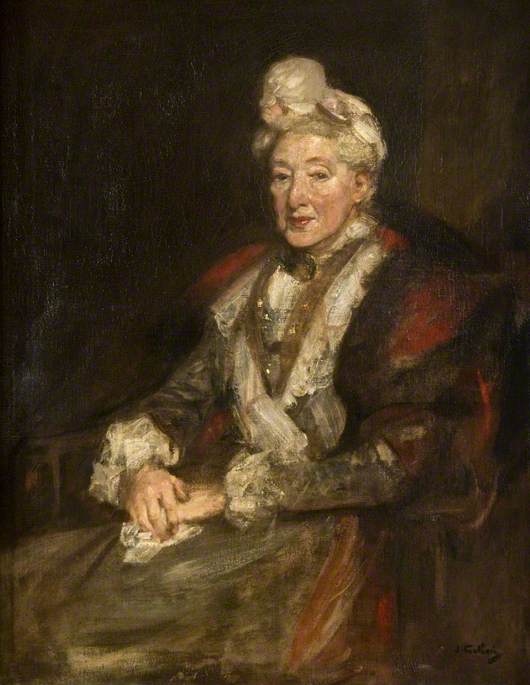
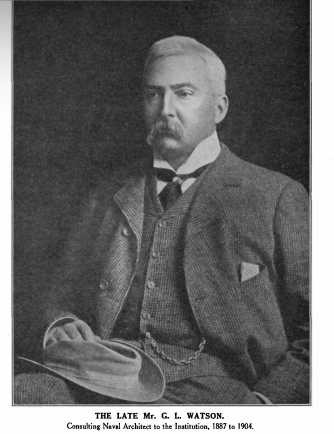
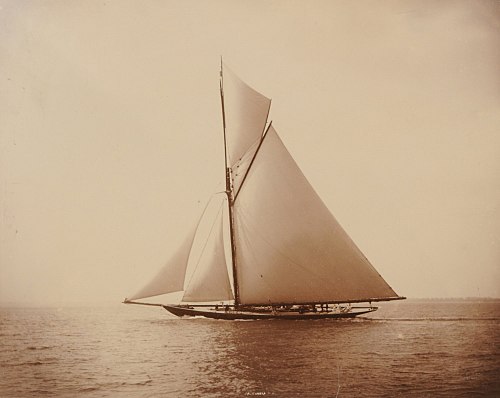
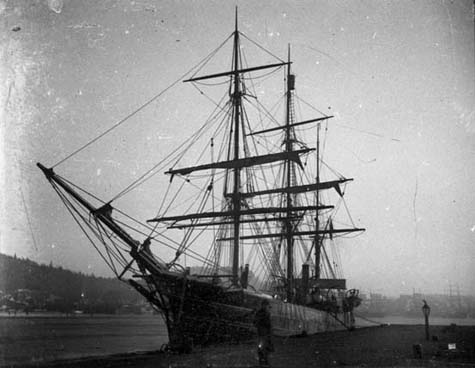
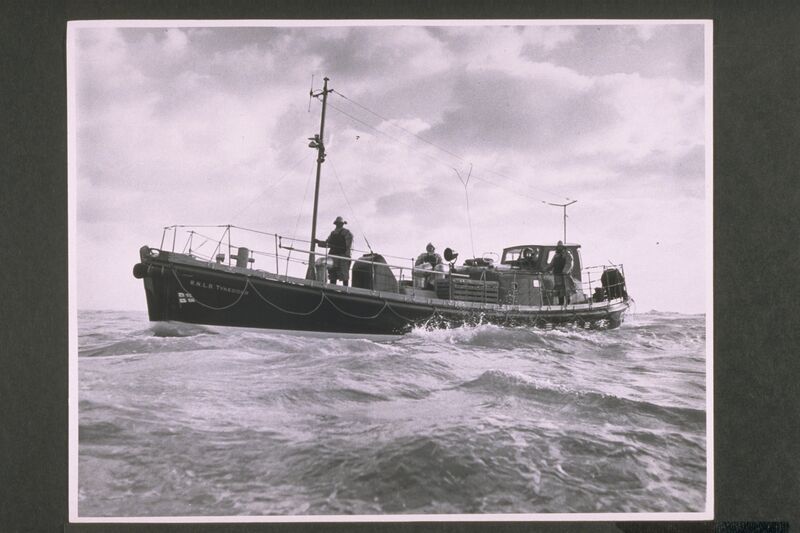
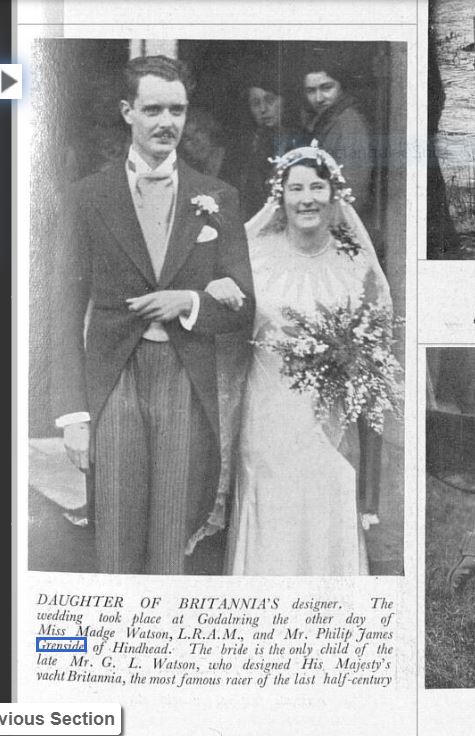
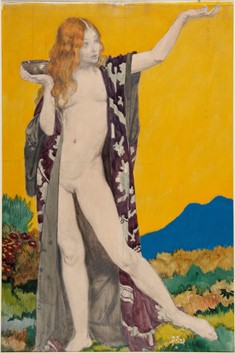
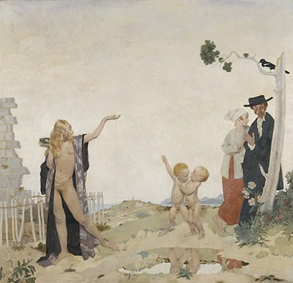
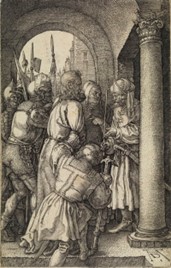
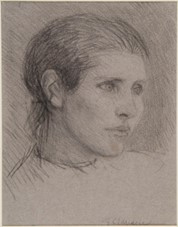
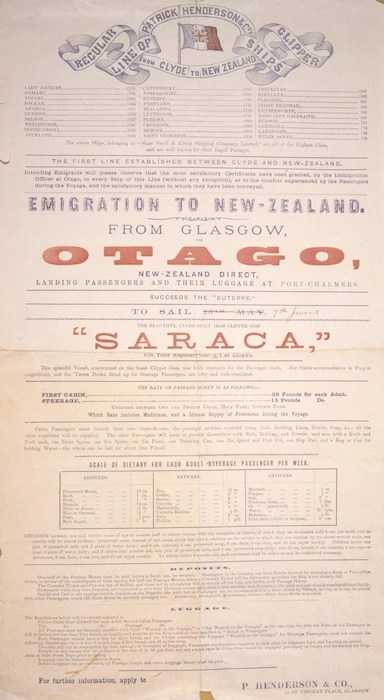
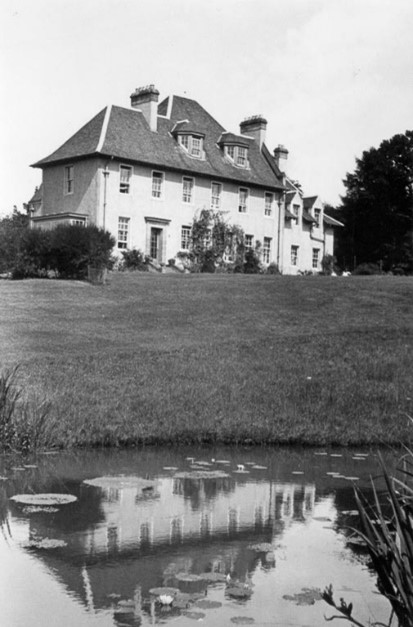

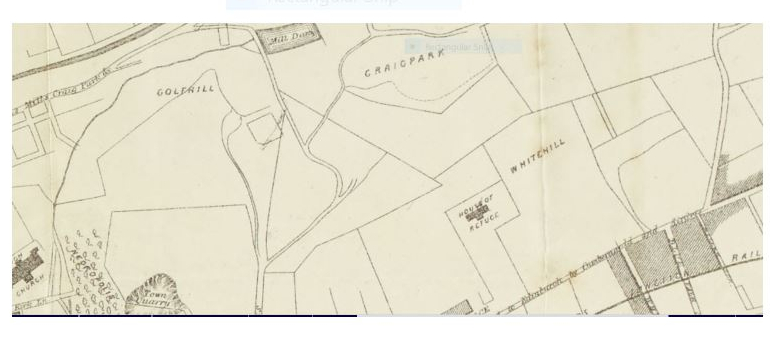
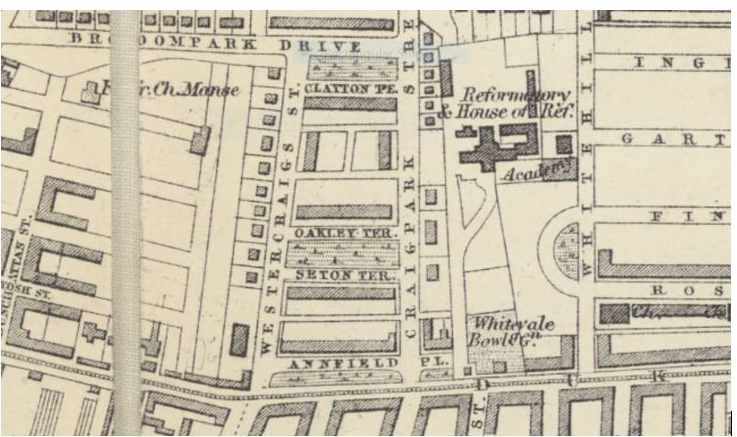
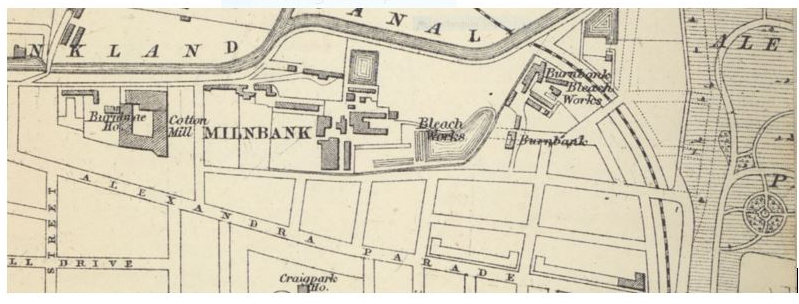
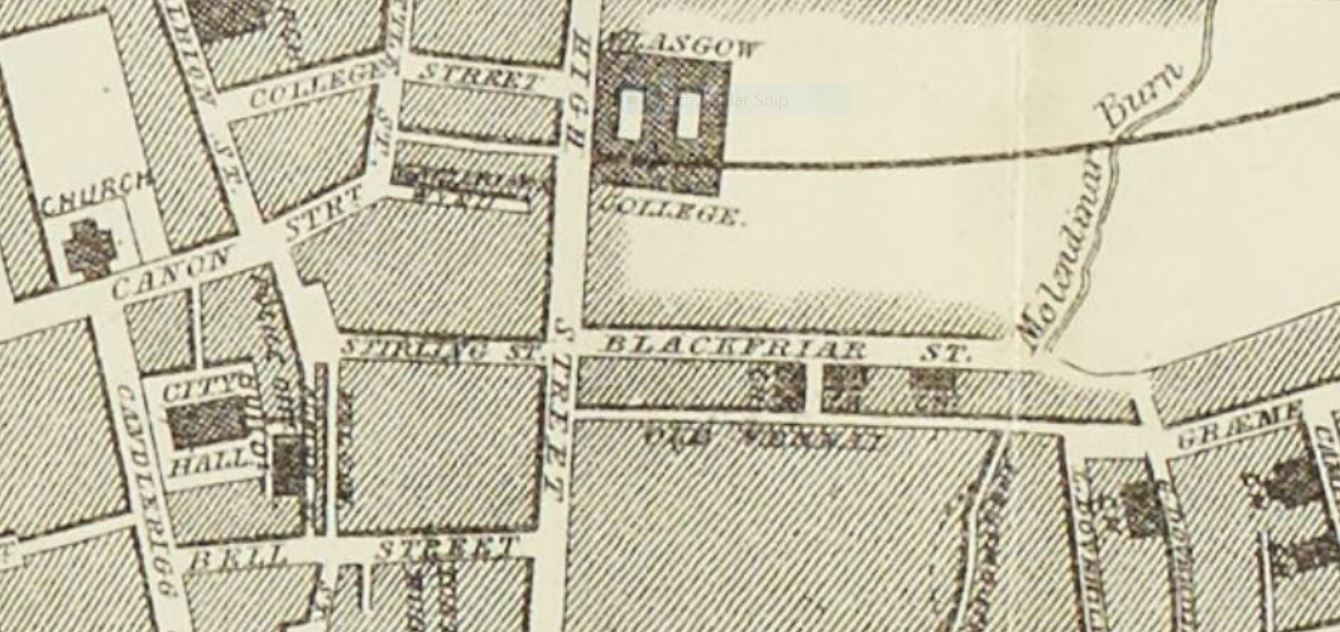

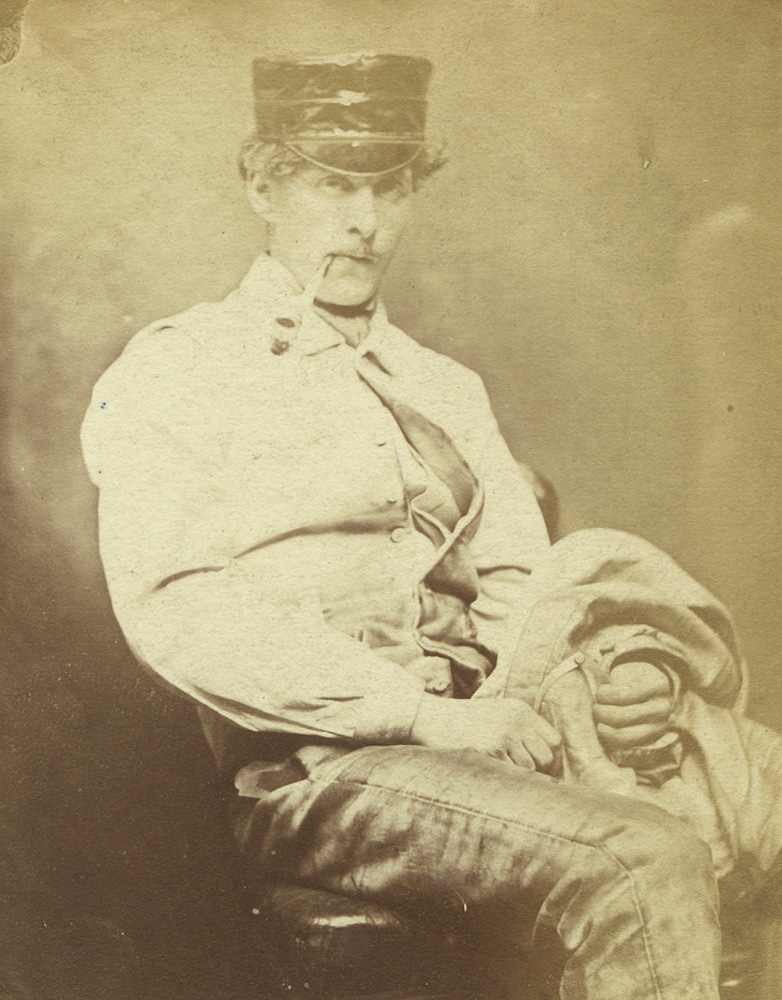
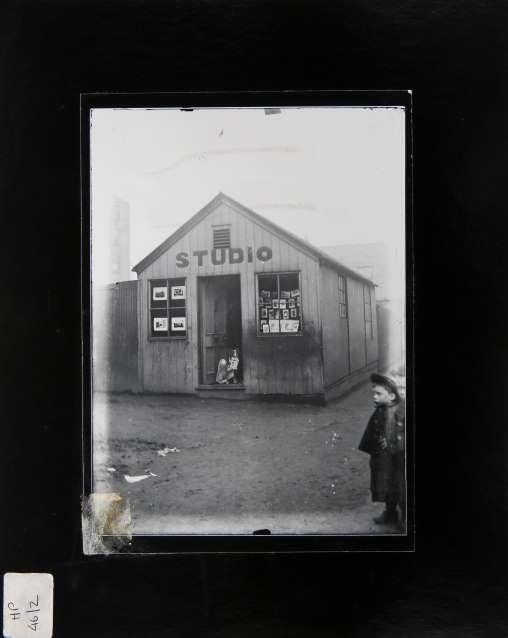
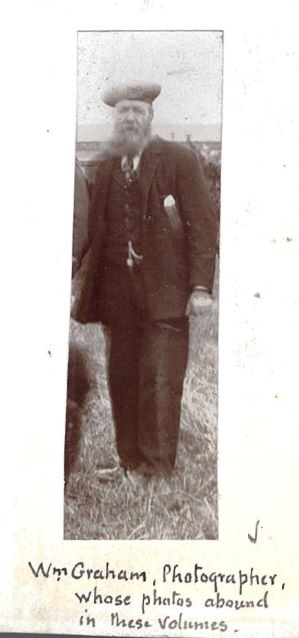
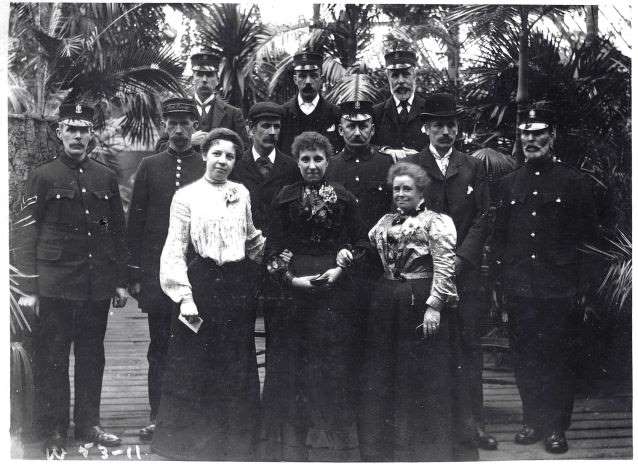
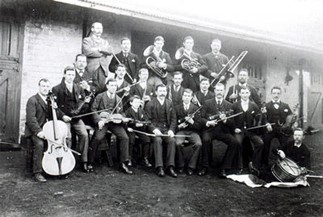
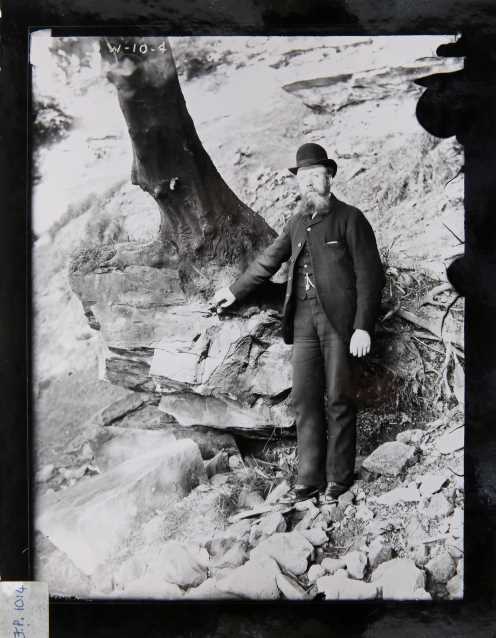
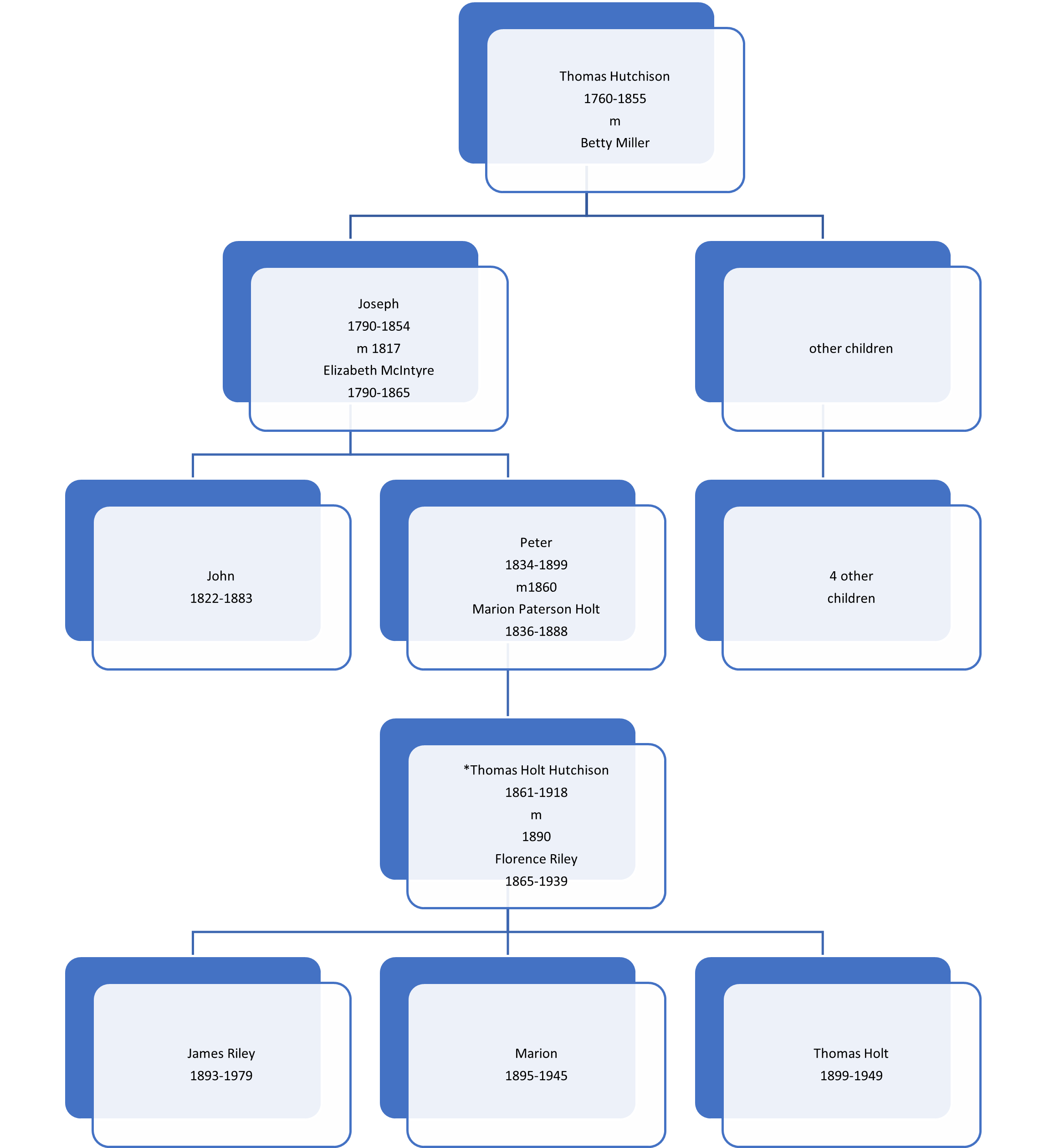
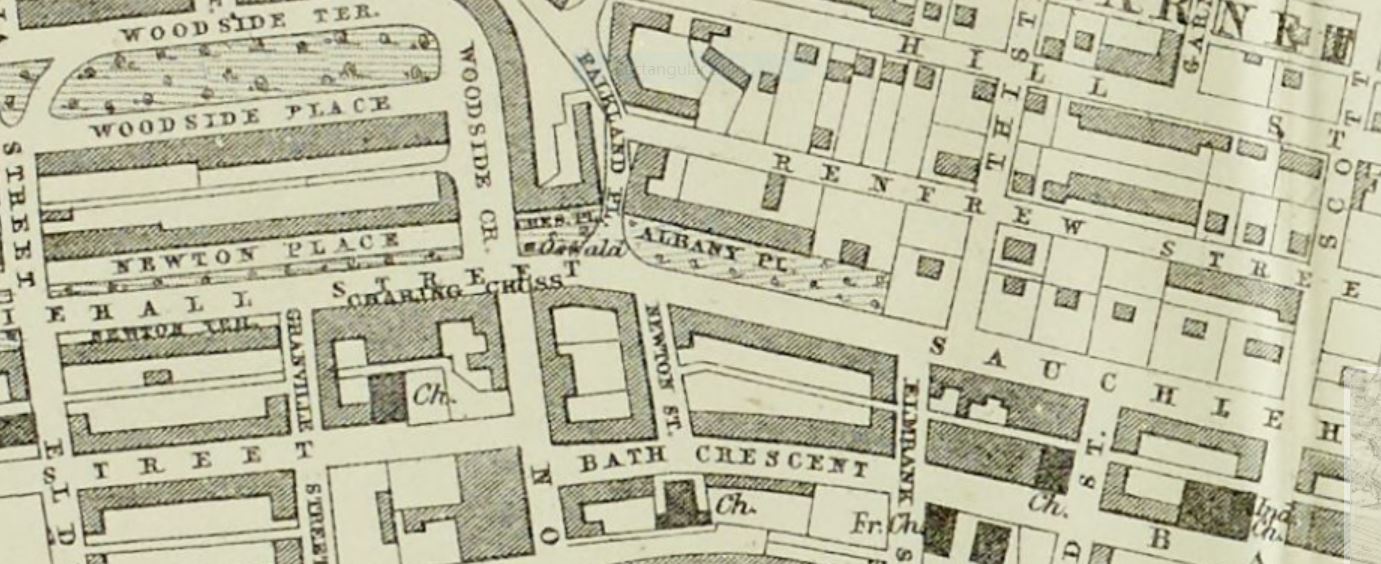
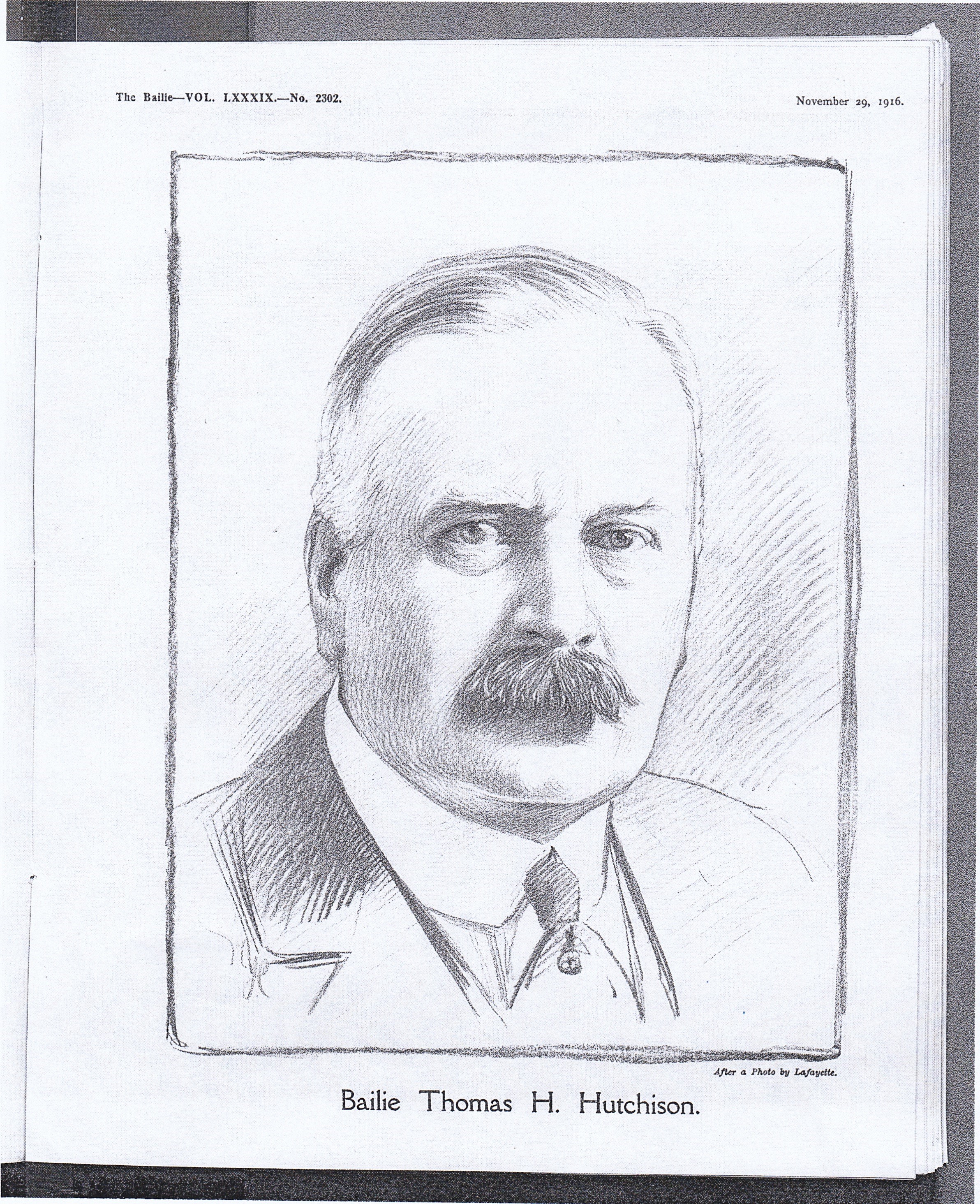
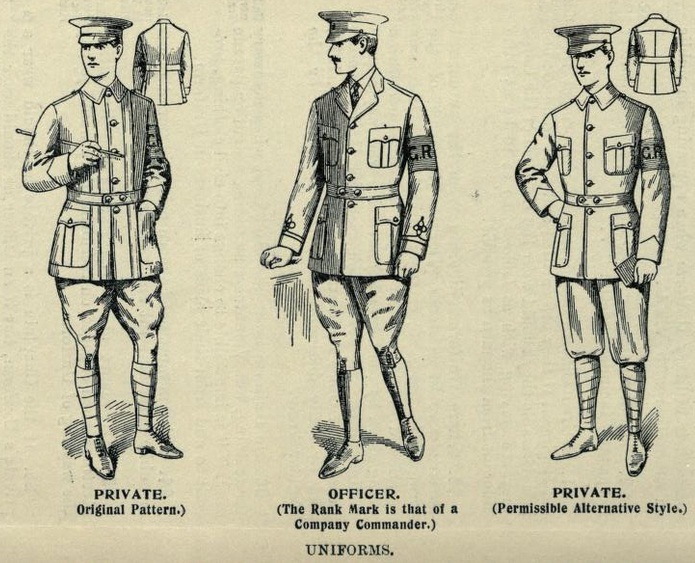
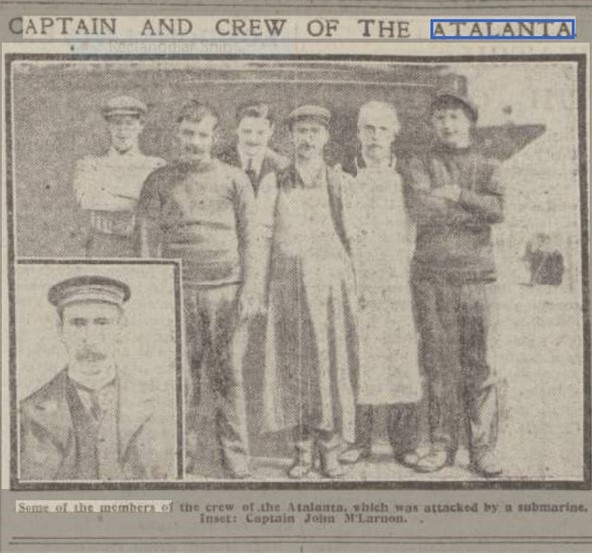
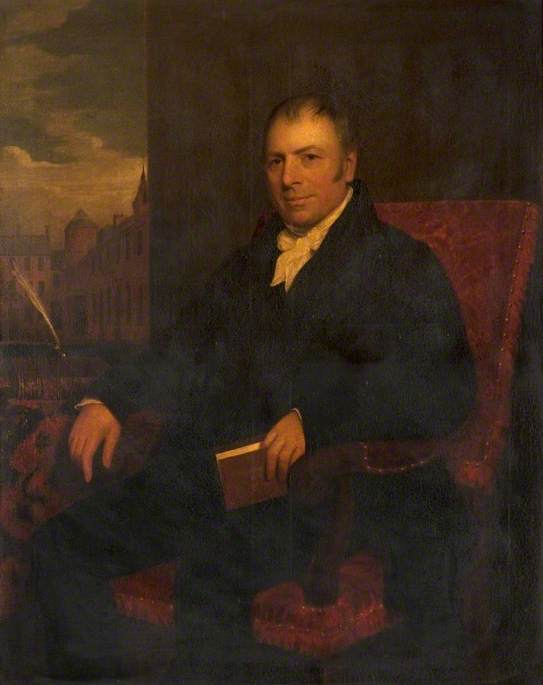
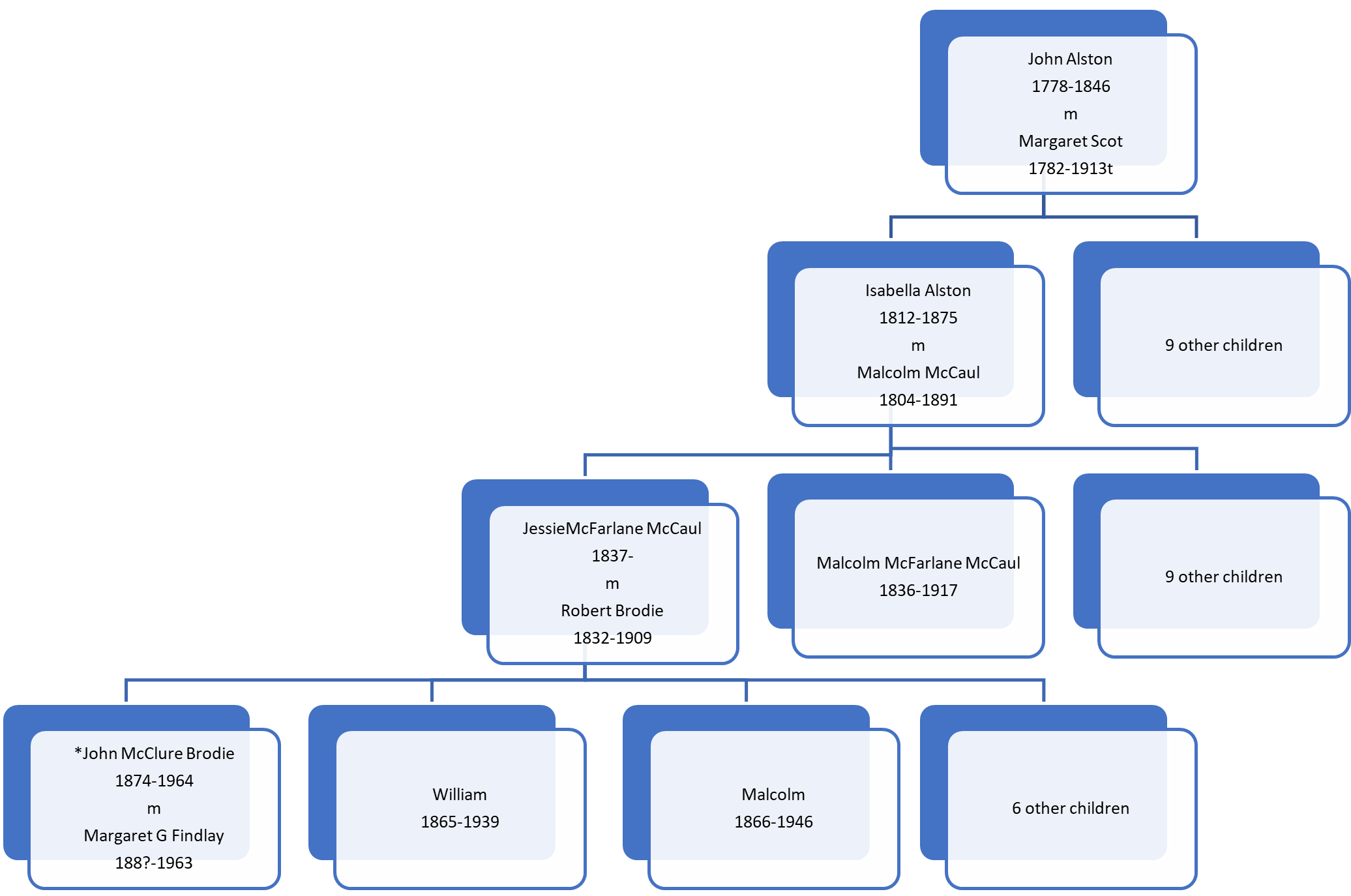
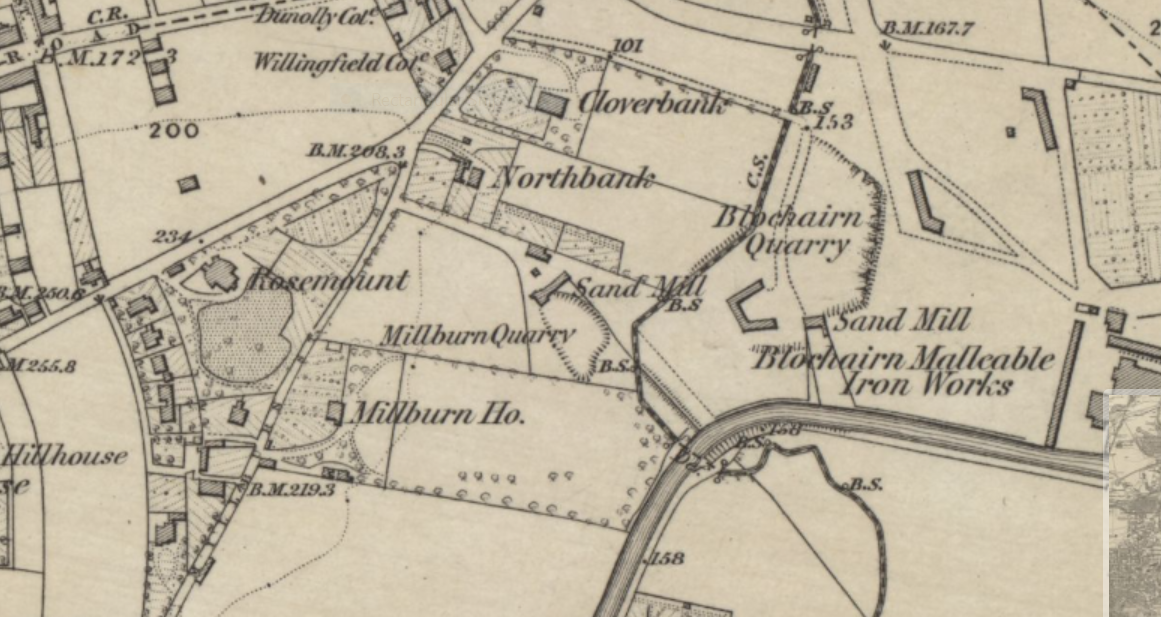
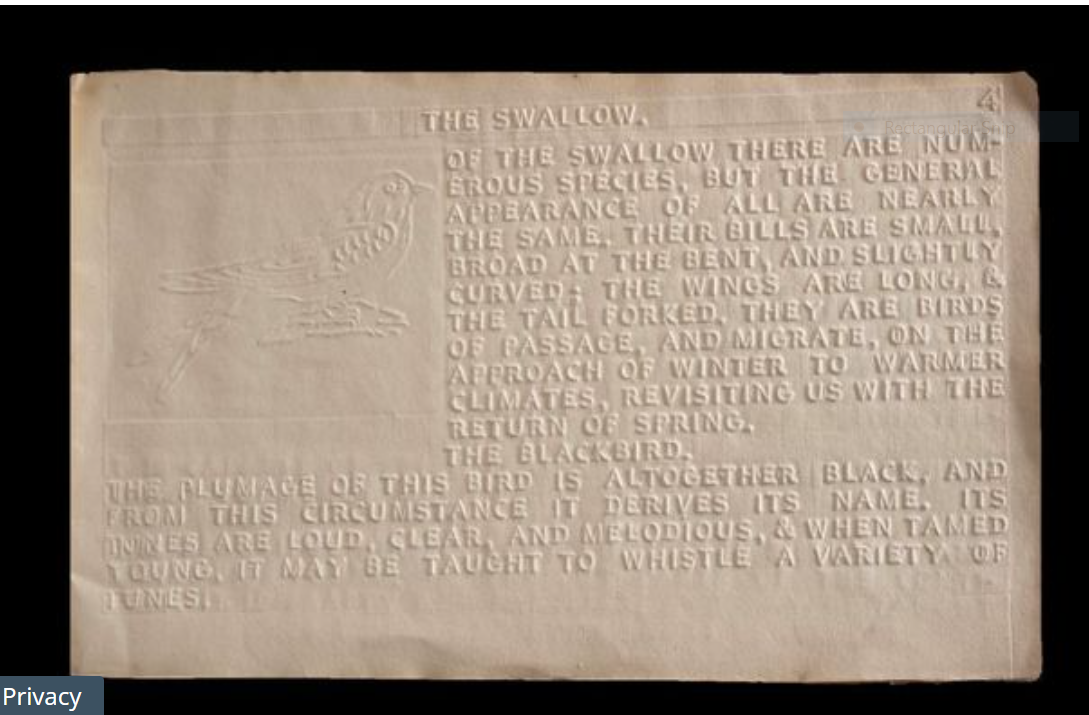
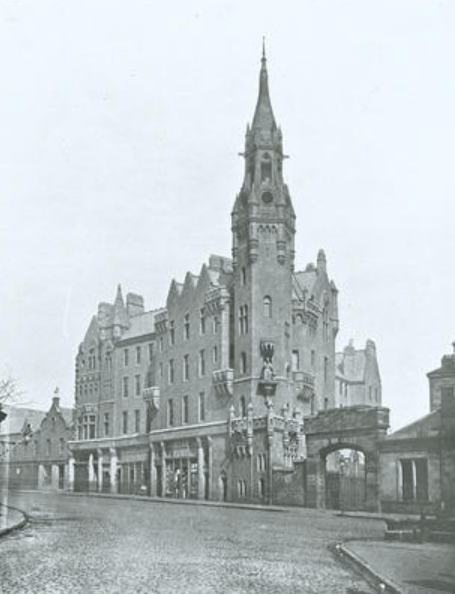
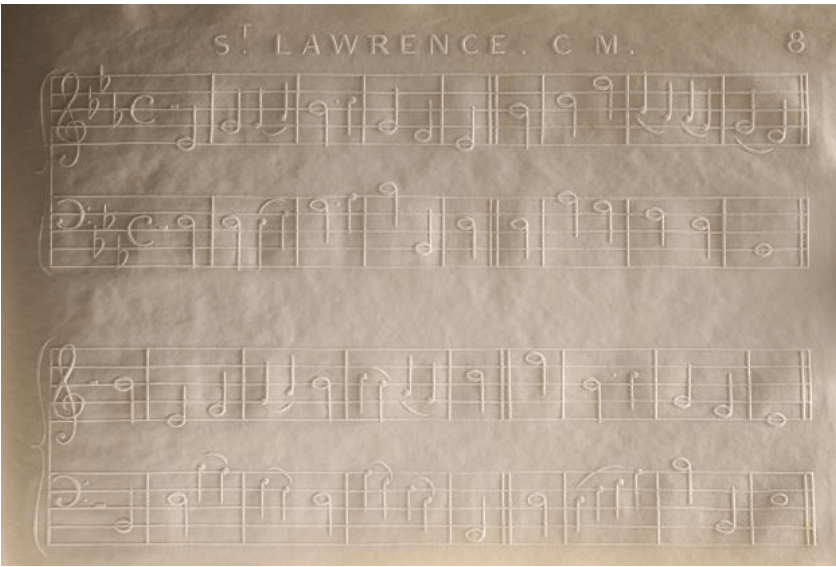
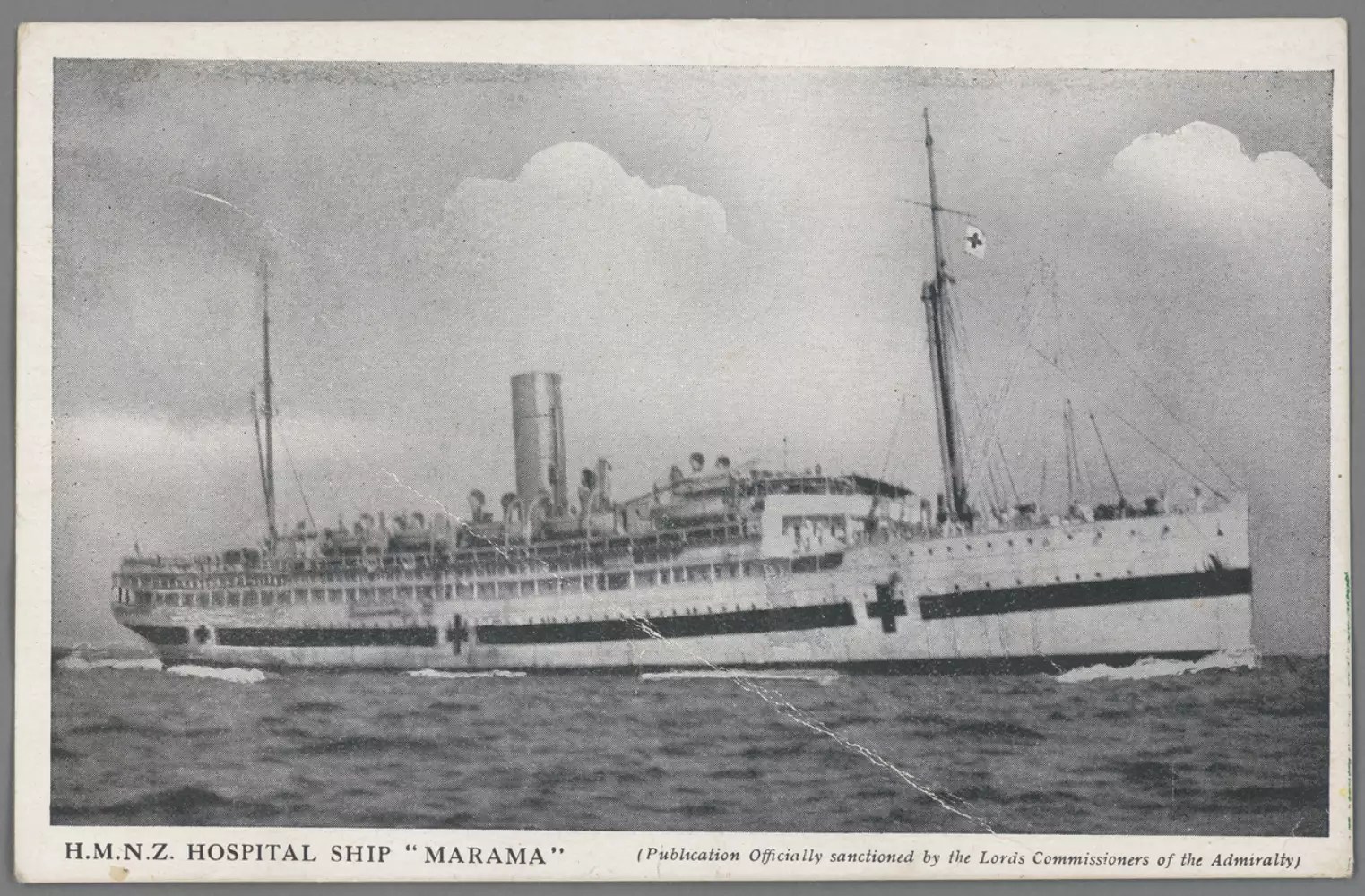
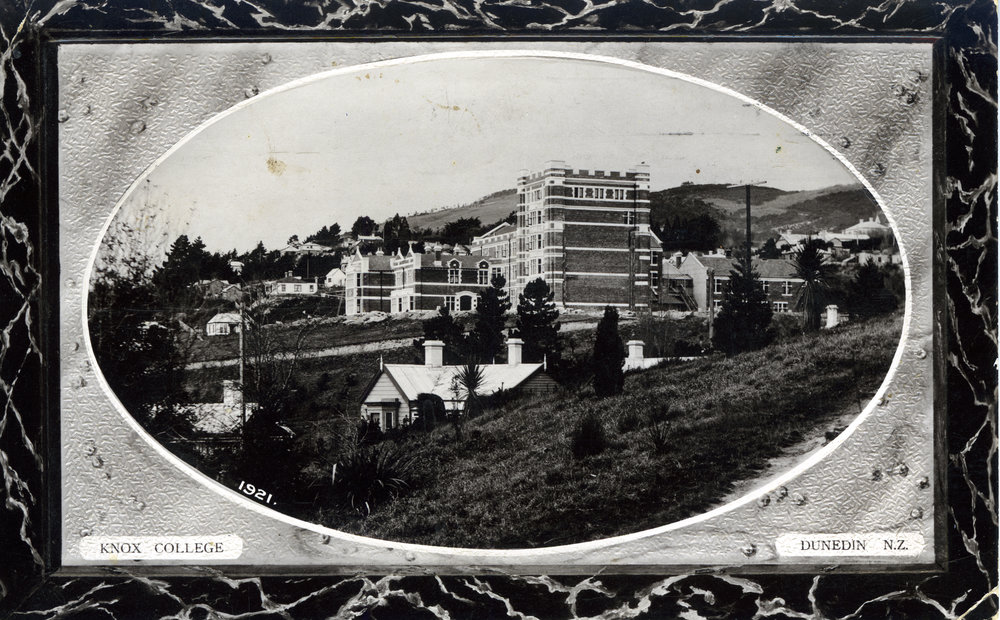
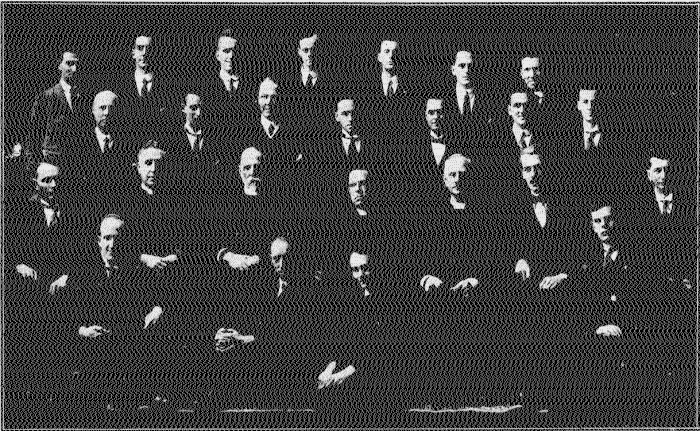
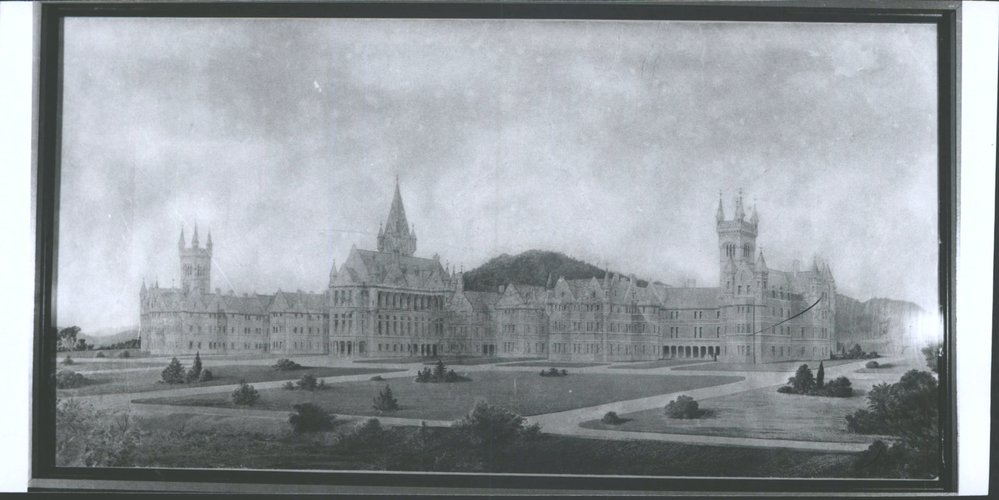
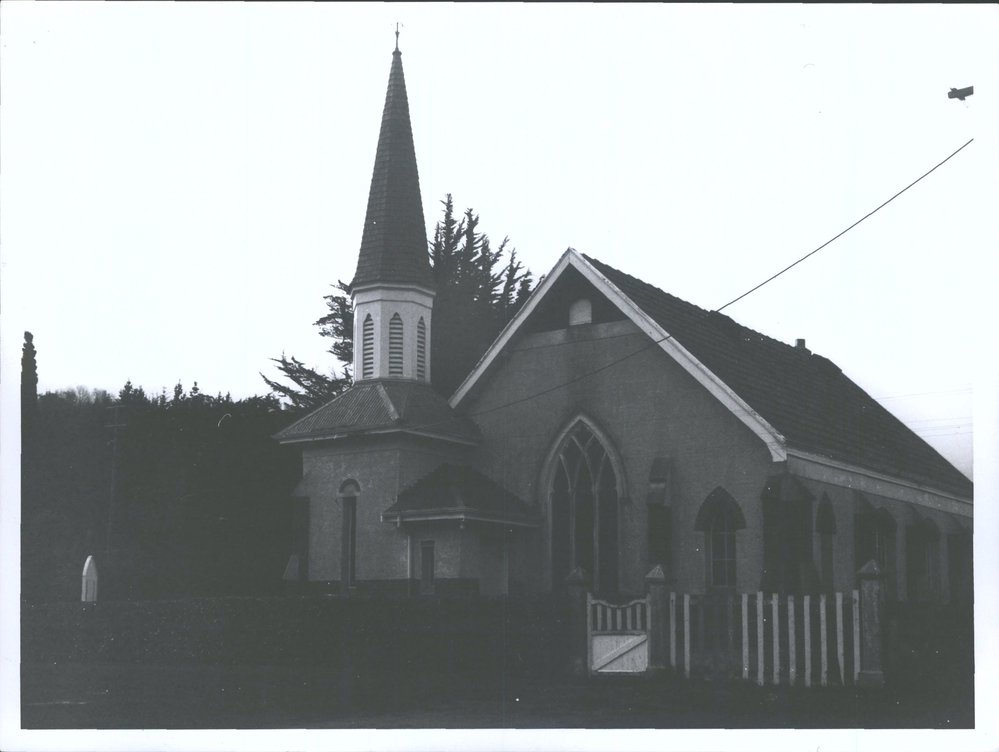
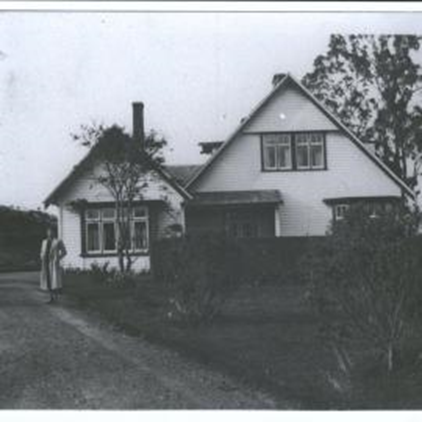
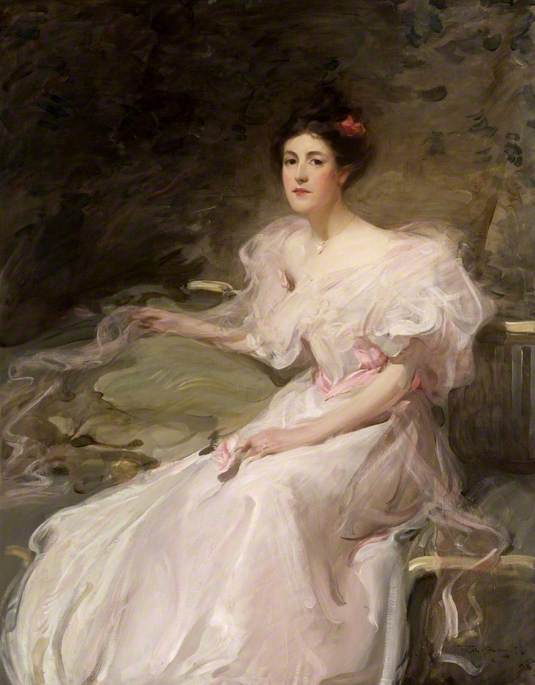
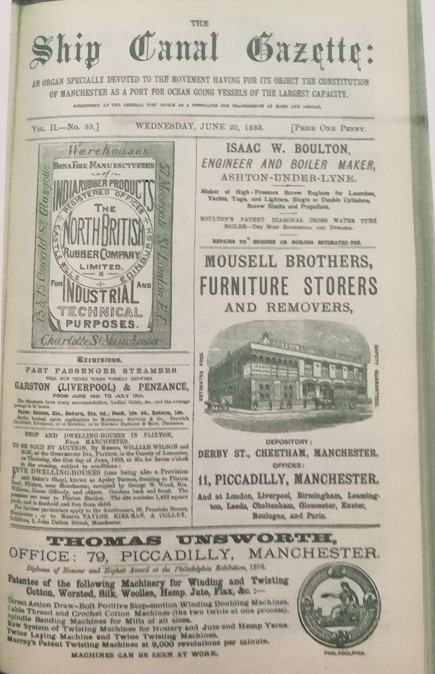
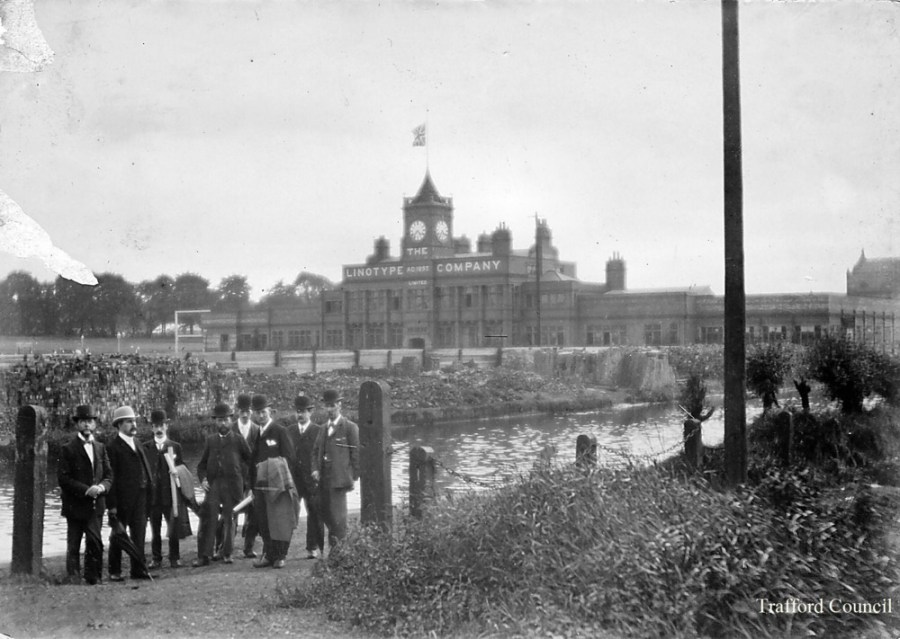
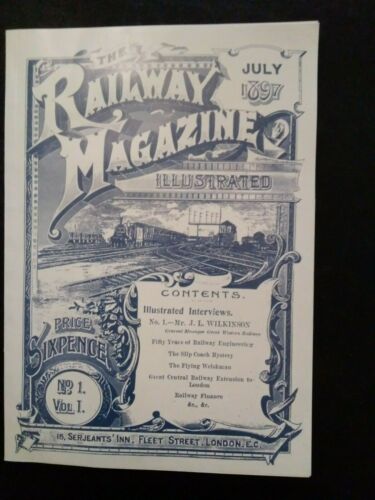
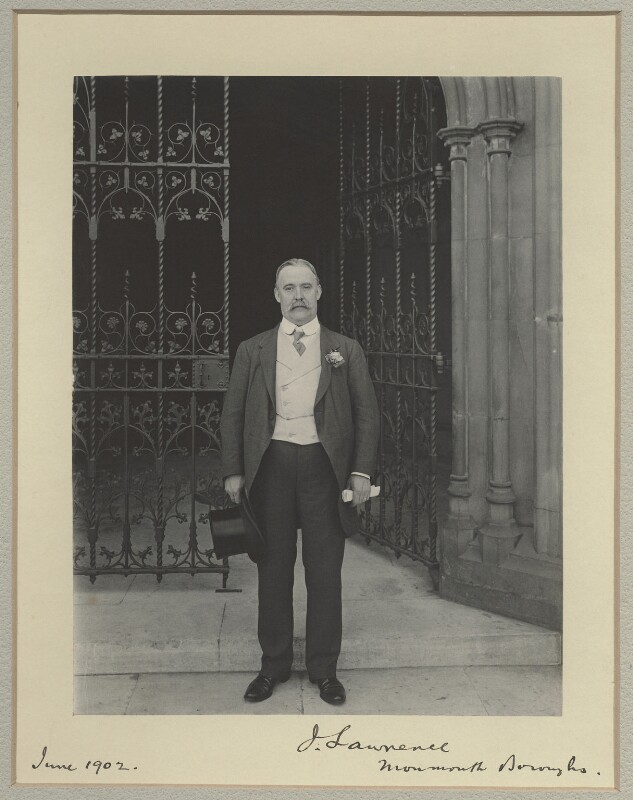
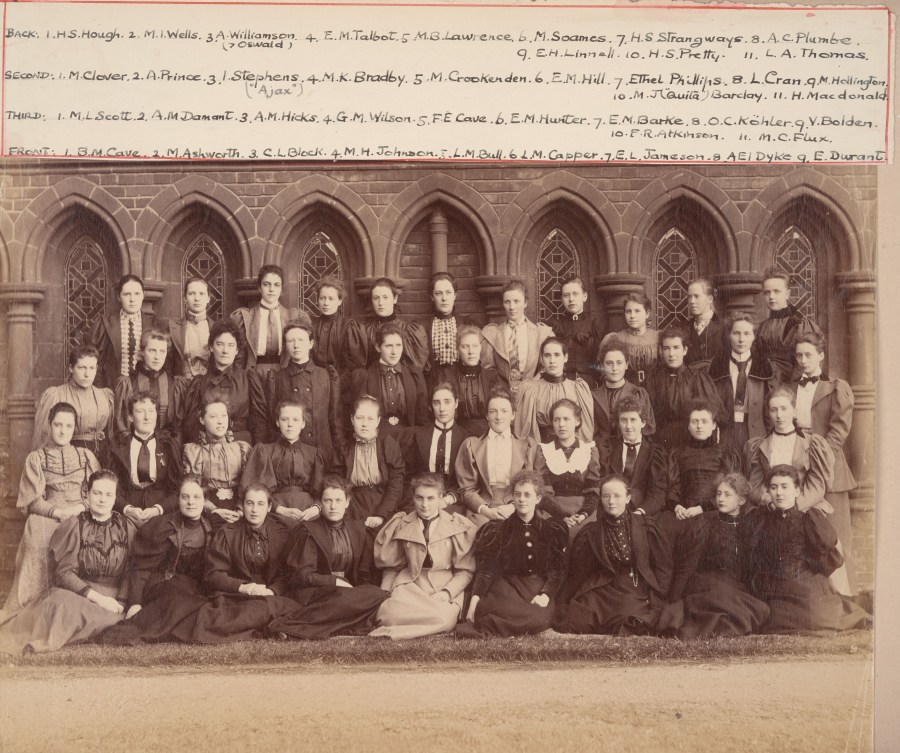
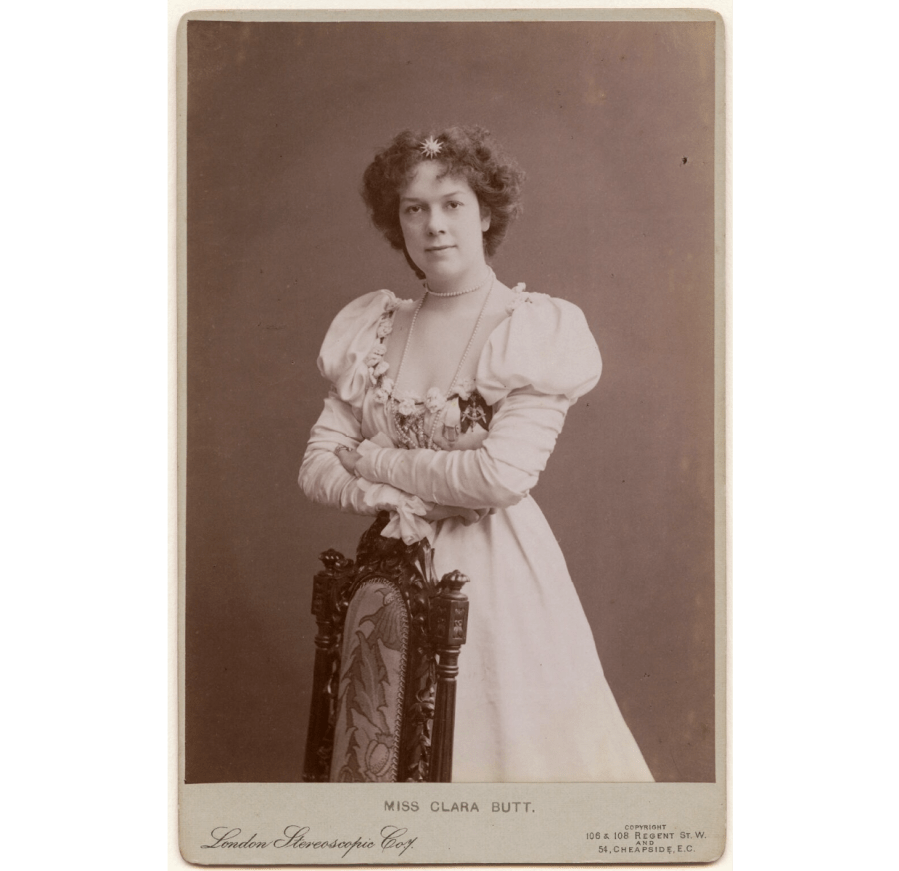
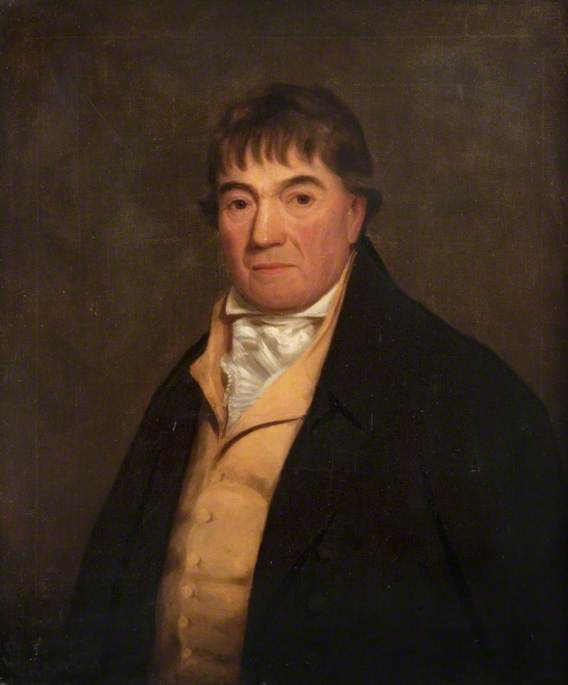
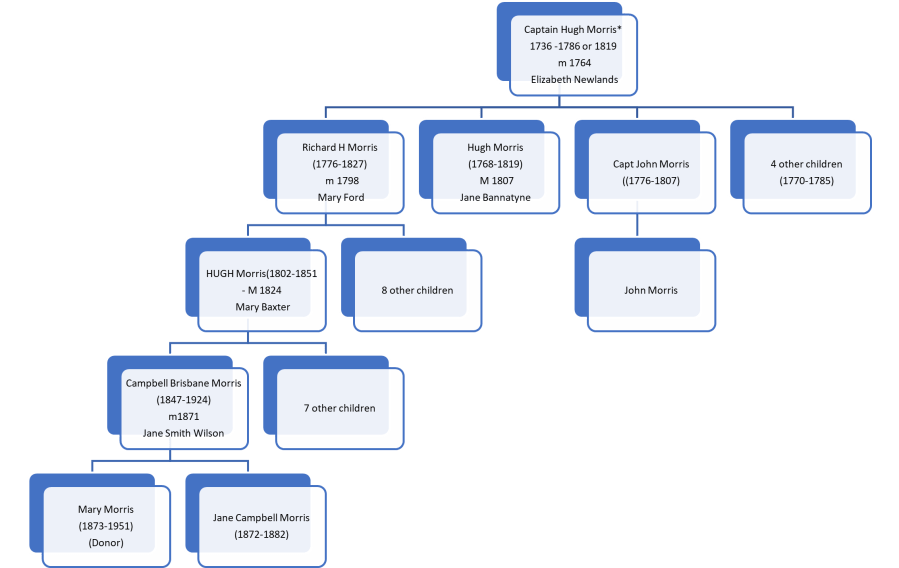
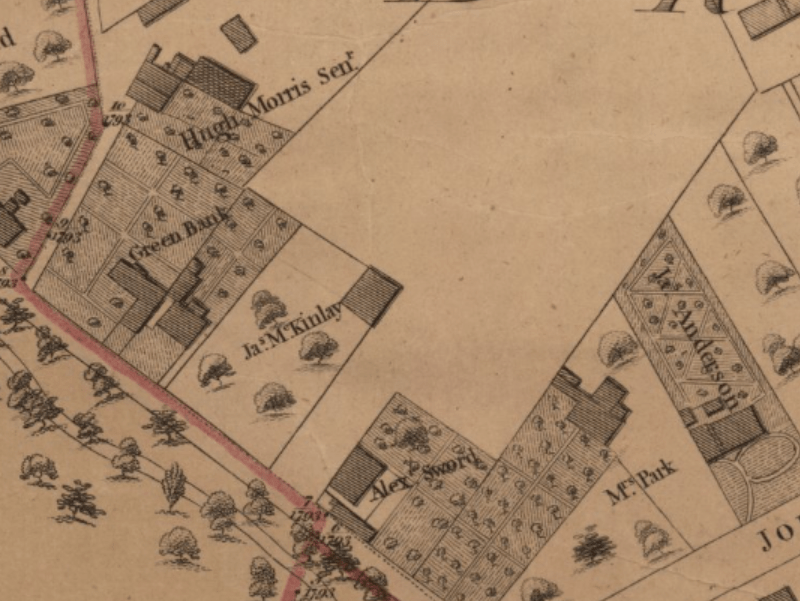
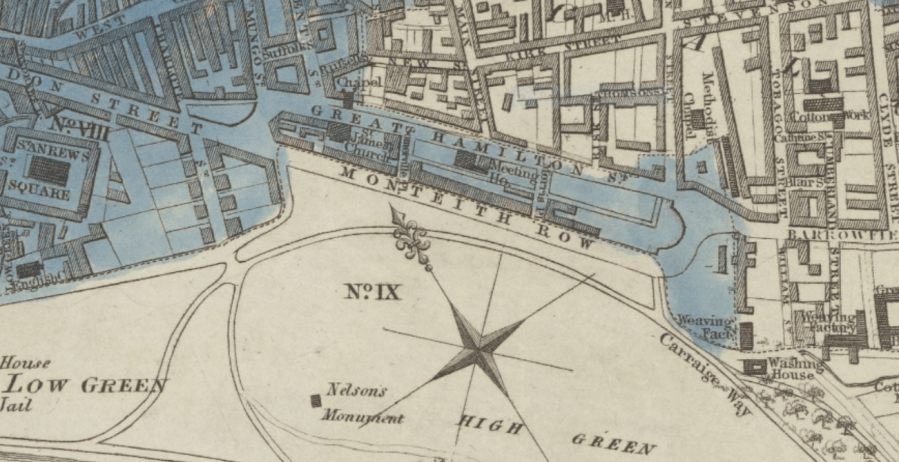
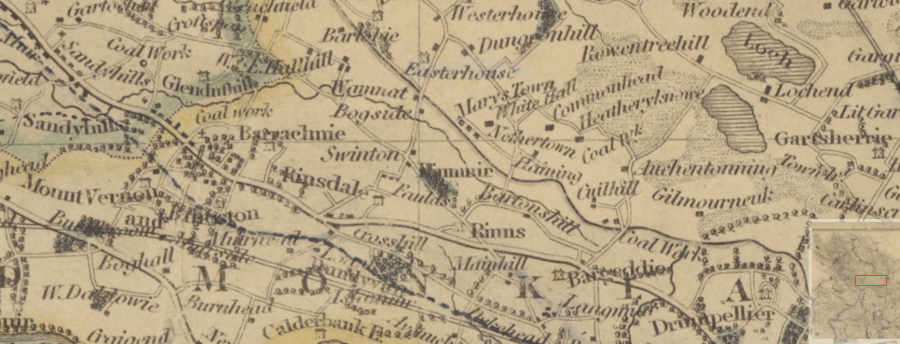
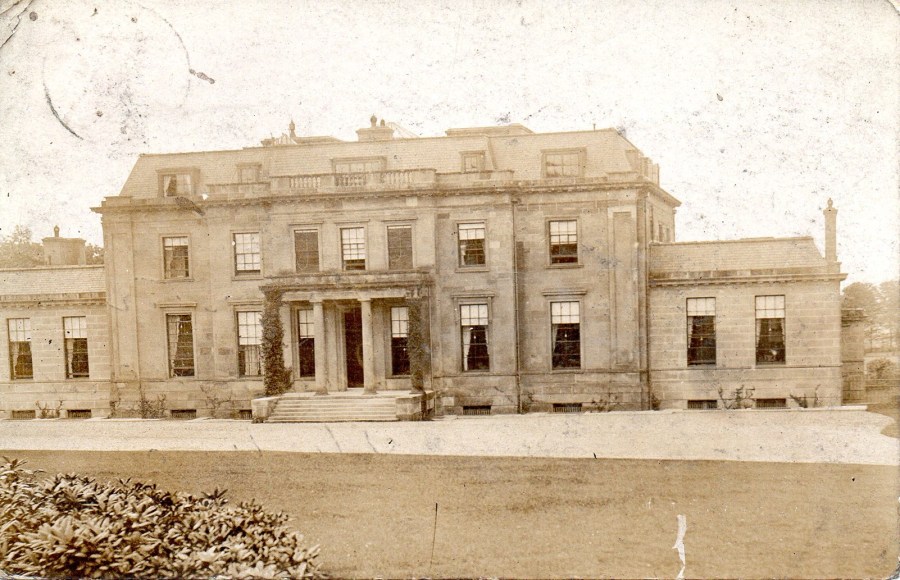
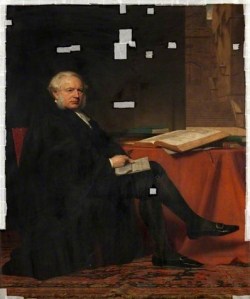
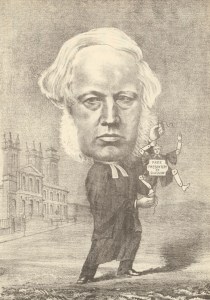
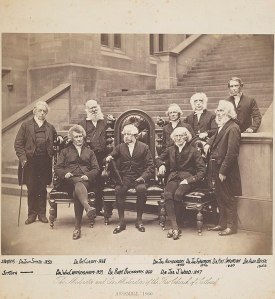
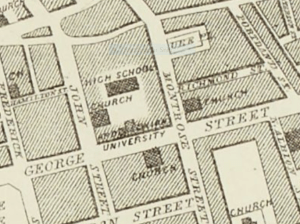
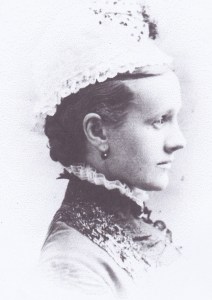
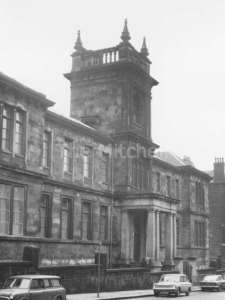
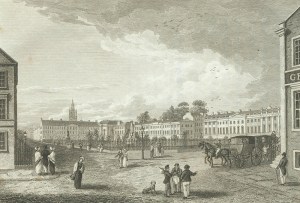
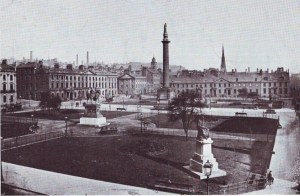
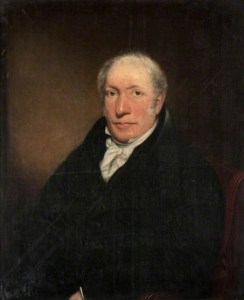
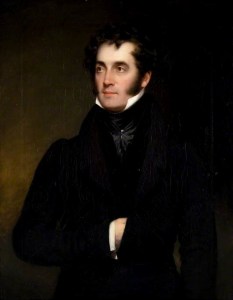
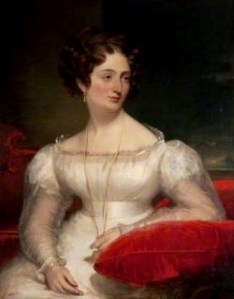
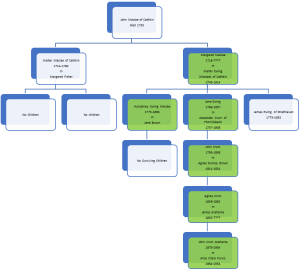
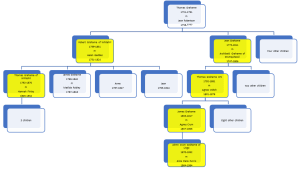
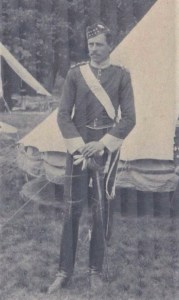
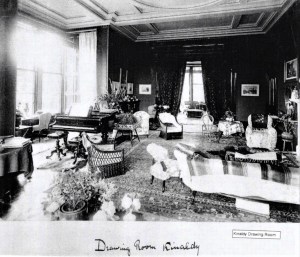
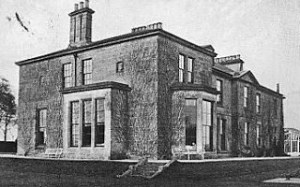
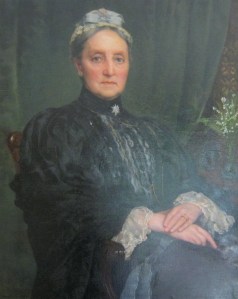
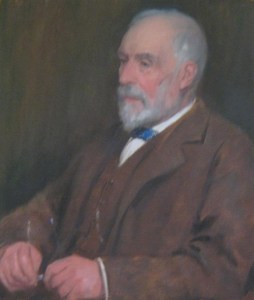
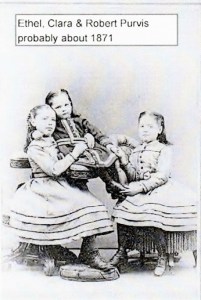
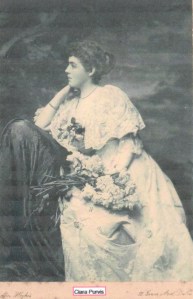
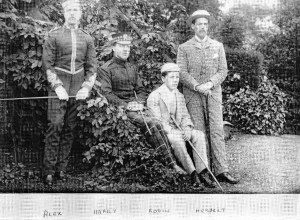
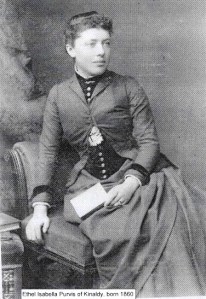
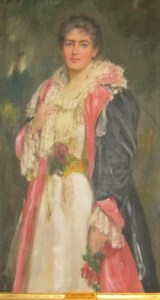
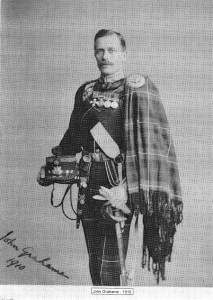
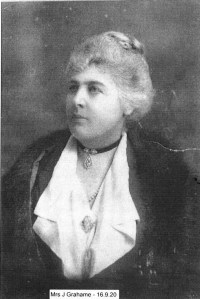
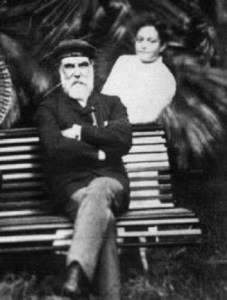
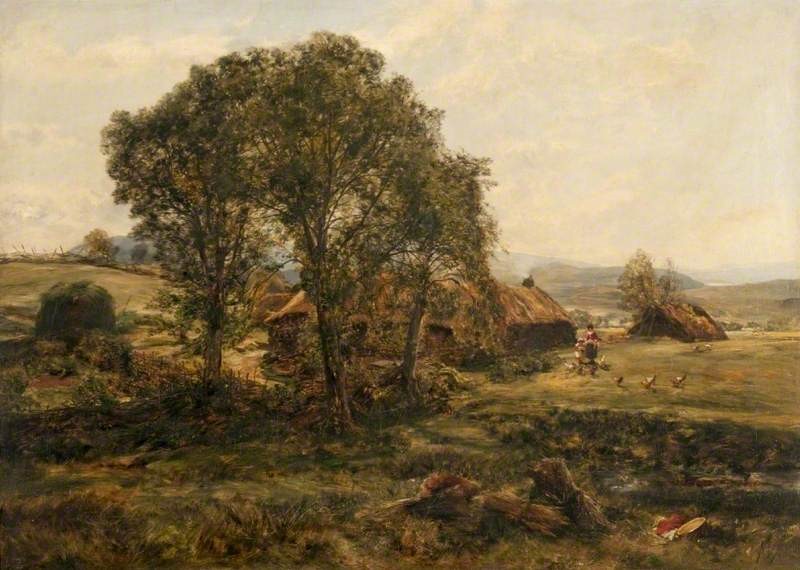
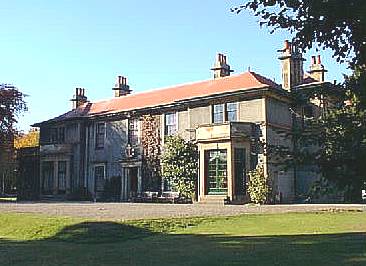
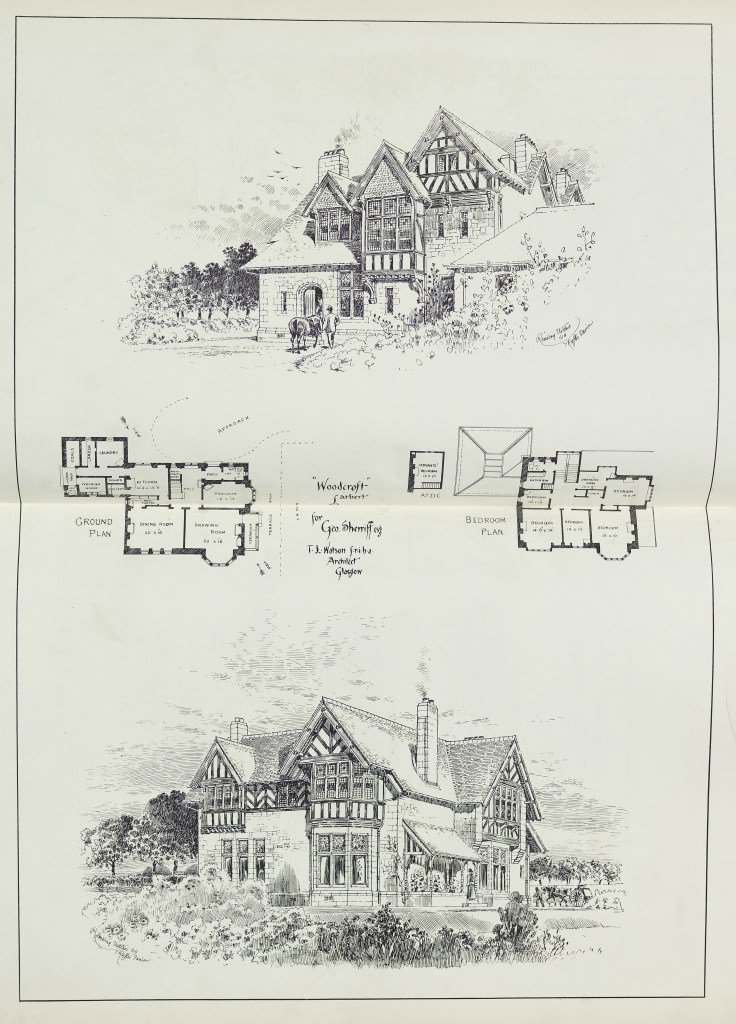
 Glasgow Museums Art Donors Group