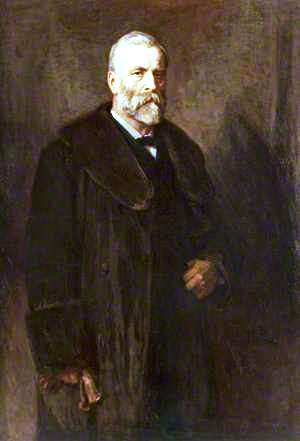
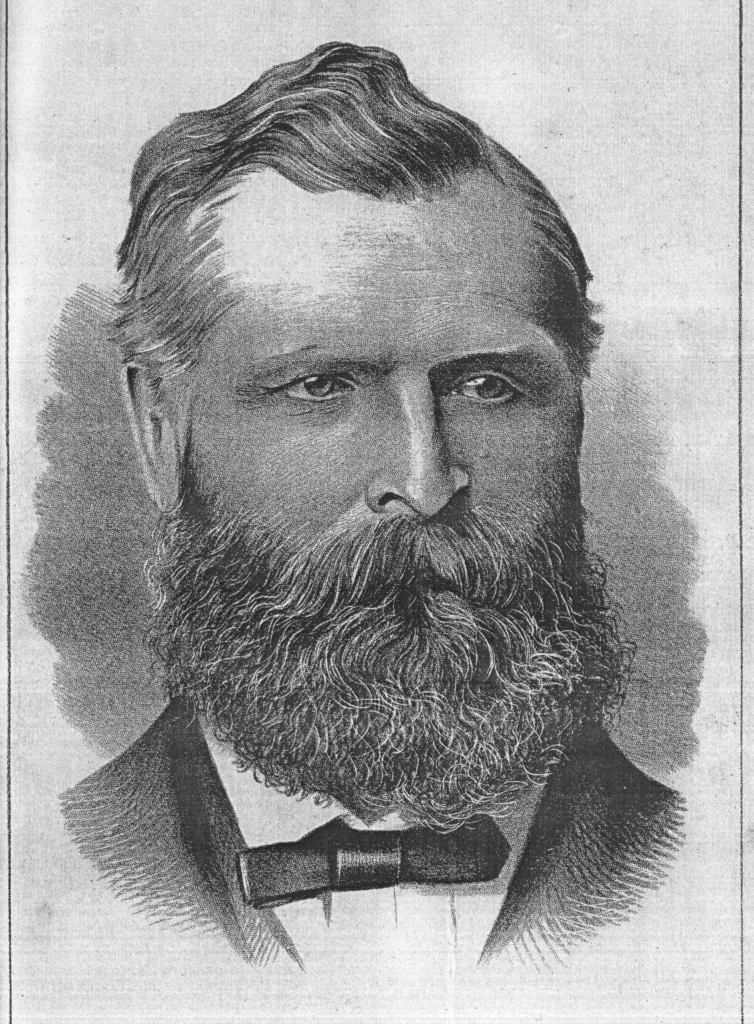
James Reid was born in Kilmaurs, a small Ayrshire town to the north of Kilmarnock on 8 September 1823. (1) He was the second son of William Reid described as a carter, or maybe a contractor (2) and his mother was Mary née Millar. Scotland had for years offered primary school education for all and there is no evidence that he had proceeded any further with schooling although there were long established Grammar Schools in Irvine (3) and in Ayr. (4)
His first job was as a blacksmith’s assistant. He moved to the firm of Liddell and company in Airdrie, a firm of millwrights and metal workers and served an apprenticeship there. (5) Such firms relied on blacksmiths and it would have been progress from his previous employment. He next moved nearer to home to Greenock where he initially joined Scott’s of Greenock a shipbuilding firm principally at that time, producing engines for small vessels. (6 ) Staying in Greenock he joined another shipbuilding firm, Cairds and Company of Greenock which built seagoing, steam propelled ships. (7) Working in these firms would have exposed him to the various uses to which engines could be put and focussed his attention on their production. At Cairds he rose to the position of chief draughtsman.
He married Margaret Scott in Greenock in December 1850. (8 ) She was the daughter of a cabinetmaker. (9) A son William Scott Reid was born in February 1852 but died in April. He is buried in the churchyard in Greenock.
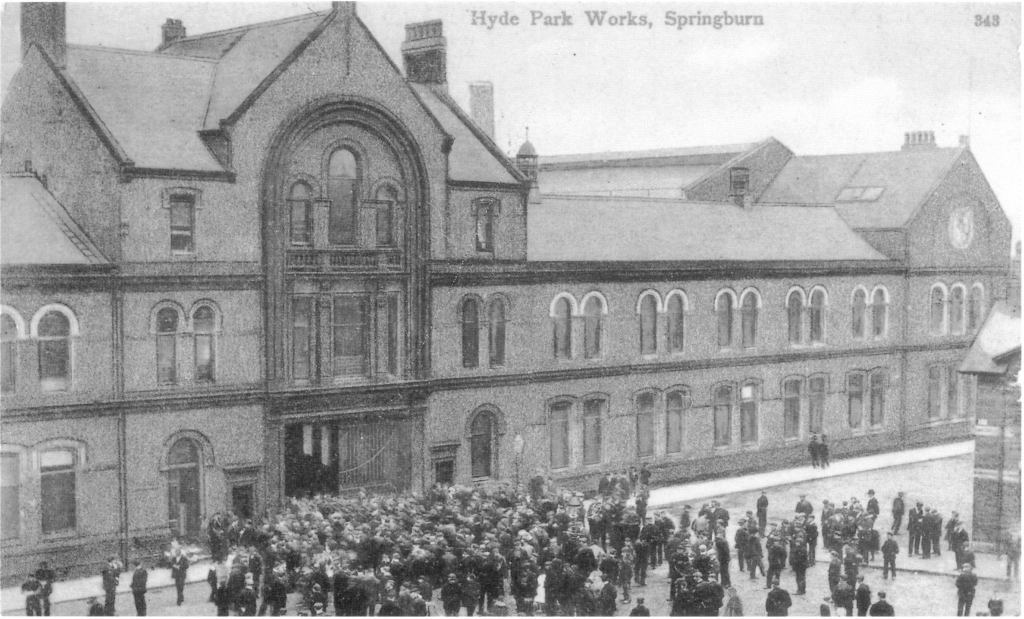
At this time, interest was developing in engines both stationary and for railway locomotives and the West of Scotland was well placed for their manufacture because of the local availability of iron and coal. He must have seen this as the coming thing so he moved to Springburn, in Glasgow, to Neilson and company at the Hydepark Works. At this time, he was living at St Vincent Street, Glasgow. (10) Two children were born: Elizabeth (11) and James (12). He rose to become general manager of the firm until in 1858 he was replaced by Henry Dubs, a German engineer then working for Sharp Stewart and a company in Manchester which had extensive experience in the manufacture of railway engines. Dubs became a partner in the firm. (13)
James Reid then made an important decision and moved to Manchester to Sharp and Stewart for further experience. (14) In Manchester three more children were born: Hugh (15 ) John (16 ) and Andrew. (17) The family lived in Charlton upon Medlock. (18 )
In 1863 James moved back to Glasgow to the Hydepark Works now as a director of the firm which became Neilson and Reid. (19) He can be found in Springburn living at Wellfield House certainly until 1874. (20 ) Another three sons were born: Edward (21),Walter (22) and William(23). William died aged 3 years.
About 1875 the family moved to 10 Woodside Terrace in the Park District of Glasgow, living in some style with four live-in servants. (24 ) (25)
His wife, Elisabeth Ann died in August 1881 in Perthshire. (26)
James and family suffered another tragic bereavement in November 1882 (27) on the death of his oldest son James. The Glasgow Herald and other papers gave an account of the accident. (28 ) (29 ) (30 ) He had been shooting partridge on the Glenquaich estate with Mr Wilkes, the shooting tenant and his son. One of the party stumbled and his gun discharged all of its shot into James Reid’s thigh. All efforts were made to stop the bleeding and he was taken to the Royal Hotel, Crieff. The next day Professor Robertson of Glasgow performed a hind quarter amputation but James died that night from weakness and haemorrhage . In 1886 James married Charlotte Geddes. ( 31) There is evidence that the family had visited Perthshire on occasions and in 1887 he bought Auchterarder house (32 ) which was extensively remodelled for him by the architect Sir John James Burnett.
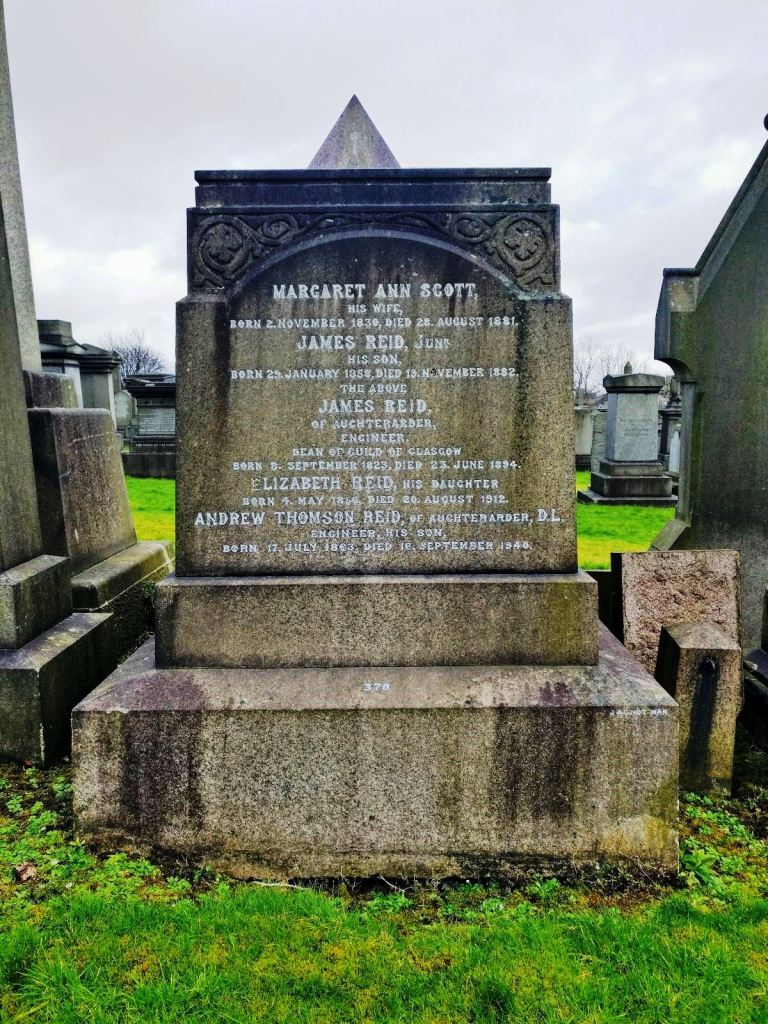
In 1894 James died of a heart attack on the golf course at St Andrews . (33) He is buried in the Necropolis in Glasgow.(34)
Family grave stone in Glasgow Necropolis Image from Find my Grave
To his four sons he bequeathed not only material goods but also a legacy of public service, philanthropy and sound business sense. His son Hugh became Managing Director and his brothers were all directors of Reid and Sons.
James was involved in civic affairs as a Town Councillor and a JP being elected in 1877. (35) In 1880 he took a prominent part in the decision about the building of the new City Chambers. The Bailie (36 ) records his views on the proposal to limit the finance available which restrictions, he thought, showed Glasgow in a poor light compared to the proposals for other cities such as Manchester. In 1893, he became the Second Citizen of Glasgow when he became Lord Dean of Guild, Head of the Merchants House. (37 ) He died in office.
James Reid was a member of the Institution of Mechanical Engineers founded in 1857 and now the IMechE. He was President of the Scottish Institution of Engineers and Shipbuilders 1882-84. (38.)
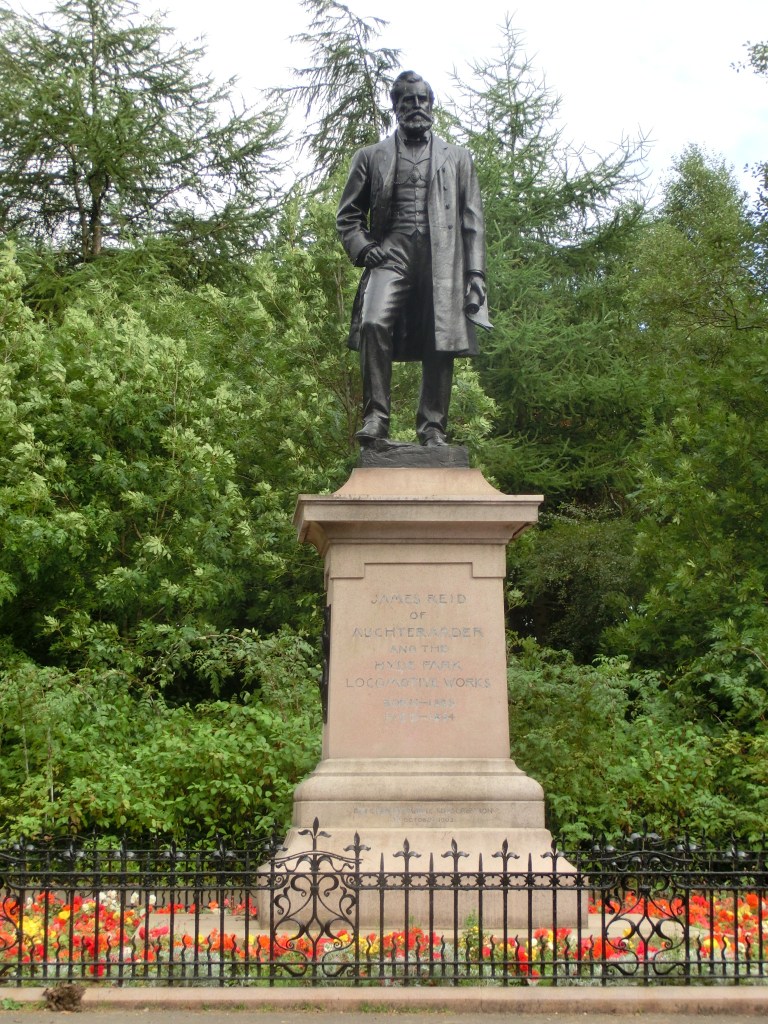
Statue of James Reid in Springburn Park. Copyright Fiona Murphy
Because he had lived and worked in Springburn, he was Chairman of the Springburn School Board. He was a major donor to Springburn and gave land to the citizens for Springburn Park and bandstand. This is commemorated by a statue in the park, raised by public subscription in 1903. (39)
He was also a Director of the Tramways Company.
He was an art collector of note (40) favouring the Barbizon and Hague schools. He chaired the Royal Glasgow Institution of Fine Arts.
When he died his sons gifted ten important paintings from his collection to the City of Glasgow, now in Kelvingrove Art Gallery and Museum. These are among the best known and much valued paintings in the collection. (41)
Artist
Painting
J M Turner
I Pifferari
John Constable
Hampstead Heath
Sir Lawrence Alma Tadema
A Lover of Art
Sir William Quiller Orchardson
The Farmer’s Daughter
John Lanelli
Downward Rays
Patrick Naismith
Windsor Castle
Jean B C Corot
Pastorale
Constant Troyon
Landscape and Cattle
Josef Israels
The Frugal meal
Sir George Reid
James Reid of Auchterarder
In March 1914 an auction of his remaining 114 pictures was held at J and R Edminston. The catalogue includes paintings by Horatio McCulloch, William McTaggart, John Faed, Sam Bough and many others showing his interest in and support for the Scottish painters.
References
OPR Births and Baptisms 21.09.1823
National Records of Scotland Statutory Deaths 1894
Irvine Academy website
Ayr Academy website
Grace’s Guide to British Industrial history
Wikipedia Scotts of Greenock website
Wikipedia Cairds of Greenock website
OPR Marriages 20.12.1850
National Records of Scotland Statutory Deaths 1881
Post Office Directories Glasgow 1852
National Records of Scotland Statutory Births 1857
National Records of Scotland Statutory Births 1858
Henry Dubs Wikipaedia
Grace’s Guide to British Industrial history
National Records of England Statutory Births 1860
National Records of England Statutory Births 1861
National Records of England Statutory Births 1862
National Records of England Census 1861
Grace’s Guide to British Industrial history
National Records of Scotland Census 1871
National Records of Scotland Statutory Births 1862
National Records of Scotland Statutory Births 1865
Ancestry .co.uk 1871
Post Office Directories Glasgow 1871
National Records of Scotland Census 1881
National Records of Scotland Statutory Deaths 1881
National Records of Scotland Statutory Deaths 1881
The Glasgow Herald 21 November 1881
The Glasgow Herald 22 November 1881
Leamington Spa Gazette 22 November 1881
National Records of Scotland Statutory Marriages 1886
Auchterarder House Wikipaedia
National Records of Scotland Statutory Deaths 1894
Find a grave website
Obituary in Grace’s Guide to British Industrial history
The Bailie no 407 August 1880. The Man you Know
Grace’s Guide to British Industrial history
Institution of Mechanical Engineers website
Springburn Park website
Frances Fowles. Impressionism in Scotland. National Galleries of Scotland in Association with Culture and Sport Glasgow. Edinburgh, 2008
Edmiston: A catalogue of a valuable collection ofpictures belonging to the late James Reid esq.10 Woodside Terrace and his representatives. Thursday 26 March 1914
National Railway Museum records
James W Lowe. British Steam Locomotive Builders 2014. Kindle Edition, Amazon 2014
Appendix 1
Railway Locomotive Manufacturers in Glasgow.
The firm of Neilson and Mitchell was established in 1836 to manufacture marine and stationary engines at Hyde Park Works in Glasgow. It was not until 1855 that they began to produce railway engines. The firm of Sharp and Roberts had been originally established in Manchester in 1828 to manufacture stationery engines for cotton mills and to make machine tools. They built their first railway engine in 1833. In 1843 the firm became Sharp, Stewart and Company and had established an excellent reputation at home and abroad.
By 1861 Neilson and company had established an export business in locomotives exporting to Europe and India. Henry Dubs left the company and formed his own company at the Glasgow Locomotive works at Polmadie in 1863.
Walter Neilson branched out on his own to establish the Clyde Locomotive company in 1884. In 1887 Sharp Stewart and Company, looking to expand their business moved to Glasgow and purchased the Clyde Locomotive Company.
There were at that time three competing locomotive works in Glasgow: Neilson Reid and Company, Sharp and Stewart Company and The Glasgow Locomotive company. In 1903, they amalgamated and became
The North British Locomotive Company.
Information received from two main sources:
The records of the North British Locomotive Company and constituent companies, Locomotive builders, Glasgow Scotland held in the National Railway Museum (42)
James W Lowe, British Steam Locomotive Builders (43) Both these sources can be consulted for further information.
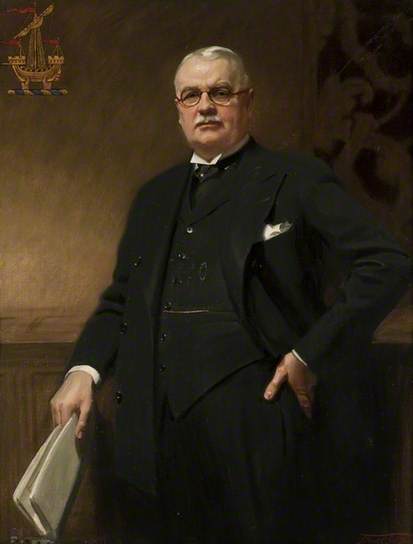
‘The Town Clerk submitted a letter from Lord Inverforth offering to present to the corporation his portrait by Frank O. Salisbury, at present on exhibition in the Kelvingrove Art Galleries, and the committee agreed that the gift be accepted and that a letter of appreciation be sent to the donor.’ 1
Andrew Weir was born on the 24 April 1865 in Glasswork Street, Kirkcaldy. He was the eldest son of William Weir a cork manufacturer and Janet Laing who were married on 2 January 1865.2 According to the census, 3 the family was still at Glasswork Street in 1871 but by 1881 had moved to 269 High Street, Kirkcaldy.4 Andrew, aged 15, having attended Kirkcaldy High School was now an apprentice clerk with the Commercial Bank of Scotland living with his parents, brothers Thomas (13), William (8), David (1) and sisters Jessie (6) and Isabella (4). Thereafter, Andrew moved to Glasgow and worked for a time in a shipping office. Then, in 1885, at the age of twenty, he bought his first ship – the barque Willowbank. On 5 May that year he opened a small office in Hope Street, Glasgow 5 (According to The Bailie it was at 70 Waterloo Street. 6) and used his ship in the coasting trade. The business prospered and within ten years he had built up a fleet of fifty-two ships of modern design and created the firm of Andrew Weir and Co. Shipowners of Glasgow. This firm ‘controlled the largest fleet of sailing ships in the world’ under one owner. 7 It became managing owners of the Bank Line (named after Weir`s first ship), Invertanker, Inver Transport, Trading Company, and several other shipping companies.
On 1 August 1889 Andrew Weir married Tomania Anne Dowie, daughter of Thomas Kay Dowie, a coachbuilder, in her home at 28 Thomson Place, Kirkcaldy. Andrew`s address was 185 Kent Road, Glasgow. His younger brother William was a witness. 8 Two years later, Andrew and Tomania were living at 4 Edelweiss Terrace, Partick, Glasgow with their newborn daughter Anne Forrestdale. With them were Andrew`s siblings, William Weir (19), Jessie B. Weir (16) and Bella B. Weir (14). 9
In 1896 Weir began to modernize his fleet by converting it to steam. His first steamship was launched under the banner of the Bank Line. At the time of the 1901 Census, he was with his family (now four girls and a boy) at Blanefield Mansion, Kirkoswald, Ayrshire. 10 Sometime after this he moved to London and at the 1911 Census his address was 57 Holland Park, Kensington, London. 11
In 1917 Weir was asked to investigate the way in which materials were supplied to the army. Among his recommendations was the appointment of a Surveyor-General of Supply to oversee the task of providing the army with all its stores and equipment other than munitions. His recommendations were accepted, and he was given the job of Surveyor-General with a seat on the Army Council.
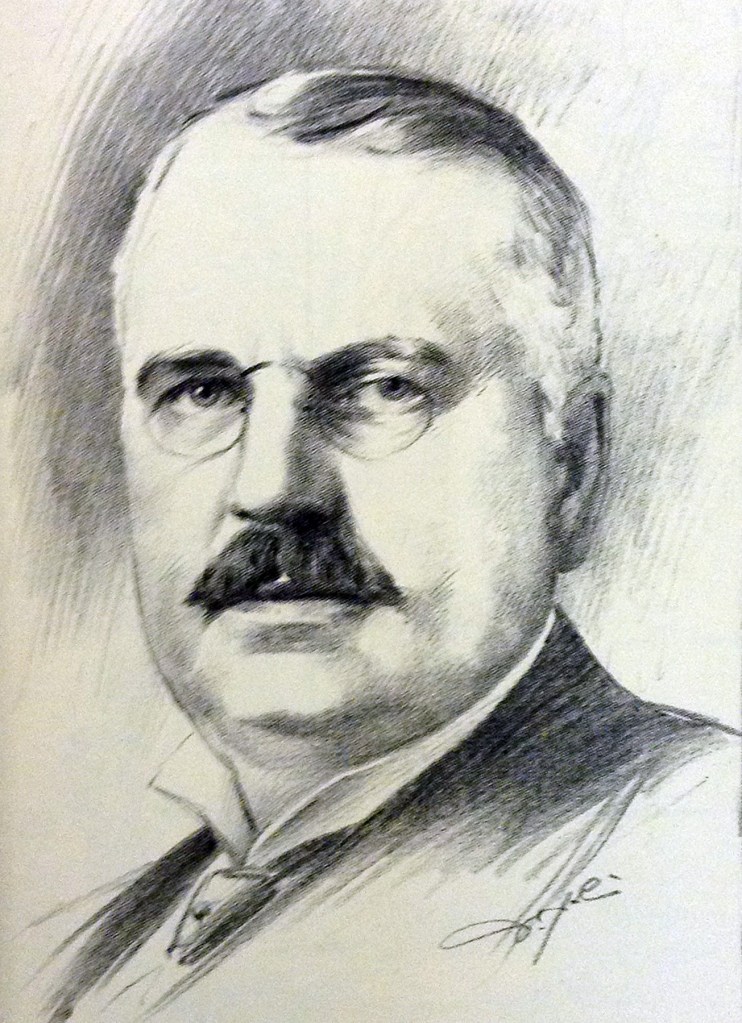
Fig. 2 Andrew Weir in 1917 12
In 1919 he was appointed Minister of Munitions, and he remained in this office until March 1921. His focus now changed to the sale of the vast quantities of army stores which had accumulated during the war. ‘Again, his genius for organization and great business acumen converted what might have been worthless goods or liabilities into considerable assets. It was not without reason that he was termed the man who saved Britain millions.’ For his services he was raised to the peerage as Baron Inverforth, of Southgate on 5February 1919. 13 He was also made a member of the Privy Council and received the American Distinguished Service Medal.
After the war he invested in diesel-powered ships and broadened his business interests. He became chairman of the Marconi Wireless Telegraph Company and president of the Radio Communications Company, the Marconi International Marine Communications Company and Cable and Wireless which was formed by a merger of all the transmission companies. He was chairman of the Anglo-Burma Rice and Wilmer Grain companies and was on the board of Lloyds Bank. He was founder and first chairman of the United Baltic Corporation set up at the instigation of George V to replace German shipping interests in the Baltic.
In 1925, Inverforth bought the 60-room mansion, and eight acres of grounds called The Hill, Hampstead Heath. This property had formerly belonged to Lord Leverhulme. (When Inverforth died in 1955 he bequeathed the house, now known as Inverforth House, to Manor House Hospital. Inverforth House became the women’s section of the hospital and became known as Inverforth House Hospital).14
Andrew Weir and his wife celebrated their golden wedding in 1939, but Lady Inverforth died two years later in 1941. He continued to go to his office four days a week into his ninety-first year. He died at his home in Hampstead on 17 September 1955.15,16 An obituary was published in the Glasgow Herald.17(Appendix 1) His wealth at death was £548,214 1s. 8d.18
‘One thing more remains to be said. Mr. Andrew Weir inherited the moral traditions of Scottish industry. He grew rich, but not ostentatious. His increasing fortune went back and back into trade. He never dreamed either of cutting a figure in plutocratic society or making himself a public character. A quiet, rather shy, and not often articulate person, he lived a frugal life, loving his business because it occupied all his time and satisfied nearly every curiosity of his inquiring mind.’19
‘Inverforth possessed great energy and enthusiasm, and also that almost essential quality of leadership: the ability to select suitable subordinates and leave them to carry on without interference. His integrity, great driving force, and brilliant organizing ability made him a man of power and influence in the commercial world although he shunned the limelight of publicity. His friends and employees, terms frequently synonymous, knew his unobtrusive generosity and kindness. He was particularly approachable: even the most junior employee who had some suggestion towards the improvement or well-being of the firm would be sure of a patient and appreciative hearing and would carry away the remembrance of a kindly twinkle in Inverforth’s eye and a good-humoured quiet voice. In many ways he was a model employer, taking interest in the welfare of his staff and their families both during and after their service with him. For many years, until he was eighty, he was treasurer of the Royal Merchant Navy School and, even after he had handed over this office, he continued to take a deep interest in the children.’ 20
References
Minutes of Glasgow Corporation, 19th January 1943, page 394, Mitchell Library.
The death occurred on Saturday of Lord Inverforth at his home, The Hill, Hampstead Heath, London. He was in his ninety-first year.
Lord Inverforth was one of the greatest shipowners of his time, and his work as Surveyor-General of Supply at the War Office during the First World War and later as Minister of Munitions was of the greatest importance to the nation. He was Andrew Weir and was born in Kirkcaldy in 1865 and educated at Carlyle`s High School. He originally chose banking as a profession but at a very early age his interest turned to shipping.
At the age of 20, having purchased two sailing vessels, he founded the firm of Andrew Weir and Co., with offices in Glasgow. The two ships soon became a fleet, and one of his barques, the Willowbank, gave her name to the Bank Line. In 1896 his first steamship was launched, and this was the beginning of the Bank Line which Andrew Weir and Co. managed.
War Services
During the First World War, Mr. Weir placed his services at the Government`s disposal. In 1917 he was made Surveyor-General of Supply at the War office and a member of the Army Council. Two years later he became Minister of Munitions and remained in that post and a member of the Cabinet until 1921. For his war services he was created a baron in 1919 and made a member of the Privy Council.
On entering the Government he severed his connection with Andrew Weir and Co. and thereafter his business interests lay in wider fields. He became chairman of a number of companies, including the Marconi Wireless Telegraph Company, and when in 1929 the merger of all the transmission companies was arranged Lord Inverforth became the chairman of the new Cable and Wireless, Ltd. and later president and then honorary president. He was also the president of the Andrew Weir Shipping and Trading Company, chairman of the United Baltic Corporation, and the Bank Line. He had been a director of Lloyds Bank and the National Bank of Australasia.
Heir to the Peerage
In 1889 Lord Inverforth married Anne (who died in 1941), younger daughter of Mr Thomas Kay Dowie and they had one son and four daughters. The son, who succeeds to the peerage, is the Hon. Andrew Alexander Morton Weir. He was born in 1897 and is a partner in Andrew Weir and Co. In 1929 he married Iris Beryl, daughter of the late Charles Vincent, 4th battalion, The Buffs, and they have two sons.
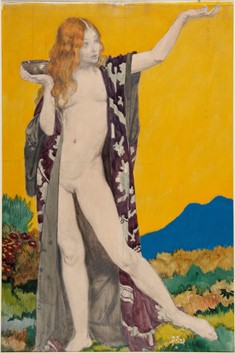
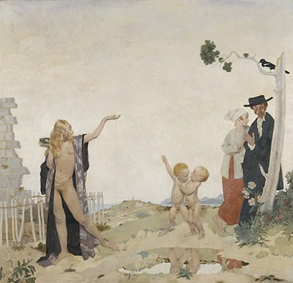
This painting , a watercolour, gouache on paper ,appears to be a study for a larger work Sowing NewSeed for the Board Of Agriculture and Technical Instruction In Ireland (see below Figure 2))which was described by one newspaper as ,’a baffling but beautiful piece of imaginative painting’ when it was exhibited at The New English Art Club in December 1913. 2 (See Appendix A)
The completed painting is now in the collection of the Mildura Arts Centre in Victoria, Australia. 3
The painting was donated in February 1952. The work appears to have been previously owned by T. & R. Annan Ltd , Photographers and Fine Art Dealers of 518 Sauchiehall Street ,Glasgow. According to a letter dated 21 January 1952 from Thomas Craig Annan, one of the directors of the firm, to Dr Tom Honeyman ,the Director of Glasgow Museums, a ‘visitor’ had approached him wanting to know if Dr Honeyman would be interested in the painting if it was presented to Glasgow Corporation and if it might then be loaned to Glasgow School of Art for the students to study. Apparently some of the instructors at GSA had praised the work and had sent students to the Annan Gallery to study the work. The visitor referred to was probably Gilbert J Innes or his representative as the work was presented by Gilbert to Glasgow Museums the following month. There is no information at this date that the painting was loaned to Glasgow School of Art at any time .4
Figure 2 Sowing New Seed c 1913 by Sir William Newenham Montague Orpen (see Appendix B)
By kind permission of the Mildura Art Centre Collection
Senator RD Elliott Bequest. Presented to the City of Mildura by Mrs Hilda Elliot 1956
Donor. Gilbert James Innes (1888-1971)
1888-1914
Gilbert James Innes was born on 5 April 1888 at 24 Oakfield Terrace ,Hillhead in Glasgow. His father was Gilbert Innes ,a draper and warehouseman, and his mother was Margaret Richmond .5 Gilbert was the eldest of four boys . John Richmond was born in 1891, Frederick in 1892 and Thomas in 1894.6 Frederick had a twin sister Margaret who sadly died of whooping cough when eight weeks old .7 By 1901 the family were living at 27 Hamilton Drive in Partick and employed two servants .8 All the Innes boys attended Glasgow Academy ,a private school for boys near Kelvinbridge in Glasgow’s West End. Gilbert was in the Latin Class and attended the school from 1898 to 1904 when he left aged sixteen .9 Gilbert retained a connection to the school throughout his life. For example he was an Honorary Governor of the Glasgow Academicals War Memorial Trust from 1957 to 1971.10 In 1961 he gave £2000 to the school to provide new laboratory equipment for the school .11
In 1908 Gilbert became a member of the Incorporation of Weavers at Trades House in Glasgow. The Innes family had connections to the weaving industry. His father ,Gilbert was a draper and his grandfather, James Innes, was a calico printer and mill manager .12
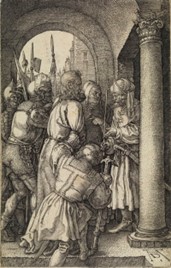
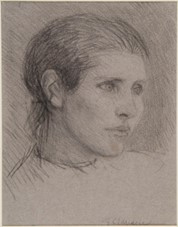
The family had moved to 16 Kirklee Road in Hillhead by 1911. This remained the family home for many years . Gilbert was twenty-two years old in 1911 and was employed as a clerk in a shipping agency .13 His employer was probably P Henderson & Company where his uncle, John Innes, had been a partner since 1887. John Innes was managing director of the company from 1884 to 1927.14 John Innes was a knowledgeable and wide collector of art. He was especially known for as a collector of prints. In the 1920s he presented over 170 prints and etchings to Glasgow Art Galleries including works by Albert Durer, Lucas von Leyden , Rembrandt, Whistler ,Cameron and Boner(see figure 3 ). This donation forms a valued part of the ’black and white ‘ section of Glasgow Art Galleries .It may be that this interest influenced his nephew but this is mere speculation.
Christ Before Pilate by Albrecht Durer(1471-1528) Glasgow Museums Resource Centre PR1920.6aq
Head of a Young Girl by David Young Cameron GMRC 1920.6
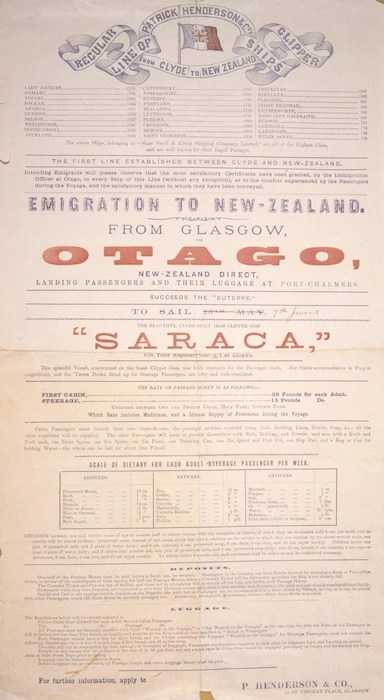
P Henderson & Company had been founded in Glasgow in 1834 by twenty-five year old Patrick Henderson. The company were ship owners, agents and managers. From about 1854 the company began to transport Scottish emigrants to New Zealand in sailing ships and had the contract for Royal Mail to New Zealand. As there was little cargo to carry back from New Zealand at that time the company ships began calling regularly at Burma for cargo such as teak to take back to Glasgow. So successful was this venture that to increase the supply of much needed capital more investing partners were taken on in 1860 and formed The Albion Shipping Company Ltd which dominated trade with New Zealand and in 1882 pioneered the first refrigerated frozen meat shipment from New Zealand to London using sailing ships as there were no coaling stations en route at that time.
Figure 4 Poster advertising emigration from Glasgow to Otago, New Zealand.
In 1865 the opportunity arose to become involved in the Irrawaddy Flotilla Company which operated a ferry service on the Irrawaddy River in Burma. This company was managed by P. Henderson and Company from Glasgow and by the nineteen twenties operated over 600 ferries on the river .16 The company also started a steamship service between Glasgow, Liverpool and Burma in 1870 which in 1882 need capital for expansion and amalgamated with Shaw Savill and Company becoming Shaw, Savill &Albion Co Ltd. The ships continued to be managed by P Henderson & Company for whom our donor probably worked after leaving school at sixteen .17
1914-1919
Gilbert and his three brothers all served in the army during World War One. Gilbert’s service at the beginning of the war is rather confusing as he appears to have originally enlisted with 9th Battalion Highland Light Infantry as a private but in August 1915 he was transferred to the 8th Battalion Scottish Rifles(The Cameronians) as a 2nd Lieutenant .18 It appears that these two battalions both served at Hamilton Barracks at the beginning of the war and transfers between battalions were quite common 19, especially if a soldier had previous officer training as Gilbert may have done in the Glasgow Academy Officer Training Corps which was attached to the 9th Battalion HLI from 1908.20 Gilbert served in Egypt, Palestine and in France between 1916 and 1918. He was wounded in France in July 1918 by which time he was a captain in the 8th Battalion Scottish Rifles. Lt Colonel J.M. Findlay who was the commanding officer of the 8th Battalion in his book With The Scottish Rifles 1914-1918, writes , ‘Innes ,my adjutant, was badly wounded ‘. This was at a battle in Baigneux which was fought between 28 July and 4 August 1918.21 Gilbert’s brother John was also serving in the 8th Battalion though John may have ended war as a captain in Royal Engineers .22 All the Innes brothers survived the war.
Post War Years
Gilbert was made a partner at P. Henderson and Company in 1920.23 He was principally concerned with the design of ships and later with the passenger side. He played an active part in the world of shipping becoming a member of several organisations connected to shipping. For example he was a member of the management committee and later chairman of The British Corporation Classification Society, later The British Corporation Register of Shipping and Aircraft, before its absorption by Lloyds Register of Shipping. He was elected as a member of the General and Technical Committee of Lloyds Register of Shipping 24 and was an underwriter for Lloyds. 25 He served as honorary treasurer of The Institution of Engineers and Shipbuilders in Scotland 26 and also became chairman of the Clyde Lighthouse Trust .27
At the time of the 1921 census Gilbert was a boarder staying at Ellerslie, a guesthouse in Cove, a popular holiday destination on the Clyde Coast. Also staying the house were two nurses, one of whom was Dorothy S.Prain .28 We do not know if Gilbert and Dorothy already knew each other or if this is when they first met but they were married on July 12 1922 in Dundee .29
Dorothy was born in Longforgan , Perthshire on 29 April 1893. Her father was John Prain ,a farmer at the time of her birth. Her mother was Nellie Boyd Scrymegeour .30 Dorothy attended the High School of Dundee .31 Dorothy’s mother died in 1907 aged only thirty-three 32 and her father married again in 1913.33
There is no information as to Dorothy’s activities during WW1 but she trained to be a nurse at the Western Infirmary in Glasgow and was registered as a nurse in 1919 so presumably she was undergoing nursing training during the war . 34 Perhaps Dorothy and Gilbert met in the hospital while Gilbert was recuperating from his wounds.
According to the tradition at that time Dorothy would have given up her nursing career on marriage. The couple lived at 8 Queensburgh Gardens in Hillhead Glasgow after their marriage and on July 15 1928 a daughter Doreen Prain Innes was born. Doreen was born at a private nursing home at 1 Claremont Terrace in Glasgow. 35 There were several nursing homes in Claremont Terrace at that time. 1 Claremont Terrace was run by Henrietta Gunn who was an experienced nurse and midwife. 36
During the nineteen twenties Gilbert travelled abroad several times and spent time in Burma possibly because of P. Henderson &Company’s connection with the Irrawaddy Flotilla Company. In March 1928 he and his uncle John Innes travelled to Rangoon in Burma on the SS Amorapoora and later that year Gilbert and Dorothy travelled to Rangoon on the SS Yoma departing from Liverpool on 26th October 1928.37 Both ships were owned by the Henderson Line. Whether daughter Doreen travelled with them is unknown as she would have been only three months old at the time.
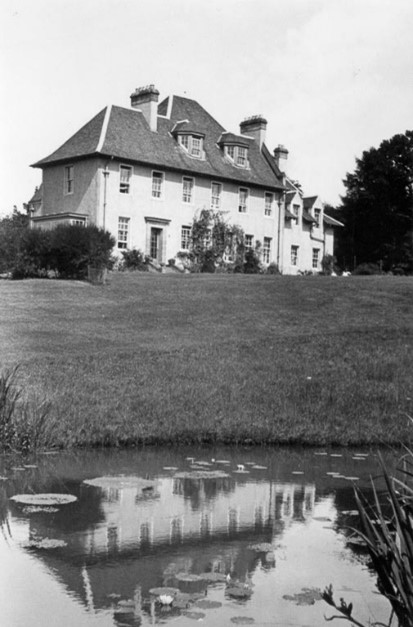
At the end of the decade the Innes family moved to Killearn in Stirlingshire where they built a house called Gartaneaglais .38 The house was designed by a naval architect called Gardener and the garden by J B Wilson. 39
Gilbert continued to be involved in the shipping industry after the move to Killearn both as a partner in Patrick Henderson Ltd and in various shipping concerns as well as being an underwriter for Lloyds. One example in 1953 was his bid to became a major shareholder in the Liverpool Steamship Company. 40
Our donor appears to have had an interest in charitable activities throughout his life. In 1930 he was elected a member of the Incorporated Glasgow and Stirlingshire and Sons of the Rock Society an organisation founded to help those in need. The annual dinner was held at the Golden Lion Hotel in Stirling. 41
He was also a founding member of The Killearn Trust which was founded in July 1932 for the ‘promotion and advancement of the welfare and interests of the Parish of Killearn.’ Gilbert is quoted as ‘the moving spirit’ of the Trust and remained its chairman until his death in 1971.42 The activities of the Trust are too numerous to mention here but one of the main activities was to provide housing for those in need in the community. 43
Gilbert was, like his Uncle John, a collector of art including the Scottish Impressionists. He gave several paintings from his collection to The Glasgow Academy. 44 He was listed as a member of the council of the Royal Glasgow Institute of Fine Arts when it met at the Glasgow Art Club in March 1937.45 Gilbert was also a keen photographer. Several local photographs taken by Gilbert were included in the second edition of a book about Killearn The Parish of Killearn. 46 As we have seen Gilbert also took an interest in Glasgow School of Art (GSA). He was a member of GSA Board of Governors from 1935 and Vice Chairman from 1941 to 1967. From 1936 to 1949 he was Convenor of the School and Staff Committee and Honorary Vice President from 1967 to 1972.47
Dorothy Innes also played a part in community activities .To support the war effort during WW2 for example on 2 November 1939 she presided over a meeting of the Killearn Red Cross Society. 48 In May 1942 Mr and Mrs Innes invited local people to visit the gardens at Gartaneaglais to view the great show of daffodils, narcissi and flowering shrubs and to give donations to the Women’s Royal Institute (WRI) Comforts Fund for HM Forces. 49 In June 1944 on behalf of the Dumgoyne WRI Mrs Innes granted the use of her kitchen at Gartaneaglais for the canning of fruit. 50 In December 1945 an advertisement appeared in the Stirling Observer for a Christmas Sale of toys and fancy goods at Gartaneaglais in aid of the Thanksgiving Fund. 51 These are only a few of many such events.
Participation business and the local community is a constant theme in our donor’s life. He was a member of the Glasgow Chamber of Commerce and was Convener of the Postal, Telephone and Telegraph Committee in the 1940s. 21 He was a member of the Glasgow Western Hospital Board of Management. When a new medical rehabilitation and geriatric hospital opened at Killearn Hospital in 1957 Gilbert stated, ’Western Hospitals Group, since the inception of the NHS, had been very much in need of the facilities now provided in Killearn’. 53
Gilbert was also involved in business and commercial education. At some point he became vice-chairman of the Board of Governors of the Glasgow and West of Scotland Commercial College Ltd 54 which had been founded in 1915 and which moved to a new building at 173 Pitt Street in Glasgow in 1934. Among its courses the college offered qualifications in business and commerce, librarianship and secretarial studies and ran the Scottish Hotel School which was based at Ross Hall in Crookston in Glasgow. In 1955 this college became The Scottish College of Commerce. In 1964 the college joined with the Royal College of Science and Technology in George Street, Glasgow to form the new Strathclyde University. In 1975 173 Pitt Street became the headquarters of Strathclyde Police. 55
There is little further information regarding the Innes family other than they often spent holidays in Iona for which they had great affection. 56
Daughter Doreen attended St Andrews University and in 1950 graduated with a BSc in Mathematics and Astronomy 57 going on to earn an Honours BSc in 1952.58 She married William Thomas Foster in 1956.59
It is to be assumed that Gilbert continued his involvement in the various activities described above as his contribution to the community and the business world was recognised in the Queen’s Birthday Honours in 1963 when he was awarded an OBE in June specifically for his services as chairman of the Glasgow War Pensions Committee. 60 Gilbert had been involved in this organisation since at least 1937 when he was vice-chairman. 61
Dorothy Innes died, aged 74 on November 1 1967 of bronchopneumonia while staying in Perth possibly with a cousin A. M Prain who witnessed the death certificate. 62
Gilbert died on 2 November 1971 aged eighty-three at Cannisburn Hospital Bearsden of ,’peripheral vascular failure’ and artherosclerosis’. 63
Our study is of the naked female on the left of the full painting. The inspiration for the completed painting was reported to be a reaction to Orpen’s anger that at that time in Ireland government grants for art and education
came from Whitehall under the direction of the Irish Board of Agriculture. Orpen was horrified by this situation which he thought was bizarre and furious that agriculture received far more funding than art. His painting is thought to mock the attitudes of the government using allegorical figures. The nude female(our study) represented the sowing of new ,more progressive ideas while the naked children appear as the offspring of this intellectual enlightenment. The peasant couple on the right and the ramshackle farmhouse with the pig-pen to the left signified the Board of Agriculture’s awkward attitude towards art and culture.
Appendix B The Artist
William Newenham Montague Orpen (1878-1932)
William Orpen was born in Stillorgan ,County Dublin and studied at the Dublin Metropolitan School of Fine Art for six years from the age of thirteen. He won every major prize including the British Isles Gold Medal for life drawing. He then moved to London and studied at the Slade School from 1897 to 1899. He had a private teaching studio in Chelsea along with Augustus John ,a fellow Slade graduate. He split his time between Dublin and London and built a lucrative reputation painting society portraits as well as group portraits known as ‘conversation pieces’ for example The Café Royal in London (1912).During WW1 he was a war artist based mainly in Amiens, travelling to the Somme in April 1917. He painted portraits of Douglas Haig and Sir Hugh Trenchard, commander of the Royal flying Corps. He continued to be successful after the war exhibiting at the New English Art Club and The Royal Academy .4 Orpen also had connections to Glasgow School of Art. During the 1914 to 1915 academic year Orpen was an assessor for diplomas, scholarships and bursaries (Drawing and Painting) and one of the judges for the Haldane Travelling Scholarships.
Acknowledgements
I would like to offer many thanks to the following people for their help in the research for this report:
Jillian Peterson of the Mildura Arts Centre ,Victoria, Australia
Fiona Glass ,a member of the Innes family and editor of the 3rd edition of The Parish of Killearn.
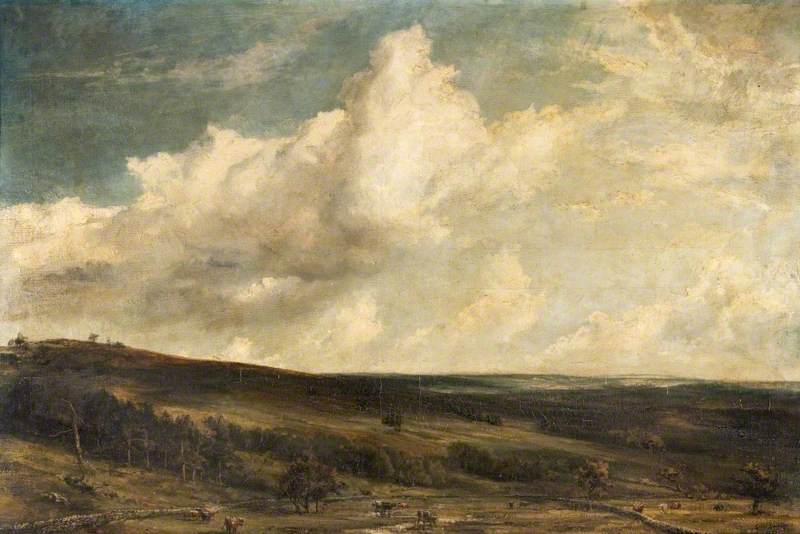
An oil painting titled Barden Moor by Cecil Lawson was received by Glasgow Corporation from Mrs. Graham, 4 Belgrave Crescent, Edinburgh on 29 February 1924.1
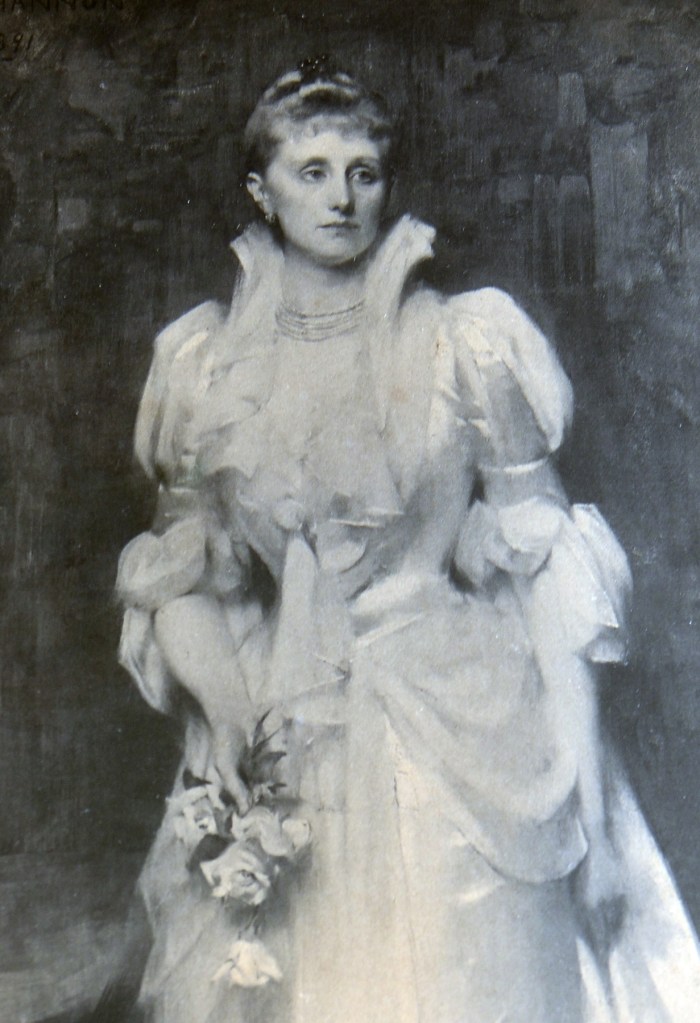
Gertrude Lawrence Clara Dunsterville (Mrs. Clara Graham) was born on 16 September 1853 in Bombay, India. She was christened at Naseerabad, Bombay on 11 October 1853. 2 Clara (as she preferred to be called) was born into a family with a history of service in the Indian Army. She was the eldest daughter of Colonel James Barnes Dunsterville and Harriet Birch who had married in Deesa, India in 1847. Her father was attached to the 19th Regiment of Native Infantry and at that time was Assistant Commissary General of the Bombay Army. Her grandfather, General James Henderson Dunsterville, was Commissary General of the East India Company. He married Clara`s grandmother, Lucy Barnes, in Bombay in 1817. Clara`s sister, Harriet Mary, married Lt. Col. Arthur Shewell in Bombay in 1869 3. One of Clara`s cousins, Major General Lionel Charles Dunsterville, was a friend of the author Rudyard Kipling and served as the model for ‘Stalky’ Corkran in the author`s stories of Stalky and Co.4 On 3 August 1872, aged eighteen, Clara married twenty-eight year old Donald Graham in Bombay 5. He was a son of John Graham of Skelmorlie, Ayrshire who had extensive business interests in Scotland, India and Portugal based on textiles and port wine.
Fig. 2 Mrs. Clara Graham in her wedding dress 6
Very soon after their marriage the couple travelled to Scotland and took up residence in Skelmorlie Castle in Ayrshire the home of Donald`s parents and on 15 May 1873 their first child, James Dunsterville Graham was born. 7 The family then returned to Bombay probably because of Donald`s business interests but also because Clara`s widowed mother was still living there. Two further sons were born in Bombay, Donald M. N. Graham on 12 November 1874 and Charles T. J. Graham on 4 December 1877. 8 Thereafter the family returned to Scotland possibly as late as 1880. They were probably accompanied by Clara`s mother and sister who was widowed that year.9 In the 1881 census Donald, Gertrude (Clara) and their three sons were living at Skelmorlie Castle 10. A fourth son, Archibald, was born in Edinburgh in 1882. This birth was registered in both Largs and Edinburgh. Another son, Maurice, was born at Skelmorlie in 1888. 11 Donald Graham bought Airthrey Castle and estate in Stirlingshire from Lord Abercrombie in 1889 for the sum of £75,000. He built a large extension to the castle at a cost of a further £15,708 and planted the grounds with conifers and rhododendrons. 12 In the 1891 census, Donald and Gertrude and four of their sons were living at Airthrey Castle. 13 Clara gave birth to three more sons there between 1892 and 1898.
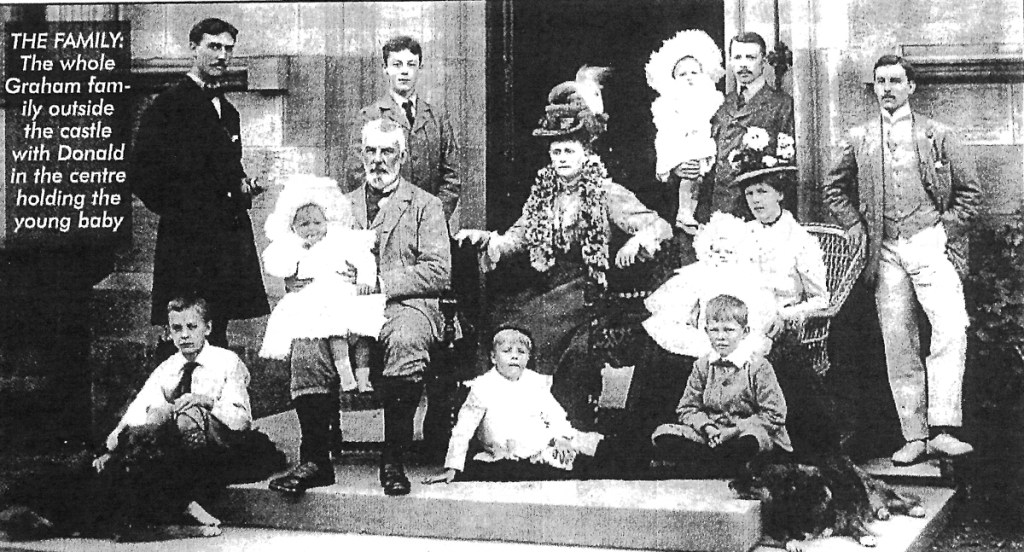
Fig. 3 Donald and Clara Graham and family , Airthrey Castle (about 1898) 14
Donald Graham died at Airthrey Castle on 23 January 1901 after a short illness. He was buried in Logie Churchyard and Clara commissioned a stained-glass window to be placed in the new Logie Church in his memory. 15 Clara continued to live at Airthrey Castle and in the 1901 census she was the head of the family, aged 47 with four sons at home. 16 Ownership of the estate was formally handed over to her by Donald`s trustees on 15 May 1902 17. In the 1911 Census, Clara and two of her sons, John and Nigel were living at Airthrey Castle together with her widowed sister Harriet (Shewell) and a niece. 18 In 1924, Airthrey Castle was leased to Charles Donaldson of the shipping family Donaldson Brothers.19 This coincides with the date of donation of the painting and most probably resulted from Clara ‘downsizing’ to move in, at least temporarily, with her niece in Belgrave Crescent, Edinburgh. The painting would have been given to Glasgow because of her husband`s business connections with the city. Clara Graham died aged seventy-nine on 20 April 1932, at 9 Weymouth Street, Portland Place, London. 20 She was buried beside her husband and two of her grandchildren in the Old Churchyard of Logie Kirk, Bridge of Allan on 23 April. Six of her sons acted as pallbearers. 21 In the course of her funeral service, the Rev. W. McIntyre referred to the work Mrs. Graham had done as a heritor in the parish, (with which she had been associated for nearly fifty years), and of the widespread interest she took in its welfare. He commented that ‘she was esteemed for her charity and her own spirit and personality and her loyalty to those who served her’. 22
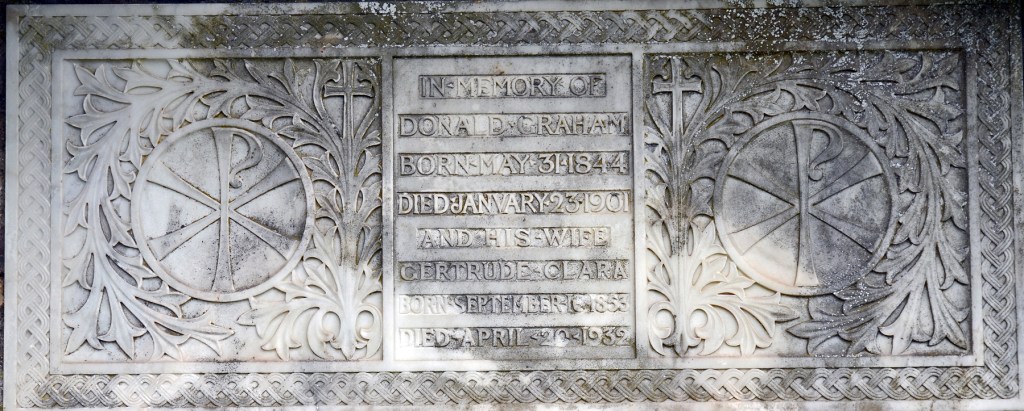
Fig. 4 Memorial plaque to Donald and Clara Graham on the wall of Logie Old Church. (Photo by author)
Airthrey Castle became a maternity hospital in 1939. Airthrey Estate continued in family ownership until 1946 and eventually became the campus for the University of Stirling.
Edinburgh Connection Donald Graham`s sister Margaret married Henry Hill Lancaster an advocate and essayist. Their daughter, Elizabeth Ethel Graham Lancaster married Sir Ludovic James Grant, Regius Professor of Public Law at Edinburgh University. The Grants owned the house at 4 Belgrave Crescent, Edinburgh from where the painting was donated in 1924. Elizabeth Grant was Clara’s niece with whom she was living at this time, Airthrey Castle having been leased to Charles Donaldson. The writer and broadcaster Sir Ludovic Kennedy was born at 4 Belgrave Crescent in 1919. He was the grandson of Sir Ludovic and Lady Grant.
The Painting The painting was bought by John Graham (father-in-law of Clara) soon after it was completed in 1881. It was lent by him to the Royal Glasgow Institute of the Fine Arts (RGI) Exhibition of 1882. 23 The painting then passed to Donald Graham and was lent by him to the Glasgow International Exhibition of 1888. The minutes of Glasgow Corporation of 5 January 1934 record that the painting was lent to the Paisley Art Institute for their 58th Exhibition to be held that year. 24
The Graham Family The firm of W. & J. Graham & Co has its roots in a Glasgow based textile concern. However, the family had extensive business interests not just in their native Scotland but also in India. The success of their affairs led to them being described by a contemporary historian, as being ‘among the merchant princes of Great Britain’. At the early age of fifteen, John Graham undertook the establishment of a branch of the firm at Leghorn, which continued until the success of Napoleon’s policy excluded British commerce from all the continental markets except Portugal. Therefore, an office of the company was established in Oporto, Portugal`s second city. In 1820 John and his brother William, who were then managing the office, accepted 27 pipes of Port wine in settlement of a bad debt. This Port was shipped to the parent company in Glasgow which initially reprimanded the brothers for not sending cash. Fortunately, however, the Port turned out to be very popular and soon William and John were being urged by their parent company to acquire and ship more of this wine. The brothers formed the partnership of W & J Graham & Co. with the aim of specialising in the production of the finest Port wines. They channelled their considerable resources and energy towards the pursuit of this goal. In 1839 the firm, by the formation of a house at Bombay, extended its business operations to India; and again in 1863 a separate firm was established at Calcutta and later a branch was formed at Kurrachee. 25 John Graham retired to Skelmorlie Castle in Ayrshire. He was well known in Glasgow as an enthusiastic supporter of the fine arts. From its foundation in 1861 he had contributed paintings each year to the RGI Loan Exhibitions and in 1878 this amounted to twenty-six pictures including works by Turner and Gainsborough. ‘All the canvases shown …..are no more than so many specimens of what his private gallery really is. They only enable us to judge ……of the wonderful treasures of the Skelmorlie mansion’. 26 He died at Skelmorlie Castle on 4 October 1886 aged 89 years. Donald Graham, C.I.E., was born in Oporto, Portugal in 1844 and educated at Harrow. He was a son of John Graham of Skelmorlie and Elizabeth Hatt Noble. His business interests were centred in Glasgow and Bombay. He was made a Companion of the Most Eminent order of the Indian Empire (C.I.E.) for his services on the Legislative Council of Bombay. In 1896 he was vice-president of the Glasgow Chamber of Commerce and was elected Lord Dean of Guild the following year. His business address was ‘W. & J. Graham & Co., 55 Cathedral Street, Glasgow’ later becoming ‘Graham, D. and J. & Co., merchants’.27 He was also a JP for Lanarkshire and Deputy Lieutenant of the City of Glasgow and Stirlingshire.
References
Minutes of Glasgow Corporation, Sub-Committee on Art Galleries and Museums, 29February 1924.
FamilySearch, United Kingdom, British India Office, Births and Baptisms, 1712 – 1965. (Her date of birth is given incorrectly in Family Search. The correct date is taken from the plaque in Logie Old Churchyard).
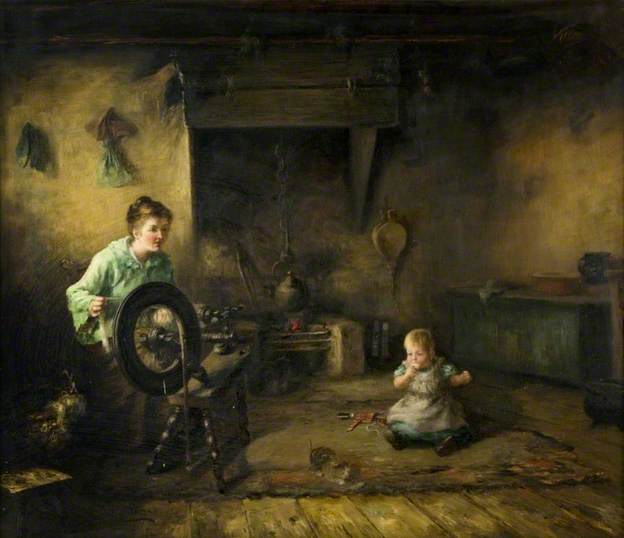
There was submitted an offer by Dr A. J. Ballantyne, 11 Sandyford Place, Glasgow C3, to gift the oil painting Interior by Tom McEwan, and the committee, after hearing a report from the director, agreed that the picture be accepted and that a letter of thanks be sent to the donor.1 The painting was received on 30 January 1942.
Fig. 1 Interior – (The Spinning Wheel) (2268) – Tom McEwan
The painting was exhibited at the Royal Glasgow Institute of the Fine Arts Annual Exhibition of 1895, priced at £65 2
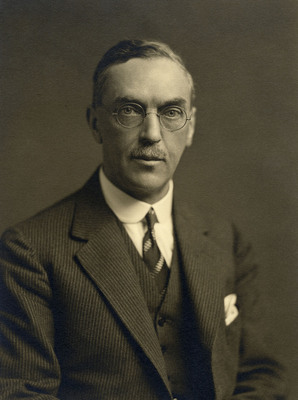
Fig. 2 Arthur James Ballantyne (1876 – 1954)
Arthur James Ballantyne was born on 13 July 1876, at 36 Dalhousie Street, Blythswood, Glasgow 3. He was one of a ‘large and brilliant family of a Glasgow merchant.4
His father Thomas Ballantyne was a pawnbroker and jeweller who had married Jane Kate Chalmers on 20 September 1870 in Glasgow 5. Thomas Ballantyne was born in Paisley in 1828, and this was his second marriage. Jane Kate was born in Dundee in 1838. According to the 1881 Census, in addition to Arthur, aged four, there were nine other siblings at 36 Dalhousie Street ranging in ages from 20 years to 2 months 6. Thomas Ballantyne died of cancer in 1887 leaving Jane ‘living on private means’. 7 The family moved to 260 Renfrew Street, Glasgow and in the 1891 Census there were eight children at home with one servant employed 8.
Arthur Ballantyne was educated at Garnethill School, Glasgow and graduated M.B., Ch. B. in 1898 and M.D. in 1901 from the University of Glasgow. 9 His doctoral thesis was entitled Contusion Injuries to the Eyeball. 10 After spending a year at the University of Vienna, he returned to Glasgow and spent two years as Assistant House Physician and Assistant Surgeon at the Glasgow Eye Infirmary. He joined the Ophthalmological Society of the United Kingdom in 1903 and in 1906 was elected to the Fellowship of the Royal Faculty of Physicians and Surgeons of Glasgow. He was appointed Surgeon at the Glasgow Eye Infirmary in 1909 – a post he held until 1935. In 1909 he was appointed Professor of Physiology at Anderson`s College of Medicine. This post was relinquished in 1914 when he became Professor of Ophthalmology at the College. The previous year he had held a similar post at St. Mungo`s College. 11
At the 1911 Census,Arthur was living with his mother and brother Thomas who was a civil engineer and two servants at 11 Sandyford Place, Anderston. His occupation was ‘physician, eye-specialist. 12 On 14July 1916 he attended a meeting of the Oxford Ophthalmological Congress where he read a paper on Quinine Amaurosis. He was then ‘Surgeon to the Glasgow Eye Infirmary’ 13. During the latter stages of the First World War, he was given a temporary commission as a lieutenant in the Royal Army Medical Corps and was appointed Ophthalmic Surgeon to the 67th General Hospital in Salonika 14. When he arrived in Salonika, he was to take the place of a certain Dr Tom Honeyman (later Director of Kelvingrove Art Gallery and Museum, Glasgow) who had become ill due to an attack of fever.15
In 1920, Ballantyne was appointed Lecturer in Ophthalmology at the University of Glasgow. In the same year, on 23 June, at the age of 43, he married Jessie Snodgrass, the daughter of one of his colleagues. She was 27. The marriage took place in the Grand Hotel, Glasgow 16. Sadly, Jessie died from eclampsia on 27January 1928. 17 It may have been on this occasion that he reportedly wrote to a colleague, ‘These have been sad days for us, but work and service remain to make life worthwhile.’ 18
Part of this “work” involved travelling to give lectures on his research and on 15 August 1930, he arrived in Montreal, Canada aboard the Duchess of Bedford. His final destination was St. Albans, Vermont in the U.S.A. 19 almost certainly to deliver lectures there.
He was appointed the first Tennent Professor of Ophthalmology at the University of Glasgow in 1935, a post he held until his forced retirement in 1941 due to age rules. (The Tennent chair was the first in Ophthalmology to be founded in the United Kingdom. It was endowed by Gavin Patterson Tennent who graduated M.D. from the University in 1870). On his retirement, Arthur Ballantyne was awarded an LL.D. by the University and made an Emeritus Professor. 20
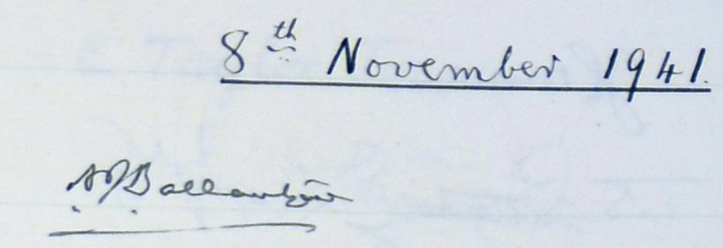
Fig. 3 Arthur Ballantyne`s signature on the Register of Awards of Honorary LL.D. s 21
He ‘continued his ground-breaking research in diabetic retinopathy’ and was awarded the Mackenzie Medal in 1942. (This award was established in 1924 to mark the centenary of the Glasgow Eye Infirmary. It was named after its founder and was awarded to an eye surgeon who had made a special contribution to ophthalmology). In 1943 Dr Ballantyne delivered the Montgomery Lectures in Dublin and in 1946 the Doyne Memorial Lectures at Oxford. 22
In 1947 he travelled to Roanoke College in Virginia to be awarded an honorary D.Sc. degree. It was recorded in the immigration papers that he was ‘aged 70 and a widower, 5 ft 5 ins tall, fair complexion with grey hair and grey eyes’.23 He continued to publish original research and in 1950 was awarded the Nettleship Medal for the ‘best piece of original work by a British ophthalmologist published in any journal during the previous three years’. 24
Despite living all his life in the West End of Glasgow, Arthur Ballantyne retired to the village of Killearn, and he died there on 9 November 1954 aged 78. The cause of death was cardiovascular degeneration. 25 His estate was valued at £83,051:14:0 26. An obituary recorded that while ‘His professional work claimed most of his time, he was an expert in colour photography and a connoisseur of art in which he was not a mere dilettante; he was a member of the Committee of the Glasgow Institute for Fine Arts and was on the hanging committee’ (of that Institute). 27 An obituary was also published in the British Journal of Ophthalmology.28
Arthur Ballantyne was a ‘prolific contributor to medical literature’ and had an international reputation for his research activities. He served upon the editorial committees of the Glasgow Medical Journal, the Ophthalmoscope, Ophthalmologica, and the British Journal of Ophthalmology. He was co-author of the Textbook of the Fundus of the Eye which was published posthumously in 1962. A description of the book stated that; “The problems of the fundus of the eye were the life-long study of the late Professor Arthur J. Ballantyne who brought to them an unusual patience fordetail and an appreciation of their importance in the understanding of the total picture. He stimulated a generation of Glasgow ophthalmologists with his interest”. 29
References
Minutes of Corporation of Glasgow, 17 February, 1942, C1/3/105, p791.
Billcliffe, Roger, The Royal Glasgow Institute of the Fine Arts, 1861-1989: A Dictionary of Exhibitors at the Annual Exhibitions, (Woodend Press, 1990).
Scotland`s People, Birth Certificate
Thomson, A. M. Wright The Glasgow Eye Infirmary, 1824-1962
Scotland’s People, Marriage Certificate
ancestry.co.uk, Scottish Census, 1881
Thomson, A. M. Wright The Glasgow Eye Infirmary, 1824-1962
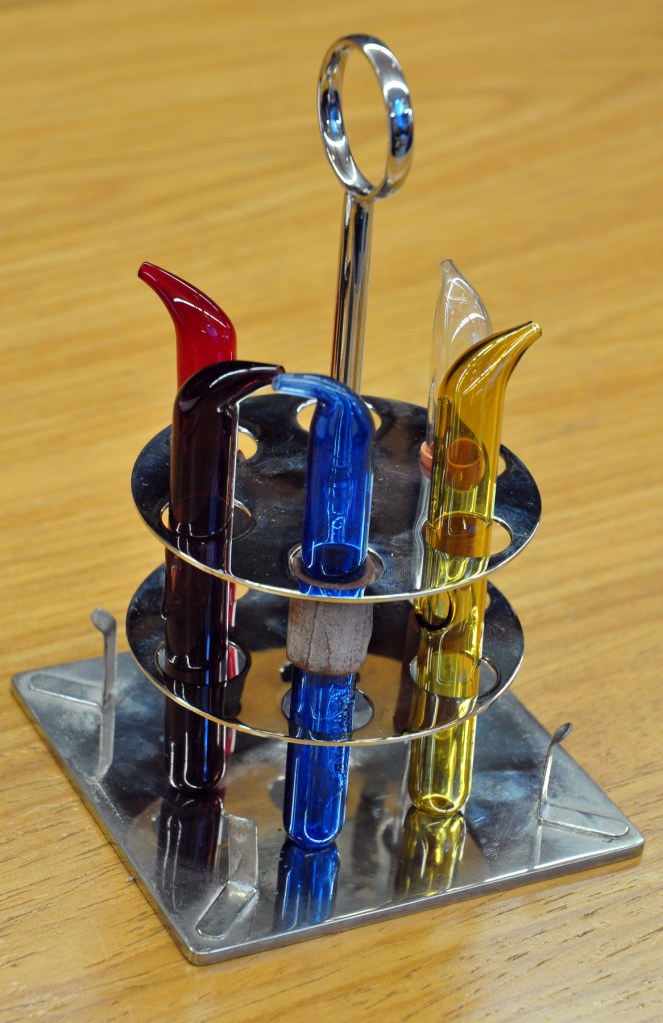
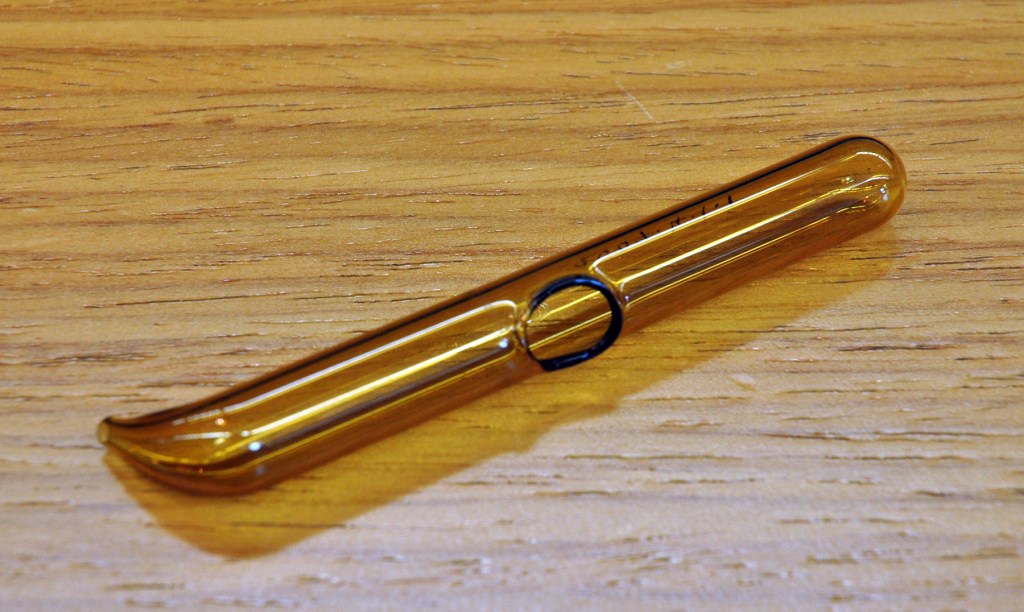
The library of the Royal College of Physicians and Surgeons of Glasgow has a set of instruments called Ballantyne Droppers. These were used and probably designed by Arthur Ballantyne.
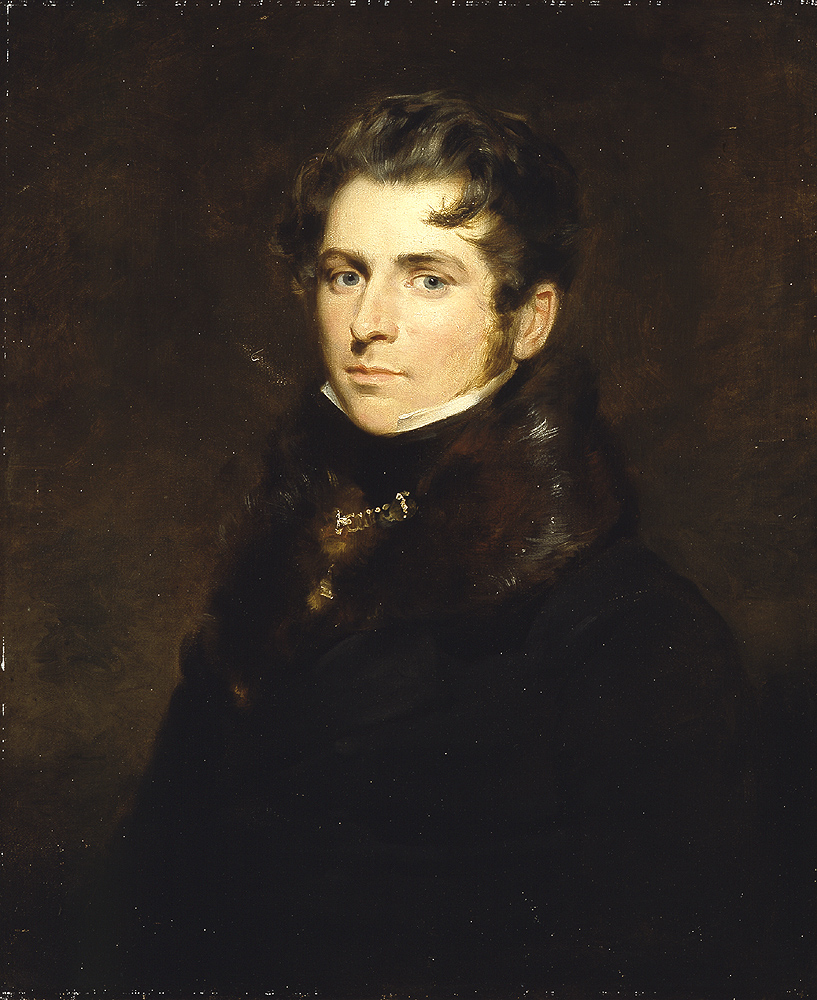
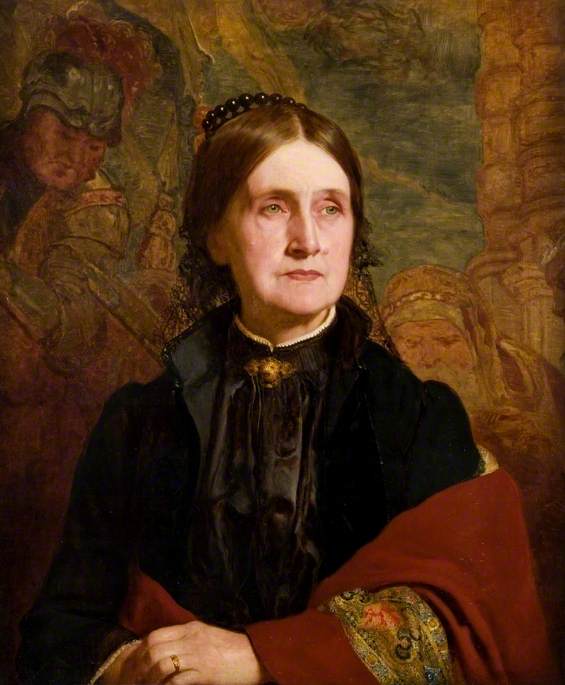
This portrait was donated in June 1915 by his son, William Heath Wilson, artist, in memory of all that his father had contributed to the teaching of art in the city of Glasgow.
The artist was Sir John Watson Gordon (1788-1864) who was a successful portrait painter of the artists, literati and intellectuals of his day.(1) He was a founding member of the Royal Scottish Academy in 1826.
William Heath Wilson
William was his father’s fourth child and the only son of his second wife, Johanna Catherine, daughter of William John Thomson, himself a portrait painter. He was also the grandson of the artist Andrew Wilson.
He was born in Edinburgh in 1849 and lived in the United Kingdom until 1868 when the family moved to Florence, Italy, and he was still living there in the 1870’s and 1880’s.(2)
He was taught to paint by his father at Glasgow School of Art and specialised in genre scenes and landscape painting, mostly in oil and mostly on a small scale. He painted in the Impressionist Style. His paintings are of Scotland, Italy, London and Cairo. Ten of his works are in the Glasgow Museums’ collection in Glasgow Museums Resource Centre at Nitshill.
In 1881 he married Isabella Clements who had been born in 1853.
He used to travel to London every year between 1884 and 1899 to exhibit his work at the Royal Academy, London.
His work was, and continues to be, very popular, and frequently appears for sale in Auction Houses, including Christies. Prices for his works are also increasing.(3) An auction of the contents of Hopton Hall, Worksworth in 1989 saw four of his paintings sold there.(4)
Charles Heath Wilson ‘Missionary Of Art’
Charles was not a donor of paintings to Glasgow Museums although there are some of his works in their collections. He is, however, one of the most important figures in the history of Fine Arts in Glasgow.
He was born in September 1809 in London, the eldest son of Andrew Wilson, landscape painter and art importer, and Master of the Trustees Academy from 1818-1826. He trained for a short period with Alexander Naysmith and worked in London, and was friends with David Wilkie.(5)
Charles studied painting with his father and accompanied him to Italy in 1826, where he studied ancient architectural ornament. He stayed there until 1833, when he returned to Edinburgh, where he practised as an architect, and taught ornament and design in the School of Art. (6)
The 1841 census has him living in Woodhill Cottage, Corstorphine with his wife and daughter.(7)
His pictorial work was principally in watercolour and one of his paintings is in the National Gallery of Scotland – a fine watercolour of Florence and the Arno. He gave several works to Glasgow University in 1869. He was also an expert on Fresco Painting.
In 1835 he was elected ARSA but he did not not exhibit after 1842, which resulted in his resignation in 1858.
He was interested in stained glass and spent 10 years re-glazing Glasgow Cathedral, working with the Board of Trade, and using panels made in Munich. This caused considerable controversy with those who thought that the glass should come from elsewhere but he did have the support of such people as the Duke of Hamilton and Sir John Maxwell of Pollock.(8)
He was twice married – firstly to Louisa Orr, daughter of the surgeon John Orr, in 1838; and secondly, in 1848, to Johanna Catherine, daughter of William John Thomson, the portrait painter. Altogether he had two sons and three daughters.
He was passionately interested in education. Between 1837 and 1843 he was Head of the Department of Design at Edinburgh Trustees Academy. In 1840 he visited the Continent and reported to the Government on Fresco Painting. Between 1843 and 1848 he became Director of the Government Schools of Design at Somerset House in London. It was in this capacity that he co-founded, together with John Mossman and others, the world renowned Glasgow School of Art (then known as the Glasgow School of Design).(9)
In 1849 he moved to Glasgow and lived at 29 St. Vincent Place. He was appointed Headmaster of the Government School of Design in Glasgow, which was housed at 116, Ingram Street. The school was immediately oversubscribed and additional space was purchased in Montrose Street.(10)
In 1853, with the creation of the Science and Art Departments, it became the School of Art. While Headmaster, Wilson made many changes to the school. He introduced life classes and set up a mechanical and architectural drawing class. He taught a class on practical geometry and superintended the advanced class. The courses of study were modified to retain established designers and pattern drawers in the school. He worked closely with the Mossman Brothers who were teaching many of the sculptors and carvers who produced the bulk of the city’s architectural sculpture and monuments in the Glasgow Necropolis and who studied their craft at evening classes in Ingram Street.
Wilson was also involved with the creation of another of the city’s great institutions, the McLellan Galleries whose treasures formed the nucleus of Glasgow’s civic art collection in 1856.
He continued with painting and architecture and was involved in several commissions and competition designs. In 1855, along with the Mossmans, he designed the monument to Henry Monteith of Carstairs in the Necropolis.(11)
In the 1861 census he was living at 286 Bath Street. (12)
In 1864 the Board of Trade masterships were suppressed and Wilson was pensioned off, although his involvement with the School of Art continued for a few more years. He became an Honorary Director of the School of Art and one of the trustees of the Haldane Academy. He gave evidence to several House of Commons Select Committees and prepared a Report for the Commission on the Design of the National Gallery.(13)
After leaving the Art School, he returned to full-time practice as an architect in 1864, opening an office at 29 St. Vincent Place, and formed a partnership with a former pupil, David Thomson.(14)
One of their projects was the monument to John Graham Gilbert in the Glasgow Necropolis, designed in 1867. In the same year they redesigned the interior of the Maclellan Galleries, converting part of the building into a picture gallery for Glasgow Corporation. They made alterations to the stables at Pollok House and rebuilt Duntreath Castle, Strathblane in 1864. These are just some of a long list of commissions and designs worked on by the partnership.(15)
In 1868 he inherited a large sum of money and in 1869 he and his family went to live in Italy. He never returned to Scotland.(16)
He spent his last years in Florence, where he was at the centre of a large circle of artists and writers. He wrote a book entitled Life of MichaelangeloBuonarotti in 1876 and he also illustrated some books for which he was awarded the cross of the ‘Corona d’Italia ‘ by Victor Emmanuel.(17)
He died in Florence in 1882.
Almost every member of his family inherited his artistic capability, the most well-known being his son, William, the donor of the painting.
In 2000 Wilson was the subject of an exhibition of his life and work held at Glasgow School of Art and entitled Missionary of Art: Charles Heath Wilson1809-1882. This was accompanied by the publication of the book Missionary ofArt(ed: Rawson) which contains the above portrait and is lavishly illustrated with examples of his paintings and designs. He is remembered chiefly as ‘one of the most important contributors to (the city’s) art scene that Glasgow has witnessed’.(18)
References
Harris, Paul and Julian Halsby. The Dictionary of Scottish Painters 1600 to the Present. Canongate Books. 2001. ISBN 1 84195 150 1
A plaque attached to the painting has the following inscription: –
‘Presented to Mr. John Arnott of Messrs. J. & B. Stevenson by the employees at Cranston Hill Bakeries in appreciation of the happy relations which have always existed between him and them and to celebrate the occasion of his completing a connection of forty-five years with the firm. Glasgow, May 1920’.
(The firm of J. and B. Stevenson was established in Glasgow in 1865 and grew to become one of the largest bakers of bread and cakes in the world. By 1891 they had established bakeries in Cranstonhill and Plantation each of which was seven stories high and capable of producing 100,000 loaves daily. Each bake house was “under the careful supervision of an efficient foreman personally responsible for the conduct of a large staff of bakers”. The firm later opened bakeries in Battersea in London). 3
John Cuthbert (Eliza’s father) was born about 1825 in Kirriemuir, Forfarshire. His occupation initially was as a ‘seedsman’ 4 but by 1871 he was the manager of the Wick and Pulteney Gas Works in Pulteneytown, Wick. 5 He married Margaret Stiven, who was born in Arbroath, in Inverness on 15 February 1866 and thirteen years later, on 26February 1879, Eliza Stiven Cuthbert was born in Burn Street, Pulteneytown. 6 Eliza was the youngest of seven children. In 1882, John Cuthbert died in Wick, aged 58 7 and the family moved to 14 Kersland Street, Partick, Glasgow with Eliza`s older sisters variously employed as dressmaker, milliner and pupil teacher. 8 Eliza`s mother died in Partick in 1900 aged 62.9 The family remained in Kersland Street and in the 1901 census, Eliza`s oldest sister Margaret aged 32 was head of the family. Also living there were Isabel Jane Cuthbert, 25, William Stiven Cuthbert, 23 and Eliza, 22. 10 However, by 1908 Eliza had moved to 14 Glasgow Street, Hillhead and was employed as a bookkeeper. 11 This seems to have remained her address until 1929.
On 15 November 1923 at 22 Woodlands Terrace, Glasgow, Eliza Stiven Cuthbert married John Arnott. She was 44 and he was 72. Eliza`s sister Isabel was one of the witnesses.12
John Arnott was born in Tillicoultry, Clackmannanshire in 1851, but his family moved to Glasgow and by 1861 were living at 2 Orchard Street in Govan. John’s father, also John, was born in Fordyce, Banff in 1826 and was a wool sorter. 13 He married Janet Drummond on 5 September 1847. In 1871 the family was living at 53 McNeil Street, Hutchesontown. John, aged 19, was a ‘dyer’. Jane Arnott, 44, was head of the family. 14 In 1875, John Arnott joined the firm of J. and B. Stevenson (see above). By the time of the 1881 census, the family had moved to 120 South Wellington Street, Hutchesontown and John was now a ‘baker’s shopman’. His father was fifty-six and his mother Janet fifty-four. 15 On 4 July 1882 at 110 Thistle Street, Glasgow, John aged thirty-one, married Mary- Jane Middlemass who was twenty-six and a milliner. Their respective addresses were 120 South Wellington Street and 211 Hospital Street, both Glasgow. John was now a ‘baker’s foreman’. 16 John progressed through the firm becoming a master baker and eventually bakery manager. In the 1891 census he was at 31 Dover Street, Glasgow, aged thirty-eight, with his wife Mary Ann Arnott (sic) who was thirty-five and born in Ireland. 17 Ten year later, the couple had moved again, this time to 53 Bentinck Street, Sandyford, Glasgow and they now employed a servant. 18 From 1906 they lived at 6 Royal Terrace, Glasgow. 19 and that was their address in the 1911 census having been married for twenty-eight years but had no children. Mary Arnott died on 14 August 1918 at 3 Claremont Terrace, Glasgow. On her death certificate her name is given as Mary-Jane Arnott nee Middlemass, aged sixty-two. 20
After his marriage to Eliza, the couple probably moved to 6, Royal Terrace but it seems that Eliza retained her property at 14 Glasgow Street. 21 Eliza`s portrait was painted in 1927 when she was 48. John Arnott continued to work at J. and B. Stevenson until his death in 1928. He died at The Deans, 28 Drummond Terrace, Crieff from a cardiac syncope leaving an estate valued at £11,489. 22,23
After his death Eliza remained at 6 Royal Terrace with her sister Isabel at least until 1931 when she made her will. 24 Later she gave up her flat in Glasgow Street and the house in Royal Terrace (she is not listed in the Glasgow Post Office Directory at either address). She moved to Kilmacolm with her sister. 25
Eliza Stiven Arnott died aged 63 at Oakfield, Kilmacolm on 28June 1942. Her death was caused by a thrombosis following an operation to remove a gall bladder. 26 She was buried in Cathcart cemetery on 1 July. 27 Eliza`s name was added to the family memorial stone in the Old Municipal Cemetery in Wick. 28 Her estate was valued at £3,183:10:0. Her sister Isabel who was her executor and the sole beneficiary, died aged 90 in Glasgow in 1960.29
The painting was bought by Glasgow collector William McInnes from Alexander Reid and Lefevre in 1942 in what turned out to be to his final purchase. The painting then passed to his son Thomas and then to Thomas’s widow Jessie.
Jessie McEwan was born on 27 September 1874 at 13 Cedar Street in the Hillhead district of Glasgow. She was the daughter of Thomas McEwan a journeyman baker and his wife Jessie Ewing who had married on 15 November 1867 in Milton, Glasgow. Jessie’s mother registered the birth. 1 By the 1881 census, the family had moved to 31 Crossburn Street, Milton. 2 Ten years later, Jessie was employed as a stationer’s assistant still living at 31 Crossburn Street with her parents and seven siblings. 3
On 5 July 1899 at 30 Berkeley Terrace, Glasgow, Jessie married Thomas Macdonald McInnes a draughtsman and a younger brother of William McInnes (qv) who was a witness at the ceremony. The other witness was Jessie’s sister Nellie. 4 The couple took up residence at 40 Nithsdale Drive, Strathbungo, Glasgow. Jessie was described as a ‘sanitary engineer draughtsman’s wife’. 5 By the time of the next census, Thomas and Jessie had moved to 74 Norham Street, Shawlands, Glasgow. 6 Thomas McInnes died at 17 Darnley Gardens, Glasgow in 1951 aged 79. He was a retired sanitary engineer. Jessie reported his death. 7
Jessie Ewing McInnes died on 21 January 1957 at 17 Darnley Gardens, Glasgow. She was 83. Her death was reported by her niece, Jessie Chase. 8
The painting was presented in memory of John Young by his family. 1 It was purchased by Mary’s grandfather, James ‘Paraffin’ Young, in 1877 and passed to her father John Young. 2
Mary Young was one of twelve children, and the second daughter, born to John Young ‘a landed proprietor’ and his wife Christina Maclellan who married at 17 Royal Crescent, Glasgow on 17 July 1877. 3, 4 The couple were given the estate of Durris in Kincardineshire by John’s father. John and his brother James managed the chemical works at Addiewell and Bathgate established by their father. 5 Mary was born on 13 July 1881 in Durris House. Which Mary’s grandfather James Young had bought together with the estate in 1871 from Alexander Mactier. The house was apparently later known locally as ‘Paraffin Ha’. 6 In the census of 1881, Durris House was in the possession of John Young who gave his occupation as ‘chemist’. 7 By 1885 the estate seems to have been shared between John Young and his younger brother Thomas Graham Young. 8 It was sold in 1890 9 In 1891 Mary was a scholar aged nine living with her family at 22 Belhaven Terrace, Govan, Glasgow. 10 By 1901 Mary was still a scholar, but the family had moved to 2 Montague Terrace, Partick, Glasgow. As well as Mary and eleven siblings, there were six servants. 11 On 6 June 1912 at Westbourne United Free Church, Glasgow, Mary married James Alexander Mackenzie a writer of 3 Queen’s Gardens, Glasgow. 12, 13 The couple moved to 11 Montgomerie Quadrant, Hillhead, Glasgow and by 1921 had three children, James Y., born 1914, Mona C., 1916 and Helen H., 1920. They also employed a table maid, cook and a nurse. 14 James Mackenzie died in 1960 aged 82. 15 Mary Mackenzie died on 10 October 1968 in a nursing home at 50 Cleveden Drive, Glasgow. She was 87 years old. 16 Her funeral was held at Glasgow Crematorium, Maryhill on 12 October. 17
References
Catalogue of Donations to Glasgow Museums, Glasgow Museums Resource Centre
VADS
Scotland’s People, Birth Certificate
Glasgow Herald, 18 July 1877
Leitch, Mary Muir Paraffin Young and Friends, A Biography of James Young, 1811-1883, the World’s First Professional Oilman, Alan Fyfe, 2012
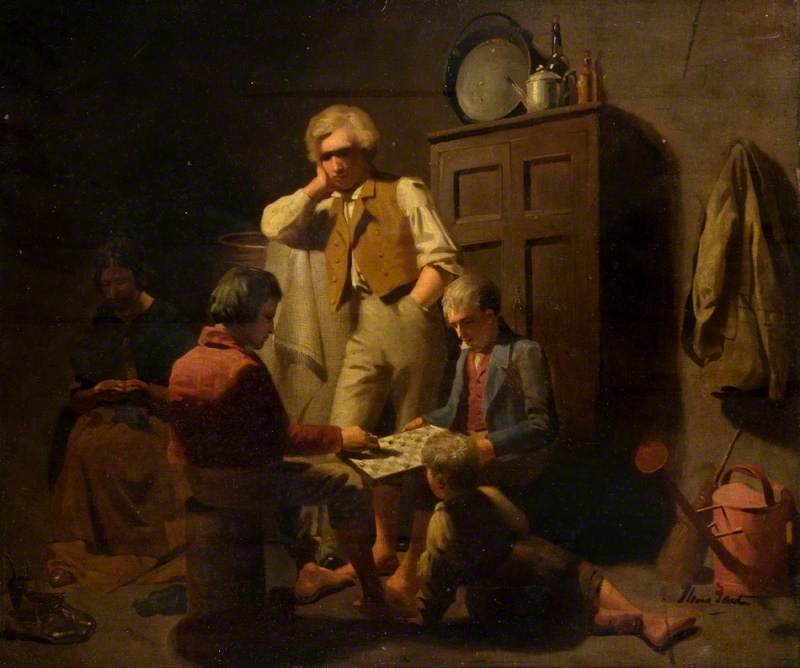
James was born into a family of prominent nineteenth-century artists and engravers who lived at Barley Mill in Gatehouse of Fleet, Galloway. He gifted two paintings to Glasgow 1) Interior With Figures by Thomas Faed (his father), and 2) The Artists Wife, Jane McDonald by John Faed (his uncle).
James Alastair was born on 19 November 1905 to James Faed junior, artist, and Eleanor Annie Herdman, (1) who came from a flour milling family from East Lothian and had moved to 38 Abbey Road, St John’s Wood, London prior to Jame’s birth. (2) James junior (1856 – 1920) was a landscape painter and much influenced by his father, sometimes referred to as James senior.
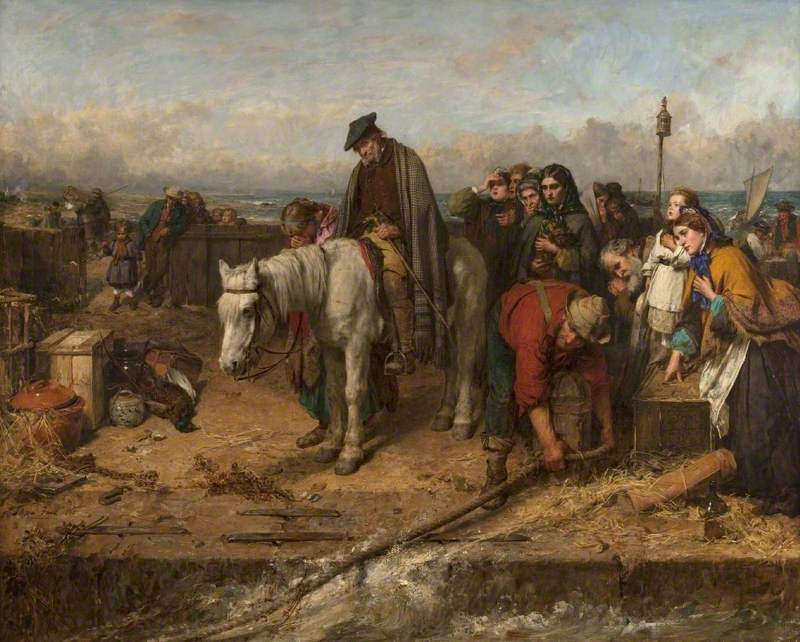
James senior’s brothers Thomas and John were also artists and Thomas is probably the best known, having moved to London, exhibited at the Royal Scottish Academy and become a full member of The Royal Academy in London in 1864. Thomas’s best known work is Last of The Clan which has become an iconic symbol of Scottish emigration, and is currently exhibited at Kelvingrove Art Gallery in Glasgow. (3)
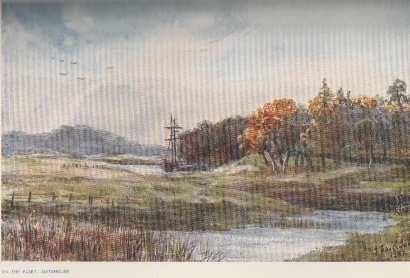
James Faed junior’s uncles excelled in painting pictures of humble Scottish life and people, but James preferred to paint landscapes, especially in Galloway, capturing the colour and depth of the countryside. (4) In 1908 James junior illustrated the book Galloway by J M Sloan, which describes the landscapes and history of Galloway. Each chapter is illustrated with a relevant watercolour such as On The Fleet, Gatehouse. (5)
Figure 4.On The Fleet, Gatehouse James Faed jun, from Galloway by J M Sloan 1908
He married Eleanor Annie Herdman in 1897 and soon afterwards they moved to St John’s Wood in London where there was a thriving artists population. Their first son, James Ronald Herdman was born in May 1899. He entered the royal Navy as a midshipman at the outbreak of WW1 and tragically was killed when his ship Goliath was torpedoed in the Dardanelles in May 1915. He was awarded the Star Victory Medal.(6) By 1913 James junior and Eleanor had moved with the young James Alastair to The Bungalow, New Galloway. The valuation roll of 1915 notes Eleanor Annie Faed of 38 Abbey Road, London as proprietor, with James Faed Junior as tenant. (7) James junior did little painting after 1915 due to paralysis of his hands, although he subsequently did some painting using his mouth. He died on 17 February 1920 and is buried in Kells Churchyard, New Galloway. Eleanor returned to Edinburgh shortly thereafter. (8)
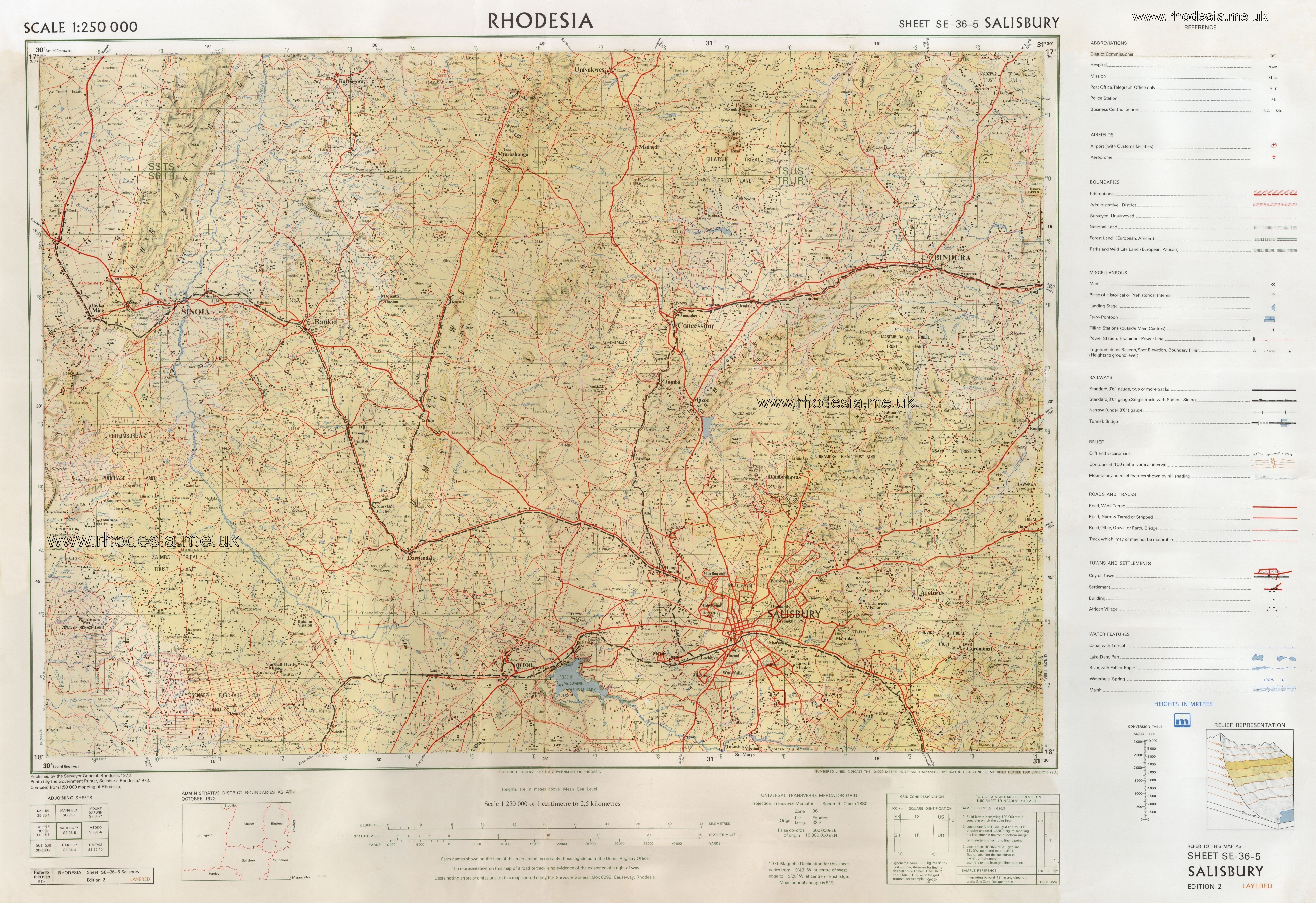
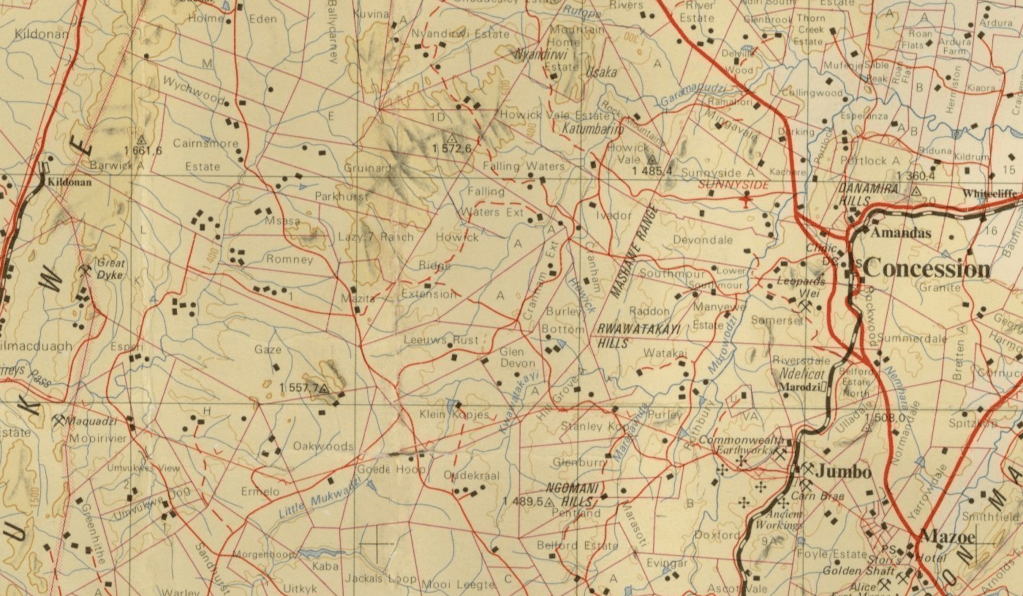
James Alastair emigrated to Southern Rhodesia (now Zimbabwe) when he was in his twenties. He became a farmer and lived at Cairnsmore Ranch, possibly named after the hill Cairnsmore of Fleet, a short distance from Gatehouse of Fleet in Galloway, the home of his forebears.(9) The farm is near the village of Umvukwe in Mazoe district about thirty five miles north of the capital Salisbury, now Harare.
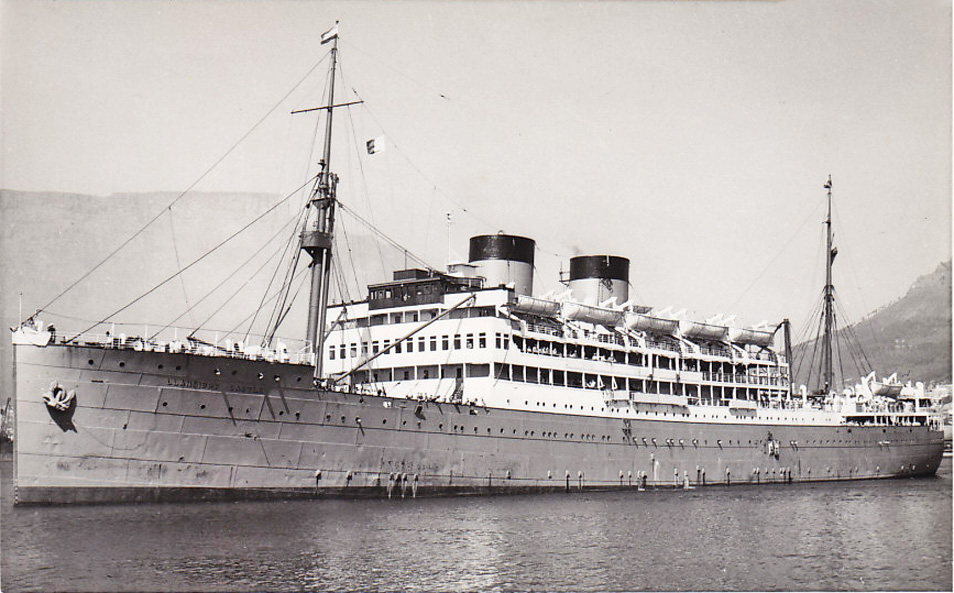
His mother left Edinburgh and travelled from the UK with James on 18 May 1933 on the ship Llangibby Castle (built by Harland and Wolff, Govan in 1929) to Mozambique,(10) and later that year on 12 October James Alastair married Frances Elizabeth Herdman in Salisbury, Rhodesia. (11) Frances was born in Edinburgh in 1905 (12) to John Herbert Herdman, a flour miller and Edith Marian Paton who lived in Edinburgh and who had been married at St Giles Cathedral on 20th June 1900. (13) James Alastair and Frances had two children, Fiona Joan Faed and Simon James Faed. (13)
James Alastair qualified as MRAC (Member of the Royal Agricultural College) (14) and arrived in Southern Rhodesia at a time when immigration was encouraged, especially from the UK, to establish and build on agricultural output. The Mazoe area was a wilderness up to the early twentieth century, the name being a corruption of the word manzou, meaning ‘place of the elephants’.
Gold mining was an important industry in the area, but as the fertile region developed, farming gained in importance. Orange growing developed in the Mazoe valley, helped by the building of The Mazoe Dam, completed in 1920 by The British South Africa Company which supplied irrigation water to maintain production on a large scale. (15)
Tobacco plantations were developed, with cattle ranches and, to a lesser extent, dairy farming becoming a feature of the area. The decline in mining in the early 1900’s led to The British South Africa Company encouraging settler farmers from abroad. Consequently, agricultural research, settlement schemes and farm training programmes were implemented. By attracting settler farmers with at least £500 capital, the fertile land was developed commercially and led to increased exports, compared to the more traditional subsistence farming of the indigenous population. (16)
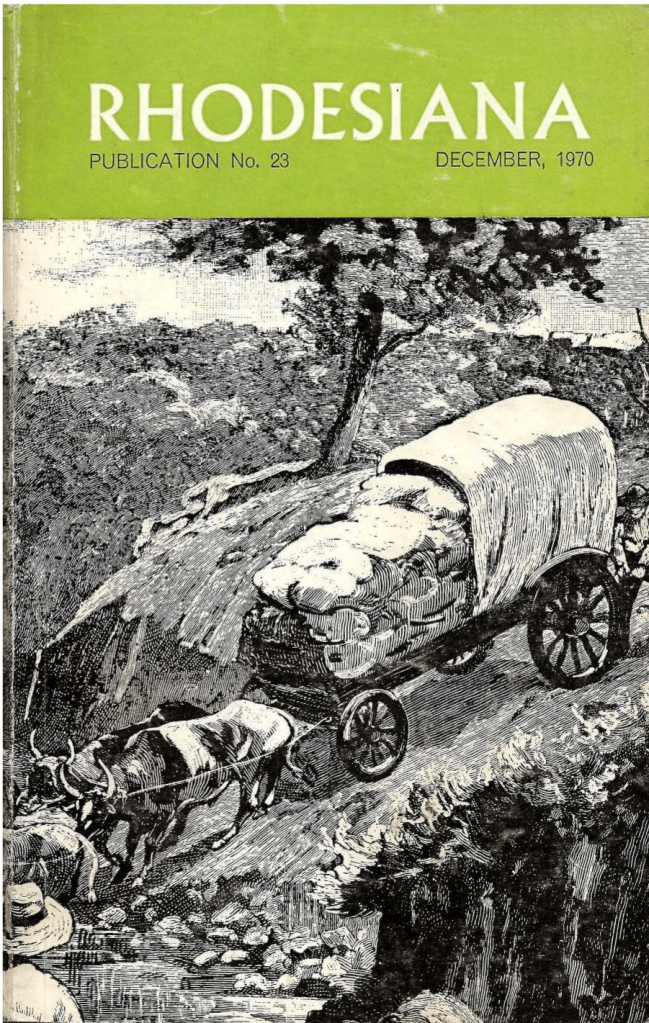
The Rhodesiana magazine was published from 1956 by The Rhodesiana Society and promoted historical studies and research about Rhodesia. Occasionally a list of subscribers was included and James Alistair is listed as a member over a number of years.
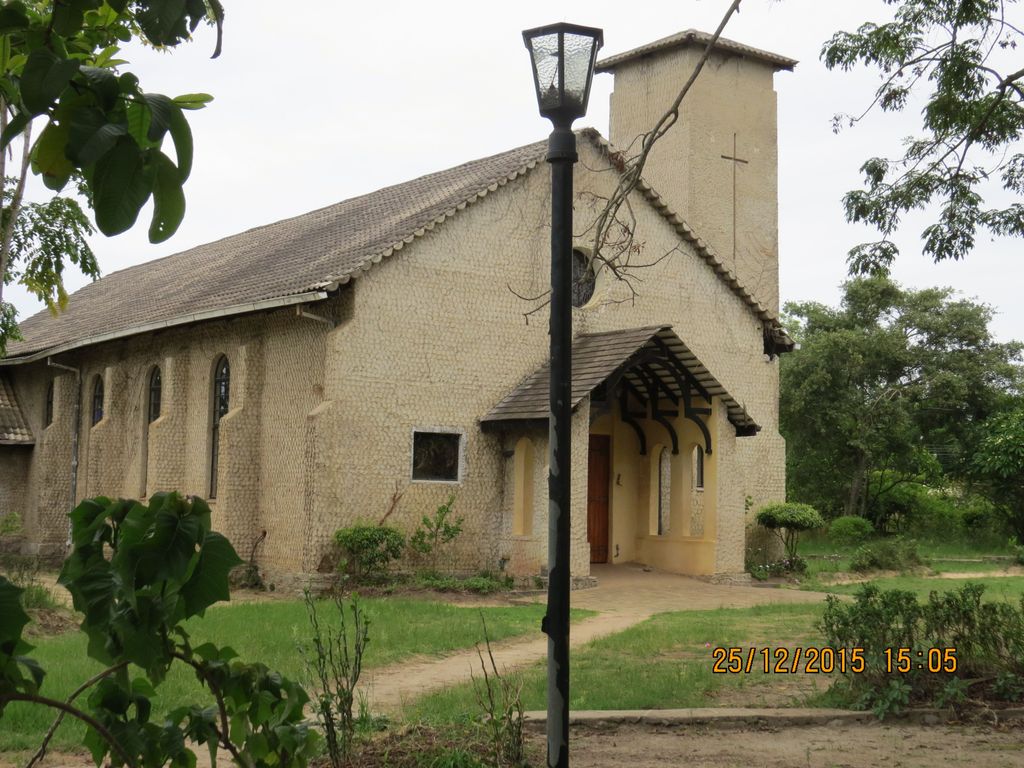
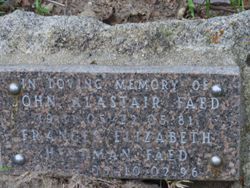
James Alistair Faed died in Zimbabwe in 1981 and was interred in The Anglican Cathedral cemetery, Mazoe District, Zimbabwe. Frances returned to Edinburgh and died in 1996.
 Glasgow Museums Art Donors Group