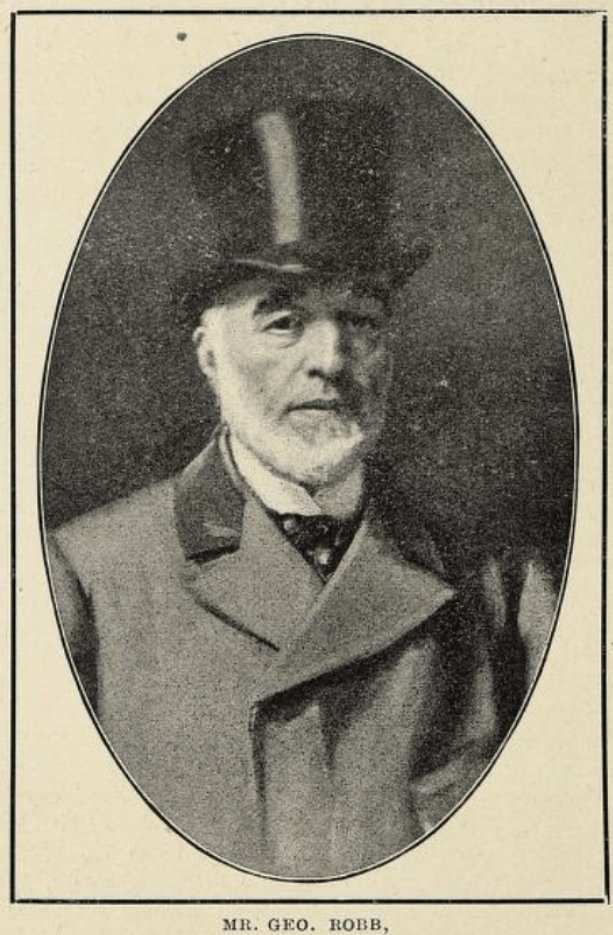
George Robb came from an old family of carters who provided a service transporting goods to many towns in south west Scotland, at a time when the railway network was in its infancy.(1) The Robb family was prominent in the Kilmarnock area, where the earliest Scottish railway to be incorporated by private Act of Parliament was built between Kilmarnock and Troon in 1808. As the railway system developed, George moved to Glasgow where he joined the Caledonian Railway Company and progressed to become Superintendent of their Carting Department.(2)

George was born in December 1833 in Kilmarnock to James, Innkeeper of The Wheatsheaf in Kilmarnock and a goods carrier between Glasgow and Carlisle, and Elizabeth Hutchison. George was educated at Kilmarnock Academy and left school to work with his uncle, Charles Robb at his carting business in Glasgow, based in Brunswick Street before moving to West Nile Street. (3) George succeeded to the business on his uncle’s death. George is recorded as living at 102 West Nile Street by 1861 and described as a railway agent. (4) By 1871 his address is 223 Hope Street and he was recorded as Carting Superintendent for Caledonian Railway. (5)
Carting services were widely publicised in local newspapers. In 1837/38, for example, J & W Robb (possibly related to George) advertised carrier services from Dumfries to Sanquhar and Thornhill ‘from opposite Mr Hairsten’s, High Street, every friday’. (6) All kinds of goods were carted, including alcohol. When George became Carting Superintendent he assumed responsibility for the efficient management of the service and checks were made to ensure that goods arrived at their destination intact. At one time carriers from Glasgow were met halfway to Kilmarnock by carters from that town. On one occasion it was discovered that there was ‘a great leakage in strong waters somewhere on the road. He (George Robb) rode to the rendezvous by devious hidden paths, and found the men indulging freely in the wine of the country. There was no more illicit jollification on Mearns moor’.(7)
The railway system in Scotland developed rapidly in the early nineteenth century. The Caledonian Railway was established by Act of Parliament in 1845 as a result of the absorption and amalgamation of a number of existing lines. By 1866 the Scottish Central and Scottish North Eastern Railways had been absorbed by The Caledonian.(8) Although the need for carting declined as the railways expanded there was still a demand to service the transport of goods between destinations not covered by the railways. The Carting Department of The Caledonian Railway was set up on 1 February 1870 and George was offered the job of managing the Department, which he accepted, and had free reign to organise the business as he felt fit. The Company acquired George’s stud of horses. By 1906 the company ran its own carting services from 55 of its stations and employed 1000 staff and over 1000 horses.(9) George had a renowned knowledge of horses and a reputation for acquiring only the best on the market. He related a story that when he was only ten years old he purchased his first pony, which he sold the following day for a profit of £5. Later in life he exhibited and judged horses at agricultural shows.(10)
One of George’s responsibilities was the purchase of healthy working horses. On 15 April 1881 a John Rankin from Largs sold a bay horse for £68 to George Robb, at the cattle market in Glasgow. On 20 April George wrote to Rankin to advise that the horse was unsound, being a ‘roarer’ ( a condition whereby a deformity in the throat causes the animal to ‘roar’) and should be returned. The case went to court and was found in Robb’s favour.(11)
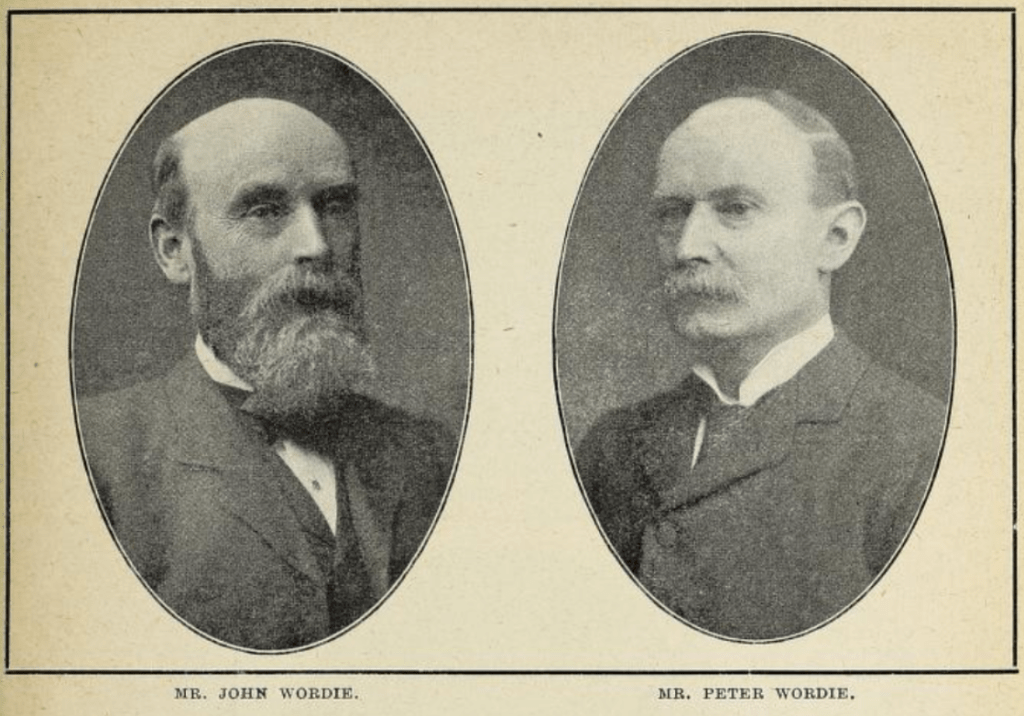
The railway employed several contractors, Messrs Wordie and Company being one of the most prominent. The firm had been connected with The Caledonian Railway since its inception and had a reputation as being equivalent to the English firm of Messrs Pickfords. At the end of the nineteenth century John Wordie and Peter Wordie, sons of the company’s founder William Wordie, were partners, and worked with George Robb at Caledonian Railway Company in the management of its carting services.(12)
By 1891 George was living at 17 Scott Street, a dwelling with 11 rooms. Also resident were a house keeper and a domestic servant. The building no longer exists and is replaced by Glasgow School of Art structures.(13)
George died at his home at 17 Scott Street, Glasgow on 27 February 1909 (14) and was interred in his family grave at The High Kirk churchyard in Kilmarnock. Mr Robb was a well known and respected figure and a special train conveyed mourners to his funeral in Kilmarnock. The service was conducted by the Reverend Mr Gunson, minister of Ramshorn Church, Glasgow, formerly St David’s Church, where many prominent Glasgow merchants are interred.(15) George Robb left an estate of almost £80,000 including a bequest ‘to the Kirk Session of The Ramshorn Church the sum of one thousand two hundred pounds, the free annual revenue of which shall be paid to the minister of the church for the time being’, that being the Reverend Gunson at the time. Bequests were also made to friends and business associates including John Wordie and Peter Wordie.(16)

George bequeathed two paintings to Glasgow…
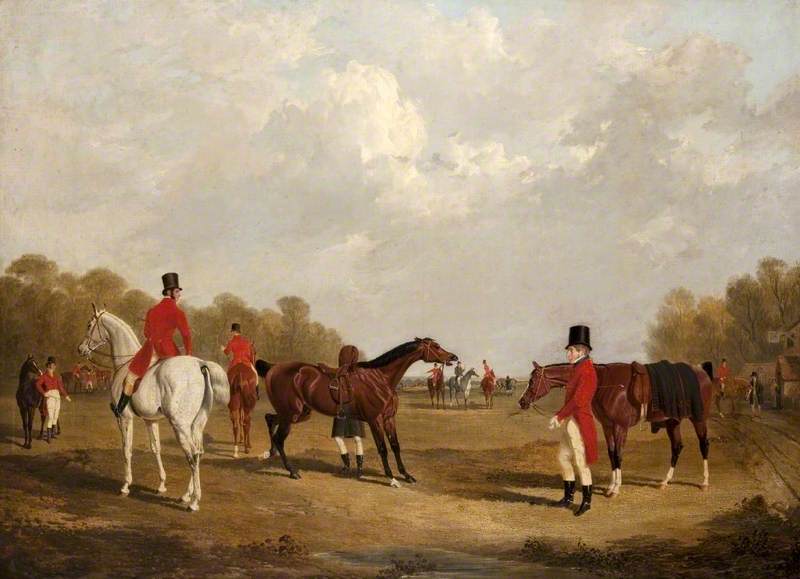
1) The Meet by John Frederick Herring Snr 1795-1865. Herring specialised in painting horses, especially hunting and race horses and his clientele included Queen Victoria.
2) Coming from Church by David Adolf Constant Artz 1837-1890. Artz was a dutch painter who was associated with the Hague School.

References…
(1) Local history Section, Burns monument Centre, Kilmarnock,
(2) https://en.wikipedia.org/wiki/Kilmarnock_and_Troon_Railway
(3) Local history Section, Burns monument Centre, Kilmarnock – Obituary, Kilmarnock Standard 6/3/1909
(4) Census 1861 (1861 644/06001/06013), http://www.scotlandspeople.gov.uk/
(5) Census 1871 (1871 644/06025/06010), http://www.scotlandspeople.gov.uk/
(6) Pigot & C0, Directory for Dumfries and Maxwelltown 1837/38, https://dgnhas.org.uk/wood-pigot-personal/pigot-personal-dumfries-maxwelltown-1837-38
(7) Local History Section, Burns Monument Centre, Kilmarnock – Obituary, Kilmarnock Standard 6/3/1909
(8) The Caledonian Railway Association (https://crassoc.org.uk/web/node/9)
(9) The Railway Magazine, Diamond Jubilee Edition Sep 1907, Article by G Robb, Carting Superintendant, Caledonian Railway.
(10) Local history Section, Burns monument Centre, Kilmarnock – Obituary, Kilmarnock Standard 6/3/1909
(11) Court Case, Rankin v Caledonian Railway Coy – https://www.casemine.com/judgement/uk/ 5a8ff81b60d03e7f57eba253
(12) The Railway Magazine, Diamond Jubilee Edition Sep 1907, Article by G Robb, Carting Superintendant, Caledonian Railway.
(13) Census 1871 (1871 644/06025/06010) http://www.scotlandspeople.gov.uk/
(14) Deaths (Statutory register of deaths 644/9 158) http://www.scotlandspeople.gov.uk/
(15) Local history Section, Burns monument Centre, Kilmarnock – Obituary, Kilmarnock Standard 6/3/1909
(16) Wills and Testaments (SC36/51/150, Glasgow Sheriff Court Wills)
 Glasgow Museums Art Donors Group