John Findlay Carson (1883 – 1955)

Figure 1 Alexander Dennistoun and Family of Golfhill. Thomas Faed (1826-1900). Accession Number 3439. © CSG GIC Glasgow Museums Collection.

 This painting was gifted to Glasgow in 1955 by John F. Carson. 1

Alexander Dennistoun is the subject of a report listed elsewhere in this blog.

            From Scotland’s People there are two John F. Carsons who died after 1955. John French Carson who died in Greenock in 1984 and John Findlay Carson who died in Maybole in 1955. The latter seemed more likely as the donor.

            John Findlay Carson was born at St. Oswald, Kilmacolm, Renfrewshire on 9 November 1883. He was the son of David Simpson Carson, a chartered accountant, and his wife Margaret Findlay. John’s parents had married on 19 September 1878 in the Church of Scotland Manse, Kirkoswald, Ayrshire where Margaret’s father was the minister. 2 John’s older brother, David Simpson Carson was born in Kilmacolm in 1879. He also had two sisters, Jessie Muriel Carson born 1880 in Partick and Una Margaret Carson born 1889 in Kilmacolm. 3

From the 1901 Census,4 John was a pupil at Fettes College in Edinburgh. Afterwards he followed his father in becoming a chartered accountant. He joined the Royal Naval Volunteer Reserve (RNVR) and on 2 January 1910 he was appointed Assistant Paymaster.5 In 1911 he and his father were boarders at the Hydropathic Institute in Kilmacolm. 6 At about this time, he became a partner in Moores, Carson and Watson, chartered accountants based at 209 West George Street, Glasgow. (He remained with this firm for 44 years until ill-health forced his retirement).7 On 10 June 1912 he was promoted to Paymaster, RNVR followed by a secondment/connection to the Admiralty on 13 June.8 A further promotion followed in 1914 when he was appointed Acting Paymaster Commander, RNVR.

On 30 January 1914, ‘An engagement (was) announced between John Findlay Carson, younger son of David S. Carson, St. Oswald’s, Kilmacolm and Molly, youngest daughter of the late Cecil Arkcoll and Mrs W. M. MacLeod, and stepdaughter of W. M. MacLeod, Markyate Cell, Dunstable’. 9 The couple were married at St. John’s Church, Markyate on 18 July 1914 with the bride now referred to as Mary Frances.10 The Luton Reporter also had an account of what was a lavish wedding with a full list of all the wedding presents given by almost everyone in the village. The bride was the daughter of the ‘Lord of the Manor’. After the nuptials, the couple honeymooned in Switzerland and Northern Italy. 11

            On 25 August 1914, John Carson transferred from his base at Clyde to Blandford in Dorset. Blandford Camp was set up at the outbreak of WW1 as a base depot and training camp for the RNVR. The poet Rupert Brooke was stationed here at this time, and it was here that he wrote his poem ‘The Soldier’.
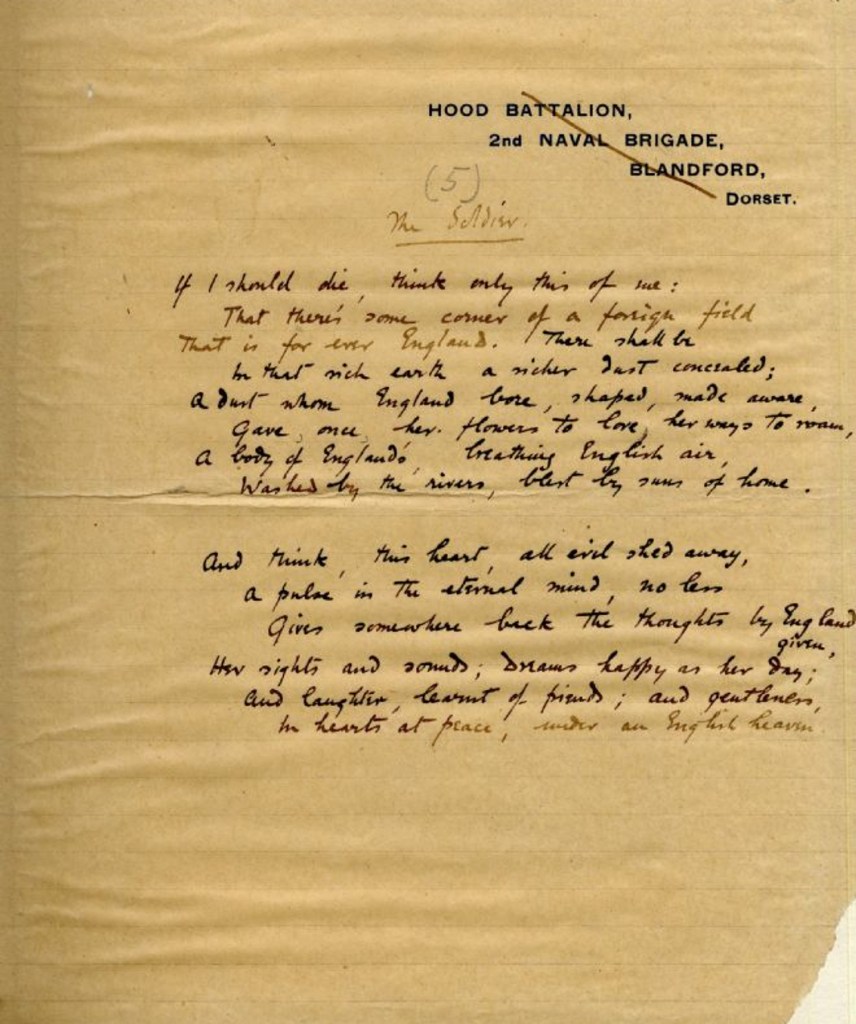
Figure 2. ‘The Soldier’ by Rupert Brooke. British Library, Creative Commons, (CC BY-NC)

On 16 October 1914 John Carson was made Acting Staff Paymaster and in January 1915 he joined the 1st R.N. Brigade at RNVR, HQ. In 1916 he was posted for a time to Mudros. This was a small Greek port on Lemnos and acted as a base for the British attempt to seize control of the Dardanelles. It was also where the armistice was signed between Turkey and the Allied Forces in 1918. Later that year John embarked on H.M.T. Franconia for France. (This ship was sunk by U-boat action in October 1916 on her way from Alexandria to Marseille). In France he was posted to Rouen which was a base depot for supplies, transport, reinforcements and hospitals. During his service, he seems to have been called up frequently for duty at the Admiralty.

John and Mary’s first child, Ian Seton Findlay Carson, was born on 22 September 1916 at Kilmacolm.12 A second child, Allan McLeod Carson was born on 18 September 1917. 13 This year also saw the death of John’s father, David Simpson Carson at 12 Claremont Terrace, Glasgow. He was 67. 14 On 11 July 1918 John Carson was made Acting Paymaster Commander, Lieutenant Commander RN Division. He still held this position when on 12 December 1919 he was awarded an OBE. ‘His name was brought to the notice of the Secretary of State for War for valuable services rendered in connection with the war’. 15

After the war, he returned to his position as partner in Moores, Carson and Watson. He came into possession of extensive property near Maybole in Ayrshire which comprised houses and farms at Fisherton and Drumbain (his main residence), a house near Ayr, woodlands, shootings etc. 16

In public life he became a Trustee of the Glasgow Savings Bank in 1933 and from 1947 to 1955 he was a Director of the Merchants’ House in Glasgow and Director of the Glasgow School of Art and from 1950 to 54, Director of the Glasgow Chamber of Commerce. In 1950 he was elected President of the Institute of Accountants and Actuaries in Glasgow. He was Past Chairman of the Glasgow and West of Scotland College of Domestic Science and a Past President of the Scottish Chartered Accountants Benevolent Association. 17

Mary Frances Carson died at Drumbain, Dunure on 21 November 1952. John Findlay Carson died three years later on 23 November 1955 at Drumbain.18 They were buried in Dunure Cemetery.
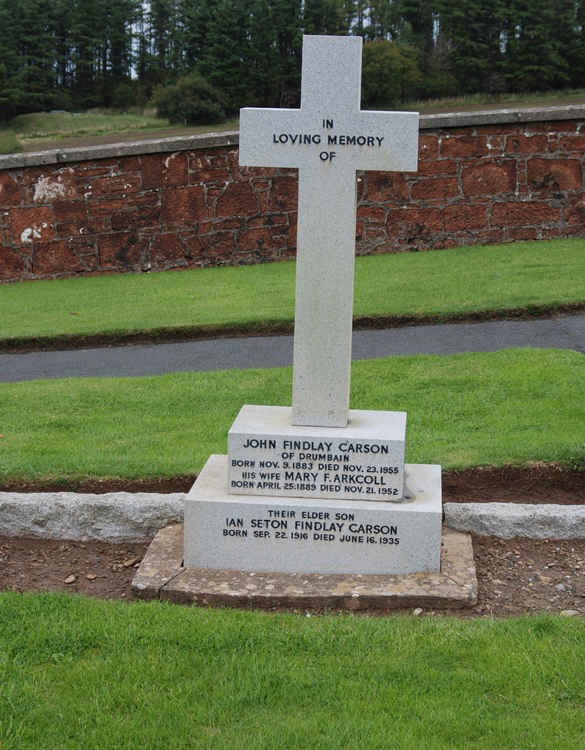
Figure 3. FindaGrave, (https://www.findagrave.com/memorial/17508828) Gravestone in Dunure Cemetery.

            References

  1. List of Donations to Glasgow Corporation, Glasgow Museums Resource Centre.
  2. Scotland’s People, Birth Certificates
  3. ibid
  4. Scotland’s People, Census 1901.
  5. London Gazette, 2 April 1910.
  6. Scotland’s People, Census 1911.
  7. Glasgow Herald, 24 November 1955, p11 (Obituary).
  8. London Gazette, 13 June 1912.
  9. The Scotsman, 30 January 1914
  10. Ibid. 20 July 1914
  11. Luton Reporter, 20 July 1914
  12. Scotland’s People, Births.
  13. Ibid
  14. Scotland’s People, Death Certificate
  15. London Gazette, 12 December 1919
  16. Scotland’s People, Valuation Roll, 1925
  17. Glasgow Herald, 24 Nov 1955 p11(Obituary)
  18. Scotland’s People, Death Certificate

Thomas Francis Donald

Thomas Francis Donald 1853 – 1932

Knox, John, 1778-1845; The Clyde from Dalnottar Hill

The Clyde from Dalnottar Hill:  John Knox

Donated by T. F. Donald October 1921

Copyright Glasgow Museums Collection

Thomas Francis Donald came from an established Glasgow family. His  great grandfather and his grandfather were among the chief importers of tobacco in the city of Glasgow.(1)

Thomas Francis Donald was a Chartered Accountant and Stockbroker.  His father, Thomas Donald, was the County Clerk of Lanarkshire. His mother was Frances Maxwell.  (2)

“There are few families now in existence in Glasgow who are more connected with the Glasgow of olden days than the Donalds” (3)

Mr Donald worked in 104 West George Street (a building which also housed Leslie Hunter, the artist).  He lived in 14 Huntly Gardens (4) and in later life moved to Dargavel House, Bishopton , the seat of the Maxwell Family. He lived here until his death. Dargavel House is now a B listed building, which became part of the Royal Ordnance Factory and is now owned by BAE Systems. (5)

Thomas Francis Donald achieved great success in his chosen career. He was noted for his thoroughness, and was widely respected. He was a member of the Glasgow Stock Exchange, twice holding the position of chairman. It was noted that he never gave any client thinking of having a “flutter” any too rosy a picture of his prospects. “His honesty was merciless” He was a keen sportsman, a member of the Royal Northern Yacht Club, where he held the position of secretary and treasurer from 1887 until 1896. He was also a member of the Mudhook Yacht Club. He was a golfer, taking up the game in 1864. He would therefore have been in the forefront of the expansion of golf in Scotland which occurred in the second half of the nineteenth century. This expansion was due to two events – the discovery of the gutta percha ball and the expansion of the railways. This made golf  more accessible and led to the formation of golf clubs in Scotland. One of these clubs was Prestwick, created by Old Tom Morris in 1851.(6) In 1920, Thomas Donald became  the Captain of Prestwick golf club.  (7)

Thomas Donald was an active member of Glasgow society and was secretary to the Knot of Bachelors. He was a member of, and treasurer to, the Western Club. (His great great grandfather had been a founding member.) He was chairman of the Western Club from 1924/25 and wrote a brief history of the club to mark the club’s centenary. He occupied the chair at the Club’s centenary celebrations. (8)

He was a member of the Hodge Podge Dining Club, many of whose members came from the Western Club. This club was established in 1750, originally as a discussion group, but members quickly decided to abandon discussion in favour of Whist, which was played between 5 p.m. and supper at 9 p.m. The club exists to the present day, meeting in the Western Club every six months. (9)

The Baillie summed him up thus:

“Mr Donald is a Glasgow citizen of credit and renown…. He comes of excellent stock…. and the traditions of this stock are excellently maintained in his person. Success on the local bourse has left him abundant time and opportunity to cultivate the higher graces of life… His offices speak volumes for his savoir faire, and for the high esteem in which he is held by the circles of which he is a member. Mr Donald’s reading is extensive and peculiar. It ranges from volumes on the abstruser sciences down to the latest cookery book. Consequently, among his intimates his conversation is uncommonly bright and interesting. Even his censure is accepted with as good a grace as is the approval of another.” (10)

Thomas Francis Donald

Thomas Francis Donald

The Baillie July 8th 1886

His obituary in the Glasgow Herald summed up Thomas Donald : ” He warmed, if ever a man did, both hands before the fire of life….He had a good knowledge of literature and was well versed in family history. He contributed frequently to the columns of the Glasgow Herald. He also wrote a good deal otherwise, chiefly on antiquarian subjects. His love of music was very real and he was a member of Glasgow Amateur Dramatic Club. He had a most happy knack of light verse. He was a connoisseur in cuisine and no one could arrange a dinner or ball to better effect. It is a matter of regret that he was not painted by Raeburn, for he was one well fitted for that master’s brush. His strong features and ruddy, clean shaven face would ….have gone well with a white stock and a canary waistcoat. With him there passes an intimate knowledge of nineteenth century Glasgow.” (11)

In all that has been written about Thomas Donald there is no mention of particular interest in art, or of art collection. It is possible to surmise that his yachting experiences on the Clyde led to his interest in the particular painting which he donated.  It is also notable that the timing of his donation coincides with his move from Glasgow to Bishopton. He is buried in the Necropolis. (12)

References

(1) The Baillie July 8th 1896

(2) Scotland’s People Census 1861

(3) Old Country Houses of the Old Glasgow Gentry: Glasgow James Maclehose, 1878

(4) Post Office Directories

(5) http://www.canmore.org.uk

(6) http://www.prestwickgc.co.uk

(7) Glasgow Herald March 1st 1932

(8) Donald T.F. Western Club 1825 – 1925 (1925) : Glasgow, Maclehose, Jackson and Co. 1925

(9) Strang, John  Glasgow and its Clubs: London and Glasgow, Richard Griffin and Company, 1857

(10) The Baillie July 8th 1896

(11) Glasgow Herald March 1st 1932

(12) Necropolis Interment Register 1932, Mitchell Library Archives

Other Sources

Scotland’s People Census 1851-1911

Paisley Reference Library

Paisley and Renfrewshire Gazette

Castles and Mansions 1890