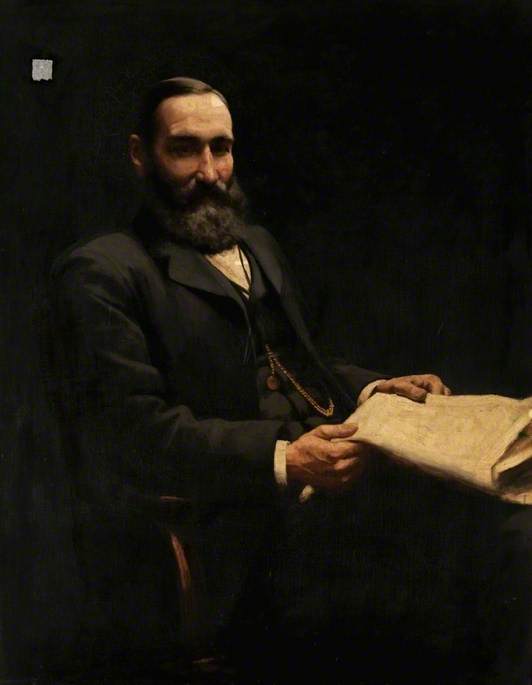
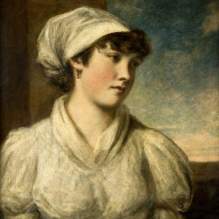
On 28 February 1944, an oil painting by Sir John Lavery presented by Mrs Baird of 8 Northbank Terrace, Glasgow, N.W., was accepted by Glasgow Corporation.1 The subject of the painting was Mr. George Ure Baird who was the father-in-law of the donor.
Anna Bella Walker Maltman was born at 17 Kelvinhaugh Street, Anderston, Glasgow on 14 January 1870.2 Her father, Thomas Maltman was a drapery warehouseman who had married Anna`s mother Isabella Adam on 6 July 1860 in Glasgow.3 In 1871 the family consisted of Thomas, (who was now a shipping clerk) and Isabella with Magdalena aged 8, Frances 6, John 4 and Anna Bella.4 Ten years later the family was living at 9 Windsor Street, Kelvin, Glasgow. Anna Bella was a scholar, aged 11 and there were two other children, Johanna aged 7 and James aged 2.5
In 1891, the twenty-year-old Anna was living at 52 Ardbeg Road, Rothesay with her sisters Frances and Magdalena and brother-in-law, Andrew Adamson who was a photographic artist. Anna was ‘living on private means’.6 On 9 April 1896 Anna married George Callwell Baird at her home, 22 Montgomerie Street, Glasgow. George was a commercial traveller, aged 27, living at his brother`s home, Killadoon, Langside. Anna`s sister Johanna was a witness.7
By 1901 Anna and George had moved to 2 Albany Street, Kelvinside. They now had a son George Ure Baird aged 3 and employed one servant.8 Ten years later, they were living at 242 Wilton Street, (later 8 Northbank Terrace) and now had three children, George, Dorothy, aged 9 and Thomas, aged 2.9 George senior was now a silk buyer employed by Gilmour & Co. silk merchants of 5 Royal Exchange Square, Glasgow. 10
George Callwell Baird died in the Western Infirmary, Glasgow on 18 May 1943. He was 75.11 The following year Anna donated the painting of her father-in-law to Glasgow Museums.
Anna Bella Walker Baird died on 10 December 1963 at 44 Balshagray Avenue, Glasgow. She was aged 93 and the cause of death was ‘senile decay’. Her usual address was that of her son Thomas at 242 Wilton Street.12
The Sitter
George Ure Baird was born in Saltcoats on 8 January 1832 although the birth was registered in Stevenston. His parents were Hugh Baird, gentleman, and Margaret Anderson.13 On 18 July 1860, George married the nineteen-year-old Mary Helen Robertson at Gothic Cottage in Govan, and the couple took up residence at 3 Osborne Place, Govan. George was a commission merchant in sewing machines and lace.14 By 1881 the family had moved to Cartbank, 45 Netherlee Road, Cathcart. (This small Georgian house consisted of a single storey with a basement. It was described as symmetrical, two ends circled, ashlar, large square bay window on front. Probably circa 1770, with ends added circa 1800).15 The family now consisted of four sons and three daughters.16
It was about this time that the portrait of George Ure Baird was commissioned from John Lavery – probably to help the artist become established. Lavery later said that ‘Mr. Baird was one of my first patrons and his kindness to me still excites my warm gratitude’.17 Lavery`s paintings The Tennis Party and a watercolour Lady on a Safety Tricycle, (now in the government art collection) were painted at Cartbank and dated to 1885.18
George Ure Baird died of consumption aged 53 at Anglesy Lodge on 21 January 188519 and was buried in the Glasgow Necropolis along with two sons and a daughter who had predeceased him. The inscription on the headstone reads;-
‘GEORGE URE BAIRD ANN OGILVY born 22nd April 1873 died 6 March 1875, DAVID ANDERSON born 6th Oct 1870 died 28th March 1875 JESSIE born 3rd Jan 1877 died 9th Aug 1877, GEORGE URE BAIRD born 8th Jan 1832 died 21st Jan 1885, MARY HELEN ROBERTSON wife of the said GEORGE URE BAIRD who died 4th Oct 1903 aged 61’.
His business of commission merchant was carried on by his son Hugh Baird in partnership with Mr. William Ewing. However, the name George Ure Baird was retained. 20
The Painting and the Artist
John Lavery was born in Belfast in 1856 but was orphaned three years later. At the age of ten he was sent to live with a rich cousin of his aunt who had a pawnshop in Saltcoats.21 George Ure Baird was one of his earliest patrons and the portrait was one of the first painted by Lavery. It may have been commissioned partly to help the artist become established. (It is not clear if the Saltcoats connection is relevant to their relationship since Baird would have moved to Glasgow before Lavery arrived in Saltcoats). However, the present portrait at GMRC is not the one commissioned by Baird.
Lavery had bought and insured a studio in St.Vincent Street and ‘very shortly afterwards it succumbed to a mysterious fire’. Lavery recalled later that he had completed the original painting at his studio one Saturday evening but was not at all happy with the finished work. On returning to the studio the next day he found the place in flames and the painting destroyed ‘to his secret pleasure’. He pretended to be aggrieved but was secretly pleased with the outcome. More especially since he collected £300 of insurance money with which he financed his departure in 1880 for the Heatherley School of Fine Art in London and then to Paris.22
Sometime later (1885) he painted the present portrait from a photographic miniature. Unfortunately, it was completed after the sitter’s death and was delivered to his widow. When Mary Helen Baird died on 4 October 1903, the painting passed to her son George Callwell Baird, husband of the donor. There is a letter on file at Glasgow Museums Resource Centre from Lavery to Mr. J. (sic) C. Baird dated 3 October 1931 from 5 Cromwell Place, London in which he says that he will be ‘passing through Glasgow on Monday with an hour to spare’ and stating that he would wish to come and visit and view the painting. The letter was handed in to Kelvingrove in February 1962 by Mr. T. M. Baird the grandson of the sitter.
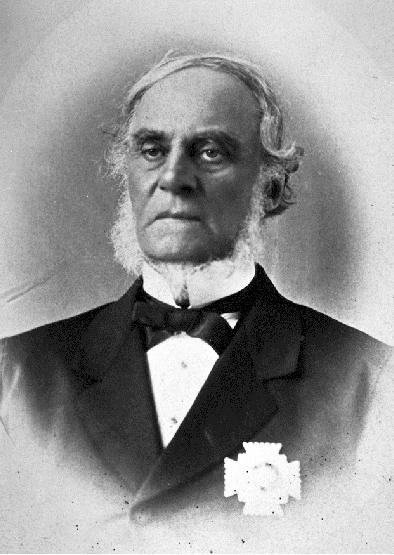
J D C White was born at Hayfield House, Rutherglen on 18 August 1871, to John Orr White and Fanny Campbell White (2) who were second cousins and came from a family of industrialists. The family moved to London. His father died on 22 January1879 (3) but his mother continued to live in London. (4) He was educated at Charterhouse School where he did well. (5) He then attended Trinity College Cambridge and in his five years there he was awarded a BA First Class in the Classical Tripos (1894) and also in the Theological Tripos (1896). He proceeded to an MA in 1899. (6) He went to the London Hospital where he was a House Physician and qualified MRCS and LRCP. (7) In 1905 Cambridge awarded him an MD. (8) He did not go into medical practice but joined the Lister Institute to undertake research. This was made possible in 1908 because he was his uncle Lord Overtoun’s heir and on his death inherited his estate in Dunbartonshire. (9)
His research was mainly into the social aspects of venereal disease and he was a member of the British Social Hygiene Council. (10) In the following years he published and lectured quite widely. In the First World War he was a Captain in the Royal Army Medical Corps. (11) In 1922 he was sent by the army to Constantinople to conduct an anti-venereal disease campaign. (12) From 1923 he was Chairman of the Council of the Tavistock Clinic. (13)He was a committed Christian and continued to take an interest in religious affairs. He had been ordained a Deacon in the Church of St Peters in Eaton Square, London in 1898. (14) He was Chairman of the Council of the Modern Churchmen’s Union from 1923 to 1930. (15)
In 1898 he married Lucy Agnes McClure (16) and they had a son. He died at Harrow-on the-Hill on 25 March 1940. (17) His life is summed up in the BMJ obituary: ‘Circumstances made it possible for him to do unpaid jobs; training made him competent to look on sociological problems from both ethical and physiological viewpoints.’ (18)
The White family members were industrialists and chemical manufacturers in the west of Scotland. They combined business acumen with strong religious beliefs and a commitment to civic service. (19) The family had come out at the Disruption in the Church of Scotland and clung to the ethics of the Free Church.
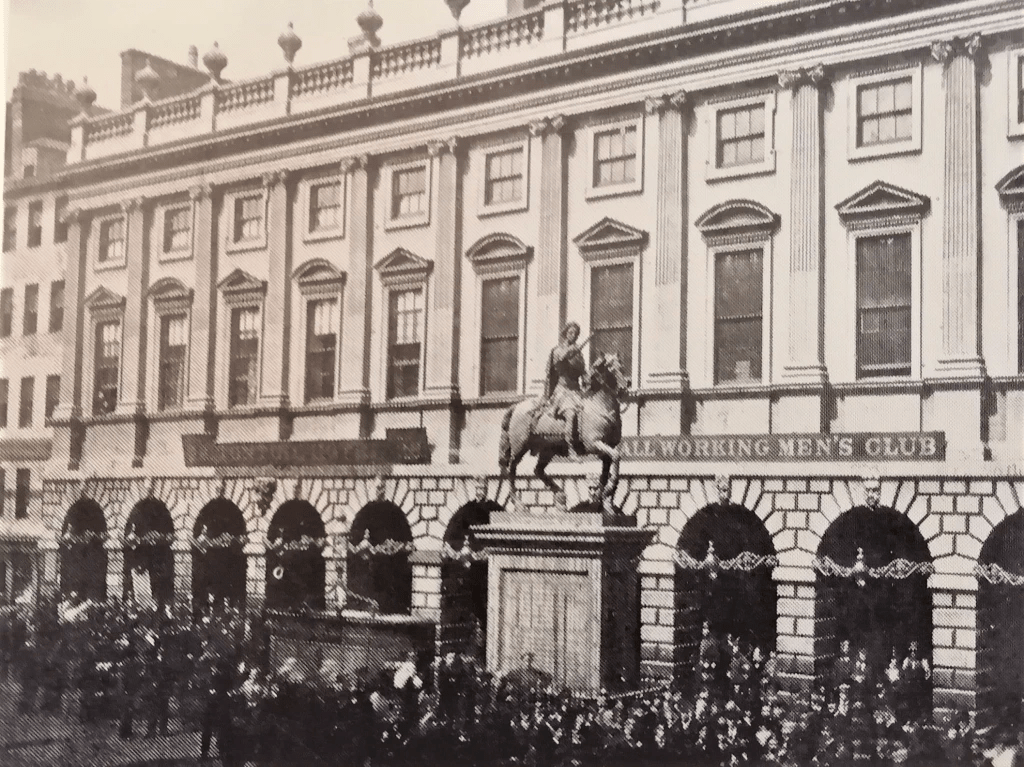
In the early years of the nineteenth century, brothers James and John White established a factory to make soda and soap in Shawfield, Rutherglen near Glasgow. By 1830 they were producing potassium dichromate, used as a mordant for the dye industry. By 1850 the site covered 200 acres and employed 500 men. It was a very successful business, a near monopoly, because of the large textile factories within Glasgow and Paisley. (20) James was well known in business and for philanthropy and his statue now stands in Cathedral Square, Glasgow. (21)
Their sons, John Orr White, son of James and John Campbell White, son of John, carried on the business but it was John Campbell White who became best known. (22) He studied at Glasgow University, graduating MA and studied law before entering the business. (23) Over the years he left others to run the business and devoted himself to philanthropy and religious causes and gave much time and money to charity. He was a powerful figure in the Liberal Party and became Baron Overtoun in 1893. He developed his estate in Dumbarton at Overtoun which he had inherited from his father.
The chrome business was successful but it was a dirty business. Little heed was paid to the well-being of workers or to the disposal of toxic waste. In 1899, the workers went on strike and their cause was taken up by Keir Hardie. This became a cause célèbre with much criticism of Lord Overtoun and can be followed in the Scotsman. (24) (25 ) (26 )(27) Opinions are divided about how much Lord Overtoun was involved. Eventually a compromise was reached and the workers returned to work with improved conditions of employment but the legacy of chrome persisted in ill health and environmental damage.
In 1903 Lord Overtoun gave public parks to Dumbarton and to Rutherglen, both called Overtoun Park. For this he was made a Freeman of Dumbarton (28) in 1903 and of Rutherglen in 1905. (29)
In 1908 Lord Overtoun died childless and the estate and his art collection passed to his nephew. (30) Dr John Campbell Douglas White also inherited a religious belief and a sense of duty to society.
In 1935 the estate was given to Dumbarton by Dr White and some paintings were given to Glasgow and Dumbarton. (31)
Minutes of Glasgow City Council 1935
National Records of Scotland Statutory Births 1877
Ancestry .co.uk
Census England and Wales 1880
Venn J.A, Alumni Cantabriensis London England. Cambridge University Press, 1922-1954
BMJ 20 April 1940 p673. Obituary
Ibid
Ibid
National Records of Scotland Statutory Deaths 1908
BMJ 20 April 1940 p673. Obituary
Venn J.A, Alumni Cantabriensis London England. Cambridge University Press, 1922-1954
BMJ 20 April 1940 p673. Obituary
ibid
Venn J.A, Alumni Cantabriensis London England. Cambridge University Press, 1922-1954
BMJ 20 April 1940 p673. Obituary
Venn J.A, Alumni Cantabriensis London England. Cambridge University Press, 1922-1954
Ancestry.co.uk
BMJ 20 April 1940 p673. Obituary
Ritchie, Lionel Alexander. ‘John Campbell White, Lord Overtoun’ in Slaven, A A Dictionary of Scottish Business Biography. Aberdeen. Aberdeen University Press,1986. Page 293
In 1930 a portrait of John Thomas Alston of Moore Park (1780–1857) by John Graham Gilbert (1794-1866) was gifted to Kelvingrove Gallery by Mrs. Stella Alston. John Thomas Alston had been Provost of the City of Glasgow between 1820 and 1822. A copy of the painting is depicted below.
Our donor Stella Alston was born at 3 De Vere Gardens, London in 1881. Her parents were Mr Charles Parbury and Mrs Annie Parbury from Australia. [1]
Mr Parbury was an Australian merchant, who traded between India and Australia. However, they lived most of their time in London. Stella was one of nine children and she was brought up in London’s De Vere Gardens, one of the very fashionable areas of London where many artists and writers lived. Some of those notable residents were writer Henry James, poet Robert Browning and H. Kempton Dyson (1880–1944), English structural engineer, civil engineer, architect, editor and author. [2]
On 16 July 1903 our donor Stella Parbury married Mervyn Campbell Stephen who was also from Australia and whose grandfather was the famous member of the Australian Legislature Sir Alfred Stephen (1802-94). [3]
Mervyn Campbell Stephen had studied law at Trinity College, Cambridge and had become a barrister. Their daughter Sheila Annie was born on 28 November 1904. The Stephen Family, then sometime in between 1905 and 1911, had moved to Eastbourne as the 1911 English Census records that their residence was 15 Jevington Gardens, Eastbourne. However, Mr. Mervyn Campbell Stephen died suddenly on 20 October 1912, at the young age of 36, leaving Stella a widow and mother of a young child. [4]
Later in 1914 Stella married again. [5] Her husband was Mr. George Alston whose previous wife Mary Charlotte Thompson had died in 1912.
George Alston’s father was a tea planter in Ceylon (present day Sri Lanka). The tea plantation in Ceylon was called Craighead, which was the name of the Alston family home in Scotland. [6] George Alston was a relative of John Thomas Alston, the Lord Provost of Glasgow and the subject of our painting.
After researching his genealogy, it was discovered that John Thomas Alston was, in fact, the grand uncle of Stella’s husband George Alston (i.e. brother of his grandfather). [7] John Thomas Alston was born in Glasgow, one of six children of John Alston (1743–1818), a bank cashier with the Thistle Bank, and his wife, Patrick Craigie (sic).The family later lived at 56 Virginia Street, Glasgow.John Thomas moved to separate lodgings at Clyde Street in 1818. In 1820 he succeeded Henry Monteith as Lord Provost of Glasgow. He then bought Moore Park, a simple Georgian villa by David Hamilton in the Broomloan district of Glasgow. The house was photographed in 1870 by Thomas Annan just prior to its demolition for railway improvements in the city. After that he was known as John Thomas Alston of Moore Park. [8]
Returning to our donor’s life, Stella and George Alston, after their marriage, lived in Newbury, Berkshire, England. However, later they moved to Duns in Berwickshire, Scotland where they lived together in Nesbit House until George’s death on 5 June 1930. [9]
Stella’s daughter, Sheila Annie Stephen, after her first marriage to Mervyn Campbell Stephen, married Sir David George Home of Blackadder on 5 January 1933. [10] He had been born on 21 January 1904. His father was Sir John Home of Blackadder, 12th Baronet, and his mother was the Hon. Gwendolina Hyacinth Roma Mostyn.
Sir David George Home was educated at Harrow School, Harrow, London and graduated from Jesus College, Cambridge University in 1925 with a Bachelor of Arts BA. He succeeded as the 13th Baronet Home, of Blackadder, on 19 October 1938. [11] He fought in the Second World War and gained the rank of Temporary Major in the Argyll & Sutherland Highlanders. He was admitted to the Royal Company of Archers and was the director of Edinburgh & Dundee Investment. Sir David and Sheila Annie had four children. [12]
After her husband’s death in 1930, Stella Alston returned to England and lived in London. She died there on 3 May 1970 and her death notice was in The Times of 6 May 1970. She was widowed twice before she was fifty and had seen two world wars.
Our donor’s son-in-law Sir David Home died on 17 January 1992 and his wife, Sheila Annie, soon after on 16 May 1992. They are both buried in the Grange Cemetery Edinburgh. [13]
References
[1] London, England, Church of England Births and Baptisms, 1813-1920 Kensington and Chelsea St Stephen, Kensington 1847-19011891 English Census.
On 19 January 1943, an oil painting by James Godsell Middleton entitled Jeannie Deans and the Queen was presented by Mrs E. W. Gow, Ardchattan, 2 Wellshot Drive, Cambuslang. Its acquisition number is 2309. 1
The frame of the painting bears a tablet with the inscription ‘J. Middleton (Scottish School) Jeannie Deans and the Queen / Lent by Captain Dennistoun’.
The painting was exhibited at the Royal Academy Exhibition of 1845 by the artist whose address was 76 Newman Street, London . It carried the caption:
Jeannie Deans begging the life of her sister from Queen Caroline. “Tear followed tear down Jeannie`s cheeks as, her features glaring and quivering with emotion, she pleaded her sister`s cause etc. Heart of Midlothian”, (481). 2
The artist also exhibited the painting at the Royal Scottish Academy the following year with a shortened caption!
Jeannie Deans begging the life of her sister from Queen Caroline, vide The Heart of Midlothian (136) 3
There was no record of the donation in the Corporation Minutes.
Elizabeth Webster Waugh (later Mrs. E. W. Gow) was born on 2 June 1873 at 5 East Howard Street, Glasgow. 4 Her father, Robert Waugh, was a storekeeper who married, Elizabeth Chambers, a domestic servant, on 30 September 1870 at Hamilton Street in Motherwell. 5 Elizabeth Waugh was the second of six children of the marriage. In 1881 “Bessie” (Elizabeth) and her family were living at 115 Stirling Road, Glasgow along with four older siblings – children of Robert Waugh`s first marriage to Janet Marshall. Robert Waugh died on 6 July 1888 6 and the family moved to 9 Glebe Street, Glasgow. In 1891, Bessie, aged 17 was a ‘furniture polisher’. 7 (It may have been because of her occupation that she met her future husband Walter Gow who was a house furnisher/furniture dealer). Elizabeth`s mother died in 1892 8 and three years later, on 19 March 1895, Elizabeth, aged 21, married Walter Gow who was then 35. It was Walter`s second marriage. (He had first married Elizabeth Marquis on 29 June 1883 in Glasgow 9. At that time, he was a cabinet maker and upholsterer with an address at 73 Buccleuch Street. However, Elizabeth Marquis “formerly married to Walter Gow” re-married in 1894 10 presumably after she and Walter divorced).
The marriage to Elizabeth was ‘by declamation’ at 63, Cockburn Street, Edinburgh in the presence of Elizabeth`s sister Margaret and her brother Thomas. According to the marriage certificate Walter Gow was a bachelor whose occupation was ‘cabinet maker’. He gave his address as ‘The Grand Hotel, Charing Cross, Glasgow’. 11 (Walter Gow`s father Joseph was also a cabinet maker and had originated the family business of ‘J. Gow and Sons’, house furnishers. In 1899 the business was based at 187 (later 175) Trongate, 12).
After their marriage, Walter and Elizabeth moved to ‘Glenholm’ a large house at 31 Hamilton Drive, Cambuslang.13,14 The marriage did not produce any children. However, by 1911 Walter and Elizabeth had adopted Mosina (Ina) Mills the daughter of Elizabeth`s sister Annie and were living in Hamilton Drive along with Elizabeth`s older sister Margaret and one servant. Walter was a house furnisher and employer. 15
By 1927 Walter and Elizabeth had moved to ‘Ardchattan’, 2 Wellshot Drive, Cambuslang. The business was now based at 11 Hope Street. 16 (The name of the house would have derived from Walter`s interest in Clan or Family History. In 1898, he had been a subscriber to a book concerning the history of Clan Chattan.17 Gow is one of the minor Septs of Clan Chattan).
On 30 April 1929 Elizabeth`s niece and adopted daughter Ina, married Alexander Stephen, a fishery officer from Peterhead, in Glasgow Cathedral.18
Walter Gow died aged 76, on 26 March 1936 at 2 Wellshot Drive, Cambuslang and was buried in East Kilbride Cemetery. 19 He left an estate valued at £100,111:18s:7d.20 Elizabeth inserted “In Memoriam” notices in the Glasgow Herald each year from 1937 to 1951 (apart from 1949 and 1950) in memory of her husband.
For example, the following appeared in the ‘In Memoriam’ column of the Glasgow Herald, on 26 March 1943:
GOW. In loving memory of my beloved husband Walter Gow, J.P., who died on 26th March 1936. Inserted by Mrs Gow, “Ardchattan”, Cambuslang”
Elizabeth moved from Cambuslang to 29 Newlands Road in 1945 or 1946 and in the following year to ‘White Croft’, Barrhead. (Taken from Glasgow Herald, In Memoriam Columns.) Sometime between 1948 and 1951 she moved to ‘Glengyron’, Whitecraigs in Renfrewshire.
Elizabeth Gow died aged 78 at ‘Glengyron’, 38 Ayr Road, Whitecraigs on 21 August 1951 21. She was buried beside her husband in East Kilbride Cemetery on 24 August.22
The business of J. Gow and Sons was still operating from 11 Hope Street in 1964 23.
References
Glasgow Museums Record of Donations
Graves, Algernon, The Royal Academy of Arts; a complete dictionary of contributors and their work from its foundation in 1769 to 1904, H. Graves and Co., London, 1905.
Object File at Glasgow Museums Resource Centre
Scotland`s People, Birth Certificate
Scotland’s People, Marriage Certificate
Scotland’s People, Death Certificate
ancestry.com, Scotland Census 1891,
Scotland’s People, Death Certificate
Scotland’s People, Marriage Certificate
ibid
ibid
Glasgow Post Office Directory, 1899-1900
Cambuslang Suburban Directory, 1900/01
Glasgow Post Office Directory, 1902/03 till 1920/21
Scotland`s People, Census 1911.
Glasgow Post Office Directory 1927/8.
Fraser-Mackintosh, Charles, of Drummond, An Account of the Confederation of Clan Chattan: Its Kith and Kin; The Minor Septs of Clan Chattan. J. Mckay, Glasgow, 1898
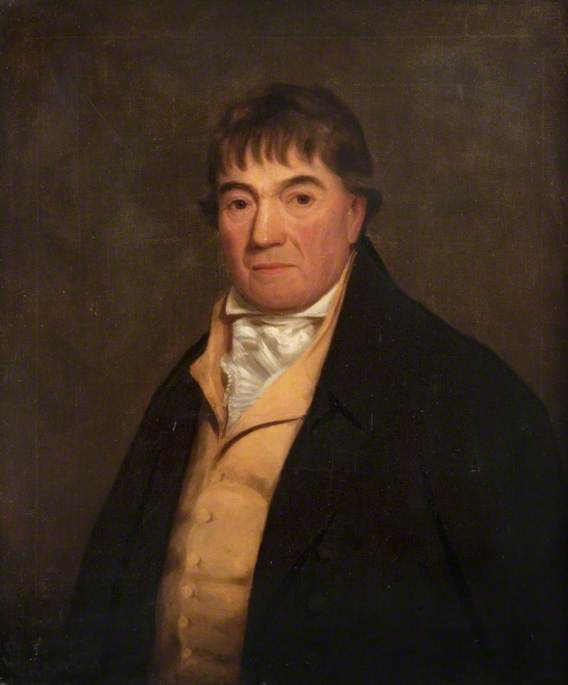
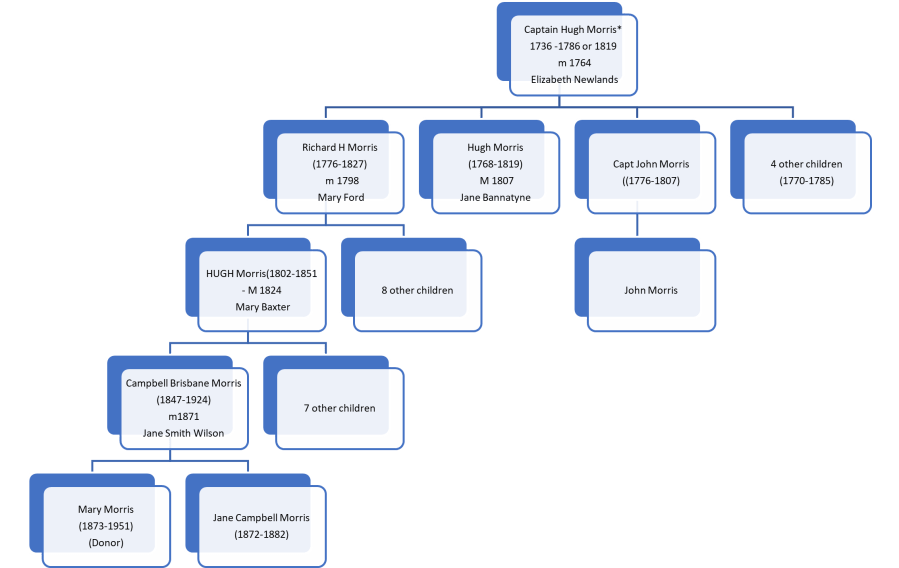
The donor of this painting was Mary Morris (see below) who bequeathed the portrait on 22 May 1951 as well as several other items.1 At the time of her death she was living at 67 Argyle Road, Saltcoats.2 There is no date or artist attributed to this portrait and there are several members of the Morris family named Hugh but evidence leads us to believe that the portrait is that of Mary Morris’s great -great grandfather (see Morris Family Tree below).3 Before discussing the life of Mary Morris the Morris Family who came before her will be discussed.
Captain Hugh Morris was our donor’s great-great grandfather. He was possibly born on 6 May 1736 in Largs ,Ayrshire. His father was John Morris and his mother was Jean McFie.4 After his birth the next information we have is his marriage on 31 July 1764 to Elizabeth Newlands at Calton then a separate weaver’s village outside Glasgow. Elizabeth’s father Richard was a weaver and Hugh Morris’s occupation is given as ‘mariner.5 By the time of the birth of their first child John in 1766 Hugh Morris was described on the baptism certificate as a ‘shipmaster’ (captain)of Port Glasgow’.6 Subsequent children were born in Port Glasgow leading us to believe that the family lived there while the head of the family was at sea. Hugh and Elizabeth had at least seven children. All but Hugh (b1768 in Barony, Glasgow) were born in Port Glasgow between 1766 and 1785 including our donor’s direct descendant Richard Morris born in 1776.7 Also there is a Captain Hugh Morris, shipmaster of Port Glasgow listed in John Tait’s Directory of the City of Glasgow 1783.8
There is evidence that Captain Hugh Morris was involved in Glasgow’s tobacco trade with Virginia as captain of a ship owned by William Cunninghame, one of Glasgow’s foremost ‘tobacco lords.’ Morris was captain of the ship Neptune from about 1769 to at least 1781. 9 The Neptune appears to have made at least two voyages each year. For example it was reported in February 1775, ’A Manifest of the Lading on board the ship Neptune, Hugh Morris Master, for Glasgow 476 hogshead tobacco, 30,000 staves, 30 dozenHoops’.10 Then in July 1775 the James River Manifest Book 1774-5 reported ‘a manifest of lading of the ship Neptune, Hugh Morris master, to be 474 hogshead of tobacco,13,000 staves and 40 dozen hoops’.11
In 1777 shortly after the beginning of the American War of Independence an Act of Parliament was passed allowing the Lord High Admiral or his Commissioners to grant Letters of Marque to merchant ships which allowed them to be armed and to seize any enemy ships encountered in regular trading enterprises for the duration of hostilities. Any prize money gained from the selling- off of enemy ships and or cargo went to the ship owner, captain and possibly the crew. The Letter of Marque was given to the captain of the ship and a copy was preserved in the records of the High Court of the Admiralty.12 In 1777 one such Letter of Marque signed by Registrar Godfrey Lee Tarrant was granted to Captain Hugh Morris and the ship Neptune.13
There are two further reports of Captain Morris’s involvement in voyages to Virginia after the issue of the Letter of Marque but no information as to seizure of American ships. In 1779 the Chester Courant reported the arrival at Falmouth of the Neptune from Jamaica with Morris as Captain. It is unclear if this was referring to Falmouth Virginia or Falmouth in England.14 Then in September 1781 the Neptune, captained by Morris, sailed from Portsmouth (presumably Portsmouth Virginia) to London.15 There is no information after this date of any further voyages.
Perhaps Captain Morris retired from sea at this time? Perhaps he had gained some prize money from seized American ships? Information on this point is speculative. Did he develop business interests of his own in America perhaps? James Robinson, superintendent factor of W. Cunninghame and Co. who was based in Falmouth, Virginia reported in a letter to Cunninghame on 15 September 1774 that ,’Captain Morris…wants to go to Carolina to look after some old affairs’.16 So perhaps he had business interests there.
In The Biographical Register of St Andrews Society of the State of New York17 the entry for Richard Morris (see family tree above) our donor’s great grandfather, who appears to have joined the society in 1797 while living in New York, describes him as, ‘ a son of Captain Hugh Morris of the Greenhead, Glasgow’. Greenhead was an old industrial part of Glasgow north of John Street (now Tullis Street) in Bridgeton extending into the Calton.18 There is a present day Greenhead Street near to Glasgow Green which possibly took its name from the area known as Greenhead.
Jones Directory or Useful Pocket Companion for 1787 lists a Morris ,Hugh &Son, manufacturers, Todds Land, High Street and for 1789 Morris ,Hugh & Sons, manufacturers High Street,’ above no 16’.19 The family business was certainly known as Hugh Morris &Sons in 1797 in a letter written to the United States Secretary of State, James Madison by John J Murray Consulate General in Glasgow concerning a dispute over ownership of ships being traded by the company to New York.20 The business later moved to St Andrews Square(see below). There are also examples of Hugh Morris & Sons trading with Jamaica. For example in July 1802 when customers were invited to contact Hugh Morris& Sons regarding freight and passage aboard The Maria sailing from Port Glasgow.21
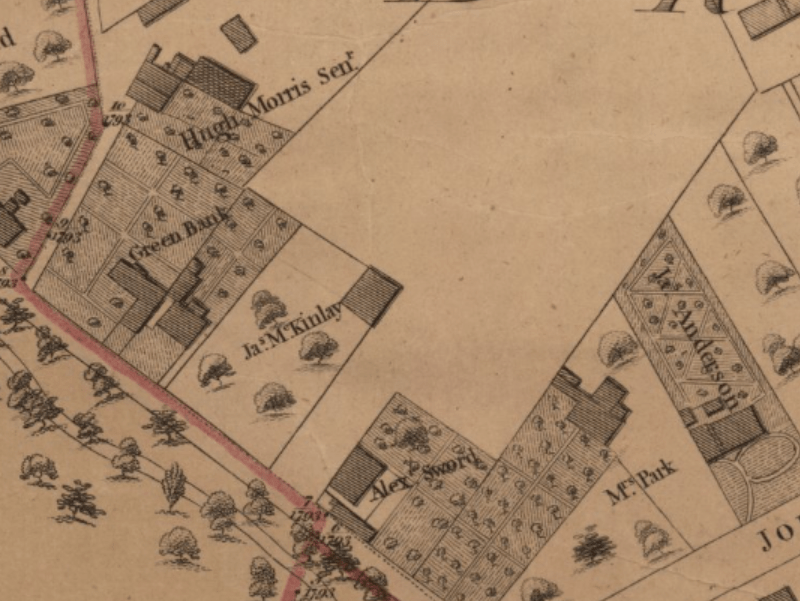
A map of Glasgow of 1807 shows a piece of land off Glasgow Green owned by Hugh Morris Senior.22
Figure 3 Extract from Peter Fleming Map of Glasgow and Suburbs 1807. Reproduced with the permission of the National Library of Scotland.
The Glasgow Sasines Register 1801 shows that a Hugh Morris bought land in St Andrews Square off Glasgow Green23 and The Post Office Directory for 1801 has an entry for Morris H & Sons Merchant, 55 St Andrews Squareand in 1806 for Morris H Senior merchants 55 St Andrews Square. House, Greenhead.24 By this time his second son Hugh and third son Richard appear to have joined the business (see below).
It is unclear when our Captain Hugh Morris died. A Captain Hugh Morrice, shipmaster, died on 20 April 1786 with no indication of age.25 But a Captain Hugh Morrise died 22 February 1819 aged 89. Both died in Glasgow and both were buried in the Parish of Ramshorn and Blackfriars. However as there continued to be a Hugh Morris Senior mentioned in the various directories later than 1786 it is probable that our Hugh Morris(or Morrise) died at the later date.26 The alternative is that the name of the firm Hugh Morris Senior was used by his son Hugh for several years after his death.
Hugh Morris (1768-1819)
This Hugh Morris was our donor’s great- uncle. The second son of Captain Hugh Morris and Elizabeth Newlands he was born on 21 March 1768 in Glasgow Barony.27 There is little information about his early life and no evidence that he went to sea. It is not clear exactly when he started in the family business of Hugh Morris and Sons but as we know from about 1801 the business premises were at 55 St Andrews Square. Around 1806 his brother Richard appears in the Glasgow Post Office Directory at the same address.28
In 1807 Hugh married Jane Bannatyne daughter of John Bannatyne of Castlebank, Lanark.29 As we have seen, the Morris Family appears to have lived in the Greenhead area better known as Bridgeton today and many streets have been renamed for example the then William street is now Templeton Street around the area of the former Templeton Carpet Factory building. By 1819 Jane and Hugh had a house in St Vincent Street.30
There do not appear to have been any children as when Hugh was thrown from a gig and killed at Pitcaithly near Perth in August 31 his estate, after making provision for his wife Jane, went to his brother Richard and various nephews and nieces.32
Around 1810 a Hugh Morris appears to have become part of the firm of Morris, Kinnear &Co at 55 St Andrews Square and this partnership continued until Hugh’s death in 1819. They were listed as ‘merchants’.33
By the time of his death in 1819 as well as being a partner in the Glasgow firm of Morris, Kinnear and Company, Hugh Morris was also a partner in the firm of Ferguson, Morris and Co of St Lucia34 which suggests an involvement in trade with St Lucia. He left an estate worth £10,000 including the house in St Vincent Street and a house in Largs which he left to his brother Richard together with the business property in St Andrews Square.35
Richard H Morris (1776-1827)
Richard Morris was our donor’s great-grandfather. He was born 28 July 1776 in Port Glasgow.36There is little information about his early life but one presumes it was spent in Port Glasgow with the rest of the family. Most of our information in this period comes from The Biographical Register of the St Andrew Society of New York, which Richard joined in 1797. He was introduced as ‘a son of Captain Hugh Morris of the Greenhead of Glasgow.’
By the age of twenty Richard had moved to New York and had begun business principally as a shipping agent and commission merchant for the family business Hugh Morris &Sons. He was also part owner of the brig Moses Gill which traded between New York and Greenock.37 On 16 June 1797 he married Mary Ford (1778-1840).38 They went on to have nine children between Agnes, born in New York in 1801 and Jean born in 1815 a total of seven girls and two boys.39
By 1799 Richard’s business was operating from 10 Liberty Street, New York.40 He and Mary appear to have travelled back to Scotland around 1802 as a son Hugh was born there about 1802.41 Richard’s brother Captain John Morris, master of a vessel The Hunter went to New York in 1804 to take over the business in Liberty Street which suggests that was when Richard and Mary moved back to Scotland. Unfortunately John Morris died of consumption in 1807 which brought Richard back to New York to settle up his brother’s affairs. Then on 15 December 1808 ,along with his nephew John, he set sail on the British packet Chesterfield for Falmouth.42
As we have seen Richard went into the family business known as Hugh Morris & Sons with his father and then his brother Hugh. In 1809 the firm of Morris ,R H& Co merchants was based at 55 St Andrews Square as was Morris, H, Merchant. In both cases the home address was given as Greenhead possibly 63 William Street43 (later renamed Templeton Street) in present day Bridgeton. Between 1810 and the death of his brother Hugh in 1819 the firm changed to Morris ,Kinnear &Co still based at 55 St Andrews Square.44
He was executor of both his brother’s estate, Hugh Morris (junior) and that of Hugh Morris( senior) of Greenhead, presumably his father. On 16 June 1820 an advertisement appeared in the Glasgow Herald for the sale of
‘Property at Greenhead belonging to the late Mr Hugh Morris Senior ,extending to about 2 acres and bounded by the Camlachie Burn…’
suggesting that as executor for both his late father and brother he was dispensing with the Greenhead land. It is also further indicates that Hugh Morris senior died at the later date of February 1819 but of course we cannot be certain.
Richard was also Treasurer of the Calton Chapel of Ease and owned a house in Rothesay.45
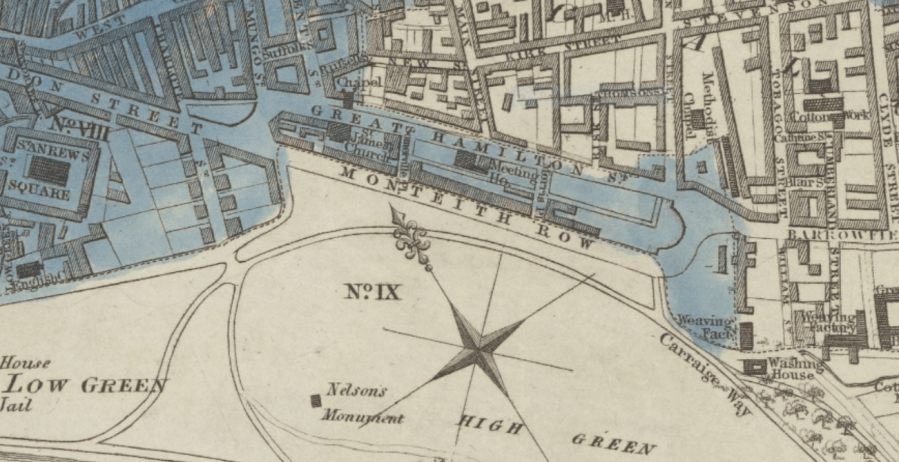
By 1824 Richard and his family were living at 24 Monteith Row off Glasgow Green.46 In 1814 permission had been granted to build a terrace of houses to front Glasgow Green. The row of houses which was in three sections, was not completed until the1840s. The street was named after Henry Monteith the then Lord Provost of Glasgow. This development had been planned for several years, the plans having been drawn up by architect David Hamilton in 1812. Monteith Row was referred to as the ‘Park Lane ‘ of Glasgow where affluent citizens lived until smoke and industrial development moved them out to the developing West End.47
Figure 4. 1830 Map of Glasgow showing Monteith Row and Morris Place48. Reproduced with the permission of the National Library of Scotland
In his will Richard Morris refers to his building a three-storey tenement in Monteith Row of which his wife Mary was to receive the rental as part of her settlement49. As can be seen from the above map there was a short road called Morris Place between the second third terraces of Monteith Row which possibly takes its name from the Morris family. Mrs Richard Morris was living at 1 Morris Place in 1831-2.50
Richard had retired from business in August 1827 and died in Rothesay on 22 October 1827 of cholera morbus an old medical term for acute gastroenteritis. He was buried in St Davids (Ramshorn) ‘in Capt MorrisLair’.51
Hugh Morris (1802-1851 )
This Hugh Morris was Richard Morris’s eldest son born around 1802 and the grandfather of our donor. There appears to be no record of his birth at this point but the UK Census of 1851 puts his birth around 1802 or 1803. He attended Glasgow University from 181852 and then joined the family business.53
On 11 July 1824 Hugh married Mary Baxter at the Chapel of Ease,Calton.54 Hugh is described as a ‘cloth merchant’. Mary was the daughter of Isaac Baxter who was also a merchant with a business Isaac Baxter & Sonswho were grocers, confectioners, oilmen and wine merchants operating from The Italian Warehouse in Candleriggs and from 137 Buchanan Street.55 At some point Isaac bought Rhinsdale House close to Baillieston on the outskirts of Glasgow56 together with nine acres of land. There is a Rhinsdale Tavern and a Rhinsdale Crescent in Baillieston today. The house had five bedrooms, a drawing room, dining room and parlour, servants quarters stables and coach house together with a large garden.57
Figure 5.Extract from 1890 Map of Glasgow showing Rhinsdale.58 Reproduced with the Permission of the National Library of Scotland.
Mary and Hugh went on to have at least nine children including another Richard born in 182559, Mary born in 1827, Hugh born in 1830 and our donor’s father Campbell Brisbane Morris born in 184760. They appear to have lived for a time at 48 West Nile Street.61
When his father Richard retired in August 1827 Hugh appears to have bought his father’s share of the family business by an agreed series of instalments. When his father died he inherited the family business as well as receiving £3,000 from his father.62
In 1829 the firm of Hugh Morris &Co Cloth Merchants was still operating but from 18 Hutcheson Street.63 By 1832 Hugh had become a partner in the firm of Morris Kirkwood & Co, merchants and warehousemen. Unfortunately the company and the two partners went bankrupt in 183264 but the following year sees Hugh applying for a discharge of bankruptcy so he must have been able to pay off his various creditors.65 It is difficult to know exactly what was going on as no other details are forthcoming.
The family appears to have gone to live at Rhinsdale House in Baillieston with Mary’s father as Hugh is referred to as ‘Hugh Morris Esquire of Rinsdale’ when his son Hugh Baxter was born in 1828.66 The present A8,Edinburgh Road, cuts through what was once the site of Rhinsdale House and its policies and stood where Kaldi’s (formerly the Little Chef) restaurant stands today at the Baillieston end of the Edinburgh Road.67
Mary and the children were still at Rhinsdale at the time of the 1841 Census but Hugh was not there. There are two entries for a Hugh Morris of relevant age in the 1841 Census. One, a seaman in Port Glasgow aged 30 and one in Mount Stuart Road in Rothesay aged 35.68 The Rothesay entry would appear to be the closest as the age is about right and we know Hugh’s father Richard owned a house in Rothesay.69 This Hugh Morris was said to be of independent means.
We can presume the family remained in Baillieston until Isaac Baxter’s death in 184870 when the house was advertised for rent probably by Mary’s brother Walter.71 As daughter Jane was born in Ardrossan in 1845 and son Campbell in West Kilbride (see below Campbell Baxter Morris) in 184772 perhaps the family then moved to Ayrshire. Certainly by 1851 the family was living at Sandlands House, Seamill.73 Hugh’s occupation in the 1851 Census is given as ‘retired cloth merchant’. Along with wife Mary were five of their children. Mary was twenty, Walter was fourteen, Eliza was eleven, Jane six and our donor’s father Campbell Brisbane was three.
In April 1851 Sandlands House was put up for sale.74 However it had not sold by 4 October of that year when Hugh Morris died.75 He was buried in Glasgow Necropolis.76
Campbell Brisbane Morris (1847-1924)
Campbell Brisbane Morris our donor’s father was born on 19 April 1847 at Kenningbrae Cottage, Seamill 77 in the Parish of West Kilbride.78 He was only three years old when his father died. By 1861 aged thirteen he was a pupil at Montgreenan House School, Kilwinning while his mother, now a widow, lived at Springburn Cottage, Ardrossan Road, Saltcoats.79
Montgreenan House was built in 1810 by Robert Glasgow a Glasgow merchant who had bought the Montgreenan Estate in 1794. Robert Glasgow had owned two sugar plantations and 247 slaves in St Vincent in the West Indies. After Robert Glasgow’s death in 1827 the house was often let out.80
Montgreenan School was opened in 1849 by Thomas R Wilson who originally ran a boarding school at North Woodside in Glasgow. The school was ’For the Education of Young Gentlemen’.81 Thomas R Wilson also taught mathematics. At the time of opening the school had three residential teachers covering Classics, English, Writing and Drawing as well as visiting teachers of French and German, Fencing and Gymnastics, Music and Dancing. Many of the pupils were from the British Colonies.82 We do not know when Hugh started at the school but perhaps he was a pupil on 20 August 1856 when the school went on a trip to The Isle of Arran but unfortunately missed the last ferry home and had to stay the night on Arran. No doubt the boys found that an adventure.83
There are several examples of the boys donating pocket money to the local poor. For example at Christmas in 1856 they donated £25. There were four mining villages nearby whose inhabitants lived precarious lives.84 In August 1861 the School moved to Sunderland so presumably Hugh left Montgreenan at that point.85
The 1871 Census puts Hugh age twenty-three at Clydeview Terrace, a row of villas on the north side of Whiteinch in Partick with his mother Mary now sixty-eight. His occupation is ‘engineer in steamships.86 On 20 April 1871 at 20 Laurence Place, Partick, Campbell married Jane Smith Wilson, daughter of the late David Wilson of Rothesay, a grocer and wine and spirit merchant. One of the witnesses at the wedding was Hugh Baxter Morris, Campbell’s elder brother.87
The newly-weds lived at 20 Laurence Place. They had two daughters, Jane born in 1872 and our donor Mary in 1873.88 Sadly Campbell’s wife Jane aged only thirty, died in July 1877 of a long-standing pulmonary complaint. She died at 5 Mount Stuart Road, Rothesay. Perhaps this was her former family home or the house in Rothesay owned by Campbell’s grandfather Richard. Campbell was still a marine engineer at the time of Jane’s death.89
By 1881 Campbell appears to have given up his maritime career as his occupation in the 1881 Census is given as ‘calico printer’. The family was living at Primrose Place, 219 Paisley Road. Also in the house was nephew Hugh Low, a marine insurance clerk, and a domestic servant called Margaret Milne aged twenty-three. Ten-year old daughter Jane died the following year of diptheria. She died at 5 Mount Stuart Road, Rothesay. As has already been suggested perhaps this was her mother’s family home or the house which had been in the Morris family since the time of Richard Morris.90 Our donor Mary then became an only child. The family was still at Primrose Place in 1891 with Campbell’s occupation now ‘warehouseman/calico printer’ and he was an employee rather than an employer. Margaret Milne was still employed in the house as ‘housekeeper’ now aged thirty-three, assisted by a sixteen-year old domestic servant Janet Jack.91
According to the Valuation Rolls of 1885 Campbell owned Mansfield Cottage, Howgate, Kilwinning as well as being tenant/occupier of Primrose Place. Mansfied Cottage was rented out.92 He was also a partner in Charles Cassils &Co, Calico Printers based at 13 St Vincent Place in Glasgow. The company went bankrupt in 189893 but by 1901 Campbell seems to have recovered from this as his occupation was that of calico printer but this time he was an employer. He and Mary were now living at 5 Walmer Crescent, Bellahouston with one servant. Margaret Milne was included in the census as a visitor so she must have remained very close to Campbell and Mary.94
The next census in 1911 tells us that Campbell and Mary had moved to 53 Glencairn Drive,Polloksheilds. Campbell’s occupation was ‘calico printer/salesman’ and he was now ‘a worker’ rather than an employer. Once again Margaret Milne was a visitor at the house at the time of the census.
There is no more information concerning Campbell Brisbane Morris until his death on 21 May 1924 at home in Glencairn Drive. He was seventy-six.95
Mary Morris (donor) (1873-1951)
As has been experienced many times before it is always difficult to find information about female donors apart from the little which is contained in official documents such as Census Reports. Mary Morris is no exception to this thus much of Mary’s early life has been covered in the above section about her father.
Mary Morris was born on 27 August 1873 at Primrose Place, Paisley Road Govan.91 Mary was the second daughter, her sister Jane having been born on 14 February 1872.96 The family had moved to Primrose Place ( 219 Paisley Road) in Govan by the time of the 1881 Census. Also living in the family home was Mary Milne, a general domestic servant aged twenty-three. Mary was seven at this time and was at school.
As we know Mary had lost both her mother and her only sister by the time she was nine years old and she lived with her father and servants. She was at school at the time of the 1881 census . At 17 in1891 Mary was still a scholar97 which was beyond the normal school leaving age at that time and suggests she may have either been at a private school or had entered further education of some kind but this is speculation.
Mary’s next home was 5 Walmer Crescent, Bellahouston where she still lived with her father and there is no information as to any occupation. Again, as at the time of the 1901 census, Margaret Milne was a visitor and again at the time of the 1911 census when the family had moved to Pollokshields and was living at 53 Glencairn Drive. Perhaps Margaret Milne, former housekeeper, had become something of a mother figure to Mary or perhaps there is some other explanation for her continued presence in the house.
In 1911 Mary who was thirty-two by this time and unmarried with no recorded occupation perhaps looked after the house for her father as was the lot of many unmarried daughters. They still had one servant Williamina Cunningham aged seventeen.98
Mary remained at 53 Glencairn Drive until 193099 when she bought a property at 67 Argyle Road, Saltcoats. This may have been a flat as there was another occupier of that address who appears unconnected to Mary. This remained her address throughout World War II.100 We have no information as to any involvement in war work as it has been impossible to access the 1939 Scottish Register at this time.
It was in Saltcoats Mary died on 19 February 1951. Interestingly on her death certificate her occupation is given as ‘artist’ but this was the first mention of any such occupation and so far no information has been found to give more details.101
Acknowledgements.
Many thanks to Chris Hawksworth of Kilwinning Heritage for sharing his research on the Montgreenan Estate and Montgreenan House.
Many thanks also to Jane Raftery of Glasgow Museums Resource Centre for bringing to my attention the Letter of Marque issued to Captain Hugh Morris in 1777
Notes and References
As well as the portrait Mary Morris donated the following items which are in stored at the Glasgow Museums Resource Centre.
Glasgow Museums Resource Centre Object Files:
Punch Bowl ref A.1951.38.a
Vase ref A1951.38.b
Mustard Mill ref A 1951.37.c
Letter of Marque 1777.ref A.1951. 37.d (See Above p1)
3.The name Hugh Morris is very common and although every care has been taken to be accurate the information in the Old Parish Registers is often incomplete and errors do happen unintentionally.
Our donor Margaret Helen Garroway was the daughter of Robert Garraway, a well-known nineteenth century Scottish industrialist, and Agnes Garraway, formerly Agnes McWilliam. She was born on 24 August 1860 in Rosemount, Cumbernauld Road, Shettleston, Glasgow. [1] Her father Robert Garroway, a surgeon by training, graduated from Glasgow University and later became a manufacturing chemist [2]. He set up business with his brother James Garraway at 694 Duke Street, Glasgow, which became known as R&J Garroway, Netherfield Chemical Works [3]. Robert Garraway’s brother, James, died in 1877 and left quite a big fortune in his will to be distributed among his family and some of the workers in the factory. The total sum of his fortune was recorded as £52,218-6s-09d. [4]
The Garroway Family prospered during the Industrial Revolution which, as well as changing the world, brought great fortunes to those who were able to invest in the inventions andother developments. In Glasgow, most of the industrialists spent some of their fortunes on grand houses and objets d’art to decorate them. The Garroways were one of these families. Our donor’s uncle, James had a house in Helensburgh and father Robert had a house called ‘Thorndale’ in Skelmorlie in Ayrshire which is now a B-listed house. [5]
The Garroways were manufacturing chemists by profession. The factory that they founded was one of the notable firms engaged in the exemplification of Glasgow’s great chemical industry in the nineteenth century [6]. Their factory ‘Netherfield Works’ occupied over eight acres. The factory manufactured a variety of chemicals as well as chemical fertilisers for the home and export markets. They were awarded the gold medal at the Edinburgh International Exhibition of 1886 for excellence of manufacture.
Glasgow was a major centre for chemical manufacture in the nineteenth and early twentieth centuries. Garraway’s company survived until 1970. Since then, fertiliser manufacture has been abandoned, but the works were still producing sulphuric acid in 2002 [7].
It may be appropriate at this juncture to mention that the Garroway family was also very active in their civic duties. Between 1890 and 1893 a general reordering of the choir of Glasgow Cathedral was carried out. [8] The Garroway Family was one of the prominent donors of this major architectural renovation. In particular, the older brothers of our donor, John and James Garroway, made significant contributions to the City of Glasgow. In 1880, John Garroway donated a ‘new bell’ and James Garroway donated the ‘communion table’ to the Cathedral. It must be mentioned that, because of their contributions during the general reordering of the choir of Glasgow Cathedral, between 1890 and 1893, the father, surgeon Robert Garroway and brother, Major John Garraway, of our donor, were both buried at the Glasgow Cathedral. Also their names were carved on a memorial stone in the cathedral’s gardens.
However, our donor, Margaret Helen Garroway has been very elusive during this search, though she appears on every census since 1861. There are no records of a marriage. There is also no indication that she held any position in the company that was run by her father and her brothers. Her occupation was described as ‘living on her own means’ on the census recordings. There is no mention of her name in any of the local or national press. However, there is one public announcement that she made and that was through her solicitors. That was the bequest she made to the Glasgow’s Kelvingrove Gallery, just before her demise. This was recorded in the Minutes of the Council of City of Glasgow Art Gallery and Museums held on 11 March 1947 in Paragraph 4 mentioning the bequest made by Miss Margaret H. Garroway to the Kelvingrove Gallery [9]. It said:
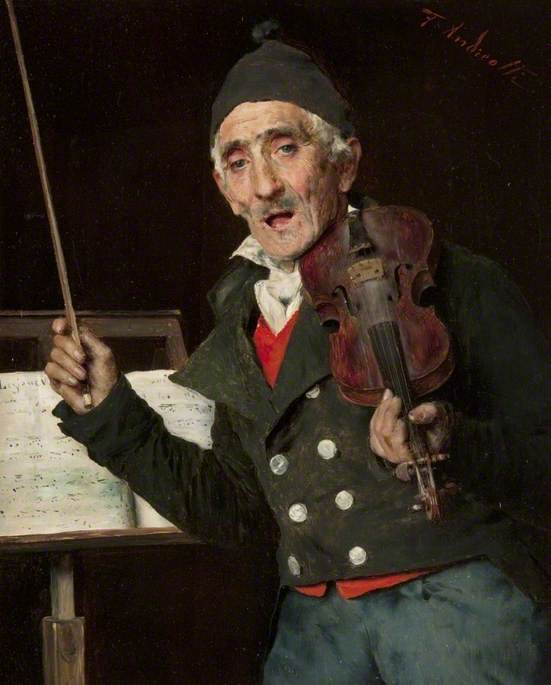
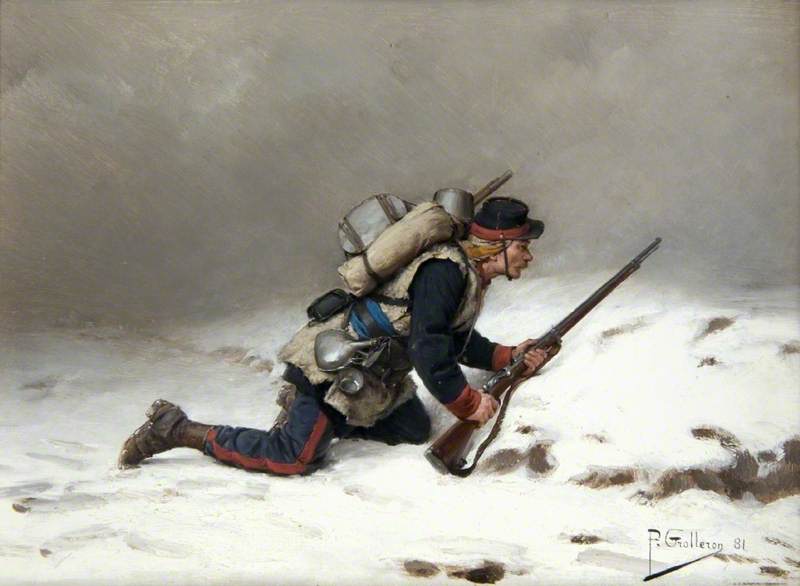
Bequest made by late Miss Margaret H. Garroway. There was submitted a letter by Messrs Kidstons and Co. solicitors of 86 St. Vincent Street, Glasgow, intimating that the late Miss Margaret H. Garroway of Thorndale, Skelmorlie, had offered the Corporation under her settlement the choice of her collection of ivories, pictures and engravings, the selection to be postponed until after the death of her two nieces, Mrs Todd and Miss Haldane. The two nieces in question were agreeable to the corporation making their selection now. There was also submitted a report by the Director stating that he had inspected the collection and recommended acceptance by the Corporation of the complete set of ivories, the following pictures, three of which are shown, viz. –
MediumArtist’s NameName of the Painting
Oil Frederigo Andreotti A Violin Teacher Watercolour Eduard Detaille The Drummers Oil Lucien Gerard Young Man Reading Oil Paul Grolleron The Scout Oil Charles-Louis Kratké French Army on the March(1848-1921) Watercolour A P Robinson Highland Loch Oil Adolphe Weisz Going to Mass
There was also a number of engravings which would be useful for the library of period prints. The committee agreed that the Director’s recommendation be approved.‘Glasgow. A collection of approximately ninety pieces of oriental Ivory has been presented to the Art Gallery by the Trustees of Miss Margaret H. Garroway’.Margaret H. Garroway was brought up with her two brothers and three sisters. She was the youngest in the family. At that time, the Family Garroways had a house on Cumbernauld Rd, called Rosemount. They also had a house at Skelmorlie in Ayrshire. It is possible that our donor was educated privately, as was the custom of wealthy people at that time.
It appears that Miss Margaret Helen Garroway either inherited or possibly bought the above paintings and the collection of ivory. In her later life, our donor moved to her final home Thorndale, Skelmorlie in Ayrshire.
Margaret Helen Garroway died on 24 January 1947, when she was 86 years old. Her death was reported in the Deaths column on the first page of the Glasgow Herald of 25 January 1947. [11] It read:
‘Garroway: At Thorndale Skelmorlie, on 24th January 1947 Margaret Helen, daughter of the late Dr Robert Garroway. Funeral Private’.
There were no obituaries. The Scotsman of 23 May 1947 reported in its Wills and Estates on page seven that her estate was worth £53,248. [12]
Although our donor Margaret H. Garroway appears in all relevant Scotland Censuses, she is invisible all throughout her life until she makes her donation to Kelvingrove Gallery.
Arthur Edward Anderson donated the two paintings shown to Kelvingrove in 1931 (1) Arthur Edward Anderson was born in Wandsworth in 1870. (2) He was the son of Edward John Anderson and Eleanor Anderson. Arthur Edward Anderson died in Chessington Surrey on November 9th 1938. (3) There is no evidence of any marriage. Edward John Anderson was born in Meerut, East India, with census returns in 1871 showing him as a British Subject, his occupation listed as ‘gentleman’. His father owned a soap factory in Meerut. Edward John Anderson returned to England to live and established himself as a wharfinger. (4)
The family undoubtedly had money. Most of the scant census information available for Arthur E. Anderson, who was the first born son of the family, lists him as a gentleman, although in the 1901 and 1911 census he is listed as a clerk in the East India Merchant Company. (4) His life’s work however, seems to have been philanthropy, fuelled by his passion for art.
His wealth is also highlighted in a brief biography on the website of the British Museum which states that his art purchases were funded by his ‘inherited wealth’, although the same biography states that Anderson was ruined by the ‘great crash’ – presumably the stock market crash of 1929. It is worth noting that although he was ‘ruined’, he still managed to donate two paintings to Kelvingrove in 1931 and donated paintings to the Fitzwilliam Museum in Cambridge until 1935 (5)
A.E. Anderson was a philanthropist who definitely gave for public benefit. He wanted others to enjoy art as he did. According to Sir Sydney Cockerell who wrote Anderson’s obituary for the Times, Anderson was a man of exceptional taste who bought art works because they were beautiful. Cockerell acknowledges that he took advice from gallery directors about what he should buy. (6) Having bought these works, Anderson then donated them to Galleries and Museums around Britain.
These galleries included the Fitzwilliam Museum In Cambridge (of which Sir Sydney Cockerell was the director) and the Whitworth Institute in Manchester. Between 1924 and 1935 Anderson donated twenty six items to the Fitzwilliam Museum, including watercolours, drawings and sculpture. Between 1916 and 1927 Anderson donated 17 drawings to the British Museum. These included drawings by Brandoin, Daumier, Raemaekers and Clara Klinghoffer, among others. (7)
After his death, obituary notices were featured not only in the Times, but also in local papers in places such as Gloucester, Hull, Derby, Belfast and in Angus in Scotland, perhaps an indication of the scope of Mr Anderson’s generosity (8)
Although frequently invited to do so, Anderson seldom visited any of the museums and galleries to which he donated art works. Even when the Whitworth Institute held an exhibition of works donated by him he could not be persuaded to attend the opening. He has been quoted as saying ” I do it because I enjoy it and I don’t like being thanked.”
Apparently he did once visit Cambridge because he had at one time been destined to attend Clare College. He is also known to have attended a gathering of distinguished guests invited by the government of the day to celebrate the centenary of the foundation of the National Gallery in 1924. Largely however, Anderson was not a man who sought recognition. In some cases, paintings would arrive at galleries having come directly from the dealer where Anderson bought them with no information other than the name of the donor.
Cockerell stated of Anderson that he got as much pleasure out of finding homes for his art works as did the collector who hung his treasures on his own walls. Cockerell also hoped that “the example of this unique public benefactor will inspire others with similar enthusiasm”
Anderson himself wrote, ” I often wonder what made me take up such an unusual hobby – I simply cannot resist buying a beautiful work of art when I see it and, as there is no room in my tiny cottage, there is nothing like presenting them to the great public museums, where they will have a safe refuge for many years to come. I should hate a sale for distribution far and wide after they have been collected together with such loving care.” (9)
Arthur Edward Anderson’s story is a small but significant one. He has no great galleries named after him and most of the works he donated rest in the stores of the Museums to which he was so generous. However, his motives for giving are clear and his desire to share his love of art with others stands in tribute to his memory. Donors such as Arthur Edward Anderson form an important part of much of our cultural life. Without them our galleries and museums would be lesser places.
Bibliography
(1) Glasgow Corporation Minutes 1931
(2) ancestry.co.uk :1881 census accessed 07/04/2021
(3) The Times, November 11th 1938
(4) ancestry.co.uk: 1901 census, 1911 census accessed 07/04/2021
(5) Fitzwilliam Museum Cambridge : http://www.fitz museum.cam.ac.uk
On 11th October 1948 the following 3 paintings were presented to Kelvingrove Galleries from Mrs Anna Walker’s Trust, per Messrs. Inglis Glen and Co., 223 West George St., Glasgow, C2:
On 11October 1948 the following three paintings were presented to the Kelvingrove Galleries from Mrs Anna Walker’s Trust, per Messrs. Inglis Glen and Co., 223 West George Street, Glasgow, C2:
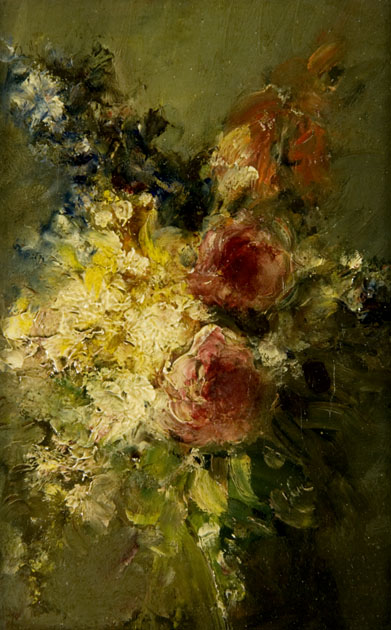
A Bunch of Flowers, an oil painting by Victor Vincelet (1840-1871).
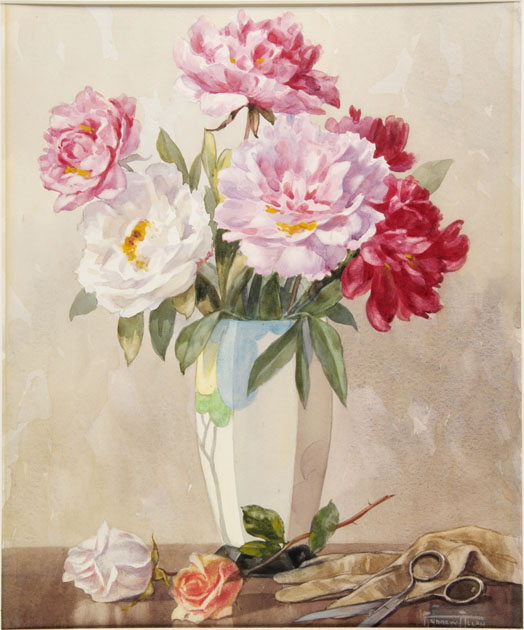
Peonies, a watercolour by Andrew Allan (1905-1982).
Cathedral Interior, a watercolour by James Holland (1799-1870).
When a female donor makes a donation using only her married name and with no other details, it is difficult to find out much information about her. Our donor is a prime example of this. Apart from her name and the pictures that she donated to the Gallery, there is no other information. However, what was obvious about her was her enthusiasm for flowers which is very clear from the above two paintings that were presented to Kelvingrove Gallery (See 1 and 2).
As the search started, it was clear that it would be expedient to write something about the historical background. This was the mid- Industrial Revolution age which saw tremendous social changes as well as certain scientific awareness and discoveries which affected everybody in this country as well the whole world.
The Industrial Revolution took hold in Glasgow at the beginning of the nineteenth century. Linen was Scotland’s premier industry in the eighteenth century but at the beginning of the nineteenth century the manufacture of cotton and textiles increased rapidly. Immigrants from the Highlands in the 1820s and from Ireland in the 1840s formed the workforce. The city then diversified into heavy industries like shipbuilding, locomotive construction and other heavy engineering that could thrive on nearby supplies of coal and iron ore. Between 1870 and 1914, Glasgow ranked as one of the richest and finest cities in Europe. [1]
As all this industrialisation was going on, it was clear that certain breathing spaces of the City must be built in the form of parks and botanic gardens as the lungs of the City. Thomas Hopkirk, a distinguished Glasgow botanist, had founded the Botanic Gardens in 1817 with the support of a number of local dignitaries and the University of Glasgow. [2] The Gardens were originally laid out on an 8-acre site at Sandyford at the western end of Sauchiehall Street (at that time on the edge of the city). The Royal Botanical Institution of Glasgow owned and ran the Gardens. They agreed to provide the University of Glasgow with teaching aids, including a supply of plants for medical and botanical classes. It is worth noting that one of the future famous plant-hunters, David Douglas, who was born at Scone near Perth, had taken up a post at the Glasgow Botanic Gardens in 1820.
Professor Hooker, who was Regius Professor of Botany at Glasgow University in 1820 and later became the first official director of the Royal Botanic Gardens, Kew in 1865, took a great liking to Douglas and the two men made a number of botanical trips together to the Scottish Highlands while Hooker was writing his book Flora Scotica. It was on Hooker’s recommendation that the Horticultural Society (not yet ‘Royal’) employed Douglas in 1823 as an explorer. It should be noted here that when David Douglas was exploring North-West America in the 1830s, he sent home seeds of Pseudotsuga, now commonly known as the Douglas Fir. David Douglas had also introduced more than 200 species of plants to gardens in Europe. [3]
Until the 1840s Glasgow’s West End consisted of open countryside, isolated farmhouses and the country dwellings of Glasgow’s most wealthy citizens. The completion of the Great Western Road and the re-location of the Botanic Gardens to the Kelvinside Estate in the early 1840s was the catalyst for a rapid change to the character of the area. [4] The Botanic Gardens and Glasgow Green are prime examples of these developments of the time. ln 1852 the Council purchased some land from the Kelvingrove and Woodlands estate to create an area which is now Kelvingrove Park and which was to be the new home for the famous Kibble Palace. [5]
There was definitely some desire to experiment growing and cultivating new breeds of plants brought in by scientists and other enthusiasts from the faraway lands of India, China, Japan and the Americas. These plants were either acquired in seed form or as complete plants to the newly established Horticultural Society and the like.
This enthusiasm for bringing plants from faraway lands continued into the beginning of the twentieth century, when we meet our donor Mrs Anna Walker.
She was on holiday in Northern Italy, when she accidentally discovered a heather. It was propagated by her gardener Robert Howieson-Syme and it was then sent to the Royal Horticultural Society (RHS) at Wisley and in 1925 named by F.J Chittenden, the then Director of the RHS. Initially, this new variety of heather was called Springwood which was the name of the house in Stirling where Anna lived with her husband. Later it was named Springwood White on the appearance of another variant called Springwood Pink by F. J. Chittenden in 1925. [6] The preferred name for the plant is Erica Carnea f1 Alba Springwood White. [7] It is remarkable that our donor Mrs Anna Walker had discovered her heather at a time when the main part of the Industrial Revolution had ended. Furthermore, World War I was over. However, the endeavour for the appreciation and growing plants from foreign lands was still alive.
The above information obtained from the article in the Heather Society [8] was the key to discovering the identity of our donor Anna Walker – her age, date of birth and her family’s details. In the 1881census [9], Anna was 14 years old and described as a scholar. She was born in 1866 in Glasgow, Lanarkshire. Her father, William Gibson, born in 1841, was a cloth merchant and her mother Isabella S. Gibson was born in 1844. In the same census record, it is recorded that she had a brother George who was 10 and a sister Jeannie T. who was 12. The Gibson Family lived in 1 Burnbank Gardens, Glasgow, Barony Lanarkshire with two servants.
Anna Gibson married Ralph Wardlaw Thomson Walker, a ship broker in 1890 in the Glasgow district of Partick. [10] Also in the 1891 census [11] it is recorded that the Gibson family was living in Doune, Perthshire in Castle Bank Cottage. Ralph WT Walker is shown to be in the same dwelling with his now wife, Mrs Anna Walker. Furthermore, the same household appears to have a guest, William Linklater, a minister of the Free Church in their house.
Our donor’s husband, Ralph W.T. Walker, was born in 1865. His father’s name was Robert Walker and his mother’s name was Mary Ann (Donaldson). The couple lived for a time in 3 Bruce Street Glasgow where Ralph had lived and had been living for a few years before he married. In the 1891 census [12], Anna’s brother George Gibson is described as a mercantile shipping clerk.
In the 1901 census [13], Mr and Mrs Walker are shown to be living in 4 Athole Gardens at Partick Burgh, Glasgow. Ralph’s profession is now recorded as ship owner. This is a large house and our donor Mrs Anna Walker now employed two servants – one as a table maid domestic and the other as a cook domestic. There is an impression that Mr and Mrs Walker were keen travellers, because apart from their travel to Italy in the 1920s, both of their names also appear on the First Class passenger list of the ship Duchess Of Atholl belonging to the Canadian Pacific Line bound to a West Indies cruise from the port of Greenock on 30 January 1930. [14]
Our couple stayed in Athole Gardens until 1915 and then moved to Stirling . The name of the house is Springwood and is B-listed. It was built about 1870 and they lived there from the early twentieth century until Anna died on the 24 July 1948. Earlier, Ralph had died there too in 1943.
In the Glasgow Herald of the 26 July 1948 there was a notice [15] which is printed below:
At Springwood Stirling on the 24th July 1948 Anna, wife of late Ralph W.T.Walker, ship owner. Funeral private. No Flowers.
On the 18 October 1950, three oil paintings were presented to Glasgow by Mrs Carola Yapp of 14 Clareville Court, Clareville Grove, London, S.W.7.
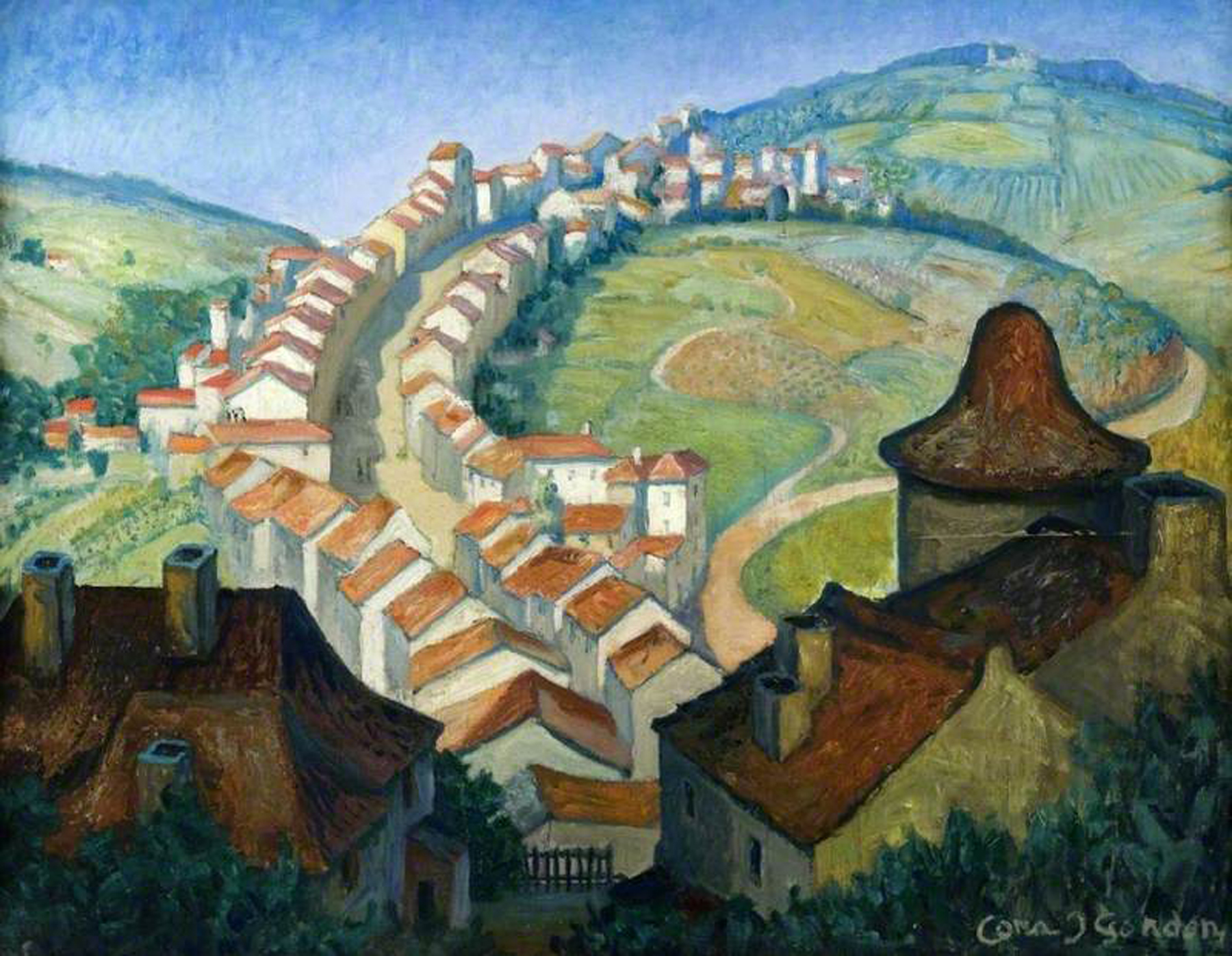
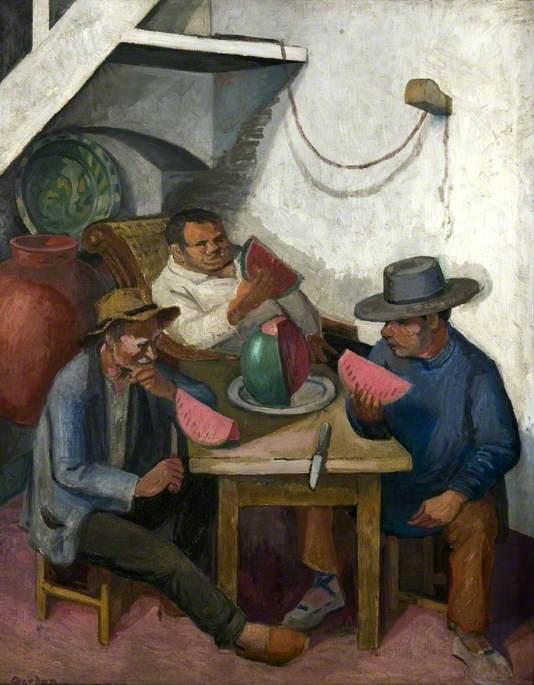
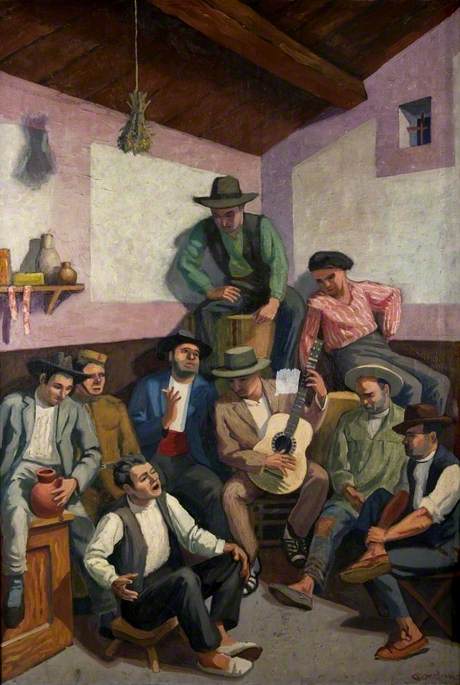
The paintings were an oil by Cora J. Gordon (1879 – 1950), France – The Village on the Hills (2685) and two oils by Jan (Godfrey Jervis) Gordon (1882 – 1944) – The Melon Guzzlers (2866) and The Gypsy Singer (2867).
“There was submitted a letter from Mrs. Carola Yapp offering two paintings by Jan Gordon and one by Cora Gordon as gifts to the Corporation. There was also submitted a report by the Director and the committee agreed that the paintings be accepted and that an expression of thanks be conveyed to the donor”.1
Carola Florence Stanuell was born in Dublin on the 6 August 1893. She was the second child of Charles Athill Stanuell, a Dublin solicitor, and Ida Marion Turner. Ida who was from Buxton in Derbyshire was the elder sister of the artist Cora Gordon.2 In addition to being a solicitor, Carola`s father was also a wealthy landowner and was secretary of the Incorporated Law Society of Ireland from 1913 to 1917. At the census of 31 March 1901 the family was living at 7 Clyde Road, Pembroke West in Ballsbridge, a well-to-do area on the south side of Dublin. The household consisted of Charles aged 48, Ida, 32 and their two daughters, Dorothy Helen 8 and Carola Florence 7 and three servants.3
On the 18 December 1918 Carola Stanuell married Charles Peter Yapp a lieutenant in the Bedfordshire Regiment in St. Bartholomew’s Church on Clyde Road, Dublin where Carola had lived as a child.4 After their marriage the regiment was posted to India where the couple remained for about four years. On 23 September 1922 they arrived back in Plymouth having sailed from Bombay. Charles’ occupation on the ship’s manifest was “army” while Carola’s was “domestic”. He was 27 she was 29. They took up residence in Great House Court, East Grinstead.5
In 1928 Carola gave birth to a son Peter Michael Stanuell Yapp in Kensington, London.6 From about 1932 till World War II, the family lived at Flat 5, 16 Emperor’s Gate, Kensington with Carola’s sister Dorothy Helen (and briefly, her mother Ida Marion) residing with them.7 After the war Charles, Carola and Peter moved to 14 Clareville Court.
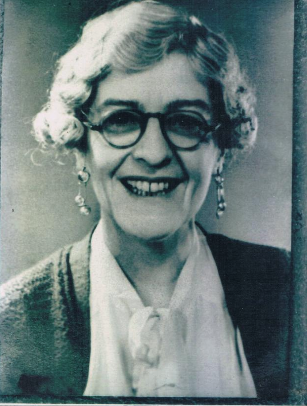
After Carola’s husband Charles died in London in 1955 aged 59 8 her sister Dorothy moved in with her. By this time her son Peter had married and was living in Kingston, Jamaica and on 23 May 1958 Carola sailed from London to visit Peter and his wife Rita. Her address in the UK on the ship`s manifest was White House Hotel, Earls Court, London. She is listed as having “no occupation”.9 The visit seems to have gone well with Rita subsequently describing her mother-in-law as “a very sweet lady”.10
Figure 4. Carola Yapp. Courtesy of her daughter-in-law, Rita Yapp.
After spending some months in Kingston she flew to La Porte, Texas on 5 August, 1958 and then on to Miami. Her address was Stewart House, London.11 Returning to Kingston she sailed to London arriving on 26 September 1958. Her address was now West Heath Road, Hampstead and her occupation “housewife”.12
Carola Florence Yapp died on 24 July 1971 aged 78 in Hendon, Greater London.13
It remains a mystery as to why these three paintings were donated to Glasgow by a woman who was born in Dublin and spent most of her life in London. Jan Gordon died in 1944 and when Cora Gordon died six years later their paintings and artefacts appear to have been dispersed. There is a possibility that before her death Cora had asked her niece Carola to gift the three paintings to Glasgow because of a prior connection to the city 14 although nothing was mentioned specifically in her will. In any event the paintings were duly presented to Glasgow three months after Cora’s death.
References
Glasgow Corporation Minutes, 18th October 1950 – Mitchell Library, Glasgow
ancestry.co.uk, UK Incoming Passenger Lists 1878 -1960
Family Search, England and Wales Birth Registration Index, 1837-2008
ancestry,co.uk, London Electoral Registers 1832 – 1965
ancestry.co.uk, England and Wales, Civil Registration Death Index, 1916-2007
ancestry.co.uk, UK Outward Passenger Lists, 1890-1960
Personal communication via Ken Bryant
ancestry.com, Florida Passenger Lists 1898-1963
ancestry.co.uk, UK Incoming Passenger Lists, 1878 – 1960
ancestry.co.uk, England and Wales National Probate Calendar, 1858-1995
Suggestion from Ken Bryant. Ken has spent many years researching the life and works of Jan and Cora Gordon. http://www.janandcoragordon.co.uk/. He still keeps in touch with some members of the family including Rita Yapp.