On 21 November 1944, an oil painting of Provost Robert Donald by an unknown artist was presented to Glasgow Corporation by Mr T. W. Donald, 172 St. Vincent Street, Glasgow. C.2.
(Thomas Walter Donald was the 3x great grandnephew of Robert Donald).

There was submitted a letter from Mr T.W. Donald, Writer, 172 St. Vincent Street, offering to present to the Corporation a portrait of Robert Donald, who was provost of Glasgow from 1776 to 1777, and the committee, after hearing a report from the Director, agreed that the gift be accepted and that a letter of thanks be sent to the donor.1
Thomas Walter Donald was born on 5 January 1878 at The Baths, Helensburgh. (This was an extension of the Baths’ Hotel – later the Queen`s Hotel – built for Henry Bell who ferried customers from Glasgow in his steamship The Comet to the hotel). His parents were Ellen Mary Jane Brown and Colin Dunlop Donald jr., a writer in the family firm of McGrigor, Donald & Co., (later C.D. Donald & Sons) of 172 St. Vincent Street, Glasgow. Colin`s address at the time was North Cottage, Wemyss Bay. Colin and Ellen had married on 16 January 1877 in Helensburgh and Thomas was their first child. 2 Thomas` brother, Colin Dunlop Donald was born on 11 September 1879. 3


In the 1881 census, the family was at 72 East Clyde Street, Helensburgh.4 This was the home of Thomas`s great grandfather Walter Buchanan of Shandon who had been an MP for Glasgow between 1857 and 1865. A third brother, William Frances Maxwell Donald (Frank) was born on 3 June 1881, and a sister Helen (Nelly) on 16 July 1882. Thomas later wrote a memoir of his childhood in Helensburgh recalling some of his earliest memories.5
Thomas`s mother died suddenly of a chill on 20 August 1882 shortly after the birth of her daughter. A memorial window to her was placed in St. Michaels`s Church in Helensburgh in 1889. 6
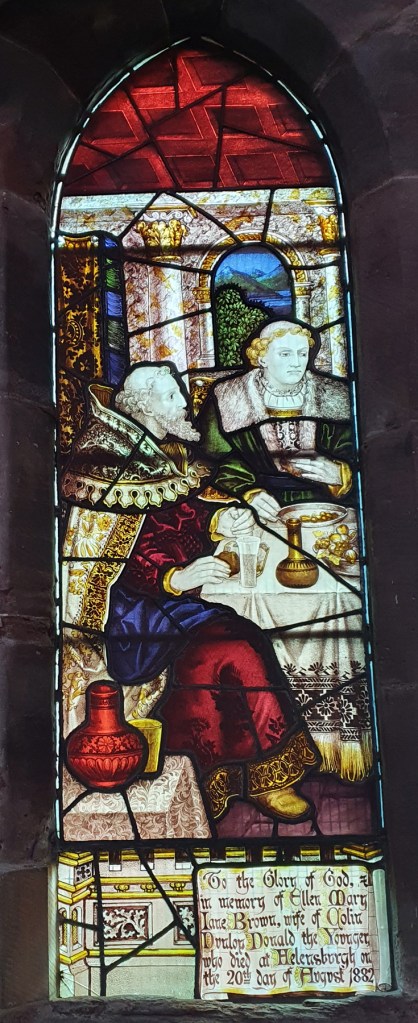


(Photographs by the author)
In the year following Ellen Donald’s death, the family left Helensburgh and moved to Glasgow, first to Westbourne Gardens where they remained for a year, and then to 14 Huntly Gardens, Hillhead. 7,8

The boys were later sent to boarding schools in England. In the 1891 Census, Thomas, aged 13, was a pupil at Bilton Grange School in Warwickshire. 9 In January of the following year he entered Rugby School boarding at Michell House. At Rugby he seems to have kept a low profile as there is no record of him participating in any of the school teams or winning any major prizes. 10 He left in the summer of 1895 to go to Glasgow University.
(His two younger brothers also attended Rugby School. Both boarded at Mitchell; Colin Dunlop Donald from 1893-1895 and William Francis Maxwell Donald from 1895-1898.11 William later studied engineering at Glasgow University).

It was here that Thomas shot his first rabbit! Thomas is in the middle
of the back row. By kind permission of Frank and Colin Donald.
Thomas`s father, Colin Dunlop Donald III wrote articles on archaeology and a history of The Board of Green Cloth which provided ‘a social history of Glasgow at the turn of the nineteenth century’. He was Hon. Secretary of the Regality Club which published books on the buildings of Glasgow. These were illustrated by etchings by D. Y. Cameron who used to call at 14 Huntly Gardens with the proofs.12 (These etchings were left to Thomas and subsequently passed to his grandson Frank Donald who donated them to Glasgow. These are catalogued as PR.2004.5).
When their father died suddenly (of a chill) in 1895, Thomas`s unmarried uncle Thomas F. Donald (TFD) took over the care of the four orphans.
(Thomas F. Donald was an accountant and stockbroker. As a young apprentice his firm had been engaged by one of the Directors of the City of Glasgow Bank to see if he had any defence after the bank failed in 1878. TFD saw the balance sheet which had been presented to a meeting of the board, and when he examined the same balance sheet afterwards it had fictitious amendments in red ink! TFD was secretary of the Royal Northern Yacht Club in Rhu for 24 years and was presented with 200 guineas when he retired in 1910. He was also a donor to Glasgow gifting The Clyde from Dalnottar by John Knox in 1921. This is displayed in the Kelvingrove Art Galleries and Museum).

At university Thomas Walter Donald continued the study of Latin and Greek which he had begun at school. He also attended classes in Mathematics, English, Logic and Roman Law for fees of £5.5.0 per year. He graduated MA on 3 November 1898. Thereafter, he began a course leading to the degree of LLB. He gained a ‘Highly Distinguished’ award in History in 1898-99. In 1899-1900 he studied Scots Law under Professor Alexander Moody Stuart and was awarded a prize for ‘Eminence in Class Examinations’. He matriculated as ‘Thomas Walter Donald MA’ for session 1900-1901 taking classes in Jurisprudence, and Constitutional Law and History. In the latter class he was awarded first prize and he graduated LLB in 1901.13
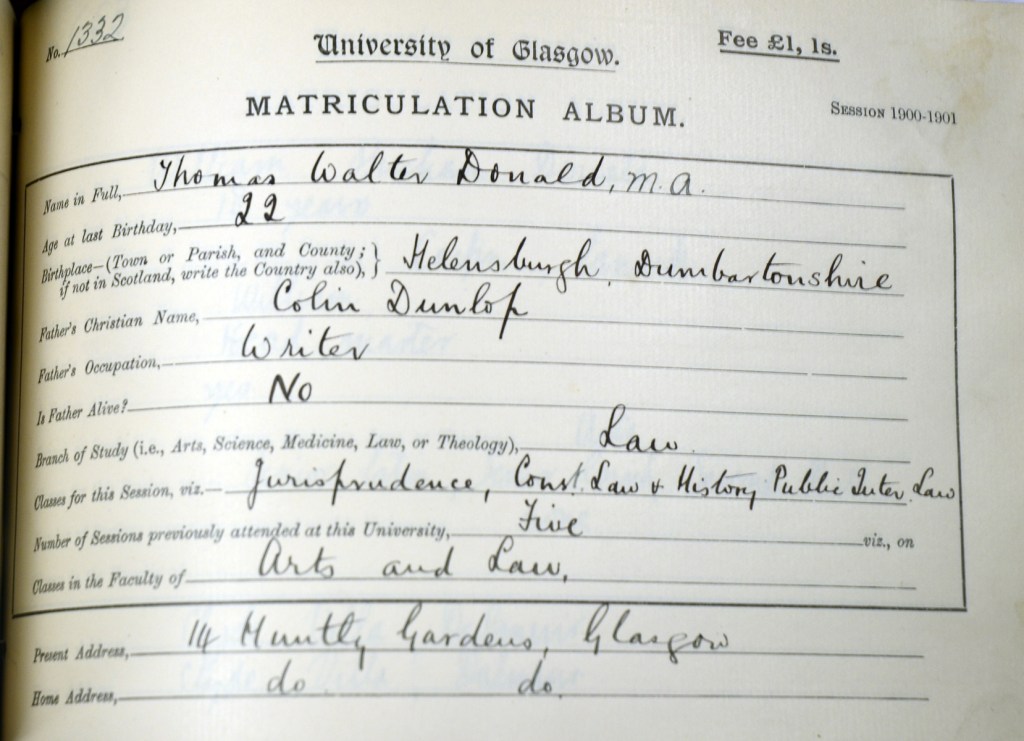
In the 1901 Census, Thomas was a ‘lawyer`s apprentice’, aged 23, living with his uncle, Thomas F. Donald, 47, at 14 Huntly Gardens, Glasgow. His brothers, Colin aged 21 and William, 19, were also living there.14
After serving an apprenticeship with the Glasgow legal firm of Maclay, Murray and Spens, Thomas was admitted a solicitor in 1902.
On 20 September 1902, Thomas married Sarah Gertrude Newstead, at St. Mary’s Church, Bryanston Square, Westminster, London.15 She was 28, the daughter of a retired surgeon from Bristol. The couple moved to Glasgow to a flat at 8 Clarence Drive, Hillhead, where their son Colin George Walter Donald was born on 7July 1904. 16,17 Soon after the birth they moved to Grendon Lodge in Helensburgh. 18 It was here that their daughters Monica Mary Louise (1910) and Barbara Gertrude (1912) were born.19 Apparently, the children later became close friends of the Blackie children who lived in the ‘Hill House’. Barbara later reported that ‘while the window seats in the Hill House were great fun, the famous Charles Rennie Mackintosh chairs were terribly uncomfortable’. 20
About 1905, Thomas joined McGrigor, Donald and Co., Glasgow a law firm which had been part founded by his great-grandfather, Colin Dunlop Donald.21 He remained with this firm for the rest of his life eventually becoming senior partner. He also became the senior member of the Royal Faculty of Procurators in Glasgow. He seems to have specialized in lawsuits involving shipping and shipwrecks and often acted on behalf of the Board of Trade at which time, ‘all other work in the office ceased!’ The firm also acted for the family of Madeleine Smith.22
Thomas had a keen interest in his family history and outlined some of its main points in a letter to the Glasgow Herald in 1909 23. This was in response to a previous letter requesting information about the father, grandfather and great grandfather of Robert Donald – the subject of the donated portrait. (Appendix 1)
Due to a pre-existing medical condition, Thomas was not required to do active service in WW1. However, he did undertake a course of training in the Glasgow Citizen Training force which he completed in 1915 before transferring to the corresponding company in Helensburgh. (In WW2 his duties involved a stint of fire watching at 172 St Vincent Street).

After living for eighteen years in Helensburgh the family moved to Stirling in 1922, to a house at 9 Snowdon Place which they also named Grendon. 24 (This is still called Grendon House but has been converted to flats)
Thomas and his brother Colin Dunlop Donald became members of the Merchants’ House of Glasgow in 1928. 25

(The page shows, Matriculation Number; Date, 13th Sept. 1928; Name; Occupation; Address of Firm; Father`s Name and Designation; Entry Fee (21 guineas) and date when paid).
Thomas was fond of ‘cruising in other peoples’ yachts’ but he also undertook some more far-flung voyages. On 19 June 1931, he arrived in London via Plymouth from Bombay, India. He was 53 and had travelled on the P & O ship ‘Malwa’.
On 21 February 1938 he arrived at Bristol from Kingston, Jamaica following a visit to his son and daughter-in-law.26

Gertrude Donald died from cancer at 9 Snowdon Place, Stirling on 13 April 1942. She was 68.27
In 1952 Thomas moved to 44 Kelvin Court on Great Western Road, Glasgow. In 1969 he gave an interview to Jack Webster of the Scottish Daily Express in which he talks about his connection with the West India Association.28 This had been set up in 1807 to facilitate trade with the West Indies. He had become treasurer of the association in the 1930s and had presided over their last meeting in 1969. (Appendix)
Thomas Walter Donald died on 23December 1970 at 44 Kelvin Court, Glasgow. He was 92. The cause of death was hypostatic pneumonia and myocardial degeneration. The death was registered by his nephew Colin Dunlop Donald.29
According to the writer of his obituary, Thomas Walter Donald ‘was a man of great charm and wide culture, and in his extensive legal practice his humanity found full scope’.
He played his part in public work as a director of the Merchants` House and the Elder Hospital, and as representative of the Glasgow Faculty on the Joint Committee of Legal Societies from which the Law Society of Scotland developed. He was a director of the British Linen Bank and the Scottish Provident Institution.30 He was also a Trustee of Provands Lordship.
Thomas`s daughter-in-law was Russian and a good friend of the painter Eric Prehn and his wife Irina, whom she had known in Riga. When Eric and Irina moved to Edinburgh Thomas used to stay with them when he attended British Linen Bank board meetings. As a result of their friendship Thomas was encouraged to take up painting himself. Unfortunately, not much of his work has survived. Thomas does not appear to have been a collector of art but owned the following paintings which have family connections.
- Portrait of Robert Donald, Provost of Glasgow 1776-7. Donated to Glasgow.
- Portrait of Colin Dunlop of Carmyle, Provost of Glasgow and one of the founders of the ‘Ship Bank’. This was donated to the British Linen Bank to celebrate the bicentenary of the Ship Bank. It passed to the Bank of Scotland and was subsequently returned to the family.
- Portrait of Kathrine Donald, wife of Robert. This remains in the family.
- Portrait of James Donald painted in1757. This remains in the family. It was shown as part of the Old Glasgow Exhibition.
The Sitter
Robert Donald (1724 – 1803)
Robert Donald was a ‘Virginia Merchant’ – one of the Glasgow ‘Tobacco Lords’ – and a Provost of the City. He was born in 1724 the fourth son of Thomas Donald of Lyleston (also a tobacco merchant) and Janet Cumming of Baremann. 31
He formed a partnership with his older brother James. (James Donald, also a tobacco merchant, acquired the lands of Geilston in Cardross in 1757 and was subsequently styled, James Donald of Geilston). Robert married his first cousin Katherine Donald, daughter of Robert Donald of Greenock.
When James Donald died in 1760 his estate passed to his eldest son Thomas who maintained the partnership with his uncle Robert, and they traded as Robert Donald and Co. They had their own fleet of ships which they operated in conjunction with their cousins in Greenock. They maintained a network of Company Stores in the back country of Virginia and dealt with the small tobacco growers.
Both Robert and James appear to have spent time in Virginia, and had a house in Pages a township in Hanover County where they were visited by George Washington in 1752. Robert left America to return to Scotland in 1758.
Robert became a Burgess of Glasgow (by right of his wife) in 1759. He was elected a Baillie in 1765 and 1773. In 1767, he feued the 24-acre Mountblow estate near Clydebank from George Buchanan of Auchentoshan and built Mountblow House on this estate.

He was elected Provost of Glasgow on 1 October 1776 and retained that position until 30September 1777. In 1778 he took an active part in raising a regiment to serve against the Americans in the War of Independence. However, he later lost most of his fortune when Thomas Donald & Son became bankrupt in 1787. (Presumably Thomas was now senior partner hence the name change.) Robert remained at Mountblow and, until 1798, was employed by the city to supervise the deepening of the River Clyde at a salary of £50 per annum later increased to £60.
On 6 June 1793, Robert wrote a letter from Mountblow to George Washington asking him to look favourably on the bearer who was his nephew.
Katherine Donald died in 1798 and five years later, on 22 February 1803 Robert Donald died at Mountblow. 32 He was buried in the Ramshorn Churchyard in Glasgow. Having no children of his own he seems to have left the bulk of his estate to his nephew Alexander Donald.
The Mountblow estate was acquired by Henry Bowie and then by William Dunn of Duntocher (1770-1849). It was inherited by Dunn’s nephew, the Advocate Alexander Dunn Pattison. He sold it to Glasgow Corporation in 1877 and they in turn rented it to James Rodger Thomson of the Clydebank Shipyard until 1893 when it was leased to the Seamen’s Orphans’ Institute. It became Mountblow Children’s Home in 1922.33 The house probably suffered damage in the Clydebank Blitz of 1941 although was not hit directly by bombs. The remains were demolished to make way for housing after the war.
The Painting
The painting was completed in London in 1762 when Robert Donald was 38. The artist is unknown. The painting did not remain in the family and may have been sold either when Robert`s business collapsed or when he died. In 1868, the portrait was on loan at an Exhibition of Portraits held in the New Galleries of Art in Sauchiehall Street. It was lent by Thomas Carlisle Esq.* It was loaned to the ‘Old Glasgow Exhibition’ held under the auspices of the Glasgow Institute for Fine Arts in 1894. This time the lender was a Miss Carlisle.
*Thomas Carlisle was a manufacturing chemist and a partner in the firm of Stevenson, Carlisle and Co. with works at Millburn Street, Townhead, Glasgow and an office at 23 West Nile Street. He had a house at 2 Lancaster Terrace, Great Western Road. He died in 1917. It seems he was also in possession of a portrait of Katherine Donald, wife of Robert at the time of the 1868 exhibition. Perhaps Thomas Walter Donald purchased both portraits from the Carlisles?

Appendix
An article written by Jack Webster which appeared in the Scottish Daily Express.
‘When the tax on rum was a farthing a gallon’
Thomas Walter Donald nods towards a portrait above his lounge mantelpiece and tell you that the robust gentleman in question, his great-great-grandfather, was born in 1745 and became one of Glasgow`s tobacco lords trading with the American colonies.
But Mr. Donald, quiet and cultured, does not require a portrait to give his visitor a sense of history. For he himself has lived through 92 years in which he has been, and remains, an active city lawyer. He was a trustee of the estate of Mr. Smith of Blythswood Square, father of Madeleine Smith, the Glasgow girl accused in 1857 of poisoning her secret French lover, a charge which was found “not proven”.
The other day, Mr. Donald brought another reminder of an age that is all but forgotten when he called a rather special meeting of the West India Association. The association was founded in 1807 to help those eager businessmen who were trading with the West Indies during last century to bring home the rum, sugar and tobacco. “My family has turned from trading to law, however”, says Mr. Donald, “and I was never a trader myself. I merely became treasurer of the West India Association in the 1930s, by which time there was not much business being done”.
“The emancipation of the slaves had knocked a considerable hole in the profits. But there was a time in the heyday of these tobacco, rum and sugar lords when the association was very active. In 1840 for example, it appointed a delegation to go to Parliament to protest against an increase on the duty on rum from ¼ d to ½ d per gallon. Glasgow was doing a tremendous overseas trade at that time. By the time the Second World War came, more and more trade was being done from London”.
“Those in Glasgow still interested began to die off and the association became moribund. We met again in 1946 – but not again until 1969, when I thought it was perhaps about time that we had another meeting”.
“This time it was to see about disposing of stock and cash totaling around £730 – and eight remaining members of a once flourishing organisation agreed that the remaining surplus funds will be handed over to “the West India Committee” in London. This is a non-profit making body founded in 1750, which promotes Commonwealth, Caribbean/UK trade and stimulates investment in the Commonwealth and Caribbean and the improvement of the standard of living there”.
In his luxury flat in Glasgow`s west end, Mr. Donald showed me the massive tomes of minutes stretching back to 1807 – which are now being handed over to the Mitchell Library. He had known nearly half of that period from his own experience. To talk to him was to absorb history itself. At 92, he is still senior partner in one of the Scotland`s biggest legal practices. He pops down to the Western Club in the city centre, or off on a cruise to Madeira.
Jack Webster
References
- Glasgow Corporation, Minutes of Art Galleries and Museums Committee, 21 November 1944, page 165. Held in The Mitchell Library, Glasgow
- Scotland`s People, Birth Certificate
- ibid
- ancestry.co.uk, 1881 Census, Scotland
- Memoir written by T.W. Donald. Excerpts from this memoir were supplied by Frank Donald, grandson of the donor. I am most grateful to Frank and his cousins Colin and James Donald for supplying photographs and information contained in this report. Any un-attributed material in this report is due to them.
- Stained Glass Window in St. Michael`s Church, Helensburgh. Made by Charles Eamer Kempe, 1889. (Mary Magdalene anointing the feet of Christ), St Michael’s Church — a short history Penny Johnston, 30 March 2010, Helensburgh Heritage
- T. W. Donald Memoir
- Glasgow Post Office Directory, 1884-5
- Ancestry.co.uk, 1891 Census for England
- Information from Rusty MacLean, archivist, Rugby School
- ibid
- T.W. Donald Memoir
- Archives of the University of Glasgow
- Ancestry.co.uk, 1901 Census, Scotland
- Ancestry.com, London Marriages
- Glasgow Post Office Directories for 1903-4, 1904-5 and 1905-6
- Scotland`s People, Birth Certificate
- Scotland`s People, Census 1911
- Scotland’s People, Birth Certificates
- T.W. Donald Memoir
- Glasgow Post Office Directories for 1903-4, 1904-5 and 1905-6
- Glasgow Herald, 25 December 1970, page 11.
- Letter initialed “T. W. D.”, Glasgow Herald, 16 April 1909, page 14
- Post Office Directory, Stirling, 1922
- Merchants` House of Glasgow Archive, Mitchell Library, Glasgow
- Ancestry.com, UK Incoming Passenger Lists, 1878-1960
- Scotland`s People, Death Certificate
- Scottish Daily Express, 31 July 1969
- Scotland`s People, Death Certificate
- Glasgow Herald, 25 December 1970, page 11
- Marwick, J.D. ed., Provosts of Glasgow, in Charters and Documents Relating To the City of Glasgow 1175-1649 Part 1, Glasgow, 1897
- The Scots Magazine, Vol 65, 1803, (‘At Mountblow, in the 79th year of his age, Robert D(onald) Mountblow, Esq formerly Lord Provost’)
- Glasgow University Library, Special Collections, Dougan Add. 73


 Glasgow Museums Art Donors Group