( Barmouth, St. Ives Bay and A Dutch Mill, were received in February 1928 from Andrew Lusk`s executor. Castle Campbell near Dollar was given by his niece Mrs. Berkeley Robertson, nee. Janet Lusk on 29 August 1941. However, the catalogue entry at Glasgow Museums Resource Centre for this painting has a note added ‘to be described as presented by the late Andrew Lusk, Windsor, 1941’).
Andrew Lusk was born at ‘Lusk`s Cottage’, Coatbridge, Lanarkshire on 3 June 1853. 2 He was the son of James Lusk, a master baker and his wife Janet Reid. (James was born in Colmonell, Ayrshire in 1817. Janet was born in Cambuslang also in 1817). 3 There were two other children, John Lusk, born 14 July 1848 (the father of Janet Lusk) and Margaret Earl Lusk, born 3 March 1851.4 All were at Lusk`s Cottage in the 1861 Census along with two servants. Andrew`s father employed two men and forty-three boys. 5 The family is listed in Armorial Families6. (Appendix 1)
Figure 6. James Lusk. National Archives of Scotland, (NAS) GD501
Figure 7. Janet Reid. National Archives of Scotland, (NAS) GD501
Andrew attended Glasgow High School in the 1860s and seems to have had an interest in and an aptitude for art from an early age which was further developed while at school. 7
From the 1871 census, Andrew, aged 17, was living with his parents, brother and sister at Glasgow Road, Bothwell. He was employed as a clerk. 8 By 1881 his siblings had both married and he had moved with his parents to Hamilton Road, Ferniebank, Bothwell. He was now aged 27 and a ‘commercial clerk in the iron trade’. 9 Sometime after that he moved to England. His father died in 1890 and Andrew was one of his executors. His address then was 3 Fenchurch Avenue, London. The 1891 census found him, aged 37 and single, at The Dell, Woking in Surrey. (The Dell was one of the larger houses in Woking but has since been demolished 10). He was now an ‘iron and steel merchant’ and employed two servants. 11 Woking would seem an unlikely place to find an iron and steel merchant. However, the town had an excellent train service to London so Andrew could have commuted to his business in the city.
It is possible that his career as a steel merchant came about after his brother John married, in 1876, Jessie, the daughter of David Colville, the founder of the Colville steel firm. 12 An account of his assets after his death showed that Andrew was receiving a pension from Colvilles. 13
By the time of the 1901 Census, Andrew had moved to 7 Queen`s Gardens, Osborne Road, New Windsor. 14 He later named the house St. Moritz after a holiday in Switzerland in 1909.
Andrew’s uncle Sir Andrew Lusk who was Lord Mayor of London in 1874 and head of the firm of Andrew Lusk and Co. died in 1909. His funeral took place at St. John’s Church, Southwick Crescent, London on 24 June 1909. Andrew was in attendance as one of the ‘chief mourners’. 15 Andrew later wrote a memoir of his uncle which is held in the National Archives of Scotland. Dame Eliza Lusk, widow of Sir Andrew, died the following year. Andrew was an executor of her will and was left the sum of £1000.
In the 1911 census, Andrew was at the Regent Hotel, Leamington Spa, 16 presumably on holiday because by this time his residence was in Windsor, Berkshire. He also owned a house Roseisle in Glasgow Road, Perth. This was occupied by his sister Margaret and her husband Alexander Sutherland who was a local minister. After Andrew`s death, the house was to have been left to Margaret during her lifetime. However, she predeceased him. His mother Janet who was living on private means moved in with her daughter after the death of her husband in 1890. She died at Roseisle in 1899 and Andrew was present to register her death. 17
In 1915 an appeal was made for subscribers to ‘extinguish the debt incurred by the King Edward VII Hospital in Windsor’. Andrew donated fifteen guineas and a further twenty the following year 18.
Andrew had a great interest in art, music and books. In his house in Windsor he had a collection of paintings, sculpture and many fine editions of books. These were to be kept in the family after his death as ‘I cannot bear the thought of my Fine Editions being handled by careless young people’. He owned a library of music manuscripts which was left to his nephew the Rev. David Colville Lusk who sold it to St. Andrew`s University in 1952.19 He also owned a violin and piano which he may have played. His intention, according to his will was that his paintings be given to the National Gallery in Edinburgh. Were the National Gallery to refuse them, they were then to be offered to Glasgow and to Perth. In the event, Glasgow received four paintings as detailed above. The Sandeman Library in Perth was given five pictures, five marble busts and three pedestals (Appendix 2). The Royal Scottish Academy was given a tea urn believed to have belonged to Sir Henry Raeburn 20. In his will he left £100 to his former housekeeper. After his death she wrote to his executor thanking him for the legacy and stating that as Mr. Lusk`s housekeeper, she ‘had spent many happy years in his service’. (As well as a detailed will, he left a four-page document of ‘Testator’s Suggestions to his Executors’ on how to dispose of his assets e.g. who should be employed to sell his furniture and books and where to find various items mentioned in his will. He also suggested the best firm to pack up his pictures for donation). 21
He also left a painting by Fred Roe ARA, The Landing of Nelson at Yarmouth to the Castle Museum at Yarmouth. (This painting had been exhibited at the Royal Academy in 1909). His own sketches – views of Rome, Florence, Holland, Sweden etc. were to be kept in the family ‘if at all possible’.
Andrew Lusk never married and died at his home in Windsor on 12 October 1927. It is likely he had been ill for some time as illness prevented him attending the funeral of his sister who died in Perth the previous year.22 He was buried in a lair in St. Andrew`s Cathedral Churchyard, Fife which he had purchased in 1899.23 His will contained instructions for the design of his tombstone! It was to be ‘in the same style and colour as Lord Playfair`s close by’! According to his will which was probated in Edinburgh his personal estate was valued at £25, 190. 5s. 8p. The Scotsman reported that he ‘left £100 to the Royal Society of Musicians, and £300 to the United Free Church of Scotland Foreign Missions, in memory of his mother Janet Lusk’ and gave details of his donation of paintings to Edinburgh and Glasgow. 24The Motherwell Times also carried a report of his estate and noted that he was a director of David Colville and Sons, Ltd., steel manufacturers. 25
The following are two extracts from the Minutes of the Corporation of Glasgow, sub-committee on Art Galleries and Museums:
23 December 1927: The Superintendant reported that he had received a letter from Messrs. Gard, Lyell and Co., London, Law Agents for the trust estate of the late Andrew Lusk, St. Moritz, Windsor, intimating that the deceased under his will, had bequeathed to the National Gallery, Edinburgh, certain pictures, and that six of these pictures specified in said letter might, if desired, be available for the Corporation of Glasgow. The sub-committee, after consideration, agreed that it be remitted to Depute River Baillie Doherty and Councillor Drummond, along with the Superintendant, to inspect the pictures, and with power to accept the same on behalf of the Corporation.
2 March 1928: With reference to the minute, of date 23rd December last, Depute River Baillie Doherty and Councillor Drummond, under remit to them, along with the Superintendant, reported that they had inspected the collection of pictures belonging to the Trust Estate of the late Andrew Lusk, St. Moritz, Windsor, and had agreed to recommend acceptance of the following works of art, viz.
Barmouth – J. W. Oakes, A.R.A.
St. Ives Bay – John Brett, A.R.A. and
The Windmill – Clarkson Stanfield, R.A. 26
Because Andrew Lusk had insisted in his will that his paintings should be hung tastefully and together with the appellation ‘from the bequest of Andrew Lusk, Windsor’, his executor went to great lengths to see that this was carried out. There are three letters relating to the placement of the pictures given to Glasgow in the NAS file.
In his ‘Testator’s Suggestions to his Executors’ he stated that ‘I wish particularly that my other pictures apart from those mentioned in my will be kept in the family (the Greenock cousins excluded!!) or given to friends who would appreciate them rather than sold to dealers for whom I have a great objection’.
A portrait of Lady Sawyer by Sir Hubert Herkomer RA was left to his nephew and executor David Colville Lusk. Heidelberg on the Rhine by J. B. Pyne probably went to his niece Jenny Robertson. Another picture Old Mortality had been entrusted to him by his aunt Dame Eliza Lusk in her will but was in fact the property of his brother.
References.
National Archives of Scotland, (NAS) GD501 (This is an extensive collection of Lusk family papers and photographs. It contains a book of Andrew`s paintings completed while still at school. The donor`s address was Dunblane, Perthshire). Other family photographs (Figs. 6 and 7) taken from the same source,
Fox-Davis, Arthur Charles, Armorial Families – A Directory of Gentlemen of Coat-Armour, two vols., Edinburgh, T.C. and E.C. Jack, 1905.
Scotland`s People, 1871 Census
Scotland’s People, 1881 Census
Woking History Society, Sue Jones, by e-mail
ancestry.co.uk, England Census, 1891
Scotland’s People, Marriages
NAS, GD501
Ancestry.co.uk, England Census, 1901
The Times, 25 June 1909
Ancestry.co.uk, England Census, 1911
Scotland’s People, Death Certificate
Slough, Eton and Windsor Observer, 17 and 24 July 1915, p. 4 and 19 May 1916, p1.
NAS, GD501
ibid
ibid
Perthshire Advertiser, 6 November 1926.
NAS, GD501
The Scotsman, 3 March 1928, p14.
Motherwell Times, 10 October 1928, p5.
Corporation of Glasgow, Minutes, 1928, C1/3/78 pp. 516 and 987.
Appendix 1: From Armorial Families.
Sons of James Lusk of Feam Bank(sic), Lanarksh., (5. 1817 ; d. 1890; m. 1846, Janet, d. of Andrew Reid of Hamilton, Cambuslang : — John Lusk, Gentleman [Arms as above, and (matric. 30 May 1903) a bordure silver. Crest — An ancient ship as in the arms, but without the rainbow as above], b. 14 July 1848 ; m. 10 Aug. 1876, Jessie, d. of David Colville ; and has issue — (i) James Lusk, Gentleman, b. 19 Sept. 1878 (2) David Colville Lusk, Gentleman, b. 19 Nov. i88i and Janet. Res. — South Dean, Merchiston, Edinburgh ..Coulter House, Lanarkshire. Andrew Lusk, Gentleman, b. 3 June 1853. Res. — St. Moritz, Windsor.
Appendix 2
Donations to the Sandeman Library, Perth (Now Perth Museum).
Trebarwith Strand, Cornwall, Edwin John Ellis, R.I. (1848 – 1916)
Dover Cliffs, Edwin John Ellis, R.I.
Cattle and Trees (original title), now Landscape with Cattle, William Shayer, sen.
Windsor Castle from Snowhill (original title), now Windsor Castle from Windsor Great Park, Charles Edward Johnson, R.I. (Exhibited at RA, 1895)
General Gabriel Gordon, (1763 – 1855), Sir John Watson Gordon, P.R.S.A. (1788 – 1864)
Marble Busts of: Sir Walter Scott, with pedestal
Milton
Diana, with pedestal
Dido, with pedestal
Demosthenes.
Further Information about these:
There is a picture in Perth Art Gallery by Edwin John Ellis entitled Fishing Boats on a Beach. Could this be the same picture? It has reference FA76/78 and acquisition method is ‘unknown’.
In Perth Art Gallery, ref. FA99/78. ‘Unknown acquisition method’.
In Perth Art Gallery, ref. FA59/78. ‘Unknown acquisition method’.
In Perth Art Gallery, ref. FA101/78. ‘Bequeathed by Andrew Lusk, 1951’.
In Perth Art Gallery, ref. FA92/78. ‘Bequeathed by Andrew Lusk, 1951’.
A receipt for five pictures, five busts and three pedestals was received by D.C. Lusk on 5 December 1927 from the Sandeman Library, Perth.
Note: Charles Rennie Cowie and his son John always in Bold.
Figure 1. John Cowie. By kind permission of John D. Napper.
In 1964 the widow of East India merchant John Cowie, Mrs. Elizabeth Janet Cowie, donated to the National Library of Scotland (NLS) in Edinburgh and the Mitchell library in Glasgow a collection of rare books, historical manuscripts and letters, included in which are rare editions of Robert Burns poems, first editions of Milton, Galt, and Scott, and a large number of letters of Burns and others. It consists of several hundred items and is an astonishingly eclectic accumulation of material covering over six hundred years. The NLS was to get that material which was of national importance, the Mitchell the rest, the decision making process being undertaken by personnel from both libraries, Mrs. Cowie and her lawyer. Eventually the NLS collection consisted of manuscripts of Robert Burns, Sir Walter Scott and the poet Allan Ramsay.
The individual who had collected all this material was not John Cowie however, it was his father Charles Rennie Cowie, also an East India merchant, who had bequeathed it to his wife Grizel on his death in 1922.[1] In his will the collection was identified as of National and Historic Interest, thereby excluding it from his estate for tax purposes, and valued at £4083.[2] Today, at that valuation, the joint collections would be worth around £2 million.[3] Grizel died seven years later with the collection eventually going to John.[4]
Who was Charles Rennie Cowie, what was his and his wife’s family background? By what means did he fund his purchases? One other question which seems unlikely to be answered by this research is from whom did he make his purchases?
The Cowie family originated in Stirlingshire, most likely in the parish of Larbert. JohnCowie’s great grandfather was forester James Cowie who was married to Margaret McAlpine.[5] It’s not clear when they married however John’s grandfather, also John, was born in 1817,[6] the fifth of eight children all born in Larbert. They lived in Carronhall village to the east of Larbert, James dying there in 1848.[7] Margaret remained in Carronhall until circa 1863 when she moved to Grahamston to live in a house owned by her son John.[8][9] She died there at the age of eighty seven in 1870.[10]
John married Margaret Rennie in 1839,[11] she also being born in Larbert the daughter of iron founder John Rennie and his wife Mary Alexander.[12] It’s not clear what his occupation was at the time of his marriage however by 1841 he was a grocer in Grahamston in the parish of Falkirk,[13] an occupation he followed for most of his working life. He and Margaret had twelve children between 1840 and 1862, seven sons and five daughters, the relevant offspring to this research being Charles RennieCowie and three of his brothers, James, Archibald and Thomas, and his sister Jessie.
John and Margaret lived in Grahamston until at least 1872[14] however by 1881 they had moved to Mavis Villa, Riddrie,[15] which is where he died in 1882.[16] Margaret lived a further twelve years, dying in Hyde Park, Blantyre in 1895.[17] Interestingly in the 1891 census she was resident in Rutherglen, living on a private income, with her son James, another East India merchant, and two grandchildren John and Mary, both born in Rangoon,[18] the children, as I’ll show, of her son Charles Rennie Cowie.
Charles was born on the 24th October 1851 and baptized in July the following year[19]. His initial education was at a local school. He then attended Anderson’s College in George Street in Glasgow studying chemistry under Frederick Penny.[20] Penny was a Londoner who had studied chemistry under Michael Faraday at the Royal Institution and in 1839 had been appointed Chair of Chemistry at the College, a position he held until his death in 1869. He also was involved in testing the water quality from Loch Katrine to establish if it was suitable for Glasgow’s water supply and gave expert testimony in a number of criminal trials involving poisons including that of the infamous Dr. Pritchard who had murdered his wife and mother in law.[21]
When Charles left College is not certain, nor is it clear what his qualification was, but he must have left around 1870 as by 1871 he was employed as chemist at the Uphall Oil Works in Linlithgow, living in lodgings at Crossgreen Farm in Uphall.[22] In due course he became manager of the facility[23] which was just a few miles from James ‘Paraffin’ Young’s refinery in Bathgate. In 1873, being described as ‘gent’ he was appointed ensign in the 5th Linlithgowshire Rifle Volunteers.[24]
He did not remain in Uphall very much longer as around 1874[25] he travelled to Rangoon eventually becoming manager of the Rangoon Oil Company the precursor of Burmah Oil, this being his occupation when he married Grizel or Grace Purdie in 1878,[26] more of whom shortly.
Between 1876 and 1878 he registered two patents in Rangoon, one dealing with the use of rice husks as furnace fuel in rice mills,[27] the other about improving the efficiency of steam furnace combustion.[28] The first patent at least halved the cost of milling rice with the added benefit of the burnt rice husks proving to be an effective deodorizer used to cover all kinds of refuse dumps. His invention not only found use in Burma but also in Thailand and French Indo-China.[29] He also registered a third patent with a colleague in 1881, again dealing with furnace efficiency.[30]
Figure 2. Grace Purdie Christening Cup. Courtesy of Bo’ness Pottery
He remained manager of the oil works until circa 1878/79 at which time he founded in Rangoon the trading company Charles R Cowie & Co.,[31] trading in almost any commodity that was required by customers in British India and elsewhere. That was the beginning of Charles, his brothers James, Archibald and Thomas, and his eventual sons, becoming East India merchants
His wife Grizel was the daughter of Thomas Purdie, farmer, and Margaret Storrie, [32] her birth being commemorated by her parents having a christening mug made by Bo’ness Potteries.[33]
The family originated in West Calder where Grizel’s grandfather Andrew Purdie farmed at West Mains which is where he died in 1863 age ninety five.[34] In 1837 whilst Andrew was the tenant of the farm a servant girl Elizabeth Brown was charged with child murder or concealment of a pregnancy. She confessed and was sentenced to ten months imprisonment. The court records make no mention of the male involvement only that Elizabeth’s address was c/o Andrew Purdie, West Mains Farm. [35]
Figure 3. Uphall, Crossgreen and Fortneuk Farms. Courtesy of Bo’ness Pottery
Thomas Purdie farmed at Forkneuk, Uphall from around 1855[36] which makes it likely that Charles and Grizel met before he went to Rangoon, the farms being in close proximity to each other. They married at Forkneuk on the 17th December 1878, the beginning of a married life that for the first twelve or so years saw them travelling frequently between Rangoon and Glasgow.
Their first born child was John, the ostensible donor of the Cowie Collection. He was born in Rangoon in October 1880 and baptized there in July 1881.[37] They had a further nine children between 1882 and 1903 as follows:
Mary Storrie, born 1882 at Rangoon and baptized there.[38]
Margaret Rennie, born 1884 at Portobello, baptized in Rangoon later that year.[39]
Gracie Purdie, born and baptized at Rangoon in 1886.[40]
Thomas Purdie, born at Woodend House, Partick in 1893.[44]
Charles Rennie, born at Woodend House, Partick in 1895.[45]
Gladys Dorothy, born at Woodend House, Partick in 1903.[46]
Whilst Charles ran his company in Rangoon his brother James in 1880 was working for Jas. L. McClure & Co., merchants and agents for a number of companies dealing in iron and steel products.[47] Two years later he established his own agency company, James Cowie & Co., representing a number of similar companies from England and Scotland.[48]
In the following year Cowie Brothers & Co. were formed located at the same address, 59 St. Vincent Street, as James’ company. No other brother seemed to be involved at that point[49] however it does appear that simply was a matter of timing as within the next twelve months brother Archibald joined the company.[50]Charles was home in Glasgow that year (1884), not associated with either of the family businesses but with merchants Russell, Macfarlane & Co., a situation that occurred every time he came home from Rangoon until circa 1891 when he came home to Glasgow for good. He had lived at various address on each return home finally settling at Woodend House, Partick sometime after 1891, his wife Grizel being recorded as the owner.[51] His Rangoon company however still operated in his name as before directed by Rangoon partners and his sons.
The two Glasgow Companies continued to operate for another ten years, latterly from 196 St Vincent Street, with Charles continuing to be associated with Russell, Macfarlane and Co. until 1893 when he formally joined Cowie Brothers & Co.[52] It’s clear brother James was seriously ill at that time as he died the following year of cirrhosis of the kidneys which he had suffered from for at least six months.[53] James’ company ceased trading in 1897/98, the last year it appeared in the Glasgow directory.[54] Cowie Brothers & Co continued for several years afterwards with brother Thomas joining the company in 1905, remaining involved until 1911. Subsequent to that date the Cowies involved in the company were the three sons of Charles, namely John, Thomas and his namesake Charles. The company was still listed in the Glasgow Directory in 1975.[55]
Charles senior’s company in Rangoon also continued to operate at least until the late 1930s, with his three sons all involved to varying degrees, travelling back and forth to Rangoon as required. The last journey from Rangoon I have established is that of son Charles Rennie Cowie and his wife Norah on the M.V. Oxfordshire during April/May 1939.[56]
However a third Charles Rennie Cowie was to remain in Burma. John, the eldest son of Charles and Grizel married in 1908 Elizabeth Janet Ramsay. They had four children the eldest of whom was another Charles Rennie Cowie, born in Rangoon in 1911. He joined the Rangoon Battalion of the Burmese Auxiliary Force in 1938 and in 1940 is listed as a lieutenant in the Battalion. He continued to be listed through 1941 as such although it seems he was promoted captain in April 1941.[57] Exactly where he was located during this time has not been established although I have come across a photograph of him and fellow officers, along with their honorary colonel, Sir Alexander Cochrane, in Burma (Rangoon?) in 1940.[58] Lieutenant C. R. Cowie is seated at the extreme right hand side.
He stayed in Burma throughout the war, attaining the rank of Lieutenant-Colonel by its end.
John’s brother Thomas Purdie Cowie married in Rangoon in 1921[59]. In the Thacker’s Commercial Directory of 1925, the company was located at 6 Merchants Street and described as machinery importers, mill furnishers and mill stores, engineers and contractors, electrical stores, insurance agents, importers and exporters, and as agents for the Dollar Steamship Line. There were no Cowies listed as Rangoon partners although Thomas was listed as an assistant in the company.[60] He returned to British India in 1945, this time to Bombay, as the Director of Stores for the Indian Red Cross.[61]
As stated previously, the Cowie companies traded any commodity that had a buyer. Their sales included cutlery, steam engines, pottery, biscuits and bricks. Where they could they labelled or marked the items with their company name.
Figure 5. Cowie Brothers and Co. trademark applied to transfer printed bowls by Bridgeness Pottery. Courtesy of Bo’ness Pottery
Figure 6. As figure 5.
Figure 7. Steam Engine with Cowie Brothers and Co. nameplate. Courtesy of Bo’ness Pottery.
Their involvement with bricks came about when Charles senior’s sister Jessie married coalmaster Mark Hurll in 1888.[62] At the time of his marriage his brother Peter was a fireclay brick manufacturer in Glenboig. About three years later Mark set up with his brother as a brick manufacturer, amongst other similar products, forming P & M Hurll, with works in Maryhill, Garscsadden as well as Glenboig. This led to the Cowie brothers trading the bricks and applying their name to each individual product.[63]
Their involvement with biscuits in terms of their trademark however was not as successful. In 1896 at the Court of Session they applied for an interdict against biscuit manufacturers George Herbert, a supplier of Cowies, to stop them using what they claimed to be the Cowie trademark, an image of the Glasgow Municipal Building, on biscuits sold by Herberts on their own behalf in Rangoon.
Charles Rennie Cowie and brother Archibald gave evidence essentially saying that Cowies had traded biscuits to Rangoon since 1889, with that trademark. The defendant had also been trading in Rangoon but had begun to use a similar image of the Municipal Building on biscuits he sold directly there thereby confusing potential native purchasers. After a very longwinded obtuse argument involving images of temples and mosques, the judgement went against Cowies and the interdict was refused, the judges essentially declining to accept Rangoon natives would be confused.[64]
It will be pretty obvious by now that the money Charles senior earned through his business ventures as an East India Merchant was the means by which he created his collection. When he died in 1922 his estate was valued at £144,507[65], current worth somewhere between £7million and £70million.[66]
The NLS collection is listed on the library website as contained within MSS 15951 – 15975 and consists of manuscripts relating to Robert Burns, Sir Walter Scott and the poet Allan Ramsay. The manuscripts include an autobiographical letter written by Burns to Dr. John Moore in 1787 in which the poet writes retrospectively of his life to date (MS 15952), and a series of thirteen manuscripts relating to the seven volume collection ‘The Works of Robert Burns’ edited by W Scott Douglas, 1877-1879 (MSS 15955-67). Also included are proofs of ‘The History of Scotland’, 1829-1830, by Sir Walter Scott (MS15969), the final version of ‘The Gentle Shepherd’ by Allan Ramsay, 1724-1725 (MS15972), and letters of Sir Walter Scott to Robert Southey and others (MS15971).[67],[68]
The Cowie collection at the Mitchell is somewhat different. Although it also contains a lot of Burns material, it has an exceptional range of other manuscripts, books, including first editions, and letters from an extremely wide range of individuals including royalty. As far as I’m aware there are no digitalised records of the collection however there are two catalogues which contain a full list of the items donated. They are ‘The John Cowie Collection-Catalogue’ and ‘The John Cowie Collection-Autograph Albums. Index 1 to 4’.
The following will give some idea of the range of topics and material that the Mitchell holds.
Statutes of Edward I and II. MSS dated 1274.
Rerum Scoticarum Historia. Edinburgh: A. Arbuthnot 1582. Author George Buchanan.
Quintus Curtius. Venice 1494. De Rebus Gestis Alexandri Magni.
John Milton – Paradise Regained. 1st Edition 1671.
Carolus Gustavus, King of Sweden. Last will and Testament – 1660.
Aesop Fables by Sir Roger L’Estrange. 1692/1699.
The Rosebery Burns Club, Glasgow. Its origins and Growth 1906.
Charles Edward Stuart – Order signed by him to raise the Mackintoshes – 1746
Letter of Leopold I, King of the Belgians 1850.
Paul, Emperor of Russia letter to Baron Dimsdale 1778.
Bassendyne Bible 1576
C.F. Brotchie. History of Govan 1905
Eikon Basilike. The Pourtraicture of his sacred Majestie in his solitudes and sufferings. 1648. (Charles I).
Acts of Parliament – 1711.
Royal Navy Accounts of Cruisers and Home- Convoys – 1704.
George I Document headed 15/4/1724
M.W. Turner R.A. lecture ticket dated 1818.
William Wilberforce various letters 1819 – 1825
Louis XVI. Order for lieutenant to command the corvette ‘La Poulette’ – 1781.
Last will and testament of Carolus Gustavus King of Sweden – 1660.
Allan Ramsay The Ever Green, a collection of poems – 1724.
Sir Walter Scott. Guy Mannering, Edinburgh 1815
An account of the taking of the late Duke of Monmouth. Samuel Keble 1685.
Giuseppe Garibaldi – letter to Rear Admiral Mundy. 1860.
James III letter to Cardinal Gotti, Bologna. 1729.
James Boswell. The journal of a tour to the Hebrides with Samuel Johnson. London:1785.
The Works of Geoffrey Chaucer 4th John Kyngston 1561.
Figure 9. Charles Rennie Cowie. Courtesy of Bo’ness Pottery.
His enthusiasm for Robert Burns went beyond collecting books and manuscripts. He contributed significantly to the purchase and restoration of buildings associated with the poet.
Burns’ house in Castle Street (previously Back Causeway), Mauchline, where he and Jean Armour lived was put up for sale at the beginning of 1915 by its then owner, a Miss Miller. The Glasgow and District Burns Clubs Association were interested in purchasing it and sent a delegation to examine the premises, which included Cowie as president of the Partick Burns Club.
It was decided to buy the property despite it being in the need of repair. It’s not clear what the total costs involved were however Cowie donated the required funds to purchase and repair the house. The building once restored was formally opened to the public on the 28th August 1915. In addition to the museum created, provision was made in the other rooms of the property to accommodate deserving elderly people.[70] At the end of the ceremony Mrs Cowie was presented with a silver key to mark the occasion and her husband’s generous gift.[71]
Figure 10. Opening of Burns House, Mauchline. Mrs Cowie and Charles fifth and sixth from left. Courtesy of Bo’ness Pottery.
Following on from that in 1916 Charles funded the purchase of the property adjoining the Burns house which had been once owned by Dr. John MacKenzie who had apparently attended Burns’ father at the end of his life. Little work was done during the war but by 1919 the premises were fully restored allowing the museum to expand and to provide accommodation for additional elderly people. His final act of generosity in this respect was for the purchase of Nanse Tinnocok’s Tavern across the road from the other two properties. It was formally opened after repair on the 24th May 1924 by Mrs. Cowie, Charles having died in 1922.[72]
Figure 11. Mrs Grizel Cowie being presented with ceremonial key after performing the opening ceremony of the restored Nanse Tinnocks Tavern. Courtesy of Bo’ness Pottery.
Charles Rennie Cowie died at Woodend House, Partick on the 18th November 1922, cause of death given as chronic nephritis (inflammation of the kidneys).[73] In his lifetime he had been a very successful chemist, inventor and merchant, amassing a fortune from his trading activities which allowed him to indulge his interests in Burns, and collecting.
His obituary in the Glasgow Herald makes reference to his professional life and to his collecting, describing him as a an ‘ardent admirer of the national poet’ and ‘keenly interested in the history of Scotland’. It also adds that he was prominent in temperance circles, an elder in Dowanhill U.F. Church and a member of several General Assembly committees.
He was President of the Abstainers Union and had been a director of the Scottish Temperance League, also supporting these organisations and others financially, and had purchased the old Partick Academy gifting it to the Western branch of the Y.M.C.A. He had also endowed one of the beds in the Arran War Memorial Hospital, an island he visited annually on holiday. He was a J.P., vice president of the Hillhead Liberal Association, had been a member of the Govan School Board, and was a Fellow of the Society of Antiquaries of Scotland. (F.S.A.). [74]
In his obituary in The Straits Times of 16 December it was stated that every rice eater owed the cheapness of his meal to the ‘unobtrusive chemist from Scotland’. He was also described as a ‘public spirited and charitable citizen’.[75]
John and his mother Grizel were named as executors and trustees of Charles’ estate. Grizel inherited all the household items including his collection and other artefacts and there were also a number of bequests to his church and the temperance organisations he had been involved with. The residue was then to be split half to Grizel, and the other half equally divided between his ten children.[76]
Grizel died in 1929 leaving the collection to John. He died on the 10th March 1963 of a heart attack.[77]
Acknowledgement: My thanks to John D. Napper, grandson of John Cowie, for additional information on the Cowie family
In August 1918, the Trustees of the late Mr George Dickson presented a painting called Falls of the Dochart, Killin by Sir Alfred East (1844–1913) as a memorial to Mr George Dickson. [1]
The above painting that was presented to Kelvingrove Gallery, on behalf of our donor, was painted by Alfred East who was born in 1844 in Kettering and died in 1913, four years before our donor George Dickson’s death. By a strange coincidence Alfred East’s family as well as our donor’s family were both in the shoe business. A letter received from a research assistant in the Alfred East Gallery, Kettering, (http://www.kettering.gov.uk) at our request, gave some information regarding Alfred East. In the following lines this information is summarised.
After the death of his father, Charles East, in 1876, Alfred East became a junior partner in the business, with his nephews, Walter and Fred East. In Glasgow, he attended his first evening classes at the Government School of Art. In 1880, he resigned from the family business and with his savings and a part-time job in a bank, he was able to attend the Glasgow School of Art. How long he spent there is unclear, but by 1882 he was in Paris studying at the École des Beaux Arts and, later, the Académie Julién. He painted A Dewy Morning (a Barbizon landscape) in 1882, which was his first work to be exhibited at the Royal Academy in 1883.
It transpired that Alfred East managed his family’s firm’s warehouse and appears to have been the firm’s representative for sales and distribution in Scotland as well as in the north of England. In around 1874, he was sent to Glasgow by his family’s shoe business. It is possible that Alfred East and George Dickson might have met in Glasgow and perhaps the painting that was given to Kelvingrove Gallery and Museum was then bought by George Dickson from Alfred East. But the research assistant mentioned in his letter that he could not find any notes or indicators in the records that such an encounter had ever taken place.
Our donor, George Dickson, was born on 18 October 1829, in Glasgow. His father was James Dickson and mother was Janet Dickson (née Janet MS Nimmo). He was baptised
on 22 November 1829 in the Gorbals district of the city. When he was 10 years old, his family lived in Saltmarket Street, Glasgow. His father, James Dickson, was a currier, a craftsman who curries leather for shoe making and any other articles such as gloves. [2]
It may be appropriate at this juncture to mention that the Incorporation of Cordiners is one of the fourteen ancient crafts which comprise the Trades House of Glasgow founded in 1605. It has its meetings in the historic Trades Hall designed by Robert Adam in 1791. The Incorporation of Cordiners in Glasgow has been supporting aspiration in the leather trade for nearly five-hundred years, certainly long before it received its Deed of Cause in 1558. [3]
There is not much information available about our donor’s early education, but it is known that there was quite an emphasis on education in Scotland during the nineteenth century. Scotland has long enjoyed an international reputation as historically one of the best-educated countries in the world. The foundation for this reputation was laid in the seventeenth century and was the result of the Calvinist emphasis on reading the Bible. Putting men and women in touch with the word of God was seen by the Scottish authorities and clergy as of paramount importance. To achieve this goal, schools paid for by the Church of Scotland and local landowners were established in all rural parishes and burghs by an Act of Parliament in 1696.
These educational establishments were run by the Church and were open to all boys and girls regardless of their social status. The democratic nature of the Scottish system had so impressed the eighteenth-century writer Daniel Defoe that he remarked while England was a land ‘full of ignorance’, in Scotland the ‘poorest people have their children taught and instructed’. The openness of the Scottish system ran all the way from the schoolroom to the university. A talented working-class boy the ‘lad o’pairts’ (a clever or talented fellow) through intelligence and hard work and by utilising a generous system of bursaries was able to gain a university education, something largely unthinkable in England in the eighteenth century. [4]
Therefore, we can assume that there had been a good education available to George Dickson as he was growing up. He had married Annie Buchanan on 20 February 1857 in Glasgow. [5] The I871 Census shows that, they had 5 children by that date. They were James (13), George B. (11), Robert (8), Oliver (6) and Jessie Ann (2). [6]
Also, in the censuses available during his lifetime, we see that he lived at several different addresses. The address given in the 1871 Census indicates that Dickson and his family lived at 2 Abercromby Terrace. Glasgow. In the 1881 and 1891 censuses, his home address is given as 15 North Claremont Street, Glasgow, then it changed to 8 Sandyford Place, Glasgow where he stayed until his death in October 1917. [7] His death was recorded in the Deaths column of the Glasgow Herald of 13 October 1917. [8]
His death certificate indicates that, he was a boot and shoe merchant, though the certificate could not be traced. As his father before him was a currier, it appears that he had followed his father’s footsteps into the shoe business. There are also recordings in the censuses during his lifetime that he had been a boot and shoe merchant. His premises were in 449 Argyle Street in Glasgow, which was later extended to include 451 Argyle Street, Glasgow. Furthermore, after his death, when his son Oliver Dickson was in charge, the company was extended further to have many branches throughout Glasgow.[9]
It is interesting to note that our donor lived after the Napoleonic Wars (1792-1815) and during the time when Wellington boots were becoming fashionable in Great Britain. To see how the name of Wellington Boots came into being, the following story can be read online at the following reference. [10]
Acknowledgement
Help of the Archive staff of Mitchell Library, Glasgow and also the Trades House Glasgow is greatly appreciated.
In 1886 Janet Aitchison gifted a portrait of her father to Glasgow. Painted by Sir Daniel McNee, a renowned Scottish portrait painter who became president of the Royal Scottish Academy in 1876, it depicts John Aitchison as a confident, successful businessman.
The painting was exhibited at The Glasgow Institute of Fine Arts exhibition of 1894 and lent by The Corporation of Glasgow.(1)
In 1868 the painting was exhibited in The Illustrated Catalogue of Exhibition of Portraits on Loan in The New Galleries of Art, Corporation Buildings, Sauchiehall Street, Glasgow and lent by Walter Paterson who was a son of John’s sister Euphemia.(2)
John was a prominent merchant in Glasgow at a time when trade with America was particularly strong. However, with the decline of the tobacco industry after the American War of Independence, the British Empire looked for other opportunities, especially in the colonies. The sugar industry expanded and by 1790 the West Indies became Glasgow’s primary trading outpost.(3) Raw sugar had to be processed to make it saleable and it was these refining processes which John helped to develop.
John was born in Glasgow on 2 September 1769 to Walter Aitchison and Isobel Henderson, who had married in 1768.(4) John was the first of seven children (5) and he lived in Glasgow for much of his life. On 14 August 1797 John married Margaret Robertson (6) whose father James was a merchant in Glasgow. Their first child Walter was born in 1798 and they went on to have a family of twelve over the following sixteen years.(7)
In 1786 aged seventeen John entered The Ship Bank as an apprentice.(8) One of the earliest banks in Glasgow, it was founded by some of the wealthiest merchants in the city, particularly those involved in the tobacco trade. In 1776 The Ship Bank became known as Moores, Carrick & Company, then in 1789 changed its name to Carrick, Brown & Company.(9) Robert Carrick was the leading partner at the time and lived above the bank. One of John’s duties, as the youngest apprentice, was to sleep in the premises at night, armed with a gun, bayonet, powder-horn and a bag of slugs and Mr Carrick would lock the door behind him to ensure security. Both Robert Carrick and John were fond of playing the violin, and they would often practise after work at Robert’s flat. Carrick was known as a bit of a miser and it is said that he left a fortune of £1 million pounds ‘…a grim old bachelor without leaving one plack or penny to any of the charitable institutions of the city….’ The two remained friends till Robert’s death in 1821.(10)
In 1796 John is recorded in the Trades House library as a Burgess and Guild Brethren of Glasgow. He is described as a merchant and serving apprentice with Messrs Moore, Carrick and Company at this time.(11) John left the Bank for the mercantile world, specialising in the processing of cane sugar which was being imported in large quantities from The West Indies. Greenock and Glasgow became major sugar refining centres and much of the machinery required was manufactured locally.
In the early nineteenth century one of the sugar-refining processes enabled impurities to be extracted, by boiling the cane sugar to form a liquid. The liquid was transferred to a series of pans until the required density was achieved. However, if the temperature was too high the liquid would turn into uncrysallizable molasses (treacle). As with many other industries in Glasgow during the Industrial Revolution improvements and efficiencies were constantly being developed. Messrs D Cook of Glasgow developed a more efficient design for evaporating sugar. A Mr Cleland of Glasgow also developed a system of using steam to quicken the evaporating process. It was John Aitchison who developed this process further by controlling the flow of liquid along a specially designed copper apparatus. The boiling action caused the impurities to rise to the surface and form a crust, which could then be easily taken off when the liquid cooled, leaving purified sugar.(12) The process was later patented.(13)
One of the few surviving sugar refining buildings in Glasgow is at 40-50 Speirs Wharf on The Forth and Clyde canal just north of Glasgow city centre, now converted to flats.
Figure 2. 40-50 Speirs Wharf, Glasgow, photo by author
In 1833, Margaret died. In a letter dated 26 July 1833 to his son Robert, who had sailed from Rothesay to Madeira, John describes Margaret’s failing health and the good care she received from their doctor. News of the death was communicated to the Captain of the ship Brig Staffa just before leaving Rothesay and the news was broken to Robert when at sea. Robert became a merchant in Burma until his death in 1838. The funeral was attended by some prominent merchants including John Buchanan of Woodlands and James Buchanan of Dowanhill. Mention is made of Robert’s brother John who applied to a Captain Johnston in London for work, presumably, like Robert, at sea. John senior also makes reference to ‘making every exertion so to get your brother into the service of The East India Company’. It is not clear which brother he refers to. John also refers to his business dealings in the sugar industry , ‘We have not done much as yet in the wee Sugar House …we expect liberty soon to refine all sorts of Foreign Sugars…struggle to get using E India sugars, it will be good bye and bye’.(14)
In 1837-38 John’s business address is recorded as Adam’s Court Lane, Argyll Street, and he is described as a merchant and patentee for machines for sugar refining.(15) In 1838 his business address is recorded as 14 St Enoch Square, Glasgow (replaced in 1875 by Teachers whisky offices). He lived at 52 Renfield Street, Glasgow at this time (the building was replaced by The Odeon Cinema in the nineteen thirties).(16) From 1845 to 1852 he was living at 105 Kensington Place, Sauchiehall Street.(17) By 1855 he had moved to 15 Claremont Street, just off Sauchiehall Street,(18) west of Charing Cross, where he resided till his death in 1859.(19)
Figure 3. 15 Claremont Street, Glasgow photo by author
He was buried at Ramshorn Church in Glasgow,(20) where many notable Glasgow merchants were laid to rest including Robert Carrick (21) who maintained a friendship with John throughout his life. John’s son James and daughters Euphemia and Isabella Henderson are also laid to rest there.(22)
According to the 1861 census Mary Newbigging Aitchison, John’s daughter, was living at 9 Sandyford Place, Glasgow, just across the road from John’s final home.(23) She and Janet never married and they probably lived with John to his final days.(24) The head of the household at 9 Sandyford Place was Margaret, her sister. Also noted as being present was George Bogue Carr, studying In Glasgow to be a minister of The United Free Church.(25) He was from Berwick-upon-Tweed and after a period as minister in Tranent, then Dalmeny Street Church in Edinburgh he emigrated to the USA, becoming Professor of Religious Rhetoric and English at Lincoln University. George was John Aitchison’s grandson whose mother was Jane Robertson Aitchison, John’s second daughter.(26) The Carr family and the Aitchison family were closely associated through marriage at this time.(27)
Colonel Charles Louis Spencer was a merchant, a soldier, a yachtsman and a generous donor to museums in Glasgow and Edinburgh and a donor to The National Trust for Scotland.
He was born in 1870 to John and Robina (nee Jarvie) Spencer (1 ) then living at 165 Hill Street, Glasgow. John Spencer had been a manufacturer of optical and photographic equipment, in business with his father, John senior, with premises at 34 Union Street, Glasgow. (2) John senior retired in 1869 and the business closed down. ( 3) By 1872 young John was a merchant, at 125 West Regent Street, Glasgow. The family home was at 2 Rosslyn Terrace, Victoria Park, Glasgow. ( 4) By 1881, they were living in Bridge of Allan and John is listed as a foreign merchant. (5 )
Charles was educated at Kelvinside Academy (6 ) and then from 1895 to 1896 at the College Chaptal in Paris. This was a college dedicated to the education of young men, destined for a career in commerce and industry, in science and languages. (7 ) His father John died in 1890. (8) His mother moved to Edgehill, Horselethill Road, Glasgow and her children John, Elizabeth and Ann lived with her. They had a cook, a laundress and a table maid. (9)
Charles and his older brother John carried on their father’s business. (10) Their father’s inventory (11) published after his death gives an idea of the scope of their business in Canada, the USA, Calcutta and Colombo. The brothers were admitted to the Merchants House in 1912. (12 )
Charles had a long association with the Lanarkshire Volunteers Royal Engineers (13) During the First World War, he was a Lieutenant Colonel in the Royal Engineers and served in France and Flanders. (14) He was thrice mentioned in dispatches and received the DSO in 1918.(15) and in 1919 he was appointed a CBE (16)
He was a yachtsman and gained his Master’s certificate in 1897. He was Commodore of the Clyde Cruising Club and Flag Officer for 23 years. He sailed in his yacht RON and King George V was a frequent guest. (17 ) He collected, fashioned and repaired ship models and some of these are now in Glasgow museums’ collection.(18 ) On board ship sailing from India or from Canada he spent time making ship models. His book Knots , Splices and Fancy work went to several editions. (19 )
His brother John made a study of the Darien scheme and when he died in 1939 ( 20) his collection of papers was left to the University of Glasgow where they are kept as the Spencer Bequest in Special Collections. (21)
Charles was a member of the Society of Antiquaries in Edinburgh. He was a Councillor from 1922 to 1937.(22 ) Charles and his sister Ann lived together at 5 Great Western Terrace and also bought a house at Warmanbie in Dumfriesshire in 1933.(23) In 1940 they wrote to Glasgow City Council (24 ) offering;
Two pastel drawings by Sir James Guthrie: Ploughing and The Smiddy; An oil painting Black Setter by Sir George Pirie and The Steeple Chase by Joseph Crawhall
12 items of arms and weapons
A collection of Japanese swords
16 books relating to arms and armour
In addition Colonel Spencer wanted to place on permanent loan several models of sailing ships.(25 )
The National Museums of Scotland received the rest of his weapons collection. This comprises 18 crossbows, 7 prodds,1 windlass,4 cranequins and 8 crossbow bolts. (26
Another donation should be noted. He had inherited two small islands in Loch Lomond in 1911 from Donald Macgregor of Ardgarten and in 1943 he gave them to The National Trust for Scotland.(27 )
Charles and John had set up a Trust to maintain the upkeep of the Nunnery garden in Iona.(28 )
Charles died at Warmanbie in 1948. (29 ) His sister Ann died in 1952. (30 )
Acknowledgement
I am pleased to acknowledge the help I received from Roderick Mc Callum from the Annandale Museum with respect to documents relating to Colonel Spencer’s time in Warmanbie and to his death there.
References
National Records of Scotland Statutory Births 1870
In 1877 Alexander Dennistoun donated to Glasgow Museums the painting View of Glasgow and Cathedral by the Scottish painter John Adam Houstoun. However, this was not the only ‘gift’ he gave to Glasgow as in 1861 he began to create the suburb of Dennistoun in the east of the city.
Alexander’s father was James Dennistoun who along with his brother Alexander established J & A Dennistoun, cotton merchants. It’s not clear when the company was set up but when their father, yet another Alexander, died in 1789 his will describes them as merchants in Glasgow.[1]
Their father was farmer Alexander Dennistoun of Newmills Farm, Campsie whose wife was Margaret Brown. James was their third child, baptised in 1759, [2] Alexander, the fourth, baptised in 1764. [3] Their siblings were Jean, Ann and George, the two girls being the first children of the family.[4]
It is not clear where James or Alexander was educated, what is certain however is that neither matriculated nor graduated from Glasgow University.
There is some evidence to suggest that by 1787 James was a merchant manufacturer in Glasgow. Whilst there are three James Dennistouns listed in that year’s city directory it’s clear that the first two are father and son Dennistouns of Colgrain.[5] By 1799 J & A Dennistoun was listed as manufactures in Brunswick Street, neither brother being separately listed.[6]
J & A Dennistoun continued in business until circa 1876 by which time James and Alexander were both dead. Over its eighty odd years it moved premises on a number of occasions, but it centred mainly on various addresses in Montrose Street until 1839, thereafter in George Square until it ceased trading. More on the business in due course.
James married Mary Finlay, daughter of William Finlay of the Moss, Killearn in 1786. They had eight children, donor Alexander being the eldest boy, born in 1790.[7]
His siblings were:
Elisabeth, born in 1787 in Glasgow.[8] She married Glasgow merchant John Wood in 1807 [9] and had five children between 1808 and 1817.[10] One of her daughters Anna, born in 1812, married William Cross in 1835.[11] She was the mother of John Walter Cross[12] who married the novelist George Eliot (Mary Ann Evans) in 1879 and subsequently wrote her biography after her death in 1880.[13]
James, born in Barony parish in 1799.[21] He matriculated at Glasgow University in 1813,[22] and married Marjory Gibson Gordon of Milrig. He died in June 1828 of consumption [23], five days before his son James was born.[24]
John, born in Glasgow in 1803,[25] matriculated at Glasgow University in 1816.[26] In due course he and his brother Alexander became the key players in the family business. He also had his own company, John Dennistoun & Co., cotton spinners, usually located at the same premises as J & A Dennistoun. He was elected as one of the two MPs for Glasgow in 1837, succeeding James Oswald. He remained an MP until 1847 when he lost his seat at the general election. He married Frances Anne Onslow, the daughter of Sir Henry Onslow at All Saints in Southampton in 1838.[27] They had three children, all surviving into adulthood. At various times they lived in England and in Scotland, essentially as business and parliamentary life required. He died in 1870 at Rhu, Dumbarton.[28] His estate was valued at over £130,000 with property in Scotland, England, Paris, Melbourne and New Orleans.[29]
Mary Finlay died sometime around 1808 in Devon, unfortunately not confirmed by any primary source. James subsequently married widow Maria Ann Bennett in 1813.[30] She had previously married John Cukit a merchant of Liverpool in 1802,[31] however he had died in 1809,[32] the marriage apparently being childless.
James and Maria had three daughters all born in Glasgow as follows:
Figure 3. Golfhill House. From The Old Country Houses of the Old Glasgow Gentry by John Guthrie Smith and John Oswald Mitchell. 1878.
J & A Dennistoun flourished during this period, allowing James to purchase the estate of Goufhill, which later became known as Golfhill. The estate was part of the ecclesiastical lands of Wester Craigs which had come into the ownership of the Merchants House in 1650. Merchant John Anderson bought Golfhill from the House in 1756 his family trustees selling it to James Dennistoun in 1802.[36] In the following year James had built Golfhill House, designed by architect David Hamilton.[37]
How brother Alexander’s life was developing is not known as I’ve not been able to establish anything in that respect. As the business grew it had branches in Australia, France, England and the United States, the US being key to their cotton and manufacturing activities. I rather suspect therefore he moved to their New York premises at some point to manage that side of the business. The only evidence I have to support that contention is that an Alexander Dennistoun died there in 1846, the information given to, or by, a William Wood of Liverpool, where the company had offices.[38] He also had a nephew of that name, the son of his sister Elisabeth and John Wood. Pure conjecture.
James became a member of the Glasgow Merchants House serving on various committees over a number of years and in 1806-07 became a bailie.[39] He was a Burgess and Guild Brother (B and GB) of Glasgow although it’s not clear from what date. However, sons Alexander and John became the same in 1824 and 1845 respectively, by right of their father.[40]
In 1809 he and sixteen others founded the Glasgow Banking Company, the last partnership bank to be formed in Glasgow. James was the lead and managing partner, having invested £50,000 in the venture amounting to one quarter of the capital raised.[41] The bank’s original premises were located at 74 Ingram Street, moving to 12 Ingram Street in 1825.
In the meantime, the business was expanding from a cotton based one essentially trading with the US to one which was an export /import business serving worldwide markets. Subsidiary companies were set up in in various places including Dennistoun, Cross and Company, London (his niece Anna’s husband William Cross), Dennistoun, Wood and Company, New York (his brother-in-law John Wood and/or his nephew William Wood previously mentioned), A & J Dennistoun and Company, New Orleans and Dennistoun Brothers and Company, Melbourne.[42]
Figure 4. Alexander Dennistoun. From Memoirs and Prtraits of 100 Glasgow Men by James Maclehose. 1886.
His sons were all involved in the business, Alexander from c.1815 followed by James and then John, James’ involvement being cut short by his untimely death in 1828.
James senior retired from the family firm and the bank in 1829, continuing to live at Golfhill House until his death in October 1835.[43] He left over £204,000 with various legacies to the children of his two marriages,[44] his second wife Maria predeceasing him in February 1835.[45] Currently that sum would equate to over £20 mllion in terms of purchasing power. By other measures it could be worth just under £1bn.[46] When his father Alexander had died in 1789 his estate had been valued at £29.[47]
Like his brothers, James’ eldest son Alexander had matriculated at Glasgow University in 1803.[48] It’s not clear when he became active in the family business however by 1820 he was in New Orleans running the company’s cotton trade operation. Following his return to Britain he managed the company’s Liverpool branch for a time. It was during this period that he met Eleanor Jane Thomson, the daughter of John Thomson of Nassau, New Providence, then living in Liverpool.[49] They married in St Anne’s in Liverpool in 1822, continuing to live there until his return to Glasgow around 1827 when he was first listed in the Post Office directory.[50]
They had eight children, five sons and three daughters as follows:
James, born in Cathcart in 1823.[51] Died circa 1838 from scarlet fever.[52]
Robert, born in Cathcart in 1826.[53] He joined the 11th Dragoons at the age of 14 and in 1847 he purchased his promotion from Cornet to Lieutenant [54] and transferred to the 6thDragoons.[55] He seems to have left the army prior to 1851 as in that year’s census he is boarding in a hotel in Little Meolse, Chester being described as ‘late Lieutenant, army’.[56] What he did subsequently has not been established however in 1867 he is recorded in the London Gazette as one of the partners in the multiple family partnerships as they were renewed, his father Alexander signing approval on his behalf.[57] In a similar Gazette statement in 1870 he is not listed amongst the partners.[58] It seems he never married as in his will, he died at Eastbourne in 1877, there is no mention of a wife or children. He left a number of legacies, one to a Lieutenant Colonel of the 54th Regiment, his estate being valued at just under £64,000 with assets in Scotland, England and Australia.[59]
Alexander Horace, born in Scotland in 1827. [60] He matriculated at Trinity College, Cambridge in 1847 and graduated BA in 1852. In 1850 he was admitted to Lincolns Inn whilst still a student. What profession he followed after that, if any, is not clear however he gained an MA from Cambridge in 1872.[61] At some point he joined the 1st Dumbartonshire Rifle Volunteers’, formed in 1860,[62] as in 1870 he was promoted from Captain to Major.[63] Further promotions followed in 1876[64] and 1892 when he became Lieutenant Colonel and finally Honorary Colonel.[65]He married Georgina Helena Oakeley, the daughter of Sir Charles Oakeley, in 1852 at St John the Baptist in Hillingdon.[66] They had seven children, the first five of whom were girls born between 1855 and 1864. The first son and heir Alexander Heldewier Oakeley was born in 1867,[67] to be followed by brother Charles Herbert Oakeley in 1870 in London,[68] the only child not to be born in Scotland. Alexander joined the Black Watch and in 1891 had the rank of Captain. He went to France in 1916 and at the end of his military service had attained the rank of Major.[69] Charles went to Eton and matriculated at Trinity in 1888.[70]In Alexander’s Trust Settlement of 1866 son Alexander Horace was named as one of his father’s executors, with eldest son Robert not included in the list. It was clear however that once specific legacies had been paid, mainly to the daughters, then the estate residue would be shared equally between the brothers. A change was made in a codicil dated 1873 which essentially varied the daughters’ legacies but left the brothers’ inheritance as per 1866. However, in 1874 a few months before he died Alexander, in a further codicil, essentially disinherited Robert by leaving him only 200 shares in the Union Bank of Scotland, the residue of the estate, both heritable and movable, being left to Alexander Horace.[71] The estate inventory valued it at over £343,000.[72] Why this change occurred is not known. Alexander Horace died in 1893 whilst visiting Fort Augustus, his usual residence being Roselea, Row, Dumbartonshire.[73]
Eleanor Mary was born in Havre de Grace, Normandy in 1829 and baptised later that year in Ingouville.[74]Alexander at that time was running a branch of the family business in France, subsequently moving to Paris before returning home sometime before 1833.[75] Eleanor married William Young Sellar, interim Professor of Humanity at Glasgow University in 1852.[76] He was the son of Patrick Sellar of Sutherland and had a distinguished academic career. He matriculated at Baliol College Oxford in 1842, gained a BA in 1847, followed by a MA in 1850. He was a Fellow of Oriel College from 1848 to 1853. He subsequently held professorships at Glasgow, Edinburgh and St. Andrews Universities.[77] They had 6 children, 3 sons and 3 daughters between 1853 and 1865.[78] Eleanor wrote a family history in 1907 called Recollections andImpressions dedicated to her children, grandchildren and great grandchildren, which I have referred to from time to time in this report.[79] William died in 1890,[80] Eleanor in 1918.[81]
Walter Wood was born in Ingouville, Normandy in 1831 and baptised there in 1832.[82] He died of consumption in 1847.[83]
Elizabeth Anna was born in Scotland in 1833.[84] She married insurance broker Seton Thomson, a maternal cousin, in 1862 [85]. They had one son, Seton Murray Thomson born at Golfhill House in 1864.[86] Seton senior had been born in the Bahamas [87]and at the time of his marriage was living at Golfhill House. Elizabeth died intestate in London in 1885, her estate valued at just under £1,000.[88] Seton died in 1918 at Linlithgow, his estate valued at £172,500, son Seton Murray being the major beneficiary.[89]
Euphemia was born in Scotland circa 1835. She died in 1840. [90]
John Murray was born in Scotland circa 1837. He died in 1840.[91] Both he and Euphemia would appear to have died from meningitis.
Figure 5. Germiston House. From The Old Country Houses of the Old Glasgow Gentry by John Guthrie Smith and John Oswald Mitchell. 1878.
When Alexander and family returned from France in 1833 they lived at Germiston House.[92] In January 1835 he was elected MP for Dunbartonshire, a position he held until 1837, having decided not to stand as a candidate for that year’s election.[93] Despite not pursuing his political career Alexander remained a firm supporter of the Whig party as an advisor and benefactor. When his father James died in 1835, he and his family moved to Golfhill House where he lived for the rest of his life.
Figure 6. Mrs Alexander Dennistoun and some of her children. From Recollections and Impressions by her daugher Mrs Eleanor Mary Sellar 1907.
He and his brother John continued to be involved with J & A Dennistoun and the various subsidiary companies with significant success. They also maintained their interest in the Glasgow Banking Company which in 1836 amalgamated with the Ship Bank. In 1843 the Union Bank of Scotland was formed when the Glasgow and Ship Bank joined with the Glasgow Union Bank.[94] By 1847 however, as described above, four of his eight children had died before reaching adulthood. More tragedy was to follow with the death of his wife Eleanor from consumption in 1847, shortly after the death of his son Walter.[95]
In 1857 a serious financial issue arose for Alexander and the family when the Borough Bank of Liverpool failed, the Dennistouns being major shareholders of the bank.[96] The situation was exacerbated as the bank failure was coincident with the American financial crisis of the same year, the ‘Panic of 1857’, which was caused by a declining international economy and the over expansion of the American economy.[97] The effect on the business was that liabilities exceeded £3million, resulting in the suspension of payment to creditors which would have ended in bankruptcy. Alexander and John dealt with it by asking their creditors for a period of grace to allow them to resolve the issue, which was agreed. Within a year confidence in the business was restored and the creditors paid their dues in full plus five per cent interest. The following few years took the business back to its pre-crisis financial condition. [98]
Before the financial problems of 1857 Alexander began to plan the founding of the suburb to Glasgow which would bear his name, Dennistoun. For some time he had been buying plots of land adjacent to Golfhill which included Craig Park, Whitehill, Meadow Park, Broom Park and parts of Wester Craigs. Some of these purchases came from merchant John Reid who had similar ideas but had died in 1851 before any significant action had been taken.[99] In 1854 the architect James Salmon was commissioned by Alexander to design and produce a feuing plan for such a suburb.[100]
By 1860 Alexander also owned Lagarie Villa on the Gareloch at Row (Rhu), sharing his time between there and Golfhill. Brother John also had a home in the parish of Armadale.[101]
In 1861 the process of creating Dennistoun began however the eventual reality did not reflect the grand detail of Salmon’s design for a number of reasons. Nonetheless Dennistoun was eventually successfully established, much reduced from the original concept, with a mixed style of housing as opposed to the Garden Suburb with villas, cottages and terraces, aimed at the middle-class, envisaged by Alexander and James Salmon. The first street to be formed was Wester Craig street which ran from Duke Street northwards. It was on that street that the first house was built by James Dairon in 1861.[102]
In 1861 the Glasgow Corporation acquired the Kennyhill estate and started to lay out what became Alexandra Park. Alexander donated five acres to the project which allowed the main entrance to the park to be from Alexandra Parade.[103]
Figure 7. Alexander Dennistoun in later life. From Recollections and Impressions by her daugher Mrs Eleanor Mary Sellar 1907.
Alexander spent the rest of his life quietly at the Gareloch or Golfhill. He continued to be keenly interested in the development of Dennistoun and is said to have travelled round the district often to observe the changes made. His daughter Eleanor described him in her book as someone who had a great interest in finance and politics despite him having no formal business training and having eschewed a political career. He had a great interest in art and had a ‘very good collection, ancient and modern‘[104] He was described by others as affable and courteous with a kindly disposition, and a willingness to help others when it was needed.[105]
There is one possible sour note however. The University College London research on the Legacies of British Slavery identifies an Alexander Dennistoun who received £389 2s 4d compensation in 1837 for the release of 25 slaves from a plantation in the Bahamas. It states that it possibly could be Alexander Dennistoun of Golfhill but that it was not certain.[106] It may be significant that his wife Eleanor was born in the Bahamas.
Alexander died on the 15th July 1874 at Lagarie, his son Alexander Horace, as described above, his heir.[107]
References.
[1] Testamentary Records. Scotland. 6 August 1789. DENISTON, Alexander. Hamilton and Campsie Commissary Court. CC10/5/12. www.scotlandspeople.gov.uk
[13] Ashton, Rosemary. (2008). ‘Evans, Marion (George Eliot) (1819-1880).’ In: Oxford Dictionary of National Biography. Oxford: Oxford University Press. https://www.oxforddnb.com/view/article/6794.
[29] Testamentary Records. Scotland. 4 January 1871. DENNISTOUN, John. Dumbarton Sheriff Court. SC65/34/16. www.scotlandspeople.gov.uk
[30] Marriages (PR) England. Neston, Cheshire. 10 September 1813. DENNISTOUN, James and CUKIT, Maria Ann. Record 218. Collection: England, Cheshire Bishop’s Transcript 1598-1900. https://www.familysearch.org/ark:/61903/1:1:NHH5-8ZZ
[31] Marriages (PR) England. Liverpool, Lancashire. 19 April 1802. CUKIT, John and BENNETT, Maria Ann. Collection: England Select Marriages 1538-1973. https://search.ancestry.co.uk
[38] Death Announcements (1846). 25 July 1846. Dennistoun, Alexander. p.49. Collection: New York, Death Newspaper Extracts 1801-1890 (Barber Collection). https://search.ancestry.co.uk
[50] Marriages (PR) England. Liverpool, Lancashire. 12 March 1822. DENNISTOUN, Alexander and THOMSON, Eleanor, Jane. Collection: Lancashire, England, Church of England Marriages and Banns 1754 – 1936.
[62] Grierson, Major-General J.M. (1909) Records of the Scottish Volunteer Force 1859-1908. Edinburgh and London: William Blackwood and Sons. pp. 228-232. https://www.tradeshouselibrary.org
[66] Marriages (PR) England. Hillingdon, Middlesex. 10 November 1852. DENNISTOUN, Alexander Horace and OAKELY, Georgina Helena. London Metropolitan Archives; London, England; Reference Number: dro/110/017https://search.ancestry.co.uk
[67] Births (SR) Scotland. Glasgow. 14 June 1867. DENNISTOUN, Alexander Heldewier Oakeley. 644/ 2 1262. www.scotlandspeople.gov.uk
[68] Births (SR) England. London, Westminster. 23 February 1870. DENNISTOUN, Charles Herbert Oakeley. City of Westminster Archives Centre; London, England; Westminster Church of England Parish Registers; Reference: STA/PR/4/21https://search.ancestry.co.uk
[69] Hart’s Annual Army List 1908. DENNISTOUN, Alexander Heldewier Oakeley, and Army Medal Office (Great Britain). WW 1 Medal Index Card. DENNISTOUN, Alexander Heldewier Oakeley. Collection: British Army WW 1 Medal Roll Index Cards, 1914-1920. https://search.ancestry.co.uk
[71] Testamentary Records. 2 November 1874. DENNISTOUN, Alexander. Glasgow Sheriff Court Wills. SC36/51/66. www.scotlandspeople.gov.uk
[72] Testamentary Records. 2 November 1874. DENNISTOUN, Alexander. Glasgow Sheriff Court Inventories. SC36/48/75.. www.scotlandspeople.gov.uk
[73] Deaths (SR) Scotland. Fort Augustus, Inverness. 29 August 1893. DENNISTOUN, Alexander Horace. 092/ A2 8. www.scotlandspeople.gov.uk
[74] Births France. Havre de Grace, Normandy. 19 September 1829. DENNISTOUN, Eleanor Mary. Collection: UK, Foreign and Overseas Registers of British Subjects 1628-1969. https://search.ancestry.co.uk
[80] Deaths (SR) Scotland. Dalry, Kirkcudbright. 12 October 1890. SELLAR, William Young. 865/ 14. www.scotlandspeople.gov.uk
[81] Deaths (SR) Scotland. St George, Edinburgh. 9 February 1918. SELLAR, Eleanor Mary. 685/ 1 61. www.scotlandspeople.gov.uk
[82] Births France. Ingouville, Normandy. 23 February 1931. DENNISTOUN, Walter Wood. Collection: UK, Foreign and Overseas Registers of British Subjects 1628-1969. https://search.ancestry.co.uk
In 1933 Gertrude Elizabeth Macfarlane gifted a portrait of her father Colonel John MacFarlane to Glasgow Museums. The painting, titled Portrait of Colonel John MacFarlane M.V.O., V.D., D.L., J.P., of The 1st Lanarkshire Rifle Volunteers was completed by Warwick Reynolds in 1907, who wasbetter known as a painter of animals, but he had an interest in depicting regimental figures.The portrait was exhibited at The Royal Glasgow Institute of Fine Art in 1909.(1)
Figure 2. Reynolds; Warwick, Poster – Recruits Wanted for the Scottish Regiments: Permission of Imperial War Museum, Accession IWM PST 13490
In 1919 Reynolds designed a poster entitled Recruits Wanted for the Scottish Regiments, a copy of which is in The Imperial War Museum.(2)
Gertrude was born in Glasgow on 6 January 1877 to John Macfarlane, a grain merchant, and Marion Buchanan McCallum from Lanarkshire.(3) John was born at Gartmore, Perthshire on 19 June 1846 and his parents were John MacFarlane, farmer and portioner (inheritor of a small piece of land), and Janet Sands.(4)
John junior, the subject of our story, attended Dalmary School in Gartmore, and when the family moved to Glasgow he was educated at St Enoch’s Public School followed by Andersons College. (5) At age 16 he started in business in Helensburgh with his brother Robert. Six years later he was working in a grain store in Glasgow, and in 1869 he set up business with another brother Malcolm. (6) Number 14 Kent Road, Charing Cross, Glasgow was the business address of Robert S MacFarlane, grain merchant, from 1865 to 1868, followed by Malcolm MacFarlane, grain merchant from 1868 to 1870. The same address was then occupied by the firm of M & J Macfarlane from 1870 to1879, (7) so this appears to be Johns place of work for this period and his progression to a senior level within the business. The business expanded and a branch was opened in Coleraine in Ireland followed by several agencies in Africa. (8)
John married Marion on second of February 1872 at 15 Hill Street, Garnethill, Glasgow. (9) In 1881 they were living at 11 Camphill Quadrant adjacent to Queens Park in Glasgow, with their family, John, William, Robert, Gertrude (our donor) and Marion aged from five months to eight years.They employed three servants. (10)
John then became senior partner with Messrs M and J MacFarlane, grain merchants, and eventually sole partner with Macfarlane Brothers, Job Masters, hiring out horse drawn carriages in Berkley Street. (11) The arched entrance gave access to two levels for horses and carriages. The premises were demolished in 2000 to make way for a large block of flats and shops.
In 1907-08 John and Marion were living at 15 Dundonald Road in the West End with their son William (12) who was employed in both of these businesses.
During his lifetime John contributed much to public duty, beginning as a reforming member of The Barony Parochial Board. In 1884 he entered the Town Council as a representative of the fourteenth ward and was a Magistrate of the city from 1889 to 1903. He became Convenor of The Statute Labour Committee from 1894 to 1902, with responsibility for looking after the public streets of Glasgow, and laying the foundation stones of three Glasgow bridges; Millbrae Bridge over the River Cart, Rutherglen Bridge over the River Clyde and Kirklee bridge over the River Kelvin. (13)
Among his many prominent roles he was preceptor (chairman) of Hutchieson’s Hospital from 1905 to 1908 and a Justice of The Peace and President of Central Division Liberal Association, Glasgow. He was Deputy Lieutenant of the County of the City of Glasgow and was on the board of many charitable institutions. (14)
One of his overriding interests was in The 1st Lanarkshire Volunteers, where he passed through all the grades to command the battalion as Colonel Commandment. John’s services were recognised by being awarded The Volunteer Decoration, and in 1905 he was enrolled as a member of The Royal Victorian Order by King Edward V11 when on a visit to Edinburgh. (15)
During a Royal Visit to Glasgow in 1907 Colonel John MacFarlane’s skills were employed in organising the royal processions. (16) John also originated the ‘Marches Out’, and these included the then famous midnight march to Lenzie and the three day march to Gartmore and around Loch Katrine. Johns’ favourite pastimes were riding and shooting and he also made time to join The Royal Clyde Yacht Club.(17)
John died on 19 December 1910 of pneumonia at his home at 15 Dundonald Road.(18)
DS
References…
Mitchell Library, Royal Glasgow Institute record of exhibitions
In October 1950 Mrs. Helen Percy presented to Glasgow Museums a portrait of her mother by the artist John Graham Gilbert.
Her mother was Elizabeth Bannatyne, wife of Glasgow merchant John Jarvie who was heavily involved in trade with China and the Far East during the middle of the nineteeth Century.
This article looks at both their family backgrounds and how he became a ‘foreign merchant’ particularly in Singapore, who was not always successful.
John Jarvie’s grandfather was William Jarvie, a coal master of Pollokshaws. He married Agnes McGie in 1754[1] and they had at least four children, three girls and one boy. They were all baptised on the same day in 1762 in the parish of Eastwood, their birth dates ranging from 1755 to 1762.[2]
William was a coal master at a time in Scotland when essentially miners were no better than slaves and were legally tied to mines (bondsmen) by an Act of Parliament (1606), unless their master agreed to release them. Another Act in 1672 authorised ‘coal masters, salt masters and others, who had manufactories in this kingdom to seize upon any vagabonds or beggars wherever they can find them, and to put them to work.’ [3] This state of affairs continued until the beginning of the 19th Century. For more on the history of coal mining in Scotland the Scottish Mining Website (http://www.scottishmining.co.uk/index.html) is an excellent source of information.
Whilst his main occupation is given as coal master he also farmed at various locations within Sir John Maxwell’s Pollok estate, including at Clogholes farm, PolIocktoun and Northwoodside. His will, he died c.1767, details the value of equipment and crops at each of these locations and others, and also includes the value of tools, equipment and instruments associated with his coal works at Napiershall. When household goods, furniture and so on are included his estate was valued at £334 2s., his wife Agnes being his named executrix.[4]
His son Robert was born in July 1758 at Shaws.[5] His initial schooling has not been established, the only certainty being that he did not attend the University as the matriculation or graduation records do not include his name. It’s probable he worked for his father at some stage but again nothing has been found to indicate what he did in the early part of his life.
Robert eventually became a merchant in Glasgow however his first appearance in the Post Office Directories does not occur until 1806 where he is described as a merchant with James Hamilton, Sen. and Co., his home address being given as Charlotte Lane,[6] which is where he lived until 1815.[7] He remained with that company for the rest of his active life, eventually becoming a partner in the business and others. He was also a director of the Chamber of Commerce from 1829 until 1833.[8]
He married in 1814 Jane Milligan,[9] the daughter of William Milligan, merchant, and Jean Ure of Fareneze Printfield, Neilston.[10] They had seven children, five sons and two girls. The family home was at Maxwellton Place from 1815 until 1824, at which time they moved to 19 Carlton Place.[11]
Robert died at home on the 28th April 1843. At the time of his death his movable estate was valued at £8378 9s 3d,[12] equivalent to £800,000 today by simple RPI changes, in terms of economic power it equates to several millions of pounds.[13]
However, that does not tell the whole story of his wealth. In 1830 he set up a Trust Disposition and Settlement which dealt with his heritable estate in Glasgow plus what is described as his ‘stock in trade’ including his ‘share of same’ from other co-partneries with which he was involved. Included was property/ground bounded by the west of Robertson Street and the Broomielaw, subjects in Queen Street, property in Carlton Place and other properties and ground.
Eleven trustees were named whose function was to manage the trust to support his wife and children and if need be, their children. There are three codicils to the deed the last of which in 1836 names his eldest son William as a trustee.[14]
Four of the five sons, William, Robert, James and John,more of whom later, all matriculated at the University between 1829 and 1837,[15] and all became merchants in due course. There is no evidence to suggest the youngest son Alexander became a merchant or attended the University, however there was a bit of a mystery about his whereabouts after 1856 which led to a petition for him to be presumed dead.
In 1885 Robert’s sister Agnes, the widow of Isaac Buchanan, resident in Hamilton, Canada, sought to have Alexander presumed dead in accordance with the 1881 Presumption of Life Limitation Scotland Act. In her submission to the Lords of Council and Session she stated that her brother had sailed from New York to Melbourne, Australia in 1856 and had not been heard of since. She also stated that he was unmarried at that time.
Deposited in a bank account in his name was his share of his father’s estate which was finally settled in 1865, plus other bequests and interest accrued amounting to £1644, all of which had remained untouched since the account had been set up.
Judgement was given in her favour and Alexander was presumed to have died on or about the 23rd February 1864. Why that date is not made clear however a reasonable guess would be that since he was presumed to have died before his father’s estate was settled then his share would automatically go to his siblings, otherwise it should go to any heirs (children) he may have had which would have entailed a difficult search for proof.
In the event with Alexander being declared dead Agnes, as the only surviving sibling, was confirmed as executrix and sole beneficiary of his estate in January 1886.[16]
When I tried to find out if he did die in Australia only one possibility arose in that an Alexander Jarvie died in Wellington, New South Wales in 1902. The data from the NSW web site is sparse but intriguingly the first names of the parents quoted in the document were Robert and Jane. Pure coincidence or could this have been the long lost brother?[17]
The other brothers’ stories are also somewhat interesting. The eldest, William, started on his own account as a commission agent in 1839 in Robertson Street. By 1846 he was a partner in Rainey, Jarvie and Co. and by 1848 he was declared bankrupt and had his assets sequestrated.[18] He never appears in the Post Office Directories again.
Very little is known about James except he died in 1867 at Lismore, Argyllshire. The registration document describes him as a merchant, no other source has been found to confirm that, and that he died of ‘excessive drinking’.[19]
A little more is known about Robert. He undoubtedly was a merchant but it’s not obvious with whom in Glasgow. The most likely is Buchanan, Hamilton and Co. as in 1860 a partnership was established in Shanghai between Buchanans, Robert Jarvie and William Thorburn, which was styled Jarvie, Thorburn and Co.[20] This partnership lasted until Robert’s death in Shanghai in 1866.[21]
John Jarvie, the second youngest of the brothers was born in 1822.[22] He matriculated at the University in 1837[23] and by 1842 he was in Singapore donating 20 Spanish dollars for raising a spire and tower for St. Andrew’s Church there.[24]
He was essentially to remain there for the next eighteen years, travelling around the Far East as required by business. In 1848 he was acting as an agent for the Glasgow firm of Hamilton, Gray and Co.[25] and in 1852 he became a partner of the company in Singapore and also of Buchanan, Hamilton and Co. in Glasgow.[26] During that period, he travelled to and from Hong Kong,[27]Siam[28], India,[29] and Australia.[30] His travels continued to these destinations and others until he returned home circa 1860.
In 1854 he was appointed Consul for Denmark in Singapore, an appointment he fulfilled well on behalf of that country.[31] In 1858 he travelled to Siam accredited to the Royal Court there by King Frederich VII of Denmark. His task was to negotiate a treaty with the ‘first and second kings’ of Siam and their ‘magnates’. As he was well known to all of the personnel involved he had no difficulty in concluding a treaty of friendship and commerce along the same lines as other countries had done before.[32]
He played his part in Singapore civic life serving on several grand jurys between 1849 and 1854. In 1853 he served on a jury whose calendar comprised of eighteen cases including two murders.[33] In November 1850 he was elected Master of the local Masonic lodge from the position of Senior Warden.[34]
In 1859 in recognition of his service to Denmark he was created a Chevalier of the Royal Order of Danebrog by the King of Denmark.[35]
He returned to Glasgow in 1860 and married Elizabeth Bannatyne in November of that year. She was the daughter of Andrew Bannatyne, writer, and Margaret Millar.[36]
Her paternal grandfather was Dugald Bannatyne[37] a prominent citizen of Glasgow in the early part of the nineteenth century. He was a stocking weaver who was influential in the development of George Square around 1800. He formed, along with Robert Smith Jr and John Thomson, the Glasgow Building Company.[38] He was able to attract English capital to what was a speculative venture through Thomson’s brother-in-law, an English stocking weaver called Johnston.[39] By 1804 the Square had buildings on each side which were being described as ‘elegant, particularly on the north (side).’[40]
He was appointed Post Master General in 1806 and was secretary to the Glasgow Chamber of Commerce from 1809 to 1830.[41] In 1817 he was a member of a committee of the Glasgow Merchants House charged with bringing about the building of a new Merchants Hall.[42] Dugald’s wife was Agnes Stirling, who was a descendant of the Stirling family of Drumpellier.[43]
John and Elizabeth had 11 children, six boys and five girls. Sadly, with two exceptions they all died before they were forty-five years old, the exceptions being Helen the donor of the painting and her sister Agnes. Two died as infants, four as teenagers, two of whom, Andrew and Robert, died from pneumonia within 8 days of each other in 1878.[44][45] The other five all married, more of which later.
John continued in partnership with Buchanan, Hamilton and Co. and others this time based in Glasgow, the family living at 13 Park Circus.[46] Unfortunately this situation did not last for very long. In 1865 the funds of all the partnerships he was involved with and those of the individual partners were sequestrated. The companies involved were Buchanan, Hamilton and Co., Jarvie, Thorburn and Co., and Hamilton, Gray and Co., the partners being Walter Buchanan, William Hamilton, John Jarvie and George Henderson.[47] The process of dealing with creditors lasted until 1876.[48]
John however around 1866/67 had already formed another partnership with George Henderson apparently unaffected by the sequestration problems they both faced. They were known as Jarvie, Henderson and Co, in Glasgow [49] and J. Jarvie and Co. in Shanghai. However, this was another venture which ended up in failure, the funds of the companies and those of the partners being sequestrated on the 2nd June 1873.[50]
There is no evidence that he formed any other partnerships following that with George Henderson, as from 1874 on his entries in the Post Office Directories simply state that he is a merchant.[51][52]
He died intestate in 1879 at 9 Lyndoch Crescent, the family home since 1866. When he died his occupation was recorded as wine agent.[53] The value of his estate was eventually given as £642 5s 7d.[54] John’s wife Elizabeth died in Bournemouth in 1924. Her estate was valued at £9690 16s, probate being granted to her daughters Agnes Bannatyne and Elizabeth Helen Percy.[55]
The five surviving children of John and Elizabeth were George Garden Nicol, Norman Alexander, Helen (Elizabeth Helen), Agnes and Susan Evelyn.
George married Sarah Elizabeth Tuffin at St Peter’s Limehouse in 1900. He was 29 years old and Sarah was 22. At the time of his marriage his occupation was given as mariner.[56] They had a son in 1903, George Norman who died a few months after his birth. George’s occupation at that was time given as ‘independent’.[57] Not much more has been established about him except that he died on the 10th May 1907, age 36 at the Deddington Arms, a beer house in Poplar, Middlesex. He left estate valued at £30.[58] He seems to have been the landlord of the establishment as two years later his wife was still at the same address.[59]
Norman spent some of his life in the military. In 1895 he was given a commission as a second lieutenant in the 3rd/4th battalion of the Highland Light Infantry.[60] As a lieutenant he acted as aide-de-camp to Colonel Thackery, his battalion commander, when the Duke of Connaught, son of Queen Victoria and the battalion’s honorary chief, visited the battalion in June 1899.[61]
He eventually attained the rank of temporary captain and was an Instructor of Musketry when he was seconded to a line battalion in South Africa early in 1900 at the start of the second Boer War.[62]
It seemed his military career was progressing satisfactorily though it came to an abrupt end a few months later whilst he was in South Africa. In the London Gazette of the 1st May 1900 it was announced that Captain N.A. Jarvie was to be appointed second lieutenant.[63] I have not been able to ascertain what caused this demotion but worse was to follow. About seven weeks later his new appointment was cancelled[64] to be followed by his dismissal from the army in November, the official Gazette notice stating that he was ‘removed from the army, Her Majesty having no further occasion for his service’.[65]
Norman married Edith Nora Ferguson in Huntingdon in 1903.[66] By the 1911 census they were living in a private apartment in Llandudno with no family. Norman’s occupation was given as actor working on his own account.[67] You can’t help but get the impression that he had led a rather nondescript life since his dismissal from the army.
However, there are two postscripts to his army life. In 1905 there was a further entry in the London Gazette about him, which stated that the paragraph about his removal from the army in the November 1900 issue was to be substituted by one that simply said that Captain (temporary) N.A. Jarvie has retired from the Military.[68]
The other is that three weeks after Great Britain declared war on Germany on the 4th August 1914 Norman enlisted as a private with the King Edward’s Horse at the age of 41. He did not see any active service as he died on the 13th December of that year at a hospital in Hounslow, cause of death not stated but seemingly from an accident or an illness. The army documentation which records his enlistment and his death also records that his estate was not entitled to any war gratuity as he had not served for six months.[69] His estate was valued at £11.[70]
Agnes married chartered accountant John Allan Bannatyne in 1894.[71He was the son of her mother’s brother John Miller Bannatyne, that is, they were first cousins.[72] He was a partner in Bannatyne, Bannatyne and Guthrie when the company was founded in 1892[73] but after 1902 he is no longer mentioned in the directory and the company name has changed to Bannatyne and Guthrie.[74] What he did subsequently is unknown. They had a son Ninian John, born in 1896, who was killed in action in France in 1917.[75] John died intestate in Sierra Madre, California in 1909, leaving £688 2s 7d, probate granted to Agnes twenty years after his death.[76] She died in Durban, South Africa in 1949.[77]
Susan Evelyn married Duncan Forbes Robertson Aikman in 1903 in Westminster, London.[78] He was a member of the Robertson Aikman family of Ross House and New Parks House Leicester. His father was Hugh Henry Robertson Aikman whose brother Frederick Robertson Aikman[79] won a V.C. during the Indian Mutiny in 1858.[80] The marriage was childless and did not last very long as Susan died at the age of 32 in 1908.[81] He died in 1920.[82]
Helen, the donor of the painting was born in 1868.[83] She married Edward Josceline Percy in 1907 in London.[84] He was the son of Hugh Josceline Percy who was descended from Hugh Percy, the 1st Duke of Northumberland (great grandfather), via the 1st Earl Beverly (grandfather),and the Rev. Hugh Percy, Bishop of Rochester and then Carlisle, his father.[85] Edward died in 1931, probate granted to Helen, his estate being valued at £7898.[86] She died in 1954.[87] There were no children of the marriage.
In the Necropolis in Glasgow, the family lair has fifteen family names inscribed on its headstone starting with Robert Jarvie and his wife Jane Milligan. They are followed by John Jarvie and his wife Elizabeth Bannatyne and all of their children. Not all of them are buried there however, the exceptions being George Garden Nicol Jarvie and Susan Evelyn Jarvie.[88]
When it’s considered that Robert Jarvie left a very significant fortune when he died in 1843 it’s difficult not to come to the conclusion that none of the adult sons took advantage of the start in business that had been given to them. In fact, the family fortune went in reverse due to their combined lack of the business acumen shown by their father.
On a sadder note, despite having eleven children there are no direct descendants of John Jarvie and Elizabeth Bannatyne.
[1] Marriages (OPR) Scotland. Govan. 11 November 1754. JARVIE, William and MCGIE, Agnas. 646/ 10 379. www.scotlandspeople.gov.uk
[2] Births (OPR) Scotland. Barony. 23 September 1755, JARVIE, Margaret, Shaws. 1 July 1758, JARVIE Robert, 12 June 1760, JARVIE, Agnes and 23 June 1762. JARVIE, Janet. 562/ 20 30. www.scotlandspeople.gov.uk
[24] Singapore Free Press and Mercantile Advertiser. (1842). The Free Press, Church subscriptions. Singapore Free Press and Mercantile Adviser. 10 November 1842. p. 3d. http://eresources.nlb.gov.sg/newspapers
[38] Kellet, John R. (2002)’ Property Speculators and the Building of Glasgow, 1780-1830.’ In: Pacione, Michael, ed. The City: The City in Global Context. London: Routledge. p.79.
[54] Testamentary Records. Scotland. 16 June 1880. JARVIE, John. Inventory. Glasgow Sheriff Court. SC36/48/92. www.scotlandspeople.gov.uk
[55] Testamentary Records. Scotland. 8 May 1925. JARVIE, Elizabeth. National Probate Index (Calendar of Confirmations and Inventories), 1876-1936. 1925, p. J10. https://www.ancestry.co.uk
[56] Marriages (SR) England. Limehouse, Tower Hamlets. 30 July 1900. JARVIE, George Garden Nicol and TUFFIN, Sarah Elizabeth. England, Church of England Marriages and Banns, 1754-1932. https://www.ancestry.co.uk
[57] Births (SR) England. Poplar, St Stephen, Tower Hamlets. 10 May 1903. JARVIE, George Norman. London, England, Church of England Births and Baptisms, 1813-1917. https://www.ancestry.co.uk
[58] Testamentary Records. England. 18 July 1907. JARVIE, George Garden Nicol. Principal Probate Registry. Calendar of the Grants of Probate. 1907, p. 325. Collection: England & Wales, National Probate Calendar (Index of Wills and Administrations), 1858-1995. https://www.ancestry.co.uk
[66] Marriages (SR) England. Huntingdon. 1st Qtr. 1903. JARVIE, Norman Alexander and FERGUSON, Edith Nora. England & Wales, Civil Registration Marriage Index, 1837-1915. Vol. 3b, p. 630. https://www.ancestry.co.uk
[67] Census. 1911. Wales. Llandudno cum Eglyws-Rhos. RD 632, ED 05. Piece: 34540; Schedule Number: 119. https://www.ancestry.co.uk
[70] Testamentary Records. England. 14 June 1916. JARVIE, Norman Alexander. Principal Probate Registry. Calendar of the Grants of Probate. 1916, p. 285. Collection. England & Wales, National Probate Calendar (Index of Wills and Administrations), 1858-1995. https://www.ancestry.co.uk
[71] Marriages (SR) Scotland. Hamilton, Lanark. 4 December 1894. BANNATYNE, John Allan and JARVIE, Agnes Marion. 647/ 195. www.scotlandspeople.gov.uk
[76] Testamentary Records. Scotland. 26 November 1929. BANNATYNE, John Allan. National Probate Index (Calendar of Confirmations and Inventories), 1876-1936. 1929, p. B15. https://www.ancestry.co.uk
[77] Testamentary Records. England. 30 June 1950. BANNATYNE, Agnes Marion. Principal Probate Registry. Calendar of the Grants of Probate. 1950, p. 317. Collection. England & Wales, National Probate Calendar (Index of Wills and Administrations), 1858-1995. https://www.ancestry.co.uk
[78] Marriages. (SR) England. London. 1st Qtr. 1903. AIKMAN, Duncan Forbes Robertson and JARVIE, Susan Evelyn. England and Wales Civil Registration Indexes, 1837-1915. Vol. 1a, p. 768. https://www.ancestry.co.uk
[81] Deaths. (SR) England. Faringdon, Berkshire. 2nd Qtr. 1908. AIKMAN, Susan Evelyn R. England & Wales, Civil Registration Death Index, 1837-1915. Vol. 2c, p. 157.https://www.ancestry.co.uk
[82] Deaths. (SR) England. Faringdon, Berkshire. 4th Qtr. 1920. AIKMAN, Duncan Forbes Robertson. England & Wales, Civil Registration Death Index, 1837-1915. Vol. 2c, p. 318.https://www.ancestry.co.uk
[83] Births. (SR) Scotland. Anderston, Glasgow. 13 March 1868. JARVIE, Elizabeth Helen. 644/8 529 www.scotlandspeople.gov.uk
[84] Marriages. (SR) England. London. 1st Qtr. 1907. PERCY, Edward Josceline and JARVIE, Elizabeth Helen. England and Wales Civil Registration Indexes, 1837-1915. Vol. 1a, p. 868. https://www.ancestry.co.uk
[86] Testamentary Records. England. 8 August 1931. PERCY, Edward Josceline. Principal Probate Registry. Calendar of the Grants of Probate. 1931, p. 679. Collection. England & Wales, National Probate Calendar (Index of Wills and Administrations), 1858-1995. https://www.ancestry.co.uk
[87] Testamentary Records. England. 11 April 1954. PERCY, Helen Elizabeth. Principal Probate Registry. Calendar of the Grants of Probate. 1954, p. 377. Collection. England & Wales, National Probate Calendar (Index of Wills and Administrations), 1858-1995. https://www.ancestry.co.uk
Jessie Turner bequeathed a portrait of her grandfather James Turner by Norman Macbeth to Glasgow City Council in 1927. Jessie was born in 1837 in Laurieston, Glasgow to William Turner, an ironmonger and Elizabeth Paterson, whose family were from Ayr.(1) They married in 1834 in Glasgow.(2) Williams’ parents were James Turner, a tobacco spinner, and Jean Hardie (3) who married in 1797 (4) and it is James who is the subject of the portrait.
James was born on 29th April 1768 in Glasgow (5) and became a wealthy tobacconist, living at Thrushgrove House in the district of Garngad, an area which became a centre of social unrest in the early nineteenth century.
In Recollections of James Turner Esq of Thrushgrove 1854 by J Smith, he is described as ‘rather under the middle size, of firm make and benevolent aspect. …an adorable portrait by Mr Macbeth gives an admirable idea of what he was when an octogenarian.’ (6) James Macbeth was born in Greenock andspent some time in Glasgow and Edinburgh as a portrait painter. He became a full member of The Royal Scottish Academy in 1880. (7)
James was the son of William Turner, a shoemaker in Glasgow. (8) He appears to have been a very obstinate boy as he refused to go to school. His father resolved to punish him by making him a tobacco boy. James served with several tobacconists before entering the employment of a Mr Hamilton as an errand boy at sixteen pence a week. Mr Hamiltonregularly read to his employees and James decided that he should be able to read and write. Although some of his education would have been from home, he benefited from his employer’s benevolence. Following a nine years apprenticeship James continued as a Journeyman. In 1798 he set up his own business as a tobacconist and tobacco spinner with a shop at 275 High Street near the University. (9)(10)
Figure 2. Site of tobacco shops at 275 and 104 High Street Glasgow, shop at Gallowgate and Duke Street prison, Street Guide to Glasgow (probably 1920’s) owned by author
On 4 June 1797 James married local girl Jean Hardie (11) and rented their first house using part of his savings of around £100, a larger than average amount for a newly wed at the time.
The business flourished and he moved to premises at The Cross Well, farther down High Street at number 104, and he remained there till 1831 when he retired.(12)(13) The couple had a total of eleven children, only three surviving at the time of James death; George, William and James. In 1813 he was able to afford his own small estate of Thrushgrove on the edge of Glasgow at Garngad, now Royston. (14) The property ran from Castle Street to Garnock Street and the area was later intersected by Turner Street (in memory of James Turner), Villiers Street, Cobden Street and Bright Street, also named after men who shared Turner’s radical views. (15) He lived there till 1838 (Jane died in 1837) when he moved to London Street followed by St Andrew Square and East George Street, and finally to Windsor Terrace. (16)
Figure 3. Approximate site of Thrushgrove Estate, Street Guide to Glasgow (probably 1920’s) showing Turner Street centre of highlighted area
It was in the aftermath of the Napoleonic wars that James Turner came to public notice. There was great discord in the country, high unemployment, and dissatisfaction with living conditions and the lack of representation in local and national government. There was universal outcry for parliamentary reform, and public meetings became a common occurrence. In 1816 both the town council and the owners of land normally used for meetings refused permission for a meeting to demand political reform. It was during this emergency that James Turner came forward and offered the radicals the use of the fields of Thrushgrove, as it lay just outside the jurisdiction of the magistrates of Glasgow.
It is believed that upward of 40,000 attended the meeting on 29 October 1816, which lasted from twelve till four pm. It was the largest radical gathering ever seen in Scotland. The City Council was so afraid of trouble that the 42nd regiment was drawn up in arms within the barrack square in Gallowgate in readiness. However order prevailed throughout and physical intervention was not required.
James chaired the meeting and his speech included calls for an overhaul of The House of Commons and voting rights for citizens to elect members of Parliament and representatives of town councils.
A petition of nineteen resolutions was sent to His Royal Highness, The Prince Regent. James Turner was later charged with high treason and was imprisoned in the Bridewell Prison in Duke Street. However he was never brought to trial and was soon released. (17) The Bridewell was rebuilt as Duke Street prison around 1825 and survived till 1955, when it closed and was finally demolished in 1958. (18)
Figure 4. Thomas Sulmans 1864 Bird’s Eye View of Glasgow. https://universityof glasgowlibrary.wordpress.com/2015/08/01
A contemporary east end poet, Sanny Roger penned the following verse amid the foment going on in the city at the time. He is better known for The Muckin’ o Geordie’s Byre. (19)
Vile sooty rabble what d’ye mean
By raisin’ a’ this dreadful din
Do you no ken what horrid sin
Ye are committing
By haudin’ up your crafts sae thin
For sig a meeting?
When the demand for political reform was renewed in 1830, Turner became a leading member of the Glasgow Political Union, which aimed to unite working class supporters of reform of Parliament. When the Reform Act of 1832 gave the vote only to the middle class, Turner continued to campaign for further reform and for a further extension of the franchise to include all householders. In 1833 a democratic electorate was introduced in politics and Turner was elected to the new town council as a representative of the First Ward. He remained an active member of the council until his defeat in 1847, when he became a Baillie. He continued his interest in reform and was regularly asked to chair political reform meetings, although he did not go as far as The Chartists did, in supporting universal suffrage. He remained convinced of the importance of re-establishing the links between middle class and working class reformers. (20)
James acquired many properties, mainly around High Street, Gallowgate and adjacent to the Thrushgrove Estate. Flats, shops and land were passed on to his three surviving sons on his death. In his Will, probated on 13 July 1858, he describes two shops ‘just under Blackfriars Church and on the east side of High Street’ (Blackfriars Church stood next to Glasgow University which was later demolished to make way for The City of Glasgow Union Railways College Station).
Just to the north of Thrushgrove was land bordered by the site of Charles Tennant and the Company of St Rollox. (21) Charles Tennant discovered bleaching powder and founded a mighty industrial dynasty and the St Rollox Works soon grew to be the largest chemical plant in the world. (22) Charles Street was named in his memory and had just been formed when Turner made his Will. Some 1433 square yards of land between St Rollox and Thrushgrove is part of Turner’s bequest to his sons. (23)
On 20 May 1858 James died at the ripe old age of 90 at his son’s house in Windsor Terrace, Glasgow (24) and was laid to rest in the Necropolis, adjacent to Glasgow Cathedral. The Glasgow Herald reported in his obituary that ‘in private life he was highly esteemed by all…in personal matters he was uniformly kind and conciliatory.’ (25)
Smith J, Recollections of James Turner Esq of Thrushgrove 1854, printed at The Examiner office, Glasgow 1854. Collection University of Guelph, Toronto.
Smith J, Recollections of James Turner Esq of Thrushgrove 1854, printed at The Examiner office, Glasgow 1854. Collection University of Guelph, Toronto.
(10) No 275 High Street, Post office Directories 1819
(12) Smith J, Recollections of James Turner Esq of Thrushgrove 1854, printed at The Examiner office, Glasgow 1854. Collection University of Guelph, Toronto.
(13) 104 High Street, Post Office Directories 1825
(14) Smith J, Recollections of James Turner Esq of Thrushgrove 1854, printed at The Examiner office, Glasgow 1854. Collection University of Guelph, Toronto.
(16) Smith J, Recollections of James Turner Esq of Thrushgrove 1854, printed at The Examiner office, Glasgow 1854. Collection University of Guelph, Toronto.
(17) Smith J, Recollections of James Turner Esq of Thrushgrove 1854, printed at The Examiner office, Glasgow 1854. Collection University of Guelph, Toronto.
(20) Smith J, Recollections of James Turner Esq of Thrushgrove 1854, printed at The Examiner office, Glasgow 1854. Collection University of Guelph, Toronto.
(21) Wills and Testaments 1858, Turner, James (SC36/51/38, Glasgow Sheriff Court Wills)
On the 21st of August 1946 a portrait in oil of Mrs. J. B. McLennan (nee Robina Birnie Lawrence) by Alexander Spottiswoode Duthie was presented to Glasgow Corporation by Mr and Mrs J. Bryce McLennan, Hotel Swisse, Hyeres (Var), France, formerly of Ardoch, Blanefield 1 (2566)
Robina Birnie Lawrence was born at Gowanhill, Rathen, Aberdeenshire on the 23rd April 1868. Her parents, William Jamieson Lawrence, a general merchant and Elizabeth Hall Morgan, the daughter of a shipmaster, had married at St. Clement’s Aberdeen on the 25th of November 1837. 2 Robina was named after her paternal grandmother.
The family remained at Gowanhill and by 1881 Robina had five older siblings and one younger. 3 Sadly, her mother Elizabeth had died of tuberculosis at Bridge of Allan in 1879. 4 Her father was now a merchant, a bakery shop owner and a farmer. 5 However, he died in Aberdeen on the 29th of September 1885 6 and the business was taken over by Robina’s brother William. Gowanhill was now a shop and a farm and the home of William, Robina and their three sisters. The business also employed four ‘servants’. 7
James Bryce McLennan was born on the 26th of December 1869 at 68, Pollok Street, Tradeston, Glasgow. His parents were James McLennan, a ‘commercial traveller’ and Henrietta Bryce. 8 They had married on the 24th of December 1868 in Govan and went on to have seven children. (This was James McLennan`s second marriage; he had a son Andrew born in 1866 by his first marriage to Agnes Watt Logan. Agnes died, aged only nineteen, in the same year that Andrew was born. 9 By the 1881 census the family had moved to 88, Leslie Street, Govan and James` father was now a ‘wholesale wine and spirit merchant’. Ten years later, James was a commercial clerk aged 21 living at 20, South Crescent, Ardrossan with his family. 10 It was probably about this time that James joined his father in the wine and spirits trade. His great grandfather Alexander Bryce founded the firm of Alexander Bryce and Co. in 1812. 11 James McLennan, senior was born in 1838 in Coylton, Ayrshire, the son of an innkeeper. He moved to Glasgow in 1853 to work for a firm of bonded storekeepers. Twelve years later he was employed as a ‘traveller’ for Alexander Bryce and Co. Three years after the death of his first wife, James married Henrietta Bryce the granddaughter of Alexander on Christmas Eve 1868. 12 In 1875 he was appointed as a partner in the firm. The other partners were Alexander Kirkpatrick and Peter Clark both sons-in-law of Alexander Bryce. Alexander Kirkpatrick retired in 1875 and when Peter Clark died in 1882, James McLennan became sole owner of the firm and very wealthy. His eldest son by his marriage to Henrietta was James Bryce McLennan. Father and son were both members of the Trades’ House of Glasgow with James senior elected Deacon Convenor in 1884. In his memory a portrait bust was presented to the House.13 In 1892, as Deacon Convenor, James McLennan purchased part of the façade of the 1796 Adam designed Assembly Rooms (Atheneum) in Ingram Street then under demolition. He presented this to Glasgow and after being moved several times has, since 1991, been located at the entrance to Glasgow Green – The McLennan Arch. 14
On the 21st of December 1898 at the Free Church in Rathen, Aberdeenshire, James Bryce McLennan, wine merchant, married Robina Birnie Lawrence. James` address was Newhall, Dowanhill Gardens, Partick which was his parents` home at the time. 15 In the same year, or very soon thereafter, the couple took over the tenancy of Ardoch, an estate in Strathblane, Stirlingshire owned by Sir Archibald Edmonston, at a yearly rent of £40. 16 They then began to cultivate the garden at Ardoch, which was later to become a showpiece of the district and for which they became well known further afield.
On the 7th of February 1899 James McLennan senior died at his house, Newhall, Hillhead. 17 The firm was bought from the trustees of his estate by James and his brother Andrew and they continued to run the business successfully for many years.
With James having the business to run (in the census of 1901 his occupation is ‘wine and spirit merchant’) responsibility for the garden at Ardoch seems to have fallen, initially at least, to Robina. Within a few years the garden became well established so much so that it was open to the public and advertised in the Press. On the 11th and 12th of September 1909 King Edward VII visited Strathblane and a local newspaper reported: Mrs McLennan of Ardoch, noted for their (sic) fine gardens, which were opened to the public, had created a floral tribute in the form of a crown of red, white and blue flowers. 18
In 1911 when the couple had been married for twelve years, they were employing three servants and a chauffeur. James was still listed as a wholesale wine and spirit merchant. 19 However, in 1916 the firm of Alexander Bryce and Co was wound up 20 presumably giving James the opportunity to devote more time to landscape gardening. Robina and James continued to cultivate the garden and advertised ‘Open Days’ in the Glasgow Herald. This was usually accompanied by a report of the garden in glowing terms. Robina featured in articles in Scottish Country Life:
Figure 2. The Rock Garden at Ardoch, Blanefield. Its owner, Mrs. R. B. McLennan, is the well-known landscape gardener, who devotes special attention to this department of her art. Scottish Country Life, September 1930, p162, (Photo John A. Stewart).
Figure. 3 Ardoch, Blanefield, Stirlingshire (from an old photograph)
Figure 4. Ardoch in the Trees (from an old photograph)
The following notice appeared in the Glasgow Herald: 21
Mrs. McLennan advertised herself as a landscape gardener/garden designer and had a hand in designing gardens up and down the country. The following newspaper article dated 26 May 1933 is in the donor’s file at the Glasgow Museum Resource Centre as are the two old postcards shown in figures 3 and 4.
A DREAM GARDEN
BLANEFIELD COUPLE`S CLEVER WORK
There is a garden in Blanefield, so lovely that it takes your breath away, and so clever that it might have happened by some divine chance. It belongs to Mr. and Mrs. R. B. McLennan, who for 35 years have made it their life work.
Beyond a sweep of smooth lawn rises the rock garden, ablaze with azaleas and rhododendrons. In the water garden, a tiny stream runs between low banks into a brown pool edged with reeds and golden marigolds. Further on is the “pleasaunce”, a quaint, formal garden of circular green lawns and square flower beds filled with dignified yellow tulips.
Down a mossy path lies the last part of the 13 acres – the woodland garden – where the wild hyacinths lie like a blue mist among the long grasses and the clumps of fern, and the rabbits come out boldly to play.
Although the Blanefield garden was originally begun as a hobby, Mrs. McLennan and her husband have since taken up the work of landscape gardening as a profession. Mrs. McLennan has designed gardens from Inverness to Buckinghamshire.
Looking at the garden in the glory of a May afternoon, one could not but wonder at the beauty of it. If ever an enthusiasm justified itself, this one has. – M.
In 1938, the couple gave up the tenancy of Ardoch 22 and seem to have moved temporarily to The Old Cloth Hall, Cranbrook, Kent. The electoral registers for Cranbrook 23 confirm that they were occupants of the property in 1939, although whether they were owners or tenants is unclear. The property had extensive gardens which would have appealed to them. Their next move was to France. James B. McLennan was described as ‘an ardent Francophile and well-read in French Literature’. 24 In 1938, he presented a bronze statue of Robert Burns to the British Institute at the Sorbonne. Coming from Ayrshire, his ‘ancestors were well acquainted with him (Burns)’. 25 During the occupation the statue was hidden to prevent it being melted down by the Nazis. After the war it was restored and is presently on display at the Sorbonne.
Figure 5. Photograph from Erica Burnham, Head of Library, IT and Facilities, University of London Institute in Paris. (Used with permission)
Figure 6. Photograph from Erica Burnham, Head of Library, IT and Facilities, University of London Institute in Paris. (Used with permission)
In gratitude for preserving the statue, the Burns Federation presented a set of the Scottish National Dictionary to the Sorbonne in 1946. 26
At some point the couple moved to France settling at Hyeres on the south coast. They were of course caught up in the Nazi occupation and Robina, in particular, suffered a great deal. In a letter written in 1947 on behalf of Dr T. J. Honeyman in reply to J. McLennan Boyd a nephew of the couple he mentions that Mrs McLennan ‘had gone through so much during the occupation and that she had been “such an outstanding figure in the history of landscape gardening’. He was also ‘particularly charmed’ by the merit of the painting. 27
Robina McLennan died at the Hotel Suisse, Hyeres, France on the 15th of August 1946. She was 78. James arranged for her body to be brought back to Blanefield and buried in the churchyard. He inserted a notice of her death in the Glasgow Herald : ‘Ruby (nee Lawrence) loving wife and companion for 47 years of James Bryce McLennan, late of Ardoch, Blanefield, Stirlingshire’. 28
Fig 7 Gravestone Inscription in Blanefield Cemetery. (Photo by author)
The portrait was presented after her death perhaps as a memorial to her. The artist seems to have been a family member as one of Robina`s brothers was Robert Duthie Lawrence. In the probate of Robina`s will she is described as ‘Lawrence or McLennan Robina Birnie of Old Cloth Hall, Cranbrook, Kent and Hostellerie du Beau Rivage, Carqueiranne, (Var), France’. 29
After his return from France, James McLennan lived on in Strathblane at the Kirkhouse Inn. He died there on the 3rd of March 1950 aged eighty His death was reported by a nephew John McLennan 30 and a notice appeared in the Glasgow Herald. 31


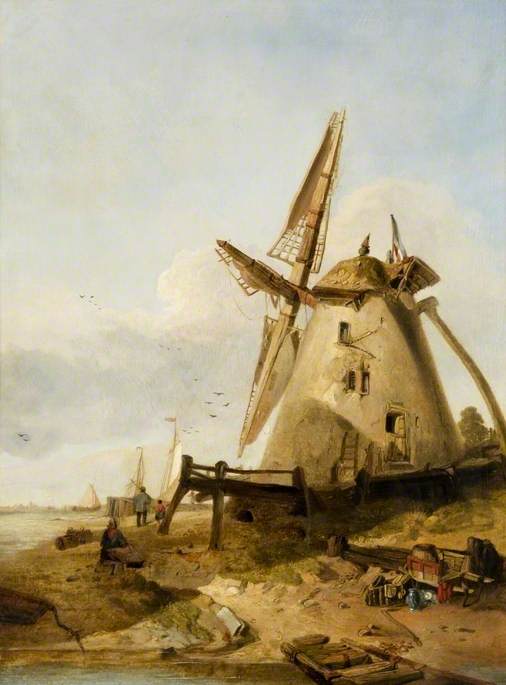
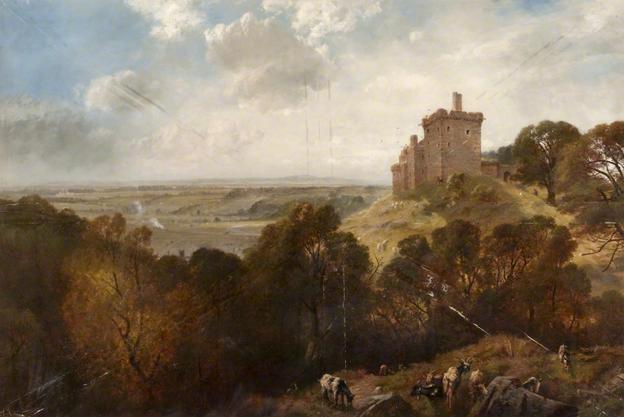
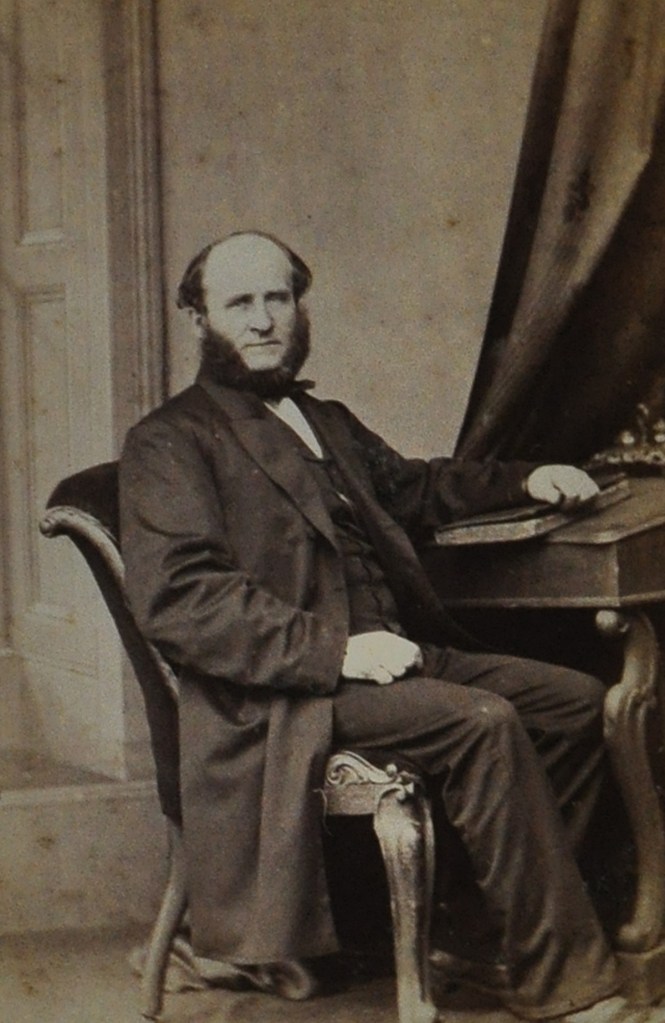


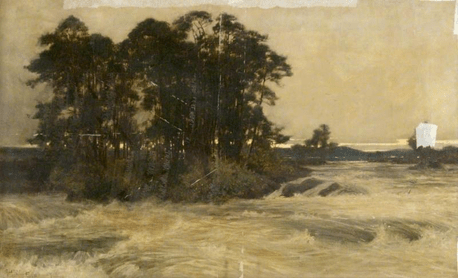


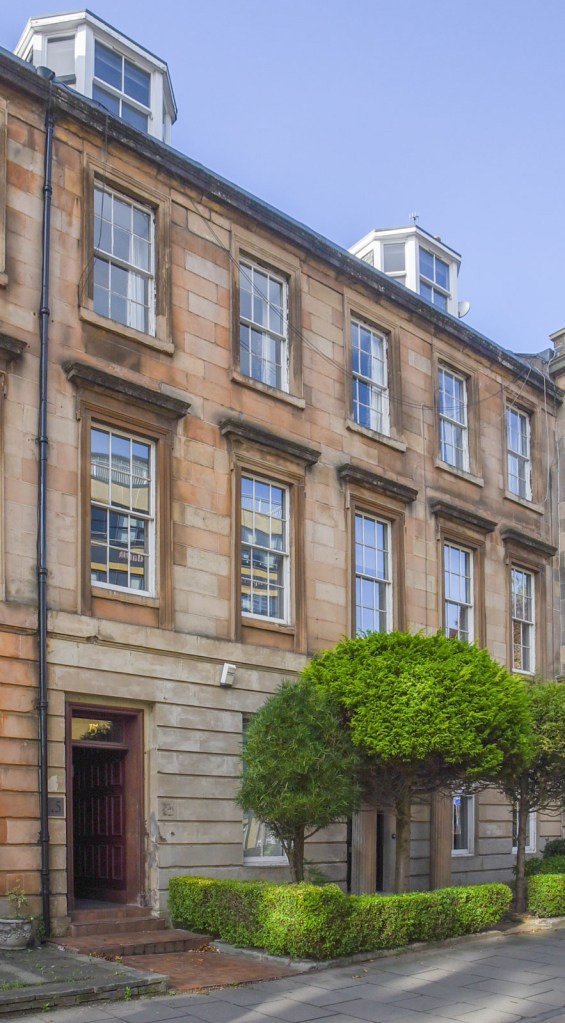
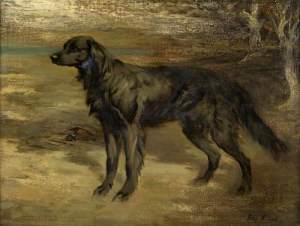


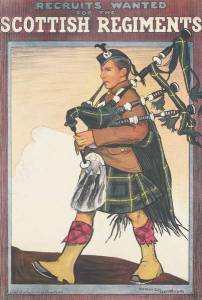


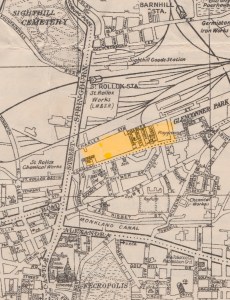


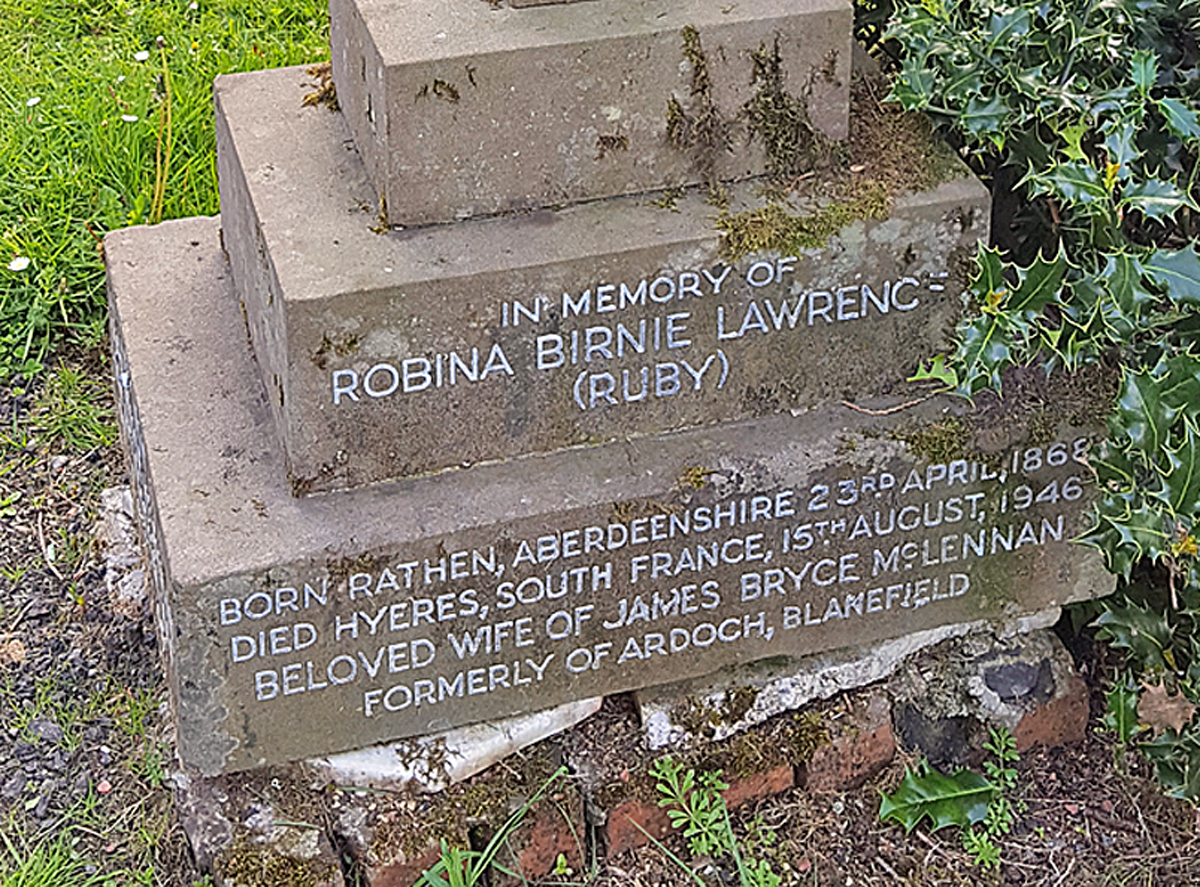
 Glasgow Museums Art Donors Group