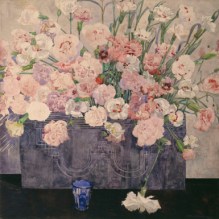
In December 1941, John Sawers donated eight watercolours and three drawings to Glasgow’s collections, including a striking watercolour, Pinks, by Charles Rennie MacKintosh. (1)
John Sawers was born in 1862 and died in 1945. He married Mary Watson in 1888 and they had three children, two daughters and a son.(2)
John Sawers, with his father Thomas and his brother George, was part of a well-known fish, game and poultry business within the city of Glasgow and beyond. The firm had branches in Birmingham and other English cities, as well as eight branches in Glasgow. There is also a Sawers in Belfast, which exists to this day. The company had a flair for publicity. For example, its fleet of vans were nicknamed after fish – Miss Haddock, Miss Crab and Miss Plaice.
The firm was the biggest buyer in the Glasgow Fish Market and could apparently “command any exotic sea creature, such as a shark, porpoise, turtle or monkfish as a centrepiece for their displays in Howard Street.” (3) The Oyster Bar within the fish emporium in Howard Street was legendary, and the gentlemen of Glasgow would congregate here to sample the wares and meet their fellow Glaswegians. It was the only licensed fishmongers in Scotland, so the city gentlemen could have their seafood with a glass of ale or porter.
When the Howard Street shop opened in 1890, a large banquet was held and many influential tradesmen and merchants in the city were invited. It was noted that “the banquet was given in almost regal style”. (4)
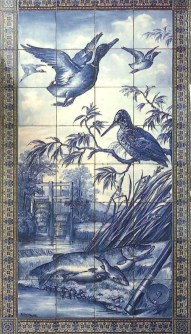
Many newspapers carried the story of the wonderful establishment and praised its designer, Mr J Winton Mackie, who was assisted by Mr John Sawer. “There is no more magnificent fish shop in Europe, and the splendours of the suggestive tiles and granite slabs must be inspected in order to be appreciated.” (5) The tiled panels, created for the shop by Doulton of Lambeth, attracted a great deal of attention and fortunately, when the firm folded in 1960 after attracting the attention of corporate raiders, Glasgow Museums rescued the entire tiled scheme and part of the mosaic fascia from the front of the shop.
Sawers also published an annual fish and game calendar and a cookbook ” Our Table Fishes: How to Choose and Cook Them”. (6)
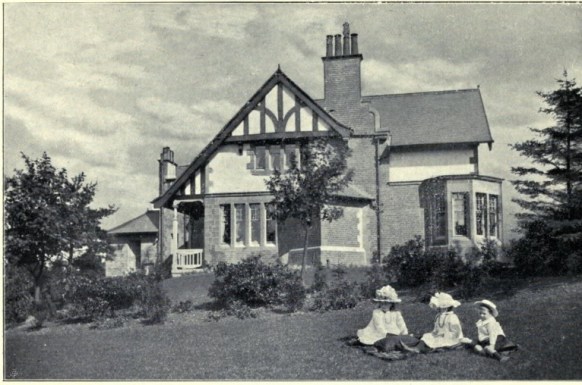
In the early 1900s John Sawers bought a plot of land in Giffnock known as the Hollows. Here he built a house known as Eastwood Hollows. The house was designed by Andrew Balfour and was a fine example of an Art and Crafts House. (7) Balfour was articled to James Boucher and, during his apprenticeship, won a studentship to Glasgow School of Art (GSA). After finishing his apprenticeship Balfour worked with John Burnet. (8) The picture below shows the house and presumably the three children seated are the Sawers children.
John Sawers made a beautiful garden round his house, with a pond, a pergola and a greenhouse where he grew vines. The house was demolished, in the 1960s allegedly to make way for a road and a roundabout. (9)
John Sawers was more than just a fishmonger. He was clearly an art lover and in his obituary is mentioned as being an artist in his leisure moments. His obituary also states that he was “a pioneer of colour photography”.(10) He liked to surround himself with beautiful art, including his house in Giffnock. Even within his working environment Sawers incorporated art. His art can now be enjoyed by a wider audience thanks to his generous donation to Glasgow Museums.
References
1.Glasgow Corporation Minutes Nov 1941- May 1942 p.428
2.Scotland’s People: scotlandspeople.gov.uk
3. King, Elspeth (1991) The People’s Pictures, The Story of Tiles in Glasgow, Glasgow: Glasgow Museums
4. Stratten and Stratten (1891) Glasgow and Its Environs, Glasgow: Stratten and Stratten
5.The Baillie: October 1890 P4
6. Glasgow University Library, Special Collections.
7. Koch, Alexander, ed. (1901). Academy Architecture. Vol.19. London: Academy Architecture. pp 102,. 105.
John Stewart became a partner in a grain merchants business and had lifelong interests in family history, boating and photography, but it is Lochranza on the island of Arran which provides a common thread which brings together all of these topics. In 1928 John gifted a painting to Glasgow Loch Ranza by Andrew Black to Glasgow, who often depicted west of Scotland coastal scenes incorporating fishing and leisure boats.
John Stewart was born at 15 Willowbank Street, Glasgow on 23rd March 1877 to Alexander Stewart, a seaman first mate, and Euphemia Hamilton Allen, a dressmaker (1). They married in 1875 at a time when Alexander senior was second mate aboard SS County of Sutherland, following his fathers’ maritime occupation as a ships carpenter (2). John lived with his mother and her sister, Margaret together with his grandmother Jane Allen. According to the census of 1881 his mother had been widowed by that date.
John and his mother went to live with his uncle, William McHarg and aunt Margaret at Hillbank Cottage in Milngavie (3). William was a grain merchant with a large store at 104-112 Cheapside Street, Glasgow. Around 1890 John was employed as a clerk in the business and in the early 1900s became a partner in the business when the name changed to McHarg and Stewart, by then described as grain merchant and general storekeepers (4).
Interestingly the Cheapside Street building was designed by architects Honeyman and Keppie in 1892, who employed the young Charles Rennie Mackintosh as a draughtsman from 1889. Mackintosh submitted some drawings for the premises but it is not known if any of his work was included in the plans for the building. The design was influenced by northern Italian palazzi, with massive arches and pilasters. The northern third was designed for William McHarg and remained in the McHarg family till the 1950s when Samuel McHarg and Company were the owners. It was then used as a bonded warehouse storing large quantities of whisky and other spirits (5).
McHarg & Stewart Grain Stores, Cheapside Street by permission of University of Glasgow Library, Special Collections.
On 28th March 1960 a devastating explosion destroyed the building, the resulting fire killing fourteen members of the Glasgow Fire Brigade and five members of the Glasgow Salvage Corps. The date is commemorated in Glasgow each year.
In 1901 John was living with the McHarg family at 294 St Vincent Street, moving to 9 Clifton Street, Kelvingrove by 1909 (6).
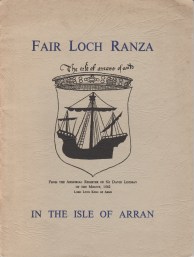
John never married, and throughout his life maintained an interest in boats. In his early years he would accompany his mother to Arran, often in a small rowing boat. They especially loved Lochranza. Photography became a passion for John and he published a series of his work, mainly of west of Scotland scenes. One of these is titled ‘Fair Lochranza in the Isle of Arran’ which is dedicated ‘to my mother and happy memories of Loch Ranza in Victorian Days’,and includes images of boats and hills aroundthe castle of Lochranza (7).
Fair Loch Ranza 1949, Geo Stewart & Co, Edinburgh – by permission of The Stewart SocietyPhotograph from Fair Loch Ranza by John A Stewart – by permission of The Stewart Society
Another is titled ‘Rosneath and Clynder Views’ which is introduced by Admiral Sir Angus Cunninghame Graham in 1958. The Cunninghame Grahams of Ardoch appear to have been family friends. He writes ’…the pleasing photographs reveal something of the generation which was concerned with the greatness of Glasgow and the Clyde.’(8)
When John retired, about 1940, he moved to a large house, ‘Bonaly’ in the village of Clynder on the Clyde and quickly became a well known member of the yachting fraternity and contributed articles on yacht design in Yachting Monthly, leading to speed improvements in racing yachts (9).His greatest passion however was family history. Again Lochranza is the starting point. In 1262 the castle belongedto Walter Stewart, third Steward of Scotland, gifted by the Earl of Menteith.
Walter and his wife were interred on the island of Inchmahome on Lake of Menteith and are represented by possibly the finest 14th century effigies in Scotland (10). Also interred on the island is Robert Bontine Cunninghame Graham (1852-1936) who made his name in politics (he was the first president of the Scottish National Party), and spent time in Argentina as a rancher with the local gauchos.
John’s interest in the Stewart family led to him co-founding the Stewart Society in 1899 and he was an active member for nearly sixty years. He became known as John A Stewart of Inchmahome and is referred to as such in many of his publications. The Stewart connection with Inchmahome led to him purchasing the island in 1926, subsequently gifting it to The Stewart Society in 1948, and it is now administered by Historic Scotland on their behalf (10).
John also had an interest in heraldry and published ‘The Story of the Scottish Flag’ in 1925.
On his death John wished to be buried on the island and arranged for a small mausoleum to be built. He died on 28th February1962 and his funeral was held at Port of Monteith Church. Thereafter the funeral party crossed the icy lake to lay John to rest in his mausoleum (11).
Mausoleum on Island of Inchmahome, by permission of The Stewart Society
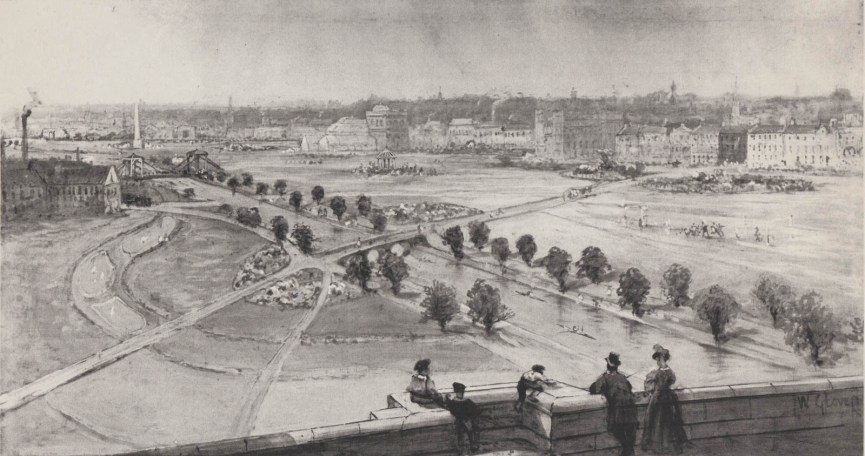
James Henry Roger is best known as a successful wine merchant, whose enthusiasm for amateur rowing led to the formation of Clydesdale Amateur Rowing Club. He donated a very large painting in 1899 ‘Glasgow Green with the proposed Straitening of the Clyde’ by William Glover.
James was born in 1839 in Kirkintilloch to the north of Glasgow to John, a clothier who had a business in Buchanan Street, Glasgow and Marion (nee McLaren), also from Kirkintilloch (1). The family moved to Glasgow when he was six he lived in 37 North Frederick Street in 1851 with his brother John and sister Agnes (2). James showed a keen interest in rowing from an early age and in 1857 became secretary to the newly formed Clydesdale Rowing Club which was based on the river Clyde at Glasgow Green (3). In the early days members would relax after racing by kicking a ball around the Green, and it was this activity which developed into the formation of Rangers Football Club in 1873 (4). A mural at Ibrox Stadium commemorates the origins of Rangers with Clydesdale rowers at Glasgow Green.
James Henry Roger – The Baillie, Mitchell Library, Glasgow
In 1859 Queen Victoria visited Glasgow to open the Loch Katrine waterworks in the Trossachs. James took part as a volunteer guard at the event, which was accompanied by constant heavy rain. He may already have been involved in the drinks industry as he is said to have organised the installation ofcontainers for whisky in the gun cartridge cases, no doubt to warm up the cold wet volunteers (5).
In 1863 James married Margaret McLeod, a Glasgow girl and they had three children, John, James and Margaret (6). Margaret died in 1870 at Rutland Place in Govan (7). James is described as a clothier at this time and may have worked at his father’s business.
James remarried in 1880 to Kate Stirling at her hometown of Comrie, Perthshire (8). They had two children, Kate and Bertie and according to the 1891 census they were all living at 23 Radnor Street, Glasgow.
In the 1870s the Bodega Spanish Wine Cellar in Royal Exchange Square, Glasgow was in decline and in 1879 James took over the business and turned it around. Business boomed and he opened further branches in Glasgow and then in Edinburgh, Greenock and Dundee which were stockedfrom bonded warehouses in Glasgow where special whiskies were blended, and wines and ports stored (9).
The Bodega in Royal Exchange Square later changed its name to ‘Rogano’, a name familiar to many Glaswegians as a fine restaurant with (later) art deco styling. The name is said to come from the first half of Roger’s surname, and ‘ano’ from ‘another’ which refers to a Mr McCulloch, a silent partner in the business.
The Glasgow International Exhibition of 1888 in Kelvingrove park, which promoted industry, science and art to the world as the second city of the empire, provided an opportunity for many local businesses to promote their wares. The Bodega opened a temporary branch in the park despite the protestations of an active temperance movement in the city. Contemporary accounts reveal the popularity of the venue which employed 175 and had had difficulty in coping with the queues (10).
Glasgow International Exhibition 1888 – The Bodega. ‘by permission of University of Glasgow Library, Special Collections’
The painting ‘Glasgow Green with the proposed Straitening of the Clyde’ has great significance for James Roger’s interest in rowing. In the late nineteenth century the Clyde at Glasgow Green was used by several rowing clubs. Weirs had been constructed to control tidal waters in the city centre and the level waters were ideal for rowing. However, in 1899, the weir had been removed and James, being an ambassador for rowing, proposed the straitening of the river to enhance rowing facilities. The painting was commissioned to illustrate the proposed plans which Glasgow Corporation would hopefully carry out. However the plan did not materialise and when James died in 1913 at his home Venard in Pollokshields, he incorporated a clause in his Will stating that if the improvements were carried out within five years of his death the residue of his estate would contribute towards the funding, failing which the funds would be used for youth facilities in Kirkintilloch, his town of birth.
In 1905 a new boathouse was constructed on the north side of the Clyde to replace the southside building. This was shared with another club. James provided funding and this was conditional on Clydesdale Rowing Club having choice of the preferred eastern part, otherwise the offer would be withdrawn. The building is still used by two rowing clubs and is currently being upgraded, and is included in the Glasgow annual Open Doors event.
West Boat House, Glasgow Green. Creative Commons Licence – Thomas Nugent
William Glover completed the painting in 1898 or 1899. Although it could be described as a sketch, it provides a snapshot of Glasgow Green at the close of the nineteenth century and includes the newly opened Peoples Palace. Glover made his name as a theatre manager and scene painter and was an accomplished artist. An image of the painting is currently on view at the Peoples Palace.
Our donor, James Carfrae Alston, son of Thomas Scott Alston and Jessie Seaton Alston was born on 18th August 1835 in Glasgow. His father was a “Cloth Merchant”[1]. James Carfrae Alston was married to Bertine Amelia Wood and they both lived at 18 Oakfield Terrace , Glasgow[2] for a few years and then moved to 9 Lorraine Gardens, Partick, Glasgow,where his wife died in 1908 [3].
In 1909, he gifted to the Kelvingrove Gallery his art collection. Some of the paintings with their titles and the artists’ names are shown below within the text. The letter, offering his collection of paintings to the Corporation of Glasgow, which was sent from his club to the Lord Provost of the day by Mr Alston, is reproduced below:
Western Club
Glasgow,
7th July 1909.
Dear Ld. Provost,
I beg to offer for your acceptance, as the official head of my native city, the gift of small collection of pictures and of one bronze, to be the property of the Corp. of Glasgow and to be placed in their galleries.
The pictures are characteristic of the thirteen artists represented, and I may venture to say are of good quality.
It will be gratification to me should they be the means of affording pleasure to many as they to myself.
I am,
Yours faithfully,
J. Carfrae Alston.
Our donor, James, did not follow his father’s footsteps as a cloth merchant but decided to be a tobacco merchant. From the Valuation Roll [4], it is seen that he established his premises in 27, James Watt Street, Glasgow. From a very early age our donor showed a deep interest in civic affairs. So much so that, when he was a young man, he was one of ten men, who started the Scottish Volunteer Movement in Glasgow on 2nd May, 1859 [5,6]. He served with the group for 20 years and he left with the title of Major.
The well-known Boys Brigade, which was first formed by Mr W.A. Smith in 1883, had a lot in common with the Volunteer Movement. Therefore, it was not surprising that, in 1885 the Executive of the Boys Brigade appointed Mr. J. Carfrae Alston as Brigade President and Mr. W. A. Smith as Brigade Secretary as Mr Smith had declined to be the president and preferred to be the secretary.
Another important activity in our donor’s life was to continue with the good work of his grandfather, John Alston, at the blind Asylum. His grandfather did a great deal of work by helping to improve the system of reading for the blind by the means of raised Roman characters which later gained wide acceptance before the ascendancy of Braille. John Alston maintained that ‘blind children can be trained to do almost anything’ [7]. Boys who attended the asylum were aged 10 to 16 and, in addition to attending classes, they made nets for wall-trees and sewed sacks, while girls were educated along gendered lines and assisted in household work and knitted silk purses, stockings and caps [8].
At the National Archives [9], they hold two copies of what is thought to be the first ‘tactile’ map of Great Britain and Ireland made for the use of blind people. Produced at the Glasgow Asylum for the Blind in 1839, the maps are made of thick paper with the lines and other details embossed so that they can be ‘seen’ by the reader’s fingertips. Although Braille had already been invented, it did not come into common use in the United Kingdom until later in the nineteenth century, so the text is written with raised versions of ordinary letters.
The National Archives hold these two maps because John Alston, the Asylum’s director, sent them to London to draw the government’s attention to the work done by his organisation and to the difficulty and expense of producing books and similar materials for blind people. One copy is marked for the attention of Lord John Russell [10], Secretary of State for the Home Department, and the other for Fox Maule [11], the Under-Secretary. However, Treasury records [12] reveal that Mr Alston’s appeal to the government was successful. The Glasgow Asylum was awarded a grant of £400 towards printing bibles in raised type.
Our Donor continued the family’s interest in the needs of the blind and was one of the managers of the Blind Asylum. Furthermore, he was a director of the Glasgow Training Home for Nurses and of Glasgow Day Nurseries Association. He was also a member of the Juvenile Delinquency Board. On his business side, he was head of the firm of Alston Brothers of Tobacco Bonded Stores in James Watt Street, Glasgow. These stores were sold in 1903.
Apart from being a very active man in civic affairs, he was also interested in cultural affairs. He travelled widely with his wife, Bertine Amelia, to Europe, Egypt and India. He was an art collector and specialised in The Hague School, Whistler and the Glasgow Boys. He was a member of the Royal Glasgow Institute of Art and he often generously lent from his art collection to many exhibitions, including the 1901 Glasgow Exhibition. One of his collection Whistler’s “The Shell”, which was among his loan to the exhibition was considered to be sensuous. This particular work by Whistler was bought in 1892 from the Glaswegian art dealer Alexander Reid. More reference to “The Shell” may be found in [13].
Our donor, James Carfrae Alston, died on 20th November 1913, at Dowanhill, Glasgow [14]. The following obituary note appeared in the Glasgow Herald of 21st November 1913:
Obituary 21st November 1913 Glasgow Herald.
Alston- at 9 Lorraine Gardens Dowanhill, Glasgow on 20th November 1913 James C. Alston aged 78 eldest son of Thomas C. Alston- Funeral on Saturday 22nd November from Westbourne Church, Funeral service at 2.pm.
Officers who served in the 1st Lanarkshire Rifles volunteer corp., Officers of the Boys Brigade and those associated with Mr Alston in other departments of public work are invited to be present at the service.
No uniforms will be worn. Personnel who wish to attend, personal friends who desire to be present at the interment at the Western Necropolis will send their names to Messrs Wylie and Lockhead, 96 Union Street. Carriages from St. Georges Church till 3.30p.m. Nofollowers by special request.
[8] Alston, J. “Statements of the education, employments, and international arrangements, adopted at the Asylum for the Blind”, (1842, 1895 reprint), pub. Glasgow. London: Sampson. Low, Marston.
Painting: Princess Theresa Benedikta Maria of Bavaria. (2452)
From the studio of Georg Desmarees
In the Glasgow Corporation minutes of 1944 (1) this painting is listed as a portrait of Clementina Sobieska by Largilliere. It is now believed that the subject is Theresa Benedikta Maria, a princess of Bavaria, and it is now attributed to the studio of George Desmarees. (2)
Princess Theresa Benedikta Maria was the third child of Charles, Elector of Bavaria and Holy Roman Emperor. Theresa Benedikta Maria died at the age of 17 in 1743.
There is a Sobieski connection. The grandmother of the princess was a Sobieska, the daughter of King John III of Poland. The princess therefore had a familial connection with Clementina Sobieska. The portrait below of Clementina Sobieska gives an opportunity to compare the two women to see if there is any family resemblance. It may also help to explain why the initial confusion about the naming of the subject of the painting arose.
Princess Maria Clementina Sobieska (1702 – 1735). Wife of Prince James Frances Edward Stuart. Martin van Meytens (1695-1770). Reproduced by permission of The Blairs Museum Trust.
The donor of the painting of Princess Theresa Benedikta Maria was Sir Daniel M. Stevenson, Bart. The painting was bequeathed to him by his brother John, an entrepreneur who lived and worked in Pennsylvania.
Daniel Stevenson was an astute businessman, an iron and coal exporter. As well as his business interests, Stevenson was a formidable local politician who helped make governance in Glasgow a model for other cities across the world.
Daniel Macaulay Stevenson came from a notable family. His grandfather was Dan Macaulay who edited “The Liberator” and “The Free Trade Advocate” and was a noted social and political reformer. Born and raised in a tenement in Hutchesontown, his father was John Stevenson, an engineer, who was also committed to social improvement for the poor. One of his brothers was Robert Macaulay Stevenson, one of the Glasgow Boys. (3)
Daniel Stevenson was educated at the Glasgow Secular School. He left school at sixteen and served an apprenticeship with a city Shipbroking firm. In 1879 he set up his own business, exporting coal, and became the largest coal and iron exporter in Scotland. (4)
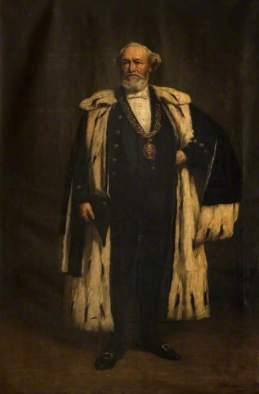
By all accounts, Daniel Stevenson was a successful businessman. But he was much more than that. He became a very significant local politician, serving as Lord Provost of Glasgow between 1911 and 1914. He represented the Woodside ward between 1892 and 1914. Sir Daniel was a Liberal with a strong belief in communal solutions to social problems. (5)
What were Stevenson’s political achievements? Museums and Art Galleries which open on Sunday – the cartoon below shows Stevenson trying to force open the door of the People’s Palace on a Sunday, a testament not only to his vision for the Museums’ services, but also to his determination to ensure that his policies would be implemented even in the face of opposition.
The Baillie Cartoon Supplement: 22 December 1897, The Mitchell Library.
Other innovations overseen by Stevenson included: Corporation libraries, municipalisation of transport, telephone systems, licensing laws, gas and electricity and improved procedures and financial structures within the Corporation. Stevenson was a dedicated advocate of “Municipal Socialism”. He was a founder in 1889 of the Glasgow Social Union and a promoter of the Glasgow Workmen’s Dwellings Company, which aimed to provide decent housing for the working class, with affordable rents. Stevenson believed that a society which took care of everyone was a stronger, more stable society. (6)
Sir Daniel Stevenson was also involved in promoting the Scottish Labour Colony Union. This was an organisation which aimed to provide work for those who had lost their jobs until they could find new ones and which, for the Glasgow branch, provided farm work in Dumfriesshire. The movement’s aim was to help those who were willing to help themselves. Today, this type of support for the unemployed has fallen out of favour, categorised as punishing the unemployed, but the movement had wide support in Stevenson’s time, including from the Salvation Army and Beatrice and Sydney Webb, the founders of the Fabian Society. (7)
Daniel M Stevenson, with other notable Liberals, presided over a period of municipal development in Glasgow which was the envy of many, including American politicians, who were particularly interested in how Glasgow was governed and the success of its municipalisation. They liked the model of the businessman politician, closely rooted in his local community, someone who knew what it was like in the working world and understood business concerns, but they were also drawn to the community element of the governance. Everyone was being catered for, rich and poor alike. Community cohesion was seen as critical. Other cities had similar models, but Glasgow’s was seen by many to outstrip the rest. (8)
Eventually the tide turned against Liberal socialism. The First World War, to which Sir Daniel was vehemently opposed, stating that “he would have preferred the Clyde to resound to the building of Merchant ships rather than the construction of warships” (Glasgow Vol II p.6.), brought with its ending a new wave of socialism across Europe. Sir Daniel retired from local politics in 1914, but maintained his commitment to his community throughout the next thirty years.
He was a founding father of the Scottish National Academy of Music which became the Royal Scottish Academy of Music and Drama, which is now the Royal Conservatoire of Scotland. Stevenson’s sister was a talented musician but was unable to complete her musical education in Scotland due to lack of facilities. She went to study in Hamburg and eventually married there, her husband becoming the Mayor of Hamburg. (9) Stevenson also stated in a letter that he wanted to establish a music school so that students from the Highlands and Island of Scotland could have access to musical education. (10) The Stevenson Hall at the Conservatoire was named in recognition of his generosity and effort in the establishment of the school. He endowed chairs of Italian and Spanish at Glasgow University and also exchange scholarships for Spanish, French and German studies. He established a citizenship fund at the University. He eventually became Chancellor of the University from 1934 -1945. He established chairs at Liverpool and London University. (11)
Sir Daniel was a noted Europhile and spoke a number of European languages. Although he opposed the First World War, he helped to organise an Ambulance Brigade during the Spanish Civil War. He also received many awards from European Countries – Italy, Spain, Belgium and Germany, including the Legion d’honneur from France. (12)
According to the Baillie he was an intellectual, forward thinking man, although it did acknowledge that he was not a great public speaker. He was also a man who was ready to argue for what he believed in. (13) He stood for Parliament once but failed to be elected. It could be argued that Westminster’s loss was Glasgow’s gain.
Although Sir Daniel was a widely travelled man who enjoyed visiting other countries and often admired what he saw there, on receiving the freedom of Glasgow in 1929, he stated that: “One could have no worthier ambition than to be a good and faithful servant of one’s own city.”
There can be no doubt about his contribution to his home city. It is estimated that Sir Daniel gave £400,000 to the city until his death in 1944. In his will he remembered the city also, leaving his estate to the public good. His house at 5 Cleveden Road was left to the Salvation Army for use as a children’s home. His Steinway Grand piano along with all his sheet music and music books were left to the Conservatoire. Other books were left to the Mitchell Library
“Stevenson’s wholly positive outlook and concern to promote community values reflected a strong strand of continuity in Glasgow’s Civic government which had proved remarkably successful in maintaining the city’s integrity between 1833 and 1912” (Portable Utopia)
Sir Daniel died in 1944.
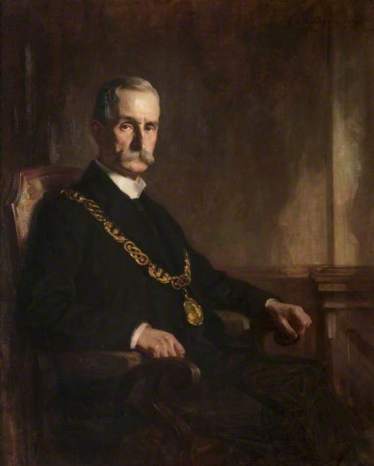
Sir Daniel Macaulay Stevenson (1851–1944), Lord Provost of Glasgow (1911–1914)
Glasgow Corporation Minutes April 1944 – November 1944. !5th August 1944 p.1274
Object file 2452 G.M.R.C
DOLLAN, P.J. (1944), Forward 22 July : Royal Conservatoire of Scotland Archive
theglasgowstory.com: The Glasgow Story 1914 to 1950: Personalities – Sir Daniel Macaulay Stevenson
ASPINWALL, B. (1984) Portable Utopia: Glasgow and the United States 1820 – 1920 Aberdeen: Aberdeen University Press
glasgowhistory.co.uk/housing/bridgeton and dalmarnock
FIELD, J. (2009) Able Bodies: Work Camps and the Training of the Unemployed in Britain before 1939. Stirling Institute of Education : University of Stirling
MAVER, I; FRASER, W.H. (1996) Glasgow: Volume II 1830 – 1912, Manchester: Manchester University Press
Glasgow Herald 17.7.1944: J. Arnold Fleming
Letter from D.M.Stevenson 4.9.42: Royal Conservatoire of Scotland Archive
The Glasgow Herald: 12th July 1944;13th July 1944; 14 July 1944; 15th July 1944
Glasgow City Council: Freedom of the City Recipients
The Baillie: 18th March 1891; 29th December 1897; 17th October 1906; 7th July 1909; 15th November 1911; 2nd October 1912; 17th June 1914; 20th January 1921
Other Reading: Who’s Who in Glasgow 1909 pp.198/199
In 1888 John Muir donated to Glasgow ‘Two Strings to Her Bow’, painted by John Pettie in 1887 and which currently is on display at Kelvingrove Art Gallery and Museum. 1888 was the year of the Glasgow International Exhibition which emulated the great Exhibition of 1851 in London to promote industry, art and commerce (1) in the context of the British Empire. The £46,000 profits of the exhibition contributed to the funding of the present building which opened in 1901. Muir purchased the painting from the lucky winner of a raffle for the Exhibition Art Union, and presented it to highlight ‘…its most prominent deficiency in the department of ‘modern art’’ (2)
The painting ‘Two Strings to her Bow’ is typical of John Pettie’s style, depicting a beautiful young lady between two competing suitors. This painting has become a popular image in the advertising world for example being presented as the front cover of Georgette Heyer’s novel False Colours, a cigarette pack for soldiers during World War 11, and even on the label of a Polish lemon flavoured vodka.
John was born on 26th December 1828 in Hutchesontown, Glasgow to James Muir (3), senior partner of Glasgow merchants Webster Steel & Company which had branches in Chile, South Africa and London (4). His mother was Elizabeth Brown (5), a descendent of James Finlay who founded the textile business of James Finlay and Company in Glasgow. He was educated at Glasgow High School and Glasgow University. In 1849 he joined James Finlay & Company, which had expanded to include mills at Catrine in Ayrshire in 1801, and Deanston in Stirlingshire in 1808 (the latter is now a whisky distillery). The original James Finlay founded the business in 1750 and in 1792 his son Kirkman Finlay took over as senior managing partner, the core activity being textile manufacture but later their trading activities became more important. The firm purchased competitors Wilson, Kay and Company and in 1854 opened premises in West Nile Street, Glasgow (6).
In 1860 John married Margaret Kay (7), eldest daughter of Alexander Kay, then a senior partner of Finlays, and raised four sons and six daughters, all of whom were born at their townhouse at 6 Park Gardens, Glasgow.
In 1861 John was appointed as a junior partner of James Finlay & Company, along with his cousin Hugh Brown Muir and Robert Barclay, a partner in Robert Barclay & Sons, Manchester. The business had become stagnant under the management of the Finlay family and John was brought in to revitalise it. The American Civil War, which had started in that year, affected cotton supplies and Hugh Muir visited India in search of alternative quality sources, resulting in offices being opened in Bombay (Mumbai) and Calcutta (Kolkata). There were close links with Samuel Smith MP, a leading cotton broker in Liverpool and also related to the Finlay family (8).
Over the following years the two cousins increased their personal shareholding and broadened the scope of the mainly cotton based business to include insurance, shipbuilding and tea. However, tensions built up between John and Hugh and things came to a head after Hugh had dismissed a senior employee for playing chess on the sabbath (John was a member of the Free Church of Scotland). Hugh departed from the company in 1873 to form a successful business in London, and John eventually took sole control by 1883. In that year Archibald Buchan, the last of the old Finlay family, tried but failed to obtain a legal injunction to prevent Muir trading under the name of James Finlay and Company (9).
Around the time when Hugh left the business John was increasingly interested in the growing market for tea, and purchased estates in Darjeeling, Assam and Travancore in India, under the name Finlay, Muir & Company. Trade was aided by the shipbuilding connection and Muir invested in the Clan Line in Glasgow. Thomas Cayzer had been introduced to Alexander Stephen of Linthouse, a shipbuilder, and John Muir as financier. The three men, although they never learned to trust each other, entered an agreement to build two ships which became the nucleus of the Clan Line, cargo carriers with some passenger capacity. The ships were based in Calcutta (Kolkata) but Muir forced a move to Chittagong by offering huge cargoes of tea and jute (10). Contemporary opinion held that Muir was ‘the greatest bully in the trade, and the worst tempered man in Scotland’. He encouraged remaining partners in James Finlay and Company to retire in order to take overall control, earning himself in Glasgow business circles the nickname ‘cuckoo’ (11).
In 1873 John moved into the infant tea industry in India and Ceylon, buying up quality plantations, and keeping close supervision through the Calcutta office which included weekly reports, a management pattern that was later adopted throughout the industry. Two of John’s sons were involved in the Indian enterprise but John was not good at delegating. In 1898 he wrote to them ‘My advice to you both is to fall in cordially with my views and policy, even when you do not quite understand them’(12). At that time the UK tea business was channelled through London, but Muir set up various businesses to bypass London to reach new outlets in America, Canada and Russia. He invested heavily in capital developments including railway and hydro-electric schemes and telephone systems. However he was seen as a harsh employer, both to his Indian labour force and his British, mainly Scottish planters and ‘jute-wallahs’. A planter received a larger allowance for his essential horse than for a wife (13). By the 1890s Muir was the world’s major stakeholder in the growing and marketing of tea, employing some 70,000 workers on the Indian subcontinent (14).
John and Margaret had moved in 1873 to Deanston House which had been owned by John Finlay, the last of Kirkman Finlay’s sons, the house being rebuilt. In 1883 an extension was added by Glasgow architect J J Burnett in the Italianate style (15). Margaret took a great interest in the welfare of the mill workers and was a popular local figure. A memorial clock tower was erected in the village after her death in 1929 (16).
Deanston House (as a hotel, probably 1950’s) -from a postcard in authors possession
With his Indian empire secured John turned to civic affairs. He was elected a baillie of Glasgow town council in 1886 and as Lord provost in 1889-92, and received a baronetcy in 1893. He became a Liberal-Unionist in 1886 and was active in Glasgow and Perthshire, a JP in Lanarkshire as well as Deputy Lieutenant of the counties of Ayrshire and Lanark. During his term as Lord Provost he presided over the extension of Glasgow City boundaries, adding 10,000 to the population, extended electricity and gas works, and oversaw the building of St Andrew’s Halls. The 1888 Glasgow International Exhibition provided a focus for philanthropic work when he donated £15,000 and was Convenor of the Indian and Ceylon section. He was also appointed chairman of the association entrusted with the duty of erecting the building (17).
Sir John Muir suffered two strokes, one in 1901 in Glasgow and another at Deanston House where he died on 6th August 1903 (18). He left an estate of £862,802 but with much of his wealth invested as capital in James Finlay and Company and various offshoots, it is thought that his true worth was considerably greater (19). The Finlay business continues today, its core business continuing in growing and processing tea products in India and Africa, with its headquarters moving from Glasgow to London a few years ago.
Alexander Kay Muir (1868-1951), John’s eldest son became second baronet, and continued to manage James Finlay and Company after his fathers death, modernising and converting the haphazard collection of companies into a private company, owned by members of the extended Muir family. Just before he retired in 1926 he sent planters from Southern India and Ceylon to open the first large scale tea plantations in Kenya, and the name continues there producing tea products. He lived at his Blair Drummond estate with his second wife, Nadejda Constanza Irenea Garilla Euphrosyne, eldest daughter of Dmitry Stancioff, former premier of Bulgaria, which appears to have been a very happy marriage and they enjoyed the regular company of King Boris of Bulgaria. Sir Alexander Kay died in 1951 and his wife in 1957, and the baronetcy devolved on his nephew John Harling Muir, the son of his late brother James Finlay Muir (20).
Glasgow Museums also hold a sketch portrait of John Muir, often referred to as John Muir of Deanston . The sketch was painted by John Lavery, a leading ‘Glasgow Boy’ artist, as one of many individual portraits incorporated into his ‘State Visit of Queen Victoria to the Glasgow International Exhibition 1888’. Muir became Lord provost the following year in succession to Sir John King who is portrayed in the purple robes.
(1) Perilla Kinchin and Juliet Kinchin, Glasgow’s great Exhibitions, ISBN 0-9513124-0-5
(2) Glasgow City Council Minutes, Mitchell Library















 Glasgow Museums Art Donors Group