On 11 December 1946, an oil painting entitled Mrs. Scott, Wife of James Scott of Kelly (2590) by John Graham-Gilbert RSA, was presented to Glasgow Corporation by Major Ker of Easterton, Milngavie. 1
The subject of the painting is Jane Martha Galbraith who was born in Barony on 7 May 1830. (She died aged 87 in 1917 at 8 Woodside Crescent, Glasgow). Her parents were Andrew Galbraith, a cotton spinner/merchant, and Margaret Bogle Scott. 2 In 1848, aged eighteen, Jane married the thirty- eight-year-old James Scott. 3 (Appendix) The following year James Scott bought the estate of Kelly in the parish of Inverkip, Renfrewshire. The painting is dated to 1850 (ArtUK) so either commemorates the couples’ marriage or perhaps the birth of their first child Margaret Bogle Scott who was born on 14 July 1850. 4 Between 1850 and 1866 Jane Martha Scott gave birth to ten children, five boys and five girls. One of the girls, Helen Bethia Scott who was born on 16 July 1855 in Inverkip 5 was the mother of the donor. Helen Bethia Scott was 21 when she married Thomas Ripley Ker ‘gentleman’ of Dougalston, Milngavie on 20 June 1877 at St. Mary`s Tower, Birnam, Little Dunkeld. 6 (Thomas Ker’s father Robert Ker went out East as a merchant in 1825 and made his fortune before returning to Glasgow in 1836 and becoming a partner in Ker, Bolton & Co. of 27 West George Street, Manilla and Singapore Merchants. In 1841 he married Elizabeth Johnston of Shieldhall and had four children).7
Thomas and Helen Ker’s first child, Robert McNeil Ker (later ‘Major Ker’ the donor of the painting) was born in Strathblane on 18 February 1878. 8 A second child, Ronald Scott Ker was born in 1879 and the family took up residence in Bardowie House (Castle), Baldernock, Stirling. 9
‘Finely situated on its north-east side of Bardowie Lochan, and embowered among foliage, is Bardowie House, an edifice of moderate size, and somewhat timeworn, yet withal wearing an appearance of quiet cosieness and comfort .’ 10
Figure 2. Bardowie_Castle in 1870 By Thomas Annan httpwww.theglasgowstory.comimage.phpinum=TGSB00235, Public Domain, httpscommons.wikimedia.orgwindex.phpcurid=15233785
Robert was educated at Dalvreck Academy (later Ardvrek Academy) in Crieff and appears on the school roll in 1891 11 but no record of Robert’s time there could be found by the school archivist. By 1901 the family had moved to Dougalston Mansion. This was a large house – according to the census there were thirty-five rooms with one or more windows – situated in Milngavie. 12
Figure 3. Dougalston, Milngavie (From an old post card)
The house had been built by John Glassford, one of the Glasgow ‘Tobacco Lords’ in the early 18th century. Robert’s grandfather Robert Ker bought the house and estate in 1870 13 and had the house restored about 1872-73. 14 He also, in 1883, acquired the estate of Easterton . When he died in 1888, Robert Ker left an estate valued at £220,000 not including Dougalston. 15
The family now consisted of Thomas and Helen, Robert aged 23 was a ‘militiaman’, Ronald, an Oxford undergraduate and a sister Helen Ripley Ker born in 1887. They employed eight servants and a governess. 16
On 24 September 1902, Robert joined the army – the Officer Cadet Battalion with the rank of Honorary Captain. 17 The following year as a lieutenant in the Royal Garrison Regiment he married Margaret Lilian Blagden in Tisbury, Wiltshire.18,19 On 29 April 1904, the Royal Garrison Regiment embarked for South Africa to take up garrison duties at Fort Napier, Pietermaritzburg. 20 Tragically, Margaret Lilian Ker died in Pietermaritzburg on 7 April 1905. Robert later erected a memorial plaque to her in the church of St. Mary the Virgin, Donhead St. Mary, Wiltshire:
In Memory of
Margaret Lilian Ker
Nee Blagden
Who was married in this church 13th October 1903
And who died in Pietermaritzburg, Natal
7th April 1905
Erected by Robert MacNeil Ker
Xmas 1905
Robert returned from South Africa later that year with three battalions of the regiment. (The Royal Garrison Regiment was disbanded on 1 September 1908 21). In the same year as the death of his wife, Robert’s grandmother Elizabeth Ker died at Eastertoun. 22
On 17 April 1907, Robert McNeil Ker married Lucy Winifred Strickland -Constable at Holy Trinity Church, Sloane Street, Chelsea. 23 Lucy was born in Wassand Hall, Seaton, Yorkshire in 1875. She was the daughter of Henry Strickland – Constable and niece of Sir Charles Strickland eighth baronet of Boynton. After the wedding, the couple left for Paris and a continental honeymoon. 24
They had a son, Neil Ripley Ker, born on 28May 1908 in Brompton, London. Neil became an eminent palaeographer and his entry in the Oxford Dictionary of National Biography says that his father was a captain in the 3rd battalion of the Argyll and Sutherland Highlanders (A & SH). During the war years his mother and grandmother held garden fetes etc. to raise funds for the A & SH Comforts’ Fund. 25
According to the census of 1911, Robert, aged 33 was living ‘on private means’ at Friningham Lodge, Detling, near Maidstone in Kent. With him were his wife Lucy aged 36 and son Neil aged 2. In 1914, with the advent of war, Robert was a captain in the Reserve of Officers attached to the Brigade of Infantry. In the same year he joined the Argyll and Sutherland Highlanders and then the Machine Gun Corps with the rank of major. At some point during the war, he was made acting lieutenant colonel of the corps. 26
Figure 4. Easterton House (Alexander Nisbet Paterson, 1915)Old Postcard View found in Crawford, James, Old Mugdock, Balmore, Baldernock and Bardowie, 2016, Stenlake Publishing, Ltd.
After the war he seems to have lived quietly at Easterton, his father’s house in Milngavie taking an interest in local affairs. Lucy Winifred Ker died at Eastertoun on 7 December 1942. 27She was sixty-seven. Robert’s father, Thomas Ripley Ker, died at Eastertoun on 18 July 1947. An extensive obituary was published in the local paper. 28Robert McNeil Ker died on 15 October 1953 at Easterton. His death certificate states that he was a Major in the Royal Garrison Regiment (retd.) and the widower of Lucy Winifred Strickland – Constable. 29 A brief report appeared in the local newspaper stating that ‘he was well known locally for the deep interest and kindness he showed in philanthropic institutions, and particularly of the Old Folks Clubs. He was of a quiet genial disposition and will be missed by many in the district’. 30
After a private funeral he was buried in Baldernock Churchyard alongside his parents, his brother and his second wife. His father had earlier gifted land to enlarge the churchyard ‘where the maternal ancestors of President Roosevelt are buried’. 31
Figure 5. Ker family gravestones in Baldernock Churchyard. httpswww.findagrave.commemorial196889564robert-macneil-ker
Appendix
James Scott 1810 – 1884
James Scott had been made a partner in the firm of James Black & Co., calico printers, at the age of twenty and largely thanks to his efforts the firm’s business grew rapidly. In 1835 it acquired the Dalmonach printworks in Alexandria and through Scott’s ‘extraordinary enterprise’…….. attained it’s present position in the foremost ranks of printing’. James Scott retired from business in 1847. However, in 1852 he returned to set up the firm of J. & W.J. Scott with his younger brother. It became the largest cotton spinning works in Scotland. He also had interests in the railways and in oil setting up works at Clippens in Renfrewshire. 32 As a town councillor in Glasgow he was largely responsible for the formation of Kelvingrove Park. He sold the estate of Kelly to James ‘Paraffin’ Young in 1867. James Young died there on 13 May 1883 and is buried in Inverkip cemetery. James Scott died in 1884. Kelly House burned down in 1913 allegedly from suffragette activity. 33
References
Catalogue of Donations, Glasgow Museums Resource Centre
Scotland’s People, Death Certificate 1917, Jane Martha Scott
Old Parish Registers, Family Search, Scotland
Ibid
Scotland’s People, Birth Certificate
Scotland’s People, Marriage Certificate
Smith, John Guthrie, Strathendrick, and its inhabitants from early times, Glasgow, J Maclehose and sons, 1896
Scotland’s People, Birth Certificate
ancestry.co.uk, 1881 Scotland Census
Macdonald, Hugh, Rambles Round Glasgow, 1854
ancestry.co.uk, 1891 Scotland Census
ancestry.co.uk, 1901 Scotland Census
Smith, John Guthrie, Strathendrick, and its inhabitants from early times, Glasgow, J Maclehose and sons, 1896
William Campbell was our donor’s great -grandfather and one of the founder’s of the family’s prosperity. The artist was” Underhill” but whether William Underhill (1848-1871) or Frederick Charles Underhill(1832-1896) or another artist by that name is not known at this time. James Campbell was our donor’s grandfather who continued the management of the family business after his father’s death.
There is no evidence that either painting was exhibited.
The Campbell Family
We cannot discuss the life and exploits of Henry Alastair Campbell (known as Alastair) without looking into his family background as the subjects of the portraits played such a great part in the economic and social life of Glasgow and the surrounding area in the 19th Century as well as in the prosperity of the Campbells , which affected future generations.
William Campbell (1793-1864)
“Christian Philanthropist and one of our Merchant Princes” was how William Campbell,great-grandfather of H.A. Campbell was described in his obituary1. William Campbell was one of the founders of the family fortune. His father was a tenant farmer on the Gartmore Estate near Port of Menteith. He was the fifth of nine children. In 1805 his parents brought the family to Glasgow ,attracted by the burgeoning industry of the city. After learning weaving William was employed by John Craig,who had a “respectable Scotch cloth business “ in the High Street. Such was the good impression he made,through his honesty,cheerfulness and energy for hard work, that on the death of his employer, William was invited by the widow to run the business. However William decided to set up in business for himself. He was 22 years old. He began by selling handkerchiefs from premises in the Saltmarket in 1817. The business prospered ,extending to all types of drapery,eventually outgrowing the premises and William’s ability to run the business single-handed. One of the reasons for his success was his acknowledged transformation of the art of retailing in Glasgow. He introduced a system of small profits,quick returns and fixed prices. Thus he ended the practice of “prigging” where the price of everything on sale was negotiable. Different people paid different prices for the same product and the whole business was very time-consuming.
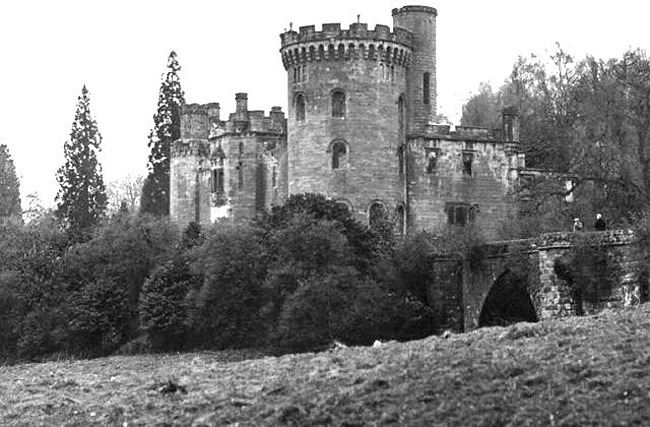
William was eventually joined by his brother James and together they formed the partnership of ‘J & W Campbell & Co General Warehousemen’ and moved to a purpose-built warehouse in Candleriggs. By 1841 William had became so prosperous he was able to buy the estate of Tullichewan on the shores of Loch Lomond and moved to Tullichewan Castle2. James bought the estate of Strathcatro in Angus. Both sons of James Campbell,James A Campbell and Henry Campbell became Members of Parliament. Henry Campbell ,MP for Stirling , inherited an estate in Kent from his uncle Henry Bannerman in 1871 with the provision that he change his name to Campbell- Bannerman He was later to become Henry Campbell Bannerman,Prime Minister3.
The company continued to prosper, expanding into a wholesale business which traded with every part of the UK as well as Australia ,New Zealand ,South Africa,The West Indies,Canada and the USA. J&W Campbell also acted as agents for manufacturers and other warehouses which wanted to export goods abroad . In 1856 the company moved for the final time to large new premises in Ingram Street which had been built to the company’s specifications.
William Campbell was an intimate friend of Thomas Chalmers, the minister who led the Disruption of the Church of Scotland and to the founding of the Free Church of Scotland. Chalmers was a frequent visitor to Tullichewan Castle. William was an avid supporter of the Disruption ,not least in the financial support he gave. He took an active part in the scheme of William Collins to build 20 new churches in Glasgow and that of Thomas Chalmers to build two hundred new churches in Scotland. He is included in that very famous memorial to the Disruption,”The Disruption Worthies”4.
William Campbell’s generosity was not confined to the building of churches. He spent a large part of his fortune on those in need. He was co- founder and financial supporter of The Glasgow Night Asylum for the Homeless to which he bequeathed a legacy of £1500. He supported The City Improvement Scheme,The Royal Infirmary and the Indigent Gentlewoman’s Fund. He did not shy away from the darker side of life either in that he supported those who worked to rescue girls from a life working in the brothels of Glasgow and he is credited with financing the rescue of 30-40 girls. He was always alert to the need to improve the lives of working people. To that end he contributed £500 to the financially struggling Glasgow Botanic Gardens so that it could open its gates to the general public on the annual Glasgow Fair Holiday. It is estimated that he gave away between £80,000 and £90,000 to charity of all kinds during his lifetime5.
In 1822 William had married Margaret Roxburgh. They went on to have five children and became one of the leading families in Dunbartonshire.
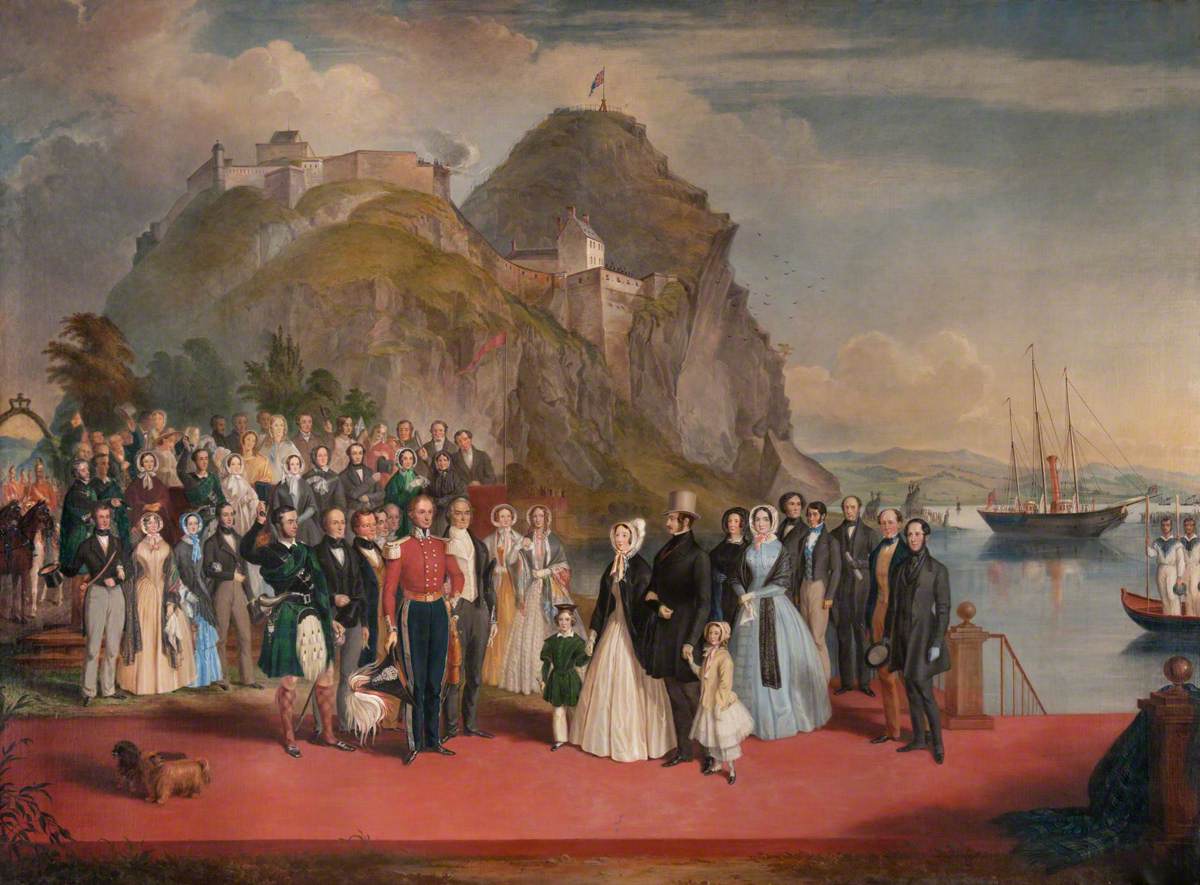
When Queen Victoria and Prince Albert visited Dumbarton Castle in 1847, Mr and Mrs William Campbell as well as their son James and his wife, Jessie, were among the party which greeted the queen6.
William Campbell died on April 2nd 1864 at the home of his son James at 200 Bath Street7. He is buried at Glasgow Necropolis“among the great of Glasgow”8 .
James Campbell of Tullichewan (1823-1901)
Even before the death of his father in 1864 his second son, James, our donor Alastair’s grandfather, had taken over the running of J&W Campbell & Company aided by two of his Campbell cousins, sons of James Campbell ,later Sir James Campbell, Lord Provost of Glasgow. In 1846 James had married Janet Black(always known as Jessie) daughter of the owner of a bleaching business. They were married for over fifty years and had five children-William born in 1848;Eliza born 18519;Margaret born 1854;Jessie G born in 1855 and James Adair,Alastair’s father, born in 186010.
Under James’s leadership the company went from strength to strength. Since about 1856 when the company moved to the Ingram Street premises, it had become a completely wholesale enterprise. The Ingram Street premises had three floors and a basement. The ‘counting house’ was on the ground floor,the basement housed ‘heavier classes of goods’ for example ‘flannels and blankets…waterproof fabrics, moleskins…towellings … carpets and floorcloths…stock…representative of the best national products of its kind’. The first floor housed woollen cloth ‘embracing every variety of the tweeds of Scotland and England’ among many other drapery items.The second and third floors were equally well-stocked with every kind of drapery one could imagine including ‘a ready-made clothing department…silks and satins,ribbons,laces,flowers,fancy goods,smallwares,fans,bags,umbrellas,stays,braces,mantles,millinery and shawls’. The company employed between five and six hundred employees11. The Campbells had come a long way from selling handkerchiefs from a tenement in the Saltmarket!
On the death of William Campbell James and Jessie moved from their home at 200 Bath Street to Tullichewan Castle. Like his father James continued to support the Free Church,later the United Free Church, and carried on many of his father’s philanthropic works,for example he was president of the Glasgow Night Asylum For the Homeless for many years. James was also an ardent Liberal and supporter of William Gladstone. He supported many Liberal associations in the Vale of Leven both financially and by giving advice.He was also very interested in the education of young people12.
Although living at Tullichewan, James continued to take an active part in the life of the City of Glasgow. He was very interested in the education of the young and served on the School Board of Glasgow. He was a member of the Executive Council for the 1901 Glasgow International Exhibition. He was also very interested in drama and music. The Glasgow Music Festival of 1874 owes no small thanks to James who was Chairman of the Executive Committee. James was also President of the Glasgow Choral Union and a patron of the Glasgow Amateur Dramatic Club which had been founded in 1883 as a charitable institution,’to promote the study and practice of Dramatic Art’. Tickets were only available from members13.
We cannot forget Alastair’s grandmother Jessie as she was an extraordinary woman for her time.Jessie was involved in many social and intellectual movements but her main interest was the promotion of the cause for the higher education of women in Scotland. It was she who first suggested in 1868 that Glasgow University hold lectures for women in Natural History,Moral Philosophy,English Literature and Astronomy,given by professors from the university. These lectures were held at the university and at the Corporation Galleries( known to us as McLellan Galleries where the city’s art collection was housed at that time). These lectures were very successful and continued until 1877 when the Glasgow Association for the Higher Education of Women was formed to offer women the opportunity to study at University level. Jessie became Vice President of the Association. In 1883 the Association was incorporated as Queen Margaret College. Jessie took on the role of Vice President and chaired its executive committee. She persuaded her friend Isabella Elder, wife of ship builder David Elder and one of the greatest Glasgow philanthropists of her time, to buy North Park House,(Queen Margaret Drive) in the West End of Glasgow for the college. Jessie was the main fund-raiser of the £20,000 college endowment fund. At this time Queen Margaret College was the only college of higher education for women in Scotland. The college amalgamated with Glasgow University in 1892 and was particularly noted for its medical faculty for the training of female doctors-separate from the training of male doctors of course! In 1901 Jessie Campbell was awarded an honorary LLD degree in gratitude for her services14.
Unfortunately the year 1901 was not a happy one for the Campbell family. In April 1901, James and Jessie’s grandson, George Gildea,son of their daughter Eliza and her husband, the late Major General George Frederick Gildea , died of enteric fever in Johannesburg while serving as a 2nd Lieutenant in the Royal Highland Fusiliers as his father had done. Young George and his step-sister, Alleine, spent a lot of time at Tullichewan with the Campbell grandparents while their parents were with his regiment.
Eliza was the second wife of George Fredreick Gildea who was a distinguished soldier. He fought in the Crimean War and in the Anglo-Boer war of 1880-81 when he was Garrison Commander of a fort near Pretoria. This fort was built around 1880 and he named it Fort Tullichewan after his wife’s home in Scotland15. Eliza accompanied her husband to South Africa and was awarded the Royal Red Cross for her services attending the wounded at the ‘investment of Pretoria’16. On the Major -General’s retirement in 1886 the Gildea’s lived at Broomley House on the Tullichewan Estate. According to his obituary James never recovered from the death of his young grandson and on August 14th 1901 he died at Tullichewan and was buried in a newly built family vault in Alexandria17.
James Adair Campbell ( 1860-1932)
At the time of his grandfather’s death our donor Alastair was living at Broomley House on the Tullichewan Estate with his parents James Adair Campbell (known as Adair) and his mother Jean Blanche Campbell. Alastair was five years old his eldest brother ,James Haldane Adair Campbell was seven and his younger brother Melvin was two. A sister , Shena ,was born in 190318.
Adair Campbell had not married until the age of 32. He had served in the Matabele with the British South African Company Police in 1890 and along with Cecil Rhodes was in the pioneer column which penetrated what later became Southern Rhodesia . He received one of the few medals which were awarded during this campaign19. At St Mary’s Church in Tuxedo , New York ,in November 1892 he married Jean Blanche Havermeyer whose grandfather had been Mayor of New York. According to the Dundee Courier “they met and loved in Algiers” during the previous summer20. The couple returned to Scotland in January 189321. Blanche was 10 years younger than her husband. Adair Campbell was involved in the running of J&W Campbell and Company during this period. The marriage appeared to be happy for the first ten years ,during which time,as we have seen, they had four children. Then, according to Blanche, Adair changed and ‘lost interest in home and in her and his interests appeared to be centred elsewhere’. They were divorced in 1925 , having not lived together since 191422. Divorce was unusual at that time and was not regarded as entirely the correct way to behave!
Perhaps the state of his marriage was the reason that on the outbreak of war in 1914 at the age of 55 Adair joined up on the first day. He was a Captain in the 8th Battalion Argyll and Sutherland Highlanders (AS&H). He was wounded and sent home from France after which he continued to serve in training camps, in Ripon for example.
Sadly the Campbells suffered an even worse war casualty as on 7th June 1916 TheScotsman reported that Midshipman Melfort Campbell ,third son of Blanche and Adair,was killed in action aboard HMS Defence on May 31st. He was only 17 years old.
In 1919 Adair returned to Glasgow to continue as a businessman. Apart from his interest in the family firm he was also a director of the Royal Exchange Insurance Company. He was a member of The Royal Company of Archers, a keen yachtsman ,a first class shot and an enthusiastic fisherman. There is little information as to how much contact he had with his children after the divorce . His last permanent address,according to his death certificate, was The New Club Edinburgh. According to his obituary ‘He had a happy capacity for making friends and will be missed by staff and customers alike23.
Henry Alastair Campbell OBE (1895-1971)
Schooldays
Having looked at Alastair’s family background we can go on to look at the life of this donor. Alastair went to school at Wellington College in Berkshire from 1909 until 1912. Wellington College was built as a national monument to the Duke of Wellington. The school opened in 1859 and was originally intended to educate the sons of deceased army officers. While at the school Alastair was in Mr Bevir’s House, was a ‘Gentleman of the Hunt’-a member of the cross-country running team -and played Rackets for the school24.
After Easter in 1912 Alastair enrolled at the Royal Military Academy at Sandhurst as a Gentleman Cadet. According to the Military Announcements in the Aberdeen Press and Journal of May 2nd 1914 he graduated from Sandhurst in May 1914 and was commissioned 2nd Lieutenant into the 2nd Battalion A S&H (Princess Louise’s Regiment) at Fort George. He was subaltern to Lieutenant Hyslop in B Company25.
World War 1914-1918
Alastair was at Fort George when war was declared. He entrained for Southampton on 9th August and embarked with the 2nd battalion on 11th August on the ship “Sea Hound” for Boulogne. They were the first fighting troops to land in France26. He fought at the battles of Mons ,Cambrai and Le Cateau where it appears he was wounded and was shipped home. The Scotsman reported this on 11th September 1914. Alastair was visited in his private nursing home by Princess Louise, Duchess of Argyll, who was not only Honorary Commander-in- Chief of the regiment but had been a friend of the family for many years. Since 1890 the Princess’s main home had been Rosneath Castle in Argyll and so was a “neighbour “ of the Campbells, mixing socially with Mrs and Mrs James Campbell. The princess shared Jessie’s interest in the education of women and was a supporter of the suffragette movement27. Alastair returned to France in May 1915 as part of a draft to join the 2nd Battalion. He was now a lieutenant. In August 1915 Alastair was appointed temporary Captain and in December 1915 set sail from Marseilles for Egypt as part of the Mediterranean Expeditionary Force. In February 1916 he was transferred to the 1st Battalion the Lovat’s Scouts and was appointed adjutant. The battalion was sent to Salonika as part of the British Salonika Force. Alastair was adjutant until October 1917 when he was transferred back to the 1st Battalion A S &H, remaining in Salonika until Spring 1918. He arrived in the UK from Salonika on 4th June, one of the last officers to leave Salonika28. He was then posted to the 4th Battalion A&SH in Edinburgh . In the autumn of 1918, just after the end of the war, he was appointed a staff captain to the Adjutant General’s Department at the War Office in London29. Alastair was awarded the 1914 Star,The British War Medal and the Allied Victory Medal-known to the British “ Tommy”as,“Pip, Squeak and Wilfred” after popular cartoon characters of the time which appeared in the Daily Mirror .
Between the Wars 1919-1939
Alastair continued his career as a professional soldier after the war. He remained a Staff Captain at the Adjutant General’s Office in London until January 1920 when he was seconded to The Staff Training College in Camberly on a four month course after which he re-joined the 2nd Battalion A&SH at Aldershot. He remained with his battalion until 21st June 1921 when he was given 3 months leave to accompany the Earl of Dundonald and Lady Cochrane as Military Attache to Peru to represent the British Government at the celebrations of the Centennial of that country’s independence, arriving back in England on 14th September30.
At some point in 1922 Alastair underwent additional training at the musketry school in Hythe. According to his Army Record he passed the course with distinction.
He then took up the post of acting adjutant,then adjutant to the 2nd Battalion AS&H , in Aldershot, a post which he retained until 30th April 1925 after which he was restored back to the 2nd Battalion establishment31.
At the end of September 1923 the 2nd Battalion was posted to Parkhurst Barracks on the Isle of Wight to replace the Royal Ulster Rifles who had been stationed there for four years. The battalion remained in the Isle of Wight until September 1927. During the General Strike of 1926 the battalion was sent to Gosport from 6-17th May “on General Strike duties” though there is no information as to whether Captain Campbell took part in these duties32.
During this period several events took place in Alastair’s personal life. In 1922 Tullichewan Castle and Estate were sold. Although William McOran Campbell was the eldest son of James and Jessie Campbell he and his wife Marianne do not appear to have lived at Tullichewan which was in the hands of a Trust set up by James Campbell in 190033. It is unclear whether Alastair’s father lived there permanently though he did take an interest in the affairs of the estate. For example in July 1922 The Scotsman reports that Major Adair Campbell won the medal for the best turkey at the Highland and Agricultural Society Show held in Dumfries34 and in August he attended the grouse shooting on the Tullichewan Estate35. The Estate had been put up for sale in May 1922 at an auction at the McLellan Galleries in Glasgow but did not sell. Despite dividing the 987 acre estate into smaller lots, there were no buyers. This was a time of depression after WW1 and there were many estates for sale at the time as landowners struggled to cope with the death duties which resulted from the death of so many men during the war. It was not until December 1922 that the Sunday Post reported that part of the Tullichewan estate had been bought by a Mr Scott Anderson “a Glasgow business gentleman”36. Tullichewan Castle was demolished in 1954 to make way for the A82 bypass around Alexandria along Loch Lomondside37.
In 1922 also the family firm of J&W Campbell amalgamated with another Glasgow company Stewart and McDonald to form Campbell, Stewart and McDonald, the warehouse in Ingram Street which continued in business until the 1980s. Apparently it was Stewart and MacDonald who were in financial difficulties, not J&W Campbell.38
In 1922 Alastair acted as best man at the wedding of his elder brother James Haldane Adair Campbell to Princess Ekaterina Galitzine, daughter of Prince Paul Golitzyn who had been Master of the Imperial Hunt and a State Councillor to Tsar Nicholas 2nd and who had fled the Russian Revolution. Apparently Catherine had made her way to the South of France possibly in the company of the Grand Duchess Vladimir of Russia and there met Captain James Haldane Adair Campbell. The couple’s wedding was a big London Society affair held on Sunday 12th November at St Philip’s Church Buckingham Palace Road and was attended by that old friend of the Campbells, Princess Louise39.
In 1922 Alastair was awarded the Order of the Star of Serbia with Crossed Swords (fifth class) for his services to that country during WW1.
The Dundee Courier of 23rd April 1925 reported that Captain Alastair Campbell and his fiancée Miss Aileen Emmett were entertained to lunch at Kensington Palace by Princess Louise ,Duchess of Argyll, in order to receive a wedding present-a silver box for cigarettes and cigars engraved with the Princess’s initials. She could not attend the wedding as she was about to leave for the South of France. The couple appear to have known one another since at least December 1923 when Alastair was a guest at the wedding of Aileen’s eldest brother, J. A. Garland Emmett40.
On April 29th 1925 Alastair married Aileen (known as ‘Muffy’) ,daughter of Major and Mrs Robert Emmett of Moreton Paddox in Warwickshire. Robert Emmett and his wife,natives of New York, had settled in England early in the 20th Century and built a magnificent house. They bred horses and Aileen was a keen rider and fox-hunter.
They married at St James’ Church, Spanish Place in London .The Emmetts were a wealthy Catholic family and the wedding ceremony a Catholic one. It is not known if Alastair changed his religion but ,as we shall see later, the children were probably brought up in the Catholic Faith. At least one of the sons attended Ampleforth College , a famous Catholic boarding school in Yorkshire41. The wedding reception was held at 66 Grosvenor Square,the London home of the Emmetts.
The pipers of the A S&H played the tune, “Highland Laddie “as the happy couple left the church42. It would appear that the couple lived in Elizabeth Street,Eaton Square in London as there is a report of the theft of £7000 of jewellery belonging to Aileen43. It is not known if Aileen accompanied her husband on the posting to the Isle of Wight. She was certainly in London when their first child,John Alastair, was born in 192744.
One would have thought there would be few better postings for a soldier than the Isle of Wight but the next posting for the 2nd battalion was even better. In September 1927 the 2nd Battalion AS&H was posted to Bermuda in the West Indies!
Aileen and infant John Alastair were among the eight officers’ wives, and five officers’ children who accompanied husband and father on this posting along with 34 soldiers’ wives and 40 soldiers’ children45. A second son, Robert Adair was born in Bermuda around March or April 192846 and a daughter Fiona was born in May 192947. A second daughter, Morag Nada, was born in 1932 after the family returned to the UK48.
From August 1931 until November 1934 Alastair was seconded to the post of adjutant to the 14th London Regiment ,known as the London Scottish, a Territorial Regiment. Shortly afterwards he was promoted Major and transferred to the 2nd Battalion A&S H in Edinburgh.
In November 1934 he exchanged postings with Major Ritchie of the 1st Battalion and joined that battalion in Edinburgh. Perhaps this exchange was because the 2nd Battalion was due to be posted to India and for some reason ,a young family perhaps, Alastair felt unable to go. The 1st Battalion was then transferred to the Lucknow Barracks at Tidworth Camp, Wiltshire49 . In 1936 he attended a training course for senior officers in machine gunnery at Sheerness50. This was because it was planned that the 1st Battalion was to become a machine gun unit.
During this period Alastair continued his interest in sporting activities and won the Individual Cup in the Highland Brigade Point to Point 51. He remained at Tidworth as second in command of the battalion until he retired from the army,aged 43, in March 1938. During the period at Tidworth Alastair was awarded the King’s Jubilee Medal(1935) and the Caledonian Medal(1937)52.
Also during the 1930s, probably as a result of his family’s connections, Alastair had represented the Duchess of Argyll at several formal occasions such as the funeral of the Laird of Ardgour in June 1930 and at the Requiem Mass for the late King Albert of the Belgians in 1934 at Westminster Cathedral 53 .
If Alastair and Aileen had hoped for a peaceful life after Alastair’s retirement from the army they were sadly mistaken. Only 15 months later Alastair was “back in the saddle”. In June 1939 at the rank of Lieutenant Colonel T.A. he was appointed Commanding Officer of the 8th Battalion A & S H(a territorial battalion). In August 1939 he was transferred to the 11th Battalion, again as Commanding Officer54. The Stirling Observer reported on 19th November 1939 that the 11th Battalion had arrived in Doune,near Stirling, and were billeted in halls , hotels and private houses.The following June his army records show he was admitted to hospital but it not known where or why. However he must have recovered as on 12th November 1940 he was appointed Local Defence Commander-defence advisor to the station commander- at RAF Bassingbourn in Cambridgeshire55. It would appear that many army personnel were seconded to the RAF,part of the RAF Regiment, to carry out defence duties at airfields at a time when the threat of invasion was very real.
On 23 February 1943, Lt Colonel Campbell was appointed GSO1,ie Chief-of-Staff ,No 2 Group RAF Western Europe. This was one of ten ,later more ,groups of Bomber Command .In 1943 the HQ was at RAF Huntingdon ,Cambridgeshire ,and one presumes this is where Alastair was based. In 1943 2 Group consisted of more than a dozen operational squadrons ,spread out over at least ten different areas. Alastair’s job was to keep the Group operation-a daunting task indeed!
In May 1943 2 Group left RAF Bomber Command to join the new Second Tactical Airforce whose main task was to prepare for the allied invasion of Europe. It was felt that the threat of invasion was over and army personnel were more valuable training for the invasion of Europe than defending RAF bases . Eventually the Group became part of the first occupational forces in Germany. There is no detailed information as to Alastair’s actions during this period other than he seems to have remained with 2 Group until June 1945 and left the service in August 194556.
In March 1945 Lt Colonel H A Campbell was awarded the OBE for his service during the war57.
Aileen Campbell had also played her part in the war effort. From some point in 1939 the Campbells rented Kilsythe Castle near Dunblane, Stirlingshire, possibly because Alastair’s battalion, the 11th , was based at Doune which was not far away. Aileen remained there throughout the war. Throughout the war she was Commandant of the local Doune Voluntary Aid Detachment. The VAD had been formed in 1909 with the help of the Red Cross and St John’s Ambulance in order to train volunteers in medical ,nursing and other related skills. VADs played a valuable part in nursing wounded soldiers both at home and abroad during World War One. It is not known how or why Aileen had become involved . Perhaps her interest was aroused during WW1 when her family home,Moreton Paddox in Warwickshire ,had been a military hospital largely organised by her mother. There had been 50 beds in 8 wards at Moreton Paddox 58.
Aileen was also on the organising committee of the A&SH War Comforts Depot,based at 19 Park Terrace in Stirling. The Stirling Observer reported that Fiona and Morag Campbell had presented bouquets to the Duchess of Argyll on her visit to the depot early in December 193959.
Post War Years 1945-1971
On 20th September 1945 The Stirling Observer reported the sudden death of Captain James Adair Campbell, Alastair’s elder brother , of a heart attack at the age of 52. Apparently Captain Campbell had been wounded at Gallipoli during WW1 and had been a semi -invalid ever since. At the time of his death he was living in Edinburgh60. Perhaps this is the reason why, a year or so later, the two portraits of Campbell ancestors were given to Glasgow Museums . One could believe that it was decided by the family to give these paintings to Glasgow at a time when Captain Campbell’s estate was being dealt with. As the eldest son , he would probably have inherited the paintings from his father, Adair Campbell.
The Campbells left Dunblane in November1945 as there is an account in The Stirling Observer of Mrs Campbell’s receiving a presentation as thanks for her work with the VAD in “as she was leaving the district”61. They moved to Ardhuncart Lodge near Alford in Aberdeenshire. There they played a full part in local society attending many local events such as the Aboyne Ball in September 1949 and the Ballater Ball in the same month62. In this article there is mention of Fiona Campbell’s skill as a skier and that she was a member of the British Olympic team in 1948. Lt Colonel Campbell was also involved in the formation of the Aberdeenshire Home Guard while at Ardhuncart Lodge63.
Next the Campbells moved to their final home Altries Estate near Maryculter, Aberdeenshire. In 1960 the Altries Fishing Company Ltd was set up, a private company controlled by the Campbells, renting out the Altries stretch of the River Dee to fishermen. A very keen rider ,Alastair took part in many local point -to-points on his horse,Lear. He continued his life of service in the local community.
He was a Deputy Lieutenant of Kincardineshire, a member of the Aberdeenshire County Council and Chairman of the Dee and Don River purification Board. He was also a member of The Royal Company of Archers,the Queen’s Bodyguard in Scotland.64
According to his obituary in The Thin Red Line Aileen and Ali, as he was known to his friends, had,”a particularly happy marriage” and ,”kept open house for their friends ,who will remember with gratitude their ever warm welcome and hospitality”65 .
Henry Alastair Campbell died in Aberdeen Royal Infirmary on 3rd September 1971 at the age of 76. He is buried in the cemetery of Kirkton of Maryculter. The Altries Fishing Estate is still in the hands of the Campbell family.
References
1.Glasgow Morning Journal (GMJ)11/04/1864
2.James Maclehose.Memoirs and Portraits of One Hundred Glasgow Men. 1886. Mitchell Library
27.C.Myers.University Co-Education in the Victorian Era:Inclusion and Exclusion in the United States and the United Kingdom. NY Palgrave Macmillan 2010
28.Thin Red Line Vol 26 1971 p88
29.Army Form B119A .Service Record of Henry Alastair Campbell ( HAC Army Record)
32.A History of the 2nd Battalion Argyle and Sutherland Highlanders(Princess Louise’s)(Formerly 93rd Sutherland Highlanders)1919-1947. Brigadier R.C.B. Anderson DSO MC.Unpublished. Argyll and Sutherland Highlanders Museum Collection ,Stirling.
33.www.scotlandspeople.co.uk Wills and Trusts
34.Scotsman (S) 19/07/1922
35. S .18/08/1922
36. S .11/05/1922 ; Sunday Post 10/12/1922
37.www.valeofleven.org.uk
38.Anthony Slaven;Sidney Checkland (ed)Dictionary of Scottish Business Biography Vol 2 AUP 1990
39.Dundee Evening Telegraph 27/11/1922
40.Warwick and Warwickshire Advertiser (WWA) 01/12/1923
41.Aberdeen Evening Express 30/12/1953
42. S. 30/04/1925
43.Yorkshire Post and Leeds Inteligencer 14/12/1925
44.www.ancestry.co.uk Statutory Births
45.The 93rd Sutherland Highlanders Now 2nd Bn The Argyle and Sutherland Highlanders (Princess Louise’s) 1799-1927. p281.Brigadier General A.E.J Cavendish CMG.Published privately 1928. Argyll and Sutherland Highlanders Museum Collection ,Stirling
46.www.ancestry.co.uk Statutory Births
47.Aberdeen Press and Journal(APJ)15/05/1929
48.www.ancestry.co.uk Statutory Births
49.Brigadier R.C.B Anderson DSO. MC.History of Argyll and Sutherland Highlanders 1st Battalion 1909-1939. p155. Privately printed T.A.Constable Ltd Edinburgh.Argyll and Sutherland Highlanders Museum Collection ,Stirling
50.HAC Army Record
51. Anderson. History of Argyll and Sutherland Highlanders 1st Battalion 1909-1939. p152
52.HAC Army Record
53.DC. 02/06/1930 ; Nottingham Evening Post 28/02/1934






 Glasgow Museums Art Donors Group