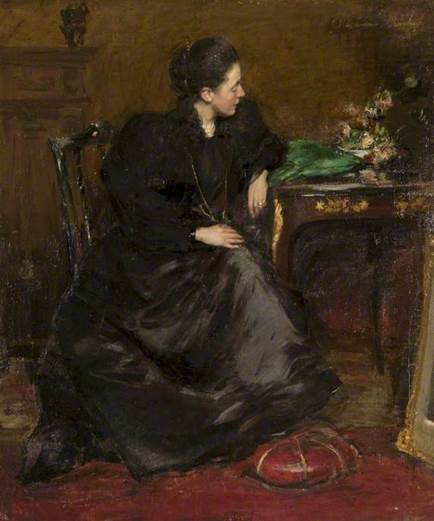
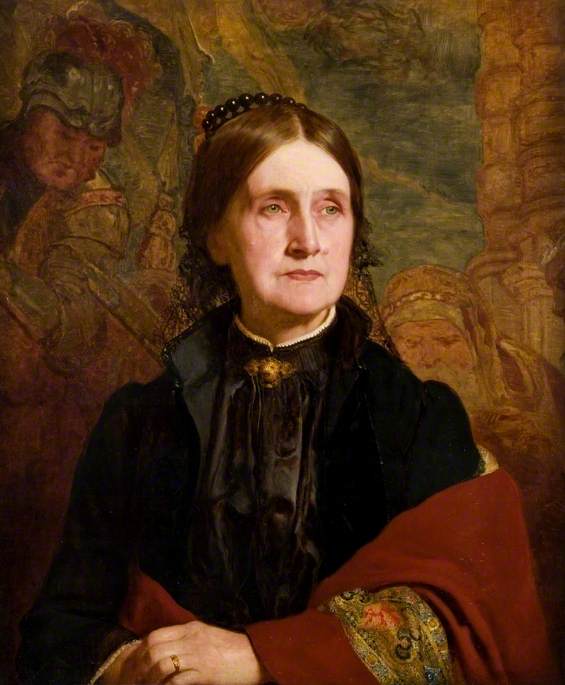
Fig. 1 Mrs. Roberts
Alexander Ignatius Roche (1861 – 1921)
Accession Number 2967, 1895 © CSG GIC Glasgow Museums Collection
The painting was presented by (Mrs.) John Roberts, Wellwood, Selkirk (on behalf of an American cousin). *
It was exhibited at the Royal Scottish Academy in 1896 and at the Glasgow International Exhibition in 1901.
*There would seem to be a doubt as to who donated the painting. The Paintings’ Register at Glasgow Museums’ Resource Centre (GMRC) states that it was Mrs John Roberts while a record card in the Object File at GMRC says John Roberts.
The Roberts Family
George Roberts (1798 – 1877) was a clothier in Selkirk. In October 1838, he purchased Forest Mills in the town to build a spinning mill in partnership with Andrew Dickson a manufacturer in Galashiels. In January 1843, George married Agnes Scott Fowler (1871 – 1901) in Melrose. The couple had a daughter Eliza and six sons. The company prospered and expanded. When George died in 1877, he was succeeded by his sons George, Alexander and Thomas James Scougal and his nephew Frank. Another son, John (1845 – 1934) emigrated to New Zealand but his son, also John (1876 – 1966), returned to Scotland and in 1894 joined the firm and played a major role in its development. The firm became very prosperous and up till the outbreak of WW1 was one of the leaders of the Scottish woollen industry. The two relatives associated with this painting are John junior and Thomas Scougal Roberts. 1
Thomas Scougal Roberts (He commissioned the painting)
Thomas Scougal Roberts was born in Selkirk on 24 January 1850, the son of George Roberts and Agnes Scott Fowler.2 In the 1861 census he was aged 11, a scholar living at Wellwood Park, Selkirk with his parents, brothers and a sister.3 On 31 March 1875 he married Hyndmer Rutherford Crawford aged eighteen of Caddenfoot, Selkirk.4 The couple moved to Byethorn House in Selkirk and had two children, George Crawford born in 1878, and Alexander Thomas born in 1885. (Alexander became the ‘American Cousin’ mentioned in the donation). In 1881 Thomas was 31, a tweed manufacturer living at Byethorn House, Selkirk.5 By 1891, he had moved with his wife and son Alexander aged 5, to the Mansion House, Stow, Caddonfoot, Selkirk.6 (His son George had died in 1885.) It was possibly here that he commissioned the present painting of his wife, Hyndmer, from Alexander Roche in 1895. In 1901, the family was living at Drygrange, Melrose, Roxburghshire, with eight servants.7 Hyndmer Roberts died in 1911. The following year, Thomas travelled to Canada arriving in Victoria aboard the Makura in May 1912 8 and then on to Vancouver in June 1912 aboard the Empress of Japan.9 Thomas Scougal Roberts died on 3 February 1921 in Edinburgh. 10 Probate was granted in Edinburgh on 16 May 192111, on 16 June in London.12 and in Otago and Wellington, New Zealand in the same year. Among his executors were his brother Alexander Fowler Roberts, Fairnielee, Galashiels, and his son Alexander Thomas Roberts. His will was dated 4 March 1920 and recorded in Jedburgh on 16 May 1921. The value of his estate was £253,246.4s.2d.
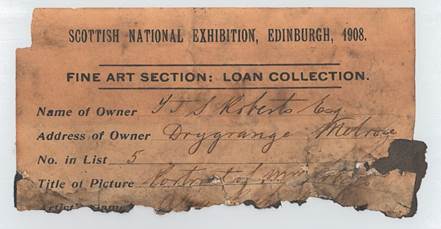
Fig. 2 Label from the reverse of the painting.
This label indicates that the painting was owned and exhibited in 1908 by Thomas James Scougal Roberts who was now living at Drygrange, Melrose.
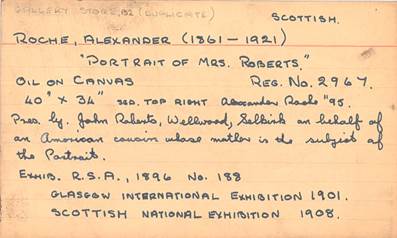
Fig. 3 Record card for the painting (GMRC)
This record card states that the subject of the painting is the mother of the ‘American cousin’. This is Alexander Thomas Roberts who was born in Selkirk but emigrated to America in the early 1900s. The card gives the donor as John Roberts.
Sir John ‘Jack’ Roberts – Mill owner and Provost of Selkirk.
(Possible Donor of the painting)
John Roberts (1845 – 1934), a brother of Thomas Scougal Roberts emigrated to New Zealand from Selkirk and married Louisa Jane Kettle (1848 – 1922) on 26 January 1870. Their son, John Roberts junior was born in 1876. He was educated at Otago Boys High School from 1888 to 1892 and then emigrated to Scotland where he attended Merchiston Castle School from 1892 to 1894. After leaving school, in 1895 he joined the family firm of George Roberts and Co Ltd.13 At the 1901 census he was lodging at 4 Marion Crescent, Selkirk, and was a ‘manufacturer of wool.14 Later the same year, on 18 September, he married Agnes Amelia Muir, daughter of Dr. John Stewart Muir the local GP in Selkirk.15 This was the same year that his grandmother Agnes Scott Roberts (nee Fowler) died. She had occupied the house and lands around Wellwood in Selkirk which had belonged to her husband, George, and then to her son, John Roberts senior, who, in 1902 was listed as the proprietor of Wellwood and Haugh, Railway Station Lands and in 1903 of a house with garden and stable at Wellwood, Ettrick Terrace, Selkirk.16 These properties were passed on to John junior by at least 1914.
In the census of 1911, John and Agnes were boarding at the Gordon Arms in Selkirk with their children, Andrina Barbara Henderson Roberts, 8, John Stewart Roberts, 6, Louisa Jane Roberts, 4, Stewart Muir Roberts, 3, and George Edward Roberts, six weeks.17 In 1914 he gave ‘an interesting lecture’ in the Masonic Hall in Motherwell in which he described a trip to New Zealand.18 In the same year he subscribed to a fund for the relief of the Belgian People.19
John Roberts was Provost of Selkirk three times, the first of these in 1908 and then in 1915-1920 but he resigned from the latter term for health reasons and stated in a letter to the local newspaper that he would remain in office until the new Council was elected. 20 He was again Provost in 1935 until 1941 when he resigned both as Provost and Councillor. 21 He does not appear on the 1921 census, but he was the proprietor/occupier of Wellwood House at 52 Ettrick Terrace, Selkirk.22
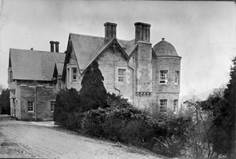
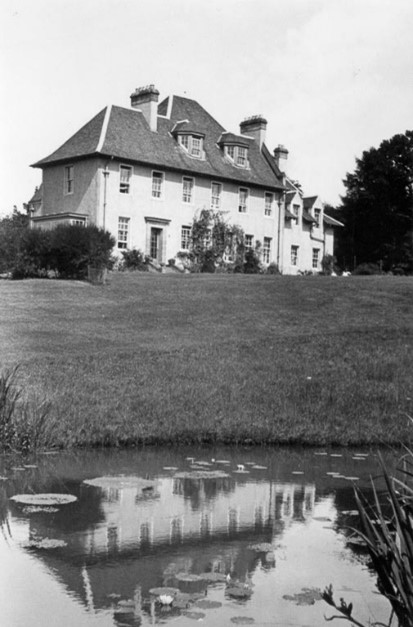
Fig. 4 Wellwood House. Selkirk 23
John Roberts was a prominent member of the Roxburgh and Selkirk, Unionist Association, 24 later becoming vice-chairman.25 He was made a Freeman of the Royal Burgh of Selkirk in 1952. The following year, he received a knighthood in the Coronation Honours ‘For political and public services in Selkirkshire.’ 26 Sir John Roberts died at the age of ninety at Craigallan, Heatherlie Park, Selkirk on 23 January 1966 having outlived his wife by eighteen years. His son Stewart reported his death. 27
Alexander Thomas Roberts (Inherited the Painting and donated it remotely)
Alexander Thomas Roberts was born on 8 May 1885 in Byethorn House, Selkirk to Thomas James Scougal Roberts and his wife Hyndmer Rutherford Crawford who had married on 31 March 1875 at Mountainview, Duns(e). Perhaps his parents had second thoughts about his name as it was Thomas Alexander Roberts on his birth certificate, later changed on 23 July. 28 At the age of fifteen, he was a pupil at Fettes College, Comely Bank, Edinburgh.29 In the early 1900s Alexander emigrated to America. He is recorded as arriving at Ellis Island, New York in 1913 aboard the S.S. Campania. His place of residence was Melrose, Scotland.30 This was probably a return trip from Scotland as on 15 June 1913 he married Evelyn Laura Henderson, 22, in Detroit. On the marriage license he was described as a ‘manufacturer’.31 It is possible that his father attended the wedding as he had been travelling in Canada the year before.32 In 1916, Alexander and Evelyn visited Scotland and stayed at Drygrange, Melrose with Alexander’s widowed father. They returned from Liverpool to New York aboard S.S. St. Louis on 25 November. He did not list an occupation. 33 On 12 September 1918 Alexander provided the following details for a draft registration card. He was a British citizen, living with his wife at 10 Longfellow Avenue, Detroit and was an officer in the British War Office on sick leave. He was of medium build and height with blue-grey eyes and black hair.34 (According to his obituary, he had attained the rank of Captain in pre-war service in the King’s Own Scottish Borderers).35 Alexander and Evelyn again travelled to Scotland to stay at Drygrange, Melrose with Alexander’s father. They returned to Detroit by way of Liverpool and the S.S. Orduna on 19 December 1919.36
Thomas Scougal Roberts died on 3 February 1921. Alexander and Evelyn may have spent most of that year in Scotland. Alexander was in Edinburgh on 9 May for the reading of his father’s will. As an only child he would have inherited the bulk of his father’s £253,246.4s.2d estate. This enabled him to purchase the Park-Ward company of London which manufactured automobile bodies for Rolls-Royce and Bentley. He retained ownership of the company until 1939 when he sold it to Rolls-Royce.37 Alexander and Evelyn arrived back in America on 2 December 1921 having sailed from Liverpool aboard the S.S. Baltic. Both had ‘nil’ under ‘occupation’ and both listed an aunt, Mrs. A. F. Roberts of Fairnielee, Galashiels, as their nearest relative in Scotland.38 In April 1922, Alexander and Evelyn again travelled to Scotland for an extended stay in Melrose.39 They returned to New York from Southampton travelling first class aboard S.S. Mauretania on 19 October 1923.40 Sometime afterwards, Alexander and Evelyn were divorced. Evelyn married William Frue, ten years her junior on 22 June 1931 in Fulton, Ohio.41
It seems that Alexander also remarried about this time as on 2 February 1935 he sailed from Southampton aboard S.S. Bremen presumably bound for New York. His place of birth was given as ‘Selkirk’ and his last permanent residence ‘London’. He was accompanied by Mary Elizabeth Roberts who was 37 and born in Toronto. Both were listed as ‘married’. 42 They must have returned to Britain later that year as on 26 February 1936 they again left Southampton aboard S.S. Bremen and while Alexander lists his occupation as ‘none’, Mary is a housewife. 43
On 25 April 1940, Alexander flew from Havana in Cuba where he had been staying at the Hotel Plaza to Miami. He was now fifty-five and retired. His home address was 11 Keofferam Road, Old Greenwich, Connecticut. 44 In 1941 he was required to complete a Draft Registration card. His address was now 5 Grant Avenue, Old Greenwich, Connecticut. His ‘named person’ was David Rosen of 105 Bedford Street, Stamford, Connecticut, possibly suggesting that he was now widowed or divorced. 45
In any event, on 14 February 1946, Alexander now aged sixty obtained a licence to marry Emily Wright Johnston who was thirty-nine from Buffalo, New York. According to the licence, obtained In Marlboro County, South Carolina, Alexander was an American citizen.46 After their marriage, and possibly as late as 1952, the couple moved to Pinehurst, North Carolina.47 Alexander had been a frequent visitor to Pinehurst since travelling there to play golf in 1917. 48 This is about the time he gave instructions for the painting of his mother to be given to Glasgow. Alexander Thomas Roberts died of a cerebral thrombosis on 14 May 1972 aged 87, at the Moore Memorial Hospital, Pinehurst, North Carolina. His wife Emilie Wright Roberts reported his death and gave his occupation as ‘owner, auto body manufacturer’. 49 He was buried at the Mount Hope Cemetery, Southern Pines, North Carolina. Still apparently a Scottish citizen. 50 He was survived by his wife and a stepdaughter. 51
Mary Ellis (Possible Donor)
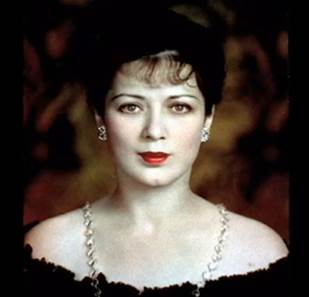
Fig. 5 Mary Ellis about 1936 (Archiveradio1930@archiveradio1930-dw5kg, YouTube)
May Belle Elsas was born on 15 June 1897 in Manhattan, New York to Herman and Caroline (nee Reinhardt) Elsas. Her father had emigrated from Germany; her mother was born in Texas to a German father. In 1900 the family was living at 88th Street, New York. Herman was a paper manufacturer. 52 As a child, May made several trips to Europe with her family. For example, on 28 September 1909 aged 12 she, along with her parents and twenty-one-year-old sister Lucile who was born in Texas, arrived back in New York from Southampton aboard the S. S. Kronprinz Wilhelm. Her father was forty-five and her mother forty-one. All were U.S. citizens. 53 Herman Elsas was a manufacturer in the paper industry. 54 Caroline Elsas was a talented pianist. May began studying music and taking singing lessons in her teens. She made her professional debut, with her name now Mary Ellis, in December 1918 at the Metropolitan Opera in the world premiere of Puccini’s triptych Il trittico , creating the role of Suor Genovieffa in Suor Angelica and understudying Florence Easton in the role of Lauretta in Gianni Schicchi . She was only the second singer to perform the aria ‘O Mio Babbino Caro’ when Florence Easton became ill. Her performance was very well received and was followed by roles as Gianetta in L’elisire d’amore with Enrico Caruso and in Charpentier’s Louise with Geraldine Farrar. 55
During the war years, Mary met a young airman, Louis G. Bernheimer, who had been ‘sent home from France with medals and a nervous breakdown’. 56 After the first season of the opera, he persuaded Mary to marry him and on 6 February 1920, escorted by her parents, Mary married Louis in City Hall, Lower Manhattan. The subsequent honeymoon in Paris proved to be ‘traumatic’ as Mary recounts in her autobiography. ‘Louis told me he longed to see his mistress of the war days, Marie Delorme. Finally, I had the sense to tell him to go and visit her. He said that if he did not come back to the hotel by six that evening, he would be staying with her and that we would take it from there’. After a day spent on a bench on the Champs Elysees, Mary returned to the hotel to find Louis there. However, he was inconsolable as Marie had died months before. ‘Added to this he was suffering unromantically from piles, to which I had to apply some healing ointment every few hours. The Paris honeymoon was over’. The couple divorced within the year.
Mary’s next venture was in to classical theatre, possibly while waiting for her voice to mature. She signed up with David Balasco to appear as Nerissa in The Merchant of Venice. This opened in the Lyceum Theatre, New York on 26 February 1923. Perhaps because of the staging and although it ran for several months, it was not a success. However, Mary later said ‘it gave me an experience the like of which I have never had again’. Later that year, on 30 April 1923, despite misgivings and advice from friends, Mary married Edwin Harris Knopf in Manhattan, New York. 57 Again, the marriage was short-lived. The following year on 2 September at the Imperial Theatre in New York, Mary appeared in the title role in the operetta Rose-Marie ‘and the ‘Indian Love Call’ became theatre history. All I remember of that first night is sitting cross-legged on the table in Act One and reaching a pianissimo high B-flat which brought the house down’. After a successful year, Mary felt she had had enough and persuaded the producer Arthur Hammerstein to let her leave. However, he made her sign an injunction which prevented her from singing for any management but his. This meant she never sang professionally in the United States again. In a return to the stage, Mary played Leah in The Dyubbuk in 1925 and in 1927 she played Kate in The Taming of the Shrew opposite the British actor Basil Sydney. The play ran for thirty-two weeks, the longest ever consecutive run of a Shakespeare play! In 1929, in New Milford, Connecticut, Mary and Basil were married and subsequently settled in Britain. Her first London appearance was in Knave and Quean opposite Robert Donat at the Ambassadors Theatre in 1930, and she played Nina in the British premiere of Eugene O’Neill’s Strange Interlude a year later. Her marriage to Basil Sydney ended in 1934 when Basil left her to live in New York with a young actress who had appeared in his play Dinner at Eight. Mary was offered a two-year contract with Paramount to do three films in Hollywood including All the King’s Horses ‘a pretty mediocre effort’ and Paris Love Song.
In 1935, she travelled back to London to star as Militza Hajos in Ivor Novello’s musical Glamorous Night at the Theatre Royal, Drury Lane. When it closed, she completed her contract in Hollywood with a third film Fatal Lady. While there, she obtained a divorce from Basil in Nevada. Back in London, Glamorous Night was made into a film in 1937 at Elstree Studios with Mary in the leading role.
Clip of Mary Ellis performing in Glamorous Nights 58
In January 1938, Mary met Jack ‘Jock’ Roberts the oldest son of Provost and Mrs Roberts of Selkirk (above) while she was appearing in The Innocent Party at the Lyceum Theatre in Edinburgh. 59 It was just after Mary had learned that her father had died. Jock told her that he had been so excited to see her that he had crashed his car on leaving the theatre. As a result, he had stayed overnight and was still in his evening clothes and a bit dishevelled. He asked for her to forgive him which of course she did but also told him she was in deep distress. ‘An hour later my room at the hotel was filled with flowers from him’. After six months of ‘the most hectic and instructive courtship’ during which Mary met Jock’s family ‘(his mother had her doubts about me, but his father liked me)’ the couple announced their engagement on 28 June that year although they had been engaged for some weeks. 60
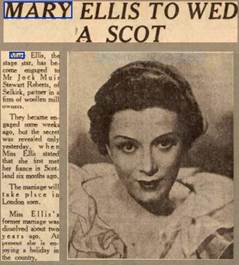
Fig. 6 Dundee Courier 28 June 1938 p2
Mary Ellis married Jock Muir Stewart Roberts on 1 July 1938 at Westminster City Register Office (Caxton Hall). Miss Ellis’s mother and two friends were the only people present. 61 They spent their honeymoon in Norway.
Mary co-starred again with Novello in The Dancing Years which opened in March 1939 in Drury Lane. After that she gave up the stage temporarily during the war years to engage in ‘Welfare and occupational therapy work in Emergency Hospitals’. Her first posting was to an RAF Coastal Command unit on the Isle of Islay in the Inner Hebrides. This was followed, months later, by a posting to an emergency hospital near Peebles. After a spell in Iceland, Jock was posted back to London and Mary Joined him. On 9 November 1943 she returned to the stage at the Phoenix Theatre in Ivor Novello’s Arc de Triomphe. When this closed in 1944, she returned to Scotland to stay with Jock and his family until he was called away on war duty. ‘I loved his family, and I could talk for hours to his father about Edwardian life and listen to his Scottish stories.’
Post war, Mary’s created the roles of Millie Crocker-Harris in The Browning Version and Edna Selby in Harlequinade in Terence Rattigan’s Playbill in September 1948. The following year she was asked to appear at the Edinburgh Festival in a Peter Ustinov play The Man in the Raincoat. This gave her the opportunity to meet Jock’s family again and they all came to the theatre. However, relations with Jock were strained. She also appeared in several television plays; all broadcast live. On 6 March 1950 while preparing for a trip to Switzerland, Jock Roberts was killed in a climbing accident in Thornbush Quarry on Selkirk Hill.
In 1952, Mary appeared as Volumnia in Shakespear’s Coriolanus at Stratford-Upon Avon and in Mourning Becomes Electra, directed by Peter Hall in 1955. Her final musical role was in 1954 as Mrs Erlynne in After the Ball, Noel Coward’s musical adaptation of Oscar Wilde’s Lady Windemere’s Fan. Her final West End performance was in Look Homeward, Angel in 1962 at the Vaudeville Theatre and her last theatre appearance was in Mrs Warren’s Profession at Yvonne Arnaud Theatre, Guildford in 1970.
In the same year as she published her autobiography, Mary was interviewed on the Christmas Day edition of Desert Island Discs. She made two appearances on television in The Casebook of Sherlock Holmes, 1993 and The Memoirs of Sherlock Holmes 1994.
Mary Ellis died on 30 January 2003 at her home in Eaton Square at the age of 105 ‘as a snowstorm flurried around SW1: a friend told me that Miss Ellis had given a drinks party in her bedroom only the previous day’. 62 At the time of her death, she was believed to have been the last surviving performer to have created a role in a Puccini opera.
Hyndmer Rutherford Crawford (The Sitter)
Hyndmer Rutherford Crawford was born on 27 February 1857 in Newtown Street, Dunse, Berwickshire. Her father, Alexander Crawford, was a writer. Her mother was Agnes Hewat. 63 In 1871 she was living at Mountview Villa, Dunse aged fourteen with her brothers William, 33, Richard, 21 and David, 16 and sister Agnes, 28, and three servants. 64 After her marriage to Thomas Roberts the couple moved to Byethorn House in Selkirk where Hyndmer gave birth to two sons, George Crawford Roberts on 20 August 1876, 65 (Tragically, George died of Bright’s disease on 30 March 1885 aged eight 66), and Alexander Thomas Roberts on 8 May 1885. Hyndmer Rutherford Roberts died on 6 September 1911 aged 54 at Drygrange, Melrose. 67 She was buried in Wairds cemetery. The inscription on her headstone reads:
In memory of Hyndmer Rutherford Crawford, Wife of TJS Roberts of Drygrange, Born 27th February 1857 Died 6th September 1911. Also, of his son George Crawford Born 30th August 1876. Died 30th March 1885. 68
References
- http://archiveshub.jisc.ac.uk/data/gb582-hwuagr
- ancestry.com. Scotland, Select Births and Baptisms, 1564-1950
- ancestry.com. 1861 Scotland Census
- Scotland’s People, Marriage Certificate
- ancestry.com. 1881 Scotland Census
- ancestry.com, 1891 Scotland Census
- Scotland’s People, 1901 Census
- Canada, Passenger Lists, 1881-1922, FamilySearch
- ibid
- Scotland’s People, Death Certificate
- ancestry.com. Scotland National Probate Index
- ancestry.com, England and Wales National Probate Index
- https://www.calmview.eu/HUBCAT/CalmView/Record.aspx?src=CalmView.Persons&id=DS%2FUK%2F9193
- Scotland’s People, 1901 Census
- Scotland’s People, Marriage Certificate
- Scotland’s People, Valuation Roll, Selkirk
- Scotland’s People, 1911 Census
- Berwick Advertiser, 30 January 1914
- ‘The Brave Belgians’ Provost Allan’s Relief Fund, Southern Reporter, 3 September 1914
- Southern Reporter, October 1919
- Hawick News and Border Chronicle, 17 October 1941
- Scotland’s People, Valuation Rolls, Selkirk 1916 – 1920
- Morrab Library Photographic Archive, accessed 13 November https://photoarchive.morrablibrary.org.uk/items/show/20615
- Southern Reporter, 7 May 1925
- Hawick News and Border Chronicle, 11 May 1934
- Supplement to the London Gazette, 1 June 1953, page 2941 and Jedburgh Gazette, 5 June 1953
- Scotland’s People, Death Certificate
- Scotland’s People, Birth Certificate and Register of Corrected Entries
- ancestry.co.uk, Scottish Census, 1901
- New York Passenger Arrival Lists (Ellis Island), 1892-1924, FamilySearch
- Return of Marriages in Michigan, FamilySearch,
- Canada, Passenger Lists, 1881-1922, FamilySearch
- New York Passenger Arrival Lists 1892-1924, FamilySearch
- United States World War I Draft Registration Cards, 1917-1918″, databasewith images, FamilySearch (https://www.familysearch.org/ark:/61903/1:1:7T6S XCMM:8July 2024), Alexander Thomas Roberts, 1917-1918.
- Greensboro Daily News (Greensboro, NC), 15 May 1972, p20 (On findagrave.com)
- New York Passenger Arrival Lists 1892-1924, FamilySearch
- Greensboro Daily News (Greensboro, NC), 15 May 1972, p20 (On findagrave.com)
- New York Passenger Arrival Lists 1892-1924, FamilySearch
- Ibid
- ibid
- Ohio County Marriages, 1789 – 2016, FamilySearch
- United Kingdom Outgoing Passenger Lists, 1890 – 1960, FamilySearch
- Ibid
- Index to Aliens Arriving by Airplane at Miami, Florida, 1930 – 1942, FamilySearch
- United States World War II Draft Registration Card, 1941, FamilySearch
- South Carolina, County Marriage Licenses, 1911 – 1953, FamilySearch
- Greenwich Directory, 1952 states that ‘Roberts, Alex. T. and Emilie W. removed to Pinehurst, N.C’. FamilySearch
- Greensboro Daily News (Greensboro, NC), 15 May 1972, p20 (On findagrave.com)
- Death Certificate, North Carolina State Board of Health, Family Search
- Find a Grave Index, Database, FamilySearch
- Greensboro Daily News (Greensboro, NC), 15 May 1972, p20 (On findagrave.com)
- Family Search, United States Census, 1900, Manhattan, New York
- Family Search, List of Alien Pasengers for United States
- Family Search, United States Census, 1910, Manhattan, New York
- Some of the material here and subsequently is adapted from the Mary Ellis Archive in the V&A Theatre and Performance Collections, https://archiveshub.jisc.ac.uk/data/gb71-thm/307
- Here and elsewhere, quotations are taken from Mary Ellis’ autobiography, Those Dancing Years, John Murray Ltd., London, 1982
- Family Search, New York City Marriage Records, 1829-1938
- https://www.youtube.com/embed/1maNU3NVJtE?feature=oembed
- Southern Reporter, 30 June 1938
- Dundee Courier 28 June 1938, p2
- Dundee Courier, 2 July 1938, Southern Reporter, 7 July 1938
- https://lessenteurs.wordpress.com/
- Scotland’s People, Birth Certificate
- Scotland’s People, 1871 Census
- Scotland’s People, Birth Certificate
- Scotland’s People, Death Certificate
- Ibid
 Glasgow Museums Art Donors Group