David Fortune (1842 – 1917)


Figure 1. Portrait of David Fortune (1452) by Francis Wilson (1911). © CSG GIC Glasgow Museums Collection/Art UK.

         This oil painting was bequeathed by the sitter, David Fortune, of the Scottish Legal Life Assurance Society, 84 Wilson Street. It was received in June 1911.

            David Fortune was born about 1842 in Glasgow. His parents were Helen Brown and David Fortune, a master plumber. It is possible that both his parents died when David was young because in the 1851 census he was with his grandfather, David Fortune, a journeyman plumber, and his grandmother Smollet Renton.1 (His grandparents had married on 19 June 1818 in Glasgow). 2 They were living at 74 Cannon Street, Glasgow along with David`s uncle John Fortune who was 17 and his aunt Smollet Fortune aged 14. David`s parents do not appear in any census. In the 1861 census 3, David`s occupation was ‘printer compositor’. He was now aged 18 and living with his uncle John and his wife Mary at 140 Cumberland Street, Hutchesontown. His grandfather was living with them.

            By 1865, aged 23, David Fortune had become secretary of the Central Working Men’s Club based at 153 Trongate. He had a house at 10 Wellington Street 4. While occupying this position, he was instrumental in setting up the first of several industrial exhibitions he was to be involved with. From a retrospective article in The Bailie we are told that:

Mr. David Fortune was the Secretary of the first Industrial Exhibition in
Scotland. It was held under the auspices of the Central Working Men`s
Club, in the present Royal Polytechnic buildings, in the year 1865, and
was opened by the late Duke of Argyll as a Winter Exhibition. Mr.
Fortune was also connected with the Partick and Whiteinch Exhibition
held in the same year. 5

 (An earlier edition of The Bailie had demoted him somewhat stating that he was ‘janitor of an industrial exhibition in what is now (1889) the Polytechnic Warehouse’). 6 According to the Glasgow Encyclopaedia, The Royal Polytechnic buildings were at 99 Argyll Street and the exhibition (of 1865) had ‘500 exhibits, 400 of which, its placards announced, were by working men’. 7        
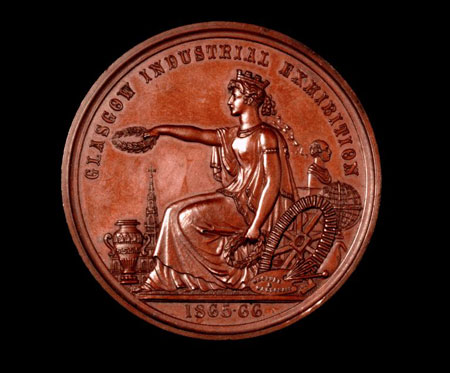
Figure 2. A medal Awarded at the Industrial Exhibition of 1865. On file at Glasgow Museums Resource Centre (GMRC)

           The Post Office Directory for 1866-67 lists David Fortune as the ‘manager of an Industrial Museum at 99 Argyll Street with a house at 26 George Street’.

            On 15 March 1866, David Fortune married Ann Webster, a seamstress, at 24 Stockwell Street, Glasgow. In the same year, on 29 November, their first child, George Roy Fortune was born. 8 This  occasion gives the first glimpse of David`s passion for the Temperance Movement as the child seems to have been named after George Roy Esq. who, according to a report on the movement 9, was a prominent member of the Scottish Temperance League and became its Honorary Director in 1868. The whole family was named as members of the Scottish Temperance League in 1868-69 with George Roy (aged 2) a ‘Juvenile Adherent’. In the report David Fortune is listed among those ‘Gentlemen who have frankly given their occasional services in the advocacy of the cause….their labours have been most abundant and self-denying’. He contributed five shillings in Donations and Subscriptions. (William Collins, the publisher, and future employer of David Fortune, who was also a member, contributed £5).

            The following year, aged 25, David Fortune was appointed to the post of Janitor of Anderson`s University and Keeper of the University Museum. There were 267 applicants for the post with 14 leeted. (Whether significant or not, David Fortune was the first name on the leet). He was appointed on 18 September 1867, with a salary of £60 per annum. In addition, he was to receive a 5% commission on Annual Subscriptions to the University which he was to collect. He was also to occupy the Janitor`s House rent free with water, gas and coal included and free of taxes. He sent his letter of acceptance on 20  September 10 (Appendix 1).

            In the census of 1871 11, the family was at 204 George Street (the Janitor`s House). David is described as the ‘Curator of University’. Apart from George Roy, aged 4, there were two other children, Jamie E. (a daughter who probably died young) and Maggie Webster aged 7 months. Another child, Anne Smollett Fortune, had been born on 24 July 1869 12 but is not recorded on the census. In the Glasgow Post Office Directories from 1868 to 1872,  David Fortune is listed at the Andersonian University, 204 George Street. He was still pursuing his temperance activities as the following advertisement, which appeared in The Temperance Record of 1871, illustrates:

 Amy Royson`s Resolve, by David Fortune. A New Prize Temperance Tale.
Price, in paper covers, 1s; post free, 14 stamps. In extra cloth
boards, 2s; post free 28 stamps.  Published by John S. Marr and Sons,
Glasgow. 13

            According to the Anderson`s University Calendar, David Fortune was Janitor of the University until 1871-2. However, on 21 February 1872 he tendered his resignation in order to take up a ‘new post’. Although his terms of employment stated that he was required to give three months’ notice, he asked to be allowed to relinquish his post within fourteen days and was given permission to leave on 1 March.14 His ‘new post’ was that of Secretary of the Irish Temperance League (ITL) in Belfast.15 On 2 June 1873 he communicated an article on The Origin of the Temperance Agitation in Ireland which was published in a volume entitled The Early Heroes of the Temperance Reformation. 16 ‘He was a very dynamic and effective secretary’ of the League and had the idea of setting up coffee stalls in Belfast ‘for which the ITL is popularly remembered’. 17

            In 1876 an International Temperance Conference was held in Philadelphia. David Fortune contributed an article The Irish Temperance League which was published in a Memorial Volume. 18  He left the ITL in 1877 (a departure that was ‘greatly regretted’) and returned to Glasgow to take up a ‘share in the management of the important business of Sir William Collins &Co.’.19 From 1879 to 1881 he was living at 89 North Frederick Street 20 and according to the census of 1881 he was the ‘foreman of a stationery manufacturer’. There had been an addition to the family – David jnr. who was aged two and born in Glasgow.21

Between 1881 and 1886 he became President of the Scottish Legal Life Assurance Society (SLLA).22 It is likely that this was a part-time post as his main occupation was still with William Collins. In the same year he gave evidence to the Select Committee on ‘National Provident Insurance’. 23, 24 (Appendix 2) At that time the SLLA had over 30,000 children under the age of five listed as members, but he denied, in his evidence, that child insurance encouraged infanticide or neglect.

            He was now resident at 104 Peel Terrace, Hill Street, Garnethill. As The Bailie commented ‘whenever a decent, hard-working, shoemaker or warehouseman blossoms into a ‘swell’ he chucks his ancient dwelling-place in Monteith Row or North Frederick Street, and travels ‘out West’. 25 The article was bemoaning the exodus from the East-end of Glasgow and the increased prominence in city affairs of the West-end.

            On 25 November 1886 an Industrial Exhibition was opened at the Burnbank Drill Hall and Grounds in Great Western Road. David Fortune was a member of the Executive Committee and Honorary Secretary. Of the members of the Executive Committee, The Bailie commented ‘One and all of these gentlemen, each of whom is a citizen of repute, has wrought with might and main to further the scheme’. 26       
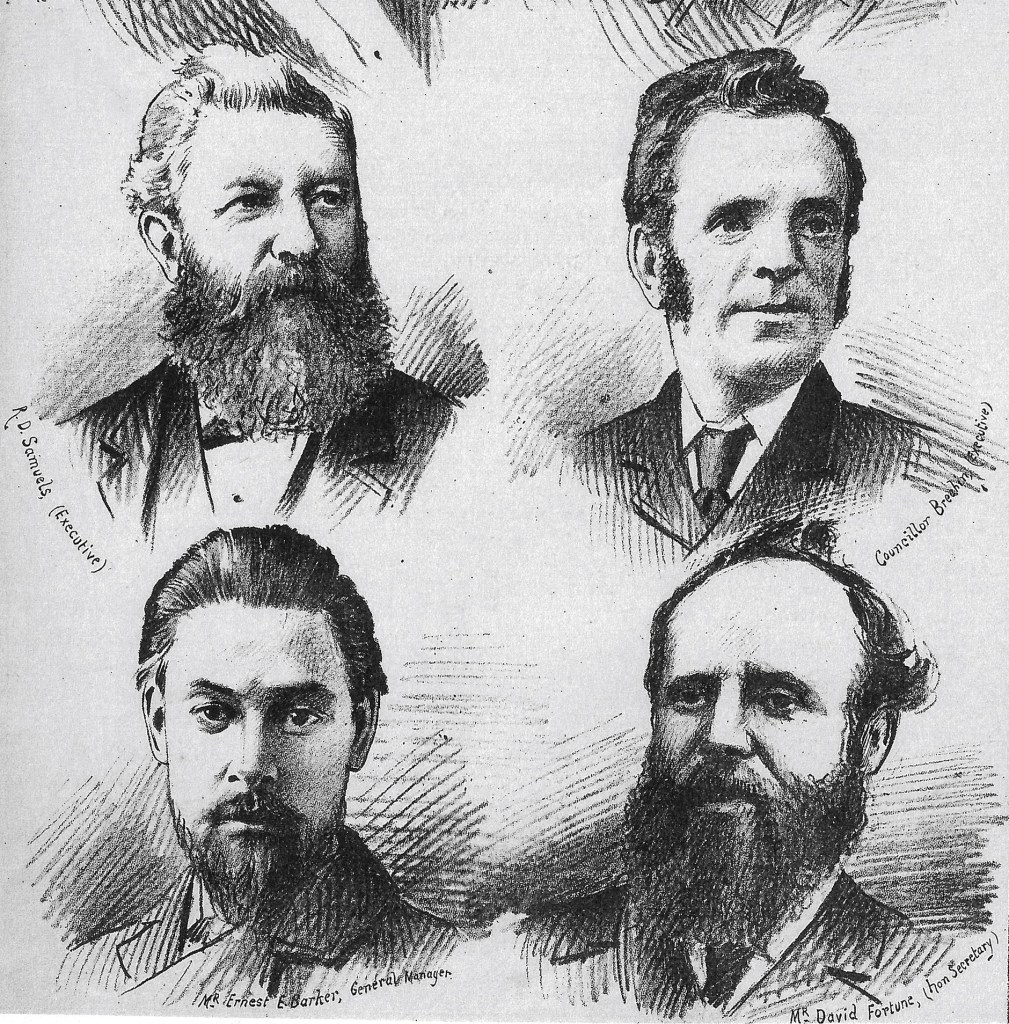
Figure 3.  The Executive Committee, Burnbank Industrial Exhibition. The Bailie, 24 November 1886.

 An advertisement was placed in The Glasgow Herald  advising that there would be ‘Illuminations with Electric Light’, ‘Machinery in Motion’ and ‘Sir Noel Paton`s Choice Works’ etc. etc. The proceeds of the first week and any overall profits were to be given to local charities. An article in the same issue gave a full account of the attractions on offer. 27

            In the Glasgow Post Office Directory of 1888-89 David Fortune is described as ‘manager, Sir William Collins, Sons and Co., Stirling Road’ and ‘President of Scottish Legal Life Assurance’. According to The Bailie the SLLA ‘may be congratulated on the possession of a Chairman (President) whose strong common sense and admirable business faculty has already been of the utmost advantage in their interests’. 28  He was also Chairman of the Congress of Friendly Societies and Director of the Scottish Temperance League. His interest in education was shown when he gave evidence before a Royal Commission on Technical Education.

            David Fortune`s next major project was the East-End Industrial Exhibition of 1890 held in Dennistoun.

            ‘It is but a few months since an East-end Industrial Exhibition was
suggested by Mr. David Fortune, and today………the Marquis of
Lothian unlocks a palace of instruction and entertainment’. 29

            Perhaps because of the influence of David Fortune the exhibition seems to have been a teetotal affair and perhaps because of that ‘misguided decision’ was lacking in visitors. 30 However, a later edition of The Bailie  states that the exhibition ‘resulted in a surplus of £3000 being handed to the Corporation to aid in building the People`s Palace.’ 31 This is confirmed by an article in the Glasgow Encyclopaedia:

The East End Industrial Exhibition of Manufactures, Science and Art,
took place in 1890-91. Its profits were to go towards establishing ‘an
institute for the intellectual and social improvement and recreation of
the inhabitants of the East End of Glasgow’. – this objective was realised
by the erection of the People`s Palace.32
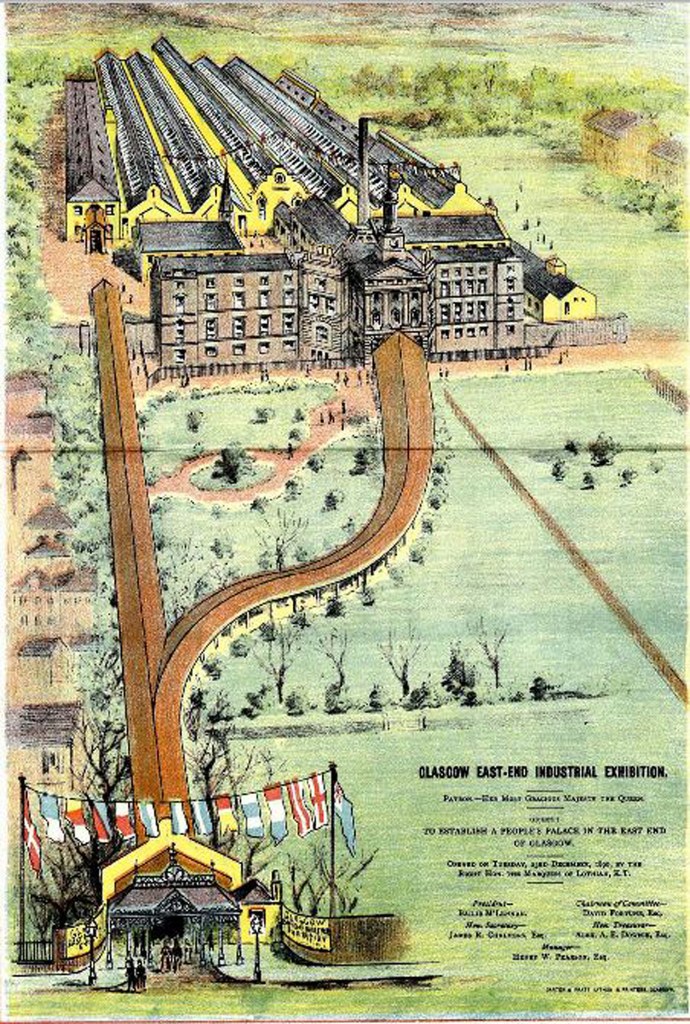
Figure 4.Poster for East-end Industrial Exhibition of 1890 http://www.dennistounconservationsociety.org.uk

      Again, The Baillie had something to say:

‘Concerning Mr. David Fortune, the Chairman of the Executive
Committee, there is little need to say anything. Mr. Fortune is an
eager and enthusiastic worker at whatever he puts his hand to, and
he usually contrives to make the different enterprises with which he is
connected turn out successes.’ 33

 One of his duties was to reply to the toast to the executive at the opening ceremony.

            According to the 1891-92 Glasgow Post Office Directory he was ‘President, Scottish Legal Life Assurance Society’ but was now described as a ‘mercantile stationer’ at 28 Gordon Street. In the 1893-94 edition he was a manager at Sir William Collins, Sons and Co., Stirling Road and had become Secretary of Scottish Legal Life. In 1895-96 he is listed as ‘J.P., F.S.S.’. In 1897 he moved to 197 Pitt Street and two years later he moved again to 19 Rowallan Gardens, Broomhill.

            David Fortune was Chairman of the Glasgow East End Industrial Exhibition which ran from 9 December 1903 till 9 April 1904. It was staged in Duke Street in premises designed for the East End Exhibition of 1890 – 91 and attracted 908,897 visitors. Its aim was to raise funds for the Royal Infirmary but in the event made a disappointing profit of £221. An advertisement for the exhibition appeared in the Glasgow Herald of 9 December 1903. At the closing ceremony ‘the members of the Executive, accompanied by Sir John Ure Primrose, the Hon. the Lord Provost came upon the platform and were enthusiastically received. Mr. David Fortune, who presided, briefly introduced the Lord Provost’. 34 In his speech, the Lord Provost congratulated the Executive on the success of the Exhibition. Mr. Fortune then proposed a vote of thanks to the Lord Provost and the formal proceedings were terminated.

The Bailie again commented:

‘Mr. Fortune`s zeal and energy have permeated the various
committees. Exhibitions are Mr. Fortune`s hobby, but in the serious
business of life he devotes his time and attention to the work of the
Scottish Legal Life Assurance Society, where, as the able and efficient
Secretary, he renders yeoman service. Mr. Fortune is also actively
identified with the leading social, educational, and municipal
movements in the city.’ 35

            On 10 October 1911, David Fortune was presented with his portrait in oils ‘in recognition of 50 years public service in Glasgow’. (This was the painting which was subsequently bequeathed to Glasgow). Rather appropriately, the portrait was presented to him at the Scottish National Exhibition of 1911 held in Kelvingrove. The purpose of this exhibition was to raise funds to endow a Chair of Scottish History and Literature at the University of Glasgow. For once, David Fortune appears not to have been involved. The presentation was made by Lord Rowallan in front of a large gathering in the Athole Restaurant. At the same time, Mrs. Fortune was presented with a gold pendant set with pearls. Among those present were David Fortune`s daughter and his son Dr. George Fortune. Also present was Francis Wilson who painted the portrait. 36

            On 16 June 1912 Annie Fortune died aged 65 at home in Broomhill. Her death was reported by her son G. Roy Fortune but some details on her death certificate differ from those shown on her marriage certificate i.e., her father is listed as David Webster, a blacksmith and farmer, and her mother as Annie Webster m.s. Hall. 37

            After his wife’s death, David Fortune appears to have remarried although this marriage is not recorded on Scotland’s People. His new bride was a widow Mary Ann Gray (nee Kemp) who predeceased him. She died on 24 March 1917. 38

David Fortune died, aged 75, on 12 November 1917 at 19 Rowallan Gardens, Broomhill. He was buried in the Glasgow Necropolis on 14 November but there is no evidence of a gravestone having been erected. His death certificate records that he was an insurance secretary, widower of 1. Annie Webster, 2. Marion (sic) Gray. The death was reported by his son G. Roy Fortune and again the details differ from those on his marriage certificate. His father is given correctly as David Fortune, plumber but his mother is listed as Maggie Fortune m.s. Galloway. 39 His obituary was published in The Glasgow Herald under the heading ‘A Social Reformer – Death of Mr David Fortune’. The author noted that as well as his many other interests, David Fortune was a ‘keen Burnsian’ and was frequently called upon to deliver ‘The Immortal Memory’. He was a Fellow of the Royal Statistical Society and of the Chartered Institute of Secretaries and a member of the Greenock Harbour Trust. 40
A memorial service was held on 18 November 1917 in the Newton Place United Free Church in Partick.
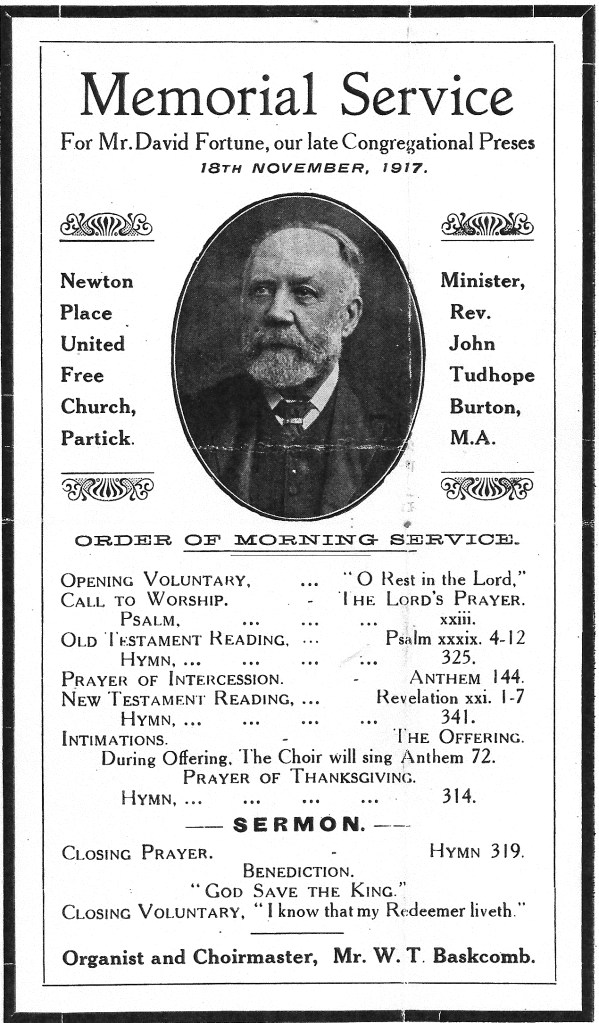
Figure 5. Order of Service (On File at GMRC)

His estate was valued at £6913.18s. 6d and in his will,41 he left £100 each to the Scottish Temperance League and the Royal Glasgow Institute for the Deaf and Dumb and £50 each to the Royal National Lifeboat Institute and the East Park Home for Infirm Children. He also left bequests to the Sabbath Schools of the Newton Place United Free Church, Partick ‘for the purchase of prizes’ and to the Rose Street Day Industrial School to help with funding the Annual Excursion and Christmas Entertainment for the poorer children. The ‘goods and chattels’ belonging to his second wife were left to her grand-niece Marjorie Hartstone who was then living at 19 Rowallan Gardens.  

            Two paintings are mentioned in his will; Scotland Yet by Cameron (first name not given) ‘bequeathed to me by the grandson of Robert Burns’ which was left to his elder son and his portrait by Francis Wilson which was to be given to the People`s Palace in Glasgow.

            His portrait was offered by his trustees to Glasgow Corporation on 1 February 1918 and was initially declined due to a lack of space at the People`s Palace. However, after further consideration and correspondence from the trustees, the painting was accepted on 31 May 1918. 42

The Artist

Francis Wilson was primarily a painter of landscapes and portraits. He was born in Glasgow in 1876. He studied at the Glasgow School of Art and continued his training in Florence, Paris and Rome. On his return from the Continent, he set up a studio in Glasgow, exhibiting at many of the Scottish societies, including the Royal Scottish Academy and the Glasgow Institute. He also exhibited at the Paris Salon. He was a Member of the Glasgow Art Club and his work is represented in the Glasgow Art Gallery.

References

  1. ancestry.co.uk, Scotland Census 1851
  2. familysearch.org
  3. ancestry.co.uk, Scotland Census 1861
  4. Glasgow Post Office Directory, 1865-66.
  5. The Bailie, No. 1626, 16 December 1903, Mitchell Library, Glasgow
  6. The Bailie, No. 886, 9 October 1889
  7. Fisher, Joe, The Glasgow Encyclopaedia, Mainstream Publishing, 1994. pp 130-134.
  8. Scotland`s People, Birth Certificates
  9. Annual Report of the Scottish Temperance League, 1868-69. Anguline Research Archives. http://anguline.co.uk/Free/Temperance.pdf
  10. Minute Book of Anderson`s University, 1865-1881. Andersonian Library, University of Strathclyde.
  11. ancestry.co.uk, Scotland Census 1871
  12. Scotland Births and Baptisms, 1564-1950, database, FamilySearch (This birth is not recorded on Scotland’s People
  13. The Temperance Record, 4 November 1871, p528. Google Books.
  14. Minute Book of Anderson`s University, 1865-1881. Andersonian Library, University of Strathclyde.
  15. The Bailie, No. 886, 9 October 1889
  16. The Early Heroes of the Temperance Reformation, Scottish Temperance League, Glasgow, 1873. Houlston and Sons and W. Tweedie, London. http://www.archive.org/stream/earlyheroesoftem00logauoft/earlyheroesoftem00logauoft_djvu.txt
  17. Information from Archie Wood, Honorary Archivist, Irish Temperance League. (Sent by email, 2012)
  18. Centennial Temperance Volume. A Memorial of the International Temperance Conference, held in Philadelphia, June 1876. (Published 1877, article number 851 – 852). (Google Books).
  19. The Bailie, No. 886, 9 October 1889
  20. Glasgow Post Office Directories
  21. Scotland’s People, Census 1881
  22. Glasgow Post Office Directories
  23. Scotland in the 19th Century, (ebook), Chapter 6, Section 6.8, Insurance
  24. The Bailie, No. 736, 24 November 1886.
  25. The Bailie, No. 886, 9 October 1889.
  26. The Bailie, No. 736, 24 November 1886
  27. The Glasgow Herald, 25 November 1886 pages 1 and 5.
  28. The Bailie, No. 886, 9 October 1889.
  29. The Bailie, No. 949, 24 December 1890.
  30. ibid
  31. The Bailie, No. 1626, 16 December 1903.
  32. Fisher, Joe, The Glasgow Encyclopaedia, Mainstream Publishing, 1994 pp 130-134.
  33. The Bailie, No. 949, 24 December 1890.
  34. The Glasgow Herald, 11 April 1904, page 9.
  35. The Bailie, No. 1626, 16 December 1903.
  36. The Glasgow Herald, 11 October 1911, page 9.
  37. Scotland`s People, Death Certificate.
  38. ibid
  39. ibid
  40. The Glasgow Herald 12 November 1917.
  41. Scotland’s People, Wills and Testaments, SC36/51/179, pp 228-239, 1918
  42. Glasgow Corporation Minutes, 1 February 1918, C1 3.58, p584; 1 May 1918, p1089; 31 May 1918, C1 3.59, p 1277, Mitchell Library

Appendix 1

            David Fortune`s letter of acceptance of the post of Janitor of
Anderson`s University and Keeper of the Museum.

26, George Street,
20th September 1867

Sir,      

            I beg to acknowledge receipt of your communication of yesterday, acquainting me of my appointment by the Managers, as Janitor to Anderson`s University, and Keeper of the Museum connected with that institution. I cordially agree to the terms specified in your letter, and I need scarcely say that my best energies shall be devoted to the fulfilment of the various duties required of me, in a manner which, I hope, shall prove satisfactory to the Managers and the other gentlemen connected with, and interested in the welfare of the University. With thanks for the great favor (sic) bestowed on one,
I remain, Sir etc.

                           (signed)  David Fortune

William Ambrose Esq.
Secretary,
Anderson`s University.

Taken from the Minute Book of Anderson`s University, 1865-1881.

Appendix 2

David Fortune, the President of the Scottish Legal Life Assurance Society, which was a mutual as well as a collecting society, said its business was almost entirely confined to the working classes. Out of a total of 400,000 members, 38,771 were under the age of 5 and 37,731 between the ages of 5 and 10. He disclaimed the suggestion that child insurance encouraged infanticide or neglect. He recommended that only one insurance should be allowed on a child, as with only one certificate, there would be no possibility of insurance beyond the legal amount. He thought all societies insuring children ought to be registered under the Friendly Societies Act, 1875, but did not recommend the registration of every child life insurance as this would be extremely unpopular among the working classes

Janette Thesiger née Ranken (1877 – 1970) Actor and socialite

Janette Mary Fernie Ranken was born on 16 December 1877 to Robert Burt Ranken, Writer to the Signet, and his wife Mary at 8 Learmonth Terrace, Edinburgh. (1)      On her birth certificate she is ‘Jeanette’ but on all other documents this is spelt ‘Janette’.  She first appears in the 1881 census (2) with father, mother and her brother Thomas and household staff which included a cook, 2 housemaids, a laundress, 3 nurses and a kitchen maid. In the 1891 census (3) she is at Cringletie Manor House, near Eddleston, with her younger brother William, and a governess, housekeeper, nurse, cook, laundry maid and coachman. Her parents are not present and are presumably furth of Scotland. Cringleltie is now a hotel and is a substantial house which was then rented, since it was owned by another family. (4)

Figure 1. Janette Ranken at Lady Margaret Hall .By kind permission of the Principal and Fellows

She attended Lady Margaret Hall in Oxford from 1895 to 1897 and in their records is described as having been educated at home. (5)

 From time to time her father, while retaining his main residence in Learmonth Terrace in Edinburgh, rented other substantial houses in the Borders   In 1901 Janette’s residence is listed as with her father at Dalswinton house, Dumfries (6) and at 8 Learmonth Terrace, Edinburgh. (7)

Her father died in August 1902 (8) at Dalswinton House and she was named a Trustee in his Will with her older brother Thomas and others. (9) Glimpses of her may be seen in Hilary Spurling’s biography of Ivy Compton Burnett (10) ‘her (Margaret Jourdain’s) closest friend at Lady Margaret Hall, Oxford was Janette Ranken, a statuesque beauty from a well-to –do Edinburgh family’. Margaret Jourdain became a writer and a much-admired historian of furniture. She and Janette lived together until 1917. (11)   Margaret was friendly with Janette’s brother William and with his friend Ernest Thesiger. They all moved in a literary and aesthetic circle in London. (12)

 Janette eventually became an actor. During the 1914-1918 war she worked in censorship and in relief organizations. From 1918 she worked for the Theosophist Society. (13)

Figure 2. From ‘The Sketch‘ 30 May 1917

Janette married the actor Edward Thesiger, a friend of her brother William, on 29 May 1917 at Holy Trinity, Chelsea London. (14)  Margaret Jourdain then became Ivy Compton Burnett’s lifelong companion. Janette’s forthcoming marriage was reported in various papers, in The Scotsman (15) and in The Sketch ‘An interesting marriage between the actor Edward Thesinger and the well-known actor Miss Ranken’. (16)   This was because he was known to be gay. She was given away by her brother Major Thomas Ranken.

On the subject of her marriage Hilary Spurling comments that ‘Janette whose devotion to Margaret remained unimpaired by a marriage so unexacting on both sides that a great many of Ernest’s friends never suspected him of having a wife at all’. (17) An article in The Stage published after his death quoted him as saying ‘that the marriage was never consummated’.  (18)

After her marriage her life is not well documented and she would appear to have lived on private means and to have continued her interest in Theophisists but she did travel to Colombo in 1928 and to Durban in 1936 (19) (20) and she appears to have been unaccompanied.   Ernest Thesinger died in 1961. (21)

Figure 3. W.E.B. Ranken The Garden Door © CSG CIC Glasgow Museums Collection
 

 Janette was always very close to her brother William and when he died in 1941, (22) she distributed his paintings to Art Galleries in the UK and abroad.

She gave two paintings to Glasgow Museums in 1926 both by William Ranken’, an Oil Painting The Garden Door and a watercolour Dreaming Room at 139 Picadilly  She died in June 1970, aged 92 years, in Kensington, London.  The last years of her life had been marred by illness. She was blind and latterly bedridden. (23)

It was generally agreed that Janette found women more attractive than men (24) but there were three men in her life. Her brother Thomas Ranken was a donor to Glasgow museums in his own right and is reported separately.

 The second and most important was her brother the artist William Bruce Ellis Ranken (1881-1942). (25) He was educated at Eton and the Slade School of Art under Henry Tonks. (26)  It was there that his lifelong friendship with Ernest Thesiger began. His first exhibition in London in 1904 was well received. He became friendly with John Singer Sargent and travelled to America possibly with him. In America his clientele expanded to include the wealthy and famous and he exhibited successfully. He returned to Britain and his studio was at 14 Cheltenham Terrace, London.  His subjects included Queen Mary and the Princess Christian. (27)  He also painted miniatures for the Queen’s Dolls’ house.

Figure 4. Ranken, William Bruce Ellis; The Throne Room, Madrid; © CSG CIC Glasgow Museums Collection
 

He was an accomplished and prolific painter and painted interiors e.g.in Madrid and landscapes in France.

Figure 5. Ranken, William Bruce Ellis; Sir John Stirling Maxwell (1866-1956), 10th Bt; Pollok House, Glasgow. © CSG GIC Glasgow Museums Collection. (www.artuk.org).

His many portraits include that of Sir John Stirling Maxwell at Pollok House, which is in the Glasgow Museums Collection and hangs in Pollok House. (28)   He became quite wealthy and bought an estate Warbrook, in Hampshire.  

He died suddenly in 1942 and left about 200 paintings. (29)

Janette was responsible for donating these to Art Galleries around Britain. Eighty-two of his paintings feature in the ArtUK website. (30)
Her husband Ernest Thesiger (1879-1961) (31) came from a prominent English family of public and civil servants. (32)     His grandfather was the first Lord Chelmsford; his father was Sir Edward Pierson Thesiger a civil servant; an uncle was General Charles Thesiger of the African campaign and a cousin was the explorer, Wilfred Thesiger.

Figure 6. W.E.B. Ranken. Ernest Thesiger. Photo credit: Manchester Art Gallery (www.artuk.org).

After an education at Marlborough College, he proceeded to the Slade School of Art where he met William Ranken. (33) He tried to follow a career as a painter but became an actor though he continued to be an accomplished embroiderer. From 1909 he had success on the London stage and moved in artistic circles which included George Bernard Shaw and John Singer Sargent. He served in France in the First World War but was wounded and honourably discharged. He first appeared in a film in 1916 but it was not until 1930 that his Hollywood career was launched properly.  He continued to appear in films until the year before he died. He appeared in over 50 films and among them are some which are well known such as The Bride of Frankenstein and The Man in the White Suit. (34)  He was awarded a CBE in 1960 (35) and died in 1961. (36).       

References

  1. National Records of Scotland Statutory Births 1877
  2. National Records of Scotland Census 1881
  3. National Records of Scotland Census 1891
  4. Cringletie House Hotel website
  5. Archives of Lady Margaret Hall. By kind permission of the Principal and Fellows
  6. Dalswinton House Dumfries
  7. National Records of Scotland Wills and Confirmations 1902
  8. National Records of Scotland Statutory Deaths 1902
  9. National Records of Scotland Wills and Confirmations 1902
  10. Hilary Spurling. Secrets of a Woman’s Heart: the later life of Ivy Compton-Burnett. Hodder and Stoughton, London, 1984
  11.  Ibid           
  12. Milne, James Lees.    Ranken, William Bruce (1881-1961).    Oxford Dictionary of National Biography, Oxford University Press, 2014.
  13. Archives of Lady Margaret Hall. By kind permission of the Principal and Fellows
  14. Ancestry.co.uk
  15. The Scotsman 10 April 1917
  16. The Sketch 30 May 1917
  17. Hilary Spurling. Secrets of a Woman’s Heart: the later life of Ivy Compton-Burnett. Hodder and Stoughton, London, 1984
  18. The Stage 20 October 2000
  19. Ancestry.co,uk
  20. ibid
  21. England and Wales National Probate Calendar
  22. Milne, James Lees.    Ranken, William Bruce Ellis (1881-1961).    Oxford Dictionary of National Biography, Oxford University Press, 2014.
  23. Hilary Spurling. Secrets of a Woman’s Heart: the later life of Ivy Compton-Burnett. Hodder and Stoughton, London, 1984
  24. ibid
  25. National Records of Scotland Statutory Births 1881
  26. A Forgotten Gay Great: mrmhadams.typed.com
  27. ibid
  28. Art.uk
  29. Ancestry.co.uk
  30. Art.uk
  31. Ancestry.co.uk
  32. National Portrait Gallery website
  33. Anderson, Michael. Thesiger, Ernest Frederic Graham (1879-1961) Oxford Dictionary of National Biography, Oxford University Press, 2014.
  34. Wikipedia
  35. Anderson, Michael. Thesiger, Ernest Frederic Graham (1879-1961) Oxford Dictionary of National Biography, Oxford University Press, 2014.
  36. ibid
  37. Ancestry.co.uk

Alexander Brownlie Docharty (1862 – 1940)

In October 1917, Alexander Brownlie Docharty gifted a series of his own paintings to Glasgow Corporation.  (Appendix 1)

Fig. 1 In the Woods  Early Spring (1914). (1436). (c) Glasgow Museums; Supplied by The Public Catalogue Foundation


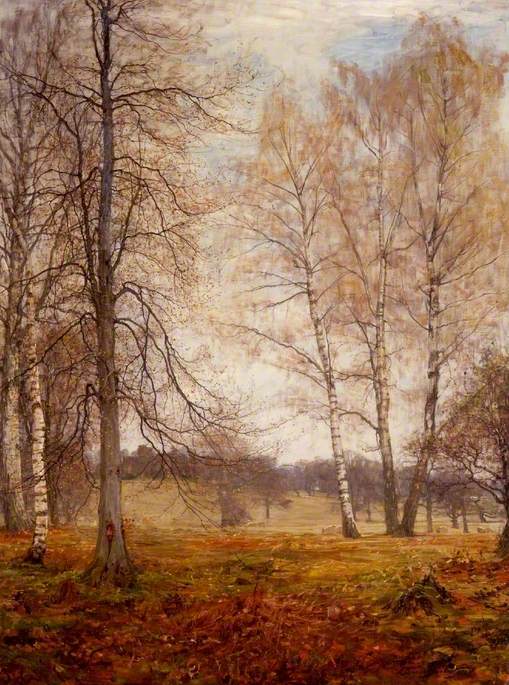
Figure 2. An Autumn Day (1917). (1437). (c) Glasgow Museums; Supplied by The Public Catalogue Foundation


Figure 3. Winter Sunshine. (1917). (1438). (c) Glasgow Museums; Supplied by The Public Catalogue Foundation


Figure 4. THe Old Clock Tower, Evening. (1439). (c) Glasgow Museums; Supplied by The Public Catalogue Foundation


Figure 5. Springtime, Hawthorn Blossom (1917). (1440). (c) Glasgow Museums; Supplied by The Public Catalogue Foundation

            Alexander Brownlie Docharty was born on 8 October 1862 at 5 McAslin Street, Glasgow. 1 This was in the Townhead area of the city near the present University of Strathclyde. He was the second son of Joseph Docharty a pattern designer and his wife Elizabeth Brownlie. Joseph and Elizabeth had married in Calton, Glasgow on 13 June 1859.2 They went on to have three sons and three daughters. At the 1871 census 3, the family was living in Crossmyloof, Cathcart. Joseph Docharty was described as a ‘designer and coal agent’ born in Bonhill, Dunbartonshire.

              Alexander left school aged thirteen to work with his father designing calico prints. At the same time, he studied in the evenings at the Glasgow School of Art under Robert Greenlees and in 1878 at the age of fifteen he had a watercolour, On the Cart  Pollockshaws  hung in the Glasgow Fine Art Institute. It was priced at three guineas.The painting was submitted from 5 Viewfield Terrace. 4

            At the 1881 Census, Alexander was living with his widowed mother, grandfather (a retired grocer) and siblings at Langbank, Renfrewshire. He was described as a ‘landscape painter’. The following year he had a painting Arran Cottages hung in the Royal Academy in London. The painting was sent from 113 West Regent Street, Glasgow. 5 However, his attempts to make a living from painting seem to have been premature and he found employment as a designer with the firm of Inglis & Wakefield who had a print works at Busby.

            By 1885 however, he had returned to painting and while living at 11 Prince`s Street, Pollockshields he shared a studio with his uncle James Docharty and his cousin also James Docharty at 134 Bath Street, Glasgow. 6 James Docharty, A.R.S.A., was a well-known painter of landscapes who exhibited extensively at the Royal Scottish Academy from 1864 till his death in 1878. He undoubtedly had a significant influence on his nephew Alexander`s decision to try to make his living as an artist.

            On 6 June 1890 at Nether Barr, Ayrshire, Alexander married Catherine McKnight a schoolteacher and daughter of a farmer from Kirkconnell, Dumfries. His occupation was ‘landscape and portrait painter’ and his address ‘Maitland, Dailly’. 7

            At the 1891 census he was at Nether Barr with his in-laws. In the same census his wife and their new-born son, Joseph, were at 4 Melville Street, Govan with Alexander`s mother and family.

            Alexander was among those Glasgow painters who in 1891 appended their names to a petition requesting that the Corporation of Glasgow buy Arrangement in Grey and Black, No. 2: Portrait of Thomas Carlyle  by J. A. M. Whistler. 8 This painting was duly purchased (for 1000 guineas!) from the artist and is now in Kelvingrove Art Galleries in Glasgow.

            In 1894 Alexander went to Paris where he entered the Academie Julien and studied for a time under Benjamin Constant and Jean Paul Laurens. On his return to Scotland, he went to live and work at Kilkerran in Ayrshire. He painted mainly in oils and spent about fourteen years in Kilkerran in a cottage owned by Sir James Fergusson. 9 One of the works he produced there was shown at the Venice Biennale in 1903 and purchased by the Italian Minister for Foreign Affairs. It hung in the Consulta Palace in Rome. 10

            According to the Glasgow Post Office Directory for 1895-96, he still had a business address at 134 Bath Street with a house at Ruglen, Kilkerran, Ayrshire.

            In 1901, the family was living at 3 Jane Street, Blythswood Square, Glasgow. Alexander was now an ‘artist (painting) working on his own account’. As well as Joseph there were now two other children, William McK. Docharty, aged 5 and Mary R. Docharty, aged 3. Both children were born in Kirkoswald, Ayrshire. There was also a servant employed who had been born in Dailly. 11

            In the early 1900s, Alexander spent his summers in Symington painting at Dankeith, Dundonald and Auchans. 12 He also travelled to the Highlands and the nature of the subjects he depicted is indicated in the titles of a few of his more outstanding works including, Winter in Glenfinlas (1902), Ben Venue (1905) and Lochiel`s Country which was shown at the Royal Academy, London and was purchased by Glasgow Corporation. In 1907, his September, Glen Falloch was exhibited at the Glasgow Institute. It was purchased by Archibald Watson Finlayson of Merchiston (qv) and presented to Glasgow Corporation.13 In 1916 his painting Glen Morriston was sold for 320 guineas by J. and R. Edmiston.

            Alexander travelled and painted in Europe especially in Holland and made trips to Donegal in Ireland. In 1903 he went to Paris and then to Italy via the Riviera and on to Naples, Rome, Florence visiting Venice several times. One of his landscapes, Glenfinlas, was hung in the St. Louis International Exhibition of 1904. This may have come about because an uncle, Alexander Brownlie, had emigrated to the USA and in 1904-5 was living at 338 Bloomfield Avenue, Montclair, NJ. He was a member of a flourishing artistic community in the town. (An article in the Montclair Times describes a walking tour of the town which pointed out the homes of turn-of-the-century artists. This included the home of Alexander Brownlie). 14

            Alexander Brownlie Docharty was a member of the Royal Glasgow Institute of the Fine Arts and served on the Council of the Institute. In addition, he was president of the Glasgow Art Club from 1911 to 1913 and was a Member of Council thereafter.

            In 1915, the Balloch Estate on Loch Lomondside, was sold to Glasgow Corporation and on 2 October 1916, Alexander wrote to the Lord Provost with his offer to ‘paint and present several of the more outstanding views (autumnal and spring) of the park and its surroundings’. (Appendix 1) The five paintings produced were those gifted to the Corporation in 1917. It seems that the first of these had been painted before the acquisition of the estate at Balloch and this may have given him the idea for the remainder.

            On 26 July 1926, age 63, Alexander sailed on the Caledonia from Glasgow to New York. He was accompanied by his daughter May Rankine Docharty . They arrived back in Glasgow from New York via Moville in Northern Ireland on 10 October having travelled first class on the California. 15

            By 1940 he was living with his daughter at 20 Hyndland Road, Hillhead. 16 He died there on the 12 November 1940 aged 78. 17 However, the death notice in the Glasgow Herald states that he died at 6 Montague Terrace. 18 He was buried in Cathcart Cemetery on 14 November 1940. (His uncle, James Docharty, was also buried there). His wife pre-deceased him and he was survived by a son and daughter. An obituary was published in the Glasgow Herald 19 and his death was also reported in an article in The Scotsman which noted that ‘he took a deep interest in religious work and served as an elder of Glasgow Cathedral’. 20

Figure 6. From the Glasgow Herald
13 November 1940.

            Alexander Brownlie Docharty exhibited widely for almost 60 years including at the Royal Academy (12 works), the Royal Scottish Academy (19) 21, the Royal Society of Painters in Watercolour (5) and the Glasgow Institute (155) 22 as well as at the Walker Art Gallery in Liverpool, the Manchester City Art Gallery and the New English Art Club. His work attracted praise and criticism from various sources. Of his landscapes Caw commented,

‘Painted with gusto, but not without refinement, in frank, fresh and harmonious colour, and good in drawing and design, Brownlie Docharty`s landscapes preserve the aroma of a sincere, if
unimpassioned, love of the simple and everyday aspects of Nature and awakened pleasant memories of the country’.23

Harris and Halsby note that, ‘(He) worked mainly in oil but his watercolours can be fine with good composition and sensitive colour’. 24 The Scotsman reported on four of his paintings exhibited at the Glasgow Art Club Show of 1899; ‘Mr. Brownlie Docharty`s works have always shown him to be an artist in evident sympathy with the tenderer aspects of nature which disclose themselves in woodland and stream, but his sojourn to Holland has added both sweetness and strength to his brush,…. 25 

            Again in 1912, the same paper reported; ‘One of the most striking landscapes in the gallery is the Falls of Garry by Mr. A. Brownlie Docharty. ……….the rocks are painted with a solidity which would have pleased Ruskin; the foaming water has been carefully studied, and with a dainty brush, the artist has rendered the summer greens of the trees and the glow of the sky’. 26

            Alexander Brownlie Docharty`s two surviving children each had their own claim to fame. His son, William McKnight Docharty served with the King`s Liverpool Regiment during World War I and achieved the rank of Captain. He was twice wounded in action and was awarded the Military Cross. 27 He became a keen hillwalker and compiled and published in 1954, a list of the 900 highest mountains in Britain. He was also the second person to complete in 1960 the ascents of all 220 ‘Corbetts’ i.e. Scottish mountains between 2500 and 2999 feet in height. William McKnight Docharty died on 14 July 1968 aged 72. 28

            May Brownlie Docharty, who died in 1972, was a gifted player and teacher of contract bridge. She owned and managed the Western Bridge Club in Glasgow which she formed after her father`s death. 29

References

  1. Scotland`s People , Birth Certificate
  2. Scotland’s People, Marriage Certificate
  3. Scotland’s People, Census 1871
  4. Glasgow Institute of the Fine Arts Exhibitions Catalogues 1877-83. (Mitchell Library).
  5. Catalogues of the Royal Academy Exhibitions, 1880-89, W. Clowes and Sons., Ltd.
  6. Glasgow Post Office Directory, 1885-86
  7. Scotland’s People, Marriage Certificate
  8. Glasgow Town Council, Sub-committee on Galleries and Museums, 27 February 1891: (see http://www.whistler.arts.gla.ac.uk).
  9. Eyre-Todd, George, Who`s Who in Glasgow in 1909 Gowan & Gray, 1909, Glasgow. http://gdl.cdlr.strath.ac.uk/eyrwho/eyrwho0513.htm
  10. venicebiennale.britishcouncil.org/timeline/1903/history/1105/).
  11. Scotland’s People, Census 1901
  12. Eyre-Todd, George, Who`s Who in Glasgow in 1909 Gowan & Gray, 1909, Glasgow. http://gdl.cdlr.strath.ac.uk/eyrwho/eyrwho0513.htm
  13. ibid
  14. The Montclair Times, 10October 2003. (Also www.brownlee.com.au).
  15. Ancestry.co.uk, New York Passenger Lists, 1820 – 1957
  16. Voters` Roll, Glasgow, Hillhead, 1940.
  17. Scotland’s People, Death Certificate
  18. Glasgow Herald, 13 November 1940.
  19. ibid
  20. The Scotsman, 13 November 1940, p 5.
  21. Royal Scottish Academy Exhibitors, 1826 – 1990, Hilmartin Manor Press, 1991.
  22. Premier Paintings, Gairloch (website)
  23. Caw, Sir James L., Scottish Painting, Past and Present, 1620 – 1908, T.C. & E. C. Jack, Edinburgh, 1908.
  24. Harris, P. and Halsby, J., The Dictionary of Scottish Painters, 1600 to the present, Birlinn Ltd; 4th Edition, October 2010
  25. The Scotsman, 6 November 1899, The Glasgow Art Club Exhibition
  26. The Scotsman, 7 December 1912, The Glasgow Art Club Exhibition
  27. The Scotsman, 16 October 1918, p7
  28. http://www.corbetteers.blogspot.com/
  29. Glasgow Herald 5 May 1972.

Appendix

Glasgow Corporation Minutes, 4 October 1916. C1 3.57, p2002.

There was submitted a letter, of date 2nd instant, from Mr. A. Brownlie Docharty, 3, Jane Street, Blythswood Square, to the Lord Provost, in which he states that the value and beauty of Loch Lomond Park, recently acquired by the Corporation, and its immediate surroundings, might be brought home to many of our working-classes and industrial citizens, if these were depicted on canvas, and, for this purpose, he is willing to paint and present several of the more outstanding views (autumnal and spring) of the park and its surroundings on condition that the pictures be housed together in the People`s Palace, in Glasgow Green, where they would be most likely to come under the notice of the citizens.

            The members of the committee unanimously resolved to record their high appreciation of Mr. Docharty`s generous offer, and to accept the same and to award to him, on behalf of the citizens, their most cordial thanks for this handsome gift. It was also agreed that it be remitted to the Convener, Sub-convener, and Councillor Barrie to confer with Mr. Docharty as to the necessary arrangements for the work being executed and to adjust any details with reference thereto.

The gift was accepted by the full committee of the Corporation at their meeting of 18.10.17. “The paintings would, in accordance with the desire of the artist, be housed in the Peoples` Palace in Glasgow Green”.

The Scotsman of October 17 1917, page 5, has the following article, presumably written when the paintings were gifted to the corporation;

“ARTIST`S GENEROUS OFFER TO GLASGOW:- Mr. A. Brownlie Docharty, a well-known landscape artist, has offered to paint for the Glasgow Corporation, several of the more outstanding views of the Loch Lomond Park and its surroundings, on condition that the pictures are placed together in the People`s Palace. In his letter to the Lord Provost, Mr. Docharty suggested that the value and the beauty of Loch Lomond Park might be brought home to the working classes if depicted on canvas. The Parks Committee of the Corporation have recorded their high appreciation of Mr. Docharty`s generous offer and have agreed to accept the gift”.