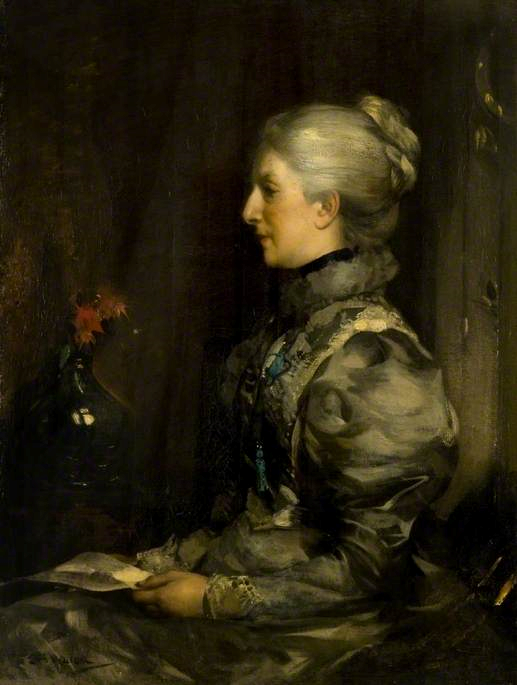
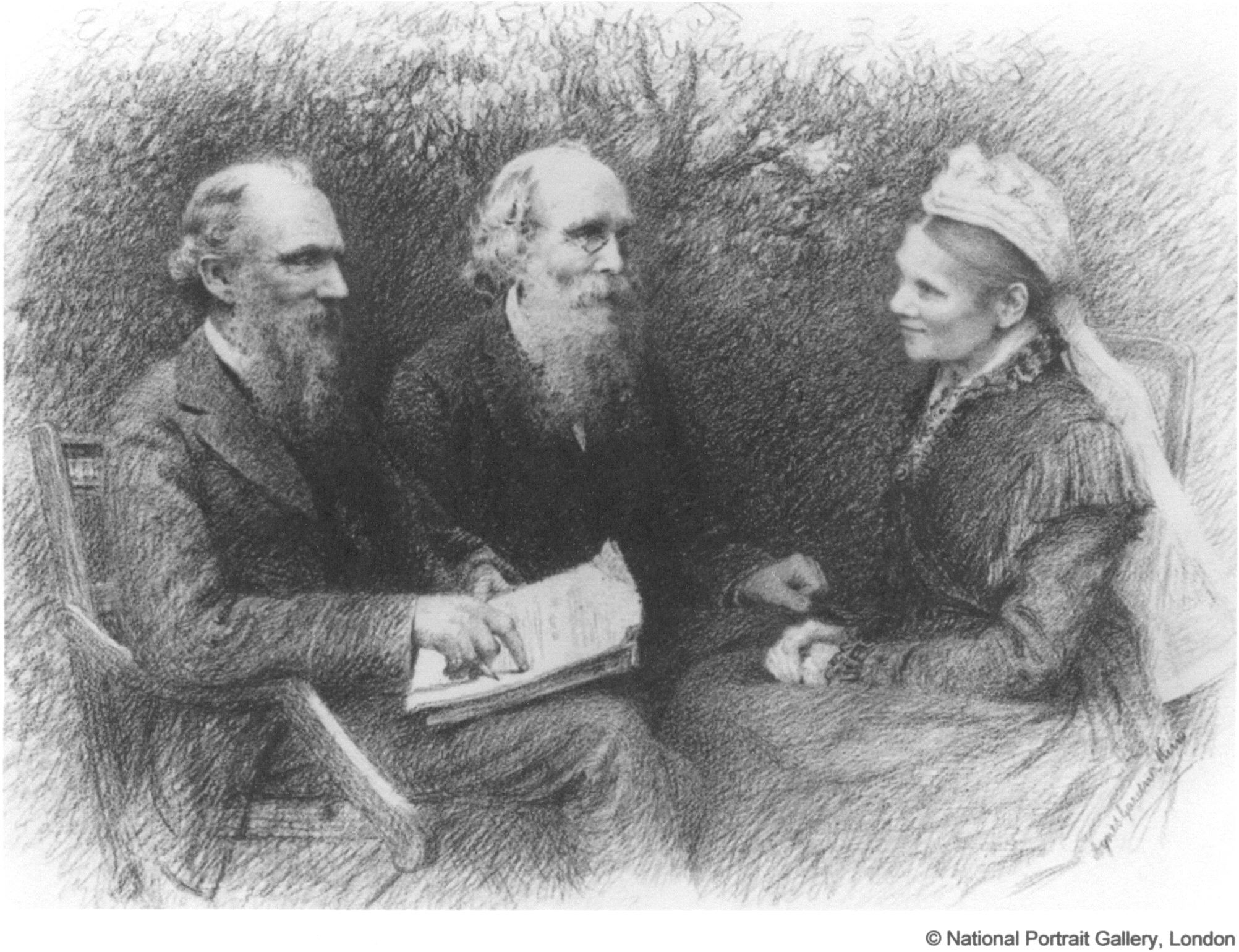
John Mathieson Mathias 1906-1963

Donor.  John  Mathieson Mathias (1906-1963)

John M Mathias donated four paintings to Glasgow in December 19511. Two are by French artist Andre Lhote   (Figures 1 and 2) and two are by English artist Mark Gertler(Figures 3 and 4) 

     https://artuk.org/discover/artworks/head-of-a-woman-84963

 Figure 1 .Head of a Woman by Andre Lhote   c1925   ©CSGCIC Glasgow Museums . Acc 2930 

 https://artuk.org/discover/artworks/nude-84964

Figure 2 Nude by Andre Lhote c1925 © CSGCIC Glasgow Museums. Acc 2931

The Paintings

 Figures 1 and 2  are  the work of  Andre Lhote (1885-1962). He was born in Bordeaux and trained first as a decorative wood carver before attending L’Ecole des Beaux- Arts in Bordeaux where he took up painting. He  moved to Paris in 1906  where his works were shown for example at the Salon d’Automne. Lhote originally painted colourful landscapes in the Fauvist style but his mature works were in the Cubist style.  Over the next few years Lhote’s works were shown all over Europe including in London in 1912 at the Second Post  Expressionist  exhibition at the Grafton Galleries  which was organised by Roger Fry and the Bloomsbury Group. He set up his own art school- Academie Montparnasse in Paris  in 1922. His most significant work however was not as a visual artist but  as a writer who articulated Cubist theories and as an educator who influenced a generation of French artists.2

We do not know at this point for certain  how or when these paintings were acquired by  John Mathias or the Mathias family. We do know that in November 1927 Andre Lhote held an exhibition of his own and his students work at the Claridge Gallery at 52 Brook Street in London 3 which was partly owned by our donor’s mother Ena Mathias . In the 1927 exhibition catalogue (Exhibition of Paintings and Drawings by Andre Lhote and His Pupils)  there is one work entitled Negresse  which is the title  given to one of two  Andre Lhote paintings which appear in the  1951 Catalogue of French Paintings  published by Glasgow Museums. The description and measurements  correspond to  Figure 1  Head of a Woman” above.  The original  title  was obviously changed at some point as it would not now be acceptable .There  are three works entitled Nu   in the 1927 exhibition catalogue any one of which could be our  Nude ( Figure 2) in the 1951 catalogue though there is no description or any measurements to support  this .4 It is possible  that both paintings were  bought by someone in the Mathias family from this exhibition.

 During the period of the  exhibition Andre Lhote gave a lecture at the home of Mrs Emile Mond  whose home was a centre of art and culture at the time. She was said to be a talented artist and musician .5 Emile Mond was a cousin of Robert Moritz Mathias, our donor’s father(See Appendix ) .    

Figures 3 and 4 are the work of English artist  Mark Gertler(1891-1939) )   who was born in Spitalfields of Polish -Jewish descent. 6 He attended the  Slade School of Art from 1908-1912 where he won several prizes. His  health was not good and he spent a lot of time in the South of France where he was influenced by Post -Impressionism. His style was highly individual with strong elements of Eastern folk art. He specialised in still lives, female portraits and nudes. He had a studio in Hampstead  and frequently exhibited in various London Art Galleries such as the Leicester Galleries. He was very successful until the nineteen thirties  when his popularity began to wane. He suffered bouts of depression and after  an unsuccessful exhibition at the Lefevre Gallery in London in 1939 he committed suicide .7 We can only speculate  at this point as to how these two paintings came into the possession of John Mathias or the Mathias family or why they were given to Glasgow. We know that one  of Gertler’s patrons was Lady Ottoline Morrell, half -sister of the Duke of Portland. She was also a close friend of Ena Mathias. Another  link between Gertler and  the Mathias family is that Ena’s brother Robert bought one of Gertler’s paintings .8 Ottiline suggested that Gertler might exhibit at her friend Ena’s Claridge Gallery at a time when his finances were low but Gertler refused saying the Claridge was not prestigious enough and Ena could not offer him an advance payment. However in  November 1926 Robert Mathias did buy one of Gertler’s paintings  -possibly Pomegranates and Melon for £50 which  according to 

Gertler was ,’a Godsend’. 9  According to The Times  Gertler did exhibit at the Claridge Gallery at the end of 1926.10  Clytie and Autumn Leaves was exhibited at the Leicester Galleries in 1932.11 A work called  After Giotto was exhibited in the Lefevre Gallery in London in May 1939 shortly before Gertler’s death . 12  These may have been our paintings  but we still do not know how they came into the hands of the Mathias family.
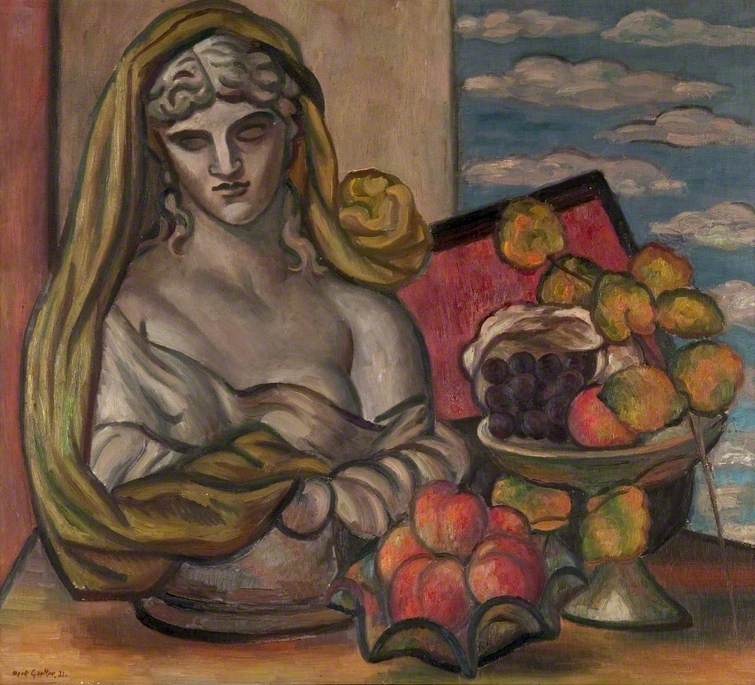
Figure 3 Clytie and Autumn Leaves  by Mark Gertler c 1932  © CSGCIC Glasgow Museums .Acc 2929
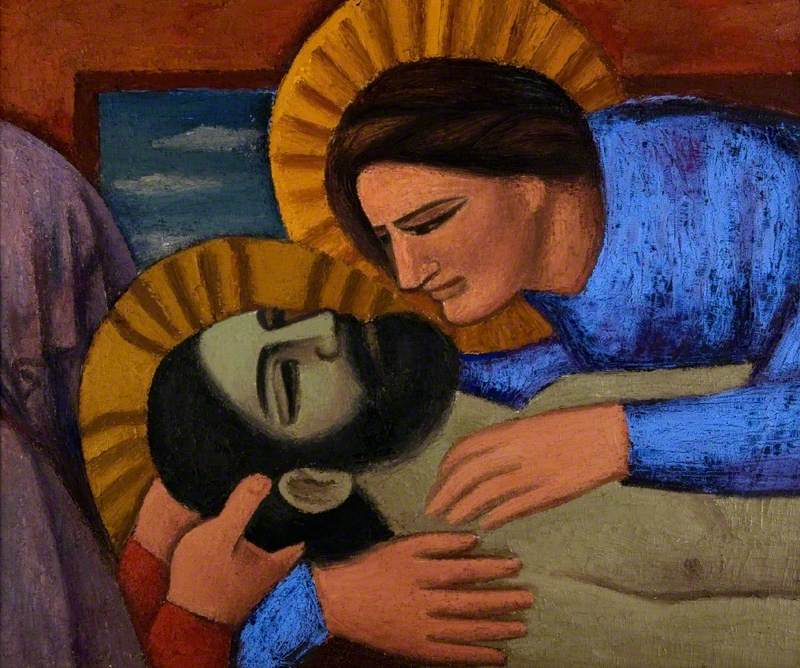
Figure 4 After Giotto(also known as Pieta) by Mark Gertler is  a study of a detail from Giotto’s Lamentation (The Mourning of Christ) c 1911-1939 © CSGCIC Glasgow Museums  Acc 2928

The Mathias/Wertheimer  Family

Our donor’s father   was Robert Moritz Mathias (1873-1961) and his  mother  was Helena(known as Ena) Wertheimer(1874-1936). 

Robert M Mathias was a watercolourist as well as a collector of art . He was born in Cologne ,Germany in 1874  and he  came  to Britain partly because of religious persecution against Jewish people at that time  and also  to work for his uncle Ludwig Mond(See Appendix )). He became a naturalised British citizen in 1910. The naturalisation papers were signed by Winston Churchill who was then one of the Principal Secretaries of State.13 His father was Mathieson Mathias (1823-1883) and his mother was Mathilde Mond (1845-1928).14 At the time of our donor’s birth in 1906 Robert Mathias was the managing director of the Mond Nickel Company .15 He does not appear on the UK Census of 1891 or 1901  but was in the UK by 1905 when he married Ena Wertheimer .16

Ena Wertheimer was one of the daughters of  successful London art dealer Asher Wertheimer (1844-1918) who had a gallery at 154  New Bond Street ,London which had been established by his father Samson Wertheimer, who was born in Germany but fled  to  Britain in the 1830s as a result of the  antisemitic persecution of that time.  A Family Romance  by Jean Strouse gives a detailed account of  Samson and Asher Wertheimer’s  very successful dealing in the British art world in the late nineteenth and early twentieth centuries when they bought from and sold to  prominent families in London society including the Rothschilds as well as British aristocracy and  became part of  London Society of the early twentieth century .17  The Wertheimers  moved to 8 Connaught Place  near Hyde Park, London  in 1884 . Connaught Place housed a mixture of titled aristocrats and wealthy Jewish families. Lord and Lady Randolf Churchill lived at 2 Connaught Place .18 

Asher Wertheimer was a friend of  the artist John Singer Sargeant and commissioned him to paint twelve portraits of his family over a period of ten years including portraits of Ena and her sister(Figure 5). Nine of the twelve paintings were  bequeathed to the nation in 1918 after the death of Asher Wertheimer and were displayed in their own room in the National Gallery between 1923 and 1926. Many of these portraits are now in The Tate Gallery in London. When Asher Wertheimer died in 1918  his obituary in The Times described his involvement in the highest echelons of the world of art dealing and the respect in which he was held by the art world  during his life Asher Wertheimer left £1.5 million  in his will which was an enormous fortune at that time .19
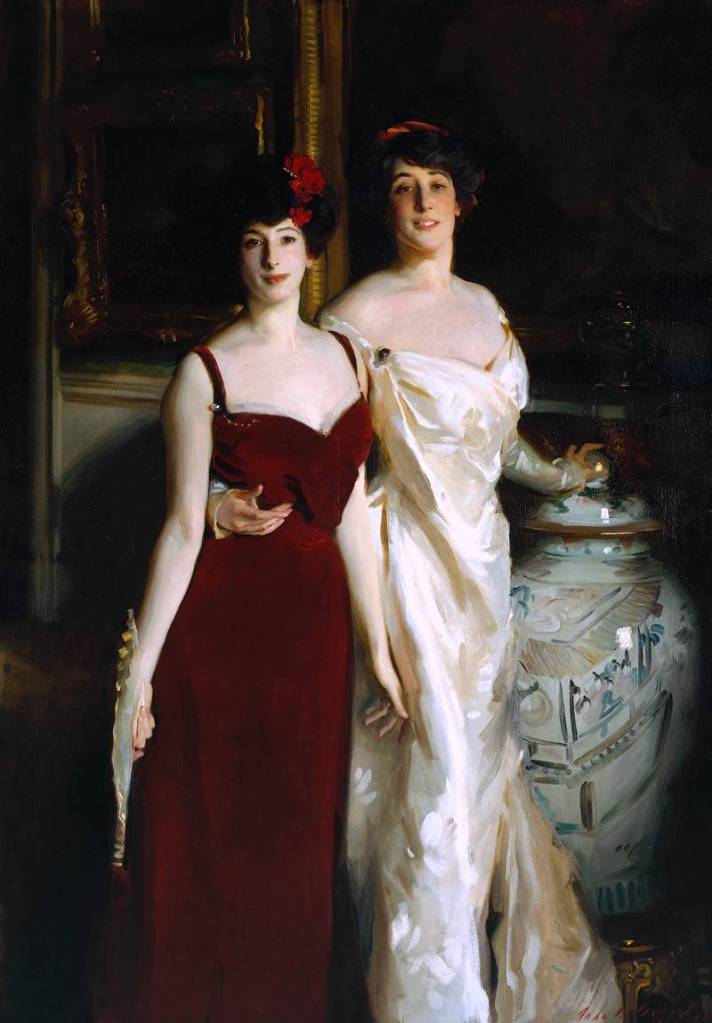
Ena and Betty, Daughters of Asher and Mrs Wertheimer 1901 John Singer Sargent 1856-1925 Presented by the widow and family of Asher Wertheimer in accordance with his wishes 1922 http://www.tate.org.uk/art/work/N03708

Fig 5. Ena and Betty Werthiemer. John Singer Sargeant 1901 © Public Domain

  Ena had attended the Slade School of Art between 1902 and 1905 to study painting. ()Ena was said to be ,’an accomplished painter’ 20  who  seems to have been something of a force of nature . She carried on the Wertheimer family’s presence in the art trade by opening the Claridge Gallery at 52 Brook Street London. This was not her fIrst commercial venture. 1923 Ena had opened a dress shop for girls and debutantes  which specialised in French dresses which  she obtained from Paris. The shop was called Poulain (foal) and was in  George Street in London’s West End. Russian emigrees and a manageress ran the shop which soon moved to larger premisses at 52 Brook Street. However an examination of the accounts showed that the business was deeply in the red partly because the manageress had been helping herself to cash.  Ena’s husband Robert commented that,

‘she might as well have given each dress away with a £10 note pinned to it.’

 The Mathias marriage was said to be tempestuous with the couple agreeing on nothing. ‘Ena was as extravagant ,strong-willed and impulsive as her husband was cautious and restrained’. Ena loved to entertain and gave lavish dinners, teas and musical entertainments with the help of a large household staff .21 Her activities were frequently reported in  the press as in 1912 when the Westminster Gazette reported her taking part in a pageant at the Allbert Hall to raise money for the University College Hospital ,London. The pageant consisted of the performance of a series of fairy stories in which Ena took part in the production of  Aladdin .The pageant was attended by the Prince of Wales and other members of the Royal Family .22 Her friends included prominent artists, poets and authors such as Somerset Maugham and  the Sitwells . Celebrities from   the world of ballet such as  Diaghilev  and from the art world such as Picasso had dinner in Montague Square. While he lived Ena had a close relationship with John Singer Sargeant and they wrote to one another frequently. It was even suspected by Robert that  they had an affair .23

 After the demise of Poulain 52 Brook Street  was reconfigured as the Claridge Gallery which was said to appeal more to Ena’s cultural and artistic interests. The Claridge Gallery was opened  in  July 1925 with an  exhibition of the work of John Singer Sargent (1856-1925)who had recently died. The proceeds of the sale of the exhibition catalogue were to go to the National Art Collections  Fund .24

  The Gallery did not follow the Wertheimer tradition  of exhibiting and  dealing in Old Masters, portraits and the art of the French ancient regime. Ena exhibited  twentieth- century art   giving  young artists an opportunity to show their works without having to pay the exorbitant fees and commissions charged by other west-end galleries. She exhibited established artists as well including Lhote, Mark Gertler, Raoul Dufy, Harold Squire and many others .25

 Also   part owner  of the gallery was Walter Archibald Propert who as well as being a surgeon was a  devotee of ballet and art. He wrote a book on Russian ballet  and many of the exhibitions at the Claridge Gallery  concerned Russian  art and Russian ballet. He  had served as a surgeon in Russia during WW1 so perhaps his interest in Russia stemmed from then. He had been a friend  of the Mathias family for at least twenty years  and was one of the referees who supported John Mathison Mathias’s application to become a student at  The  Inner Temple in 1927(see below).26 

After several apparently successful years where visitors included Queen Mary in June 193027  the Claridge Gallery closed on December 18  1931. There appear to be two reasons for the closure. The Daily Mirror in December 1931 reported that the closure of the gallery would be regretted by many people  even though few bought paintings .28 It is said Ena bought many works that failed to sell .29 The Daily Sketch  reported that     a recent exhibition of the work of a popular young artist  had attracted 1800 people only six of whom  bought paintings. The Daily Sketch however also reported that the lease of the property was up .30

The Mathias family lived at 15 Montague Square,  Marylebone,London at the time of our donors birth 31 and in the late nineteen twenties also  bought  Bury Manor, a country house  in the village of Bury in West Sussex .This was a house of fourteen bedrooms ,six bathrooms and several reception rooms.32 As we have seen the Mathias family, though Jewish were  not overtly so and were greatly involved in London society many of whom were frequent  guests at Bury Manor. The Mathias family was also involved  in  the community around Bury Manor and Ena especially was involved in many fundraising charity events,  those involving the creative arts being her greatest interest .33

John Mathieson Mathias

John Mathieson Mathias was born on 4 September   1906.34 He had four siblings:-

Diana Henrietta born 1908

Anthony Robert born 1910

Elizabeth Flora born 1912

David Frederick Archibald born 191335

As we have seen at  the time of his birth the family was living 15,  Montague Square ,Marylebone ,London. The 1911 Census  tells us that at that time of the  census John ,Diana and Anthony were staying at the home of his father’s cousin ,Robert Mond, eldest son of Ludwig Mond the chemist ,at Combe Bank, Sundridge in Kent. Also in the house were Robert Mond’s two daughters, Freda age 11 and Irena age 10 . Neither set of parents were in the house and it appears that all the children were being looked after by the governess ,Amy Allen and a house full of servants .36 There is no trace of either set of parents in the 1911 Census  so perhaps they were abroad on holiday . Robert and Ena Mathias often travelled abroad to the Continent ,North Africa and the Middle East leaving the children with nannies and governesses .37

There is little information regarding our donor’s childhood.  In a letter to his mother John Singer Sargent referred to him as ,

“the Greek God so shy and struggling  although possessed of magnificent aplomb” which appears to be something of a contradiction. 38

  John  attended a school in Horsham ,West Sussex  but we do not know which one .39 The 1921 Census sees the family still living in Montague Square together with a butler, cook and housemaid. John was fourteen at the time of this census and described as a full-time  student .40 He appears to have matriculated in October 1925 when he would have been 17 years old.

John  was admitted to Trinity College Cambridge on 1 October 1925 to study for a BA in History  as a ‘pensioner’ which was the name given to regular fee-paying students. He was assigned historian Denys Arthur Winstanley as a tutor. For his first two years he lived at 11 Portland Stree,Cambridge ,moving to  Bishops Hostel where he remained until the end of his third year  at Easter 1928. His name does not appear in the residency lists after this point. 41

The University Records show that in 1928 he was granted leave to proceed to study for an  LLB but appears to have failed the Principal Examination in Law at the end of that year. However in 1929 he sat the Principal Examination in French and achieved a second -class grade finally gaining his BA in 1930. During his time at Trinity JMM appears to have been a member of the Magpie and Stump-a Trinity College debating Society and a member  of the Boat Club .42

John’s career studying for his LLB was rather mixed. He was admitted to the Inner Temple on 22 September 1927 to study for the Bar while still attending Trinity College.  Between 1928 and 1931 he failed several exams at the first sitting  but eventually passed his Final Exams in the Hilary Term of 1931. He was called to the Bar  at the inner Temple on 17 November 1931.43  He is listed as a member of the Inner Temple  in the 1932 Law List which is an annual record of solicitors and barristers .44 His professional chambers were in the Goldsmith Building of the Inner Temple from 1932  while he lived at various address in the West End of London .45 Unfortunately we have  no information about JMMs career as a barrister.

The  Mathias  country home Bury Manor had been owned by the Mathias family since at least 1928 .46  As already stated the family involved themselves in the local community for example opening the gardens of Bury Manor each year to raise money for local causes and ran an annual bazaar to raise money  for the Bury and District Nursing Association .47 Ena Mathias was very hospitable and generous. According to the West Sussex Gazette ,’ she had in its highest and best sense the artistic temperament -an acute and sensitive love of beauty unmixed with any trace of pose or affectation’ .48  and The Times reported that ,

‘at her charming house in London and at her lovely little manor house under the Sussex Downs it was her delight to entertain her friends .’49

John Mathias’s mother, Ena died in a London nursing home on 24 March  1936 of stomach cancer. According to the local press she was much missed by the people of Bury most of whom attended a memorial service for her in the local church to which she had donated two brass candlesticks .50

On 9  November 1937 John married Ludmilla Krassin who was the daughter of the late Leonid Krassin ,Russian  Ambassador to the United Kingdom before his death  in 1926. Leonid Krassin was a prominent Bolshevik .The marriage took place in the Chelsea Registry Office. 51 It is not known how John and Ludmilla met.

Before being Soviet Ambassador in London Leonid Krassin  had been Soviet Ambassador in Paris where he lived with his wife and three daughters. In 1925 he was appointed to the post in London but died in 1926 leaving a vast fortune according to rumours of the time but which turned out to be a myth. 52  There were numerous reports in newspapers about Ludmilla  Krassin’s  romantic entanglements . One that she had secretly married M Gaston Bergery, a lawyer who had been secretary to a former Prime Minister of France . The marriage was reported to have taken place in the Soviet Embassy in Paris in August 1927 but was later denied by M. Bergery who said they were merely engaged. The second rumour going around in 1927  was that Ludmilla was to marry the French Duc de la Rochefoucaud . The newspapers emphasised  Ludmilla’s beauty  and wealth .53 However neither’ romance  ended in marriage as Ludmilla was described as a spinster on the certificate of her marriage to John Mathias. Perhaps finding out that Ludmilla had not inherited a fortune affected her previous romances.

 In 1938 John and Ludmilla  were living at 27 Donne Place in  the Borough of Kensington and Chelsea,London. They later moved to 3 Sterling Street in Kensington which remained their London home until around 1958 /1959 when they moved to a flat at 23 Rutland Gate, London  SW 7.54

At the time of the 1939 Register John and  Ludmilla together with father Robert   and sister Elizabeth were living at Bury Manor  while still retaining  town houses in London. The sister of Robert Mathias , Theresa Said -Ruete was also there. Also listed was Dorothy Braddell whose husband was the son of Sir Thomas Braddell ,Chief Justiciary to the Federal Malay States. Dorothy was there with her daughter Virginia who was in her twenties.

  There were  twenty three people listed as  living at Bury Manor , five of whom were servants .55 Those who were not either family friends or relatives  may have been evacuees.  2 September  1939 saw the beginning of Operation Pied Piper ,the name given to  the British Government plan to evacuate mothers with babies as well  as school age  children  from the threat of bombing in London at the outbreak of war. West Sussex saw the arrival of thousands of evacuees to the Petworth area which was near Bury Manor. 56 Listed in the 1939 Register as living at Bury Manor were Rosina Linton with her daughter Doreen who was only a few months old and Irene Linton with her son Anthony who was about a  year old .57 They had all previously lived in London. The 1939 Register was taken at  the end of September 1939 giving time for evacuees to be listed .58

We have little information regarding life  at Bury Manor during World War 2  apart from Robert Mathias being  fined £1 for not immobilising his car according to wartime legislation. 59  Robert remarried in December 1942. His bride was Mary Branch who had  lived at White Webbs Cottage in Bury .60 Another wedding in the family was that of Elizabeth Mathias, John’s sister, to Captain Robert Guillaumet of the Fighting French. 61 

Whether John and Ludmilla spent the war living at Bury Manor or lived in London is not known at this point. They did not have any children. John Mathias does not seem to appear in any military records of the period. The 1939 Register tells us that Ludmilla was involved with ‘W.S Red Cross’ which may be an abbreviation of West Sussex Red Cross. However  the inhabitants of Bury Manor played a part in fund- raising for various causes during the war. One example is a Garden Fete held to raise funds for the Bury and Amberley District Nursing Association in which the new Mrs Mathias participated .62 She  also organised a whist drive and dance in the tithe barn of Bury Manor  in 1944 in aid of The Agricultural Fund of the Prisoners of War Fund .63

On 9 August 1952 Ludmilla and John set sail from London   for Vigo  on the south west coast of Spain presumably for a holiday. They travelled  First Class on the Highland Monarch 64 which was  a combined cargo and passenger ship of the Royal Mail Line which had been built in 1928 by Harland and Wolff for the Nelson Line and  transferred to the Royal Mail Line in 1932. 65   The Highland Monarch covered the South American route calling at Vigo ,Lisbon, Las Palmas ,Rio de Janeiro, Santos, Monte Video and Buenos Aires .66

The Mathias family appear to have continued their interest in art as in July 1960 John Mathias was one of the sponsors of a posthumous exhibition of the works of local artist Harold Squire of Henfield in West  Sussex . Robert Mathias owned two of Squire’s works which he loaned to the exhibition which was held in aid of the Chilean earthquake  relief fund. Harold Squire was born in Chile. 67

Robert Mathias died in London on 25 January 1961 aged eighty-nine leaving over £184,000 in his will .68 John Mathiesson Mathias died at Bury Manor on April 18 1963 aged only fifty-seven. He left over £230,000 in his will .69 He also bequeathed a painting to the Victoria and Albert Museum. The work was  Mongol Archer on Horseback described as  an ink on paper painting by an unknown artist from the Ming Dynasty(c 1368-1644) and is in the East Asian Collection .It had been exhibited at Sotherby’s Gallery in January 1940 which may have been when it was bought by a member of the Mathias family.70
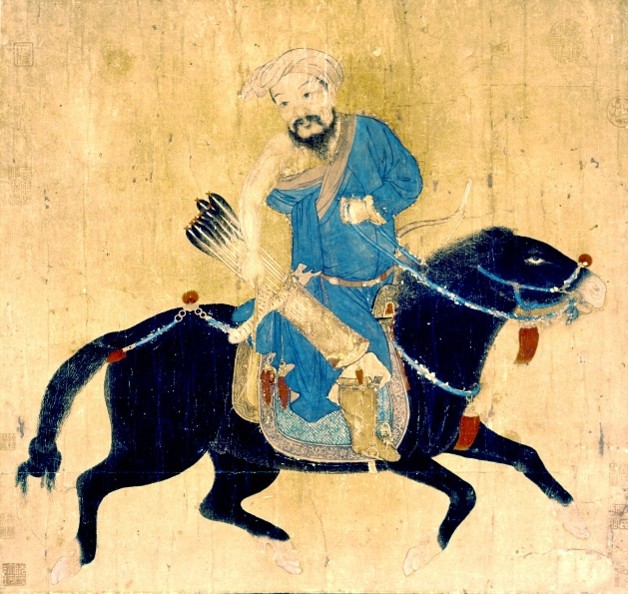
Figure 6. Mongol Archer on Horseback  c15th-16th century artist unknown © V&A

After the death of John Mathias Bury Manor was put up for auction 71 and became Dorset House Preparatory  School which it remains to this day .72 The former tithe barn which saw fundraising events during WW2  is now a popular wedding venue .73

Appendix
The Mond Family

 Mathilde Mond ,our donor’s grandmother, was the sister of the chemist Ludwig Mond (1839-1909) who was responsible for setting up the Brunner Mond Company in 1873 to produce soda ash. Brunner Mond  eventually became part of  Imperial Chemical Industries  in 1926. Ludwig was also a collector of Italian art .He   set up  the Mond Nickel Company in 1900  which was licensed to mine nickel in Canada   which was then sent to Britain to be purified by the carbonite process patented by Ludwig Mond.  Robert  Mathias ,our donors father ,was a director of  the Mond Nickel Company.   Alfred M Mond  was a son of Ludwig Mond who was involved in the various family businesses, became a Liberal MP in 1906 and was elevated to the House of Lords  as  first Baron Melchett of Landford in 1928.74(1869-1936)( Oxford Dictionary of National Biography).

References

1. Minutes of the Corporation of Glasgow November 1951-May 1952 p.1351

2. www.britannica.com/biography/AndreLhote

3. Westminster Gazette 04/11/1927 p8

4. Glasgow Art Gallery. Catalogue of French Paintings.  Glasgow Art   Gallery and Museums, 1953

5. op cit  ref 3

6. Sunday Times 2/11/1965

7. Time and Tide 01/07/1939 pp21-22

8. Strouse, Jean  Family Romance; John Singer Sargent and the Wertheimers   

    Farrar Strous and Giroux 2024 .p196

9. McDougall, Sarah  Mark Gertler.  John Murray 2002. p245

10. Strouse p 198

11. Time and Tide 15/10/1932 p1114

12. The Times 13/05/1939  p12

13. www.ancestry.co.uk Statutory Births . John Mathieson Mathias

14. www.ancestry.co.uk  Geanet Community Trees

15. op cit ref 13

16. Strouse  pp146-9

17. Strouse.  Chapter 4

18. as above p 72

19. The Times 12/08/1918

20 .South of England Advertiser 2/04/1936 

21. Strouse p p 198-201

22.  Westminster Gazette 05/12/1912 p6

23.  Strouse pp201-2

24. Strouse. p 191

25. as above

26. Strouse p194-5

27. Scotsman 13/06/1930 p8

28. Daily Mirror 7/12/1931 p11

29. Strouse p.198

30. Daily Sketch 18/12/1931 

31. op.cit ref 13

32. West Sussex County Times  20/09/1963 p21

33. op cit ref 20

34. op.cit  ref 13

35 .www.ancestry.co.uk  Statutory Births

36. UK Census 1911

37. Strouse p 201

38. Strouse p.150

39. archives@trin.cam.ac.uk

40. UK Census 1921

41.  op cit ref 39

42. as above

43. cpilkington@innertemple.org.uk

44. Law List 1932

45. www.ancestry.co.uk  UK Census and Electoral Rolls

46. Worthington Gazette 05/09/1928 

47. West Sussex Gazette 31/10/1935 p4

48. West Sussex Gazette 02/04/1936 p3

49. The Times  27/03/1936 

50. op cit ref 48

51. Daily News 10/11/1937 p11

52. Daily Express  22/08/1927 p2

53. Daily News 20/08/1927 p7. Illustrated Police News 18/08/1927 p2

54. www.ancestry.co.uk  Electoral Registers 1938-1963

55. 1939 Register

56. iwm.org.uk/history/second-world-war/the-evacuation-of-children

57. op cit ref 55

58. www,nationalarchives.gov.uk

59. Littlehampton Gazette 19/09/1941 p3

60. West Sussex Gazette 17/12/1942 p2

61. as above 11/03/1943

62. as above 29/07/1943

63. as above 06/01/1944

64. www.ancestry.co.uk  Passenger Lists 

65. http://www.mastermariners.org.au/stories-from-the-past/6218-mv-highland-monarch-1928

66. op cit ref 64

67. West Country Times 07/04/1960 p19

68. www.ancestry.co.uk Index of Wills and Administrations 1858-1985

69 as above

70  https://collections.vam.ac.uk

71. West Sussex County Times  20/09/1963 p21

72. The Observer  15/05/1964 p6

73. https://burymanorbarn.co.uk

74.  Oxford Dictionary of National Biography.
Robert Hannah (1812 – 1909)

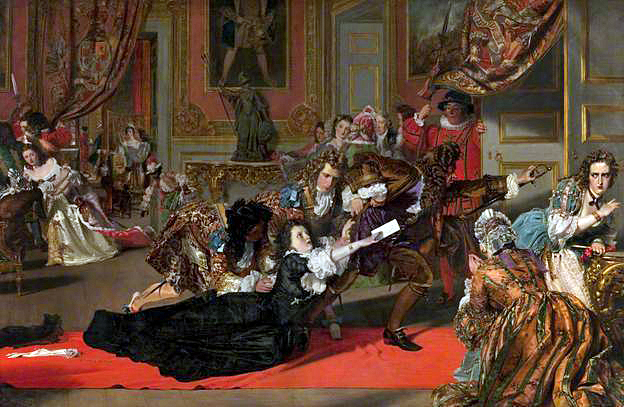
‘The Lord Provost intimated that Robert Hannah, Esq., of 82 Addison Road, Kensington, London, had, through his friend, David Ritchie, Esq., of Messrs. Buchanan, Wilson and Co., Limited, Glasgow, intimated his desire to present to the Corporation, to be placed in the New Art Galleries, Kelvingrove Park, the free gift of a picture entitled  “The Countess of Nithsdale Petitioning George I on Behalf of her Husband who was under sentence of death for rebellion” painted by the donor, and which had been exhibited at the Royal Academy in 1854. The Lord Provost moved that, in accepting this picture, the Corporation express their high appreciation of the valuable gift and accord the donor a cordial vote of thanks therefor. The motion was unanimously agreed to.’  1  

Fig. 1 The Countess of Nithsdale Petitioning George I on Behalf of her Husband
© CSG GIC Glasgow Museums Collection/ArtUK (Accession Number1177)

This painting depicts; ‘The interior of a room in Windsor Castle (in 1716). In the centre is George I making for the door and dragging (Winifred) Lady Nithsdale, who grasps his coat, along the floor. Two courtiers endeavour to release the King from her hold. On the right, kneeling, is Mrs Morgan a friend of Lady Nithsdale, and to the left, seated, are Lady Nairn and the Duchess of Montrose. Various groups of lords and ladies-in-waiting etc. are about the room.” 2

 (The King turned down her petition but Lady Nithsdale (1680 – 1749) was successful in rescuing her husband from the Tower of London by dressing him as a woman. The couple then escaped to France).

            According to the Parish Register, Robert Hannah was christened on 2 July 1812 at Kirkmabreck near Creetown, Kirkcudbright. (Most references state that he was born on 3July in Creetown). He was the fifth of eight children born to John Hannah, a builder and artisan, and Janet Brait. 3 (The family name was originally Hannay but Robert`s father preferred the palindromic symmetry of Hannah). Janet Brait`s father had been a farmer in Chapleton but died relatively young. It was said that his three daughters were ‘remarkable for their personal attractions.’ 4

      Very little is known about Robert`s early life but it may be that, like his eldest brother John, he spent his youth with his mother`s relatives in Chapleton. 5 It was said that John left home at an early age ‘to avoid the possibility of becoming burdensome to his parents.’ Perhaps a similar sentiment influenced Robert`s decision to leave home early. He studied first in Liverpool and then at the Royal Society of Arts Schools in London. He also spent some time in Rome and by 1842 was exhibiting his paintings at the Royal Academy (RA) in London. His address at this time was Shubbery House, Brompton Road, London.6 In all he exhibited 22 works at the RA between 1842 and 1870.7 Two of his paintings – The Novel and The Play – which were exhibited at the RA in 1852 – were bought by Charles Dickens.

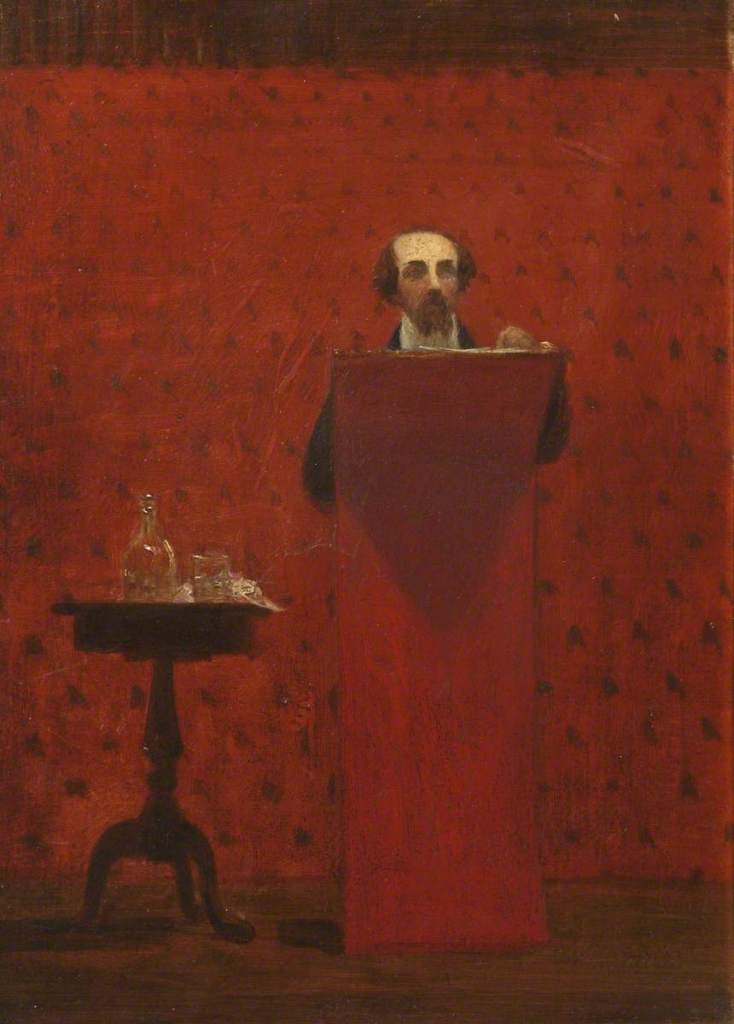
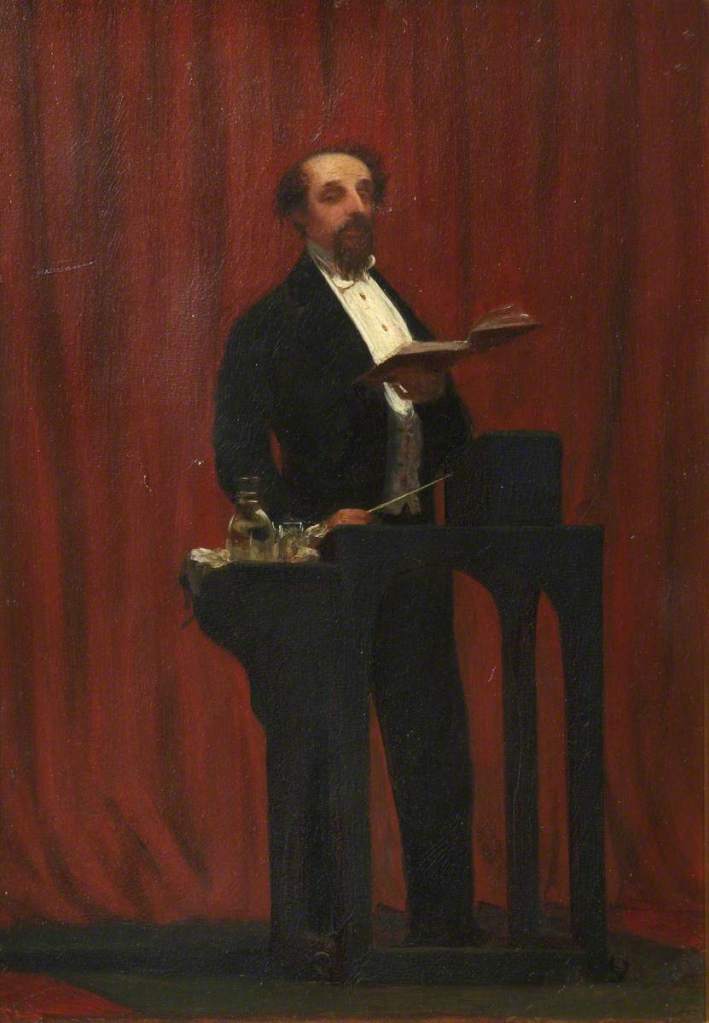
Two small oil paintings (10 inches x 7.2 inches) of Dickens giving a public reading are in the Charles Dickens Museum in London. These were made from memory by Hannah the morning after he had been present at one of Dickens` readings. The paintings were given to Georgina Hogarth, Dickens` sister-in-law, by Hannah in January 1904. They were gifted to the museum in 1941 by Comte Alain de Suzannet.8 One of these paintings was exhibited at the 34th Annual ‘Dickens on the Strand’ festival in Galveston, Texas in December 2007 9.

 Figs. 2 and 3 Charles Dickens giving a public reading
Charles Dickens’ Museum, London/ArtUK
https://creativecommons.org/licenses/by-nc-sa/4.0/

In 1845 Robert Hannah married Emma Cordy Baxter in Kensington, London. 10 She was born in St. Pancras on 26 June 1820.11 In 1851, the two were living at 2 Alfred Place West, Kensington. His occupation was ‘artist and painter’ and he employed two servants. 12

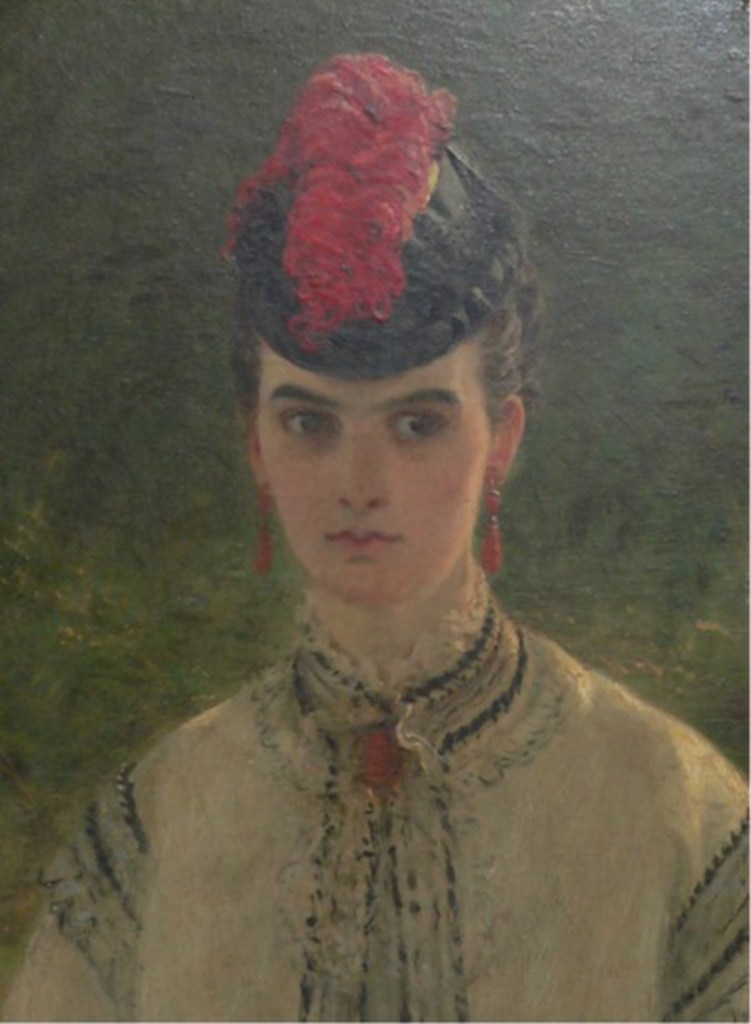
In 1851, Robert`s eldest brother John (b. 1802) was living in Burton-on-Trent with his sister Agnes. He was a widower with three young daughters and a son. John was a ‘cheese factor’. 13 He was also a part-time poet; a volume of his poetry was published posthumously. 14 John Hannah died in 1854 and Robert and Emma, who had no children of their own, took over the task of raising John`s three girls; Janet Sarah, born 1837, Gertrude, born 1841 and Bessie (Elizabeth?), born 20 August 1842. They afterwards became the subject of many of Robert’s paintings.15  

 Fig. 4 Portrait of Bessie Hannah painted by
her uncle and given to her as a
wedding gift.                                                                  

     In the 1861 census Robert Hannah (listed as Hannay) was a ‘bond fund holder and proprietor of houses.’ Bessie aged 17 was still living with Robert and Emma while Gertrude had found employment as a governess at Eton. In 1863, the Glasgow Institute of the Fine Arts held an Exhibition of Works by Living Artists. Robert Hannah whose address was 2 Alfred Place West, Old Brompton, London, exhibited two works: Sisters of Charity (no price given) and A Birthday Present priced at £105.00.16 Both pictures had been exhibited at the RA in London the previous year.

      By 1871 Robert and Emma had moved to 153 Upper Church Street, Chelsea. From the census, Robert was living on ‘income from houses and dividends’. Emma and his niece Janet were with him. It seems that he was now part of the thriving artistic community in Chelsea and was a friend of William Holman Hunt.

In 1870 Birnie Philip moved his workshop to a villa in Manresa Road, and artists were also starting to move into Upper Church Street: Robert Hannah, the Scots historical painter, made large additions to (the house at) number 153. He was still at the same address in 1881.

In the 1890s several artists moved into Upper Church Street. Number 123 on the corner of Elm Park Road was built in 1894 for Felix Moscheles, and by 1901 the Chelsea Arts Club had moved into two old villas at numbers 143-5. Evelyn and William de Morgan moved to numbers 125-7 (8-9 Bolton Place) Upper Church Street, where two terraced houses were adapted for them in 1909-10. Augustus John occupied Robert Hannah’s house at number 153, until he moved to Mallord Street. 17

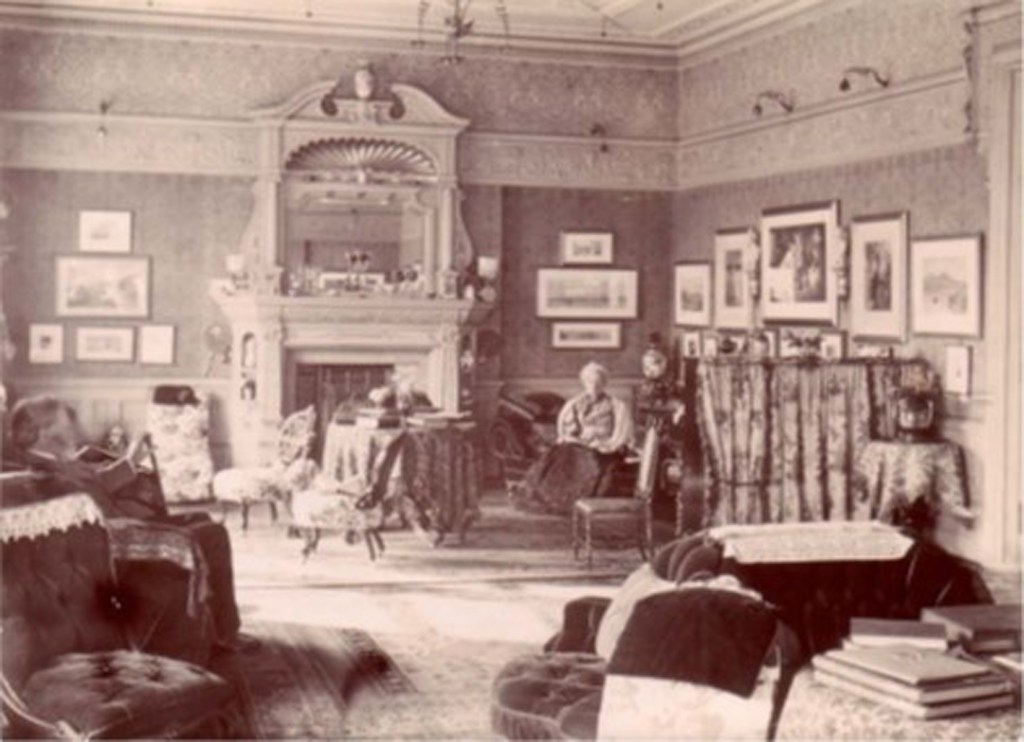
Fig. 5 Robert and Emma Hannah in their London Home.

By this time (1891) Robert and Emma had moved to 82 Addison Road, Kensington. In the census of that year, Robert is described as ‘living on his own means’ and employing two housemaids, a cook and a footman. He was still at the same address in 1901, aged 88 and an ‘artist and painter’. He had four servants.

Emma Hannah died at home the following year aged 82. Robert Hannah died in Kensington on 5 April 1909 aged 97 after a long illness. 18

It may be that Robert Hannah made more from his property dealings than from his paintings. He does not rate a mention in the Dictionary of National Biography.
Among his listed paintings are:
 Astronomy in the Castle Douglas Art Gallery, Stewartry Collection 19.
Confidence (1844).
Refreshing the Weary (1847) which was bequeathed anonymously to York Art Gallery in 1970 20.
William Harvey Demonstrating the Circulation of Blood to Charles I (1848).
(A wood engraving of this painting was published in the Illustrated London News, in 1851 and was also reproduced in Nuland, Medicine: The Art of Healing, 1992).
Master Isaac Newton in his Garden, (1856)
Portrait of the Artist, J. C. Hook, A.R.A. (1859).
Eton College from the Thames, In the Victoria and Albert Museum, London. (Dixon Bequest)
Honeymoon (This painting was sold in London on 5 November 1997, for £4,485) 21

Robert Hannah was described as a painter of portraits, genre scenes, landscapes and historical subjects with a style similar to that of the Faeds. 22

References

  1. Minutes of the Corporation of Glasgow, 22 February 1906, C1/3/34 page 876, Mitchell Library, Glasgow
  2. Glasgow Art Galleries Catalogue, 1935.
  3. Parish Registers, Family Search, familysearch.org
  4. John Hannah of Creetown, Poet’ http://www.kirkcudbright.co/historyarticle.asp?ID=296&p=5&g=4
  5. ibid
  6. McEwan, Peter J. M., Dictionary of Scottish Art and Architecture, Antique Collectors Club 1994
  7. Parkinson, R., Victoria and Albert Museum, Catalogue of British Oil Paintings 1820-1860, London: HMSO, 1990, p. 117
  8. Dexter, Walter, The Dickensian, June 1941. (From Michael Slater, Emeritus Professor of Victorian Literature, Birkbeck, University of London – by e-mail).
  9. molly.dannenmaier@galvestonhistory.org
  10. England and Wales Marriage Registration Index, 1837-2005, database, FamilySearch (https://familysearch.org/
  11. England Births and Christenings, 1538-1975, database, FamilySearch (https://familysearch.org/
  12. ancestry.co.uk, Census 1851, England
  13. ibid
  14. Hannah, John, Posthumous Rhymes 1854, Samuel Wilton Rix. http://www.kirkcudbright.co/historyarticle.asp?ID=296&p=5&g=4
  15. My Ancestry; http://www.feeshowell.com/…/Microsoft%20Word%20-%20Ch1%20-…
  16. Exhibition Catalogue, Mitchell Library, Glasgow
  17.  ‘Settlement and building: Artists and Chelsea’, A History of the County of Middlesex: Volume 12: Chelsea (2004), pp. 102-106. http://www.britishhistory.ac.uk/report.aspx?compid=28699. Date accessed: 07 July 2012.
  18. Parkinson, R., Victoria and Albert Museum, Catalogue of British Oil Paintings 1820-1860, London: HMSO, 1990, p. 117
  19. www.artistsfootsteps.co.uk
  20. ibid
  21. Benezit, Dictionary of Artists. Paris, 2006
  22. ibid

Alexander Brownlie Docharty (1862 – 1940)

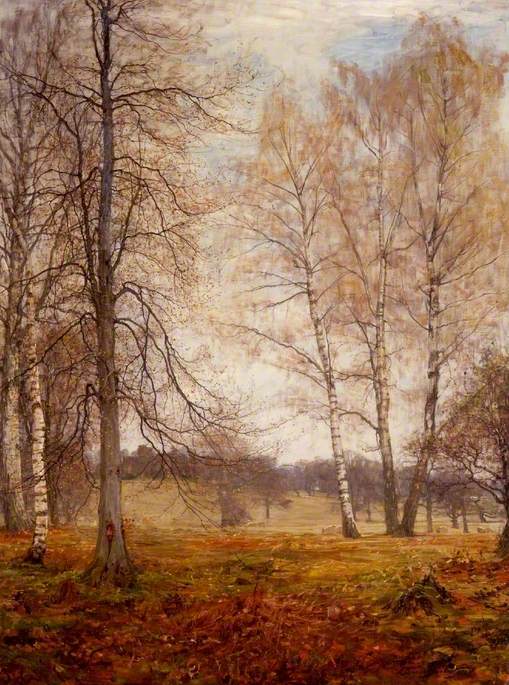
In October 1917, Alexander Brownlie Docharty gifted a series of his own paintings to Glasgow Corporation.  (Appendix 1)

Fig. 1 In the Woods  Early Spring (1914). (1436). (c) Glasgow Museums; Supplied by The Public Catalogue Foundation


Figure 2. An Autumn Day (1917). (1437). (c) Glasgow Museums; Supplied by The Public Catalogue Foundation


Figure 3. Winter Sunshine. (1917). (1438). (c) Glasgow Museums; Supplied by The Public Catalogue Foundation


Figure 4. THe Old Clock Tower, Evening. (1439). (c) Glasgow Museums; Supplied by The Public Catalogue Foundation


Figure 5. Springtime, Hawthorn Blossom (1917). (1440). (c) Glasgow Museums; Supplied by The Public Catalogue Foundation

            Alexander Brownlie Docharty was born on 8 October 1862 at 5 McAslin Street, Glasgow. 1 This was in the Townhead area of the city near the present University of Strathclyde. He was the second son of Joseph Docharty a pattern designer and his wife Elizabeth Brownlie. Joseph and Elizabeth had married in Calton, Glasgow on 13 June 1859.2 They went on to have three sons and three daughters. At the 1871 census 3, the family was living in Crossmyloof, Cathcart. Joseph Docharty was described as a ‘designer and coal agent’ born in Bonhill, Dunbartonshire.

              Alexander left school aged thirteen to work with his father designing calico prints. At the same time, he studied in the evenings at the Glasgow School of Art under Robert Greenlees and in 1878 at the age of fifteen he had a watercolour, On the Cart  Pollockshaws  hung in the Glasgow Fine Art Institute. It was priced at three guineas.The painting was submitted from 5 Viewfield Terrace. 4

            At the 1881 Census, Alexander was living with his widowed mother, grandfather (a retired grocer) and siblings at Langbank, Renfrewshire. He was described as a ‘landscape painter’. The following year he had a painting Arran Cottages hung in the Royal Academy in London. The painting was sent from 113 West Regent Street, Glasgow. 5 However, his attempts to make a living from painting seem to have been premature and he found employment as a designer with the firm of Inglis & Wakefield who had a print works at Busby.

            By 1885 however, he had returned to painting and while living at 11 Prince`s Street, Pollockshields he shared a studio with his uncle James Docharty and his cousin also James Docharty at 134 Bath Street, Glasgow. 6 James Docharty, A.R.S.A., was a well-known painter of landscapes who exhibited extensively at the Royal Scottish Academy from 1864 till his death in 1878. He undoubtedly had a significant influence on his nephew Alexander`s decision to try to make his living as an artist.

            On 6 June 1890 at Nether Barr, Ayrshire, Alexander married Catherine McKnight a schoolteacher and daughter of a farmer from Kirkconnell, Dumfries. His occupation was ‘landscape and portrait painter’ and his address ‘Maitland, Dailly’. 7

            At the 1891 census he was at Nether Barr with his in-laws. In the same census his wife and their new-born son, Joseph, were at 4 Melville Street, Govan with Alexander`s mother and family.

            Alexander was among those Glasgow painters who in 1891 appended their names to a petition requesting that the Corporation of Glasgow buy Arrangement in Grey and Black, No. 2: Portrait of Thomas Carlyle  by J. A. M. Whistler. 8 This painting was duly purchased (for 1000 guineas!) from the artist and is now in Kelvingrove Art Galleries in Glasgow.

            In 1894 Alexander went to Paris where he entered the Academie Julien and studied for a time under Benjamin Constant and Jean Paul Laurens. On his return to Scotland, he went to live and work at Kilkerran in Ayrshire. He painted mainly in oils and spent about fourteen years in Kilkerran in a cottage owned by Sir James Fergusson. 9 One of the works he produced there was shown at the Venice Biennale in 1903 and purchased by the Italian Minister for Foreign Affairs. It hung in the Consulta Palace in Rome. 10

            According to the Glasgow Post Office Directory for 1895-96, he still had a business address at 134 Bath Street with a house at Ruglen, Kilkerran, Ayrshire.

            In 1901, the family was living at 3 Jane Street, Blythswood Square, Glasgow. Alexander was now an ‘artist (painting) working on his own account’. As well as Joseph there were now two other children, William McK. Docharty, aged 5 and Mary R. Docharty, aged 3. Both children were born in Kirkoswald, Ayrshire. There was also a servant employed who had been born in Dailly. 11

            In the early 1900s, Alexander spent his summers in Symington painting at Dankeith, Dundonald and Auchans. 12 He also travelled to the Highlands and the nature of the subjects he depicted is indicated in the titles of a few of his more outstanding works including, Winter in Glenfinlas (1902), Ben Venue (1905) and Lochiel`s Country which was shown at the Royal Academy, London and was purchased by Glasgow Corporation. In 1907, his September, Glen Falloch was exhibited at the Glasgow Institute. It was purchased by Archibald Watson Finlayson of Merchiston (qv) and presented to Glasgow Corporation.13 In 1916 his painting Glen Morriston was sold for 320 guineas by J. and R. Edmiston.

            Alexander travelled and painted in Europe especially in Holland and made trips to Donegal in Ireland. In 1903 he went to Paris and then to Italy via the Riviera and on to Naples, Rome, Florence visiting Venice several times. One of his landscapes, Glenfinlas, was hung in the St. Louis International Exhibition of 1904. This may have come about because an uncle, Alexander Brownlie, had emigrated to the USA and in 1904-5 was living at 338 Bloomfield Avenue, Montclair, NJ. He was a member of a flourishing artistic community in the town. (An article in the Montclair Times describes a walking tour of the town which pointed out the homes of turn-of-the-century artists. This included the home of Alexander Brownlie). 14

            Alexander Brownlie Docharty was a member of the Royal Glasgow Institute of the Fine Arts and served on the Council of the Institute. In addition, he was president of the Glasgow Art Club from 1911 to 1913 and was a Member of Council thereafter.

            In 1915, the Balloch Estate on Loch Lomondside, was sold to Glasgow Corporation and on 2 October 1916, Alexander wrote to the Lord Provost with his offer to ‘paint and present several of the more outstanding views (autumnal and spring) of the park and its surroundings’. (Appendix 1) The five paintings produced were those gifted to the Corporation in 1917. It seems that the first of these had been painted before the acquisition of the estate at Balloch and this may have given him the idea for the remainder.

            On 26 July 1926, age 63, Alexander sailed on the Caledonia from Glasgow to New York. He was accompanied by his daughter May Rankine Docharty . They arrived back in Glasgow from New York via Moville in Northern Ireland on 10 October having travelled first class on the California. 15

            By 1940 he was living with his daughter at 20 Hyndland Road, Hillhead. 16 He died there on the 12 November 1940 aged 78. 17 However, the death notice in the Glasgow Herald states that he died at 6 Montague Terrace. 18 He was buried in Cathcart Cemetery on 14 November 1940. (His uncle, James Docharty, was also buried there). His wife pre-deceased him and he was survived by a son and daughter. An obituary was published in the Glasgow Herald 19 and his death was also reported in an article in The Scotsman which noted that ‘he took a deep interest in religious work and served as an elder of Glasgow Cathedral’. 20

Figure 6. From the Glasgow Herald
13 November 1940.

            Alexander Brownlie Docharty exhibited widely for almost 60 years including at the Royal Academy (12 works), the Royal Scottish Academy (19) 21, the Royal Society of Painters in Watercolour (5) and the Glasgow Institute (155) 22 as well as at the Walker Art Gallery in Liverpool, the Manchester City Art Gallery and the New English Art Club. His work attracted praise and criticism from various sources. Of his landscapes Caw commented,

‘Painted with gusto, but not without refinement, in frank, fresh and harmonious colour, and good in drawing and design, Brownlie Docharty`s landscapes preserve the aroma of a sincere, if
unimpassioned, love of the simple and everyday aspects of Nature and awakened pleasant memories of the country’.23

Harris and Halsby note that, ‘(He) worked mainly in oil but his watercolours can be fine with good composition and sensitive colour’. 24 The Scotsman reported on four of his paintings exhibited at the Glasgow Art Club Show of 1899; ‘Mr. Brownlie Docharty`s works have always shown him to be an artist in evident sympathy with the tenderer aspects of nature which disclose themselves in woodland and stream, but his sojourn to Holland has added both sweetness and strength to his brush,…. 25 

            Again in 1912, the same paper reported; ‘One of the most striking landscapes in the gallery is the Falls of Garry by Mr. A. Brownlie Docharty. ……….the rocks are painted with a solidity which would have pleased Ruskin; the foaming water has been carefully studied, and with a dainty brush, the artist has rendered the summer greens of the trees and the glow of the sky’. 26

            Alexander Brownlie Docharty`s two surviving children each had their own claim to fame. His son, William McKnight Docharty served with the King`s Liverpool Regiment during World War I and achieved the rank of Captain. He was twice wounded in action and was awarded the Military Cross. 27 He became a keen hillwalker and compiled and published in 1954, a list of the 900 highest mountains in Britain. He was also the second person to complete in 1960 the ascents of all 220 ‘Corbetts’ i.e. Scottish mountains between 2500 and 2999 feet in height. William McKnight Docharty died on 14 July 1968 aged 72. 28

            May Brownlie Docharty, who died in 1972, was a gifted player and teacher of contract bridge. She owned and managed the Western Bridge Club in Glasgow which she formed after her father`s death. 29

References

  1. Scotland`s People , Birth Certificate
  2. Scotland’s People, Marriage Certificate
  3. Scotland’s People, Census 1871
  4. Glasgow Institute of the Fine Arts Exhibitions Catalogues 1877-83. (Mitchell Library).
  5. Catalogues of the Royal Academy Exhibitions, 1880-89, W. Clowes and Sons., Ltd.
  6. Glasgow Post Office Directory, 1885-86
  7. Scotland’s People, Marriage Certificate
  8. Glasgow Town Council, Sub-committee on Galleries and Museums, 27 February 1891: (see http://www.whistler.arts.gla.ac.uk).
  9. Eyre-Todd, George, Who`s Who in Glasgow in 1909 Gowan & Gray, 1909, Glasgow. http://gdl.cdlr.strath.ac.uk/eyrwho/eyrwho0513.htm
  10. venicebiennale.britishcouncil.org/timeline/1903/history/1105/).
  11. Scotland’s People, Census 1901
  12. Eyre-Todd, George, Who`s Who in Glasgow in 1909 Gowan & Gray, 1909, Glasgow. http://gdl.cdlr.strath.ac.uk/eyrwho/eyrwho0513.htm
  13. ibid
  14. The Montclair Times, 10October 2003. (Also www.brownlee.com.au).
  15. Ancestry.co.uk, New York Passenger Lists, 1820 – 1957
  16. Voters` Roll, Glasgow, Hillhead, 1940.
  17. Scotland’s People, Death Certificate
  18. Glasgow Herald, 13 November 1940.
  19. ibid
  20. The Scotsman, 13 November 1940, p 5.
  21. Royal Scottish Academy Exhibitors, 1826 – 1990, Hilmartin Manor Press, 1991.
  22. Premier Paintings, Gairloch (website)
  23. Caw, Sir James L., Scottish Painting, Past and Present, 1620 – 1908, T.C. & E. C. Jack, Edinburgh, 1908.
  24. Harris, P. and Halsby, J., The Dictionary of Scottish Painters, 1600 to the present, Birlinn Ltd; 4th Edition, October 2010
  25. The Scotsman, 6 November 1899, The Glasgow Art Club Exhibition
  26. The Scotsman, 7 December 1912, The Glasgow Art Club Exhibition
  27. The Scotsman, 16 October 1918, p7
  28. http://www.corbetteers.blogspot.com/
  29. Glasgow Herald 5 May 1972.

Appendix

Glasgow Corporation Minutes, 4 October 1916. C1 3.57, p2002.

There was submitted a letter, of date 2nd instant, from Mr. A. Brownlie Docharty, 3, Jane Street, Blythswood Square, to the Lord Provost, in which he states that the value and beauty of Loch Lomond Park, recently acquired by the Corporation, and its immediate surroundings, might be brought home to many of our working-classes and industrial citizens, if these were depicted on canvas, and, for this purpose, he is willing to paint and present several of the more outstanding views (autumnal and spring) of the park and its surroundings on condition that the pictures be housed together in the People`s Palace, in Glasgow Green, where they would be most likely to come under the notice of the citizens.

            The members of the committee unanimously resolved to record their high appreciation of Mr. Docharty`s generous offer, and to accept the same and to award to him, on behalf of the citizens, their most cordial thanks for this handsome gift. It was also agreed that it be remitted to the Convener, Sub-convener, and Councillor Barrie to confer with Mr. Docharty as to the necessary arrangements for the work being executed and to adjust any details with reference thereto.

The gift was accepted by the full committee of the Corporation at their meeting of 18.10.17. “The paintings would, in accordance with the desire of the artist, be housed in the Peoples` Palace in Glasgow Green”.

The Scotsman of October 17 1917, page 5, has the following article, presumably written when the paintings were gifted to the corporation;

“ARTIST`S GENEROUS OFFER TO GLASGOW:- Mr. A. Brownlie Docharty, a well-known landscape artist, has offered to paint for the Glasgow Corporation, several of the more outstanding views of the Loch Lomond Park and its surroundings, on condition that the pictures are placed together in the People`s Palace. In his letter to the Lord Provost, Mr. Docharty suggested that the value and the beauty of Loch Lomond Park might be brought home to the working classes if depicted on canvas. The Parks Committee of the Corporation have recorded their high appreciation of Mr. Docharty`s generous offer and have agreed to accept the gift”.

Louisa Ellen Perman  (1854-1921)

Torrance, James, 1859-1916; Kitty
Figure 1. Torrance, James: Kitty (1521): Glasgow Museums Resource Centre. © CSG GIC Glasgow Museums Collection.(http://www.artuk.org)

The donor of the above painting was Louisa Ellen Perman. Louisa Perman was born in Eastwood and died in Helensburgh. The painting, donated after her death by her trustees, is the portrait, “Kitty”. The portrait was the work of her husband, James Torrance (1859 – 1916). Her trustees were instructed to donate ‘all pictures and drawings to such of the principal art galleries in any part of the world as they think proper.’ An offer was made to Glasgow Corporation, who accepted the painting of Kitty by James Torrance and six wash drawings for his book illustrations. (1)

Louisa Perman and James Torrance were working artists, their story one of two people who lived and worked within their artistic and social communities and who made a contribution to the artistic life of Scotland. Their work provided them with a living, but some have argued that their contribution to Scottish art was underestimated.

Perman, Louisa Ellen, 1854-1921; Roses
Figure 2: Roses : Perman, Louise Ellen. Glasgow Museums Resource Centre. © CSG GIC Glasgow Museums Collection.(http://www.artuk.org)

Louisa Perman studied at Glasgow School of Art from 1884 until 1890. She was a noted painter of flowers, often exhibiting with artists such as Jessie Algie, Jessie M. King and Margaret Muir. Caw compares Perman favourably to Stuart Park, a flower painter associated with the Glasgow boys: ‘her pictures evoke much of the feeling which has been indicated as wanting in his’ (2) ( Caw p.450)  She was a frequent exhibitor at the Royal Scottish Academy between 1885 and 1920. (3)  In 1908, her painting White Roses was bought by the Luxembourg in Paris. (4)

She was a member of the Glasgow and West of Scotland Lady Artists’ Club and was serving as Vice-President of the Club at the time of her death in 1921. (5) The Dictionary of Scottish Art and Architecture describes Louisa Perman as ‘an underestimated painter whose true qualities are only now beginning to be recognised.’ (6) Although she may have been underestimated in Scotland, her work was widely shown in Europe: Munich, Berlin, Dresden and Prague, to name but a few.

This image has an empty alt attribute; its file name is james-torrance-2.jpg
Figure 3. James Torrance T & R Annan & Sons. National galleries of Scotland. http://www.nationalgalleries.org

Louisa Perman’s husband was James Torrance who was born in Glasgow in 1859 and was an illustrator and artist.

Torrance worked for some time in London as a book illustrator and a portrait painter. He illustrated fairy stories for children, including Sir James Douglas’ ‘Scottish Fairy Tales and Folk Tales‘ Some of the original illustrations for this work are held in the Victoria and Albert in London, the National Gallery of Scotland and others are held in Glasgow Museums’ collections. Torrance also illustrated the works of the American author, Nathaniel Hawthorne (7) and a book of Folk and Fairy Tales by W. B. Yeats.  (8)

95312
Figure 5. “Tammie felt the wind of Nuckleavee’s clutch” Study for an illustration for Scottish Fairy and Folk Tales. James A.S. Torrance. National Galleries of Scotland. http://www.nationalgalleries.org
Figure 4. The Legend of Tyrone: Study for an illustration for Scottish Fairy and Folk Tales. James A.S. Torrance. National Galleries of Scotland. http://www.nationalgalleries.org

James Caw described Torrance thus: ‘although his work is never seen in the exhibitions and his name is practically unknown outside a very limited circle in Glasgow and the west, Mr James Torrance is one of the most vital painters of the younger generation.’ (9)

Torrance and Perman had a long engagement. They did not marry until 1912, by which time she was 58. She had received a legacy which enabled her to buy a house in Helensburgh.  The house was called ‘The Glen’ and both artists had studios there. His was above the coach house, hers was in the garden. In later years, her studio became the meeting place of the Helensburgh and District Art Club, which was formed in 1951. Both artists were involved in staging an art exhibition in Glasgow in 1916, the proceeds of which were to relieve cases of hardship arising from the First World War. Torrance died in 1916.

Helensburgh has had a strong artistic community over many years. Neil Munro described it as ‘Painters too have favoured it; there is no Helensburgh School it is true, but studios hide among its flowers, and an infinite number of pictures have been inspired by the hills, shores and sylvan lanes of its neighbourhood’ (10) The obituaries written in the local newspaper for both artists suggest that they became valued members of the Helensburgh community. (11)

 As well as the bequest to Glasgow museums, Louisa Perman left a brass Buddha and her drawing room piano to the Glasgow and West of Scotland Lady Artists’ Club. A note in the minutes of the Club details the Buddha being brought to the Club by one of the members, with the piano to be delivered later. (12)  She also left a sum for the upkeep of her husband’s grave in Faslane Cemetery.

After Torrance’s death, Louisa Perman left a sum of money in memory of her husband, the interest on which was ‘to be awarded to a person, not being a member or associate of any Royal Art Society exhibiting, as his or her own work, a painting in oil or water colour of high artistic merit at the annual exhibition of the Royal Glasgow Fine Art Institute. The judges were to be three professional painters appointed annually, one from the council of the RGI, one from the council of Glasgow Art Club and one from the Council of the Glasgow Lady Artists Club.’ The prize is awarded to the present day.

References

(1) Glasgow Corporation Minutes 02.09.1921

(2) CAW, James L, 1908: Scottish Painting Past and Present 1620 – 1908: London: T.C. & E.C. Jack, 16 Henrietta Street London

(3) RSA Exhibitors 1826-1990 (Mitchell Library)

(4) CAW, James , 1908.: Scottish Painting Past and Present 1620 – 1908: London: T.C. & E.C. Jack 16  Henrietta Street London

(5) Archive Material on Glasgow and West of Scotland Lady Artists’ club (Mitchell Library)

(6) McEWAN, Peter J.M. (2004): Dictionary of Scottish Art and Architecture: Ballater, Aberdeenshire: Glengarden Press

(7) www.nationalgalleries.org/es/art-and-artists/79093/james-torrance  accessed 6.10.2021

(8) YEATS W.B. (1893): Irish Folk and Fairy Tales: London: Scott N.D.  

(9)  CAW, James L, (1908): Scottish Painting Past and Present 1620 – 1908: London: T.C. & E.C. Jack, 16 Henrietta Street London. p.430.

(10) MUNRO, Neil (1907): The Clyde, River and Firth: London: Adam and Charles Black

(11) Helensburgh and Gareloch Times: 8 March 1916; 9 March 1921

(12) Archive Material on Glasgow and West of Scotland Lady Artists’ club (Mitchell Library)

Other sources:

Century of Art Exhibition 1835-1935 (Mitchell Library)

Reference Library, Helensburgh Library

Some Helensburgh Artists and their Studios: Ailsa Tanner

Joseph Henderson R.S.A., R.S.W. (1832-1908)

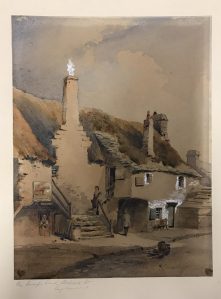
Figure 1. The Sweep’s Land, Stockwell Street by Thomas Fairbairn © CSG GIC Glasgow Museums Collection.

‘The gifts include a water colour, “The Sweep`s Land, Stockwell Street” by James (sic) Fairbairn, presented by Mr Joseph Henderson, R.S.W., Glasgow, and this sub-committee resolved that a special vote of thanks be accorded him for the gift’. 1

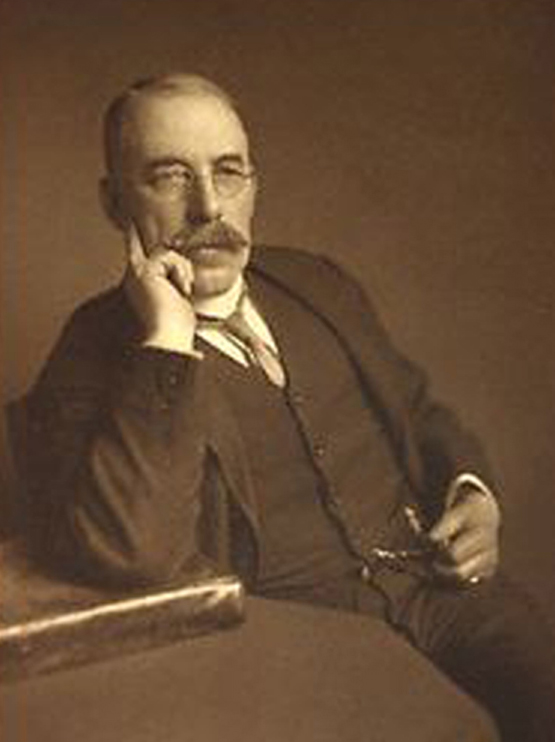
Joseph Henderson was born on 10 June 1832 in Stanley, Perthshire, He was the third of four boys. When he was about six, the family moved to Edinburgh and took up residence in Broad Street. The two older boys joined their father, also Joseph, as stone masons. 2 Joseph’s father died when Joseph was eleven leaving his mother, Marjory Slater, in straightened circumstances. 3 As a result, Joseph and his twin brother, James, were sent to work at an early age and the thirteen-year-old Joseph was apprenticed to a draper/hosier. At the same time, he attended part-time classes at the Trustees’ Academy, Edinburgh. At the age of seventeen, on 2 February 1849, he enrolled as an art student in the Academy.4 From the census of 1851, Marjory, Joseph and James were living at 5 Roxburgh Place, Edinburgh. Marjory was now a ‘lodging housekeeper’ with two medical students as boarders. James was a ‘jeweller’ while Joseph was a ‘lithographic drawer’.5 In the same year Joseph won a prize for drawing at the Academy enabling him, along with fellow students, W. Q. Orchardson, W. Aikman and W. G. Herdman, to travel to study the works of art at the Great Exhibition in London, which he found to be a very formative experience.6

He left the Academy about 1852-3 and settled in Glasgow. He is first mentioned in the Glasgow Post Office Directory for 1857-8 where he is listed as an artist living at 6 Cathedral Street.7 The census of 1861 confirms this address where he is a ‘portrait painter’ living with his wife Helen, daughter Marjory aged four and his mother Marjory who is now his ‘house keeper’.8

Joseph Henderson’s first exhibited work was a self-portrait which was shown at the Royal Scottish Academy (RSA) in 1853.9 He painted several portraits of friends and local dignitaries including a half-length portrait of his friend John Mossman in 1861. His painting, The Ballad Singer established his reputation as one of Scotland`s foremost artists when exhibited at the RSA in 1866.10 Throughout his career he continued in portraiture. He executed portraits of James Paton (1897) a founder and superintendent of the Kelvingrove Art Gallery and Museum (this portrait was bequeathed to Kelvingrove in 1933) and Alexander Duncan of the Faculty of Physicians and Surgeons of Glasgow. 11 He also painted Mr. Scott Dickson, Sir Charles Cameron, Bart., DL, LLD (1897), RGI and Sir John Muir, Lord Provost of Glasgow (1893). 12 His portrait of councillor Alexander Waddell (1893) was presented to Kelvingrove in 1896.13

However, it is probably as a painter of seascapes and marine subjects that he became best known. His picture Where Breakers Roar attracted much attention when exhibited at the Royal Glasgow Institute (RGI) in 1874, ‘as a rendering of angry water’.14

Figure 2. Joseph Henderson, The Bailie, No. 277, 6th Feb. 1878. (Mitchell Library).

Henderson was in part responsible for raising the profile and status of artists in Glasgow and was a member of the Glasgow Art Club (he was President in 1887-8), the Royal Glasgow Institute of the Fine Arts (founded 1861) and the Royal Society of Painters in Watercolour.15 Between 1853 and 1892, he exhibited frequently at the RSA and at the RGI and between 1871 and 1886 he had twenty pictures accepted for the Royal Academy in London. In 1901 he was entertained at a dinner by the President and Council of the Glasgow Art Club to celebrate his jubilee as a painter. He was presented with a solid gold and silver palette. An inscription on the palette read: ‘Presented to Joseph Henderson, Esq., R.S.W. by fellow-members of the Art Club as a mark of esteem and a souvenir of his jubilee as a painter, 8th January 1901’ 16

Joseph Henderson was married three times. On  8  January 1856 he married Helen Cosh (d. 1866) with whom he had four children including a daughter Marjory who became the second wife of the artist William McTaggart. On 30 September 1869 he married Helen Young (d. 1871) who bore him one daughter and in 1872 he married Eliza Thomson with whom he had two daughters and who survived him.17 Two of his sons, John (1860 – 1924) and Joseph Morris (1863 – 1936) became artists; John was Director of the Glasgow School of Art from 1918 to 1924.18

By 1871 he had moved with his family; wife Helen, daughter Marjory and sons James, John and Joseph and his mother Marjory from Cathedral Street to 183 Sauchiehall Street. He also employed a general servant. He is described in the census as a ‘portrait painter’.19 In 1881, Joseph was living at 5 La Belle Place, Glasgow with Eliza, two sons and four daughters.20 He later moved to 11 Blythswood Square, Glasgow. 21 In the 1901 census he was still at this address with his wife Eliza, sons John and Joseph and daughter Mary and Bessie. His occupation is ‘portrait and marine painter’.22

Figure 3. Joseph Henderson in 1894. Painted by his son-in-law William McTaggart. © CSG GIC Glasgow Museums Collection. (http://www.artuk.org)
Figure 4. Joseph Henderson, The Bailie, No. 1472, 2nd Jan. 1901. (MItchell Library)

Joseph Henderson painted many of his seascapes at Ballantrae in Ayrshire. At the beginning of July 1908, he again travelled to the Ayrshire coast. However, he succumbed to heart failure and died at Kintyre View, Ballantrae, on 17  July 1908 aged 76 and was buried in Sighthill cemetery in Glasgow. 23  A commemorative exhibition of his works was held at the RGI in November of that year. 24 A full obituary was published in the Glasgow Herald. 25

As well as his devotion to art, Joseph Henderson was a keen angler and golfer. A contemporary account states that he was ‘frank and genial, with an inexhaustible fund of good spirits and a ready appreciation of humour, of which he himself possesses no small share’. 26

A comprehensive account of the life and works of Joseph Henderson has been written by Hilary Christie-Johnston. 27

Thomas Fairbairn (1821 – 1885) was an older contemporary of Henderson and both were friends of John Mossman and Robert Greenlees.  A series of his drawing were acquired by Glasgow Corporation. 28 It is possible that the painting The Sweep`s Land, Stockwell Street was given to him by the artist.

References.

  1. Glasgow Corporation Minutes, 6 July 1898, p 642.
  2. Scotland’s People, 1841 Census, St. Cuthbert’s Edinburgh
  3. glasgowwestaddress.co.uk/1909
  4. J. L. Caw, rev. Elizabeth S. Cumming. ‘Henderson, Joseph (1832–1908)’. Oxford Dictionary of National Biography, Oxford University Press, 2004.
  5. Scotland`s People, 1851 Census, St. Cuthbert`s Edinburgh
  6. glasgowwestaddress.co.uk/1909
  7. Glasgow Post Office Directory, 1857-1858, National Library of Scotland
  8. Scotland`s People, 1861 Census, St. David`s, Glasgow
  9. Baile de Laperriere, Charles (ed.) Royal Scottish Academy Exhibitors, 1826 – 1990, Vol II,  Hillmartin Manor Press, 1991
  10. https://www.markmitchellpaintings.com/joseph-henderson-1832-1908
  11. Billcliffe, Roger, Royal Glasgow Institute of the Fine Arts 1861-1989. Vol 2, Roger The Woodend Press, 1991
  12. Glasgow Herald, 18th July 1908, p9
  13. Art UK/ Glasgow Museums Resource Centre
  14. Waters, Grant M., Dictionary of British Artists, (1900 – 1950),  Eastbourne Fine Arts Publications, 1975.
  15. glasgowwestaddress.co.uk/1909
  16. Glasgow Herald, 18 July 1908, p9
  17. Caw, J. L.  rev. Elizabeth S. Cumming. ‘Henderson, Joseph (1832–1908)’. Oxford Dictionary of National Biography, Oxford University Press, 2004.
  18. Glasgow School of Art, archives
  19. Scotland`s People, 1871 Census, Glasgow, Barony
  20. Scotland’s People, 1881 Census, Glasgow
  21. Scotland’s People, 1891 Census, Glasgow
  22. Scotland`s People, 1901 Census, Blythswood, Glasgow
  23. Scotland`s People; Death Certificate.
  24. Billcliffe, Roger, Royal Glasgow Institute of the Fine Arts 1861-1989. Vol 2, Roger The Woodend Press, 1991
  25. Glasgow Herald, 18 July 1908.
  26. The Bailie, Mitchell Library, Glasgow, GC 920.04 BAI., No. 277, Feb. 6th, 1878; No. 1472, Jan. 2nd. 1901.
  27. Christie-Johnston, Hilary, Joseph Henderson: Doyen of Glasgow Artists, 1832 – 1908,   Macmillan Art Publishing, Melbourne, Australia, 2013
  28. https://electricscotland.com/art/artinscotland18o.htm


Robert Gemmell Hutchison (1855 – 1936)

Robert Gemmell Hutchison pre 1900
Figure 1. Robert Gemmell Hutcheson, R.S.W., R.B.A.from a chalk study by H.W.Kerr, A.R.S.A. G. Setoun, Art Journal, 1900 p 321

In December 1918, Robert Gemmell Hutchison of 8, St. Bernard`s Crescent, Edinburgh and “Coral Den”, Carnoustie presented the painting Getting Ready to Glasgow Corporation as a memorial to his son the artist.1

(c) Glasgow Museums; Supplied by The Public Catalogue Foundation
Figure 2. Getting Ready by George Jackson Hutchison, 1916. © CSG GIC Glasgow Museums Collection. (www.artuk.org)

Robert Gemmell Hutchison was born at 35, North Richmond Street, Edinburgh on 1st July 1855. He was the first child of George Hutchison, a brass founder, and his wife Margaret Forman. 2 Soon after his birth, the family moved to 37, Carrubbers Close, Canongate. 3 It is not recorded which school Robert attended but he did not enjoy the experience! He was described as “scraping from class to class with as little work as possible, and, as soon as he could, leaving it gladly”.4 From the census of 1871, the family was still at 37, Carrubbers Close and had increased to seven; three sons and four daughters. Robert`s occupation was “seal engraver”. 5 “Still, if he did not like school, he liked seal-engraving, to which he was apprenticed, less”. With encouragement from his mother of whom he “always speaks with great reverence”, he was determined to become an artist and gave up seal-engraving to attend, aged 17, the Board of Manufacturers` School of Art in Edinburgh (also called the Trustees Academy).6 One of his instructors here was William McTaggart. He also attended the Royal Scottish Academy (RSA) Schools. At this time, he received valuable advice and help from the artist J. Campbell Noble, RSA and thus encouraged he sent some of his paintings to the RSA Annual Exhibitions. After several rejections, he was eventually successful in 1878 when he had three small landscapes exhibited: Youthful Labour, Quiet Pastures and A Country Well. 7 One of these was bought by the Royal Association for the Promotion of the Fine Arts in Scotland and for which Hutchison received the sum of six guineas. 8 He submitted the paintings from his studio at 1, India Buildings, Edinburgh.

On 24th June 1879, Robert aged 23, married Janet Boe who was 21 and the daughter of a grocer in Biggar. The marriage took place at 4, Morningside Park, Edinburgh. On the marriage certificate he listed his occupation as “artist (figure painter)” and his address as 38, Jamaica Street, Edinburgh. For some reason he omitted to sign his surname on the certificate! 9 The couple had nine children only five of whom survived infancy 10. These were four daughters; Jane (1880-1956), Marion Maud (1887-1963), Roberta Louise (1889-1966), Ann Carr Forman (1893-1978) and a son, George Jackson Hutchison who was born in 1895. In 1881, Robert was with his wife and daughter Jane at 26, Caledonian Place, Edinburgh. His occupation was “artist”.11

After a period spent painting landscapes along the Fife coast, Robert began to specialise in scenes of Scottish rural life especially those involving children and in the year after his marriage, he had a painting The Empty Cradle exhibited at the Royal Academy (RA) in London. His studio was now at 53, George Street, Edinburgh. There followed five exhibits at the RA over the next decade all sent from addresses in London.12 He continued to exhibit annually at the RSA and in 1886 was awarded a prize for his painting Boys Guddling Trout. From 1888 onwards he also exhibited at the Royal Glasgow Institute. At the 1891 Census he was an “artist, figure and portrait”, living at 4, Melville Place, Edinburgh with his wife and four daughters. 13 His son George was born at the same address four years later. 14

He began to paint and exhibit widely throughout Britain. A favourite location was Carnoustie in Angus where he had a house, “Coral Den”, in William Street. He also painted in Macrihanish, at Musselburgh and on the Farne Islands. From about 1896 to 1903 the family (Robert, Janet, Roberta, Ann and George) was living at St. Ive`s Cottage Lanark Road, Braidwood, Carluke. 15,16 Robert was elected to many prestigious institutions throughout the British Isles; e.g. to the Royal Society of Painters in Watercolour, (RSW) in 1895, the Royal Society of British Artists (RBA), 1896, the Royal Institute of Oil Painters (ROI), and Associate of the Royal Scottish Academy (ARSA) in 1901 and RSA in 1911.17 In 1903 he exhibited a work Bairnies Cuddle Doon at the Paris Salon. 18 He was awarded a gold medal and the painting was purchased by the Scottish Modern Arts Association.21 He was awarded a second gold medal at the Paris Salon Exhibition of 1928 for his painting The White Seam. This was bought by Paisley Corporation and is now at the Paisley Museum and Art Gallery. Hutchison was elected to full membership of the RSA in 1911, replacing William McTaggart who had died the previous year.20 “Gemmell Hutchison had held McTaggart in the highest esteem and it was to him that he owed his loose painterly technique and in many ways his most popular subject matter – that of children on the beach. Both his family and that of McTaggart confirmed that the latter was a luminary for Hutchison. 21

RGHutchison Edit
Figure 3. Robert Gemmell Hutchison (early 1900s). Royal Scottish Academy Archives  Copyright R.S.A                                   

Another influence on Hutchison was the artistic style of the Hague School in Holland which he visited in 1905. On his return to Scotland he took to painting in the open air with a “looser technique and lighter palette”. 22 One of his works of this period was Seagulls and Sapphire Seas (1909) which he sold to Bolton Art Gallery in 1912 (Appendix 1). In 1910 he was commissioned to paint the coronation of George V and Queen Mary at Westminster Abbey. From the census of 1911 he and his family were living at 14, Craighall Terrace, Inveresk, Musselburgh. In his later years he spent his summers at his daughter`s home in Coldingham, Berwickshire painting outdoors. His subjects included views of St. Abbs, Gulls on the Farne Islands as well as portraits of his daughter. He continued to exhibit up till the year of his death.

Robert Gemmell Hutchison died of a cerebral haemorrhage at Coldingham on 23rd August 1936. He was 81 years of age. 23 He was buried in the Dean Cemetery in Edinburgh after a private service at his home at 8, St. Bernard`s Crescent. Two of his daughters, his son-in-law and a nephew were among the pall-bearers. Also present were many fellow artists and members of the artistic establishment. 24,25

His estate was valued at £11,079.10s.7p with his two daughter named as next of kin. 26

Headstone
Figure 4. Gravestone in Dean Cemetery, Edinburgh.© http://www.gravestonephotos.com

Various critics have commented on his painting style:

“Robert Gemmell Hutchison is one of the best-known of the early twentieth-century Scottish artists who drew their inspiration from the Hague School of painters and by the work of the nineteenth century Dutch artists Joseph Israels and Bernardus Johannes Blommers. His paintings of fisher-folk, especially of young children playing by the sea or seated in cottage interiors, have a charming pathos and are similar in subject to those painted by his luminary William McTaggart ”. 27

He “has an appreciation of the fusing influence of tone and atmosphere, and brings a broad and vigorous method of painting, good drawing, and effective design to bear upon a rather fresh view of village life. Despite a certain commonness, his pictures are usually well thought out, and, logically put together in a pictorial way, tell their stories with considerable point. His feeling again, although lacking in charm or novel insight, is sympathetic, and his treatment of childhood, if somewhat literal, fresh and individual”. 28

His paintings today are valued and continue to sell well e.g. The Village Carnival sold for £110,000 in Edinburgh in 2006. 29 (See also Appendix 2).

George Jackson Hutchison was a gifted painter but was killed in action at Merville, France on 28th June 1918 aged only twenty-two. He had served as a private in the K.O.S.B.s. After George`s death, his father presented his painting Getting Ready to Glasgow Corporation as a memorial to his son. The painting was accepted on 18th December 1918. The Minutes of the Corporation record that;

“The sub-committee agreed to accept the picture by this talented young artist, who made the supreme sacrifice for King and Country, and to recommend that the Corporation accord his father a vote of thanks for the gift and extend to him their sympathy and condolence in his bereavement”. 30

Each year, Edinburgh College of Art awards a “George Jackson Hutchison Memorial Prize” for outstanding painting. It seems likely that this was initiated by Robert Gemmell Hutchison in memory of his son. However, Edinburgh College of Art, now incorporated into Edinburgh University, could not confirm this due to the current state of their records.

References

  1. Glasgow Corporation Minutes, Sub-Committee on Art Galleries and Museums, C1 3.60, p330, 18th December 1918.
  2. Scotland`s People, Birth Certificate
  3. ancestry.co.uk, Scotland Census 1861
  4. Setoun, G., R. Gemmell Hutchison, R.S.W., R.B.A., Art Journal, 1900, pp 321-6
  5. ancestry.co.uk, Census 1871
  6. Setoun, G., R. Gemmell Hutchison, R.S.W., R.B.A., Art Journal, 1900, pp 321-6
  7. Royal Scottish Academy Exhibitors, 1826 – 1990, Hilmartin Manor Press, 1991.
  8. Setoun, G., R. Gemmell Hutchison, R.S.W., R.B.A., Art Journal, 1900, pp 321-6.
  9. Scotland`s People, Marriage Certificate
  10. Scotland`s People, Census 1911
  11. Scotland`s People, Census 1881
  12. Catalogues of the Royal Academy Exhibitions, 1880-89, W. Clowes and Sons, Ltd.
  13. Scotland`s People, Census 1891
  14. Scotland`s People, Birth Certificate
  15. Scotland`s People, Census 1901
  16. Slater`s National Commercial Directory of Scotland, 1882-1915
  17. Johnson, J and Greutzner, A., Dictionary of British Artists, 1880 – 1940, , Antique Collectors Club, 1976).
  18. Setoun, G., R. Gemmell Hutchison, R.S.W., R.B.A., Art Journal, 1900, pp 321-6
  19. Fowle, Frances, The Oxford Dictionary of National Biography, OUP, 2004-13, May 2011.
  20. The Scotsman, February 9th, 1911, p5.
  21. https://lyonandturnbull.com/content/show_news.asp?id=146
  22. Fowle, Frances, The Oxford Dictionary of National Biography, OUP, 2004-13, May 2011.
  23. Scotland`s People, Death Certificate
  24. The Scotsman, August 27th, 1936, p8.
  25. The Scotsman, August 24th, 1936, Death Notices
  26. Confirmations and Inventories, 1936, Mitchell Library, Glasgow
  27. artfact.com › Auctioneer Directory
  28. Caw, J.L., Scottish Painting, 1908, p 427-8.
  29. Edinburgh Evening News, May 3rd, 2006.
  30. Glasgow Corporation Minutes, Sub-Committee on Art Galleries and Museums, C1 3.60, p330, 18th December 1918.

Appendix 1

One of the finest paintings by Robert Gemmell Hutchison, possibly the best loved of Scottish artists, set a new world record for the artist at Bonhams Annual Scottish Sale in Edinburgh on Wednesday 31 August, 2011 when it was sold for £120,000. Sea Gulls and Sapphire Seas was painted in 1909 and represents the artist at the height of his powers. In a dazzling display of impressionistic technique, Hutchison places a characteristic foreground of children in the sand dunes against the sparkling sea and whirling gulls. Many of his most popular paintings feature children playing beside the sea and he often used his daughters and their friends as models in coastal locations in Berwickshire, East Lothian and Carnoustie. The painting was sold by Bolton Museum which bought the work from the artist for £150 in 1912.

Beach
Figure 5. Public Domain (http://www.artdaily.org)

Appendix 2

A pensioner has unearthed a hoard of stolen art treasures in the loft of his Helensburgh home. The 67-year-old discovered the missing paintings while rummaging in the dusty room and – not realising their value – decided to try to raise a few pounds by selling them. After seeking advice from an art expert, he was told the paintings were not his to sell. The canvasses were the creations of two celebrated Scottish artists, which had been stolen five years ago and were worth at least £250,000. Inquiries revealed that the three paintings by Robert Gemmell Hutchison and two by Sir James Guthrie were stolen from a house in Helensburgh’s Cairndhu Gardens in 2002. Investigators believe that when the thieves failed to sell the works they dumped them in the communal attic above a block of flats in the town’s Kirkmichael estate. The paintings are The Pink Pinafore, Feeding the Gulls and Cottarita by Gemmell Hutchison and Luss Road and Candlelight by Guthrie.

One resident said: “The old boy went up there on Thursday and initially tried to sell them on. He contacted someone at the Fine Art Council and they made checks and realised they were stolen. “There were five paintings in total and my mate was offered them as a set, but wasn’t that impressed and wouldn’t have paid more than £50 for the lot.” He added: “The paintings have obviously been nicked years ago by a gang of young lads, but when they found out they couldn’t get anything for them, they just dumped them.

Robert Gemmell Hutchison was born in Edinburgh in 1855 and was a prolific artist whose works were lauded around Britain. His work, The Village Carnival, was sold for £110,000 in 2006.  At the time of their theft in 2002 the five paintings were valued at £246,000.

The Scotsman, Saturday 12 January 2008

Lindsay Grandison MacArthur 1873-1956

In 1946 Lindsay MacArthur’s widow, Beatrice Butts Thomson, donated four paintings to Glasgow. Lindsay was an artist and two of these works were his own, The Golden Quarry and Pastorale, Evening. 

MacArthur, Lindsay Grandison, c.1866-1945; The Golden Quarry
Figure 1. MacArthur, Lindsay Grandison; The Golden Quarry; Glasgow. (© CSG CIC Glasgow Museums Collection)

Lindsay’s father, also Lindsay Grandison, was born in the village of Ecclefechan, Dumfriesshire. (1) His mother Catherine McNicol, known as Kate, who hailed from Dublin was Lindsay’s second wife and was twenty- one years his junior. (2) They married in Liverpool in 1860  and shortly moved to Braehead Villa, Oban in Argyll where Lindsay junior was born on 21 April 1865. (3) This was a period when the rail network was expanding, enabling many people to travel to coastal resorts. Oban was already a busy fishing town and ferry port. In 1866 Lindsay senior built the 80 room Alexandra Hotel, on vacant land which is now known as the Corran Esplanade, a prime site overlooking Oban Bay and competed with The Great Western Hotel for the top end of the market. He ran the hotel with his daughter Jane till his death in 1885. He left debts of £2478 of which £1000 was owed to Thomas Lawrie, art dealers in Glasgow, so perhaps Lindsay junior’s interest in art was inspired by his father. The hotel was then managed by Lindsay Senior’s wife until 1897 when it was put up for sale. (4) Although the family had a house at 3 Hampden Terrace in Glasgow, they resided mainly at the Alexandra in Oban in the 1870s. (5) 

blog Alexandra_Hotel,_Oban
Figure 2. Alexandra Hotel, Oban

Lindsay junior appears to have had an early interest in art, attending Glasgow School of Art from 1881 to 1884. (6) In the 1891 census, when he was 25, he is described as a landscape painter. His brother Robert also studied art but by 1891 had become a surgeon. (7) Interestingly the 1881 census reveals that the artist William Black was staying at the Alexandra Hotel. He was a popular novelist whose landscape painting  influenced his writing style such as in White Wings: A Yachting Romance of 1880. (8) 

Lindsay  travelled south in the 1890s and lived in the picturesque village of Broadway in The Cotswolds and became part of a group of artists known as The Broadway Group which was mainly comprised of expatriate American artists. The most prominent member was John Singer Sergeant who produced some of his best known works there such as Carnation, Lily, Lily, Rose which was painted in the garden of Russell House in the village. This was the home of American artist Francis Millet who purchased the nearby Abbot’s Grange, a ruined monastery which he converted into a communal artists studio. 

Sargent, John Singer, 1856-1925; Carnation, Lily, Lily, Rose
Figure 3. Sargent, John Singer; Carnation, Lily, Lily, Rose 1885-6; Tate; digital image © Tate released under Creative Commons CC-BY-NC-ND 3.0 (Unported).

One of Millet’s best known works is Between Two Fires of 1892 which depicts a puritan standing between two rather confident kitchen maids. The puritan figure is modelled on Lindsay MacArthur who is described by a contemporary as ‘a highland landscape artist with a sardonic biting humour, a quick temper and fierce loyalties.’ (9)

Between Two Fires c.1892 by Francis Davis Millet 1846-1912
Figure 4. Francis Davis Millet, Between two Fires, 1892 digital image © Tate released under Creative Commons CC-BY-NC-ND 3.0 (Unported)

Another of Millet’s paintings The Black Sheep, in The New Bedford Library, Massachusetts, and of a similar setting to Between Two Fires includes the same character modelled on MacArthur. Millet’s last return to the USA was, unfortunately, in 1912 when he boarded The Titanic and was last seen helping women and children as she sank. The bohemian Broadway Group had a reputation for the high life, with singing and drinking regularly breaking the peace of the village. The writer Edmund Gosse describes…’Nothing we do scandalises the villagers…one of the Americans was chased down the village street, screaming all the time and and trying to escape up lamp-posts and down wells. Not a villager smiled, they only say ‘them Americans is out again’. (10)

While at Broadway MacArthur designed a bookplate (National Galleries Scotland) for Lady Maud Bowes-Lyon, aunt to Her Majesty The Queen Mother. She lived at Orchard farm in the village and frequently hosted concerts in her music room (she was an accomplished violinist) and held regular art exhibitions. (11)

One of MacArthur’s donations Pastorale, Evening may have been painted during his stay in the Cotswolds, and he exhibited thirteen paintings at The Royal Academy between 1893 and 1904. (12)

MacArthur, Lindsay Grandison, c.1866-1945; Pastorale, Evening
Figure 5. MacArthur, Lindsay Grandison; Pastorale, Evening.(© CSG CIC Glasgow Museums Collection)

The 1901 census places MacArthur at Spencer Street, London and little is known of his whereabouts in the following few years. However, he appears to have spent time travelling as many of his paintings from this period are landscapes and seascapes of Palestine and Ceylon with a few from France. He does not appear to have dated his work.

In 1934 Lindsay married Beatrice Butts Thomson in Chelsea. Beatrice was born in 1873 in Japan to British parents. (13) Her first husband, John Leslie Thomson was a landscape artist from Aberdeen and trained at The Slade in London He was a member of The New English Art Club and requested an invitation to one of Whistler’s famous 10 0’Clock lectures. He died in 1929. (14) They lived at 1 Hornton Street, Kensington. (15)

After their marriage Lindsay and Beatrice lived at 9a St Mary Abbot’s Place, Kensington and over the next few years Lindsay exhibited at Royal Scottish Academy with landscapes of England, Galilee and Ceylon. (16)

Lindsay died in Surrey in 1945 aged 80. (17) In 1946 Beatrice was living at 37 Drumsheugh Gardens, Edinburgh and she gifted paintings to public collections around Scotland with the majority going to Kirkcaldy Galleries. Around half of the donations were painted by Lindsay Grandson MacArthur, with the remainder by her first husband John Leslie Thomson. (18) It would appear that both artists were influenced by the French Impressionists, depicting fleeting moments of time and displayed a remarkably similar style to each other.

Thomson, John Leslie, 1851-1929; Seascape, Anglesey
Figure 6. Thomson, John Leslie; Seascape, Anglesey; (© CSG CIC Glasgow Museums Collection)

Beatrice moved to Devon, to the market town of Honiton where she died in 1956. (19)

DS

References

1. (Census, 1881, 677356) http://search.ancestry.co.uk

2. (Census, 1881, 644/9 61/21) https://www.scotlandspeople.gov.uk

3. (Births,Lindsay Grandson MacArthur 523/000023) https://www.scotlandspeople.gov.uk

4.  Fiona Morrison, Bournemouth University Thesis, http://eprints.bournemouth.ac.uk/22514/

5. (Census 1871, 560/00004/00027)  https://www.scotlandspeople.gov.uk

6. Glasgow Schoo; of Art, archives@gsa.ac.uk

7. (Census 1891, 52300002/00001)  https://www.scotlandspeople.gov.uk

8. https://en.wikipedia.org/wiki/William_Black_(novelist)

9. https://www.cotswolds.info/arts-crafts-antiques/broadway-artists.shtml

10. https://www.cotswolds.info/arts-crafts-antiques/broadway-artists.shtml

11. http://www.broadwaymanor.co.uk/blog/page/2/

12. Royal Academy (libraryinformationdesk@royalacademy.org.uk)

13. England and Wales Marriages 1837-2005,  https://search.findmypast.co.ukBMD/M/1934/3/ AZ/000990/030

14. University of Glasgoe, https://www.whistler.arts.gla.ac.uk/correspondence/people/biog/?bid=Thom_JL&firstname=&surname=thomson

15. (Census 1911, 2frg), https://search.findmypast.co.uk

16. Royal Scottish Academy, https://collections@royalscottishacademy.org

17. England and Wales Deaths, https://search.findmypast.co.uk/record?id=bmd1945

18. https://artuk.org

19. England and wales Deaths, https://search.findmypast.co.uk/record?id=bmd2f1945

Mrs C.R.Ashbee 1877-1961

In 1947, Mrs C.R.Ashbee donated a painting of her mother-in-law Mrs H.S.Ashbee to Glasgow museums. (1) The painting was by E. A .Walton, one of the Glasgow Boys.


mrs H S Ashbee
Figure 1. Mrs H S Ashbee by E A Walton c CSG CIC Glasgow Museums Collection.

Janet Elizabeth Forbes(2) was born on the 28 December 1877 in Sevenoaks, Kent, to Francis A. Forbes, a cultivated stockbroker and his wife, Jessie Carrick, who was of Scottish descent but had been brought up in Saint Petersburg, Russia.(3)  She was educated at home by a governess, Miss  Stoy (4 ) and she studied English literature, geography, basic Latin and languages . At the age of 15 she and Miss Stoy spent a year in Germany and the next year they spent  months in Paris. She began to keep commonplace books and diaries, a practice which she continued for some years. These with many letters are now in the Ashbee family archives and are a source for the remarkable biography written by her daughter, Felicity  Ashbee.(5) At the age of 19, on 8 September 1898(6), she married Charles Robert Ashbee, a leading light in the Arts and Crafts movement.

Since her life thereafter was linked to his, it is reasonable to discuss Charles Robert Ashbee. He was born in 1863(7) to Henry Spencer Ashbee, a rich and successful businessman and exporter, and to his wife Elizabeth Jenny Lavy, daughter of a rich merchant from Hamburg. He was educated at Winchester College and at King’s College Cambridge(8) where he read History. It is said that his father disapproved and wished him to join the family firm, Charles Lavy and Company, however with the support of his mother he went to Cambridge. His father cut him off with £1000.(9) His father had a collection of erotica(10) which he eventually gave to the British Library. It forms the major part of its collection in the “Private Case”.

While at Cambridge, Charles met Edmund Carpenter, a founding member of the Fellowship of the New Life which extolled the virtues of the simple life, manual labour and friendship. He also came under the influence of William Morris. He decided to become an architect and (11) he lived in the East End of London at Whitechapel in

C_R__Ashbee_by_William_Strang_1903.jpg
Figure 2. C R Ashbee by William Strang Wikipaedia Commons Public Domain

Toynbee Hall. There he founded Ashbee’s Guild of Handicraft. The Guild had the support of Burne-Jones, Holman Hunt and Alma Tadema to name but a few. It was a decidedly masculine society and put much faith in comradeship and craftsmanship. He lived at 37 Cheyne Walk with his mother and two unmarried sisters in a house which he had designed after his parents separated in 1893.(12 ) .  E.A. Walton was a neighbour at 73 Cheyne Walk.(13)

In 1898 at the age of 35, he married Janet Forbes who was then in 19 years old.(14) His life style had been that of a homosexual but there is a touching letter (15 ) to Janet in which he asked her to be his “ comrade wife” They lived in 74 Cheyne Walk in a house which he had designed and which was paid for by Janet’s father.(16 ) She was assimilated into the Guild and took part in the fellowship and  out door life that they enjoyed. (17) For example they sailed the river Wye and camped by its banks. In 1901 they travelled to America for a lecture tour with Charles’ mother, whom they called “The Little Mother”, covering  the  east coast ofAmerica, Washington and New York, and Chicago. They met, among others Frank Lloyd Wright. (18)

Janet became a strong and resourceful woman who took responsibility for the domestic arrangements and the many moves during her married life.

Charles Ashbee continued to promote the Guild and in 1902 it moved to Chipping Camden though he retained his office in Cheyne Walk. Number 74 was rented for a time to Rex Whistler.(19)

In Chipping Camden, there were living areas, workshops and a library and museum. All kinds of crafts were there, preferably hand worked: metalwork, jewellery, woodwork, cabinetmaking and painting. In addition to his architect practice, Charles designed silver ware and metal works which can be found in museums (20) among them the Victoria and Albert in London and the Court Barn Museum in Chipping Camden. Some are in private collections and they still come up for auction from time to time. Many young artists were attracted to work there and Mrs Ashbee became the “mother figure” although she was near to their age. She was the link with the people in Chipping Camden.(21)

After 13 years of marriage, her first daughter was born. In all she and Charles had four daughters(22) and caring for them became her fulfilment. She wrote one novel which was never published but her literary output is in her letters and diaries. She spoke French and German and had “ a facility for languages “. (23 )

The Guild was very sociable and enjoyed lectures and entertainments. It attracted many notable people (24) including Beatrice and Sidney Webb, William De Morgan, A.E.Housman, John Masefield and Lloyd Wright. The Guild eventually overextended itself and was disbanded in 1907, though it was reconstituted in 1908 but never really revived. The First World War ended the dream.

In 1915, Charles went on another lecture tour in America. In 1917, he sailed to Cairo to teach English at a training College (25). In 1918, he was appointed Civic Adviser to the British Mandate in Palestine, overseeing building works and protection of religious sites (26). He and his family lived in Jerusalem from 1918 to 1923.He published the Records of the Pro-Jerusalem Society in 1924.(27) On returning to Britain, the couple moved to his wife’s family home in Sevenoaks .He died in Seven Oaks on2 May 1942.(28) Janet died in Lancaster in June 1961.(29)


References

  1. Minutes of Glasgow City Council 1947
  2. Church of England Births and Baptisms 1813-1917 Ancestry.co.uk
  3. Fiona MacCarthy: The Simple Life: C.R.Ashbee in the Cotswolds. London, Lund Humphries, 1981
  4. Felicity Ashbee: Janet Ashbee. Love , Marriage and the Arts and Crafts Movement.Syracuse University Press.2002. p5,7.
  5. Felicity Ashbee: Janet Ashbee. Love , Marriage and the Arts and Crafts Movement.Syracuse University Press.2002. p5,7.
  6. England and Wales Civil Registration Marriage Index. Ancestry.co.uk
  7. Church of England Births and Baptisms 1813-1917 Ancestry.co.uk
  8. Cambridge University Alumni 1261-1900 Ancestry.co.uk
  9. Fiona MacCarthy: The Simple Life: C.R.Ashbee in the Cotswolds. London, Lund Humphries, 1981
  10. The Observer.9th February 2019. Kate Williams .What I saw in the British Library’s Dirty Book Section.
  11. Fiona MacCarthy: The Simple Life: C.R.Ashbee in the Cotswolds. London, Lund Humphries, 1981
  12. Felicity Ashbee: Janet Ashbee. Love , Marriage and the Arts and Crafts Movement.Syracuse University Press.2002
  13. Letter on fie in Archives of Glasgow Museums from Alan Crawford
  14. England and Wales Civil Registration Marriage Index. Ancestry.co.uk
  15. Felicity Ashbee: Janet Ashbee. Love , Marriage and the Arts and Crafts Movement.Syracuse University Press.2002
  16. Fiona MacCarthy: The Simple Life: C.R.Ashbee in the Cotswolds. London, Lund Humphries, 1981
  17. Felicity Ashbee: Janet Ashbee. Love , Marriage and the Arts and Crafts Movement.Syracuse University Press.2002.p98
  18. Ibid p57
  19. Fiona MacCarthy: The Simple Life: C.R.Ashbee in the Cotswolds. London, Lund Humphries, 1981.p77
  20. The Art Fund
  21. Fiona MacCarthy: The Simple Life: C.R.Ashbee in the Cotswolds. London, Lund Humphries, 1981
  22. Ancestry.co.uk
  23. Felicity Ashbee :Janet Ashbee. Love , Marriage and the Arts and Crafts Movement.Syracuse University Press.2002
  24. Fiona MacCarthy: The Simple Life: C.R.Ashbee in the Cotswolds. London, Lund Humphries, 1981
  25. Felicity Ashbee: Janet Ashbee. Love , Marriage and the Arts and Crafts Movement.Syracuse University Press.2002
  26. ibid
  27. C R Ashbee .Jerusalem 1918-1920: Being the Records of the Pro-Jerusalem Council during the Period of British Military Administration. London ,John Murray.1924
  28. England and Wales Civic registration Death Index 1916-2007
  29. England and Wales Civic registration Death Index 1916-2007

Thomas Hunt (1854 – 1929)

In 1913 the artist Thomas Hunt donated to Glasgow Museums a painting, Patchwork, accession number 1325, by his late wife Helen Russell Salmon. This report contains biographical notes on both artists.

Thomas Hunt was born in Skipton, Yorkshire in 1854 [1], the sixth child of ten, [2],[3] of John Hunt and his wife Betty (nee Wood) who married in 1848 [4]. John’s main occupation was as a limestone merchant and canal carrier, and he had also been an inspector of tolls.[5] In 1877 he stood for election as a Liberal candidate in the South Ward of Leeds, duly winning by 34 votes.[6] He remained as a councillor until 1892 when he retired from politics.[7] He died in 1900, age 81, leaving an estate valued at £1034 7s 3d, probate being granted to his sons Richard and Henry.[8]

Thomas initially started out as commercial clerk [9] probably working for his father, however by the age of 21 he had become a full-time artist having been inspired to do so after attending an International Art Exhibition in Leeds at the age of 15.[10] There is reference in a Scottish Art Dictionary to him studying in Paris under Raphael Collins, receiving an honorable mention at the Paris Salon in 1905, and attending the Glasgow School of Art and the Leeds equivalent.[11] However there is no record of him attending the Glasgow school [12] nor has any better source been identified which confirms his connection with the Leeds School or Paris. By 1879 he was living at 113 West Regent Street in Glasgow,[13] that address consisting of a number of offices, housing professional people such as architects, writers and accountants, and six artist studios, one of which he occupied.[14] In 1884 another studio at that address was occupied by the artist Helen Russell Salmon, whom he eventually married a few years later.[15]

Helen, born in 1855 in Glasgow,[16] was the daughter of the architect James Salmon, whose company James Salmon and Son, between 1862 and 1903, was involved with the building of a number of public and professional structures in Glasgow and elsewhere, including schools, churches, banks and hospitals. He first made his name with the building of St. Matthew’s Church in Bath Street and building, for Archibald McLennan, an art warehouse in Miller Street.[17] In 1854 Salmon was commissioned by Alexander Dennistoun to design the new east end suburb of Dennistoun, a design not fully realized,[18] where, by 1871 the Salmon family was resident at 3 Broompark Circus.[19] They were however unsuccessful participants in the competition for the City Chambers in George Square in 1880, and also for alterations to the Virginia Street side of the Trades House in 1882.[20] James was the co-founder of the Glasgow Architectural Society in 1858 and was a Baillie of Glasgow between 1864 and 1872. [21] His wife was Helen Russell whom he married in 1837 in Edinburgh.[22]

In the census of 1871 daughter Helen Russell Salmon is recorded as a scholar living in the family home.[23] In 1874 she is listed in the Glasgow School of Art student catalogue, during which year she won a local competition, ‘Stage 6b, figure shaded from flat, book prize.’[24] Where she was resident at that time is not listed in the school records however by 1881 she is living with her sister Margaret and her husband David Miller in Bridge of Allan and is described as an artist.[25] Her father, now a widower, her mother having died in January 1881,[26] continued to live at Broompark Circus with two of Helen’s siblings.[27] Her usual residence for the next few years is unclear, however from 1882 to 1883 she had a studio at 101 St Vincent before moving to 113 St Vincent Street in 1884, at which address she painted from until 1888.[28] It’s quite possible that she also lived at these addresses at varying times however when she married Thomas Hunt on 27th October 1887, her usual residence was given as 3 Broompark Circus which is where her marriage took place.[29]

In 1891 Tom and Helen were living In Garelochhead, [30] where she died in August of that year having been ill with phthisis (tuberculosis) for two years.[31] In the 1891 census her occupation is not recorded which perhaps suggests she had ceased to paint some time before then due to her illness. Patchwork, which was painted in 1888,[32] and was exhibited at the Royal Glasgow Institutes of the Fine Arts in 1889 [33] was one of her last works.

In a letter dated 29th January 1948 to John Fleming, Deputy Director of Kelvingrove Art Gallery, from Robert Lillie, founder of the Lillie Gallery in Milngavie, [34] the subject of the painting is identified as Miss Annie Elizabeth Nisbet, the adopted daughter of John Nisbet, church officer of St John’s Church in George Street, Glasgow, and his wife Agnes.[35] In the letter, which tells of her death, she is described as the ‘Belle of St John’s’. In 1900 she married Robert Arbuckle Mackie, her adoptive parents being deceased by then.[36] She died, aged 80 in January 1948.[37]

Figure 1 ‘Patchwork;’ Helen Russell Salmon 1888.     © CSG GIC Glasgow Museums Collection.(http://www.artuk.org)

Helen had 23 paintings exhibited by the Glasgow Institute between 1882 and 1891, the last  of which were painted in 1889, and two, Madge and Wallflowers which were completed at her home in Garelochhead, in 1891.[38]She also had her work exhibited by the Royal and Royal Scottish Academies between 1884 and 1890.[39]

In 1935 the Catalogue of the Pictures in the Glasgow Museums and Art Galleries, page 205, carried a short biography of Helen in which it stated she had trained in Paris. Also included were details of her painting Patchwork.[40]

In 1982 an exhibition in the Collins Exhibition Hall of Strathclyde University was held to celebrate the 100th anniversary of the Glasgow Society of Lady Artists. The catalogue of the exhibition, which also took place at the Fine Art Society premises in Edinburgh later that year, included on page 23 a black and white illustration of one of Helen’s paintings.[41]

Tom eventually moved back to Glasgow and by 1895 was living at 219 West George Street.[42] Between then and his death he stayed at various Glasgow addresses including Holland Street,[43] Bath Street,[44] and finally Hill Street in Garnethill.

He was elected a member of the Glasgow Art Club in 1879, became vice president in 1883 and was club president in 1906-1907.[45]

Figure 2 Tom Hunt drawn by Wat Miller of the Glasgow Art Club. Courtesy of the Glasgow Art Club

He exhibited at the club and elsewhere including the Burns Exhibition of 1896 in Glasgow where his paintings A Winter’s Night and Alloway Kirk were shown,[46] the annual RSW shows, and also several times from 1881 at the Royal Academy in London and the Royal Scottish Academy.[47] He also exhibited at the Royal Glasgow Institutes of the Fine Arts yearly between 1879 and 1929 with a total of 138 paintings being shown during this period, the last three of which were posthumous.

The prices of his paintings during these exhibitions were anywhere between £30 and £300.[48] His wife Helen’s were typically priced at under £30.[49]

He was elected a member of the Royal Scottish Society of Painters in Watercolour (RSW) in 1885 [50] and was made an Associate of the Royal Scottish Academy (ASRA) in 1929.[51]

He is represented in the museums of Sheffield, Leeds, Perth and Kinross, Paisley, Inverclyde, South Ayrshire and the Hunterian in Glasgow. There are three of his paintings in Glasgow Museums: Corner of Hope Street and Sauchiehall Street, Glasgow, gifted 1917, accession number 1444, A Few Remarks’ gifted 1939, accession number 2124, and November, Braes of Balquidder purchased 1914, accession number 1343.[52]

He died of pnuemonia on the 13th March 1929 in the Glasgow Royal Infirmary, his usual residence being given as 156 Hill Street. His death was registered by E.E. Smith his niece from Leeds.[53] His estate was valued at £1889 12s 3d and on the 15th August his fellow artists Joseph Morris Henderson and Archibald Kay, were confirmed as his executors.[54]

[1] Births (PR) England. Skipton, Yorkshire. 1st Qtr 1854. HUNT, Thomas. England & Wales Births 1837-2006 Transcriptions. www.findmypast.co.uk:

[2] Census. 1861 England. Leeds, Yorkshire. ED 9, Schedule 47, piece 3371, folio 51, page 10. www.ancestry.co.uk:

[3] Census. 1871 England. Leeds, Yorkshire. ED 9, Schedule 23, piece 4543, folio 6, page 5. www.ancestry.co.uk:

[4] Marriages (PR) England. Leeds, St Peter, Yorkshire. 29 August 1848. HUNT. John and WOOD, Betty. Collection: West Yorkshire, England, Marriages and Banns 1813-1935. www.ancestry.co.uk:

[5] Census. 1861 England. Leeds, Yorkshire. ED 9, Schedule 47, piece 3371, folio 51, page 10. www.ancestry.co.uk and Census. 1871 England. Leeds, Yorkshire. ED 9, Schedule 23, piece 4543, folio 6, page 5. www.ancestry.co.uk

[6] Leeds Mercury. (1877) Election Results. Leeds Mercury. 3 November 1877. Supplement p.1a. Collection: 19th Century British Newspapers. National Library of Scotland. www.find.galegroup.com.connect.nls.uk/bncn/publicationSearch.do:

[7] Leeds Times, (1892) Municipal Elections. Leeds Times. 22 October 1892. p.5f

[8] Testamentary Records. England.6 April 1900. HUNT, John. Principal Probate Registry, Calendar of the grants of probate. p.275. Collection: National Probate Calendar 1858-1966.www.ancestry.co.uk:

[9] Census. 1871 England. Leeds, Yorkshire. ED 9, Schedule 23, piece 4543, folio 6, page 5. www.ancestry.co.uk

[10] Eyre-Todd, George. (1909). Who’s Who in Glasgow 1909. Glasgow: Gowan and Grey. Collection: Glasgow Digital Library. http://gdl.cdlr.strath.ac.uk/eyrwho/:

[11] McEwan, Peter J M (1994). Dictionary of Scottish Art and Architecture. Woodbridge, Suffolk: Antique Collectors Club. Mitchell Library reference: f.709.411. MCE

[12] Grant, Jocelyn. (2015) Thomas Hunt and Helen Russell Salmon. E-mail to George Manzor, 30 November 2015. g.manzor@ntlworld.com:

[13] Billcliffe, Roger (1991). The Royal Glasgow Institute of the Fine Arts 1861-1998: A Dictionary of Exhibitors at the Annual Exhibitions. Vol. 2. Mitchell Library (Glasgow) reference: f.709.411.074 Roy.

[14] Valuation Rolls. 1885. Scotland, Glasgow, West Regent Street, HUNT, Thomas. GROS Data VR102/335/171. www.scotlandspeople.gov.uk:

[15] Billcliffe, Roger (1992). The Royal Glasgow Institute of the Fine Arts 1861-1998: A Dictionary of Exhibitors at the Annual Exhibitions. Vol. 4. Mitchell Library (Glasgow) reference: f.709.411.074 Roy.

[16] Births (CR) Scotland. Central District, Glasgow. 17 October 1855. SALMON, Helen Russell GROS Data 644/01 1358. www.scotlandspeople.gov.uk:

[17] Dictionary of Scottish Architects. http://www.scottisharchitects.org.uk/architect_full.php?id=200029

[18] Dennistoun Conservation Society. http://www.dennistounconservationsociety.org.uk/Page.asp?Title=History&Section=11&Page=11:

[19] Census 1871 Scotland. Springburn, Glasgow. GROS Data 644/02 100/00 022). www.scotlandspeople.gov.uk:

[20] Dictionary of Scottish Architects. http://www.scottisharchitects.org.uk/architect_full.php?id=200029

[21] Ibid.

[22] Marriages (PR) Scotland. Edinburgh, Midlothian. 20 March 1837. SALMON, James and RUSSELL, Helen. GROS Data 685/01 0650 0219. www.scotlandspeople.gov.uk:

[23] Census 1871 Scotland. Springburn, Glasgow. GROS Data 644/02 100/00 022).

www.scotlandspeople.gov.uk

[24] Grant, Jocelyn. (2015) Thomas Hunt and Helen Russell Salmon. E-mail to George Manzor, 30 November 2015. g.manzor@ntlworld.com

[25] Census 1881 Scotland. Logie, Bridge of Allan. GROS Data 374/00 003/00 001. www.scotlandspeople.gov.uk

[26] Deaths (CR) Scotland. 19 January 1881. SALMON, Helen. GROS Data 644/03 0107.

www.scotlandspeople.gov.uk

[27] Census 1881 Scotland. Springburn, Glasgow. GROS Data 644/03 037/00 017.

www.scotlandspeople.gov.uk

[28] Billcliffe, Roger (1992). The Royal Glasgow Institute of the Fine Arts 1861-1998: A Dictionary of Exhibitors at the Annual Exhibitions. Vol. 4. Mitchell Library (Glasgow) reference: f.709.411.074 Roy.

[29] Marriages (CR) Scotland. Dennistoun, Lanark. 27 October 1887. HUNT, Thomas and SALMON, Helen Russell. GROS Data 644/03 0383. www.scotlandspeople.gov.uk

[30] Census 1891 Scotland. Row, Garelochhead. GROS Data 503/00 013/00 009.

www.scotlandspeople.gov.uk

[31] Deaths (CR) Scotland. 5 August 1891. HUNT, Helen Russell. GROS Data 503/00 0124.

www.scotlandspeople.gov.uk

[32] BBC My Paintings. http://www.bbc.co.uk/arts/yourpaintings/paintings/patchwork-85945

[33] Billcliffe, Roger (1992). The Royal Glasgow Institute of the Fine Arts 1861-1998: A Dictionary of Exhibitors at the Annual Exhibitions. Vol. 4. Mitchell Library reference: (Glasgow) f.709.411.074 Roy.

[34] East Dunbartonshire Leisure + Culture. http://www.edlc.co.uk/arts/lillie_art_gallery.aspx:

[35] Lillie, Robert. (1948) Letter to John Fleming. 29 January. GMRC Archives and Object file.

[36] Marriages (CR) Scotland. Blythswood, Glasgow. 26 September 1900. MACKIE, Robert Arbuckle and Nisbet, Annie Elizabeth. GROS Data 644/07 0994. www.scotlandspeople.gov.uk

[37] Deaths (CR) Scotland. Milton, Glasgow. 26 January 1948. MACKIE, Annie Elizabeth. GROS Data 644/10 0045. www.scotlandspeople.gov.uk

[38] Billcliffe, Roger (1992). The Royal Glasgow Institute of the Fine Arts 1861-1998: A Dictionary of Exhibitors at the Annual Exhibitions. Vol. 4. Mitchell Library reference (Glasgow): f.709.411.074 Roy.

[39] McEwan, Peter J M (1994). Dictionary of Scottish Art and Architecture. Woodbridge, Suffolk: Antique Collectors Club. Mitchell Library reference: f.709.411. MCE

[40] GMRC Object File – Helen Russell Salmon.

[41] Ibid.

[42] Valuation Rolls. 1895. Scotland, Glasgow, West George Street, HUNT, Thomas. GROS Data VR102/463/167. www.scotlandspeople.gov.uk:

[43] Census 1911 Scotland. Blythswood, Glasgow. GROS Data 644/11 033/00 031.

www.scotlandspeople.gov.uk

[44] Valuation Rolls. 1925. Scotland, Glasgow, Bath Street, HUNT, Thomas. GROS Data VR102/1368/274. www.scotlandspeople.gov.uk:

[45] Macaskill. D.K. (2015) Glasgow Art Club Minute Books. E-mail to George Manzor, 26 June 2015. g.manzor@ntlworld.com:

[46] (1898) Memorial Catalogue of the Burns Exhibition 1896.  Glasgow: William Hodge & Co. and T & R Annan & Sons. https://archive.org/stream/cu31924029635798#page/n7/mode/2up:

[47] McEwan, Peter J M (1994). Dictionary of Scottish Art and Architecture. Woodbridge, Suffolk: Antique Collectors Club. Mitchell Library reference: f.709.411. MCE

[48] Billcliffe, Roger (1991). The Royal Glasgow Institute of the Fine Arts 1861-1998: A Dictionary of Exhibitors at the Annual Exhibitions. Vol. 2. Mitchell Library reference (Glasgow): f.709.411.074 Roy.

[49] Billcliffe, Roger (1992). The Royal Glasgow Institute of the Fine Arts 1861-1998: A Dictionary of Exhibitors at the Annual Exhibitions. Vol. 4. Mitchell Library reference (Glasgow): f.709.411.074 Roy.

[50] Royal Scottish Society of Painters in Watercolour. http://www.rsw.org.uk/pages/members_page.php?recordID=133:

[51] Billcliffe, Roger (1991). The Royal Glasgow Institute of the Fine Arts 1861-1998: A Dictionary of Exhibitors at the Annual Exhibitions. Vol. 2. Mitchell Library reference: f.709.411.074 Roy.

[52] BBC My Paintings. http://www.bbc.co.uk/arts/yourpaintings/artists/thomas-hunt:

[53] Deaths (CR) Scotland. Dennistoun, Glasgow. 13 March 1929. HUNT, Thomas GROS Data 644/04 0530. www.scotlandspeople.gov.uk

[54] Testamentary Records. Scotland. 15 August 1929. HUNT, Thomas. Scotland, National Probate Index (Calendar of Confirmations and Inventories), 1876-1939. . www.anc

Agnes Gardner King(1857-1929)

_ISP7459.NEF
Figure 1 William Thomson (Lord Kelvin)© CSG GIC Glasgow Museums Collection.

In 1920, Agnes Gardner King offered a painting of her uncle, William Thomson, later Lord Kelvin, to Glasgow Art Galleries. The painting was by J Graham Gilbert, a Glasgow artist.

Agnes Gardner King was born in Ilkley, York shire in 1857 to Elizabeth Thomson and the Reverend David King, LLD (1). She had a sister Elizabeth Thomson King. Her mother, Elizabeth Thomson, was the sister of William Thomson, later Lord Kelvin, and James Thomson. William and Elizabeth were great friends and often went on walking tours together when they were in their twenties in Switzerland(2)(3). Elizabeth was an accomplished amateur artist and some of her paintings are in the National Portrait Gallery in London(4).

kelvin and siblings Agnes gardner King
Figure 2. William,James and Elizabeth Thomson by Agnes Thomson King National Portait Gallery, London, reproduced with permission

It is not known how Agnes was educated and what her training was but she became a gifted artist in watercolour. She painted pictures of children and also landscapes. She is featured in the Dictionary of British Artists. Her most interesting work ,which hangs in the National Portrait Gallery, is a charcoal drawing of her uncles Baron Kelvin (William Thomson), and James Thomson with her mother Elizabeth King.

Her Canadian Paintings are in the Canadian Government Archives. One is entitled ”View of Sleeping Beauty from Windows of C P R Hotel, Vancouver”(5).

She published a number of books alone or with her sister. These include: My Sister by Agnes Gardner King; Daily Texts for the the Little Ones by Elizabeth Thomson King illustrated by Agnes Gardner King; Islands Far Away. Fijian Pictures with Pen and and Brush by Agnes Gardner King; Kelvin the Man, a Biographical Sketch by his Niece, Agnes Gardner King.

In 1912, after an undisclosed illness and needing recuperation, she fulfilled a long-standing wish to travel to Fiji(6). She travelled with a companion, Mrs Hopkirk, sailing on the Empress of Britain from Liverpool through storms and, in fact, a snowstorm and in sight of icebergs, to land in Québec. They crossed Canada by train to Victoria and then embarked on the Makura to the Sandwich Islands and then on to Fiji. She travelled around the islands writing about spending a week in a Fijian village, travelling up the Navua River on a boat poled by native boatmen and enjoying the hospitality of a number of Chiefs in many villages and towns. This book, which ran to 2 editions, was published in 1921 and it is illustrated by 80 pen and ink and charcoal drawings. It gives a remarkable picture of islands which had, in living memory, a history of cannibalism. It also reflects her indomitable spirit and openness to different patterns of life.


  1. The Young Kelvin at Home by Elizabeth Thomson King
  2. Ancestry.co.uk
  3. The Life of Lord Kelvin by Silvanus Thompson
  4. http://www.npg.org.uk
  5. http://www.archivescanada.ca
  6. Islands far Away. Fijian Pictures with Pen and Brush by Agnes Gardner King. Bibliolife