In October 1917, Alexander Brownlie Docharty gifted a series of his own paintings to Glasgow Corporation. (Appendix 1)
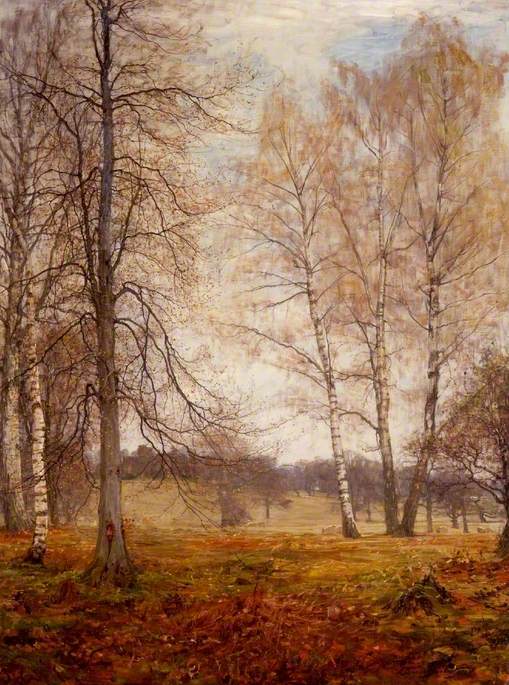


Alexander Brownlie Docharty was born on 8 October 1862 at 5 McAslin Street, Glasgow. 1 This was in the Townhead area of the city near the present University of Strathclyde. He was the second son of Joseph Docharty a pattern designer and his wife Elizabeth Brownlie. Joseph and Elizabeth had married in Calton, Glasgow on 13 June 1859.2 They went on to have three sons and three daughters. At the 1871 census 3, the family was living in Crossmyloof, Cathcart. Joseph Docharty was described as a ‘designer and coal agent’ born in Bonhill, Dunbartonshire.
Alexander left school aged thirteen to work with his father designing calico prints. At the same time, he studied in the evenings at the Glasgow School of Art under Robert Greenlees and in 1878 at the age of fifteen he had a watercolour, On the Cart Pollockshaws hung in the Glasgow Fine Art Institute. It was priced at three guineas.The painting was submitted from 5 Viewfield Terrace. 4
At the 1881 Census, Alexander was living with his widowed mother, grandfather (a retired grocer) and siblings at Langbank, Renfrewshire. He was described as a ‘landscape painter’. The following year he had a painting Arran Cottages hung in the Royal Academy in London. The painting was sent from 113 West Regent Street, Glasgow. 5 However, his attempts to make a living from painting seem to have been premature and he found employment as a designer with the firm of Inglis & Wakefield who had a print works at Busby.
By 1885 however, he had returned to painting and while living at 11 Prince`s Street, Pollockshields he shared a studio with his uncle James Docharty and his cousin also James Docharty at 134 Bath Street, Glasgow. 6 James Docharty, A.R.S.A., was a well-known painter of landscapes who exhibited extensively at the Royal Scottish Academy from 1864 till his death in 1878. He undoubtedly had a significant influence on his nephew Alexander`s decision to try to make his living as an artist.
On 6 June 1890 at Nether Barr, Ayrshire, Alexander married Catherine McKnight a schoolteacher and daughter of a farmer from Kirkconnell, Dumfries. His occupation was ‘landscape and portrait painter’ and his address ‘Maitland, Dailly’. 7
At the 1891 census he was at Nether Barr with his in-laws. In the same census his wife and their new-born son, Joseph, were at 4 Melville Street, Govan with Alexander`s mother and family.
Alexander was among those Glasgow painters who in 1891 appended their names to a petition requesting that the Corporation of Glasgow buy Arrangement in Grey and Black, No. 2: Portrait of Thomas Carlyle by J. A. M. Whistler. 8 This painting was duly purchased (for 1000 guineas!) from the artist and is now in Kelvingrove Art Galleries in Glasgow.
In 1894 Alexander went to Paris where he entered the Academie Julien and studied for a time under Benjamin Constant and Jean Paul Laurens. On his return to Scotland, he went to live and work at Kilkerran in Ayrshire. He painted mainly in oils and spent about fourteen years in Kilkerran in a cottage owned by Sir James Fergusson. 9 One of the works he produced there was shown at the Venice Biennale in 1903 and purchased by the Italian Minister for Foreign Affairs. It hung in the Consulta Palace in Rome. 10
According to the Glasgow Post Office Directory for 1895-96, he still had a business address at 134 Bath Street with a house at Ruglen, Kilkerran, Ayrshire.
In 1901, the family was living at 3 Jane Street, Blythswood Square, Glasgow. Alexander was now an ‘artist (painting) working on his own account’. As well as Joseph there were now two other children, William McK. Docharty, aged 5 and Mary R. Docharty, aged 3. Both children were born in Kirkoswald, Ayrshire. There was also a servant employed who had been born in Dailly. 11
In the early 1900s, Alexander spent his summers in Symington painting at Dankeith, Dundonald and Auchans. 12 He also travelled to the Highlands and the nature of the subjects he depicted is indicated in the titles of a few of his more outstanding works including, Winter in Glenfinlas (1902), Ben Venue (1905) and Lochiel`s Country which was shown at the Royal Academy, London and was purchased by Glasgow Corporation. In 1907, his September, Glen Falloch was exhibited at the Glasgow Institute. It was purchased by Archibald Watson Finlayson of Merchiston (qv) and presented to Glasgow Corporation.13 In 1916 his painting Glen Morriston was sold for 320 guineas by J. and R. Edmiston.
Alexander travelled and painted in Europe especially in Holland and made trips to Donegal in Ireland. In 1903 he went to Paris and then to Italy via the Riviera and on to Naples, Rome, Florence visiting Venice several times. One of his landscapes, Glenfinlas, was hung in the St. Louis International Exhibition of 1904. This may have come about because an uncle, Alexander Brownlie, had emigrated to the USA and in 1904-5 was living at 338 Bloomfield Avenue, Montclair, NJ. He was a member of a flourishing artistic community in the town. (An article in the Montclair Times describes a walking tour of the town which pointed out the homes of turn-of-the-century artists. This included the home of Alexander Brownlie). 14
Alexander Brownlie Docharty was a member of the Royal Glasgow Institute of the Fine Arts and served on the Council of the Institute. In addition, he was president of the Glasgow Art Club from 1911 to 1913 and was a Member of Council thereafter.
In 1915, the Balloch Estate on Loch Lomondside, was sold to Glasgow Corporation and on 2 October 1916, Alexander wrote to the Lord Provost with his offer to ‘paint and present several of the more outstanding views (autumnal and spring) of the park and its surroundings’. (Appendix 1) The five paintings produced were those gifted to the Corporation in 1917. It seems that the first of these had been painted before the acquisition of the estate at Balloch and this may have given him the idea for the remainder.
On 26 July 1926, age 63, Alexander sailed on the Caledonia from Glasgow to New York. He was accompanied by his daughter May Rankine Docharty . They arrived back in Glasgow from New York via Moville in Northern Ireland on 10 October having travelled first class on the California. 15
By 1940 he was living with his daughter at 20 Hyndland Road, Hillhead. 16 He died there on the 12 November 1940 aged 78. 17 However, the death notice in the Glasgow Herald states that he died at 6 Montague Terrace. 18 He was buried in Cathcart Cemetery on 14 November 1940. (His uncle, James Docharty, was also buried there). His wife pre-deceased him and he was survived by a son and daughter. An obituary was published in the Glasgow Herald 19 and his death was also reported in an article in The Scotsman which noted that ‘he took a deep interest in religious work and served as an elder of Glasgow Cathedral’. 20

13 November 1940.
Alexander Brownlie Docharty exhibited widely for almost 60 years including at the Royal Academy (12 works), the Royal Scottish Academy (19) 21, the Royal Society of Painters in Watercolour (5) and the Glasgow Institute (155) 22 as well as at the Walker Art Gallery in Liverpool, the Manchester City Art Gallery and the New English Art Club. His work attracted praise and criticism from various sources. Of his landscapes Caw commented,
‘Painted with gusto, but not without refinement, in frank, fresh and harmonious colour, and good in drawing and design, Brownlie Docharty`s landscapes preserve the aroma of a sincere, if
unimpassioned, love of the simple and everyday aspects of Nature and awakened pleasant memories of the country’.23
Harris and Halsby note that, ‘(He) worked mainly in oil but his watercolours can be fine with good composition and sensitive colour’. 24 The Scotsman reported on four of his paintings exhibited at the Glasgow Art Club Show of 1899; ‘Mr. Brownlie Docharty`s works have always shown him to be an artist in evident sympathy with the tenderer aspects of nature which disclose themselves in woodland and stream, but his sojourn to Holland has added both sweetness and strength to his brush,…. 25
Again in 1912, the same paper reported; ‘One of the most striking landscapes in the gallery is the Falls of Garry by Mr. A. Brownlie Docharty. ……….the rocks are painted with a solidity which would have pleased Ruskin; the foaming water has been carefully studied, and with a dainty brush, the artist has rendered the summer greens of the trees and the glow of the sky’. 26
Alexander Brownlie Docharty`s two surviving children each had their own claim to fame. His son, William McKnight Docharty served with the King`s Liverpool Regiment during World War I and achieved the rank of Captain. He was twice wounded in action and was awarded the Military Cross. 27 He became a keen hillwalker and compiled and published in 1954, a list of the 900 highest mountains in Britain. He was also the second person to complete in 1960 the ascents of all 220 ‘Corbetts’ i.e. Scottish mountains between 2500 and 2999 feet in height. William McKnight Docharty died on 14 July 1968 aged 72. 28
May Brownlie Docharty, who died in 1972, was a gifted player and teacher of contract bridge. She owned and managed the Western Bridge Club in Glasgow which she formed after her father`s death. 29
References
- Scotland`s People , Birth Certificate
- Scotland’s People, Marriage Certificate
- Scotland’s People, Census 1871
- Glasgow Institute of the Fine Arts Exhibitions Catalogues 1877-83. (Mitchell Library).
- Catalogues of the Royal Academy Exhibitions, 1880-89, W. Clowes and Sons., Ltd.
- Glasgow Post Office Directory, 1885-86
- Scotland’s People, Marriage Certificate
- Glasgow Town Council, Sub-committee on Galleries and Museums, 27 February 1891: (see http://www.whistler.arts.gla.ac.uk).
- Eyre-Todd, George, Who`s Who in Glasgow in 1909 Gowan & Gray, 1909, Glasgow. http://gdl.cdlr.strath.ac.uk/eyrwho/eyrwho0513.htm
- venicebiennale.britishcouncil.org/timeline/1903/history/1105/).
- Scotland’s People, Census 1901
- Eyre-Todd, George, Who`s Who in Glasgow in 1909 Gowan & Gray, 1909, Glasgow. http://gdl.cdlr.strath.ac.uk/eyrwho/eyrwho0513.htm
- ibid
- The Montclair Times, 10October 2003. (Also www.brownlee.com.au).
- Ancestry.co.uk, New York Passenger Lists, 1820 – 1957
- Voters` Roll, Glasgow, Hillhead, 1940.
- Scotland’s People, Death Certificate
- Glasgow Herald, 13 November 1940.
- ibid
- The Scotsman, 13 November 1940, p 5.
- Royal Scottish Academy Exhibitors, 1826 – 1990, Hilmartin Manor Press, 1991.
- Premier Paintings, Gairloch (website)
- Caw, Sir James L., Scottish Painting, Past and Present, 1620 – 1908, T.C. & E. C. Jack, Edinburgh, 1908.
- Harris, P. and Halsby, J., The Dictionary of Scottish Painters, 1600 to the present, Birlinn Ltd; 4th Edition, October 2010
- The Scotsman, 6 November 1899, The Glasgow Art Club Exhibition
- The Scotsman, 7 December 1912, The Glasgow Art Club Exhibition
- The Scotsman, 16 October 1918, p7
- http://www.corbetteers.blogspot.com/
- Glasgow Herald 5 May 1972.
Appendix
Glasgow Corporation Minutes, 4 October 1916. C1 3.57, p2002.
There was submitted a letter, of date 2nd instant, from Mr. A. Brownlie Docharty, 3, Jane Street, Blythswood Square, to the Lord Provost, in which he states that the value and beauty of Loch Lomond Park, recently acquired by the Corporation, and its immediate surroundings, might be brought home to many of our working-classes and industrial citizens, if these were depicted on canvas, and, for this purpose, he is willing to paint and present several of the more outstanding views (autumnal and spring) of the park and its surroundings on condition that the pictures be housed together in the People`s Palace, in Glasgow Green, where they would be most likely to come under the notice of the citizens.
The members of the committee unanimously resolved to record their high appreciation of Mr. Docharty`s generous offer, and to accept the same and to award to him, on behalf of the citizens, their most cordial thanks for this handsome gift. It was also agreed that it be remitted to the Convener, Sub-convener, and Councillor Barrie to confer with Mr. Docharty as to the necessary arrangements for the work being executed and to adjust any details with reference thereto.
The gift was accepted by the full committee of the Corporation at their meeting of 18.10.17. “The paintings would, in accordance with the desire of the artist, be housed in the Peoples` Palace in Glasgow Green”.
The Scotsman of October 17 1917, page 5, has the following article, presumably written when the paintings were gifted to the corporation;
“ARTIST`S GENEROUS OFFER TO GLASGOW:- Mr. A. Brownlie Docharty, a well-known landscape artist, has offered to paint for the Glasgow Corporation, several of the more outstanding views of the Loch Lomond Park and its surroundings, on condition that the pictures are placed together in the People`s Palace. In his letter to the Lord Provost, Mr. Docharty suggested that the value and the beauty of Loch Lomond Park might be brought home to the working classes if depicted on canvas. The Parks Committee of the Corporation have recorded their high appreciation of Mr. Docharty`s generous offer and have agreed to accept the gift”.

 Glasgow Museums Art Donors Group