Donation
William Graham Collection
The William Graham Collection consists of approximately 3000 glass negatives, 450 lantern slides bought and donated by Thomas Holt Hutchison in 1916 and originally one and now two volumes of prints 180 of which were bought by purchase in 19121 and others donated later by Mrs Graham and it is thought by other members of the Graham family. 2 The collection is a unique photographic record of different areas of Scotland especially of Glasgow and the includes many buildings which have long been demolished, eminent Glasgow men of the time as well as slums and old stone carvings and photographs of ordinary citizens .3
William Graham was born in Glasgow on February 8 1845 .4 His father, William, was a ‘railway servant’ 5 and his mother was Elizabeth Hamilton. 6 The family home was Little Hamilton Street (Figure 1) off George Square between Frederick Street and John Street.
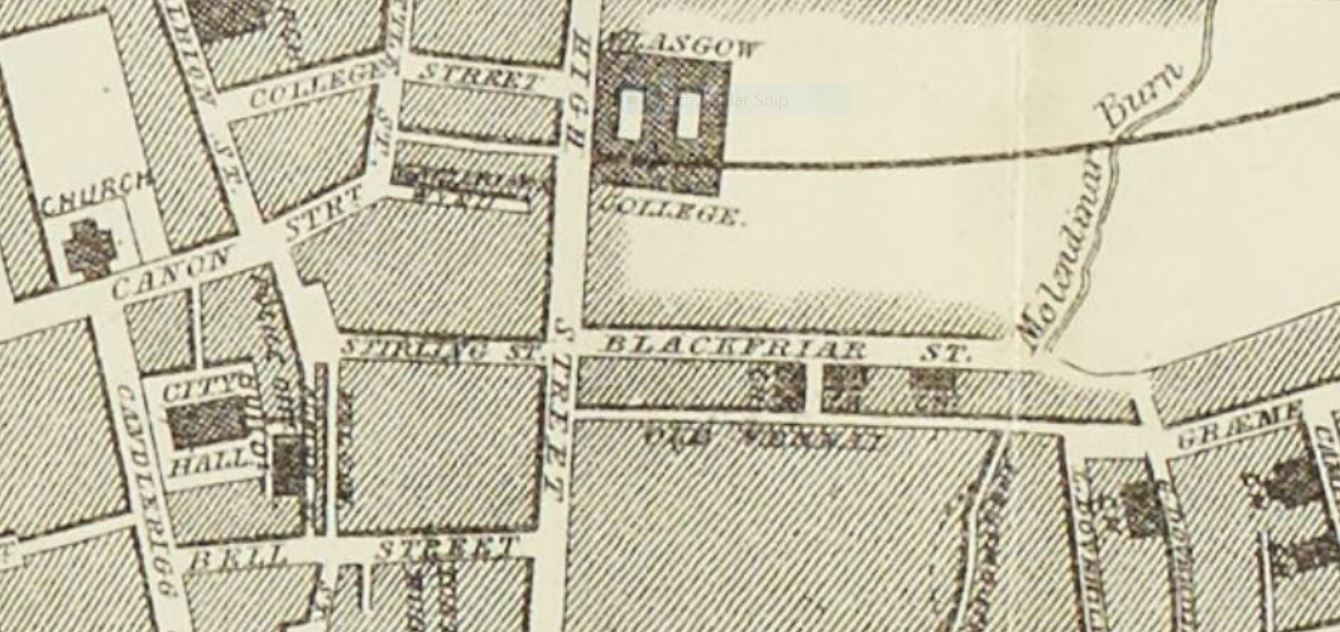

He was educated at St Paul’s Parish School in Stirling Street (Figure 1) off the High Street and later at St Andrew’s Parish School in Greendyke Street.
His first job as a young boy was that of carter’s boy employed by J&P Cameron. William changed occupations several times and was variously a printer working for a well-known Glasgow Printers Bell and Bain, a cooper with Mathers Wine Merchant in Queen Street, a fireman with the Edinburgh to Glasgow Railway and an engine driver with the North British Railway Company (see Figure 2). 7
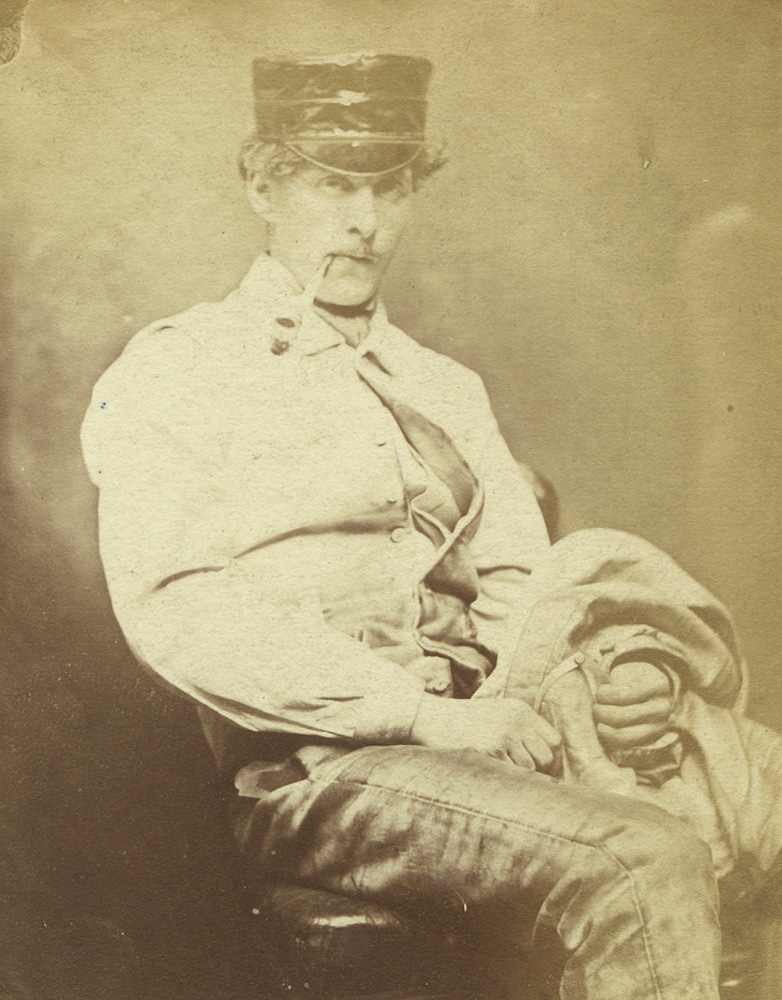
There is also some evidence that somewhere along the line he was also an ‘iron turner’ possibly around the 1870s.8
William was first married to Mary Morton possibly in 1868 9 with whom he had at two children, Elizabeth, who was born at 16 Colgrain Terrace in Springburn in 186910 and William who was born in 1871.11 Eight days after young William’s birth his mother died of puerperal fever. 12 In 1873 William remarried. His second wife was Catherine Wilson and it is on the marriage certificate that the occupation ‘iron turner’ is recorded. Catherine was a domestic servant at the time of her marriage which appears to have taken place at 131 New City Road in Glasgow, the location of her father’s grocery business. 13
According to the 1881 census William, Catherine and twelve year old Elizabeth were living at 29 Portland Street. This was probably during William’s time with Mathers Wine Merchants .14 There is no mention of son William so perhaps he did not survive long after his mother’s death. By the time of the 1891 census Catherine and William were living at 4 Colgrain Terrace in Springburn and William’s occupation was that of ‘engine driver’ with the North British Railway Company. 15 After a series of strikes in 1890-1891 William was sacked from his job and went into business as a photographer ,having been an enthusiastic amateur for many years. He set up a studio in Vulcan street in Springburn. 16 The couple had moved to 468 Springburn Road by the time of the 1901 census in which William’s occupation was described as ‘photographic artist’ and which remained the family home.
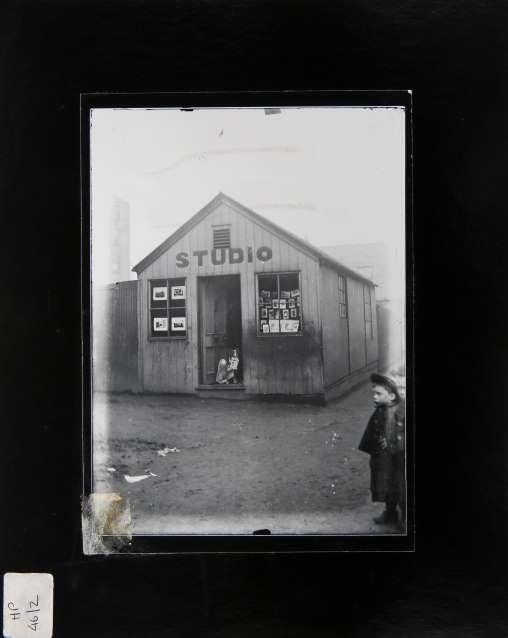
William was a friend of another amateur photographer ,Duncan Brown ,who had acquired a reputation for his work in the 1850s and 1860s 17(see Fig 2).
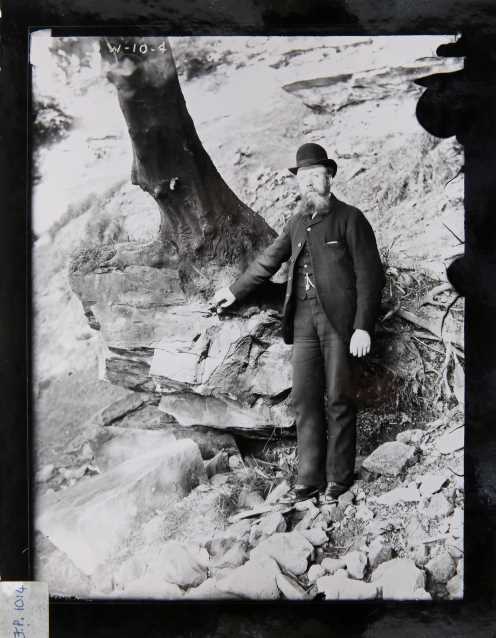
William was a freemason and a founding member of the Old Glasgow Club which was founded in 1900 and which met in the Trades Hall in Glassford Street. 18 The aim of the club was to inform members of Glasgow’s history, architecture etc in the form of papers presented by members and guests. William contributed himself. For example on 21 February 1910 he gave a talk illustrated with his photographs entitled ‘Inscribed Sculptured Stones in and around Glasgow with Lime-Light Illustrations.’ 19 He had friends in Glasgow’s artistic community for example watercolourist William Young RSW (1845-1916). They often went for walks together and Graham took photographs while Young painted. The photograph of William Graham (Figure 3 below) was taken on a walking trip in September 1909 to the Peel of Drumry near Drumchapel. 20
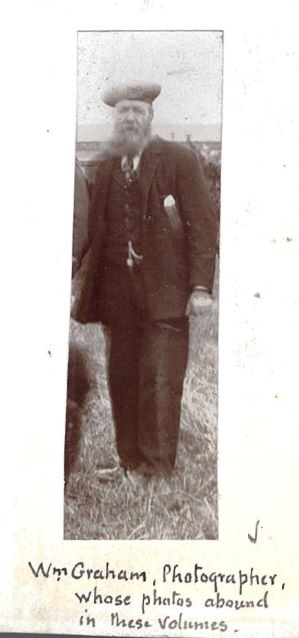
© csglasgow.org
In 1914 in a letter to the Club Secretary William suggested the Club might acquire ‘certain photographs taken by him of Old Glasgow Buildings and other items of interest…’.However William had died before this offer could be discussed. Whether ‘acquire’ meant purchase is unknown. 21
There is little information as to how financially successful was William’s business . His talents as a photographer certainly did not go unnoticed by the press . The Weekly Herald reported in February 1913, ‘Mr William Graham, photographer,…is well known in the city…his pictorial stories have been frequently called on to supply material for illustrated lectures and they are always available for the newspaper press of the city’. 22 We know he had financial dealings dealings with George Outram & Co, owners of the Glasgow Herald, as he took a photograph of a cheque from Outram’s for photographs he had taken of the 1911 Glasgow International Exhibition. 23 There is little information about William or Catherine and their day- to- day life but William Graham will always be remembered for his hundreds of photographic prints and plates which form the William Graham Collection .
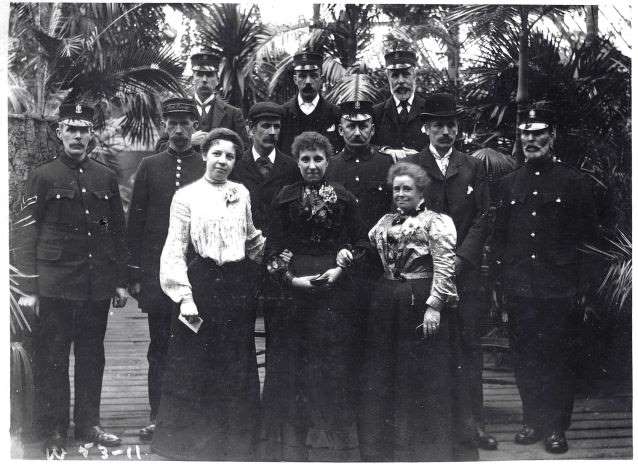
Photographer William Graham. William Graham Collection. © csglasgow.org
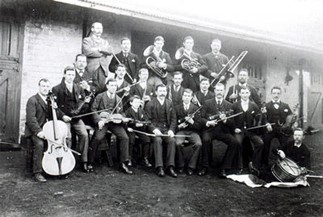
Photographer William Graham. Burrell Collection Photo Library. ©csglasgow.org.uk
William Graham died at the age of 69 on July 22 1914 at his home in Springburn of arterial sclerosis. 24 Catherine lived until 1921 and died at the family home at 468 Springburn Road. On her death certificate it is stated that Catherine was the widow of ‘William Graham iron turner’ with no mention of her husband’s photographic career or his railway years. 25
Donor. Thomas Holt Hutchison (1861-1914)
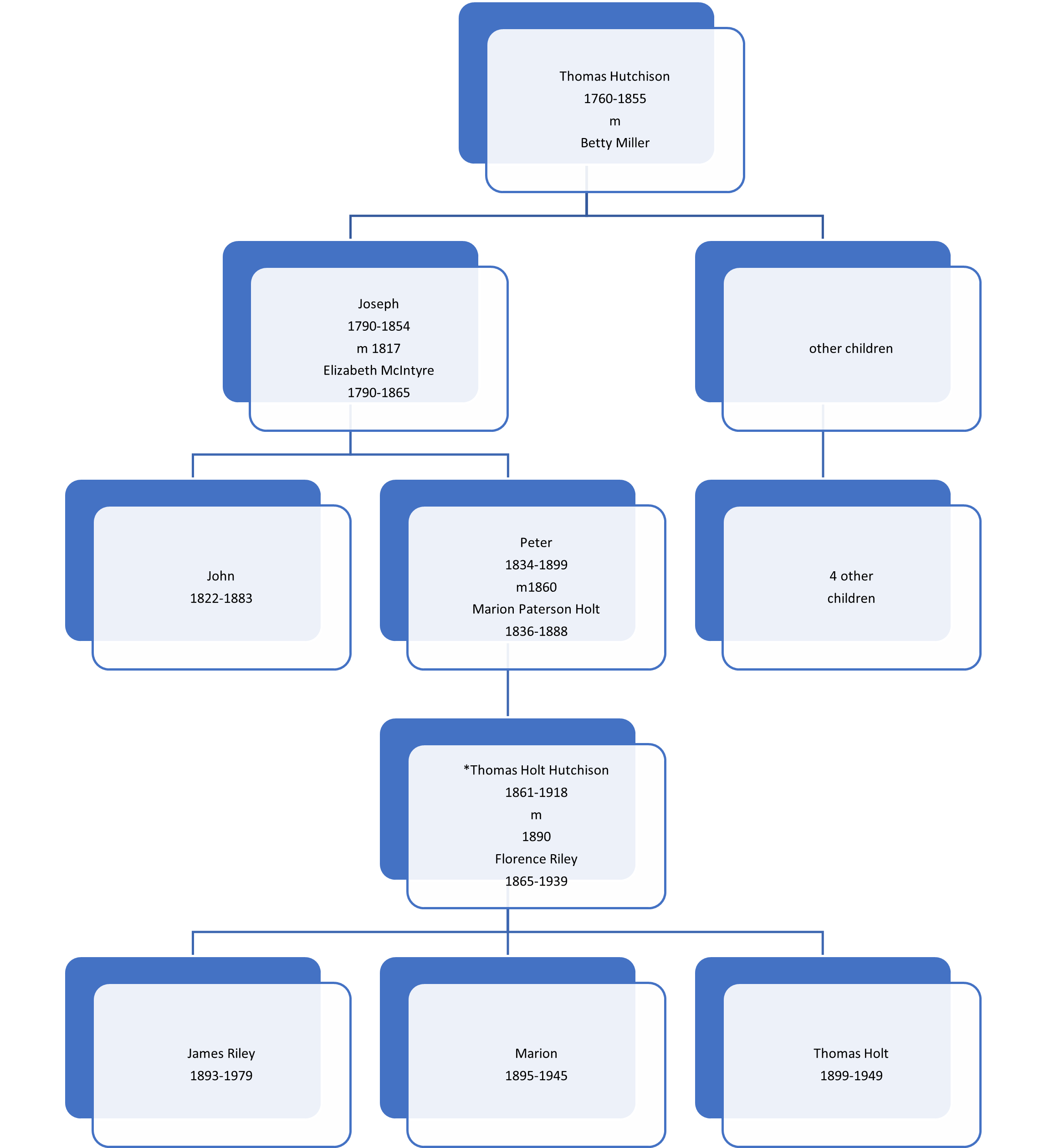
The Hutchison family came from Perthshire. Our donor’s great-grandfather Thomas Holt(1760-1855) was a tailor who in 1784 married Betty Miller, daughter of a mason. 26 Among their children was Joseph (1790-1854) who by 1835 was running a ‘comb warehouse ‘ at 36 High Street in Glasgow. 27 This business had expanded into that of ,’comb manufacturer, jeweller, hardware merchant and importer of foreign goods, wholesale’ by 1841. and was at 25 St Andrews Street near St Andrews Square. 28
By 1851 Joseph was living at 35 St Andrews Square with his wife Elizabeth ,formerly McIntyre,(1790-1865) and four children of whom John was born in 1822, and our donor’s father Peter in 1834. Joseph is described in the 1851 census as a merchant who employed 23 men. 29
Thomas Holt Hutchison (THH) (1861-1918)
Early Life and Education
Our donor was born on 19 February 1861 at 211 Sauchiehall Street, Glasgow the home of his parents Peter Hutchison and Marion Paterson Hutchison(or Holt).30Thomas was the eldest of five surviving children. Elizabeth was born around 1863, Joseph around 1865, Jeanette around 1867 and Marion around1870.31 By 1865 the family home was 15 Charing Cross which was off Sauchiehall Street at the junction of Woodside Crescent and Sauchiehall Street but which today has been replaced by the M8 motorway complex. 32
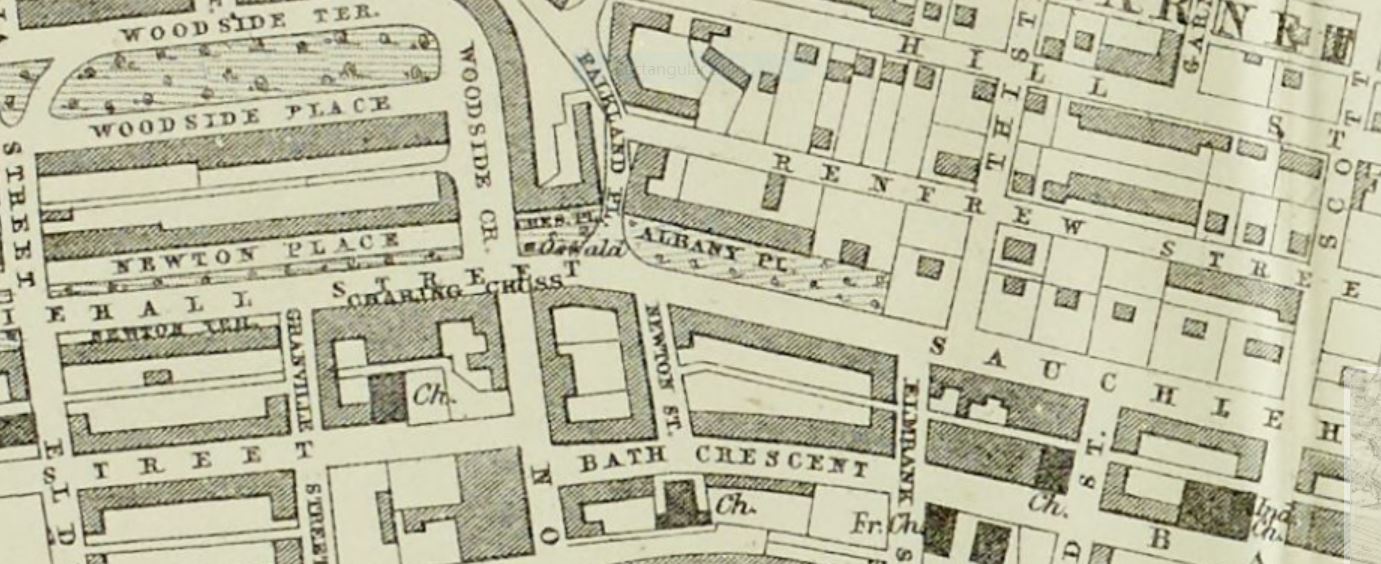
J.G. Bartholomew © NLS
The family had moved to Berkley Street by the time of the 1871 census in which THH was reported to be ‘a scholar’ .33
His obituary states that THH had his early education at the old Albany Academy and then at Glasgow Academy. 34 Albany Academy, a private school for boys, was opened around 1871 at 328 Sauchiehall Street 35 and then in 1876 moved to 44 West Cumberland Street( later changed to Ashley Street) off Woodlands Road to a new school building designed by architects H&D Barclay which was described as ‘More like a city mansion than a school.’36 Hence the reference to the ‘old Albany Academy’. The building still stands today and is a Community Volunteer Centre. The headmaster was James N. McRaith, formerly an assistant teacher of English at Glasgow Academy (see below).37
THH was enrolled at Glasgow Academy in Elmbank Crescent, aged twelve ,for the 1873-4 academic year in Class 4L so he probably attended Albany Academy before it was moved. 38 Glasgow Academy was a private school founded in 1845 by, ‘a number of gentlemen connected with the Free Church’ one of whom was the Reverend Robert Buchanan .39 The building was designed by Charles Wilson and situated in Elmbank Street off Sauchiehall Street.40 These premises were opened in 1847 but the school was moved to Kelvinbridge in 1878 after the Elmbank premises were sold to the Glasgow School Board. During our donor’s time at Glasgow Academy the rector was Donald Morrison MA LLD who was rector from 1861 to 1899. Although originally a boys only school it is now co-educational. 41 THH remained at Glasgow Academy for three academic years while the family were living in nearby Berkley Street and left in 1896 at the age of fifteen. 42
After leaving school THH travelled and studied in France and Greece before entering the family ship- owning business of J&P Hutchison. 43 The family had moved to 3 Lilybank Terrace in Hillhead by 1881 and this remained the Glasgow home of THH’s parents and where THH lived until his marriage and where his mother Marion died in 1888.44
Like many young men of the time THH joined one of the many volunteer companies which were founded after 1859 at the end of the Crimean War when the British Government became concerned about home defence at times when most of the regular army was abroad fighting various wars.4 5 These volunteer companies underwent several amalgamations and name changes in the late nineteenth and early twentieth centuries according to the various government initiatives of the time. We do know that THH joined the 19th Lanarkshire Corps as a 2nd Lieutenant in 1879,46 was promoted to Captain in the renamed 5th Lanarkshire Regiment(2nd Northern Company) in 188247 resigned his commission in 188448 only to be made Captain again in April 1885.49 This regiment eventually became the 5th(City of Glasgow) Battalion the Highland Light Infantry50 in which THH served for eight years.
Business Career
According to the 1881 census THH ,aged 20, was working as a shipping clerk, presumably in the family business of J &P Hutchison. At this time the business was based at 69 Great Clyde Street. 51 J&P Hutchison was founded around 1869 by our donor’s uncle John Hutchison who was joined in the enterprise by his brother Peter, our donor’s father. 52 The company’s ships traded with Ireland ,France and Portugal as well as around the coast of Scotland. 53 When Peter Hutchison died in 1899 the company had majority shareholdings in approximately thirteen ships. 54 THH became sole partner in the company in September 1911.55 In 1919 the company was taken over by The Royal Steam Packet Company and later became part of the Moss Hutchison Line. 56
THH had many other business interests and investments including shares in the Caledonian Railway Company, J&P Coats Ltd, The Lanarkshire Steel Company Co Ltd, The Ailsa Shipbuilding Company of which he was a director and The Galway Granite Quarry and Marble Works Ltd to name but a few. 57 The Hutchison family also owned several tenement properties in Glasgow which were rented out for example several tenements around Dumbarton Road in Partick. 58
Public Service
THH , following his father Peter’s example, served on Glasgow City Council. 59 After many invitations in 1910 THH agreed to stand for and was elected one of the councillors for Park Ward and in 1915 became a Bailie.60 Possibly his most valuable contribution was during his chairmanship of the Libraries Committee where he was instrumental in setting up the Commercial Library, the first such library in Britain outside London which was open to the public. The idea was first suggested in October 1913.61
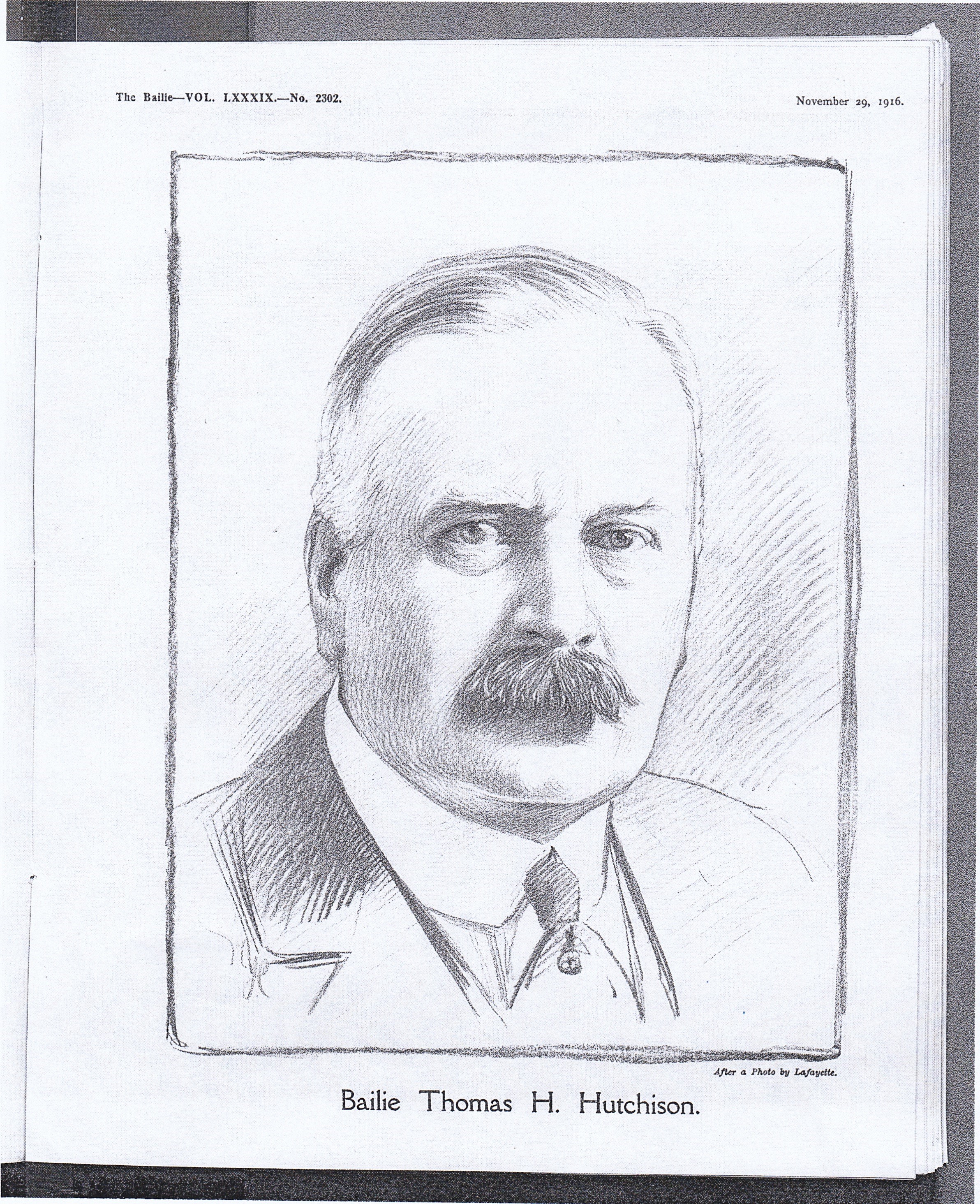
The first Commercial Library was to use part of the Stirling’s Library at 21 Miller Street, which had formerly housed the Mitchell Library before it was moved to its current premises in North Street ,Charing Cross. The City Librarian was encouraged to ‘utilise as far as possible furniture, books ,periodicals etc already available in the City Libraries and to add such further books etc and minor fittings as necessary’.62 The City Librarian had visited the London Chamber of Commerce , the Imperial Institute and the Guildhall Library for information and assistance in setting up Glasgow’s Public Commercial Library. 63 A booklet was produced to describe the library and its function. Four thousand copies were printed at a cost of £22.64
The Commercial Library was formally opened by the Lord Provost on 3 November 1916 ,’ with a large and representative attendance of businessmen’.65 The library was intended to serve the needs of local industry and commerce with ‘business directories, telephone directories with world- wide coverage, book stock on company law, economics, insurance, taxation, trade publications, patents and trade -marks for the UK and overseas and newspapers and statistical publications’. 66 One of the councillors paid tribute to Bailie Hutchison’s ‘zeal and energy…in helping to establish and develop this Commercial Library’. 67
There were 15,000 enquirers and visitors in the first few months and it was decided more books and other materials were needed .68 By March 1917 all four thousand copies of the Commercial Library pamphlet had been distributed and the Libraries Committee agreed that a second edition be published. 69 In 1955 the Commercial Library, along with Stirling’s Library, was moved to to the former Royal Bank of Scotland building in Queen Street which had been bought by Glasgow Corporation in 1949 and remained there until its closure in 1983 when its function was transferred to the Mitchell Library. 70 THH was also responsible for the building and opening of Langside Library which was the first in Glasgow to experiment with the open access method and which proved to be such a success that the system was adopted throughout the city, overcoming the prediction in some quarters that the result would be “all sorts of sacrilege, destruction and even theft. 71
THH also took a deep interest in the Glasgow Trades House and in September 1917 was elected Deacon Convenor of the Incorporation of Hammermen. He was treasurer of the Hillhead United Free Church ‘and gave valued service to several philanthropic institutions’.In 1915 he was elected to the Magistrates Bench. 72 He was a well-respected magistrate and councillor and remained on Glasgow Corporation Council until 1918.73
Family and Home Life.
In 1890 THH married Florence Riley at the Church of Scotland in Uddingston. Florence was the daughter of James Riley, general manager of the Steel Company of Scotland whose home was Brooklands Villa in Uddingston.74 The couple began married life at 4 Windsor Quadrant(now Kirklee Quadrant) in Kelvinside where they remained until around 1897-1898.75 The building was a red sandstone tenement block which was built in the later 1890s 76 and rent was £105 per year plus £20 feu duty.77 During this period Florence gave birth to a son, James Riley in 1893 and a daughter Marion, known as Maisie, born in 1895. 78 The Hutchisons moved to 16 Crown Terrace in Dowanhill, around 1898- 1899 where a second son Thomas Holt was born in 1899.79 16 Crown Terrace was one of a row of terraced houses designed by James Thomson and built around 1880 consisting of two floors ,an attic and a basement. 8016 Crown Terrace remained their Glasgow home until the death of THH in 1918.81
The Hutchisons also had a country home. Sometime before June 1910 82 the Hutchison’s had become tenants of Cranley House and Estate near Carstairs, which was rented along with two other shooting estates. One can presume that THH enjoyed shooting, a fashionable pastime among the rich at the time. Cranley was owned by the Monteith family. 83 The Hutchisons appear to have played a full part in the local community with many references in local newspapers to participation in local events such as Mrs Hutchison’s attendance at the Carstairs Horticultural Society Flower Show 84 and THH’s participation in local political meetings such as that to support the prospective Unionist Candidate for South Lanark in November 1912.85
World War One
THH continued his involvement in the Volunteer Movement during WW1 and was a Major commanding the Third Battalion Lanarkshire Volunteers attending such events as a Parade Inspection at Lanark .86 He was also involved in the formation of the Biggar Company of the Third Lanarkshire Volunteers. 87
The Lanarkshire Volunteer Regiment was part of the World War One equivalent of what was to become the Home Guard during World War Two. The Volunteer Movement had been replaced in the Haldane Act of 1908 by the Territorial Movement, with each volunteer regiment being attached to a regiment of the Regular Army. When World War One broke out many of the Territorial Regiments went to fight with the Regular Army leaving the Home Front with little defence. At the outbreak of the war there had been calls from those under or over the age of enlistment or those unable to enlist for other valid reasons to form volunteer battalions to be trained for home defence in case of invasion. These ‘civilian defence companies’ were organised all over the country and were largely self -financing through membership fees. At first their value was not officially recognised by the War Office as it was thought these civil defence companies would deter recruits from enlisting in the regular Army. However it was gradually realised that these men could carry out duties which would free up trained troops. The Central Association of Volunteer Training Corps (VTC) was set up in London to coordinate these civilian defence groups with a similar body in Scotland. There was much public and press pressure to have official recognition of the VTC. 88
The Scottish Volunteer Association (SVA )was formed in the spring of 1915 under the presidency of Lord Roseberry and was officially recognised by the War Office in May 1915. The aim of the SVA was to co-ordinate and supervise the volunteer movement in Scotland. A communication was sent to Lord Provosts, Provosts of all burghs in Scotland and to the Lord Lieutenants of all counties to bring all the volunteer forces within their respective areas in touch with the new organisation. 89
In March 1916 due to the introduction of conscription and much public pressure the dormant 1863 Volunteers Act was reinvigorated and regulations were drawn up by the War Office to organise the Volunteer Training Corps which was to be organised strictly on a county level and administered by the Lord Lieutenant of each county. Recruits had to be 17 with ‘no alien to be enrolled’. Commissions were to be temporary and the VTC were eventually allowed to wear the khaki uniform with a red armband inscribed with the letters ‘G R’. So at last the former civilian defence organisations became volunteer regiments named after the county concerned. The demands upon the services of the VTC grew and they were used for example to guard munitions factories, on the rail network and to bring in the harvest.90
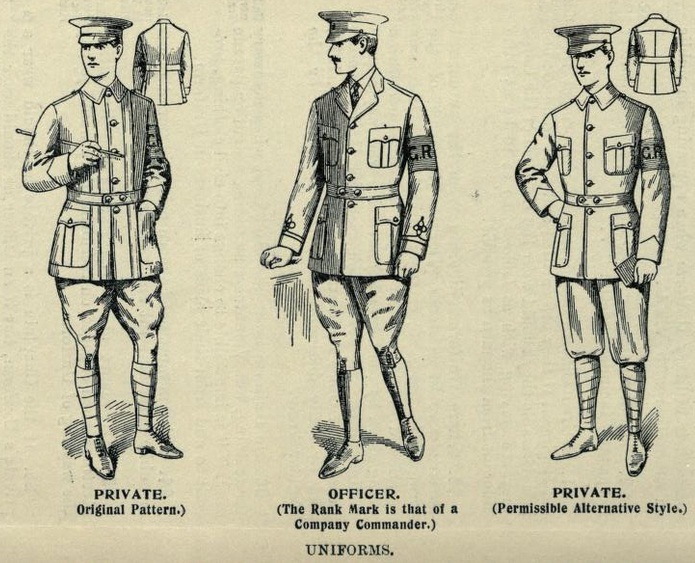
Central Assoc Volunteer Corps ©Public Domain
The VTC trained regularly in Drill Halls, took part in many shooting competitions and had to attend summer training camps, for example at Lanark Race Course.91 Some members of the public did make jokes rather unkindly about the VTC referring to the ‘GR’ as meaning ‘Grandpa’s Regiment’ or ‘Government Rejects’. But by July 1918 they were being issued Enfield Rifles and Hotchkiss Mk 1 machine guns by the War Office. 92
Florence Hutchison, along with her daughter Maisie, also contributed to the war effort from Cranley by being one of the founders of the local Red Cross Society. They helped to recruit seventy volunteers who knitted socks and other garments for soldiers. 93 In 1915 they played a role in the National Egg Collection, an appeal for one million eggs ‘for our wounded soldiers and sailors’. The Hamilton Advertiser reported Mrs Hutchison’s thanks to local farmers for contributing 404 eggs which were sent to London. 94 They also entertained convalescing soldiers at Cranley. 95 Maisie became secretary of the Red Cross Society and her work was greatly valued. 96 She married Lieutenant J. E. Glynn Percy at Carstairs Parish Church in March 1918.97
THH’s two sons, James Riley Holt and Thomas Holt also played their part in the war. James Riley Holt obtained a commission in the Lanarkshire Yeomanry at the outbreak of the war and was later attached to the 19th Lancers in France after which he transferred to the 17th Cavalry in India . He also had a distinguished career in World War Two serving with the French Resistance and was awarded the DSO. After the war he became Conservative MP for Glasgow Central and was awarded a baronetcy. 98 The younger son, Thomas Holt, had to wait until March 1918 when, aged 18, he joined the Royal Naval Air Service as a Probationary Flight Officer. 99
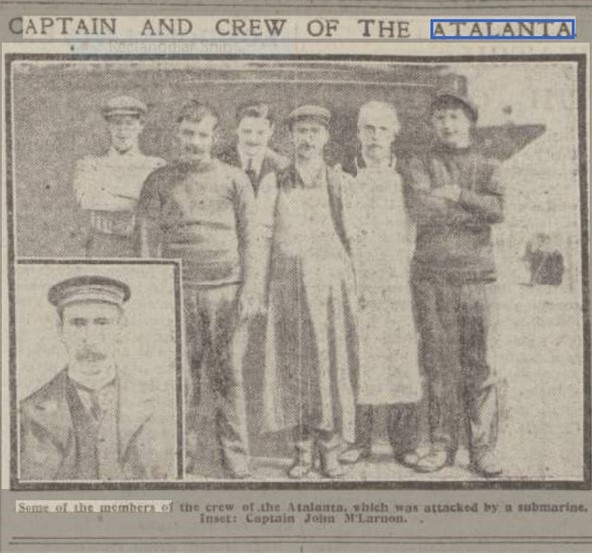
The J&P Hutchison shipping fleet also played its part by transporting Red Cross goods and ambulances to France free of freight charges 100 and suffered casualties with at least three ships being lost. The Chloris and the Dartmoor appear to have been lost or badly damaged as compensation was paid by the British Government. 101 The Chloris had been torpedoed off Flamborough Head on 27 July 1918 with the loss of three lives including that of the master.102 The Atalanta, sailing from Galway to Glasgow with a cargo which included coal, timber and scrap iron, was torpedoed off the coast of Connemara on 14 March 1915 but the crew of sixteen who were all from Cushendall in County Antrim managed to escape by lifeboat. 103 The ship ,though taking, water was towed to harbour and the damage later repaired .104
Thomas Holt Hutchison died at Cranley on 22 June 1918 aged fifty -seven of pernicious anaemia 105 so did not live to see the end of the war. The Hamilton Advertiser reported that his death ,’ was not unexpected ,none the less it was a surprise to the community’. At the beginning of the proceedings of the Northern Police Court in Glasgow just after his death THH was paid a tribute by Bailie John Bryce who referred to his death as ,’a great loss to the city’ 106 THH was buried at the Glasgow Necropolis on 25 July 1918.107
In 1921 Mrs Hutchison and the Hutchison Family presented an organ to Carstairs Parish Church in memory of Thomas Holt Hutchison. 108
Notes and References
1. Glasgow Corporation Minutes 10/12/1912 p. 312
2. William Graham Collection. Mitchell Library Special Collections
3. William Graham Collection www.csglasgow.org.uk
4. http://www.scotlandspeople.co.uk Old Parish Registers. Births.
5. www.scotlandspeople.co.uk Old Parish Registers. Deaths.
6. op cit ref 4
7. The Times 04/08/1914 . William Young Collection. www.csglasgow.org.uk
8. www.scotlandspeople.co.uk Statutory Marriages. William Graham to Catherine Wilson 1873
9. www.scotlandspeople.co.uk Statutory Marriages. William Graham to Mary Morton 1868
10. www.scotlandspeople.co.uk Statutory Births. Elizabeth Graham 1869
11. http://www.ancestry.co.uk UK Census 1871
12. www.scotlandspeople.co.uk Statutory Deaths. Mary Graham or Morton 1871
13. op.cit ref 8
14. www.ancestry.co.uk UK Census 1881
15. as above 1891
17. as above
18. Minutes of the Old Glasgow Club . Mitchell Library Archives.
TD1541/1 1905-23 OGC Volume 1.1900
19. Transactions of The Old Glasgow Club .Vol 2 1908-12 p.112 pub Aird and
Coghill 1913. Mitchell Library Archives
20. William Young Collection. Sketchbook 25. www.csglasgow.org.uk
21. op cit ref 18 24/04/1914
22. Weekly Herald 13/02/1913
23. op cit ref 3
24. www.scotlandspeople.co.uk Statutory Deaths William Graham 1914
25. as above Catherine Graham or Wilson 1921
26. www.scotlandspeople.co.uk Old Parish Registers Marriages 1784
27. Glasgow Post Office Directory 1835-6
28. as above 1841-2
29. www.ancestry.co.uk UK Census 1851
30. www.scotlandspeople.co.uk Statutory Births Thomas Holt Hutchison 1861
31. as above
32. Glasgow Post Office Directory 1865-6
33. www.ancestry.co.uk UK Census 1871
34. Hamilton Advertiser 29/6/1918 p.5
35. Glasgow Post Office Directory 1871-2
36. McKean Charles et al. Central Glasgow :An Illustrated Architectural Guide RIAS 1993
37. MacLeod, Ian The Glasgow Academy 150 Years. The Glasgow Academicals’ War Memorial Trust 1997. P27
38. Glasgow Academy Archives
39. op cit MacLeod p1
40. as above p.4
41. op cit ref 37
42. op cit ref 38
43. Carluke and Lanark Gazette 29/06/1918 p.1
44. www.ancestry.co.uk UK Census 1881
45. Grierson, James Records of The Scottish Volunteer Force 1859-1908.
Blackwood 1909.Pp 143-146
46. London Gazette 23/12/1874
47. Naval and Military Gazette 20/12/1882
48. as above 2/01/1884
49. Army and Navy Gazette 18/04/1885
50. op cit ref 45
51. Glasgow Post Office Directory 1868-9
52. as above 1869-70
53. North British Daily Mail 13/03/1873 p.8
54. www.scotlandspeople.co.uk Will of Thomas Holt Hutchison
55. Galway Express 4/11/1911 p.4
56. Middlemiss, Norman “Forgotten Fleets”. Shipping Today and Yesterday.
12/01/2021
57. op cit ref 54
58. www.scotlandspeople.co.uk Valuation Rolls 1895 Peter Hutchison
59. Glasgow Herald 8/09/1899
60. Hamilton Advertiser 29/06/1918 p. 5
61. Glasgow Corporation Minutes. April-November 1913 p 2722
62. as above 1916 p. 2710
63. as above p. 2211
64. as above November-April 1917 p. 168
65. Daily Mail and Record 4/11/1916 p. 6
67. op cit ref 65
68. op cit ref 64
69. Glasgow Corporation Minutes. 14/03/1917 p. 960
70. as above
71. The Bailie. Men We Know. No 2302 p3. November 29 1916
72. Carluke and Lanark Gazette 29/06/1918 p.1
73. Domesday Book of Glasgow: Members of the Council . Mitchell Library
Archives C/8/3
74. www.scotlandspeople.com Statutory Marriages
75. www.scotlandspeople.com Statutory Births Marion Hutchison 1895
76. Urquhart, Gordon R. Along Great Western Road. An Illustrated History
of Glasgow’s West End. Stenlake Publishing. 2000
77. www.scotlandspeople.com Valuation Rolls 1895 Thomas Holt Hutchison.
78. as above Statutory Births. Thomas Holt Hutchison 1899
79. Glasgow Herald 5/10/1899 p1
80. Small ,Sam Greater Glasgow p.45 published R.I.A.S. 2000
81. op cit ref 54
82. Carluke and Lanark Gazette 25/06/1910 p. 3
83. www.scotlandspeople.com Valuation Rolls 1915 Thomas Holt Hutchison
84. op cit ref 82
85. Carluke and Lanark Gazette 30/11/1912
86. as above 15/09/1917 p.2
87. Carluke and Lanark Gazette 10/03/1917 p.2
88. www.en.wikipedia.org/wiki/Volunteer_Training_Corps
89. Milngavie and Bearsden Herald 21/05/1915 p. 6
90. Daily Record and Mail 4/11/1916 p. 6
91. Carluke and Lanark Gazette 01/09/1917
92. www.en.wikipedia.org/wiki/Volunteer_Training_Corps
93. Hamilton Advertiser 29/08/1914 p.5
94. Hamilton Advertiser28/08/1915 p.5
95. Carluke and Lanark Gazette 14/08/1915 p. 2
96. Hamilton Advertiser 29/06/1918 p. 5
97. Carluke and Lanark GazetteL 16/03/1918 p.5
98. The Times 19/11/1979 p. 26
99. UK Navy Lists 1888-1970 April 1918 p.97
100. The Bailie. Vol LXXX1X. 19/11/1916.Men We Know 2302
101. op cit ref 54
102. www.naval_history.net/ww1LossesBrMS1918htm
103. Daily Record and Mail 18/03/1915 p.3
104. Daily Record and Mail 19/03/1915 p.3
105. www.scotlandspeople.co.uk Statutory Deaths
106. op cit ref 96
107. Glasgow Herald 26/06/1918 p.5
108. CLG 03/06/1921 p.3
Acknowledgements
Thanks to the following for the help given in the production of this report:-
Staff of the Glasgow City Archives and Special Collections at the Mitchell Library Glasgow, the National Library of Scotland, Glasgow Academy Archives and Glasgow School of Art Archives.

 Glasgow Museums Art Donors Group