Harry McShane, Socialist Activist 1891 – 1988
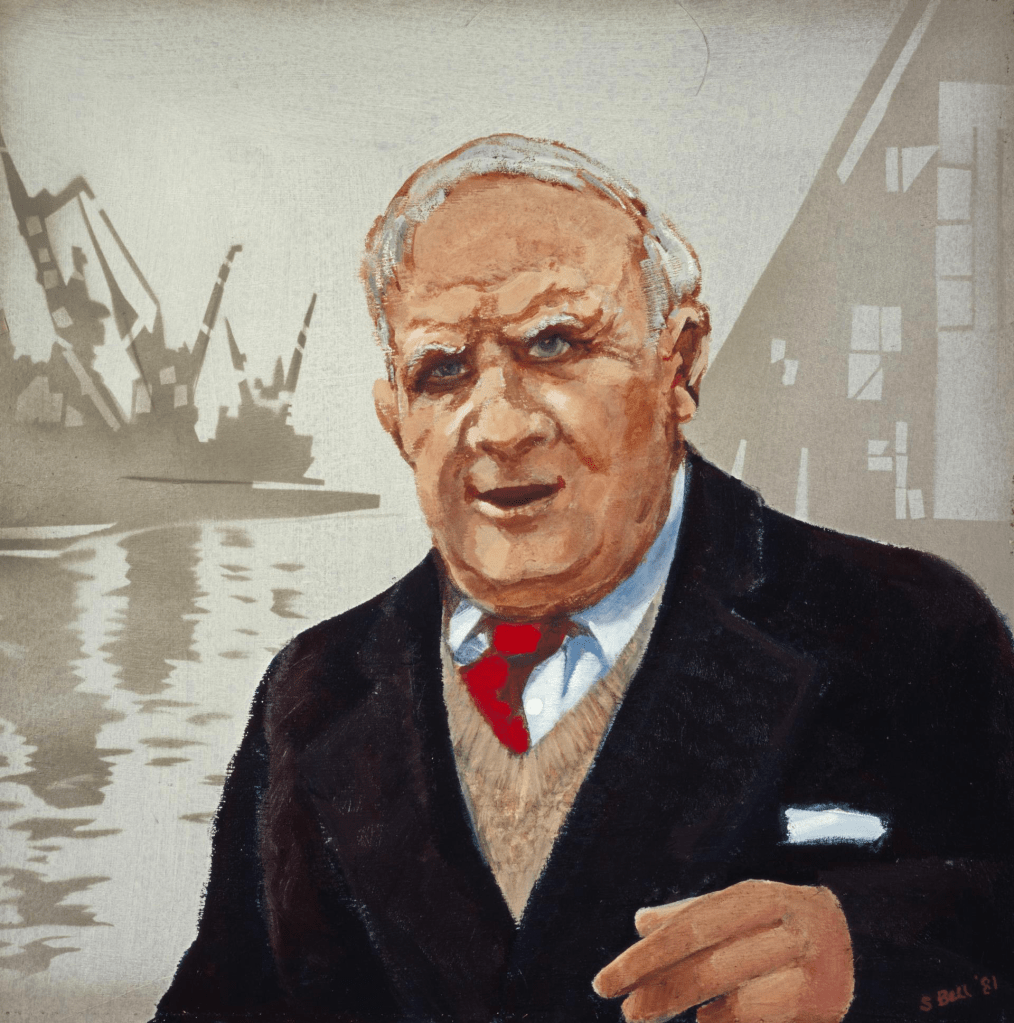
Harry McShane 1891-1988 Socialist Activist
Artist – Stanley Bell,1981
National Gallery of Scotland
‘He became a revolutionary Marxist in 1908 and he died a revolutionary Marxist in 1988.’
Thus Paul Foot described Harry McShane, going on to call Harry an agitator in the struggle between the classes. ‘He made up his mind very early on that the socialist society he wanted was not going to be made by anyone for the workers, it was going to be made by the workers or not at all’. (1)
Harry McShane lived in Glasgow for almost a century, living and working within the city throughout most of this time, witnessing first hand and being actively involved in many of the significant events of the movement.
Early Life
Harry McShane was born on 7 May 1891. (2) His father, John McShane, was from an Irish Catholic family. McShane’s paternal grandparents came from County Tyrone in Northern Ireland. His mother, Janet Sanson, was from a family who were originally from Edinburgh. They were a Protestant family. The couple met and married in Glasgow. Janet worked in a fish hook factory in Glasgow. John was a mason’s labourer. (3)
Harry McShane wrote about the problems facing those who entered into mixed marriages in the 1900s. Both Catholics and Protestants disapproved of such marriages. When he was a few months old his parents separated and his father took him to live with his grandparents. Harry stated that the differences in the marriage were about status as well as religion. Harry’s father and grandfather were builders’ labourers. His maternal grandfather, Tom Sanson, was a blacksmith, a skilled worker, and was also a member of the Church of Scotland. McShane stated that Tom Sanson was very anti Catholic.
The separation between Harry’s parents did not last long. John McShane went back to his wife and they went on to have ten more children. They never separated again. Harry, however, stayed with his grandparents and rarely saw his mother, although his father came regularly to visit him at his grandparents and took him out a lot. He was brought up as a Catholic. (4)
Family Life
Compulsory education in the 1890s began at six, but Harry started school at five. He remembered that he wore shoes to school, while most of the other children had bare feet. Harry had a shaky start at the local school in the Gorbals – ‘ My first day, I saw a teacher hitting a boy’s bare leg with a cane. Then, to make matters worse I lost my road home.’ His grandparents decided not to send him back to that school. They moved from Gorbals to Tradeston, to a house where Harry could have his own bedroom, and he was sent to St Margaret’s in Kinning Park, where Harry got what he described as his ‘meagre Catholic education’. He described a cruel regime at the school, although he acknowledged that there were some good teachers there. Harry’s father’s influence on his education was significant. He encouraged him to read and also influenced what he read, steering him away from boys’ stories to more serious reading, such as the essays of Macauley.
Harry describes buying books to read: ‘ There was a string of barrows right along the riverside then, with second-hand tools and books – this was before Barrowland grew up in the East End of Glasgow’.
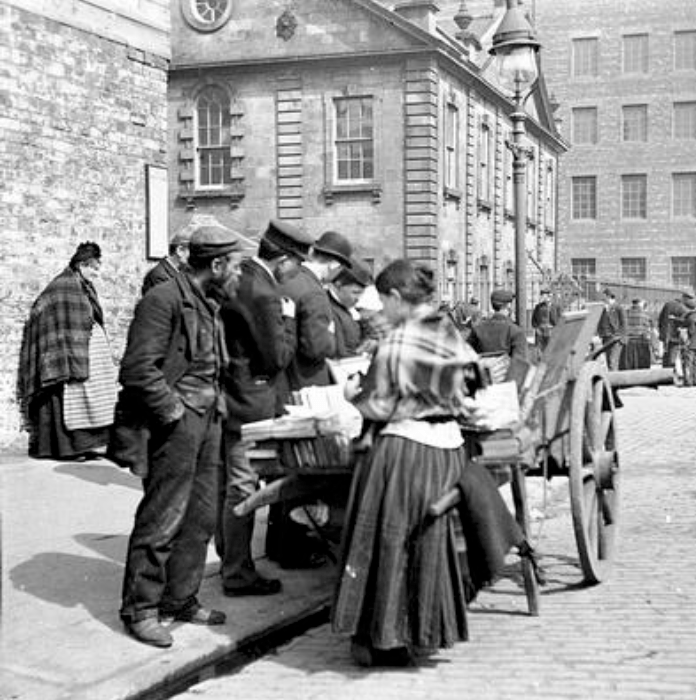
Book Barrow in Greendyke Street c 1916
Glasgow City Council. Glasgow Museums
Harry also remembered being told at school that for his knowledge of English he should read Macaulay’s essays and the Glasgow Herald. Many of his grandparents’ generation were illiterate, not uncommon at the time, as many of that generation would not have attended school as children. He described people coming to his grandparents’ house so that Harry could read reports from the newspapers to them. (5)
Harry started a relationship with Jean Johnstone when he was aged eighteen. She lived in the next close to him and Harry described her as ‘the best-looking girl in the whole place’ Their social life consisted of visits to music halls and theatres, with an occasional visit to a restaurant. They married in 1915. (6) His wife attended Communist Party Meetings when they were first married.
Political Awakening
Growing up, Harry would have been aware of working life around him. He recalled playing around the Kingston Docks near to where he lived in Tradeston. Harry’s father and grandfather were both involved in the union movement. Originally they were members of the Workers’ Union, which eventually merged into the Transport and General Workers Union after the First World War. Harry had an awareness of politics, both British and Irish, and the union movement from an early age. He attended meetings and debates from his early teenage years onwards. Glasgow Green on a Sunday was where debates and speeches would be heard. Large numbers of people would attend these gatherings, which began at noon and went on until nearly ten o’clock at night. Harry described hearing arguments during these debates and following them up by visiting the Mitchell Library to find books on the issues he had heard discussed. When he left school, the priest and others tried to persuade him to go to St Mungo’s Academy, but he resisted as he wanted to start work. His grandparents agreed with him and they and his father encouraged him to try for an engineering apprenticeship. They did not want him to be a labourer or a handyman as they had been. Harry began an engineering apprenticeship in 1907, aged sixteen.
Harry’s engineering apprenticeship involved attending evening lectures twice a week. A normal day was getting up at 5.30 am to attend work, then going to his lectures in the evening. Harry described his status as an engineer, which had been so important to his grandparents and father: ‘ They (engineers) weren’t the highest paid men. The joiners, masons and bricklayers were better paid than we were, but we had much greater security’. (7)
Working hours were long at the beginning of the twentieth century. Up to 1914 the working week was 54 hours. Working people, including boys and girls started the day at 6.00 am and finished at 5.30 pm and worked until noon on Saturdays. Harry McShane described working at Dalmuir during the war and having to leave the house before 5 a.m. to get the ferry to Anderston Cross and the train to Dalmuir.
Harry had joined the Independent Labour Party (ILP) in 1909 and left the Catholic Church shortly afterwards, in spite of pressure from local Catholics and the priest. This pressure served only to strengthen Harry’s decision to break with the church. The decision to join the ILP seems to have been influenced by the slump of the early 1900s. By 1908 unemployment in Glasgow was very high and there were mass demonstrations about unemployment, which took place in George Square every week until they were banned by magistrates. One of the leaders of these meetings became legendary in Glasgow history – John Maclean. (8) John Maclean was a Glasgow teacher who believed that Marxism had to be accepted as the only way to look at socialism. He established regular classes to teach Marxist economics. These classes were held every Sunday afternoon at the Central Halls in Glasgow and were regularly attended by several hundred people. Harry believed these meetings led to a transformation of the Labour movement in Glasgow.
McShane was a member of the Tramp Trust Unlimited, a small group of unemployed people who travelled around the country spreading ideas of militant socialism. The Tramp Trust Unlimited was formed by John Maclean and campaigned for a minimum wage a six hour working day and full unemployment benefits.
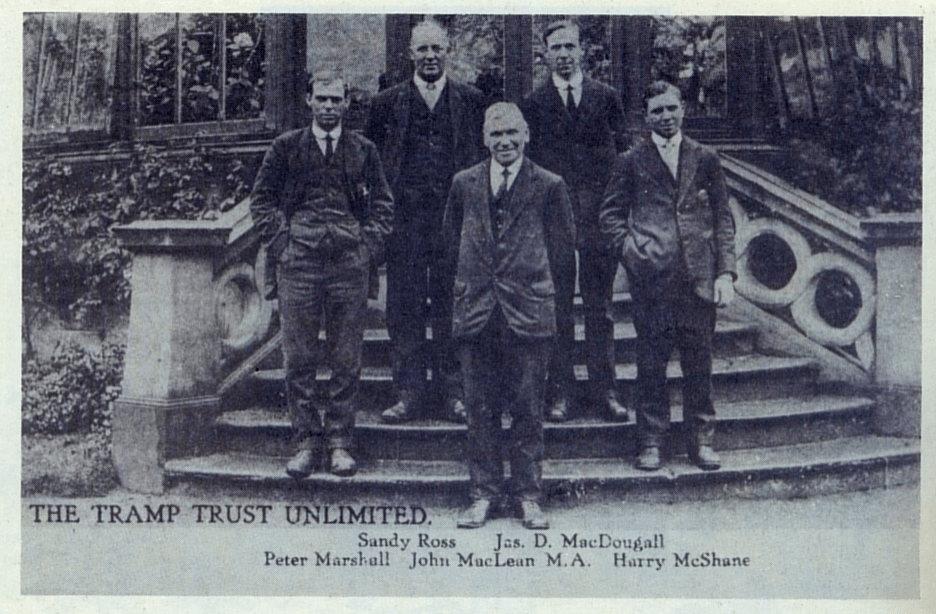
Hayes People’s History Michael Walker 2013 (6)
Political activity at this time was associated with self-improvement. Harry McShane wrote of John MacLean: ‘ He educated the Socialists of Clydeside and of Scotland. Let me say that he had a greater influence on me than any man I have ever known.’ (9)
In September 1914, Harry enlisted in the army with the aim of doing propaganda work with his fellow soldiers. He joined the Royal Engineers. He became a sapper and learned how to handle explosives and build bridges and pontoons. He never intended to take part in the war and he returned to Glasgow on leave and never went back to the army. Harry was sheltered by friends and tried to get work under an assumed name, but every time he got a job he would be recognised and have to move on. (10)
Union Activism
After the war, unions were keen to see a reduced working week, some suggesting 47 hours. The engineering workers took up the fight to reduce the working week to 40 hours. A strike to support this was called on 27 January 1919. The strike caused significant unrest in the city centre. Harry McShane was present during most of it. He described the aim of the strike as reducing the working week from 54 to 40 hours. It was believed that the reduction in the working week would lead to improved chances of work for soldiers returning from the war. When the strike ended on Monday 10 February an agreement for a 47 hour week had been made and the workers started work at 8am. The 40 hour week did not come into being until after the Second World War. (11)
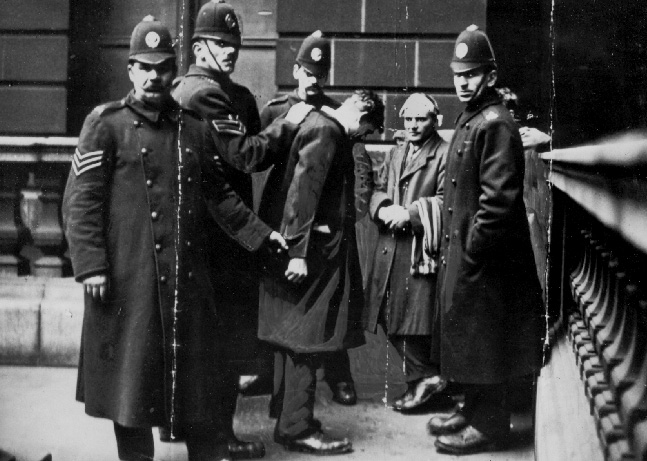
David Kirkwood and Willie Gallagher being arrested. George Square 1919
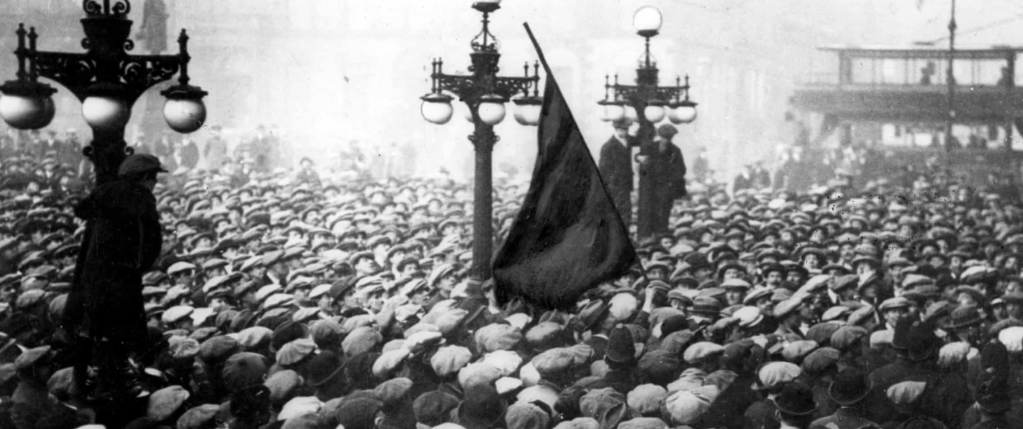
George Square 1919 Herald and Times Group
In 1920/21 Harry McShane became involved in working with the unemployed. He continued to work as an engineer, moving south to England where he worked during the 1920s. In 1928 he moved briefly to America and Canada, working in the Yukon. In 1930 Harry discovered that his marriage had ended. The only other evidence found of the ending of the marriage is on Harry’s death certificate which states that he was divorced. (12)
Harry McShane joined the Communist Party in 1922, which led to a break in his friendship with John McLean. Harry remained a member until 1953, when he decided he could no longer agree with the party’s leadership. During his time in the Communist party, he was the main Scottish spokesman for the National Unemployed Workers Movement (NUWM) and led many marches and demonstrations throughout the UK. During the Second World War he joined the staff of the Daily Worker, the newspaper of the Communist Party.
In the early 1940s, the NUWM had closed down and he started working on the Daily Worker, the newspaper of the Communist Party. A Scottish edition was being published and McShane and a small group of others were responsible for producing the weekly paper. He worked there, apart from a brief closure, until 1953. (13)
Scrutiny by the State
Between 1930 and 1939 there is evidence in the National Archives at Kew, London that Harry McShane was under scrutiny by the state. This included warrants to intercept his mail, where some correspondents discussed use of arms and spreading of discontent leading to possible uprisings. McShane’s articles were also scrutinised. His passport was limited to the UK. No commonwealth travel was permitted. A record of McShane’s court appearances, mostly for incitement to breach of the peace, was kept.
The warrants stated that they were issued by one of His Majesty’s Principal Secretaries of State. The reason given for the warrant was that he was an official or leading member of the Communist Party of Great Britain…… and may have been engaged in different open or underground phases of communist work. Some of the letters he received were considered suspicious. Programmes of meetings he attended were kept and he was being followed, as reports were made of his movements around the UK. When he tried to join the army at this time, he was turned down as unsuitable. There were suspicions that the intention was to enlist for the purposes of obtaining weapons. Correspondence with someone known as Winged Spur suggested to McShane that he and others should enlist in the territorial army for the purposes of obtaining weapons, which Winged Spur claimed were held in drill halls throughout the country. Winged Spur argued that these weapons could then be used to carry out an uprising.
McShane’s marches were also closely monitored. On 28 September 1932 a memo gave information that McShane had been instructed by the HQ of the National Unemployed Workers’ Union to call at the GPO in each town on the march to pick up material or instructions. The GPO was provided with details of the route and asked to intercept the mail and examine the correspondence when it arrived. (14)
Later Life
In 1953 Harry left the Communist party and became unemployed. He took work in the shipyards and worked there until he could claim his old age pension at 69.
After his retirement aged 69, Harry McShane remained active. In his eighties he was still writing pamphlets, lecturing at Saskatchewan University and taking part in right to work marches. In his nineties he saw off an attempt to evict him from his Church of Scotland Nursing home because he was an atheist. He also supported the staff at his nursing home in an industrial dispute. In 1987, the year before he died, he addressed the May Day rally in Glasgow.
In 1984 Harry McShane was given the Freedom of the City of Glasgow. It was noted jokingly during the Ceremony that Harry had cost the city a great deal of money over the years. First, when he led the unemployed, the cost of policing the City Chambers to keep him out. Years later, when he finally got in, there was the cost of the banquet to celebrate his freedom of the city. During that day, the red flag flew over the City Chambers and instead of the National Anthem the guests sang ‘I Belong to Glasgow’. (15)
‘We all know that great men and women don’t make history, but we also know that working class history would be a mean thing if it were not enriched by great men and women’. (16)
Harry McShane’s archive is held in the City Archive in the Mitchell Library (17)
References
2. http://www.scotlandspeople.co.uk Statutory Registers of Births 644/12733 1891
3. http://www.scotlandspeople.co.uk Statutory Registers Marriages 644/12733 1893
4. McShane H and Smith J. No mean Fighter. Tramps Trust Unlimited 1977. p3
5. Op cit pp 5-7
6. http://www.scotlandspeople.co.uk Statutory Registers Marriages 644/1821
7. McShane H and Smith J. No mean Fighter. Tramps Trust Unlimited 1977. p20
8. https://www.marxists.org/archive/mcshane//1958/10/maclean.html
Harry McShane: John MacLean
9. McShane H and Smith J. No mean Fighter. Tramps Trust Unlimited 1977 pp 67-70
10. ourhistory-hayes.blogspot.com Hayes People’s History, Michael Walker, 2013
11. Glasgowlife.org.uk. The Battle of George Square – Times Past
12. http://www.scotlandspeople.co.uk Death Certificate 1159 5531
13. The Times London April 16 1988
14. http://www.nationalarchives.gov.uk KV 2/3588
15. The Times London April 16 1988
16. The Harry McShane Collection https:/libcat.cs.glasgow.org/web/arena/mcshane
17. https://www.marxists.org//archive/foot-paul/1988/mcshane.htmlf


