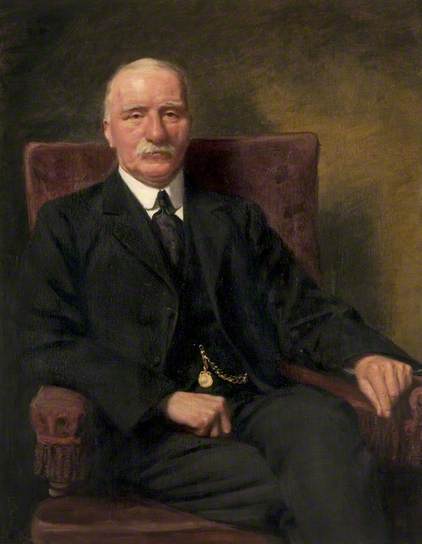
Lady Florence Willert (1882 – 1953)

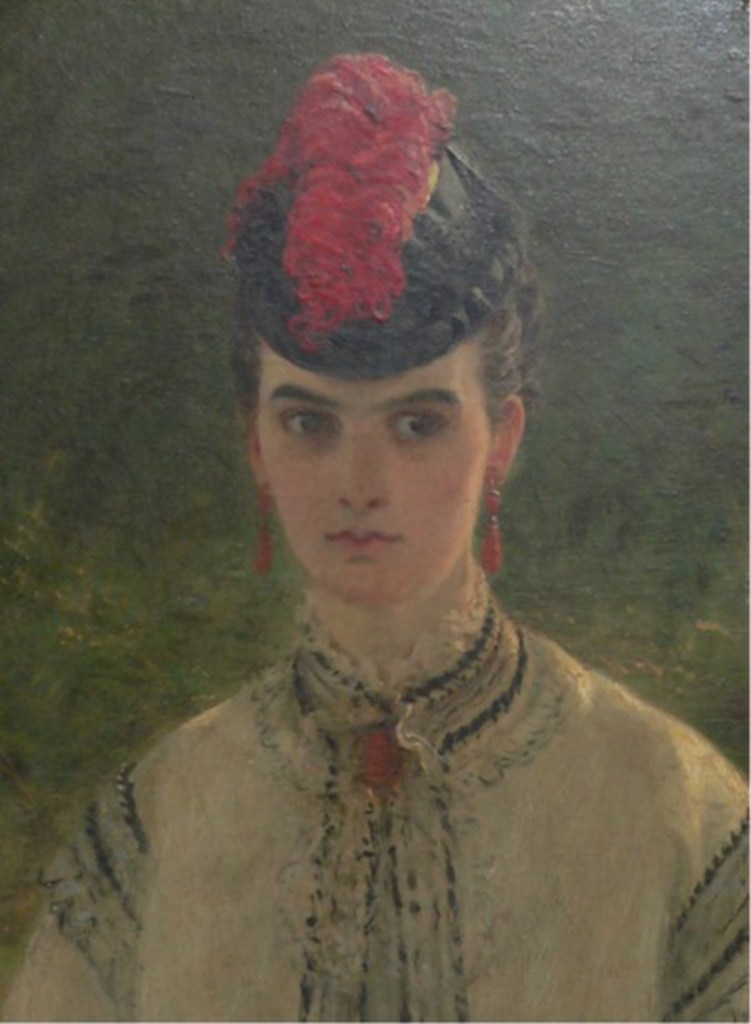
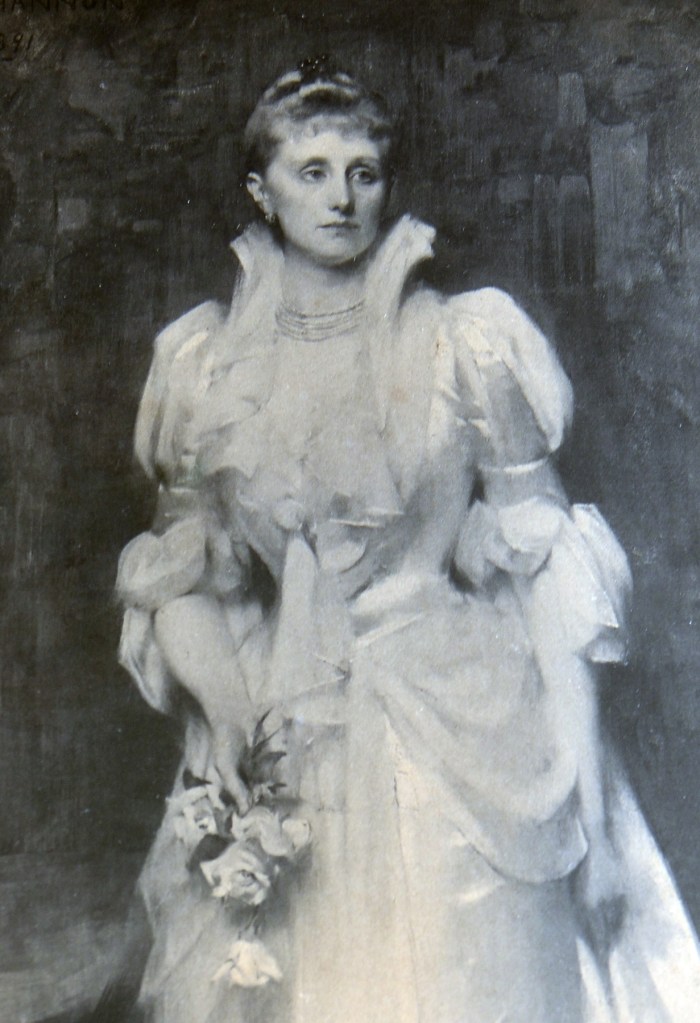
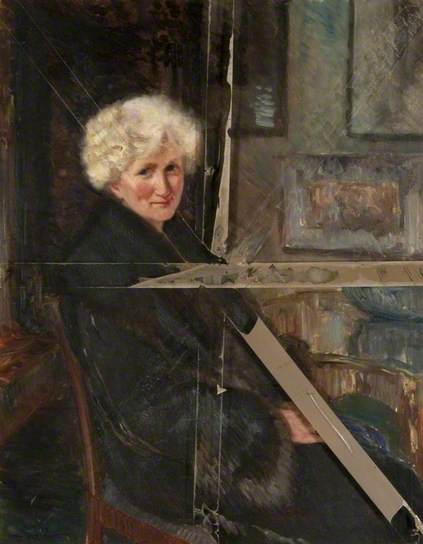
In 1953, Lady Florence Willert gifted a portrait of her mother, Lady Simpson by Valentine Cameron Prinsep to Glasgow. Accession Number 2997.
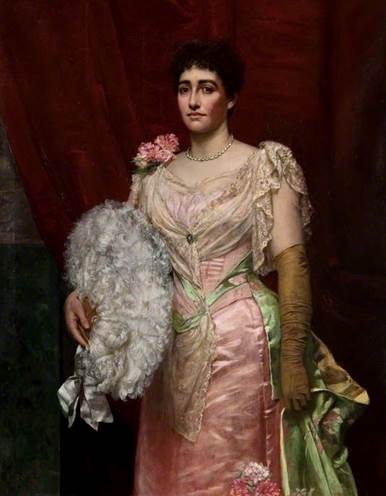
Fig. 1 Lady Simpson (nee Anne Fitzgerald MacKay) (1892)
 Valentine Cameron Prinsep (1838-1904)
 (© CSG GIC Glasgow Museums/ ArtUK)

Lady Simpson
On 7 November 1854, Alexander MacKay married Isabella Thomson in Wick, Caithness. 1 The family moved to Thurso where a daughter, Rose-Ann MacKay was born on 31 August 1856 in Durness Street. 2 From the census taken in 1861, the family had moved to 9 Dempster Street in Pulteneytown, Wick. Alexander, aged fifty-five, was a mason born in Rogart, Sutherland while Isabella, thirty-six, had been born in Eday, Orkney. The couple had two daughters, Isabella aged eleven (perhaps from a previous marriage?) born in Avie, Orkney and Rose-Ann aged four. 3 Ten years later Roseanna (sic) and her parents were still at 9 Dempster Street, but Isabella was not. 4 The family later moved to Kintore, Aberdeenshire where Alexander is listed as tenant/occupier of Kintore House from 1877-1880. 5

Rose-Ann MacKay, (now styled Ann Fitzgerald MacKay) married Sir Walter Grindlay Simpson of 5 Randolf Cliff, Edinburgh on 13 January 1881 in the Manse at Banchory Devenick, Kincardinshire. Walter was thirty-seven and an advocate. Ann was twenty-four living at Kintore, Aberdeenshire. On the marriage certificate, Ann’s parents are Alexander MacKay, architect, deceased and Isabella Catherine Thomson. 6

    (According to the 1911 census for England, Ann Simpson (nee MacKay) was born in Thurso about 1857. The only birth listed on Scotland’s People for that date is that of Rose-Ann MacKay born to Alexander MacKay and Isabella Thomson. There is no record of an Ann Fitzgerald MacKay.)

      The best man at the wedding was the groom’s brother, William Simpson. The sole bridesmaid was Evelyn Farquharson, cousin of the bride. Ann’s uncle, Peter Farquharson was a witness. (Evelyn Farquharson was born in Kirkwall, Orkney on 24 August 1843. Her parents were Peter Farquharson and Mary Thomson7 who married in Shapinsay on 18 January 1842 8) After the ceremony the couple left for London and thence to a honeymoon in the south of France. 9

            Walter Grindlay Simpson was born on 1 September 1843 in Edinburgh. He was the second son of Sir James Young Simpson (7 June 1811 – 6 May 1870), the eminent physician and pioneer in the use of chloroform as an anaesthetic) and Janet (Jessie) Grindlay. With the death of his father in 1870, Walter became the second baronet. He was a good friend of Robert Louis Stevenson whom he met at the University of Edinburgh and in 1876, the pair undertook a voyage by canoe from Antwerp to Pontoise. This was later documented by Stevenson. 10

         Sir Walter and Lady Simpson had four children, James Walter MacKay Simpson (1882 – 1924), Odo Louis MacKay Simpson (1885 – 1917, k.i.a.), Ethel Lucy Florence MacKay Simpson (later Lady Willert) and Beatrix Frances Frederica MacKay Simpson. In 1891 the family was living in Hanover Square, Belgravia, London. 11 This suggests the painting was completed in London the following year when Lady Simpson was thirty-six.

Walter Grindlay Simpson died on 29 May 1898 at his home, Ballabraes, House Ayton, Berwickshire. He was 54. 12 Obituaries mentioned that he was educated at Edinburgh Academy and Caius College, Cambridge where he studied chemistry and anatomy graduating with a BA Hons. in Natural Science. He also rowed stroke for the university.  He was called to the Scottish Bar in 1873. 13 He was an enthusiastic golfer and was Captain of the Honourable Company of Edinburgh Golfers. He published an authoritative guide to the game The Art of Golf in 1887. It seems that he purchased Millbank House about 1890 14 and renamed it Balabraes 15

      Now widowed, Lady Simpson continued to live at Balabraes House with her two daughters. She and Florence were ‘living on their own means’. 16 Florence married Arthur Willert in 1908 and by 1911 Ann was in residence in Kensington, London with Beatriix and Odo. The census of that year states that she was born in Thurso. 17 During WW1, her son Odo enlisted in the Canadian Expeditionary Force. Ann signed his Attestation Papers 18 Tragically, he was killed in action in 1917. She seems to have retained ownership of Balabraes until about 1920 when it was sold. 19 In 1921, Ann Simpson was living at 14a Westbourne Terrace, Paddington, London. 20 This was the home of her daughter Beatrix and husband Bertram Couly. (They divorced in 1933). She probably attended the wedding of her grandson Paul Willert in 1934. Lady Ann Fitzgerald MacKay Simpson died on 23 October 1941 at 62 St. John Street, Oxford. She was eighty-six. 21

Lady Willert
 Florence Ethel Lucy Mackay Simpson (later Lady Willert) was born in Kensington, London in the second quarter of 1882. 22 She was the daughter of Sir Walter Grindlay Simpson, Bt. and Anne Fitzgerald Mackay. Florence was also the granddaughter of Sir James Young Simpson who pioneered the use of chloroform as an anaesthetic.

She must have been a precocious child since when her grandmother, Isabella MacKay, died on 26 January 1896 at Sunnyside, Bridge of Allan, Stirlingshire, the thirteen-year-old Florence was entrusted with reporting the death the following day. 23 She was seventeen when her father died in 1898 at the family home Ballabraes House, Ayton, Berwickshire.24 She was one of the executors of her father’s will. 25 In 1901, Florence was with her widowed mother, both living on their own means, and sister Beatrix F. Simpson aged five at Ballabraes House. 26 (There are two mistakes in the census; Florence was not twenty-five and her mother was not born in England).
  On 25 January 1908, Florence married Arthur Willert. 27 The marriage took place in Italy.

In Genoa, at the Archbishop’s Palace, and before H.B.M.’s Consul General, Arthur, son of P. F. Willert Esq., Headington Hill, Oxford, to Florence, elder daughter of the late Sir Walter Grindlay Simpson, Bart. of Balabraes, Ayton, Berwickshire. 28

The following month, on 10 February both Florence and Arthur left Southampton to sail to New York and then on to Washington D.C. 29

After returning from America, Florence gave birth to a son, Paul Odo Willert, on 25 May 1909, in Marylebone, London. 30 On 15 January 1910, Arthur Willert sailed to New York from Liverpool on his own. His last permanent address was that of his parents at Headington Hill, Oxford. He was a journalist. 31

            Arthur and Florence again sailed to New York and then to Washington on 7 February 1910 with Florence’s mother, Lady Simpson, listed as their nearest relative in the old country. They remained in Washington at The Dresden Apartments and were there at the time of the census on 28 April 1910. Florence confirmed that her parents were born in Scotland. Arthur’s occupation was ‘journalist’. They were also travelling with a nurse. So, although Paul does not appear on the census, it would appear he was with them. 32

Arthur Willert was The Times‘s chief United States correspondent from 1910 to 1920, with an interruption from 1917 to 1918, when he was Secretary of the British War Mission in Washington and the representative of the Ministry of Information. He formed an extensive network of influential American contacts, which enabled him to supply the British government with valuable information concerning American politics during the First World War and to convey British views to American officials. 33

            It seems likely therefore that Florence and Arthur spent the years 1914-1918 in America returning to Britain at the end of the war. On 19 February 1919, Arthur sailed from  Liverpool via New York to Washington. Later that year he was in Canada but there is no indication that Florence was with him. 34

Arthur Willert was appointed Knight Commander of the Order of the British Empirein 1919 ‘for valuable services rendered in connection with the war’ and was ‘late secretary of the British War Mission in Washington’. 35  

    In 1924 Florence was joint author of Told in the Corner Tides with B. Montgomery and E. Paterson. 36 Thereafter she and Arthur appear to have been part of the London social scene. ‘Sir Arthur and Lady Willert (who) lived in Washington for some years’ attended a reception given by the American Women’s Club for the new American Consul-General’. 37 It was also noted that Sir Arthur and Lady Willert and Mr Paul Willert have returned to Cambridge Square from Italy. 38 On 12 November 1925 Lady Willert assisted in the opening of a Grand Bazaar at St. Thomas the Apostle church. 39 In 1927 she sailed to New York with her son Paul who was then a student aged 18. They travelled on ‘Diplomatic Passports’. 40

On 11 June 1934, Paul Willert married the Honourable Brenda Pearson daughter of Viscount Cowdray at St. Mark’s Church, North Audley Street, London. 41

On 20 December 1935 Arthur and Florence sailed from Southampton to New York aboard S.S. New York. He was described as a ‘writer’, she was a ‘housewife’. 42 They remained in Washington over Christmas and the New Year and later visited the White House.

 As Eleanor Roosvelt recorded on 4 January 1936,

            Sir Arthur and Lady Willert, who spent many years in Washington when he was correspondent for the London Times, were also staying with us. He has since served many years in the Foreign Office in London. There were many to greet them warmly on their reappearance even here where people are quickly forgotten because they change so often. 43

and on 16 March 1936,

            This morning, I said goodbye to Lady Willert who is sailing for England, and now I am on the train on my way back to Washington. 44

Arthur and Florence again spent the following Christmas and New Year in Washington having sailed from Southampton on 23 December 1936, aboard S.S. New York. Both were described as ‘writers’. Florence was 57yrs 10mo, Arthur 54yrs 4mo. 45 The following year on 24 February they had dinner at The White House and were also houseguests of President Roosevelt. 46

Eleanor Roosevelt again recorded on 1 March 1937 that

Lady Willert, Miss Fannie Hurst, Mrs. Leach and I had a grand evening of talk.

One of the items discussed appears to have been the White House meals which the President had complained were too ‘routine’. Mrs. Roosevelt revealed that she had given the President a ‘New Deal’ and that the new menus would include several items suggested by Lady Willert. 47

On 4 November 1942, Mrs. Roosevelt recorded,

 I was in London. During the day I saw my old friends, Sir Arthur and Lady Willert and their granddaughter (born in 1936) who is my godchild.

From 1939 to 1945, Sir Arthur Willert oversaw the regional work at the Ministry of Information. At a leaving ceremony in 1945 he was presented with an engraved silver tankard, and Lady Willert received a bouquet of flowers. 48

            In 1948, Lady Willert and her sister Mrs. Beatrice Long gifted some documents related to the early use of chloroform as an anaesthetic to the University of Edinburgh. These included a letter from Sir William Lawrence to Sir James Young Simpson reporting the first use of chloroform in St. Bartholomew’s Hospital in 1847. 49

Two years after she donated the painting of her mother, Dame Ethel Lucy Florence Mackay Willert died on 3 April 1955. Her address at the time was 12 Sloane Terrace Mansions, Chelsea, London.  Arthur Willert died aged ninety in 1973. His papers were bequeathed to Yale University. Among them are his own letters to and from his wife and also correspondence of Florence’s e.g. to and from Winston Churchill in 1917 and to/from Eleanor Roosevelt at various times between 1932 and 1955.

References

  1. Scotland Marriages 1561-1910, FamilySearch
  2. Scotland’s People, Birth Certificate
  3. Scotland’s People, Census 1861
  4. Scotland’s People, Census 1871
  5. Scotland’s People, Valuation Roll, Kintore, Aberdeenshire
  6. Scotland’s People, Marriage Certificate
  7. Scotland Births and Baptisms, 1564-1950, FamilySearch
  8. Scotland’ People, Old Parish Registers
  9.  Home News for India, China and the Colonies, London, 4 February 1881. (Contains a full description of the wedding).
  10. An Inland Voyage, Stevenson, Robert Louis, C. Kegan Paul and Co. 1878
  11. ancestry.co.uk, England Census, 1891
  12. Dundee Evening Telegraph 1 June 1898
  13. Edinburgh Evening News 30 May 1898
  14. Scotland’s People, Valuation Roll, Berwickshire 1890
  15. Dundee Evening Telegraph 31 May 1898
  16. Scotland’s People, Census 1901
  17. ancestry.co.uk, England Census, 1911
  18. ancestry.com, Canada CEF Attestation Papers
  19. Scotland’s People, Valuation Roll, Berwickshire 1920.
  20. ancestry.co.uk, England Census, 1921
  21. Berwick Advertiser, 30 October 1941
  22. England and Wales, Birth Registration Index, 1837-2008, FamilySearch
  23. Scotland’s People, Death Certificate
  24. Ibid
  25. Morning Post, 7 June 1898
  26. Scotland’s People, Census 1901
  27. ancestry.com. North America, Family Histories, 1500-2000 [database on-line]
  28. Illustrated Berwick Journal, 6 February 1908
  29. Passenger and Crew Lists of Vessels arriving at New York, 1897-1957, FamilySearch
  30. England and Wales, Birth Registration Index, 1837-2008, FamilySearch
  31. Passenger and Crew Lists of Vessels arriving at New York, 1897-1957, FamilySearch
  32. United States Census 1910 FamilySearch.
  33. Wikipedia
  34. United States Border Crossings from Canada to US 1895-1956, FamilySearch
  35. Gloucester Journal, 11 January 1919
  36. Ashbourne Telegraph 27 June 1924
  37. London Evening News, 30 October 1924
  38. Westminster Gazette, 29 September 1924
  39. West London Observer, 6 November 1925
  40. New York Passenger and Crew Lists, 1909, 1925-1958, FamilySearch
  41. London Daily News, 12 June 1934
  42. New York Passenger and Crew Lists, 1909, 1925-1958, FamilySearch
  43. The Eleanor Roosevelt Papers Digital Edition (2018)
  44. Ibid
  45. Passenger and Crew Lists of Vessels arriving at New York, 1897-1957, FamilySearch
  46. The Eleanor Roosevelt Papers Digital Edition (2018)
  47. Daily Express, 2 March 1937
  48. Reading Standard, 3 August 1945
  49. The Scotsman, 28 January 1948
Captain Lewis Pash Renateau (1887 – 1978)

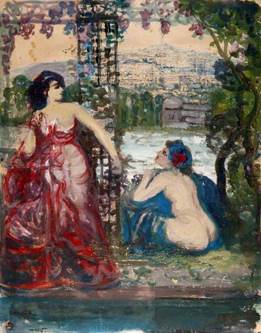
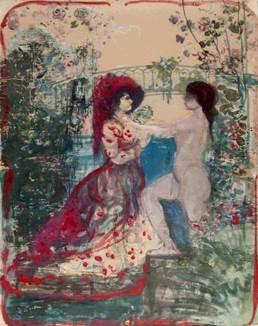
In 1953, Lewis Pash Renateau donated forty-seven artworks by Charles Conder (1868 – 1909) to Glasgow. These included prints and drawings and two oil paintings. 1

Fig. 1 The Trellis (Charles Conder (1868 -1909)
© CSG GIC Glasgow Museums Collection/ArtUK
(Accession Number 2989)

Fig. 2 The Bridge (Charles Conder (1868 -1909)
© CSG GIC Glasgow Museums Collection/ArtUK
(Accession Number 2990)

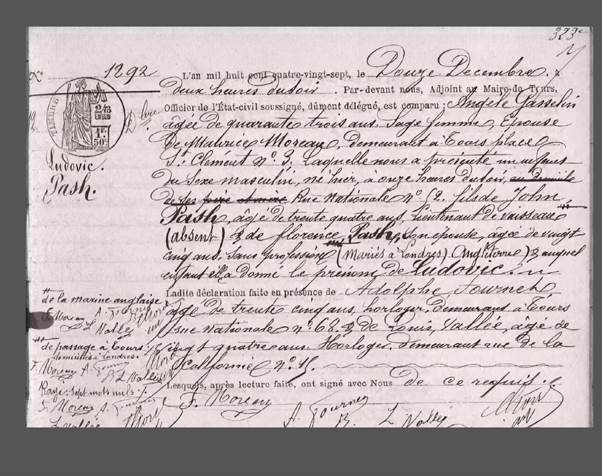
Lewis Renateau’s mother, Florence Pash, was born in Kingsland, Middlesex in 1863.2 She was the daughter of Daniel John Pash (1823 – 1914) a boot manufacturer, and Martha Fassett (1829 – 1906).3.4 In 1887, having gone to France apparently to study art, Florence gave birth to a son in Tours on 11 December that year. Details are contained in a notice of birth:

Fig. 3 Notice of a Birth. 5

The gist of this is that,
On 12th December 1887 at two o’clock in the evening, a midwife called Angele Passelin appeared before the deputy mayor of Tours, to inform him of a male born yesterday at 11 o’clock in the evening at Rue Nationale No. 2, the son of John Pash, aged thirty-four Lieutenant (absent) and Florence Pash his wife aged 25 no profession (married in London, England) given the first name Ludovic.
(Notes in the margin suggest that John Pash was in the English Navy and was ‘passing through and that their home was in London).

Another version is that,

Florence had an illegitimate child born in Tours, France on December 11, 1887, while she was in the country studying art. The father was Albert Carl Gustav Ludovici who was born in Prague in 1852. Lewis (Ludovic) was raised in France by foster parents named Renateau. This version seems to have been verified by Lewis’ grandson. 6
That Albert was Lewis’ father is possibly borne out by the fact that in 1889 Albert Ludovici opened a studio at 132 Sloane Street, London ‘under the management of Florence Pash’. This was a studio where lady artist pupils would be able take life classes, etc.7
Florence was with her parents and siblings at 94 Fordwich Road, Hampstead, London at the time of the census in 1891. She was now an ‘artist painting’. There is no mention of her son.8 In his biography of Walter Sickert, Matthew Sturgis has a description of Florence.

‘(She) was a forceful and handsome figure: tall, dark-haired with heavy-lidded eyes. At 28 and two years younger than Sickert when she met him when they were both showing at Suffolk Street’. ‘She had established herself with remarkable assurance in the London art world. The daughter of a successful North London shoe retailer, she had studied painting briefly at South Kensington and in France’. Sickert painted her portrait and ‘it is possible, even likely, that the friendship with Florence became an affair’. 9

Florence became a successful portrait artist exhibiting at the Royal Society of British Artists, the Paris Salon and the Royal Academy of Arts. A portrait she painted of Walter Sickert was exhibited at the Royal Academy in 1924 and subsequently at the Louvre. She also sat as a model for Charles Conder and Walter Sickert. 10
In 1898, Florence, now thirty-eight, married Albert Anthony Humphrey, aged fifty-four, an ‘advertising news agent’ who had been born in Quebec, Canada. Florence and Albert were living at 122 Victoria Street, Westminster, London in 1901 along with Lewis Renateau who is listed on the census, as a ‘visitor’, born in France but now a British citizen.11
Later that year Lewis was in the lower fifth at Borden Grammar School in Kent. He was awarded prizes for being first in mathematics, languages and divinity and second in science. 12  
Lewis attended Dulwich College, London between September 1903 and July 1905. He was listed as living with a guardian, Mrs Humphrey, who was his aunt, at 122 Victoria Street, London.  His final form at the College was the Remove Engineering (roughly equivalent to modern Y12 in England, the penultimate year of school).  In his final term he placed 10th in a class of 18 overall.  In French he came 3/19; workshops 7/25; and in drawing he came 4/26.13
In 1904, Florence Humphrey gave birth to a son, Cecil Albert Humphrey. 14 (Cecil later became a Balliol Scholar and joined the Indian Civil Service. He and his wife had a daughter born in Bengal in 1937. Cecil died in Hampstead, London on 5 September 1949).15
After college, Lewis must have undertaken courses in naval architecture as this turned out to be his profession. However, in 1909, along with his stepfather, he took out a patent on ‘Improvements in and Connected with Aeroplanes’ dated 15/25 December.16
On 4 April 1913, Lewis emigrated to Halifax, Nova Scotia. Canada. He sailed from Liverpool aboard the Corsican giving his occupation as ‘draughtsman’. 17 The following year on 23 September he volunteered for the Canadian Overseas Expeditionary Force, Royal Highlanders of Canada. He stated that he was born in London (?) and was unmarried. His next of kin was a cousin, Cecil Albert Humphrey of 122 Victoria Street, London. (Actually, his half-brother). Lewis’s occupation was as a naval architect, and his previous military experience was in the officer training corps. 18
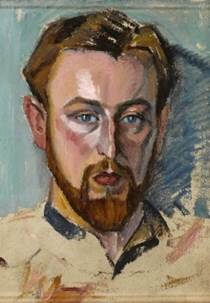
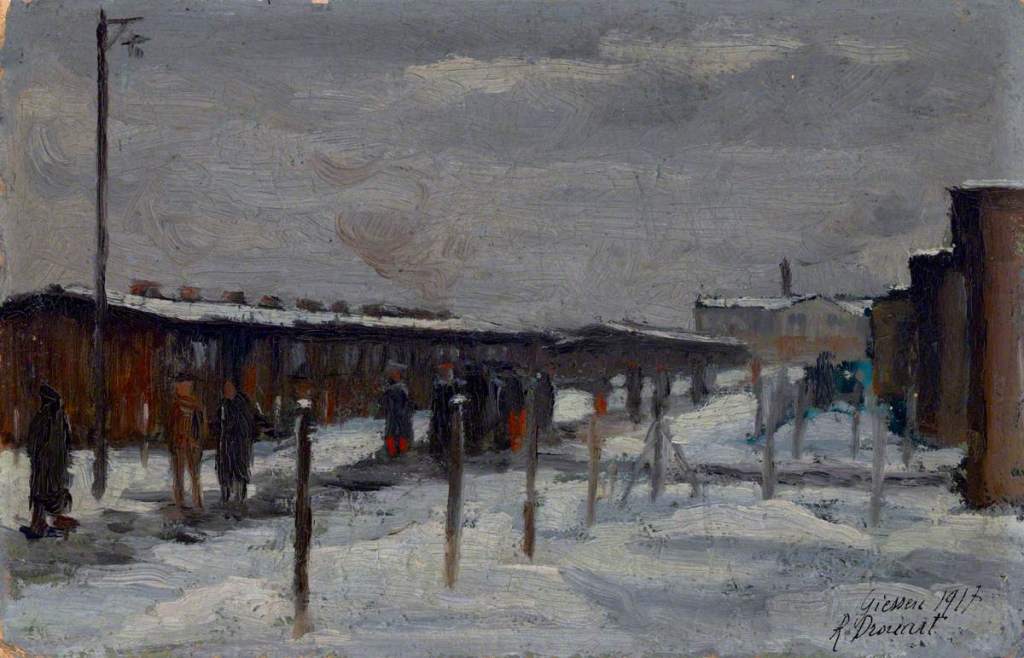
In 1915, having previously been reported missing, 19 it was confirmed that Lewis, (now Lieutenant Renateau of the 13th Battalion, Royal Highlanders of Canada) had been taken prisoner at St Julien, near Ypres, on 24 April 1915. He had been transferred to the Giessen POW camp.20 While there, a fellow prisoner, Raphael Drouart (1894 – 1972) painted his portrait.

Fig. 4 Lieutenant Lewis Pash Renateau
13th Battalion, Royal Highlanders of Canada
Raphael Drouart, 1916
National Army Museum, London/ArtUK

The same artist later (1917) completed a painting of the camp under snow. This was done on a box lid of a food parcel originally sent to Renateau. The lid still listed the contents of the original parcel: ‘Margarine/Potted Meat/Biscuits/Prunes/Cherries/Camp Pie/Golden Syrup/Lemonade Powder/Service Rations/Cocoa/Milk/Sugar

Fig. 5    POWs at the Giessen POW Camp, Germany Autumn/Winter 1917
Raphael Drouart
National Army Museum/ArtUK

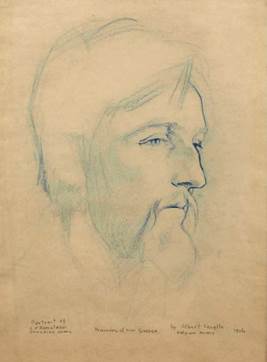
 In September 1916, The Burlington Magazine published a letter from Lewis.

THE CAMP AT GIESSEN, HESSE – [We have received from a Canadian artist, Mr. Lewis Renateau, with whom we are otherwise unacquainted, the letter published below, which may relieve the anxiety of the friends of prisoners in one German camp. We have also received from Mr. H. Walter Barnett, as specimen of the work of this imprisoned society of artists, a photograph of a very pleasing pencil drawing of our correspondent, Mr. Renateau, by one of his fellow-prisoners, Mr. Albert Venelle. Mrs. A. A. Humphrey, 122 Victoria St., S.W., desires us to say that she will gladly receive any gifts on behalf of these interned artists. -ED]

GENTLEMEN, – We have received many numbers of The Burlington Magazine from Mrs. A. A. Humphrey (122 Victoria St., S.W.), and she writes to me that you were the kind donators. We appreciate them greatly and send you our most grateful thanks and best wishes,
The “we” consists of about twenty men of many various talents and qualities, from theatrical scenic painters to wood-carvers. The best artists here are Raphael Drouart (Parisian), A. Nantel (on“The Standard” Montreal), Tisseire, caricaturist (Parisian), and as students of art, A. Venelle (Brussels), Patoisseaux (Nantes), Beddoe (Ottawa). The rest are architects, decorators, furniture designers, etc.
We are very well treated and can work as we can work as we like and get in any materials from the town we need that we can afford, so that we are really very well off.
Thanking you again for your, kindly thought and gifts on behalf of the Giessen Art Fraternity,
I remain, Yours truly,
LEWIS RENATEAU.

The pencil drawing referred to above by Albert Venelle was offered for sale during the London Art Week on 6 December 2023 priced at £1200.00.

Fig. 6     Lewis Renateau by Albert Venelle 1916, Blue chalk on paper
londonartweek.co.uk Forgotten Masters/Enduring Images III 6
December 2023

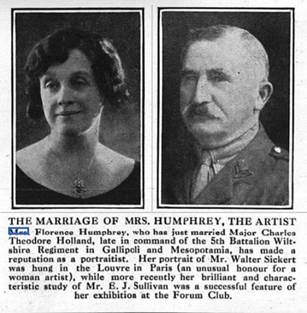
Lewis’ stepfather died in 1917 and on 12 May 1923, his mother married Major C. T. Holland in Kensington Registry Office, London. 21

Fig. 7 Marriage of Florence Humphrey and Charles Holland. 22

However, the marriage ended with the death in London of Major Holland aged sixty-nine in 1927.
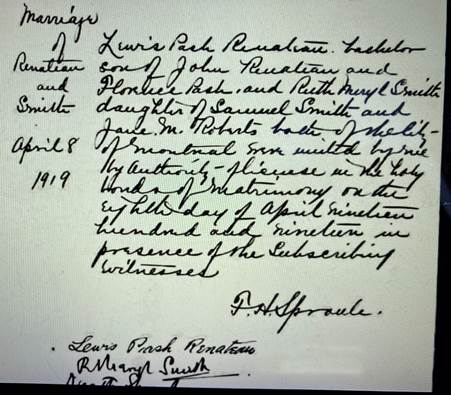
After the war, Lewis returned to Canada to be demobilised and on 8 April 1919 he married Ruth Meryl Smith in Montreal.

Fig. 8 Marriage Certificate 23
Lewis Pash Renateau, bachelor, son of John Renateau and Florence Pash and Ruth Meryl Smith daughter of Samuel Smith and Jane M Roberts both of the City of Montreal united by me by Authority of License in the holy bonds of matrimony on the eighth day of April nineteen hundred and nineteen.
Ruth Meryl Smith was born in Dorking, Surrey in 1882. Her family was living in Amhurst Road in Hackney in 1891 24 suggesting that her parents emigrated to Canada later. Sometime in the early 1900s she worked for six years for a Scottish engineering company, 25 but by 1911, aged twenty-seven, she was living with her sister Alice Margaret in Greenwich, London. 26 She moved to Canada in 1912 27 where she met Lewis but returned to England in 1915 to engage in war related work. She became secretary to Sir Frank Sanderson the then Controller of Trench Warfare, National Shell Filling Factories and Stores at the Ministry of Munitions. After the armistice, she returned to Canada in arriving at St. John’s Newfoundland on 1 March 1919 28 on her way to a job in Manchuria. However, she got a cable from Lewis asking her to marry him. 29
The couple returned to England, initially to Kensington in London where a son, John Pash Renateau was born on 6 November 1919. A daughter, Ann Meryl Pash Renateau, was born on 29 January 1921 at 9 Highland Road, Upper Norwood, London, the family home. From the census of that year, Lewis, aged 33 years and 6 months, born in Tours, France but a British subject was employed by the Port of London Authority as a naval architect. Also listed were Ruth Renateau aged 39 years and 2 months and their children. 30 9 Highland Road remained their address throughout the 1920s. Ruth must have returned to Canada after the birth of her daughter (possibly to introduce her children to her parents?). She returned in 1922 to resume her role as secretary to Sir Frank Sanderson after he became MP, a position she retained until 1940.31
An entry for Lewis (possibly in a list of foreign nationals) appeared in the London Gazette on 5 April 1929.
Pash, Ludovic (known as Lewis Pash Renateau); Doubtful Nationality;
Naval Architect; 39, Sylvan Road, Upper Norwood, Croydon. 18 March 1929.

 Lewis joined the Port of London Authority as a naval architect and remained with them for forty years.  His pastimes included swimming, tennis and cricket: he was for a time secretary of the Port of London tennis club. 32 He was also a talented amateur artist as this review of a Painting Exhibition held at the Port of London Authority indicates.

‘The best paintings are those of Mr. L. Renateau, an engineer’s draughtsman, whose normal occupation has scarcely any influence upon his pastime. Mr. Renateau’s portraits are virile and to the point, although their colour is often unsound.’ 33
The family moved to The Nutshell on Hamhough Island in the Thames and were there from 1936 until at least 1946. In 1939, Lewis was a ‘shipbuilding draughtsman and Ruth a ‘private secretary’ while Ann Reniteau claimed to be, single and an unpaid domestic, living at The Nutshell, Sunbury on Thames, with her parents. 34 During WW2, Lewis saw service in the War Office until 1947. He was in the Corps of Royal Engineers (Transportation) involved in design and construction of ports and opening up rivers etc. He was made second lieutenant on 3 March 1941 (later promoted to captain in 1944). 35
After the war, the family moved to 21 Bowes Road, Walton-on-Thames. In 1950 the occupants at this address were, Lewis, Ruth, their son John and Ruth’s sisters Alice and Frances. 36 In the same year, Ann Renateau married Arthur Douglas Eade in Cornwall and John Renateau married Gwendoline D. Fleet. 37
Lewis’ mother, Florence Pash Humphrey Holland who was still actively exhibiting in her 80s, died on 25 June 1951 aged eighty-nine. 38 His wife, Ruth Meryl Renateau died in October 1952 at 21 Bowes Road, Walton-on-Thames. She was buried on the 27th at Brookwood Cemetery, Woking, Surrey. 39 The following year, Lewis married Avalon Ethelston Osborne in Surrey. 40
(Perhaps as a result of moving house after his marriage, Lewis decided to clear out some items. Ruth may have been employed by a Glasgow firm during her time in Scotland and would have been acquainted with Kelvingrove Art Gallery. This may have prompted Lewis to deposit the Charles Conder materials there.)
In 1958, Lewis penned a letter to his local newspaper.

To the Editor Sir, – Like Major Kirkpatrick, M.C., I suffered for many years from dyspepsia and indigestion and was treated with many medicines and diets. I had all my teeth extracted and appendix removed, all of which was quite unnecessary, as I found out the cause and cured myself. Tannin in tea and food fried in a pan was the cause. Lewis Renateau, Common Moor Cottage, Burley Street, Burley. 41                    

Lewis Pash Renateau died on 9 October 1978 at Couch Hill Lane, Burley Ringwood, Hampshire. His funeral was held at Bournemouth Crematorium on 17 October. He was survived by his wife Avalon, two children and two grandchildren. An obituary was published in a local newspaper. 42 According to Sturgis, he left a manuscript, ‘Life of Florence Pash’ which is to be found in Islington archives in London. 43

Lewis Renateau and Charles Conder
Alexander H. MacAdams, a lumber merchant, married Sarah Emma Humphrey about 1858 in Quebec, Canada. Sarah was a sister of Albert Alexander Humphrey who married Florence Pash. The couple had a daughter Stella Maris MacAdams born in 1862. 44 In 1889, Stella married George Noel Belford in Kensington, London but she was widowed within ten years. In early summer 1901, Florence Humphrey invited Stella, her niece, to tea to meet Charles Conder.

Fig. 9 Charles Conder, Stella Maris Belford (MacAdams) and Florence Pash

The couple seem to have hit-it-off immediately so much so that Conder was heard to declare at that first meeting, ‘I’m going to marry that woman’. 45 After a holiday in Normandy with her sister Annie and Florence, Stella married Charles Conder in the British Embassy in Paris in 1901.  Condor suffered from syphilis and died in a mental home in Virginia Water on 9 February 1909. 46 When Stella died three years later, it is probable that some of Charles’ artwork would have passed to Florence and thence to Lewis.

References

  1. https://collections.glasgowmuseums.com/mwebcgi/mweb?request=jump;dtype=d;startat=17
  2. FamilySearch, England Census 1871; artbiogs.co.uk
  3. FamilySearch, England and Wales, Marriage Registration Index, 1837-2005
  4. ancestry.co.uk, England and Wales Census 1881
  5. www.jtrforums.com
  6. Sturgis, Matthew, Walter Sickert: A Life, , HarperCollins, London, 2005 (Sickert and Ludovici, both artists, met while painting in St. Ives, Cornwall). This version is also quoted in www.jtrforums.com
  7. www.jtrforums.com
  8. ancestry.co.uk, England and Wales Census 1891
  9. Sturgis, Matthew, Walter Sickert: A Life, , HarperCollins, London, 2005
  10. Wikipedia, Florence Pash
  11. ancestry.co.uk, England Census, 1901
  12. Sittingbourne East End Gazette, 14 December 1901
  13. Information from Dulwich College Archivist
  14. FamilySearch, England and Wales Births, 1837 – 2006
  15. FamilySearch, England and Wales, National Index of Wills and Administrations, 1858-1957
  16. GB Patents Number GB190930194A, econterms.net
  17. ancestry.co.uk, Uk and Ireland, Outward Passenger Lists 1890-1960
  18. ancestry.co.uk, Canada WW1 CEF Personnel Files, 1914-1918
  19. Ottawa Free Press, 9 July 1915
  20. FamilySearch, National Archives, Military Prisoners of War, 1715-1947
  21. ancestry.co.uk, England and Wales, Civil Registration Marriage Index, 1916-2005
  22. The Graphic, 26 May 1923, p 5
  23. ancestry.com, Canadian Marriages
  24. ancestry.co.uk, England and Wales Census 1891
  25. London Evening News 2 April 1940
  26. ancestry.co.uk, England and Wales Census 1911
  27. ancestry.com, Canada Incoming Passenger Lists, 1865-1935
  28. ibid
  29. London Evening News, 2 April 1940
  30. ancestry.co.uk, England and Wales Census 1921
  31. London Evening News 2 April 1940
  32. New Milton Observer 21 October 1978 p5
  33. Daily News and Westminster Gazette, 26 November 1929 p9
  34. ancestry.co.uk, National Register, England and Wales, 1939
  35. London Gazette 2 May 1941
  36. ancestry.co.uk, London, England, Electoral Registers, 1832-1972
  37. FamilySearch, England and Wales, Marriage Registration Index, 1837-2005
  38. Pash, Florence 1863-1951 Artist Biographies Ltd. Quoted in Wikipedia.
  39. Herald and News, 24 October 1952
  40. FamilySearch, England and Wales, Marriage Registration Index, 1837-2005
  41. New Milton Advertiser & Lymington Times, Saturday, 1 March 1958
  42. New Milton Observer 21 October 1978, p5
  43. Walter Sickert: A Life, Sturgis, Matthew HarperCollins, London, 2005. Florence Pash Papers, S/SFC/2/1/9, !896-1999
  44. FamilySearch, Canada Census 1871
  45. Charles Conder the last bohemian, Galbally, Anne, Melbourne, 2002, pp.224-25
  46. ibid

 Helen Robertson Carmichael (1869 – 1953)

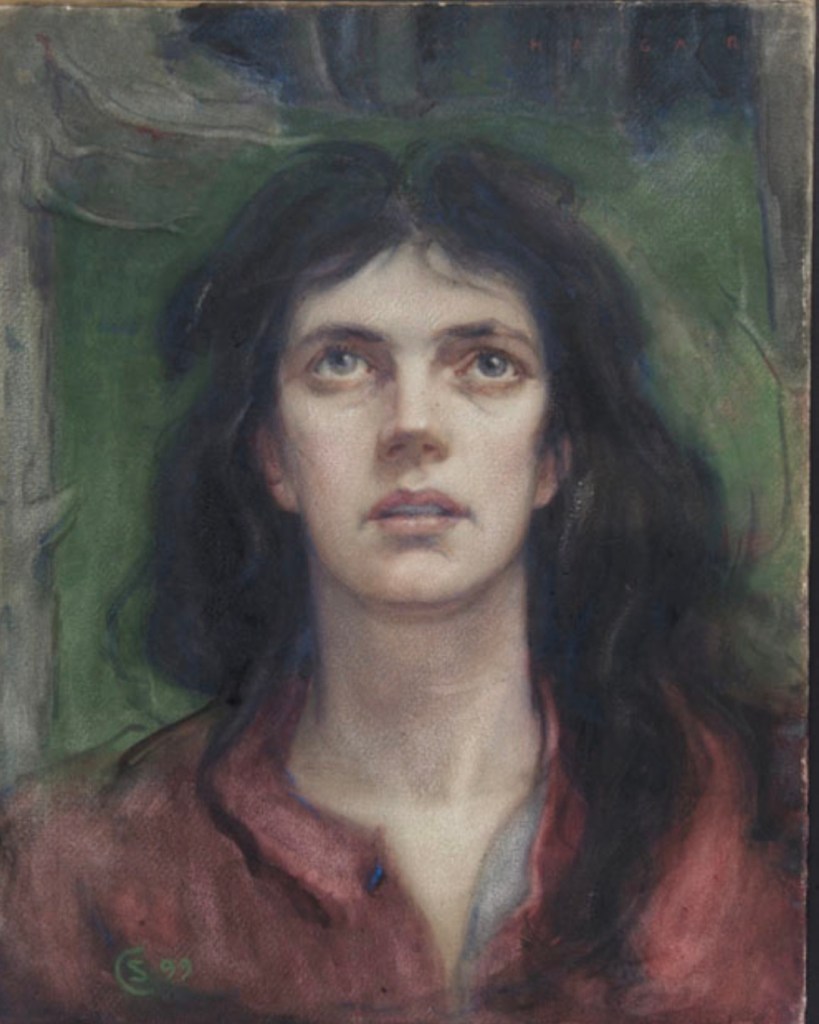
A watercolour painting entitled Hagar was donated to Glasgow by Helen R. Carmichael in 1952. Helen was the sister of the artist.

   Fig. 1        Hagar  
Stewart Carmichael (1867 – 1950) Scottish (Accession Number 2946)
© CSG GIC Glasgow Museums Collection     

Helen Robertson Carmichael was born on 28 March 1869 at 13 Balfour Street, St. Peter, Dundee.  She was the seventh child of James Carmichael, a leather merchant and his wife Helen Robertson who had married on 19 June 1857 in Dundee. 1,2 Her brother, Stewart was born on 8 February 1867 at 4 Heathfield Place, Hawkhill, Dundee. 3 An eighth child, Lizzie Batchelor Carmichael was born on 8 October 1871. 4 Helen’s father was widowed on 15 January the following year when Helen’s mother died from heart disease. 5 By 1881 the family had moved to 51 Park Wynd, Dundee. 6 Helen attended Aberdeen Teacher Training College from 1890 – 91. 7 While at the college, she was lodging at 18 Balmoral Lane, Aberdeen and in the census was described as a ‘normal student’. 8 The following year she began teaching at Blackness Primary School in Dundee. 9 In the 1901 census she was aged thirty and living with her brother John at 10 Airlie Terrace, Dundee. Her occupation was ‘school board teacher’. 10 From 1915 till at least 1940, Helen was a tenant at 89 Magdalen Road, Dundee. 11 In August 1931, she was one of a group of tenants which sought an interim interdict to prevent the town council from closing Magdalen Park to hold the annual flower show with the resultant expected disturbance. 12 However, the matter was resolved when the council agreed not to hold the show there in subsequent years and to take steps to minimise noise etc. in the present year. 13
Helen retired from Blackness Primary School in 1932 after forty years as a teacher there. 14 She died on 25 February 1953 at Maryfield Hospital, Dundee. She was 83. Her usual address was 2 Windsor Street, Dundee. 15

References

  1. Scotland’s People, Birth Certificate
  2. Scotland’s People, Census 1871
  3. Scotland’s People, Birth Certificate
  4. Ibid
  5. Scotland’s People, Death Certificate
  6. Scotland’s People, Census 1881
  7. Dundee City Archives
  8. Scotland’s People, Census 1891
  9. Dundee City Archives
  10. Scotland’s People, Census 1901
  11. Scotland’s People, Valuation Rolls
  12. Dundee Courier 25 August 1931
  13. Dundee Courier 27 August 1931
  14. Dundee City Archives
  15. Scotland’s People, Death Certificate

Robert Hannah (1812 – 1909)

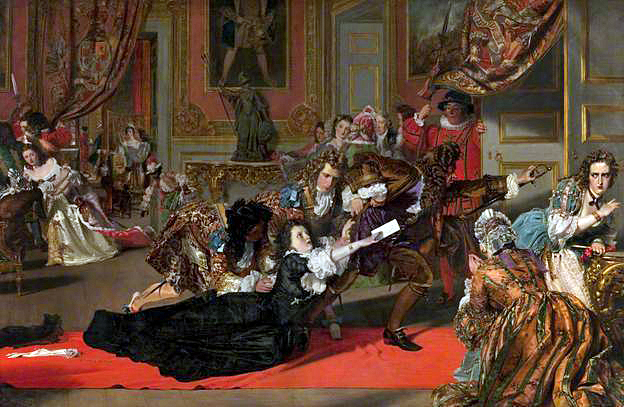
‘The Lord Provost intimated that Robert Hannah, Esq., of 82 Addison Road, Kensington, London, had, through his friend, David Ritchie, Esq., of Messrs. Buchanan, Wilson and Co., Limited, Glasgow, intimated his desire to present to the Corporation, to be placed in the New Art Galleries, Kelvingrove Park, the free gift of a picture entitled  “The Countess of Nithsdale Petitioning George I on Behalf of her Husband who was under sentence of death for rebellion” painted by the donor, and which had been exhibited at the Royal Academy in 1854. The Lord Provost moved that, in accepting this picture, the Corporation express their high appreciation of the valuable gift and accord the donor a cordial vote of thanks therefor. The motion was unanimously agreed to.’  1  

Fig. 1 The Countess of Nithsdale Petitioning George I on Behalf of her Husband
© CSG GIC Glasgow Museums Collection/ArtUK (Accession Number1177)

This painting depicts; ‘The interior of a room in Windsor Castle (in 1716). In the centre is George I making for the door and dragging (Winifred) Lady Nithsdale, who grasps his coat, along the floor. Two courtiers endeavour to release the King from her hold. On the right, kneeling, is Mrs Morgan a friend of Lady Nithsdale, and to the left, seated, are Lady Nairn and the Duchess of Montrose. Various groups of lords and ladies-in-waiting etc. are about the room.” 2

 (The King turned down her petition but Lady Nithsdale (1680 – 1749) was successful in rescuing her husband from the Tower of London by dressing him as a woman. The couple then escaped to France).

            According to the Parish Register, Robert Hannah was christened on 2 July 1812 at Kirkmabreck near Creetown, Kirkcudbright. (Most references state that he was born on 3July in Creetown). He was the fifth of eight children born to John Hannah, a builder and artisan, and Janet Brait. 3 (The family name was originally Hannay but Robert`s father preferred the palindromic symmetry of Hannah). Janet Brait`s father had been a farmer in Chapleton but died relatively young. It was said that his three daughters were ‘remarkable for their personal attractions.’ 4

      Very little is known about Robert`s early life but it may be that, like his eldest brother John, he spent his youth with his mother`s relatives in Chapleton. 5 It was said that John left home at an early age ‘to avoid the possibility of becoming burdensome to his parents.’ Perhaps a similar sentiment influenced Robert`s decision to leave home early. He studied first in Liverpool and then at the Royal Society of Arts Schools in London. He also spent some time in Rome and by 1842 was exhibiting his paintings at the Royal Academy (RA) in London. His address at this time was Shubbery House, Brompton Road, London.6 In all he exhibited 22 works at the RA between 1842 and 1870.7 Two of his paintings – The Novel and The Play – which were exhibited at the RA in 1852 – were bought by Charles Dickens.

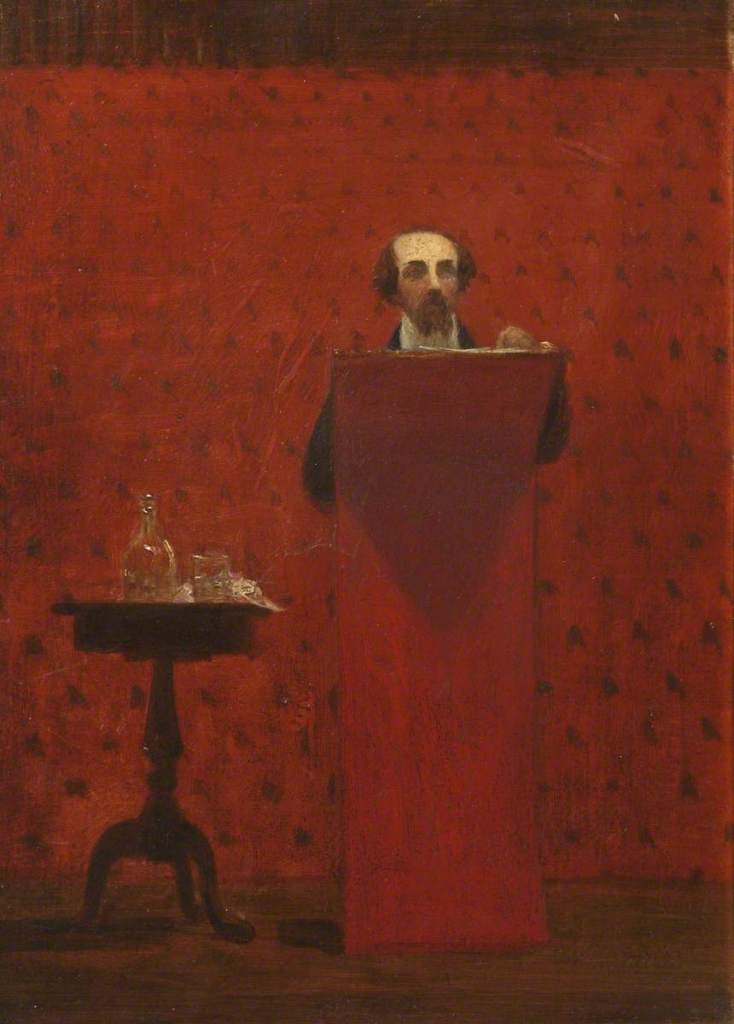
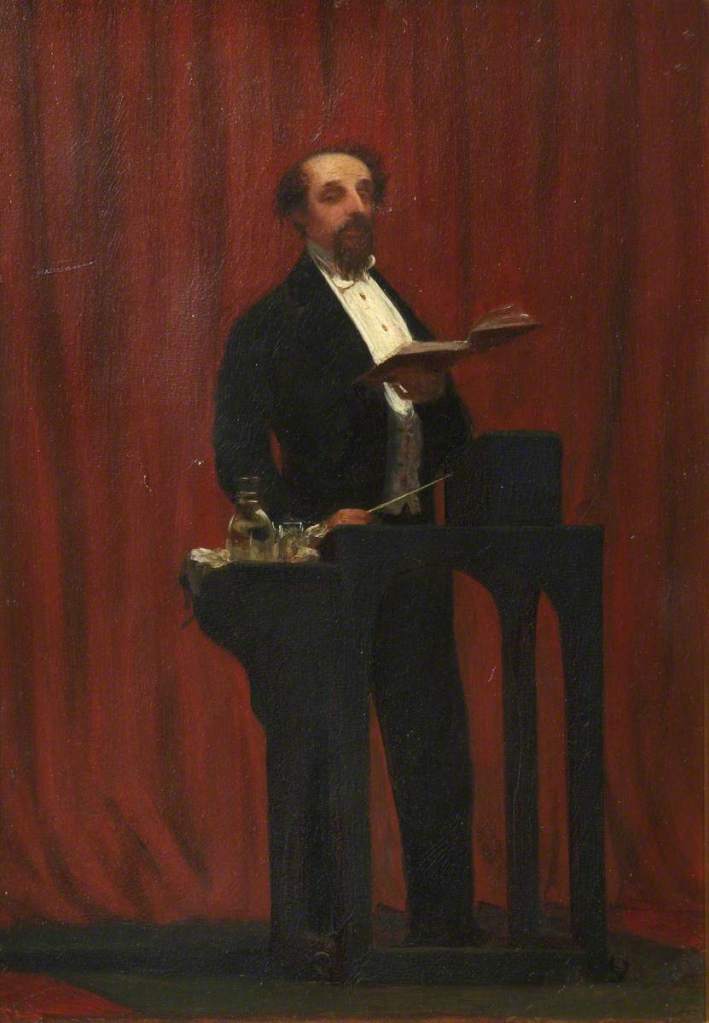
Two small oil paintings (10 inches x 7.2 inches) of Dickens giving a public reading are in the Charles Dickens Museum in London. These were made from memory by Hannah the morning after he had been present at one of Dickens` readings. The paintings were given to Georgina Hogarth, Dickens` sister-in-law, by Hannah in January 1904. They were gifted to the museum in 1941 by Comte Alain de Suzannet.8 One of these paintings was exhibited at the 34th Annual ‘Dickens on the Strand’ festival in Galveston, Texas in December 2007 9.

 Figs. 2 and 3 Charles Dickens giving a public reading
Charles Dickens’ Museum, London/ArtUK
https://creativecommons.org/licenses/by-nc-sa/4.0/

In 1845 Robert Hannah married Emma Cordy Baxter in Kensington, London. 10 She was born in St. Pancras on 26 June 1820.11 In 1851, the two were living at 2 Alfred Place West, Kensington. His occupation was ‘artist and painter’ and he employed two servants. 12

In 1851, Robert`s eldest brother John (b. 1802) was living in Burton-on-Trent with his sister Agnes. He was a widower with three young daughters and a son. John was a ‘cheese factor’. 13 He was also a part-time poet; a volume of his poetry was published posthumously. 14 John Hannah died in 1854 and Robert and Emma, who had no children of their own, took over the task of raising John`s three girls; Janet Sarah, born 1837, Gertrude, born 1841 and Bessie (Elizabeth?), born 20 August 1842. They afterwards became the subject of many of Robert’s paintings.15  

 Fig. 4 Portrait of Bessie Hannah painted by
her uncle and given to her as a
wedding gift.                                                                  

     In the 1861 census Robert Hannah (listed as Hannay) was a ‘bond fund holder and proprietor of houses.’ Bessie aged 17 was still living with Robert and Emma while Gertrude had found employment as a governess at Eton. In 1863, the Glasgow Institute of the Fine Arts held an Exhibition of Works by Living Artists. Robert Hannah whose address was 2 Alfred Place West, Old Brompton, London, exhibited two works: Sisters of Charity (no price given) and A Birthday Present priced at £105.00.16 Both pictures had been exhibited at the RA in London the previous year.

      By 1871 Robert and Emma had moved to 153 Upper Church Street, Chelsea. From the census, Robert was living on ‘income from houses and dividends’. Emma and his niece Janet were with him. It seems that he was now part of the thriving artistic community in Chelsea and was a friend of William Holman Hunt.

In 1870 Birnie Philip moved his workshop to a villa in Manresa Road, and artists were also starting to move into Upper Church Street: Robert Hannah, the Scots historical painter, made large additions to (the house at) number 153. He was still at the same address in 1881.

In the 1890s several artists moved into Upper Church Street. Number 123 on the corner of Elm Park Road was built in 1894 for Felix Moscheles, and by 1901 the Chelsea Arts Club had moved into two old villas at numbers 143-5. Evelyn and William de Morgan moved to numbers 125-7 (8-9 Bolton Place) Upper Church Street, where two terraced houses were adapted for them in 1909-10. Augustus John occupied Robert Hannah’s house at number 153, until he moved to Mallord Street. 17

Fig. 5 Robert and Emma Hannah in their London Home.

By this time (1891) Robert and Emma had moved to 82 Addison Road, Kensington. In the census of that year, Robert is described as ‘living on his own means’ and employing two housemaids, a cook and a footman. He was still at the same address in 1901, aged 88 and an ‘artist and painter’. He had four servants.

Emma Hannah died at home the following year aged 82. Robert Hannah died in Kensington on 5 April 1909 aged 97 after a long illness. 18

It may be that Robert Hannah made more from his property dealings than from his paintings. He does not rate a mention in the Dictionary of National Biography.

Among his listed paintings are:
 Astronomy in the Castle Douglas Art Gallery, Stewartry Collection 19.
Confidence (1844).
Refreshing the Weary (1847) which was bequeathed anonymously to York Art Gallery in 1970 20.
William Harvey Demonstrating the Circulation of Blood to Charles I (1848).
(A wood engraving of this painting was published in the Illustrated London News, in 1851 and was also reproduced in Nuland, Medicine: The Art of Healing, 1992).
Master Isaac Newton in his Garden, (1856)
Portrait of the Artist, J. C. Hook, A.R.A. (1859).
Eton College from the Thames, In the Victoria and Albert Museum, London. (Dixon Bequest)
Honeymoon (This painting was sold in London on 5 November 1997, for £4,485) 21

Robert Hannah was described as a painter of portraits, genre scenes, landscapes and historical subjects with a style similar to that of the Faeds. 22

References

  1. Minutes of the Corporation of Glasgow, 22 February 1906, C1/3/34 page 876, Mitchell Library, Glasgow
  2. Glasgow Art Galleries Catalogue, 1935.
  3. Parish Registers, Family Search, familysearch.org
  4. John Hannah of Creetown, Poet’ http://www.kirkcudbright.co/historyarticle.asp?ID=296&p=5&g=4
  5. ibid
  6. McEwan, Peter J. M., Dictionary of Scottish Art and Architecture, Antique Collectors Club 1994
  7. Parkinson, R., Victoria and Albert Museum, Catalogue of British Oil Paintings 1820-1860, London: HMSO, 1990, p. 117
  8. Dexter, Walter, The Dickensian, June 1941. (From Michael Slater, Emeritus Professor of Victorian Literature, Birkbeck, University of London – by e-mail).
  9. molly.dannenmaier@galvestonhistory.org
  10. England and Wales Marriage Registration Index, 1837-2005, database, FamilySearch (https://familysearch.org/
  11. England Births and Christenings, 1538-1975, database, FamilySearch (https://familysearch.org/
  12. ancestry.co.uk, Census 1851, England
  13. ibid
  14. Hannah, John, Posthumous Rhymes 1854, Samuel Wilton Rix. http://www.kirkcudbright.co/historyarticle.asp?ID=296&p=5&g=4
  15. My Ancestry; http://www.feeshowell.com/…/Microsoft%20Word%20-%20Ch1%20-…
  16. Exhibition Catalogue, Mitchell Library, Glasgow
  17.  ‘Settlement and building: Artists and Chelsea’, A History of the County of Middlesex: Volume 12: Chelsea (2004), pp. 102-106. http://www.britishhistory.ac.uk/report.aspx?compid=28699. Date accessed: 07 July 2012.
  18. Parkinson, R., Victoria and Albert Museum, Catalogue of British Oil Paintings 1820-1860, London: HMSO, 1990, p. 117
  19. www.artistsfootsteps.co.uk
  20. ibid
  21. Benezit, Dictionary of Artists. Paris, 2006
  22. ibid

Andrew Weir – The Right Hon. Lord Inverforth of Southgate (1865 – 1955)

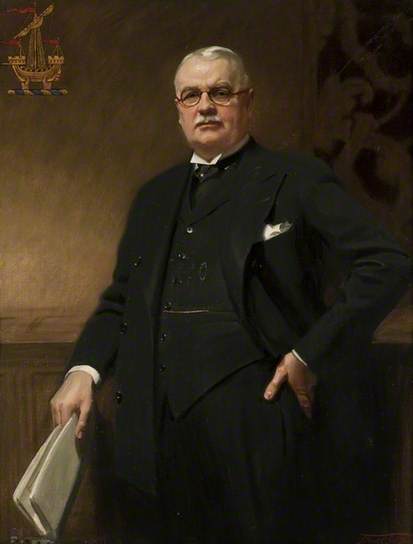
Fig. 1 The Rt. Hon. Lord Inverforth, P.C
Frank O. Salisbury, C.V.O., LL.D., R.P., R.I. (1874-1962).
       Acquisition Number 2310.
© estate of Frank O. Salisbury. All rights reserved, DACS 2024.
     Image credit: Glasgow Life Museums/ArtUK

‘The Town Clerk submitted a letter from Lord Inverforth offering to present to the corporation his portrait by Frank O. Salisbury, at present on exhibition in the Kelvingrove Art Galleries, and the committee agreed that the gift be accepted and that a letter of appreciation be sent to the donor.’ 1

            Andrew Weir was born on the 24 April 1865 in Glasswork Street, Kirkcaldy. He was the eldest son of William Weir a cork manufacturer and Janet Laing who were married on 2 January 1865.2 According to the census, 3 the family was still at Glasswork Street in 1871 but by 1881 had moved to 269 High Street, Kirkcaldy.4 Andrew, aged 15, having attended Kirkcaldy High School was now an apprentice clerk with the Commercial Bank of Scotland living with his parents, brothers Thomas (13), William (8), David (1) and sisters Jessie (6) and Isabella (4). Thereafter, Andrew moved to Glasgow and worked for a time in a shipping office. Then, in 1885, at the age of twenty, he bought his first ship – the barque Willowbank. On 5 May that year he opened a small office in Hope Street, Glasgow 5 (According to The Bailie it was at 70 Waterloo Street. 6) and used his ship in the coasting trade. The business prospered and within ten years he had built up a fleet of fifty-two ships of modern design and created the firm of Andrew Weir and Co. Shipowners of Glasgow. This firm ‘controlled the largest fleet of sailing ships in the world’ under one owner. 7 It became managing owners of the Bank Line (named after Weir`s first ship), Invertanker, Inver Transport, Trading Company, and several other shipping companies.  

            On 1 August 1889 Andrew Weir married Tomania Anne Dowie, daughter of Thomas Kay Dowie, a coachbuilder, in her home at 28 Thomson Place, Kirkcaldy. Andrew`s address was 185 Kent Road, Glasgow. His younger brother William was a witness. 8 Two years later, Andrew and Tomania were living at 4 Edelweiss Terrace, Partick, Glasgow with their newborn daughter Anne Forrestdale.  With them were Andrew`s siblings, William Weir (19), Jessie B. Weir (16) and Bella B. Weir (14). 9

            In 1896 Weir began to modernize his fleet by converting it to steam. His first steamship was launched under the banner of the Bank Line. At the time of the 1901 Census, he was with his family (now four girls and a boy) at Blanefield Mansion, Kirkoswald, Ayrshire. 10 Sometime after this he moved to London and at the 1911 Census his address was 57 Holland Park, Kensington, London. 11

                 In 1917 Weir was asked to investigate the way in which materials were supplied to the army. Among his recommendations was the appointment of a Surveyor-General of Supply to oversee the task of providing the army with all its stores and equipment other than munitions. His recommendations were accepted, and he was given the job of Surveyor-General with a seat on the Army Council.

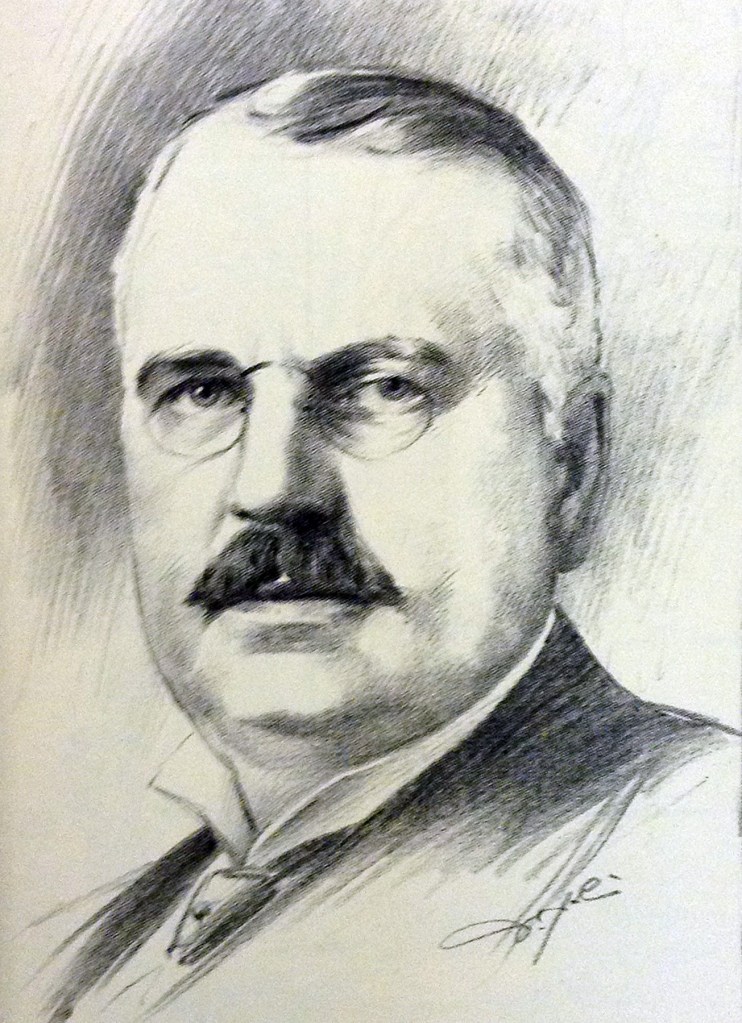
                                  Fig. 2    Andrew Weir in 1917 12

                In 1919 he was appointed Minister of Munitions, and he remained in this office until March 1921. His focus now changed to the sale of the vast quantities of army stores which had accumulated during the war. ‘Again, his genius for organization and great business acumen converted what might have been worthless goods or liabilities into considerable assets. It was not without reason that he was termed the man who saved Britain millions.’  For his services he was raised to the peerage as Baron Inverforth, of Southgate on 5February 1919. 13 He was also made a member of the Privy Council and received the American Distinguished Service Medal.

            After the war he invested in diesel-powered ships and broadened his business interests. He became chairman of the Marconi Wireless Telegraph Company and president of the Radio Communications Company, the Marconi International Marine Communications Company and Cable and Wireless which was formed by a merger of all the transmission companies. He was chairman of the Anglo-Burma Rice and Wilmer Grain companies and was on the board of Lloyds Bank. He was founder and first chairman of the United Baltic Corporation set up at the instigation of George V to replace German shipping interests in the Baltic. 

            In 1925, Inverforth bought the 60-room mansion, and eight acres of grounds called The Hill, Hampstead Heath. This property had formerly belonged to Lord Leverhulme. (When Inverforth died in 1955 he bequeathed the house, now known as Inverforth House, to Manor House Hospital. Inverforth House became the women’s section of the hospital and became known as Inverforth House Hospital).14

            Andrew Weir and his wife celebrated their golden wedding in 1939, but Lady Inverforth died two years later in 1941. He continued to go to his office four days a week into his ninety-first year. He died at his home in Hampstead on 17 September 1955.15,16 An obituary was published in the Glasgow Herald.17(Appendix 1) His wealth at death was £548,214 1s. 8d.18

            ‘One thing more remains to be said. Mr. Andrew Weir inherited the moral traditions of Scottish industry. He grew rich, but not ostentatious. His increasing fortune went back and back into trade. He never dreamed either of cutting a figure in plutocratic society or making himself a public character. A quiet, rather shy, and not often articulate person, he lived a frugal life, loving his business because it occupied all his time and satisfied nearly every curiosity of his inquiring mind.’19

            ‘Inverforth possessed great energy and enthusiasm, and also that almost essential quality of leadership: the ability to select suitable subordinates and leave them to carry on without interference. His integrity, great driving force, and brilliant organizing ability made him a man of power and influence in the commercial world although he shunned the limelight of publicity. His friends and employees, terms frequently synonymous, knew his unobtrusive generosity and kindness. He was particularly approachable: even the most junior employee who had some suggestion towards the improvement or well-being of the firm would be sure of a patient and appreciative hearing and would carry away the remembrance of a kindly twinkle in Inverforth’s eye and a good-humoured quiet voice. In many ways he was a model employer, taking interest in the welfare of his staff and their families both during and after their service with him. For many years, until he was eighty, he was treasurer of the Royal Merchant Navy School and, even after he had handed over this office, he continued to take a deep interest in the children.’ 20

References

  1. Minutes of Glasgow Corporation, 19th January 1943, page 394, Mitchell Library.
  2. Scotland`s People, Birth Certificate
  3. Scotland’s People, 1871 Census
  4. Scotland’s People, 1881 Census
  5. Oxford Dictionary of National Biography
  6. The Bailie, No. 2321, Mitchell Library, Glas
  7. Begbie, Harold, The Mirrors of Downing Street Chapter XII, G. P. Putnam and Sons, 1921 http://www.readcentral.com/Books/Harold Begbie
  8. Scotland’s People, Marriage Certificate
  9. Scotland’s People, Census 1891
  10. Scotland’s People, Census 1901
  11. ancestry.co.uk, England Census, 1911
  12. The Bailie, No. 2321, Mitchell Library, Glasgow
  13. The London Gazette 7Feb 1919, p 1956
  14. www.cityoflondon.gov.uk/…/Hampstead-heath-inverforth-house-heritage#
  15. Wikipedia, en.wikipedia.org/wiki/Andrew_Weir,_1st_Baron_Inverforth‎
  16. Glasgow Herald 19 September 1955, page 1
  17. Glasgow Herald 19 September 1955, page 8. (There were also obituaries published in The Times, Manchester Guardian and The Scotsman)
  18. probate, 3 Oct 1955, CGPLA Eng. & Wales
  19. Begbie, Harold, The Mirrors of Downing Street Chapter XII, G. P. Putnam and Sons, 1921 http://www.readcentral.com/Books/Harold Begbie
  20. Oxford Dictionary of National Biography

Obituary Glasgow Herald 19 September 1955 page 8

            The death occurred on Saturday of Lord Inverforth at his home, The Hill, Hampstead Heath, London. He was in his ninety-first year.

            Lord Inverforth was one of the greatest shipowners of his time, and his work as Surveyor-General of Supply at the War Office during the First World War and later as Minister of Munitions was of the greatest importance to the nation. He was Andrew Weir and was born in Kirkcaldy in 1865 and educated at Carlyle`s High School. He originally chose banking as a profession but at a very early age his interest turned to shipping.

            At the age of 20, having purchased two sailing vessels, he founded the firm of Andrew Weir and Co., with offices in Glasgow. The two ships soon became a fleet, and one of his barques, the Willowbank, gave her name to the Bank Line. In 1896 his first steamship was launched, and this was the beginning of the Bank Line which Andrew Weir and Co. managed.

War Services

            During the First World War, Mr. Weir placed his services at the Government`s disposal. In 1917 he was made Surveyor-General of Supply at the War office and a member of the Army Council. Two years later he became Minister of Munitions and remained in that post and a member of the Cabinet until 1921. For his war services he was created a baron in 1919 and made a member of the Privy Council.

            On entering the Government he severed his connection with Andrew Weir and Co. and thereafter his business interests lay in wider fields. He became chairman of a number of companies, including the Marconi Wireless Telegraph Company, and when in 1929 the merger of all the transmission companies was arranged Lord Inverforth became the chairman of the new Cable and Wireless, Ltd. and later president and then honorary president. He was also the president of the Andrew Weir Shipping and Trading Company, chairman of the United Baltic Corporation, and the Bank Line. He had been a director of Lloyds Bank and the National Bank of Australasia.

Heir to the Peerage

            In 1889 Lord Inverforth married Anne (who died in 1941), younger daughter of Mr Thomas Kay Dowie and they had one son and four daughters. The son, who succeeds to the peerage, is the Hon. Andrew Alexander Morton Weir. He was born in 1897 and is a partner in Andrew Weir and Co. In 1929 he married Iris Beryl, daughter of the late Charles Vincent, 4th battalion, The Buffs, and they have two sons.

Gilbert James Innes (1888-1971)

  Donor . Gilbert  James   Innes  OBE (1888-1971)

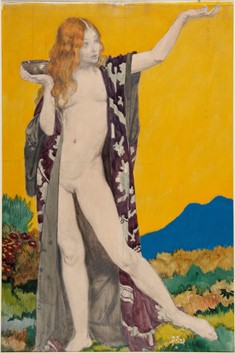
 Figure 1 Sowing the Seed  1913 by William Newenham Montague Orpen1 (1878-1932)       © CSGCIC Glasgow Museums and Libraries Acc 2941

The Painting

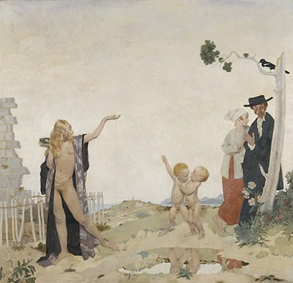
This painting , a watercolour, gouache on paper ,appears to be  a study for a larger work Sowing New Seed for the Board Of Agriculture and Technical Instruction In Ireland (see below Figure 2))which was described by one newspaper as ,’a baffling but beautiful piece of imaginative painting’ when it was exhibited at The New English Art Club in December 1913. 2 (See Appendix A)

 The completed painting is now in the collection of the Mildura Arts Centre in  Victoria, Australia. 3

The painting was  donated in February 1952. The work  appears to have been previously owned  by  T. & R.  Annan Ltd , Photographers and Fine  Art Dealers of 518 Sauchiehall Street ,Glasgow.  According to a letter  dated  21  January 1952  from  Thomas Craig Annan, one of the directors of the firm, to Dr Tom Honeyman ,the Director of Glasgow Museums, a ‘visitor’ had approached him wanting to know if  Dr Honeyman would be interested in the painting if it was presented to Glasgow Corporation and if it might then be loaned to Glasgow School of Art for the students to study. Apparently some of the instructors at GSA had praised the work and had sent students to  the Annan   Gallery to study the work. The visitor referred to was probably Gilbert J Innes or his representative as the work was presented by Gilbert  to Glasgow Museums the following month. There is no information at this date that the painting was loaned to Glasgow School of Art at any time .4

Figure 2 Sowing New Seed c 1913  by Sir William Newenham Montague Orpen (see Appendix B)

By kind permission of the Mildura Art Centre Collection

Senator RD Elliott Bequest. Presented to the City of Mildura by Mrs Hilda Elliot 1956

Donor.  Gilbert James Innes (1888-1971)

1888-1914

Gilbert James Innes was born on  5 April  1888 at 24 Oakfield Terrace ,Hillhead in Glasgow. His father was Gilbert Innes ,a draper and warehouseman, and his mother was Margaret Richmond .5 Gilbert was the eldest of four boys . John Richmond was born in 1891, Frederick in 1892 and Thomas in 1894.6 Frederick had a twin sister Margaret who sadly died of whooping cough when eight weeks old .7 By 1901 the family were living at 27 Hamilton Drive in Partick and employed two servants .8 All the Innes boys attended Glasgow Academy ,a private school for boys  near Kelvinbridge  in Glasgow’s West End. Gilbert was in the  Latin Class and attended the school from 1898 to 1904 when he left  aged sixteen .9 Gilbert retained a connection to the school  throughout his life. For example he was an Honorary Governor of the Glasgow Academicals War Memorial Trust from 1957 to 1971.10  In 1961 he gave £2000 to the school to provide new laboratory equipment for the school .11

In 1908 Gilbert became a member of the Incorporation of Weavers at Trades House in Glasgow. The Innes family had connections to the weaving industry. His father  ,Gilbert was a draper and his  grandfather, James Innes, was a calico printer and mill manager .12

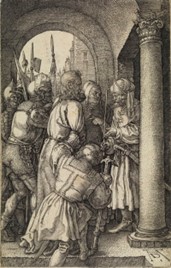
The family had moved to 16  Kirklee Road in Hillhead by 1911. This remained the family home for many years . Gilbert was twenty-two years old in 1911 and was employed as a clerk in a shipping agency .13 His employer was probably   P Henderson & Company where his uncle, John Innes, had been a partner since 1887. John Innes was  managing director of the company  from 1884 to 1927.14 John Innes was a knowledgeable and wide collector of  art. He was especially known for as a collector of prints. In the 1920s  he presented over 170 prints and etchings to Glasgow Art Galleries including works by  Albert Durer, Lucas von Leyden , Rembrandt, Whistler ,Cameron and Boner(see figure 3 ). This donation forms a valued part of the ’black and white ‘ section of Glasgow Art Galleries .It may be that this interest influenced his nephew but this is mere speculation.

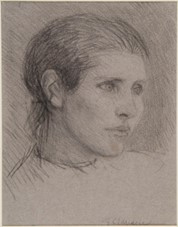
© Figure 3 Examples  of etchings CSGCIC  Glasgow Museums and Libraries

Christ Before Pilate by Albrecht Durer(1471-1528) Glasgow Museums Resource Centre PR1920.6aq


Head of a Young Girl by David Young Cameron GMRC 1920.6


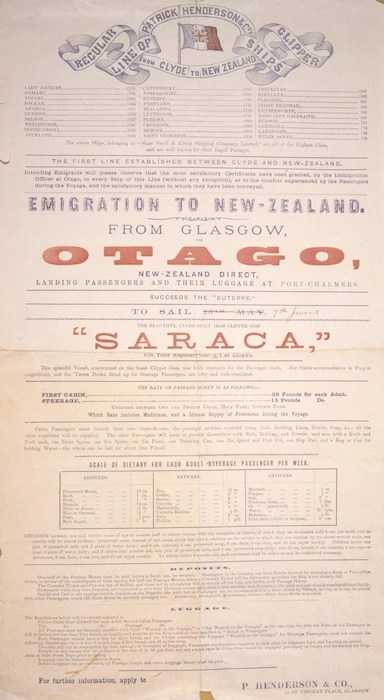
P Henderson & Company had been founded in Glasgow in 1834 by twenty-five year old Patrick Henderson. The company were ship owners, agents and managers. From about 1854 the company began to transport Scottish emigrants to New Zealand in sailing ships and had the contract for  Royal Mail to New Zealand. As there was little cargo to carry back from New Zealand at that time the company ships  began calling regularly at Burma for cargo such as teak to take back to Glasgow. So successful was this venture that to increase the supply of much needed capital more investing partners were taken on in 1860 and formed The Albion Shipping Company Ltd  which  dominated trade with New Zealand and in 1882 pioneered the first refrigerated frozen meat shipment from New Zealand to London  using sailing ships as there were no coaling stations en route at that time.

Figure 4 Poster advertising emigration from Glasgow to Otago, New Zealand.

Figure 4 Poster advertising emigration from Glasgow to Otago, New Zealand.© National Library of New Zealand

In 1865 the opportunity arose to become involved in the Irrawaddy Flotilla Company which operated a ferry service on the Irrawaddy River in Burma. This company was managed by P. Henderson and Company from Glasgow and by the nineteen twenties operated over 600 ferries on the river .16 The  company also started a steamship service between Glasgow, Liverpool and Burma in 1870 which  in 1882 need capital for expansion and amalgamated with  Shaw Savill  and Company becoming Shaw, Savill &Albion Co Ltd. The ships continued to be  managed by P Henderson & Company for whom our donor probably worked after leaving school at sixteen .17

1914-1919

Gilbert and his three brothers all served in the army  during World War One. Gilbert’s service at the beginning of the war is rather confusing as he appears to have originally   enlisted with 9th Battalion Highland Light Infantry as a private but in August 1915 he was transferred to  the 8th Battalion Scottish Rifles(The Cameronians) as a 2nd Lieutenant .18 It appears that these two battalions both served at Hamilton Barracks at the beginning of the war and transfers between battalions were quite common 19, especially if a soldier had previous officer training as Gilbert may have done in the  Glasgow Academy Officer Training Corps which was attached to the 9th Battalion HLI from 1908.20 Gilbert served in Egypt, Palestine and in France between 1916 and 1918. He was wounded in France in July 1918 by which time he was a captain in the 8th Battalion Scottish Rifles. Lt  Colonel J.M. Findlay who was the commanding officer of the 8th Battalion in his book With The Scottish Rifles 1914-1918, writes ,  ‘Innes ,my adjutant, was badly wounded ‘. This was at a battle in  Baigneux  which was fought between 28 July and 4  August 1918.21  Gilbert’s  brother John  was also serving  in the 8th Battalion though John may have ended war as a captain in Royal Engineers .22 All the Innes brothers survived the war.

Post  War Years

 Gilbert was made a partner at P. Henderson and Company in 1920.23 He was principally concerned with the design of ships and later with the passenger side.  He played an active part in the world of shipping becoming a member of several  organisations connected to shipping. For example he was a member of the management committee and later chairman  of The British Corporation Classification Society, later The British Corporation Register of Shipping and Aircraft,  before its absorption by Lloyds Register of Shipping. He was elected as a member of the General  and Technical Committee of Lloyds Register of Shipping 24  and was an underwriter for Lloyds. 25 He served as  honorary treasurer of The Institution of  Engineers and Shipbuilders   in Scotland 26 and also became chairman of the Clyde Lighthouse Trust .27

 At the time of the  1921 census Gilbert was  a boarder staying at Ellerslie, a guesthouse in Cove, a popular holiday destination on the Clyde Coast. Also staying the house were two nurses, one of whom was Dorothy S.Prain .28 We do not know if Gilbert and Dorothy already knew each other or if this is when they first met  but they were married on July 12 1922 in Dundee .29

Dorothy was born in Longforgan , Perthshire on 29 April 1893. Her father was John Prain ,a farmer at the time of her birth. Her mother was Nellie Boyd Scrymegeour .30 Dorothy  attended the High School of Dundee .31 Dorothy’s mother died in 1907 aged only thirty-three 32 and her father married again in 1913.33

 There is no information as to Dorothy’s  activities during WW1  but she  trained to be a nurse at the Western Infirmary in Glasgow and  was registered as a nurse in 1919 so presumably she was undergoing nursing training during the war . 34 Perhaps Dorothy and Gilbert met in the hospital while Gilbert was recuperating from his wounds.

According to the tradition  at that time Dorothy would have given up her nursing career on marriage. The couple lived at 8 Queensburgh Gardens in Hillhead Glasgow after their marriage and on July 15  1928 a daughter Doreen Prain Innes was born. Doreen was born at a private nursing home at 1 Claremont Terrace in Glasgow. 35 There were several nursing homes in Claremont Terrace at that time. 1 Claremont Terrace was run by Henrietta Gunn  who was an experienced nurse and midwife. 36

During the nineteen twenties  Gilbert  travelled abroad several times and spent time in Burma possibly because of P. Henderson &Company’s  connection  with the Irrawaddy Flotilla Company. In March 1928 he and his uncle John Innes travelled to Rangoon in Burma on the  SS Amorapoora and later that year Gilbert and Dorothy travelled to Rangoon on the SS Yoma departing from Liverpool on 26th October 1928.37 Both ships were owned by the Henderson Line. Whether daughter Doreen travelled with them is unknown as she would have been only three months old at the time.

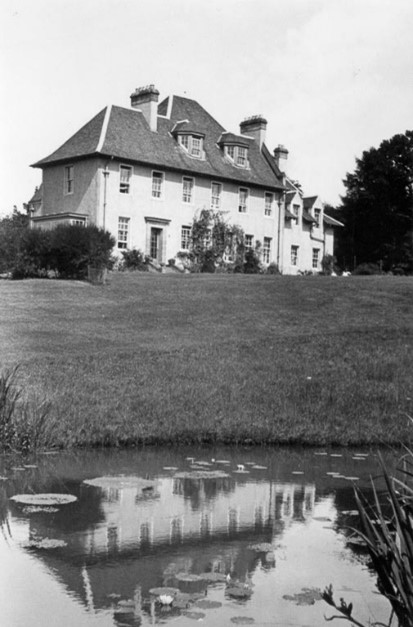
At the end of the decade the Innes family moved to Killearn in Stirlingshire where they built a house called Gartaneaglais .38 The house was designed by a naval architect called Gardener and the garden by J B Wilson. 39

1930-1971                   

Figure 5 Gartaneaglis, Killearn © Killearn Trust

Gilbert  continued to be involved in the shipping industry after the move to Killearn both as a partner in Patrick Henderson  Ltd  and in various shipping  concerns   as well as being an underwriter for Lloyds.  One example in 1953 was his bid to became a major shareholder in the Liverpool Steamship Company. 40

Our donor  appears to have had an interest in charitable activities throughout his life. In 1930 he was elected a member of the Incorporated Glasgow and Stirlingshire and Sons of the Rock Society an organisation founded to help those in need. The annual dinner was held at the Golden Lion Hotel in Stirling. 41

He  was also a founding member of The Killearn Trust which was founded in July 1932  for the ‘promotion and advancement of the welfare and interests of the Parish of Killearn.’ Gilbert is quoted as ‘the moving spirit’ of the Trust and remained its chairman until his death in 1971.42 The activities of the Trust are too numerous to mention here but one of the main activities was to provide housing for those in need in the community. 43

Gilbert was, like his Uncle John, a collector of  art including the Scottish Impressionists. He gave several  paintings from his collection to The Glasgow Academy. 44 He was listed as  a member of the council of the Royal Glasgow Institute of Fine Arts when it met at the Glasgow Art Club in March 1937.45 Gilbert was also a keen photographer. Several local photographs taken by Gilbert were included in the  second edition of  a book about Killearn The Parish of Killearn. 46 As we have seen Gilbert also took an interest in Glasgow School of Art (GSA). He was a member of GSA Board of Governors from 1935 and Vice Chairman from 1941 to 1967. From 1936 to 1949 he was Convenor of the School and Staff Committee  and Honorary Vice President from 1967 to 1972.47

Dorothy Innes also played a part in community activities .To support the war effort during WW2 for example on 2 November 1939 she presided over a meeting of the Killearn Red Cross Society. 48 In May 1942  Mr and Mrs Innes  invited local people  to visit the gardens at Gartaneaglais to view the great show of daffodils, narcissi and flowering shrubs and to give donations to the Women’s Royal Institute (WRI) Comforts Fund for HM Forces. 49 In June 1944 on behalf of the Dumgoyne WRI Mrs Innes granted the use of her kitchen at Gartaneaglais  for the canning of fruit. 50 In December 1945 an advertisement appeared in the Stirling Observer for a Christmas Sale  of toys and fancy goods at Gartaneaglais in aid of the Thanksgiving Fund. 51 These are only a few of many such events.

Participation business and the local community  is a constant theme in our donor’s life. He was a member of the Glasgow Chamber of Commerce and was Convener of the Postal, Telephone and Telegraph Committee in the 1940s. 21 He was  a  member of the Glasgow Western Hospital Board of Management. When a new medical rehabilitation and geriatric hospital opened at  Killearn Hospital in 1957 Gilbert stated, ’Western Hospitals Group, since the inception of the NHS, had been very much in need of the facilities now provided in Killearn’. 53

Gilbert was also involved  in business and commercial education. At some point he became vice-chairman of the Board of Governors of the Glasgow and West of Scotland Commercial College Ltd 54 which had been founded in 1915 and which moved to a new building at 173 Pitt Street in Glasgow in 1934. Among its courses the college offered qualifications in business and commerce, librarianship and secretarial studies and ran the Scottish Hotel School which was based at Ross Hall in Crookston in Glasgow. In 1955 this college became The Scottish College of Commerce.  In 1964 the college joined with the Royal College of Science and Technology in George Street, Glasgow  to form   the new Strathclyde University. In 1975 173 Pitt Street became the headquarters of Strathclyde Police. 55

There is little  further information regarding the Innes family other than  they often spent holidays in Iona for which they had great affection. 56

Daughter Doreen attended St Andrews University and in 1950 graduated with a BSc in Mathematics and Astronomy 57 going on to earn an Honours BSc in 1952.58 She married William Thomas  Foster in 1956.59

It is to be assumed that Gilbert continued his involvement in the various activities described above  as his  contribution to the community and the business world was recognised in the Queen’s Birthday Honours  in 1963 when he was awarded an OBE in June specifically  for his services as chairman of the Glasgow  War Pensions Committee. 60 Gilbert had been involved in this organisation since at least 1937 when he was vice-chairman. 61

Dorothy  Innes died, aged 74  on November 1 1967 of bronchopneumonia while staying in Perth possibly with a cousin A. M Prain who witnessed  the death certificate. 62

Gilbert died on 2 November 1971 aged eighty-three at Cannisburn  Hospital Bearsden of ,’peripheral vascular failure’ and artherosclerosis’. 63

References

1. www.newenglishartclub.co.uk/past-members/william-orpen

2. Leicester Chronicle and Leicestershire Mercury 06/12/1913 p. 2

3.  https://paulineconolly.com/2021/orpens-sowing-newseedof-protest/the

4. Glasgow Museums Resource Centre (GMRC) Object File 2941  

5. www.scotlandspeople.org.uk Statutory  Births .1888

6. as above 1891,1892,1894

7. www.scotlandspeople.org.uk  Statutory Deaths 1894

8. UK Census 1901

9.  https://theglasgowacademyarchive.org.uk

10. MacLeod, Iain The Glasgow Academy. 150 Years.Appendix . p.iii.  The Glasgow Academicals War Memorial Trust 1997

11. Glasgow Herald 30/06/1961 p. 2

12.  www.tradeshouselibrary.org.uk

13. UK Census 1911

14. Laird,Dorothy ,Paddy Henderson: the Story of P .Henderson & Company     1834-1961.  P Henderson &Co 1961.pp.227-8

15. as above p. 156

16. op. cit. Laird p. 113

17. http://www.en.wikipedia.org/wiki/P_Henderson_%26_Company

18. Army Lists. Monthly  Supplement  September 1915

19. https://www.longlongtrail.co.uk>regiments-and-corps

20. op. cit.   MacLeod.  p. 64

21. Findlay,Colonel J.M. With The Scottish Rifles 1914-18 .  Blackie & Sons 1926. p.169

22. Army Lists. Monthly Supplement September 1917

23. op. cit. Laird p. 184

24. Times 11/04/1949 p. 8

25. Liverpool  Echo 30/11/1958 p.5

26. Dundee Evening Telegraph 05/04/1939 p. 6

27. op. cit.   Laird  p. 184

28. UK Census 1921

29. www.scotlandspeople.org .uk Statutory Marriages 1922

30. www.scotlandspeople.org.uk Statutory Births 1893

31. Dundee Courier 27/06 1908 p. 8

32. www.scotlandspeople.org.uk Statutory Deaths 1907

33. www.scotlandspeople.or.uk Statutory Marriages 1913

34. www.ancestry.co uk  UK and Ireland Nursing Register.Royal College of Nursing  1898-1968

35. www.scotlandspeople.org.uk Statutory Births 1928

36. www.ancestry.co.uk Midwives Register 1904-1957

37. www.ancestry.co.uk Passenger Lists  1890-1960

38. Glass, Fiona (editor)The Parish of Killearn :the Village and its History. 3rd edition  The Killearn Trust 2009.p.151

39. as above

40. Birmingham Post 22/10/1953 p. 9

41. Falkirk Herald 25/01/1930 p. 6

42. Wilson, Andrew (editor) The Parish of Killearn.   2nd edition 1988 .The Killearn Trust .p. 146

43. as above

44. Killearn Trust . heritage@kcfc.co.uk

45. Scotsman 24/03/1937 p. 11

46. op. cit. ref 42 pp 40-41

47. archives@gsa.ac.uk

48. Stirling Observer 02/11/1939 p. 4

49. Stirling Observer 07/05 1942 p. 4

50. Stirling Observer 29/06/1944  p.4

51. Stirling Observer 13/12/1945 p. 4

52. Courier and Advertiser 20/03/1947 p. 3

53. Edinburgh Evening News 16/02/1957 p. 5

54. Scotsman 02/07/1955 p. 3

55. http://www.theglasgowstory.com

56. op. cit. ref 38 p. 151

57. St Andrews Citizen 17/06/1950 p. 3

58. Scotsman 05/07/1952 p. 3

59. www.scotlandspeople.org.uk Statutory Marriages 1956.

60. Daily Record 08/06/1963 p. 9

61. Scotsman 11/10/1937 p. 11

62. www.scotlandspeople.org.uk Statutory Deaths 1967

63. as above 1972

Appendix A The Painting

Our study is of the naked female on the left of the full  painting. The inspiration for the completed painting was reported  to be a reaction to Orpen’s anger  that at that time in Ireland government grants for art and education

 came from Whitehall under the direction of the Irish Board of Agriculture. Orpen was horrified by this situation which he thought was bizarre and furious that agriculture received far more funding than art. His painting is thought to  mock the attitudes of the government using allegorical figures. The nude female(our study) represented the sowing of new ,more progressive ideas while the naked  children appear as the offspring of this intellectual enlightenment. The peasant couple on the right and the ramshackle farmhouse with the pig-pen to the left  signified the Board of Agriculture’s awkward attitude towards art and culture.

Appendix B  The Artist

William Newenham Montague Orpen (1878-1932)

William Orpen was born in Stillorgan ,County Dublin and studied at the Dublin Metropolitan School of Fine Art for six years from the age of thirteen. He won every major prize including the British Isles Gold Medal for life drawing. He then moved to London and studied at the Slade School from 1897 to 1899. He had a private teaching studio in Chelsea along with Augustus John ,a fellow Slade graduate. He split his time between Dublin and London and built a lucrative reputation  painting society portraits as well as group portraits known as ‘conversation pieces’  for example The Café Royal in London (1912).During WW1 he was a war artist based mainly in Amiens, travelling to the  Somme in April 1917. He painted portraits of Douglas  Haig and Sir Hugh Trenchard, commander of the Royal flying Corps. He continued to be successful after the war exhibiting at the New English Art Club and The Royal Academy .Orpen also had connections to Glasgow School of Art. During the  1914 to 1915 academic year Orpen was an assessor for diplomas, scholarships and bursaries (Drawing and Painting) and one of the judges for the Haldane Travelling Scholarships.

Acknowledgements

I would like to offer many  thanks to the following people for their help in the research for this report:

Jillian  Peterson of the Mildura Arts Centre ,Victoria, Australia

Fiona Glass ,a member of the Innes family and editor of the 3rd edition of The Parish of Killearn.

Gill Smith of the Killearn Trust

J.M.M.

Mrs. Clara Graham nee Gertrude Lawrence Clara Dunsterville (1853 – 1932)

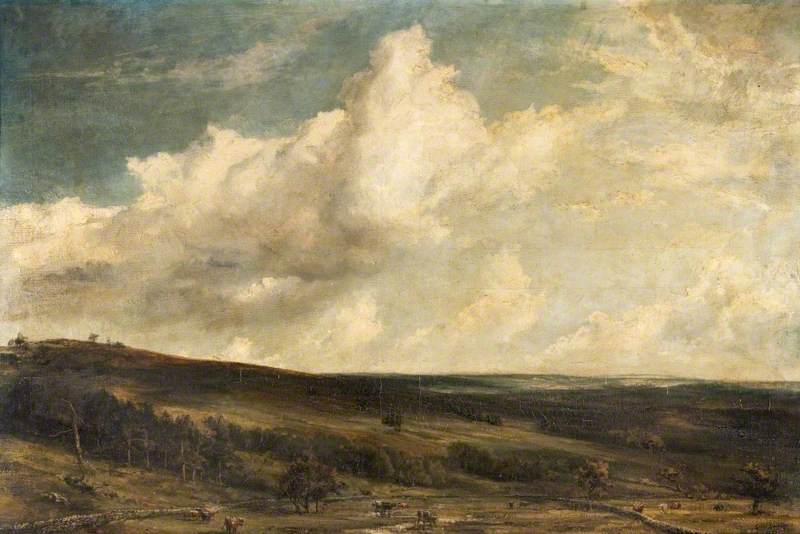
An oil painting titled Barden Moor by Cecil Lawson was received by Glasgow Corporation from Mrs. Graham, 4 Belgrave Crescent, Edinburgh on 29 February 1924.1

Fig. 1 Barden Moor, Yorkshire , 1881 Cecil Gordon Lawson (1849 – 1882)
 © CSG GIC Glasgow Museums/ArtUK. (Accession Number 1572)

Gertrude Lawrence Clara Dunsterville (Mrs. Clara Graham) was born on 16 September 1853 in Bombay, India. She was christened at Naseerabad, Bombay on 11 October 1853. 2 Clara (as she preferred to be called) was born into a family with a history of service in the Indian Army. She was the eldest daughter of Colonel James Barnes Dunsterville and Harriet Birch who had married in Deesa, India in 1847. Her father was attached to the 19th Regiment of Native Infantry and at that time was Assistant Commissary General of the Bombay Army. Her grandfather, General James Henderson Dunsterville, was Commissary General of the East India Company. He married Clara`s grandmother, Lucy Barnes, in Bombay in 1817. Clara`s sister, Harriet Mary, married Lt. Col. Arthur Shewell in Bombay in 1869 3. One of Clara`s cousins, Major General Lionel Charles Dunsterville, was a friend of the author Rudyard Kipling and served as the model for ‘Stalky’ Corkran in the author`s stories of Stalky and Co.4
On 3 August 1872, aged eighteen, Clara married twenty-eight year old Donald Graham in Bombay 5. He was a son of John Graham of Skelmorlie, Ayrshire who had extensive business interests in Scotland, India and Portugal based on textiles and port wine.

                           Fig. 2 Mrs. Clara Graham in her wedding dress 6

            Very soon after their marriage the couple travelled to Scotland and took up residence in Skelmorlie Castle in Ayrshire the home of Donald`s parents and on 15 May 1873 their first child, James Dunsterville Graham was born. 7 The family then returned to Bombay probably because of Donald`s business interests but also because Clara`s widowed mother was still living there. Two further sons were born in Bombay, Donald M. N. Graham on 12 November 1874 and Charles T. J. Graham on 4 December 1877. 8 Thereafter the family returned to Scotland possibly as late as 1880. They were probably accompanied by Clara`s mother and sister who was widowed that year.9 In the 1881 census Donald, Gertrude (Clara) and their three sons were living at Skelmorlie Castle 10. A fourth son, Archibald, was born in Edinburgh in 1882. This birth was registered in both Largs and Edinburgh. Another son, Maurice, was born at Skelmorlie in 1888. 11
Donald Graham bought Airthrey Castle and estate in Stirlingshire from Lord Abercrombie in 1889 for the sum of £75,000. He built a large extension to the castle at a cost of a further £15,708 and planted the grounds with conifers and rhododendrons. 12 In the 1891 census, Donald and Gertrude and four of their sons were living at Airthrey Castle. 13 Clara gave birth to three more sons there between 1892 and 1898.

Fig. 3 Donald and Clara Graham and family , Airthrey Castle (about 1898) 14

Donald Graham died at Airthrey Castle on 23 January 1901 after a short illness. He was buried in Logie Churchyard and Clara commissioned a stained-glass window to be placed in the new Logie Church in his memory. 15 Clara continued to live at Airthrey Castle and in the 1901 census she was the head of the family, aged 47 with four sons at home. 16
Ownership of the estate was formally handed over to her by Donald`s trustees on 15 May 1902 17. In the 1911 Census, Clara and two of her sons, John and Nigel were living at Airthrey Castle together with her widowed sister Harriet (Shewell) and a niece. 18
In 1924, Airthrey Castle was leased to Charles Donaldson of the shipping family Donaldson Brothers.19 This coincides with the date of donation of the painting and most probably resulted from Clara ‘downsizing’ to move in, at least temporarily, with her niece in Belgrave Crescent, Edinburgh. The painting would have been given to Glasgow because of her husband`s business connections with the city.
Clara Graham died aged seventy-nine on 20 April 1932, at 9 Weymouth Street, Portland Place, London. 20 She was buried beside her husband and two of her grandchildren in the Old Churchyard of Logie Kirk, Bridge of Allan on 23 April. Six of her sons acted as pallbearers. 21
In the course of her funeral service, the Rev. W. McIntyre referred to the work Mrs. Graham had done as a heritor in the parish, (with which she had been associated for nearly fifty years), and of the widespread interest she took in its welfare. He commented that ‘she was esteemed for her charity and her own spirit and personality and her loyalty to those who served her’. 22

 Fig. 4 Memorial plaque to Donald and Clara Graham on the wall of 
Logie Old Church. (Photo by author)

  Airthrey Castle became a maternity hospital in 1939. Airthrey Estate continued in family ownership until 1946 and eventually became the campus for the University of Stirling.

Edinburgh Connection
Donald Graham`s sister Margaret married Henry Hill Lancaster an advocate and essayist. Their daughter, Elizabeth Ethel Graham Lancaster married Sir Ludovic James Grant, Regius Professor of Public Law at Edinburgh University. The Grants owned the house at 4 Belgrave Crescent, Edinburgh from where the painting was donated in 1924. Elizabeth Grant was Clara’s niece with whom she was living at this time, Airthrey Castle having been leased to Charles Donaldson.
The writer and broadcaster Sir Ludovic Kennedy was born at 4 Belgrave Crescent in 1919. He was the grandson of Sir Ludovic and Lady Grant.

The Painting
The painting was bought by John Graham (father-in-law of Clara) soon after it was completed in 1881. It was lent by him to the Royal Glasgow Institute of the Fine Arts (RGI) Exhibition of 1882. 23 The painting then passed to Donald Graham and was lent by him to the Glasgow International Exhibition of 1888. The minutes of Glasgow Corporation of 5 January 1934 record that the painting was lent to the Paisley Art Institute for their 58th Exhibition to be held that year. 24

The Graham Family
The firm of W. & J. Graham & Co has its roots in a Glasgow based textile concern. However, the family had extensive business interests not just in their native Scotland but also in India. The success of their affairs led to them being described by a contemporary historian, as being ‘among the merchant princes of Great Britain’.
At the early age of fifteen, John Graham undertook the establishment of a branch of the firm at Leghorn, which continued until the success of Napoleon’s policy excluded British commerce from all the continental markets except Portugal. Therefore, an office of the company was established in Oporto, Portugal`s second city. In 1820 John and his brother William, who were then managing the office, accepted 27 pipes of Port wine in settlement of a bad debt. This Port was shipped to the parent company in Glasgow which initially reprimanded the brothers for not sending cash. Fortunately, however, the Port turned out to be very popular and soon William and John were being urged by their parent company to acquire and ship more of this wine.
The brothers formed the partnership of W & J Graham & Co. with the aim of specialising in the production of the finest Port wines. They channelled their considerable resources and energy towards the pursuit of this goal.
In 1839 the firm, by the formation of a house at Bombay, extended its business operations to India; and again in 1863 a separate firm was established at Calcutta and later a branch was formed at Kurrachee. 25
John Graham retired to Skelmorlie Castle in Ayrshire. He was well known in Glasgow as an enthusiastic supporter of the fine arts. From its foundation in 1861 he had contributed paintings each year to the RGI Loan Exhibitions and in 1878 this amounted to twenty-six pictures including works by Turner and Gainsborough. ‘All the canvases shown …..are no more than so many specimens of what his private gallery really is. They only enable us to judge ……of the wonderful treasures of the Skelmorlie mansion’. 26 He died at Skelmorlie Castle on 4 October 1886 aged 89 years.
Donald Graham, C.I.E., was born in Oporto, Portugal in 1844 and educated at Harrow. He was a son of John Graham of Skelmorlie and Elizabeth Hatt Noble. His business interests were centred in Glasgow and Bombay. He was made a Companion of the Most Eminent order of the Indian Empire (C.I.E.) for his services on the Legislative Council of Bombay. In 1896 he was vice-president of the Glasgow Chamber of Commerce and was elected Lord Dean of Guild the following year. His business address was ‘W. & J. Graham & Co., 55 Cathedral Street, Glasgow’ later becoming ‘Graham, D. and J. & Co., merchants’.27 He was also a JP for Lanarkshire and Deputy Lieutenant of the City of Glasgow and Stirlingshire.

References

  1. Minutes of Glasgow Corporation, Sub-Committee on Art Galleries and Museums, 29February 1924.
  2. FamilySearch, United Kingdom, British India Office, Births and Baptisms, 1712 – 1965. (Her date of birth is given incorrectly in Family Search. The correct date is taken from the plaque in Logie Old Churchyard).
  3. http://www.swinhopeburnfamilies.com/grpf1266.html
  4. Information from Mrs. Christina McLaren, (great granddaughter of Clara Graham). Also archiveshub.ac.uk/data/gb012-ms.add.9498
  5. FamilySearch, India Marriages, 1792 – 1948
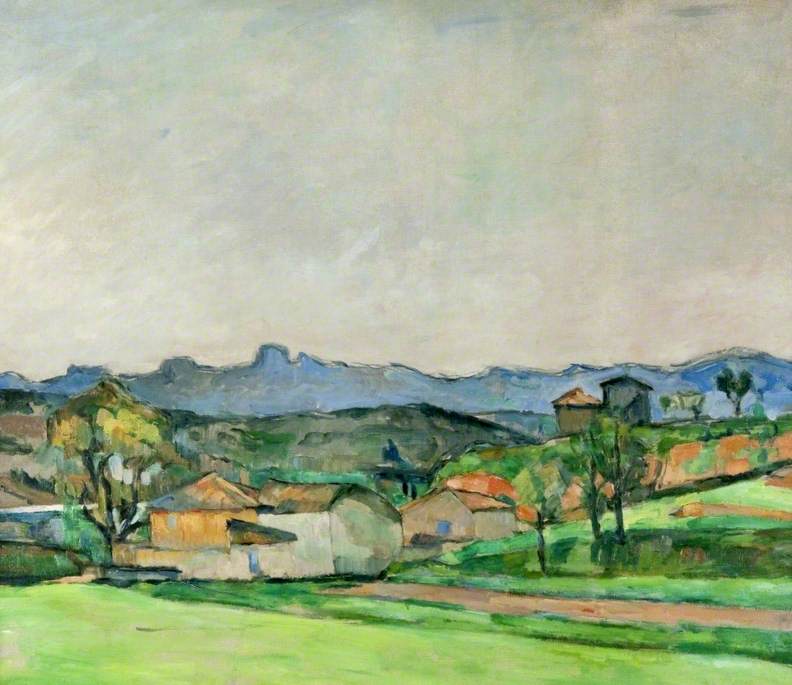
  6. From a picture in the possession of Mrs Christina McLaren, with permission
  7. Scotland`s People, Birth Certificate
  8. FamilySearch, India Births and Baptisms, 1786 – 1947
  9. Information from Mrs. Christina McLaren,
  10. ancestry.co.uk, Scottish Census, 1881
  11. Scotland’s People, Birth Certificates
  12. Ferguson, R. Menzies, M.A., Logie, A Parish History, Vol II, Alexander Gardner, pub., Paisley, 1905, pp 61-63.
  13. ancestry.co.uk, Scottish Census, 1891
  14. The original photograph is in the possession of Mrs. Christina McLaren. Used with permission
  15. Information from Mrs. Christina McLaren
  16. ancestry.co.uk, Scottish Census, 1901
  17. Ferguson, R. Menzies, M.A., Logie, A Parish History, Vol II, Alexander Gardner, pub., Paisley, 1905, pp 61-63.
  18. Scotland’s People, Census 1911
  19. Information from Mrs. Christina McLaren
  20. Bridge of Allan Gazette 23 April 1932
  21. Bridge of Allan Gazette 30 April 1932
  22. ibid
  23. Billcliffe, Roger, The Royal Glasgow Institute of the Fine Arts, 1861-1989: A Dictionary of Exhibitors at the Annual Exhibitions, Woodend Press, 1990
  24. Object File, Glasgow Museums Resource Centre
  25. Memoirs and Portraits of One Hundred Glasgow Men, James Maclehose and Sons, Glasgow, 1886
  26. The Bailie, No 296, 19June 1878, Mitchell Library, Glasgow
  27. Glasgow Post Office Directories 1888 and 1901

Dr Arthur James Ballantyne (1876 – 1954)

There was submitted an offer by Dr A. J. Ballantyne, 11 Sandyford Place, Glasgow C3, to gift the oil painting Interior by Tom McEwan, and the committee, after hearing a report from the director, agreed that the picture be accepted and that a letter of thanks be sent to the donor.1 The painting was received on 30 January 1942.

Fig. 1 Interior – (The Spinning Wheel) (2268) – Tom McEwan

© CSG GIC Glasgow Museums (Not listed on ArtUK)

The painting was exhibited at the Royal Glasgow Institute of the Fine Arts Annual Exhibition of 1895, priced at £65 2

  Fig. 2 Arthur James Ballantyne (1876 – 1954)

            Arthur James Ballantyne was born on 13 July 1876, at 36 Dalhousie Street, Blythswood, Glasgow 3. He was one of a ‘large and brilliant family of a Glasgow merchant.4

His father Thomas Ballantyne was a pawnbroker and jeweller who had married Jane Kate Chalmers on 20 September 1870 in Glasgow 5. Thomas Ballantyne was born in Paisley in 1828, and this was his second marriage. Jane Kate was born in Dundee in 1838. According to the 1881 Census, in addition to Arthur, aged four, there were nine other siblings at 36 Dalhousie Street ranging in ages from 20 years to 2 months 6. Thomas Ballantyne died of cancer in 1887 leaving Jane ‘living on private means’. 7 The family moved to 260 Renfrew Street, Glasgow and in the 1891 Census there were eight children at home with one servant employed 8.

            Arthur Ballantyne was educated at Garnethill School, Glasgow and graduated M.B., Ch. B. in 1898 and M.D. in 1901 from the University of Glasgow. 9 His doctoral thesis was entitled Contusion Injuries to the Eyeball. 10 After spending a year at the University of Vienna, he returned to Glasgow and spent two years as Assistant House Physician and Assistant Surgeon at the Glasgow Eye Infirmary. He joined the Ophthalmological Society of the United Kingdom in 1903 and in 1906 was elected to the Fellowship of the Royal Faculty of Physicians and Surgeons of Glasgow. He was appointed Surgeon at the Glasgow Eye Infirmary in 1909 – a post he held until 1935. In 1909 he was appointed Professor of Physiology at Anderson`s College of Medicine. This post was relinquished in 1914 when he became Professor of Ophthalmology at the College. The previous year he had held a similar post at St. Mungo`s College. 11

            At the 1911 Census,Arthur was living with his mother and brother Thomas who was a civil engineer and two servants at 11 Sandyford Place, Anderston. His occupation was ‘physician, eye-specialist. 12 On 14July 1916 he attended a meeting of the Oxford Ophthalmological Congress where he read a paper on Quinine Amaurosis. He was then ‘Surgeon to the Glasgow Eye Infirmary’ 13. During the latter stages of the First World War, he was given a temporary commission as a lieutenant in the Royal Army Medical Corps and was appointed Ophthalmic Surgeon to the 67th General Hospital in Salonika 14. When he arrived in Salonika, he was to take the place of a certain Dr Tom Honeyman (later Director of Kelvingrove Art Gallery and Museum, Glasgow) who had become ill due to an attack of fever.15

            In 1920, Ballantyne was appointed Lecturer in Ophthalmology at the University of Glasgow. In the same year, on 23 June, at the age of 43, he married Jessie Snodgrass, the daughter of one of his colleagues. She was 27. The marriage took place in the Grand Hotel, Glasgow 16. Sadly, Jessie died from eclampsia on 27January 1928. 17 It may have been on this occasion that he reportedly wrote to a colleague, ‘These have been sad days for us, but work and service remain to make life worthwhile.’ 18

            Part of this “work” involved travelling to give lectures on his research and on 15 August 1930, he arrived in Montreal, Canada aboard the Duchess of Bedford. His final destination was St. Albans, Vermont in the U.S.A. 19 almost certainly to deliver lectures there.

            He was appointed the first Tennent Professor of Ophthalmology at the University of Glasgow in 1935, a post he held until his forced retirement in 1941 due to age rules. (The Tennent chair was the first in Ophthalmology to be founded in the United Kingdom. It was endowed by Gavin Patterson Tennent who graduated M.D. from the University in 1870). On his retirement, Arthur Ballantyne was awarded an LL.D. by the University and made an Emeritus Professor. 20

               Fig. 3 Arthur Ballantyne`s signature on the Register of Awards of
Honorary LL.D. s 21

He ‘continued his ground-breaking research in diabetic retinopathy’ and was awarded the Mackenzie Medal in 1942. (This award was established in 1924 to mark the centenary of the Glasgow Eye Infirmary. It was named after its founder and was awarded to an eye surgeon who had made a special contribution to ophthalmology). In 1943 Dr Ballantyne delivered the Montgomery Lectures in Dublin and in 1946 the Doyne Memorial Lectures at Oxford. 22

            In 1947 he travelled to Roanoke College in Virginia to be awarded an honorary D.Sc. degree. It was recorded in the immigration papers that he was ‘aged 70 and a widower, 5 ft 5 ins tall, fair complexion with grey hair and grey eyes’.23 He continued to publish original research and in 1950 was awarded the Nettleship Medal for the ‘best piece of original work by a British ophthalmologist published in any journal during the previous three years’. 24

            Despite living all his life in the West End of Glasgow, Arthur Ballantyne retired to the village of Killearn, and he died there on 9 November 1954 aged 78. The cause of death was cardiovascular degeneration. 25 His estate was valued at £83,051:14:0 26. An obituary recorded that while ‘His professional work claimed most of his time, he was an expert in colour photography and a connoisseur of art in which he was not a mere dilettante; he was a member of the Committee of the Glasgow Institute for Fine Arts and was on the hanging committee’ (of that Institute). 27 An obituary was also published in the British Journal of Ophthalmology.28

            Arthur Ballantyne was a ‘prolific contributor to medical literature’  and had an international reputation for his research activities. He served upon the editorial committees of the Glasgow Medical Journal, the Ophthalmoscope, Ophthalmologica, and the British Journal of Ophthalmology. He was co-author of the Textbook of the Fundus of the Eye which was published posthumously in 1962. A description of the book stated that; “The problems of the fundus of the eye were the life-long study of the late Professor Arthur J. Ballantyne who brought to them an unusual patience fordetail and an appreciation of their importance in the understanding of the total picture. He stimulated a generation of Glasgow ophthalmologists with his interest”. 29

References

  1. Minutes of Corporation of Glasgow, 17 February, 1942, C1/3/105, p791.
  2. Billcliffe, Roger, The Royal Glasgow Institute of the Fine Arts, 1861-1989: A Dictionary of Exhibitors at the Annual Exhibitions, (Woodend Press, 1990).
  3. Scotland`s People, Birth Certificate
  4. Thomson, A. M. Wright The Glasgow Eye Infirmary, 1824-1962
  5. Scotland’s People, Marriage Certificate
  6. ancestry.co.uk, Scottish Census, 1881
  7. Thomson, A. M. Wright The Glasgow Eye Infirmary, 1824-1962
  8. ancestry.co.uk, Scottish Census, 1891
  9. www.universitystory.gla.ac.uk
  10. www.bjo.bmj.com
  11. www.universitystory.gla.ac.uk.
  12. ancestry.co.uk, Scottish Census, 1911
  13. British Journal of Ophthalmology, 1917; 1; 153 -161
  14. British Journal of Ophthalmology, 1917; Supplement to the London Gazette, 2 July 1917.
  15. Webster, Jack, From Dali to Burrell, The Tom Honeyman Story, B & W Publishing, Ltd., Edinburgh, 1997
  16. Scotland’s People, Marriage Certificate
  17. Scotland’s People, Death Certificate
  18. British Journal of Ophthalmology, 1955; 39:1, 63 – 64.
  19. ancestry.com, Border Crossings: From Canada to U.S., 1895 – 1954
  20. Archives of the Royal College of Physicians and Surgeons,
  21. Glasgow; University Archives
  22. Minutes of the Royal College of Physicians and Surgeons of Glasgow, 6 December 1954.
  23. ancestry.com, New York, Passenger Lists, 1820 – 1957.
  24. Minutes of the Royal College of Physicians and Surgeons of Glasgow, 6 December 1954.
  25. Scotland’s People, Death Certificate
  26. Confirmations and Inventories, 1954. National Records of Scotland.
  27. British Journal of Ophthalmology, 1955; 39:1, 63 – 64.
  28. Minutes of the Royal College of Physicians and Surgeons of Glasgow, 6 December 1954.
  29. http://www.amazon.com/Textbook-Fundus-Arthur-Ballantyne-F-R-F-P-S/dp/B007LVOPXY/ref=sr_1_1?s=books&ie=UTF8&qid=1372834404&sr=1-1

Appendix

The library of the Royal College of Physicians and Surgeons of Glasgow has a set of instruments called Ballantyne Droppers. These were used and probably designed by Arthur Ballantyne.

Fig. 4, A Set of Ballantyne Droppers

Fig. 5, A Ballantyne Dropper

Mrs John Arnott nee Eliza Stiven Cuthbert (1879 – 1942)

Two paintings were received by Glasgow Corporation on 20 April 1943. They were bequeathed by Mrs Arnott. 1

Fig. 1 Mr John Arnott                                 Fig. 2 Mrs John Arnott
Robert Cree Crawford                                 James McBey
1920 *                                                             1927 2
 © CSG GIC Glasgow Museums/ArtUK.

Accession Number 2321                                Acc. No. 2322

  • A plaque attached to the painting has the following inscription: –

‘Presented to Mr. John Arnott of Messrs. J. & B. Stevenson by the employees at Cranston Hill Bakeries in appreciation of the happy relations which have always existed between him and them and to celebrate the occasion of his completing a connection of forty-five years with the firm. Glasgow, May 1920’.

(The firm of J. and B. Stevenson was established in Glasgow in 1865 and grew to become one of the largest bakers of bread and cakes in the world. By 1891 they had established bakeries in Cranstonhill and Plantation each of which was seven stories high and capable of producing 100,000 loaves daily. Each bake house was “under the careful supervision of an efficient foreman personally responsible for the conduct of a large staff of bakers”. The firm later opened bakeries in Battersea in London). 3

            John Cuthbert (Eliza’s father) was born about 1825 in Kirriemuir, Forfarshire. His occupation initially was as a ‘seedsman’ 4 but by 1871 he was the manager of the Wick and Pulteney Gas Works in Pulteneytown, Wick. 5 He married Margaret Stiven, who was born in Arbroath, in Inverness on 15 February 1866 and thirteen years later, on 26February 1879, Eliza Stiven Cuthbert was born in Burn Street, Pulteneytown. 6 Eliza was the youngest of seven children. In 1882, John Cuthbert died in Wick, aged 58 7 and the family moved to 14 Kersland Street, Partick, Glasgow with Eliza`s older sisters variously employed as dressmaker, milliner and pupil teacher. 8 Eliza`s mother died in Partick in 1900 aged 62.9 The family remained in Kersland Street and in the 1901 census, Eliza`s oldest sister Margaret aged 32 was head of the family. Also living there were Isabel Jane Cuthbert, 25, William Stiven Cuthbert, 23 and Eliza, 22. 10 However, by 1908 Eliza had moved to 14  Glasgow Street, Hillhead and was employed as a bookkeeper. 11 This seems to have remained her address until 1929.

            On 15 November 1923 at 22 Woodlands Terrace, Glasgow, Eliza Stiven Cuthbert married John Arnott. She was 44 and he was 72. Eliza`s sister Isabel was one of the witnesses.12

            John Arnott was born in Tillicoultry, Clackmannanshire in 1851, but his family moved to Glasgow and by 1861 were living at 2 Orchard Street in Govan. John’s father, also John, was born in Fordyce, Banff in 1826 and was a wool sorter. 13 He married Janet Drummond on 5 September 1847. In 1871 the family was living at 53 McNeil Street, Hutchesontown. John, aged 19, was a ‘dyer’. Jane Arnott, 44, was head of the family. 14 In 1875, John Arnott joined the firm of J. and B. Stevenson (see above). By the time of the 1881 census, the family had moved to 120 South Wellington Street, Hutchesontown and John was now a ‘baker’s shopman’. His father was fifty-six and his mother Janet fifty-four. 15 On 4 July 1882 at 110 Thistle Street, Glasgow, John aged thirty-one, married Mary- Jane Middlemass who was twenty-six and a milliner. Their respective addresses were 120 South Wellington Street and 211 Hospital Street, both Glasgow. John was now a ‘baker’s foreman’. 16 John progressed through the firm becoming a master baker and eventually bakery manager. In the 1891 census he was at 31 Dover Street, Glasgow, aged thirty-eight, with his wife Mary Ann Arnott (sic) who was thirty-five and born in Ireland. 17 Ten year later, the couple had moved again, this time to 53 Bentinck Street, Sandyford, Glasgow and they now employed a servant. 18 From 1906 they lived at 6 Royal Terrace, Glasgow. 19 and that was their address in the 1911 census having been married for twenty-eight years but had no children. Mary Arnott died on 14 August 1918 at 3 Claremont Terrace, Glasgow. On her death certificate her name is given as Mary-Jane Arnott nee Middlemass, aged sixty-two. 20

After his marriage to Eliza, the couple probably moved to 6, Royal Terrace but it seems that Eliza retained her property at 14 Glasgow Street. 21 Eliza`s portrait was painted in 1927 when she was 48. John Arnott continued to work at J. and B. Stevenson until his death in 1928. He died at The Deans, 28 Drummond Terrace, Crieff from a cardiac syncope leaving an estate valued at £11,489. 22,23 

            After his death Eliza remained at 6 Royal Terrace with her sister Isabel at least until 1931 when she made her will. 24 Later she gave up her flat in Glasgow Street and the house in Royal Terrace (she is not listed in the Glasgow Post Office Directory at either address). She moved to Kilmacolm with her sister. 25

            Eliza Stiven Arnott died aged 63 at Oakfield, Kilmacolm on 28June 1942. Her death was caused by a thrombosis following an operation to remove a gall bladder. 26 She was buried in Cathcart cemetery on 1 July. 27 Eliza`s name was added to the family memorial stone in the Old Municipal Cemetery in Wick. 28 Her estate was valued at £3,183:10:0. Her sister Isabel who was her executor and the sole beneficiary, died aged 90 in Glasgow in 1960.29

References

  1. ArtUk
  2. Ibid
  3. Index of Firms in Glasgow,1891 
  4. glasgowwestaddress.co.uk/1891_Book/Stevenson_J_&_B.htm‎
  5. ancestry.co.uk, 1851 Scottish Census
  6. ancestry.co.uk, 1871 Scottish Census
  7. Scotland’s People, Birth Certificate
  8. Scotland’s People, Death Certificate
  9. ancestry.co.uk, 1891 Scottish Census
  10. Scotland’s People, Death Certificate
  11. ancestry.co.uk, 1901 Scottish Census
  12. Glasgow Post Office Directory, 1908-09
  13. Scotland’s People, Marriage Certificate
  14. ancestry.co.uk, 1861 Scottish Census
  15. ancestry.co.uk, 1871 Scottish Census
  16. ancestry.co.uk, 1881 Scottish Census
  17. Scotland’s People, Marriage Certificate
  18. ancestry.co.uk, 1891 Scottish Census
  19. ancestry.co.uk, 1901 Scottish Census
  20. Glasgow Post Office Directory, 1906 – 7, and subsequent years
  21. Scotland’s People, Death Certificate
  22. Glasgow Post Office Directory, 1906 – 7, and subsequent years
  23. Scotland’s People, Death Certificate
  24. Index of Confirmations and Inventories, Mitchell Library, Glasgow
  25. Index of Confirmations and Inventories, National Records of Scotland
  26. Glasgow Post Office Directory, 1931 – 32
  27. Scotland’s People, Death Certificate
  28. Glasgow Herald, deaths, 1 July 1942
  29. gravestonephotos.com
  30. Scotland’s People, Death Certificate

Jessie McInnes nee McEwan (1874 – 1957)

Mrs Jessie McInnes donated The Star Ridge with the King’s Peak by Paul Cezanne to Glasgow in 1951.

Fig. 1 The Star Ridge with the King’s Peak, Paul Cezanne (1839 – 1906)
 © CSG GIC Glasgow Museums/ArtUK. Accession Number 2932

The painting was bought by Glasgow collector William McInnes from Alexander Reid and Lefevre in 1942 in what turned out to be to his final purchase. The painting then passed to his son Thomas and then to Thomas’s widow Jessie.

Jessie McEwan was born on 27 September 1874 at 13 Cedar Street in the Hillhead district of Glasgow. She was the daughter of Thomas McEwan a journeyman baker and his wife Jessie Ewing who had married on 15 November 1867 in Milton, Glasgow. Jessie’s mother registered the birth. 1 By the 1881 census, the family had moved to 31 Crossburn Street, Milton. 2 Ten years later, Jessie was employed as a stationer’s assistant still living at 31 Crossburn Street with her parents and seven siblings. 3

On 5 July 1899 at 30 Berkeley Terrace, Glasgow, Jessie married Thomas Macdonald McInnes a draughtsman and a younger brother of William McInnes (qv) who was a witness at the ceremony. The other witness was Jessie’s sister Nellie. 4 The couple took up residence at 40 Nithsdale Drive, Strathbungo, Glasgow. Jessie was described as a ‘sanitary engineer draughtsman’s wife’. 5 By the time of the next census, Thomas and Jessie had moved to 74 Norham Street, Shawlands, Glasgow. 6 Thomas McInnes died at 17 Darnley Gardens, Glasgow in 1951 aged 79. He was a retired sanitary engineer. Jessie reported his death. 7

Jessie Ewing McInnes died on 21 January 1957 at 17 Darnley Gardens, Glasgow. She was 83. Her death was reported by her niece, Jessie Chase. 8

References

  1. Scotland’s People, Birth Certificate
  2. ancestry.co.uk, Scotland Census, 1881
  3. ancestry.co.uk, Scotland Census, 1891
  4. Scotland’s People, Marriage Certificate
  5. ancestry.co.uk, Scotland Census, 1901
  6. ancestry.co.uk, Scotland Census, 1911
  7. Scotland’s People, Death Certificate
  8. Ibid