The Glasgow Orpheus Choir (1901 – 1951)

On 21 November 1946 a portrait of Sir Hugh Roberton (1874 – 1952) was presented to Glasgow Corporation by the Glasgow Orpheus Choir

Fig. 1 Sir Hugh Roberton
by Maurice Codner (1888 – 1958) © CSG GIC Glasgow Museums Collection. (www.artuk.org).

The portrait was completed in 1938 1 and exhibited at the Royal Glasgow Institute in the same year, priced at £165. 2

The Glasgow Orpheus Choir had its origins in the Toynbee Social Club, a working men`s club in the east end of Glasgow. As part of the club`s activities it had established the Toynbee Musical Association. This was a group of about 40 people, gathered to socialise and sing as a choir. The group was joined in the autumn of 1901 in a hall in Rottenrow by their new conductor Hugh Stevenson Roberton. He later reported that although they were not necessarily trained singers they were ‘bright and eager’. The choir`s initial performances, given in model lodging houses etc., were low-key and a concert given at the end of their first year was not a success. After much hard work, the choir sang as part of the East End of Glasgow Exhibition in December 1903. The performance given was ‘memorable’ and the audience was extremely enthusiastic. This was followed by further concerts including performances at the Corporation Saturday Afternoon Recitals – for a fee of 3 guineas! – and concerts outside of Glasgow in Balmore, Bowling, Alexandria and Ardrossan.

1905 saw the start of annual concerts by the choir at the City Hall which proved to be a great success and in 1906 the choir severed relationships with Toynbee House and took up residence at the Collins’ Institute. Here, at the suggestion of Hugh Roberton, the choir was named the Glasgow Orpheus Choir and at this time had a membership of about 32 singers. The following year the choir`s first large-scale performance took place in St Andrews Hall, Glasgow, and was a major success. Thereafter, the choir sang to large and enthusiastic audiences. In 1911, Roberton founded and edited the Monthly Record of the Glasgow Orpheus Choir later called The Lute. He also wrote most of the content. During the 1914-18 War, the choir gave many concerts for soldiers in hospitals and in army camps. To celebrate ten years since its founding, an anniversary concert was given in 1915.

In 1920 the choir`s annual visits to London began. Here they sang to packed audiences. Throughout the 1920s the choir travelled extensively in Europe, South Africa, Canada and the United States. Each season they gave of the order of 40 concerts. By this time the choir was about 140 strong. It was invited to sing at 10 Downing Street on two occasions and in 1928 performed at Balmoral Castle for George V and Queen Mary. The choir also sang regularly on the BBC becoming something of a national institution. However, Roberton was a lifelong pacifist and because of his views the BBC initially refused to broadcast performances by the Orpheus Choir during WW2. However, after the matter was raised in parliament the ban was lifted and a performance by the choir was broadcast in June 1942. Despite Roberton`s pacifist views, the choir performed numerous concerts for soldiers in hospitals and camps and in May-June 1946 it toured the British Occupied Zone in Germany. After the war the choir performed annually at the Edinburgh Festival and continued to give many concerts. However, in 1951 Sir Hugh Roberton took the decision to retire and resigned as conductor. The choir`s final concert as the Glasgow Orpheus Choir was given in Glasgow in 1951. Each choir member was presented with a black and white print of the donated portrait signed by Sir Hugh Roberton.3

When Sir Hugh Roberton resigned as conductor at the age of 77, the name Orpheus retired with him although the choir continued to perform and was renamed the Glasgow Phoenix Choir. Sir Hugh Roberton died on 7 October 1952.

References

  1. Information on file at Glasgow Museums Resource Centre
  2. Billcliffe, Rodger, Royal Glasgow Institute of the Fine Arts, 1861-1989, The Woodend Press, 1990.
  3. Dorothy Gunnee, member of the Phoenix Choir, by email

See also

richardtoye.blogspot.com/2007/09/radical-conduct-how-sir-hugh-roberton.html

The Musical Times, Novello & Co., 1 May 1925

Craigie, Wemyess, Sir Hugh S. Roberton, Scotland’s Magazine, Scottish Tourist Board, February 1974

*Edith Julia Emma Edinger (Mrs. Geoffrey E. Howard)(1891 – 1977)

‘The Director reported that Mrs. Howard, Green Gates, Albion Hill, Loughton, Essex, had gifted a portrait of herself as a young child by Robert Brough, and the committee agreed that the gift be accepted and that a letter be sent to Mrs. Howard conveying their appreciation therefor’.1

(‘Green gates’ was a house that Edith and her husband occupied temporarily while they were looking for permanent accommodation in London). 2

            In the catalogue of donations to Glasgow, the painting is entitled Edie, Daughter of O. H. Edinger, Esq., London (2285) and was presented by Mrs Geoffrey E. Howard, of Ashmore, near Salisbury on 6 June 1942.3

            There is no photograph available of the painting as it is currently on extended loan to Edith’s family.                                                           

            The portrait was painted about 1900 when ‘Edie’ was nine. It was exhibited at the Royal Scottish Academy (RSA) Exhibition of 1900 having been sent from the Rossetti Studios, Flood Street, Chelsea, London. 4 The artist, who was Scottish, was a protégé of John Singer Sargent who in turn was a friend of Edith`s father which is probably why Brough was chosen to paint the portrait.5

Figure 1. Photograph supplied by Professor Sir Michael Howard and used with permission

  Edith Julia Emma Edinger (“Edie”) was born in London on 15 May 1891 6. Her parents were German Jews who emigrated to Britain and took British citizenship. Her father, Otto Henry Edinger was born in Worms in 1856; her mother was Augusta Fuld, whose date of birth was 24 June 1869 7. They married in Germany on 2 July 1890 8. Edith had two younger brothers, Valentine (born 1894) and George (born 1900) 9.

            Otto had first visited London in 1875 and set up in business there. He appears on the 1881 Census as a ‘lodger’ at 72 Prince`s Square, Paddington. 10 He was employed as a clerk. However, by 1901 he was living with his family at 83 Cadogan Gardens, Chelsea. He was now a stockbroker and employed six servants.11 He made several trips to New York between 1904 and 1907 but seems to have been unaccompanied. 12

            Otto`s family was now ‘rich and fashionable ……..kept a carriage and a butler, rode in Rotten Row, and in the winter months took the train out to Leighton Buzzard to hunt’. 13 As a result, Edith received a privileged upbringing. She ‘went to a fashionable, girls` day-school near Sloane Square and to finishing schools in France and Germany’. She was a debutante at the court of Edward VII and was also presented to the Kaiser aboard his yacht. (She reported to the family that the Kaiser spoke better English than Edward VII). ‘She dined with his officers, flirted with the King of Norway (and) attended the Berlin premiere of Rosenkavalier. She was lively, witty, wealthy ……….. and very beautiful’. She met her husband, Geoffrey Eliot Howard, at a dance at the Alpine Club in London in 1913 and they married on 19 November the following year. 14

Figure 2. Photograph supplied by Professor Sir Michael Howard and used with permission

Geoffrey, who was born on 24 December 1877 in Walthamstow, was thirty-even and Edith twenty-three. He was a director of the family firm of Howards and Sons based in Ilford and was later appointed chairman 15. The firm manufactured pharmaceutical and industrial chemicals. (Their main medicinal products were ether, quinine and aspirin, the latter being marketed with the slogan ‘Howard’s Aspirin is not the cheapest – it is the Best’) 16

After their marriage, Geoffrey and Edith moved into a house in Brompton Square ‘in a highly fashionable area on the borders of South Kensington and Chelsea’. Their first son, John Anthony Eliot Howard was born there on 19 January 1916. The next three years saw the birth of another son, Denis Valentine Eliot Howard but also the death of both of Edith`s parents. Her brother Val was killed on the Western Front in 1918. After the war they moved to a larger house looking on to Ennismore Gardens where a third son, Michael Eliot Howard was born in 1922.

            According to Michael, the 1920s were happy times for his mother. Her family was growing up and living in some style with a retinue of servants to look after them. She had a wide circle of friends in London and in the country. In addition, ‘She collected pictures and (Chinese) jade with enthusiasm and discrimination with a taste for modern artists’. She possessed works by Walter Sickert, Laura Knight, Duncan Grant, Jacob Epstein, Paul Maitland, Mary Potter, Marie Laurencin and Matthew Smith. She and her brother George were founder members of Chatham House set up in 1920 to analyse and promote understanding of major international affairs.

            Geoffrey`s father, Eliot Howard, died in 1927 and his house The Cottage on the Ashmore Estate, near Salisbury in Dorset passed to Edith and Geoffrey . Later as the house became too small for their needs it was ‘swapped’ for the village Rectory. Michael recalled ‘My mother spent what were probably the happiest years of her life redecorating what had now become The Old Rectory……in the elegant and comfortable style of the 1930s’.

            ‘But in the 1930s ……she slipped into a decline from which she never entirely recovered. Still implacably elegant, increasingly neurotic ………she spent the rest of her life in a search for the kind of stability that the world of the twentieth century proved unable to provide’. Her depression was exacerbated by the likely outbreak of war and the prospect of all three of her sons being called up for military duty. When war did break out, she moved with the family out of London to Ashmore. They returned to London in early 1940 when the more valuable pictures (in her collection) were placed in store’.

            However, in the bombing which followed, their house in Brompton Square although not directly hit was declared unsafe and they were again evacuated to Ashmore. In the spring of 1942, they moved back to central London to a flat in Ennismore Gardens. Edith ‘regained her old elegance and sparkle ……. visiting picture galleries and adding to her small, excellent collection of contemporary, British painters’. She also worked in the Red Cross attending to the needs of prisoners-of-war. ‘Air raids she took in her stride, refusing to go to the shelter at night and next morning, immaculate in twinset and pearls……..she crunched in her high heeled shoes through the broken glass of Knightsbridge and Piccadilly to the Redfern Gallery or Harrods; this was her finest hour’.

            After the war she and Geoffrey moved to a house in Egerton Crescent, London. Geoffrey Howard died on 16 January 1956 and was buried at Ashmore. Edith survived him by 20 years and died in the spring of 1977 aged 86. Her ashes were buried at Ashmore beside her husband.

            It is still not clear why Edith took the decision to donate her portrait to Glasgow since it seems unlikely that she ever visited the city. Was the nationality of the artist a factor? The painting itself had crossed the border once before to be exhibited at the RSA exhibition of 1900. It may have been sent north to escape the bombing in London although many of her other paintings were placed in storage at that time. It may also be that as she continued to collect the works of modern artists, she needed space to display them.

References

  1. Minutes of the Corporation of Glasgow, November 1941 to May 1942, C1/3/105, Mitchell Library, Glasgow. Minute of the Committee on Art Galleries and Museums, 21April 1942.
  2. Information from Professor Sir Michael Howard, Edith’s youngest son
  3. Catalogue of Paintings Donated to Glasgow Corporation, Glasgow Museums Resource Centre
  4. Baile de Laperriere , Charles, editor, The Royal Scottish Academy Exhibitors, 1826-1900, Hillmartin Manor Press, 1991
  5. Information from Professor Sir Michael Howard
  6. www.pennyghael.org.uk/Howard.pdf
  7. www.familysearch.org
  8. ibid
  9. ibid
  10. www.ancestry.co.uk, Census, England, 1881
  11. www.ancestry.co.uk, Census, England 1901
  12. www.ancestry.com New York, Passenger Lists 1820 – 1957
  13. This and subsequent quotes are used with permission from Captain Professor, a life in war and peace – The Memoirs of Sir Michael Howard, Continuum UK, 2006.
  14. www.pennyghael.org.uk/Howard.pdf
  15. The Times, 7 September 1942
  16. Graces Guide, http://www.gracesguide.co.uk%2FHowards_and_Sons&usg=AOvVaw3QmZ_9-idPcVhrdv8g0SXF

David Fortune (1842 – 1917)


Figure 1. Portrait of David Fortune (1452) by Francis Wilson (1911). © CSG GIC Glasgow Museums Collection/Art UK.

         This oil painting was bequeathed by the sitter, David Fortune, of the Scottish Legal Life Assurance Society, 84 Wilson Street. It was received in June 1911.

            David Fortune was born about 1842 in Glasgow. His parents were Helen Brown and David Fortune, a master plumber. It is possible that both his parents died when David was young because in the 1851 census he was with his grandfather, David Fortune, a journeyman plumber, and his grandmother Smollet Renton.1 (His grandparents had married on 19 June 1818 in Glasgow). 2 They were living at 74 Cannon Street, Glasgow along with David`s uncle John Fortune who was 17 and his aunt Smollet Fortune aged 14. David`s parents do not appear in any census. In the 1861 census 3, David`s occupation was ‘printer compositor’. He was now aged 18 and living with his uncle John and his wife Mary at 140 Cumberland Street, Hutchesontown. His grandfather was living with them.

            By 1865, aged 23, David Fortune had become secretary of the Central Working Men’s Club based at 153 Trongate. He had a house at 10 Wellington Street 4. While occupying this position, he was instrumental in setting up the first of several industrial exhibitions he was to be involved with. From a retrospective article in The Bailie we are told that:
Mr. David Fortune was the Secretary of the first Industrial Exhibition in
Scotland. It was held under the auspices of the Central Working Men`s
Club, in the present Royal Polytechnic buildings, in the year 1865, and
was opened by the late Duke of Argyll as a Winter Exhibition. Mr.
Fortune was also connected with the Partick and Whiteinch Exhibition
held in the same year. 5

 (An earlier edition of The Bailie had demoted him somewhat stating that he was ‘janitor of an industrial exhibition in what is now (1889) the Polytechnic Warehouse’). 6 According to the Glasgow Encyclopaedia, The Royal Polytechnic buildings were at 99 Argyll Street and the exhibition (of 1865) had ‘500 exhibits, 400 of which, its placards announced, were by working men’. 7        

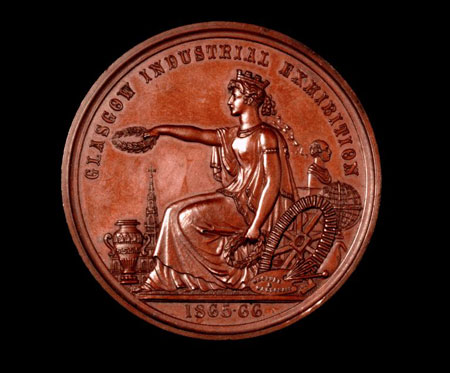
Figure 2. A medal Awarded at the Industrial Exhibition of 1865. On file at Glasgow Museums Resource Centre (GMRC)

           The Post Office Directory for 1866-67 lists David Fortune as the ‘manager of an Industrial Museum at 99 Argyll Street with a house at 26 George Street’.

            On 15 March 1866, David Fortune married Ann Webster, a seamstress, at 24 Stockwell Street, Glasgow. In the same year, on 29 November, their first child, George Roy Fortune was born. 8 This  occasion gives the first glimpse of David`s passion for the Temperance Movement as the child seems to have been named after George Roy Esq. who, according to a report on the movement 9, was a prominent member of the Scottish Temperance League and became its Honorary Director in 1868. The whole family was named as members of the Scottish Temperance League in 1868-69 with George Roy (aged 2) a ‘Juvenile Adherent’. In the report David Fortune is listed among those ‘Gentlemen who have frankly given their occasional services in the advocacy of the cause….their labours have been most abundant and self-denying’. He contributed five shillings in Donations and Subscriptions. (William Collins, the publisher, and future employer of David Fortune, who was also a member, contributed £5).

            The following year, aged 25, David Fortune was appointed to the post of Janitor of Anderson`s University and Keeper of the University Museum. There were 267 applicants for the post with 14 leeted. (Whether significant or not, David Fortune was the first name on the leet). He was appointed on 18 September 1867, with a salary of £60 per annum. In addition, he was to receive a 5% commission on Annual Subscriptions to the University which he was to collect. He was also to occupy the Janitor`s House rent free with water, gas and coal included and free of taxes. He sent his letter of acceptance on 20  September 10 (Appendix 1).

            In the census of 1871 11, the family was at 204 George Street (the Janitor`s House). David is described as the ‘Curator of University’. Apart from George Roy, aged 4, there were two other children, Jamie E. (a daughter who probably died young) and Maggie Webster aged 7 months. Another child, Anne Smollett Fortune, had been born on 24 July 1869 12 but is not recorded on the census. In the Glasgow Post Office Directories from 1868 to 1872,  David Fortune is listed at the Andersonian University, 204 George Street. He was still pursuing his temperance activities as the following advertisement, which appeared in The Temperance Record of 1871, illustrates:

 Amy Royson`s Resolve, by David Fortune. A New Prize Temperance Tale.
Price, in paper covers, 1s; post free, 14 stamps. In extra cloth
boards, 2s; post free 28 stamps.  Published by John S. Marr and Sons,
Glasgow. 13

            According to the Anderson`s University Calendar, David Fortune was Janitor of the University until 1871-2. However, on 21 February 1872 he tendered his resignation in order to take up a ‘new post’. Although his terms of employment stated that he was required to give three months’ notice, he asked to be allowed to relinquish his post within fourteen days and was given permission to leave on 1 March.14 His ‘new post’ was that of Secretary of the Irish Temperance League (ITL) in Belfast.15 On 2 June 1873 he communicated an article on The Origin of the Temperance Agitation in Ireland which was published in a volume entitled The Early Heroes of the Temperance Reformation. 16 ‘He was a very dynamic and effective secretary’ of the League and had the idea of setting up coffee stalls in Belfast ‘for which the ITL is popularly remembered’. 17

            In 1876 an International Temperance Conference was held in Philadelphia. David Fortune contributed an article The Irish Temperance League which was published in a Memorial Volume. 18  He left the ITL in 1877 (a departure that was ‘greatly regretted’) and returned to Glasgow to take up a ‘share in the management of the important business of Sir William Collins &Co.’.19 From 1879 to 1881 he was living at 89 North Frederick Street 20 and according to the census of 1881 he was the ‘foreman of a stationery manufacturer’. There had been an addition to the family – David jnr. who was aged two and born in Glasgow.21

Between 1881 and 1886 he became President of the Scottish Legal Life Assurance Society (SLLA).22 It is likely that this was a part-time post as his main occupation was still with William Collins. In the same year he gave evidence to the Select Committee on ‘National Provident Insurance’. 23, 24 (Appendix 2) At that time the SLLA had over 30,000 children under the age of five listed as members, but he denied, in his evidence, that child insurance encouraged infanticide or neglect.

            He was now resident at 104 Peel Terrace, Hill Street, Garnethill. As The Bailie commented ‘whenever a decent, hard-working, shoemaker or warehouseman blossoms into a ‘swell’ he chucks his ancient dwelling-place in Monteith Row or North Frederick Street, and travels ‘out West’. 25 The article was bemoaning the exodus from the East-end of Glasgow and the increased prominence in city affairs of the West-end.

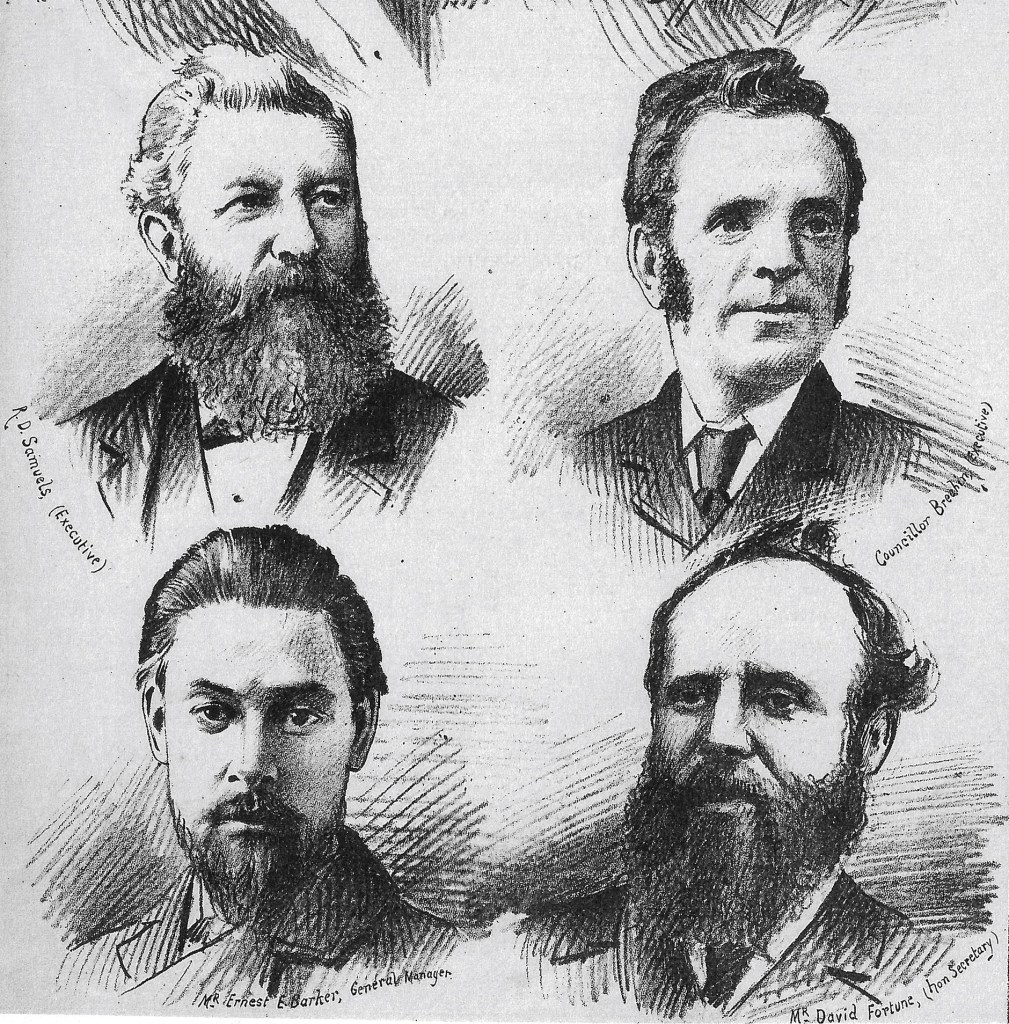
            On 25 November 1886 an Industrial Exhibition was opened at the Burnbank Drill Hall and Grounds in Great Western Road. David Fortune was a member of the Executive Committee and Honorary Secretary. Of the members of the Executive Committee, The Bailie commented ‘One and all of these gentlemen, each of whom is a citizen of repute, has wrought with might and main to further the scheme’. 26       

Figure 3.  The Executive Committee, Burnbank Industrial Exhibition. The Bailie, 24 November 1886.

 An advertisement was placed in The Glasgow Herald  advising that there would be ‘Illuminations with Electric Light’, ‘Machinery in Motion’ and ‘Sir Noel Paton`s Choice Works’ etc. etc. The proceeds of the first week and any overall profits were to be given to local charities. An article in the same issue gave a full account of the attractions on offer. 27

            In the Glasgow Post Office Directory of 1888-89 David Fortune is described as ‘manager, Sir William Collins, Sons and Co., Stirling Road’ and ‘President of Scottish Legal Life Assurance’. According to The Bailie the SLLA ‘may be congratulated on the possession of a Chairman (President) whose strong common sense and admirable business faculty has already been of the utmost advantage in their interests’. 28  He was also Chairman of the Congress of Friendly Societies and Director of the Scottish Temperance League. His interest in education was shown when he gave evidence before a Royal Commission on Technical Education.

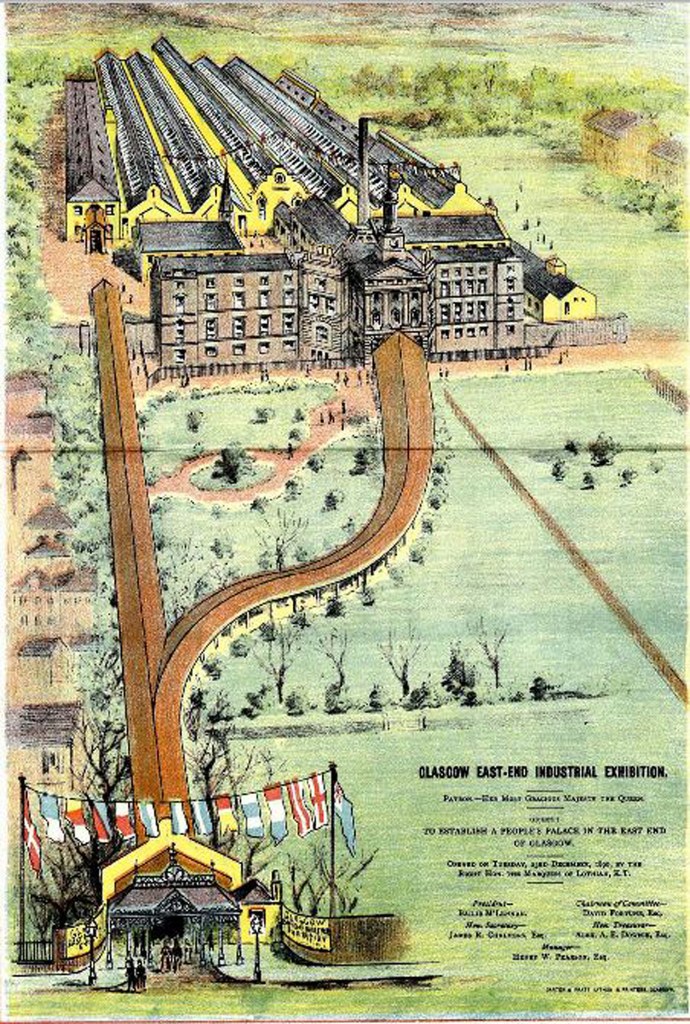
            David Fortune`s next major project was the East-End Industrial Exhibition of 1890 held in Dennistoun.

            ‘It is but a few months since an East-end Industrial Exhibition was
suggested by Mr. David Fortune, and today………the Marquis of
Lothian unlocks a palace of instruction and entertainment’. 29

            Perhaps because of the influence of David Fortune the exhibition seems to have been a teetotal affair and perhaps because of that ‘misguided decision’ was lacking in visitors. 30 However, a later edition of The Bailie  states that the exhibition ‘resulted in a surplus of £3000 being handed to the Corporation to aid in building the People`s Palace.’ 31 This is confirmed by an article in the Glasgow Encyclopaedia:

The East End Industrial Exhibition of Manufactures, Science and Art,
took place in 1890-91. Its profits were to go towards establishing ‘an
institute for the intellectual and social improvement and recreation of
the inhabitants of the East End of Glasgow’. – this objective was realised
by the erection of the People`s Palace.32

Figure 4.Poster for East-end Industrial Exhibition of 1890 http://www.dennistounconservationsociety.org.uk

      Again, The Baillie had something to say:

‘Concerning Mr. David Fortune, the Chairman of the Executive
Committee, there is little need to say anything. Mr. Fortune is an
eager and enthusiastic worker at whatever he puts his hand to, and
he usually contrives to make the different enterprises with which he is
connected turn out successes.’ 33

 One of his duties was to reply to the toast to the executive at the opening ceremony.

            According to the 1891-92 Glasgow Post Office Directory he was ‘President, Scottish Legal Life Assurance Society’ but was now described as a ‘mercantile stationer’ at 28 Gordon Street. In the 1893-94 edition he was a manager at Sir William Collins, Sons and Co., Stirling Road and had become Secretary of Scottish Legal Life. In 1895-96 he is listed as ‘J.P., F.S.S.’. In 1897 he moved to 197 Pitt Street and two years later he moved again to 19 Rowallan Gardens, Broomhill.

            David Fortune was Chairman of the Glasgow East End Industrial Exhibition which ran from 9 December 1903 till 9 April 1904. It was staged in Duke Street in premises designed for the East End Exhibition of 1890 – 91 and attracted 908,897 visitors. Its aim was to raise funds for the Royal Infirmary but in the event made a disappointing profit of £221. An advertisement for the exhibition appeared in the Glasgow Herald of 9 December 1903. At the closing ceremony ‘the members of the Executive, accompanied by Sir John Ure Primrose, the Hon. the Lord Provost came upon the platform and were enthusiastically received. Mr. David Fortune, who presided, briefly introduced the Lord Provost’. 34 In his speech, the Lord Provost congratulated the Executive on the success of the Exhibition. Mr. Fortune then proposed a vote of thanks to the Lord Provost and the formal proceedings were terminated.

The Bailie again commented:

‘Mr. Fortune`s zeal and energy have permeated the various
committees. Exhibitions are Mr. Fortune`s hobby, but in the serious
business of life he devotes his time and attention to the work of the
Scottish Legal Life Assurance Society, where, as the able and efficient
Secretary, he renders yeoman service. Mr. Fortune is also actively
identified with the leading social, educational, and municipal
movements in the city.’ 35

            On 10 October 1911, David Fortune was presented with his portrait in oils ‘in recognition of 50 years public service in Glasgow’. (This was the painting which was subsequently bequeathed to Glasgow). Rather appropriately, the portrait was presented to him at the Scottish National Exhibition of 1911 held in Kelvingrove. The purpose of this exhibition was to raise funds to endow a Chair of Scottish History and Literature at the University of Glasgow. For once, David Fortune appears not to have been involved. The presentation was made by Lord Rowallan in front of a large gathering in the Athole Restaurant. At the same time, Mrs. Fortune was presented with a gold pendant set with pearls. Among those present were David Fortune`s daughter and his son Dr. George Fortune. Also present was Francis Wilson who painted the portrait. 36

            On 16 June 1912 Annie Fortune died aged 65 at home in Broomhill. Her death was reported by her son G. Roy Fortune but some details on her death certificate differ from those shown on her marriage certificate i.e., her father is listed as David Webster, a blacksmith and farmer, and her mother as Annie Webster m.s. Hall. 37

            After his wife’s death, David Fortune appears to have remarried although this marriage is not recorded on Scotland’s People. His new bride was a widow Mary Ann Gray (nee Kemp) who predeceased him. She died on 24 March 1917. 38

David Fortune died, aged 75, on 12 November 1917 at 19 Rowallan Gardens, Broomhill. He was buried in the Glasgow Necropolis on 14 November but there is no evidence of a gravestone having been erected. His death certificate records that he was an insurance secretary, widower of 1. Annie Webster, 2. Marion (sic) Gray. The death was reported by his son G. Roy Fortune and again the details differ from those on his marriage certificate. His father is given correctly as David Fortune, plumber but his mother is listed as Maggie Fortune m.s. Galloway. 39 His obituary was published in The Glasgow Herald under the heading ‘A Social Reformer – Death of Mr David Fortune’. The author noted that as well as his many other interests, David Fortune was a ‘keen Burnsian’ and was frequently called upon to deliver ‘The Immortal Memory’. He was a Fellow of the Royal Statistical Society and of the Chartered Institute of Secretaries and a member of the Greenock Harbour Trust. 40
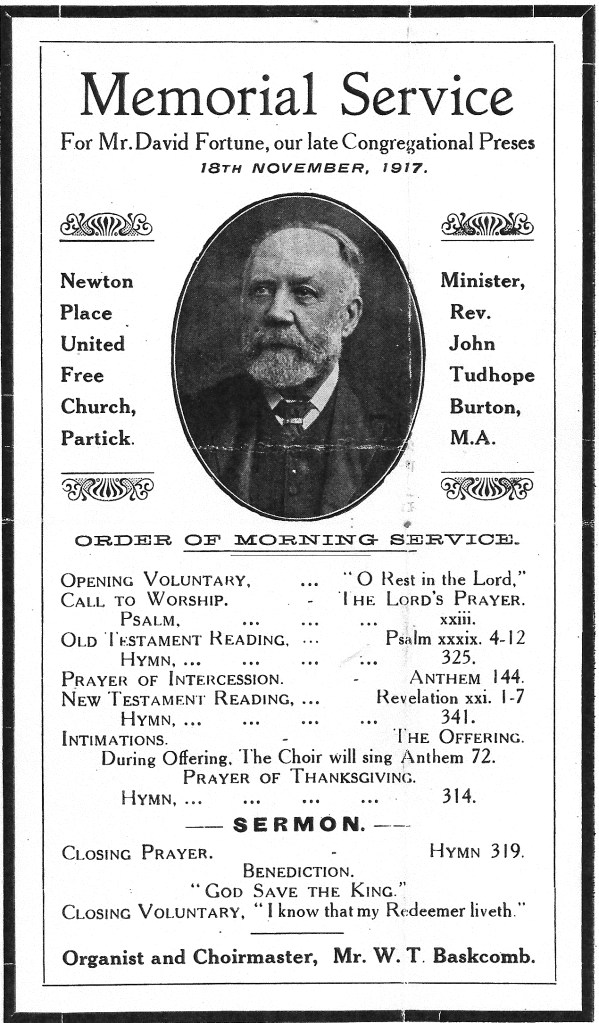
A memorial service was held on 18 November 1917 in the Newton Place United Free Church in Partick.

Figure 5. Order of Service (On File at GMRC)

His estate was valued at £6913.18s. 6d and in his will,41 he left £100 each to the Scottish Temperance League and the Royal Glasgow Institute for the Deaf and Dumb and £50 each to the Royal National Lifeboat Institute and the East Park Home for Infirm Children. He also left bequests to the Sabbath Schools of the Newton Place United Free Church, Partick ‘for the purchase of prizes’ and to the Rose Street Day Industrial School to help with funding the Annual Excursion and Christmas Entertainment for the poorer children. The ‘goods and chattels’ belonging to his second wife were left to her grand-niece Marjorie Hartstone who was then living at 19 Rowallan Gardens.  

            Two paintings are mentioned in his will; Scotland Yet by Cameron (first name not given) ‘bequeathed to me by the grandson of Robert Burns’ which was left to his elder son and his portrait by Francis Wilson which was to be given to the People`s Palace in Glasgow.

            His portrait was offered by his trustees to Glasgow Corporation on 1 February 1918 and was initially declined due to a lack of space at the People`s Palace. However, after further consideration and correspondence from the trustees, the painting was accepted on 31 May 1918. 42

The Artist

Francis Wilson was primarily a painter of landscapes and portraits. He was born in Glasgow in 1876. He studied at the Glasgow School of Art and continued his training in Florence, Paris and Rome. On his return from the Continent, he set up a studio in Glasgow, exhibiting at many of the Scottish societies, including the Royal Scottish Academy and the Glasgow Institute. He also exhibited at the Paris Salon. He was a Member of the Glasgow Art Club and his work is represented in the Glasgow Art Gallery.

References

  1. ancestry.co.uk, Scotland Census 1851
  2. familysearch.org
  3. ancestry.co.uk, Scotland Census 1861
  4. Glasgow Post Office Directory, 1865-66.
  5. The Bailie, No. 1626, 16 December 1903, Mitchell Library, Glasgow
  6. The Bailie, No. 886, 9 October 1889
  7. Fisher, Joe, The Glasgow Encyclopaedia, Mainstream Publishing, 1994. pp 130-134.
  8. Scotland`s People, Birth Certificates
  9. Annual Report of the Scottish Temperance League, 1868-69. Anguline Research Archives. http://anguline.co.uk/Free/Temperance.pdf
  10. Minute Book of Anderson`s University, 1865-1881. Andersonian Library, University of Strathclyde.
  11. ancestry.co.uk, Scotland Census 1871
  12. Scotland Births and Baptisms, 1564-1950, database, FamilySearch (This birth is not recorded on Scotland’s People
  13. The Temperance Record, 4 November 1871, p528. Google Books.
  14. Minute Book of Anderson`s University, 1865-1881. Andersonian Library, University of Strathclyde.
  15. The Bailie, No. 886, 9 October 1889
  16. The Early Heroes of the Temperance Reformation, Scottish Temperance League, Glasgow, 1873. Houlston and Sons and W. Tweedie, London. http://www.archive.org/stream/earlyheroesoftem00logauoft/earlyheroesoftem00logauoft_djvu.txt
  17. Information from Archie Wood, Honorary Archivist, Irish Temperance League. (Sent by email, 2012)
  18. Centennial Temperance Volume. A Memorial of the International Temperance Conference, held in Philadelphia, June 1876. (Published 1877, article number 851 – 852). (Google Books).
  19. The Bailie, No. 886, 9 October 1889
  20. Glasgow Post Office Directories
  21. Scotland’s People, Census 1881
  22. Glasgow Post Office Directories
  23. Scotland in the 19th Century, (ebook), Chapter 6, Section 6.8, Insurance
  24. The Bailie, No. 736, 24 November 1886.
  25. The Bailie, No. 886, 9 October 1889.
  26. The Bailie, No. 736, 24 November 1886
  27. The Glasgow Herald, 25 November 1886 pages 1 and 5.
  28. The Bailie, No. 886, 9 October 1889.
  29. The Bailie, No. 949, 24 December 1890.
  30. ibid
  31. The Bailie, No. 1626, 16 December 1903.
  32. Fisher, Joe, The Glasgow Encyclopaedia, Mainstream Publishing, 1994 pp 130-134.
  33. The Bailie, No. 949, 24 December 1890.
  34. The Glasgow Herald, 11 April 1904, page 9.
  35. The Bailie, No. 1626, 16 December 1903.
  36. The Glasgow Herald, 11 October 1911, page 9.
  37. Scotland`s People, Death Certificate.
  38. ibid
  39. ibid
  40. The Glasgow Herald 12 November 1917.
  41. Scotland’s People, Wills and Testaments, SC36/51/179, pp 228-239, 1918
  42. Glasgow Corporation Minutes, 1 February 1918, C1 3.58, p584; 1 May 1918, p1089; 31 May 1918, C1 3.59, p 1277, Mitchell Library

Appendix 1

            David Fortune`s letter of acceptance of the post of Janitor of
Anderson`s University and Keeper of the Museum.

26, George Street,
20th September 1867

Sir,      

            I beg to acknowledge receipt of your communication of yesterday, acquainting me of my appointment by the Managers, as Janitor to Anderson`s University, and Keeper of the Museum connected with that institution. I cordially agree to the terms specified in your letter, and I need scarcely say that my best energies shall be devoted to the fulfilment of the various duties required of me, in a manner which, I hope, shall prove satisfactory to the Managers and the other gentlemen connected with, and interested in the welfare of the University. With thanks for the great favor (sic) bestowed on one,
I remain, Sir etc.

                           (signed)  David Fortune

William Ambrose Esq.
Secretary,
Anderson`s University.

Taken from the Minute Book of Anderson`s University, 1865-1881.

Appendix 2

David Fortune, the President of the Scottish Legal Life Assurance Society, which was a mutual as well as a collecting society, said its business was almost entirely confined to the working classes. Out of a total of 400,000 members, 38,771 were under the age of 5 and 37,731 between the ages of 5 and 10. He disclaimed the suggestion that child insurance encouraged infanticide or neglect. He recommended that only one insurance should be allowed on a child, as with only one certificate, there would be no possibility of insurance beyond the legal amount. He thought all societies insuring children ought to be registered under the Friendly Societies Act, 1875, but did not recommend the registration of every child life insurance as this would be extremely unpopular among the working classes

Alexander Brownlie Docharty (1862 – 1940)

In October 1917, Alexander Brownlie Docharty gifted a series of his own paintings to Glasgow Corporation.  (Appendix 1)

Fig. 1 In the Woods  Early Spring (1914). (1436). (c) Glasgow Museums; Supplied by The Public Catalogue Foundation


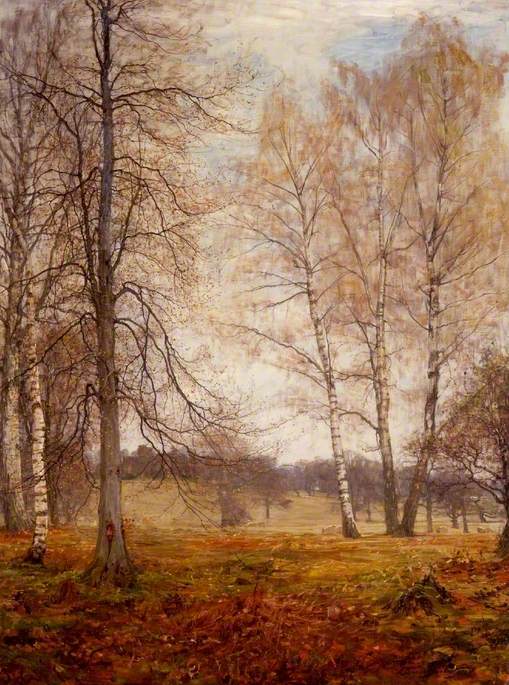
Figure 2. An Autumn Day (1917). (1437). (c) Glasgow Museums; Supplied by The Public Catalogue Foundation


Figure 3. Winter Sunshine. (1917). (1438). (c) Glasgow Museums; Supplied by The Public Catalogue Foundation


Figure 4. THe Old Clock Tower, Evening. (1439). (c) Glasgow Museums; Supplied by The Public Catalogue Foundation


Figure 5. Springtime, Hawthorn Blossom (1917). (1440). (c) Glasgow Museums; Supplied by The Public Catalogue Foundation

            Alexander Brownlie Docharty was born on 8 October 1862 at 5 McAslin Street, Glasgow. 1 This was in the Townhead area of the city near the present University of Strathclyde. He was the second son of Joseph Docharty a pattern designer and his wife Elizabeth Brownlie. Joseph and Elizabeth had married in Calton, Glasgow on 13 June 1859.2 They went on to have three sons and three daughters. At the 1871 census 3, the family was living in Crossmyloof, Cathcart. Joseph Docharty was described as a ‘designer and coal agent’ born in Bonhill, Dunbartonshire.

              Alexander left school aged thirteen to work with his father designing calico prints. At the same time, he studied in the evenings at the Glasgow School of Art under Robert Greenlees and in 1878 at the age of fifteen he had a watercolour, On the Cart  Pollockshaws  hung in the Glasgow Fine Art Institute. It was priced at three guineas.The painting was submitted from 5 Viewfield Terrace. 4

            At the 1881 Census, Alexander was living with his widowed mother, grandfather (a retired grocer) and siblings at Langbank, Renfrewshire. He was described as a ‘landscape painter’. The following year he had a painting Arran Cottages hung in the Royal Academy in London. The painting was sent from 113 West Regent Street, Glasgow. 5 However, his attempts to make a living from painting seem to have been premature and he found employment as a designer with the firm of Inglis & Wakefield who had a print works at Busby.

            By 1885 however, he had returned to painting and while living at 11 Prince`s Street, Pollockshields he shared a studio with his uncle James Docharty and his cousin also James Docharty at 134 Bath Street, Glasgow. 6 James Docharty, A.R.S.A., was a well-known painter of landscapes who exhibited extensively at the Royal Scottish Academy from 1864 till his death in 1878. He undoubtedly had a significant influence on his nephew Alexander`s decision to try to make his living as an artist.

            On 6 June 1890 at Nether Barr, Ayrshire, Alexander married Catherine McKnight a schoolteacher and daughter of a farmer from Kirkconnell, Dumfries. His occupation was ‘landscape and portrait painter’ and his address ‘Maitland, Dailly’. 7

            At the 1891 census he was at Nether Barr with his in-laws. In the same census his wife and their new-born son, Joseph, were at 4 Melville Street, Govan with Alexander`s mother and family.

            Alexander was among those Glasgow painters who in 1891 appended their names to a petition requesting that the Corporation of Glasgow buy Arrangement in Grey and Black, No. 2: Portrait of Thomas Carlyle  by J. A. M. Whistler. 8 This painting was duly purchased (for 1000 guineas!) from the artist and is now in Kelvingrove Art Galleries in Glasgow.

            In 1894 Alexander went to Paris where he entered the Academie Julien and studied for a time under Benjamin Constant and Jean Paul Laurens. On his return to Scotland, he went to live and work at Kilkerran in Ayrshire. He painted mainly in oils and spent about fourteen years in Kilkerran in a cottage owned by Sir James Fergusson. 9 One of the works he produced there was shown at the Venice Biennale in 1903 and purchased by the Italian Minister for Foreign Affairs. It hung in the Consulta Palace in Rome. 10

            According to the Glasgow Post Office Directory for 1895-96, he still had a business address at 134 Bath Street with a house at Ruglen, Kilkerran, Ayrshire.

            In 1901, the family was living at 3 Jane Street, Blythswood Square, Glasgow. Alexander was now an ‘artist (painting) working on his own account’. As well as Joseph there were now two other children, William McK. Docharty, aged 5 and Mary R. Docharty, aged 3. Both children were born in Kirkoswald, Ayrshire. There was also a servant employed who had been born in Dailly. 11

            In the early 1900s, Alexander spent his summers in Symington painting at Dankeith, Dundonald and Auchans. 12 He also travelled to the Highlands and the nature of the subjects he depicted is indicated in the titles of a few of his more outstanding works including, Winter in Glenfinlas (1902), Ben Venue (1905) and Lochiel`s Country which was shown at the Royal Academy, London and was purchased by Glasgow Corporation. In 1907, his September, Glen Falloch was exhibited at the Glasgow Institute. It was purchased by Archibald Watson Finlayson of Merchiston (qv) and presented to Glasgow Corporation.13 In 1916 his painting Glen Morriston was sold for 320 guineas by J. and R. Edmiston.

            Alexander travelled and painted in Europe especially in Holland and made trips to Donegal in Ireland. In 1903 he went to Paris and then to Italy via the Riviera and on to Naples, Rome, Florence visiting Venice several times. One of his landscapes, Glenfinlas, was hung in the St. Louis International Exhibition of 1904. This may have come about because an uncle, Alexander Brownlie, had emigrated to the USA and in 1904-5 was living at 338 Bloomfield Avenue, Montclair, NJ. He was a member of a flourishing artistic community in the town. (An article in the Montclair Times describes a walking tour of the town which pointed out the homes of turn-of-the-century artists. This included the home of Alexander Brownlie). 14

            Alexander Brownlie Docharty was a member of the Royal Glasgow Institute of the Fine Arts and served on the Council of the Institute. In addition, he was president of the Glasgow Art Club from 1911 to 1913 and was a Member of Council thereafter.

            In 1915, the Balloch Estate on Loch Lomondside, was sold to Glasgow Corporation and on 2 October 1916, Alexander wrote to the Lord Provost with his offer to ‘paint and present several of the more outstanding views (autumnal and spring) of the park and its surroundings’. (Appendix 1) The five paintings produced were those gifted to the Corporation in 1917. It seems that the first of these had been painted before the acquisition of the estate at Balloch and this may have given him the idea for the remainder.

            On 26 July 1926, age 63, Alexander sailed on the Caledonia from Glasgow to New York. He was accompanied by his daughter May Rankine Docharty . They arrived back in Glasgow from New York via Moville in Northern Ireland on 10 October having travelled first class on the California. 15

            By 1940 he was living with his daughter at 20 Hyndland Road, Hillhead. 16 He died there on the 12 November 1940 aged 78. 17 However, the death notice in the Glasgow Herald states that he died at 6 Montague Terrace. 18 He was buried in Cathcart Cemetery on 14 November 1940. (His uncle, James Docharty, was also buried there). His wife pre-deceased him and he was survived by a son and daughter. An obituary was published in the Glasgow Herald 19 and his death was also reported in an article in The Scotsman which noted that ‘he took a deep interest in religious work and served as an elder of Glasgow Cathedral’. 20

Figure 6. From the Glasgow Herald
13 November 1940.

            Alexander Brownlie Docharty exhibited widely for almost 60 years including at the Royal Academy (12 works), the Royal Scottish Academy (19) 21, the Royal Society of Painters in Watercolour (5) and the Glasgow Institute (155) 22 as well as at the Walker Art Gallery in Liverpool, the Manchester City Art Gallery and the New English Art Club. His work attracted praise and criticism from various sources. Of his landscapes Caw commented,

‘Painted with gusto, but not without refinement, in frank, fresh and harmonious colour, and good in drawing and design, Brownlie Docharty`s landscapes preserve the aroma of a sincere, if
unimpassioned, love of the simple and everyday aspects of Nature and awakened pleasant memories of the country’.23

Harris and Halsby note that, ‘(He) worked mainly in oil but his watercolours can be fine with good composition and sensitive colour’. 24 The Scotsman reported on four of his paintings exhibited at the Glasgow Art Club Show of 1899; ‘Mr. Brownlie Docharty`s works have always shown him to be an artist in evident sympathy with the tenderer aspects of nature which disclose themselves in woodland and stream, but his sojourn to Holland has added both sweetness and strength to his brush,…. 25 

            Again in 1912, the same paper reported; ‘One of the most striking landscapes in the gallery is the Falls of Garry by Mr. A. Brownlie Docharty. ……….the rocks are painted with a solidity which would have pleased Ruskin; the foaming water has been carefully studied, and with a dainty brush, the artist has rendered the summer greens of the trees and the glow of the sky’. 26

            Alexander Brownlie Docharty`s two surviving children each had their own claim to fame. His son, William McKnight Docharty served with the King`s Liverpool Regiment during World War I and achieved the rank of Captain. He was twice wounded in action and was awarded the Military Cross. 27 He became a keen hillwalker and compiled and published in 1954, a list of the 900 highest mountains in Britain. He was also the second person to complete in 1960 the ascents of all 220 ‘Corbetts’ i.e. Scottish mountains between 2500 and 2999 feet in height. William McKnight Docharty died on 14 July 1968 aged 72. 28

            May Brownlie Docharty, who died in 1972, was a gifted player and teacher of contract bridge. She owned and managed the Western Bridge Club in Glasgow which she formed after her father`s death. 29

References

  1. Scotland`s People , Birth Certificate
  2. Scotland’s People, Marriage Certificate
  3. Scotland’s People, Census 1871
  4. Glasgow Institute of the Fine Arts Exhibitions Catalogues 1877-83. (Mitchell Library).
  5. Catalogues of the Royal Academy Exhibitions, 1880-89, W. Clowes and Sons., Ltd.
  6. Glasgow Post Office Directory, 1885-86
  7. Scotland’s People, Marriage Certificate
  8. Glasgow Town Council, Sub-committee on Galleries and Museums, 27 February 1891: (see http://www.whistler.arts.gla.ac.uk).
  9. Eyre-Todd, George, Who`s Who in Glasgow in 1909 Gowan & Gray, 1909, Glasgow. http://gdl.cdlr.strath.ac.uk/eyrwho/eyrwho0513.htm
  10. venicebiennale.britishcouncil.org/timeline/1903/history/1105/).
  11. Scotland’s People, Census 1901
  12. Eyre-Todd, George, Who`s Who in Glasgow in 1909 Gowan & Gray, 1909, Glasgow. http://gdl.cdlr.strath.ac.uk/eyrwho/eyrwho0513.htm
  13. ibid
  14. The Montclair Times, 10October 2003. (Also www.brownlee.com.au).
  15. Ancestry.co.uk, New York Passenger Lists, 1820 – 1957
  16. Voters` Roll, Glasgow, Hillhead, 1940.
  17. Scotland’s People, Death Certificate
  18. Glasgow Herald, 13 November 1940.
  19. ibid
  20. The Scotsman, 13 November 1940, p 5.
  21. Royal Scottish Academy Exhibitors, 1826 – 1990, Hilmartin Manor Press, 1991.
  22. Premier Paintings, Gairloch (website)
  23. Caw, Sir James L., Scottish Painting, Past and Present, 1620 – 1908, T.C. & E. C. Jack, Edinburgh, 1908.
  24. Harris, P. and Halsby, J., The Dictionary of Scottish Painters, 1600 to the present, Birlinn Ltd; 4th Edition, October 2010
  25. The Scotsman, 6 November 1899, The Glasgow Art Club Exhibition
  26. The Scotsman, 7 December 1912, The Glasgow Art Club Exhibition
  27. The Scotsman, 16 October 1918, p7
  28. http://www.corbetteers.blogspot.com/
  29. Glasgow Herald 5 May 1972.

Appendix

Glasgow Corporation Minutes, 4 October 1916. C1 3.57, p2002.

There was submitted a letter, of date 2nd instant, from Mr. A. Brownlie Docharty, 3, Jane Street, Blythswood Square, to the Lord Provost, in which he states that the value and beauty of Loch Lomond Park, recently acquired by the Corporation, and its immediate surroundings, might be brought home to many of our working-classes and industrial citizens, if these were depicted on canvas, and, for this purpose, he is willing to paint and present several of the more outstanding views (autumnal and spring) of the park and its surroundings on condition that the pictures be housed together in the People`s Palace, in Glasgow Green, where they would be most likely to come under the notice of the citizens.

            The members of the committee unanimously resolved to record their high appreciation of Mr. Docharty`s generous offer, and to accept the same and to award to him, on behalf of the citizens, their most cordial thanks for this handsome gift. It was also agreed that it be remitted to the Convener, Sub-convener, and Councillor Barrie to confer with Mr. Docharty as to the necessary arrangements for the work being executed and to adjust any details with reference thereto.

The gift was accepted by the full committee of the Corporation at their meeting of 18.10.17. “The paintings would, in accordance with the desire of the artist, be housed in the Peoples` Palace in Glasgow Green”.

The Scotsman of October 17 1917, page 5, has the following article, presumably written when the paintings were gifted to the corporation;

“ARTIST`S GENEROUS OFFER TO GLASGOW:- Mr. A. Brownlie Docharty, a well-known landscape artist, has offered to paint for the Glasgow Corporation, several of the more outstanding views of the Loch Lomond Park and its surroundings, on condition that the pictures are placed together in the People`s Palace. In his letter to the Lord Provost, Mr. Docharty suggested that the value and the beauty of Loch Lomond Park might be brought home to the working classes if depicted on canvas. The Parks Committee of the Corporation have recorded their high appreciation of Mr. Docharty`s generous offer and have agreed to accept the gift”.

Thomas Walter Donald (1878 – 1970)

On 21 November 1944, an oil painting of Provost Robert Donald by an unknown artist was presented to Glasgow Corporation by Mr T. W. Donald, 172 St. Vincent Street, Glasgow. C.2.

 (Thomas Walter Donald was the 3x great grandnephew of Robert Donald).

Figure 1. Robert Donald, Provost of Glasgow, 1776 -77. © CSG CIC Glasgow Museums Collection. Supplied by The Public Catalogue Foundation

 There was submitted a letter from Mr T.W. Donald, Writer, 172 St. Vincent Street, offering to present to the Corporation a portrait of Robert Donald, who was provost of Glasgow from 1776 to 1777, and the committee, after hearing a report from the Director, agreed that the gift be accepted and that a letter of thanks be sent to the donor.1

            Thomas Walter Donald was born on 5 January 1878 at The Baths, Helensburgh. (This was an extension of the Baths’ Hotel – later the Queen`s Hotel – built for Henry Bell who ferried customers from Glasgow in his steamship The Comet to the hotel).  His parents were Ellen Mary Jane Brown and Colin Dunlop Donald jr., a writer in the family firm of McGrigor, Donald & Co., (later C.D. Donald & Sons) of 172 St. Vincent Street, Glasgow. Colin`s address at the time was North Cottage, Wemyss Bay. Colin and Ellen had married on 16 January 1877 in Helensburgh and Thomas was their first child. 2 Thomas` brother, Colin Dunlop Donald was born on 11 September 1879. 3

Figure 2. Colin Dunlop Donald jr. By kind permission of Frank and Colin Donald.
Figure 3. Ellen Mary Jane Donald. By kind permission of Frank and Colin Donald.


In the 1881 census, the family was at 72 East Clyde Street, Helensburgh.4 This was the home of Thomas`s great grandfather Walter Buchanan of Shandon who had been an MP for Glasgow between 1857 and 1865. A third brother, William Frances Maxwell Donald (Frank) was born on 3 June 1881, and a sister Helen (Nelly) on 16 July 1882. Thomas later wrote a memoir of his childhood in Helensburgh recalling some of his earliest memories.5

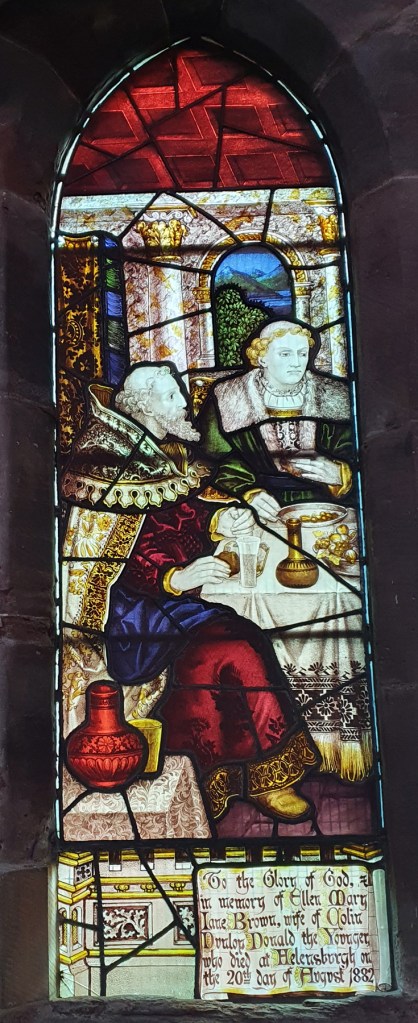
Thomas`s mother died suddenly of a chill on 20 August 1882 shortly after the birth of her daughter. A memorial window to her was placed in St. Michaels`s Church in Helensburgh in 1889. 6

Figure 4. Memorial Window to Ellen Mary Jane Brown (Donald)
  (Photographs by the author)


In the year following Ellen Donald’s death, the family left Helensburgh and moved to Glasgow, first to Westbourne Gardens where they remained for a year, and then to 14 Huntly Gardens, Hillhead. 7,8

Figure 5. Four Siblings (about 1887?) By kind permission of Frank and Colin Donald.

The boys were later sent to boarding schools in England. In the 1891 Census, Thomas, aged 13, was a pupil at Bilton Grange School in Warwickshire. 9 In January of the following year he entered Rugby School boarding at Michell House. At Rugby he seems to have kept a low profile as there is no record of him participating in any of the school teams or winning any major prizes. 10 He left in the summer of 1895 to go to Glasgow University.

(His two younger brothers also attended Rugby School. Both boarded at Mitchell; Colin Dunlop Donald from 1893-1895 and William Francis Maxwell Donald from 1895-1898.11  William later studied engineering at Glasgow University).

Figure 6. The Donald Family on holiday at the Coul Estate, Auchterarder in 1892.
It was here that Thomas shot his first rabbit!  Thomas is in the middle
of the back row. By kind permission of Frank and Colin Donald.

Thomas`s father, Colin Dunlop Donald III wrote articles on archaeology and a history of The Board of Green Cloth which provided ‘a social history of Glasgow at the turn of the nineteenth century’. He was Hon. Secretary of the Regality Club which published books on the buildings of Glasgow. These were illustrated by etchings by D. Y. Cameron who used to call at 14 Huntly Gardens with the proofs.12 (These etchings were left to Thomas and subsequently passed to his grandson Frank Donald who donated them to Glasgow. These are catalogued as PR.2004.5).

When their father died suddenly (of a chill) in 1895, Thomas`s unmarried uncle Thomas F. Donald (TFD) took over the care of the four orphans.

(Thomas F. Donald was an accountant and stockbroker. As a young apprentice his firm had been engaged by one of the Directors of the City of Glasgow Bank to see if he had any defence after the bank failed in 1878. TFD saw the balance sheet which had been presented to a meeting of the board, and when he examined the same balance sheet afterwards it had fictitious amendments in red ink! TFD was secretary of the Royal Northern Yacht Club in Rhu for 24 years and was presented with 200 guineas when he retired in 1910. He was also a donor to Glasgow gifting The Clyde from Dalnottar by John Knox in 1921. This is displayed in the  Kelvingrove Art Galleries and Museum).

Figure 7.  Thomas F. Donald By kind permission of Frank and Colin Donald.

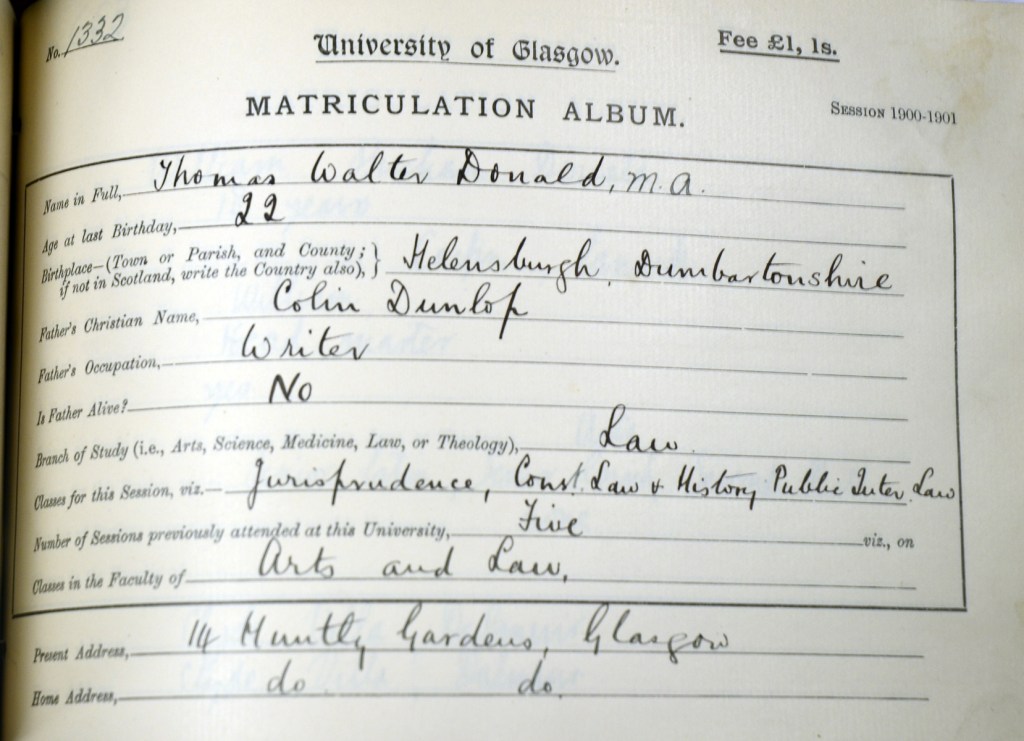
At university Thomas Walter Donald continued the study of Latin and Greek which he had begun at school. He also attended classes in Mathematics, English, Logic and Roman Law for fees of £5.5.0 per year. He graduated MA on 3 November 1898. Thereafter, he began a course leading to the degree of LLB. He gained a ‘Highly Distinguished’ award in History in 1898-99. In 1899-1900 he studied Scots Law under Professor Alexander Moody Stuart and was awarded a prize for ‘Eminence in Class Examinations’. He matriculated as ‘Thomas Walter Donald MA’ for session 1900-1901 taking classes in Jurisprudence, and Constitutional Law and History. In the latter class he was awarded first prize and he graduated LLB in 1901.13

Figure 8.     Page from Matriculation Album 1901-2. Glasgow University Records.

 In the 1901 Census, Thomas was a ‘lawyer`s apprentice’, aged 23, living with his uncle, Thomas F. Donald, 47, at 14 Huntly Gardens, Glasgow.  His brothers, Colin aged 21 and William, 19, were also living there.14

After serving an apprenticeship with the Glasgow legal firm of Maclay, Murray and Spens, Thomas was admitted a solicitor in 1902.

On 20 September 1902, Thomas married Sarah Gertrude Newstead, at St. Mary’s Church, Bryanston Square, Westminster, London.15 She was 28, the daughter of a retired surgeon from Bristol. The couple moved to Glasgow to a flat at 8 Clarence Drive, Hillhead, where their son Colin George Walter Donald was born on 7July 1904. 16,17 Soon after the birth they moved to Grendon Lodge in Helensburgh. 18 It was here that their daughters Monica Mary Louise (1910) and Barbara Gertrude (1912) were born.19 Apparently, the children later became close friends of the Blackie children who lived in the ‘Hill House’. Barbara later reported that ‘while the window seats in the Hill House were great fun, the famous Charles Rennie Mackintosh chairs were terribly uncomfortable’. 20

About 1905, Thomas joined McGrigor, Donald and Co., Glasgow a law firm which had been part founded by his great-grandfather, Colin Dunlop Donald.21 He remained with this firm for the rest of his life eventually becoming senior partner. He also became the senior member of the Royal Faculty of Procurators in Glasgow. He seems to have specialized in lawsuits involving shipping and shipwrecks and often acted on behalf of the Board of Trade at which time, ‘all other work in the office ceased!’ The firm also acted for the family of Madeleine Smith.22

Thomas had a keen interest in his family history and outlined some of its main points in a letter to the Glasgow Herald in 1909 23. This was in response to a previous letter requesting information about the father, grandfather and great grandfather of Robert Donald – the subject of the donated portrait. (Appendix 1)

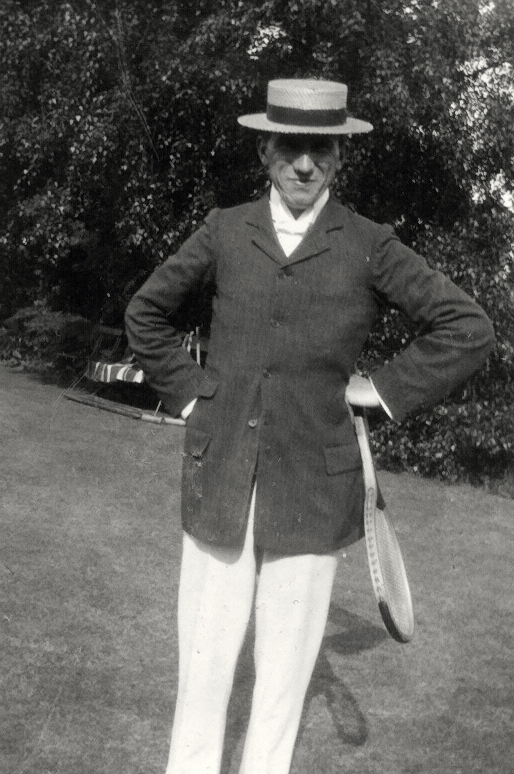
Due to a pre-existing medical condition, Thomas was not required to do active service in WW1. However, he did undertake a course of training in the Glasgow Citizen Training force which he completed in 1915 before transferring to the corresponding company in Helensburgh. (In WW2 his duties involved a stint of fire watching at 172 St Vincent Street).

Figure 9.   Thomas Walter Donald. By kind permission of Frank and Colin Donald.

              After living for eighteen years in Helensburgh the family moved to Stirling in 1922, to a house at 9 Snowdon Place which they also named Grendon. 24 (This is still called Grendon House but has been converted to flats)

Thomas and his brother Colin Dunlop Donald became members of the Merchants’ House of Glasgow in 1928. 25

Figure 10. The Merchant`s House Matriculation Album

(The page shows, Matriculation Number; Date, 13th Sept. 1928; Name; Occupation; Address of Firm; Father`s Name and Designation; Entry Fee (21 guineas) and date when paid).

Thomas was fond of ‘cruising in other peoples’ yachts’ but he also undertook some more far-flung voyages. On 19 June 1931, he arrived in London via Plymouth from Bombay, India. He was 53 and had travelled on the P & O ship ‘Malwa’.

On 21 February 1938 he arrived at Bristol from Kingston, Jamaica following a visit to his son and daughter-in-law.26

 Figure 11. T.W.D. at chess. By kind permission of Frank and Colin Donald.

 Gertrude Donald died from cancer at 9 Snowdon Place, Stirling on 13 April 1942. She was 68.27

In 1952 Thomas moved to 44 Kelvin Court on Great Western Road, Glasgow. In 1969 he gave an interview to Jack Webster of the Scottish Daily Express in which he talks about his connection with the West India Association.28 This had been set up in 1807 to facilitate trade with the West Indies. He had become treasurer of the association in the 1930s and had presided over their last meeting in 1969. (Appendix)

Thomas Walter Donald died on 23December 1970 at 44 Kelvin Court, Glasgow. He was 92. The cause of death was hypostatic pneumonia and myocardial degeneration. The death was registered by his nephew Colin Dunlop Donald.29

According to the writer of his obituary, Thomas Walter Donald ‘was a man of great charm and wide culture, and in his extensive legal practice his humanity found full scope’.

            He played his part in public work as a director of the Merchants` House and the Elder Hospital, and as representative of the Glasgow Faculty on the Joint Committee of Legal Societies from which the Law Society of Scotland developed. He was a director of the British Linen Bank and the Scottish Provident Institution.30 He was also a Trustee of Provands Lordship.

            Thomas`s daughter-in-law was Russian and a good friend of the painter Eric Prehn and his wife Irina, whom she had known in Riga. When Eric and Irina moved to Edinburgh Thomas used to stay with them when he attended British Linen Bank board meetings. As a result of their friendship Thomas was encouraged to take up painting himself. Unfortunately, not much of his work has survived. Thomas does not appear to have been a collector of art but owned the following paintings which have family connections.

  1. Portrait of Robert Donald, Provost of Glasgow 1776-7. Donated to Glasgow.
  2. Portrait of Colin Dunlop of Carmyle, Provost of Glasgow and one of the founders of the ‘Ship Bank’. This was donated to the British Linen Bank to celebrate the bicentenary of the Ship Bank. It passed to the Bank of Scotland and was subsequently returned to the family.
  3. Portrait of Kathrine Donald, wife of Robert. This remains in the family.
  4. Portrait of James Donald painted in1757. This remains in the family. It was shown as part of the Old Glasgow Exhibition.

The Sitter

Robert Donald (1724 – 1803)

Robert Donald was a ‘Virginia Merchant’ – one of the Glasgow ‘Tobacco Lords’ – and a Provost of the City. He was born in 1724 the fourth son of Thomas Donald of Lyleston (also a tobacco merchant) and Janet Cumming of Baremann. 31

He formed a partnership with his older brother James. (James Donald, also a tobacco merchant, acquired the lands of Geilston in Cardross in 1757 and was subsequently styled, James Donald of Geilston). Robert married his first cousin Katherine Donald, daughter of Robert Donald of Greenock.

When James Donald died in 1760 his estate passed to his eldest son Thomas who maintained the partnership with his uncle Robert, and they traded as Robert Donald and Co. They had their own fleet of ships which they operated in conjunction with their cousins in Greenock.  They maintained a network of Company Stores in the back country of Virginia and dealt with the small tobacco growers. 

Both Robert and James appear to have spent time in Virginia, and had a house in Pages a township in Hanover County where they were visited by George Washington in 1752. Robert left America to return to Scotland in 1758.

Robert became a Burgess of Glasgow (by right of his wife) in 1759. He was elected a Baillie in 1765 and 1773. In 1767, he feued the 24-acre Mountblow estate near Clydebank from George Buchanan of Auchentoshan and built Mountblow House on this estate.

Figure 12. Mountblow House photographed in 1870 by Thomas Annan. National Galleries Scotland. Creative Commons – CC by NC

  He was elected Provost of Glasgow on 1 October 1776 and retained that position until 30September 1777. In 1778 he took an active part in raising a regiment to serve against the Americans in the War of Independence. However, he later lost most of his fortune when Thomas Donald & Son became bankrupt in 1787. (Presumably Thomas was now senior partner hence the name change.) Robert remained at Mountblow and, until 1798, was employed by the city to supervise the deepening of the River Clyde at a salary of £50 per annum later increased to £60.

On 6 June 1793, Robert wrote a letter from Mountblow to George Washington asking him to look favourably on the bearer who was his nephew.

Katherine Donald died in 1798 and five years later, on 22 February 1803 Robert Donald died at Mountblow. 32 He was buried in the Ramshorn Churchyard in Glasgow. Having no children of his own he seems to have left the bulk of his estate to his nephew Alexander Donald.

            The Mountblow estate was acquired by Henry Bowie and then by William Dunn of Duntocher (1770-1849). It was inherited by Dunn’s nephew, the Advocate Alexander Dunn Pattison. He sold it to Glasgow Corporation in 1877 and they in turn rented it to James Rodger Thomson of the Clydebank Shipyard until 1893 when it was leased to the Seamen’s Orphans’ Institute. It became Mountblow Children’s Home in 1922.33 The house probably suffered damage in the Clydebank Blitz of 1941 although was not hit directly by bombs. The remains were demolished to make way for housing after the war.

The Painting

The painting was completed in London in 1762 when Robert Donald was 38. The artist is unknown. The painting did not remain in the family and may have been sold either when Robert`s business collapsed or when he died. In 1868, the portrait was on loan at an Exhibition of Portraits held in the New Galleries of Art in Sauchiehall Street. It was lent by Thomas Carlisle Esq.* It was loaned to the ‘Old Glasgow Exhibition’ held under the auspices of the Glasgow Institute for Fine Arts in 1894. This time the lender was a Miss Carlisle.

*Thomas Carlisle was a manufacturing chemist and a partner in the firm of Stevenson, Carlisle and Co. with works at Millburn Street, Townhead, Glasgow and an office at 23 West Nile Street. He had a house at 2 Lancaster Terrace, Great Western Road. He died in 1917. It seems he was also in possession of a portrait of Katherine Donald, wife of Robert at the time of the 1868 exhibition. Perhaps Thomas Walter Donald purchased both portraits from the Carlisles?

  Figure 13. Portrait of Katherine Donald. By kind permission of Frank and Colin Donald.

 Appendix

An article written by Jack Webster which appeared in the Scottish Daily Express.

                 ‘When the tax on rum was a farthing a gallon’

Thomas Walter Donald nods towards a portrait above his lounge mantelpiece and tell you that the robust gentleman in question, his great-great-grandfather, was born in 1745 and became one of Glasgow`s tobacco lords trading with the American colonies.

But Mr. Donald, quiet and cultured, does not require a portrait to give his visitor a sense of history. For he himself has lived through 92 years in which he has been, and remains, an active city lawyer. He was a trustee of the estate of Mr. Smith of Blythswood Square, father of Madeleine Smith, the Glasgow girl accused in 1857 of poisoning her secret French lover, a charge which was found “not proven”.

The other day, Mr. Donald brought another reminder of an age that is all but forgotten when he called a rather special meeting of the West India Association. The association was founded in 1807 to help those eager businessmen who were trading with the West Indies during last century to bring home the rum, sugar and tobacco. “My family has turned from trading to law, however”, says Mr. Donald, “and I was never a trader myself. I merely became treasurer of the West India Association in the 1930s, by which time there was not much business being done”.

“The emancipation of the slaves had knocked a considerable hole in the profits. But there was a time in the heyday of these tobacco, rum and sugar lords when the association was very active. In 1840 for example, it appointed a delegation to go to Parliament to protest against an increase on the duty on rum from ¼ d to ½ d per gallon. Glasgow was doing a tremendous overseas trade at that time. By the time the Second World War came, more and more trade was being done from London”.

“Those in Glasgow still interested began to die off and the association became moribund. We met again in 1946 – but not again until 1969, when I thought it was perhaps about time that we had another meeting”.

“This time it was to see about disposing of stock and cash totaling around £730 – and eight remaining members of a once flourishing organisation agreed that the remaining surplus funds will be handed over to “the West India Committee” in London. This is a non-profit making body founded in 1750, which promotes Commonwealth, Caribbean/UK trade and stimulates investment in the Commonwealth and Caribbean and the improvement of the standard of living there”.

In his luxury flat in Glasgow`s west end, Mr. Donald showed me the massive tomes of minutes stretching back to 1807 – which are now being handed over to the Mitchell Library. He had known nearly half of that period from his own experience. To talk to him was to absorb history itself. At 92, he is still senior partner in one of the Scotland`s biggest legal practices. He pops down to the Western Club in the city centre, or off on a cruise to Madeira.

Jack Webster

References

  1. Glasgow Corporation, Minutes of Art Galleries and Museums Committee, 21 November 1944, page 165. Held in The Mitchell Library, Glasgow
  2. Scotland`s People, Birth Certificate
  3. ibid
  4. ancestry.co.uk, 1881 Census, Scotland
  5. Memoir written by T.W. Donald. Excerpts from this memoir were supplied by Frank Donald, grandson of the donor. I am most grateful to Frank and his cousins Colin and James Donald for supplying photographs and information contained in this report. Any un-attributed material in this report is due to them.
  6. Stained Glass Window in St. Michael`s Church, Helensburgh. Made by Charles Eamer Kempe, 1889. (Mary Magdalene anointing the feet of Christ), St Michael’s Church — a short history Penny Johnston, 30 March 2010, Helensburgh Heritage
  7. T. W. Donald Memoir
  8. Glasgow Post Office Directory, 1884-5
  9. Ancestry.co.uk, 1891 Census for England
  10. Information from Rusty MacLean, archivist, Rugby School
  11. ibid
  12. T.W. Donald Memoir
  13. Archives of the University of Glasgow
  14. Ancestry.co.uk, 1901 Census, Scotland
  15. Ancestry.com, London Marriages
  16. Glasgow Post Office Directories for 1903-4, 1904-5 and 1905-6
  17. Scotland`s People, Birth Certificate
  18. Scotland`s People, Census 1911
  19. Scotland’s People, Birth Certificates
  20. T.W. Donald Memoir
  21. Glasgow Post Office Directories for 1903-4, 1904-5 and 1905-6
  22. Glasgow Herald, 25 December 1970, page 11.
  23. Letter initialed “T. W. D.”, Glasgow Herald, 16 April 1909, page 14
  24. Post Office Directory, Stirling, 1922
  25. Merchants` House of Glasgow Archive, Mitchell Library, Glasgow
  26. Ancestry.com, UK Incoming Passenger Lists, 1878-1960
  27. Scotland`s People, Death Certificate
  28. Scottish Daily Express, 31 July 1969
  29. Scotland`s People, Death Certificate
  30. Glasgow Herald, 25 December 1970, page 11
  31. Marwick, J.D. ed., Provosts of Glasgow, in Charters and Documents Relating To the City of Glasgow 1175-1649 Part 1, Glasgow, 1897
  32. The Scots Magazine, Vol 65, 1803, (‘At Mountblow, in the 79th year of his age, Robert D(onald) Mountblow, Esq formerly Lord Provost’)
  33. Glasgow University Library, Special Collections, Dougan Add. 73

Humphrey Gordon Roberts-Hay-Boyd (1866 – 1931)

The Town Clerk reported that the late Rev. Humphrey Gordon Roberts Hay Boyd, Townend-of-Symington, Ayrshire, had by his Trust Disposition and Settlement*, directed his Trustees to convey and deliver free of legacy duty certain pictures from his art collection to the Kelvingrove Art Galleries. The Director reported that the said bequest consisted of the following pictures viz:

1. Oil painting of roses in a gilt frame by S.J. Peploe. (This painting was not subsequently given to Glasgow).

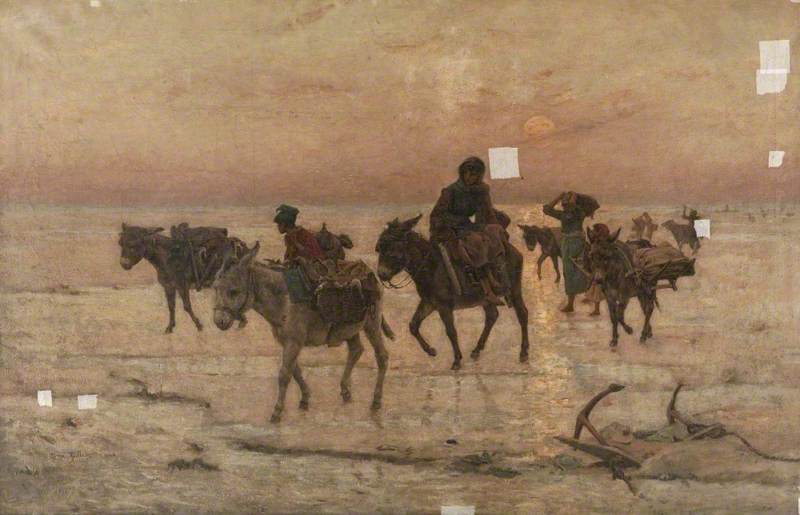
2. Small oil painting The Fisherman by J. Weissenbruch. (This painting was ascribed to Jan Hendrick Weissenbruch (1824-1903) Dutch but is probably by his son Willem Johannes (1864 – 1941). Its title is now An Artist Sketching from a Boat – early 1900s (Accession number 2231).

Weissenbruch, Jan Hendrik, 1824-1903; An Artist Sketching from a Boat

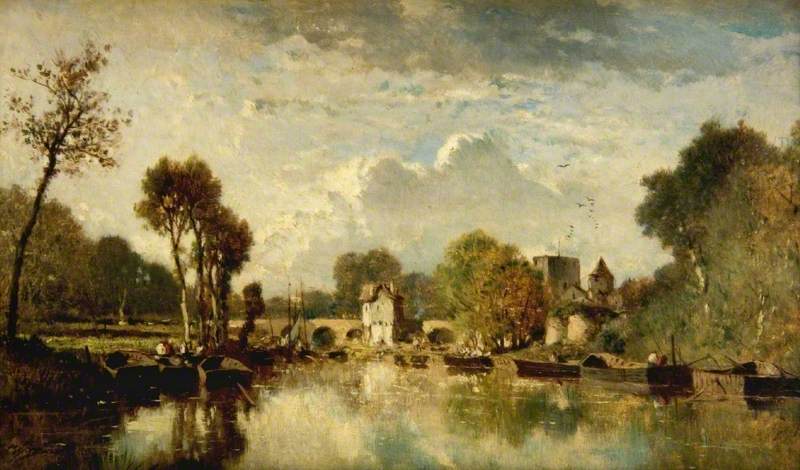
3. Oil painting on panel A River Scene by Charles-Francois Daubigny (1817 – 1898). Now titled River Scene Sunset – 2230.

Daubigny, Charles-Francois, 1817-1878; River Scene, Sunset

4. Watercolour Drawing Sunset Brise (Briare) by the French master Henri Harpignes (1819 – 1916) – 2235.

                                                                 
5.Water Colour Drawing, Barge in Dry Dock by Robert Purves Flint, R.S.W. (1883 – 1947) – 2234. This is an oil painting not a watercolour.

               
 6. Oil painting Ploughing by the French master Leon L’Hermitte (1844 – 1925). Now called Ploughing with Oxen, Evening, 1871 – 2229

Lhermitte, Leon-Augustin, 1844-1925; Ploughing with Oxen

This painting was exhibited at the Royal Academy of Arts in 1872 with title Oxen Ploughing. 1 It was purchased by H.G.R. Hay-Boyd after 1918, probably from Eugene Cremetti, London. 

7. Small oil painting River Scene by Frank Brissot – (Active 1879 – 1881) – 2233

Brissot, Frank, active 1879-1881; River Scene

The committee agreed the bequest be accepted’.2

*His will stated that the pictures should remain in his wife`s possession till her death. Hence, although he died in 1931 the date of the donation was 1941.

All the above paintings © CSG GIC Glasgow Museums Collection.

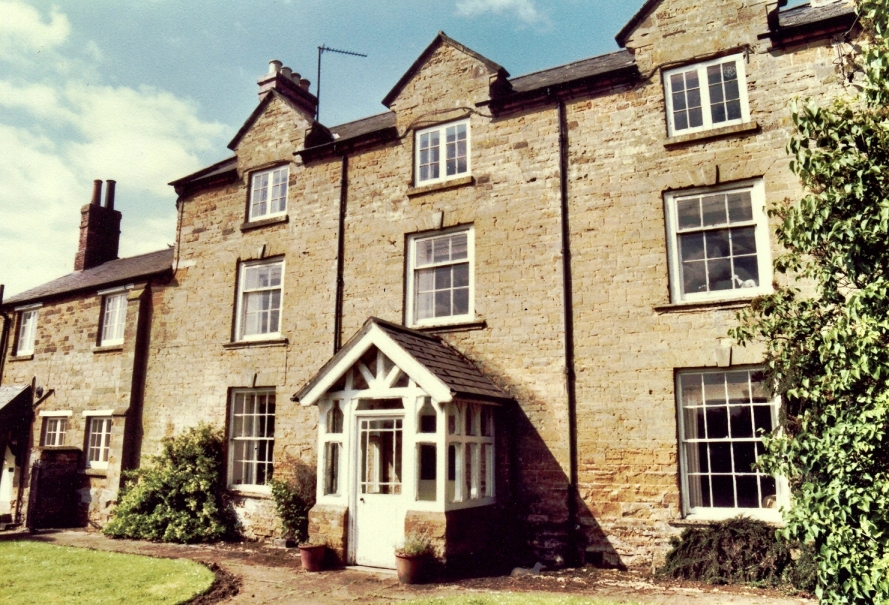
Humphrey Gordon Roberts was born in September 1866 in Waterloo, Liverpool. He was the son of Humphrey Roberts Esq., a merchant in Liverpool, and Margaret Thomson. 3 Between 1871 and 1881, the family moved to London, firstly to 10 Ashburn Place (by which time Humphrey`s father was a retired merchant ‘living on his own means’) and then to 8 Queen`s Gate Place, Kensington.4 Having attended Uppingham School, Humphrey entered Jesus College, Cambridge in October 1884, aged 17, graduated BA in 1887 and MA in 1891.5,6 He also attended Ridley Hall Theological College in Cambridge. According to the 1891 census he was a theology student, living in Kensington, London with his widowed father and four sisters. 7 He was ordained Deacon (Canterbury) in 1891 by the Archbishop of Canterbury at Maidstone Parish Church 8 and was Deacon of Sandgate in Kent from 1891 to 1894 after which he moved to a similar post at Spratton, Northants. 9 He was Vicar and Patron of Spratton between 1897 and 1905. 10 On moving there, he opted not to occupy the early eighteenth century vicarage, which was probably in need of updating, but moved to a much grander residence which he renamed The Manor House.11

Figure 1. The Manor House, Spratton, Northants. From Enid Jarvis, Chair, Spratton Local History Society

1655 -Rev Humphrey Hay-Boyd
Figure 2. Humphrey Gordon Roberts late 1890s. From Enid Jarvis, Chair, Spratton Local History Society

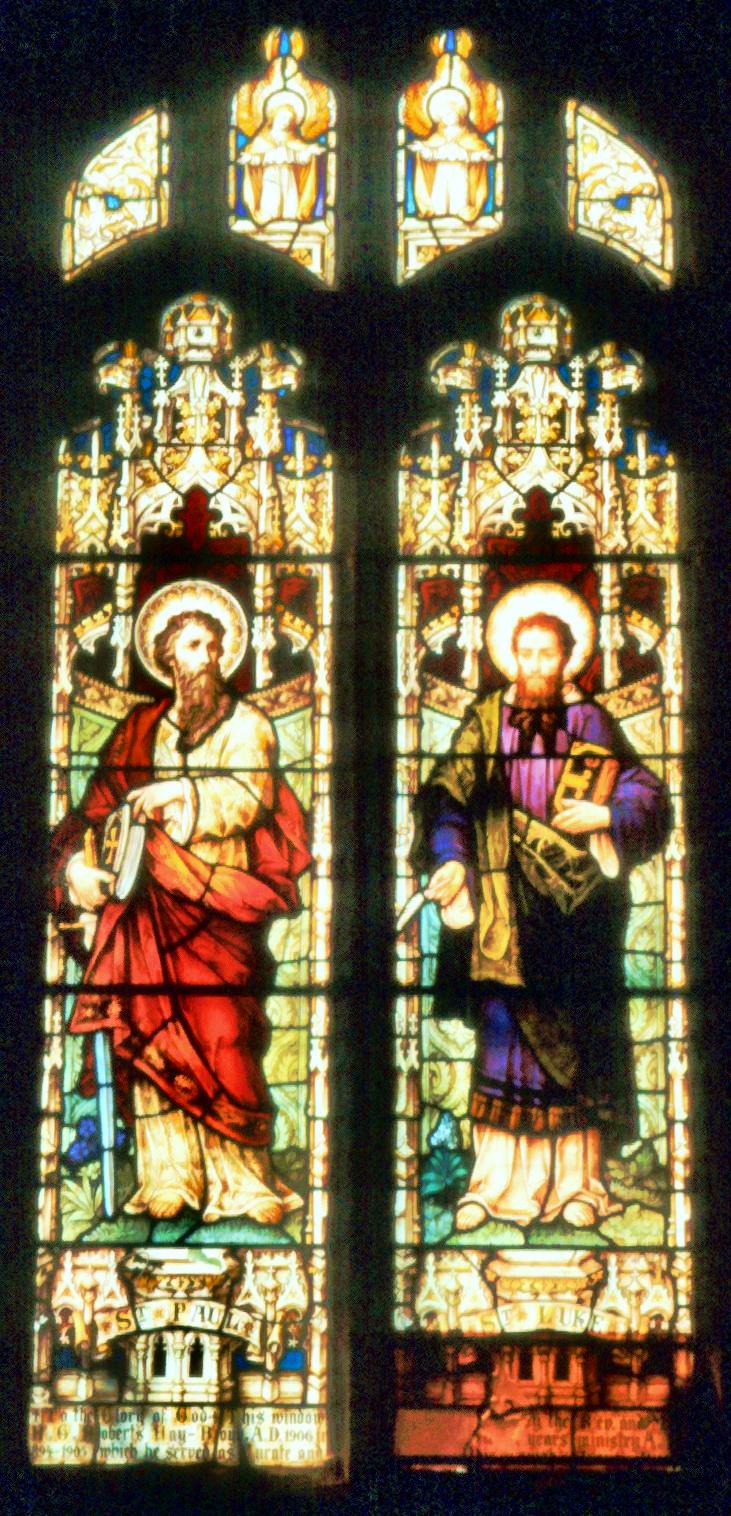
On 23 March 1901, Humphrey married Mary Elizabeth Hay-Boyd at St. George’s Chapel, Albemarle Street, London. 12 She was born in 1865 at Symington, Ayrshire the only child of Lieut-Col. James George Hay-Boyd, JP DL of Townend of Symington and Mary Adeline McAlester. (Mary Adeline was the daughter of Lieut-Col. Charles Somerville McAlester of Loup and Kennox, Ayrshire). Their son, George Edward Humphrey Roberts, was born in Spratton on 3 July 1902. (He died in 1983, at East Dereham, Norfolk). 13 The family moved in 1905 to Townend of Symington and at this point changed their name to Roberts-Hay-Boyd. Before leaving Spratton, the couple arranged for the donation of a stained-glass window to Spratton Parish Church.

0748-ps-nk-churchsouthmainaislewindow-2
Figure 3. Stained Glass Window. From Enid Jarvis, Chair, Spratton Local History Society

Figure 4. Spratton Church from an old engraving. From Enid Jarvis, Chair, Spratton Local History Society

The window carries the inscription ‘To the Glory of God this window was donated by the Rev. and Mrs. H.G. Roberts Hay-Boyd, A.D.1906, in thanks for eleven years ministry, A.D. 1894-1905, which he served as curate and vicar of this parish.’14

Soon after arriving in Ayrshire, Humphrey acquired at least two racehorses one of which ran in the Adamhill Cup at Ayr Racecourse as part of the Scottish Grand National Festival in 1907.15 The other ran in the Motherwell Plate at Hamilton Park in the same year. It was not a successful outing as his horse was defeated by fifty lengths! 16

In retirement in Ayrshire the Hay-Boyds seem to have enthusiastically embraced the local music and amateur dramatics scene. (Before her marriage, Miss Hay-Boyd had appeared as ‘a most dignified Lady Somerford’ in a performance of The Jacobite in the Oddfellows Hall, Kilmarnock.17) A ‘Historical Masque – Men of the Westland’ was given in Ayr Town Hall in March 1910. This portrayed the ‘progress of civilisation in Carrick, Cunninghame and Kyle from pagan to modern times.’ It appears to have been a lavish affair, help with costumes being given by Fra Newberry and the governors of the Glasgow School of Art. The Rev. Hay-Boyd played John Knox and Mrs Hay-Boyd was the personification of the Town of Ayr.18

In the 1911 census Humphrey was at the Rutland Hotel, Edinburgh with his son. He was described as a ‘retired clergyman’, aged 44.19 Later that year he travelled back to Spratton to help raise funds for the lighting of Spratton’s streets. This took the form of two variety entertainments in the school at which Humphrey performed two songs, Love’s Coronation and Three for Jack ‘sung in rousing style’.20 In the same year (possibly at the same time?), Mrs Hay-Boyd also returned to Spratton;

The Sunday School treat was held in the field and garden of Mr and Mrs R. GILBY of Olde House Farm, Yew Tree Lane. The prizes were distributed by Mrs ROBERTS HAY-BOYD and the tea was organised by Miss Letitia GILBY. 21

In December 1913, Humphrey boarded the S.S. Otway in London bound for Naples.22 In May 1925, the Roberts-Hay-Boyds hosted a coming-of-age ball for their son George in Ayr Town Hall which was, according to reports, attended by the cream of local society including the Marchioness of Ailsa and Major Hastings Montgomerie. 23

Both the Rev. and Mrs. Hay-Boyd had a great interest in music and were heavily involved in the musical affairs of Ayrshire. He was president of the Ayr Choral Union from 1916 till his death, and both subscribed to the staging of The Messiah in the Town Hall, Ayr on 26 December 1930. He was a Vice-President and a member of the council of the Ayrshire Musical Festival ‘and took his fair share of the work associated with that annual event’.24,25In describing one of the Ayr Art exhibitions a local newspaper states that Mrs Roberts-Hay-Boyd had ‘provided a splendid concert’ in connection with the event and that one of the ‘principal artistes’ was the Rev. Mr. Hay-Boyd. Unfortunately, there is no mention of what his special talent was. 26

The Hay-Boyds were also in possession of several works of art of outstanding quality and from 1909 to 1919 they regularly lent paintings to various exhibitions in the Carnegie Library in Ayr.27

1909    Exhibition of Old Engravings
Milking Time                                          C. Troyon, engraved by V. Girarchet
(Line Engraving – Steel)                            (Lent by Rev H. Roberts Hay-Boyd)

1910    Ayr Fine Art Exhibition
Conway Castle                                                 J.M.W. Turner R.A.,
(Was this the picture which was sold in 2010 by Christie`s for £325,250?)

The Ferry Boat                                                 C. F. Daubigny
On the Oise                                                      C. F. Daubigny
Resting                                                             Alexander Nasmyth
(Lent by Rev. H. Roberts-Hay-Boyd, Esq.,)

George Douglas of Rodinghead,                       Sir Henry Raeburn
(Lent by Mrs Roberts Hay-Boyd).
This was probably a family heirloom as Mrs Hay-Boyd`s grandmother was Elizabeth Douglas of Rodinghead.
(Was this the painting which was sold at Sotheby`s in 1993?)

1919    Ayr Sketch Club
Carting Timber                                                 Anton Mauve
(Lent by Rev. H. Roberts-Hay-Boyd, Symington).

Humphrey Gordon Roberts-Hay-Boyd died on 25 October 1931, aged 64, in Greystones Nursing Home, Prestwick, Ayrshire. His occupation was ‘minister of religion’ but with no charge.28 He was buried in Symington Churchyard with other members of the Hay-Boyd family.

1249 - Hay Boyd Grave
Figure 5 Hay-Boyd family grave in Symington Churchyard (photo by author)

In Memory Of
MARY ADELINE HAY BOYD
Died 13th Novr. 1894
wife of
Colonel JAMES GEORGE HAY BOYD
of Townend of Symington
and daughter of the late
Col. CHARLES SOMERVILLE McALESTER
of Kennox

Also of
Colonel JAMES GEORGE HAY BOYD
of Townend of Symington
Late XXth Regt.
Died 21st November 1904
Son of Capt. FRANCIS HAY XXXIVth Regt.
& Mrs ELIZABETH DOUGLAS or HAY
Of Rodinghead

To the Beloved Memory of the
Revd. HUMPHREY GORDON ROBERTS, M.A.
and husband of
MARY ELIZABETH HAY BOYD of Townend
Obit 25th October 1931
Also the above
MARY ELIZABETH ROBERTS-HAY-BOYD
who died at Townend 25th February 1941.

He was survived by his wife and son. An obituary in the Ayrshire Post contained the following information: ‘Mr and Mrs Roberts-Hay-Boyd resided part of the time in the former home in Wellington Square of Colonel Hay-Boyd, one of the few remaining residences in the square, and at the picturesque home in Townend, embowered among trees near Symington Village. Mr Roberts-Hay-Boyd was of a quiet and unobtrusive nature and was held in high esteem in the district’.29 An obituary was also published in the London Times 30and his death was reported in the Northampton Mercury.31

As well as the pictures given to Glasgow, He also bequeathed paintings to the Town Council of Ayr and to the National Gallery of Scotland (NGS).

‘In terms of deceased`s trust disposition and settlement, the legacy was not to take effect until the death of his widow, but Mrs. Hay-Boyd desires now to deliver the following four pictures:

  1. Roses in a white frame           S. J. Peploe                                          Oil
  2. Sunset, Kilbrannan Sound      Sir J. Lawton Wingate, P.R.S.A.             Oil
  3. The Four Master                     R. Burns (!) Flint                    Watercolour
  4. View of Haarlem                    J. H. Weissenbruch               Watercolour’ 32

Bequests were also made to the NGS and were presented in 1941.

          Roses                                         S. J. Peploe                                         Oil
          Peaches on a Dish                     Henri Fantin-Latour                            Oil

References

  1. Graves, Algernon, F.S.A., The Royal Academy of Arts A Complete Dictionary of Contributors and their work from its foundation in 1769 to 1904, Vol III, Henry Graves and Co. Ltd., London and George Bell and Sons, 1905
  2. Glasgow Corporation Minutes – Committee on Art Galleries and Museums, Mitchell Library, Glasgow 25.4.1941.
  3. Births, Deaths and Marriages Index, England and
  4. ancestry.co.uk, Census England, 1871, 1881.
  5. ancestry.co.uk, Cambridge University Alumni (1261 – 1900)
  6. London Evening Standard 15 May 1891 p3
  7. ancestry.co.uk, Census England 1891.
  8. Folkstone Herald, 30 May 1891
  9. Northampton Mercury 24 November 1905
  10. Ayrshire Post, 30 October 1931
  11. From Enid Jarvis, Chair, Spratton Local History Society
  12. The Globe, March 25, 1901 p7; The Queen 30 March 1901 p43
  13. Burke`s Peerage, Baronetage and Knightage, 107th Edition, 2003, www.thepeerage.com
  14. From Enid Jarvis, Chair, Spratton Local History Society.
  15. Scotsman 12 April 1907 p4
  16. Sporting Life, 15 July 1907, p5
  17. Ardrossan and Saltcoats Herald, 12 March 1897, p4
  18. Queen, 26 March 1910, p563
  19. Scotland’s People, 1911 Census, Scotland
  20. Northampton Mercury, 14 July 1911, p5
  21. Spratton Parish Magazine 1911.
  22. Homeward Mail from India, China and the East, December 22, 1913 p27
  23. Gentlewoman, 9 May 1925, p16
  24. Ayrshire Post, Oct. 30 1931, p8.
  25. Catalogues of Exhibitions of Ayr Sketch Club, Ayr Fine Arts Society, Ayr Art Union
  26. ibid
  27. ibid
  28. Scotland’s People, Death Certificate
  29. Ayrshire Post, Oct. 30, 1931, p8.
  30. The Times, Oct. 27, 1931, p15.
  31. Northampton Mercury, Oct 30, 1931 p5
  32. Ayrshire Post, 21 May 1937, p12. 

Adam’s First Sight of Eve – Provenance

The oil painting Adam’s First Sight of Eve (2570) by John Martin was presented to Glasgow on 4 October 1946 by the Imperial Chemical Company, Ardeer, through Lord McGowan and the Local Secretary Ms. Pitceathly. 1 It had been discovered in the Kilmeny Hotel in Ardrossan by Evelyn Waugh when he was stationed there during WW2.

Figure 1. Martin, John; Adam’s First Sight of Eve. © CSG GIC Glasgow Museums Collection. (http://www.artuk.org/)

Since the donor’s history is well documented it seemed more interesting to research the provenance of the painting and how it came to be in a hotel in Ardrossan, Ayrshire.

What Was Known?

            Adam`s First Sight of Eve was completed in 1812 by John Martin. It is signed J. Martin, 1812. He sent it to the Royal Academy Exhibition of 1813 where to his delight it was displayed in the Great Room. It was accompanied by a quote from Milton’s Paradise Lost,

                        ‘Nature herself, though pure of sinful thought,
Wrought on her so, that, seeing me, she turned’.

            It was purchased, probably from the exhibition, by ‘Spong, a rich Kentish collector’ for seventy guineas. 2, 3, 4

What Is New?

A search of the census records suggested that the ‘Spong’ in question was Thomas Spong who was born in Aylesford, Kent in 1780/81. He was christened on 6 January 1781. 5 He is recorded in three census records where he is described as a ‘merchant’ aged 60 (1841), a ‘coal merchant’ aged 69 (1851) and a ‘retired gentleman’ aged 80 (1861). In 1861 he was living at 2 Albion Terrace, Faversham next door to his son William. 6

The painting seems to have remained in the possession of Thomas Spong for forty years as the next we hear of it is when it was advertised for sale by Christie and Manson in a collection of English pictures which was held at their Great Room, 8 King Street, London on 30 June 1853. 7 The sale catalogue listed

‘Lot 81, Adam’s first sight of Eve. The celebrated work, exhibited at Somerset House about 1813’.

   Unfortunately, the painting failed to sell. (No buyer to take the story forward!) The reserve on it was £50 and the bidding went up to £47. The seller, whose name was not disclosed at the time of the sale was a Mr. Walter Tebbitt, of 3 Union Crescent, Wandsworth Road, London. 8 Walter Tebbitt was born in 1827/8 in Surrey. On 5 February 1850 he was elected to the Linnean Society. Their records give his address as Cottage House, Clapham Common, London. His main interest was botany. On 5 May 1850 he co-presented a portrait of Edward Stanley (1779-1849) to the Society. 9 In the 1851 census for St. Giles in the Fields he is listed as aged 23, unmarried with his occupation ‘Mother of Pearl Works Ornamental’, born Surrey and employing one servant. His address was 4 North Crescent. 10On 28 April 1852, in Aylesford, Kent, Walter Tebbitt married Grace Nash Spong who was 19 and the daughter of Thomas Spong. 11

            Walter Tebbitt left the Linnean Society on 1 November 1860. On the 1861 census he and Grace and their two children were living at Martinhoe, North Devon, Wooda Bay. He was now a ‘fundholder’. 12 Thomas Spong died at Canterbury on 15 August 1865. He was survived by his wife, Mary Eliza Spong who inherited most of his effects. There was no mention of the painting in his will. 13 Walter Tebbitt died on 24 March 1893 at Marlborough House, Tunbridge Wells. The painting is not mentioned in his will, but he did leave his pictures to his widow. 14 Grace Tebbitt died on 4 December 1924 in Tunbridge Wells. 15 It seems that she did not leave a will. From 1853 to 1942 the whereabouts of the painting are unknown.

            In April 1942 Evelyn Waugh, then a captain in the Royal Marines, was posted to Glasgow and then to the Special Services Brigade in Ardrossan. He had earlier undertaken commando training on the Isle of Arran. Later in the year, on 28 September, when visiting Diana Cooper in Bognor Regis he told her that there was a small painting by John Martin in the Kilmeny Hotel in Ardrossan. 16

Kilmeny Hotel

            Kilmeny* House (later the Kilmeny Hotel) was built in South Crescent, Ardrossan for John Galloway between 1885 and 1888. John Galloway was born in Glasgow in 1829. In the census of 1861, he was aged 31 and living at 55 Clarence Street, Glasgow with his wife Margaret and two daughters. He was a ‘Clerk Cashier in a Shipping Insurance Broker’s Office’. 17 He moved to Ardrossan shortly after and in 1865 was the tenant occupier of a house in Countess Street. 18 He was employed by the firm of Patrick (Paddy) Henderson ship owners and eventually was appointed its managing director. In 1874 he became a member of the Glasgow Chamber of Commerce. The following year he was the proprietor/occupier of a house and offices in South Crescent and the occupier of a house in Raise Street, Ardrossan. 19 In 1885 he was elected a Director of the Glasgow Chamber of Commerce. The first mention of Kilmeny appears on 22 September 1888 when an article in the Ardrossan and Saltcoats Herald notes that ‘Mr. John Galloway (of Messrs P. Henderson Ltd.) who resided at Kilmeny, Ardrossan, placed a memorial stone in the Free Church’. In the 1895 Valuation Roll for Ardrossan, he is listed as Proprietor, Kilmeny House Offices and Garden, South Crescent. He was also a tenant at 2 Manse Street, Church Place suggesting that he may have been using Kilmeny House as offices only. He was re-elected Chairman of Glasgow Chamber of Commerce in January 1899. In the census of 1901, he is listed as a ‘retired shipowner’. John Galloway passed away on 25 September 1904.

       ‘John Galloway, Homehill, Bridge of Allan, (formerly of Kilmeny Ardrossan), died. He was head of Patrick Henderson shipowners before his retirement. His estate was valued at £53,613, 16s. 6d.’20, 21

His death and an appreciation of his service was noted in the minutes of the Glasgow Chamber of Commerce. 22

From his death certificate his father George Galloway was an artist. Could he have acquired the painting?

   The next proprietor of Kilmeny House in 1905 was James Cant, a timber broker with premises at 52 St. Enoch Square, Glasgow. 23 On 4 October 1907 he was elected president of the local branch of the National Bible Society. 24 He was still proprietor in 1915 but by 1920 ownership had passed to Major Frederick Charles Gavin. On 12 April 1922 North Ayrshire Licensing Court granted a certificate by 7 votes to 3, for an inn and hotel for Kilmeny House, South Crescent, Ardrossan. The licensee was Charles F.O. Lee the keeper of the nearby Eglinton Arms Hotel. ‘Kilmeny House is a private residence, containing 30 apartments, and had not previously been licensed, and objections were stated against granting a licence, on behalf of a number of persons owning and occupying property in the vicinity’. 25

ICI

Following his invention of ‘dynamite’, Alfred Nobel formed the British Dynamite Company Ltd. In 1870. He purchased land on the Ardeer Peninsula in Ayrshire to set up a plant to manufacture dynamite. Its relative remoteness and substantial sand dunes made it suitable from a safety point of view. The company, renamed as Nobel’s Explosives Company Ltd. In 1877, became the largest explosives factory in the world. 26

Harry Duncan McGowan was born in Glasgow on 3 June 1874. He attended Hutchesons’ Grammar School and Allan Glen’s School, Glasgow but left at age fifteen to join Nobel’s Explosives Company eventually becoming manager. During the First World War he was able to merge most of the British explosives industry, and by 1920 he had become Chairman and Managing Director of the resulting Nobel Industries Ltd. In 1926 this company merged with other chemicals-based industries to become Imperial Chemical Industries (ICI). McGowan became Chairman and Managing Director in 1930 and remained Chairman until 1950. He was made Baron McGowan of Ardeer in 1937. Ardeer, which is about three miles from Ardrossan, became the Nobel Division of ICI after the merger in 1926. 27

    ICI began using the Kilmeny Hotel to entertain and accommodate guests from 1929 28 and Charles Lee remained the proprietor until at least 1940 and probably till 1945 when it was taken over by ICI. The painting was found in a dirty state and was cleaned and restored under the supervision of Mr. F. C. Speyer who was the Controller of the Industrial Ammonia Division at ICI. 29 On 4 October 1946, the painting was donated to Glasgow. When ICI moved out of Kilmeny in 1949 a report in a local newspaper opined that ‘in the last twenty years it has looked more like a mausoleum than a hotel’. 30 This might account for the state of the painting.

(In the Object File there are two references purporting to be referring to the sale of the painting.

A Christie’s sale on 7 August 1855. Christie’s could find no trace of this sale. In fact, the date in incorrect. It should be 7 August 1875 – The Hooton Hall Sale.

Lot 850 – Adam and Eve Praying at Sunset by John Martin- sold by Naylor and bought by Fitzhenry 

On 3 May 1879 – Nield Sale – lot 59 – Adam and Eve with an angel in the Garden of Eden by John Martin, bought by Fraser.

Both refer to different John Martin paintings).

          * Kilmeny may derive from a poem by James Hogg.

.. Bonnie Kilmeny gaed up the glen;
But it wasna to meet Duneira’s men,
Nor the rosy monk of the isle to see,
For Kilmeny was pure as pure could be.
It was only to hear the yorlin sing,
And pu’ the cress-flower round the spring;
The scarlet hypp and the hindberrye,
And the nut that hung frae the hazel tree;

                                          etc.

  Figure 2. Bonnie Kilmeny by John Faed. Public Domain.

 References

  1. Glasgow Museums, List of Donors, Glasgow Museums Resource Centre
  2. Equivalent to about £5,500 today
  3. Pendered, Mary, John Martin, Painter – His Life and Times, Hurst & Blackett, London, 1923 pp 61, 77, 79,
  4. Balston, Thomas, John Martin 1789 – 1854: His Life and Works, Gerald Duckworth, London, 1947  p36,
  5. Old Parish Registers, Kent, Family Search
  6. Ancestry.co.uk, Census Records, England
  7. The Morning Post, 20 June 1853
  8. Information from Lynda McLeod, Archivist, Christie’s Archives, transcribed from sales’ catalogue and sellers’ list
  9. Information from Luke Thorne, Assistant Archivist, Linnean Society
  10. Ancestry.co.uk, Census Records, England
  11. Old Parish Registers, Family Search
  12. Ancestry.co.uk, Census Records, England
  13. Will proved at HM Court of Probate, Canterbury, 8 September 1865
  14. Will probate granted to his widow and three other executors. 27 May 1893
  15. Ancestry.co.uk, Grace Nash Spong family tree
  16. Page, Norman, An Evelyn Waugh Chronology (Author Chronologies), Palgrave Macmillan, London, September 1997 (also on Google Books)
  17. Scotland’s People, Census 1861
  18. Scotland’s People, Valuation Roll, Ardrossan, 1865
  19. Scotland’s People, Valuation Roll, Ardrossan, 1875
  20. Glasgow Herald, 27 September 1904
  21. Confirmations and Testaments, Mitchell Library, Glasgow
  22. Minutes of Glasgow Chamber of Commerce, 10 October 1904
  23. Scotland’s People, Valuation Roll, Ardrossan, 1915
  24. Ardrossan and Saltcoats Herald, 4 October 1907
  25. Glasgow Herald, 19 April 1922
  26. https://www.secretscotland.org.uk/index.php/Secrets/ICIArdeer
  27. https://www.gracesguide.co.uk/Harry_Duncan_McGowan
  28. Catalyst, ICI Magazine 1929, information from Judith Wilde, archivist
  29. Hansard, Volume 391, 14 July 1943
  30. Kilmarnock Herald and Ayrshire Gazette, 7 October 1949 (Getting Around and About by The Coaster) also posted in http://www.threetowners.com

Mary Jackson Kirkpatrick (1876 – 1956)

Seven oil paintings were presented to Glasgow Corporation on 14 July 1947. The donor was a Miss Kirkpatrick of 6 Cleveden Crescent, Glasgow. 1

The paintings were:

Figure 1. Constable, John (in style of); On the Wye, Herefordshire. © CSG GIC Glasgow Museums Collection.(http://www.artuk.org)
Figure 2. Donald, John Milne; Cattle in a Pool. © CSG GIC Glasgow Museums Collection.(http://www.artuk.org)
Figure 3. Boughton, George Henry; Girl with a Muff, Winter Scene. © CSG GIC Glasgow Museums Collection.(http://www.artuk.org)
Figure 4. Boughton, George Henry; Girl with Pitchers, Summer Scene. © CSG GIC Glasgow Museums Collection.(http://www.artuk.org)

Figure 5. Billet, Pierre; Bringing in the Catch. © CSG GIC Glasgow Museums Collection.(http://www.artuk.org)

The other two paintings in the donation were: The Old Story by D.A.C. Artz (2627) and Highland River by John MacWhirter, RA, ARSA  (2628).

         According to the Glasgow Voters’ Roll for 1948, there was a Mary J. Kirkpatrick resident at 1 Cleveden Crescent. In 1937 the Voters’ Roll has Mrs Mary A. Kirkpatrick and Mary J Kirkpatrick living at 6 Cleveden Crescent. This suggested that the two women were mother and daughter and that the mother had died sometime between 1937 and 1948. Mary Anne Kirkpatrick, widow of Thomas Kirkpatrick, grain merchant, died at 6 Cleveden Crescent, Glasgow on 13 December 1940. She was 86 years old, and her death was reported by her daughter Mary J. Kirkpatrick. Her father, John Jackson, was also a grain merchant. 2

                Thomas Kirkpatrick was employed by the firm of John Jackson & Co., grain and flour factors of 23 Hope Street, Glasgow. 3 He was thirty-four years old and a bachelor when he married the boss’s daughter, twenty-year-old Mary Anne Jackson at the bride’s residence, 13 Lauder Road, Grange, Edinburgh on 25 March 1875. Thomas Kirkpatrick’s address was 24 Berkeley Terrace, Glasgow.4 Mary Jackson Kirkpatrick was born the following year on 20 January at 2 Park Quadrant, Glasgow.5  Two years later, a son, Thomas was born and a second daughter, Edith Grant Kirkpatrick was born in 1880. 6 The family was completed with the birth of Arthur in 1887.7 By 1891 the family had moved to 6 Montgomerie Crescent in Kelvinside. Thomas Kirkpatrick’s occupation was ‘grain merchant, employer’. Mary was a scholar aged fifteen. 8 Ten years later, on 18 November 1901, Thomas Kirkpatrick died aged sixty-one after an operation for an epithelioma of the colon. 9  The family remained at 6 Montgomerie Crescent with Mary Ann Kirkpatrick living on private means along with her daughter Mary, son Arthur who was now an accounts clerk and two servants. 10 Edith Kilpatrick had married John Ernest Jarrett in 1902 11 and Thomas Jr. followed in his father’s footsteps as a grain merchant and took over the family business.

Kirkpatrick, Thos., grain merchant, 67 Hope street; ho. 4 Grosvenor cres. 12

                Sometime between 1911 and 1936, Montgomerie Crescent was renamed Cleveden Crescent. Mary Anne Kirkpatrick died at 6 Cleveden Crescent on 13 December 1940. She was eighty-six. Her daughter Mary reported her death. 13 After her mother’s death, Mary moved to 1 Cleveden Crescent 14 perhaps to a smaller flat and this may have occasioned the donation of the paintings to Glasgow. Mary Jackson Kirkpatrick died at the Royal Glasgow Cancer Hospital on 18 February 1956 aged eighty. Her sister Edith who was living with her at 1 Cleveden Crescent, reported her death. 15,16

References

  1. Glasgow Corporation, Catalogue of Donations, Glasgow Museums Resource Centre
  2. Scotland’s People, Death Certificate
  3. Glasgow Post Office Directory, 1874-5
  4. Scotland’s People, Marriage Certificate
  5. Scotland’s People, Birth Certificate
  6. Ibid
  7. Ibid
  8. Scotland’s People, Census 1891
  9. Scotland’s People, Death Certificate
  10. Scotland’s People, Census 1911
  11. Scotland’s People, Marriage Certificate
  12. Glasgow Post Office Directory, 1918-19
  13. Scotland’s People, Death Certificate
  14. Glasgow Voters’ Roll, 1948
  15. Scotland’s People, Death Certificate
  16. Glasgow Herald, 20 February 1956, p1

Robert McNeil Ker (1878 – 1953)

On 11 December 1946, an oil painting entitled Mrs. Scott, Wife of James Scott of Kelly (2590) by John Graham-Gilbert RSA, was presented to Glasgow Corporation by Major Ker of Easterton, Milngavie. 1

Figure 1. Graham-Gilbert, John; Mrs James Scott of Kelly; Glasgow Museums;
http://www.artuk.org/artworks

The subject of the painting is Jane Martha Galbraith who was born in Barony on 7 May 1830. (She  died aged 87 in 1917 at 8 Woodside Crescent, Glasgow). Her parents were Andrew Galbraith, a cotton spinner/merchant, and Margaret Bogle Scott. 2 In 1848, aged eighteen, Jane married the thirty- eight-year-old James Scott. 3 (Appendix) The following year James Scott bought the estate of Kelly in the parish of Inverkip, Renfrewshire. The painting is dated to 1850 (ArtUK) so either commemorates the couples’ marriage or perhaps the birth of their first child Margaret Bogle Scott who was born on 14 July 1850. 4 Between 1850 and 1866 Jane Martha Scott gave birth to ten children, five boys and five girls. One of the girls, Helen Bethia Scott who was born on 16  July 1855 in Inverkip 5 was the mother of the donor. Helen Bethia Scott was 21 when she married Thomas Ripley Ker ‘gentleman’ of Dougalston, Milngavie on 20 June 1877 at St. Mary`s Tower, Birnam, Little Dunkeld. 6 (Thomas Ker’s father Robert Ker went out East as a merchant in 1825 and made his fortune before returning to Glasgow in 1836 and becoming a partner in Ker, Bolton & Co. of 27 West George Street, Manilla and Singapore Merchants. In 1841 he married Elizabeth Johnston of Shieldhall and had four children).7                   

Thomas and Helen Ker’s first child, Robert McNeil Ker (later ‘Major Ker’ the donor of the painting) was born in Strathblane on 18 February 1878. 8 A second child, Ronald Scott Ker was born in 1879 and the family took up residence in Bardowie House (Castle), Baldernock, Stirling. 9

Finely situated on its north-east side of Bardowie Lochan, and
embowered among foliage, is Bardowie House, an edifice of moderate
size, and somewhat timeworn, yet withal wearing an appearance of
quiet cosieness and comfort .’ 10                                                           

Figure 2. Bardowie_Castle in 1870 By Thomas Annan httpwww.theglasgowstory.comimage.phpinum=TGSB00235, Public Domain, httpscommons.wikimedia.orgwindex.phpcurid=15233785

Robert was educated at Dalvreck Academy (later Ardvrek Academy) in Crieff and appears on the school roll in 1891 11 but no record of Robert’s time there could be found by the school archivist. By 1901 the family had moved to Dougalston Mansion. This was a large house – according to the census there were thirty-five rooms with one or more windows – situated in Milngavie. 12

Figure 3. Dougalston, Milngavie (From an old post card)

 The house had been built by John Glassford, one of the Glasgow ‘Tobacco Lords’ in the early 18th century. Robert’s grandfather Robert Ker bought the house and estate in 1870 13 and had the house restored about 1872-73. 14 He also, in 1883, acquired the estate of Easterton . When he died in 1888, Robert Ker left an estate valued at £220,000 not including Dougalston. 15

The family now consisted of Thomas and Helen, Robert aged 23 was a ‘militiaman’, Ronald, an Oxford undergraduate and a sister Helen Ripley Ker born in 1887. They employed eight servants and a governess. 16

On 24 September 1902, Robert joined the army – the Officer Cadet Battalion with the rank of Honorary Captain. 17 The following year as a lieutenant in the Royal Garrison Regiment he married Margaret Lilian Blagden in Tisbury, Wiltshire.18,19 On 29 April 1904, the Royal Garrison Regiment embarked for South Africa to take up garrison duties at Fort Napier, Pietermaritzburg. 20 Tragically, Margaret Lilian Ker died in Pietermaritzburg on 7 April 1905. Robert later erected a memorial plaque to her in the church of St. Mary the Virgin, Donhead St. Mary, Wiltshire:

In Memory of

Margaret Lilian Ker

Nee Blagden

Who was married in this church 13th October 1903

And who died in Pietermaritzburg, Natal

7th April 1905

Erected by Robert MacNeil Ker

Xmas 1905

Robert returned from South Africa later that year with three battalions of the regiment. (The Royal Garrison Regiment was disbanded on 1 September 1908 21). In the same year as the death of his wife, Robert’s grandmother Elizabeth Ker died at Eastertoun. 22

On 17 April 1907, Robert McNeil Ker married Lucy Winifred Strickland -Constable at Holy Trinity Church, Sloane Street, Chelsea. 23 Lucy was born in Wassand Hall, Seaton, Yorkshire in 1875. She was the daughter of Henry Strickland – Constable and niece of Sir Charles Strickland eighth baronet of Boynton. After the wedding, the couple left for Paris and a continental honeymoon. 24

They had a son, Neil Ripley Ker, born on 28May 1908 in Brompton, London. Neil became an eminent palaeographer and his entry in the Oxford Dictionary of National Biography says that his father was a captain in the 3rd battalion of the Argyll and Sutherland Highlanders (A & SH). During the war years his mother and grandmother held garden fetes etc. to raise funds for the A & SH Comforts’ Fund. 25

According to the census of 1911, Robert, aged 33 was living ‘on private means’ at Friningham Lodge, Detling, near Maidstone in Kent. With him were his wife Lucy aged 36 and son Neil aged 2. In 1914, with the advent of war, Robert was a captain in the Reserve of Officers attached to the Brigade of Infantry. In the same year he joined the Argyll and Sutherland Highlanders and then the Machine Gun Corps with the rank of major. At some point during the war, he was made acting lieutenant colonel of the corps. 26

Figure 4. Easterton House (Alexander Nisbet Paterson, 1915)Old Postcard View found in Crawford, James, Old Mugdock, Balmore, Baldernock and Bardowie, 2016, Stenlake Publishing, Ltd.

 After the war he seems to have lived quietly at Easterton, his father’s house in Milngavie taking an interest in local affairs. Lucy Winifred Ker died at Eastertoun on 7 December 1942. 27She was sixty-seven. Robert’s father, Thomas Ripley Ker, died at Eastertoun on 18 July 1947. An extensive obituary was published in the local paper. 28Robert McNeil Ker died on 15 October 1953 at Easterton. His death certificate states that he was a Major in the Royal Garrison Regiment (retd.) and the widower of Lucy Winifred Strickland – Constable. 29 A brief report appeared in the local newspaper stating that ‘he was well known locally for the deep interest and kindness he showed in philanthropic institutions, and particularly of the Old Folks Clubs. He was of a quiet genial disposition and will be missed by many in the district’. 30   

After a private funeral he was buried in Baldernock Churchyard alongside his parents, his brother and his second wife. His father had earlier gifted land to enlarge the churchyard ‘where the maternal ancestors of President Roosevelt are buried’. 31

Figure 5. Ker family gravestones in Baldernock Churchyard. httpswww.findagrave.commemorial196889564robert-macneil-ker


Appendix

James Scott 1810 – 1884

James Scott had been made a partner in the firm of James Black & Co., calico printers, at the age of twenty and largely thanks to his efforts the firm’s business grew rapidly. In 1835 it acquired the Dalmonach printworks in Alexandria and through Scott’s ‘extraordinary enterprise’…….. attained it’s present position in the foremost ranks of printing’. James Scott retired from business in 1847. However, in 1852 he returned to set up the firm of J. & W.J. Scott with his younger brother. It became the largest cotton spinning works in Scotland. He also had interests in the railways and in oil setting up works at Clippens in Renfrewshire. 32 As a town councillor in Glasgow he was largely responsible for the formation of Kelvingrove Park. He sold the estate of Kelly to James ‘Paraffin’ Young in 1867. James Young died there on 13 May 1883 and is buried in Inverkip cemetery. James Scott died in 1884. Kelly House burned down in 1913 allegedly from suffragette activity. 33

References

  1. Catalogue of Donations, Glasgow Museums Resource Centre
  2. Scotland’s People, Death Certificate 1917, Jane Martha Scott
  3. Old Parish Registers, Family Search, Scotland
  4. Ibid
  5. Scotland’s People, Birth Certificate
  6. Scotland’s People, Marriage Certificate
  7. Smith, John Guthrie, Strathendrick, and its inhabitants from early times, Glasgow, J Maclehose and sons, 1896
  8. Scotland’s People, Birth Certificate
  9. ancestry.co.uk, 1881 Scotland Census
  10. Macdonald, Hugh, Rambles Round Glasgow, 1854
  11. ancestry.co.uk, 1891 Scotland Census
  12. ancestry.co.uk, 1901 Scotland Census
  13. Smith, John Guthrie, Strathendrick, and its inhabitants from early times, Glasgow, J Maclehose and sons, 1896
  14. http://www.parksandgardens.org/places-and-people/site/4448?preview=1
  15. Stirling Advertiser, 11 October 1888
  16. ancestry.co.uk, 1901 Scotland Census
  17. https//www.forces-war-records.co.uk.
  18. England and Wales Marriage Registration Index, 1837-2005, ancestry.co.uk
  19. https://www.broadwoodwidger-lhs.info/blagden-family/
  20. http://samilitaryhistory.org/vol025rc.html
  21. Ibid
  22. Milngavie and Bearsden Herald, 10 February 1905
  23. England and Wales Marriage Registration Index, 1837-2005, ancestry.co.uk
  24. Hull Daily Mail, 18 April 1907
  25. Milngavie and Bearsden Herald, 12 April 1918
  26. https//www.forces-war-records.co.uk
  27. Glasgow Herald, 8 December 1942
  28. Milngavie and Bearsden Herald, 26 July 1947
  29. Scotland’s People, Death Certificate
  30. Milngavie and Bearsden Herald , 17 October 1953
  31. Kirkintilloch Herald, 2 January 1929
  32. http://www.glasgowwestaddress.co.uk/100_Glasgow_Men/Scott_James.htm
  33. http://www.wemyssbay.net/content.php?pg=gct&pd=1022

Mrs Anna Bella Baird nee Maltman (1870 – 1963)

On 28 February 1944, an oil painting by Sir John Lavery presented by Mrs Baird of 8 Northbank Terrace, Glasgow, N.W., was accepted by Glasgow Corporation.1 The subject of the painting was Mr. George Ure Baird who was the father-in-law of the donor.

Figure 1. Lavery, John (1885). George Ure Baird (2361) © CSG GIC Glasgow Museums Collection.(http://www.artuk.org)

The Donor

Anna Bella Walker Maltman was born at 17 Kelvinhaugh Street, Anderston, Glasgow on 14 January 1870.2 Her father, Thomas Maltman was a drapery warehouseman who had married Anna`s mother Isabella Adam on 6 July 1860 in Glasgow.3 In 1871 the family consisted of Thomas, (who was now a shipping clerk) and Isabella with Magdalena aged 8, Frances 6, John 4 and Anna Bella.4 Ten years later the family was living at 9 Windsor Street, Kelvin, Glasgow. Anna Bella was a scholar, aged 11 and there were two other children, Johanna aged 7 and James aged 2.5  

            In 1891, the twenty-year-old Anna was living at 52 Ardbeg Road, Rothesay with her sisters Frances and Magdalena and brother-in-law, Andrew Adamson who was a photographic artist. Anna was ‘living on private means’.6 On 9 April 1896 Anna married George Callwell Baird at her home, 22 Montgomerie Street, Glasgow. George was a commercial traveller, aged 27, living at his brother`s home, Killadoon, Langside. Anna`s sister Johanna was a witness.7

            By 1901 Anna and George had moved to 2 Albany Street, Kelvinside. They now had a son George Ure Baird aged 3 and employed one servant.8 Ten years later, they were living at 242 Wilton Street, (later 8 Northbank Terrace) and now had three children, George, Dorothy, aged 9 and Thomas, aged 2.9 George senior was now a silk buyer employed by Gilmour & Co. silk merchants of 5 Royal Exchange Square, Glasgow. 10

            George Callwell Baird died in the Western Infirmary, Glasgow on 18 May 1943. He was 75.11 The following year Anna donated the painting of her father-in-law to Glasgow Museums.

            Anna Bella Walker Baird died on 10 December 1963 at 44 Balshagray Avenue, Glasgow. She was aged 93 and the cause of death was ‘senile decay’. Her usual address was that of her son Thomas at 242 Wilton Street.12

The Sitter

            George Ure Baird was born in Saltcoats on 8 January 1832 although the birth was registered in Stevenston. His parents were Hugh Baird, gentleman, and Margaret Anderson.13 On 18 July 1860, George married the nineteen-year-old Mary Helen Robertson at Gothic Cottage in Govan, and the couple took up residence at 3 Osborne Place, Govan. George was a commission merchant in sewing machines and lace.14 By 1881 the family had moved to Cartbank, 45 Netherlee Road, Cathcart. (This small Georgian house consisted of a single storey with a basement. It was described as symmetrical, two ends circled, ashlar, large square bay window on front. Probably circa 1770, with ends added circa 1800).15 The family now consisted of four sons and three daughters.16

It was about this time that the portrait of George Ure Baird was commissioned from John Lavery – probably to help the artist become established. Lavery later said that ‘Mr. Baird was one of my first patrons and his kindness to me still excites my warm gratitude’.17 Lavery`s paintings The Tennis Party and a watercolour Lady on a Safety Tricycle, (now in the government art collection) were painted at Cartbank and dated to 1885.18

Figure 2. Lavery, John. The Tennis Party © Aberdeen Art gallery. (http://www.artuk.org).

At about this time, George Ure Baird moved to a different address. An entry in the Glasgow Post Office directory for 1884/5 is

Baird, George Ure, commission merchant, 62, Queen Street; House, Anglsey Lodge, Langside

         George Ure Baird died of consumption aged 53 at Anglesy Lodge on 21 January 188519 and was buried in the Glasgow Necropolis along with two sons and a daughter who had predeceased him. The inscription on the headstone reads;-

    ‘GEORGE URE BAIRD ANN OGILVY born 22nd April 1873 died 6 March 1875, DAVID ANDERSON born 6th Oct 1870 died 28th March 1875 JESSIE born 3rd Jan 1877 died 9th Aug 1877, GEORGE URE BAIRD born 8th Jan 1832 died 21st Jan 1885, MARY HELEN ROBERTSON wife of the said GEORGE URE BAIRD who died 4th Oct 1903 aged 61’.

His business of commission merchant was carried on by his son Hugh Baird in partnership with Mr. William Ewing. However, the name George Ure Baird was retained. 20

The Painting and the Artist

            John Lavery was born in Belfast in 1856 but was orphaned three years later. At the age of ten he was sent to live with a rich cousin of his aunt who had a pawnshop in Saltcoats.21 George Ure Baird was one of his earliest patrons and the portrait was one of the first painted by Lavery. It may have been commissioned partly to help the artist become established. (It is not clear if the Saltcoats connection is relevant to their relationship since Baird would have moved to Glasgow before Lavery arrived in Saltcoats). However, the present portrait at GMRC is not the one commissioned by Baird.

         Lavery had bought and insured a studio in St.Vincent Street and ‘very shortly afterwards it succumbed to a mysterious fire’. Lavery recalled later that he had completed the original painting at his studio one Saturday evening but was not at all happy with the finished work. On returning to the studio the next day he found the place in flames and the painting destroyed ‘to his secret pleasure’. He pretended to be aggrieved but was secretly pleased with the outcome. More especially since he collected £300 of insurance money with which he financed his departure in 1880 for the Heatherley School of Fine Art in London and then to Paris.22

            Sometime later (1885) he painted the present portrait from a photographic miniature. Unfortunately, it was completed after the sitter’s death and was delivered to his widow. When Mary Helen Baird died on 4 October 1903, the painting passed to her son George Callwell Baird, husband of the donor. There is a letter on file at Glasgow Museums Resource Centre from Lavery to Mr. J. (sic) C. Baird dated 3 October 1931 from 5 Cromwell Place, London in which he says that he will be ‘passing through Glasgow on Monday with an hour to spare’ and stating that he would wish to come and visit and view the painting. The letter was handed in to Kelvingrove in February 1962 by Mr. T. M. Baird the grandson of the sitter.

Figure 3. Lavery, John (1885). George Ure Baird (2361) © CSG GIC Glasgow Museums Collection.(http://www.artuk.org)
Figure 4 Photographic Miniature from the Glasgow Evening News 4 September 1931.


References

  1. Glasgow Corporation, Committee on Art Galleries and Museum, Minutes, 15February 1944. (Mitchell Library)
  2. Scotland`s People, Birth Certificate
  3. Scotland`s People, Marriage Certificate
  4. Ancestry.co.uk, 1871 Scotland Census
  5. Scotland`s People, 1881 Census
  6. Scotland’s People, 1891 Census
  7. Scotland`s People, Marriage Certificate
  8. Scotland`s People, 1901 Census
  9. Scotland’s People, 1911 Census
  10. Glasgow Post Office Directory, 1911-12
  11. Scotland`s People, Death Certificate
  12. Scotland’s People, Death Certificate
  13. Old Parish Registers, Ayrshire, Family Search
  14. Scotland`s People, Marriage Certificate
  15. http://www.britishlistedbuildings.co.uk/sc-33943-45-netherlee-road-cartbank
  16. Scotland’s People, 1881 Census
  17. Glasgow Evening News, 4 Sept 1931
  18. www.scotcities.com/cathcart/whitecartwalk.htm
  19. Scotland’s People, Death Certificate
  20. The Edinburgh Gazette, 24 April 1885
  21. Billcliffe, Roger, Oxford Dictionary of National Biography, https://doi.org/10.1093/ref:odnb/34425
  22. ibid