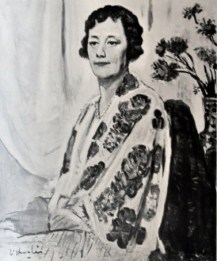
Kenneth Sanderson W.S. (1868 – 1944)

On 29 December 1943, a bequest from Kenneth Sanderson, Esq., W.S., Edinburgh, of a portrait in oil of George Murdoch (2352) by David Martin was received.

donor 3
Portrait of George Murdoch (1715-1795) – Provost of Glasgow 1754-55 and 1766-67 – by David Martin. Painted 1790. ©CSG GIC Glasgow Museums Collection.

“There was submitted a letter from Wishart & Sanderson, solicitors, Edinburgh, intimating that the late Mr. Kenneth Sanderson, W.S., had bequeathed to the Corporation the portrait of George Murdoch, Lord Provost of Glasgow, 1766, by David Martin. The committee, after hearing a report by the Director, agreed that the bequest be accepted”.1 (Accepted 29th December 1943).

Kenneth Sanderson was born on the 1st of July 1868 at Knowe Park, Galashiels. 2 He was the fourth of eight sons born to Robert Sanderson a woollen manufacturer and his wife Elizabeth Cochrane whom he had married on the 22nd of September 1859. The eldest child of the family was a daughter, Jane, born in 1860. 3

Sanderson was educated at the Edinburgh Institute (now Stewart`s Melville College) which he attended from 1882 to 1885. The following lists some of his achievements during and after his time at school 4:-

“SANDERSON, Kenneth, 5, Northumberland Street. Particulars at School – 1st XV, 1884-85. After Leaving School – W.S., 23, Rutland Street, Edinburgh; Chairman, Edinburgh Public Library; Lawn Tennis: Scotland v Belgium, 1914; 1914-18, Assistant in Law Department of Board of      Trade; Fellow of the Society of Antiquities of Scotland; Director, Scottish Power Company”

After leaving school in 1885, he attended Edinburgh University. At the same time, he was serving his apprenticeship as a Writer to the Signet which he began on the 2nd of November 1885.5 From the census of 1891, he was at his parents` home with four of his brothers. His occupation was “apprentice law clerk”.6 Having studied Civil Law and Conveyancing, he completed his apprenticeship in the office of Messrs. Bruce and Kerr, W.S. on the 13th of July 1891 when he became a member of the W.S. Society. 7 The following year, along with Andrew Wishart W. S., he formed the firm of Wishart and Sanderson where he remained a senior partner throughout his life. The firm built up a considerable practice both in Edinburgh and the Borders.8 In 1897 he wrote a letter to the Scotsman from 65, Castle Street, Edinburgh supporting the idea that “Scottish bills …. could fittingly be dealt with by a tribunal sitting in Scotland”.9 In both the 1901 and 1911 censuses he was living at 5, Abercromby Place and employing two servants. His profession was “W.S. and N.P.” 10

donor 4
Photograph of Sanderson from, James Hamilton, Research Principal, The WS Society, The Signet Library, Edinburgh

Kenneth Sanderson was a talented lawn tennis player. In 1887 he competed in tournaments in Galashiels and Melrose and in 1888, he entered the Scottish Championships, reaching the semi-finals. He competed in the Queen`s Challenge Cup in 1890 and reached the final of the Scottish Border Championships in 1903. In 1904 another entry into the Scottish Championships ended when he lost in round one. He also competed in tournaments on the Continent, South of France (quarter-finals in 1905) and Cannes (semi-finals in 1905) and again in 1909. He again reached the semi-finals of the Scottish Championships in 1908 and played in the South of Scotland Tennis Championships at Moffat as current North of Scotland Champion. He reached the men`s singles final and played in the mixed doubles.11 In April 1914 he toured Belgium with the Scottish Lawn Tennis Team and represented Scotland against Belgium in the first international match in which a Scottish team was involved. (He won two and lost two matches). (The team attributed its relatively poor form to having to play the match so soon after arriving in Belgium!)12

donor 5
Sanderson (right) playing at Moffat from “Aspects Of Scottish Lawn Tennis”, Being A Series Of Articles By J. Patten Macdougall, C.B., A. Wallace Mcgregor, A. Morrice Mackay, Edinburgh, 1st Jan 1910.

He wrote a critique of Scottish Tennis comparing the standard of play now and 40 years previously. In it he mentions some of the prominent players and tournaments.13 This was republished, (unaltered because of its historical interest), in 1927. 14

In other arenas, he was an expert angler (“a passionate sport from boyhood on Ettrick and Tweed”) and a fine golfer becoming a member of the Royal Burgess Golfing Society. He was also elected a council member of the Royal Scottish Geographical Society in 1907.

When the Edinburgh Sir Walter Scott Club was established in 1893, Sanderson was a founder member and was elected to the post of Honorary Secretary. The First Annual Meeting and Dinner of the club was held on the 7th November 1894.

The Secretary (Mr. KENNETH SANDERSON, W.S.) read the Minute of the Meeting constituting the Club, which was held on 13th June last, and the same was approved of. He reported that the membership to date numbered 496”. 15

His address at this time was 15, York Place. The following year he attended the meeting of the Club in the Synod Hall, Edinburgh where the Rev. John Watson (a.k.a. Ian Maclaren) was the speaker. The speaker commented that even then Scott was “not read”. 16 The 7th Annual Dinner of the Club was held at the Royal Hotel, with Sanderson as Hon. Sec. 17 In this capacity, he wrote to Sir Donald MacAlister in 1909 inviting him to be President of the Club for the following year. Sir Donald was then Principal of Glasgow University and the letter is preserved in the archives of the University. 18 The invitation was accepted. On the 8th of April 1910 he wrote to Lord Crewe possibly with a similar invitation. 19

After 27 years as Hon. Sec. of the Club, he indicated his intention to resign that position on 31st October 1921 and his resignation was accepted at the AGM and Dinner on the 17th of December that year.20 Presumably this prompted a presentation to him of “the Bracket Clock by Joseph Kniff, given to me by the Edinburgh Sir Walter Scott Club” which is mentioned in his will and which was left to his nephew Robert Kenneth Sanderson. He retained a connection with the club and attended its Thirtieth Annual Dinner in 1930 at the North British Hotel, with the Rt. Hon. Stanley Baldwin presiding. He was no longer an office bearer.21

In 1932 he wrote authoritative articles in the Scotsman describing exhibits (for example “The Engraved Portraits” of Scott) on display at the Scott Centenary Exhibition in the National Galleries of Scotland.22

The Old Edinburgh Club was founded in 1908 with Sanderson a founding member.23

Kenneth Sanderson`s main interests outside of his law practice were Scottish Art, Prints and Engravings, and libraries. He was regarded: “as one of the finest art connoisseurs in Scotland; he had not only one of the largest private collections of pictures and prints, but an intimate knowledge of the work of each of the great painters and engravers, particularly of the 18th century. His favourite portrait painter was probably David Martin, the master of Sir Henry Raeburn, though he had an affection for Allan Ramsay and Andrew Geddes”. 24

His “intimate knowledge” is exemplified in a letter of 1917 on the subject of “Sir Henry Raeburn`s “Glengarry””25. He was instrumental in the foundation of the Scottish Print and Fine Arts Club which held exhibitions in Edinburgh, Glasgow and Aberdeen and he contributed regularly to “The Print Collector`s Quarterly”. For example, he wrote an article on “Engravings after Raeburn” for one of the 1925 editions.26

In 1928 he became Curator of the Signet Library a post which he held for the rest of his life.27 He was Chairman of the Edinburgh Library Committee from 1930. 28 In a letter of that year he requested donations of local materials to be housed in a new library being built in Leith.29 In 1934 he presided over a meeting of the General Committee of the Edinburgh Public Library and announced that he was giving two pencil drawings by Henry Gastineau and a letter of James Gordon dated 1680, to the Edinburgh Room.30 This was followed in 1935 by his gift of two watercolour drawings to Edinburgh Central Library; “The Edinburgh Tollbooth, 1829” and “View of Portobello, 1838”.31 He was also chairman of the Library Committee of Edinburgh University.32 He was passionate about “the extensions and welfare of the Public Library – which he regarded as his chief life`s work”.33

In 1936 he was appointed to the Board of Trustees of the National Galleries of Scotland (NGS). He subsequently served as the National Galleries of Scotland Accounting Officer.34 In 1938 in his capacity as Trustee he was a member of the Executive Committee set up in Edinburgh in connection with “the most comprehensive exhibition of Scottish Art which has ever been undertaken”. The exhibition was to be held at the Royal Academy, Burlington House, London in 1939. Other members of the committee were Sir James L. Caw, Sir D. Y. Cameron, Mr. Stanley Cursiter and Mr J. R. Blyth, Chairman of the Kirkcaldy Art Gallery Committee.35 John Lavery and Sir Muirhead Bone were involved in the London committee. In connection with this exhibition he gave a series of weekly lectures on Scottish painters featuring, for example, the work of Wilkie and Geddes.36 He also lent the portrait of George Murdoch (subsequently donated to Glasgow) to be exhibited at the Royal Academy.

Sanderson visited many of the galleries in Europe the last being those in Copenhagen and Stockholm in the year before the war.37 In 1941 he represented the Trustees of NGS at an exhibition of “Inter-Allied Art” which was opened by Tom Johnston Secretary of State.38 He was reappointed to the Board of Trustees in 1942 (along with Sir William Burrell and Sir D. Y. Cameron).
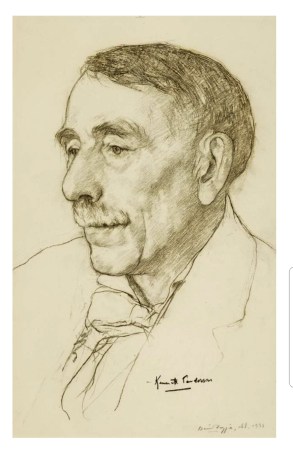
Kenneth Sanderson, 1868 – 1943. Connoisseur and collector; trustee of the National Galleries of Scotland, David Foggie, National Galleries of Scotland. © THE ARTIST’S ESTATE https://www.nationalgalleries.org/art-and-artists/3620/kenneth-sanderson-1868-1943-connoisseur-and-collector-trustee-national-galleries-scotland

 “Interested in the development of electrical supply in the South of Scotland, he became a director of the Scottish Power Company and the various electrical supply companies associated with it”. 39

Kenneth Sanderson never married. He died aged 75 on the 16th October 1943 at his home, 5, Northumberland Street, Edinburgh. “An Appreciation” appeared in the Scotsman;

“His bright, engaging and energetic personality endeared him not only to friends in the Parliament House and in other legal quarters, but in several artistic, literary and other societies. His zest, wide knowledge, sincerity and sound judgement were characteristics which won the admiration of all whom he came in contact with.” 40

The Edinburgh Evening News of 18th October 1943 contained a brief obituary and according to the Weekly Scotsman, his estate was valued at £26,503. 41 Among other bequests he left £1000 to the City of Edinburgh Council of Social Service, £500 to the Kirk Session of St. Cuthbert`s Parish Church – of which he had been an elder – (“for behoof of the Choir Endowment Fund”) and £200 to the Scottish Modern Arts Association. He also bequeathed a print showing the opening of the Scott Monument to Edinburgh Central Library.

The National Galleries of Scotland have a large collection of prints and drawings from the Kenneth Sanderson bequest of 1944. In addition, the Fine Arts Library in Edinburgh Central Library has a collection of artists` autographs and letters also from the bequest.

References

  1. Glasgow Corporation Minutes, 16th November 1943, Committee on Art Galleries and Museums. (Mitchell Library)
  2. Scotland`s People, Birth Certificate
  3. ancestry.co.uk
  4. Edinburgh Institution, 1832 – 1932, J.R.S. Young, George Waterston & Sons Ltd., 1933
  5. Information and photograph of Sanderson from, James Hamilton, Research Principal, The WS Society, The Signet Library, Edinburgh
  6. Scotland`s People, Census, 1891
  7. Scots Law Reporter, 1943, p191
  8. Information from Andrew Wishart, grandson of Kenneth Sanderson`s partner; He also provided the information that a walnut tallboy was bequeathed to the Royal Scottish Museum and is on display there;
  9. The Scotsman, 13th April 1897, p9
  10. Scotland`s People, Censuses, 1901 and 1911
  11. tennisarchives.com/player.php?playerid=9422 and The Scotsman, 7th August 1909 p13
  1. “Fifty Years of Lawn Tennis in Scotland”, 1914, Wallace MacGregor, editor and publisher
  2. “Aspects Of Scottish Lawn Tennis”, Being A Series Of Articles By J. Patten Macdougall, C.B., A. Wallace Mcgregor, A. Morrice Mackay, Edinburgh, 1st Jan 1910
  3. “Fifty Years of Lawn Tennis in Scotland”, Wallace MacGregor, publisher. 1927
  4. Minutes of the Edinburgh Sir Walter Scott Club,7th November 1894, reprinted 9th March 2009
  5. The Scotsman, 26th Nov 1895. p9
  6. The Scotsman, 10th January 1901, p9
  7. Glasgow University Archives, MS Gen 544/42
  8. Cambridge University Archives, Crewe C.14.1.24
  9. From the Minutes of the Edinburgh Sir Walter Scott Club, courtesy of Lee Simpson, Hon. Treasurer
  10. The Scotsman, 17th January 1930, p10
  11. The Scotsman, 1st and 2nd July 1932, p12
  12. Information from, James Hamilton, Research Principal, The WS Society, The Signet Library, Edinburgh
  13. The Scotsman, 19th October 1943, p4; 18th October 1943. Notice of his death and an obituary
  14. The Scotsman, 24th July 1917, p6
  15. The Print Collector`s Quarterly, Vol. 12, No. 2, April 1925
  16. Information from, James Hamilton, Research Principal, The WS Society, The Signet Library, Edinburgh
  17. The Scotsman, 22nd January 1930;
  18. The Scotsman, 24th January 1930 p7
  19. The Scotsman, 31st July 1934, p7
  20. The Scotsman 1st October 1935, p13
  21. The Scots Law Times, 6th November 1943, pp 47,48
  22. “A Friend`s Tribute”, The Scotsman, 21st October 1943
  23. I am grateful to Kerry Eldon, Librarian, Scottish National Gallery, for information and for allowing access to its collection of Sanderson papers.
  24. The Scotsman, 4th June 1938, p17
  25. The Scotsman 28th January 1939, p15
  26. “A Friend`s Tribute”, The Scotsman, 21st October 1943
  27. Glasgow Herald, 31st May 1941
  28. Edinburgh Evening Dispatch, 18th October, 1943
  29. The Scotsman, 19th Oct 1943
  30. The Weekly Scotsman, 3rd Jan 1944, p3

The Painting

The portrait was painted by David Martin (1737 – 1797) in 1793. It is signed “Martin, P.W.P* pinxit 1793”. It was a family commission and remained in the family till 1931.

It was exhibited in Glasgow in 1868 (with the attribution that it was by Raeburn) and in 1894 at an exhibition of “Old Glasgow Art”, lent by Andrew B. Yuille.

It was sold at Christie’s in London on July 10, 1931 from the property of C.T. Murdoch, Esq., M.P.** It was bought by Leggatt for £105 and sold on to Kenneth Sanderson.

In 1937 it was loaned by Kenneth Sanderson to The Scottish Fine Arts and Print Club Loan Exhibition and again in 1939 to the Exhibition of Scottish Art at the R.A., London.

*P.W.P. = Painter to the Prince of Wales

** Charles Townshend Murdoch (27 May 1837 — 8 July 1898) was a banker and Conservative politican who sat in the House of Commons between 1885 and 1898.

The Sitter

George Murdoch was admitted a burgess of Glasgow on 26th September 1737, “by right of his father”. He was Dean of Guild in 1751 and 1752. He was elected Provost of Glasgow from 1754-1755 and again from 1766-1767. He was a merchant primarily trading in wines from Madeira, but became involved in related enterprises such as becoming a partner in a glass bottle works in 1742, and forming Murdoch & Warroch to build and operate the famous Anderston Brewery. George Murdoch was thrice married. His first wife was Margaret Leitch, daughter of a Glasgow merchant whom he married about 1740 and had a family of five sons and three (four?) daughters. His subsequent marriages (to Janet Bogle and Amelia Campbell) produced no further children.

One of his sons, James, went to work in Madeira at the age of thirteen and another, George, ended up in Grenada. In 1767, while in his second term as Provost, Murdoch laid the foundation stone for the new Jamaica Street Bridge. A mason, in 1769 he became “Provincial Grand Master over the Counties of Lenrick (Lanark?), Renfrew, Air, Dumbarton and Argyle”.

George Murdoch died at Frisky Hall, Dunbartonshire on 19th September 1795 and was buried in Blackfriars Churchyard. He was survived by his third wife.

The information about the painting and the sitter comes from the object files at Glasgow Museums Resource Centre.

Hugh Locke Anderson, Junior (1863 – 1928)

Hugh Locke Anderson, junior, of Ava Lodge, Helensburgh bequeathed several works by Joseph Crawhall. They were given to Glasgow on 20th April 1943.

The works were:

2324 The Purple Cow – Charcoal, watercolour, wash, paper.

2325 Lady on Horseback – Pen, watercolour, paper

2326 The Country Gentleman – Ink, watercolour, wash, paper

2327 Horse and Cart with Lady – Gouache, linen.

2328 The Whip – Chalk, watercolour, gouache, paper.


Figure 1. Crawhill, Joseph. Horse and Cart with a Lady. © CSG GIC Glasgow Museums Collection.

This painting was exhibited at the Royal Academy Exhibition of 30th October 2010 to 23rd January 2011.(1) Another version of this painting is to be found in the National Galleries of Scotland.

He also donated “Hunting and Coursing” – six pen and ink sketches on paper catalogued as PR. 1943. 8.1 to 8.6. (Numbers 8.1 and 8.3 are drawn on menu cards of the Calfe Hotel, Tangier, Morocco.) All works are located at the Glasgow Museums Resource Centre in South Nitshill.

Hugh Locke Anderson was the son of a master house painter. His father, also Hugh Locke Anderson, was born about 1818 in Glasgow. He trained as a painter while living at 223 Gallowgate Street, Glasgow.(2) After completing his apprenticeship he formed his own company based at 119, Renfield Street and by 1851 was employing twelve men.(3) He married Helen Willox, on 9th of December 1847 in Pollokshaws,(4) and in 1851 they were living at 113, Cumberland Street, Lauriston, Glasgow.(5) Throughout the 1850s the business continued to thrive necessitating the addition of a workshop at 13, Renfield Lane and later at 16, East St. Vincent Lane.(6)

About 1860, Hugh Locke Anderson, moved with his family, which now consisted of two boys and three girls, to Williamwood House, Cathcart. (7),(8) Hugh Locke Anderson, junior was born there on 21st March 1863,(9) and was christened in Glasgow on the 3rd of May. Two years later the family moved again, this time to Hillside House, Partickhill. The firm was now styled, “H. L. Anderson and Co., Carlton, house painters and decorators”.(10) In 1871, the family moved to “Ava Cottage” at 92, Glasgow Street in Helensburgh. Hugh senior now employed 30 men and 8 boys with premises located at 141, St. Vincent Street, Glasgow.(11),(12)

In 1875 the family was living at 11, Glasgow Street, Helensburgh with the name “Ava Cottage”, moving with them!(13) With the success of his business, Hugh senior was able to have his sons John and Hugh educated privately at Larchfield Academy in Helensburgh.(14) Both boys had successful school careers with John going on to become a procurator fiscal and Hugh a marine insurance broker. Hugh continued to take a keen interest in the activities of his old school and in 1899 was a member of the committees of the Larchfield Academical Club and the Larchfield Literary Society.(15)

Both Hugh, senior and his wife Helen owned substantial stock in the City of Glasgow Bank.(16) The collapse of this bank in 1878 may have hastened Helen Anderson`s death which occurred in 1879 when she was 53.(17) After her death, the family moved again, this time to “Ava Lodge” at 14, Glasgow Street.(18) There is no mention of the family in the 1881 census.

Hugh Locke Anderson, senior, died aged 70 in Helensburgh on 11th of January 1888 and his son John became head of the family. In the 1891 census, Hugh, junior, was a marine insurance clerk, living at 14, Glasgow Street, Helensburgh and ten years later he had become a “marine insurance broker”.(19) He was employed by Bennett, Browne and Co. an old established Glasgow firm based at 17, Royal Exchange Square.(20) He became a joint partner and then sole partner, a position he held for many years until his retirement.(21) Other positions he held were the vice- chairmanship of the Royal Exchange and Justice of the Peace for the County of Dumbarton.

He also devoted a good deal of time to philanthropic work, and as a Director of the Glasgow Sailors` Home was a keen and enthusiastic supporter of that institution. For many years, until its winding up in 1923, he was a Director of the `Empress` Training Ship for Boys.(22) (This ship, formerly HMS Revenge, was moored in the Gareloch from 1889 to 1923 and was owned by the Clyde Industrial Training Ship Association. The Association had the object of providing for the education and training of boys who, through poverty, parental neglect, or any other cause, were destitute, homeless, or in danger from association with vice or crime).

Figure 2. Talisman at Rhu with The Empress Training Ship in the background. Courtesy of Helensburgh Heritage Trust.
Figure 3. Christmas Card sent from The Empress Training Ship. Courtesy of Helensburgh Heritage Trust

Hugh Locke Anderson had a great appreciation for art and possessed a valuable collection of paintings. He was an Extraordinary Member of the Royal Glasgow Institute of Fine Arts. In this capacity he is likely to have encountered a variety of contemporary artists especially those with a connection to Helensburgh. Edward Arthur Walton was born in 1860 and was thus a contemporary of Hugh Locke Anderson. He was one of the “Glasgow Boys” and among his friends were the artists James Whitelaw Hamilton, James Guthrie and Joseph Crawhall. Walton, Crawhall and Guthrie spent a great deal of time painting in Helensburgh and district and stayed with Hamilton at weekends at his home “The Grange”, 23 Suffolk Street. They spent one whole summer at Rosneath. Like Anderson, Whitelaw Hamilton (1860 – 1932) was a former pupil of Larchfield Academy. One of his paintings “Evening on the Gareloch” (In the Anderson Trust Collection, Helensburgh) contains a view of the Empress Training Ship.

It is thus likely that Hugh Locke Anderson knew Crawhall and it is possible that the paintings he subsequently donated were given to him by Crawhall or that he purchased them from him.

Figure 4. Walton, Crawhall, Guthrie and Whitelaw Hamilton in 1883. Courtesy of T & R Annan and Sons.

The photograph above appeared in the programme for Helensburgh and District Art Club’s loan exhibition ‘Helensburgh and The Glasgow School’, staged in the Victoria Halls, Helensburgh from September 9-23, 1972.

In his leisure pursuits, Hugh Locke Anderson was a member of the Helensburgh golf and tennis clubs and in 1926 was President of the Helensburgh Bowling Club.(23) For a great many years he was a member of the choir of the Helensburgh Congregational Church.(24) He also found time to travel. In 1914 he sailed from Liverpool to New York arriving there on the 5th of June. Again, on 3rd of December 1926 (probably after he retired) he left London for Australia. He stayed till the end of the month, leaving Sydney on the 30th of December bound for London. On the way home, the ship called at Melbourne, Adelaide, Colombo and Bombay.(25)

Hugh Locke Anderson, junior died on 22nd December 1928 at Ava Lodge in Helensburgh (26),(27) and was buried in Helensburgh Cemetery on the 26th.(28) His estate was valued at £72,813:3:7. In his will he stipulated that “all my pictures by Jos. Crawhall I bequeath to Glasgow Corporation in decease of my sister Jessie Jane & the large picture by Simon to my brother Stuart outright”. All his other pictures were left to Jessie Jane.(29) This explains the time interval between his death and Glasgow Corporation receiving the pictures. Jessie Jane Anderson died at Ava Lodge in November 1942. She was 85 years old.(30)

A list of Hugh Locke Anderson`s bequests to Glasgow is contained in “Joseph Crawhall, The Man & The Artist” by Adrian Bury, published by Charles Skilton Ltd., London 1958.

References

1. static.royalacademy.org.uk/files/gallery-3-etruscan-red-864.pdf (Lent by Culture and Sport Glasgow on behalf of Glasgow City Council)

2. ancestry.co.uk, 1841, Scottish Census

3. Scotland`s People, 1851, Scottish Census

4. Family Search, Scotland

5. Scotland`s People, 1851, Scottish Census

6. Glasgow Post Office Directories, 1851-1859

7. Glasgow Post Office Directory, 1860/61

8. Scotland`s People, Census 1861

9. Scotland`s People, Birth Certificate

10. Glasgow Post Office Directory, 1865/66

11. Scotland`s People, Census 1871

12. Glasgow Post Office Directory, 1871/72

13. Helensburgh Directory, 1875

14. Helensburgh and Gareloch Times, 26th December 1928, p3

15. ibid

16. Otago Daily Times, 28th November 1878, page 2 (paperspast.natlib.govt.nz/cgi-bin/paperspast?a=d&d…2.4‎)

17. Scotland`s People, Death Certificate

18. Helensburgh Directory, 1879

19. Scotland`s People, Census 1891

20. Glasgow Post Office Directory, 1891/2

21. Helensburgh and Gareloch Times, 26th December 1928, p3

22. ibid

23. Past Presidents` Board, Helensburgh Bowling Club

24. Helensburgh and Gareloch Times, 26th December 1928, p3

25. Ancestry.co.uk, UK Arrivals/Departures

26. Glasgow Herald, Death Notices, 26th December 1928.

27. Scotland`s People, Death Certificate

28. Helensburgh and Gareloch Times, 26th December 1928, pp 2 and 3

29. National Records of Scotland, SC65/36/28, page 183

30. Scotland`s People, Death Certificate

Matthew Dickie (1873 – 1944)

(c) Glasgow Museums; Supplied by The Public Catalogue Foundation
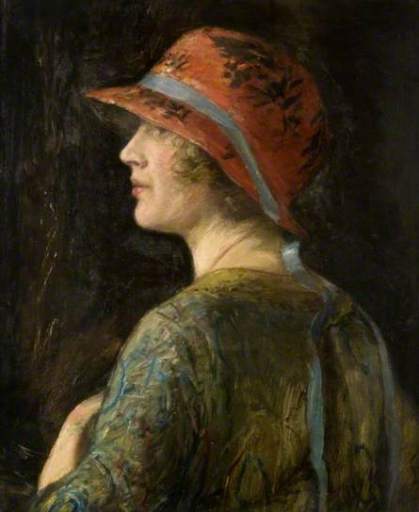
Figure 1. Oil, Alexander Roche R.S.A., “Girl in Red Hat”. Donated by Matthew Dickie, 74 Ormonde Avenue, Glasgow, S.4., on 18 February 1942. © CSG GIC Glasgow Museums Collection.
M. Dickie
Figure 2. Matthew Dickie from a portrait by David Gauld. Courtesy of Matthew K. Dickie.

Matthew Dickie was born on the 6th April 1873 at 15, Naburn Street, Hutchesontown, Glasgow. (1) His father was John Kennedy Dickie, a mason builder born in Kilmarnock in 1844, who founded the building firm of “John Dickie and Son” in 1880. (2) His mother was Janet Ramsay. Matthew was the elder son in a family of four girls and two boys. At the time of the 1881 Census the family was still living at 15, Naburn Street with Matthew, aged 8, described as a “scholar”. (3) It is not recorded where he attended school, however, it seems that about this time he began accompanying his father to work thus learning the essentials of the building trade from an early age. He later completed his apprenticeship as a stone mason and by the time he was twenty one he was managing the firm with his father. In the 1890s, the firm was based in Greenside Street, Glasgow. (4)

John Kennedy Dickie died on the 7th May 1897 and the “assets and liabilities” of the firm were passed on to Matthew and his mother Janet. (5) The business, now under the name of John K. Dickie and Son, was based at 20, South Coburg Street, Glasgow (6) and continued to flourish under Matthew`s leadership. He was living with his mother at “Largs Villa”, Myrtle Park, Crosshill. However, on the 4th of August 1900, Matthew Dickie married Mary Hutchison the daughter of a master joiner in Lesmahagow. (7) and they moved to a house at 1132 Cathcart Road. (8) The following year their daughter Nettie Duff Ramsay Dickie was born and a son, John Kennedy Dickie, arrived in 1903. (9) By 1905, the family had moved to “The Priory”, King`s Park Avenue, Cathcart. (10) A second son, Matthew, was born in 1908. (11)

In 1909 the firm moved its premises to King`s Park Road, Mt. Florida and in the following year the family moved house, this time to Chartley Lodge in Cathcart. (12) According to the 1911 Census (13) this was a large house with at least fourteen rooms, it may have been about this time that Matthew started to amass his collection of art (or perhaps the house was purchased to display his already extensive collection). He had been to Holland in 1909 visiting the major cities and may have acquired pictures there. He bought paintings sometimes through dealers and at other times from junk and second hand shops. According to his grandson, he had an excellent eye for works of art and a favourite ploy if he spotted something interesting among a group of paintings was to pretend that he was only interested in the frames and the glass and to offer a price for the whole lot which was invariably accepted.

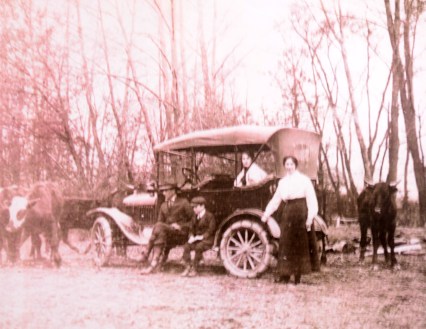
Figure 3. Dickie family in America. Courtesy of Matthew K. Dickie

It seems that from his visits to Europe he got a sense of how things were progressing there and, realising that war was probably inevitable, he took the decision to emigrate to the U.S.A. This necessitated the sale of Chartley Lodge and ultimately of his art collection. At this time he also sold Eastwood House and estate to John (later Lord) Weir. In 1913 he sailed to the USA aboard the “Mauretania” and visited Chicago, Los Angeles and California where he tried his hand at gold prospecting and successfully unearthed some nuggets which he brought back to Scotland. This may have been a trip to ascertain the “lie-of-the-land” because in the following year on 17th July, Matthew, now aged 41, and his wife Mary arrived in New York having sailed from Liverpool aboard the “Aquitania”. (14) They travelled all over America and Canada visiting Sacramento, California, Vancouver and Montreal and sailed on the St. Lawrence River. They returned to Scotland but Matthew arrived back in New York, via Liverpool, on 24th April 1916 aboard the “St. Louis” having left Mary at home at 11, Royal Crescent, Queen`s Park. (15)

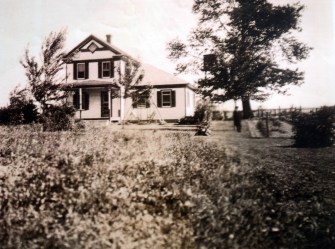
During this visit, he seems to have decided to try his hand at farming and employed a land agent to find a suitable property. Meantime he returned to Scotland to collect the family and on 18th September 1916 they all arrived in New York aboard the “Tuscania” which had sailed from Glasgow. (16) With Matthew were Mary, daughter Nettie aged 15 and sons John aged 12 and Matthew aged 8. They settled on a farm in Virginia, called “Deanwood” which Matthew had bought and the family lived there till about 1919. With the help of William Sheriff and a foreman who had travelled out from Scotland with them he was determined to make the farm productive and applied all his energies to that aim. (William Sheriff was a young engineer employed by the firm who remained with John Dickie and Son into the 1950s).

Meanwhile, back in Glasgow, on 5th October 1916, the bulk of his art collection was sold at auction by J. and R. Edmiston. Matthew`s address was listed in the catalogue as “late of Chartley Lodge, Cathcart”. (17) The star item in the sale was “Homewards at Dawn, Loch Fyne” which was painted in 1883 by William MacTaggart. It was bought for 1100 guineas by Alexander Reid. The picture was probably acquired by Matthew from the Ramsay Collection in 1909. Other items in the sale included pictures by Sir Henry Raeburn R.A., Sir Joshua Reynolds, P.R.A., George Henry, A.R.A., R.S.A., Sir James Guthrie, Fantin Latour, B.J. Blommers as well as paintings by J. Lawton Wingate, Muirhead Bone and S.J. Peploe. The Glasgow Herald in announcing the sale reported that “The pictures to be sold include not merely one or two of importance, but several of absolutely outstanding character”. (18) The sale realised a sum of about £39,000.

Figure 4. Deanwood. Courtesy of Matthew K. Dickie

In 1919 Matthew was approached by a prospective buyer who offered twice the sum he had paid for Deanwood; an offer that Matthew couldn’t refuse! With the profit, he bought “Cornwell”, a mansion in Virginia dating from 1731, with 200 acres of land around it. He renamed this “Parklands”. However, the family did not live there for long. Within eighteen months, and with Mary becoming increasingly homesick, he reluctantly sold “Cornwell” (Parklands) and the family moved back to Scotland. “Cornwell” was one of the “Historic Houses of Virginia” which featured in a book published in 2003. (19) Two years later, Matthew again set sail from Glasgow bound for New York, this time accompanied by his son John. Part of the reason for this trip would have been to visit his son Matthew who was still at school in Virginia. They arrived in New York aboard the “Cameronia” on 30th June 1921 with their final destination Vienna, Washington, D.C. Their home in Glasgow was now at 71, Broomhill Road, Newlands. (20) They returned to Glasgow but on 18th of June the following year, Matthew arrived alone in New York having sailed from Glasgow aboard the “Columbia”. Mary was at home in “Underwood”, Giffnock, Glasgow. (21)

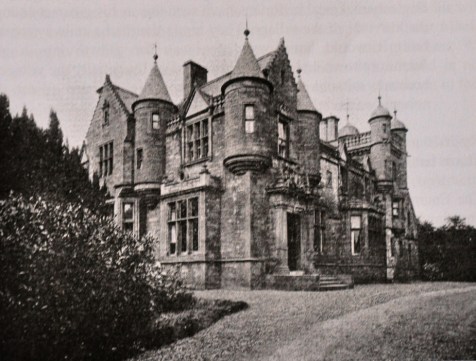
In 1930 Matthew purchased Eaglesham House together with ‘its gardens, cottages, lodge houses and farmland of 250 acres’ from the trustees of Captain Angus Cecil Gilmour. Planning consent was obtained to develop the estate with a country club, golf course and surrounding housing built in a village form including a school, shops etc. (22)

Eaglesham
          Figure 5. Eaglesham House in 1927. Courtesy of Mathew K. Dickie

Eaglesham House was requisitioned in 1940 by the War Department (Scottish Command) and occupied until 1946. Then planning consent was changed to make part of the Eaglesham estate ‘green belt’. This, together with the cost of death duties, persuaded Dickie’s Trustees to sell the house and estate to the Polnoon Estate Company. One of those involved in this purchase was the Hon. J.K. Weir, son of the Lord Weir who had purchased Eastwood House. (23)

1931 saw the death of George Leslie Hunter the artist who had been a good friend of Matthew`s. Matthew had helped Hunter financially and, at the time when Hunter`s work had fallen out of favour with collectors, Tom Honeyman wrote that “Among the older friends and patrons who still believed at this time that Hunter was by no means a spent force I can only recollect McInnes, McNair, Harrison and Dickie”; and later “The Bon-Bon was the pretentious title of a very ordinary tea room in the Central Station (which was) the meeting place for the morning coffee of McInnes, McNair, Hunter and myself. Occasionally we would be joined by Willie Gordon, who was on the staff of the Evening News; Ion Harrison, Matthew Dickie, Sam Warnock, R.C. Roy were among others who would more infrequently, join in discussions …..”. (24)

Mrs Matthew Dickie
Figure 6. Mary Dickie by George Leslie Hunter. Courtesy of Matthew K. Dickie.

Matthew owned several of Hunter’s work including one of his wife Mary. In 1941 he lent a “Still Life” by Hunter to be shown at the RGI Exhibition of that year. (25) He also owned “Fan and Fruits” which, when it came up for sale much later, was described as “one of the most dramatic Leslie Hunters ever to be on offer in recent years”. (26) Another of his paintings, “Boats in the Harbour, Cassis” by Hunter was sold at Christies in 1998 for £3,105

On the 29th October 1933, Matthew, now aged 60, Mary and their son Matthew arrived in New York aboard the “Caledonia” having left Glasgow on the 19th of October. (27) Perhaps the intention was to try to settle in the U.S.A. because they repurchased “Cornwell”. However, it was not to be and they sold up within two years and returned to Glasgow. In 1935, he purchased around 30 acres of land on the Castlemilk Estate on the outskirts of Glasgow. He proposed to erect 230 houses and 10 shops on the ground. The plans were finalised in February 1937 and preparations were made to start the work. However, Glasgow Corporation had plans to develop the estate for community housing and set a Compulsory Purchase Order on Dickie’s holding. After an inquiry in 1937, the lands and mansion of Castlemilk were finally bought by Glasgow Corporation. (28)

Matthew Dickie died on 22nd January 1944 at the Southern General Hospital, Glasgow. He had gone to visit one of his foremen in the hospital and collapsed and died from a cerebral haemorrhage. (29) His home at the time was at 74, Ormonde Avenue. Matthew was buried in Cathcart Cemetery, Glasgow. (30) According to his grandson, he left an estate worth well over £150,000 but this was severely reduced by death duties. The published value of his estate was £8,112:8:10 (31)

Matthew Dickie was an avid art collector. He owned several Peploes, a Raeburn and J.D. Fergusson`s “Lady with the Hat” now in Kelvingrove. He was a friend of Dr. Tom Honeyman who is reputed to have said that “Matthew Dickie taught me everything I know about art……. and I mean everything”. It was probably due to Honeyman that he donated “Lady in Red Hat” to Glasgow. He seemed to excel at most things he did including fishing and was an excellent artist himself. He was very musical as were two of his sisters who became opera singers. A third sister taught music at the Atheneum in Glasgow.

(I am very grateful to Matthew K. Dickie, grandson of the donor, for informative discussion and for allowing me access to family records and photographs).

References

1. Scotland`s People.

2. (The firm later became “Dickie Homes”). http://www.s1homes.com/newhomes/developer/dickie_homes/4107.shtml

3. Ancestry.com (Census Data)

4. Glasgow Post Office Directories.

5. The Edinburgh Gazette, 8th October 1897.

6. Glasgow Post Office Directories.

7. Scotland`s People.

8. Glasgow Post Office Directories.

9. Scotland`s People.

10. Glasgow Post Office Directories.

11.  Ancestry.com (Census Data)New York, Passenger Lists, 1820 – 1957.

12. Glasgow Post Office Directories.

13. Ancestry.com (Census Data)

14. Ancestry.com; New York, Passenger Lists, 1820 – 1957.

15. Ibid.

16. Ibid.

17. Glasgow Herald, 30th September 1916

18. Glasgow Herald, 6th October 1916, page 9.

19. “The Land at Cornwell Farm” by Jean Tibbetts. Copy General, 102 – 9, Executive Drive, Sterling, VA 20166. (Copyright – “The Great Falls Historical Society”, PO Box 56, Great Falls, Virginia 22066).

20. Ancestry.com; New York, Passenger Lists, 1820 – 1957.

21. Ibid.

22. http://www.geograph.org.uk/article/Eaglesham-The-Story-of-a-Planned-Village

23. Ibid.

24. “Introducing Leslie Hunter, T.J. Honeyman, Faber and Faber Ltd., 1937.(Also published in “Hunter Revisited”, Bill Smith and Jill Marriner, Atelier Publishing, 2012)

25. The Royal Glasgow Institute of the Fine Arts, 1861-1989: A Dictionary of Exhibitors at the Annual Exhibitions, Roger Billcliffe, (Woodend Press, 1990).

26. Glasgow Herald.

27. Ancestry.com; New York, Passenger Lists, 1820 – 1957.

28. Glasgow Herald, 6th November 1937, p7; also Carmunnock Heritage Trail Booklet – Glasgow City Council.

29. Scotland`s People.

30. Glasgow Herald, 24th January, 1944, p1.

31. Confirmations and Inventories, 1944. National Records of Scotland, CAL/1944/A, pp 236