
Not all donor stories are grand ones. Some donations are large, some small but sometimes even the smallest of stories can give an insight into a life well lived within a community.
George Grant Blair was born in Karachi, India in 1859. His mother was Letitia Blair who was born in Bombay. His father was John Blair, an officer in the Indian Army. George was the oldest child of six and in 1871 the family was living in Dollar, where George and his siblings attended Dollar Academy. There is no record of the father in the census, so it is possible that he continued to serve as a soldier in India. (1)
George attended the school until 1875-76, by which time he would have been 16 or 17. The remaining family members had left the school by 1879-80 and did not appear in the Dollar census of 1881. According to Dollar’s archives, the family paid fees up to 1875-76. In 1876-77 the three youngest brothers are on the list of Free Scholars. To be a Free Scholar at Dollar, the family had to be resident in the town for at least three years and the family income had to be below a certain level. Apparently a lot of families from all over the UK came to Dollar because the fees were low and they would have a chance of a free education if the family fell on hard times. It is possible to speculate that around 1875/76 the family experienced some hardship which led the younger boys to become free scholars and which may have precipitated George and his younger brother Henry leaving the school. (2)
The Baillie, in the “Men You Know” Column (3), mentions that George, after leaving school, undertook some preliminary business training in Glasgow. The same column confirms George’s father’s occupation as an officer of the Indian Army. George, after his training in Glasgow, became a purser on McCallum Ferries, where he worked for forty years.
McCallum Ferries was the forerunner of Caledonian MacBrayne, which serves the Hebrides to the present day. Martin Orme and John McCallum ran two separate ferries to the Hebrides. They operated two steamships, the Dunara Castle and the Hebrides. From 1877 these ships operated a summer sailing from Glasgow to Village Bay on St Kilda. This service operated until 1939, although St Kilda was evacuated in 1930. The company also served most of the other Hebridean islands and supported the Hebridean communities living there. Eventually the two companies merged into one, which was taken over by MacBrayne’s in 1948. (4)
According to the Baillie, although George Grant Blair had no Hebridean connections, after forty years sailing around the islands he was “in person, in sympathy and sentiment a Hebridean among Hebrideans.” The article states that George Blair became a Gaelic speaker who embraced the culture of the Hebrides and knew the history and the people of the islands well……He sings their songs and he speaks their language. He tells their stories and he voices their needs. ” The writer also comments on his universal appeal to others. “ there is scarcely a shieling on the islands… in which he is not known and deservedly popular and there is certainly no country seat…in which he in person is unfamiliar to the residential tenant or laird. “ He was chosen for the “Men You Know“ column “because he is a first rate fellow; the singer of a capital song and a first rate teller of a rattling good tale; because he is a genial and kindly host and the staunchest of friends; because he is an efficient and enthusiastic officer, and because he is at heart in sympathy with the finest things of the people among who he has moved so long – their literature, their music and their arts.”
The National Library of Scotland Archive has a short film of the McCallum ferry “Hebrides” touring round the islands of Scotland, ending with a visit to St Kilda. George Blair is seen briefly at the beginning of this film, shot between 1923 and 1928, which gives some indication of ferry travel (and island living) in those days.(5)
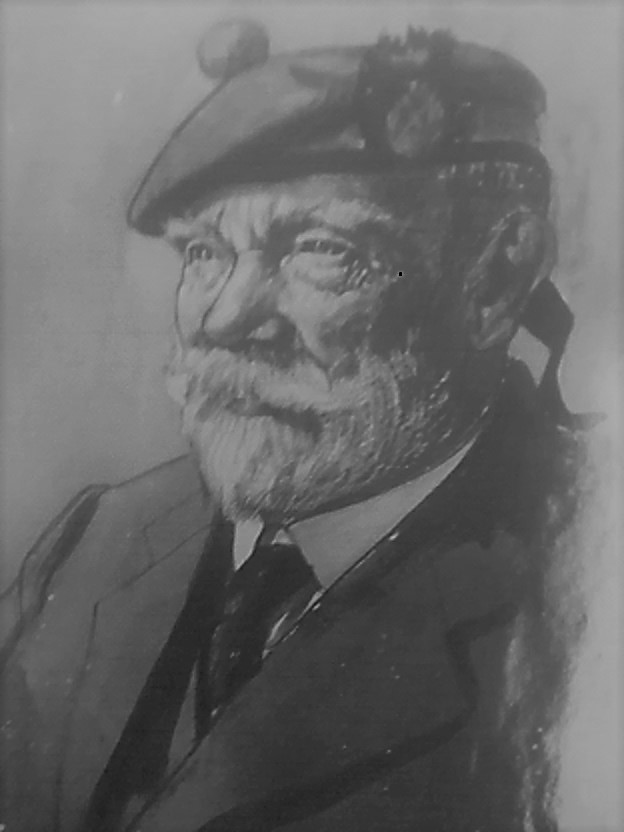
George Grant Blair died on the 27 November 1956 in Glasgow, aged 97. He left a picture of himself to Kelvingrove, a picture of a man who came from one side of the world to another and found a niche for himself in the most remote parts of Scotland.
1.Scotlands People: Census 1871, Census 1881
2.Dollar Academy Archive
3.The Baillie September 10th 1924
4. Meek, Donald E. From the Clyde to St Kilda. Ferry Publications. October 2020
5. movingimage.nls.uk.film/film/0418. Accessed 06/08/2023











 Glasgow Museums Art Donors Group