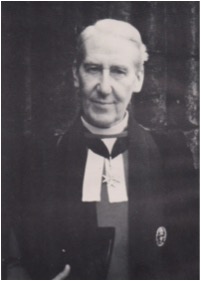
Mrs Margaret Dykes Lindsay and Colonel Barclay Shaw

In 1922, Mrs M D Lindsay (1) gave 5 paintings from the collection of Colonel Barclay Shaw to Glasgow Kelvingrove Art Gallery and Museum. This painting, which hangs in the Glasgow Boys gallery in Kelvingrove, is Japanese Girl with Fan by George Henry.
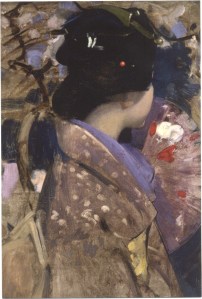
japanese lady with fan
Japanese Lady with Fan by George Henry © CSG CIC Glasgow Museums Collection

Margaret Dykes Cook was born (2) on 14th November, 1857, in Tradeston, Glasgow, the daughter of Christine  and James Cook, Master Brass Founder. On the 30th April, 1878, she married (3) Robert Barclay Shaw at her family home, Tinavale, Shields Road, Pollokshields, Glasgow.

Robert Barclay Shaw (4) was born in 1852.He was the son of William Shaw, and Janet Barclay. His father, a builder, was a prominent member of the Incorporation of Wrights in the Trades House and one_ time Deacon (5)(6). When Robert was young, the family lived in Pollok Street, moving to Valleyfield, Aytoun Rd about 1870. Robert Barclay Shaw was only 19 years old when, on the death of his father, he succeeded to the business, William Shaw and sons, Wallace St. Glasgow.  His firm moved into speculative building, building the impressive tenements in Glencairn Drive known as Olrig Terrace. After he married local girl Margaret Dykes Cook at her home, Tinavale, Shields Rd, he and his wife lived in number 6, Olrig Terrace. Later he built a detached house in Pollokshields, 40 Dalziel Drive, known as Dykeneuk, and was living there in 1888. The development of Pollokshields (7 ) as a garden suburb saw many fine houses built in varied architectural styles, indeed no two houses are identical. Shaw built three houses in Dalziel Drive, Dykeneuk, Oak Knowe and Hazliebrae.

His firm moved into specialist building construction and became very successful. His first main contract was for the buildings for the 1888 International Exhibition in Glasgow. (8 ) The architect was James Sellars, building in the Moorish style known locally as “Baghdad by Kelvinside”.  James Sellars unfortunately died in October,1888 reportedly of blood poisoning from standing on a rusty nail.

09 Mr Robert Barclay Shaw no 816
©CSG CIC Glasgow Museums and Libraries The Mitchell Library Special collections

Robert Barclay Shaw was the builder and he was much praised in The Bailie(9), being credited with the exhibition’s finishing on time and on budget. The site covered 10 acres. Shaw employed 1,000 men on the contract, used 5 million bricks, 750 tons of iron, 700,000 cubic feet of wood and 250,000 square feet of glass.
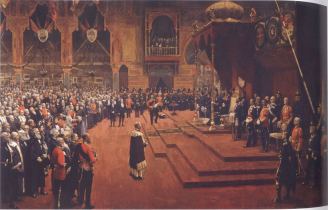
q victoria
Queen Victoria at the 1888 Exhibition by John Lavery © CSG CIC Glasgow Museums Collection

This was his first connection with Kelvingrove and it was the success of the Exhibition and the profit from it that enabled Kelvingrove Art Gallery and Museum to be commissioned.  Both Barclay Shaw and Sellars are in this painting by John Lavery of the great and the good in Glasgow when Queen Victoria visited the Exhibition in 1888.

Shaw and William Smith later supervised the building, to the design of James Miller, for the Main Hall for the Glasgow Exhibition in 1901 and for the exhibition Concert Hall.

In 1895, he built the Kildrastan buildings with shops and adjacent tenements in Terregles and Glencairn Drives. In the valuation rolls for 1905 (10 ), Mrs Dykes Shaw is the proprietor of properties in Kildrastan Street which included shops and residential buildings. As well as the properties in Pollokshields, he built the Langside Tram Depot and stands at Hampden Football Park for Queens Park Football Club.

He was a sociable man. He followed his father as a member of Trades House- in the Incorporation of The Wrights- and was elected as Collector in 1888. (11) Why Colonel Barclay Shaw?
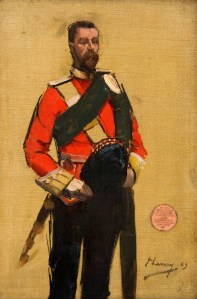
Colonel Shaw
Colonel Barclay Shaw by John Lavery © CSG CIC Glasgow Museums Collection

While he was still a lad he joined the 8th Lanarkshire Volunteers which became the 3rd Blythswood Volunteer Battalion of the Highland Light Infantry in 1887.(12) He was gazetted Colonel in 1904. (13)

In 1895, he purchased Annick Lodge(14 ) near Irvine, an imposing country house. The estate extended to 45 acres with 15 estate houses and a farm of 95 acres.
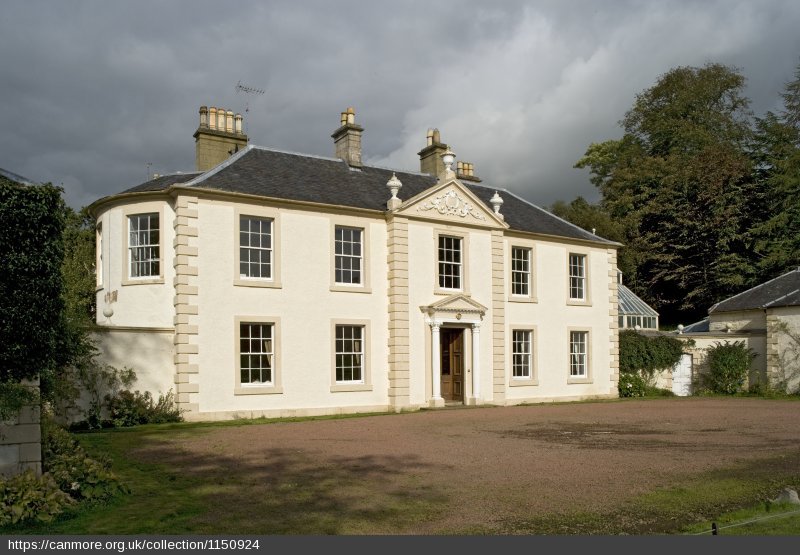
canmore_image_DP00064822
Annick Lodge Canmore Collection 1150924

He died in 1905. His death is reported by Rev. William Lindsay, minister of Dreghorn.(15 )

After his death, his widow continued living at Annick Lodge. Valuation Rolls show that she ran the estate with a manager. In 1908 (16), she married the Reverend James Lindsay, M.A, B.Sc., B.D., D.D the minister of St Andrews Church of Scotland , Kilmarnock(17 ) and brother of the minister at Dreghorn, who had registered the death of Barclay Shaw. She continued to manage the estate. Dr Lindsay died in 1923 (18 ) but she continued to live at Annick Lodge, then administered by a Trust, (19) until it was sold in 1934 and she moved to Dalry. She died in 1942.(20 )

The Donated Paintings

The other oil painting in the donation is entitled The Storm by John Lawson.

The three others are watercolours.

DSCF4921.TIF
A Mediterranean Port by Arthur Melville © CSG CIC Glasgow Museums Collection
DSCF2653.TIF
A Moorish Pack Horse by Joseph Crawhall © CSG CIC Glasgow Museums Collection

The Koto player Tokyo by George Henry

References

  1. Minutes of Glasgow City Council, 1922.
  2. National Records of Scotland Statutory Births 1857
  3. National Records of Scotland Statutory Marriages 1878
  4. National Records of Scotland Statutory Births 1852
  5. The Bailie. The Man You Know. June 6th 1888. Mitchell Library, Glasgow
  6. N.J.Morgan “Robert Barclay Shaw” in Slaven A.  A Dictionary of  Scottish Business Biography Aberdeen. Aberdeen University Press, 1986. Pp164-167
  7. Pollokshield Heritage. www.pollokshieldsheritage.org
  8. Kinchin P. and Kinchin K. Glasgow’s Great Exhibitions. White Cockade, 1988
  9. The Bailie. The Man You Know. June 6th 1888. Mitchell library, Glasgow
  10. National Records of Scotland Valuation Rolls
  11. The Scotsman. 22nd September 1888
  12. www.britisharmedforces/regiments
  13. The London Gazette. 1904
  14. www.historicscotland.gov.uk
  15. National Records of Scotland Statutory Deaths 1905
  16. National Records of Scotland Statutory Marriages 1908
  17. Fasti Ecclesiae Scoticaneae. Mitchell Library
  18. National Records of Scotland Statutory Deaths 1923
  19. National Records of Scotland Valuation Rolls
  20. National Records of Scotland Statutory Deaths 1942


Miss Catherine Spence Howden

GL_GM_2919.jpg
A Spring Roundelay by E.A. Hornel. © CSG GIC Glasgow Museums Collection. (www.artuk.org)

In May1914, Miss Catherine S. Howden and her brother gave A Spring Roundelay by E.A. Hornel to Kelvingrove Art Gallery and Museum.  The painting now hangs in the City Chambers in the Satinwood Room.

Catherine Spence Howden was born in 1875in Helensburgh, (1) though her birth certificate cannot be sourced. She was the daughter of James Howden and his first wife, Helen Burgess Adams (2). She had two younger brothers James and William born to his second wife, Allison Hay. In the 1891 census the family were living at 66 Berkeley Street in Glasgow.

In 1892, she matriculated at the Queen Margaret College in Glasgow (3) in the Faculty of Arts where she studied for three years. Then in 1895, she enrolled in the Medical School there. In Glasgow University Archives there are records of her enrolment in classes until 1900 and she progressed through the years to her final year. There is no record that she graduated. Since the archives do not keep records of class tickets there is no reason given for this. In July 1899(5), her stepmother died of a cerebral tumour, having been ill for ten months, leaving two sons who were teenagers. Her family commitments may have meant she had to change her plans. In 1901(6), she is living with her father and two teenage brothers at 2 Princes Terrace, Dowanhill, Glasgow. It is possible to keep track of her through the census and valuation rolls. Her brother James died on 16th January 1908 in Montreux, Switzerland (7). Her father died in 1913 (8), leaving her a substantial legacy (9) so that she could live on private means. In 1915, she was living as proprietor (10) at 15 Mirrilees Drive and was proprietor of Lodge Cottage in Cove.

An Article in the Glasgow Herald after her death states that “During her lifetime, Miss Howden was a generous patron of art and music in Glasgow”.

The City Council minutes(11) of 1914 acknowledge the gift of A Spring Roundelay by E A Hornel presented by Miss C S Howden, 2 Princes Terrace, Dowanhill, on behalf of her brother and herself.  In the City Council minutes of February 1919(12), Miss Howden’s donation of 17 etchings and prints by Whistler, Legres, Beuer, Gordon Craig, Zorn, Haddon, Maryon and Muirhead Bone to the recently established Print Room in Kelvingrove is acknowledged. It has not been possible to trace her membership of societies in Glasgow related to Art or Music.

She died on the3rd May 1925 (13) and her death certificate is signed by Dr Marion Gilchrist, the first female graduate in Medicine from Glasgow University, who was her contemporary. Soon after her death, articles appeared in the Glasgow Herald (14) because of a further bequest to the City of Glasgow. “In all Miss Howden’s bequest consists of 117 etchings and prints, a portfolio of 21 etchings by Charles Keene-one of a set of 150-and Muirhead Bone’s 50 lithographs of Glasgow, with notes on Glasgow by A.H. Charteris, published in 1911 in a limited edition of 900 copies by Messrs James Macclehose and Sons. The collection contains such valuables as an etching by Van Dyck, one by Van Oestede, one by Durer and four by the master etcher, Rembrandt.” These were seen as a valuable addition to the print room of the Art Galleries which was then in the early stages of development. Full details of the bequest are detailed in the Council minute of June 19th, 1925(15). In her will (16) she left £5,000 to endow a scholarship at Edinburgh University in the name of her nephew Dr Andrew Adams Rutherford and a painting by Stuart Park to an aunt and uncle.

James Howden (1832-1913)

James Howden (17)(18) was an engineer and business man who displayed great talent for innovation and an enterprising business flair. He was born in East Lothian and moved to Glasgow in 1847. His apprenticeship was with engine builders James Gray and Company. He set up his own business as a consulting engineer in 1854. In 1862, he established the firm of James Howden and Company to manufacture engines and boilers specialising especially in boilers for ships. The invention for which he is remembered is the Forced Draught Engine. This enabled ships to go twice as fast on half the amount of coal and greatly contributed to trade around the world.

He married twice. He was married to Helen Burgess Adams and they had a daughter, Catherine. His second marriage, in 1872, was to Alison Moffat Hay (19) and there were 2 sons. His son James, who studied engineering at Glasgow University, predeceased him in 1908 and William was a director of the company but died childless in 1943 (20). In 1882, a nephew, James Howden Hume, joined the company and a limited company was established in 1907. Howden Hume succeeded as company chairman on his uncle’s death. Howden (21) is still based in Renfrewshire providing air and gas handling products in over 20 countries world wide.

In his will (22), James Howden left £388,251, leaving his daughter well provided.

References

  1. National Records of Scotland Census 1891
  2. Ancestry .co.uk
  3. Queen Margaret College www.universitystory.gla.ac.uk
  4. Glasgow University Archives
  5. National Records of Scotland Statutory Register of Deaths 1899
  6. National Records of Scotland Census 1901
  7. The Scotsman. 17th January 1908
  8. National Records of Scotland Statutory Register of Deaths 1913
  9. National Records of Scotland Wills and Testaments 1913
  10. National Records of Scotland Valuation Rolls 1915
  11. Glasgow City Council Minutes 1914. Mitchell Library, Glasgow
  12. Glasgow City Council Minutes 1919. Mitchell Library, Glasgow
  13. National Records of Scotland Statutory Register of Deaths 1925
  14. The Glasgow Herald. June 20th 1925
  15. Glasgow City Council Minutes 1925. Mitchell Library, Glasgow
  16. National Records of Scotland Wills and Testaments 1925
  17. The Bailie 3rd April 1895. Mitchell Library, Glasgow
  18. Munro C.W. “James Howden” in Slaven A. A Dictionary of Scottish Business Biography Aberdeen. Aberdeen University Press, 1986. pp165-167
  19. Ancestry .co.uk
  20. Hume D.H. Douglas Hume : A Personal Story: the Howden Heritage. Belfast,2009
  21. www.Howden.com/en/Howdenhistory
  22. National Records of Scotland Wills and Testaments 1913


Agnes Gardner King(1857-1929)

_ISP7459.NEF
Figure 1 William Thomson (Lord Kelvin)© CSG GIC Glasgow Museums Collection.

In 1920, Agnes Gardner King offered a painting of her uncle, William Thomson, later Lord Kelvin, to Glasgow Art Galleries. The painting was by J Graham Gilbert, a Glasgow artist.

Agnes Gardner King was born in Ilkley, York shire in 1857 to Elizabeth Thomson and the Reverend David King, LLD (1). She had a sister Elizabeth Thomson King. Her mother, Elizabeth Thomson, was the sister of William Thomson, later Lord Kelvin, and James Thomson. William and Elizabeth were great friends and often went on walking tours together when they were in their twenties in Switzerland(2)(3). Elizabeth was an accomplished amateur artist and some of her paintings are in the National Portrait Gallery in London(4).

kelvin and siblings Agnes gardner King
Figure 2. William,James and Elizabeth Thomson by Agnes Thomson King National Portait Gallery, London, reproduced with permission

It is not known how Agnes was educated and what her training was but she became a gifted artist in watercolour. She painted pictures of children and also landscapes. She is featured in the Dictionary of British Artists. Her most interesting work ,which hangs in the National Portrait Gallery, is a charcoal drawing of her uncles Baron Kelvin (William Thomson), and James Thomson with her mother Elizabeth King.

Her Canadian Paintings are in the Canadian Government Archives. One is entitled ”View of Sleeping Beauty from Windows of C P R Hotel, Vancouver”(5).

She published a number of books alone or with her sister. These include: My Sister by Agnes Gardner King; Daily Texts for the the Little Ones by Elizabeth Thomson King illustrated by Agnes Gardner King; Islands Far Away. Fijian Pictures with Pen and and Brush by Agnes Gardner King; Kelvin the Man, a Biographical Sketch by his Niece, Agnes Gardner King.

In 1912, after an undisclosed illness and needing recuperation, she fulfilled a long-standing wish to travel to Fiji(6). She travelled with a companion, Mrs Hopkirk, sailing on the Empress of Britain from Liverpool through storms and, in fact, a snowstorm and in sight of icebergs, to land in Québec. They crossed Canada by train to Victoria and then embarked on the Makura to the Sandwich Islands and then on to Fiji. She travelled around the islands writing about spending a week in a Fijian village, travelling up the Navua River on a boat poled by native boatmen and enjoying the hospitality of a number of Chiefs in many villages and towns. This book, which ran to 2 editions, was published in 1921 and it is illustrated by 80 pen and ink and charcoal drawings. It gives a remarkable picture of islands which had, in living memory, a history of cannibalism. It also reflects her indomitable spirit and openness to different patterns of life.


  1. The Young Kelvin at Home by Elizabeth Thomson King
  2. Ancestry.co.uk
  3. The Life of Lord Kelvin by Silvanus Thompson
  4. http://www.npg.org.uk
  5. http://www.archivescanada.ca
  6. Islands far Away. Fijian Pictures with Pen and Brush by Agnes Gardner King. Bibliolife


The Very Reverend Nevile Davidson Ch.St.J., D.D., D.L. (1899-1976)

In 1945, Dr Nevile Davidson, Minister of Glasgow Cathedral, wrote to the Director of Glasgow Museums, Dr Tom Honeyman, offering a painting, Still Life by David Horn, a seventeenth century Dutch artist, to the Art Gallery(1).

donor 1
Figure 1 Still Life by David Horn,© CSG CIC Glasgow Museums Collection.

He had bought it in poor condition, had it cleaned, but now wished to donate it. Dr Honeyman  suggested  that the painting had some  merit and would be useful for educational purposes.  It now hangs in the  “Looking at Art” gallery in Kelvingrove Art Gallery. It is in the style of a Vanitas which possibly appealed to Dr. Davidson.

Andrew Nevile Davidson was born to James Davidson, Minister of the Free Church, Blackadder Church   of Scotland, in North Berwick and to his wife Rosina Constance nee Agnew(2)(3). He was educated at the High School, North Berwick and graduated from Edinburgh University(4). He was assistant minister at St George’s West Church, Edinburgh. In 1925, he was called to St Mary’s, Aberdeen and in 1932 he moved to St Enoch’s, Dundee. In 1935, he was appointed minister of Glasgow Cathedral from where he retired in 1967. In 1940, he volunteered as an army chaplain(5) and was sent to France with the King’s Own Scottish Borderers. The battalion was eventually evacuated from Cherbourg and his war service continued on the mainland. In 1942, he was persuaded to return to the Cathedral since there was greater need there.

He married(6) Margaret Helen de Carteret Martin, daughter of Colonel de Carteret Martin M.D., on 19th January, 1944. He had no children.

donor 2
Figure 2 Very Reverend Nevile Davidson, from ‘Beginnings but no Ending’

He served on various committees of the Church of Scotland, particularly as Convenor of The Committee on Church and Nation(7). He was made Chaplain to the King in 1946. This entailed visits to the Royal Family at Balmoral on many occasions. In 1962-1963, he was Moderator of the Church of Scotland. In his Moderatorial year, he travelled widely both in Scotland and abroad. In a three month tour, he visited the Scots of King’s Own Scottish Borderers in Aden. He and his wife flew from there to Kenya and then on to Australia and New Zealand. They returned to Scotland with time in Los Angeles and San Francisco. At every place he was able to preach and his account is full of memorable places and people.

He was a promoter of communication, involved in the ecumenical movement and in the founding of the Dunkeld Fellowship for Church of Scotland ministers. He established the Friends of Glasgow Cathedral.

He was the recipient of the St Mungo Prize in 1958. He was Scottish Prelate of the Most Venerable Order of St John of Jerusalem.

Dr. Davidson had a great affection for the cathedral and wrote its history(8). Dr. and Mrs. Davidson tried to introduce colour and art to the cathedral which they felt had been swept away at the Reformation and were major donors to the cathedral. They gave a studio copy of a painting by Camillo Procaccini (ca 1600) The Adoration of the Shepherds and two early paintings of the cathedral. With Lord Bilsland, Dr Davidson was responsible for the project to replace the nineteenth century stained glass which used the talents of contemporary artists and took many years to complete. Dr and Mrs. Davidson gave six new windows by Harry Stammers, and four sixteenth and seventeenth century windows from Switzerland, all now in the Blacader Aisle .

He moved to Dunbar after he retired in 1967. He died suddenly in 1976. There were many tributes to him after his death, including one by Ronald Falconer(9) who wrote a personal memoire of ” a devout Christian and a hospitable man”(10) . He is buried in the Necropolis and there is a memorial window in the cathedral by Gordon Webster(11). The Archive of his papers was given by his wife to the National Library of Scotland(12).

Sources

  1. Letter in file at Glasgow museums
  2. Statutory births, Deaths and Marriages: Scotland’s People
  3. Ancestry.co.uk
  4. Obituary. Glasgow Herald:1976 December 21st
  5. Beginnings but no Ending by   A. Nevile Davidson. Edina Press
  6. Ancestry.co.uk
  7. Davidson, op. cit.
  8. Glasgow Cathedral: A Short History and Guide by A. Nevile Davidson
  9. Ibid
  10. Nevile Davidson: A personal memoir; Ronald Falconer
  11. A Walk through Glasgow Cathedral by   Very Rev William Morris: Society of Friends of Glasgow Cathedral
  12. National Library of Scotland Inventory