In 1945, Dr Nevile Davidson, Minister of Glasgow Cathedral, wrote to the Director of Glasgow Museums, Dr Tom Honeyman, offering a painting, Still Life by David Horn, a seventeenth century Dutch artist, to the Art Gallery(1).
He had bought it in poor condition, had it cleaned, but now wished to donate it. Dr Honeyman suggested that the painting had some merit and would be useful for educational purposes. It now hangs in the “Looking at Art” gallery in Kelvingrove Art Gallery. It is in the style of a Vanitas which possibly appealed to Dr. Davidson.
Andrew Nevile Davidson was born to James Davidson, Minister of the Free Church, Blackadder Church of Scotland, in North Berwick and to his wife Rosina Constance nee Agnew(2)(3). He was educated at the High School, North Berwick and graduated from Edinburgh University(4). He was assistant minister at St George’s West Church, Edinburgh. In 1925, he was called to St Mary’s, Aberdeen and in 1932 he moved to St Enoch’s, Dundee. In 1935, he was appointed minister of Glasgow Cathedral from where he retired in 1967. In 1940, he volunteered as an army chaplain(5) and was sent to France with the King’s Own Scottish Borderers. The battalion was eventually evacuated from Cherbourg and his war service continued on the mainland. In 1942, he was persuaded to return to the Cathedral since there was greater need there.
He married(6) Margaret Helen de Carteret Martin, daughter of Colonel de Carteret Martin M.D., on 19th January, 1944. He had no children.
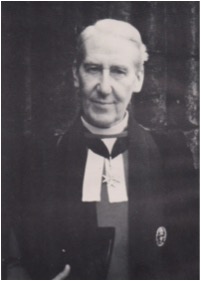
Figure 2 Very Reverend Nevile Davidson, from ‘Beginnings but no Ending’
He served on various committees of the Church of Scotland, particularly as Convenor of The Committee on Church and Nation(7). He was made Chaplain to the King in 1946. This entailed visits to the Royal Family at Balmoral on many occasions. In 1962-1963, he was Moderator of the Church of Scotland. In his Moderatorial year, he travelled widely both in Scotland and abroad. In a three month tour, he visited the Scots of King’s Own Scottish Borderers in Aden. He and his wife flew from there to Kenya and then on to Australia and New Zealand. They returned to Scotland with time in Los Angeles and San Francisco. At every place he was able to preach and his account is full of memorable places and people.
He was a promoter of communication, involved in the ecumenical movement and in the founding of the Dunkeld Fellowship for Church of Scotland ministers. He established the Friends of Glasgow Cathedral.
He was the recipient of the St Mungo Prize in 1958. He was Scottish Prelate of the Most Venerable Order of St John of Jerusalem.
Dr. Davidson had a great affection for the cathedral and wrote its history(8). Dr. and Mrs. Davidson tried to introduce colour and art to the cathedral which they felt had been swept away at the Reformation and were major donors to the cathedral. They gave a studio copy of a painting by Camillo Procaccini (ca 1600) The Adoration of the Shepherds and two early paintings of the cathedral. With Lord Bilsland, Dr Davidson was responsible for the project to replace the nineteenth century stained glass which used the talents of contemporary artists and took many years to complete. Dr and Mrs. Davidson gave six new windows by Harry Stammers, and four sixteenth and seventeenth century windows from Switzerland, all now in the Blacader Aisle .
He moved to Dunbar after he retired in 1967. He died suddenly in 1976. There were many tributes to him after his death, including one by Ronald Falconer(9) who wrote a personal memoire of ” a devout Christian and a hospitable man”(10) . He is buried in the Necropolis and there is a memorial window in the cathedral by Gordon Webster(11). The Archive of his papers was given by his wife to the National Library of Scotland(12).
Sources
Letter in file at Glasgow museums
Statutory births, Deaths and Marriages: Scotland’s People
Ancestry.co.uk
Obituary. Glasgow Herald:1976 December 21st
Beginnings but no Ending by A. Nevile Davidson. Edina Press
Ancestry.co.uk
Davidson, op. cit.
Glasgow Cathedral: A Short History and Guide by A. Nevile Davidson
Ibid
Nevile Davidson: A personal memoir; Ronald Falconer
A Walk through Glasgow Cathedral by Very Rev William Morris: Society of Friends of Glasgow Cathedral
Herbert Gunn: British portrait painter. (born Glasgow, 30 June 1893; died London, 30 Dec. 1964).
HIS EARLY YEARS
One of the most extraordinary and best known collectors of art of the last two centuries, without a doubt, is Arthur Kay. He is a contemporary of such collectors as James Donald, Sir William Burrell and W. A. Coats. Arthur Kay started collecting [1], just like William Burrell when he was a young boy. He, alongside the other wealthy industrialists and ship owners of his time, represents the energy, the entrepreneurship and foresight of the Victorian/Edwardian Eras. Arthur Kay was born in London in 1862 where his father John Robert Kay had a retail business. In 1870 they moved to Glasgow to join the board of a company called Arthur & Co., which was a retail company doing business home and overseas as wholesale distributers. They were the second largest rate payers in Glasgow after the railway companies. The company had businesses in the colonies and beyond, in fact, all over the world. At home, they had a shirt factory in Glasgow, a garment factory in Leeds and a linen factory in Londonderry. It is appropriate to mention here that the company was one of the first to make ready made clothes.
HIS GIFTS TO THE GALLERY
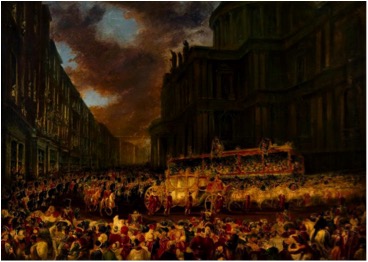
Our donor, Arthur Kay, made three gifts to the Kelvingrove Galleries. In June 1902, he presented to Kelvingrove Gallery a painting entitled “First State Visit of Queen Victoria to the City of London, Nov. 1837, Passing St. Pauls” by Sir George Hayter. This was the year the Gallery was opened to the public and also the first anniversary of Queen Victoria’s death. A copy of that painting is shown below.
Sir George Hayter, an historical and portrait painter was the son of a miniaturist, Charles Hayter (1761–1835). He studied at the Royal Academy Schools and in Rome and in 1837 he was appointed portrait and history painter to Queen Victoria, and in 1841 he was made ‘principal painter in ordinary to the queen’. He is known chiefly for his royal portraits and his huge groups.
The other gift given to the Gallery was “Still Life: Haddock, Plaice, Crabs and Lobster” by Abraham van Beyeren (1620-1690) and it is shown below.
van Beyeren was a Dutch painter of still lifes, initially active as a marine painter. Now considered one of the most important painter of still lifes, and in particular still lifes of fish.
The third painting was by William Kidd (1790-1863) and it is called “The Art Connoisseur” which is now not shown.
HIS LIFE, WORKS AND INTERESTS
The Kay Family settled in Glasgow and lived at 27, Belhaven Terrace. Arthur was educated at Park School until the age of twelve and then in Rosshall School, in Lancashire. After his school education, Arthur attended Glasgow University. In his book “Treasure Throve in Art” [2], it is mentioned that “He overworked at the University and did not complete his degree”. Instead he went abroad and studied art at Paris, Hanover, Leipzig and Berlin. While still in his teens he visited South Africa and Australia. His impressions of both colonies were afterwards embodied in two papers read before the Glasgow Philosophical Society [3]. When his education was completed, Mr Arthur Kay joined his father in Glasgow where both were directors in Arthur and Co.
His first wife, Edith came from a military family. Her father was Captain John Grahame, son of Major Grahame of Glenny, her brother was Captain C. Grahame and their cousin was General Sir Archibald Hunter, K.C.B., D.S.O. In 1889, Arthur and Edith had a daughter and named her Dorothy. After the death of his wife Edith in 1927, Arthur Kay married again. His second wife was the artist Katherine Cameron, sister of the artist D.Y. Cameron.
As a director of a large textile firm paying very high rates, he was interested in the financial affairs of the Glasgow Corporation and he was a vociferous critic of them. Among the many motions opposed by him was the one put forward by Sir Samuel Chisholm for social housing [4]. Arthur Kay was chairman of the Tenants Federation and this idea was vehemently opposed by him. As a result Sir Samuel Chisholm’s idea was thrown out. He was tireless in writing letters and pamphlets. He also read a vigorous paper before the Philosophical Society [5] in 1903 on “Municipal Trading with a special reference to the Sinking Funds of Glasgow Corporation,” and he published an exhaustive analysis of the intromissions of “The Corporation of Glasgow as owners of Shops, Tenements and Warehouses.”
However, his main interest was in the fine arts. During his life, he had formed a valuable collection of Dutch Old Masters and Japanese Lacquer Work [6]. Interest in Japanese Art started in Europe in the mid-19th century due to trade starting again between Japan and Europe which had stopped since the 16th century. As Japanese Art was totally different from European Art, it made quite an impact on the European artists as well as on private collectors of art as and Museums and Art Galleries. Arthur Kay was among the earliest collectors of Japanese Lacquer Art. There were exhibitions and lectures held in Glasgow. In 1878 the Glasgow city museums received the gift of a small but distinguished collection of Japanese art from the Japanese Government [7].
Our donor, Arthur Kay, kept his eye on the art world and was excited with the things to come.
In 1892, he decided to go to a London auction to see some paintings that included one of Degas’. The painting was called “Au Café” and much to his surprise when the painting was shown on the easel, it was hissed by the crowd. Upon seeing this reaction, he decided that he would watch (from afar) what the dealers would do. A Glasgow dealer, one Alexander Reid, bid for the picture and finally bought it. Later, after the auction, Arthur Kay bought it from him. The truth was, of course, that the Impressionists were beginning to become popular and Reid, who was a well-known art dealer in Glasgow, was extremely pleased to sell this particular painting to a Scottish collector.
Furthermore, Kay was delighted with his purchase and hung it “in a position where he could see it constantly”. However, because of the unfavourable reaction that it provoked among his peers, eventually Kay was persuaded to return the picture to Reid, although only temporarily. In his book [8] he writes: “It had not been away for 48 hours before I went back to the dealer [Reid] in order to recover it, and bought another work by Degas called “Repetition”.
Having rebought “Au Café” along with “the Repetition”, Kay now owned two works by Degas. He then lent both his works to the inaugural exhibition of the Grafton Galleries in London, where Au Café in particular, caused a tremendous stir. Au Café was exhibited under the title “L’Absinthe”, thus drawing attention to the shocking subject-matter l’absinthe–the green evil drink. It was described in the press as “vulgar and revolting” and it was probably this unfavourable reception which embarrassed Kay and prompted him to part with both works, despite his liking for L’Absinthe.
Finally, to stop this embarrassment caused by this furore, in April 1893, Kay sold the painting once again — this time to Parisian dealers Martin & Camentron. As a result, L’Absinthe left the shores of England, not to offend the sensitivities of the bourgeoisie any more. It was then sold by the dealers to Count Isaac de Camondo and was bequeathed to the Louvre later. The painting now hangs in the Musée d’Orsay.
One of the commanding masterpieces of Impressionist art had been in Scotland for a few months and in England for just 17 years before being sent back to France on a wave of disgust. In his book Arthur Kay devotes a few pages to the upheaval initiated by this painting which caused quite a few art critics of the day writing furious letters to the press. The editor of Westminster Gazette asked Arthur Kay to respond to these critics and after discussing the critics comments, Arthur Kay writes a long letter to the Westminster Gazette, 29 March 1893 pp 28-30 which is reproduced in his book “Treasure Throve in Art” [9]. Towards the end of his letter he makes the following remarks: “Degas will be understood, and in a few years those who blame will praise, and those who curse will bless”
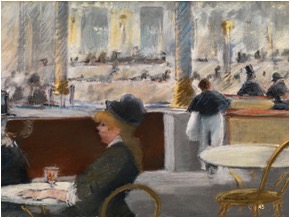
However, Kay continued to collect Impressionist paintings and it was not long before he acquired another work of a similar type to L’Absinthe. It was Manet’s small pastel “A Café, Place du Théâtre Français” of 1881 which he loaned later to the Glasgow International Exhibition of 1901 and later sold it to William Burrell. A copy of this painting is reproduced on the left.
Another painting which caused some embarrassment to Arthur Kay was the painting “Interior of a Church” by Pieter Saenredam, an architect and master painter of churches. At that time Pieter Saenredam’s work was not well known, but our donor was very impressed with it and bought it. The dealer mentioned that the director of the National Gallery in London had wanted it for the national collection, but could not get the money to buy it. He told the dealer that he would leave it to the National Gallery in his will. After some time, he decided to donate it and he sent it off to them. But much to his surprise, he received a letter from the National Gallery in London saying that, they regretted the decision but owing to the fact that it had been much restored and re-painted, they could not accept it.
Kay was very surprised and withdrew his offer and said it would be shown in 1902 Exhibition in Burlington House. After the exhibition he received a telegram from Amsterdam National Gallery asking if he would sell the painting to the Dutch Nation. Then, not long after that, he received a letter from the National Gallery in London trying to make amends for having sent the painting back by mistake. He wrote to the National Gallery that he would let them have it and would let bygones be bygones. The Glasgow Herald told this amusing story on the 4th March 1929. A copy of this painting by Saenredam is shown below.
Our donor, Arthur Kay, was also interested in the modern Scottish Art. In 1908 he bought the painting “Baby Crawford” painted in 1902 by Bessie MacNicol, probably at “McTears Salesroom” in Glasgow, after the death of Alexander Frew, the late MacNicol’s husband. Then, in the same year, he presented it to the Scottish Modern Arts Association (SMAA) [10].
Previously, Mr Kay was known chiefly by the interest which he took in fine arts and he, over six decades, built a large art collection. He was also a specialist on early Dutch painting and had frequently lent pictures from his fine collection to enrich local and other exhibitions. He had made an exhaustive study and formed a valuable collection of Japanese Lacquer Work. He was a member of the Burlington Fine Arts Club, a Fellow of the Society of Antiquaries, London. He was also Hon.Treasurer of the Royal Glasgow Institute of the Fine Arts and a Vice-President of the Council of the Tariff Reform League, London.
He had written much in the Glasgow and London press and spoken on local art occasions in advocacy of the best interests of art in municipal picture buying [11]. As well as all these activities, by 1909, Kay had been a director for 20 years of Arthur & Co. Ltd. At this date his collection was notable for early Dutch paintings and Japanese lacquer ware, but it came to encompass many eras and schools. When sold in 1943, it included 252 pictures attributed to a wide range of artists from Boudin to Zurburan, Reynolds to Couture, and 40 drawings by Daumier, Degas, Manet, Monet, Guardi, Brueghel, Tiepolo and others. Christie’s, in 8–9 Apr. 1943, sold a total of 291 lots of his collection.
Arthur Kay was a pioneer. In 1932, Arthur Kay, as Chairman of the Scottish Modern Arts Association (SMAA), petitioned for ‘a modern place of art in Edinburgh – a Tate Gallery’, a concept that manifested 28 years later in the form of The Scottish National Gallery of Modern Art (SNGMA). In 1964 the majority of works owned by the SMAA were donated to the City of Edinburgh. His concept , in 1932, of establishing a modern place of art in Edinburgh, which came to being 28 years later, shows that our donor Arthur Kay did not only have a highly incisive eye for fine art but he was also a man who had a keen foresight of things to come.
Mr Arthur Kay died on 1st January 1939 at 4.30 pm at 11 Regent Terrace, Edinburgh. He was 77 years old. The funeral of Mr Arthur Kay, HRSA was held in Edinburgh Crematorium on 4th January 1939. Representative company of artists, art lovers and other friends of the late Mr Arthur Kay, HRSA attended the funeral.
In Glasgow University, there is collection of manuscript relating to Arthur Kay. These manuscripts [12] contain information regarding to his endeavours as an artist himself and some of his paintings. These manuscripts also contain a great deal of correspondence between him and some art dealers (e.g. Alex Reid) and art critics of his time (e.g. D.S. MacColl).
References:
[1] Kay, Arthur (1939) Treasure Trove in Art. Edinburgh: Oliver and Boyd.




 Glasgow Museums Art Donors Group