Articles

Kenneth Sanderson W.S. (1868 – 1944)

On 29 December 1943, a bequest from Kenneth Sanderson, Esq., W.S., Edinburgh, of a portrait in oil of George Murdoch (2352) by David Martin was received.

donor 3
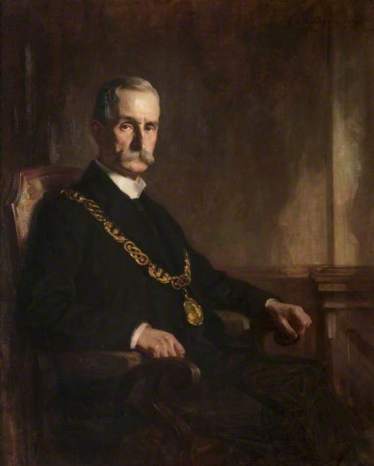
Portrait of George Murdoch (1715-1795) – Provost of Glasgow 1754-55 and 1766-67 – by David Martin. Painted 1790. ©CSG GIC Glasgow Museums Collection.

“There was submitted a letter from Wishart & Sanderson, solicitors, Edinburgh, intimating that the late Mr. Kenneth Sanderson, W.S., had bequeathed to the Corporation the portrait of George Murdoch, Lord Provost of Glasgow, 1766, by David Martin. The committee, after hearing a report by the Director, agreed that the bequest be accepted”.1 (Accepted 29th December 1943).

Kenneth Sanderson was born on the 1st of July 1868 at Knowe Park, Galashiels. 2 He was the fourth of eight sons born to Robert Sanderson a woollen manufacturer and his wife Elizabeth Cochrane whom he had married on the 22nd of September 1859. The eldest child of the family was a daughter, Jane, born in 1860. 3

Sanderson was educated at the Edinburgh Institute (now Stewart`s Melville College) which he attended from 1882 to 1885. The following lists some of his achievements during and after his time at school 4:-

“SANDERSON, Kenneth, 5, Northumberland Street. Particulars at School – 1st XV, 1884-85. After Leaving School – W.S., 23, Rutland Street, Edinburgh; Chairman, Edinburgh Public Library; Lawn Tennis: Scotland v Belgium, 1914; 1914-18, Assistant in Law Department of Board of      Trade; Fellow of the Society of Antiquities of Scotland; Director, Scottish Power Company”

After leaving school in 1885, he attended Edinburgh University. At the same time, he was serving his apprenticeship as a Writer to the Signet which he began on the 2nd of November 1885.5 From the census of 1891, he was at his parents` home with four of his brothers. His occupation was “apprentice law clerk”.6 Having studied Civil Law and Conveyancing, he completed his apprenticeship in the office of Messrs. Bruce and Kerr, W.S. on the 13th of July 1891 when he became a member of the W.S. Society. 7 The following year, along with Andrew Wishart W. S., he formed the firm of Wishart and Sanderson where he remained a senior partner throughout his life. The firm built up a considerable practice both in Edinburgh and the Borders.8 In 1897 he wrote a letter to the Scotsman from 65, Castle Street, Edinburgh supporting the idea that “Scottish bills …. could fittingly be dealt with by a tribunal sitting in Scotland”.9 In both the 1901 and 1911 censuses he was living at 5, Abercromby Place and employing two servants. His profession was “W.S. and N.P.” 10

donor 4
Photograph of Sanderson from, James Hamilton, Research Principal, The WS Society, The Signet Library, Edinburgh

Kenneth Sanderson was a talented lawn tennis player. In 1887 he competed in tournaments in Galashiels and Melrose and in 1888, he entered the Scottish Championships, reaching the semi-finals. He competed in the Queen`s Challenge Cup in 1890 and reached the final of the Scottish Border Championships in 1903. In 1904 another entry into the Scottish Championships ended when he lost in round one. He also competed in tournaments on the Continent, South of France (quarter-finals in 1905) and Cannes (semi-finals in 1905) and again in 1909. He again reached the semi-finals of the Scottish Championships in 1908 and played in the South of Scotland Tennis Championships at Moffat as current North of Scotland Champion. He reached the men`s singles final and played in the mixed doubles.11 In April 1914 he toured Belgium with the Scottish Lawn Tennis Team and represented Scotland against Belgium in the first international match in which a Scottish team was involved. (He won two and lost two matches). (The team attributed its relatively poor form to having to play the match so soon after arriving in Belgium!)12

donor 5
Sanderson (right) playing at Moffat from “Aspects Of Scottish Lawn Tennis”, Being A Series Of Articles By J. Patten Macdougall, C.B., A. Wallace Mcgregor, A. Morrice Mackay, Edinburgh, 1st Jan 1910.

He wrote a critique of Scottish Tennis comparing the standard of play now and 40 years previously. In it he mentions some of the prominent players and tournaments.13 This was republished, (unaltered because of its historical interest), in 1927. 14

In other arenas, he was an expert angler (“a passionate sport from boyhood on Ettrick and Tweed”) and a fine golfer becoming a member of the Royal Burgess Golfing Society. He was also elected a council member of the Royal Scottish Geographical Society in 1907.

When the Edinburgh Sir Walter Scott Club was established in 1893, Sanderson was a founder member and was elected to the post of Honorary Secretary. The First Annual Meeting and Dinner of the club was held on the 7th November 1894.

The Secretary (Mr. KENNETH SANDERSON, W.S.) read the Minute of the Meeting constituting the Club, which was held on 13th June last, and the same was approved of. He reported that the membership to date numbered 496”. 15

His address at this time was 15, York Place. The following year he attended the meeting of the Club in the Synod Hall, Edinburgh where the Rev. John Watson (a.k.a. Ian Maclaren) was the speaker. The speaker commented that even then Scott was “not read”. 16 The 7th Annual Dinner of the Club was held at the Royal Hotel, with Sanderson as Hon. Sec. 17 In this capacity, he wrote to Sir Donald MacAlister in 1909 inviting him to be President of the Club for the following year. Sir Donald was then Principal of Glasgow University and the letter is preserved in the archives of the University. 18 The invitation was accepted. On the 8th of April 1910 he wrote to Lord Crewe possibly with a similar invitation. 19

After 27 years as Hon. Sec. of the Club, he indicated his intention to resign that position on 31st October 1921 and his resignation was accepted at the AGM and Dinner on the 17th of December that year.20 Presumably this prompted a presentation to him of “the Bracket Clock by Joseph Kniff, given to me by the Edinburgh Sir Walter Scott Club” which is mentioned in his will and which was left to his nephew Robert Kenneth Sanderson. He retained a connection with the club and attended its Thirtieth Annual Dinner in 1930 at the North British Hotel, with the Rt. Hon. Stanley Baldwin presiding. He was no longer an office bearer.21

In 1932 he wrote authoritative articles in the Scotsman describing exhibits (for example “The Engraved Portraits” of Scott) on display at the Scott Centenary Exhibition in the National Galleries of Scotland.22

The Old Edinburgh Club was founded in 1908 with Sanderson a founding member.23

Kenneth Sanderson`s main interests outside of his law practice were Scottish Art, Prints and Engravings, and libraries. He was regarded: “as one of the finest art connoisseurs in Scotland; he had not only one of the largest private collections of pictures and prints, but an intimate knowledge of the work of each of the great painters and engravers, particularly of the 18th century. His favourite portrait painter was probably David Martin, the master of Sir Henry Raeburn, though he had an affection for Allan Ramsay and Andrew Geddes”. 24

His “intimate knowledge” is exemplified in a letter of 1917 on the subject of “Sir Henry Raeburn`s “Glengarry””25. He was instrumental in the foundation of the Scottish Print and Fine Arts Club which held exhibitions in Edinburgh, Glasgow and Aberdeen and he contributed regularly to “The Print Collector`s Quarterly”. For example, he wrote an article on “Engravings after Raeburn” for one of the 1925 editions.26

In 1928 he became Curator of the Signet Library a post which he held for the rest of his life.27 He was Chairman of the Edinburgh Library Committee from 1930. 28 In a letter of that year he requested donations of local materials to be housed in a new library being built in Leith.29 In 1934 he presided over a meeting of the General Committee of the Edinburgh Public Library and announced that he was giving two pencil drawings by Henry Gastineau and a letter of James Gordon dated 1680, to the Edinburgh Room.30 This was followed in 1935 by his gift of two watercolour drawings to Edinburgh Central Library; “The Edinburgh Tollbooth, 1829” and “View of Portobello, 1838”.31 He was also chairman of the Library Committee of Edinburgh University.32 He was passionate about “the extensions and welfare of the Public Library – which he regarded as his chief life`s work”.33

In 1936 he was appointed to the Board of Trustees of the National Galleries of Scotland (NGS). He subsequently served as the National Galleries of Scotland Accounting Officer.34 In 1938 in his capacity as Trustee he was a member of the Executive Committee set up in Edinburgh in connection with “the most comprehensive exhibition of Scottish Art which has ever been undertaken”. The exhibition was to be held at the Royal Academy, Burlington House, London in 1939. Other members of the committee were Sir James L. Caw, Sir D. Y. Cameron, Mr. Stanley Cursiter and Mr J. R. Blyth, Chairman of the Kirkcaldy Art Gallery Committee.35 John Lavery and Sir Muirhead Bone were involved in the London committee. In connection with this exhibition he gave a series of weekly lectures on Scottish painters featuring, for example, the work of Wilkie and Geddes.36 He also lent the portrait of George Murdoch (subsequently donated to Glasgow) to be exhibited at the Royal Academy.

Sanderson visited many of the galleries in Europe the last being those in Copenhagen and Stockholm in the year before the war.37 In 1941 he represented the Trustees of NGS at an exhibition of “Inter-Allied Art” which was opened by Tom Johnston Secretary of State.38 He was reappointed to the Board of Trustees in 1942 (along with Sir William Burrell and Sir D. Y. Cameron).

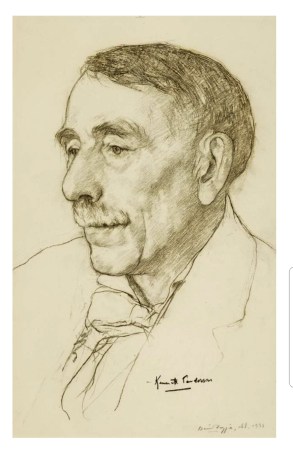
Kenneth Sanderson, 1868 – 1943. Connoisseur and collector; trustee of the National Galleries of Scotland, David Foggie, National Galleries of Scotland. © THE ARTIST’S ESTATE https://www.nationalgalleries.org/art-and-artists/3620/kenneth-sanderson-1868-1943-connoisseur-and-collector-trustee-national-galleries-scotland

 “Interested in the development of electrical supply in the South of Scotland, he became a director of the Scottish Power Company and the various electrical supply companies associated with it”. 39

Kenneth Sanderson never married. He died aged 75 on the 16th October 1943 at his home, 5, Northumberland Street, Edinburgh. “An Appreciation” appeared in the Scotsman;

“His bright, engaging and energetic personality endeared him not only to friends in the Parliament House and in other legal quarters, but in several artistic, literary and other societies. His zest, wide knowledge, sincerity and sound judgement were characteristics which won the admiration of all whom he came in contact with.” 40

The Edinburgh Evening News of 18th October 1943 contained a brief obituary and according to the Weekly Scotsman, his estate was valued at £26,503. 41 Among other bequests he left £1000 to the City of Edinburgh Council of Social Service, £500 to the Kirk Session of St. Cuthbert`s Parish Church – of which he had been an elder – (“for behoof of the Choir Endowment Fund”) and £200 to the Scottish Modern Arts Association. He also bequeathed a print showing the opening of the Scott Monument to Edinburgh Central Library.

The National Galleries of Scotland have a large collection of prints and drawings from the Kenneth Sanderson bequest of 1944. In addition, the Fine Arts Library in Edinburgh Central Library has a collection of artists` autographs and letters also from the bequest.

References

  1. Glasgow Corporation Minutes, 16th November 1943, Committee on Art Galleries and Museums. (Mitchell Library)
  2. Scotland`s People, Birth Certificate
  3. ancestry.co.uk
  4. Edinburgh Institution, 1832 – 1932, J.R.S. Young, George Waterston & Sons Ltd., 1933
  5. Information and photograph of Sanderson from, James Hamilton, Research Principal, The WS Society, The Signet Library, Edinburgh
  6. Scotland`s People, Census, 1891
  7. Scots Law Reporter, 1943, p191
  8. Information from Andrew Wishart, grandson of Kenneth Sanderson`s partner; He also provided the information that a walnut tallboy was bequeathed to the Royal Scottish Museum and is on display there;
  9. The Scotsman, 13th April 1897, p9
  10. Scotland`s People, Censuses, 1901 and 1911
  11. tennisarchives.com/player.php?playerid=9422 and The Scotsman, 7th August 1909 p13
  1. “Fifty Years of Lawn Tennis in Scotland”, 1914, Wallace MacGregor, editor and publisher
  2. “Aspects Of Scottish Lawn Tennis”, Being A Series Of Articles By J. Patten Macdougall, C.B., A. Wallace Mcgregor, A. Morrice Mackay, Edinburgh, 1st Jan 1910
  3. “Fifty Years of Lawn Tennis in Scotland”, Wallace MacGregor, publisher. 1927
  4. Minutes of the Edinburgh Sir Walter Scott Club,7th November 1894, reprinted 9th March 2009
  5. The Scotsman, 26th Nov 1895. p9
  6. The Scotsman, 10th January 1901, p9
  7. Glasgow University Archives, MS Gen 544/42
  8. Cambridge University Archives, Crewe C.14.1.24
  9. From the Minutes of the Edinburgh Sir Walter Scott Club, courtesy of Lee Simpson, Hon. Treasurer
  10. The Scotsman, 17th January 1930, p10
  11. The Scotsman, 1st and 2nd July 1932, p12
  12. Information from, James Hamilton, Research Principal, The WS Society, The Signet Library, Edinburgh
  13. The Scotsman, 19th October 1943, p4; 18th October 1943. Notice of his death and an obituary
  14. The Scotsman, 24th July 1917, p6
  15. The Print Collector`s Quarterly, Vol. 12, No. 2, April 1925
  16. Information from, James Hamilton, Research Principal, The WS Society, The Signet Library, Edinburgh
  17. The Scotsman, 22nd January 1930;
  18. The Scotsman, 24th January 1930 p7
  19. The Scotsman, 31st July 1934, p7
  20. The Scotsman 1st October 1935, p13
  21. The Scots Law Times, 6th November 1943, pp 47,48
  22. “A Friend`s Tribute”, The Scotsman, 21st October 1943
  23. I am grateful to Kerry Eldon, Librarian, Scottish National Gallery, for information and for allowing access to its collection of Sanderson papers.
  24. The Scotsman, 4th June 1938, p17
  25. The Scotsman 28th January 1939, p15
  26. “A Friend`s Tribute”, The Scotsman, 21st October 1943
  27. Glasgow Herald, 31st May 1941
  28. Edinburgh Evening Dispatch, 18th October, 1943
  29. The Scotsman, 19th Oct 1943
  30. The Weekly Scotsman, 3rd Jan 1944, p3

The Painting

The portrait was painted by David Martin (1737 – 1797) in 1793. It is signed “Martin, P.W.P* pinxit 1793”. It was a family commission and remained in the family till 1931.

It was exhibited in Glasgow in 1868 (with the attribution that it was by Raeburn) and in 1894 at an exhibition of “Old Glasgow Art”, lent by Andrew B. Yuille.

It was sold at Christie’s in London on July 10, 1931 from the property of C.T. Murdoch, Esq., M.P.** It was bought by Leggatt for £105 and sold on to Kenneth Sanderson.

In 1937 it was loaned by Kenneth Sanderson to The Scottish Fine Arts and Print Club Loan Exhibition and again in 1939 to the Exhibition of Scottish Art at the R.A., London.

*P.W.P. = Painter to the Prince of Wales

** Charles Townshend Murdoch (27 May 1837 — 8 July 1898) was a banker and Conservative politican who sat in the House of Commons between 1885 and 1898.

The Sitter

George Murdoch was admitted a burgess of Glasgow on 26th September 1737, “by right of his father”. He was Dean of Guild in 1751 and 1752. He was elected Provost of Glasgow from 1754-1755 and again from 1766-1767. He was a merchant primarily trading in wines from Madeira, but became involved in related enterprises such as becoming a partner in a glass bottle works in 1742, and forming Murdoch & Warroch to build and operate the famous Anderston Brewery. George Murdoch was thrice married. His first wife was Margaret Leitch, daughter of a Glasgow merchant whom he married about 1740 and had a family of five sons and three (four?) daughters. His subsequent marriages (to Janet Bogle and Amelia Campbell) produced no further children.

One of his sons, James, went to work in Madeira at the age of thirteen and another, George, ended up in Grenada. In 1767, while in his second term as Provost, Murdoch laid the foundation stone for the new Jamaica Street Bridge. A mason, in 1769 he became “Provincial Grand Master over the Counties of Lenrick (Lanark?), Renfrew, Air, Dumbarton and Argyle”.

George Murdoch died at Frisky Hall, Dunbartonshire on 19th September 1795 and was buried in Blackfriars Churchyard. He was survived by his third wife.

The information about the painting and the sitter comes from the object files at Glasgow Museums Resource Centre.

Sir Daniel Macauley Stevenson

Donor: Sir Daniel Macauley Stevenson

Painting: Princess Theresa  Benedikta Maria of Bavaria. (2452)

From the studio of Georg Desmarees

In the Glasgow Corporation minutes of 1944 (1) this painting  is listed as a portrait of Clementina Sobieska by Largilliere. It is now believed that the subject is Theresa Benedikta Maria, a princess of Bavaria, and it is now attributed to the studio of George Desmarees. (2)

Desmarees, George, 1697-1776; Princess Theresia Benedikta Maria of Bavaria (1725-1743)
Princess Theresa Benedikta Maria of Bavaria (1725-1743) Glasgow Museums Resource Centre © CSG GIC Glasgow Museums Collection.

Princess Theresa Benedikta Maria was the third child of Charles, Elector of Bavaria and Holy Roman Emperor. Theresa Benedikta Maria died at the age of 17 in 1743.

There is a Sobieski connection. The grandmother of the princess was a Sobieska, the daughter of King John III of Poland. The princess therefore had a familial connection with Clementina Sobieska. The portrait below of Clementina Sobieska gives an opportunity to compare the two women to see if there is any family resemblance. It may also help to explain why the initial confusion about the naming of the subject of the painting arose.

(c) Blairs Museum; Supplied by The Public Catalogue Foundation
Princess Maria Clementina Sobieska (1702 – 1735). Wife of Prince James Frances Edward Stuart. Martin van Meytens (1695-1770). Reproduced by permission of The Blairs Museum Trust.

The donor of the painting of Princess Theresa Benedikta Maria was Sir Daniel M. Stevenson, Bart. The painting was bequeathed to him by his brother John, an entrepreneur who lived and worked in Pennsylvania.

Daniel Stevenson was an astute businessman, an iron and coal exporter. As well as his business interests, Stevenson was a formidable local politician who helped make governance in Glasgow a model for other cities across the world.

Anderson, James Bell, 1886-1938; Sir Daniel Macaulay Stevenson (1851-1944), Lord Provost of Glasgow (1911-1914)
Sir Daniel Macaulay Stevenson (1851 -1944). Lord Provost of Glasgow 1911 – 1914 James Bell Anderson (1886–1938). Glasgow Museums Resource Centre (GMRC) © CSG GIC Glasgow Museums Collection.

Daniel Macaulay Stevenson came from a notable family. His grandfather was Dan Macaulay who edited “The Liberator” and “The Free Trade Advocate” and was a noted social and political reformer. Born and raised in a tenement in Hutchesontown, his father was John Stevenson, an engineer, who was also committed to social improvement for the poor. One of his brothers was Robert Macaulay Stevenson, one of the Glasgow Boys. (3)

Daniel Stevenson was educated at the Glasgow Secular School. He left school at sixteen and served an apprenticeship with a city Shipbroking firm. In 1879 he set up his own business, exporting coal, and became the largest coal and iron exporter in Scotland. (4)

By all accounts, Daniel Stevenson was a successful businessman. But he was much more than that. He became a very significant local politician, serving as Lord Provost of Glasgow between 1911 and 1914. He represented the Woodside ward between 1892 and 1914. Sir Daniel was a Liberal with a strong belief in communal solutions to social problems. (5)

What were Stevenson’s political achievements? Museums and Art Galleries which open on Sunday  – the cartoon below shows Stevenson trying to force open the door of the People’s Palace on a Sunday, a testament not only to his vision for the Museums’ services, but also to his determination to ensure that his policies would be implemented even in the face of opposition.

baillie cartoon
The Baillie Cartoon Supplement: 22 December 1897, The Mitchell Library.

Other innovations overseen by Stevenson included: Corporation libraries, municipalisation of transport, telephone systems, licensing laws, gas and electricity and improved procedures and financial structures within the Corporation. Stevenson was a dedicated advocate of “Municipal Socialism”. He was a founder in 1889 of the Glasgow Social Union and a promoter of the Glasgow Workmen’s Dwellings Company, which aimed to provide decent housing for the  working class, with affordable rents. Stevenson believed that a society which took care of everyone was a stronger, more stable society. (6)

Sir Daniel Stevenson was also involved in promoting the Scottish Labour Colony Union. This was an organisation which aimed to provide work for those who had lost their jobs until they could find new ones and which, for the Glasgow branch, provided farm work in Dumfriesshire. The movement’s aim was to help those who were willing to help themselves. Today, this type of support for the unemployed has fallen out of favour, categorised as punishing the unemployed, but the movement had wide support in Stevenson’s time, including from the Salvation Army and Beatrice and Sydney Webb, the founders of the Fabian Society. (7)

Daniel M Stevenson, with other notable Liberals, presided over a period of municipal development in Glasgow which was the envy of many, including American politicians, who were particularly interested in how Glasgow was governed and the success of its municipalisation. They liked the model of the businessman politician, closely rooted in his local community, someone who knew what it was like in the working world and understood business concerns, but they were also drawn to the community element of the governance. Everyone was being catered for, rich and poor alike. Community cohesion was seen as critical. Other cities had similar models, but Glasgow’s was seen by many to outstrip the rest. (8)

Eventually the tide turned against Liberal socialism. The First World War, to which Sir Daniel was vehemently opposed, stating that “he would have preferred the Clyde to resound to the building of Merchant ships rather than the construction of warships” (Glasgow Vol II p.6.),  brought with its ending a new wave of socialism across Europe. Sir Daniel retired from local politics in 1914, but maintained his commitment to his community throughout the next thirty years.

He was a founding father of the Scottish National Academy of Music  which became the  Royal Scottish Academy of Music and Drama, which is now the Royal Conservatoire of Scotland. Stevenson’s sister was a talented musician but was unable to complete her musical education in Scotland due to lack of facilities. She went to study in Hamburg and eventually married there, her husband becoming the Mayor of Hamburg. (9) Stevenson also stated in a letter that he wanted to establish a music school so that students from the  Highlands and Island of Scotland could have access to musical education. (10) The Stevenson Hall at the Conservatoire was named in recognition of his generosity and effort in the establishment of the school. He endowed chairs of Italian and Spanish at Glasgow University and also exchange scholarships for Spanish, French and German studies. He established a citizenship fund at the University. He eventually became Chancellor of the University from 1934 -1945. He established chairs at Liverpool and London University. (11)

Sir Daniel was a noted Europhile and spoke a number of European languages. Although he opposed the First World War, he helped to organise an Ambulance Brigade during the Spanish Civil War.  He also received many awards from European Countries – Italy, Spain, Belgium and Germany, including the Legion d’honneur from France. (12)

According to the Baillie he was an intellectual, forward thinking man, although it did acknowledge that he was not a great public speaker. He was also a man who was ready to argue for what he believed in. (13) He stood for Parliament once but failed to be elected. It could be argued that Westminster’s loss was Glasgow’s gain.

Although Sir Daniel was a widely travelled man who enjoyed visiting other countries and often admired what he saw there, on receiving the freedom of Glasgow in 1929, he stated that: “One could have no worthier ambition than to be a good and faithful servant of one’s own city.”

There can be no doubt about his contribution to his home city. It is estimated that Sir Daniel gave £400,000 to the city until his death in 1944. In his will he remembered the city also, leaving his estate to the public good. His house at 5 Cleveden Road was left to the Salvation Army for use as a children’s home. His Steinway Grand piano along with all his sheet music and music books were left to the Conservatoire. Other books were left to the Mitchell Library

“Stevenson’s wholly positive outlook and concern to promote community values reflected a strong strand of continuity in Glasgow’s Civic government which had proved remarkably successful in maintaining the city’s integrity between 1833 and 1912” (Portable Utopia)

Sir Daniel died in 1944.

Sir Daniel Macaulay Stevenson (1851–1944), Lord Provost of Glasgow (1911–1914)

  1. Glasgow Corporation Minutes April 1944 – November 1944. !5th August 1944 p.1274
  2. Object file 2452 G.M.R.C
  3. DOLLAN,  P.J. (1944),  Forward  22 July  : Royal Conservatoire of Scotland Archive
  4. theglasgowstory.com: The Glasgow Story 1914 to 1950: Personalities – Sir Daniel Macaulay Stevenson
  5. ASPINWALL,  B. (1984) Portable Utopia: Glasgow and the United States 1820 – 1920 Aberdeen: Aberdeen University Press
  6. glasgowhistory.co.uk/housing/bridgeton and dalmarnock
  7. FIELD, J. (2009) Able Bodies: Work Camps and the Training of the Unemployed in Britain before 1939. Stirling Institute of Education : University of Stirling
  8. MAVER, I; FRASER, W.H. (1996) Glasgow: Volume II 1830 – 1912, Manchester: Manchester University Press
  9. Glasgow Herald 17.7.1944: J. Arnold Fleming
  10. Letter from D.M.Stevenson 4.9.42: Royal Conservatoire of Scotland Archive
  11. The Glasgow Herald: 12th July 1944;13th July 1944; 14 July 1944; 15th July 1944
  12. Glasgow City Council: Freedom of the City Recipients
  13. The Baillie: 18th March 1891; 29th  December 1897; 17th  October 1906; 7th  July 1909; 15th  November 1911; 2nd  October 1912; 17th  June 1914; 20th  January 1921

Other Reading: Who’s Who in Glasgow 1909 pp.198/199


Hugh Locke Anderson, Junior (1863 – 1928)

Hugh Locke Anderson, junior, of Ava Lodge, Helensburgh bequeathed several works by Joseph Crawhall. They were given to Glasgow on 20th April 1943.

The works were:

2324 The Purple Cow – Charcoal, watercolour, wash, paper.

2325 Lady on Horseback – Pen, watercolour, paper

2326 The Country Gentleman – Ink, watercolour, wash, paper

2327 Horse and Cart with Lady – Gouache, linen.

2328 The Whip – Chalk, watercolour, gouache, paper.


Figure 1. Crawhill, Joseph. Horse and Cart with a Lady. © CSG GIC Glasgow Museums Collection.

This painting was exhibited at the Royal Academy Exhibition of 30th October 2010 to 23rd January 2011.(1) Another version of this painting is to be found in the National Galleries of Scotland.

He also donated “Hunting and Coursing” – six pen and ink sketches on paper catalogued as PR. 1943. 8.1 to 8.6. (Numbers 8.1 and 8.3 are drawn on menu cards of the Calfe Hotel, Tangier, Morocco.) All works are located at the Glasgow Museums Resource Centre in South Nitshill.

Hugh Locke Anderson was the son of a master house painter. His father, also Hugh Locke Anderson, was born about 1818 in Glasgow. He trained as a painter while living at 223 Gallowgate Street, Glasgow.(2) After completing his apprenticeship he formed his own company based at 119, Renfield Street and by 1851 was employing twelve men.(3) He married Helen Willox, on 9th of December 1847 in Pollokshaws,(4) and in 1851 they were living at 113, Cumberland Street, Lauriston, Glasgow.(5) Throughout the 1850s the business continued to thrive necessitating the addition of a workshop at 13, Renfield Lane and later at 16, East St. Vincent Lane.(6)

About 1860, Hugh Locke Anderson, moved with his family, which now consisted of two boys and three girls, to Williamwood House, Cathcart. (7),(8) Hugh Locke Anderson, junior was born there on 21st March 1863,(9) and was christened in Glasgow on the 3rd of May. Two years later the family moved again, this time to Hillside House, Partickhill. The firm was now styled, “H. L. Anderson and Co., Carlton, house painters and decorators”.(10) In 1871, the family moved to “Ava Cottage” at 92, Glasgow Street in Helensburgh. Hugh senior now employed 30 men and 8 boys with premises located at 141, St. Vincent Street, Glasgow.(11),(12)

In 1875 the family was living at 11, Glasgow Street, Helensburgh with the name “Ava Cottage”, moving with them!(13) With the success of his business, Hugh senior was able to have his sons John and Hugh educated privately at Larchfield Academy in Helensburgh.(14) Both boys had successful school careers with John going on to become a procurator fiscal and Hugh a marine insurance broker. Hugh continued to take a keen interest in the activities of his old school and in 1899 was a member of the committees of the Larchfield Academical Club and the Larchfield Literary Society.(15)

Both Hugh, senior and his wife Helen owned substantial stock in the City of Glasgow Bank.(16) The collapse of this bank in 1878 may have hastened Helen Anderson`s death which occurred in 1879 when she was 53.(17) After her death, the family moved again, this time to “Ava Lodge” at 14, Glasgow Street.(18) There is no mention of the family in the 1881 census.

Hugh Locke Anderson, senior, died aged 70 in Helensburgh on 11th of January 1888 and his son John became head of the family. In the 1891 census, Hugh, junior, was a marine insurance clerk, living at 14, Glasgow Street, Helensburgh and ten years later he had become a “marine insurance broker”.(19) He was employed by Bennett, Browne and Co. an old established Glasgow firm based at 17, Royal Exchange Square.(20) He became a joint partner and then sole partner, a position he held for many years until his retirement.(21) Other positions he held were the vice- chairmanship of the Royal Exchange and Justice of the Peace for the County of Dumbarton.

He also devoted a good deal of time to philanthropic work, and as a Director of the Glasgow Sailors` Home was a keen and enthusiastic supporter of that institution. For many years, until its winding up in 1923, he was a Director of the `Empress` Training Ship for Boys.(22) (This ship, formerly HMS Revenge, was moored in the Gareloch from 1889 to 1923 and was owned by the Clyde Industrial Training Ship Association. The Association had the object of providing for the education and training of boys who, through poverty, parental neglect, or any other cause, were destitute, homeless, or in danger from association with vice or crime).

Figure 2. Talisman at Rhu with The Empress Training Ship in the background. Courtesy of Helensburgh Heritage Trust.
Figure 3. Christmas Card sent from The Empress Training Ship. Courtesy of Helensburgh Heritage Trust

Hugh Locke Anderson had a great appreciation for art and possessed a valuable collection of paintings. He was an Extraordinary Member of the Royal Glasgow Institute of Fine Arts. In this capacity he is likely to have encountered a variety of contemporary artists especially those with a connection to Helensburgh. Edward Arthur Walton was born in 1860 and was thus a contemporary of Hugh Locke Anderson. He was one of the “Glasgow Boys” and among his friends were the artists James Whitelaw Hamilton, James Guthrie and Joseph Crawhall. Walton, Crawhall and Guthrie spent a great deal of time painting in Helensburgh and district and stayed with Hamilton at weekends at his home “The Grange”, 23 Suffolk Street. They spent one whole summer at Rosneath. Like Anderson, Whitelaw Hamilton (1860 – 1932) was a former pupil of Larchfield Academy. One of his paintings “Evening on the Gareloch” (In the Anderson Trust Collection, Helensburgh) contains a view of the Empress Training Ship.

It is thus likely that Hugh Locke Anderson knew Crawhall and it is possible that the paintings he subsequently donated were given to him by Crawhall or that he purchased them from him.

Figure 4. Walton, Crawhall, Guthrie and Whitelaw Hamilton in 1883. Courtesy of T & R Annan and Sons.

The photograph above appeared in the programme for Helensburgh and District Art Club’s loan exhibition ‘Helensburgh and The Glasgow School’, staged in the Victoria Halls, Helensburgh from September 9-23, 1972.

In his leisure pursuits, Hugh Locke Anderson was a member of the Helensburgh golf and tennis clubs and in 1926 was President of the Helensburgh Bowling Club.(23) For a great many years he was a member of the choir of the Helensburgh Congregational Church.(24) He also found time to travel. In 1914 he sailed from Liverpool to New York arriving there on the 5th of June. Again, on 3rd of December 1926 (probably after he retired) he left London for Australia. He stayed till the end of the month, leaving Sydney on the 30th of December bound for London. On the way home, the ship called at Melbourne, Adelaide, Colombo and Bombay.(25)

Hugh Locke Anderson, junior died on 22nd December 1928 at Ava Lodge in Helensburgh (26),(27) and was buried in Helensburgh Cemetery on the 26th.(28) His estate was valued at £72,813:3:7. In his will he stipulated that “all my pictures by Jos. Crawhall I bequeath to Glasgow Corporation in decease of my sister Jessie Jane & the large picture by Simon to my brother Stuart outright”. All his other pictures were left to Jessie Jane.(29) This explains the time interval between his death and Glasgow Corporation receiving the pictures. Jessie Jane Anderson died at Ava Lodge in November 1942. She was 85 years old.(30)

A list of Hugh Locke Anderson`s bequests to Glasgow is contained in “Joseph Crawhall, The Man & The Artist” by Adrian Bury, published by Charles Skilton Ltd., London 1958.

References

1. static.royalacademy.org.uk/files/gallery-3-etruscan-red-864.pdf (Lent by Culture and Sport Glasgow on behalf of Glasgow City Council)

2. ancestry.co.uk, 1841, Scottish Census

3. Scotland`s People, 1851, Scottish Census

4. Family Search, Scotland

5. Scotland`s People, 1851, Scottish Census

6. Glasgow Post Office Directories, 1851-1859

7. Glasgow Post Office Directory, 1860/61

8. Scotland`s People, Census 1861

9. Scotland`s People, Birth Certificate

10. Glasgow Post Office Directory, 1865/66

11. Scotland`s People, Census 1871

12. Glasgow Post Office Directory, 1871/72

13. Helensburgh Directory, 1875

14. Helensburgh and Gareloch Times, 26th December 1928, p3

15. ibid

16. Otago Daily Times, 28th November 1878, page 2 (paperspast.natlib.govt.nz/cgi-bin/paperspast?a=d&d…2.4‎)

17. Scotland`s People, Death Certificate

18. Helensburgh Directory, 1879

19. Scotland`s People, Census 1891

20. Glasgow Post Office Directory, 1891/2

21. Helensburgh and Gareloch Times, 26th December 1928, p3

22. ibid

23. Past Presidents` Board, Helensburgh Bowling Club

24. Helensburgh and Gareloch Times, 26th December 1928, p3

25. Ancestry.co.uk, UK Arrivals/Departures

26. Glasgow Herald, Death Notices, 26th December 1928.

27. Scotland`s People, Death Certificate

28. Helensburgh and Gareloch Times, 26th December 1928, pp 2 and 3

29. National Records of Scotland, SC65/36/28, page 183

30. Scotland`s People, Death Certificate

James Donald (1830-1905)

James Donald was one of the principal donors to the Kelvingrove Gallery. Over his lifetime, he collected paintings from The Hague School, French Barbizon School and also from British artists such as Turner and Constable. Towards the end of nineteenth century, he also used to loan a number of his paintings to exhibitions held in Glasgow and Edinburgh. The bequest to the Gallery from James Donald in 1905, which contained paintings of the nineteenth century Dutch, French and British oil paintings and watercolours, set the foundation for the Kelvingrove Galleries’ Impressionist Collection. During his lifetime, James Donald also made significant donations to his home town of Bothwell.

James Donald was born in 1830 in Bothwell, Lanarkshire. His parents were Mr John Donald, a grocer and spirit dealer in Bothwell and Mrs Jane (Lang) Donald. He had two older brothers, John born in 1826 and Gavin born in 1828 and a younger brother Robert who died in infancy. After the deaths of his father John Donald in 1834, when our donor was only four years old, and his brother John Jr. in 1841 [1], his mother Mrs Jane Donald found herself running the business as grocer and spirit dealer alone and looking after two young boys. This difficult period in the Donald Family’s life is somehow relieved when Mrs Donald, our donor’s mother married George Miller, a manufacturing chemist in 1843 (the Banns were proclaimed in Bothwell and Glasgow). In the 1851 census, it is recorded that the family has moved to 3 James Street, Calton, Lanarkshire near Bridgeton. However, in this census, our donor, James Donald is not listed with the family. The occupation of Mr Miller, James Donald’s stepfather is listed as the Head of the household and his occupation is described as manufacturing chemist employing 74 men in his firm.

From the Glasgow Post Office Directories 1905-1906 [2]  the name and the address of his stepfather’s Chemical Manufacturing firm to be:

Miller, George, & Co., gas coal-tar distillers, manufacturers of sulphate of ammonia, naphthas,  benzoles, pitch, carbolic acid, creosote, and dipping  oils; 40 West Nile Street.

The works; 89 Rumford St.

Miller, Geo., commission agent; 20 Smith St., Hillhead.

In the 1861 census, the Miller Family is still in Glasgow but James is still not with them. At the time of the 1861 census, the family had moved to 137 Greenhead St, Calton, Glasgow. In the 1871 census, James Donald re-appears. He is now 39 years old and the address is Wingfield Bothwell Lanarkshire. He is recorded as the stepson of the Householder George Miller (retired manufacturing chemist) and his occupation is recorded as Manufacturing Chemist.

During this period (1861), there appears to be a court case taken against George Miller and Company by the famous chemist James (Paraffin) Young and others with regard to some dispute over patent infringement [3]. However, the name of James Donald does not appear in the records quoted.

James Donald’s stepfather George Miller of Wingfield Bothwell died on the 5th January 1877.  His estate was valued [4] at £13,649 8s 5d with an additional estate of £410.

In the 1881 census, James appears on the census as living at 5 Queens Terrace, Barony, Lanark. He is the head of the house and his brother Gavin is staying with him. There is also a domestic servant in the house by the name of Margaret Nicholson. In the 1891 census, it is recorded that James is now 60 years old and married to Emily Mary. Mr and Mrs Donald are living with their daughter also called Emily. There are four others in the household. Their address is recorded as: 5 Queens Terrace, Barony, Lanark.

In the 1901 census, James Donald appears in the English Census as living in 96 Anerly Park, Anerly, London SE, Borough of Camberwell, Hamlet of Penge. He is living with his wife Emily Mary and two servants. His son-in-law Harry Busby lives with Emily at 94 Anerly Park, Anerly, London.

On the 16th March 1905, Mr James Donald died. The following notice was recorded in the Death Notices of the Glasgow Herald [5] of 21st  March 1905:

Donald, – At 96 Anerly Park Anerly, London on 16th March (inst.) James Donald also of 5 Queens Terrace, Glasgow – Friends please accepts this (the only) intimation.  

 The key words which was used in this search was ‘manufacturing chemist’, the profession of Mr James Donald.  It was evident that James Donald, the donor, worked in his stepfather’s firm, George Miller and Co. in Glasgow as a Manufacturing Chemist.  Because of the scientific nature of his profession, initially, it was assumed that he might have been a graduate of Glasgow University. However, a search in the register of graduates revealed that his name did not appear there. We know that all university students do not necessarily graduate for one reason or another. Therefore, it is possible that Mr Donald may have attended the university but not graduated. No further search was made as to his university education.

From his collection which was bequeathed in 1905, it was clear that he was a keen art collector. As there were a number of well known art dealers in Glasgow in the 1880s, such as Alexander Reid and Craig Angus, it was fairly easy for him to indulge in collecting the works of the new art of the era. Our donor was particularly interested in the artists of the Hague School of the Netherlands and French Realists such as Jozef Israëls and Jean Francoise Millet respectively.

Furthermore, it is known that he also made significant contributions to Bothwell, the town of his birth. Firstly, in 1880, he donated the Centre Window of the Bothwell Parish Church [6]. This is a three-light window whose theme is a series of six parables drawn by Sir John E Millais R A which originally appeared in a magazine called “Good Words” edited by Dr Norman Macleod [7] in the 1860s. Other portions of the windows were designed and the entire work was executed by Cottier & Co. of London in 1880. A picture of this window is depicted below.


Bothwell Parish Church Window
Figure 1. Centre Window of Bothwell Parish Church. Courtesy of the Rev.James Gibson.

An inscription on the brass plate beneath the picture states “This window was gifted by Mr James Donald in expression of his appreciation of the order in which the parish Church graveyard had been put by the Heritor’s of Bothwell during the Ministry of the Rev. John Pagan M A, March 1880.”

Secondly, another contribution of James Donald was to erect a monument to Joanna Baillie, who was a famous daughter of Bothwell. Her father, Rev. James Baillie (c.1722–1778), was a Presbyterian minister and briefly, during the two years before his death, a Professor of Divinity at the University of Glasgow. Her mother Dorothea Hunter (c.1721–1806) was a sister of the great physicians and anatomists, William and John Hunter.

Joanna Baillie was born in the manse behind the church on 11th September 1762. Her father having died in 1776, Joanna and the family moved to London where she was later to become a friend of Sir Walter Scott. Joanna spent the rest of her life in Hampstead where she is buried. Here, she was to gain fame as a poet and a playwright, often writing in her native lowland Scots dialect, her verse “Family Legend” being one of her best known works. A picture of the Joanna Bailley Memorial is shown below. More information about Bothwell Church and Joanna Baillie monument may be obtained from the links below.

Monument to Joanna Baillie
Figure 2. Joanna Bailley Memorial in Bothwell. Courtesy of the Rev. James Gibson


The third  important contribution made by James Donald to the town of Bothwell was to leave money in his will for a place of education and recreation for boys. This resulted in the building of the Donald Institute in 1910 by the architect Alexander Cullen who had secured the commission by competition. Later, the Donald Institute was converted to Bothwell Public Library which to this day contains a room dedicated to James Donald called the “Donald Institute”.  More information can be obtained from the following link:

http://www.bothwellhistoricalsociety.co.uk/about4.html

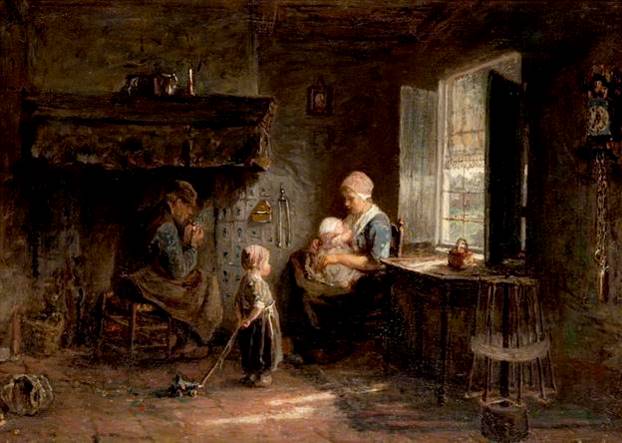
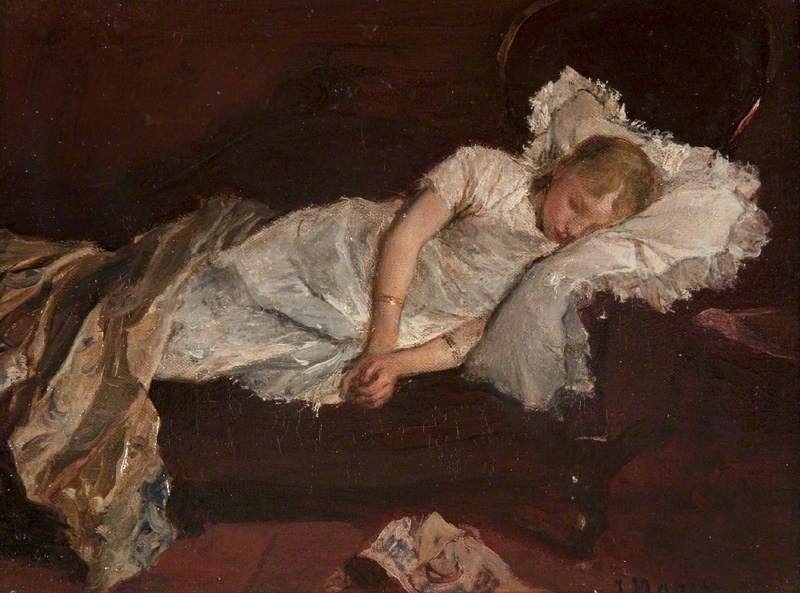
When he died on 16th March 1905, James Donald bequeathed to the Corporation in trust of the City of Glasgow a large number of paintings and bric-a-brac. A descriptive inventory and valuation of the pictures etc. had been prepared by an expert, who had valued the bequest at over £42,000 (in the year of 1905). The pictures include some of the finest examples of Turner, W.Q. Orchardson, Velasquez, Corot, Rousseau, Millet, Kalf and other eminent artists. The copies of the official minutes are kept by the Corporation of the City of Glasgow, in chronological order. Below are the 4 of his 40 paintings that James Donald gifted to the Gallery.

The Happy Family by Josef Israels
Figure 3. The Happy Family by Jozef Isarels. © CSG GIC Glasgow Museums Collection. (www.artuk.org)


Figure 4. Going to Work by Juan Francoise Millet. © CSG GIC Glasgow Museums Collection. (www.artuk.org)


Maris, Jacob Henricus, 1837-1899; A Girl Asleep on a Sofa
Figure 5. A Girl Asleep on a Sofa by Jacob Henricus Maris. © CSG GIC Glasgow Museums Collection. (www.artuk.org)


Turner, Joseph Mallord William, 1775-1851; Italian Scene with Boats and Figures
Figure 6. Italian Scene with Boats and Figures by J.M.W. Turner. © CSG GIC Glasgow Museums Collection. (www.artuk.org)

References: 

[1] Graves of his Father and two brothers http://www.memento-mori.co.uk/88.pdf

[2] Mitchell Library, Glasgow, PO Glasgow Directory, 1905-1906, p. 542.

[3] Corporate.  May 2010. Shale Oil. https://www.scottishshale.co.uk/KnowledgePages/Companies/Miller_John&Co.html. [Accessed on 19 March 2018].

[4] Confirmations and Inventories,. Mitchell Library. Glasgow. Year 1877, p 382.

[5] Death Notices. 21st March 1905. Glasgow Herald.

[6] Bothwell Parish Church http://bothwellparishchurch.org.uk/history/the-centre-window/. [Accessed on 19 March 2018].

[7] Dr Norman Macleod, Good Words. https://en.wikipedia.org/wiki/Good_Words, [Accessed on 19 March 2018].

[8] Joanna Baillie-monument. https://www.britishlistedbuildings.co.uk/200336476-bothwell-bothwell-parish-church-joanna-baillie-monument-bothwell#.Wq-n0Jenzv8, [Accessed on 19 March 2018].

Ernest Charteris Holford Wolff (1875-1946)

Figure. 1 Ernest Charteris Holford Wolff. Courtesy of Richard Steel.

In 1945 Ernest Charteris Holford Wolff of Fair Oak Lodge, near Eastleigh, Hants, donated an oil painting, ‘Portrait of William Johnstone of Glenorchard’ by Sir Daniel Macnee, to Glasgow Museums.

The Wolff family originally came from Hamburg, Germany, Ernest’s paternal grandfather Arnold Julius Wolff being born there in 1798. He was the son of Carl Heinrich Wolff and his wife Maria Carolina Anna and was born at Ritzebuttel a town on the Elbe belonging to Hamburg where his father had been a protestant clergyman for over thirty years. He came to England in 1828[1] and subsequently married Lucy Taylor on 23 June 1831 in Manchester Cathedral (Church of St. Mary, St. Denys and St. George). She was a minor (age 17)[2] and required her father’s consent to the marriage. Arnold was a merchant, both he and the Taylor family living in the township of Chorlton Row which was part of the parish of Manchester.[3]

Arnold was employed by the cotton trading firm of James Holford & Co., who were the largest British exporters into Russia having branches in Russia, Britain, Germany (Hamburg) and the United States.[4] It may well be that Arnold had been employed by the company in Hamburg and had transferred to their offices in Manchester, however whilst likely, there is only circumstantial evidence to support that.

He became a naturalized British citizen in 1840, having become a partner in the Holford business some time before that.[5] However the business had been experiencing liquidity issues which resulted in some of its branches being taken over by its employees or partners. In Manchester the business, operating as Holford, Sauer & Co., was dissolved in January 1840 and taken over by Wollf and another employee to become Wolff, Hasche & Co.[6] It became a member of the Manchester Royal Exchange and continued to trade at least until 1853[7] and probably beyond that date.

Arnold and Lucy continued to live in Chorlton in the Greenheys area after their marriage and by 1841 had four children, two girls and two boys,[8] a third boy being born later that year.[9]  Incidentally Thomas de Quincey lived in Greenheys as a youth, his father building the area in 1791.[10]

The eldest of the three boys was Arnold Holford Wolff. He was born on the 8th December, 1834 and baptised on the 18th May 1835.[11] By 1861 he along with his brother Ernest Julius were living in the family home at Greenhays and were in their father’s employ as clerks,[12] presumably in his export business. He was still living there with his mother and sister Lucy Catherine in 1871,[13] his father Arnold Julius having died in 1866. Probate was granted to his three sons, the estate being valued at “under £60,000”.[14]

Figure 2 William Johnston of Glenorchard © CSG GIC Glasgow Museums Collection

Arnold Holford Wolff, described as a ‘Russian merchant’, married Jane Johnstone Crawford on the 13th November 1872 in Edinburgh.[15] It was through his wife they ultimately came to possess the painting of William Johnston of Glenorchard, he being the brother of Jane’s mother Mary Johnstone.

The Johnstone family originated in the parish of Baldernock, then in Stirlingshire, where Thomas Johnstone and Mary Baird were married in 1803.[16] They had six children all born in Baldernock including the aforementioned William (b.1805)[17] and Mary (b.1812).[18]

William married Agnes Ewing in 1846 at Dunoon Parish Church.[19] He was a banker and had been an agent of the Commercial Bank of Scotland since 1845.[20] In 1848 he and his wife were living in the Barony Parish of Glasgow at 5 Newton Place,[21] staying there until 1858-59.[22] They became tenants of Glenorchard House around 1855 but did not permanently reside there until 1859.[23] He subsequently became the owner of the estate sometime between 1858 and 1861,[24] living there, still with the Commercial Bank, until he died.[25]

He died in 1864, not at Glenorchard, but at 200 Bath Street, Glasgow, the home of James Campbell jnr. of J & W Campbell & Co., Warehousemen.[26] The cause of death was recorded as apoplexy.[27]

He left estate valued at just over £27,100 and had set up a Trust Disposition and Settlement early in 1863 which essentially took care of his widow, his siblings where they survived, and their children, there being no children of his own marriage.[28] In particular his niece Jane (Johnstone) Crawford, the daughter of his sister Mary who had died in 1855[29], and who lived with William and his wife Agnes following her father John Crawford’s death in 1861[30], received initially £150 per quarter. On Agnes’s death he stipulated that Jane was to receive £3,000.[31]

Jane was born on the 5th February 1849[32], the last of four children. Her parents had married in 1842,[33] John being a grocer and spirit merchant in Shettleston.[34] She continued to live with her aunt Agnes following her uncle’s death, remaining with her at Glenorchard.[35] Sometime after 1871 Agnes and Jane moved to Edinburgh living at 32 Moray Place which is where Jane’s marriage to Arnold Holford Wolff took place.[36]

Her aunt died on the 15th March 1873 leaving Jane £5,000 and some personal items.[37] Although the Macnee painting is not specifically mentioned it is clear it came into Jane’s possession either when she married or as a bequest.

Jane and Arnold had two boys, Arnold Johnstone Wolff (b.1873)[38] and Ernest Charteris Holford Wolff who was born on the 3rd July 1875.[39] In late 1880 Jane was widowed when Arnold senior died at the age of 46 leaving her to bring up her two young sons.

By 1891, at the age of 17, Arnold jnr. was attending the Royal Military Academy,[40] subsequently joining the Royal Engineers as a Lieutenant. He served in the Boer Wars between 1899 – 1902 gaining the Queen’s South Africa medal with clasps for the Orange Free State, Cape Colony and the Transvaal. He was also awarded the King’s South Africa medal with clasps for 1901 and 1902.[41]

He saw further service during WW1 gaining promotion eventually to Lieutenant Colonel.[42] He was awarded the Distinguished Service Order in February 1916 at which time he was at his final rank on a temporary basis.[43] He retired from the army sometime after 1922 and by 1939 he and his wife Nora Gladys Platt, whom he married in 1905,[44] were living in Southampton[45]. He died there in 1941 leaving an estate valued at just under £27,500.[46]

In 1891 Ernest was living with his mother in Edinburgh, still at school,[47] subsequently going to Oxford where he graduated BA in 1897. He joined the colonial civil service that year with the Pahang Government,[48] travelling in November to take up his post on the SS Himalaya to Colombo, Ceylon, then on the SS Thames for Malaysia.[49]

Pahang was part of the Federated Malay States (FMS) which also included Selangor, Perak and Negri Sembilan. Between 1897 and 1908 he held a variety of positions within FMS becoming secretary to the British Resident of Negri Sembilan in 1901, taking on additional roles in 1904 (Sanitary Board chairman, Seremban) and 1905 (District Treasurer of Telek Anson). By 1908 he was the secretary to the Resident General of the colony. In 1923 he was appointed by the King as an Official Member of the Legislative Council of the Straits Settlements.[50]

He was also a very keen sportsman being on the committees of the Selangor Polo and Golf clubs in 1909,[51] and was captain of the golf club from 1907 to 1909.[52] He won the club championship in 1907/08 and subsequently the Coronation Cup.[53]

Figure 3 Mary Lilias Wolff. Courtesy of Richard Steel.

He married Mary Lilias Alison on the 6th December 1911 at Grange Parish Church of Scotland, Edinburgh. She was the daughter the Rev, John Alison of Edinburgh and Margaret McGeorge.[54] They had two daughters, Stella (b.?) and Alison Jean (b.1914).[55]

Ernest’s civil service career continued to progress and in 1924 he became the British Resident of Negri Sembilan, retaining that position until 1928 when he retired to Fair Oak Lodge, Hants,[56] where he lived for most of the rest of his life. In January of that year he was appointed Companion of the Order of St. Michael and St. George (C.M.G.).[57]

He and his wife travelled home on the SS Empress of Canada, embarking from Hong Kong on the 6th April 1928 and arriving in Victoria, British Columbia on the 6th May for a month long tour of Canada. Following the tour they travelled home to Southampton where his brother Arnold lived at Bitterne Park.[58]

It’s not clear when the Macnee painting came into his possession. Did his mother Jane leave it directly to him or did it first go to his brother Arnold who bequeathed it to him on his death in 1941? However, on the 9th July 1945 Ernest presented the painting to Glasgow,[59] just a few months before he died.

He died on the 23rd April 1946 at Cheniston Compton near Winchester leaving estate to the value of £12,420, probate being granted to his wife Mary and George Eaton Stannard Cubitt.[60]

The Wolff family motto was “Res non verba” [61] which translates as “deeds not words”, which, it seems to me, all members of the family lived up to.

Note: Johnstone is spelled with or without an e in various records.


[1] National Archives. March 1840. Naturalisation of WOLFF, Arnold Julius. HO/1/16/48 http://discovery.nationalarchives.gov.uk/details/r/C9171229

[2] Baptisms (NCR) England & Wales. Manchester, Lancashire. 8 April 1814. TAYLOR, Lucy. Class Number: RG 4; Piece Number: 2009. Collection: Non-Conformist and Non-Parochial Registers, 1567-1970. http://www.ancestry.co.uk

[3] Marriages (PR) England. Manchester, Lancashire. 23 June 1831. WOLFF, Arnold Julius and TAYLOR, Lucy. Collection: Manchester, England, Marriages and Banns, 1754-1930 (Cathedral). Archive Roll 699. http://www.ancestry.com

[4] Edmondson, Linda and Waldron, Peter, eds. (1992) Economy and Society in Russia and the Soviet Union, 1860 – 1930. p. 111. https://www.google.com/search?tbm=bks&q=Economy+and+Society+in+Russia+and+the+Soviet+Union

[5] National Archives. March 1840. Naturalisation of WOLFF, Arnold Julius. HO/1/16/48 http://discovery.nationalarchives.gov.uk/details/r/C9171229

[6] London Gazette (1840) Vol.1 24 March 1840. Holford, Sauer & Co. p. 773. https://books.google.co.uk/books?id=CxlKAQAAMAAJ

[7] Directories. England. (1853) Directory of Manchester and Salford, 1853. p.516. Collection: UK, City and County Directories, 1766 – 1946. http://www.ancestry.com

[8] Census. 1841. England. Chorlton, Lancashire. Class: H0107; Piece: 580; Book: 19; ED: 34: Folio: 9; Page: 9; Line: 9; GSU roll: 4388732. http://www.ancestry.com

[9] Baptisms (NCR) England. Manchester, Lancashire. 13 October 1841. WOLFF, Ernest Julius. FHL Film Number223716. Collection: England, Births and Christenings, 1538-1975. http://www.ancestry.com

[10] British History Online. Chorlton-Upon-Medlock. http://www.british-history.ac.uk/vch/lancs/vol4/pp251-254

[11] Baptisms (NCR) England. Manchester, Lancashire. 8 December 1834. WOLFF, Arnold Holford. Class Number: RG 4; Piece Number: 2009. Collection: Non-Conformist and Non-Parochial Registers, 1567-1970. http://www.ancestry.co.uk

[12] Census. 1861. England. Chorlton, Lancashire. Class: RG 9; Piece: 2885; ED: 42; Folio: 21; Page: 35; GSU roll: 543044. http://www.ancestry.com

[13] Census. 1871. England. Chorlton, Lancashire. Class: RG 10; Piece: 4007; ED: 71; Folio: 11; Page: 13; GSU roll: 846104. http://www.ancestry.com

[14] Testamentary records. England. 10 April 1866. WOLFF, Arnold Julius.  Principal Probate Registry. Calendar of the Grants of Probate. p. 438. Collection: England & Wales National Probate Calendar 1858-1966. http://www.ancestry.com

[15] Marriages (CR) Scotland. St George, Edinburgh. 13 November 1872. WOLFF, Arnold Holford and CRAWFORD, Jane Johnstone. 685/1 322. http://www.scotlandspeople.gov.uk

[16] Marriages. (OPR) Scotland. Baldernock, Stirlingshire. 3 June 1803. JOHNSTON, Thomas and BAIRD, Mary. 471/ 10 417.

http://www.scotlandspeople.gov.uk

[17] Baptisms. (OPR) Scotland. Baldernock, Stirlingshire. 5 January 1806 JOHNSTONE, William 471/ 10 292. http://www.scotlandspeople.gov.uk

[18] Baptisms (OPR) Scotland. Baldernock, Stirlingshire. 8 April 1812. JOHNSTONE, Mary. 471/ 10 311. http://www.scotlandspeople.gov.uk

[19] Marriages. (OPR) Scotland. Dunoon and Kilmun. 6 October 1846. JOHNSTON, William and EWING, Agnes. 510/ 30 386. http://www.scotlandspeople.gov.uk

[20] Directories. Scotland. (1845-46) Post Office Annual Glasgow Directory. Glasgow: Edward Khull. Appendix p.167. http://digital.nls.uk/83849228

[21] Directories. Scotland (1848-49) Post Office Annual Glasgow Directory. Glasgow: William Collins & Co. p. 151. http://digital.nls.uk/90167004

[22] Directories. Scotland (1858-59) Post Office Glasgow Directory. Glasgow: William McKenzie. p. 142. http://digital.nls.uk/90167004

[23] Directories. Scotland (1859-60) Post Office Glasgow Directory. Glasgow: William McKenzie. p. 148. http://digital.nls.uk/83897776

[24] Ordnance Survey Names Book. Stirlingshire OS Names Books Vol. 3 1858-1861. OS1/32/28. http://www.scotlandsplaces.gov.uk/records

[25] Directories. Scotland (1864-65) Post Office Glasgow Directory. Glasgow: William McKenzie. p. 169. http://digital.nls.uk/83927716

[26] Directories. Scotland (1864-65) Post Office Glasgow Directory. Glasgow: William McKenzie. p. 88 http://digital.nls.uk/83926744

[27] Deaths (CR) Scotland. Blythswood, Glasgow. 6 December 1864. JOHNSTON, William. 644/6 569. http://www.scotlandspeople.gov.uk

[28] Testamentary records. Scotland. 3 February 1865. JOHNSTON, William. Trust Disposition and settlement. Stirling Sheriff Court. SC67/36/49. http://www.scotlandspeople.gov.uk

[29] Deaths. (CR) Scotland. Shettleston, Lanark. 23 December 1855. CRAWFORD, Mary. 622/3 120 http://www.scotlandspeople.gov.uk

[30] Deaths. (CR) Scotland.  Shettleston, Lanark. 5 December 1861. CRAWFORD, John. 622/3 131. http://www.scotlandspeople.gov.uk

[31] Testamentary records. Scotland. 3 February 1865. JOHNSTON, William. Trust Disposition and settlement. Stirling Sheriff Court. SC67/36/49. http://www.scotlandspeople.gov.uk

[32] Births. (OPR) Scotland. Barony. 6 January 1849. CRAWFORD, Jane Johnston. 622/ 130 378. http://www.scotlandspeople.gov.uk

[33] Marriages. (OPR) Scotland. New Kilpatrick. 3 August 1842. CRAWFORD, John and JOHNSTON, Mary. 500/ 30 277. http://www.scotlandspeople.gov.uk

[34] Directories. Scotland (1855-56) Post Office Glasgow Directory. Glasgow: William McKenzie. p. 690. http://digital.nls.uk/84138937

[35] Census. 1871 Scotland. Baldernock, Stirlingshire. 471/ 1/ 10. http://www.scotlandspeople.gov.uk

[36] Marriages (CR) Scotland. St George, Edinburgh. 13 November 1872. WOLFF, Arnold Holford and CRAWFORD, Jane Johnstone. 685/1 322. http://www.scotlandspeople.gov.uk

[37] Testamentary records. Scotland. 1 September 1873. JOHNSTON, Agnes. Trust Disposition and settlement. Edinburgh Sheriff Court Wills. SC70/4/146. http://www.scotlandspeople.gov.uk

[38] Baptisms (CR) England. Manchester, Lancashire. 10 November 1873. WOLFF, Arnold Johnston. Collection: England, Non-Conformist Births and Baptisms, 1758-1912. http://www.ancestry.com

[39] Baptisms (CR) England. Manchester, Lancashire. 6 September 1875. WOLFF, Ernest Charteris Holford. Collection: England, Non-Conformist Births and Baptisms, 1758-1912.  http://www.ancestry.com

[40] Census. 1891. England. Woolwich, London. Class: RG12; Piece: 534; ED: 34: Folio: 44; Page: 9; Line: 9; GSU roll: 6095644. http://www.ancestry.com

[41] War Office (Great Britain). Record of Service.  WOLFF, Arnold Johnston. WO100/157 page 56, WO100/314 page 58 FindMyPast Transcription. Collection: Anglo-Boer War Records 1898-1902. http://www.findmypast.co.uk

[42] War Office (Great Britain). Record of Service. WOLFF, Arnold Johnston. Lieutenant Colonel, Royal Engineers 1922. Collection: British Army Lists, 1882-1962.  http://www.ancestry.com

[43] London Gazette (1916) Supplement. 2 February 1916. Military Award, Companion of D.S.O. WOLFF, Arnold Johnston, p.1336, 1337.

https://www.thegazette.co.uk/London/issue/29460/supplement/1337/data.pdf

[44] Marriages Index (CR) England & Wales. RD: Hampstead, London. Last Qtr. 1905. WOLFF, Arnold Johnston and PLATT, Nora Gladys. Vol.1a. p.1415. Collection: England & Wales, Civil Registration Marriage Index, 1837-1915. http://www.ancestry.com

[45] 1939 Register. England. Southampton, Hampshire. ‘Sandyhayes’, Thorold Road. WOLFF, Arnold Johnston. http://www.ancestry.com

[46] Testamentary records. England. 2 September 1941. WOLFF, Arnold Johnston.  Principal Probate Registry. Calendar of the Grants of Probate. p. 432. Collection: England & Wales National Probate Calendar 1858-1966.  http://www.ancestry.com

[47] Census. 1891 Scotland. Newington, Midlothian. 685/5 130/7.  http://www.scotlandspeople.gov.uk

[48] Wright, Arnold. (1908). Twentieth Century Impressions of British Malaya. London et al: Lloyd’s Greater Britain Publishing Company Ltd. p.128  http://seasiavisions.library.cornell.edu/catalog/seapage:233_134

[49] Passengers Lists (1897) The Homeward Mail. Vol. XLIII, issue 2051. 13 November. WOLFF, E.C.H. p.1543.                      http://search.findmypast.co.uk/bna/viewarticle?id=bl%2f0001712%2f18971113%2f091

[50] Edinburgh Gazette (1923). 7 August 1923. WOLFF, Ernest Charteris Holford. Appoint to Legislative Council of the Strats Settlements, p. 1105. https://www.thegazette.co.uk/Edinburgh/issue/13942/page/1105/data.pdf

[l51 Directory and Chronicle for Malay States et al (1909). p.1298. https://play.google.com/store/books/details?id=f5VEAQAAMAAJ&rdid=book-f5VEAQAAMAAJ&rdot=1

[52] Royal Selangor Golf Club (RSGC). Club Captains. https://www.rsgc.com.my/past-captains

[53] Wright, Arnold. (1908). Twentieth Century Impressions of British Malaya. London et al: Lloyd’s Greater Britain Publishing Company Ltd. p.128  http://seasiavisions.library.cornell.edu/catalog/seapage:233_134

[54] Marriages (CR) Scotland. Newington, Midlothian. 6 December 1911. WOLFF, Ernest, Charteris, Holford and ALISON, Mary Lilias. 685/5 247. http://www.scotlandspeople.gov.uk

[55] Births Index (CR) England & Wales. RD: Cheltenham, Gloucestershire. 17 July 1914. WOLFF, Alison Jeans. C44D, 4791C, Entry No. 147. Collection: England & Wales, Civil Registration Death Index, 1916-2007. http://www.ancestry.com

[56] Fox-Davies, Arthur Charles (1929) Armorial Families: A Directory of Gentlemen of Coat-Armour. 7th ed. Vol.2. London: Hurst & Blackett Ltd. p. 2125. https://archive.org/stream/armorialfamilies02foxd#page/n11/mode/2up/search/wolff

[57] London Gazette (1928) Supplement. 2 January 1928. Companion of C.M.G.  WOLFF, Ernest Charteris Holford, p. 5. https://www.thegazette.co.uk/London/issue/33343/supplement/5/data.pdf

[58] Passenger List for S.S. Empress of Canada departing Hong Kong WOLFF, Ernest Charteris Holford. 6 April 1928. Collection: Canadian Passenger Lists, 1865-1935 and Washington, Passenger and Crew Lists, 1882-1965 http://www.ancestry.com

[59] Glasgow Museums Resource Centre.

[60] Testamentary records. England. 23 April 1946. WOLFF, Ernest Charteris Holford.  Principal Probate Registry. Calendar of the Grants of Probate. p. 585. Collection: England & Wales National Probate Calendar 1858-1966.  http://www.ancestry.com

[61] Fox-Davies. op. cit.

Sir John Muir of Deanston 1828-1903

In 1888 John Muir donated to Glasgow ‘Two Strings to Her Bow’, painted by John Pettie in 1887 and which currently is on display at Kelvingrove Art Gallery and Museum. 1888 was the year of the Glasgow International Exhibition which emulated the great Exhibition of 1851 in London to promote industry, art and commerce (1) in the context of the British Empire. The £46,000 profits of the exhibition contributed to the funding of the present building which opened in 1901. Muir purchased the painting from the lucky winner of a raffle for the Exhibition Art Union, and presented it to highlight ‘…its most prominent deficiency in the department of ‘modern art’’ (2)

The painting ‘Two Strings to her Bow’ is typical of John Pettie’s style, depicting a beautiful young lady between two competing suitors. This painting has become a popular image in the advertising world for example being presented as the front cover of Georgette Heyer’s novel False Colours, a cigarette pack for soldiers during World War 11, and even on the label of a Polish lemon flavoured vodka.

Pettie, John, 1839-1893; Two Strings to Her Bow
Pettie, John; Two Strings to Her Bow. © CSG CIC Glasgow Museums Collection
Henderson, Joseph, 1832-1908; Sir John Muir (1828-1903), Lord Provost of Glasgow (1889-1892)
Sir John Muir, Lord Provost of Glasgow (1889-1892) © CSG CIC Glasgow Museums Collection

John was born on 26th December 1828 in Hutchesontown, Glasgow to James Muir (3), senior partner of Glasgow merchants Webster Steel & Company which had branches in Chile, South Africa and London (4). His mother was Elizabeth Brown (5), a descendent of James Finlay who founded the textile business of James Finlay and Company in Glasgow. He was educated at Glasgow High School and Glasgow University. In 1849 he joined James Finlay & Company, which had expanded to include mills at Catrine in Ayrshire in 1801, and Deanston in Stirlingshire in 1808 (the latter is now a whisky distillery). The original James Finlay founded the business in 1750 and in 1792 his son Kirkman Finlay took over as senior managing partner, the core activity being textile manufacture but later their trading activities became more important. The firm purchased competitors Wilson, Kay and Company and in 1854 opened premises in West Nile Street, Glasgow (6).

In 1860 John married Margaret Kay (7), eldest daughter of Alexander Kay, then a senior partner of Finlays, and raised four sons and six daughters, all of whom were born at their townhouse at 6 Park Gardens, Glasgow.
In 1861 John was appointed as a junior partner of James Finlay & Company, along with his cousin Hugh Brown Muir and Robert Barclay, a partner in Robert Barclay & Sons, Manchester. The business had become stagnant under the management of the Finlay family and John was brought in to revitalise it. The American Civil War, which had started in that year, affected cotton supplies and Hugh Muir visited India in search of alternative quality sources, resulting in offices being opened in Bombay (Mumbai) and Calcutta (Kolkata). There were close links with Samuel Smith MP, a leading cotton broker in Liverpool and also related to the Finlay family (8).

Over the following years the two cousins increased their personal shareholding and broadened the scope of the mainly cotton based business to include insurance, shipbuilding and tea. However, tensions built up between John and Hugh and things came to a head after Hugh had dismissed a senior employee for playing chess on the sabbath (John was a member of the Free Church of Scotland). Hugh departed from the company in 1873 to form a successful business in London, and John eventually took sole control by 1883. In that year Archibald Buchan, the last of the old Finlay family, tried but failed to obtain a legal injunction to prevent Muir trading under the name of James Finlay and Company (9).

Around the time when Hugh left the business John was increasingly interested in the growing market for tea, and purchased estates in Darjeeling, Assam and Travancore in India, under the name Finlay, Muir & Company. Trade was aided by the shipbuilding connection and Muir invested in the Clan Line in Glasgow. Thomas Cayzer had been introduced to Alexander Stephen of Linthouse, a shipbuilder, and John Muir as financier. The three men, although they never learned to trust each other, entered an agreement to build two ships which became the nucleus of the Clan Line, cargo carriers with some passenger capacity. The ships were based in Calcutta (Kolkata) but Muir forced a move to Chittagong  by offering huge cargoes of tea and jute (10). Contemporary opinion held that Muir was ‘the greatest bully in the trade, and the worst tempered man in Scotland’. He encouraged remaining partners in James Finlay and Company to retire in order to take overall control, earning himself in Glasgow business circles the nickname ‘cuckoo’ (11).

 In 1873 John moved into the infant tea industry in India and Ceylon, buying up quality plantations, and keeping close supervision through the Calcutta office which included weekly reports, a management pattern that was later adopted throughout the industry. Two of John’s sons were involved in the Indian enterprise but John was not good at delegating. In 1898 he wrote to them ‘My advice to you both is to fall in cordially with my views and policy, even when you do not quite understand them’(12). At that time the UK tea business was channelled through London, but Muir set up various businesses to bypass London to reach new outlets in America, Canada and Russia. He invested heavily in capital developments including railway and hydro-electric schemes and telephone systems. However he was seen as a harsh employer, both to his Indian labour force and his British, mainly Scottish planters and ‘jute-wallahs’. A planter received a larger allowance for his essential horse than for a wife (13). By the 1890s Muir was the world’s major stakeholder in the growing and marketing of tea, employing some 70,000 workers on the Indian subcontinent (14).
John and Margaret had moved in 1873 to Deanston House which had been owned by John Finlay, the last of Kirkman Finlay’s sons, the house being rebuilt. In 1883 an extension was added by Glasgow architect J J Burnett in the Italianate style (15). Margaret took a great interest in the welfare of the mill workers and was a popular local figure. A memorial clock tower was erected in the village after her death in 1929 (16).

Muir Deanston House
Deanston House (as a hotel, probably 1950’s) -from a postcard in authors possession

With his Indian empire secured John turned to civic affairs. He was elected a baillie of Glasgow town council in 1886 and as Lord provost in 1889-92, and received a baronetcy in 1893. He became a Liberal-Unionist in 1886 and was active in Glasgow and Perthshire, a JP in Lanarkshire as well as Deputy Lieutenant of the counties of Ayrshire and Lanark. During his term as Lord Provost he presided over the extension of Glasgow City boundaries, adding 10,000 to the population, extended electricity and gas works, and oversaw the building of St Andrew’s Halls. The 1888 Glasgow International Exhibition provided a focus for philanthropic work when he donated £15,000 and was Convenor of the Indian and Ceylon section. He was also appointed chairman of the association entrusted with the duty of erecting the building (17).

Sir John Muir suffered two strokes, one in 1901 in Glasgow and another at Deanston House where he died on 6th August 1903 (18). He left an estate of £862,802 but with much of his wealth invested as capital in James Finlay and Company and various offshoots, it is thought that his true worth was considerably greater (19). The Finlay business continues today, its core business continuing in growing and processing tea products in India and Africa, with its headquarters moving from Glasgow to London a few years ago.
Alexander Kay Muir (1868-1951), John’s eldest son became second baronet, and continued to manage James Finlay and Company after his fathers death, modernising and converting the haphazard collection of companies into a private company, owned by members of the extended Muir family. Just before he retired in 1926 he sent planters from Southern India and Ceylon to open the first large scale tea plantations in Kenya, and the name continues there producing tea products. He lived at his Blair Drummond estate with his second wife, Nadejda Constanza Irenea Garilla Euphrosyne, eldest daughter of Dmitry Stancioff, former premier of Bulgaria, which appears to have been a very happy marriage and they enjoyed the regular company of King Boris of Bulgaria. Sir Alexander Kay died in 1951 and his wife in 1957, and the baronetcy devolved on his nephew John Harling Muir, the son of his late brother James Finlay Muir (20).

Lavery, John, 1856-1941; John Muir of Deanston (1828-1903), 1st Bt, Lord Provost of Glasgow (1889-1892)
John Muir of Deanston by John Lavery © CSG CIC Glasgow Museums Collection


Lavery, John, 1856-1941; State Visit of Her Majesty, Queen Victoria to the Glasgow International Exhibition, 1888
State Visit of her Majesty, Queen Victoria to the Glasgow International Exhibition 1888 ©CSG CIC Glasgow Museums Collection

Glasgow Museums also hold a sketch portrait of John Muir, often referred to as John Muir of Deanston . The sketch was painted by John Lavery, a leading ‘Glasgow Boy’ artist, as one of many individual portraits incorporated into his ‘State Visit of Queen Victoria to the Glasgow International Exhibition 1888’. Muir became Lord provost the following year in succession to Sir John King who is portrayed in the purple robes.


(1) Perilla Kinchin and Juliet Kinchin, Glasgow’s great Exhibitions, ISBN 0-9513124-0-5

(2) Glasgow City Council Minutes, Mitchell Library

(3) births, 644/02 0040 0187 Gorbals, https://www.scotlandspeople.gov.uk

(4) Webster Steel & Co, piece goods manufacturers, https://archiveshub.jisc.ac.uk/data/gb248-ugd091/26

(5) births, 644/02 0040 0187 Gorbals, https://www.scotlandspeople.gov.uk

(6) Oxford Dictionary of national Biography, http://wwwoxforddnb.com/articles/52/52088

(7) marriages, 646/02 0083, https://www.scotlandspeople.gov.uk

(8) Ancestors of David Robarts-Sir John Muir, http://www.stepneyrobarts.co.uk/406htm

(9) Oxford Dictionary of national Biography, http://wwwoxforddnb.com/articles/52/52088

(10) Oxford Dictionary of national Biography, http://wwwoxforddnb.com/articles/52/52088

(11) Ancestors of David Robarts-Sir John Muir, http://www.stepneyrobarts.co.uk/406htm

(12) Ancestors of David Robarts-Sir John Muir, http://www.stepneyrobarts.co.uk/406htm

(13) Oxford Dictionary of national Biography, http://wwwoxforddnb.com/articles/52/52088

(14) Gowans and Gray, The Lord provosts of Glasgow 1833-1902, Mitchell library

(15) John J Burnett, architect, http://www.scottisharchitects.org.uk/architect_full.php?id=100033

(16) https://www.undiscoveredscotland.co.uk/doune/deanston/index.html

(17) Ancestors of David Robarts-Sir John Muir, http://www.stepneyrobarts.co.uk/406htm

(18) death, 362/00 0034, https://www.scotlandspeople.gov.uk

(19) Ancestors of David Robarts-Sir John Muir, http://www.stepneyrobarts.co.uk/406htm

(20) Oxford Dictionary of national Biography, http://wwwoxforddnb.com/articles/52/52088

DS

Archibald Cameron Corbett

Archibald Cameron Corbett (1856-1933) 

Property Developer ,Politician and Philanthropist

Paintings

Archibald Cameron Corbett presented two paintings to the Corporation of Glasgow in September 18981.

Borderland   1896  by James Paterson

Copyright  CSG CIC Glasgow Museums Collection

This painting was exhibited at The Royal Scottish Academy in 18962 and also in 1961 in ‘An Exhibition of Scottish Painting held at Kelvingrove Art Gallery . It was bought by Corbett in 1898,”for Glasgow Gallery” for £1504.

The Corbett family appear to have been patrons of Paterson over many years. The first recorded sale to  Corbett was of two watercolours, ‘Moxhill’ and ‘Old Mill Moniave’ bought for £35 in 1883. Corbett, his sister , Jessie, his father ,and his elder brother Thomas Lorimer Corbett went on to buy at least 16 more of Paterson’s paintings , both oil and watercolour. Corbett also bought many of Paterson’s watercolours to adorn the walls of Rowallan Castle,the family home in Ayrshire built in 19065.

And

The Right Honourable Arthur J Balfour MP 1896-1898

by William Ewart Lockhart
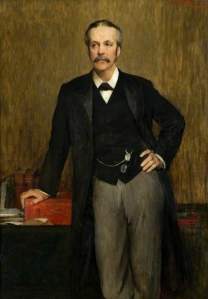
Lockhart, William Ewart, 1846-1900; The Right Honourable Arthur J. Balfour (1848-1930), MP

Copyright CSG CIC Glasgow Museums Collection

Painted by William Ewart Lockhart RSA,RSW 1896-1898. Exhibited at the Royal lScottish Academy in 18986. The portrait was commissioned by Corbett in order to be “presented to the new Art Gallery in Glasgow”.7

Early Life

Corbett was born at 8 Buckingham Terrace , Glasgow on May 23rd 18561. He was the second son , one of five children born to a wealthy Glasgow merchant, Thomas Lorimer Corbett , who had married Sarah Cameron in 18522. Corbett’s father was an ‘Australia merchant’ trading in timber and wool with his brother, Andrew , who had emigrated to Australia some years earlier.The Corbetts also had a summer home , South Park, at Cove on the Firth of Clyde, as did many wealthy Glasgow businessmen at the time4.

In 1864 when Corbett was about eight years old, Corbett senior moved his business to London with an office in Gracechurch Street5. By 1871 the family were living in a house called Oak Park in Cavendish Road, Clapham Park. By this time the family was complete with four children, three boys-Thomas, Archibald and Henry and one girl- Jessie6.

In January 1877, Thomas Corbett bought 110 acres of greenfield market garden land ,part of the Manor of Woodgrange, Forest Gate, originally part of Epping Forest, now in the London borough of Newham, and began the development of good quality housing estates in south –east London which was later carried on so successfully by his second son, Archibald7.

Despite their wealth the Corbetts lived a very unostentatious life. Mother, Sarah, appears  to have been a strict Presbyterian,allowing no games etc on Sundays and no dancing or theatre- going at any time! The family were also strict supporters of temperance. Even so our donor appears to have had a happy childhood with summers spent at Cove where he had a Shetland pony called Tottie, and winters in London8.

The Corbett children were educated at home by a series of ‘godly’ tutors, as their mother did not want them exposed to the’temptations ‘ of school life’9.

About 1870 Archibald and his elder brother Thomas  were given the choice of going on  a tour of Europe with a tutor or going to Oxford or Cambridge! What a difficult choice that must have been for a  fourteen and a fifteen year old!10. Fortunately we still have the detailed account of the trip written by Archibald in several exercise books which contain not only written details in a beautiful copperplate hand but also architectural drawings of the things he had seen 11. Whether  it was this tour  which sparked an interest in things artistic  we do not know, but soon after his European Tour Archibald enrolled at the  ‘Art School in South Kensington’ to study sculpture12. We know he was there in February 1876 as there is a letter written by him to his friend James Paterson, the artist, in which he writes ‘…..I am modelling pretty steadily at present and I hope to finish a bust of Clytie for the SK  competition…’.  How they became friends we do not know but they appear to have been quite close as in the letter Archibald tries to persuade Paterson to continue his studies in London where ‘…Millais would be one of your professors…’13

By the time he was 21 Archibald had abandoned student life  and was managing his father’s property development business in South East London  which he took over after his father’s early death in 1880. But even though his student days did not last long, according to his son ‘..he was left for life with a keen appreciation of both painting and sculpture’. As we shall see  and according to his son he became a modest patron of the arts14.

Property Developer

Archibald Cameron Corbett became one of the principal developers of the middle class suburbs of South East London. Between 1877 and 1914  Corbett managed the building of around 7,500 houses on 1096 acres of land1 . These good  quality  houses were spread over seven estates :-

Clementswood and Grange –Ilford

Dowanshall  at Seven Kings to the north of Ilford

Mayfield-to the east of Ilford

Woodgrange at Forest Gate

St German at Hither Green

Eltham Park.2

A catalogue was produced in 1913 showing the types of houses for sale in Eltham Park-not common practice among speculative developers at the time3.

The Corbetts were not builders but went into partnership with Mowlems(roads and drainage), J.J.Bassett and Son and the building firm of Picton and Hope. One of the Hope family bought one of the Eltham Park houses for himself-44 Craigton Road. There in 1913 was born Leslie Towns Hope-better known to the world as ‘Bob’4.

Many of the roads on the Corbett Estates had Scottish names. Also the estates were always built near to a railway station to encourage sales to the growing number of commuters into the City. The houses ranged from £530 for a six bed villa to £330 for a three bed terrace. The Corbett Estates had its own system of payment by  instalments . The houses were priced little higher than cost price as the real income came from the annual ground rent which ranged from £8.80 per annum for the large houses to £3.30 for a terrace house5.

The needs of the residents of the Corbett Estates were taken care of as Corbett gave land and financial support for parks, libraries and churches on all his estates. However one thing not to be found on any Corbett estate was a public house or hotel which sold alcohol as Corbett was always true to his temperance beliefs6.

IMG_20160611_0003 - Copy

Copyright  Frank Kelsall

The Corbett Estates had an office at 24 Sloane Square which exisited until 1926 when it made way for the Peter Jones Department Store7. The houses on many of the Corbett Estates are still sought after today. In 1976 the Woodgrange Estate was made a Conservation area and in October 2013 the Archibald  Corbett Society was formed in Hither Green whose aim is ,’to preserve the estate’s unique character and heritage for future generations’8.

Politician

Both Archibald and his elder brother  Thomas Lorimer Corbett were interested in a political career. Thomas was a life long Conservative and Unionist , while Archibald was a supporter of the Liberal Party for most of his political career however both brothers were life- long opponents to Irish Home Rule. After serving on the London County Council from 1889 to 1900, Thomas was eventually elected as Irish Unionist MP for North Down in 19001.

At first Archibald was unsuccessful when he stood as Liberal candidate for North Warwickshire in 1884 and seems to have been regarded as a carpet bagger by his opponents as illustrated in this cartoon by EC Mountford which appeared in ‘The Dart ‘ magazine in November 1882

cartoon ACCorbett

Copyright. University of Glasgow Archives and Special Collections. Archibald Cameron Corbett Collection GB248DC126/19

Finally in November 1885 Archibald Cameron Corbett was elected Liberal MP for the newly created constituency of Tradeston in Glasgow3. Glasgow’s seven MPs were all Liberals. The group sent a telegram to Prime Minister Gladstone which said ’Now we are seven.’4

The constituency of Tradeston included not only the district of Tradeston but also those of Kinning Park and Kingston,all industrial suburbs of Glasgow south of the Clyde now much changed as a result of the building of the M8 and M74 motorways and the Kingston Bridge.

Temperance and Home Rule were Archibald Cameron Corbett’s most cherished political beliefs. So strong were his opinions on these matters that he ‘crossed the floor of the House’ on two occasions in order to support his beliefs.

The first dispute , with his own Liberal Party led by Prime Minister Gladstone, came very early in his political career. In 1886 Archibald disagreed with Gladstone’s Irish Home Rule Bill and left the Liberal Party  to join the Liberal and Unionist Party ,newly founded by those Liberal MPs who were opposed to Irish Home Rule but yet could not bring themselves to join the Conservative Party. When the Liberal Unionists joined the Conservatives in a Coalition Government which was in power from 1895 to 1905,the Prime Minister was Arthur Balfour,leader of the Conservative Party . Thus we now know why a Liberal MP commissioned a portrait of  Conservative Prime Minister!5

The second parting of the ways occurred in 1908, when Corbett was still a member of the Liberal Unionist Party, now in opposition but taking the Conservative Whip.The Liberal Government under Gladstone introduced a Licensing Bill which was very dear to our donors heart. If passed  this Bill would close one third of the public houses in England and Wales,severly curtail Sunday opening hours and forbid the employment of women in public houses. The Bill was very unpopular ,especially among barmaids! There were even riots in Hyde Park.

The Conservative Opposition and the Liberal Unionists were very much opposed to the Bill,having many supporters in the drink and brewing industries. So Archibald , a life- long supporter of the Temperance Movement found himself in opposition to the Whips of his own party. The matter was aired many times in the Glasgow Herald and the Times during the summer of 1908, when the Tradeston MP toured the country in support of the Bill. Around August 18th  Archibald Cameron Corbett resigned from the Liberal Unionist Party. He wrote a letter to the Times in which he offered to resign his seat.6

There were several  meetings of the  Constituency Committee in Tradeston but as they had long known their MP’s views on Temperance  and as his opposition to Irish Home Rule was just as strong , he was asked to remain as the Tradeston MP.

In fact Archibald Cameron Corbett held his seat in Tradeston through eight General Elections between 1885 and 1910 , so great was his personal following  even when he stood as an Independent against the official Liberal Candidate as he did in January 1910. By the time of the December 1910 General Election he had rejoined the Liberal Party and was the victorious  official candidate.

The whole affair had taken a toll of his health and there are reports in the press in September 1908 of an illness due to exhaustion while campaigning in Newcastle. It must have been a disappointment to him, if not to the barmaids of England and Wales , that the Licensing Bill was dropped as it was so unpopular.7

There are few other insights into Corbett’s political career and beliefs. One came in the run-up to the passing of the ground breaking 1909 People’s Budget introduced by the Liberal Government . This budget would introduce welfare reforms and increase taxation on the rich. In a letter to the Times in May 1908, Corbett suggested the he regarded the Old Age Pension Bill, which proposed to give a better allowance to two single people than to a married couple , would lead to immorality!

He was also Chair of the Board of Conciliation and Arbitration  for the Steel Trades of the West of Scotland-there were no disputes on his watch! He was also a supporter of the Suffragette Movement. According to his son  Godfrey he was also responsible for  arranging for a young Marconi to transmit a message through the airwaves from Westminster across the Thames to St Thomas’s Hospital- the first wireless demonstration in Britain.8

Corbett was also noted for his innate kindness to his fellow man. According to his son , while still in the House of Commons, when the first Labour PMs were elected, his father helped them settle in.9

Perhaps it was a relief to Corbett’s political loyalties and to everyone else that further conflict was avoided when in the Coronation Honours List  in June 1911 he was raised to the peerage  and became 1st Baron Rowallan.

During his years in the House of Lords one of his favourite pastimes was taking groups of schoolchildren round Westminster, especially as the children had no idea who he was!10

When asked what gave him the greatest feeling of satisfaction in his political career, it is said that it was the passing of the Temperance( Scotland) Act 1913. This Act gave Scottish people the right to vote for a veto on the sale of alcohol in their local area if 10% of voters wished for a ballot. One wonders what the voters of Tradeston thought of that!

Personal and Family Life

Life was not all work for our donor. In  September 1887 he married Alice Mary Polson at Skelmorlie United Presbyterian Church. Alice was the 21 year old daughter of John Polson of Paisley one of the owners of Brown and Polson  Cornflower Manufacturers. Polson was a very wealthy man, his business interests included being  a director of the Vale of Clyde Tramway Company.1

Archibald and Alice  met on the  French Riviera probably in the spring of 1885 where Corbett  had gone possibly to lick his wounds after losing the North Warwickshire election. The Corbetts were staying in Nice and had gone to nearby Cimiez where the Polsons were staying. The couple met when the Corbetts took shelter from the rain at the Polsons’hotel. 2

Lavery, John, 1856-1941; Sir Archibald Cameron Corbett (1856-1933), 1st Baron Rowallan, MP

Archibald Cameron Corbett c1890  by John Lavery

 Copyright CSG CIC Glasgow Museums Collection
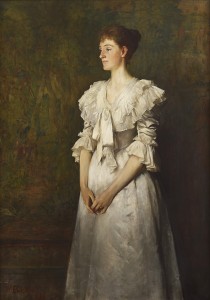
Portrait-of-Lady-Rowallan-in-White-210x300

Alice Mary Polson  by W E Lockhart 1896 

 Copyright  The Fine Art Society  Edinburgh

According to his son Godfrey  Corbett waited until he got a seat in Parliament before  he embarked on marriage. The wedding reception was held at Castle Levan on the Clyde, the summer home of the Polsons.

In 1888 the Corbetts moved to 26 Hans Place in London not far from Harrods.They had three children. Elsie was born in 1893,Thomas Godfrey in 1895 and Arthur Cameron in 1898. As well as their London home the Corbetts always had a home in Glasgow and a summer home at Cove . Bellahouston House was the Glasgow Home from 1890 to 1900, then Thornliebank House on the Rouken Glen Esate until 1906.3

Thornliebank House

Thornliebank House

Copyright Glasgow City Archives

Corbett was very conscious of his own restricted upbringing, brought about by his mother’s attitude and beliefs. He was determined to “banish the Cameronian gloom”. For example both his sons went to Eton.4

In 1901 Mrs Polson bought the 6,000 acre Rowallan Estate for the Polsons. What a very generous mother-in-law! There was an old castle on the estate but Corbett felt it was unsuitable for a family and commissioned architect Sir Robert Lorimer  to design a new house on higher ground.5

Rowallan Castle-old

Old Rowallan Castle Copyright  East Ayrshire Leisure Trust

Then in 1902 disaster struck . In July 1902 following a short illness after attending a city banquet  Alice Corbett died suddenly at Hans Place. She was to the children ,”our gay and adored mother”. Ever a caring father and determined his children should not be exposed to such grief when so young , Corbett chartered a yacht and sent his children on a cruise along the Firth of Clyde with some friends to keep them company. Only in later life did his children realise what a sacrifice that must have been for their father and how lonely he must have been.6

The plans for Rowallan  were reduced by 100,000 cubic feet,much to the chagrin of the architect. No longer was there to be a ballroom for example. The Corbetts moved into the new Rowallan Castle  in 1906,while continuing to live in Hans Place when in London and life went on as well as could be expected without Alice until 1914.

Corbett’s eldest son Godfrey(always called Billy by the family) was at Eton when war was declared in August 1914.There can be no better demonstration of their upbringing than the desire of the three Corbett children to play their part in the war effort. Billy was commissioned into the Ayrshire Yeomanry and later transferred to the Grenadier Guards. He was badly wounded and won the Military Cross. Arthur  joined the Royal Naval Air Service in 19 16 when he was just 18. Sadly he was  killed in action in December 1916. Elsie joined a Woman’s Ambulance Unit ,serving in Serbia from 1915 until 1919. She was taken prisoner by the Austrians and held for a year.7 She later wrote a book of her experiences.8

True to his generous nature their  father moved from Hans Place to Browns Hotel in 1916. He gave 26 Hans Place over to Belgian refugees.That he was a much –loved father can be seen from the many letters written to their father during the war by Elsie ,Billy and Arthur.10 In 1918 26 Hans Place was sold and Browns Hotel became Corbett’s permanent  home.

But what became of Rowallan Castle? In August 1918 Billy married  Gwyn Grimond, sister of Joe Grimond , future Liberal MP. They took over Rowallan Castle as their main residence where they had four children. Billy went on to be Chief Scout of the Commomwealth from 1945 until 1957 after which he became Governor of Tasmania ,following his father’s example  a life of public service.11      

Philanthropist

Archibald Cameron Corbett’s father,Thomas Lorimer Corbett was probably the role model for his second son’s lifetime of caring about those less fortunate than himself. While still living in Glasgow, Corbett senior set up the Glasgow Cooking Depots, canteens where working men could get cheap meals. These were very successful and made a profit which in turn was used to found Saltcoats Convalescent Home. T L Corbett was  instrumental in the financing of Quarrier’s Orphan Homes. He also founded Glasgow Working Men’s Club, the first of its kind in Scotland and supported the 1865/6 Glasgow Industrial Exhibition. His financing of bowling greens in Glasgow was true to the Corbett family tradition of trying to give working men an alternative to the public house!1

The Polsons were also a very generous family ,the town of Paisley benefiting from many gifts as in 1904 when Mrs Polson donated £10,000 to the local hospital. Thus when our donor married Alice Mary Polson in 1887 he had a wife who had been brought up with similar philanthropic views to his own.2

In Glasgow Archibald Cameron Corbett is remembered for his gift of Thornliebank House and Rouken Glen Estate(now Rouken Glen Park opened 26th May 1906) to the people of the city.He also bought the Ardgoil Estate in Argyle and gave it to the city in the hope that “large numbers of mothers and children from congested areas of Glasgow should be taken there by steamer”.4

A C Corbett c1906

Archibald Cameron Corbett c1906

Copyright Glasgow City Archives

The Corbetts were one of the  four Glasgow families who helped to finance and run The Royal Samaritan Hospital for Women,founded in 1886. Mrs Corbett was president of the Ladies Auxiliary Committee which raised funds for the hospital. The Alice Mary Corbett Memorial Home for Nurses was built in her memory after her death in 1902. Her husband  eventually became President of the hospital. The Corbetts were also involved in the Victoria Infirmary  where Corbett was its Chairman.5

After he took possession of the Rowallan Estate in 1906 ,Corbett took a great interest in how to improve the lives of his tenants. On discovering that the dairy farmers on the estate had to rise at 2am to milk the cows and then take the milk to Glasgow to sell, he set up the Rowallan Farmers Creamery ,a central point to which the farmers could take the milk to be cooled  and handled at reasonable hours. Based on a scheme which Corbett  had seen in Denmark ,it was the first of its kind in Britain.6

The list of Archibald Cameron Corbett’s charitable interests in Scotland are endless and include The Band of Hope,Temperance Association,Foundry Boys Association, Sunday Schools and many others.7 There is no better proof of the high esteem in which he was held than his repeated re-election as MP for Tradeston no matter which party he supported.

In recognition of his many years of service as both a Glasgow MP and of his great generosity to the City, Archibald Cameron Corbett was made a Burgess of the City  in January 1908.8

Because of his Parliamentary and business duties there Corbett spent a considerable part of his time in London ,”where he is as popular as he is in his Northern  Kingdom.” His philanthropic activities were as numerous in and around the Corbett Estates. Among these were:-

C1894-donated a drinking fountain for outside Forest Gate Station

1894-one acre of land given to tenants and residents of Ilford  for tennis courts and other games with £250 for layout.

1898 St German’s Recreation Grounds laid out “for tennis , croquet and other garden games”

1899-Downshall Baptist Chapel on on land and through finance given by Corbett

1900/1- 9 acres of land for parks at seven Kings Estate ,Ilford

1900/1-2000 children Lambeth given bulbs, a jar and growing instructions in December with a flower show in March to see the results.Mr and Mrs Corbett presented the prizes.

1902-ambulance given to Borough of Ilford

1903 –land donated for library at Hither Green,St German’s Estate

And many many more.9

Archibald Cameron Corbett’s philanthropy is perhaps best   summed up by the Glasgow Herald after his death.

“…supporter of every movement for the moral and social education of the populace…”10

Final Years

Corbett appears to have lived a quiet life at Browns Hotel in Albemarle Street after 1918. Little of his later life is documented. Perhaps he enjoyed visits from his  children and grandchildren . His daughter Elsie who never married  but settled in Spelsbury in Oxfordshire where she became a Justice of the Peace  for that county.1

On 19th March 1933 Archibald Cameron Corbett died peacefully at Brooks Club in London while sitting in his favourite chair reading a book . He was buried alongside his beloved Alice on Rowallan Moor in Ayrshire  in a simple grave. A short service was held at Rowallan House and was attended by large numbers of farm tenants and estate workers. The road to the burial was lined with local people,for example the boys of Fenwick School, and blinds were drawn in village shops and houses as a mark of the great respect in which this simple ,kind man was held.

A Memorial Service was held for our donor at Glasgow Cathedral on 23rd March 1933.2

Perhaps today we would find Archibald Cameron Corbett  rather paternalistic and patronising to ordinary people but the people of his time held him in great esteem.3

Notes and References

Paintings

1.Glasgow Corporation Parks Dept .Museums Sub-Committee Minutes 2/9/1898

2. C Baile  de Lapariare (ed)RSA  Exhibitions 1826-1990 Vol 111.1991

3.Catalogue: Exhibition of Scottish Paintings from Early 17th Century to Early 20th Century.Kelvingrove Museum

4.James Paterson Sales Book.Glasgow UniversityLibrary (GUL)Special Collections.MS Paterson HC4

5.ibid

6.C Baile de Lapariere(ed) RSA Exhibitions 1826-1990. Vol111.1991

7.Glasgow University Archives(GUA)GB 0248 (GUA) Doc026/16.Letter from A.J Balfour to ACC

Early Life

1. http://www.ancestry.co.uk Statutory Register of Births

2. T.G.P Corbett.Rowallan:The Autobiography of Lord Rowallan KT pub Paul Harris 1976. p6

3.ibid p4

4.ibid p7

5.ibid p7

6.www.ancestry.co.uk Census Records 1871

7.www.newshamstory.com

8. Corbett. Rowallan:The Autobiography of Lord Rowallan KT p8/9

9.ibid p9

10.ibid p10

11. GUA Doc 26/20

12.Corbett.Rowallan:Autobiography of Lord Rowallan KT p10.”SK” became Royal College of Art and Design

13. James Paterson Sales Book. GUL Special Collections.MSPaterson H4

14. Corbett. Rowallan :Autobiography of Lord Rowallan KT p10

Property Developer

1.Cole,Oswald. The Quest for Cameron Corbett:A Study of an Eminent Edwardian

2.ibid

3.www.building conservation.com:Kensall,Frank/dating old buildings.

4.The Corbett Estate. Article in The Mercury(Greenwich)19/01/2000

5.www.newshamstory.com

6. Cole.The Quest for Cameron Corbett:A Study of an Eminent Edwardian. p43

7.ibid p47

8.www.newshamstory.com

9.www.catfordcentral.com/hither-green-archibald-corbett-society

Politician

1. Cole. The Quest for Cameron Corbett:A Study of an Eminent Edwardian p41 ;www.wikipedia.org-Thomas Lorimer Corbett

2.”Dart Magazine” 24/11/1882 Glasgow University Archives and Special Collections.Archibald Cameron Corbett Collection GB248DC026/19

3.Corbett. Rowallan:Autobiography of Lord Rowallan KT. p15

4.Fisher,J. The Glasgow Encyclopaedia. Mainstream 1994

5.Glasgow Herald(GH) 20/03/1933;Cawood,Ian The Liberal Unionist Party. Taurus 2012

6.GH 18/08/1908

7.GH 28/09/1908;12/10/1908

8. GUA DC026/6;Rowallan:Autobiography of Lord Rowallan KT. p77

9. Corbett. Rowallan:Autobiography of Lord Rowallan KT. p29

10.ibid p76

Personal Life

1.Corbett. Rowallan:Autobiography of Lord RowallanKT. pp 13-16

2.ibid pp12,15,16

3.ibid pp17-24

4.ibid p18

5.ibid p26

6.ibid pp27-28

7.ibid pp37-52

8.Elsie Cameron Corbett. Red Cross in Serbia 1915-1919:A Personal Diary of Reminiscences. Mainstream 1964.

9. GUA DC026/6

10.GUA DC026/28/29/30/31

11.Corbett.Rowallan:Autobiography of Lord Rowallan KT. Chap 4

Philanthropist

1.Corbett. Rowallan:Autobiography of Lord Rowallan KT p5

2.ibid pp 12,15,16,32

3.ibid p33;GH 20/03/1933

4.Corbett. Rowallan:Autobiography of Lord Rowallan KT. p32

5.Stothers Glasgow,Lanarkshire and Renfrewshire Xmas and New Year Annual 1911-12

6.Corbett. Rowallan:Autobiography of Lord Rowallan KT. p63

7.GH  20/03/1933

8.Corbett. Rowallan:Autobiography of Lord Rowallan KT. p35

9. Stothers Glasgow,Lanarkshire and Renfrewshire Xmas and New Year Annual 1911-12

10.GH 20/03/1933

Final Years

1.Elsie Cameron Corbett. Red Cross in Serbia 1915-19:A Personal Diary of Reminiscences.

2.Corbett. Rowallan:Autobiography of Lord Rowallan KT. pp76-78

3.GH 24/03/1933

JMM


Agnes Gardner King(1857-1929)

_ISP7459.NEF
Figure 1 William Thomson (Lord Kelvin)© CSG GIC Glasgow Museums Collection.

In 1920, Agnes Gardner King offered a painting of her uncle, William Thomson, later Lord Kelvin, to Glasgow Art Galleries. The painting was by J Graham Gilbert, a Glasgow artist.

Agnes Gardner King was born in Ilkley, York shire in 1857 to Elizabeth Thomson and the Reverend David King, LLD (1). She had a sister Elizabeth Thomson King. Her mother, Elizabeth Thomson, was the sister of William Thomson, later Lord Kelvin, and James Thomson. William and Elizabeth were great friends and often went on walking tours together when they were in their twenties in Switzerland(2)(3). Elizabeth was an accomplished amateur artist and some of her paintings are in the National Portrait Gallery in London(4).

kelvin and siblings Agnes gardner King
Figure 2. William,James and Elizabeth Thomson by Agnes Thomson King National Portait Gallery, London, reproduced with permission

It is not known how Agnes was educated and what her training was but she became a gifted artist in watercolour. She painted pictures of children and also landscapes. She is featured in the Dictionary of British Artists. Her most interesting work ,which hangs in the National Portrait Gallery, is a charcoal drawing of her uncles Baron Kelvin (William Thomson), and James Thomson with her mother Elizabeth King.

Her Canadian Paintings are in the Canadian Government Archives. One is entitled ”View of Sleeping Beauty from Windows of C P R Hotel, Vancouver”(5).

She published a number of books alone or with her sister. These include: My Sister by Agnes Gardner King; Daily Texts for the the Little Ones by Elizabeth Thomson King illustrated by Agnes Gardner King; Islands Far Away. Fijian Pictures with Pen and and Brush by Agnes Gardner King; Kelvin the Man, a Biographical Sketch by his Niece, Agnes Gardner King.

In 1912, after an undisclosed illness and needing recuperation, she fulfilled a long-standing wish to travel to Fiji(6). She travelled with a companion, Mrs Hopkirk, sailing on the Empress of Britain from Liverpool through storms and, in fact, a snowstorm and in sight of icebergs, to land in Québec. They crossed Canada by train to Victoria and then embarked on the Makura to the Sandwich Islands and then on to Fiji. She travelled around the islands writing about spending a week in a Fijian village, travelling up the Navua River on a boat poled by native boatmen and enjoying the hospitality of a number of Chiefs in many villages and towns. This book, which ran to 2 editions, was published in 1921 and it is illustrated by 80 pen and ink and charcoal drawings. It gives a remarkable picture of islands which had, in living memory, a history of cannibalism. It also reflects her indomitable spirit and openness to different patterns of life.


  1. The Young Kelvin at Home by Elizabeth Thomson King
  2. Ancestry.co.uk
  3. The Life of Lord Kelvin by Silvanus Thompson
  4. http://www.npg.org.uk
  5. http://www.archivescanada.ca
  6. Islands far Away. Fijian Pictures with Pen and Brush by Agnes Gardner King. Bibliolife


The Misses Kirsop

The painting below was donated by the Agnes and Jessie Kirsop to Glasgow Corporation in January, 1915

 Me

_ISP7369.NEF
Figure 1 “Portrait of a Lady” by Sir John Watson-Gordon, PRSA. © CSG GIC Glasgow Museums Collection.

Agnes Wotherspoon Kirsop and Jessie Brown Kirsop were the youngest of seven children of John Kirsop and his wife Mary (nee Brown) who were married in Gorbals in 1846(1). The first four children were born there, but by the time that the other three came along the family had moved to 12, Corunna Street, off Argyle Street, which was then classed as Anderston but would now be classed as part of Finnieston. There in 1871, according to the census (2), the family consisted of the parents, three unmarried daughters, Elizabeth, Agnes and Jessie.

John Kirsop was a Master Hatter who had a hat and cap manufactory at 106, St. Vincent Street (3). Later, under the control  of their brother, the firm, now John Kirsop and Son(Ltd) moved to 49/51, Renfield Street in 1927-28. This firm was later, in 1956, taken over by the House of Fraser and wound up(4).

John Kirsop came of a long line of hatters. he was  related to the Kirsops who had premises in Argyll Street in the early 19th century and to their uncle, Richard Nixon, who had premises at the corner of the Argyll Arcade, and was appointed hatter to King George 4th (5).

The three principal wholesale hat manufacturers in Glasgow in the second half of the 19th century had been trained by the Nixon establishment.

The family moved further west to 3, Victoria Crescent, Partick, and then in 1891 to 15, Westbourne Terrace. Agnes was the only daughter at home then.

John died in 1898, when his estate was valued at over £21,000. Mary, his widow, died in 1908.

By 1911(6) Agnes, Jessie and Elizabeth were back at Westbourne Terrace, where, in the census of that year, they were  described as having independent means.

In 1915, Jessie was in rented accomodation in 9, York Drive (7), which was in 1929 renamed as Novar Drive(8). As far as I can find out, Agnes did not join her there until 1927(9).

The painting which the sisters donated, according to the minute of Friday, February 20th, 1914, of the Royal Glasgow Institute of Fine Arts, appeared on a list of works for sale(10). There was no  mention there of price sought or achieved, and the purchaser was not named in the minute.

The sisters donated the painting  to Glasgow Corporation in January, 1915 and the gift is recorded in a minute of the Corporation of 6th January, 1915 thus” Miss Agnes Kirsop, 9, York Drive is offering, on behalf of herself and her sister, to present to the Corporation the portrait of an old lady by Sir John Watson-Gordon, PRSA.”(11)

The sisters continued to live in various addresses around the West End until their deaths. Jessie died in Gartnavel Royal Asylum in 1930, and Agnes died at 28, Ashton Road in 1940 (12).

Bibliography

(1) http://www.scotlandspeople.gov.uk

(2) Ibid

(3) Glasgow Street Directories – Mitchell Library

(4) http://www.houseoffraserarchive.ac.uk/company/?id=c1375

(5) http://www.glasgowwestaddresses.co.uk/1888_Book/Kirsop_John_&_Son.htm (Index of Firms(1888) ).

(6) http://www.scotlandspeople.gov.uk

(7) Voters Roll 1915 – Mitchell Library

(8) Post Office Directories – Mitchell Library

(9) http://www.scotlandspeople.gov.uk

(10) Royal Glasgow Institute of Fine Arts Minute Book 1914 – Mitchell Library

(11) Glasgow Corporation Minute Book 1915 – Mitchell Library

(12) http://www.scotlandspeople.gov.uk


Matthew Dickie (1873 – 1944)

(c) Glasgow Museums; Supplied by The Public Catalogue Foundation
Figure 1. Oil, Alexander Roche R.S.A., “Girl in Red Hat”. Donated by Matthew Dickie, 74 Ormonde Avenue, Glasgow, S.4., on 18 February 1942. © CSG GIC Glasgow Museums Collection.
M. Dickie
Figure 2. Matthew Dickie from a portrait by David Gauld. Courtesy of Matthew K. Dickie.

Matthew Dickie was born on the 6th April 1873 at 15, Naburn Street, Hutchesontown, Glasgow. (1) His father was John Kennedy Dickie, a mason builder born in Kilmarnock in 1844, who founded the building firm of “John Dickie and Son” in 1880. (2) His mother was Janet Ramsay. Matthew was the elder son in a family of four girls and two boys. At the time of the 1881 Census the family was still living at 15, Naburn Street with Matthew, aged 8, described as a “scholar”. (3) It is not recorded where he attended school, however, it seems that about this time he began accompanying his father to work thus learning the essentials of the building trade from an early age. He later completed his apprenticeship as a stone mason and by the time he was twenty one he was managing the firm with his father. In the 1890s, the firm was based in Greenside Street, Glasgow. (4)

John Kennedy Dickie died on the 7th May 1897 and the “assets and liabilities” of the firm were passed on to Matthew and his mother Janet. (5) The business, now under the name of John K. Dickie and Son, was based at 20, South Coburg Street, Glasgow (6) and continued to flourish under Matthew`s leadership. He was living with his mother at “Largs Villa”, Myrtle Park, Crosshill. However, on the 4th of August 1900, Matthew Dickie married Mary Hutchison the daughter of a master joiner in Lesmahagow. (7) and they moved to a house at 1132 Cathcart Road. (8) The following year their daughter Nettie Duff Ramsay Dickie was born and a son, John Kennedy Dickie, arrived in 1903. (9) By 1905, the family had moved to “The Priory”, King`s Park Avenue, Cathcart. (10) A second son, Matthew, was born in 1908. (11)

In 1909 the firm moved its premises to King`s Park Road, Mt. Florida and in the following year the family moved house, this time to Chartley Lodge in Cathcart. (12) According to the 1911 Census (13) this was a large house with at least fourteen rooms, it may have been about this time that Matthew started to amass his collection of art (or perhaps the house was purchased to display his already extensive collection). He had been to Holland in 1909 visiting the major cities and may have acquired pictures there. He bought paintings sometimes through dealers and at other times from junk and second hand shops. According to his grandson, he had an excellent eye for works of art and a favourite ploy if he spotted something interesting among a group of paintings was to pretend that he was only interested in the frames and the glass and to offer a price for the whole lot which was invariably accepted.

Figure 3. Dickie family in America. Courtesy of Matthew K. Dickie

It seems that from his visits to Europe he got a sense of how things were progressing there and, realising that war was probably inevitable, he took the decision to emigrate to the U.S.A. This necessitated the sale of Chartley Lodge and ultimately of his art collection. At this time he also sold Eastwood House and estate to John (later Lord) Weir. In 1913 he sailed to the USA aboard the “Mauretania” and visited Chicago, Los Angeles and California where he tried his hand at gold prospecting and successfully unearthed some nuggets which he brought back to Scotland. This may have been a trip to ascertain the “lie-of-the-land” because in the following year on 17th July, Matthew, now aged 41, and his wife Mary arrived in New York having sailed from Liverpool aboard the “Aquitania”. (14) They travelled all over America and Canada visiting Sacramento, California, Vancouver and Montreal and sailed on the St. Lawrence River. They returned to Scotland but Matthew arrived back in New York, via Liverpool, on 24th April 1916 aboard the “St. Louis” having left Mary at home at 11, Royal Crescent, Queen`s Park. (15)

During this visit, he seems to have decided to try his hand at farming and employed a land agent to find a suitable property. Meantime he returned to Scotland to collect the family and on 18th September 1916 they all arrived in New York aboard the “Tuscania” which had sailed from Glasgow. (16) With Matthew were Mary, daughter Nettie aged 15 and sons John aged 12 and Matthew aged 8. They settled on a farm in Virginia, called “Deanwood” which Matthew had bought and the family lived there till about 1919. With the help of William Sheriff and a foreman who had travelled out from Scotland with them he was determined to make the farm productive and applied all his energies to that aim. (William Sheriff was a young engineer employed by the firm who remained with John Dickie and Son into the 1950s).

Meanwhile, back in Glasgow, on 5th October 1916, the bulk of his art collection was sold at auction by J. and R. Edmiston. Matthew`s address was listed in the catalogue as “late of Chartley Lodge, Cathcart”. (17) The star item in the sale was “Homewards at Dawn, Loch Fyne” which was painted in 1883 by William MacTaggart. It was bought for 1100 guineas by Alexander Reid. The picture was probably acquired by Matthew from the Ramsay Collection in 1909. Other items in the sale included pictures by Sir Henry Raeburn R.A., Sir Joshua Reynolds, P.R.A., George Henry, A.R.A., R.S.A., Sir James Guthrie, Fantin Latour, B.J. Blommers as well as paintings by J. Lawton Wingate, Muirhead Bone and S.J. Peploe. The Glasgow Herald in announcing the sale reported that “The pictures to be sold include not merely one or two of importance, but several of absolutely outstanding character”. (18) The sale realised a sum of about £39,000.

Figure 4. Deanwood. Courtesy of Matthew K. Dickie

In 1919 Matthew was approached by a prospective buyer who offered twice the sum he had paid for Deanwood; an offer that Matthew couldn’t refuse! With the profit, he bought “Cornwell”, a mansion in Virginia dating from 1731, with 200 acres of land around it. He renamed this “Parklands”. However, the family did not live there for long. Within eighteen months, and with Mary becoming increasingly homesick, he reluctantly sold “Cornwell” (Parklands) and the family moved back to Scotland. “Cornwell” was one of the “Historic Houses of Virginia” which featured in a book published in 2003. (19) Two years later, Matthew again set sail from Glasgow bound for New York, this time accompanied by his son John. Part of the reason for this trip would have been to visit his son Matthew who was still at school in Virginia. They arrived in New York aboard the “Cameronia” on 30th June 1921 with their final destination Vienna, Washington, D.C. Their home in Glasgow was now at 71, Broomhill Road, Newlands. (20) They returned to Glasgow but on 18th of June the following year, Matthew arrived alone in New York having sailed from Glasgow aboard the “Columbia”. Mary was at home in “Underwood”, Giffnock, Glasgow. (21)

In 1930 Matthew purchased Eaglesham House together with ‘its gardens, cottages, lodge houses and farmland of 250 acres’ from the trustees of Captain Angus Cecil Gilmour. Planning consent was obtained to develop the estate with a country club, golf course and surrounding housing built in a village form including a school, shops etc. (22)

Eaglesham
          Figure 5. Eaglesham House in 1927. Courtesy of Mathew K. Dickie

Eaglesham House was requisitioned in 1940 by the War Department (Scottish Command) and occupied until 1946. Then planning consent was changed to make part of the Eaglesham estate ‘green belt’. This, together with the cost of death duties, persuaded Dickie’s Trustees to sell the house and estate to the Polnoon Estate Company. One of those involved in this purchase was the Hon. J.K. Weir, son of the Lord Weir who had purchased Eastwood House. (23)

1931 saw the death of George Leslie Hunter the artist who had been a good friend of Matthew`s. Matthew had helped Hunter financially and, at the time when Hunter`s work had fallen out of favour with collectors, Tom Honeyman wrote that “Among the older friends and patrons who still believed at this time that Hunter was by no means a spent force I can only recollect McInnes, McNair, Harrison and Dickie”; and later “The Bon-Bon was the pretentious title of a very ordinary tea room in the Central Station (which was) the meeting place for the morning coffee of McInnes, McNair, Hunter and myself. Occasionally we would be joined by Willie Gordon, who was on the staff of the Evening News; Ion Harrison, Matthew Dickie, Sam Warnock, R.C. Roy were among others who would more infrequently, join in discussions …..”. (24)

Mrs Matthew Dickie
Figure 6. Mary Dickie by George Leslie Hunter. Courtesy of Matthew K. Dickie.

Matthew owned several of Hunter’s work including one of his wife Mary. In 1941 he lent a “Still Life” by Hunter to be shown at the RGI Exhibition of that year. (25) He also owned “Fan and Fruits” which, when it came up for sale much later, was described as “one of the most dramatic Leslie Hunters ever to be on offer in recent years”. (26) Another of his paintings, “Boats in the Harbour, Cassis” by Hunter was sold at Christies in 1998 for £3,105

On the 29th October 1933, Matthew, now aged 60, Mary and their son Matthew arrived in New York aboard the “Caledonia” having left Glasgow on the 19th of October. (27) Perhaps the intention was to try to settle in the U.S.A. because they repurchased “Cornwell”. However, it was not to be and they sold up within two years and returned to Glasgow. In 1935, he purchased around 30 acres of land on the Castlemilk Estate on the outskirts of Glasgow. He proposed to erect 230 houses and 10 shops on the ground. The plans were finalised in February 1937 and preparations were made to start the work. However, Glasgow Corporation had plans to develop the estate for community housing and set a Compulsory Purchase Order on Dickie’s holding. After an inquiry in 1937, the lands and mansion of Castlemilk were finally bought by Glasgow Corporation. (28)

Matthew Dickie died on 22nd January 1944 at the Southern General Hospital, Glasgow. He had gone to visit one of his foremen in the hospital and collapsed and died from a cerebral haemorrhage. (29) His home at the time was at 74, Ormonde Avenue. Matthew was buried in Cathcart Cemetery, Glasgow. (30) According to his grandson, he left an estate worth well over £150,000 but this was severely reduced by death duties. The published value of his estate was £8,112:8:10 (31)

Matthew Dickie was an avid art collector. He owned several Peploes, a Raeburn and J.D. Fergusson`s “Lady with the Hat” now in Kelvingrove. He was a friend of Dr. Tom Honeyman who is reputed to have said that “Matthew Dickie taught me everything I know about art……. and I mean everything”. It was probably due to Honeyman that he donated “Lady in Red Hat” to Glasgow. He seemed to excel at most things he did including fishing and was an excellent artist himself. He was very musical as were two of his sisters who became opera singers. A third sister taught music at the Atheneum in Glasgow.

(I am very grateful to Matthew K. Dickie, grandson of the donor, for informative discussion and for allowing me access to family records and photographs).

References

1. Scotland`s People.

2. (The firm later became “Dickie Homes”). http://www.s1homes.com/newhomes/developer/dickie_homes/4107.shtml

3. Ancestry.com (Census Data)

4. Glasgow Post Office Directories.

5. The Edinburgh Gazette, 8th October 1897.

6. Glasgow Post Office Directories.

7. Scotland`s People.

8. Glasgow Post Office Directories.

9. Scotland`s People.

10. Glasgow Post Office Directories.

11.  Ancestry.com (Census Data)New York, Passenger Lists, 1820 – 1957.

12. Glasgow Post Office Directories.

13. Ancestry.com (Census Data)

14. Ancestry.com; New York, Passenger Lists, 1820 – 1957.

15. Ibid.

16. Ibid.

17. Glasgow Herald, 30th September 1916

18. Glasgow Herald, 6th October 1916, page 9.

19. “The Land at Cornwell Farm” by Jean Tibbetts. Copy General, 102 – 9, Executive Drive, Sterling, VA 20166. (Copyright – “The Great Falls Historical Society”, PO Box 56, Great Falls, Virginia 22066).

20. Ancestry.com; New York, Passenger Lists, 1820 – 1957.

21. Ibid.

22. http://www.geograph.org.uk/article/Eaglesham-The-Story-of-a-Planned-Village

23. Ibid.

24. “Introducing Leslie Hunter, T.J. Honeyman, Faber and Faber Ltd., 1937.(Also published in “Hunter Revisited”, Bill Smith and Jill Marriner, Atelier Publishing, 2012)

25. The Royal Glasgow Institute of the Fine Arts, 1861-1989: A Dictionary of Exhibitors at the Annual Exhibitions, Roger Billcliffe, (Woodend Press, 1990).

26. Glasgow Herald.

27. Ancestry.com; New York, Passenger Lists, 1820 – 1957.

28. Glasgow Herald, 6th November 1937, p7; also Carmunnock Heritage Trail Booklet – Glasgow City Council.

29. Scotland`s People.

30. Glasgow Herald, 24th January, 1944, p1.

31. Confirmations and Inventories, 1944. National Records of Scotland, CAL/1944/A, pp 236