Ellen Stewart Carrick was the daughter of John Carrick. She lived on private means all her life. She donated a painting of her father John Carrick by Sir Daniel Mcnee to Glasgow Art Galleries. On 7 April 1920 the Parks Committee accepted the donation.(1)
Ellen Carrick (or Helen or Nellie) was born on 11 August 1857 at Dundonald, Ayrshire to John Carrick and his wife Jane Stewart.(2) She was the youngest of 7 children.(3.) _There is little to learn about her early life which is not covered by her father’s history.Until his death she lived at home. In his Will she inherited the contents of the family home at 5 Park Quadrant and the rents of the properties at number 5 and number6 foras long as she was unmarried. (4 ) She did not marry and during her life time she moved to England and can be found at different addresses sometimes living with relatives. In the 1911 census she is at the home of her sister, Jane Thomson, at North Gate, Regents Park, London.(5 ) In 1918, she donated some of her father’s effects to Glasgow museums from an address in Hasselmere,Surrey.(6 ) In 1920 she is living at 10 Promenade Terrace in Harrogate from where she donated Sir Daniel MacNee’s painting of her father.(7). Again in 1926 she gave more of her father’s. collection of coins and other objects from an address in Southbourne Rd. Bournemouth.(8 ) She died on the 14 March 1933 in Abbey Road Marylebone.London.(9 ) There is a separate stone in the Necropolis,(10) Glasgow erected by a niece which reads:
For the daughters of John Carrick. Ellen Stewart Carrick and Marion Dunn Carrick,.wife of Thomas Chalmers.
John Carrick, (1819-1890) City Architect
John Carrick was born at Larbert on 6 May 1819 to William and Marion Carrick. His father was a hotel keepe..(11) He lived in Denny as a child. At the age of 12 he entered the office of John Bryce, Architect in Glasgow as an apprentice. (12) When he had served his time, he went into partnership with James Brown and the firm was Brown and Carrick.(13 ) In 1844 he became Superintendent of Streets in Glasgow. In 1854 he was appointed Superintendent of Public Works and then City Architect. (14 ) In 1866 he developed and became responsible for the City Improvement Trust Schemes.(15) In this position he played a large part in the layout and redevelopment of Glasgow which forms much of the city centre as we know it today.
He was involved in the planning of many of the city’s landmarks among these the City Halls, what is now formally known as The Merchant City and the relocation of the Maclellan Arch on Glasgow Green.(16 ) When the foundation stone for the New Municipal Buildings was laid in 1883, he had a prominent position behind the Lord Provost and the City Council in the grand procession which went from Infirmary Square to George Square.(17 )
By 1861(18 ) he is living at 5 Park Quadrant in the Park District and ,from his will, (19 )we know that he owned one other house there at number 6. In 1871(20 ) he was living at Arran View in Prestwick.
He died in 1890 (21 ) and is buried in the Necropolis in Glasgow with his father and mother. (22) His gravestone reads:
In memory of MARION DUNN wife of William Carrick died September27 1843 aged 45 years WILLIAM CARRICK died April6 1853 aged 56 years JANE STEWART wife of John Carrick born December 5 1817 died November 6 1836 JOHN CARRICK born May 6 1812 died May 20 1890 for forty six years City Architect and Master of Works of this city SAMUEL CARRICK second son of John Carrick born September 30 1848 died June 17 1893
.As befits a man who by the nature of his profession shaped the character and geography of Glasgow and particularly that of the Merchant City there are many sources relating to his achievements. Preeminent among these are articles in The Dictionary of Scottish Architects.,(23 ) and in Glasgow City of Sculpture (24)which within a detailed account of his life list all of the buildings in which he had an interest. Articles in The Merchant City Trail (25 ) and the Bailie (26 ) all Fserve to underline his importance as a Glasgow citizen and are useful for further reading.
Glasgow Museums holds a bronze sculpture and a marble bust by Pittendreigh McGillivray. (27 ) He is also portrayed in the painting of Queen Victoria’s visit to the 1888 Exhibition by John Lavery. (28)
Figure 1. George Robb, Carting Superintendent, Caledonian Railways – The Railway Magazine Sep 1907
George Robb came from an old family of carters who provided a service transporting goods to many towns in south west Scotland, at a time when the railway network was in its infancy.(1) The Robb family was prominent in the Kilmarnock area, where the earliest Scottish railway to be incorporated by private Act of Parliament was built between Kilmarnock and Troon in 1808. As the railway system developed, George moved to Glasgow where he joined the Caledonian Railway Company and progressed to become Superintendent of their Carting Department.(2)
Figure 2. Typical Goods cart early 20th century – The Railway Magazine Sep 1907
George was born in December 1833 in Kilmarnock to James, Innkeeper of The Wheatsheaf in Kilmarnock and a goods carrier between Glasgow and Carlisle, and Elizabeth Hutchison. George was educated at Kilmarnock Academy and left school to work with his uncle, Charles Robb at his carting business in Glasgow, based in Brunswick Street before moving to West Nile Street. (3) George succeeded to the business on his uncle’s death. George is recorded as living at 102 West Nile Street by 1861 and described as a railway agent. (4) By 1871 his address is 223 Hope Street and he was recorded as Carting Superintendent for Caledonian Railway. (5)
Carting services were widely publicised in local newspapers. In 1837/38, for example, J & W Robb (possibly related to George) advertised carrier services from Dumfries to Sanquhar and Thornhill ‘from opposite Mr Hairsten’s, High Street, every friday’. (6) All kinds of goods were carted, including alcohol. When George became Carting Superintendent he assumed responsibility for the efficient management of the service and checks were made to ensure that goods arrived at their destination intact. At one time carriers from Glasgow were met halfway to Kilmarnock by carters from that town. On one occasion it was discovered that there was ‘a great leakage in strong waters somewhere on the road. He (George Robb) rode to the rendezvous by devious hidden paths, and found the men indulging freely in the wine of the country. There was no more illicit jollification on Mearns moor’.(7)
The railway system in Scotland developed rapidly in the early nineteenth century. The Caledonian Railway was established by Act of Parliament in 1845 as a result of the absorption and amalgamation of a number of existing lines. By 1866 the Scottish Central and Scottish North Eastern Railways had been absorbed by The Caledonian.(8) Although the need for carting declined as the railways expanded there was still a demand to service the transport of goods between destinations not covered by the railways. The Carting Department of The Caledonian Railway was set up on 1 February 1870 and George was offered the job of managing the Department, which he accepted, and had free reign to organise the business as he felt fit. The Company acquired George’s stud of horses. By 1906 the company ran its own carting services from 55 of its stations and employed 1000 staff and over 1000 horses.(9) George had a renowned knowledge of horses and a reputation for acquiring only the best on the market. He related a story that when he was only ten years old he purchased his first pony, which he sold the following day for a profit of £5. Later in life he exhibited and judged horses at agricultural shows.(10)
One of George’s responsibilities was the purchase of healthy working horses. On 15 April 1881 a John Rankin from Largs sold a bay horse for £68 to George Robb, at the cattle market in Glasgow. On 20 April George wrote to Rankin to advise that the horse was unsound, being a ‘roarer’ ( a condition whereby a deformity in the throat causes the animal to ‘roar’) and should be returned. The case went to court and was found in Robb’s favour.(11)
The railway employed several contractors, Messrs Wordie and Company being one of the most prominent. The firm had been connected with The Caledonian Railway since its inception and had a reputation as being equivalent to the English firm of Messrs Pickfords. At the end of the nineteenth century John Wordie and Peter Wordie, sons of the company’s founder William Wordie, were partners, and worked with George Robb at Caledonian Railway Company in the management of its carting services.(12)
Figure 3. John and Peter Wordie – The Railway Magazine Sep 1907
By 1891 George was living at 17 Scott Street, a dwelling with 11 rooms. Also resident were a house keeper and a domestic servant. The building no longer exists and is replaced by Glasgow School of Art structures.(13)
George died at his home at 17 Scott Street, Glasgow on 27 February 1909 (14) and was interred in his family grave at The High Kirk churchyard in Kilmarnock. Mr Robb was a well known and respected figure and a special train conveyed mourners to his funeral in Kilmarnock. The service was conducted by the Reverend Mr Gunson, minister of Ramshorn Church, Glasgow, formerly St David’s Church, where many prominent Glasgow merchants are interred.(15) George Robb left an estate of almost £80,000 including a bequest ‘to the Kirk Session of The Ramshorn Church the sum of one thousand two hundred pounds, the free annual revenue of which shall be paid to the minister of the church for the time being’, that being the Reverend Gunson at the time. Bequests were also made to friends and business associates including John Wordie and Peter Wordie.(16)
1) The Meet by John Frederick Herring Snr 1795-1865. Herring specialised in painting horses, especially hunting and race horses and his clientele included Queen Victoria.
2) Coming from Church by David Adolf Constant Artz 1837-1890. Artz was a dutch painter who was associated with the Hague School.
( Barmouth, St. Ives Bay and A Dutch Mill, were received in February 1928 from Andrew Lusk`s executor. Castle Campbell near Dollar was given by his niece Mrs. Berkeley Robertson, nee. Janet Lusk on 29 August 1941. However, the catalogue entry at Glasgow Museums Resource Centre for this painting has a note added ‘to be described as presented by the late Andrew Lusk, Windsor, 1941’).
Andrew Lusk was born at ‘Lusk`s Cottage’, Coatbridge, Lanarkshire on 3 June 1853. 2 He was the son of James Lusk, a master baker and his wife Janet Reid. (James was born in Colmonell, Ayrshire in 1817. Janet was born in Cambuslang also in 1817). 3 There were two other children, John Lusk, born 14 July 1848 (the father of Janet Lusk) and Margaret Earl Lusk, born 3 March 1851.4 All were at Lusk`s Cottage in the 1861 Census along with two servants. Andrew`s father employed two men and forty-three boys. 5 The family is listed in Armorial Families6. (Appendix 1)
Figure 6. James Lusk. National Archives of Scotland, (NAS) GD501
Figure 7. Janet Reid. National Archives of Scotland, (NAS) GD501
Andrew attended Glasgow High School in the 1860s and seems to have had an interest in and an aptitude for art from an early age which was further developed while at school. 7
From the 1871 census, Andrew, aged 17, was living with his parents, brother and sister at Glasgow Road, Bothwell. He was employed as a clerk. 8 By 1881 his siblings had both married and he had moved with his parents to Hamilton Road, Ferniebank, Bothwell. He was now aged 27 and a ‘commercial clerk in the iron trade’. 9 Sometime after that he moved to England. His father died in 1890 and Andrew was one of his executors. His address then was 3 Fenchurch Avenue, London. The 1891 census found him, aged 37 and single, at The Dell, Woking in Surrey. (The Dell was one of the larger houses in Woking but has since been demolished 10). He was now an ‘iron and steel merchant’ and employed two servants. 11 Woking would seem an unlikely place to find an iron and steel merchant. However, the town had an excellent train service to London so Andrew could have commuted to his business in the city.
It is possible that his career as a steel merchant came about after his brother John married, in 1876, Jessie, the daughter of David Colville, the founder of the Colville steel firm. 12 An account of his assets after his death showed that Andrew was receiving a pension from Colvilles. 13
By the time of the 1901 Census, Andrew had moved to 7 Queen`s Gardens, Osborne Road, New Windsor. 14 He later named the house St. Moritz after a holiday in Switzerland in 1909.
Andrew’s uncle Sir Andrew Lusk who was Lord Mayor of London in 1874 and head of the firm of Andrew Lusk and Co. died in 1909. His funeral took place at St. John’s Church, Southwick Crescent, London on 24 June 1909. Andrew was in attendance as one of the ‘chief mourners’. 15 Andrew later wrote a memoir of his uncle which is held in the National Archives of Scotland. Dame Eliza Lusk, widow of Sir Andrew, died the following year. Andrew was an executor of her will and was left the sum of £1000.
In the 1911 census, Andrew was at the Regent Hotel, Leamington Spa, 16 presumably on holiday because by this time his residence was in Windsor, Berkshire. He also owned a house Roseisle in Glasgow Road, Perth. This was occupied by his sister Margaret and her husband Alexander Sutherland who was a local minister. After Andrew`s death, the house was to have been left to Margaret during her lifetime. However, she predeceased him. His mother Janet who was living on private means moved in with her daughter after the death of her husband in 1890. She died at Roseisle in 1899 and Andrew was present to register her death. 17
In 1915 an appeal was made for subscribers to ‘extinguish the debt incurred by the King Edward VII Hospital in Windsor’. Andrew donated fifteen guineas and a further twenty the following year 18.
Andrew had a great interest in art, music and books. In his house in Windsor he had a collection of paintings, sculpture and many fine editions of books. These were to be kept in the family after his death as ‘I cannot bear the thought of my Fine Editions being handled by careless young people’. He owned a library of music manuscripts which was left to his nephew the Rev. David Colville Lusk who sold it to St. Andrew`s University in 1952.19 He also owned a violin and piano which he may have played. His intention, according to his will was that his paintings be given to the National Gallery in Edinburgh. Were the National Gallery to refuse them, they were then to be offered to Glasgow and to Perth. In the event, Glasgow received four paintings as detailed above. The Sandeman Library in Perth was given five pictures, five marble busts and three pedestals (Appendix 2). The Royal Scottish Academy was given a tea urn believed to have belonged to Sir Henry Raeburn 20. In his will he left £100 to his former housekeeper. After his death she wrote to his executor thanking him for the legacy and stating that as Mr. Lusk`s housekeeper, she ‘had spent many happy years in his service’. (As well as a detailed will, he left a four-page document of ‘Testator’s Suggestions to his Executors’ on how to dispose of his assets e.g. who should be employed to sell his furniture and books and where to find various items mentioned in his will. He also suggested the best firm to pack up his pictures for donation). 21
He also left a painting by Fred Roe ARA, The Landing of Nelson at Yarmouth to the Castle Museum at Yarmouth. (This painting had been exhibited at the Royal Academy in 1909). His own sketches – views of Rome, Florence, Holland, Sweden etc. were to be kept in the family ‘if at all possible’.
Andrew Lusk never married and died at his home in Windsor on 12 October 1927. It is likely he had been ill for some time as illness prevented him attending the funeral of his sister who died in Perth the previous year.22 He was buried in a lair in St. Andrew`s Cathedral Churchyard, Fife which he had purchased in 1899.23 His will contained instructions for the design of his tombstone! It was to be ‘in the same style and colour as Lord Playfair`s close by’! According to his will which was probated in Edinburgh his personal estate was valued at £25, 190. 5s. 8p. The Scotsman reported that he ‘left £100 to the Royal Society of Musicians, and £300 to the United Free Church of Scotland Foreign Missions, in memory of his mother Janet Lusk’ and gave details of his donation of paintings to Edinburgh and Glasgow. 24The Motherwell Times also carried a report of his estate and noted that he was a director of David Colville and Sons, Ltd., steel manufacturers. 25
The following are two extracts from the Minutes of the Corporation of Glasgow, sub-committee on Art Galleries and Museums:
23 December 1927: The Superintendant reported that he had received a letter from Messrs. Gard, Lyell and Co., London, Law Agents for the trust estate of the late Andrew Lusk, St. Moritz, Windsor, intimating that the deceased under his will, had bequeathed to the National Gallery, Edinburgh, certain pictures, and that six of these pictures specified in said letter might, if desired, be available for the Corporation of Glasgow. The sub-committee, after consideration, agreed that it be remitted to Depute River Baillie Doherty and Councillor Drummond, along with the Superintendant, to inspect the pictures, and with power to accept the same on behalf of the Corporation.
2 March 1928: With reference to the minute, of date 23rd December last, Depute River Baillie Doherty and Councillor Drummond, under remit to them, along with the Superintendant, reported that they had inspected the collection of pictures belonging to the Trust Estate of the late Andrew Lusk, St. Moritz, Windsor, and had agreed to recommend acceptance of the following works of art, viz.
Barmouth – J. W. Oakes, A.R.A.
St. Ives Bay – John Brett, A.R.A. and
The Windmill – Clarkson Stanfield, R.A. 26
Because Andrew Lusk had insisted in his will that his paintings should be hung tastefully and together with the appellation ‘from the bequest of Andrew Lusk, Windsor’, his executor went to great lengths to see that this was carried out. There are three letters relating to the placement of the pictures given to Glasgow in the NAS file.
In his ‘Testator’s Suggestions to his Executors’ he stated that ‘I wish particularly that my other pictures apart from those mentioned in my will be kept in the family (the Greenock cousins excluded!!) or given to friends who would appreciate them rather than sold to dealers for whom I have a great objection’.
A portrait of Lady Sawyer by Sir Hubert Herkomer RA was left to his nephew and executor David Colville Lusk. Heidelberg on the Rhine by J. B. Pyne probably went to his niece Jenny Robertson. Another picture Old Mortality had been entrusted to him by his aunt Dame Eliza Lusk in her will but was in fact the property of his brother.
References.
National Archives of Scotland, (NAS) GD501 (This is an extensive collection of Lusk family papers and photographs. It contains a book of Andrew`s paintings completed while still at school. The donor`s address was Dunblane, Perthshire). Other family photographs (Figs. 6 and 7) taken from the same source,
Fox-Davis, Arthur Charles, Armorial Families – A Directory of Gentlemen of Coat-Armour, two vols., Edinburgh, T.C. and E.C. Jack, 1905.
Scotland`s People, 1871 Census
Scotland’s People, 1881 Census
Woking History Society, Sue Jones, by e-mail
ancestry.co.uk, England Census, 1891
Scotland’s People, Marriages
NAS, GD501
Ancestry.co.uk, England Census, 1901
The Times, 25 June 1909
Ancestry.co.uk, England Census, 1911
Scotland’s People, Death Certificate
Slough, Eton and Windsor Observer, 17 and 24 July 1915, p. 4 and 19 May 1916, p1.
NAS, GD501
ibid
ibid
Perthshire Advertiser, 6 November 1926.
NAS, GD501
The Scotsman, 3 March 1928, p14.
Motherwell Times, 10 October 1928, p5.
Corporation of Glasgow, Minutes, 1928, C1/3/78 pp. 516 and 987.
Appendix 1: From Armorial Families.
Sons of James Lusk of Feam Bank(sic), Lanarksh., (5. 1817 ; d. 1890; m. 1846, Janet, d. of Andrew Reid of Hamilton, Cambuslang : — John Lusk, Gentleman [Arms as above, and (matric. 30 May 1903) a bordure silver. Crest — An ancient ship as in the arms, but without the rainbow as above], b. 14 July 1848 ; m. 10 Aug. 1876, Jessie, d. of David Colville ; and has issue — (i) James Lusk, Gentleman, b. 19 Sept. 1878 (2) David Colville Lusk, Gentleman, b. 19 Nov. i88i and Janet. Res. — South Dean, Merchiston, Edinburgh ..Coulter House, Lanarkshire. Andrew Lusk, Gentleman, b. 3 June 1853. Res. — St. Moritz, Windsor.
Appendix 2
Donations to the Sandeman Library, Perth (Now Perth Museum).
Trebarwith Strand, Cornwall, Edwin John Ellis, R.I. (1848 – 1916)
Dover Cliffs, Edwin John Ellis, R.I.
Cattle and Trees (original title), now Landscape with Cattle, William Shayer, sen.
Windsor Castle from Snowhill (original title), now Windsor Castle from Windsor Great Park, Charles Edward Johnson, R.I. (Exhibited at RA, 1895)
General Gabriel Gordon, (1763 – 1855), Sir John Watson Gordon, P.R.S.A. (1788 – 1864)
Marble Busts of: Sir Walter Scott, with pedestal
Milton
Diana, with pedestal
Dido, with pedestal
Demosthenes.
Further Information about these:
There is a picture in Perth Art Gallery by Edwin John Ellis entitled Fishing Boats on a Beach. Could this be the same picture? It has reference FA76/78 and acquisition method is ‘unknown’.
In Perth Art Gallery, ref. FA99/78. ‘Unknown acquisition method’.
In Perth Art Gallery, ref. FA59/78. ‘Unknown acquisition method’.
In Perth Art Gallery, ref. FA101/78. ‘Bequeathed by Andrew Lusk, 1951’.
In Perth Art Gallery, ref. FA92/78. ‘Bequeathed by Andrew Lusk, 1951’.
A receipt for five pictures, five busts and three pedestals was received by D.C. Lusk on 5 December 1927 from the Sandeman Library, Perth.
Figure 1. Archibald McLellan from Memoirs and Portraits of 100 Glasgow Men. (1886)
Archibald McLellan’s gift to Glasgow was an unusual, if somewhat inadvertent, one. It was an idea, not necessarily his, which led to the creation of a municipally owned art collection and the building of Kelvingrove Art Galleries.
He was the son of Archibald McLellan, a coach builder and his wife Christian Shillinglaw who married in 1794.[1] No record of his birth has been discovered however he died in 1854, his death registration document recording his age as 59 years.[2] There appears to have been a brother, James, and a sister, Christian, born in 1796 [3] and 1799 [4] respectively, both seem never to have married nor have any death records for either been identified.
Archibald senior was born in Luss in 1749.[5] On the 14 of March 1782 he became a Burgess and Guild Brother of Glasgow, being described as a hammerman and having served an apprenticeship with coach and harness makers Archibald Bogle and John Edmiston.[6] In the 1799 Glasgow directory he is listed as a partner in the coachbuilding company of McLelland and Dunbar, his name being spelt incorrectly with the addition of a ‘d’.[7] It wasn’t until 1812 that the entry was corrected to McLellan and Dunbar.[8] The business was located at various addresses in Miller Street, mostly at number 21.
In 1814 Archibald junior joined with his father, the business now being known as Archibald McLellan and Son at number 24 Miller Street, [9] eventually moving to 81 Miller Street.[10] Archibald senior died in 1831 in Glasgow. His Trust and Deed Settlement written in the same year mentions only his wife Christian and son Archibald.[11]
Archibald junior matriculated at Glasgow University in 1808, his date of birth being given as 1797.[12] His education seems to have been extensive, and might be described as a classical one, which was probably the basis for his interest in art and literature which became evident in later life.[13] He also had acquired the necessary skills to join with his father in coachbuilding, particularly as a heraldic draughtsman.[14] On the 26th of August 1813 he became a Burgess and Guild Brother of Glasgow. [15] The following day he became hammerman number 822, being described as a coachmaker. His ‘essay’ ( the manufacture of a piece of equipment to demonstrate the required skills) was a screw, bolt and nut.[16] At best he would be 18 years old, if the university birth date applies then he would 16 years old. Normally a member of the trade would be 21 years old at the time of their membership.[17] In 1819 he became Collector of the Incorporation of Hammerman probably in recognition of his varied practical and intellectual skills. In 1821 he became Deacon of the Hammermen.[18]
Prior to the 1833 Burgh Reform Act (Scotland) members of the Trades and Merchants Houses could be nominated by these organisations to become Glasgow councillors. McLellan was nominated in 1822 and on the 8 March gave his oath of allegiance and abjuration. He was described in the minutes of the council as a councillor of the Crafts rank. He was to remain a councillor in various roles for several years thereafter.[19]
He subsequently became a magistrate (bailie) of Glasgow being elected on the 2 October 1827. There were eleven crafts candidates for the position of youngest or second trades bailie. They were split into two groups of six and five, McLellan and Walter Ferguson coming top of their respective groups to run off against each other. In the event McLellan was elected unanimously. He served as bailie until October 1829. He also served as deacon convener on the council for various periods in between 1831 and 1835 and was elected city treasurer on the 11 October 1831.[20]
Most sources say he became a bailie before he reached the age of twenty five years. Clearly that is not true. If he was born in 1795 he would have been thirty two. The latest birthday I have come across for him is 1798, which means he would have been twenty nine on becoming a bailie.
McLellan was a multifaceted individual. In addition to running the coach business, initially with his father then on his own, and advancing the interests of the city through the council and the Trades House he also had a passionate interest in art, literature and music. He was friends with a number of artists of the day including Sir Daniel Macnee and Sir David Wilkie.[21]
In 1825 he became a member of the Glasgow Dilettanti Society which had been formed around February of that year. Its stated aim was ‘ to improve the taste for, and advance the knowledge of the fine arts,’ its membership being restricted to painters, sculptors, etchers and engravers but also included those individuals possessing artistic taste and knowledge. Its first president was Andrew Henderson, a portrait painter, McLellan and David Hamilton the architect joining later that year. The society met monthly with essay readings and exhibitions of work by the members or the owners. In 1826 McLellan exhibited a number of prints from his own collection.[22],[23] In 1834 he was the society’s president.[24] He was also the first president of the Glasgow Fine Arts Association in its foundation year of 1853 and on the Glasgow Art Unions management committee.
His growing influence in the Trades House resulted in him becoming its deacon convener in 1831 and again in 1832. The following year saw the introduction of the Reform Act which initially prohibited the Trades and Merchant Houses from nominating councillors. McLellan was instrumental in maintaining the right of the Deacon Convener of the Trades House and the Dean of Guild of the Merchants House, to become councillors ex officio.[25] He was again elected deacon convener of the Trades House in 1834, probably for his success in having the Act revised.[26] They also had his portrait painted by his friend Sir John Graham Gilbert which hangs in the Trades House today.[27]
It’s not clear when he started to collect works of art but it was an eclectic collection which included paintings, sculptures, and books. How it was housed is also not clear as initially he probably lived with his parents. However by 1828 he was living at 78 Miller Street,[28] near the coachworks. He remained at that address until 1838 [29] at which time he moved to 3 Dalhousie Street in the Barony parish. This last address according to Dr. Wangen, director of the Royal Gallery of Pictures in Berlin who visited Glasgow around 1852/53, housed a significant collection of paintings from the seventeeth century Dutch and Flemish schools. It also contained a number of Italian, English, Spanish and French works. Dr. Wangen was pretty scathing about other Glasgow collectors, or the lack of them, describing McLellan as an honourable exception. He described the house as being overfilled with paintings and listed and commented on over sixty of them in three of the rooms there which included works by Van Dyk, Sir David Wilkie and Brueghel. [30] McLellan also had a country domicile at Mugdock Castle, leasing the castle from around 1836 from the Marquis of Montrose family, the Grahams.[31]
He had a great interest in the architecture of Glasgow undertaking new buildings on his own account culminating in the galleries building in Sauchiehall Street named after him. He wrote Essay on the Cathedral Church of Glasgow which was published in 1833 which lamented the state of the cathedral since reformation times and suggested action to improve. Not all of his suggested changes were made however it was ‘renovated and became the pride and ornament of the land.’ [32] He also proposed a new western approach to the cathedral and purchased land between Weaver Street and Stirling’s Road to achieve this. The land was subsequently given to the city council and the Merchants House who carried out the required improvements.[33]
He never married however in a talk given to the Old Glasgow Club in 2010 by Mrs Jane Anderson, a guide at Kelvingrove Art Galleries, she describes him as having two mistresses, one, Isabella Hutcheson at Dalhousie Street who had been his servant/housekeeper there at least since 1841, the other at Mugdock, Elizabeth Park. She described them as his town and country common law wives. One other comment she made was that he was expelled from the university for vandalising the tomb of Bishop Wishart at the cathedral.[34]
He died at Mugdock Castle on the 22 October 1854. His obituary in the Glasgow Herald, including an extract from that of the Courier, described him as an orator and debater who was unrivalled, but also as someone who could be over emphatic. He was also described as kind-hearted. The Courier described his character as not being flat or neutral. He was warm, impetuous, irascible and also generous, open hearted, kind and hospitable.[35]
However one capability escaped him, namely that of keeping control of his finances. He was indebted to several banks, to such an extent that his intention to leave his art works and other property to Glasgow could not be complied with. In the event the city purchased those works and the Sauchiehall Street galleries for £44,500,[36] (today worth £4.4m re RPI changes or £143m re project cost changes[37]) from his trustees which in due course was the genesis of the city’s art collection. He may not have seen his collection as the basis of a municipal one, whether gifted or otherwise but the idea of such occurred to those who promoted the purchase however inadvertently it was arrived at.
Figure 1. In a Street in Venice by Val. C. Prinsep, R.A. (c) Glasgow Museums; Supplied by The Public Catalogue Foundation
‘The sub-committee agreed to accept an offer by Mr. Prinsep, 104 Leadenhall Street, London, made through Mr. Noel E. Peck, to present to the Corporation a picture by his father, the late Mr. Val. Prinsep RA, which was executed at Venice and thereafter exhibited at the Royal Academy, London, and to accord Mr. Prinsep a vote of thanks for his gift’.1
The painting has the title In a Street in Venice with ‘Ay, because the sea`s the street there’ added. It was exhibited at the Royal Academy in the summer of 1904. In a letter to Noel Peck, Frederick Prinsep states that ‘The picture …. is the last one my father painted. It was executed in Venice and was thereafter exhibited at the Royal Academy’.2
Frederick Thoby Leyland Prinsep was baptised in Kensington, London, on 27 January 1887.3 He was the eldest of three sons of the Calcutta-born artist Valentine Cameron Prinsep RA and his wife Florence Leyland, the daughter of the wealthy industrialist, ship owner and art collector Sir Frederick Richards Leyland (Appendix 1). Valentine`s father, Henry Thoby Prinsep married Sarah Monckton Pattle at Thoby Priory in Essex. Sarah`s sisters, Julia Margaret Cameron (the photographer} and Maria Jackson were the grandmothers respectively of the author Virginia Woolf and the artist Vanessa Bell.
In the 1891 Census, Frederick, aged 4, was living with his parents and younger brother Anthony at 1 Holland Park Road, Kensington, London.4 In 1893, aged 6, he sailed with his family from Liverpool aboard the Georgian and arrived in Boston on 4July. Their destination was Chicago. This would probably have been to attend the World`s Fair which opened in May of that year.5 Frederick was not with his parents at the 1901 census. (Check where he was?) On 8April 1902, aged 15, he was apprenticed to Harold Arthur Burke ‘Citizen and Skinner of London’ for seven years. ‘to learn his art’.6 (Appendix 2) Frederick`s father Valentine Prinsep, died on 11 November 1904. He had been a director of the London, Liverpool & Ocean Shipping Company (which became Ellerman Lines Ltd. in 1902) since 1901 and his death was recorded in the company minute book:
The Secretary reported the death of Mr. V.C. Prinsep….. and it was resolved that the Directors have learned with sincere regret the death of their esteemed colleague ….. and desire to tender their sincere sympathy with the Widow and family in their bereavement.7
(The Ellerman and Bucknall Steamship Company Limited had addresses at 104/6 Leadenhall Street, London and at 75 Bothwell Street, Glasgow).8
Three years after her husband`s death, Frederick`s mother married George Courtney Ball-Greene and on 21 December 1907, the family left Liverpool bound for the Canary Isles. Frederick was with his mother, stepfather and brother Anthony.9
On 12 December 1911 at a meeting of the directors of the Ellerman Shipping Line at 12 Moorgate Street, London, Frederick was elected to occupy the position previously held by his father on the Board:
Mr. Francis Elmer Speed (who had replaced Valentine Prinsep) tendered his resignation as a director in order to allow Mr. F. T. L. Prinsep to be elected in his place. His resignation was accepted with regret. It was resolved that Mr. Frederick Thoby Leyland Prinsep be and is hereby elected a Director of the Company …… 10
He was re-elected as a director on 14 June 1912. 11 At this time he held 2000 shares in the company and was living with his mother and stepfather at 14 Holland Park Road, Kensington.12 (His mother was also a shareholder in the Company partly through shares left to her by her first husband but also on her own behalf). According to the Company Minutes, Frederick left in 1915 ‘to undertake Red Cross work in France’. 13 He arrived in France on 21July 1915 under the aegis of the British Red Cross Society and the Order of St. John of Jerusalem. He was awarded the ‘15 Star’ and the ‘Victory’ medals.14 His time in France seems to have been brief as he was still able to attend Directors’ meetings in London and he served as a director of the company until his death in 1936.
From 1915 till at least 22 July 1921 when his mother died, Frederick`s address was 14 Holland Park Road, Kensington.15 In 1923 he (and his brothers) presented the painting by his father to Glasgow. This was possibly a result of him disposing of some family possessions and moving out of his mother`s house since in 1925 he was living at 47 Curzon Street, Westminster.16 It was also about this time that he wrote to Noel Peck about the donation to Glasgow.
Frederick`s interest in ships and shipping, not just from a commercial point of view, was shown in 1924 when he had a book published on the subject.17 It must also have been about this time that he married Francoise Catherine Pauline ……… (maiden name unknown. However, she may have been the Catalina Francisca Paula Sala Pous who was born in Gerona, Spain on 24 September 1876. 18 This date matches her age at death.).
Thereafter he is recorded on several voyages presumably associated with his shipping interests or holidays. On 20 January 1930 he and his wife left London bound for Madeira aboard the City of Nagpur. The following month on 18 February he arrived in Southampton from Buenos Aires. 19 His address was 16 Bolton Street, London, W.1. 20 Meantime, his wife (now named as Catalina Francisca Pauline Prinsep) was registering some land at Little Marlow, Buckinghamshire. Her address was ‘The Abbey’, Bourne End, Buckinghamshire.21
Figure 2. Thoby Prinsep in 1930.(Getty Images)
On 17 January 1931 Frederick arrived in London having travelled from Durban via Cape Town and Dunkirk. He was described as a ship owner aged 44 and was accompanied by his wife and four others aged between 15 and 51. They all gave their address as ‘The Abbey’, Bourne End, Buckinghamshire. 22 By 1932, Frederick had an address at 47 West Hill, N.6.23 The owner and chairman of the Ellerman Shipping Line, Sir John Ellerman, died in 1933. He left £2,500 ‘to his friend Thoby Prinsep’.24 The following year, on 23October, Thoby and his wife travelled to Calcutta leaving from Liverpool. Their address this time was 35 West Hill Court, Highgate, London.25 but in 1935 his address was again at 47. In that year both Thoby and his wife were in Birkenhead for the launch of the new steamship City of Manchester. It had been built for the Ellerman Lines by Cammell, Laird, and Co., and ‘on May 2nd it was christened with Australian wine by Mrs. Prinsep, wife of Mr. F. T. L. Prinsep, a member of the executive controlling the Ellerman Lines, Ltd. The City of Manchester has been built specially for the Australian trade and is fitted for the carriage of all classes of cargo, including chilled beef. The new ship will be an important addition to the company’s fleet’. 27
By the following year the Prinseps had moved to The Lychgate, Spencer Road, Canford Cliffs, Poole, Dorset
Figure 3. The Lychgate, Spencer Road, Canford Cliffs, Poole, Dorset. Attribution-Non Commercial-No Derivatives 4.0 International (CC BY-NC-ND 4.0). https://www.flickr.com
Thoby Prinsep`s last voyage was made on 23 January 1936 when he left Liverpool for Marseilles. He was 49 and a ‘ship owner’, with an address at Stoneways, Winnington Road, Hampstead, London. He was travelling with a nurse, Miss Daisy Winn, aged 33, of the same address.28
Frederick Thoby Leyland Prinsep died aged 49, on 12February 1936 at Villa la Pescade, Avenue du Cape de Nice, Nice in the south of France. 29
News was received in London yesterday of the death in the South of France of Mr Frederick Thoby Leyland Prinsep, elder brother of Mr. Anthony Prinsep the theatrical producer and son of the late Mr Val. Prinsep, the Victorian R.A. 30
The Ellerman Line`s house magazine said that:
The directors have to report with sincere regret the death, in February last, of Mr. F.T.L. Prinsep, who had been associated with the company as a director and one of its managers for about twenty-five years, and they desire to record their appreciation of his valued services to the Company. 31
He was buried on 15 February 1936 at St. Barnabas Cemetery. Kensington.32 His will was probated on 8 April 1936. 33 When it was written on 10 January 1929, his address was ‘The Abbey’, Bourne End, Bucks with his business address 104 Leadenhall Street, London. He lists bequests to his wife Francoise Catherine Pauline Prinsep, to his brothers and to his stepson, Serge Albert Kiriloff. The latter was to receive his ‘gold platinum watch chain’ as well as £1000. This was later altered to £25,000 in a codicil of 1934 when he was living at 47 West Hill, Highgate.
Mr Frederick Thoby Leyland Prinsep, of Stoneways, Winnington Road, Hampstead Lane, Finchley, a director of Ellerman Lines and other concerns, left £208,842. (Estate Duty £50,221). He made various bequests and left three-quarters of the residue to his wife and divided the remainder between his brothers, Anthony, the theatrical producer, and Nicholas. 34
Judging by his will, he was not a collector of art as all his paintings were either by his father or were passed down through the family. Catherine Prinsep died in 1945, aged 68, at Hendon, Middlesex.35
Noel Edwin Peck was born on 5 December 1873 in Glasgow. He was the eldest child of William Edwin Peck and Margaret Budge Forbes.36 According to the 1891 census he was an ‘apprentice shipbuilder’ living with his family at Broomhill Farm House, Partick. 37
Ten years later the family had moved to Newington in Renfrewshire and Noel was now a Naval Architect. 38 He joined the firm of Barclay, Curle and Co. Shipbuilders, Glasgow as a draughtsman eventually becoming chief draughtsman and then shipyard manager. He was made a director of the firm and, during the First World War, was Director of Shipbuilding at the National Shipyards. He died at his home in Helensburgh on 13 October 1937.39
Barclay Curle built thirteen ships for the Ellerman Line between 1903 and 1918 and a further eight between 1920 and 1936.40 Presumably Peck would have been responsible for supervising the building of most of them and it is likely that in this capacity he would have met Frederick Prinsep. The close connection between Barclay Curle, Peck and Prinsep would probably explain why the painting was given to Glasgow together with the fact that Valentine Prinsep had exhibited at the Glasgow International Exhibition of 1901.
In the Object File associated with the painting at Glasgow Museums Resource Centre it is stated that it was ‘presented by the artist`s three sons’.
The second son, Anthony Leyland Valentine Prinsep was born on 21 September 1888 in London.41 In his teens he developed into an excellent tennis player and entered Wimbledon reaching the second round of the tournament in 1909 but was eliminated in the first round in 1910.42 In the 1911 Census he was an undergraduate boarding at Carhullen, Newquay, Cornwall.43 The following year on 8 August, he married Marie Kaye Wouldes Lohr at St. Martin-in-the-Fields in London. This was a large ‘theatrical’ wedding as she was a well-known Australian actress and was appearing at the Duke of York theatre at the time.44 They had one child, Jane Prinsep, who was born in 1913 45. Between 1918 and 1928 Anthony was manager of the Globe Theatre in Shaftesbury Avenue, London. He and his wife managed it jointly until 1923.46 In August 1921 they sailed on the Empress of France to Canada where they were to embark on a ‘theatrical tour’ to Vancouver and back. His occupation was ‘theatrical lessee’.47 They returned via Liverpool on 5 March 1922.48 The couple divorced in 1928 and on 30 April 1928 Anthony married Margaret Grande Bannerman in Melbourne. She had been born in Toronto on 15 December 1896. This marriage also ended in divorce on 14 June 1938.49 Anthony Prinsep died on 26 October 1942 in London.50
The third son, Nicholas John Andrew Leyland Prinsep was born on 19 November 1894 and was baptised in St Barnabas, Kensington on 4 May 1904. 51 He served during the First World War reaching the rank of Second Lieutenant. 52 After the war he returned to live with his mother and brother Thoby at 14 Holland Park Road, London. On 9 February 1927 he left Southampton aboard the Olympic and sailed to New York. He was now aged 32 and a member of the stock exchange. On the passenger list he gave his nearest relative as Thoby Prinsep. 53
In January 1930, Nicholas Prinsep married Hannah Edelsten at St. George`s, Hanover Square, London. 54 She was a musical comedy actress with the stage name Anita Elsom.
Figure 4. Nicholas Prinsep and his wife Anita Elsom 7 Jan 1930. (Getty Images)
For their honeymoon, the couple travelled to Yokohama, Los Angeles and New York arriving back in Liverpool on 9June 1930. They were accompanied by a ‘lady`s maid’. Nicholas was a stockbroker with an address at 10 Farm Street, Mayfair. 55, 56 He seems to have been in Japan on his own in 1933 returning via Shanghai, Colombo, Bombay and Gibraltar arriving in Plymouth on 2 March. 57 On 30 January the following year Nicholas and Hannah sailed to New York aboard the Isle de France. They returned to Southampton on 23 February. He was now a ‘merchant in the London Stock Exchange’ still living at Farm Street, Mayfair. 58, 59
However, in April 1936, the couple divorced with ‘Mrs Hannah Prinsep, of Chesterfield House, Mayfair’ being granted a decree nisi with costs from her husband ‘on the grounds of his adultery in a West End hotel’. The suit was undefended. 60
In 1940, Nicholas, aged 46, was one of several Flight Lieutenants who relinquished their commissions on appointment to commissions in the Royal Air Force Volunteer Reserve. 61 When his brother Anthony died in 1942, Nicholas, now a Wing Commander, was one of his executors. 62 His name appears in The London Gazette in 1952 concerning the dissolution ‘by mutual consent’ of his business partnership with various others. 63
Nicholas Prinsep died on 27 May 1983 in London. He was 88 and was survived by his spouse Cele Prinsep. 64
References
Glasgow Corporation, Minutes of Sub-Committee on Art Galleries and Museums, 27 July 1923.
Object File at Glasgow Museums Resource Centre. This refers to a letter dated 5.7.23 from Thoby Prinsep to Noel Peck, re. proposed gift to Glasgow. (No 50 of papers relating to bequests and gifts). However, this letter cannot be traced.
London Births and Baptisms, 1813-1906, ancestry.co.uk
Census, England 1891, ancestry.co.uk
Boston Passenger and Crew Lists, 1820 -1943, ancestry.com
London, Freedom of the City, Admission Papers, 1902, ancestry.com
Minute Book of Ellerman Shipping Lines, University of Glasgow Archives
Lloyds Register of Ships and Shipping
UK Outward Passenger Lists, 1890 – 1960, ancestry.co.uk
Minute Book of Ellerman Shipping Lines, University of Glasgow Archives
ibid
London Electoral Registers, 1832 – 1965, ancestry.co.uk
Minute Book of Ellerman Shipping Lines, University of Glasgow Archives
British Army WW1 Medal Rolls Index Cards
London Electoral Registers, 1832 – 1965, ancestry.co.uk
London Births and Baptisms, 1813-1906, ancestry.co.uk
The London Gazette 18September 1914
NY Passenger Lists, 1820-1957, ancestry.com
England and Wales Marriage Index, 1916-2005, ancestry.co.uk
NY Passenger Lists, 1820-1957, ancestry.com
UK Incoming Passenger Lists 1878-1960, ancestry.co.uk
ibid
ibid
UK Outward Passenger Lists, 1890-1960, ancestry.co.uk
The Glasgow Herald, 9 April 1936, page 19
The London Gazette, 28May 1940
The London Gazette, 19 February 1943
The London Gazette, 4 January 1952
The London Times, Death Notices,1982-1988, ancestry.co.uk
Appendix 1
Sir Frederick Richards Leyland – Grandfather of Frederick Thoby Leyland Prinsep
Frederick Richards Leyland was born in Liverpool in 1831. He was apprenticed in 1844 to John Bibby & Sons, Liverpool`s oldest, independent shipping line. He prospered within the firm and was made a partner in 1861. At the end of 1872 he bought out his employers and changed the company name to the Leyland Line. He expanded into the transatlantic trade and by 1882 owned twenty-five steamships.
In 1855 Frederick married Frances Dawson and the marriage produced four children one of whom, Florence, married Valentine Prinsep. He leased Speke Hall near Liverpool in 1867 and began restoring it with advice from his friend the artist Dante Gabriel Rossetti. The walls were decorated with much of his art collection which consisted of Italian Renaissance paintings including a Botticelli series illustrating Boccaccio’s tale of Nastagio degli Onesti and mentioned in Vasari (now in the Cambó collection, Barcelona, and an Italian private collection). He also became the leading patron of several living artists, primarily Rossetti, Edward Burne-Jones, and James McNeill Whistler. Leyland began to buy Whistler’s paintings in the 1860s and had his portrait, Arrangement in Black: Portrait of F. R. Leyland painted by the artist. Leyland also commissioned several paintings from Whistler including Symphony in Flesh Colour and Pink: Portrait of Mrs. Frances Leyland, and several portraits of his daughter Florence and her sisters. He also commissioned The Beguiling of Merlin, from Edward Burne-Jones. In the 1870s, Leyland commissioned Whistler to decorate the dining room of his London house. The resulting ‘Peacock Room’ is considered one of Whistler’s greatest works. However, Leyland refused to pay the price Whistler demanded for the project, they quarreled, and their relationship ended in 1877. The Peacock Room was later dismantled and shipped to the United States.
Brooding and aloof, Leyland took solace in music, faithfully practising on his piano but never mastering the instrument to his satisfaction. According to contemporaries he was ‘hated thoroughly by a very large circle of acquaintance’ and his ‘immorality and doings with women’ are said to have been widely acknowledged. He and his wife officially separated in 1879, possibly because of Leyland’s liaison with Rosa Laura Caldecott, whom he had established in 1875 at Denham Lodge, Hammersmith, and who bore a son named Frederick Richards Leyland Caldecott in 1883. At about that time Leyland acquired Villette, near Broadstairs in Kent, a house he shared with Annie Ellen Wooster and her children, Fred Richards and Francis George Leyland Wooster, born in 1884 and 1890; they are noted in Leyland’s will as his ‘reputed sons’.
When Leyland died from a heart attack on 4January 1892 he was one of the largest ship owners in Britain with his estate was assessed at £732,770. He was buried in Brompton cemetery where his grave is marked by a bronze monument designed by Edward Burne-Jones.
In 1892, John Ellerman formed a consortium which purchased the Leyland Line from the estate of Frederick Leyland. Valentine Prinsep, Leyland`s son-in-law, was made a director. In 1901, Ellerman sold this business to J.P. Morgan for £1.2 million. However, Ellerman remained as chairman and subsequently formed the London, Liverpool & Ocean Shipping Company Limited as a separate enterprise. This company acquired fifty percent of George Smith & Sons, City Line in Glasgow and established an office in the city. Its name was changed in 1902 to Ellerman Lines Ltd. with offices in Liverpool, London and Glasgow. Frederick Prinsep became a director of this company in 1912.
Adapted from the Oxford Dictionary of National Biography and
Skinners, originally fur companies, made up one of the ‘great 12’ livery companies. Joining a ‘Livery Company’ was a condition of being able to trade in the City of London although it was not necessary to work in the company joined.
The portrait was completed in 1938 1 and exhibited at the Royal Glasgow Institute in the same year, priced at £165. 2
The Glasgow Orpheus Choir had its origins in the Toynbee Social Club, a working men`s club in the east end of Glasgow. As part of the club`s activities it had established the Toynbee Musical Association. This was a group of about 40 people, gathered to socialise and sing as a choir. The group was joined in the autumn of 1901 in a hall in Rottenrow by their new conductor Hugh Stevenson Roberton. He later reported that although they were not necessarily trained singers they were ‘bright and eager’. The choir`s initial performances, given in model lodging houses etc., were low-key and a concert given at the end of their first year was not a success. After much hard work, the choir sang as part of the East End of Glasgow Exhibition in December 1903. The performance given was ‘memorable’ and the audience was extremely enthusiastic. This was followed by further concerts including performances at the Corporation Saturday Afternoon Recitals – for a fee of 3 guineas! – and concerts outside of Glasgow in Balmore, Bowling, Alexandria and Ardrossan.
1905 saw the start of annual concerts by the choir at the City Hall which proved to be a great success and in 1906 the choir severed relationships with Toynbee House and took up residence at the Collins’ Institute. Here, at the suggestion of Hugh Roberton, the choir was named the Glasgow Orpheus Choir and at this time had a membership of about 32 singers. The following year the choir`s first large-scale performance took place in St Andrews Hall, Glasgow, and was a major success. Thereafter, the choir sang to large and enthusiastic audiences. In 1911, Roberton founded and edited the Monthly Record of the Glasgow Orpheus Choir later called The Lute. He also wrote most of the content. During the 1914-18 War, the choir gave many concerts for soldiers in hospitals and in army camps. To celebrate ten years since its founding, an anniversary concert was given in 1915.
In 1920 the choir`s annual visits to London began. Here they sang to packed audiences. Throughout the 1920s the choir travelled extensively in Europe, South Africa, Canada and the United States. Each season they gave of the order of 40 concerts. By this time the choir was about 140 strong. It was invited to sing at 10 Downing Street on two occasions and in 1928 performed at Balmoral Castle for George V and Queen Mary. The choir also sang regularly on the BBC becoming something of a national institution. However, Roberton was a lifelong pacifist and because of his views the BBC initially refused to broadcast performances by the Orpheus Choir during WW2. However, after the matter was raised in parliament the ban was lifted and a performance by the choir was broadcast in June 1942. Despite Roberton`s pacifist views, the choir performed numerous concerts for soldiers in hospitals and camps and in May-June 1946 it toured the British Occupied Zone in Germany. After the war the choir performed annually at the Edinburgh Festival and continued to give many concerts. However, in 1951 Sir Hugh Roberton took the decision to retire and resigned as conductor. The choir`s final concert as the Glasgow Orpheus Choir was given in Glasgow in 1951. Each choir member was presented with a black and white print of the donated portrait signed by Sir Hugh Roberton.3
When Sir Hugh Roberton resigned as conductor at the age of 77, the name Orpheus retired with him although the choir continued to perform and was renamed the Glasgow Phoenix Choir. Sir Hugh Roberton died on 7 October 1952.
References
Information on file at Glasgow Museums Resource Centre
Billcliffe, Rodger, Royal Glasgow Institute of the Fine Arts, 1861-1989, The Woodend Press, 1990.
Dorothy Gunnee, member of the Phoenix Choir, by email
Frederick John Nettlefold was the oldest son of Frederick Nettlefold, a businessman and patron of the arts. Like his father, Frederick John Nettlefold was an art lover. Throughout his life he donated paintings to many galleries around the UK, including the Glasgow Museums. Frederick John Nettlefold donated a number of oil paintings to the Kelvingrove Art Gallery, including works by Patrick Nasmyth, J. C. Ibbetson, Leon A. L’Hermitte, and Anton Mauve. He also donated a group of four paintings depicting the seasons by Marguerite Gerard. (1)
The Nettlefold family was an important part of British industrial history. At the start of the Industrial Revolution the Nettlefolds built up a company which is still in existence, known today as GKN or Guest, Keen and Nettlefold. John Sutton Nettlefold (1792 – 1866) opened a hardware shop at High Holborn, London in 1823. In 1826 he opened a workshop to make wood screws. This was followed by a second factory in Birmingham. He named the company Nettlefold and Sons. In 1854 Nettlefold bought a licence to manufacture a new type of wood screw from an American patent. He needed capital investment for this and brought in his brother in law, Joseph Chamberlain, as an equal partner. The company Nettlefold and Chamberlain was formed. They established further factories in Smethwick and Wolverhampton. The company was managed by both families. One of John Sutton Nettlefold’s sons was Frederick, the father of Frederick John Nettlefold. One of Joseph Chamberlain’s sons was Joseph Chamberlain, who eventually became a managing partner of the business with Frederick Nettlefold. (2) His sons were Neville Chamberlain (1869-1940), Prime minister from 1937-1940 and Austen Chamberlain (1863-1937) (3,4)
Frederick Nettlefold married Mary Warren. They had three children, Frederick John, Mary and Archibald. Frederick Nettlefold was involved in the family business throughout his life. After Joseph Chamberlain left the business, it reverted to using only the Nettlefold name, and was run by Frederick and his brother Joseph. By 1880, the company had grown and Frederick remained Chairman of the company from 1881 – 1893. From 1890, Frederick also took an interest in the silk manufacturing company of Samuel Courtauld. His mother-in-law was both the cousin and sister-in-law of Samuel Courtauld. Frederick Nettlefold was the Chairman of Samuel Courtaulds and Co between 1910 and 1913 and from 1913 to 1927 theChairman of Courtaulds Ltd. (5)
Figure 4. Frederick John Nettlefold by John Hillyard Swinstead 1926. Photograph, Anna McCann by kind permission of the National Library of Scotland.
Frederick Nettlefold was a known collector of art and after his death in 1913, his art collection was auctioned at Christie’s. News of the sale was reported by the New York Times amongst others. The sale raised a large amount of money. (6)
Frederick John Nettlefold studied at Corpus Christi, Oxford and later at Heidelberg and Berlin Universities. He was involved in the Nettlefold company and other businesses for much of his life, both in the UK and abroad but was also variously an actor manager in a number of theatres, president of a football club and a trainer of racehorses. He was a patron of the arts and an art collector. He was a director of Courtaulds for 38 years, so he obviously carried on the family involvement with the company. He was also chairman of a number of other companies, including a lighting company, a petroleum company and a gold mining syndicate in Kenya. He was president of Crystal Palace Football club from 1933 to 1938. (7)
Frederick John Nettlefold began his theatrical career as an actor in the Opera Comique in 1893. He worked with Kate Vaughan’s repertory company between 1898 and 1899. He was the actor manager of the Scala Theatre in London from 1919 -1922 and also worked as actor manager at the Apollo, London. There is little evidence of his accomplishments as an actor. However, on one occasion he sued a critic for a bad review. The play was Othello and the critic had reviewed the performance and published his review before the play was staged. The judge found in Mr Nettlefold’s favour, although the finding rested on the advance publication rather than the fairness of the review. (8)
Frederick John Nettlefold married three times. He married women involved with the theatre. His first marriage in 1907 was to Ellen Maud Redgrave m.s. Pratt. He worked with the actress, whose stage name was Judith Kyrle, at the Scala Theatre in London. They acted together in a number of productions. She was a wealthy farmer’s daughter. She had previously been married to Roy Redgrave, the founding father of the Redgrave acting dynasty. She had three children, John Kyrle Redgrave born 1895, Robin Roy Redgrave born 1897 and Nellie Maud Redgrave born 1898. The census of 1911 shows two of her children living with her and F.J. Nettlefold. The marriage lasted until her death in 1922 at the age of 50. There is no evidence of any children of this marriage. Mr Nettlefold retired from the theatre in the year of his wife’s death. (9)
His second marriage was to Lucy Eleanor Louisa Atcherley, an actress who was thirty years younger than him. They met at the Scala Theatre in 1919, where Mr Nettlefold was staging and acting in the play, The Lady of Lyons. The principal roles were played by Frederick John Nettlefold and his first wife Ellen. Lucy Atcherley also played a minor role in this play. After the run ended, Lucy Atcherley moved on to work with other stage companies in Britain and South Africa. She returned from South Africa in June 1922 and became reacquainted with Frederick John Nettlefold, whose wife had died in March of that year. They married within weeks. In December 1922, Frederick John set off for Bombay, with the agreement that Lucy would follow him in February 1923. Frederick waited at his shooting lodge in Ceylon, but Lucy never arrived, having met a diplomat on route to Baghdad and gone with him to that country. They divorced in 1924. (10)
His third marriage in 1925 was to Johanna Veronique Waterson Graaff. She was an opera singer. There were three children from the marriage, Mary April, born 1926, Frederick, born 1927, and Dorothy Anne, born 1931. This marriage, though longer lasting than his second, ended in 1944 after his wife left him for the composer Albert Coates. (11)
Frederick John Nettlefold kept careful records of his collections, publishing a series of guides to them in collaboration with a number of authors.(12) (13) He took a particular interest in Martinware.
Figure 5. From L to R: Walter F. Martin, Robert Wallace Martin and Edwin Martin. http://www.ceramicstoday.com Public domain
The four Martin brothers were early pioneers in the production of studio pottery in the late nineteenth and early twentieth centuries. Their ceramics were eccentric, but have stood the test of time and are still highly collectible today. The brothers made little money from their pottery and lived in poverty. They apparently could only afford to fire up their kiln once a year. In 1978 an exhibition of their work was held in Sotheby’s in London, followed by a New York exhibition in 1981. In 2019 two of their stoneware bird jars sold for £26,000 and £28,000 respectively. (14)
Figure 6. Martin Brothers, tabacheirra wally bird, londra e southall 1911. Wikimedia Commons.
In 1963 one of the Nettlefold donations was stolen from the Kelvingrove Art Gallery. The painting was one of the four seasons paintings entitled Winter by Marguerite Gerard. At 1.15 p.m on 2 December 1963 the theft was discovered on the screen wall in the main French Gallery. The attendant who came on duty at 1p.m. was making a routine check of his beat and discovered the theft. The attendant on duty between 12.00 and 1.00 p.m. had noticed nothing amiss. The glass on the pictures had been cleaned between 11.15 and 11.30 a.m. The painting has never been found. Doubts had been expressed about the attribution of the four paintings, and in 1967 it was suggested that they be reattributed as Unknown, French (early nineteenth Century), Pastiche in the style of Fragonard. (15)
Frederick John Nettlefold died in 1949. His obituaries noted his support for the London Symphony Orchestra, and his gift of art works to the National Gallery and the Tate in London and over sixty provincial galleries. He had led a very privileged and colourful life, throughout which he maintained a devotion to the arts in all their forms. Glasgow was a beneficiary of that devotion. (16)
References
Glasgow Corporation Minutes November 1947 to May 1948 p. 495
2. Grace’s Guide gracesguide.co.uk. Nettlefold and Sons accessed 14/03/22. Nettlefold and Chamberlain accessed 14/03/22
3. NICHOLAS, David, CHAMBERLAIN Joseph in: Loades, David. (2003) Readers Guide to British History. London,Routledge
4. Wikipedia : Joseph Chamberlain accessed 14/03/22
5. Grace’s Guide gracesguide.co.uk Frederick Nettlefold accessed 24/03/2022
6. New York Times 6 June 1913
7. The News 10 November 1950
8. The Era 22 December 1920
Pall Mall Gazette 16 December 1920
9. Gloucestershire Echo 26 November 1949
10. Atcherley Family Website: atcherley.org.uk accessed 24/3/2022
11. Lincolnshire Echo 21 November 1944
12. Grundy Reginald (1933-1938) A Catalogue of the Pictures and Drawings in the collection of Frederick John Nettlefold, 4 Volumes London, Bemrose and Sons
13. Forrer,R. (1934) The Collection of Bronzes and Castings in Brass and Ormolu formed by FJ Nettlefold . London, Waterlow and Sons
14. Beard, Charles R (1936) A Catalogue of the Collection of Martinware formed by Mr F J Nettlefold together with a shorthistory of the firm of R W Martin and Brothers of Southall. London, Waterlow and Sons
15. Object File GMRC
16 The Stage 1 December 1949. The Liverpool Echo 26 November 1949
Other Sources:
The Stage: May 15 1930
The News (Norwood) 10 February 1950
Frederick John Nettlefold, by George Hillyard Swinstead
In December 1945, Godfrey Pattison donated five paintings to Glasgow museums. The paintings were thought to be associated with family members from the late eighteenth to nineteenth centuries. Godfrey Pattison was a widower with no surviving children and no surviving brother. It is reasonable to suppose that, having no immediate family, he would ensure that family pictures were in safekeeping.
Godfrey Herbert Pattison was born in Chorleton upon Medlock, Lancashire on 16 April 1877 to John Pattison (1840-1917) and Mary Jane Ovington (1850-). (1 ) He was from a well-known Glasgow family descended from John Pattison of Kelvingrove House. He lived with his parents in Withington, in Lancashire and then in Cheshire. In !897 he sailed from the Liverpool docks bound for Calcutta. (2) The records of The Imperial Yeomanry show that he enlisted during the Boer War and served in South Africa from January 1900 to June 1901. (3)
Our subject is found travelling to and from England during his lifetime but passenger lists do not give his occupation or profession. Over the years he had different temporary addresses when he was on leave. In 1932 he was travelling to the UK from Dar-es-Salaam and his permanent address is given as Tanganyika (now Tanzania). He returned to Mozambique in 1932. (4) By 1939 he was home living in Andover, Hampshire. (5) His occupation at that time was given as farmer. When he gave the paintings in 1945 his address was given as the Commercial Hotel, High Street, Andover, Hants. (6)
In1939 he is described as widowed but there is no mention of his wife’s name or of a wedding. A son Donald Moncrieff Pattison (1920- 1944) was born in Tanganyika Territory. He served in the Second World War in the Royal Army Corps but died in action in June 1944 in Calvados in France and is buried in Ryles War Cemetery. (7)
Godfrey continued to travel to Africa after 1945 and was travelling to and from Mombasa in 1958. (8) He died in 1960 and is buried in Manchester. (9)
Family History
Figure 1. Pattison Family Tree
The family history, not only shows the direct line of descent of our subject from John Pattison of Kelvingrove House and the links to the present day Kelvingrove Museum, but also that this was a family who did not remain in Glasgow and were well travelled.
His father, John Pattisson (1840-1917) was the son of Godfrey Thomas Hope Pattison (1806- 1868) and Mary Cornelia Thomson (1819-1885). . He was born in New York at the British Naval Dockyard Hospital (10) (11) and his mother was an American citizen He is next found in the UK 1851and 1861 censuses (12) (13) in Glasgow. He married Mary Jane Ovington in 1873 in Glasgow. (14) Thereafter he lived in Lancashire and then in Altringham Cheshire. (15) (16) His occupation was given as Silk Merchant. He died on 7 March 1917 and is buried in Chorlton-cum-Hardy. (17)
His grandfather, Godfrey Thomas Hope Pattison (1806-1868) was the son of John Pattison (1782-1867) and Rebecca Monteith (1786-). (18) He became an American citizen on January 2 1828. (19) The reason for his being in America and his occupation have not been ascertained. However, he was a nephew of Alexander Hope Pattison and of Granville Sharp Pattison, who was Professor of Anatomy in the University of New York. (20) Godfrey married Mary Cornelia Thomson (1819 -1885) in 1836 in New York at a ceremony conducted by the mayor. (21). His son John was born in New York. Thereafter the family returned to Glasgow and are found in the 1851(22) and 1861(23) censuses at 27 Newton Place when he is described as a Commission merchant. He died in Glasgow in 1868 (24) and is buried in the Glasgow Necropolis.
Our subject’s great grandfather, John Pattison (1782-1867) was born in Glasgow son of John Pattison of Kelvingrove (1747-1807) and his wife Hope Margaret Moncrieff (1755-1803) of Culfargie in Perthshire. (25) He was active in local politics and a strong supporter of the Reform Act of 1832. (26) He married Rebecca Monteith in Glasgow in 1803. He lived in Bothwell in 1851(27) and in Mauchline (28) in 1861. He died in 1867 in Edinburgh. (29) He is buried in the Glasgow Necropolis. (30) It is his portrait by the American artist Chester Harding which was donated to Glasgow.
Our Subject’s great great grandfather John Pattison (1747-1807) of Kelvingrove was born in Paisley on 7 December 1750. (31) He was a Glasgow merchant and mill owner who owned one of the largest steam driven spinning mills in Glasgow. (32 ) He married Hope Margaret Moncrieff of Culfargie in the Low Church Paisley on 17 July 1781. (33)
Figure 2. Kelvingrove House by Thomas Annan. Wikimedia Commons
In 1792 he bought Kelvingrove House, which had been built for Lord Provost Patrick Colquhoun in 1782. With the house was an estate of 24 acres .and to which he added and sold both in 1795. It was not until 1852 that it was acquired by Glasgow Corporation .and became Kelvingrove House in the West End Park. Kelvingrove House was much extended to become a museum but it was later demolished. (34) Kelvingrove Park is the site of the present day Kelvingrove Museum Glasgow. He died in Glasgow in December 1807. (35)
John Pattison and Hope Margaret Moncrieff Pattison had a large family who incorporated the names ‘Hope’ and ‘Moncrieff’ into the family forenames.
The Donated paintings
Painting Artist
Lt Colonel A .Hope Pattison
Thomas Duncan R.S.A.
Portrait of a Young Man, nephew of the above
Unknown
Lord Moncrieff
After Raeburn
John Pattison
Chester Harding
Unknown Gentleman
Unknown
These portraits give some clues to the antecedents of Godfrey Pattison but there are some questions about the reliability of their connections.
Four of the paintings merit some attention. The other is obscure and there is no information about the identity of the subject or of the painter.
The painting of John Pattison by Chester Harding is not of John Pattison of Kelvingrove (1747-1807) but of his son John Pattison (1782-1867). Harding was an American artist who did not arrive in Britain until 1823. (36) John Pattison of Kelvingrove died in 1807. It is of interest that there is a painting of his wife Hope Margaret Pattison by Harding which is in a private collection.
The painting of Lord Moncrieff (1776-1851) is of Sir James Wellwood Moncrieff of Tullibole in Kinross. (37) No family link has been found at the time of the marriage with Hope Margaret’s family who were Moncrieff of Culfargie in Perthshire. Her father was a minister of the Church of Scotland. However it may be that the families have a common ancestor.
The painting of Lt. Colonel A Hope Pattison (1785-1835) by Thomas Duncan does have a strong family connection. He was a son of John Pattison of Kelvingrove and Hope Margaret Moncrieff but our subject is not a direct descendant. Alexander fought with distinction in the Napoleonic wars. There is a monument to him and to other members of the Pattison family (38)) in the Glasgow Necropolis and there is much information about them on their website and in the Glasgow Stories website of Glasgow University.
The painting of a young man, nephew of Alexander Hope Pattison, might be a portrait of Godfrey Thomas Hope Pattison but without knowledge of artist or date this is only a theory.
References
Ancestry .co.uk/ Church of England Births and Baptisms
Passenger lists 1878-1960
Ancestry.co.uk/Records of Imperial Yeomanry
Incoming passenger lists 1878-1960
1939 England and Wales Register
Archives of Glasgow Museums
Royal Army Corps Records
Outgoing Passenger Lists 1878-1960
Find a Grave Index 1300 to current day
Ancestry.co.uk
Wikipaedia Naval Dockyard Hospital, New York City USA
National Records of Scotland Census 1851 and 1861
National Records of Scotland Statutory Marriages 1873
Ancestry .co.uk
Ibid
ibid
England and Scotland Select Cemetery Registers 1800-1961
This portrait was donated to Glasgow Art Galleries in 1953 by the Reverend John McClure Brodie. The painting had originally been owned by the Glasgow Blind Asylum in Castle Street and was offered to Glasgow Art Galleries in 1934 when the building was sold to Glasgow Royal Infirmary. However the Galleries Committee rejected the work and it was given to our donor.1
The subject of the portrait was our donor’s great- grandfather .2
John Alston was a cotton manufacturer based at 55 Glassford Street ,Glasgow but lived at Rosemount House on the Rosemount Estate in the area of Glasgow now known as Roystonhill, previously known as Garngad.3 The Rosemount Estate was described as,’ composed of beautiful grounds and orchards.’ The area is now a housing estate but its history is remembered by one of the streets being named Rosemount Street.4
During his life in Glasgow John Alston was a town councillor, a magistrate and Deacon Convenor of the Incorporated Trades and a tireless supporter of many charities. However he is best known for his work for the Glasgow Blind Asylum of which he was a director and honorary treasurer and enthusiastic fund- raiser. He developed a system of reading for the blind using an embossed version of the Roman alphabet arguing that sighted people could then teach the blind to read. Alston Type was used at the School for the Blind in Paris for many years before the adoption of the system invented by Louis Braille. Alston produced the first embossed copy of the New Testament printed on the Asylum printing press. His ambition was that every blind child in the country should be able to read The Word of God. By 1844 almost 14,000 volumes of the whole Bible had been distributed across the country.5
The Glasgow Blind Asylum was founded in 1804 but the first building was erected in Castle Street in 1828 to be replaced in 1881 with a building designed by William Landless. The building was taken over in 1934 by the Glasgow Royal Infirmary as the Out Patients Department. Residents of the Asylum were taught music as well as various trades. Costs were covered by subscriptions, donations, bequests and the sale of articles made in the workshops such as brushes, baskets and bedding made in the various workshops.6
Figure 6. Detail from the musical catechism for the use of the blind.
John McClure Brodie(J McC) was born on 5 September 1874 in Govan.7 He was one of several children born to Robert Brodie8 and Jessie McFarlane McCaul.9According to the 1881 UK Census the family lived at 23 Belhaven Terrace, Partick, Glasgow which remained the family home until Robert Brodie’s death in 1909.10 Robert Brodie was a partner in the firm of McClure,Naismith and Brodie ,Writers to the Signet, and our donor was probably named after John McClure, one of the partners.11 In the 1891 census JMcC was recorded as a scholar and probably attended Kelvinside Academy as not only did his father Robert Brodie hold shares in the company which owned the school12 but John’s brother Malcom certainly attended the school13.By 1901 John McC was a law clerk and scholar, possibly working for his father’s firm though that is not certain.14 He graduated Batchelor of Law from Glasgow University in 1902.15 While attending the University he was a member of the Volunteer Medical Staff Corps. 16
Sometime after graduating J McC appears to have moved to Edinburgh where in 1907 he was a partner in the firm ofGraham ,Miller and Brodie, Writers to the Signet, at 44 Frederick Street17 and lived at 9 Marchmont Street.18 He appears to have moved back to Glasgow by the time of the 1911 Census or perhaps was commuting to Edinburgh. He lived in the family home at 23 Belhaven Terrace in Hillhead along with his mother, brother Thomson who was an accountant and sisters Margaret and Mary both spinsters in their thirties. By this time JMcC was thirty -six years old.19
Our donor’s life changed later in 1911 when he emigrated to New Zealand via Australia where he landed in Melbourne in October 1911 on the SS Anchises.20 We do not know for certain why he went to New Zealand, perhaps the death of his father in 1909 was the catalyst. Also his uncle Malcolm McFarlane McCaul(see Figure 2 above) had emigrated first to Australia sometime after 1862 and then moved to New Zealand sometime before 188121 Perhaps this was the reason for our donor’s choosing New Zealand. JMcC went via Australia perhaps to visit his elder brother, Malcolm who lived there.22
By September 1912 JMcC was living at 12 Lower Symonds Street , Auckland, North Island, where he was enrolled as a solicitor of the Supreme Court of New Zealand on the motion of W.A. Styak23 for whose law firm at Colville Chambers in Auckland he worked for the next few years.24
After the outbreak of WW1 at the age of forty-one JMcC volunteered for the New Zealand Expeditionary Force and became a private in the New Zealand Medical Corps.25 As we have seen while at Glasgow University JMcC had been a member of the Volunteer Medical Staff Corps of the Glasgow University Volunteers. While living in Auckland he had also been a volunteer with the Auckland Highland Company one of many such volunteer companies.26
According to his Military Record JMcC enlisted as a private on 15 December 1915 and was posted for training the following day to the Awapuni Camp near Palmerston, North Island.27 Established in October 1915 this was New Zealand’s only dedicated training camp for medical officers, orderlies, stretcher bearers and medical crew for hospital ships.28 He remained at Awapuni until March 1916 and was then transferred to Featherston Training Camp as a lance corporal and then back to Awapuni from where he was posted to the Hospital Ship Marama on 1 September 1916. Only three days later he was sent back to Awapuni having been demoted to private again, though it appears this may have been a temporary promotion and was ended when he was no longer needed.29 JMcC’s Military Record also states he was posted back to the Marama on 10 November 1916 in time to sail on its second commission on November 12 1916.The ship sailed via Bombay to Suez then proceeded to Southampton where 540 patients were embarked for New Zealand. A few days out from Southampton the Marama rescued survivors from a torpedoed ship.
The ship sailed again for England via Bombay on 17 March 1917 then to Mesapotamia and Suez where orders were received that the Mediterranean was unsafe and all nurses had to disembark. This may have been because in March 1917 the German Government had announced an unrestricted submarine campaign resulting in the sinking of several hospital ships in the English Channel. From Suez the Maramasailed to Durban. The lack of nurses put a great strain on the orderlies ,of which JMcC was probably one, as they had to take over the nursing of the most severely wounded, who were confined to the cots, as well as carrying out their own duties.30 JMcC must have been doing a good job as on 3rd May 1917 he was promoted to the rank of Corporal.31
From Durban they went to Cape Town and Sierra Leone and finally docked in Avonmouth to pick up a full complement of wounded New Zealand soldiers bound for home via the Suez Canal.32 JMcC’s Military Record states that he reported to Awapuni Camp on 10 October 1917 only to rejoin the Marama on 19 October 1918. The purpose of this voyage was to clear the New Zealand Hospitals in England of New Zealand patients and transport them back to various ports in New Zealand as necessary.33 He arrived back at Awapuni on 27 January 1919 and was finally discharged on 6 March 1919.
After discharge JMcC appears to have taken a post as a school teacher in Wallaceville ,Upper Hutt, a city in Wellington Region.(Military record; voting reg).34 According to The Wallaceville School Attendance and Examination Register of February to December 1921 the teacher was certainly a J.M Brodie.35
Then in 1922 JMCc enrolled as a student at Knox College, Dunedin in South Island in order to train to be a minister in the Presbyterian Church.36 There is some evidence of his earlier involvement in the Presbyterian Church in three letters kept in the National Library of Scotland addressed to John McClure Brodie at 23 Belhaven Terrace Glasgow between 1894 and 1896 which refer to his proposed sponsorship of a local person as an agent, possibly a missionary, in another country but unfortunately the content lacks detail .37 JMcC was also a member of the Kirk Session of St Andrews Church, Wellington, presumably while he was living in the area after his war service thus giving us further evidence of his connection to the Presbyterian Church.38
While at Knox College JMcC appears to have made his mark amongst his fellow students as in the student magazine The Knox Collegian No 14 1923 p23 the following ‘poem’ appeared along with others in the same vein regarding other students:-
J.M Brodie is first on left, second row from the back.
By 1925 JMcC was 50 years old and at that point, surprisingly, he married. He married 43- year- old Margaret Graham Findlay from Glasgow who appears to have sailed to New Zealand specifically to marry our donor. Margaret had sailed from Southampton on the SS Corinthic accompanied by one of her sisters, a Miss A Findlay, though we do not know if it was Agnes or Anna, on 27 November 1924.They travelled First Class and were headed for Wellington.40 According to the Intention ToMarry Register dated 10th January 1925 John McClure Brodie, theological student aged fifty had been resident in Wellington for three weeks. On the other hand Margaret Graham Findlay, spinster aged 43, had been resident in Wellington for only two days which suggests she arrived in very early January1925.41The couple were married on 15 January 1925 in the Scots Church, Seatown, Wellington.42
Margaret Graham Findlay was born in Glasgow on 2 January 1882 at 9 Montgomerie Drive, Kelvinside in Glasgow’s West End. Her father was Joseph Findlay(1852-1910),a cotton merchant and her mother was Jessie B Marshal(1852-1927).43 There is little information about Margaret except from census records. In 1891 the family was living at 11 Winton Drive, Kelvinside. There were six children including twin girls Agnes and Anna.44 The 1901 census gives us the same address and Margaret is recorded as being still a scholar even at the age of nineteen though we have no information as to the school.45
There is no mention of Margaret at the family home in Kingsborough Gardens in Hillhead in the 1911 Census, though there is a record of a Margaret Findlay aged 29 who was a patient at a Nursing Home at 4 Queens Crescent in the Park District of Glasgow but it is mere speculation that this is the same person.46 By 1921 she was back living in the family home at 16 Kingsborough Gardens, Hillhead along with her mother Jessie and twin sisters Agnes and Anna 00.47How Margaret and JMcC came to know one another is a complete mystery at this time.
The newly-weds lived in Dunedin at 15 Craigleith Street and attended the First Presbyterian Church in Dunedin48 until 1926 when John McClure Brodie was ordained as the Minister of the Seacliff and Warrington Presbyterian Church, Otago on 29th June for a period of five years.49 Seacliff was a small village on the east coast of the Otago Region of New Zealand’s South Island about twenty miles north of Dunedin. Most early Otago settlers were Presbyterians and the district had been served by Presbyterian ministers or missionaries in one way or another since 1858. The Seacliff Parish was first established around 1916 but there was no church building until 1923. However a manse was built in 1916 on land purchased in Kilgour Street ,Seacliff, intended for both the manse and the church. The first minister was the Reverend F. Tucker. 50Seacliff is best known for the presence of the Seacliff Mental Hospital, opened in 1884 and once the largest building in New Zealand.51
Figure 10.Seacliff Mental Hospital Otago. By permission of TheHocken Collection. University of Otago Library
The foundation stone for the new church was laid in June 1923 by Dr A.C. McKillop, Medical Superintendent of the Seacliff Mental Hospital. The Seacliff Presbyterian Church had an intimate connection with Mental Hospital from its inception and there is a suggestion that it was originally built for the staff of the hospital. Before the building of the church services were often held in the hospital hall as well as in the local school. The various ministers who served the parishioners in the district over the years also ministered to the patients in the hospital. Services were held in the wards and hospital patients also attended services in the Seacliff Presbyterian Church after its opening in 1923 and much of the minister’s time was spent serving the patients in the hospital.52
Figure 11. Seacliff Presbyterian Church , Kilgour Street.
Figure 11. Seacliff Presbyterian Church , Kilgour Street. Photographer J Chisholm. By permission of The Hocken Collection. University of Otago Library.
John and Margaret Brodie appear to have remained living at The Manse in Seacliff until 1929.53
Figure 12. The Manse ,Kilgour Street, Seacliff. Photographer J Chisholm. By permission of The Hocken Collection. University of Otago Library.
In March 1929 after only three years JMcC resigned as minister of Seacliff because of unspecified eye trouble.54 There had been some warning about this in the Kirk session Minutes of 22nd March 1927 when it was reported that, ‘Mr Brodie had had to postpone a communion service for Karitane( a small village about 3 miles north of Seacliff) because of eye trouble.’55 We do not know if this was the reason the Brodies decided to return to Scotland that same year. They travelled Third Class from Brisbane, Australia on the SS Berima, arriving in London on 27 August 1929.56
We do not know if JMcC had treatment for his eye problem but the Brodies did not return to New Zealand. By 1930 JMcC and his wife were living in Glasgow, probably at 18 Bank Street off Great Western Road.57 At some point in 1930 JMcC became Assistant Chaplain to the Reverend James Cardwell at the Glasgow Royal Mental Hospital in Great Western Road. Perhaps his experience ministering to the patients at the Seacliff Mental Hospital had played a part in the appointment. The Reverend Cardwell had been chaplain for 25 years. J McC took over from him sometime before 1940 when Cardwell died.58
Gartnavel Royal Hospital as it is known today originally opened in 1814 as the Glasgow Lunatic Asylum in Parliamentary Road, Cowcaddens. The hospital was awarded a Royal Charter in 1924 and became the Glasgow Royal Lunatic Asylum. It moved to new premises in the Gartnavel district of Glasgow in 1843 designed by architect Charles Wilson in the Tudor Gothic Style. There were two main wings to the hospital. The West House, later West Wing was for private patients and the East House ,later East Wing, for patients who could not afford to pay for their treatment. The hospital became Glasgow Royal Mental Hospital in 1931 then Gartnavel Royal Hospital in 1963. 59
There is little information about our donor’s time at Gartnavel .He did find time to write a History of Gartnavel Mental Hospital1810-1948 though it was never published. 60 The only information we have about JMcC during this period is from a couple of newspaper reports. In 1931 the Scotsman reported that along with others the Reverend J M Brodie had donated £1/1/0 to the New Zealand Earthquake Relief Fund.61 Then in 1940 the JMcC attended the celebration of the founding of Presbyterianism in New Zealand held at the Martyrs Church in Paisley.
‘ In the afternoon the Reverend J M Brodie, formerly a member of the Kirk session of St Andrews Church, Wellington, was the preacher.’62
The Brodies lived at 18 Bank Street during the 1930s 1940s and early 1950s.63 JMcC retired from Gartnavel around 1950.64Then around 1952 or1953 at the age of seventy-nine J McC and Margaret moved to 3 Buckingham Terrace, Great Western Road. Numbers 3 and 4 Buckingham Terrace at that time were the Kirklee Hotel. So perhaps the couple felt life would be easier for them at their age if they lived in a hotel.65
On 9 January 1962 Margaret Brodie was admitted to the West Wing of Gartnavel Royal Hospital.66 This wing was for private patients. J McC joined her on 30th January 1963 aged eighty-eight.67 Margaret died on the 19 November 1963 of ,’myocardial degeneration with arterio sclerosis’68 and the Reverend John McClure Brodie died on 11 April the following year of ‘generalised arterio sclerosis’.69 We do not know if Gartnavel Hospital acted as a care home and took in elderly patients as a matter of course or if the Brodies were taken as patients because JMcC had once worked there. There is no information as to where the couple are buried.
References
1.Glasgow Museums Resource Centre Object File. Accession No 2993
I would like to thank the following people for their invaluable help with the research for this donor: Danielle Ashby Coventry and Alison Metcalfe-National Library of Scotland; Laura Stevens-NHS Archives,Mitchell Library Glasgow; Susan Taylor-Special Collections,Mitchell Library,Glasgow;Matthew-Auckland Military Museum;Nick Austen-Hocken Collection,University of Otago;Hilary Ackroyd-Archives New Zealand;Linda McGregor-National Library of New Zealand;Rachel Hurd and Jane Boore -Presbyterian Research Centre(Archives) Knox College Dunedin.
John Blackie jnr. donated three paintings by Hugh William Williams to Glasgow museums in 1868, the subjects of the paintings being a portrait of David Dale, industrialist and philanthropist who founded the cotton mills in New Lanark, and two different views of his factories.[1]
Although being described as John jnr. he was in fact John Blackie the fourth, his great grandfather, grandfather and father all being named John.
The Blackie family originated from the east of Scotland, great grandfather John living in Haddington. Grandfather John was born and christened in 1762 [2] in Yester, Haddingtonshire, and for the first part of his life he lived in the parish of Dirleton and Gullane. He was a tobacco spinner and in 1781 he moved to Glasgow, presumably to pursue his trade more effectively. Later that year he married Agnes Burrell,[3] the daughter of James Burrell and Margaret Anderson, who was born in Scoonie in Fife in 1760.[4]
John and Agnes lived in the Old Wynd in Glasgow and had five children, three boys and two girls, the first of whom was John born in 1782.[5] He, in due course, became known as John senior.
Around 1793/94 John, Agnes and family decided to move to Newcastle, however son John snr. remained behind to serve an apprenticeship as a weaver with his father’s friend Robert Dobbie who had a four loom weaving business. The terms of the indenture were that John snr. would serve five years as an apprentice, followed by two years as a journeyman thereafter. Another common condition of the time was that John snr. would be given board and lodging with the family of Robert Dobbie. In the event John snr. was released from his journeyman commitment after one year.
His maternal grandfather James Burrell and his wife came to Glasgow around 1799/1800, James being involved in supplying water to the military barracks in the Gallowgate. The water conduit passed through Ark Lane near Duke Street on its way to the Gallowgate. In that area resided John Duncan, a well-to-do weaver. Burrell got to know Duncan and he recommended his grandson to him. Duncan agreed to employ John snr. and on the 30th January 1800 he formally joined Duncan’s business and lived with the family for nearly five years until December 1804, when on the 31st December he married Duncan’s daughter Catherine, who was five years older than him. Their first home was in Barrack Street where on the 27th September 1805, son John was born, later known as John jnr.[6] They also had two other sons, Walter Graham, born in 1816 [7] and Robert born in 1820.[8]
John snr. did not remain a weaver for long. He clearly had ambitions to improve his lot and was offered the opportunity to change his occupation by A Brownlie of the firm W.D. & A. Brownlie who were publishers and booksellers located at 414 Gallowgate.[9] It’s not clear how long he stayed with them however the last entry in the Glasgow P.O. directory for Brownlie was in 1807, located at 20 New Vennel.[10] There is some evidence to suggest that the business ran into financial difficulties and that John snr. was asked to take on some of it by its main creditor and Brownlie.[11]
He seems to have been successful in what he did as in 1812 he first appears in the Glasgow directory as J. Blackie and Co., printers and booksellers, located at 5 Saltmarket.[12] He remained there until 1816 when he moved premises to 8 East Clyde Street.[13] Also located at 5 Saltmarket was Andrew Khull, printer, and it seems likely that Blackie used him for his own publications as when he moved to East Clyde Street so did Khull.[14] By 1819 the entry in the directory was for Khull, Blackie and Co.[15] The formal partnership was established in 1820,[16] but dissolved in 1826.[17]
In 1824 he formed a partnership with Archibald Fullarton and William Somerville, the company being known as Blackie, Fullarton and Co.[18], located in 8 East Clyde Street, and first appearing in the directory of 1828.[19]John jnr. joined the partnership in 1826.[20] which lasted until 1831 when the partnership was dissolved.[21] In the 1832-33 directory, Blackie’s entry is as Blackie and Son, consisting of John snr. and Johnjnr., printer and publisher, still in East Clyde Street; Fullarton is listed as Fullarton and Co., printer and stereotype founders, located at 34 Hutcheson Street.[22]
John jnr. was initially educated at the school of William Angus thereafter attending the High School being tutored in English by a Mr. Gibson and in commercial arithmetic (accountancy) by Thomas Rennie at which he excelled. This was to be of great benefit to him in his early days working with his father. As the business had developed, various agencies had been set up in different parts of Great Britain. Johnjnr. had the task of visiting these agencies to supervise, look at accounts, and to generally be satisfied that the conduct of each agency was acceptable. Dealing with the English agencies only could take as long as three months to visit them all.[23]
Figure 2. John Blackie Jnr. From Memoirs and Portraits of 100 Glasgow Men. 1886.
He was also involved with company publications, the Casquet of Literary Gems being the first major book entrusted to him. It sold very well and probably confirmed to his father that he had [24] the capability to deal with all aspects of the business. Another major success for John jnr. was obtaining the publication rights in 1833 to the Winter Evening Tales by James Hogg, the Ettrick Shepherd. The first volume was published in 1836, the year after Hogg died.[25]
John jnr. continued to develop his activity in the business getting more involved with its publications and finances and sharing the management load with his father. His younger brothers Walter and Robert had also become active in the business and became partners in 1842.[26] He was a member of the Free Church of Scotland and became heavily involved with the publication of the company’s religious books. In particular he was instrumental in the publication of Scotland’s first religious newspaper, Scottish Guardian in 1832. It was a liberal minded publication and evangelical, it’s motto being ‘The people of Great Britain are a free and religious people and by the blessing of God I will lend my aid to help keep them so’.It remained in publication until 1862.[27]
His beliefs also manifested themselves in a number of practical ways. He helped set up three model lodging houses in Glasgow in 1845 (Green Dyke Street), 1847 (Mitchell Street) and 1856 (Carrick Street) in attempt to alleviate the squalor of existing lodging houses and generally to try and improve the conditions of the housing in which the poor were forced to live which were consequentially overcrowded, and unhealthy. In the mid-1860s he was to do much more as I’ll explain later.[28]
John jnr. married Agnes Gourlie, the daughter of Glasgow merchant William Gourlie in 1849.[29] They had three children, all boys: John James, born 1851 [30], William Gourlie, born 1853 [31], and Alfred, born 1855.[32]
Incidentally John snr. at the age of 68 married again in 1850, his second wife being Margaret Frame, the widow of wine merchant David Ferguson,[33] his first wife Catherine Duncan, having died in 1847 according to the Ancestry website although there is no primary proof of this.
In 1857 John jnr. was asked by the electors of the seventh ward in Glasgow to put himself forward for election to the town council. He was duly elected in November of that year and served on the police committee. In 1860 he was elected in ward six after becoming a bailie in 1859. He became a senior bailie in 1862 and in November 1863 he was unanimously elected as Glasgow’s Lord Provost remaining so until 1866.[34]
As a councillor, bailie and Lord Provost John jnr. continued to seek, in accordance with his political and religious beliefs, practical solutions to the housing of Glasgow’s poor whose living conditions were filthy, disease ridden and over-crowded, the buildings being too close together lacking full daylight and air. In a talk given to the Glasgow Philosophical Society in 1895 by Bailie Samuel Chisolm, a future Lord Provost of Glasgow who promoted further city improvement action, the condition of central or old Glasgow in the 1860s was clearly stated:
‘There were narrow streets, with high and crowded tenements on either side ; and closes, dark and filthy, running at right angles to the streets, were literally swarming with inhabitants. Within a comparatively narrow area 75,000 persons were huddled together, a large proportion of them under conditions which made physical well-being difficult, and moral well-being all but impossible.’
‘From each side of the Gallowgate, High Street, Saltmarket, Trongate, etc. there are narrow lanes or closes running like so many rents or fissures backwards to the extent of two, or sometimes three hundred feet, in which tenements of three or four storeys stand behind each other, generally built so close on each side that the women can either shake hands or scold each other, as they often do, from the opposite windows. When clothes are put out from such windows to dry, as is usually done by means of sticks, they generally touch each other. The breadth of these lanes is, in most instances, from three to four feet, the expense of the ground having at first induced the proprietor to build upon every available inch of it. Throughout the whole of these districts the population is densely crowded. In many of the lanes and closes there are residing in each not fewer than five, six, and even seven hundred souls, and in one close we observed thirty-eight families occupying one common stair. In the Tontine Close there are nearly eight hundred of the most vicious of our population crowded together, forming one immense hot bed of debauchery and crime’.
Dealing with this situation was therefore the key action of his time as Glasgow’s chief magistrate. Initially he and some like-minded friends joined together for the purpose of purchasing property in some of the worst districts of the city, with a view to laying out wider streets and thereafter reselling the remaining building ground, or themselves building upon it. That was not successful mainly due the exorbitant prices asked for by the landowners. What they did however was to bring the issue to the general public’s attention and demonstrate, by their failure, that the problem would only be resolved by means of an Act of Parliament which would compel change.[35]
He first brought before the council his City Improvement Scheme on the 17th September 1865. It was well received by council members and the public at large. It provided for 88 acres of over built land being dealt with, the creation or improvement of 45 streets and the power to spend £1,250,000 on the purchase of property. It also included a general rental taxation of 6d per £ for five years. This latter feature was to result in John jnr. leaving the council. In June 1866, the Act of Parliament was approved and trustees were appointed to deal with its implementation. In 1867 the first imposition of the 6d rental tax was due to be applied which led to a negative reaction to the act and John jnr. personally. So much so that when stood for re-election in November 1866, his three years tenure being up, he lost by two votes. [36]
He never sought election to the council again, continuing to play an informal part in city affairs and running the family business. He died of pleurisy on the 12th February 1873.[37]
His obituary in the Scotsman of the 13th February recorded his many attributes and included the following comment:
‘Ex Provost Blackie, as originator of the (City) Improvement Plan, has perhaps done more for the good of the city of Glasgow than any other of its chief Magistrates, with the exception of Lord Provost Stewart who promoted the Loch Katrine water scheme.’[38]
John snr. died in 1874,[39] the company he formed essentially in 1809 ceased trading in 1991.[40]
Shown below are examples of the children’s books Blackie published which are in the writer’s possession.
Figure 3. Published 1928
Figure 4. Published 1890.
Figure 5. Published 1935.
One other point worthy of mention, it was William Wilfrid Blackie, the son of Walter Graham Blackie, brother of John jnr., who commissioned Charles Rennie Mackintosh to design and build the Hill House in Helensburgh.
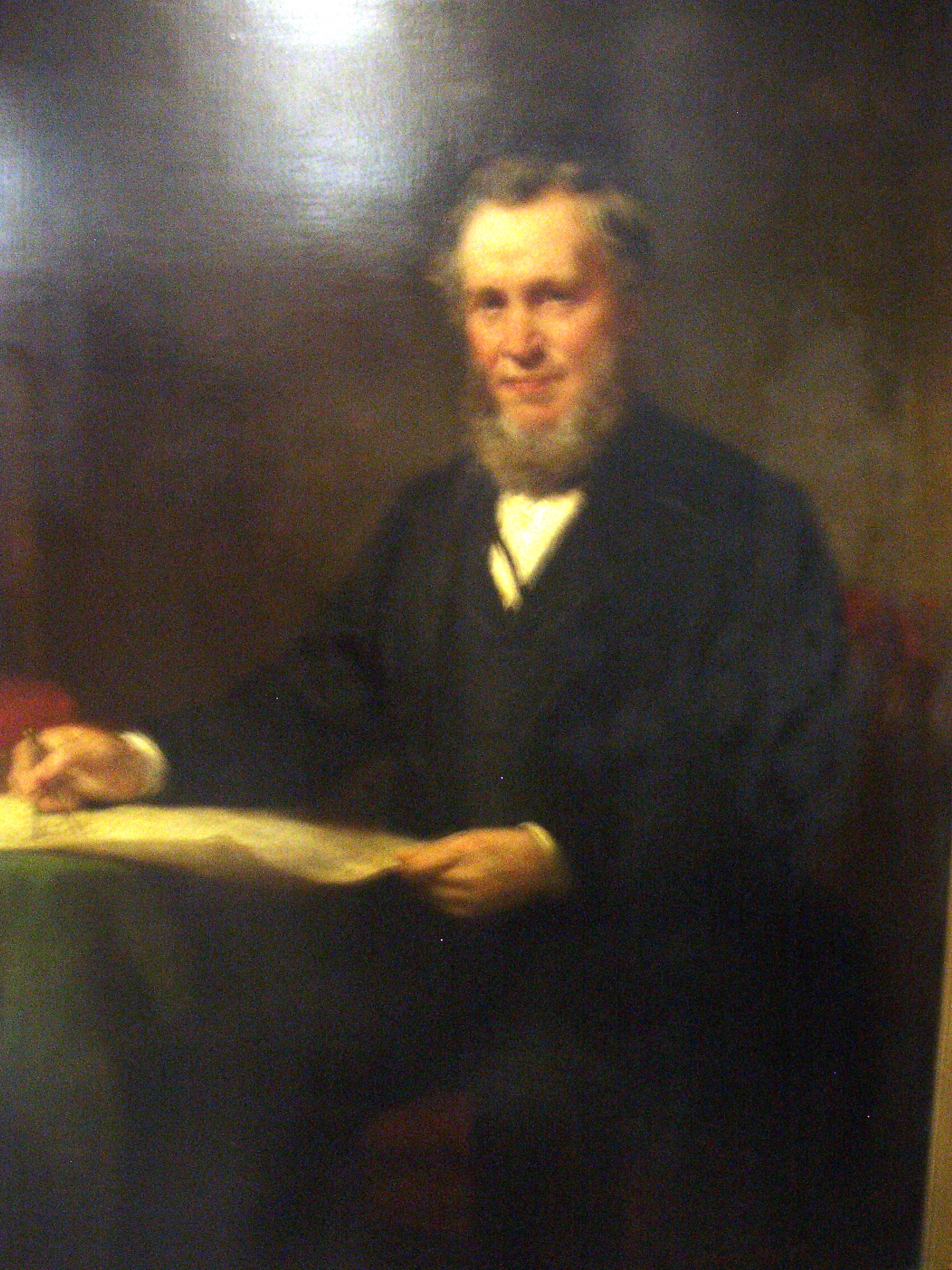
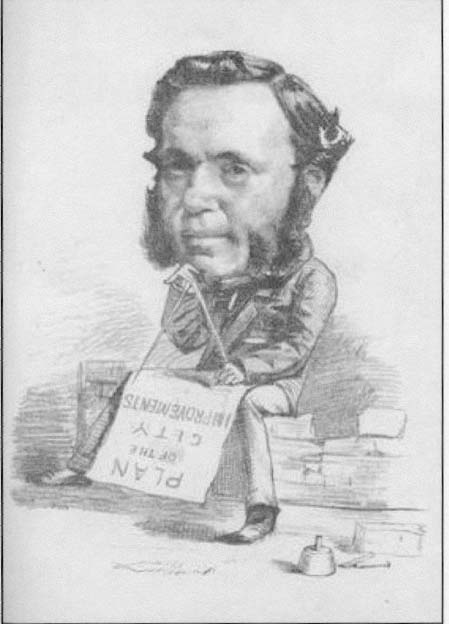
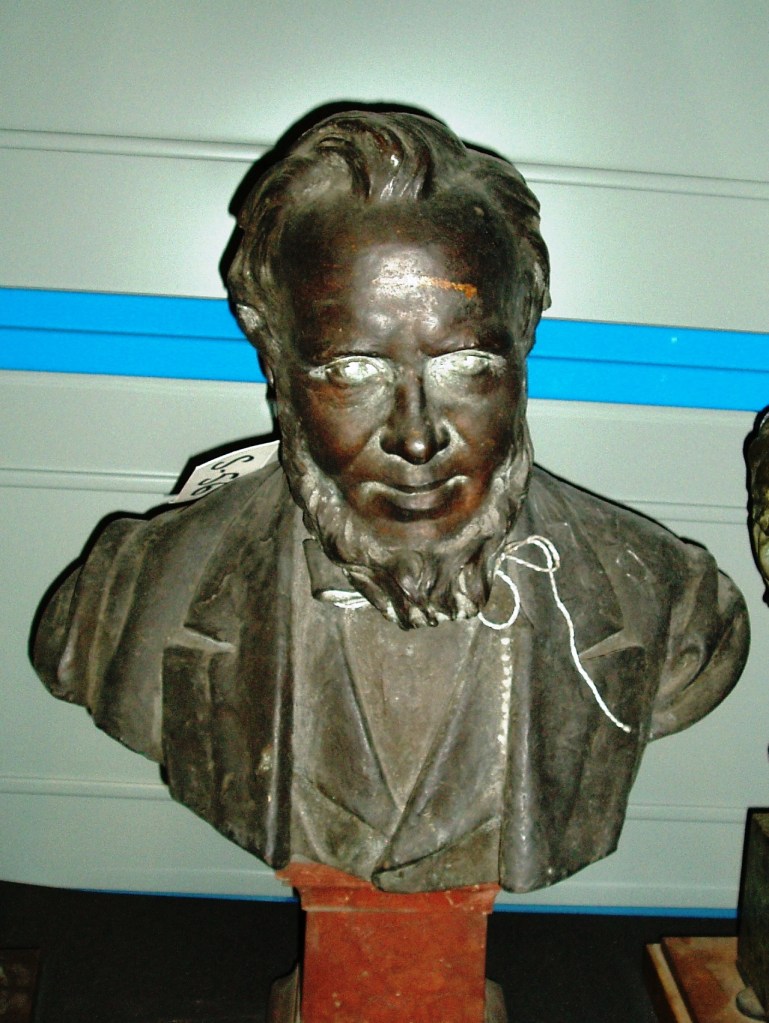
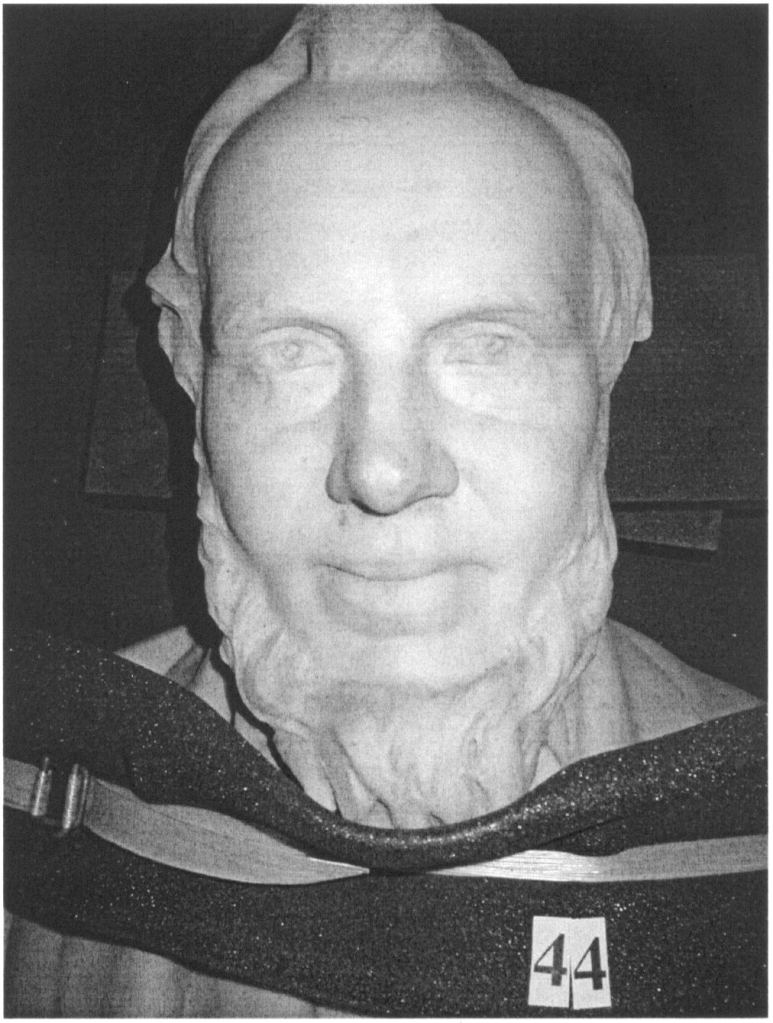
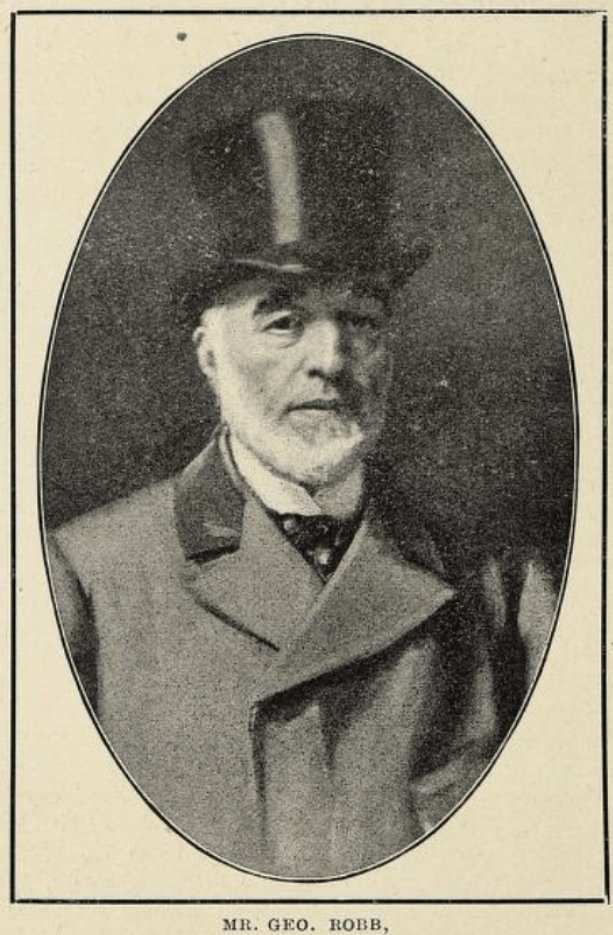

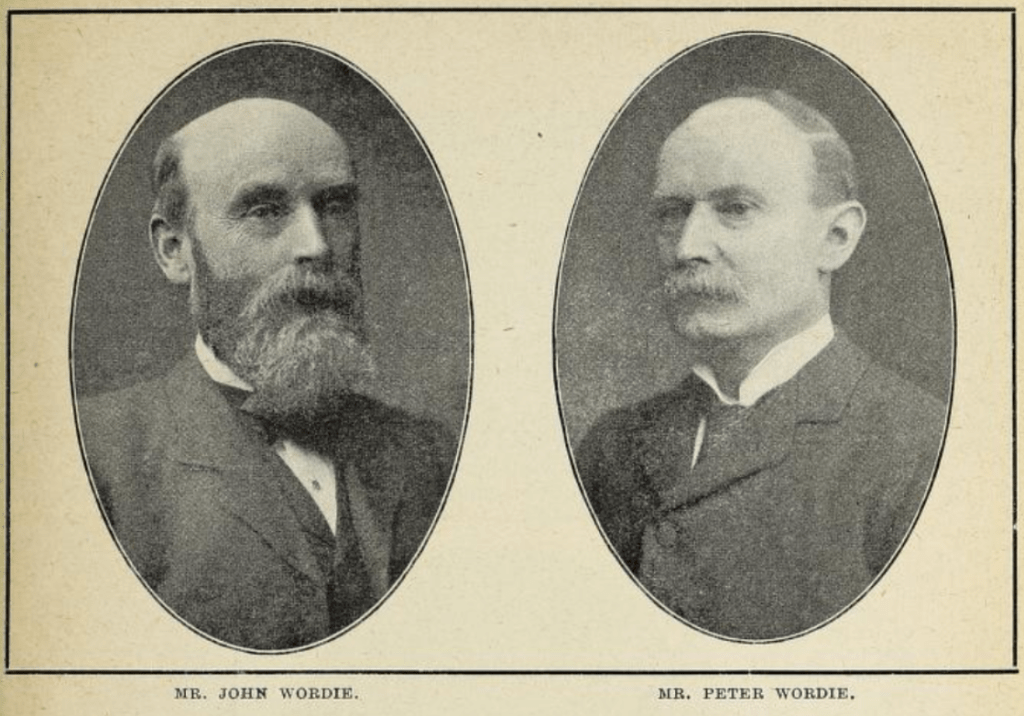

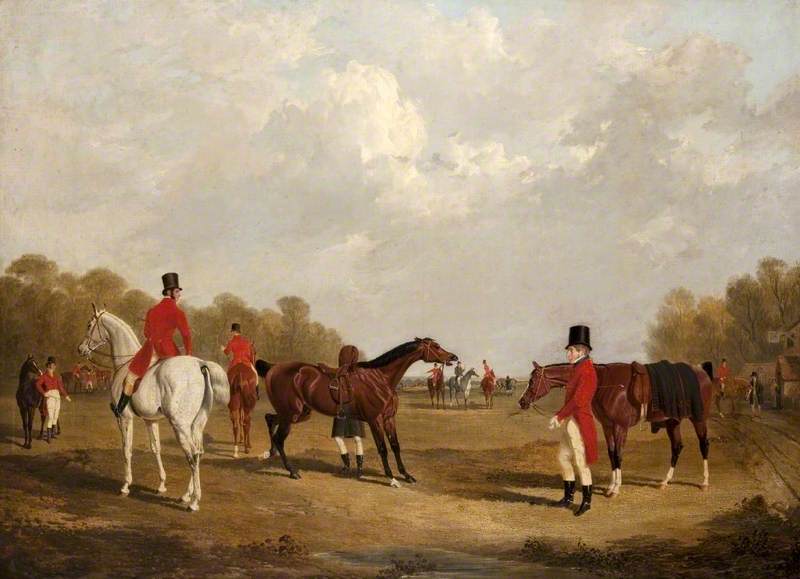


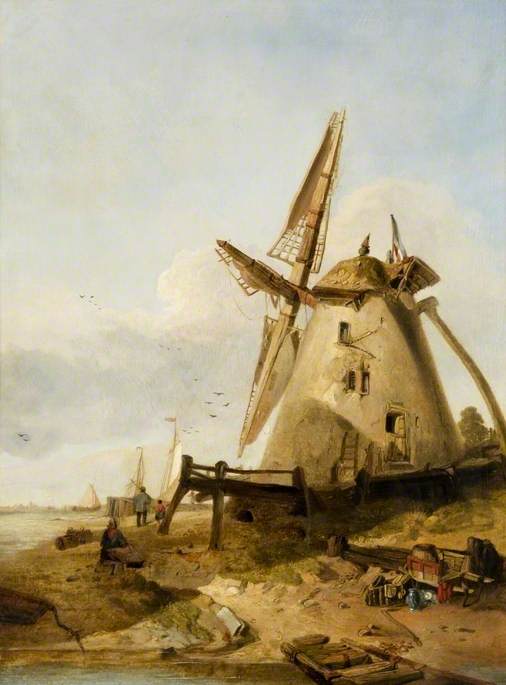
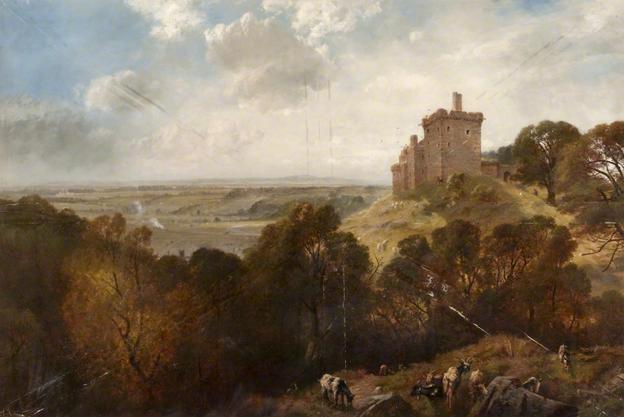
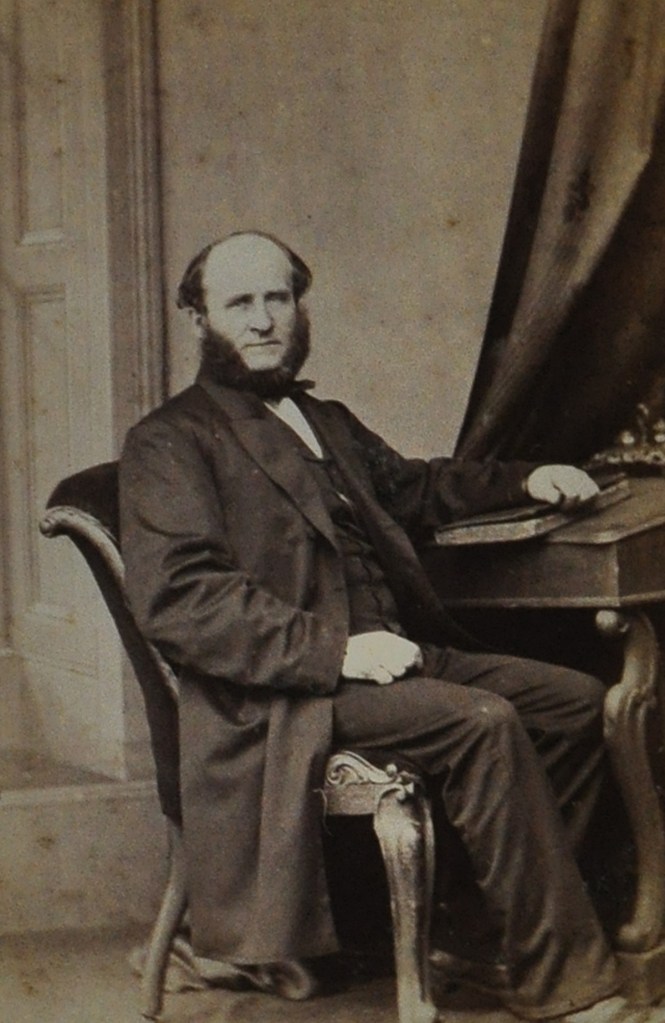


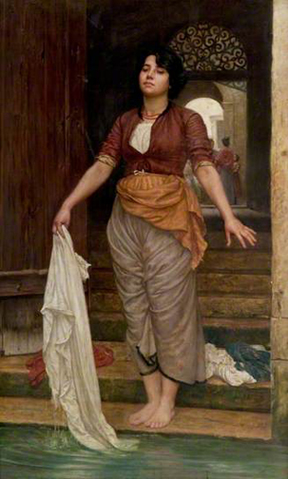
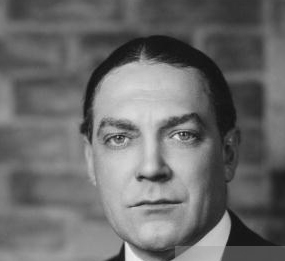
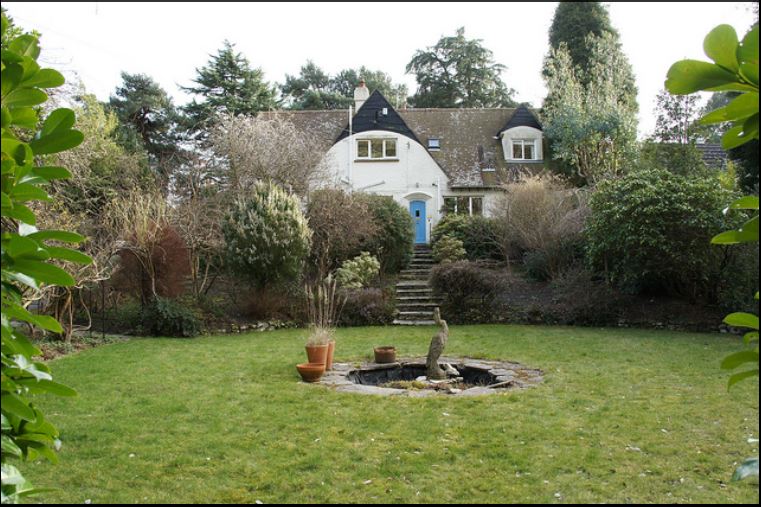
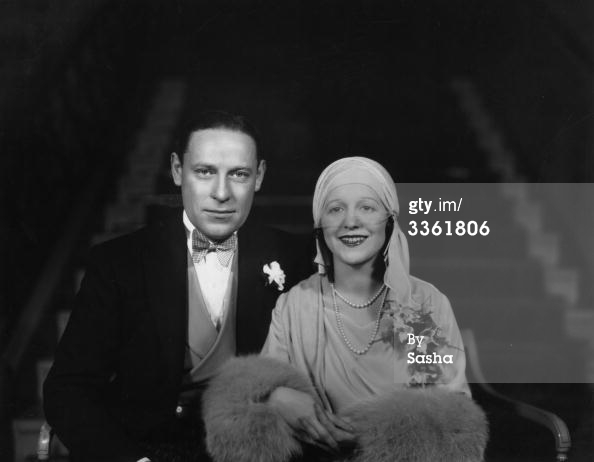
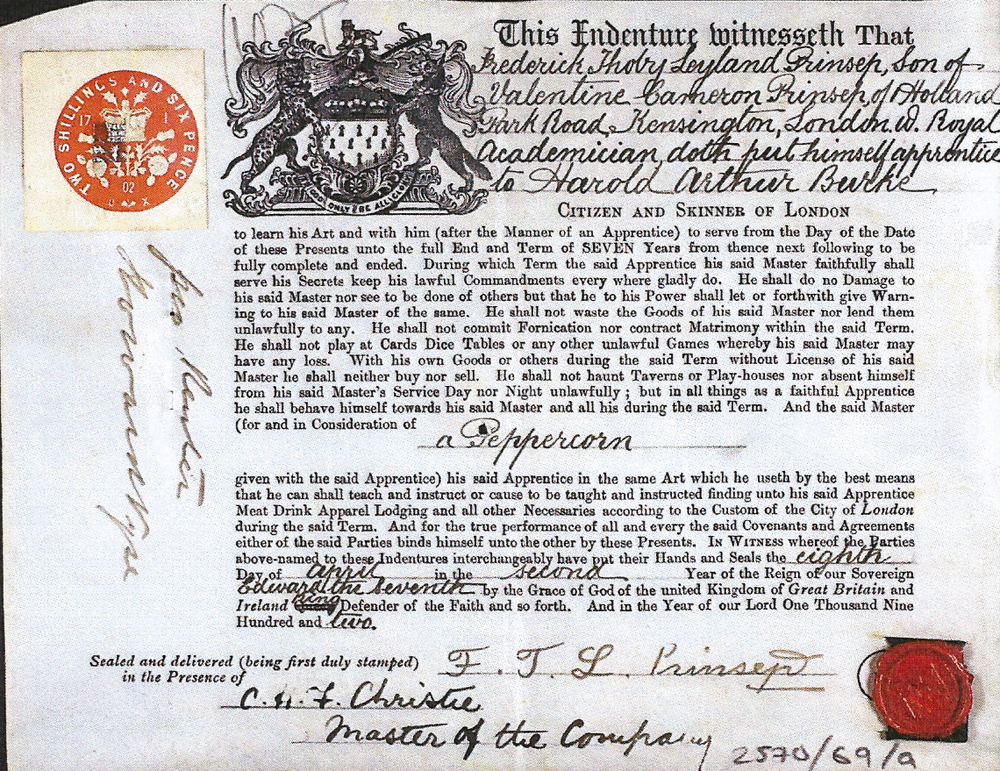


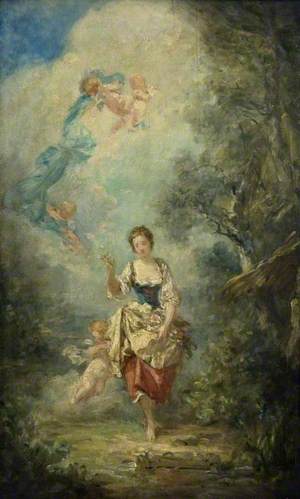


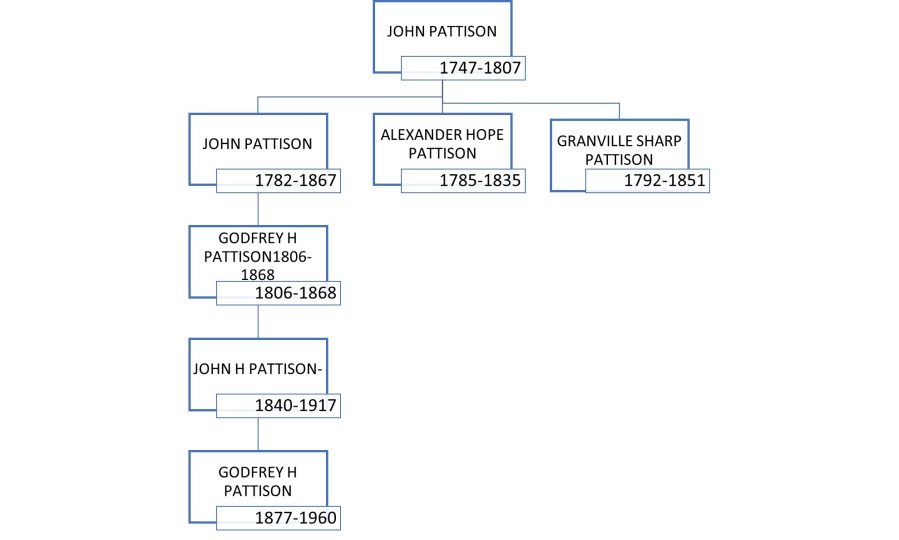
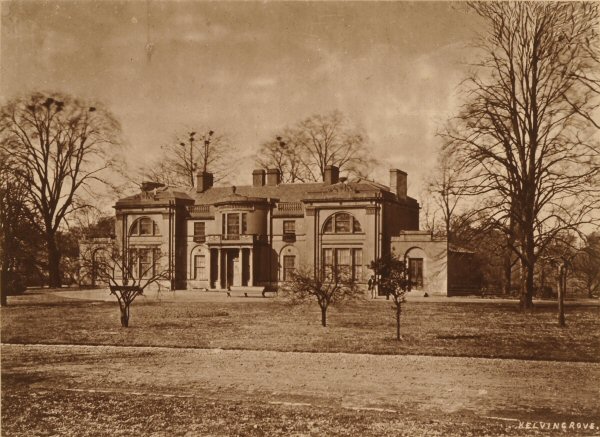
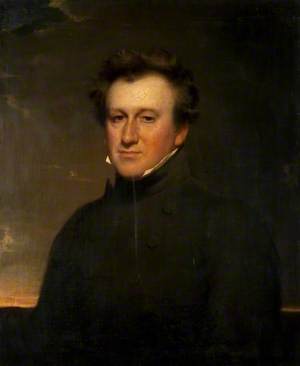
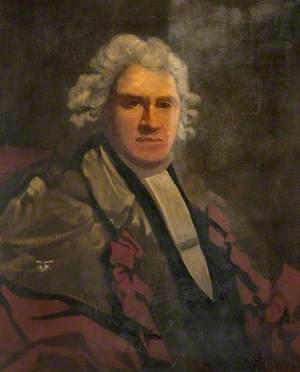
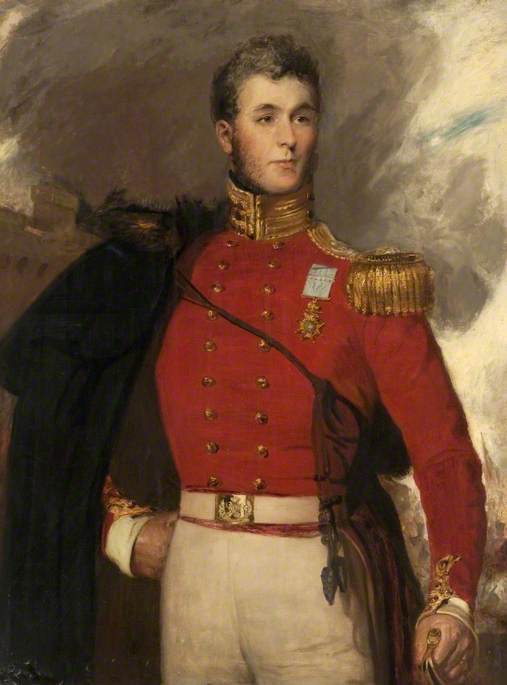
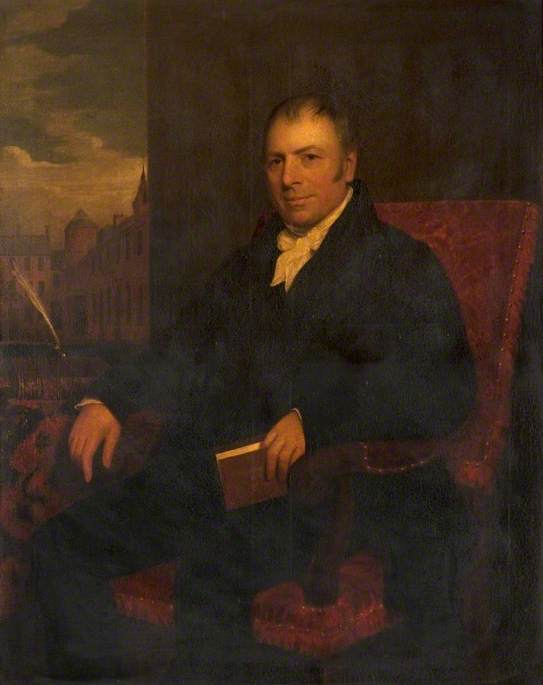
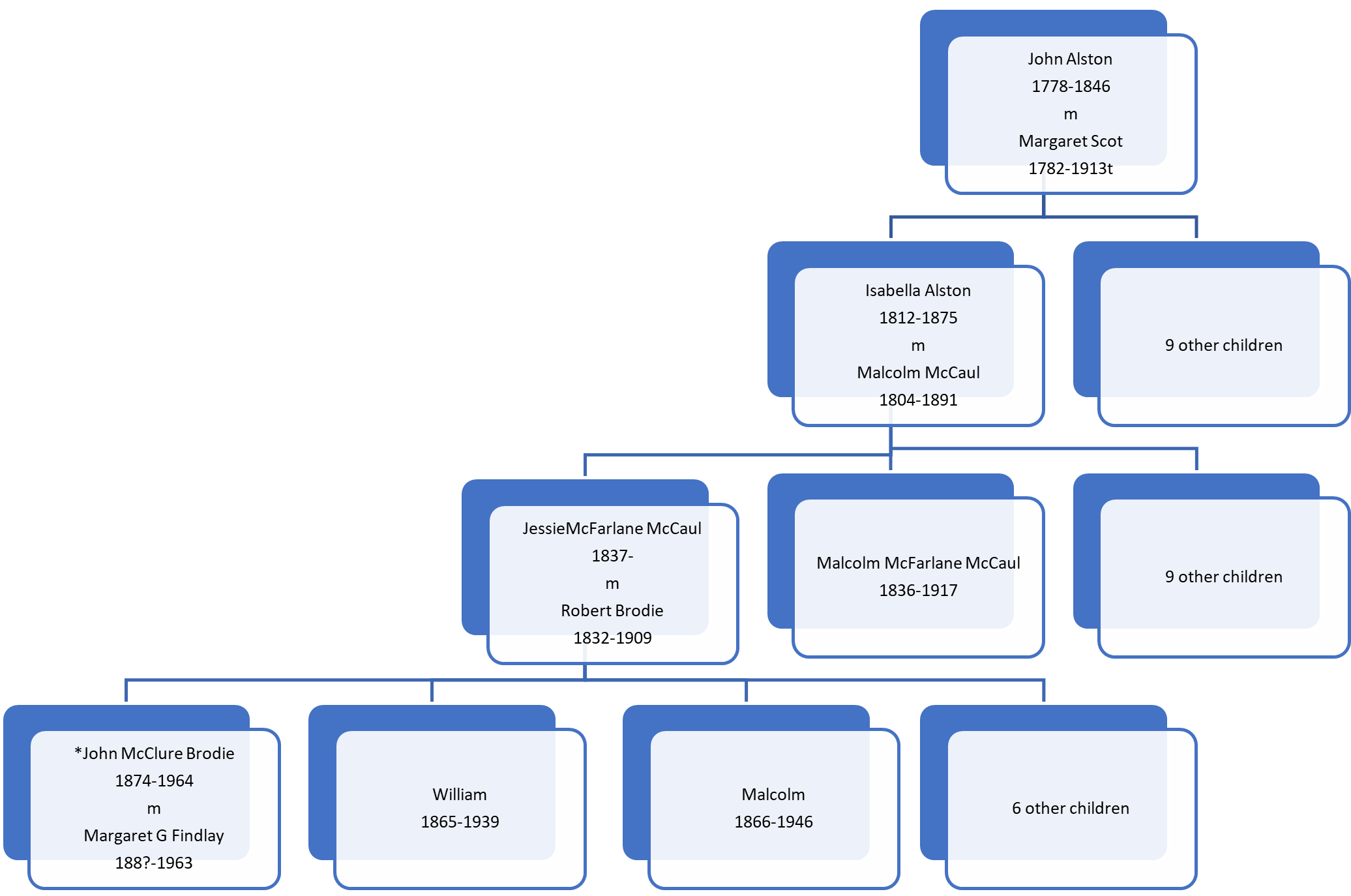
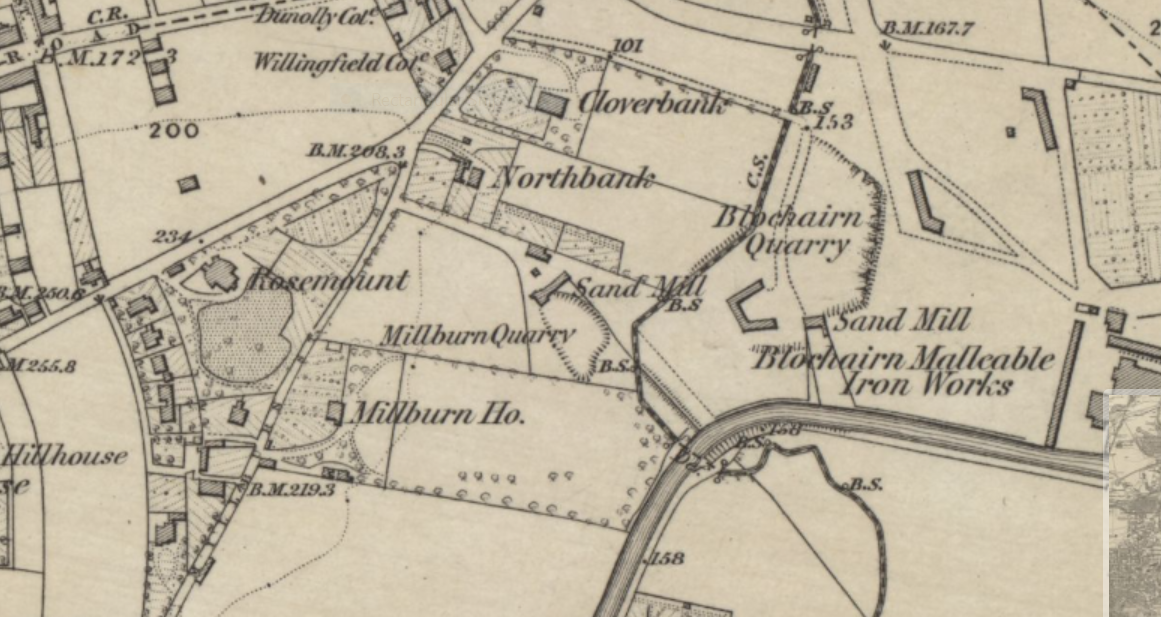
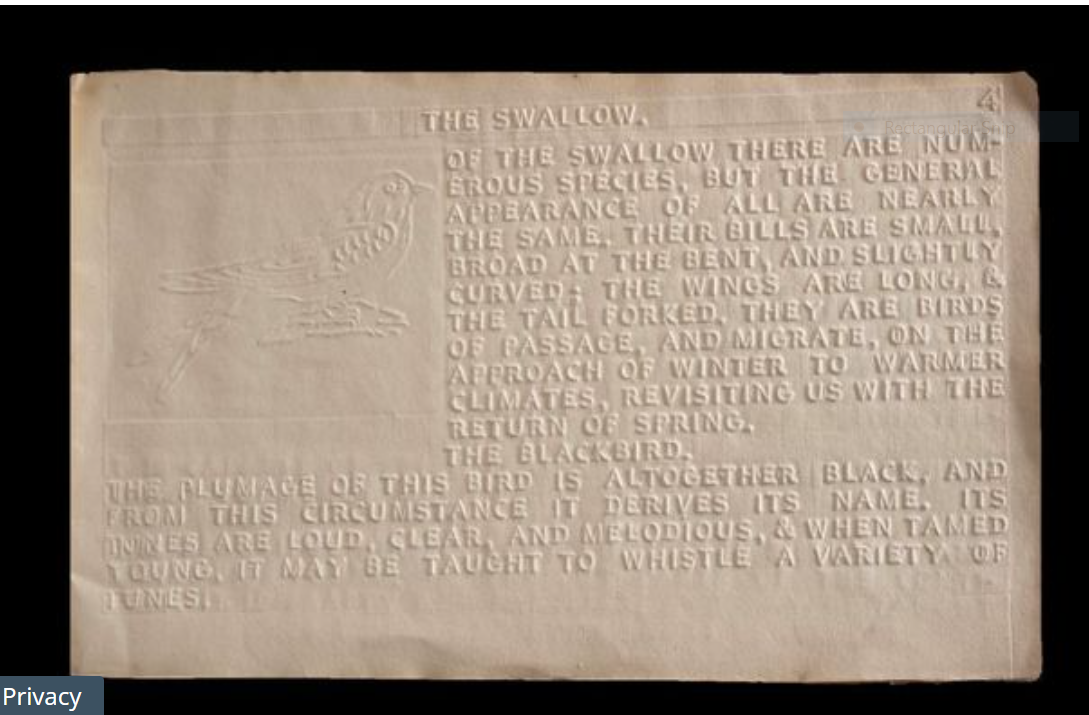
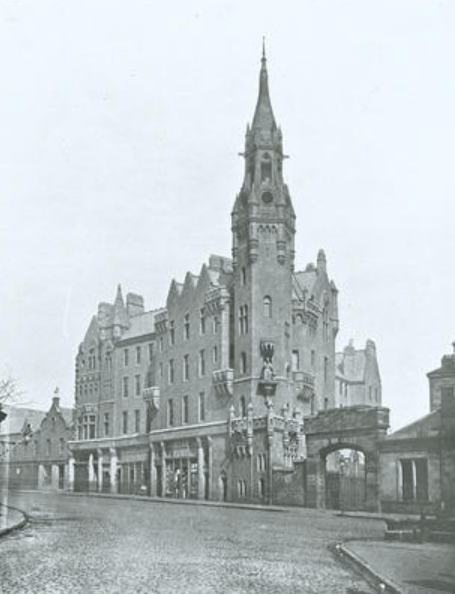
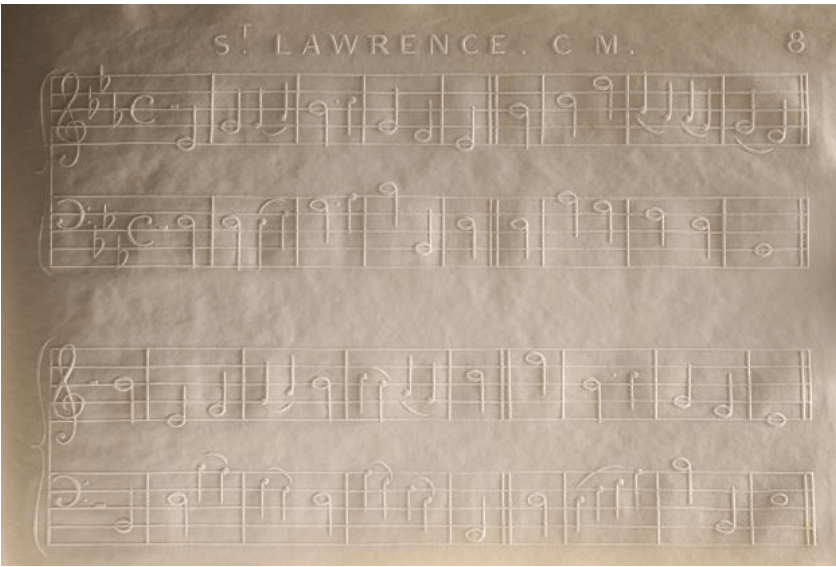
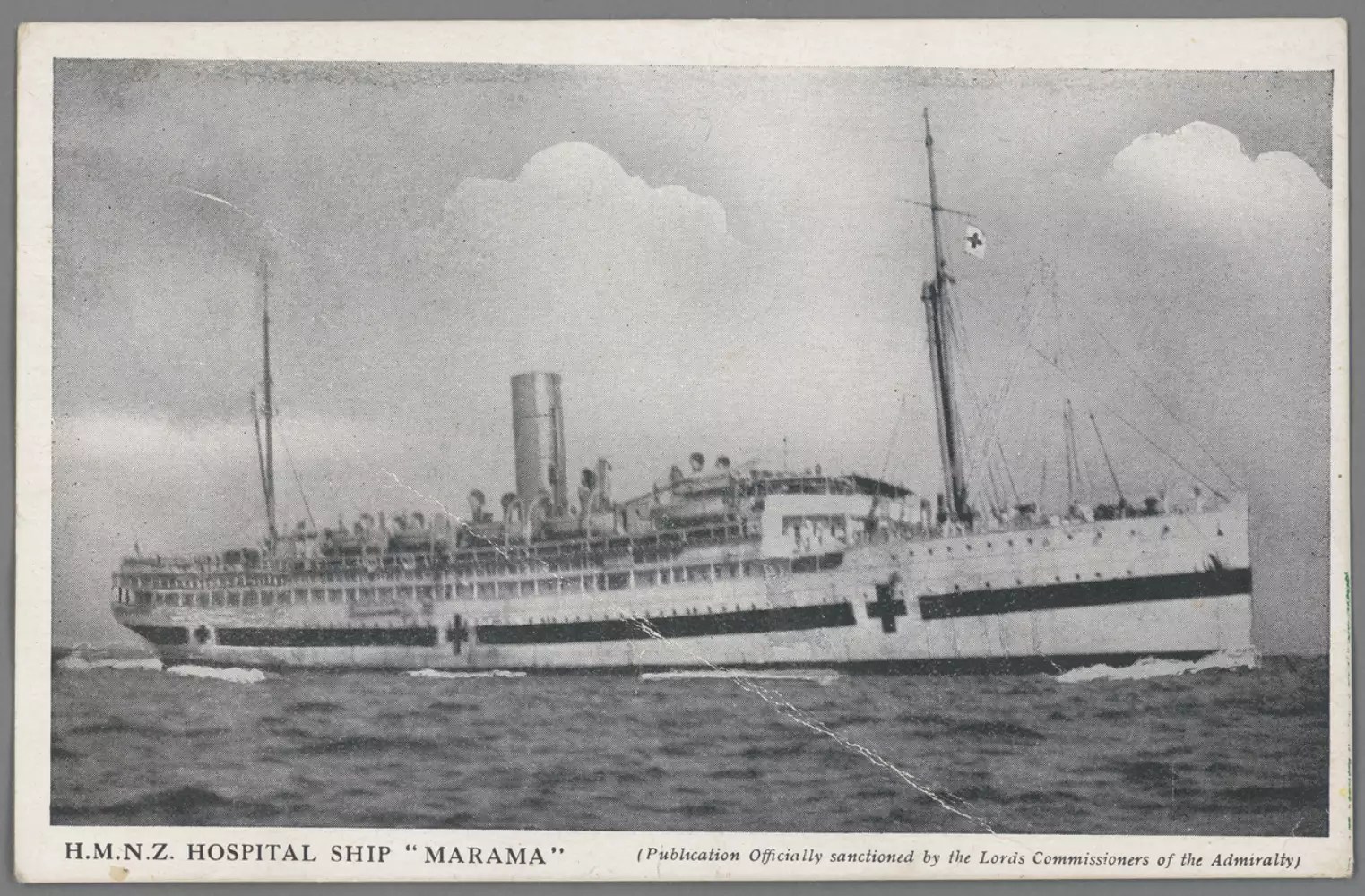
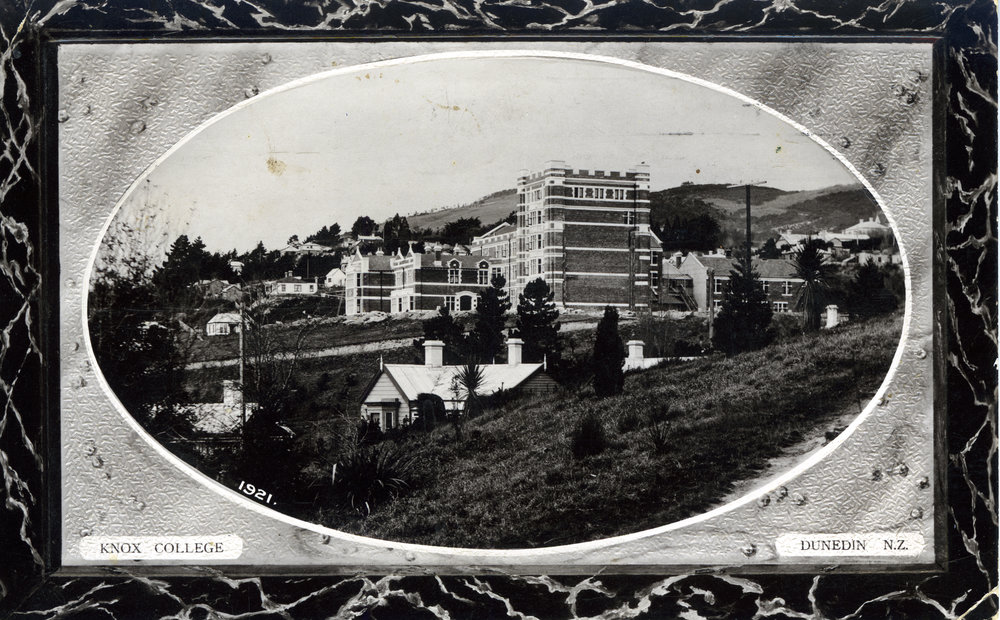
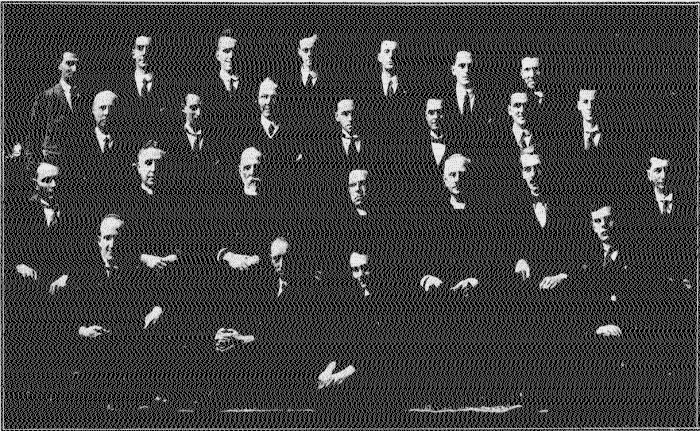
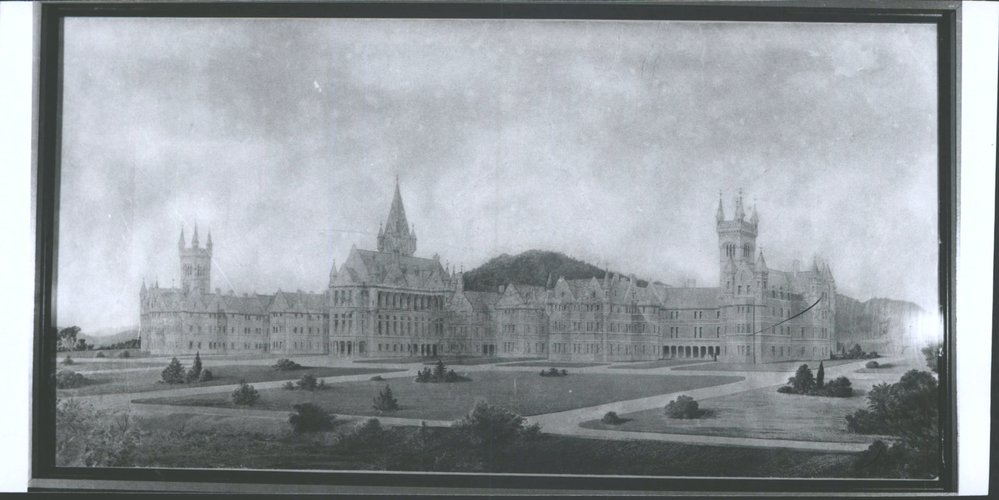
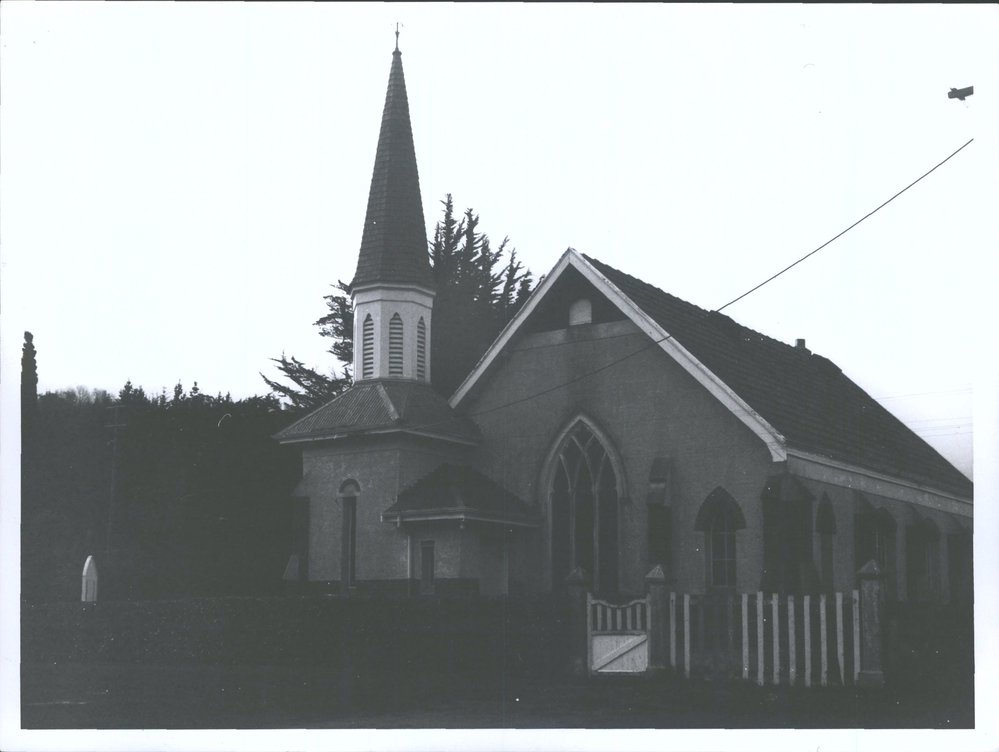
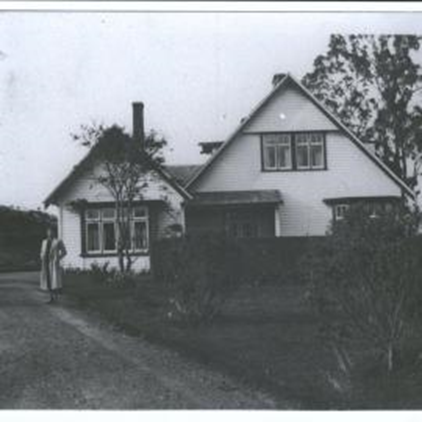


 Glasgow Museums Art Donors Group