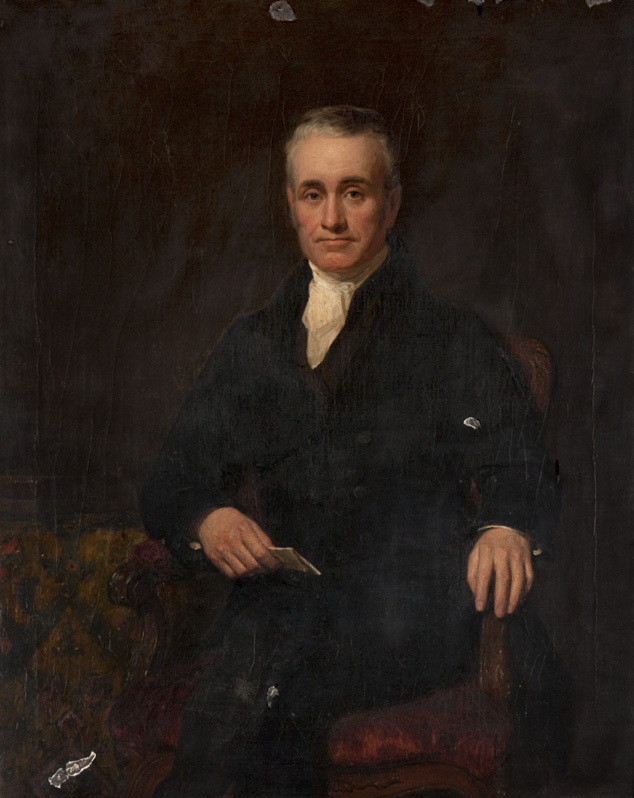
The Portrait of the late Charles Tennant by Andrew Geddes was received by Glasgow Corporation in 1920. It had been bequeathed by his grandson, James Couper, to his wife Jane as life rent (2) and under the terms of his Will, after her death, was then to be given by his Trustees to Glasgow Corporation.
James Couper was born on 13 September 1839 (3) the son of John Couper MD MRCP, Regius Professor of Materia Medica at Glasgow University (4) and his wife Charlotte Couper. His mother was the daughter of Charles Tennant (5) and his father was the son of Tennant’s great friend and associate, William Couper. (6)
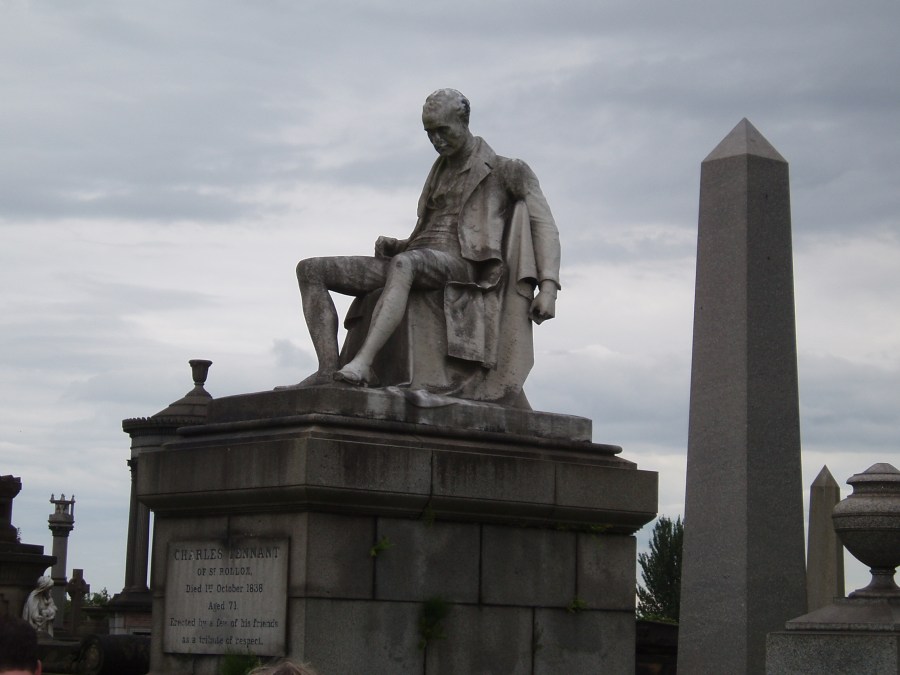
The monuments to these men are side by side in the Necropolis in Glasgow. (7)
In the 1871 Census James Couper is living in Glasgow but visiting his parents and he is a manufacturing chemist. (8) James Couper moved to Craigforth in Stirling in1873 as a tenant and eventually as owner in 1904. (9) In the 1881 Census he is listed as a manufacturing chemist, his wife is Jane, he has two sons, and 8 servants are listed. (10) Craigforth is an impressive country house now on the M9 looking towards Stirling Castle and the Wallace Monument. Couper was a director of the Steel Company of Scotland and of Messrs Ogston and Tennant. (11) He and his wife were active in local society and contributed to charitable and civic activities in Stirling. (12) In 1878, James and Jane gave the Bishop’s Chair to the newly established Episcopal Church of The Holy Trinity in Stirling. (13)
He was a Director of Stirling Royal Infirmary and of The Albert Hall Company while these were being built. (14)
He died in the Central Hotel in Glasgow on 13 June 1916. (15)
His funeral was attended by many people including his nephew Mr. Charles Tennant Couper. He is buried in Logie cemetery. (16)
Charles Tennant (1768-1838) was a bleacher from Ayrshire with bleach fields in Darnley. (17) There is a watercolour of the bleach fields by an unknown artist in the collection of Lady Maxwell in Pollok House, Glasgow (18) and a map from 1791 showing their location in the East Renfrewshire Public Library in Giffnock. (19) He went on to develop the first chemical method of bleaching using bleaching powder and to establish the St Rollox works in Glasgow, the first great chemical works in the world. (20) His son John Tennant (21) developed the firm and built Tennant’s Stalk- a huge chimney in the North of Glasgow. His son was Sir Charles Tennant, an art collector, Liberal politician and industrialist. He was the founder of a family well known in social and political circles. (22) (23) In 1926 the business became part of Imperial Chemical Industries and in 2008 became part of Atezo Nobel. (24)
References
Archives of Glasgow Museums
National Records of Scotland Wills and Testaments 1916
National Records of Scotland Statutory Births 1839
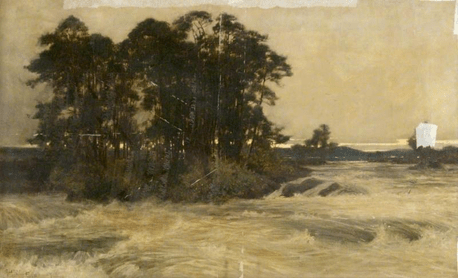
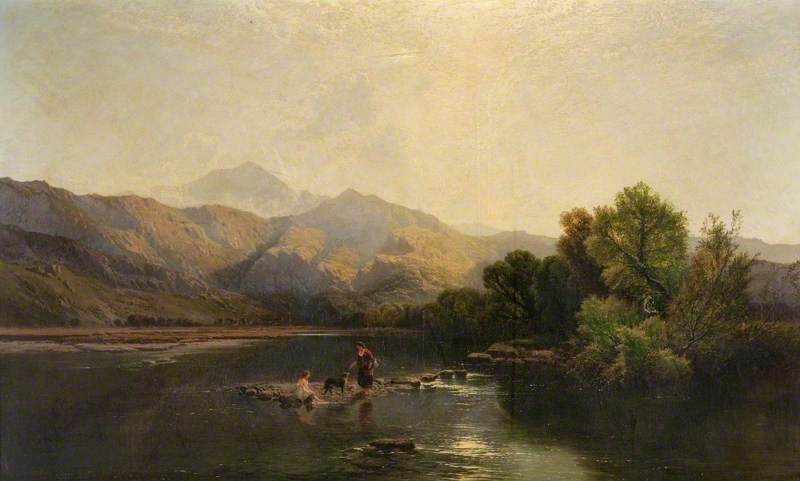
In August 1918, the Trustees of the late Mr George Dickson presented a painting called Falls of the Dochart, Killin by Sir Alfred East (1844–1913) as a memorial to Mr George Dickson. [1]
The above painting that was presented to Kelvingrove Gallery, on behalf of our donor, was painted by Alfred East who was born in 1844 in Kettering and died in 1913, four years before our donor George Dickson’s death. By a strange coincidence Alfred East’s family as well as our donor’s family were both in the shoe business. A letter received from a research assistant in the Alfred East Gallery, Kettering, (http://www.kettering.gov.uk) at our request, gave some information regarding Alfred East. In the following lines this information is summarised.
After the death of his father, Charles East, in 1876, Alfred East became a junior partner in the business, with his nephews, Walter and Fred East. In Glasgow, he attended his first evening classes at the Government School of Art. In 1880, he resigned from the family business and with his savings and a part-time job in a bank, he was able to attend the Glasgow School of Art. How long he spent there is unclear, but by 1882 he was in Paris studying at the École des Beaux Arts and, later, the Académie Julién. He painted A Dewy Morning (a Barbizon landscape) in 1882, which was his first work to be exhibited at the Royal Academy in 1883.
It transpired that Alfred East managed his family’s firm’s warehouse and appears to have been the firm’s representative for sales and distribution in Scotland as well as in the north of England. In around 1874, he was sent to Glasgow by his family’s shoe business. It is possible that Alfred East and George Dickson might have met in Glasgow and perhaps the painting that was given to Kelvingrove Gallery and Museum was then bought by George Dickson from Alfred East. But the research assistant mentioned in his letter that he could not find any notes or indicators in the records that such an encounter had ever taken place.
Our donor, George Dickson, was born on 18 October 1829, in Glasgow. His father was James Dickson and mother was Janet Dickson (née Janet MS Nimmo). He was baptised
on 22 November 1829 in the Gorbals district of the city. When he was 10 years old, his family lived in Saltmarket Street, Glasgow. His father, James Dickson, was a currier, a craftsman who curries leather for shoe making and any other articles such as gloves. [2]
It may be appropriate at this juncture to mention that the Incorporation of Cordiners is one of the fourteen ancient crafts which comprise the Trades House of Glasgow founded in 1605. It has its meetings in the historic Trades Hall designed by Robert Adam in 1791. The Incorporation of Cordiners in Glasgow has been supporting aspiration in the leather trade for nearly five-hundred years, certainly long before it received its Deed of Cause in 1558. [3]
There is not much information available about our donor’s early education, but it is known that there was quite an emphasis on education in Scotland during the nineteenth century. Scotland has long enjoyed an international reputation as historically one of the best-educated countries in the world. The foundation for this reputation was laid in the seventeenth century and was the result of the Calvinist emphasis on reading the Bible. Putting men and women in touch with the word of God was seen by the Scottish authorities and clergy as of paramount importance. To achieve this goal, schools paid for by the Church of Scotland and local landowners were established in all rural parishes and burghs by an Act of Parliament in 1696.
These educational establishments were run by the Church and were open to all boys and girls regardless of their social status. The democratic nature of the Scottish system had so impressed the eighteenth-century writer Daniel Defoe that he remarked while England was a land ‘full of ignorance’, in Scotland the ‘poorest people have their children taught and instructed’. The openness of the Scottish system ran all the way from the schoolroom to the university. A talented working-class boy the ‘lad o’pairts’ (a clever or talented fellow) through intelligence and hard work and by utilising a generous system of bursaries was able to gain a university education, something largely unthinkable in England in the eighteenth century. [4]
Therefore, we can assume that there had been a good education available to George Dickson as he was growing up. He had married Annie Buchanan on 20 February 1857 in Glasgow. [5] The I871 Census shows that, they had 5 children by that date. They were James (13), George B. (11), Robert (8), Oliver (6) and Jessie Ann (2). [6]
Also, in the censuses available during his lifetime, we see that he lived at several different addresses. The address given in the 1871 Census indicates that Dickson and his family lived at 2 Abercromby Terrace. Glasgow. In the 1881 and 1891 censuses, his home address is given as 15 North Claremont Street, Glasgow, then it changed to 8 Sandyford Place, Glasgow where he stayed until his death in October 1917. [7] His death was recorded in the Deaths column of the Glasgow Herald of 13 October 1917. [8]
His death certificate indicates that, he was a boot and shoe merchant, though the certificate could not be traced. As his father before him was a currier, it appears that he had followed his father’s footsteps into the shoe business. There are also recordings in the censuses during his lifetime that he had been a boot and shoe merchant. His premises were in 449 Argyle Street in Glasgow, which was later extended to include 451 Argyle Street, Glasgow. Furthermore, after his death, when his son Oliver Dickson was in charge, the company was extended further to have many branches throughout Glasgow.[9]
It is interesting to note that our donor lived after the Napoleonic Wars (1792-1815) and during the time when Wellington boots were becoming fashionable in Great Britain. To see how the name of Wellington Boots came into being, the following story can be read online at the following reference. [10]
Acknowledgement
Help of the Archive staff of Mitchell Library, Glasgow and also the Trades House Glasgow is greatly appreciated.
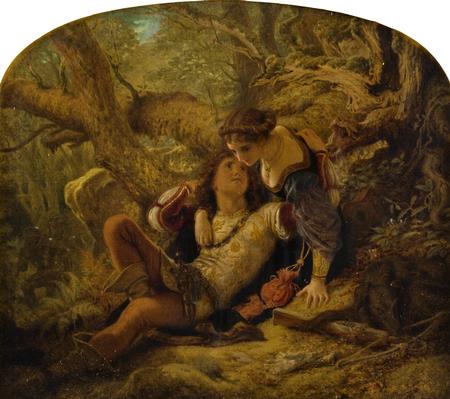
This painting has labels on the reverse, ‘19219’; ‘Pictures with Care Dr T. J. Honeyman Glasgow’; ‘G E Campbell’ ‘no. 2/’; ‘5GA’; ‘6013-2’S’. At one time it was in the possession of Asher Ezra Wertheimer a London art dealer. It was sold at Christie’s, London in 1923. 3
Also in 1952, a companion piece to the above was purchased from George Campbell by Glasgow Corporation. This is Sylvia Saved by Amintas also by François Boucher (after) (2958)
The artist F. J. Conway (Ferdinand Joseph Conway) 4 was born on 19 January 1888 in Paddington, London. 5 He was the son of the British art dealer Asher Ezra Wertheimer and his wife Flora. Asher had inherited premises in London from his father Samson. Ferdinand and his older brother changed their name to Conway ‘perhaps to avoid anti-German sentiment during the First World War’. 6 He became known as Bob Conway, artist, and writer. John Singer Sargent was commissioned by Asher to paint twelve portraits of his family between 1898 and 1908. Nine of these portraits are now in the Tate Britain Gallery in London.
When Conway died on 1 April 1950, he left his house, Tarras, Crawley Drive, Camberley, ten thousand pounds, ‘and all my personal chattels’ to his friend George Edgar Campbell. He also instructed his trustees to pay George Edgar Campbell during his lifetime, the income from his estate. 7 Although not specifically mentioned in his will, it is likely that the two donated paintings were among his ‘personal chattels’ since Conway and Campbell shared the same house for many years.
George Edgar Campbell was born on 9 December 1899 in Liverpool. 8 His parents, Thomas Campbell and Margaret Farrell were Scottish. He was christened at Edge Hill on 10 January 1900. 9 In 1911 he was living at 85 White Rock Street, Liverpool, the youngest of the family of four sisters and four brothers. His eldest brother Thomas Matthew Campbell aged 33, a railway van man, was head of the family his mother having been widowed. An uncle, Robert Edmond Farrell was also living with them. 10
On 20 August 1917, George, aged seventeen, joined the White Star Line shipping company as a steward and sailed to New York aboard the RMS Adriatic. He is described on the ship’s manifest as ‘Scotch’. 11 The following year from 1 to 25 June he served as an ordinary seaman in the Royal Navy Volunteer Reserve (RNVR) on HMS Vivid 3 based at Devonport. From 26 June to 20 October, he was based at HMS Victory 6. Like H.M..S Vivid, this was a land-based establishment and not an actual ship. (At this time, Crystal Palace was used as a Royal Navy training establishment and was given the name HMS Victory 6). He returned to HMS Vivid on 21 October 1918 and remained there until discharged with a disability on 6 February 1919 and was paid a war gratuity.12 The RNVR records describe him as being 5’10”, 38” chest with light brown hair, grey eyes and a fair complexion. His character was VG and his ability Satisfactory.
After his war service, George enrolled in the Regent Street Polytechnic to study sculpture. After five years he passed the exams of the Royal College of Art and won the Whitechapel Prize for sculpture. On completing his studies, he travelled in Italy, Switzerland and the USA and lived for a time in France. 13 He continued to sculpt and between 1934 and 1937 he completed at least three works, Virginia (1935), Helen (1936) and A Youth (1937) which were shown at the Royal Scottish Academy (RSA) of Painting, Sculpture and Architecture exhibitions between 1935 and 1937. His address at that time was 26 Holland Villas Road, London, W14. Between 1934 and 1966 he exhibited one or two works per year (twenty-two times in all) at the Royal Academy of Arts summer exhibitions. 14
‘Bob’ Conway commissioned a house to be built at 32 Newton Road, Paddington from the architect Denys (later Sir Denys) Lasdun. The house was completed in 1938 and was occupied by Conway and Campbell till at least 1943.15
The house was bought in the 1950s by the cartoonist Ronald Searle and his wife Kaye Webb. It was remarked that the house was,
‘built for a pair of bachelor artists, (unknown artistically, but extremely wealthy) it was topped by a splendid studio favoured by north light, as the estate agents say, and a fine terrace overlooking half of Paddington. As Searle remarked to his friend David Arkell, ‘If one had to overlook half of Paddington, this was the way to do it.’ 16
The Searles found that ‘the cellar was full of stuff left by the previous owners (including several Lucian Freuds, which they returned)’.17
It is not clear that the ‘previous owners’ were Conway and Campbell since in 1943 they were in residence at Tarras, Crawley Drive, Camberley. In that year George Campbell exhibited Archangel Gabriel at the RSA. 18
George Campbell again saw service in WW2. He was promoted to lieutenant on 23 June 1941 and, as part of the Royal Naval Reserve, was stationed at the shore base HMS Lucifer in Swansea. 19 This was the base for a mine sweeping trawler fleet tasked with ensuring the Bristol Channel was kept free of mines. 20
When Conway died in 1950, he left an estate valued at £83,690 with George Campbell one of his trustees and main beneficiary, He was buried in St. Peter’s Churchyard, Frimley, Surrey. 21 George Campbell had two nephews and a godson living in Sydney 22 and on 22 November 1951, he travelled first class to Australia aboard the P&O steamship Strathnaver. His London address was now 37 Holland Park Road, W.14. 23
On his return he continued to exhibit at the Royal Academy summer exhibitions, and he also executed a large amount of religious works. He became an Associate Member of the Royal Society of British Sculptors (RSBS) in 1941 and organized Children in Sculpture for the society in 1947. Two years later he served as a Member of Council. He was elected a Fellow of the RSBS in 1951. 24 In the same year, Glasgow Corporation bought one of his sculptures, Torso from the Royal Glasgow Institute of the Fine Arts Exhibition. 25
George Edgar Campbell died on 11 May 1976 at 71 Marsham Court, Marsham Street, London, SW1. He was seventy-six.26
On 10 March 2021, a 44.5 inch, bronzed, plaster maquette by Campbell, of Judith at the Well was put up for auction with an estimate of £1500 – £2000. It was unsold. 27
Figure 7. Judith at the Well
References
Catalogue of Donors to Glasgow Museums, Glasgow Museums Resource Centre
Ibid
Toutziari, Dr. Georgia, National Inventory of Continental European Paintings, Culture and Sport Glasgow (Museums): Kelvingrove Museum
FamilySearch.org., England Births and Christenings, 1538-1975
ancestry.co.uk, Census 1911, England
ancestry.co.uk, New York, U.S., Arriving Passenger and Crew Lists (including Castle Garden and Ellis Island), 1820-1957
https//www.forces-war-records.co.uk
Stevenson, Hugh, Catalogue of Sculpture Collections, Glasgow Museums Resource Centre, August 2008
‘George Edgar Campbell’, Mapping the Practice and Profession of Sculpture in Britain and Ireland 1851-1951, University of Glasgow History of Art and HATII, online database 2011 [http://sculpture.gla.ac.uk/view/person.php?id=msib6_1204564125, accessed 12 Nov 2021]
‘George Edgar Campbell’, Mapping the Practice and Profession of Sculpture in Britain and Ireland 1851-1951, University of Glasgow History of Art and HATII, online database 2011 [http://sculpture.gla.ac.uk/view/person.php?id=msib6_1204564125, accessed 12 Nov 2021] This gives George Campbell`s address from 1943
ancestry.co.uk, UK and Ireland, Outward Passenger Lists, 1890-1960
‘George Edgar Campbell’, Mapping the Practice and Profession of Sculpture in Britain and Ireland 1851-1951, University of Glasgow History of Art and HATII, online database 2011 [http://sculpture.gla.ac.uk/view/person.php?id=msib6_1204564125, accessed 12 Nov 2021]
Catalogue of Donors to Glasgow Museums, Glasgow Museums Resource Centre
J D C White was born at Hayfield House, Rutherglen on 18 August 1871, to John Orr White and Fanny Campbell White (2) who were second cousins and came from a family of industrialists. The family moved to London. His father died on 22 January1879 (3) but his mother continued to live in London. (4) He was educated at Charterhouse School where he did well. (5) He then attended Trinity College Cambridge and in his five years there he was awarded a BA First Class in the Classical Tripos (1894) and also in the Theological Tripos (1896). He proceeded to an MA in 1899. (6) He went to the London Hospital where he was a House Physician and qualified MRCS and LRCP. (7) In 1905 Cambridge awarded him an MD. (8) He did not go into medical practice but joined the Lister Institute to undertake research. This was made possible in 1908 because he was his uncle Lord Overtoun’s heir and on his death inherited his estate in Dunbartonshire. (9)
His research was mainly into the social aspects of venereal disease and he was a member of the British Social Hygiene Council. (10) In the following years he published and lectured quite widely. In the First World War he was a Captain in the Royal Army Medical Corps. (11) In 1922 he was sent by the army to Constantinople to conduct an anti-venereal disease campaign. (12) From 1923 he was Chairman of the Council of the Tavistock Clinic. (13)He was a committed Christian and continued to take an interest in religious affairs. He had been ordained a Deacon in the Church of St Peters in Eaton Square, London in 1898. (14) He was Chairman of the Council of the Modern Churchmen’s Union from 1923 to 1930. (15)
In 1898 he married Lucy Agnes McClure (16) and they had a son. He died at Harrow-on the-Hill on 25 March 1940. (17) His life is summed up in the BMJ obituary: ‘Circumstances made it possible for him to do unpaid jobs; training made him competent to look on sociological problems from both ethical and physiological viewpoints.’ (18)
The White family members were industrialists and chemical manufacturers in the west of Scotland. They combined business acumen with strong religious beliefs and a commitment to civic service. (19) The family had come out at the Disruption in the Church of Scotland and clung to the ethics of the Free Church.
In the early years of the nineteenth century, brothers James and John White established a factory to make soda and soap in Shawfield, Rutherglen near Glasgow. By 1830 they were producing potassium dichromate, used as a mordant for the dye industry. By 1850 the site covered 200 acres and employed 500 men. It was a very successful business, a near monopoly, because of the large textile factories within Glasgow and Paisley. (20) James was well known in business and for philanthropy and his statue now stands in Cathedral Square, Glasgow. (21)
Their sons, John Orr White, son of James and John Campbell White, son of John, carried on the business but it was John Campbell White who became best known. (22) He studied at Glasgow University, graduating MA and studied law before entering the business. (23) Over the years he left others to run the business and devoted himself to philanthropy and religious causes and gave much time and money to charity. He was a powerful figure in the Liberal Party and became Baron Overtoun in 1893. He developed his estate in Dumbarton at Overtoun which he had inherited from his father.
The chrome business was successful but it was a dirty business. Little heed was paid to the well-being of workers or to the disposal of toxic waste. In 1899, the workers went on strike and their cause was taken up by Keir Hardie. This became a cause célèbre with much criticism of Lord Overtoun and can be followed in the Scotsman. (24) (25 ) (26 )(27) Opinions are divided about how much Lord Overtoun was involved. Eventually a compromise was reached and the workers returned to work with improved conditions of employment but the legacy of chrome persisted in ill health and environmental damage.
In 1903 Lord Overtoun gave public parks to Dumbarton and to Rutherglen, both called Overtoun Park. For this he was made a Freeman of Dumbarton (28) in 1903 and of Rutherglen in 1905. (29)
In 1908 Lord Overtoun died childless and the estate and his art collection passed to his nephew. (30) Dr John Campbell Douglas White also inherited a religious belief and a sense of duty to society.
In 1935 the estate was given to Dumbarton by Dr White and some paintings were given to Glasgow and Dumbarton. (31)
Minutes of Glasgow City Council 1935
National Records of Scotland Statutory Births 1877
Ancestry .co.uk
Census England and Wales 1880
Venn J.A, Alumni Cantabriensis London England. Cambridge University Press, 1922-1954
BMJ 20 April 1940 p673. Obituary
Ibid
Ibid
National Records of Scotland Statutory Deaths 1908
BMJ 20 April 1940 p673. Obituary
Venn J.A, Alumni Cantabriensis London England. Cambridge University Press, 1922-1954
BMJ 20 April 1940 p673. Obituary
ibid
Venn J.A, Alumni Cantabriensis London England. Cambridge University Press, 1922-1954
BMJ 20 April 1940 p673. Obituary
Venn J.A, Alumni Cantabriensis London England. Cambridge University Press, 1922-1954
Ancestry.co.uk
BMJ 20 April 1940 p673. Obituary
Ritchie, Lionel Alexander. ‘John Campbell White, Lord Overtoun’ in Slaven, A A Dictionary of Scottish Business Biography. Aberdeen. Aberdeen University Press,1986. Page 293
On 18 November 1950, fifteen oil paintings, three watercolours and one pastel were received by Glasgow corporation having been bequeathed by Miss Jessie Whyte Craig through Messrs. Frame and Macdonald, 5 Fitzroy Pl., Glasgow, C.3. 1 Fourteen of the oil paintings are shown below, the fifteenth has been presumed stolen.
The watercolours were ‘By the Sea‘ by Robert Eadie R’S’W., ‘Pink Roses‘ by James G. Lang and ‘Kintello Village‘ by Charles A. Sellar. The pastel is ‘Delphiniums‘ by M. Hamilton.
Jessie Whyte Craig was born in ‘the village of Bothwell’, on 8 October 1856, the second child of Robert Craig, an accountant, and Agnes Brown. Robert, Jessie’s older brother was born in Tradeston on 3 February 1855. 2 Jessie’s birth was registered in Bothwell and Glasgow where the family home was at 163 Eglinton Street, Tradeston.3 Her younger brother George was born on 2 February 1861 and her sister Jane on 2 September 1863. 4 In 1861, the family was living at Shields Road Junction Cottage with the four-year-old Jessie ‘an accountant’s daughter’. 5 In the following two years the children became orphaned when first their father died followed by their mother Agnes on 9 April 1865 at 42 Grant Street. She was thirty-three. 6 The children appear to have been taken into the care of their maternal grandparents, George and Janet Brown (both born in 1800) living at 79 Eglinton Street. By 1871, Robert was an apprentice clerk with Jessie, George and Jane, scholars. Also living with them and their grandparents, was their unmarried aunt, Jessie Brown who was twenty-six. 7 By 1881, the family had moved to 109 Eglinton Street with Jessie Brown now the head and housekeeper. Jessie Craig had her occupation listed as ‘milliner’ with her sister Jane aged seventeen, still a scholar. George Craig was an ‘analytical chemist’ living as a lodger at 387 Craigston Square, Auchinleck, Ayrshire.8
George Craig became a tenant at 9 Hampden Terrace, Cathcart 9*and by 1901, his two sisters, Jessie, and Jane as well as his aunt Jessie Brown had moved in with him. 10 There is no occupation given for Jessie in the census. Jessie Craig remained domiciled at 9 Hampden Terrace for the rest of her life, living on ‘her own account’. 11 When her brother George died in the early 1930s, Jessie took over the tenancy. 12
Jessie Whyte Craig died aged 94 at 9 Hampden Terrace on 10 October 1950. Her death was reported by her cousin Jean Craig Renton whose address was in Canford Cliffs in Devon. 13 She was buried in Cathcart Cemetery on 12 October 1950. 14 The following month, Glasgow received the bequest of nineteen pictures.
9 Hampden Terrace was probably built about 1880 and consists of three storeys and a basement and large external staircase. It is now category C listed.
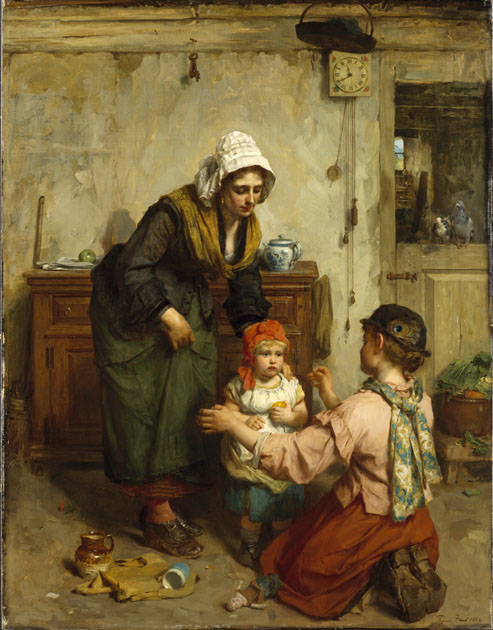
On ArtUK the painting is entitled Woman and Child by Robert Cree Crawford and is dated to about 1895 – 97.
The initial problems with researching this donor were that she was listed simply as ‘Miss Murray’ with no first name or initial given. Also, she could not be located at the address given in the Glasgow Post Office Directories spanning the years 1944 to 1949.
However, in March 2014, a distant relative of the artist visited the Glasgow Museums Resource Centre (GMRC) to view the painting. She was able to identify the child in the painting as Helen, youngest daughter of the artist Robert Cree Crawford. 2 It then seemed possible that ‘Miss Murray’ might be the woman in the picture – the child`s nurse/governess. On checking the 1891 Census 3 there was listed at 46 St. James Street, Hillhead, along with the Crawford family, an ‘Ellen Murray’ who was single, aged 23 and employed by the family as a nurse. She had been born in England. There was no Helen Crawford but there were six children under the age of eleven, one of whom was deaf, so it would have been appropriate to employ a governess.
By 1901, the family had moved to 12 Derby Crescent, Kelvinside and in the census of that year 4 there appears, ‘Helen Murray, governess, single, aged 31’ in the Crawford household. There is also a Helen C(harlotte) Crawford, daughter of Robert and born in 1892.
So, assuming the child in the painting is Helen Charlotte aged about five, the painting must have been completed about 1897 when Helen Murray would have been about 28 and a ‘governess’.
By the time the picture was painted Helen would have been with the family for ten years. Perhaps it was a birthday/anniversary present? In his will, Robert Cree Crawford left everything to his wife but there is no mention of this painting. 5 It is also a possibility that Helen Charlotte was named after a favourite nurse/governess as there seemed to be no other ‘Helens’ in the family. If this is so it shows that Helen Murray was held in high regard by the family.
Helen Murray was christened on 11 March 1868 in Everton, Liverpool. 6 Her father, David Murray was a joiner from Canonbie in Dumfries who had married Mary Beattie in Canonbie on 29 August 1862. 7 The couple and their eldest daughter, Jane moved to Liverpool around 1865 and lived there for about the next ten years. In the 1871 census 8 they were at Toxteth Park, Liverpool, and ‘Ellen’, aged 3, now had a brother Robert. By 1881 they had moved back to Scotland to Carrutherstown Village, Dalton, Dumfries. 9 Helen was now thirteen and a ‘scholar’. She had, in addition to Jane and Robert, two younger siblings, George and Mary. Ten years later, Helen, aged 23, was employed by Robert Cree Crawford as a ‘domestic servant, nurse’ and was living with the Crawford family at 46 St. James Street, Hillhead. 10 The donated painting was completed about 1897. By 1901 the family had moved to 12 Derby Crescent, Kelvinside and in the census of that year Helen`s occupation is ‘governess’, aged 31. 11
Robert Cree Crawford married his first cousin, Sophia Jean Cree. His ‘in-laws’ (or uncle and aunt) lived at ‘Woodneuk’, Rahane near Garelochhead. His father-in-law (uncle) died in 1894 and his mother-in-law (aunt) in 1903. 12 Sometime after this the Crawford family moved to Rahane, and Helen went with them. In the census of 1911 for ‘Woodneuk’ she is described as a ‘lady help’ aged 42.13 However, the family must have kept the house at 12 Derby Crescent as this was described as his usual address when Robert Cree Crawford died in 1924.
Sophia Jean Crawford died intestate in 1929 at ‘Woodneuk’ leaving £3123, 5s 5p. Her two daughters Sophia Cree Crawford and Helen Charlotte Crawford were granted confirmation, and both gave their address as Woodneuk, Rahane. 14, 15 The following year Helen Murray was in residence at 15 Belhaven Terrace, Glasgow 16. She was now 62 and had been employed by the Crawford family for over 40 years. She presented the painting to Glasgow in 1946 when she was 78.
Helen Murray died at 2 Lorraine Road, Glasgow – a nursing home – on 8 March 1959. She was 91. Her usual address was still 15 Belhaven Terrace. 17
MURRAY – At a nursing home, Glasgow on 8th March, 1959, Helen Murray, 15,
Belhaven Terrace, Glasgow, W2 – Funeral tomorrow (Wednesday) at 12.10 p.m. from Messrs Wylie & Lochhead, Ltd., 31, Bath Street to Glasgow crematorium, Maryhill arriving at 12.30 p.m.; friends desirous of attending phone …..; no flowers or letters please. 18
Helen Charlotte Crawford died, unmarried, in 1979 at Callender. She was 87.19
References
Catalogue of Donations to Glasgow, Glasgow Museums Resource Centre (GMRC)
Information in the Object File at GMRC
Scotland`s People, Census 1891
Scotland’s people, Census 1901
Scotland`s People, Wills and Testaments, Robert Cree Crawford,
Births and Christening Records, Old Parish Registers, Family Search, England
Scotland’s People, Marriage Certificate
Ancestry.co.uk, Census, England, 1871
Scotland’s People, Census, 1881
Scotland’s People, Census, 1891
Scotland’s People, Census, 1901
Scotland’s People, Death Certificates
Scotland’s People, Census, 1911
Scotland`s People, Death Certificate
Confirmations and Inventories, Mitchell Library, Glasgow
In 1930 a portrait of John Thomas Alston of Moore Park (1780–1857) by John Graham Gilbert (1794-1866) was gifted to Kelvingrove Gallery by Mrs. Stella Alston. John Thomas Alston had been Provost of the City of Glasgow between 1820 and 1822. A copy of the painting is depicted below.
Our donor Stella Alston was born at 3 De Vere Gardens, London in 1881. Her parents were Mr Charles Parbury and Mrs Annie Parbury from Australia. [1]
Mr Parbury was an Australian merchant, who traded between India and Australia. However, they lived most of their time in London. Stella was one of nine children and she was brought up in London’s De Vere Gardens, one of the very fashionable areas of London where many artists and writers lived. Some of those notable residents were writer Henry James, poet Robert Browning and H. Kempton Dyson (1880–1944), English structural engineer, civil engineer, architect, editor and author. [2]
On 16 July 1903 our donor Stella Parbury married Mervyn Campbell Stephen who was also from Australia and whose grandfather was the famous member of the Australian Legislature Sir Alfred Stephen (1802-94). [3]
Mervyn Campbell Stephen had studied law at Trinity College, Cambridge and had become a barrister. Their daughter Sheila Annie was born on 28 November 1904. The Stephen Family, then sometime in between 1905 and 1911, had moved to Eastbourne as the 1911 English Census records that their residence was 15 Jevington Gardens, Eastbourne. However, Mr. Mervyn Campbell Stephen died suddenly on 20 October 1912, at the young age of 36, leaving Stella a widow and mother of a young child. [4]
Later in 1914 Stella married again. [5] Her husband was Mr. George Alston whose previous wife Mary Charlotte Thompson had died in 1912.
George Alston’s father was a tea planter in Ceylon (present day Sri Lanka). The tea plantation in Ceylon was called Craighead, which was the name of the Alston family home in Scotland. [6] George Alston was a relative of John Thomas Alston, the Lord Provost of Glasgow and the subject of our painting.
After researching his genealogy, it was discovered that John Thomas Alston was, in fact, the grand uncle of Stella’s husband George Alston (i.e. brother of his grandfather). [7] John Thomas Alston was born in Glasgow, one of six children of John Alston (1743–1818), a bank cashier with the Thistle Bank, and his wife, Patrick Craigie (sic).The family later lived at 56 Virginia Street, Glasgow.John Thomas moved to separate lodgings at Clyde Street in 1818. In 1820 he succeeded Henry Monteith as Lord Provost of Glasgow. He then bought Moore Park, a simple Georgian villa by David Hamilton in the Broomloan district of Glasgow. The house was photographed in 1870 by Thomas Annan just prior to its demolition for railway improvements in the city. After that he was known as John Thomas Alston of Moore Park. [8]
Returning to our donor’s life, Stella and George Alston, after their marriage, lived in Newbury, Berkshire, England. However, later they moved to Duns in Berwickshire, Scotland where they lived together in Nesbit House until George’s death on 5 June 1930. [9]
Stella’s daughter, Sheila Annie Stephen, after her first marriage to Mervyn Campbell Stephen, married Sir David George Home of Blackadder on 5 January 1933. [10] He had been born on 21 January 1904. His father was Sir John Home of Blackadder, 12th Baronet, and his mother was the Hon. Gwendolina Hyacinth Roma Mostyn.
Sir David George Home was educated at Harrow School, Harrow, London and graduated from Jesus College, Cambridge University in 1925 with a Bachelor of Arts BA. He succeeded as the 13th Baronet Home, of Blackadder, on 19 October 1938. [11] He fought in the Second World War and gained the rank of Temporary Major in the Argyll & Sutherland Highlanders. He was admitted to the Royal Company of Archers and was the director of Edinburgh & Dundee Investment. Sir David and Sheila Annie had four children. [12]
After her husband’s death in 1930, Stella Alston returned to England and lived in London. She died there on 3 May 1970 and her death notice was in The Times of 6 May 1970. She was widowed twice before she was fifty and had seen two world wars.
Our donor’s son-in-law Sir David Home died on 17 January 1992 and his wife, Sheila Annie, soon after on 16 May 1992. They are both buried in the Grange Cemetery Edinburgh. [13]
References
[1] London, England, Church of England Births and Baptisms, 1813-1920 Kensington and Chelsea St Stephen, Kensington 1847-19011891 English Census.
On 17 May 1947 Mrs. Houstoun, through her solicitors, donated to Glasgow Museums two oil paintings by the artist Robert Harvie. The subjects were Lord Provost Arthur Connell of Glasgow (1772-1774) and his wife Magdalen.
Note: to avoid confusion Mrs Houstoun and her birth name Anne Douglas Stirling will always be in bold.
These notes discuss her and her husband’s family background, and hopefully, will show how these paintings came into her possession.
Both she and her husband came from long established landed and titled families whose histories can be traced back to, at least, the sixteenth century. She descended from the Stirlings* of Drumpellier through her father and also from the Kippendavie branch through her mother, he from the Lairds of Johnstone. She was not the only daughter of the Stirling family who married a Houstoun, but more of that later.
*Spelling of this surname can also be Sterling.
The Drumpellier Stirlings.
The Drumpellier Stirling’s ancestor appears to have been Robert Stirling (d.1537) of Bankeyr and Lettyr. A further seven generations between 1537 and 1777 inherited these estates, [1] this line producing a number of notable individuals including a Lord Provost of Glasgow, John Stirling (1728-1730), who when a Baillie in 1725 was arrested along with other magistrates and the Lord Provost because of the Shawfield riot in Glasgow caused by the imposition of a malt tax, [2] and Walter Stirling, his nephew, (1723-1791) who, on his death in 1791, bequeathed his house in Miller Street, his books, and £1,000 to establish Stirling’s Library, the first free public library in Scotland.[3]
John Stirling’s son William was born in Glasgow on 29 July 1717. [4] He was a Glasgow merchant, founding the cloth printing company of William Stirling and Sons c.1750, being the first to import Indian cotton printed in London, to Glasgow.[5] By the mid nineteenth century it was the largest of its kind in Scotland.[6] He married Mary Buchanan in 1747,[7] the daughter of Andrew Buchanan of Drumpellier.[8] The Drumpellier estate came into the Stirling’s hands when William’s son Andrew bought it from his mother’s brother James Buchanan in 1777 when the American War of Independence ruined the Buchanan business (Buchanan Hastie and Co.) in the American colonies.[9]
Andrew was born on 14 February 1751 in Glasgow.[10] He attended the Grammar School of Glasgow between 1760 and 1764.[11] On 26 May 1778 he married Anna Stirling, daughter of Sir Walter Stirling of Faskine and Dorothy Willing (born in Philadelphia in 1735)[12], in St. George the Martyr, Queen Square, Camden.[13] According to the record of marriage Andrew was already living in the parish.
He and Anna had sixteen children, eight boys and eight girls born between 1779 and 1798. His sons included an admiral of the Royal Navy who became the first Governor of Western Australia.[14]
Initially he was a partner in the family business William Stirling and Sons, however in 1792 he left the partnership having set up his own commission house, Stirling, Hunter and Co. in London.[15] The venture was successful for a while however in 1808 he ran into financial difficulties and sold Drumpellier back to the Buchanan family.[16] He and his brother John were also shareholders in the company building the Monkland Canal. Initially James Watt had been involved in supervising the necessary work however it was not completed as planned and the company ran out of money.
In 1782 the company was auctioned off and with others the brothers bought it, the Stirlings owning just under 50%. By 1789 Andrew owned over two thirds. From that date, and as a result of his energy and foresight, the canal was extended eastwards to Calderbank and westwards to Port Dundas.[17] He was also a significant user of the canal, exporting coal mined from his land and bringing in dung and lime by return to support his agricultural activity.[18]
Andrew died at Pirbright Lodge in Surrey and was buried in St. Michaels and All Angels Churchyard in Pirbright on the 5th April 1823.[19] Anna also died at Pirbright and was buried on 11 June 1830.[20]
His fourth son was Charles Stirling, whose granddaughter Anne Douglas Stirling, the donor of the paintings, was in due course to marry into the Houstoun family. He was born on 16 June 1788 at Drumpellier,[21] and educated at Westminster School [22]. He married his cousin Charlotte Dorothea Stirling, the daughter of Admiral Charles Stirling of Woburn in Surrey[23] in 1827. [24] They had seven children the third of whom was General Sir William Stirling. In 1835 Charles bought the estate of Muiravonside in Stirlingshire and developed the agriculture of the estate.[25] In 1826 he was also a partner in the Thistle Bank.[26] He died at Muiravonside House on the 25th August 1867 from heart disease.[27]
Charles’s son William was born on the 4th August 1835.[28] He attended Edinburgh Academy and then the Royal Military Academy at Woolwich.[29] He was appointed to Woolwich in November 1849, age 14 years and three months, passing his probationary examination in December 1850. He progressed through the Academy satisfactorily finally being promoted second lieutenant in the Royal Artillery on 22 June 1853.[30]
He married twice, his first wife being Anne Douglas Sylvester Stirling whom he married in 1864.[31] Her father was Sylvester Douglas Stirling of Glenbervie, and of the Kippendavie Stirling family.[32]
The Kippendavie Stirlings.
The Kippendavie branch of the family was established in 1594 when Archibald Stirling was given the estate of Kippendavie by his father, Sir Archibald Stirling of Keir and Cadder.[33] From this branch of the family came a number of individuals who, along with their Keir cousins were heavily involved in the sugar trade in the West Indies. Patrick and John Stirling, great, great grandsons of Archibald Stirling,[34] in turn, owned a sugar plantation in Jamaica called Content. Patrick had succeeded his father to Kippendavie and lived in Jamaica from about 1753 where he managed the plantation. He died however with no heirs in 1775 and is buried there, his brother John succeeding him to Kippendavie and Content.[35]
John, the father of Sylvester Douglas Stirling,[36] became a senior partner in Stirling Gordon & Co. This company was formed c.1750 by Arthur Connell and James Somervill and was known as Somervill Connell & Co. In 1780, five years after Connell died, it became Somervill Gordon & Co, finally in 1795, Stirling Gordon & Co.[37] It’s clear therefore that there was a business connection between Arthur Connell and the Stirlings of Kippendavie. Later that connection was strengthened through a marriage between the two families.
Between 1835 and 1837 the partners of Stirling Gordon & Co., (including two other sons of John Stirling, Charles and William) were awarded £15,616 as compensation for the loss of their slave labour when slavery was abolished in 1833. The company had four estates or plantations, including Content, with a total of 665 enslaved individuals.[38] At current values the amount awarded would be worth between £1.4m and £57m dependant on the measure used.[39]
Sylvester Douglas Stirling married Anne Craigie Connell in 1830.[40] She was the daughter of David Connell, the son of Arthur and Magdalen Connell, born in 1759. [41] He died in 1819, his death registration stating that he was buried in “Provost Connell’s lair”.[42] This marriage is the means by which the Connell paintings came into the possession of the Stirlings and ultimately Anne Douglas Stirling.
Sir William and Anne Douglas had two children the eldest of whom was Anne Douglas Stirling, born in Edinburgh in 1865. [43] She was in due course the sole executor and beneficiary of her maternal grandmother’s (Anne Craigie Connell) estate when she died in 1899, which I believe brought the Connell paintings into her ownership.[44] Further evidence of the Stirling/Connell familial ties is given by the 1901 census where Anne Douglas Stirling is registered as living (not visiting) with her cousin Arthur K Connell in Brockenhurst, Hampshire.[45]
Sir William’s military career spanned 52 years during which he saw action in the Crimea, India, China and Afghanistan.[46] Following the Afghan campaign in 1879 he was awarded Companion of the Order of the Bath (CB),[47] and in 1893, whilst Governor and Commandant of the Royal Military Academy he was made a Knight Commander of the Order, (KCB).[48]
He became Lieutenant of the Tower of London in 1900,[49] retiring from that position and the army on half pay in 1902.[50] He died on the 11th April 1906 at Ochiltree, Folkstone[51] and is buried in Cheriton Road Cemetery, Folkstone.[52]
The Houstouns of Johnstone.
Anne Douglas Stirling married the sixth Laird of Johnstone George Ludovic Houstoun at St Peter’s, Eaton Square, London on 10 November 1903.[53] His family ancestry can be traced back to Sir Ludovic Houstoun of that ilk, whose great-great-great grandfather, Sir Peter Houstoun was killed at Flodden. Sir Ludovic had two sons, the eldest and heir being Patrick, who was created a baronet in 1668. His second son was George, who became the first Laird of Johnstone.[54] It is from George that Anne Douglas Stirling’s husband is descended.
The fourth Laird of Johnstone was another George Houstoun who succeeded his father Ludovic who had succeeded his father, also Ludovic.[55] He was born on the 8th September 1744, his mother being Jane Rankine.[56] He succeeded his father at the age of 14 in 1757 and in 1779 he married Mary McDowall,[57] daughter of William McDowall, M.P. of Garthland. They had two sons, Ludovic and William born in 1780 and 1781 respectively.[58]
During his time as Laird, George extended Johnstone Castle, was involved in coal mining at Quarrelton, had lime works at Floor Craig and cotton mills on his estate.[59] He was also a founding partner of the Paisley Union Bank in 1788 along with nine others.[60] In 1838 the bank was taken over by the Union Bank of Scotland.[61] He died on the 31st December 1815[62] and was succeeded by his son Ludovic. He left estate valued at £29,750, in economic power terms worth over £155 million today.[63]
Ludovic married Ann Stirling, daughter of John Stirling of Kippendavie and Kippenross in 1809.[64] They had one son, another George, more of which later. He carried on with the businesses his father had established and in the 1861 census, when he was 80 years old it was recorded that he farmed 120 acres, employed 55 miners and 12 labourers in his coal works, 14 miners, 14 labourers, 2 joiners and 2 blacksmiths in the lime works and in his three mills 156 males and 276 females. Clearly a major employer in the area.[65]
He was a J.P. for the Abbey Parish in Johnstone and in 1831 he was appointed Deputy Lieutenant of Renfrewshire.[66]
His wife Ann’s sister Jane Stirling was a pupil of the pianist Frederic Chopin. She had met him around 1827 in Paris, which she visited annually with another sister Kathrine. She became a close friend of the pianist and in 1844 he dedicated his two Nocturnes Opus 55 to her. In 1848 she and Katherine were instrumental in bringing him to London for a series of concerts. He was subsequently invited to Scotland arriving in Edinburgh in early August, eventually staying in Johnstone Castle as a guest of the Houstoun’s for a couple of days in September.[67]
Ludovic and Ann’s son George was born on 31 July 1810.[68] He attended Eton[69] and in 1828 matriculated at Christ Church, Oxford.[70] He was an officer in the Renfrew Yeomanry Cavalry and in 1831 was commissioned as Captain[71]. He was a Conservative candidate in the Parliamentary elections in 1835 for the County of Renfrew but lost by 68 votes to Sir Michael Shaw Stewart. Sir Michael died early in 1837 and George won the subsequent by-election by 170 votes. Later that year there was a general election and he again won the seat. He remained an MP until 1841 when he decided not to stand again in the coming election.
George was the heir apparent to the Lairdship, however in 1843 he collapsed and died whilst on a shoot at Invercauld in Aberdeenshire.[72] In the transept of Paisley Abbey there is a plain stone tablet, executed by Mossman, over his grave surmounted by a sand glass which is inscribed “George Houstoun, only child of Ludovic Houston and Ann Stirling of Kippendavie – born 31st July 1810, died 14th September 1843.”[73]
In addition to his personal business activity Ludovic, as might be expected, was involved in a number of enterprises at various times. He was a director of the West of Scotland, Fire Insurance Company, a director of the Johnstone Coffee and News Room, within the Black Bull Inn, on the management committee of the Glasgow, Paisley and Ardrossan Canal and a founder member of the Flax Growers Society of Scotland.[74] He died on the 3rd October 1862 at Johnstone Castle.[75]
As he had no surviving offspring and as his brother William had died in 1856[76], his nephew George Ludovic Houstoun became the sixth and last Laird of Johnstone.
William had married Marion Douglas Russell in 1845 at Gargunnock.[77] Her mother was yet another Stirling, Mary Stirling, daughter of John Stirling of Kippendavie and sister of Ludovic’s wife Ann.[78] William was 64 years old at the time of the marriage which was probably prompted by the death of his nephew George in 1843. With no prospect apparently of his brother Ludovic and his wife having more children he was the only option for the continuation of the title. Sadly it was doomed to fail.
His bride, his niece, was c. 23 and they had four children, George Ludovic, born on the 15th October 1846,[79] William James b. 1848[80] Mary Erskine b. 1850 [81] and Ann Margaret b. 1852.[82] In 1851 the family was living in Cartside House in Johnstone, William described as a cotton spinner employing 532 men and women in his mills and a JP.[83]
The Last Laird.
George Ludovic Houstoun entered Rugby School on the 31st August 1860. His house was ‘Mayor’ so named after the house master R.B. Mayor. He remained there until 1863,[84] having become Laird the previous October at the age of 16 on the death of his uncle. He matriculated at Queens College, Cambridge in 1866, in due course graduating MA.[85]
He joined the Renfrewshire Militia also in 1866 as a lieutenant, retaining a military connection until c. 1911 when he joined the Veteran Reserve (Territorial Force Association of Renfrew) having attained the rank of Lieutenant Colonel and being associated with the 4th Argyll and Sutherland Highlanders.[86] He was appointed a Deputy Lieutenant of the County of Renfrewshire in 1873, relinquishing the role in 1922.
He also appears to have had significant political connections and may also have been involved with the Colonial Office between 1877 and c.1900. His papers are lodged in the Mitchell Library in Glasgow and contain a wealth of information in respect of his activities in South Africa and his interest in Cyprus where he had an estate near Kyrenia in Northern Cyprus.[87]
It seems he spent some time in South Africa being appointed in 1877 Commissioner for the District of Rustenberg in the Transvaal and as a Justice of the Peace. He was present in Somboti, Swaziland, in 1895, witnessing the King’s signature on a letter to Queen Victoria and in 1900 he was in Bulawayo where he received a letter from Arthur Balfour who corresponded with him often, as did other political figures. He also exchanged letters with General Gordon of Khartoum and also with the writer H. Rider Haggard between 1889 and 1891.[88]
The information in the preceding three paragraphs comes from the Houstoun Family of Johnstone papers in the Glasgow City Archives held in the Mitchell Library. The papers, contained in three boxes, are extensive and date from 1630 to 1912, reference TD263.
In the censuses of 1891[89] and 1901[90] he is recorded as staying with his sisters Mary and Ann at Johnstone Castle living on his own means, his brother William James having died in 1866.[91] It may therefore be that his involvement in colonial affairs was sporadic and informal however, in terms of his correspondence, he exchanged information and comments on a number of subjects dealing with the British presence in Africa.
When he married Anne Douglas Stirling in 1903 she brought to the marriage a significant ‘fortune’ having some £13,000 of her own money and the expectation of an inheritance from her mother’s trust fund when her father died, as per her parent’s Marriage Settlement in 1864, and also from him.[92]
They lived for a period at Johnstone Castle until c.1912 when they moved permanently to their estate in Kyrenia, apparently due to Lloyd George’s Land Tax reforms which had begun in 1909.[93]
He had been interested in establishing a Scottish Episcopalian Church in Kyrenia for some time having between 1887 and 1891 began to seek financial support from wealthy friends with the aim of raising £1,000 to do so.[94] He seems to have had a good response, whether he reached his target however is not clear. No action seems to have been taken until 1912 when St Andrews Episcopalian Church was built, the land being donated by Houstoun and the church being built by Mr. and Mrs. Ernest Eldred McDonald, he being the District Commissioner for Kyrenia.[95]
Houstoun was also involved in founding the local hospital and along with a number of other philanthropic activities, trying to improve local farming. In support of this he also established an Agricultural Show.[96]
The Church is still in existence and appears to be very active. Its current vicar is the Reverend Wendy Hough.[97]
He died in Kyrenia in 1931[98], his wife surviving him until 1950,[99] also dying in Kyrenia. They are both buried in the small Houstoun Cemetery there.[100]
Their marriage was childless and as his two sisters Mary Erskine and Ann Margaret died unmarried, Mary in Cannes in 1904[101] and Ann in Edinburgh in 1925[102], the Houstoun line begun by George Houstoun in the mid-1600s ended.
[2] Smith, John Guthrie and Mitchell, John Oswald. (1878). The Old Country Houses of the Old Glasgow Gentry. 2nd ed. ‘Drumpellier’ .Glasgow: James Maclehose and Sons. http://gdl.cdlr.strath.ac.uk/smihou/smihou036.htm
[13] Marriages. (PR) England. Bloomsbury, London. 26 May 1778. STERLING, Andrew and STIRLING, Ann. Collection: London, England, Church of England Marriages and Banns, 1754-1931. http://ancestry.co.uk
[19] Burials (PR) England. Pirbright, Surrey. 5 April 1823. STIRLING, Andrew. Collection: Surrey, England, Church of England Burials, 1813-1987. Reference Number PI/4/1. http://ancestry.co.uk
[20] Burials (PR) England. Pirbright, Surrey. 11 June 1830. STIRLING, Anna. Collection: London, England, Church of England Deaths and Burials, 1813-2003 http://ancestry.co.uk
[21] Births (OPR) Scotland. Old Monkland or Coatbridge. 16 June 1788. STIRLING, Charles. 652/ 10 263
[24] Marriages (PR) England. Pirbright, Surrey. 1 May 1827. STIRLING, Charles and STIRLING, Charlotte Dorothea. Collection: Surrey, England, Church of England Marriages, reference PI/2/2/2. http://ancestry.co.uk
[31] Marriages (PR) England. Westminster, London. 2 June 1864 STIRLING, William and STIRLING, Anne Douglas. Collection: England, Select Marriages, 1538–1973. FHL Film number 1042324.http://ancestry.co.uk
[40] Marriages (OPR) Scotland. Abbey. 7 September 1830. STIRLING, Sylvester Douglas and CONNELL, Anne Craigie. 559/ 80 234. http://www.scotlandspeople.gov.uk
[51] Testamentary Records. Scotland. 5 June 1906. STIRLING, General Sir William. Supplementary Inventory. Edinburgh Sheriff Court. SC70/1/457. http://www.scotlandspeople.gov.uk
[53] Marriage Announcements (1903) The Scotsman 12 November. HOUSTOUN, George Ludovic and STIRLING, Anne Douglas. p. 10h. Collection: Scotsman Digital Archive 1817 – 1950. https://auth.nls.uk
[54] Burke, John and Burke, John Bernard. (1844). A Genealogical and Heraldic History of the Extinct and Dormant Baronetcies of England, Ireland and Scotland. 2 ed. London: John Russell Smith. p. 627. https://books.google.co.uk
[92] Houstoun Family of Johnstone Papers. Glasgow City Archives: Mitchell Library TD263.
[93] Death Announcements. (1931). the Scotsman. 5 September. HOUSTOUN, George Ludovic. p. 15b. Collection: Scotsman Digital Archive 1817 – 1950. https://auth.nls.uk
[94] Houstoun Family of Johnstone Papers. Glasgow City Archives: Mitchell Library reference TD263.
[95] Collins, P.C. (1988) A Short History of St. Andrew’s English Church, Kyrenia, Cyprus: 1913 – 1988.
[98] Testamentary Records. Scotland. 16 March 1932. HOUSTOUN, George Ludovic. National Probate Index (Calendar of Confirmations and Inventories), 1876-1936. http://ancestry.co.uk
[99] Testamentary Records. England and Wales. 21 October 1950. STIRLING, Anne Douglas. National Probate Calendar (Index of Wills and Administrations), 1858-1966. http://ancestry.co.uk
[101] Testamentary Records. Scotland. 16 June 1904. HOUSTOUN, Mary Erskine. Paisley Sheriff Court Wills. SC58/45/13 and SC58/ 42/64. http://www.scotlandspeople.gov.uk
In 1886 Janet Aitchison gifted a portrait of her father to Glasgow. Painted by Sir Daniel McNee, a renowned Scottish portrait painter who became president of the Royal Scottish Academy in 1876, it depicts John Aitchison as a confident, successful businessman.
The painting was exhibited at The Glasgow Institute of Fine Arts exhibition of 1894 and lent by The Corporation of Glasgow.(1)
In 1868 the painting was exhibited in The Illustrated Catalogue of Exhibition of Portraits on Loan in The New Galleries of Art, Corporation Buildings, Sauchiehall Street, Glasgow and lent by Walter Paterson who was a son of John’s sister Euphemia.(2)
John was a prominent merchant in Glasgow at a time when trade with America was particularly strong. However, with the decline of the tobacco industry after the American War of Independence, the British Empire looked for other opportunities, especially in the colonies. The sugar industry expanded and by 1790 the West Indies became Glasgow’s primary trading outpost.(3) Raw sugar had to be processed to make it saleable and it was these refining processes which John helped to develop.
John was born in Glasgow on 2 September 1769 to Walter Aitchison and Isobel Henderson, who had married in 1768.(4) John was the first of seven children (5) and he lived in Glasgow for much of his life. On 14 August 1797 John married Margaret Robertson (6) whose father James was a merchant in Glasgow. Their first child Walter was born in 1798 and they went on to have a family of twelve over the following sixteen years.(7)
In 1786 aged seventeen John entered The Ship Bank as an apprentice.(8) One of the earliest banks in Glasgow, it was founded by some of the wealthiest merchants in the city, particularly those involved in the tobacco trade. In 1776 The Ship Bank became known as Moores, Carrick & Company, then in 1789 changed its name to Carrick, Brown & Company.(9) Robert Carrick was the leading partner at the time and lived above the bank. One of John’s duties, as the youngest apprentice, was to sleep in the premises at night, armed with a gun, bayonet, powder-horn and a bag of slugs and Mr Carrick would lock the door behind him to ensure security. Both Robert Carrick and John were fond of playing the violin, and they would often practise after work at Robert’s flat. Carrick was known as a bit of a miser and it is said that he left a fortune of £1 million pounds ‘…a grim old bachelor without leaving one plack or penny to any of the charitable institutions of the city….’ The two remained friends till Robert’s death in 1821.(10)
In 1796 John is recorded in the Trades House library as a Burgess and Guild Brethren of Glasgow. He is described as a merchant and serving apprentice with Messrs Moore, Carrick and Company at this time.(11) John left the Bank for the mercantile world, specialising in the processing of cane sugar which was being imported in large quantities from The West Indies. Greenock and Glasgow became major sugar refining centres and much of the machinery required was manufactured locally.
In the early nineteenth century one of the sugar-refining processes enabled impurities to be extracted, by boiling the cane sugar to form a liquid. The liquid was transferred to a series of pans until the required density was achieved. However, if the temperature was too high the liquid would turn into uncrysallizable molasses (treacle). As with many other industries in Glasgow during the Industrial Revolution improvements and efficiencies were constantly being developed. Messrs D Cook of Glasgow developed a more efficient design for evaporating sugar. A Mr Cleland of Glasgow also developed a system of using steam to quicken the evaporating process. It was John Aitchison who developed this process further by controlling the flow of liquid along a specially designed copper apparatus. The boiling action caused the impurities to rise to the surface and form a crust, which could then be easily taken off when the liquid cooled, leaving purified sugar.(12) The process was later patented.(13)
One of the few surviving sugar refining buildings in Glasgow is at 40-50 Speirs Wharf on The Forth and Clyde canal just north of Glasgow city centre, now converted to flats.
Figure 2. 40-50 Speirs Wharf, Glasgow, photo by author
In 1833, Margaret died. In a letter dated 26 July 1833 to his son Robert, who had sailed from Rothesay to Madeira, John describes Margaret’s failing health and the good care she received from their doctor. News of the death was communicated to the Captain of the ship Brig Staffa just before leaving Rothesay and the news was broken to Robert when at sea. Robert became a merchant in Burma until his death in 1838. The funeral was attended by some prominent merchants including John Buchanan of Woodlands and James Buchanan of Dowanhill. Mention is made of Robert’s brother John who applied to a Captain Johnston in London for work, presumably, like Robert, at sea. John senior also makes reference to ‘making every exertion so to get your brother into the service of The East India Company’. It is not clear which brother he refers to. John also refers to his business dealings in the sugar industry , ‘We have not done much as yet in the wee Sugar House …we expect liberty soon to refine all sorts of Foreign Sugars…struggle to get using E India sugars, it will be good bye and bye’.(14)
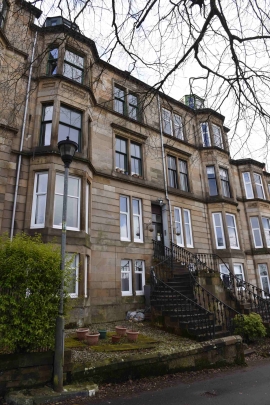
In 1837-38 John’s business address is recorded as Adam’s Court Lane, Argyll Street, and he is described as a merchant and patentee for machines for sugar refining.(15) In 1838 his business address is recorded as 14 St Enoch Square, Glasgow (replaced in 1875 by Teachers whisky offices). He lived at 52 Renfield Street, Glasgow at this time (the building was replaced by The Odeon Cinema in the nineteen thirties).(16) From 1845 to 1852 he was living at 105 Kensington Place, Sauchiehall Street.(17) By 1855 he had moved to 15 Claremont Street, just off Sauchiehall Street,(18) west of Charing Cross, where he resided till his death in 1859.(19)
Figure 3. 15 Claremont Street, Glasgow photo by author
He was buried at Ramshorn Church in Glasgow,(20) where many notable Glasgow merchants were laid to rest including Robert Carrick (21) who maintained a friendship with John throughout his life. John’s son James and daughters Euphemia and Isabella Henderson are also laid to rest there.(22)
According to the 1861 census Mary Newbigging Aitchison, John’s daughter, was living at 9 Sandyford Place, Glasgow, just across the road from John’s final home.(23) She and Janet never married and they probably lived with John to his final days.(24) The head of the household at 9 Sandyford Place was Margaret, her sister. Also noted as being present was George Bogue Carr, studying In Glasgow to be a minister of The United Free Church.(25) He was from Berwick-upon-Tweed and after a period as minister in Tranent, then Dalmeny Street Church in Edinburgh he emigrated to the USA, becoming Professor of Religious Rhetoric and English at Lincoln University. George was John Aitchison’s grandson whose mother was Jane Robertson Aitchison, John’s second daughter.(26) The Carr family and the Aitchison family were closely associated through marriage at this time.(27)
On 19 January 1943, an oil painting by James Godsell Middleton entitled Jeannie Deans and the Queen was presented by Mrs E. W. Gow, Ardchattan, 2 Wellshot Drive, Cambuslang. Its acquisition number is 2309. 1
The frame of the painting bears a tablet with the inscription ‘J. Middleton (Scottish School) Jeannie Deans and the Queen / Lent by Captain Dennistoun’.
The painting was exhibited at the Royal Academy Exhibition of 1845 by the artist whose address was 76 Newman Street, London . It carried the caption:
Jeannie Deans begging the life of her sister from Queen Caroline. “Tear followed tear down Jeannie`s cheeks as, her features glaring and quivering with emotion, she pleaded her sister`s cause etc. Heart of Midlothian”, (481). 2
The artist also exhibited the painting at the Royal Scottish Academy the following year with a shortened caption!
Jeannie Deans begging the life of her sister from Queen Caroline, vide The Heart of Midlothian (136) 3
There was no record of the donation in the Corporation Minutes.
Elizabeth Webster Waugh (later Mrs. E. W. Gow) was born on 2 June 1873 at 5 East Howard Street, Glasgow. 4 Her father, Robert Waugh, was a storekeeper who married, Elizabeth Chambers, a domestic servant, on 30 September 1870 at Hamilton Street in Motherwell. 5 Elizabeth Waugh was the second of six children of the marriage. In 1881 “Bessie” (Elizabeth) and her family were living at 115 Stirling Road, Glasgow along with four older siblings – children of Robert Waugh`s first marriage to Janet Marshall. Robert Waugh died on 6 July 1888 6 and the family moved to 9 Glebe Street, Glasgow. In 1891, Bessie, aged 17 was a ‘furniture polisher’. 7 (It may have been because of her occupation that she met her future husband Walter Gow who was a house furnisher/furniture dealer). Elizabeth`s mother died in 1892 8 and three years later, on 19 March 1895, Elizabeth, aged 21, married Walter Gow who was then 35. It was Walter`s second marriage. (He had first married Elizabeth Marquis on 29 June 1883 in Glasgow 9. At that time, he was a cabinet maker and upholsterer with an address at 73 Buccleuch Street. However, Elizabeth Marquis “formerly married to Walter Gow” re-married in 1894 10 presumably after she and Walter divorced).
The marriage to Elizabeth was ‘by declamation’ at 63, Cockburn Street, Edinburgh in the presence of Elizabeth`s sister Margaret and her brother Thomas. According to the marriage certificate Walter Gow was a bachelor whose occupation was ‘cabinet maker’. He gave his address as ‘The Grand Hotel, Charing Cross, Glasgow’. 11 (Walter Gow`s father Joseph was also a cabinet maker and had originated the family business of ‘J. Gow and Sons’, house furnishers. In 1899 the business was based at 187 (later 175) Trongate, 12).
After their marriage, Walter and Elizabeth moved to ‘Glenholm’ a large house at 31 Hamilton Drive, Cambuslang.13,14 The marriage did not produce any children. However, by 1911 Walter and Elizabeth had adopted Mosina (Ina) Mills the daughter of Elizabeth`s sister Annie and were living in Hamilton Drive along with Elizabeth`s older sister Margaret and one servant. Walter was a house furnisher and employer. 15
By 1927 Walter and Elizabeth had moved to ‘Ardchattan’, 2 Wellshot Drive, Cambuslang. The business was now based at 11 Hope Street. 16 (The name of the house would have derived from Walter`s interest in Clan or Family History. In 1898, he had been a subscriber to a book concerning the history of Clan Chattan.17 Gow is one of the minor Septs of Clan Chattan).
On 30 April 1929 Elizabeth`s niece and adopted daughter Ina, married Alexander Stephen, a fishery officer from Peterhead, in Glasgow Cathedral.18
Walter Gow died aged 76, on 26 March 1936 at 2 Wellshot Drive, Cambuslang and was buried in East Kilbride Cemetery. 19 He left an estate valued at £100,111:18s:7d.20 Elizabeth inserted “In Memoriam” notices in the Glasgow Herald each year from 1937 to 1951 (apart from 1949 and 1950) in memory of her husband.
For example, the following appeared in the ‘In Memoriam’ column of the Glasgow Herald, on 26 March 1943:
GOW. In loving memory of my beloved husband Walter Gow, J.P., who died on 26th March 1936. Inserted by Mrs Gow, “Ardchattan”, Cambuslang”
Elizabeth moved from Cambuslang to 29 Newlands Road in 1945 or 1946 and in the following year to ‘White Croft’, Barrhead. (Taken from Glasgow Herald, In Memoriam Columns.) Sometime between 1948 and 1951 she moved to ‘Glengyron’, Whitecraigs in Renfrewshire.
Elizabeth Gow died aged 78 at ‘Glengyron’, 38 Ayr Road, Whitecraigs on 21 August 1951 21. She was buried beside her husband in East Kilbride Cemetery on 24 August.22
The business of J. Gow and Sons was still operating from 11 Hope Street in 1964 23.
References
Glasgow Museums Record of Donations
Graves, Algernon, The Royal Academy of Arts; a complete dictionary of contributors and their work from its foundation in 1769 to 1904, H. Graves and Co., London, 1905.
Object File at Glasgow Museums Resource Centre
Scotland`s People, Birth Certificate
Scotland’s People, Marriage Certificate
Scotland’s People, Death Certificate
ancestry.com, Scotland Census 1891,
Scotland’s People, Death Certificate
Scotland’s People, Marriage Certificate
ibid
ibid
Glasgow Post Office Directory, 1899-1900
Cambuslang Suburban Directory, 1900/01
Glasgow Post Office Directory, 1902/03 till 1920/21
Scotland`s People, Census 1911.
Glasgow Post Office Directory 1927/8.
Fraser-Mackintosh, Charles, of Drummond, An Account of the Confederation of Clan Chattan: Its Kith and Kin; The Minor Septs of Clan Chattan. J. Mckay, Glasgow, 1898











 Glasgow Museums Art Donors Group
